Guru Loden Chokse
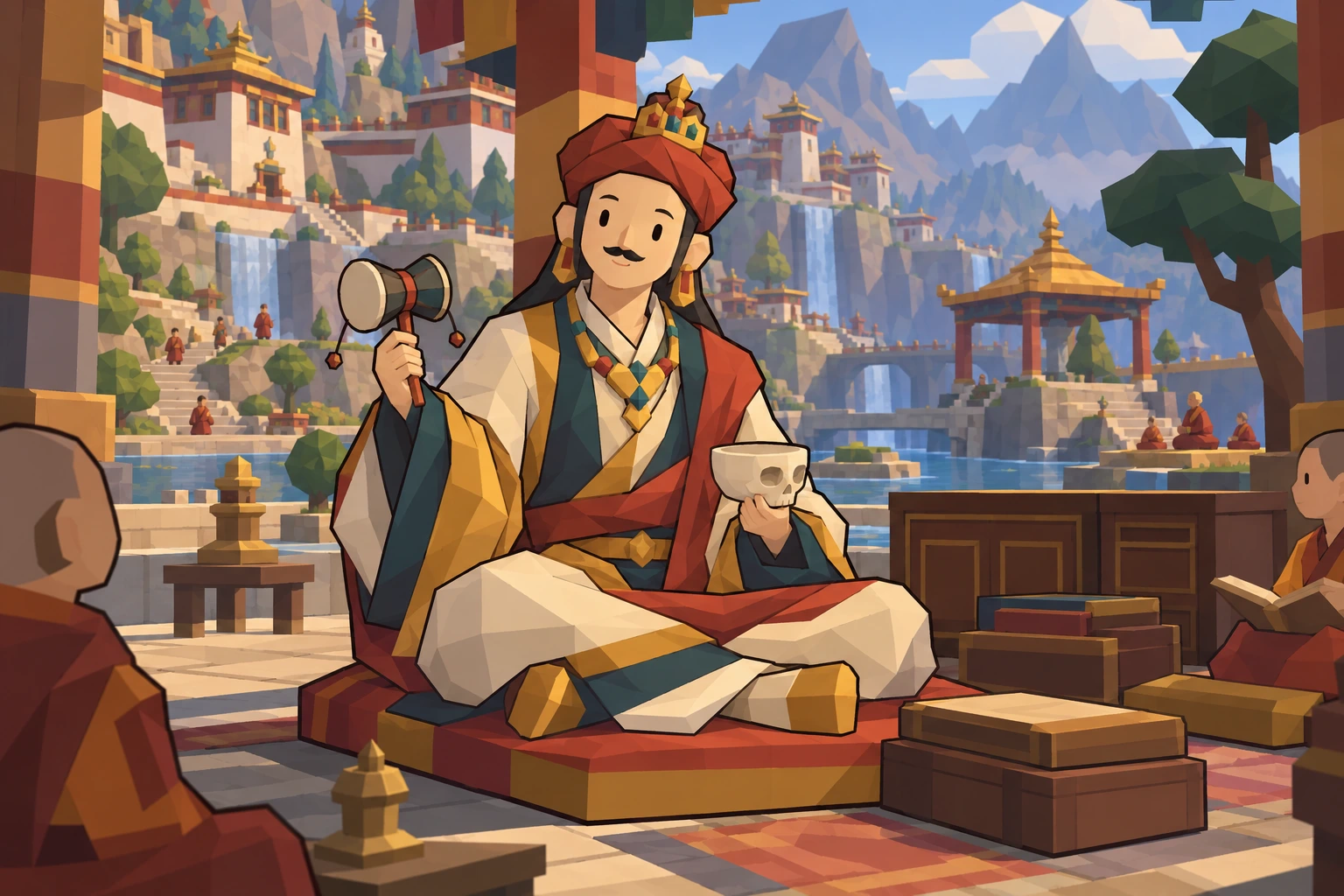
Loden Chokse, the Supreme Seeker of Knowledge, is Guru Rinpoche as a learned master. He sits pale-skinned in flowing robes of many colours, with a turban or jewelled head ornament. His right hand raises a damaru, a two-headed drum, and his left holds a skull cup.
His fine dress belongs to the learned Guru and does not make him a king. Pema Gyalpo, the Lotus King, is told apart from him by a crown and mirror. An appliqué and a painting at the Rubin differ in textiles, ornament and the way he sits.
In traditional art
These images stay with the collections that hold them. Each link opens the collection's own page.
- Loden Chokse, Rubin C2003.34.1 ↗Tibet or Bhutan · 19th century · rubinmuseum.orgMuseum photograph; no open reuse licence established. Link/reference only; museum credit is not a reuse licence.
- Loden Chokse, Rubin C2006.66.32 ↗Kham, Eastern Tibet · 19th century · rubinmuseum.orgMuseum photograph; no open reuse licence established. Link/reference only; museum credit is not a reuse licence.
Sources
- Dudjom Rinpoche: Concise Benefits of the Festival of the Tenth Day ↗
- Padmasambhava and Eight Manifestations — Rubin C2003.51.1 ↗
- Padmasambhava and Eight Forms, annotated photograph — HAR 65283 ↗
- Loden Chokse — Rubin C2003.34.1 ↗
- Loden Chokse, One of Eight Manifestations — Rubin C2006.66.32 ↗
- Loden Chokse — HAR 65254 ↗
- Padmasambhava and His Manifestations — Project Himalayan Art ↗
Depiction requirements and work notes
Guru Loden Chokse / Supreme Seeker of Knowledge
Independent Codex Item 2 review: PASS mark 3. The selected learned Guru appearance retains the figure-right raised damaru, figure-left readable cranium cup, pale seated body, wrapped headgear and broad layered robes, with concept costume and support differences explicitly retained as game adaptations.
The model capture recipe or rig source changed. Reinspect the model before relying on the recorded defects.
References, criteria, concept and model side by side
Traditional depictions

Central light-skinned learned Guru with turban-like headdress, flowing garments, right drum and left skull cup. Museum identifies this as silk applique. [guru-loden-art1] [guru-loden-har]
Object record ↗ · Source image ↗
Large central Guru: compare turban, flowing scarf/robe silhouette, raised damaru and extended cup. Surrounding lamas and dark-blue attendant are not alternate forms of the central figure. [guru-loden-art2]
Object record ↗ · Source image ↗Criteria
The model must show
- Identity: an appearance of Padmasambhava (Guru Rinpoche), not a separate Buddha or person; the learned manifestation
- Lineage variant: the white seated figure of Rubin C2003.34.1 and C2006.66.32
- Body: white or light-skinned, one face, two arms
- Hands: own right hand raises a hand drum; own left hand holds a skull cup
- Held objects: a damaru with two joined drum heads; a skull cup that reads as a cranium bowl
- Dress: turban-like headgear with jewelled ornament, flowing multicoloured lay robes
- Posture: seated
- Face: composed and peaceful, small closed mouth
- Eyes: solid black silhouettes with no whites, irises, pupils, highlights or glint (project eye rule; a recorded game adaptation, not a claim about traditional painted eyes)
- Seat: the library names none for this form; whatever seat is built is recorded as authored
- Attendants: none
The model must not show
- Cartoon smiley face: a wide U-shaped or crescent grin, open laughing mouth, rosy cheek dots or mascot cheeks
- Eye whites, irises, pupils, highlights or glint; glowing white-gold eyes (those belong only to freshly liberated beings)
- Any part of the figure (head, crown, hat, halo, raised hand or held object) touching or passing through its canopy, roof, lintel, pillars, throne back or seat in any capture angle
- Pema Gyalpo's mirror or a generic begging bowl in place of the skull cup
- A king's crown (that is Pema Gyalpo)
- The main Guru's lotus hat
- Hands or attributes mirrored to the wrong side of the figure's own body (own right appears at viewer-left in a front view)
Original game concept
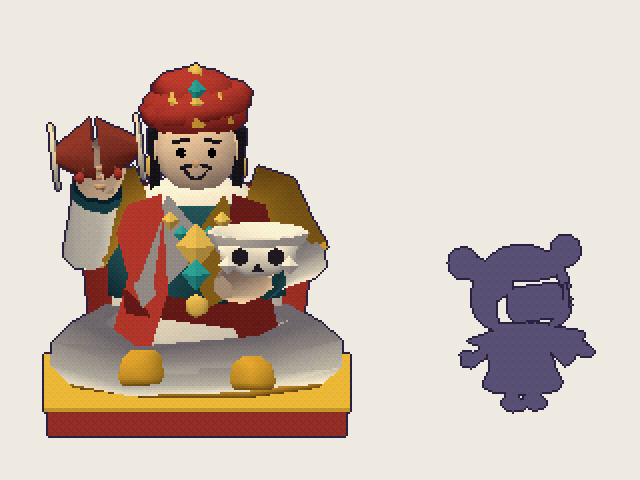
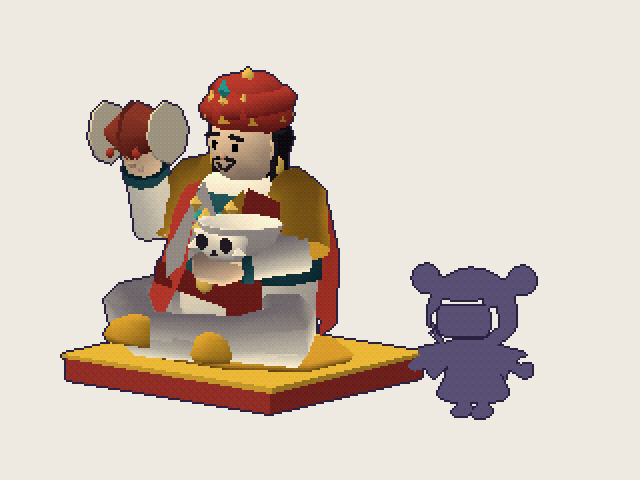
Current 3D model
presence
Depiction requirements
- Identity
- Treat elaborate appearance as the iconography of the learned Guru manifestation; do not describe him as a historical king merely because his clothes look royal. [guru-rubin-essay]
- Attribute pair
- Keep the raised damaru in figure-right and skull cup in figure-left; retain readable joined drum heads and cranium bowl. [guru-loden-art1] [guru-loden-art2] [guru-loden-har]
- Head and dress
- Follow the selected white/light-skinned seated figure with turban/jewelled head ornament and flowing multicoloured lay robes. Preserve distinction from Pema Gyalpo’s king crown/mirror. [guru-loden-art1] [guru-loden-art2]
Presentation contract
Ready to build from No readiness block is recorded in the plan.
Setting and sizing rule
No seat is named by the library. Sizing (plan rule R4, not a sourced claim): the opening of any shrine, canopy or pavilion around the figure leaves at least one of the figure's own head-heights of clear air above its tallest point (the top of the turban and the raised drum) and a clear gap on each side of its widest span (the raised drum and the cup hand); a throne back or aureole sits behind the figure without passing through it; pillars and lintel do not cross the face, hands or held objects in the front or either three-quarter capture.
Recorded variants · 1
- The applique (C2003.34.1) and the painting (C2006.66.32) differ in textiles, ornament and seated orientation
Recorded adaptations · 0
Where the plan places it · 1
- copper mountain · The band of eight forms
copper-mountain.guru-band· character Guru Loden Chokseguru-form-05
Contract sources · 4
- Padmasambhava and His Manifestations — Project Himalayan Art
- Loden Chokse — Rubin C2003.34.1
- Loden Chokse, One of Eight Manifestations — Rubin C2006.66.32
- Loden Chokse — HAR 65254
Model audit and next pass
Evidence basis: independent visual + source + fresh local Chromium/WebKit runtime
Recorded observations
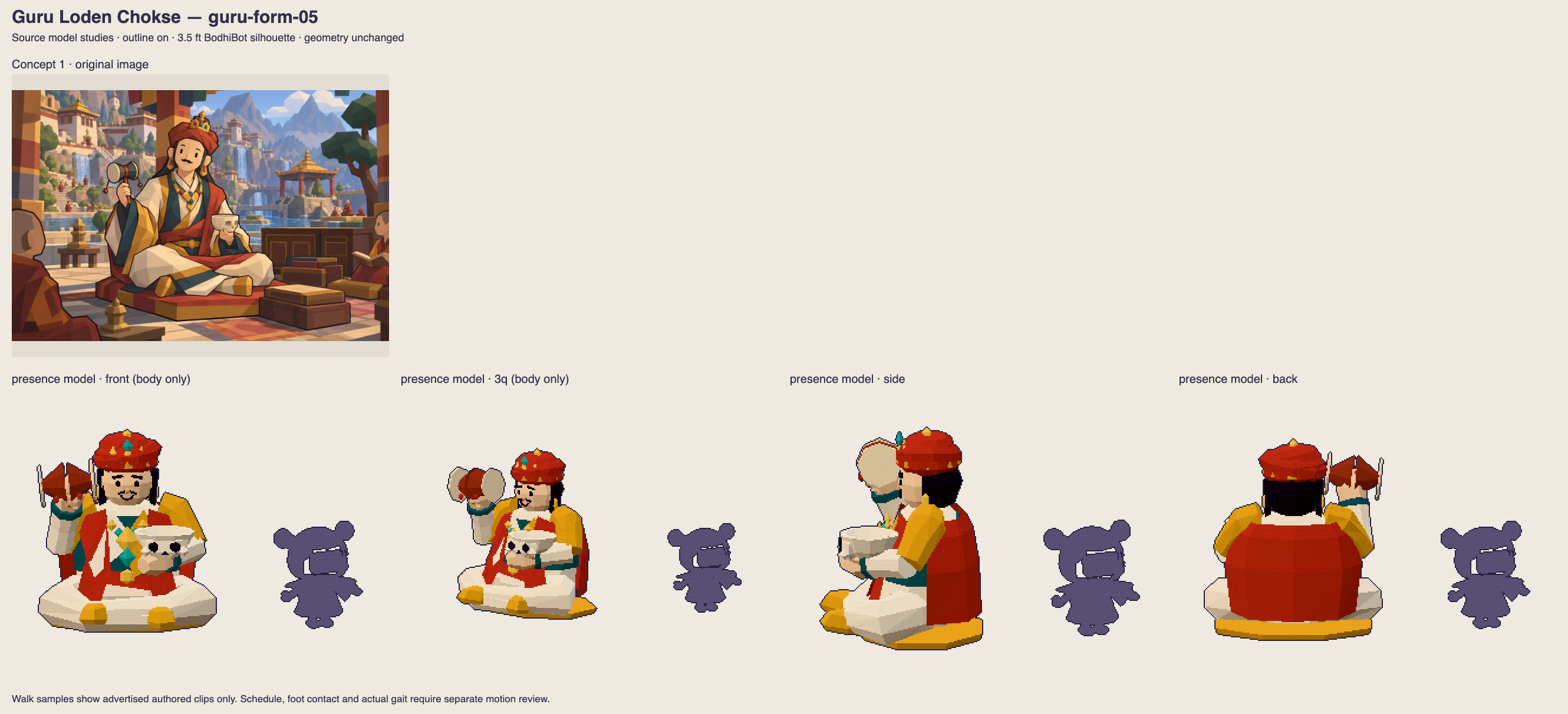
The open faceted cranium cup has a continuous thick cut rim, readable frontal sockets/nasal notch and bowl depth in side/top views; the figure-left supporting hand and thumb meet its underside and side. Figure-right fingers grip the raised damaru, whose joined heads stay readable through signature/teach extrema.
Broad inclined red turban wraps merge into the cap. Diagonal front cloth and tapering rear mantle replace the old strip stack and rear barrel; clothed knee-to-shin bends connect to broad faceted boots and the seated support.
Traditional fidelity is separate from concept fidelity: Rubin C2003.34.1 supplies the selected upright learned Guru, raised figure-right drum, figure-left skull cup and broad robe masses. Red wraps, small gold ornament, ivory trousers, teal/ochre colours, rectangular cushion, black eyes and toy proportions are recorded game adaptations. C2006.66.32 flying scarves, green lower clothing and attendant were not mixed into this appearance.
Independent source and generated-model comparison confirms one presence, correct anatomical prop sides, unchanged IDs/scale/placement/clip definitions and nine rest transforms. Solid black eyes and uncropped outlined desktop/phone presentation retained. No visible unintended intersections were found in six views or sampled action extrema; this is sampled visual evidence, not a mathematical proof of every possible surface contact.
Concept fidelity: pale moustached face, red turban, gold/teal jewellery, multicoloured robe, crossed clothed lap, boots and low cushion are retained. Broad short sleeves and compressed toy lap remain a minor concept simplification; no required rework.
PASS mark 3 for this single-character implementation. All earlier source assessments and snapshots, implementation source observation and Atlas visual review are preserved in history. No Josie approval is asserted.
Directions for a future model pass
No required iconographic rework for this selected appearance. Preserve the documented game adaptations and keep the C2006.66.32 variant separate.
Assessed baseline captures
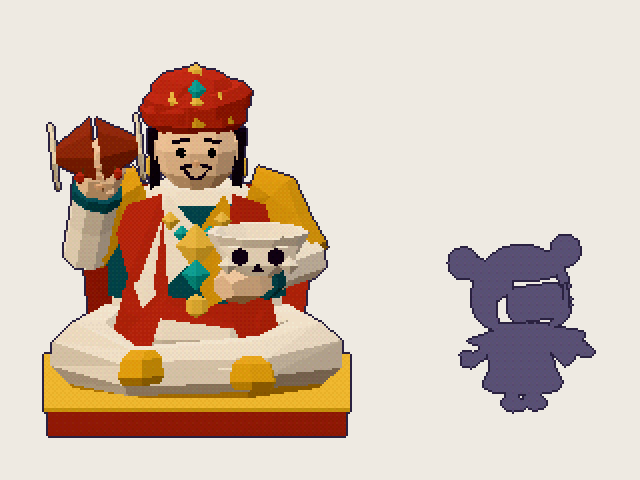
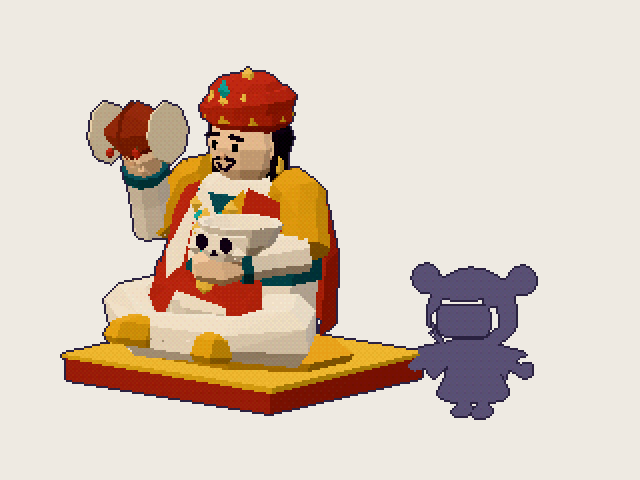
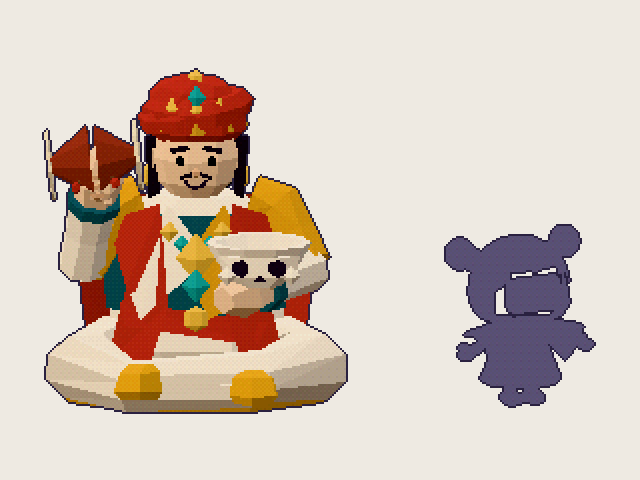
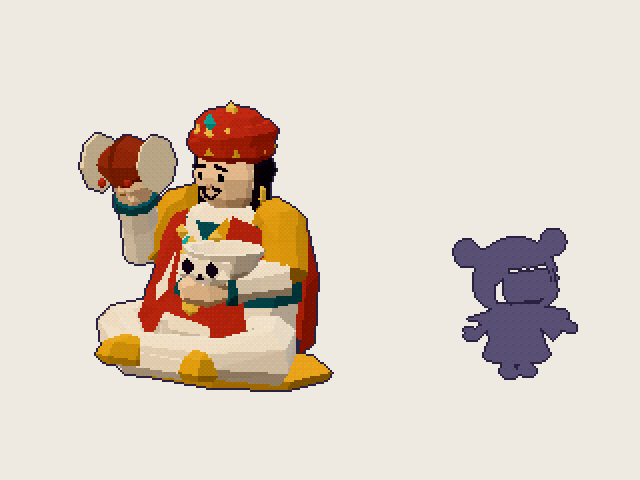
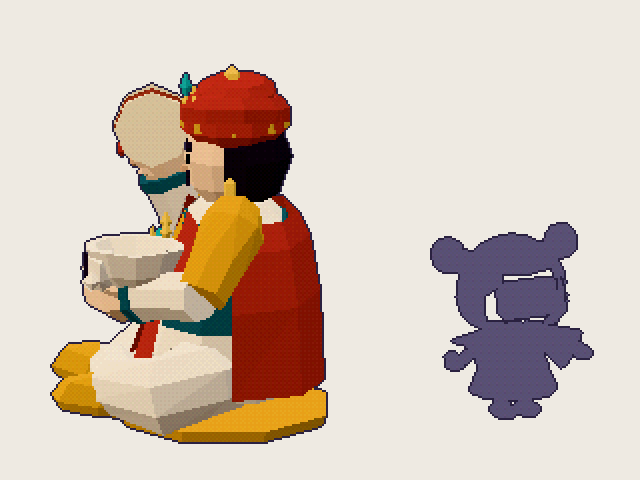
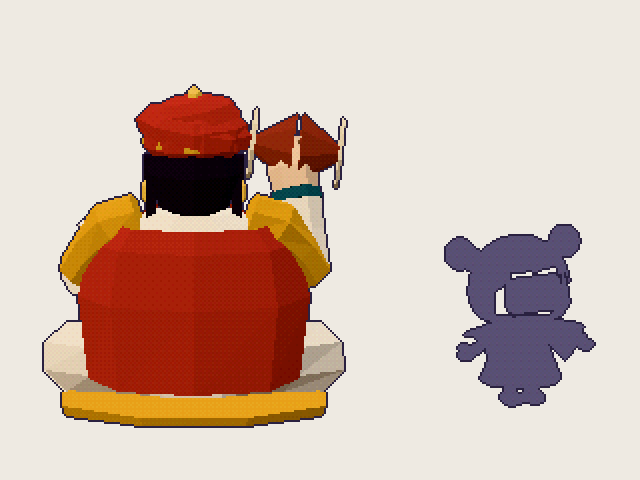
Documented forms and lineage variants · 1
Preserve one identified form consistently. A variant is usable only with its own source and context.
The applique and painted example differ in textiles, ornament and seated orientation. These are real variants, not reasons to combine all decoration.
What not to copy · 2
Do not replace the cup with Pema Gyalpo’s mirror or generic begging bowl.
Do not turn him into the main lotus-hat Guru simply to share geometry.
Sources and precise locations · 7
- [guru-dudjom] Dudjom Rinpoche: Concise Benefits of the Festival of the Tenth Day ↗
- [guru-group] Padmasambhava and Eight Manifestations — Rubin C2003.51.1 ↗
- [guru-group-labels] Padmasambhava and Eight Forms, annotated photograph — HAR 65283 ↗
- [guru-loden-art1] Loden Chokse — Rubin C2003.34.1 ↗
- [guru-loden-art2] Loden Chokse, One of Eight Manifestations — Rubin C2006.66.32 ↗
- [guru-loden-har] Loden Chokse — HAR 65254 ↗
- [guru-rubin-essay] Padmasambhava and His Manifestations — Project Himalayan Art ↗
Assessment freshness and evidence hashes
The frozen snapshot is authored evidence. Regeneration computes current hashes and leaves that snapshot as it is.
{
  "auditFreshness": {
    "status": "stale",
    "reasons": [
      "The model capture recipe or rig source changed."
    ]
  },
  "sourceSnapshot": {
    "captureHash": "05b3fc24583873e01268bc1ed0738a81ac6e2216938087dc7edeeeb68b58d153",
    "bodyGeometryHash": "065e7414d094f40d5b9f7be0f957819103321344669ec1e18be218f434ea8b06",
    "activeConceptPaths": [
      "/atlas/concepts/guru-form-05.webp"
    ],
    "sourceHashes": {
      "prototypes/prerendered-look/parts/purelands/guru-form-05.js": "585389ebc051453ba4a1ebdf32130dc9b04affb197abc6e30732e1d226c239b1"
    },
    "captureHashes": {
      "/atlas/audit/characters/guru-form-05-4b87086e7bd1-presence-3q-body.webp": "198fc3be037ae7c93200a30ffec3ddbc86612abe7cb81e5b699c5e5a058911a8",
      "/atlas/audit/characters/guru-form-05-4b87086e7bd1-presence-back.webp": "3428e8789cd8be172a74dd9bdcfcc2309b6771b143a252508f63fd85b7849b6c",
      "/atlas/audit/characters/guru-form-05-4b87086e7bd1-presence-front-body.webp": "9569ee63b1f6efebd5ea9a9317ec8f787378cf3e36f1db9a1a7da4668f144c35",
      "/atlas/audit/characters/guru-form-05-4b87086e7bd1-presence-side.webp": "d68a98698627677960c3002fefe5858acee34606890aeb68adb3f431235768f2",
      "/atlas/audit/sheets/guru-form-05-4b87086e7bd1.webp": "14ce3667239e2518c6fa20f3c1826990d45d7b9e7738bf17a792e70427ad0364",
      "/atlas/characters/guru-form-05-05b3fc245838-presence-3q.webp": "eaf1ab608d11f6843f8f0b77323bd7029550267e96a382a376b806a30cce84ef",
      "/atlas/characters/guru-form-05-05b3fc245838-presence-front.webp": "671bfda3c37ae4921166c621ebafbaa297c7326b0b66f9ccf900f81140bef175"
    },
    "conceptHashes": {
      "/atlas/concepts/guru-form-05.webp": "1ace5be0cfdca546164e9b52388da6da0964d7e649f8af7fe2fbad6ca4fb7f11"
    }
  },
  "currentSnapshot": {
    "captureHash": "153cce7ed81323d35c2ea271abf2b3e196baf654145ef6c064afd98b2c2894af",
    "bodyGeometryHash": "065e7414d094f40d5b9f7be0f957819103321344669ec1e18be218f434ea8b06",
    "activeConceptPaths": [
      "/atlas/concepts/guru-form-05.webp"
    ],
    "sourceHashes": {
      "prototypes/prerendered-look/parts/purelands/guru-form-05.js": "585389ebc051453ba4a1ebdf32130dc9b04affb197abc6e30732e1d226c239b1"
    },
    "captureHashes": {
      "/atlas/audit/characters/guru-form-05-4b87086e7bd1-presence-3q-body.webp": "198fc3be037ae7c93200a30ffec3ddbc86612abe7cb81e5b699c5e5a058911a8",
      "/atlas/audit/characters/guru-form-05-4b87086e7bd1-presence-back.webp": "3428e8789cd8be172a74dd9bdcfcc2309b6771b143a252508f63fd85b7849b6c",
      "/atlas/audit/characters/guru-form-05-4b87086e7bd1-presence-front-body.webp": "9569ee63b1f6efebd5ea9a9317ec8f787378cf3e36f1db9a1a7da4668f144c35",
      "/atlas/audit/characters/guru-form-05-4b87086e7bd1-presence-side.webp": "d68a98698627677960c3002fefe5858acee34606890aeb68adb3f431235768f2",
      "/atlas/audit/sheets/guru-form-05-4b87086e7bd1.webp": "14ce3667239e2518c6fa20f3c1826990d45d7b9e7738bf17a792e70427ad0364",
      "/atlas/characters/guru-form-05-05b3fc245838-presence-3q.webp": "eaf1ab608d11f6843f8f0b77323bd7029550267e96a382a376b806a30cce84ef",
      "/atlas/characters/guru-form-05-05b3fc245838-presence-front.webp": "671bfda3c37ae4921166c621ebafbaa297c7326b0b66f9ccf900f81140bef175",
      "/atlas/characters/guru-form-05-153cce7ed813-presence-3q.webp": "5567605af69661255838d2e53251152c558993760014919da6c879a240249c2f",
      "/atlas/characters/guru-form-05-153cce7ed813-presence-front.webp": "7c9c0758446f3df4f0b624d492e3b784ff980291e0f40a3582c6d4bab8c29d03"
    },
    "conceptHashes": {
      "/atlas/concepts/guru-form-05.webp": "1ace5be0cfdca546164e9b52388da6da0964d7e649f8af7fe2fbad6ca4fb7f11"
    }
  }
}