Delightful King of Clear Knowing
Sixth of the seven Medicine Buddhas is the Delightful King of Clear Knowing, Abhijnaraja for short. In the FPMT practice text he is coral red. His lowered right hand gives, palm out by the knee, and his left lies palm up in his lap.
The Wish-Fulfilling Jewel ritual also makes him coral and gives him the gesture of granting the supreme. A fifteenth-century painting at the Bodleian Library adds a blue bowl.

In traditional art
These images stay with the collections that hold them. Each link opens the collection's own page.
- Medicine Buddha and assembly — Rubin Museum, P1995.11.1 ↗Tibet, Buddhist · 1500–1599 · himalayanart.orgPhotographed image copyright 2004 Rubin Museum of Art; no open reuse license found. External research reference, not an approved redistributable game asset.
- Eight Medicine Buddhas — Tibetan Gelug painting, HAR 32921 ↗Tibet, Gelug · 1900–1959 · himalayanart.orgHAR: images courtesy of private collections; no open reuse license found. Link as external reference.
- Abhijñārāja — Bodleian Libraries Gyantse painting ↗Tibet, Sakya / Gyantse painting tradition · 1400–1499 · himalayanart.orgPhotographed image copyright 2014 Bodleian Libraries, University of Oxford; no open reuse license found. External research reference.
Sources
- 84000: The Previous Aspirations of the Seven Thus-Gone Ones (Toh 503) ↗
- FPMT: Medicine Buddha Sadhana (2013), Ngawang Losang Tenpa Gyältsän; translated Lama Zopa Rinpoche ↗
- FPMT: The Wish-Fulfilling Jewel, Medicine Buddha Puja (2009), Panchen Losang Chökyi Gyältsen; translated David Molk ↗
- FPMT: Medicine Buddha Sadhana (2001), variation note ↗
- Himalayan Art Resources: Eight Medicine Buddhas, variant chart ↗
- Abhijñārāja, Bodleian Libraries, University of Oxford; HAR 60905 ↗
Depiction requirements and work notes
Dharmasāgarāgramativikrīḍitābhijñārāja — Delightful King of Clear Knowing (Medicine Buddha 6 of seven)
Delightful King of Clear Knowing; current concept/model broadly match the selected color and mudra. Traditional reference assemblies are family evidence; individual member locations are unresolved unless a named standalone painting is listed.
The model capture recipe or rig source changed. The visible model geometry changed. Rig source changed or is missing: prototypes/prerendered-look/parts/purelands/medicine-buddha-06.js Reinspect the model before relying on the recorded defects.
References, criteria, concept and model side by side
Traditional depictions
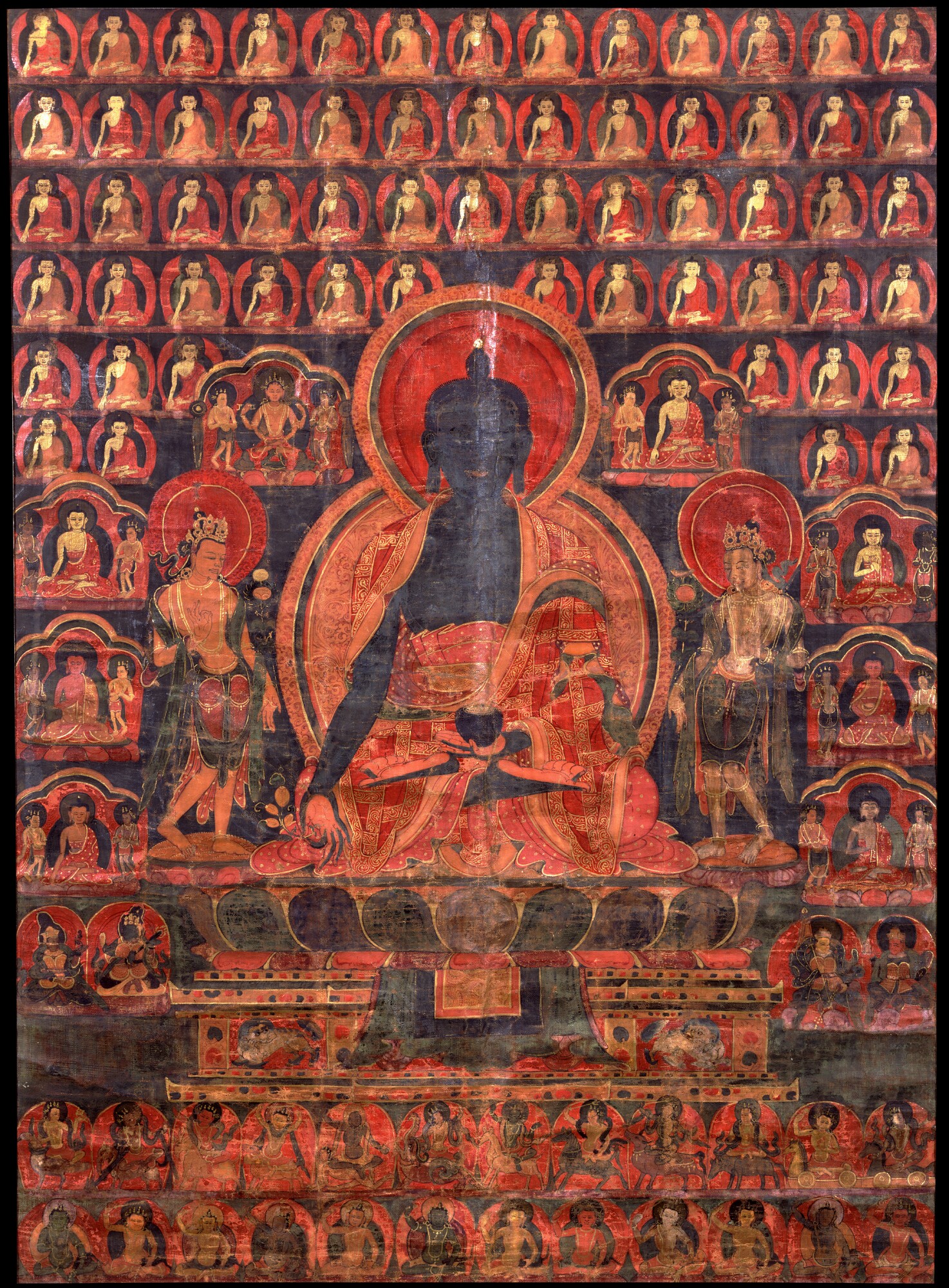
Family reference for Delightful King of Clear Knowing: Center: blue Menla, red patchwork robe, anatomical right-hand medicinal sprig and left-hand dark bowl. Six companion Buddhas occupy three panels on each side. Exact identities of individual side panels are unresolved in this record. This sheet does not establish which individual small member is this named Buddha. [med-har125]
Object record ↗ · Source image ↗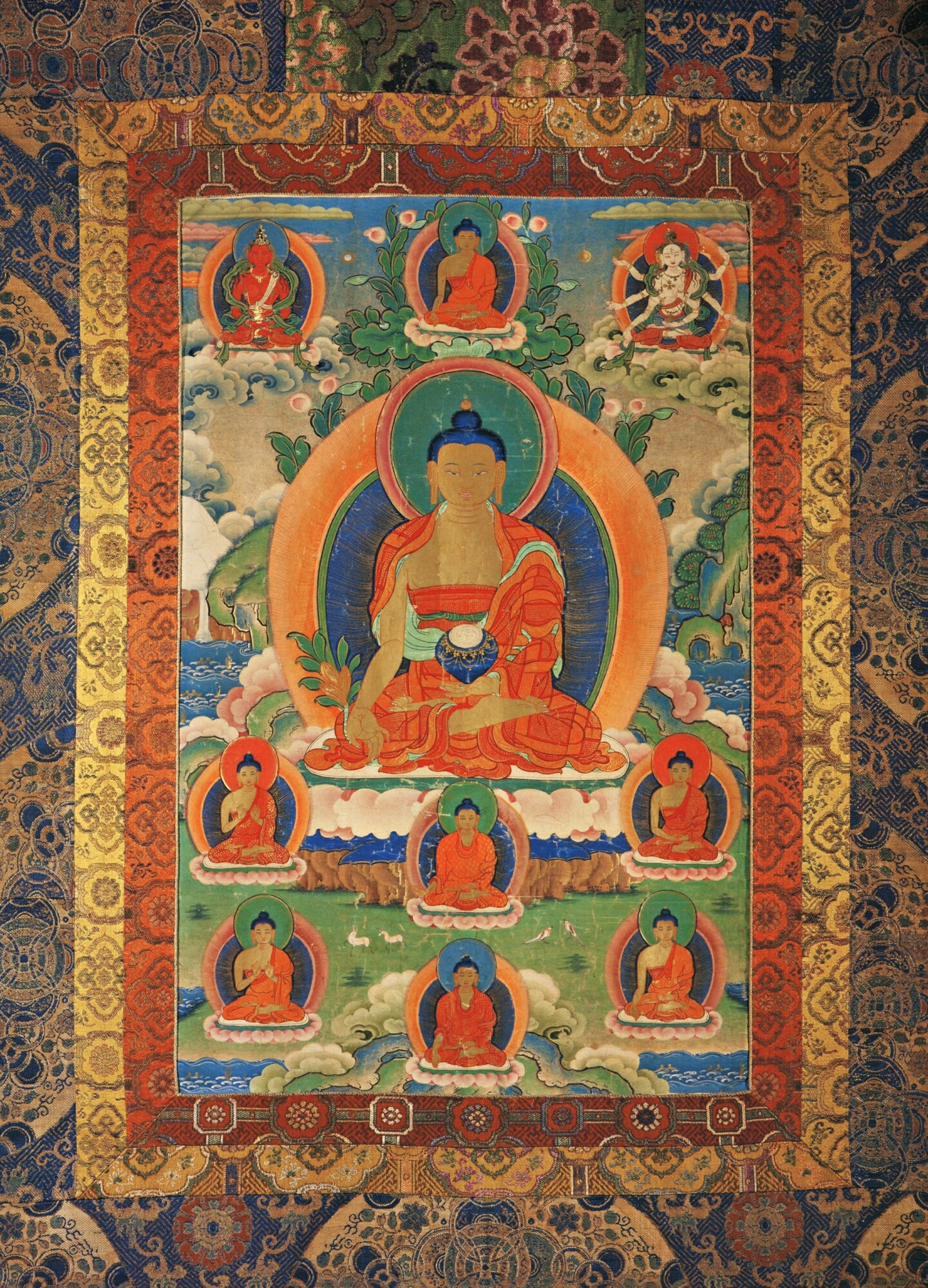
Family reference for Delightful King of Clear Knowing: Center Menla is rendered gold in this painting; six companions occupy two staggered rows underneath and Śākyamuni is above. Exact lower-member name assignment is not supplied; use this for family-level monastic appearance and composition, not name-specific color. This sheet does not establish which individual small member is this named Buddha. [med-har32921]
Object record ↗ · Source image ↗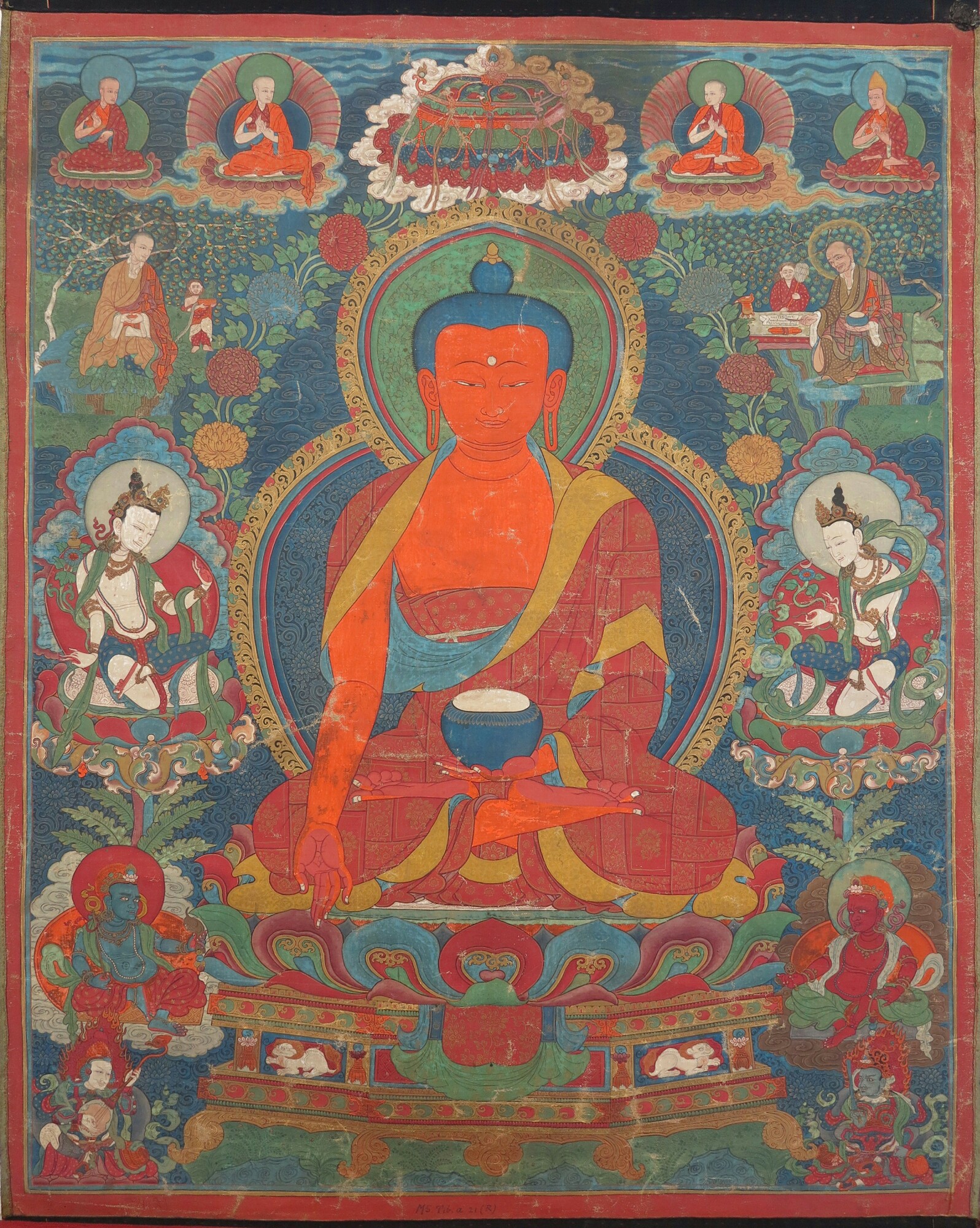
Central named Abhijñārāja is red, with anatomical right hand lowered in generosity and left hand supporting a blue alms bowl. Its bowl is a documented variant; the selected FPMT 2013 companion description does not prescribe one. [med-har60905]
Object record ↗ · Source image ↗Criteria
The model must show
- Lineage variant: FPMT Medicine Buddha Sadhana (2013), the library's selected baseline for the seven
- Body: coral red skin, one face, two arms
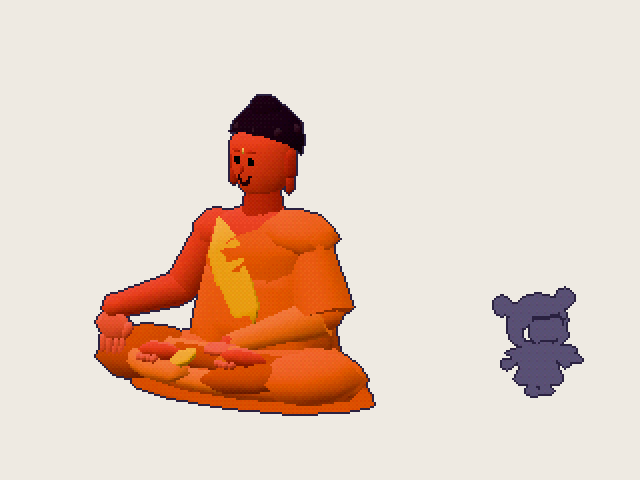
- Hands: own right hand lowered by the right knee, palm outward, fingers down (giving); own left palm upward in the lap
- Held object: none; the selected description gives a gesture, not a sprig or bowl
- Dress: monastic cloth; no crown or jewellery
- Posture: full crossed-leg Buddha seat
- Head: a recognisable ushnisha over curled hair, long earlobes, a forehead mark; these may be a few clear shapes
- Face: serene and composed, as the library gives this peaceful form: narrow calm eye shapes, level brows, a small closed restrained mouth
- Eyes: solid black silhouettes with no whites, irises, pupils, highlights or glint (project eye rule; a recorded game adaptation, not a claim about traditional painted eyes)
- Seat: the library names only the crossed-leg seat for the companions; they take the same lotus and moon support as Menla, recorded as following the principal
- Attendants: no separate attendants prescribed here; one of six companion Medicine Buddhas, with Menla making the selected seven. Śākyamuni is added only for an explicitly selected eight-Buddha assembly, not as an eighth Medicine Buddha-field.
The model must not show
- Cartoon smiley face: a wide U-shaped or crescent grin, open laughing mouth, rosy cheek dots or mascot cheeks
- Eye whites, irises, pupils, highlights or glint; glowing white-gold eyes (those belong only to freshly liberated beings)
- Any part of the figure (head, crown, hat, halo, raised hand or held object) touching or passing through its canopy, roof, lintel, pillars, throne back or seat in any capture angle
- An ordinary hair bun in place of the ushnisha
- A medicinal sprig, bowl or other prop borrowed from another Buddha
- A princely crown or jewellery
- Hands or attributes mirrored to the wrong side of the figure's own body (own right appears at viewer-left in a front view)
Original game concept
Current 3D model
presence

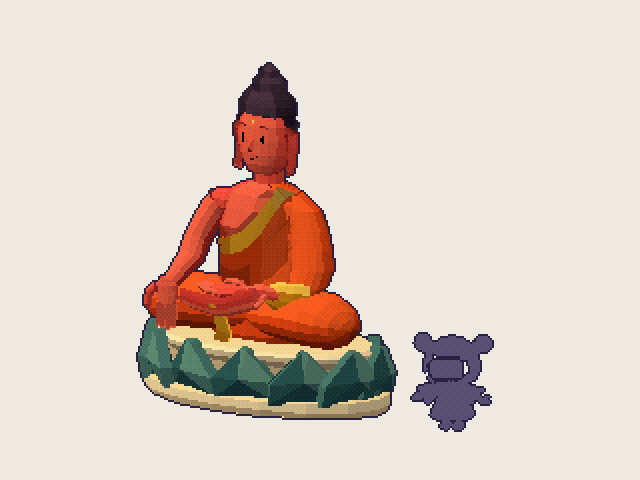
Depiction requirements
- identity and color
- Coral red body in the selected FPMT 2013 presentation; keep this source label with the model. [med-fpmt2013]
- mudra and hand sides
- Anatomical right hand grants/gives: lowered by the right knee, palm outward and fingers down; anatomical left palm meditates upward in the lap. [med-fpmt2013]
- Buddha appearance
- Monastic cloth, one face/two arms, full crossed-leg Buddha seat, long ear lobes and recognizable ushnisha; no princely crown/jewelry for this chosen appearance. [med-har125] [med-har32921]
- attributes
- The selected companion description prescribes the gesture rather than a medicinal sprig. Do not add identity-bearing props from a different Buddha or painting without recording a compatible named variant. [med-fpmt2013] [med-fpmtvariants]
- traditional cranial cues
- A forehead mark and curled hair/cranial mound can be simplified into a few clear shapes; avoid an unsourced ordinary hair bun replacing the Buddha’s ushnisha. Keep the game’s black eyes and toy proportions. [med-har125] [med-har32921]
Presentation contract
Ready to build from No readiness block is recorded in the plan.
Setting and sizing rule
A lotus-and-moon seat like Menla's; any stone pavilion is authored scenery. Sizing (plan rule R4, not a sourced claim): the opening of any shrine, canopy or pavilion around the figure leaves at least one of the figure's own head-heights of clear air above its tallest point (the ushnisha) and a clear gap on each side of its widest span (the knees and any raised or lowered hand); a throne back or aureole sits behind the figure without passing through it; pillars and lintel do not cross the face, hands or held objects in the front or either three-quarter capture.
Recorded variants · 2
- Wish-Fulfilling Jewel (p.24) also gives coral and granting-the-supreme; the Bodleian Abhijñārāja (HAR 60905) also holds a blue bowl
- FPMT (2001) notes that colours and mudras differ significantly among practices and traditions
Recorded adaptations · 0
Where the plan places it · 1
- medicine field 06 · Standing in an Ocean of Jewels, the field of Dharmasāgarāgramativikrīḍitābhijñārāja
medicine-field-06.sanctuary· character Dharmasāgarāgramativikrīḍitābhijñārājamedicine-buddha-06
Contract sources · 6
- FPMT: Medicine Buddha Sadhana (2013), Ngawang Losang Tenpa Gyältsän; translated Lama Zopa Rinpoche
- Rubin Museum Medicine Buddha, P1995.11.1; HAR 125
- Medicine Buddha assembly, Gelug, Tibet 1900–1959; HAR 32921
- FPMT: Medicine Buddha Sadhana (2001), variation note
- FPMT: The Wish-Fulfilling Jewel, Medicine Buddha Puja (2009), Panchen Losang Chökyi Gyältsen; translated David Molk
- Abhijñārāja, Bodleian Libraries, University of Oxford; HAR 60905
Model audit and next pass
Evidence basis: visual + source
Recorded observations
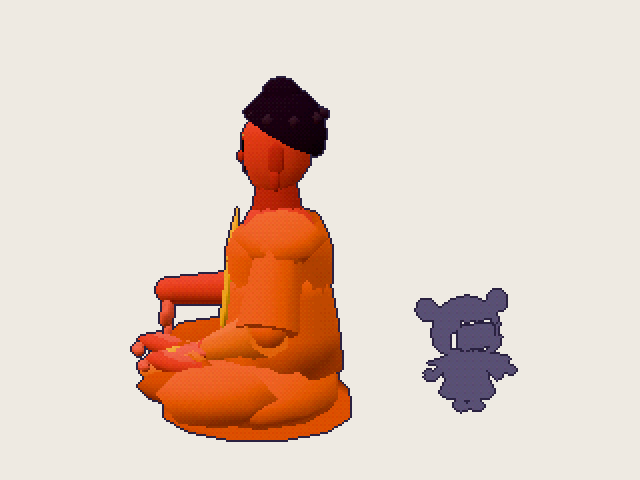
Coral-red body, lowered anatomical right giving hand and left meditation palm match FPMT 2013 and the concept.
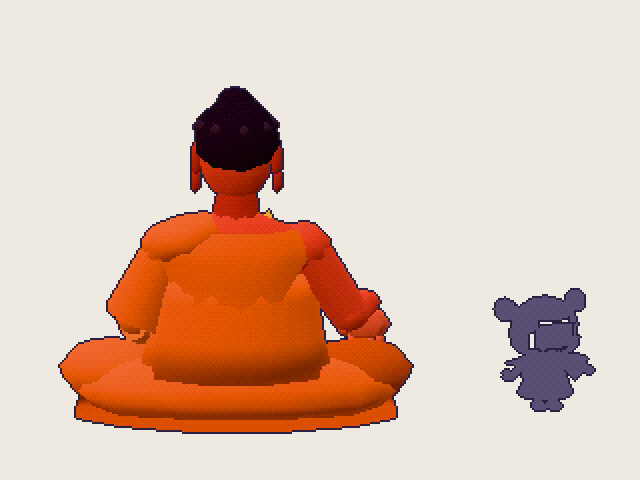
The orange robe is close in hue to the red body; increasing material separation could improve clarity. The identified Bodleian painting has a blue bowl, but that is a distinct documented variant, not evidence this selected no-attribute companion must gain a bowl.
Shared helper states anatomical right is -X, but exposes that chain under leftShoulder/leftElbow/leftWrist. Use visual anatomy and explicit right/left mudra inputs.
Directions for a future model pass
Preserve coral/giving and document FPMT 2013 as the selected variant.
Improve robe/skin separation and the giving hand’s palm/thumb anatomy; use the Bodleian object to study cranial shape and garment fall, without copying its bowl into a different selected variant.
Assessed baseline captures
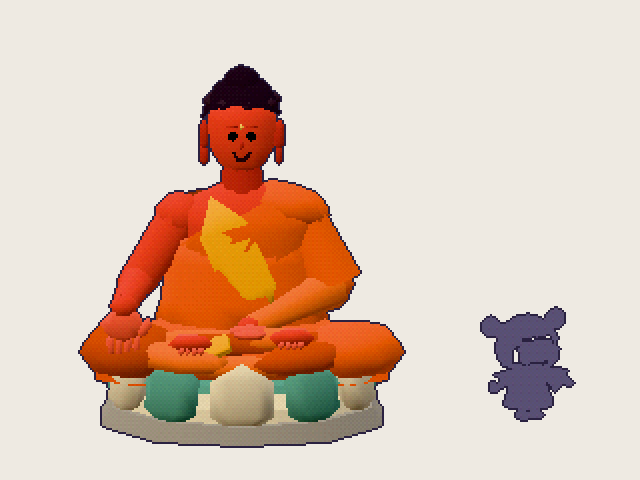
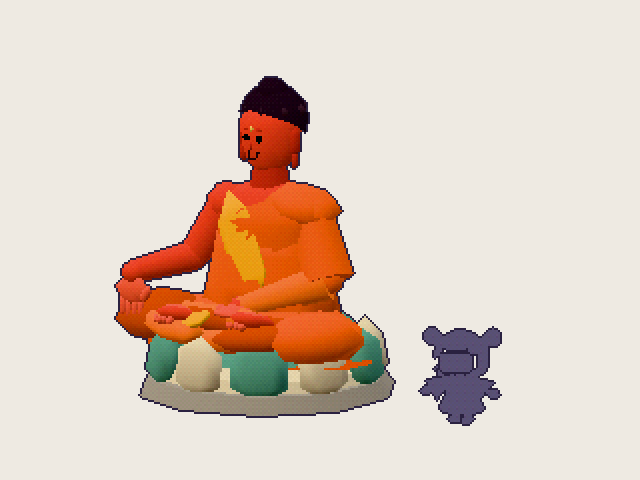
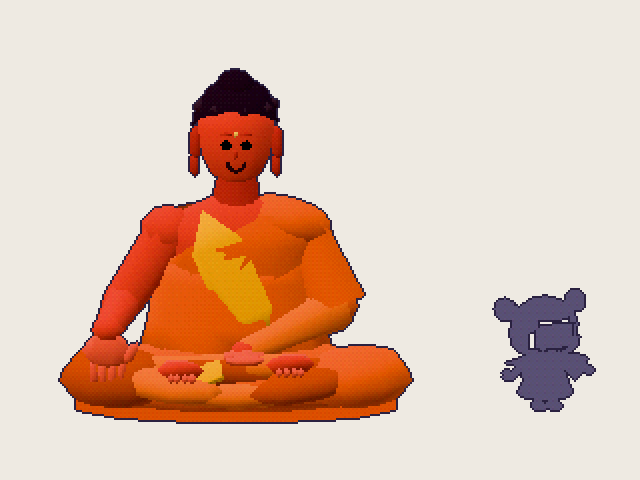
Documented forms and lineage variants · 1
Preserve one identified form consistently. A variant is usable only with its own source and context.
Wish-Fulfilling Jewel (printed p.24) likewise gives coral/granting-the-supreme. The 15th-century Bodleian Abhijñārāja additionally holds a blue bowl.
What not to copy · 3
Do not infer this Buddha’s appearance from its Sanskrit name or ordinal alone.
Do not mirror anatomical hands by trusting inverted left/right rig joint labels.
Do not treat generated concept art as a traditional iconographic source or remove a valid selected gesture because another liturgy differs.
Sources and precise locations · 9
- [med-toh503] 84000: The Previous Aspirations of the Seven Thus-Gone Ones (Toh 503) ↗
- [med-fpmt2013] FPMT: Medicine Buddha Sadhana (2013), Ngawang Losang Tenpa Gyältsän; translated Lama Zopa Rinpoche ↗
- [med-fpmt2009] FPMT: The Wish-Fulfilling Jewel, Medicine Buddha Puja (2009), Panchen Losang Chökyi Gyältsen; translated David Molk ↗
- [med-fpmtvariants] FPMT: Medicine Buddha Sadhana (2001), variation note ↗
- [med-har125] Rubin Museum Medicine Buddha, P1995.11.1; HAR 125 ↗
- [med-har32921] Medicine Buddha assembly, Gelug, Tibet 1900–1959; HAR 32921 ↗
- [med-har10430] Himalayan Art Resources: Eight Medicine Buddhas, variant chart ↗
- [med-har60905] Abhijñārāja, Bodleian Libraries, University of Oxford; HAR 60905 ↗
- [med-rig-06] Inspected authored companion and shared construction source · repository source
prototypes/prerendered-look/parts/purelands/medicine-buddha-06.js
Assessment freshness and evidence hashes
The frozen snapshot is authored evidence. Regeneration computes current hashes and leaves that snapshot as it is.
{
  "auditFreshness": {
    "status": "stale",
    "reasons": [
      "The model capture recipe or rig source changed.",
      "The visible model geometry changed.",
      "Rig source changed or is missing: prototypes/prerendered-look/parts/purelands/medicine-buddha-06.js"
    ]
  },
  "sourceSnapshot": {
    "captureHash": "eb4f090090a43c56e017c9bbe1f041a31ee9f84cfebed5efb09d27acfc81e5ee",
    "bodyGeometryHash": "990b3009481ed707e52afbe298f9835a2a350cd47b6a5cb1826f0fe6238dcb14",
    "sourceHashes": {
      "prototypes/prerendered-look/parts/purelands/medicine-buddha-06.js": "aa46816829c1a0295f87d70a6f420ef5dd38e18aaa1978e02301ebdf32ec1ba9"
    },
    "captureHashes": {
      "/atlas/audit/characters/medicine-buddha-06-3490599ee701-presence-3q-body.webp": "b5876137874a4f085d1876703e461fc91826eb74d3504d8c98951ea4f21bc09e",
      "/atlas/audit/characters/medicine-buddha-06-3490599ee701-presence-back.webp": "6618e6394b665dc7cebd377d4b4f1508af9e69ceca764135e96b3c57261cd622",
      "/atlas/audit/characters/medicine-buddha-06-3490599ee701-presence-front-body.webp": "783a2fb4403b3773a82396001e0ca645ae7e88451629e942df9685f6ea8d5f47",
      "/atlas/audit/characters/medicine-buddha-06-3490599ee701-presence-side.webp": "3bfbf8ba24c8bb2b31d2756e79d3efb580c43f8a3a4288dff4bb8a258304c085",
      "/atlas/audit/sheets/medicine-buddha-06-3490599ee701.webp": "8c34bc4bb37af1a7c5e6d112b13666c796c3968934b93f46ea68ee1c2679e4e1",
      "/atlas/characters/medicine-buddha-06-eb4f090090a4-presence-3q.webp": "ed6aad7aed91f14a72f13f1ff074e9c24d78a9e65dbab7d291542c72b040cc77",
      "/atlas/characters/medicine-buddha-06-eb4f090090a4-presence-front.webp": "b39f491e7d13e2cbfb68110bc17594b9b4001c22f47656f057a0668d84d8f82d",
      "/atlas/characters/medicine-buddha-06-ee6ce7ee7c1e-presence-3q.webp": "ed6aad7aed91f14a72f13f1ff074e9c24d78a9e65dbab7d291542c72b040cc77",
      "/atlas/characters/medicine-buddha-06-ee6ce7ee7c1e-presence-front.webp": "b39f491e7d13e2cbfb68110bc17594b9b4001c22f47656f057a0668d84d8f82d"
    },
    "conceptHashes": {
      "/atlas/concepts/medicine-buddha-06.webp": "72982ac3122998dffb3f2f74ab3aa629bf0faa7bfa6e2f42754f9f2a7d2ece60"
    },
    "activeConceptPaths": [
      "/atlas/concepts/medicine-buddha-06.webp"
    ]
  },
  "currentSnapshot": {
    "captureHash": "c255cebce5a0f48e8c3c04fbaf920c113b5007e7c5aebf18f6ee2e52773dd3bd",
    "bodyGeometryHash": "933c44a81faef79c1b36eaf98122761314848515103abb513f6974365d1aa31d",
    "activeConceptPaths": [
      "/atlas/concepts/medicine-buddha-06.webp"
    ],
    "sourceHashes": {
      "prototypes/prerendered-look/parts/purelands/medicine-buddha-06.js": "60e7efd0b5a9002f3a8f8f7def7d04fc60dc806024e08e66306c181c88c58ff9"
    },
    "captureHashes": {
      "/atlas/audit/characters/medicine-buddha-06-3490599ee701-presence-3q-body.webp": "b5876137874a4f085d1876703e461fc91826eb74d3504d8c98951ea4f21bc09e",
      "/atlas/audit/characters/medicine-buddha-06-3490599ee701-presence-back.webp": "6618e6394b665dc7cebd377d4b4f1508af9e69ceca764135e96b3c57261cd622",
      "/atlas/audit/characters/medicine-buddha-06-3490599ee701-presence-front-body.webp": "783a2fb4403b3773a82396001e0ca645ae7e88451629e942df9685f6ea8d5f47",
      "/atlas/audit/characters/medicine-buddha-06-3490599ee701-presence-side.webp": "3bfbf8ba24c8bb2b31d2756e79d3efb580c43f8a3a4288dff4bb8a258304c085",
      "/atlas/audit/sheets/medicine-buddha-06-3490599ee701.webp": "8c34bc4bb37af1a7c5e6d112b13666c796c3968934b93f46ea68ee1c2679e4e1",
      "/atlas/characters/medicine-buddha-06-c255cebce5a0-presence-3q.webp": "d6209beb4475289a367c588fa1d619513524490fc9d9742470c4c6ba6bda0ff4",
      "/atlas/characters/medicine-buddha-06-c255cebce5a0-presence-front.webp": "bb884818a3e44670974643748b603224742032e49557d84930765c4ebf422b5f",
      "/atlas/characters/medicine-buddha-06-eb4f090090a4-presence-3q.webp": "ed6aad7aed91f14a72f13f1ff074e9c24d78a9e65dbab7d291542c72b040cc77",
      "/atlas/characters/medicine-buddha-06-eb4f090090a4-presence-front.webp": "b39f491e7d13e2cbfb68110bc17594b9b4001c22f47656f057a0668d84d8f82d",
      "/atlas/characters/medicine-buddha-06-ee6ce7ee7c1e-presence-3q.webp": "ed6aad7aed91f14a72f13f1ff074e9c24d78a9e65dbab7d291542c72b040cc77",
      "/atlas/characters/medicine-buddha-06-ee6ce7ee7c1e-presence-front.webp": "b39f491e7d13e2cbfb68110bc17594b9b4001c22f47656f057a0668d84d8f82d"
    },
    "conceptHashes": {
      "/atlas/concepts/medicine-buddha-06.webp": "72982ac3122998dffb3f2f74ab3aa629bf0faa7bfa6e2f42754f9f2a7d2ece60"
    }
  }
}