The rock-ogress
Seeking the monkey's companionship, the rock-ogress becomes the ancestral mother of the Tibetans. In the Clear Mirror chronicle she later takes a woman's appearance, and Tara is a separate figure who advises. Some retellings identify the ogress with Tara herself.
Her story belongs with the monkey, their ancestral cave and their children. Narrative art shows her as a clothed woman, while another origin mural paints primate forms. No source fixes a stone skin, a giant size or a crown for her, and no cited image gives her Tara's lotus or green body.
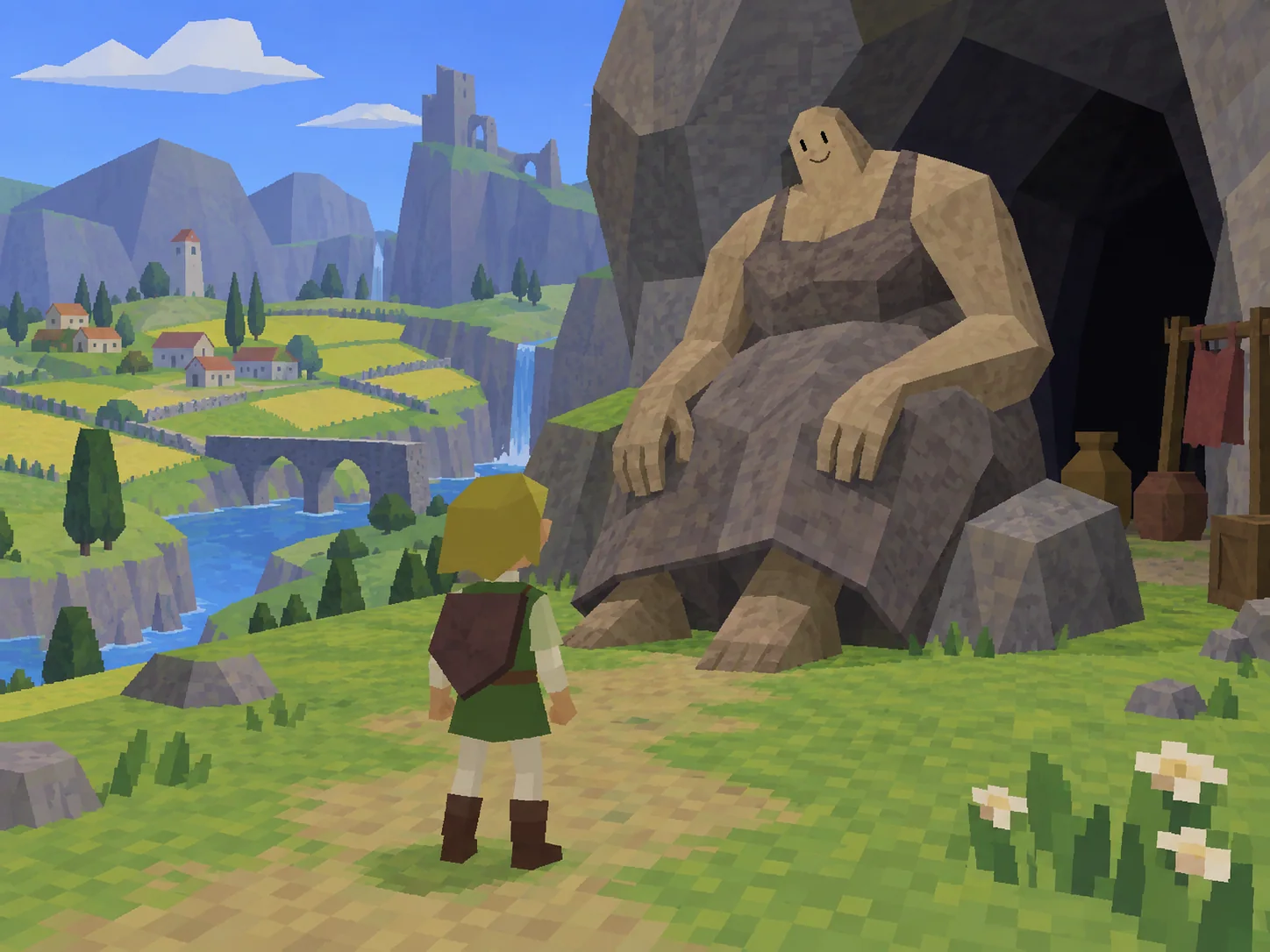
In traditional art
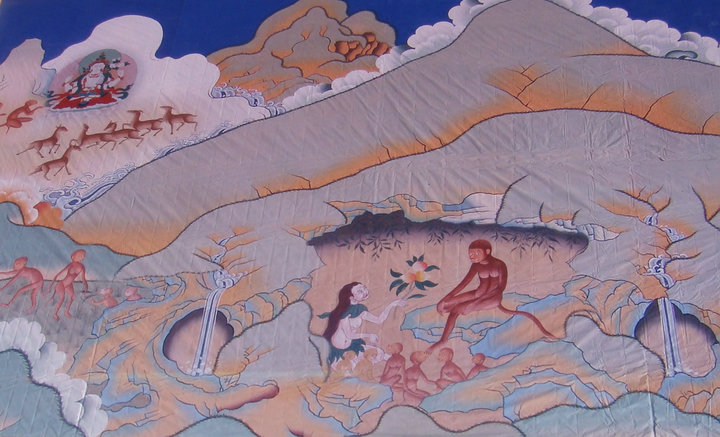
Pha Trelgen Changchup Sempa and rock-ogress narrative paintingTibetan ancestral narrative; original painting location and maker unverified · Painting date unknown; file dated16February2017CC BY-SA4.0, uploader སྤྲེའུ་དཀར་པོ།; attribution and license required, original location/date unverified.Object record ↗
In other collections
These images stay with the collections that hold them. Each link opens the collection's own page.
- Tibetan origin narrative mural — THL67451 ↗Tibetan monastery, Drotsang Gön Trashi Lhünpo, Qinghai · Mural date unspecified; photograph12October2011 · mms.thlib.orgCopyright Gya ye Drabo; only private uses permitted per THL record. Source link only; public republication not licensed.
Sources
- Sakyapa Sonam Gyaltsen: The Clear Mirror, chapter7 ↗
- Shambhala/Snow Lion: The Clear Mirror edition record ↗
- Vassar: Embodying Compassion in Buddhist Art (2015) ↗
- THL: Qinghai monastery wall painting, resource67451 ↗
- Pha Trelgen Changchup Sempa painting image/rights record ↗
- William F.Romain: Tombs of the Tibetan Emperors, RET63 (2022) ↗
Depiction requirements and work notes
The rock-ogress, Tibetan ancestral mother
A rock-ogress seeking the monkey’s companionship becomes the Tibetan ancestral mother. The chronicle lets her take a woman’s appearance and portrays Tārā as a separate adviser; some retellings identify her with Tārā. Current kind giant/cooking presence is game characterization, not a fixed Tārā icon.
The model capture recipe or rig source changed. Reinspect the model before relying on the recorded defects.
References, criteria, concept and model side by side
Traditional depictions
Named origin scene shared by the pair. At viewer-left a seated primate faces an upper-right primate grouping with young. Institution identifies the scene as monkey-and-ogress origin; it does not separately label each painted adult. Do not assign an uncertain individual or use this as a universal ogress body-color rule. [anc-thl-mural]
Object record ↗ · Source image ↗Named pair independently identified by Romain Figure11: in the central cave the red-brown monkey sits at viewer-right, the pale-faced clothed ogress at viewer-left offers fruit; children below, Avalokiteśvara upper-left. This is a narrative reference with incomplete object provenance, not a securely dated canonical master painting. [anc-commons-painting] [anc-romain-fig11]
Object record ↗ · Source image ↗Criteria
The model must show
- Lineage variant: The Clear Mirror, chapter 7: a rock-ogress who takes a woman's guise; Tārā is a separate adviser in this account
- Body: a female figure, one face, two arms; ogress or woman's guise is a recorded scene choice
- Hands: ordinary story actions (companionship, mothering, household work); no deity mudra
- Dress: clothed; not prescribed
- Face: kind and maternal as the game characterises her; small closed mouth
- Eyes: solid black silhouettes with no whites, irises, pupils, highlights or glint (project eye rule; a recorded game adaptation, not a claim about traditional painted eyes)
- Attendants: the monkey and their children, by the ancestral cave
The model must not show
- Cartoon smiley face: a wide U-shaped or crescent grin, open laughing mouth, rosy cheek dots or mascot cheeks
- Eye whites, irises, pupils, highlights or glint; glowing white-gold eyes (those belong only to freshly liberated beings)
- Any part of the figure (head, crown, hat, halo, raised hand or held object) touching or passing through its canopy, roof, lintel, pillars, throne back or seat in any capture angle
- Green Tārā's body colour, lotus, crown, extended right foot or mudra
- The separate supine demoness of Tibetan geomancy
- Stone skin, giant size or a crown described as traditional
Original game concept
Current 3D model
presence
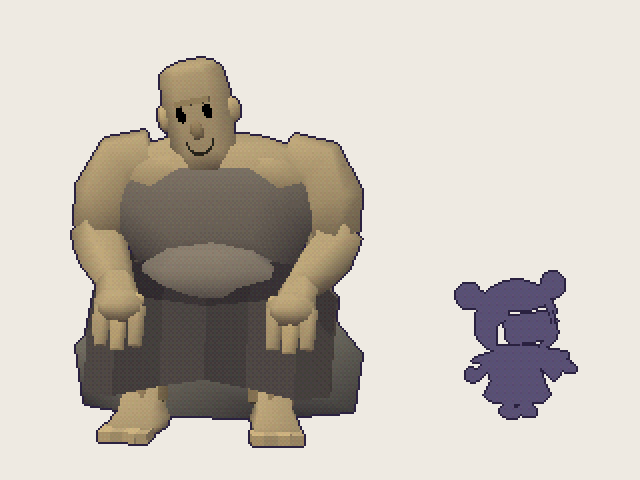
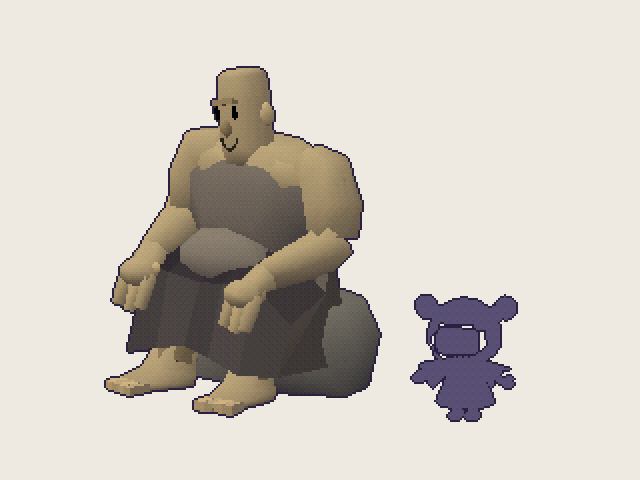
Depiction requirements
- identity/witness
- State the rock-ogress ancestral mother and the selected witness. Retain Tārā emanation as an alternate account; do not silently equate every depiction with green Tārā. [anc-clear-mirror] [anc-vassar]
- appearance alternatives
- The chronicle describes an ogress later assuming a woman’s guise; select which scene the model portrays. Named narrative art shows a clothed female figure, while another origin mural uses primate forms. No universal stone skin, giant size or crown was established. [anc-clear-mirror] [anc-thl-mural] [anc-commons-painting] [anc-romain-fig11]
- hands and attributes
- Use story-specific ordinary hands/actions, such as companionship or maternal scene if chosen. Do not transfer Tārā’s lotus, crown, green body, royal-ease foot extension or mudrā into this figure without a source that depicts the ogress in that form. [anc-clear-mirror] [anc-vassar] [anc-romain-fig11]
- relationship and setting
- Keep association with the monkey and ancestral cave/children in narrative documentation. Simplified giant at cave doorway is an explicit adaptation; a generic cliff woman alone does not establish this named tradition. [anc-clear-mirror] [anc-romain-fig11]
Presentation contract
Ready to build from No readiness block is recorded in the plan.
Open points recorded with the contract
- No universal appearance was established
Setting and sizing rule
The ancestral cave doorway; no throne. The doorway and any roof clear her seated and standing height. Sizing (plan rule R4, not a sourced claim): the opening of any shrine, canopy or pavilion around the figure leaves at least one of the figure's own head-heights of clear air above its tallest point (the top of the head) and a clear gap on each side of its widest span (the shoulders and knees when seated); a throne back or aureole sits behind the figure without passing through it; pillars and lintel do not cross the face, hands or held objects in the front or either three-quarter capture.
Recorded variants · 2
- Emanational retelling (Vassar 2015): the ogress is identified with Tārā
- One origin mural shows primate forms
Recorded adaptations · 1
- The kind giant with stone-coloured skin, plain grey-brown dress and cooking activities
Where the plan places it · 1
- human · The monkey and the ogress’s cave
human.monkey-cave· character The rock ogressogress
Contract sources · 5
- Sakyapa Sonam Gyaltsen: The Clear Mirror, chapter7
- Vassar: Embodying Compassion in Buddhist Art (2015)
- THL: Qinghai monastery wall painting, resource67451
- Pha Trelgen Changchup Sempa painting image/rights record
- William F.Romain: Tombs of the Tibetan Emperors, RET63 (2022)
Model audit and next pass
Evidence basis: visual + source; original concept, canonical front/three-quarter and multi-angle audit sheet inspected 2 October 2026; traditional artifacts viewed in Chrome, no ritual or runtime acceptance
Recorded observations
Original concept and current canonical/front/body-angle sheet show a broad bald kind-faced female giant, pale stone/ochre skin, gray-brown sleeveless dress, broad bare hands and feet, seated with hands resting on knees. Black eyes have no white/gold glow.
The current actor retains seated/standing body alternatives. ogress.js supplies sit/watch, cooking/ladle, tasting, shelter-building and walking clips; rock seat is scenery/activity support and can disappear in body-only capture.
Friendly monumental size, stone color, plain dress and practical household activities are authored game design. The selected chronicle and collected artworks do not prescribe giant proportions, literal stone flesh or a gray uniform.
No Tārā lotus/crown/green skin is incorrectly added. The model’s gentle maternal interpretation is plausible narrative adaptation, but cannot be called an exact traditional sacred-image form without a chosen appearance source.
Directions for a future model pass
P1 — Document the selected ancestral-mother/woman appearance and preserve the Tārā identity caveat; this corrects classification without any geometry change.
P2 — If aiming closer to the collected Tibetan narrative painting, revise a future concept toward its clothed maternal woman alongside the monkey/children. Keep giant stone-bodied version available as recorded game adaptation until Josie chooses an appearance.
P2 — Preserve gentle posture, broad silhouette and practical character activities; do not add lotus/crown or arbitrarily change to green solely because a retelling associates the mother with Tārā.
Assessed baseline captures
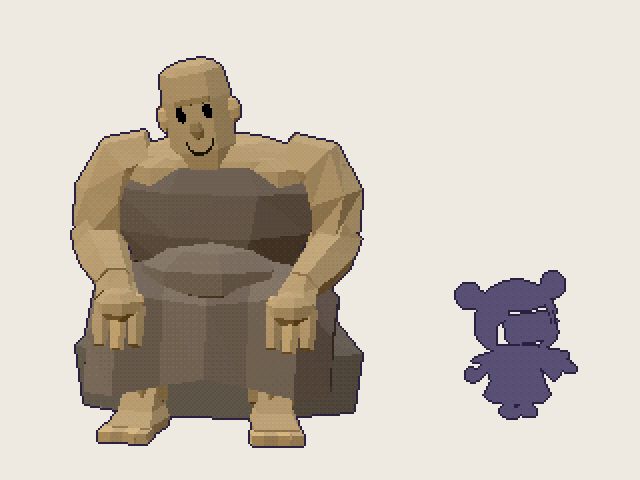
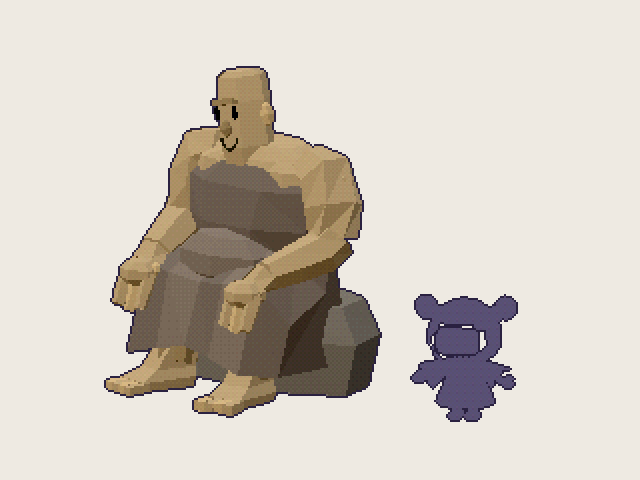
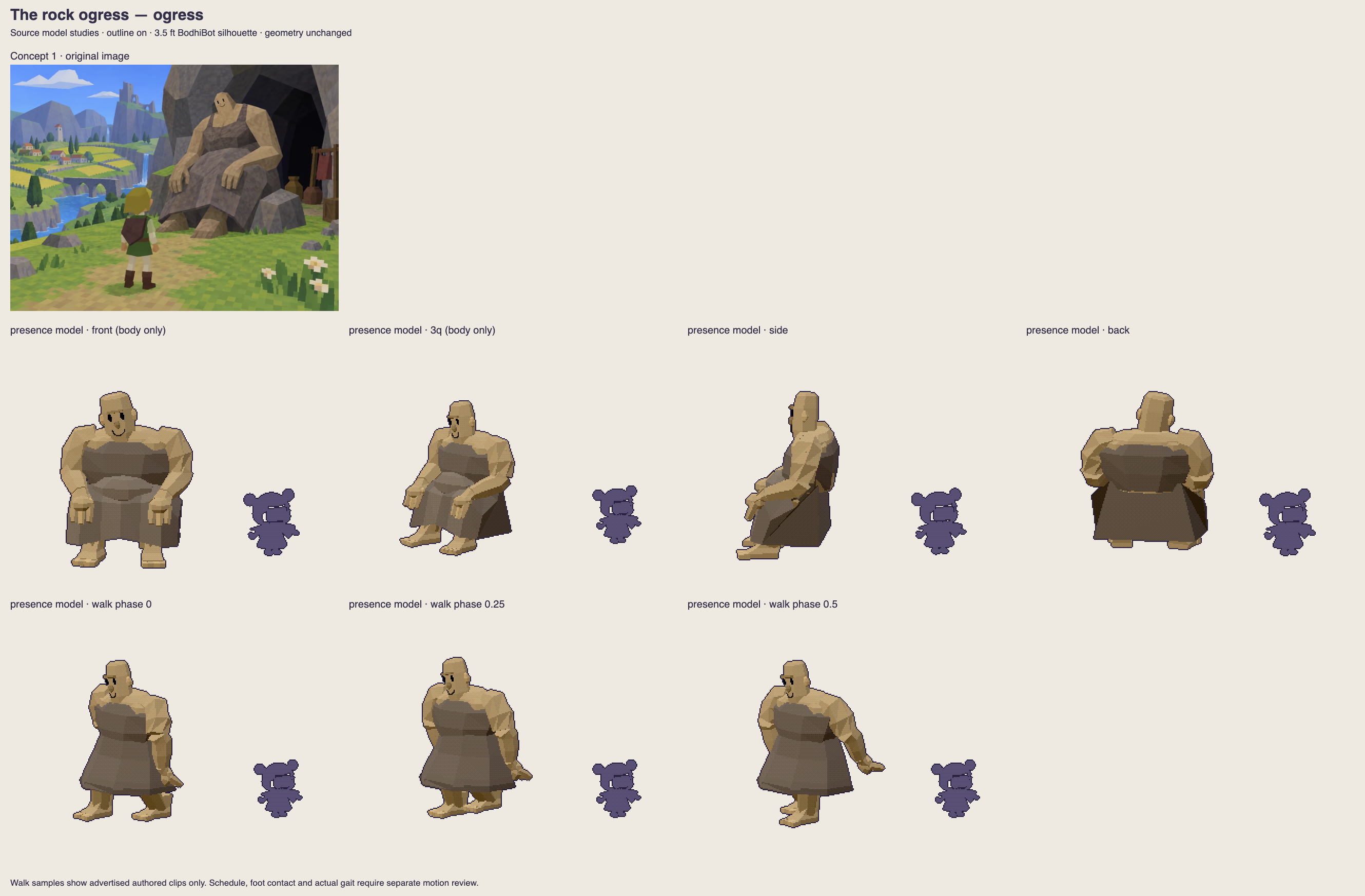
Documented forms and lineage variants · 3
Preserve one identified form consistently. A variant is usable only with its own source and context.
Disciple/adviser chronicle branch
Clear Mirror’s magical monkey receives lay vows from Avalokiteśvara; Tārā and Bhrikuti speak as approving advisers. This witness does not make the rock-ogress a green Tārā icon. [anc-clear-mirror]
Emanational retelling
The Vassar catalogue recounts Avalokiteśvara as divine monkey and identifies the ogress with Tārā. Treat this as the named account; do not claim every Tibetan witness uses the same mapping. [anc-vassar]
Dated photograph versus object date
Both named paintings have actual source images, but neither has a securely dated historical object record. The2011 photograph and2017 file date are evidence dates, not artwork ages. [anc-thl-mural] [anc-commons-painting]
What not to copy · 2
Do not replace the named ancestors
Avoid Hanuman, Sun Wukong, generic primates, ordinary Tārā icons or the separate supine geomantic Tibet demoness as unmarked exemplars for this ancestral pair. [anc-clear-mirror] [anc-thl-mural] [anc-romain-fig11]
Do not impose a deity mudrā
No universal fixed hand gesture, jewel count, crown, robe color or giant size was established by the selected chronicle/identified paintings. Choose the scene and source before prescribing those details. [anc-clear-mirror] [anc-thl-mural] [anc-commons-painting]
Sources and precise locations · 6
- [anc-clear-mirror] Sakyapa Sonam Gyaltsen: The Clear Mirror, chapter7 ↗
- [anc-clear-edition] Shambhala/Snow Lion: The Clear Mirror edition record ↗
- [anc-vassar] Vassar: Embodying Compassion in Buddhist Art (2015) ↗
- [anc-thl-mural] THL: Qinghai monastery wall painting, resource67451 ↗
- [anc-commons-painting] Pha Trelgen Changchup Sempa painting image/rights record ↗
- [anc-romain-fig11] William F.Romain: Tombs of the Tibetan Emperors, RET63 (2022) ↗
Assessment freshness and evidence hashes
The frozen snapshot is authored evidence. Regeneration computes current hashes and leaves that snapshot as it is.
{
  "auditFreshness": {
    "status": "stale",
    "reasons": [
      "The model capture recipe or rig source changed."
    ]
  },
  "sourceSnapshot": {
    "captureHash": "93a579107b288c8b853d67c2dfb9d2d6ce8fd1cec7e9b0e78bf226ab4a011db8",
    "bodyGeometryHash": "986084f440d2ece41de5b85f078a0c85fc368bfb786a7633601db6cbc20b88cd",
    "sourceHashes": {
      "prototypes/prerendered-look/parts/purelands/ogress.js": "2eedcce07ce21eef8f5c9b8291cd35ff94b498b70f01038ee5fe2d8a362f3943"
    },
    "captureHashes": {
      "/atlas/audit/sheets/ogress-bd5c5819bea6.webp": "0cd10f2ffa6b49eca32d6e7dbe195a88d4f84c6b36fb875f608383625f1f3136",
      "/atlas/characters/ogress-37b23e451c3e-presence-3q.webp": "157dc663f2530061d371e3a3e2b08f9e9bb573dec7585c6f55f3987db3d48c21",
      "/atlas/characters/ogress-37b23e451c3e-presence-front.webp": "6f142d0454f113934d8815e9f258468e8ccb79edbd9704d28ed0aea90d50a3f7",
      "/atlas/characters/ogress-93a579107b28-presence-3q.webp": "157dc663f2530061d371e3a3e2b08f9e9bb573dec7585c6f55f3987db3d48c21",
      "/atlas/characters/ogress-93a579107b28-presence-front.webp": "6f142d0454f113934d8815e9f258468e8ccb79edbd9704d28ed0aea90d50a3f7"
    },
    "conceptHashes": {
      "/purelands/concepts/ogress.webp": "36d51b54296a0fe62767b81fec17af9d51d288b2492be521f1f693879b82a142"
    },
    "activeConceptPaths": [
      "/purelands/concepts/ogress.webp"
    ]
  },
  "currentSnapshot": {
    "captureHash": "cf1725467c6aacefeeb8c2bd131bcc787922ffad067182779495d48a74cbd9cd",
    "bodyGeometryHash": "986084f440d2ece41de5b85f078a0c85fc368bfb786a7633601db6cbc20b88cd",
    "activeConceptPaths": [
      "/purelands/concepts/ogress.webp"
    ],
    "sourceHashes": {
      "prototypes/prerendered-look/parts/purelands/ogress.js": "2eedcce07ce21eef8f5c9b8291cd35ff94b498b70f01038ee5fe2d8a362f3943"
    },
    "captureHashes": {
      "/atlas/audit/sheets/ogress-bd5c5819bea6.webp": "0cd10f2ffa6b49eca32d6e7dbe195a88d4f84c6b36fb875f608383625f1f3136",
      "/atlas/characters/ogress-37b23e451c3e-presence-3q.webp": "157dc663f2530061d371e3a3e2b08f9e9bb573dec7585c6f55f3987db3d48c21",
      "/atlas/characters/ogress-37b23e451c3e-presence-front.webp": "6f142d0454f113934d8815e9f258468e8ccb79edbd9704d28ed0aea90d50a3f7",
      "/atlas/characters/ogress-93a579107b28-presence-3q.webp": "157dc663f2530061d371e3a3e2b08f9e9bb573dec7585c6f55f3987db3d48c21",
      "/atlas/characters/ogress-93a579107b28-presence-front.webp": "6f142d0454f113934d8815e9f258468e8ccb79edbd9704d28ed0aea90d50a3f7",
      "/atlas/characters/ogress-cf1725467c6a-presence-3q.webp": "5db48172564027262c42b2f3440b7cd845d69c6c94827bd92a695ccb0ff1da96",
      "/atlas/characters/ogress-cf1725467c6a-presence-front.webp": "8c70a7bbade3b3d2e4fbb7c5140907494d8ebcc92a91443a82adf6944aed1a9c"
    },
    "conceptHashes": {
      "/purelands/concepts/ogress.webp": "36d51b54296a0fe62767b81fec17af9d51d288b2492be521f1f693879b82a142"
    }
  }
}