Vajradharma
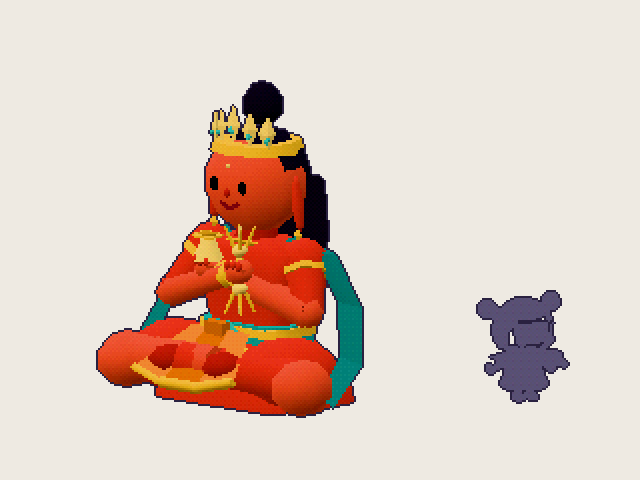
Vajradharma here is a red Buddha with one peaceful face and two arms, seated with legs fully crossed. His forearms cross at the heart, holding a vajra, the pronged ritual sceptre, and a bell. His hair is tied in a topknot, and he wears silks, jewels and bone ornaments.
This form comes from the Vajrayogini practice called Naro Khechara, in the Sakya and Ngor lineages. A praise by Ngorchen Konchog Lhundrub places him above the palace, where the root guru, the practitioner's own teacher, appears as red Vajradharma.
He is not the blue Vajradhara. Vira Vajradharma, another red form, holds a small drum and a skull cup instead. In Wang Dü's own practice, his teaching links red Vajradharma with a sambhogakaya emanation of Amitabha.
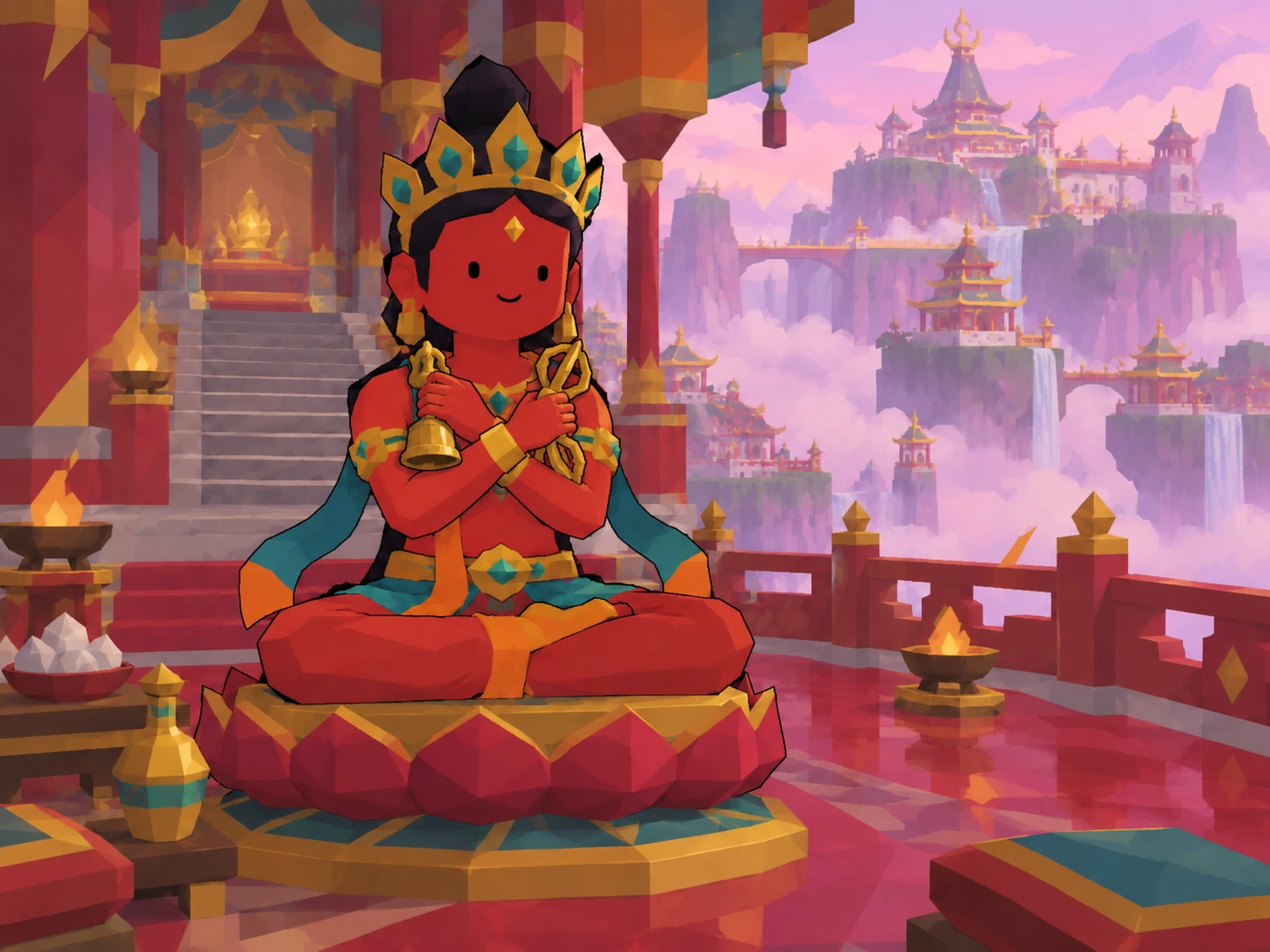
In traditional art
These images stay with the collections that hold them. Each link opens the collection's own page.
- Vajradharma in the vajra-embracing gesture, HAR24636 ↗Tibet; Sakya/Ngor · 16th century · himalayanart.orgImages courtesy of private collections per HAR; no open license established. Link-only default.
- Vajrayogini and the pure land Khechara, RubinF1997.22.1 ↗Central Tibet; Sakya/Ngor · 19th century · himalayanart.orgPhotographed image ©2004 Rubin Museum of Art per HAR; no open license.
- The Red Yogini, Vajrayogini, RubinC2002.24.11 ↗Tibet; Sakya attribution in HAR · 19th century · rubinmuseum.orgRubin protected material; no open license. Museum limited educational/personal terms apply, with attribution and restrictions.
Sources
- Nesar Ngawang Kunga Legpa’i Jungne: Vajradharma form description via HAR ↗
- Ngorchen Konchog Lhundrub: The Staircase Ascending to Khechara ↗
- Khenpo Sodargye: Commentary on Wang Dü ↗
- HAR334: Vajrayogini and Khechara ↗
- Rubin Museum: The Red Yogini, Vajrayogini ↗
- HAR65127: Vajrayogini, Naropa Tradition ↗
- HAR24636: Vajradharma, Vajra Embracing Gesture ↗
- HAR: Naming confusions around Vajradharma ↗
Depiction requirements and work notes
Buddha Vajradharma, peaceful red crossed-vajra-and-bell form in the Naro Khechara context
Red peaceful one-faced two-armed Buddha seated in vajra posture, crossed vajra-and-bell at the heart, topknotted hair, silks and jeweled/bone ornaments. The game’s current rig largely establishes this identity. Improve the ritual bell and selected adornment details rather than replacing him with blue Vajradhara, drum-holding Vira Vajradharma or a red meditation Buddha. Khechara placement above the palace is supported by a named traditional praise.
The model capture recipe or rig source changed. Reinspect the model before relying on the recorded defects.
References, criteria, concept and model side by side
Traditional depictions
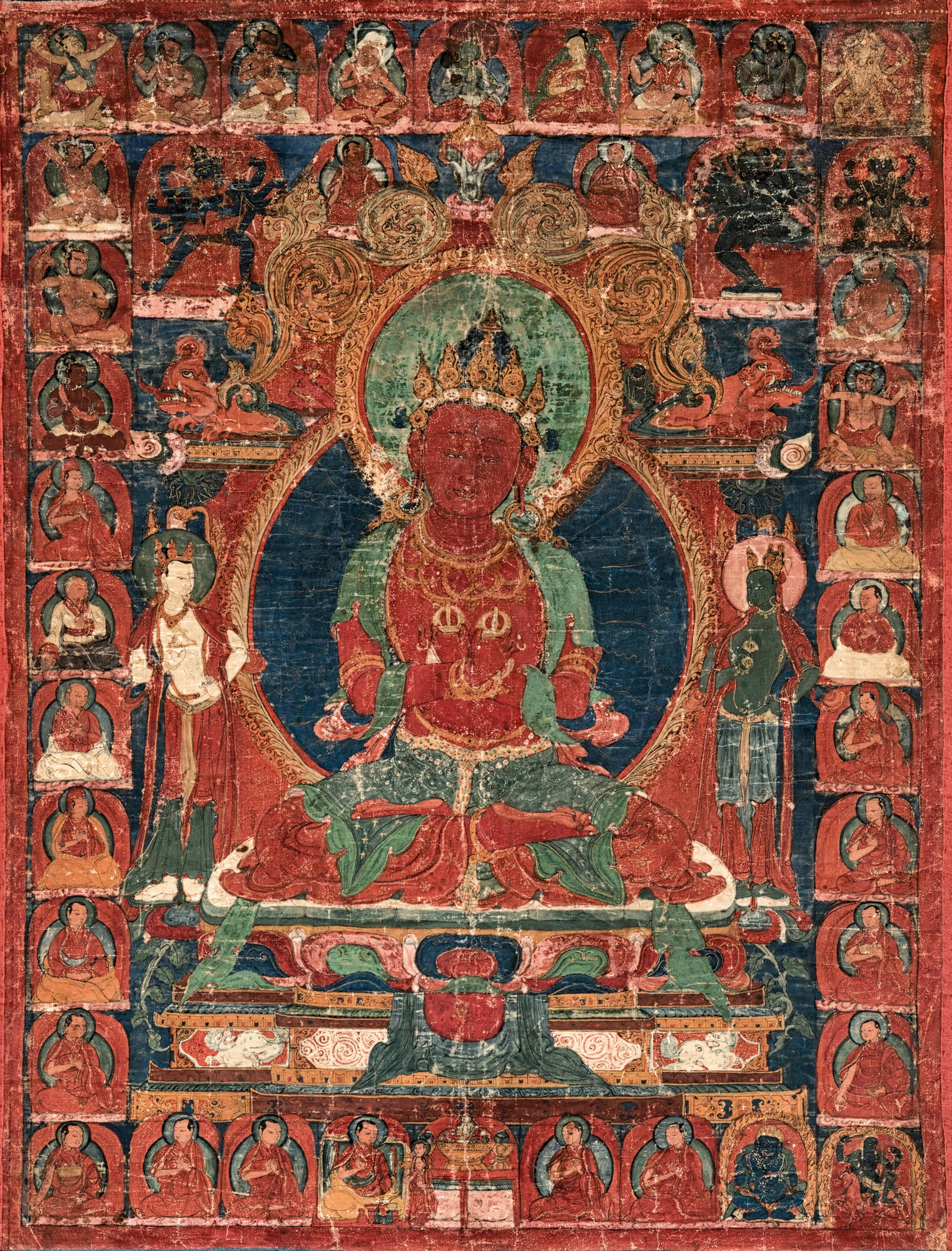
Standalone central red Vajradharma in the selected crossed-vajra/bell form. Best full-body form comparison; the direct image timed out in research, so confirm availability before any local collection. [vd-har24636]
Object record ↗ · Source image ↗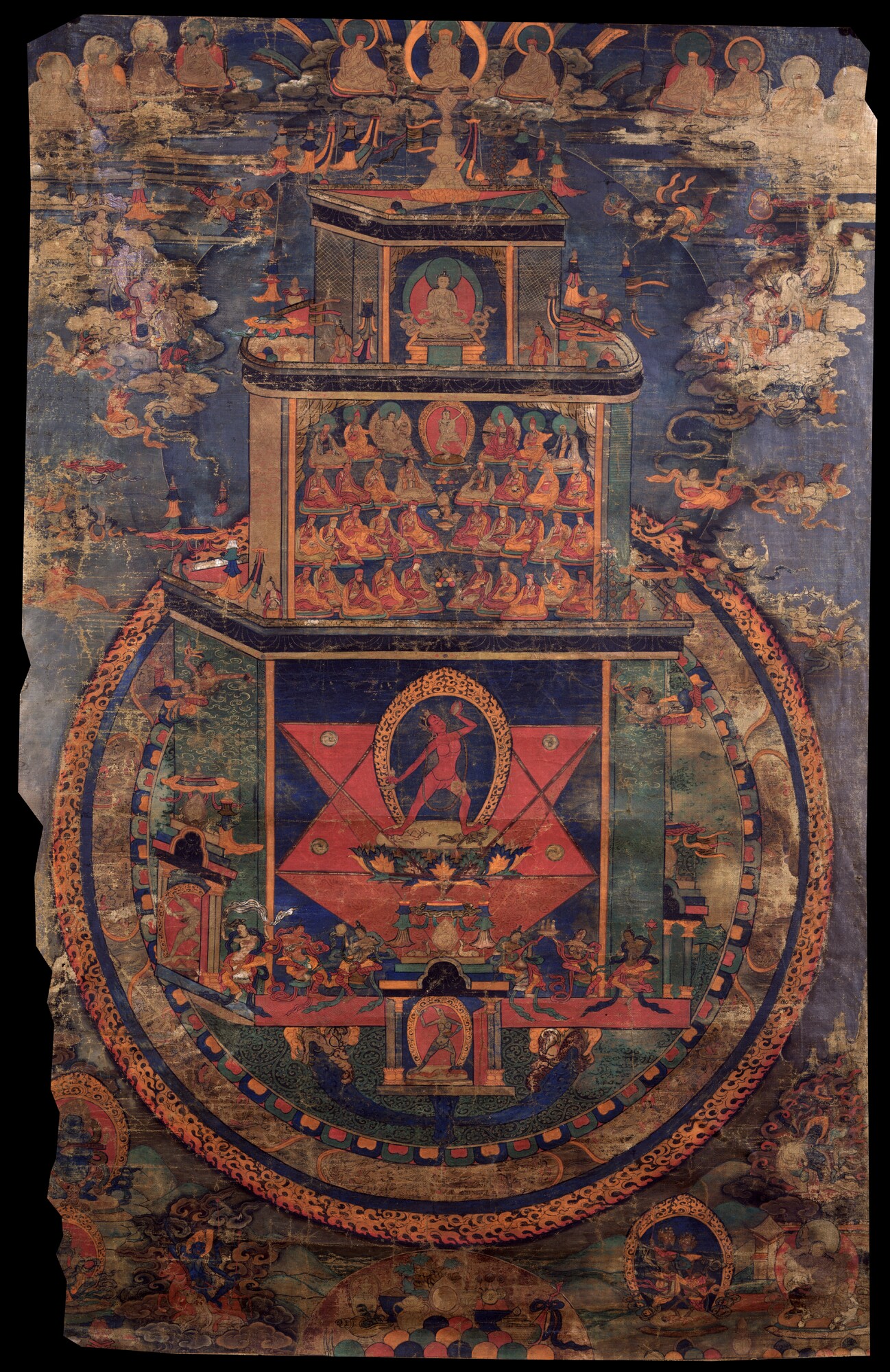
Vajradharma is the red seated crossed-implement figure in the palace’s top story. Keep the entire palace for placement evidence and clearly label the small top-story member when using a detail. [vd-har334] [vd-khechara]
Object record ↗ · Source image ↗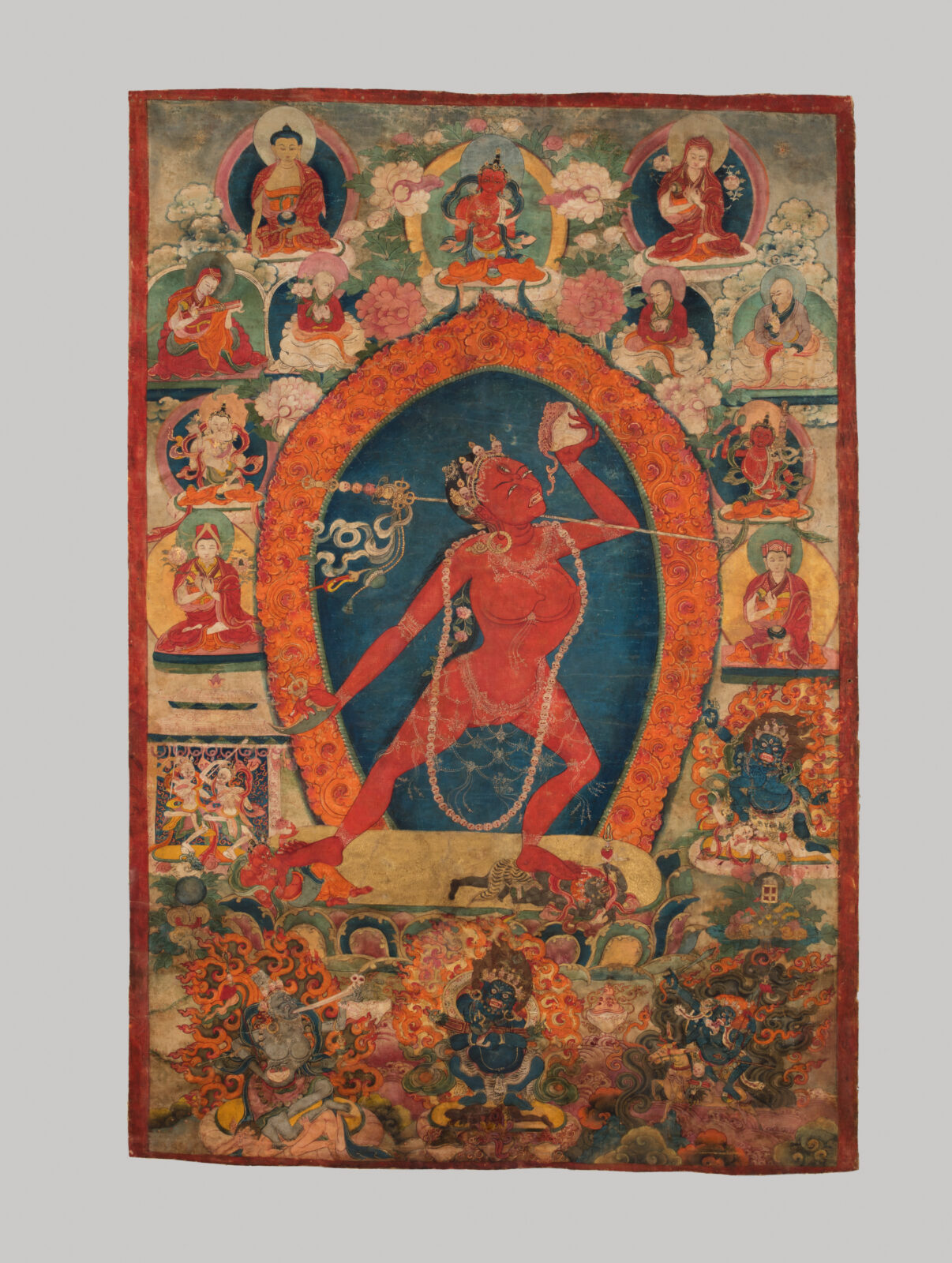
Selected Vajradharma is red at top center, vajra/bell crossed at heart. A different Vira Vajradharma also appears lower-left; that drum/skullcup figure is a comparison variant and must not be cropped/labeled as the selected target. [vd-rubin65127] [vd-har65127] [vd-rubin-terms]
Object record ↗ · Source image ↗Criteria
The model must show
- Lineage variant: the Sakya/Ngor Naro Khechara form described by Nesar Ngawang Kunga Legpa'i Jungne
- Body: red, one face, exactly two arms, youthful
- Hands: forearms crossed at the heart
- Held objects: a vajra and a ritual bell, two distinct implements; the rig puts the vajra in the own-right hand and the bell in the own-left, which the texts neither confirm nor deny
- Dress and ornaments: silk scarves, jewels and bone ornaments; hair tied in a topknot with a crown
- Posture: seated vajra posture
- Face: peaceful and youthful, small closed mouth
- Eyes: solid black silhouettes with no whites, irises, pupils, highlights or glint (project eye rule; a recorded game adaptation, not a claim about traditional painted eyes)
- Seat: the library names none beyond the vajra posture; in Khechara he sits at the top storey of the palace as the root guru
- Attendants: none
The model must not show
- Cartoon smiley face: a wide U-shaped or crescent grin, open laughing mouth, rosy cheek dots or mascot cheeks
- Eye whites, irises, pupils, highlights or glint; glowing white-gold eyes (those belong only to freshly liberated beings)
- Any part of the figure (head, crown, hat, halo, raised hand or held object) touching or passing through its canopy, roof, lintel, pillars, throne back or seat in any capture angle
- A blue body (that is Vajradhara)
- A hand drum and skull cup (Vira Vajradharma, a separate form)
- Amitābha's bowl or Amitāyus's vase in place of vajra and bell
- A plain red meditation Buddha with no implements
Original game concept
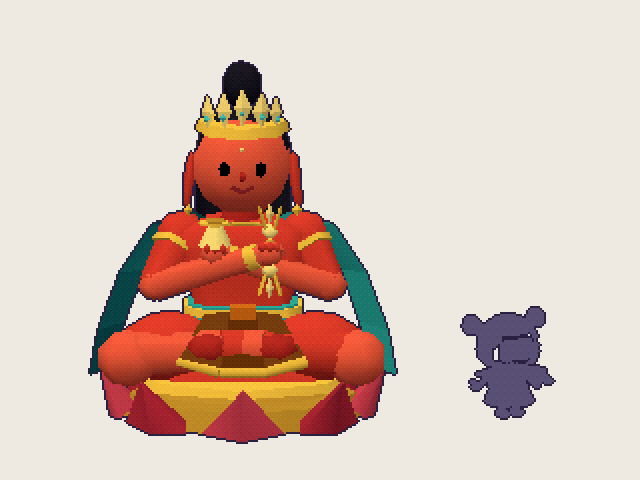
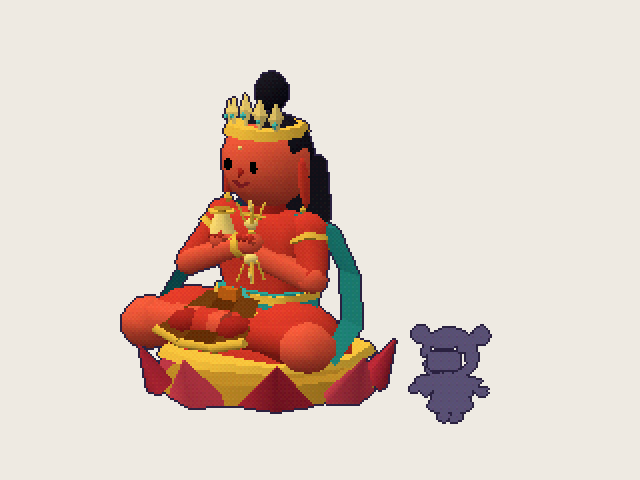
Current 3D model
presence
Depiction requirements
- Color, count and stance
- Red body, one peaceful face, exactly two arms, seated vajra posture. Keep a youthful sacred presence and hair tied in a crown/topknot. [vd-nesar] [vd-sodargye]
- Heart gesture and implements
- Cross forearms at the heart and retain two distinct ritual implements: vajra and bell. Current rig assigns proper-right hand to vajra and proper-left to bell, with crossing making vajra viewer-right and bell viewer-left. Retrieved named textual passages confirm the pair and crossing, but do not explicitly assign sides; visually verify the chosen traditional object and anatomical chain before an implementation change. [vd-nesar] [vd-khechara] [vd-har334]
- Dress and ornaments
- Retain silk scarves, jewels and crown/hair distinction; Nesar’s named description also requires bone ornaments. Choose the arrangement from an identified crossed-implement reference before simplifying bone bead/ornament shapes. Bright teal/orange garment colors are the game concept’s palette, not fixed textual body-color requirements. [vd-nesar] [vd-har24636]
- Khechara context
- If represented as the palace’s upper presence, identify it as the root guru appearing as red Vajradharma. Ngorchen’s praise supports the palace-top position; it does not turn the model into blue Vajradhara or Vira Vajradharma. [vd-khechara] [vd-har334]
Presentation contract
Ready to build from No readiness block is recorded in the plan.
Open points recorded with the contract
- Which hand holds the vajra and which the bell is not fixed by the retrieved texts
Setting and sizing rule
When shown in Khechara, the top storey of the palace above Vajrayoginī (Ngorchen's praise; HAR 334). Sizing (plan rule R4, not a sourced claim): the opening of any shrine, canopy or pavilion around the figure leaves at least one of the figure's own head-heights of clear air above its tallest point (the topknot and crown) and a clear gap on each side of its widest span (the crossed elbows with vajra and bell); a throne back or aureole sits behind the figure without passing through it; pillars and lintel do not cross the face, hands or held objects in the front or either three-quarter capture.
Recorded variants · 3
- Vira Vajradharma: red, right-hand damaru, left-hand skull cup, sometimes a khatvanga
- Vajradharma Lokeśvara is another identity (Met 38983 is not a reference here)
- In Wang Dü, red Vajradharma is tied to an Amitābha sambhogakāya emanation, for that practice only
Recorded adaptations · 1
- The teal and orange garment colours are the game concept's palette
Where the plan places it · 1
- field khechara · The five-gem palace
field-khechara.palace· character Vajradharmavajradharma
Contract sources · 7
- Nesar Ngawang Kunga Legpa’i Jungne: Vajradharma form description via HAR
- Khenpo Sodargye: Commentary on Wang Dü
- Ngorchen Konchog Lhundrub: The Staircase Ascending to Khechara
- HAR334: Vajrayogini and Khechara
- HAR24636: Vajradharma, Vajra Embracing Gesture
- HAR65127: Vajrayogini, Naropa Tradition
- HAR: Naming confusions around Vajradharma
Model audit and next pass
Evidence basis: visual + source
Recorded observations
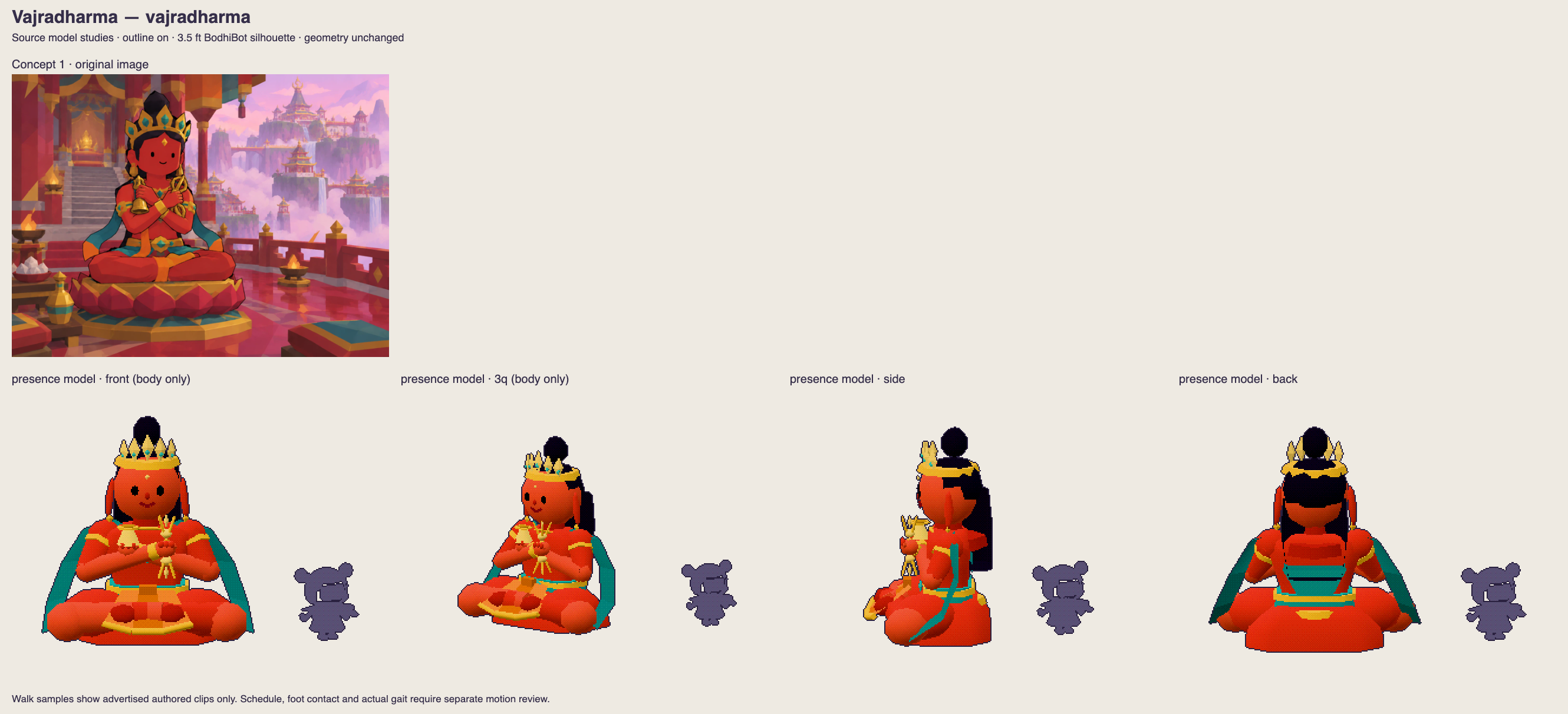
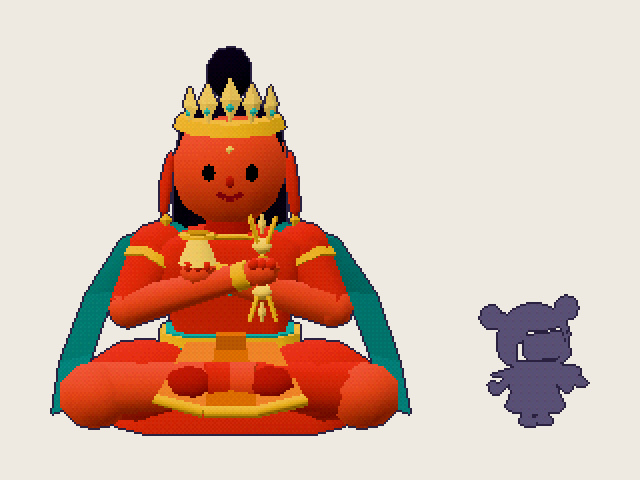
Viewed concept and current front, three-quarter, side and back sheet. Red body, single peaceful face, two crossed arms, distinct vajra/bell, seated crossed legs, topknot and five-leaf jeweled crown identify the selected form.
Source correctly distinguishes this form from blue Vajradhara and drum-bearing Vira; proper-right arm starts at negative X and crosses to positive X holding vajra; proper-left crosses opposite to bell.
Bell is modeled mouth-up(source comment and geometry) and reads like a bowl/cup with rim above its grip. Traditional reference selection must resolve bell orientation before a polish pass; this is a ritual-object shape concern, not grounds to change identity.
Source adds jeweled gold/teal ornaments and silk scarves, but no separate bone ornaments are identifiable. This omits an explicit feature in Nesar’s named form description.
Bare red thighs/lap, limited orange center panel, large block arm joins and upright open-pronged vajra are style/geometry details requiring comparison against the selected objects at all angles. The red palette and crown should be retained rather than normalized to an unadorned Buddha template.
Directions for a future model pass
Preserve the current pass and select the standalone Vajradharma object plus upper-palace assembly for the next review. Keep red body, one face/two arms, crossed heart gesture, topknot and selected identity.
Refine bell into a clearly legible ritual bell with source-selected orientation and handle, and refine vajra grip/prongs; verify anatomical hand sides against the identified traditional depiction.
Add source-selected bone ornaments and improve silk drape/crown detail within low-poly limits. Record each as a future task; this research pass changes no model or approval state.
Assessed baseline captures
Documented forms and lineage variants · 3
Preserve one identified form consistently. A variant is usable only with its own source and context.
Vira Vajradharma is a legitimate red variant with right-hand damaru and left-hand skullcup, sometimes khatvanga at left shoulder. It is a separate selected-form decision, not a polish target for this crossed-implement rig.
Vajradharma Lokeshvara/Avalokiteshvara Vajradharma is another named identity/form. The Met’s public-domain Vajradharma Lokeshvara38983 is unsuitable as an unlabeled canonical reference here.
Wang Dü identifies red Vajradharma with an Amitabha sambhogakaya emanation in that practice; preserve that scoped relation rather than rename every Vajradharma model Amitabha/Amitayus.
What not to copy · 4
Do not use blue Vajradhara images as if red Buddha Vajradharma has been verified.
Do not borrow Vira’s drum/skullcup simply because a museum title abbreviates the name to Vajradharma.
Do not replace vajra/bell with Amitabha’s bowl or Amitayus’s vase.
Do not infer exact bone adornment placement or implement-hand side solely from color or the current generated concept.
Sources and precise locations · 9
- [vd-nesar] Nesar Ngawang Kunga Legpa’i Jungne: Vajradharma form description via HAR ↗
- [vd-khechara] Ngorchen Konchog Lhundrub: The Staircase Ascending to Khechara ↗
- [vd-sodargye] Khenpo Sodargye: Commentary on Wang Dü ↗
- [vd-har334] HAR334: Vajrayogini and Khechara ↗
- [vd-rubin65127] Rubin Museum: The Red Yogini, Vajrayogini ↗
- [vd-har65127] HAR65127: Vajrayogini, Naropa Tradition ↗
- [vd-har24636] HAR24636: Vajradharma, Vajra Embracing Gesture ↗
- [vd-confusions] HAR: Naming confusions around Vajradharma ↗
- [vd-rubin-terms] Rubin Museum Terms and Conditions ↗
Assessment freshness and evidence hashes
The frozen snapshot is authored evidence. Regeneration computes current hashes and leaves that snapshot as it is.
{
  "auditFreshness": {
    "status": "stale",
    "reasons": [
      "The model capture recipe or rig source changed."
    ]
  },
  "sourceSnapshot": {
    "captureHash": "f2be54311ec203ccda2ebe341be27cb1fe62e8774f6127a5b5ce3661069a9845",
    "bodyGeometryHash": "d6cacbbd437f2d8248dabbf8c0ad1780ba31cc9ff05d687bb1978d1d43c1cd66",
    "sourceHashes": {
      "prototypes/prerendered-look/parts/purelands/vajradharma.js": "bfc4663910786b3fb6fd02f12656a3a7f83b10b618a2d219f73ade41565358dd"
    },
    "captureHashes": {
      "/atlas/audit/characters/vajradharma-6e2b8bf5ff29-presence-3q-body.webp": "168baedac41378b29eeb60199e6b057db38bdd967e8570610785941475bdcd10",
      "/atlas/audit/characters/vajradharma-6e2b8bf5ff29-presence-front-body.webp": "bae0f435a55eab6956f9c4ec641208daa4e2ea924a830214a76058acc7318ecd",
      "/atlas/audit/sheets/vajradharma-6e2b8bf5ff29.webp": "84fea2e120a78401a454ce5ba1f75404d56a6eac29ea2bb7c58fcfe5f70eefd5",
      "/atlas/characters/vajradharma-752dcd4272e4-presence-3q.webp": "46324f60e8c542b3258a2d11cfc9c0e087483c274124724afa1db14a30980587",
      "/atlas/characters/vajradharma-752dcd4272e4-presence-front.webp": "ea9fdcc42c39c9a6d3c74a8261e784d7967819916f71e1df5575ad2bec91e32a",
      "/atlas/characters/vajradharma-f2be54311ec2-presence-3q.webp": "46324f60e8c542b3258a2d11cfc9c0e087483c274124724afa1db14a30980587",
      "/atlas/characters/vajradharma-f2be54311ec2-presence-front.webp": "ea9fdcc42c39c9a6d3c74a8261e784d7967819916f71e1df5575ad2bec91e32a"
    },
    "conceptHashes": {
      "/atlas/concepts/vajradharma.webp": "4e1d4aec2f73014e86abdfa1a365f587467c639698d98b0cae504e9efb6d35f3"
    },
    "activeConceptPaths": [
      "/atlas/concepts/vajradharma.webp"
    ]
  },
  "currentSnapshot": {
    "captureHash": "bae9c538e12c8f46ee013785ffa9057c05f4391335d05a0defdd159230f8e5da",
    "bodyGeometryHash": "d6cacbbd437f2d8248dabbf8c0ad1780ba31cc9ff05d687bb1978d1d43c1cd66",
    "activeConceptPaths": [
      "/atlas/concepts/vajradharma.webp"
    ],
    "sourceHashes": {
      "prototypes/prerendered-look/parts/purelands/vajradharma.js": "bfc4663910786b3fb6fd02f12656a3a7f83b10b618a2d219f73ade41565358dd"
    },
    "captureHashes": {
      "/atlas/audit/characters/vajradharma-6e2b8bf5ff29-presence-3q-body.webp": "168baedac41378b29eeb60199e6b057db38bdd967e8570610785941475bdcd10",
      "/atlas/audit/characters/vajradharma-6e2b8bf5ff29-presence-front-body.webp": "bae0f435a55eab6956f9c4ec641208daa4e2ea924a830214a76058acc7318ecd",
      "/atlas/audit/sheets/vajradharma-6e2b8bf5ff29.webp": "84fea2e120a78401a454ce5ba1f75404d56a6eac29ea2bb7c58fcfe5f70eefd5",
      "/atlas/characters/vajradharma-752dcd4272e4-presence-3q.webp": "46324f60e8c542b3258a2d11cfc9c0e087483c274124724afa1db14a30980587",
      "/atlas/characters/vajradharma-752dcd4272e4-presence-front.webp": "ea9fdcc42c39c9a6d3c74a8261e784d7967819916f71e1df5575ad2bec91e32a",
      "/atlas/characters/vajradharma-bae9c538e12c-presence-3q.webp": "22254aca138b1d3e8b9019cc60bb5b5963bccc87e6e69e44b2db00271ab9c432",
      "/atlas/characters/vajradharma-bae9c538e12c-presence-front.webp": "073471402cf3cee6a7e02e20518ea780001fa6dc0624273716d5680fc80efc7d",
      "/atlas/characters/vajradharma-f2be54311ec2-presence-3q.webp": "46324f60e8c542b3258a2d11cfc9c0e087483c274124724afa1db14a30980587",
      "/atlas/characters/vajradharma-f2be54311ec2-presence-front.webp": "ea9fdcc42c39c9a6d3c74a8261e784d7967819916f71e1df5575ad2bec91e32a"
    },
    "conceptHashes": {
      "/atlas/concepts/vajradharma.webp": "4e1d4aec2f73014e86abdfa1a365f587467c639698d98b0cae504e9efb6d35f3"
    }
  }
}