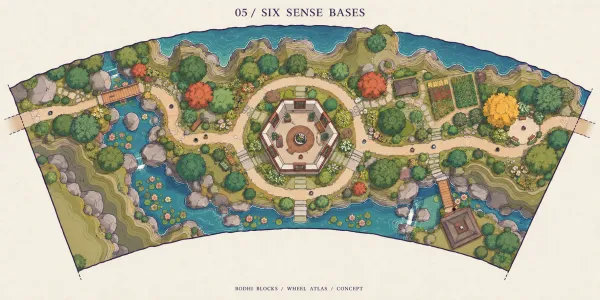
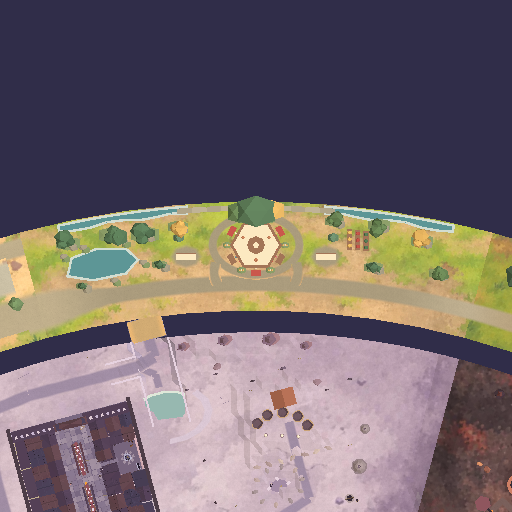
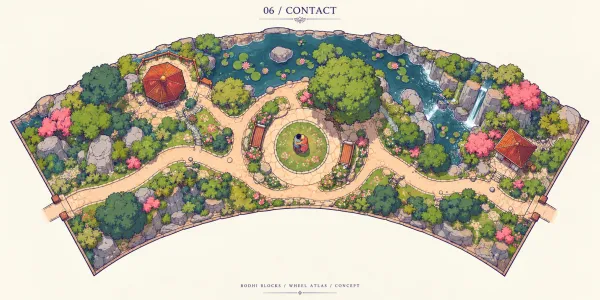
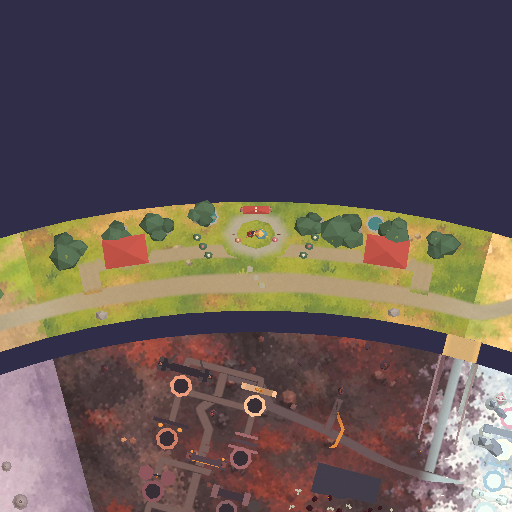
What canon says about each realm of the Wheel and the lands beside it: Jambudvīpa and the four continents, the animal realm, the hidden lands, the heavens on and above Meru, the asuras, the hungry ghosts, the hells, the hub and rim of the Wheel, the dark and the bardo, the charnel grounds, Tanaduk and the pure lands. Each topic carries every piece of art that shows it and a zoomed crop where the art shows it only in part. Gathered 2026-10-30 for the overworld layout studies: lore first, then layout. The checklist follows at What the game has.
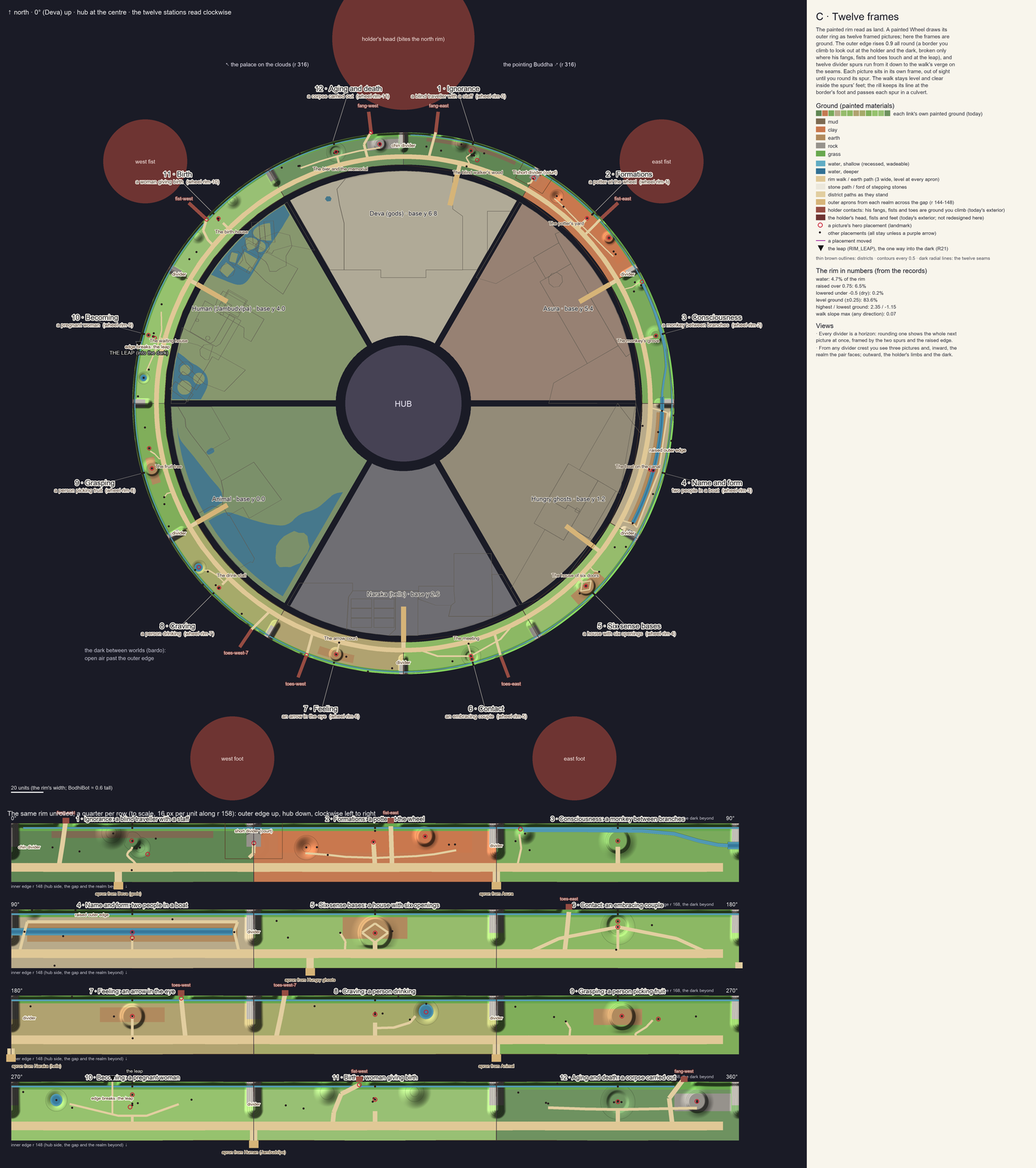
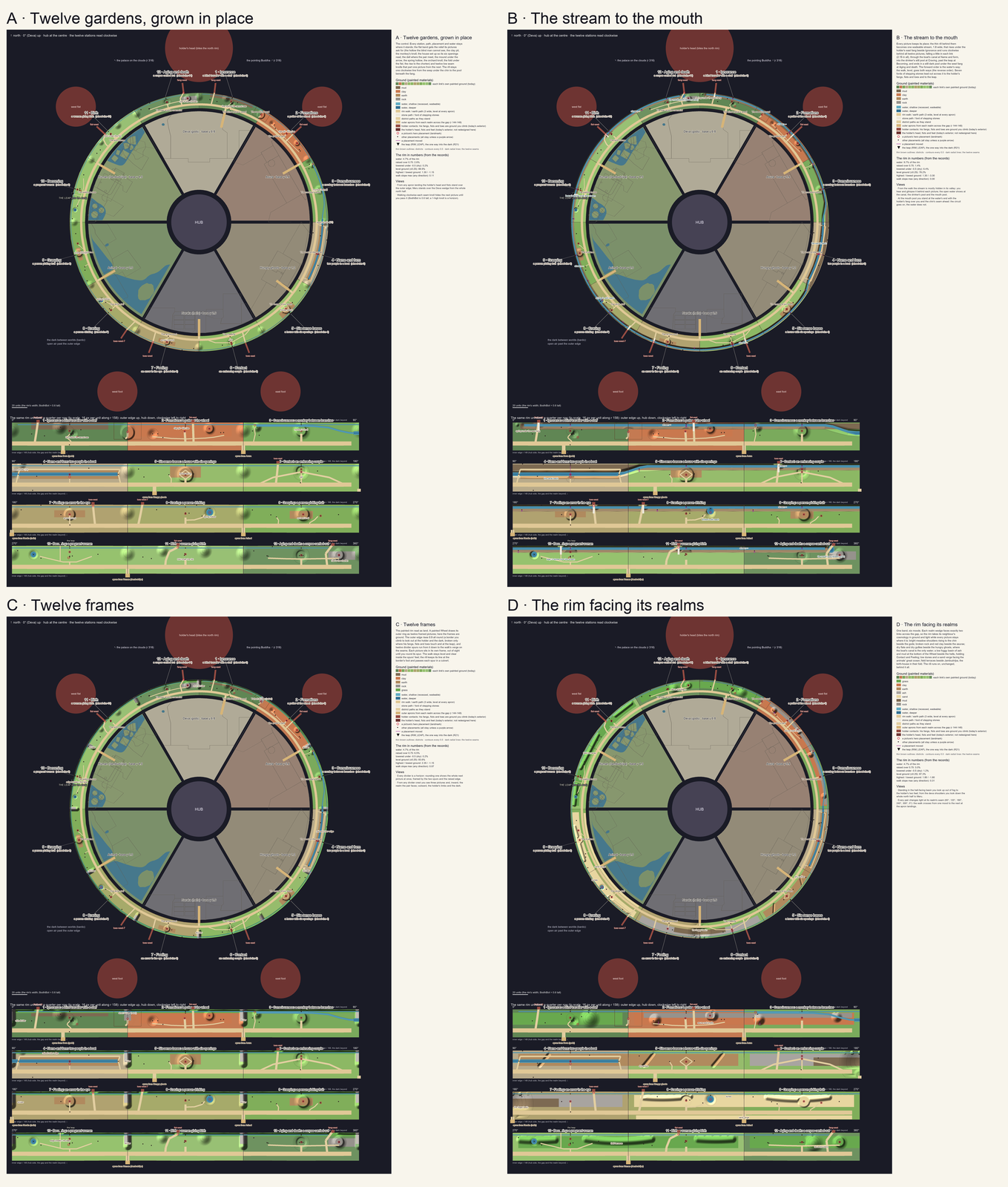
Chosen layout: C · Twelve frames
Twelve divider spurs frame the twelve links like the painted cartouches, so each picture is hidden until she rounds its spur. A raised outer edge breaks only at the holder's contacts and the leap; B's stream is a later optional layer.
Planned: building starts after the Human and Animal overhaul.
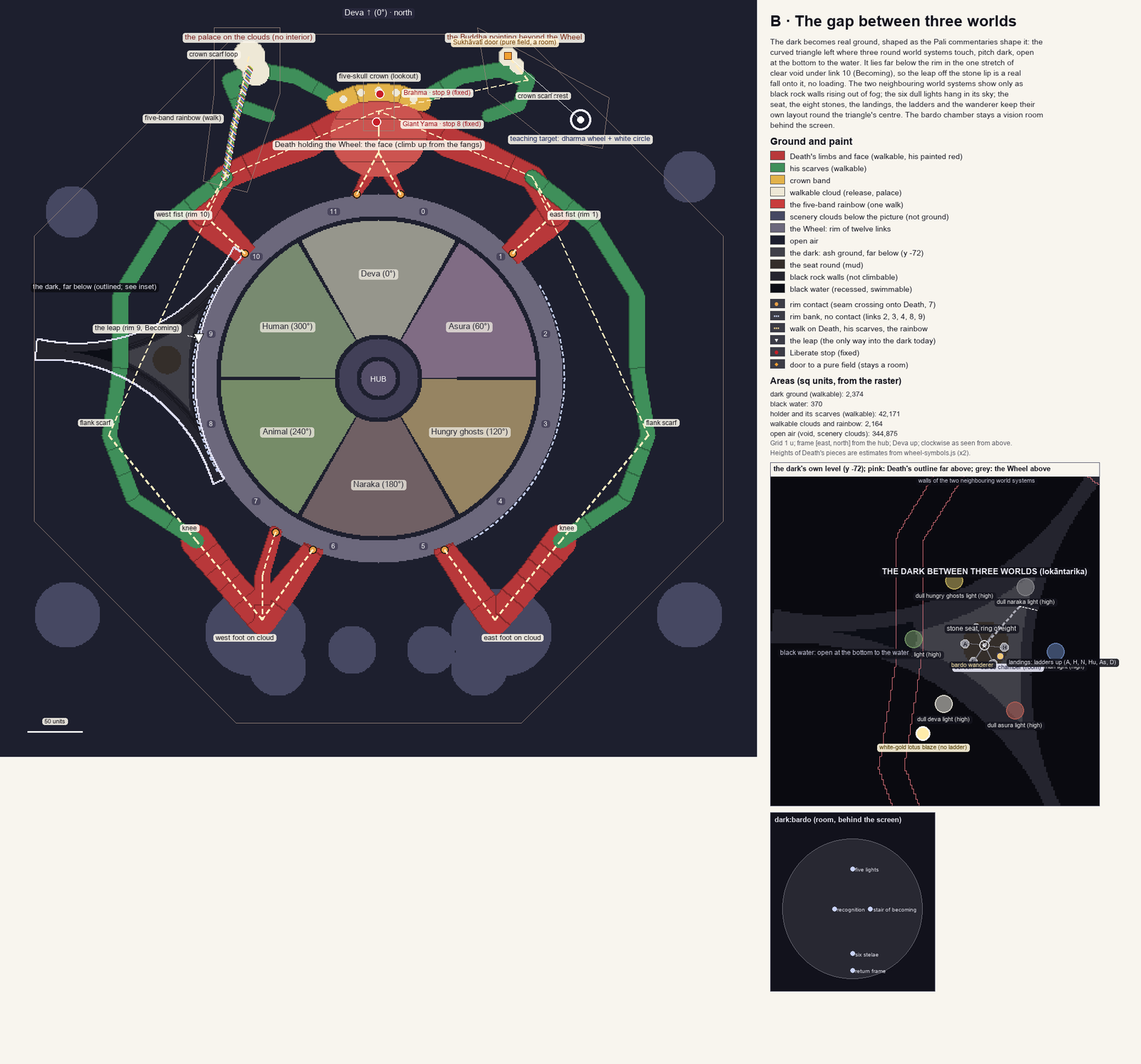
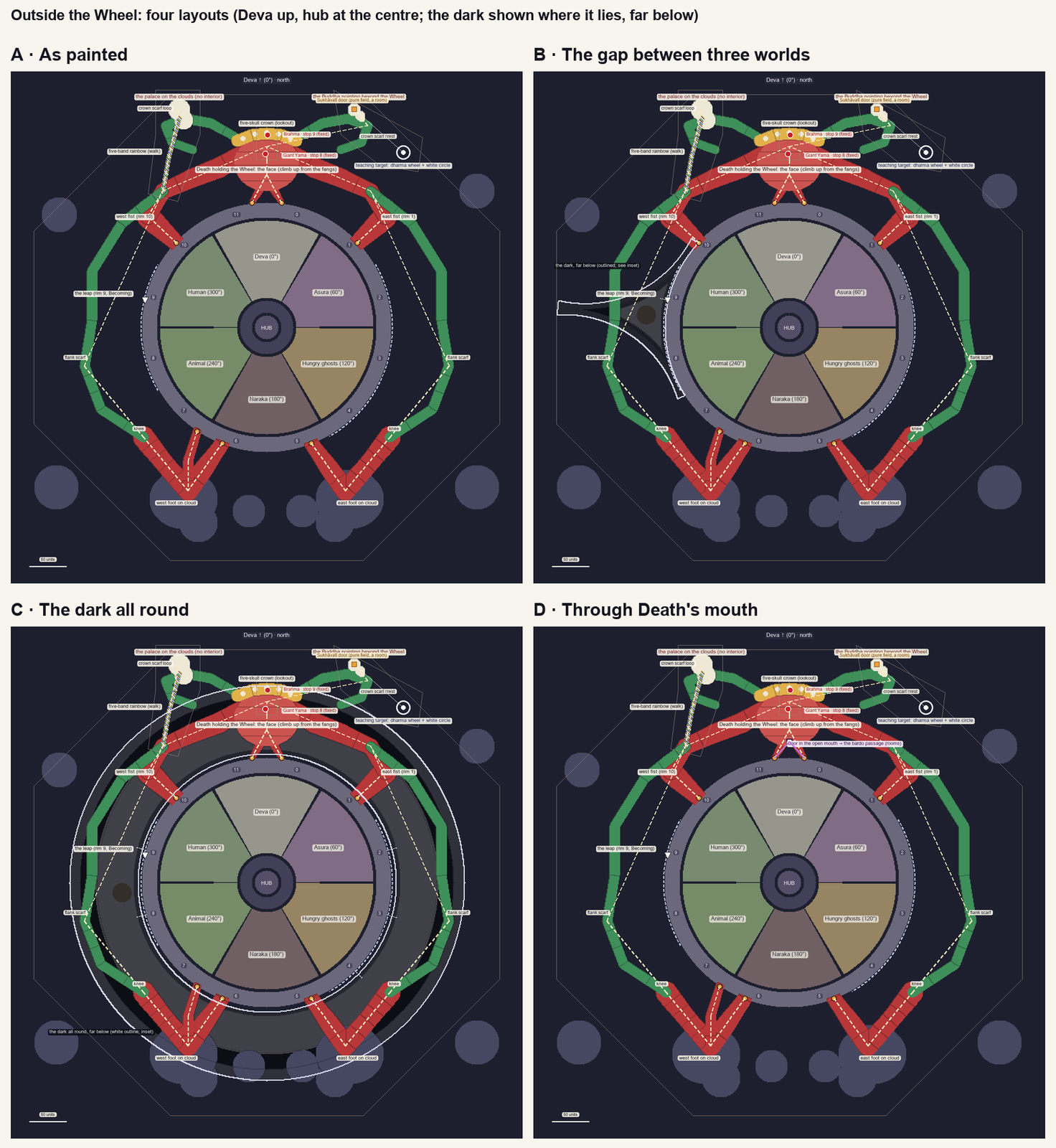
Chosen layout: B · The gap between three worlds
The dark becomes walkable ground in its canon shape, the curved triangle between three world systems, under link 10, so the existing leap is a real fall onto it. D's bardo passage through Death's mouth is the planned second step.
The hub and the Wheel: three poisons, two paths, twelve links, the holder and the way out
The Wheel of Life is the frame of the whole game world: the three poisons at its hub, the white and black paths round them, the six realms, the twelve links on its rim, the figure of impermanence that holds it and the Buddha who points beyond it. This group gathers what the Divyāvadāna, the Mūlasarvāstivāda Vinaya and its commentators fix about painting a Wheel at the monastery gate, how the standard Tibetan pictures came to be and how real paintings vary, with crops of the hub, the rim links, the holder and the outside figures from every open-licence Wheel we could show, plus what the game has already built at the hub, on the rim, on the two paths and outside the Wheel.
The hub: pig, snake and bird
Skt. rāga, dveṣa, moha (the three poisons, triviṣa); Tib. 'dod chags, zhe sdang, gti mug; dug gsum
At the centre of every Wheel three animals turn: a pig for ignorance, a snake for hatred and a bird, usually a rooster, for desire.
The innermost of the Wheel's circles holds three animals. A black pig stands for ignorance, a green snake for anger and aversion, and a bird for desire and attachment. In Tibetan and Himalayan paintings the bird is a rooster; most often the three bite one another's tails and form a ring.
The oldest written instruction says a pigeon, not a rooster. In the Divyāvadāna the Buddha orders a five-part wheel for the monastery gate and says that in its middle passion, hatred and delusion are to be shown: passion as a pigeon, hatred as a snake, delusion as a pig. The Chinese Vinaya adds a Buddha image in a white circle at the hub with the three symbols in front of it; the Tibetan Vinaya names only the three poisons and no animals, and the Indian commentators Vimalamitra, Vinītadeva and Guṇaprabha supply the pigeon, snake and pig.
Guṇaprabha's Vinayasūtra adds the detail that the pigeon and the snake are shown being swallowed by the pig: attachment and aversion come out of ignorance. Some Tibetan teachers hold the same view and say the pig should bite the tails of both the others.
The hub is a teaching picture, not a place. It is not Mount Meru, which stands in the gods' realm, and no being lives in it.
What canon fixes for the map
Three animals at the hub: pig = ignorance, snake = aversion, bird = desire [HAR 6913; HAR 78].
The bird is a pigeon in the Divyāvadāna, the Chinese Vinaya and the Indian commentators; a rooster in Tibetan and Himalayan painting [Divy. XXI; Mejor; HAR 6913].
Chinese Vinaya: a white circle at the hub with a Buddha image, the three symbols in front of it; Tibetan Vinaya: only the three poisons named; Divyāvadāna: the three animals, Buddha image elsewhere pointing at the white circle of nirvāṇa [Mejor; Teiser p. 55 via HAR 6913].
Guṇaprabha: pigeon and snake 'being swallowed by delusion' (the pig) [Mejor, Vinayasūtra 218].
Ground colour varies: blue (HAR 78, 86935), black (HAR 591), dark red (Sera), white (Wellcome drawing, Thiksey) [HAR items; Commons photos].
The hub is a diagram, not Meru and not a country [repo research note; wheel-hub.dais.not-meru].
Who lives here
The pig, snake and bird are symbols, not beings; canon gives them no names or stories.
In the game now
Samsara realm `hub`: place:three-poisons:hub (built, section wheel-hub), being:three-poisons:pig, being:three-poisons:snake, being:three-poisons:bird (all built as one sculpture on the dais; no concept, model or dialogue passes). The game follows the painted rooster, not the pigeon.
Wellcome Collection (repo copy, media.json painting-wellcome-L0069380; V0017705 is a second photograph of the same painting) · traditional · Public Domain Mark (Wellcome); V0017705 CC BY 4.0
The repo's own Wheel: a brown boar, a green snake and a red rooster on a grey disc inside a white ring; the bird and snake rise out of the pig.
Himalayan Art Resources, Jeff Watt · traditional · No open licence (link only)
Every example in the set shows the pig biting the tails of both the snake and the bird; the page quotes Teiser's translation of the pigeon-snake-pig instruction.
Himalayan Art Resources / Brooklyn Museum · traditional · No open licence (link only)
HAR's set text names this as the one known Himalayan Wheel with a Buddha at the hub; the item page itself describes only pig, snake and rooster on blue, so check the image before relying on it.
Himalayan Art Resources / Rubin Museum of Art · traditional · No open licence (link only)
Jeff Watt's standard reading of the four circles: hub, white/black ring, six realms, twelve links from bottom left clockwise.
Still missing: No open-licence image of a hub with the Buddha at its centre (the Chinese Vinaya form) or of the pigeon variant; HAR 86935 is link-only.
Repo research note: Great Wheel geography (docs/wheel-geography-canonical-research-2026-10-01.md = public/purelands/wheel-geography-research.md), Source register W and V-excerpt; 'Center, karmic bands and exterior'; rim table
How the three animals are arranged
Painters arrange the hub five ways: a tail-biting ring, the pig biting both tails, three loose animals, a stack, or the animals below a Buddha.
Jeff Watt lists five placements seen in Himalayan Wheels. Most often each animal bites the tail of the next and the three form a circle. In the second, the pig alone bites the tails of the snake and the bird. In the third the three simply stand in the disc without touching. In the fourth they are stacked upward, sometimes on a tree with the pig at the base, the snake climbing and the bird on top. In the fifth they sit below or beside a Buddha.
Some Tibetan teachers say only the second arrangement is right, because attachment and aversion grow out of ignorance; Guṇaprabha's 'swallowed by delusion' is the Indian root of that view. The paintings gathered here show how loosely the rule is kept: Sera's animals chase nose to tail, the Library of Congress scroll and the Seattle mural have bird and snake issuing from the pig's mouth, Thiksey has the bird holding the snake.
No text fixes which way round the ring turns. The game's clockwise chase is its own rule, taken from its clockwise invariant, not from the Vinaya.
What canon fixes for the map
Five arrangements: ring; pig biting two tails; disassociated; stacked; below or beside a Buddha [HAR 6913].
'Right order' argued by some teachers: pig bites snake and bird [HAR 6913; Mejor on Guṇaprabha].
No source fixes the direction of rotation; clockwise is adaptation [wheel-hub.dais.clockwise].
In the game now
wheel-hub.dais: three animals on one ring 120 degrees apart, interlocked nose to tail and chasing clockwise (adapted, section wheel-hub).
Repo world plan: docs/world-plan/sections/wheel-hub.json, account, districts, claims, adaptation
The white path and the black path
Tib. dkar po'i lam, nag po'i lam (the second circle)
Round the hub a ring is split in two: on its white half beings of good karma climb toward the gods, on its black half beings of bad karma fall naked toward the hells.
The second circle of a painted Wheel is half white and half black. On the white half, people who did good move upward, often as monks, nuns and lay people walking with offerings; on the black half, people who did wrong fall headlong, naked, roped and driven by the red and green attendants of the Lord of Death. Jeff Watt reads them as good karma and bad karma; Eric Huntington adds that these results are themselves impermanent.
The old texts picture the same thing with a machine. The Divyāvadāna and the Vinaya say beings are to be shown sinking and rising by the contrivance of a water-wheel with buckets (ghaṭīyantra): the living show their heads, the dead their feet. Tibetan painters replaced the buckets with the two coloured halves.
Not every Wheel has this ring. The repo's Wellcome gouache and the Wellcome ink drawing go straight from the hub to the six realms; the Thiksey mural has no ring either. In HAR 591 the ring is read as beings rising through merit and falling when it runs out. Favourable rebirth stays inside saṃsāra: nobody on the white path is leaving the Wheel.
What canon fixes for the map
Second circle: white half, good karma ascending; black half, bad karma descending naked, led by Yama's red and green attendants [HAR 78; HAR 86935].
Textual root: beings rising and sinking like buckets on a water-wheel [Divy. XXI; Teiser p. 55 via HAR 6915; Mejor].
Which side is white varies: white left in Rubin C2004.21.1, Sera, Seattle and the LoC scroll [Rubin essay; Commons photos].
Some Wheels omit the ring entirely (Wellcome L0069380, Wellcome ink drawing, Thiksey) [repo media; Commons].
The white path is rebirth among gods and humans, not liberation [HAR 591; repo wheel-ascent claims].
Who lives here
Attendants of the Lord of Death, red and green, who drive the falling [HAR 78].
In the game now
being:three-poisons:rising and being:three-poisons:falling (built as sculptures); sections wheel-ascent (west, light half) and wheel-descent (east, dark half). See built-wheel-paths.
Photo Hiroki Ogawa, Panoramio (via Wikimedia Commons) · photo · CC BY 3.0
The clearest open photograph: white half left with monks and laymen walking up, black half right with naked figures tumbling head first, a demon dragging at the top.
Rubin Museum of Himalayan Art · traditional · No open licence (link only)
The game's selected composition: white half left, black half right, Buddha upper right pointing to an inscription cartouche, dharma wheel and small white circle upper left. Eric Huntington's essay walks every part: https://rubinmuseum.org/projecthimalayanart/essays/wheel-of-existence/
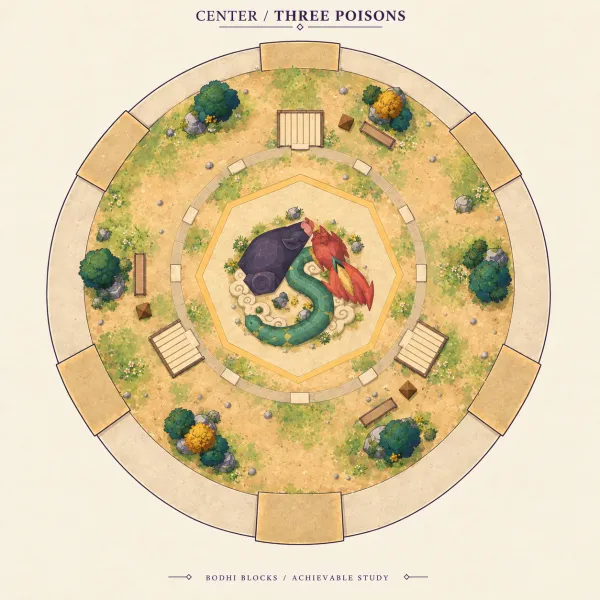
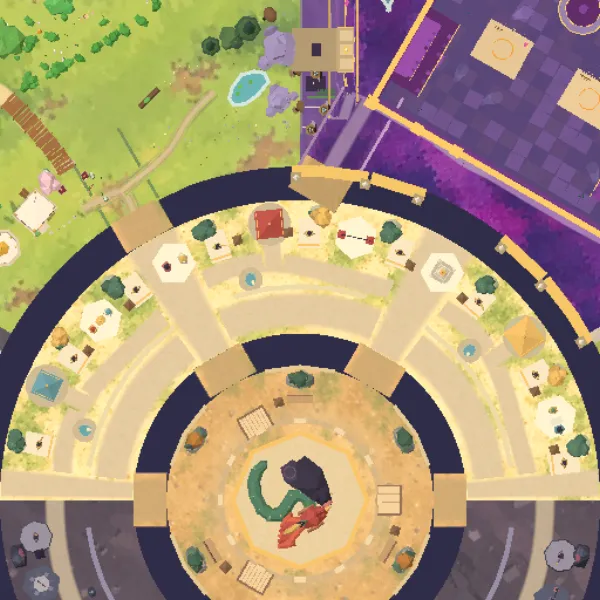
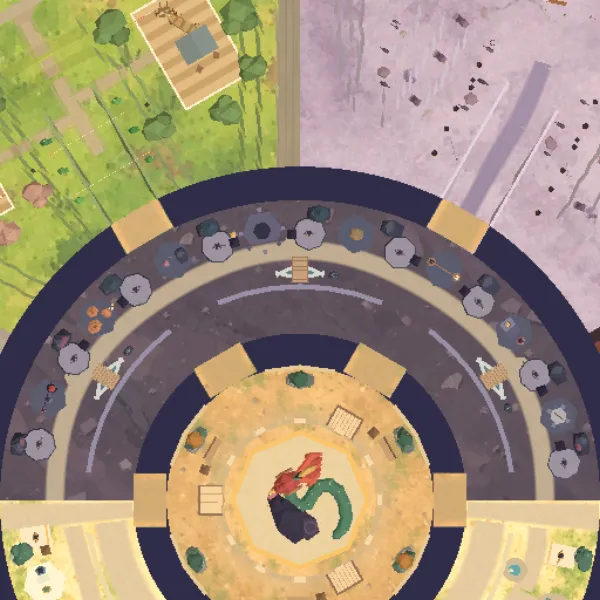
A walled garden court at the Wheel's centre with the three animals as one sculpture on an octagonal dais, a walk round it, six spoke bridges out, and BodhiBot's home hung beneath it.
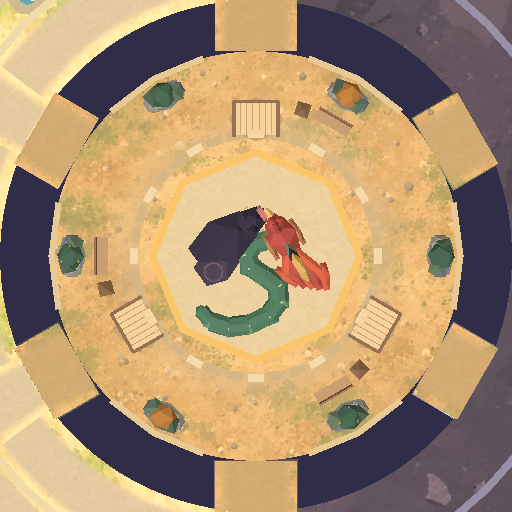
The plan chooses the painted convention: a pig, a rooster and a snake interlocked nose to tail, set as one sculpture on a three-tiered octagonal dais (top at 0.5) in a small court of radius 8 at world (0,0). A sandstone promenade circles it (r 4.4 to 7.6) inside a low kerb that opens only at the six spoke heads. Three viewing bays, seats, lamps and three planted pockets make it a place to stop. Nothing else stands in it: the centre holds only the stair's stone axle, capped in gold.
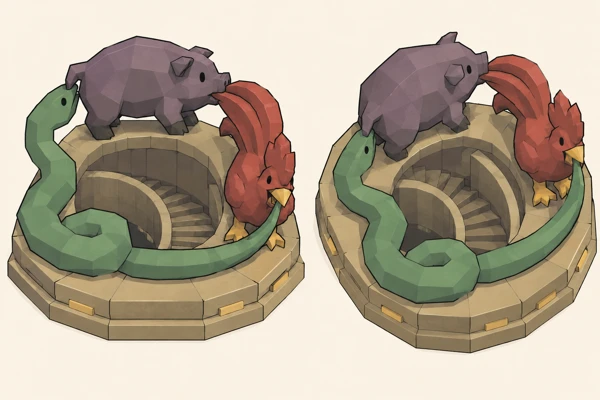
Districts: wheel-hub.dais (the three poisons), wheel-hub.circuit (the walk and the six spokes), wheel-hub.home (BodhiBot's home under the hub, a platform hung by three chains over Yama, with an energy wall that shows only where touched) and home (her room: bedroll, zafu, desk, keepsakes). A stair well 1.45 across opens in the middle of the dais down to the home.
Canon vs adaptation: the three animals and their meanings are sourced (HAR 78). Interlocking is sourced; the exact mouth-to-tail cycle, the clockwise chase, the clear centre, the bays, seats, lamps, spokes and the home are the game's. The Vinaya's pigeon and central Buddha are recorded as alternatives, not built. Reading the hub as Meru is rejected.
Travel sets her down at polar (12, 180°) on the Naraka spoke line facing the centre; the Contemplate sign there reads 'Pig, rooster and snake: ignorance, attachment and aversion keep the wheel turning.' Free Roam starts at home under the hub (R20).
What canon fixes for the map
Hub r 0–8, flat at y 0; dais three octagonal tiers, top 0.5 [wheel-hub terrain].
Six spokes at 0°, 60°, 120°, 180°, 240°, 300° (Deva north, Asura, Hungry Ghost, Naraka south, Animal, Human) cross the r 8–10 open-air gap to the inner ring [wheel-hub seams].
Animals on one ring of radius 2.6, 120° apart, turned 30° off the spoke lines [wheel-hub landmarks].
No character has its home on the dais; BodhiBot's home is under it [wheel-hub.home].
Who lives here
BodhiBot (player companion; home under the hub).
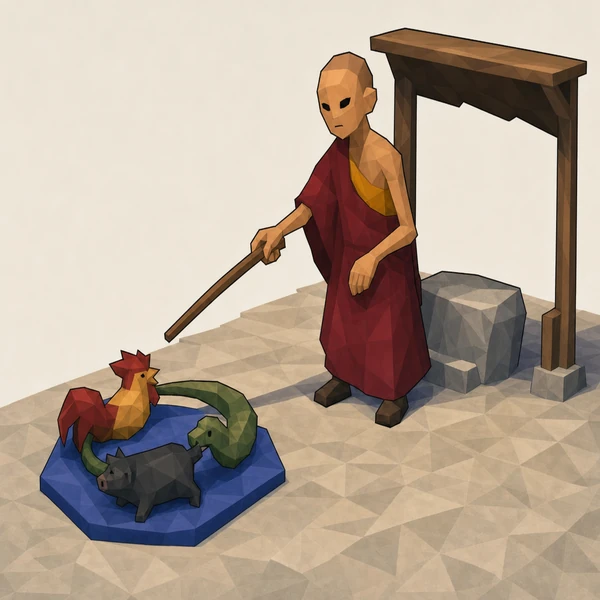
The monk who explains the Wheel (atlas being wheel-hub-explainer, concept only, not yet placed): the game's nod to the Vinaya's appointed monk at the gate.
In the game now
Samsara `hub`: place:three-poisons:hub built; being:three-poisons:pig/snake/bird built as the sculpture. Section file docs/world-plan/sections/wheel-hub.json; current map public/atlas/terrain-review/alternatives/current-top-down/wheel-hub.png.
Art (6)
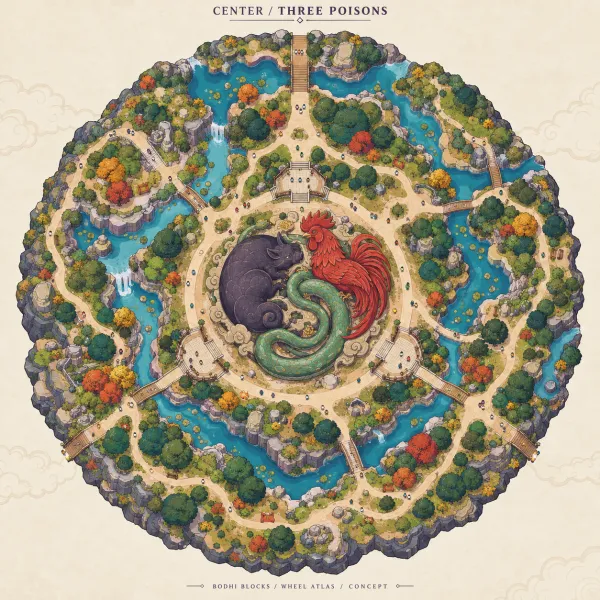
Wheel hub: concept (07-three-poisons)
Project art (repo wheel-concepts) · concept · Project art
The original numbered concept for the hub court.
Wheel hub: view from above (in-world capture)
Project capture · world-view · Project art
The built court as it stands: dais, promenade, kerb and the six spoke heads.
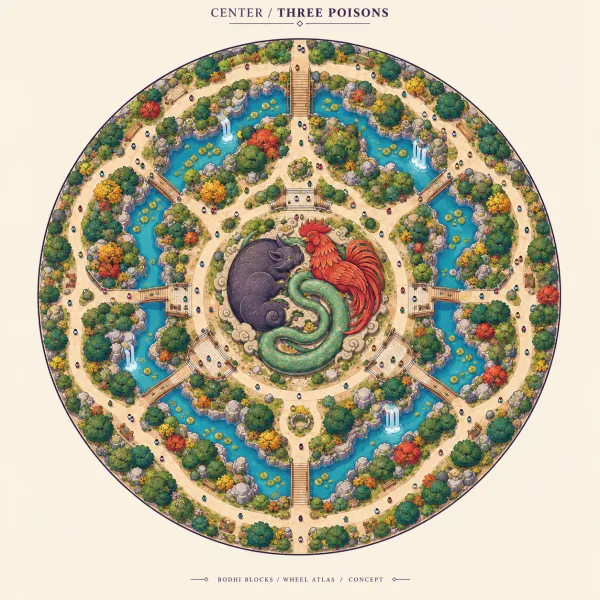
Wheel hub: achievable map study
AI concept study (repo) · layout-study · Project art
Layout study of the court within the current kit.
Wheel hub: ambitious map study
AI concept study (repo) · layout-study · Project art
The fuller alternative study.
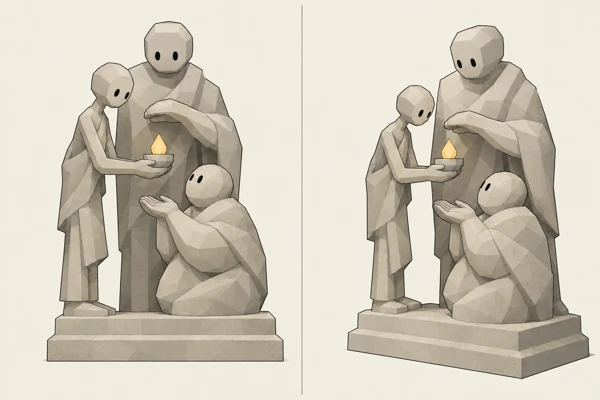
Statue concept: three poisons and open stairwell
AI concept study (repo) · concept · Project art
Concept for the sculpture group with the stair well at its centre (R20).
The monk who explains the Wheel (concept)
AI concept study (repo) · concept · Project art
Concept for the explainer monk; the Vinaya says a competent monk should be stationed at the gate to explain the Wheel.
Still missing: No ground-level capture of the sculpture; the three animals have no individual concept or model review yet.
Sources
Repo world plan: docs/world-plan/sections/wheel-hub.json, account, districts, claims, adaptation
Repo research note: Great Wheel geography (docs/wheel-geography-canonical-research-2026-10-01.md = public/purelands/wheel-geography-research.md), Source register W and V-excerpt; 'Center, karmic bands and exterior'; rim table
Why the Wheel is painted: the story and the instructions
The Buddha ordered a five-part wheel painted in the monastery gatehouse so that visitors could see what Maudgalyāyana used to tell them, and set a monk there to explain it.
Mahāmaudgalyāyana used to travel through the hells, the animal, ghost, god and human worlds and tell the four assemblies what he saw; crowds came and were helped. Since he could not be everywhere, the Buddha told Ānanda that a wheel with five parts should be made in the gatehouse (dvārakoṣṭhaka) of the monastery. The monks did not know how, so he spelled it out.
The instructions: the five destinies, with the hells, animals and ghosts below and gods and humans above, and the four continents; in the middle passion, hatred and delusion as pigeon, snake and pig; a Buddha image pointing at a white circle for nirvāṇa; beings rising and sinking like buckets on a water-wheel; round the rim the twelve links of dependent arising in forward and reverse order; and the whole gripped by impermanence. Two verses are to be written. When visitors asked what it meant and the monks said 'we also do not know', the Buddha ordered a monk appointed to the gatehouse to explain it, and after some bad appointments, a competent monk.
The story is in the Divyāvadāna (XXI, Sahasodgata) and in the Mūlasarvāstivāda Vinayavibhaṅga under the thirty-first pāyantika rule, where Śāriputra and Maudgalyāyana both tour the realms. The Chinese Vinaya, translated by Yijing in 703, is the most detailed: circles drawn like a cart wheel with five spokes, the hub with a Buddha and the three animals, how to depict the twelve links. A separate Vinayakṣudraka passage has Anāthapiṇḍada decorating Jetavana and puts the five-part wheel with the great miracle in the vestibule.
Teiser argues the Chinese text shaped where Wheels were painted: at the threshold between the entrance and the Buddha's hall, where they were also thought to protect. The earliest surviving Wheel is at Ajanta Cave 17 (5th century); Tibetan temples still paint it by the door.
What canon fixes for the map
Place: the gatehouse or vestibule of the monastery (dvārakoṣṭhaka, sgo khang) [Divy. XXI; Mejor].
Five parts (gatis): hells, animals, ghosts below; gods and humans above; four continents shown [Divy. XXI; Teiser p. 55].
Hub: pigeon, snake, pig; Buddha image pointing to a white circle of nirvāṇa; water-wheel of rising and sinking beings; twelve links forward and reverse; everything swallowed by impermanence; two verses [Divy. XXI; Mejor].
An appointed, competent monk explains the Wheel to visitors [Divy. XXI; Guṇaprabha sūtra 223 via Mejor].
Mahāmaudgalyāyana, the disciple whose tours of the realms the Wheel replaces.
Ānanda, who receives the instruction.
Śāriputra, who tours the realms with Maudgalyāyana in the Vinaya version.
The appointed monk at the gate.
In the game now
Nothing on the gate itself. The game's Wheel is the whole explorable world rather than a mural; being wheel-hub-explainer (concept only) is the appointed monk.
Rubin Museum Project Himalayan Art, photo Eric Huntington · traditional · No open licence (link only)
The 5th-century mural fragment on the veranda; link only.
Still missing: No open image of the Ajanta Cave 17 Wheel or of a Wheel in an actual gatehouse position (Commons has Ajanta veranda photos whose Wheel is hard to make out).
Skt. dvādaśāṅga-pratītyasamutpāda; Tib. rten 'brel yan lag bcu gnyis
The outer ring holds twelve small scenes, one for each link of dependent arising, read clockwise from the blind man to the corpse.
The outermost circle of the Wheel is divided into twelve. Each division holds one picture for one link in the chain of dependent arising: ignorance, formations, consciousness, name and form, six sense sources, contact, sensation, craving, appropriation, becoming, birth, and aging and death. The Rice Seedling gives the forward order ('ignorance causes formations...') and the reverse ('when ignorance ceases, formations cease...'); the Vinaya says both orders are to be painted, and the ring, having no end, shows both at once.
The standard Tibetan pictures are: blind man with a stick; potter; monkey; two people in a boat; house with six windows; embracing couple; arrow in the eye; drinking; picking fruit; pregnant woman or a couple; childbirth; a corpse carried out. The Chinese Vinaya prescribes a different set for several links (a rākṣasa for ignorance, a woman with a child for craving, a man fetching water for appropriation, Brahmā for becoming) and adds scenes for sickness, sadness and pain; Vinītadeva's lost source gives yet another list. Painters did not follow either exactly.
The sequence usually begins just after 12 o'clock or just after 6 o'clock and runs clockwise, but some Wheels start anywhere. Two of the images swap places between sources: the monkey and the fruit-picker. HAR's list has the fruit-picker at link three and a monkey holding fruit at link nine; the Wellcome drawing, HAR 591 and the repo have the monkey at three and the fruit-picker at nine.
The twelve scenes are a dependent process, not twelve countries or twelve beings. The repo's research note says so, and the sections built on the rim are teaching gardens with no residents.
What canon fixes for the map
Order fixed by The Rice Seedling 1.4–1.5 (forward and reverse) [Rice].
Twelve standard Tibetan images as listed by HAR 6927 and the Wellcome catalogue [HAR 6927; Wellcome 47116i].
Start position varies: bottom left (HAR 78), 12 o'clock (HAR 591, 62807), 1 o'clock (HAR 7564), top right (Wellcome drawing); no cardinal rule [HAR 6927].
Chinese Vinaya variants and extra scenes (old age, sickness, death, sadness, malady, pain, difficulty: a couple pulling a camel) [Teiser pp. 55–56 via HAR 6927].
Vinītadeva variants: woman, potter, monkey, couple, touching couple, suffering man, nursing mother, entering a womb, embryo, birth, old man, corpse [Mejor].
Not places or beings [repo research note, rim table].
In the game now
place:wheel-rim-0 … place:wheel-rim-11 all built (sections wheel-rim-0..11), one teaching garden per link, read clockwise from north; concepts /purelands/wheel-concepts/10–21. See built-wheel-rim and the twelve link topics.
Ms Sarah Welch (Wikimedia Commons), derived from the Wonderlane photo · map-study · CC BY-SA 4.0
A labelled teaching diagram of the same rim; CC BY-SA 4.0, kept as a link because the labels are a modern overlay.
Still missing: No open image of a Chinese-style rim with the extra scenes (camel, sickness); Dazu Baodingshan photos exist on Commons but were not checked.
Repo research note: Great Wheel geography (docs/wheel-geography-canonical-research-2026-10-01.md = public/purelands/wheel-geography-research.md), Source register W and V-excerpt; 'Center, karmic bands and exterior'; rim table
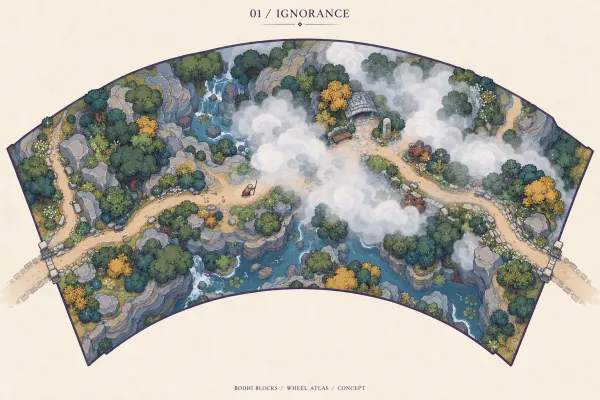
Link 1: Ignorance
Skt. avidyā; Tib. ma rig pa
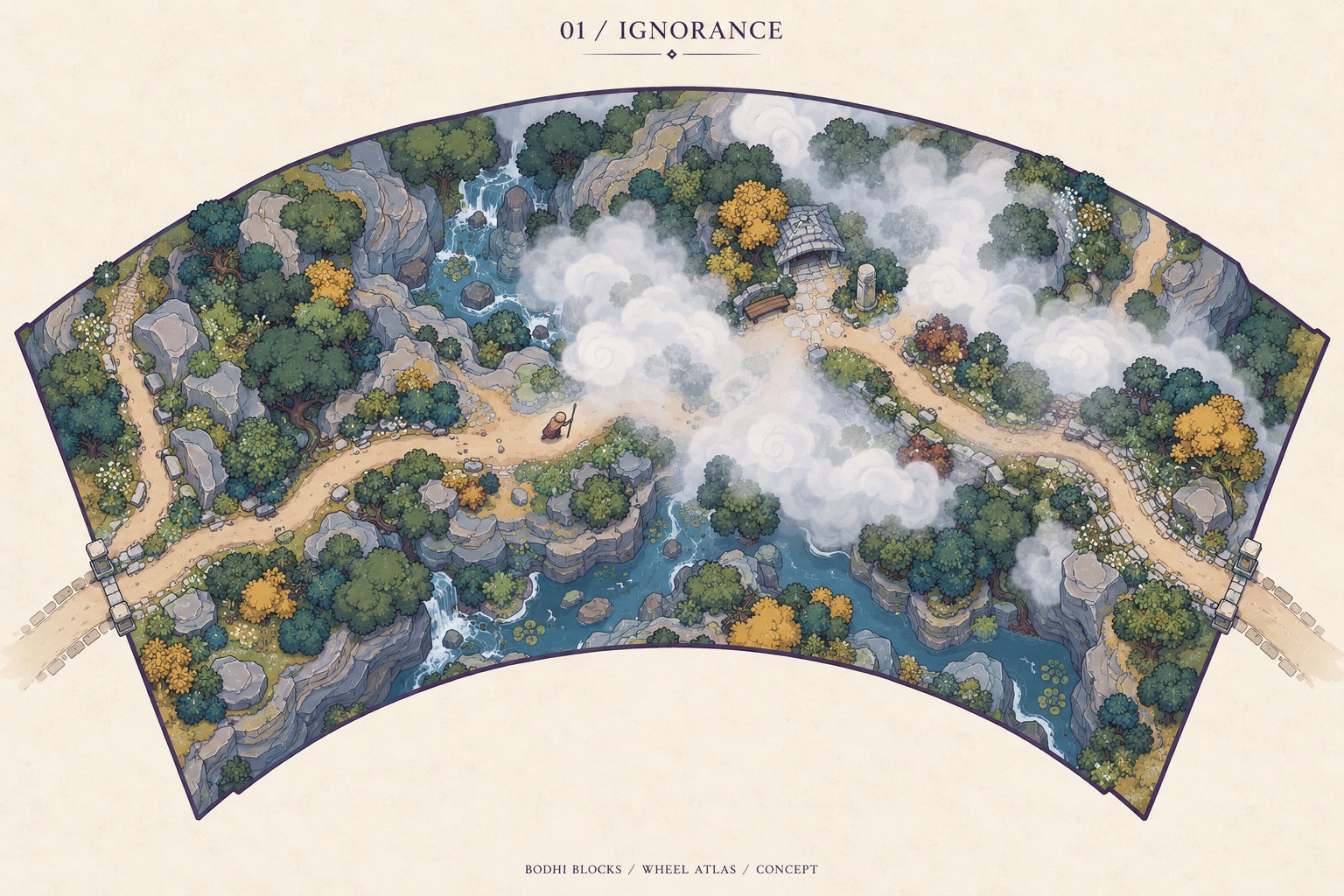
Ignorance is link 1 of twelve; painters show it as a blind man with a staff.
The first link. The Rice Seedling defines ignorance as not knowing the six elements as one, as the same, as permanent, stable or unchanging; it causes formations [Rice 1.29]. Painters show a blind person groping forward with a stick, because ignorance walks without seeing where it goes.
The Chinese Vinaya text prescribes a rākṣasa demon for this link instead; Vinītadeva's lost source gives a woman. The blind man is the Tibetan and Himalayan norm [HAR 6927].
What canon fixes for the map
Position on the rim: usually the first cartouche after 12 o'clock or after 6 o'clock; HAR 78 starts at bottom left, HAR 591 and 62807 at 12 o'clock, HAR 7564 at 1 o'clock, the Wellcome drawing at top right [HAR 6927; HAR 78; HAR 591; Wellcome 47116i].
Chinese prescription: a rākṣasa; Tibetan painted norm: blind man with stick [HAR 6927 Source Text].
The repo says blindness is misapprehension, never moral blame [wheel-rim-0 claims].
In the game now
place:wheel-rim-0 built (section wheel-rim-0, the 1st rim garden clockwise from north); concept /purelands/wheel-concepts/10-outer-*.png; in-world capture /atlas/terrain-review/in-world/wheel-rim-0.png.
Art (4)
link 1, ignorance: blind man led by a small figure
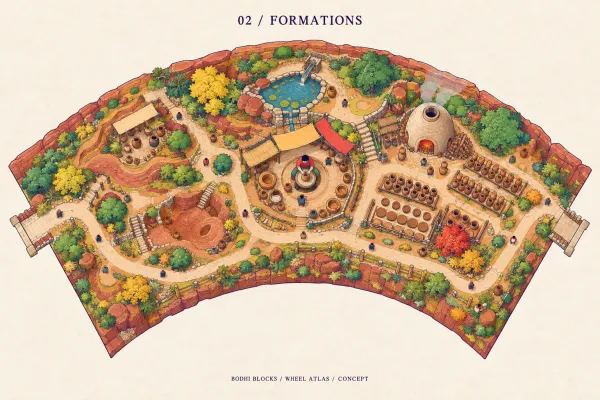
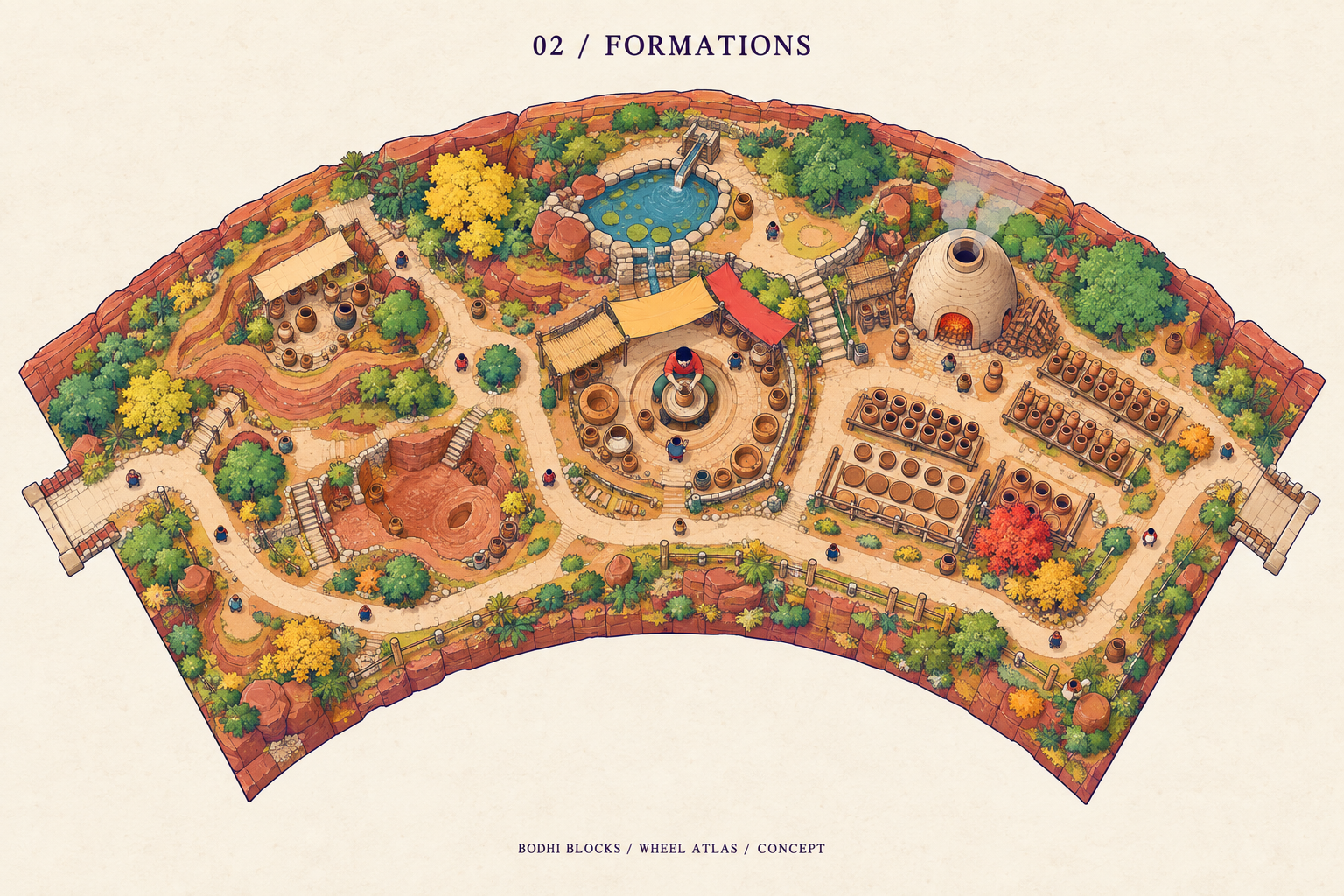
Formations is link 2 of twelve; painters show it as a potter at the wheel.
The second link, volitional formations or karma. The Rice Seedling calls them the three kinds of formation that arise from ignorance: meritorious, demeritorious and unwavering [Rice 1.29]. Painters show a potter turning clay on a wheel: shapes are made by repeated action and come out as pots of every kind.
The potter is the same in the Chinese text, in Vinītadeva and in every Tibetan painting; it is the most stable of the twelve images [HAR 6927; Mejor].
What canon fixes for the map
Second cartouche, clockwise after the blind man [HAR 591].
Image agreed by Chinese text, Vinītadeva and Tibetan painting: a potter with his wheel [HAR 6927; Mejor].
In the game now
place:wheel-rim-1 built (section wheel-rim-1, the 2nd rim garden clockwise from north); concept /purelands/wheel-concepts/11-outer-*.png; in-world capture /atlas/terrain-review/in-world/wheel-rim-1.png.
Art (4)
link 2, formations: potter shaping a pot, finished pots beside the wheel
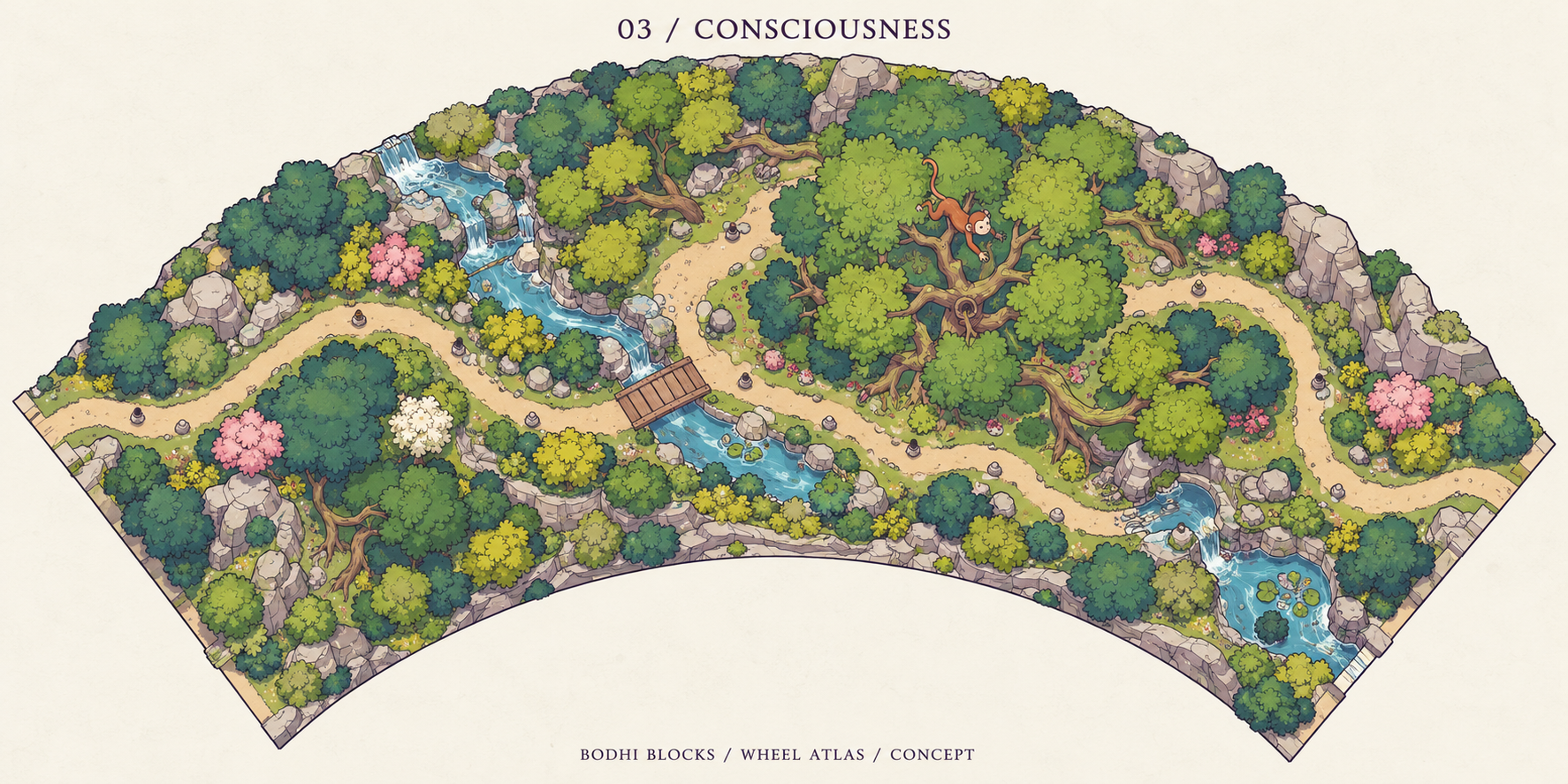
Consciousness is link 3 of twelve; painters show it as a monkey.
The third link, the six kinds of consciousness that formations give rise to [Rice 1.29]. The Tibetan painted norm is a monkey, restless and jumping from branch to branch; in the Library of Congress scroll and the Wellcome drawing it climbs a fruit tree.
HAR's list reads the third picture as 'a man picking fruit' and puts the monkey at link nine; the Wellcome drawing, HAR 591 and the repo put the monkey here and the fruit-gatherer at nine. Both orders are found in real paintings [HAR 6927; HAR 591; Wellcome 47116i].
What canon fixes for the map
Third cartouche. Monkey (Wellcome, HAR 591, Chinese text, Vinītadeva) or man picking fruit (HAR 6927 list) [Wellcome 47116i; HAR 591; HAR 6927; Mejor].
The Chinese text also gives a monkey for consciousness [HAR 6927 Source Text].
In the game now
place:wheel-rim-2 built (section wheel-rim-2, the 3rd rim garden clockwise from north); concept /purelands/wheel-concepts/12-outer-*.png; in-world capture /atlas/terrain-review/in-world/wheel-rim-2.png.
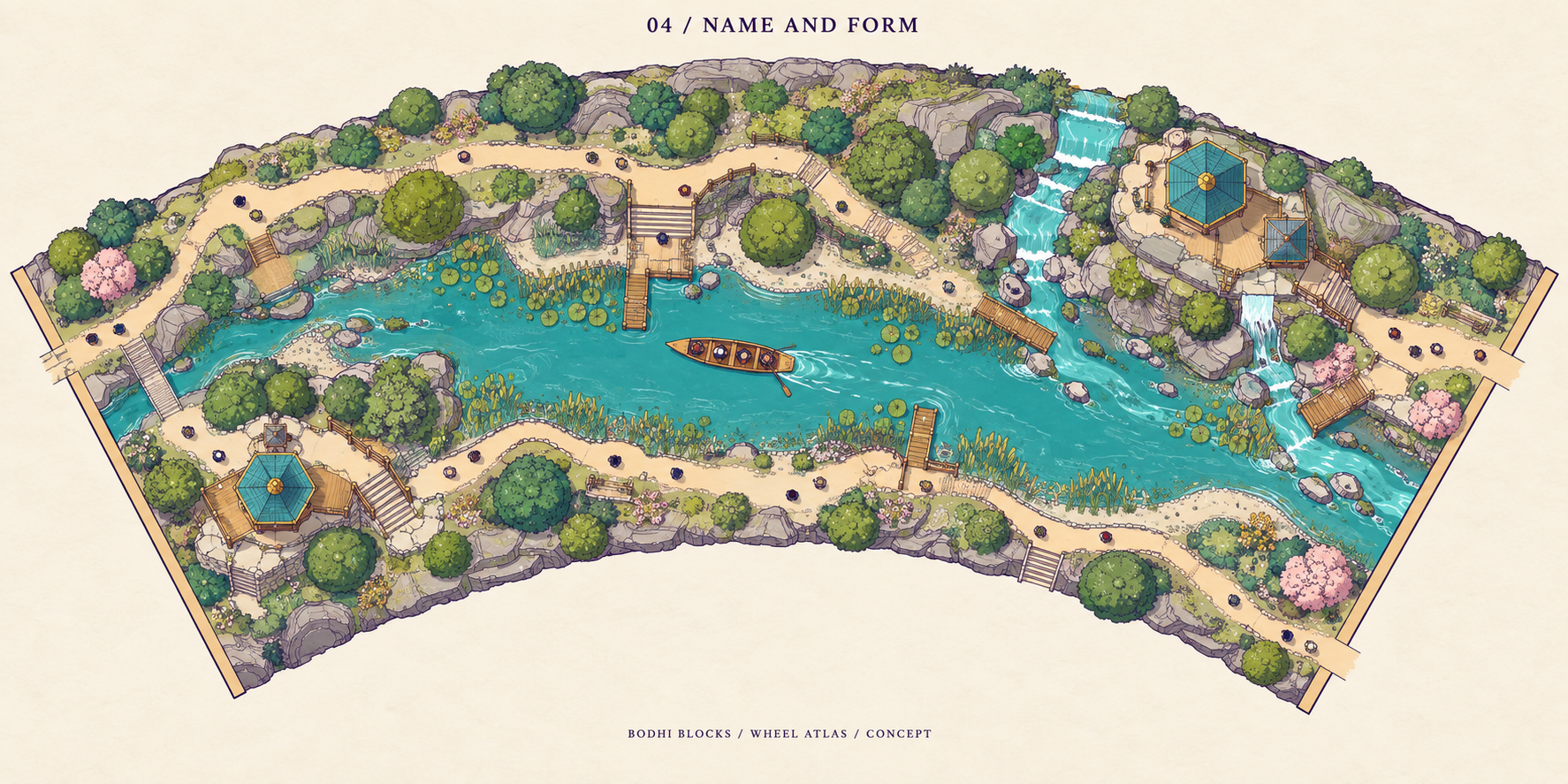
Name and form is link 4 of twelve; painters show it as two people in a boat.
The fourth link: the four formless aggregates (name) and form, which arise together from consciousness [Rice 1.29]. Painters put two or more people in a boat: the body is the boat, the mind its passenger, and neither crosses alone.
Vinītadeva's source gives 'a couple' for this link; the Chinese text and Tibetan paintings give the boat [Mejor; HAR 6927].
What canon fixes for the map
Fourth cartouche: two people in a boat [HAR 6927; HAR 591; Wellcome 47116i].
Vinītadeva variant: a couple [Mejor].
In the game now
place:wheel-rim-3 built (section wheel-rim-3, the 4th rim garden clockwise from north); concept /purelands/wheel-concepts/13-outer-*.png; in-world capture /atlas/terrain-review/in-world/wheel-rim-3.png.
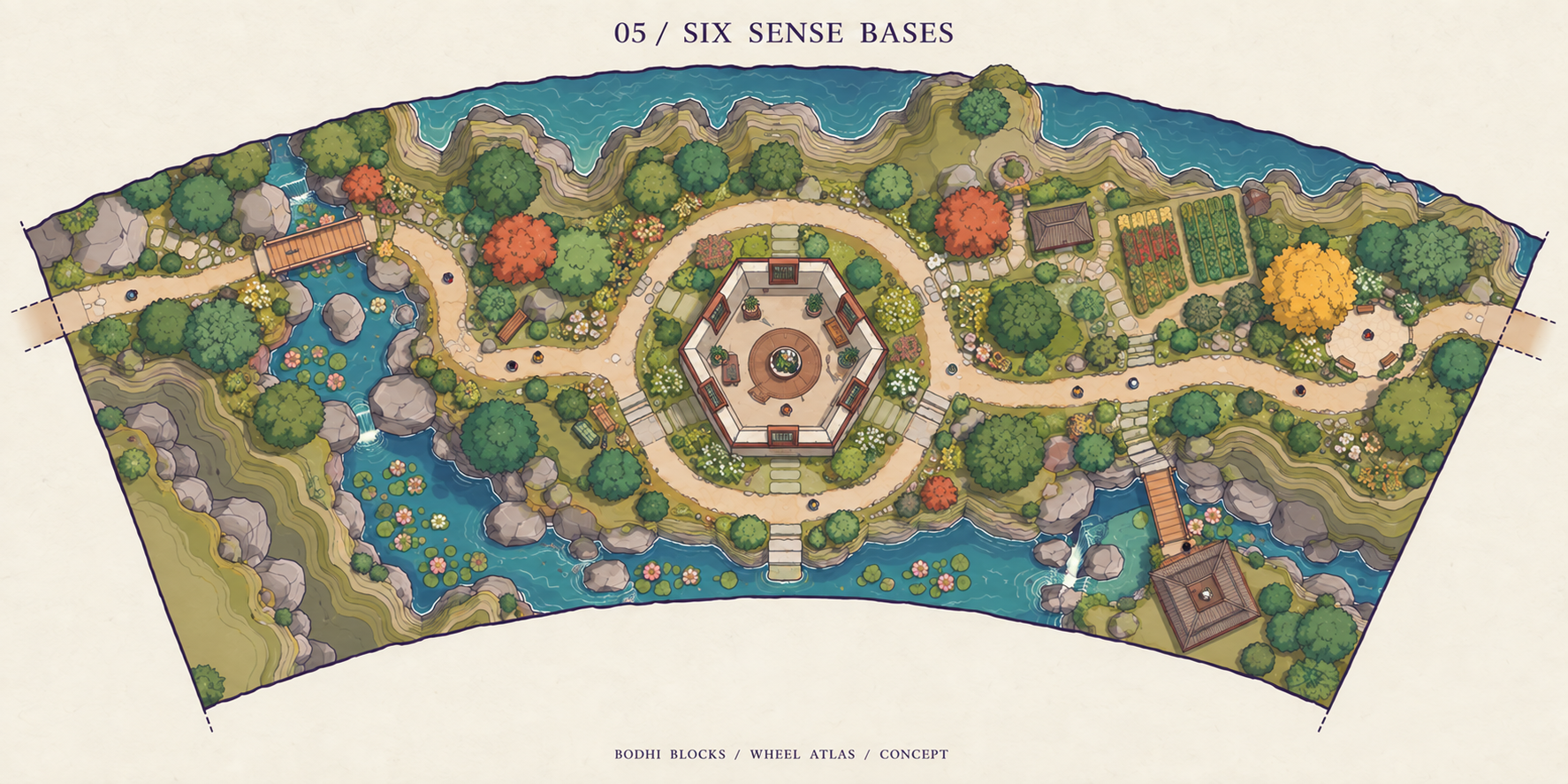
Six sense sources is link 5 of twelve; painters show it as an empty house with six windows.
The fifth link, the six sense sources that arise from name and form [Rice 1.29]. The picture is an empty house with openings: five windows and a door, or six windows, one for each sense. In the Library of Congress scroll it is a white Tibetan house.
The Chinese text agrees: a house with six windows [HAR 6927 Source Text].
What canon fixes for the map
Fifth cartouche: house with six windows (or five windows and a door) [HAR 6927; HAR 591; Wellcome 47116i].
The repo counts exactly six openings as its acceptance test; the hexagon and the six emblems are the game's [wheel-rim-4 claims].
In the game now
place:wheel-rim-4 built (section wheel-rim-4, the 5th rim garden clockwise from north); concept /purelands/wheel-concepts/14-outer-*.png; in-world capture /atlas/terrain-review/in-world/wheel-rim-4.png.
Art (4)
link 5, six sense sources: white house with windows
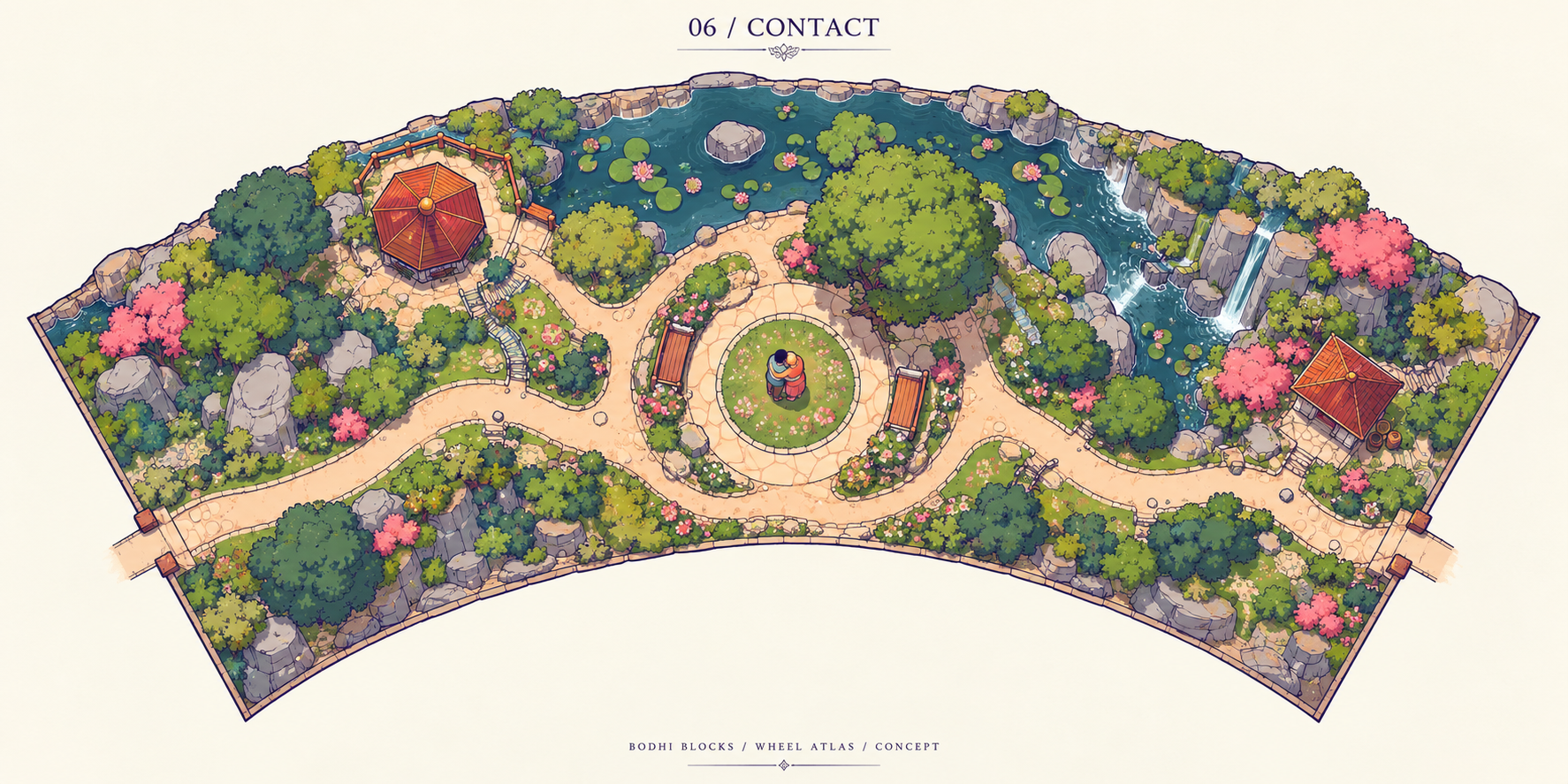
Contact is link 6 of twelve; painters show it as a couple embracing.
The sixth link, the meeting of sense, object and consciousness [Rice 1.29]. The picture is a man and a woman embracing or touching. Contact is wider than touch, but touch is the plainest contact there is.
Vinītadeva's source gives a touching couple here too [Mejor].
The repo keeps the pair readable without explicit sexual imagery [wheel-rim-5 claims].
In the game now
place:wheel-rim-5 built (section wheel-rim-5, the 6th rim garden clockwise from north); concept /purelands/wheel-concepts/15-outer-*.png; in-world capture /atlas/terrain-review/in-world/wheel-rim-5.png.
Art (4)
link 6, contact: couple seated close together under a tree
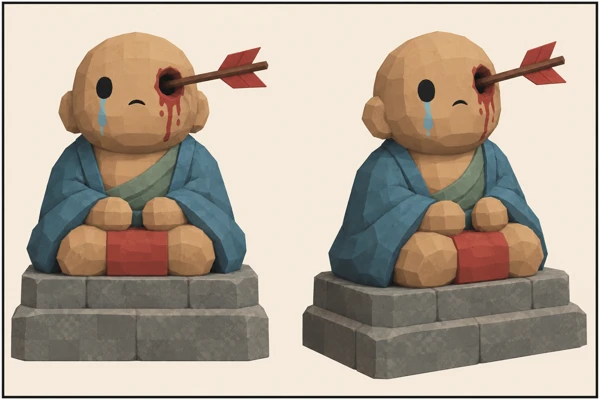
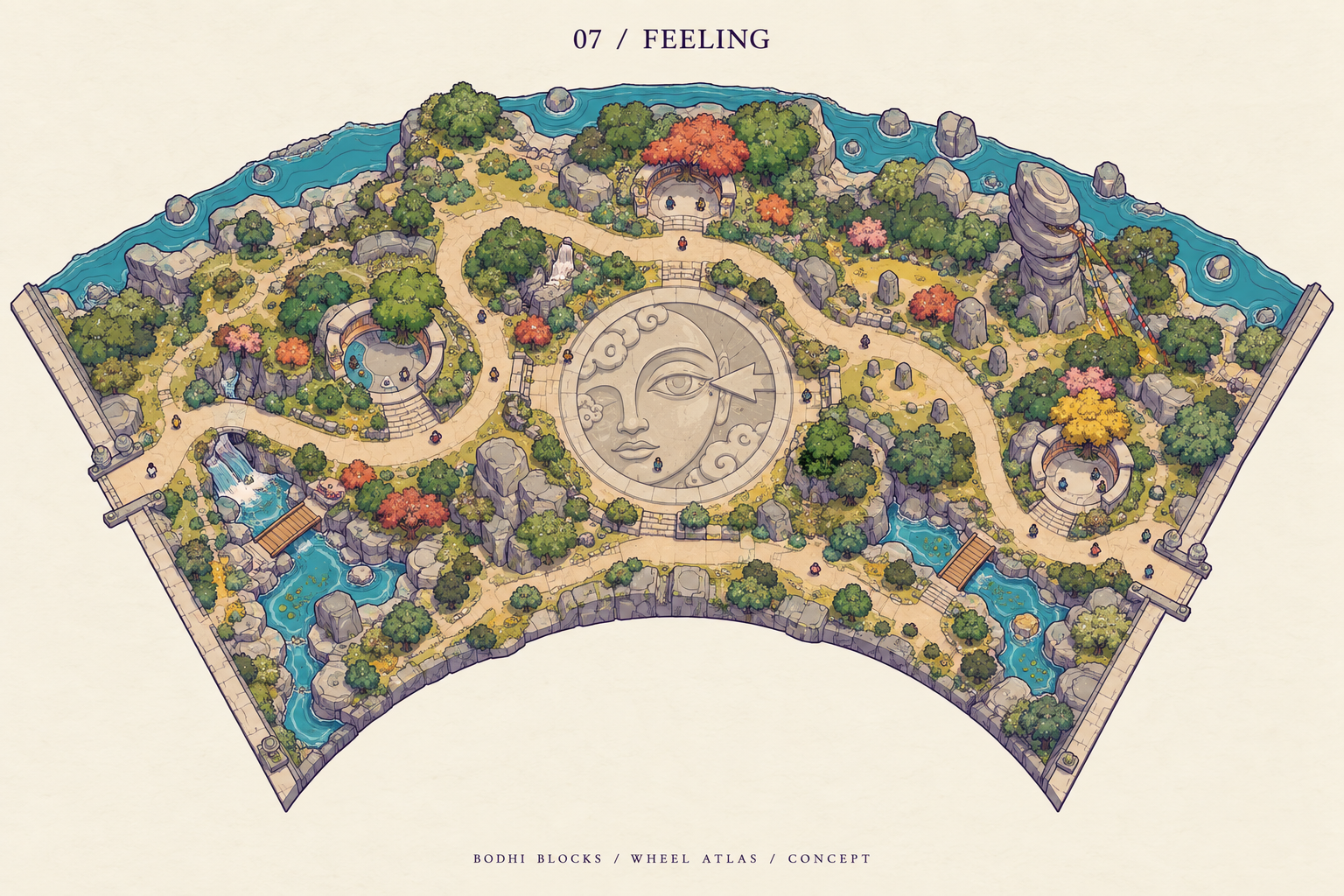
Sensation is link 7 of twelve; painters show it as an arrow in the eye.
The seventh link, sensation: pleasant, painful and neither, arising from contact [Rice 1.29]. The picture is a person struck in the eye by an arrow, the sharpest sensation a painter can draw.
Vinītadeva's source gives 'a suffering man'; the arrow is the Tibetan painted norm [Mejor; HAR 6927].
What canon fixes for the map
Seventh cartouche: arrow in the eye [HAR 6927; HAR 591; Wellcome 47116i item 7, 'Arrow in a man's eye'].
Rule R7 in the repo keeps the arrow in the eye unsoftened [wheel-rim-6 claims].
In the game now
place:wheel-rim-6 built (section wheel-rim-6, the 7th rim garden clockwise from north); concept /purelands/wheel-concepts/16-outer-*.png; in-world capture /atlas/terrain-review/in-world/wheel-rim-6.png.
Art (4)
link 7, sensation: seated figure under a tree with a hand to the eye
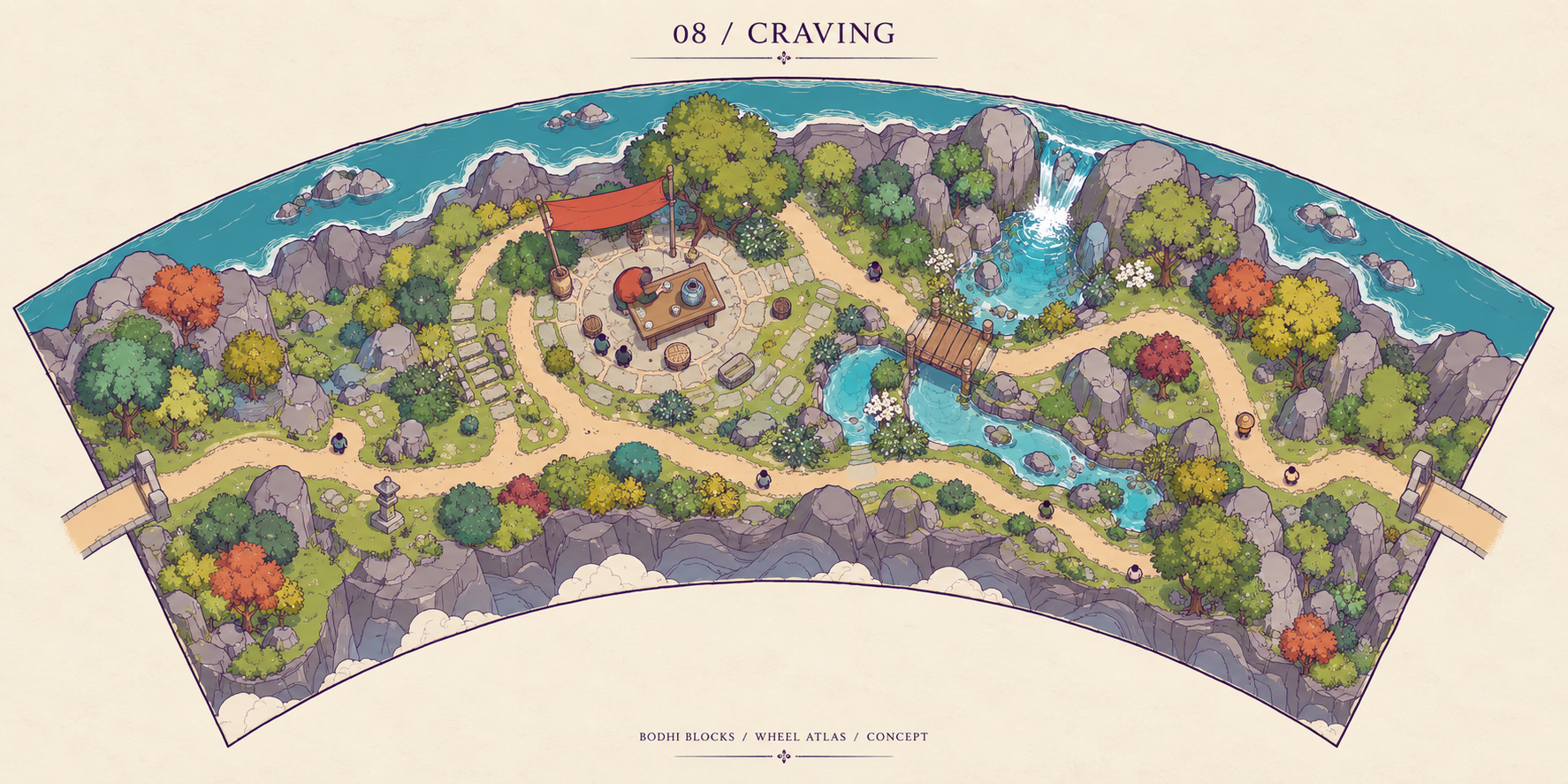
Craving is link 8 of twelve; painters show it as a person drinking.
The eighth link, craving, which the Sanskrit calls thirst; it arises from sensation [Rice 1.29]. The picture is someone drinking, often served by a woman who refills the cup: chang, beer or wine.
The Chinese text gives a woman holding a child for this link; Vinītadeva's source a nursing mother. Tibetan painters chose the drinker [HAR 6927 Source Text; Mejor].
What canon fixes for the map
Eighth cartouche: man receiving a drinking cup / drink served by a woman [HAR 6927; HAR 591; Wellcome 47116i].
Chinese and Vinītadeva variants: woman with child, nursing mother [HAR 6927; Mejor].
In the game now
place:wheel-rim-7 built (section wheel-rim-7, the 8th rim garden clockwise from north); concept /purelands/wheel-concepts/17-outer-*.png; in-world capture /atlas/terrain-review/in-world/wheel-rim-7.png.
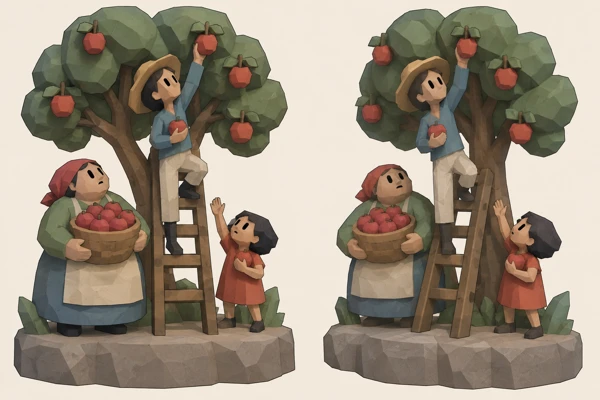
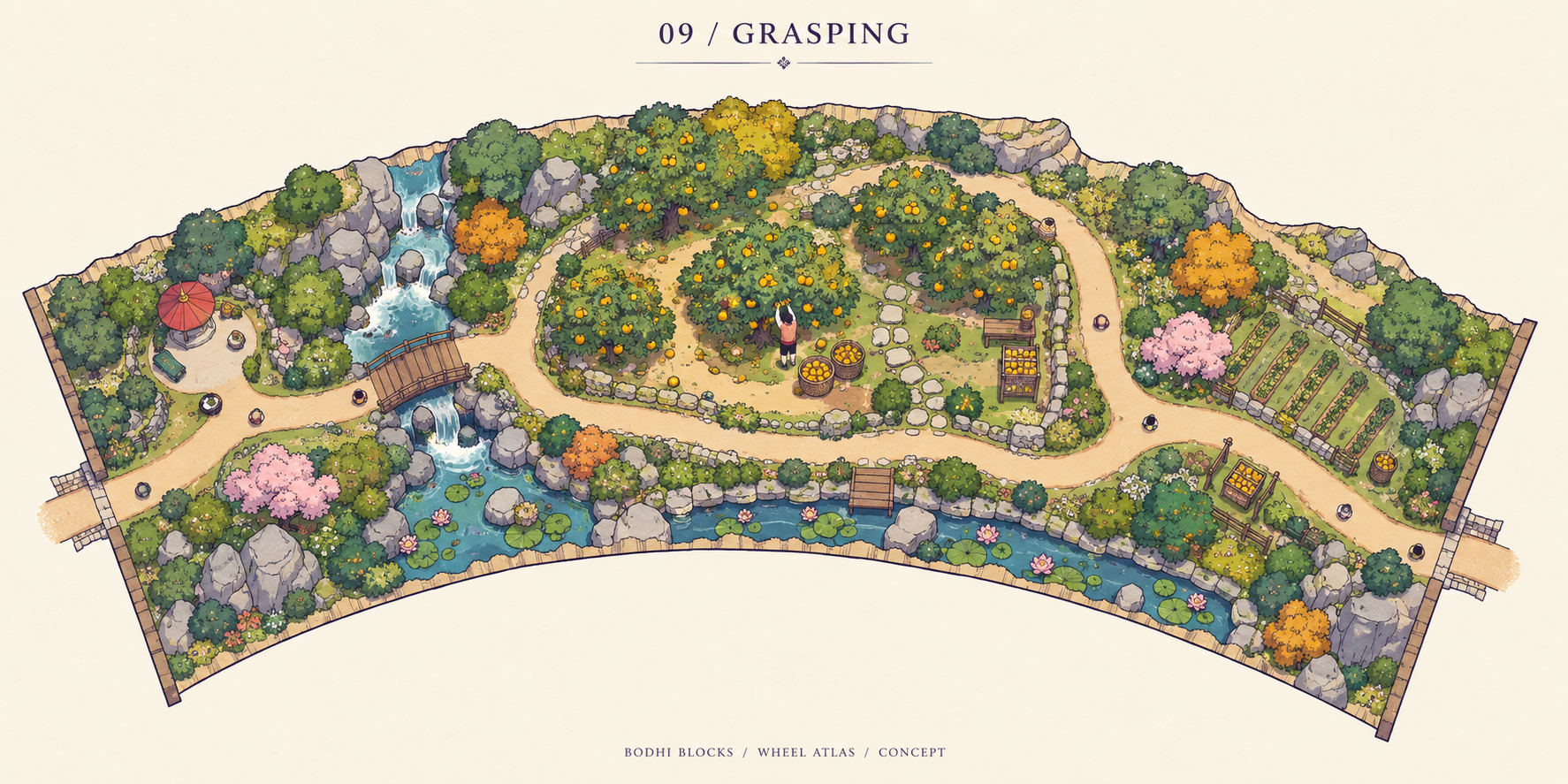
Appropriation is link 9 of twelve; painters show it as picking fruit.
The ninth link, appropriation or clinging, arising from craving [Rice 1.29]. The picture is a person gathering fruit from a tree into baskets: wanting has become taking and holding.
HAR's list puts 'a monkey holding fruit' here and the fruit-picker at link three; the Wellcome drawing and HAR 591 have the picker here. The Chinese text gives a man fetching water with a bottle; Vinītadeva's source, entering a womb [HAR 6927; HAR 591; Mejor].
What canon fixes for the map
Ninth cartouche: person gathering fruit (Wellcome, HAR 591) or monkey with fruit (HAR 6927 list) [Wellcome 47116i; HAR 591; HAR 6927].
Chinese variant: man fetching water [HAR 6927 Source Text].
In the game now
place:wheel-rim-8 built (section wheel-rim-8, the 9th rim garden clockwise from north); concept /purelands/wheel-concepts/18-outer-*.png; in-world capture /atlas/terrain-review/in-world/wheel-rim-8.png.
Art (4)
link 9, appropriation: fruit-picker filling baskets
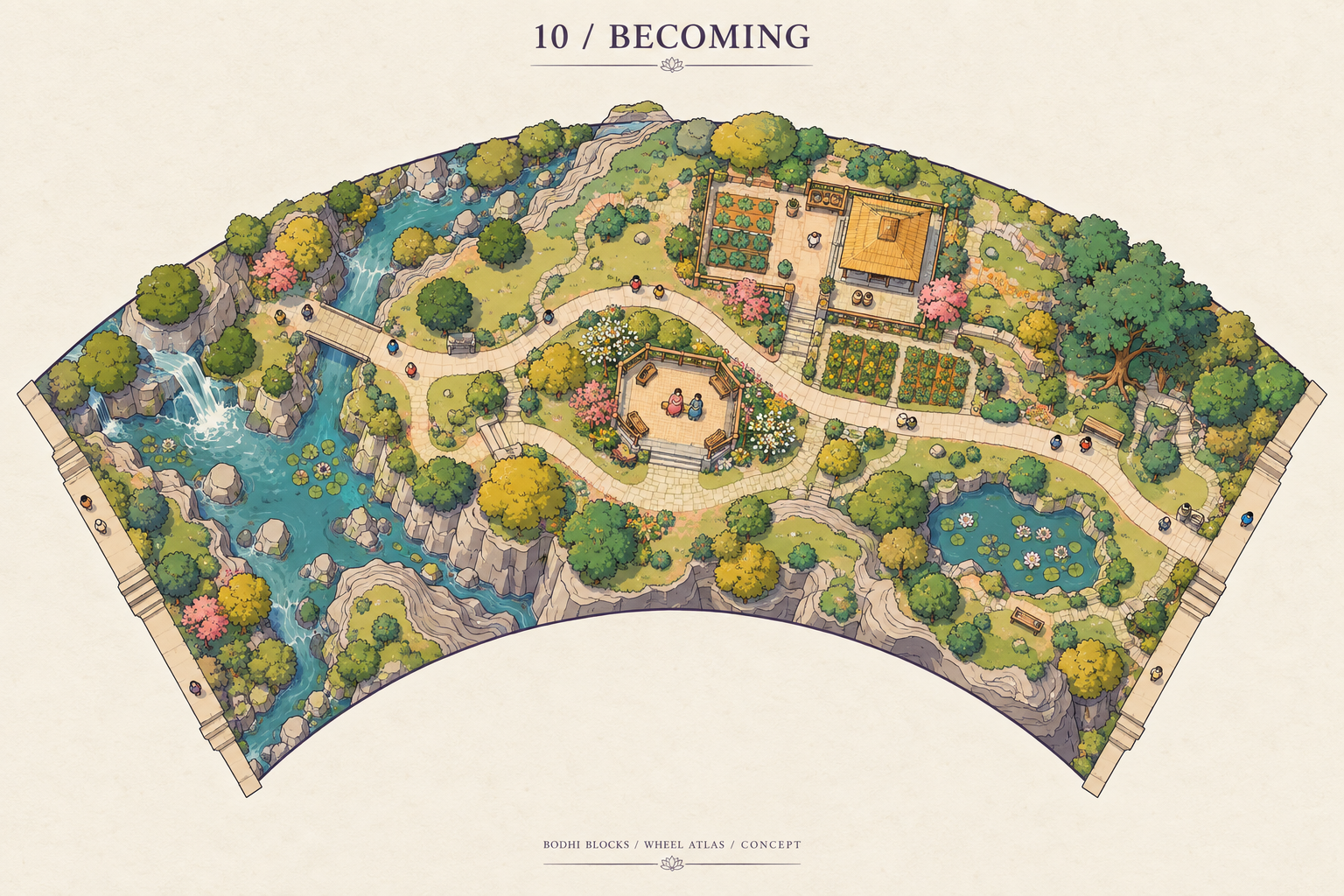
Becoming is link 10 of twelve; painters show it as a pregnant woman.
The tenth link, becoming or existence: the karma, gathered by appropriation, that produces the next birth [Rice 1.29]. The Wellcome drawing shows a pregnant woman; HAR's list and HAR 591 show a couple (in HAR 591 explicitly a couple in intercourse). Both say the same thing: a new life is already on its way.
The Chinese text gives the god Brahmā for this link; Vinītadeva's source, the embryo [HAR 6927 Source Text; Mejor].
What canon fixes for the map
Tenth cartouche: pregnant woman (Wellcome) or a couple (HAR 6927; HAR 591) [Wellcome 47116i; HAR 6927; HAR 591].
Chinese variant: Brahmā [HAR 6927 Source Text].
In the game now
place:wheel-rim-9 built (section wheel-rim-9, the 10th rim garden clockwise from north); concept /purelands/wheel-concepts/19-outer-*.png; in-world capture /atlas/terrain-review/in-world/wheel-rim-9.png.
Art (4)
link 10, becoming: bed under a canopy, a figure lying in it
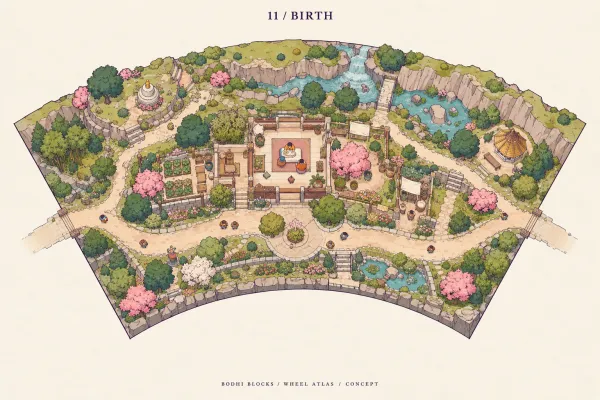
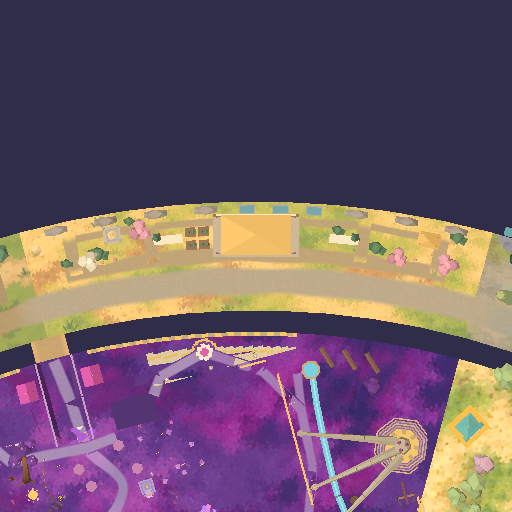
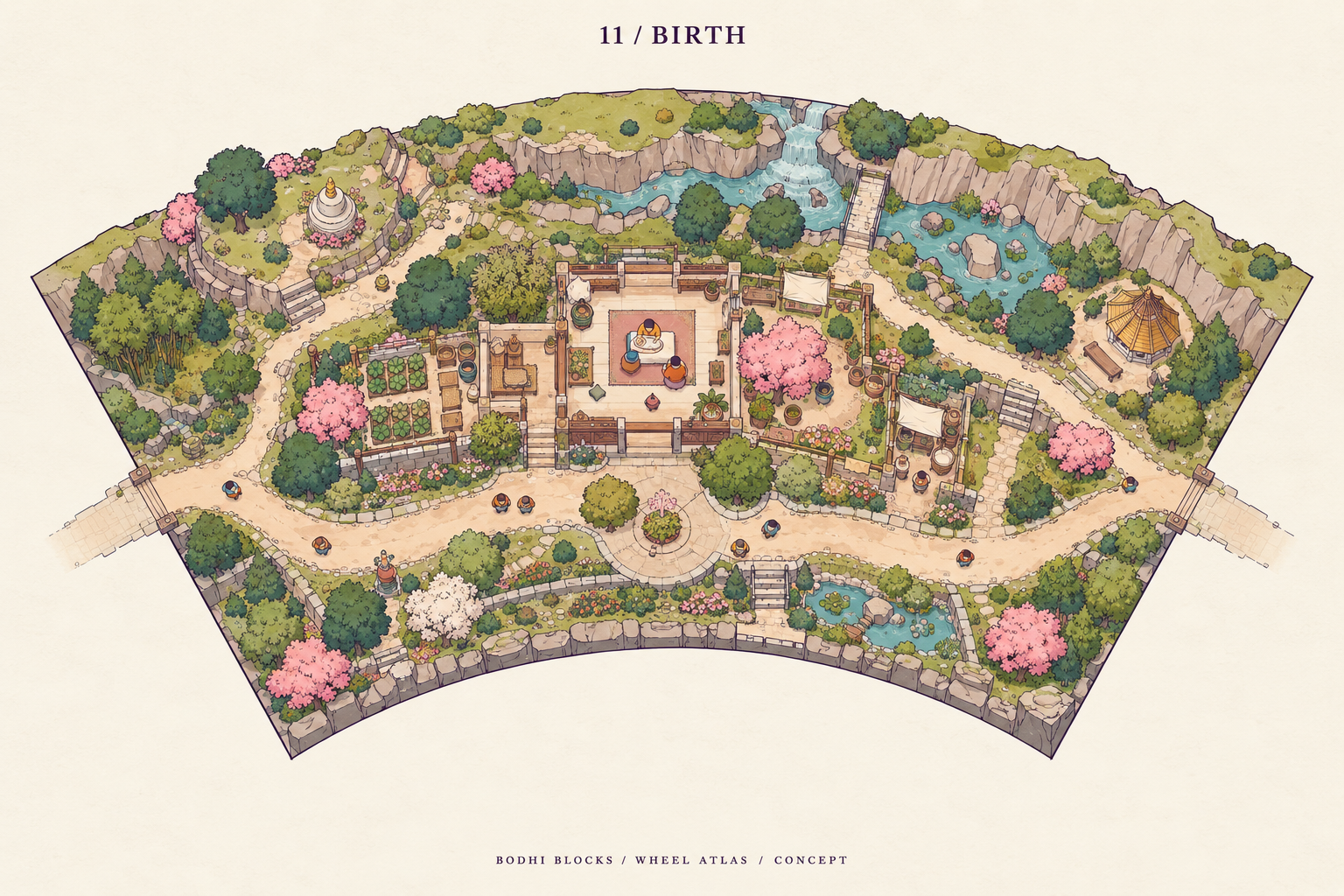
Birth is link 11 of twelve; painters show it as a woman giving birth.
The eleventh link, birth, arising from becoming [Rice 1.29]. The picture is a woman in labour or just delivered, often on a bed with helpers; the Library of Congress scroll shows her lying under a canopy with a table of offerings.
place:wheel-rim-10 built (section wheel-rim-10, the 11th rim garden clockwise from north); concept /purelands/wheel-concepts/20-outer-*.png; in-world capture /atlas/terrain-review/in-world/wheel-rim-10.png.
Art (4)
link 11, birth: woman lying in bed after the birth
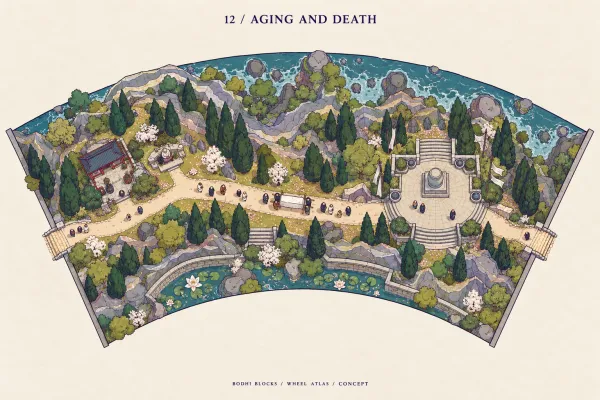
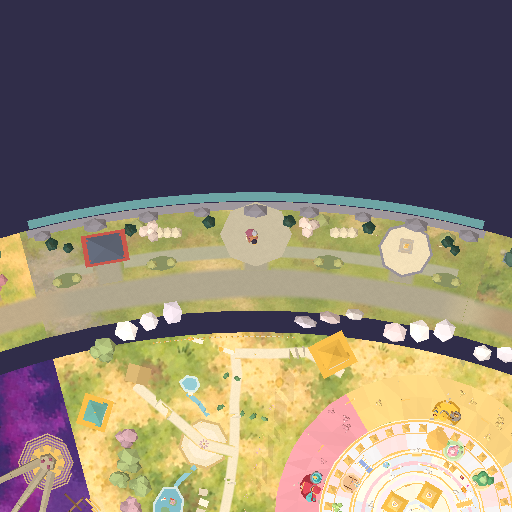
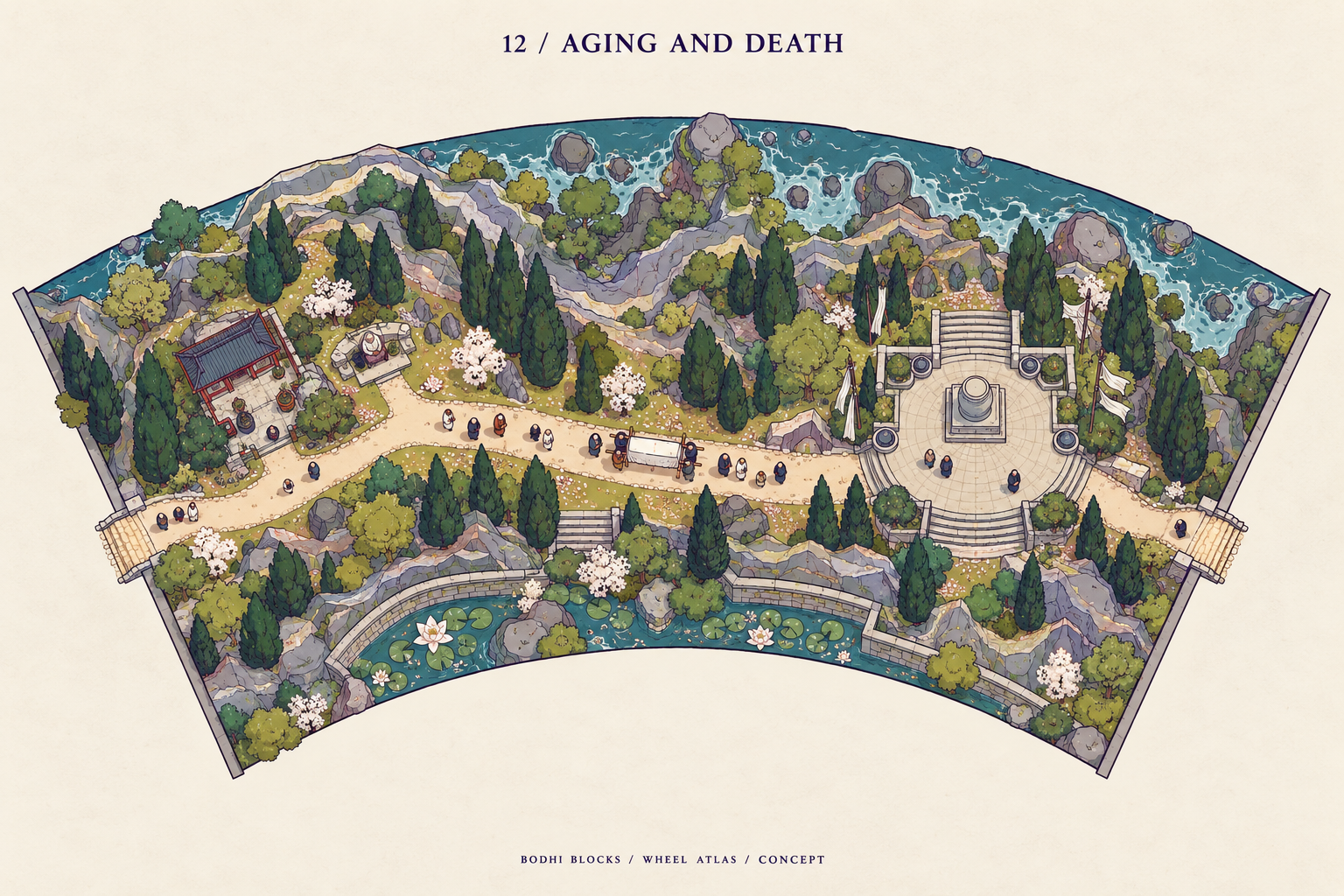
Aging and death is link 12 of twelve; painters show it as a corpse carried out.
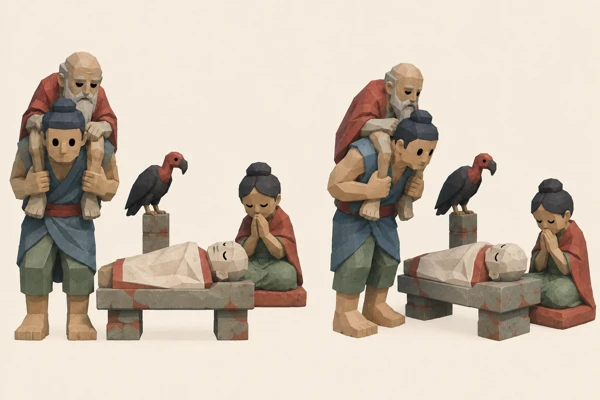
The twelfth link: from birth come aging and death, with sorrow, lamentation, suffering, despair and anxiety, 'this entire great heap of suffering' [Rice 1.4]. The picture is a man carrying a corpse on his back to the charnel ground or pyre; in the Library of Congress scroll a stupa and a vulture wait.
The Chinese text adds separate scenes for old age, sickness, death, sadness, malady, pain and difficulty, the last shown as a couple pulling a stubborn camel; Tibetan painters keep one corpse [HAR 6927 Source Text].
What canon fixes for the map
Twelfth cartouche: corpse being carried [HAR 6927; HAR 591; Wellcome 47116i].
Its clockwise neighbour across the seam is the blind man again: the rim has no end [HAR 78].
In the game now
place:wheel-rim-11 built (section wheel-rim-11, the 12th rim garden clockwise from north); concept /purelands/wheel-concepts/21-outer-*.png; in-world capture /atlas/terrain-review/in-world/wheel-rim-11.png.
Art (4)
link 12, aging and death: man carrying a corpse on his back toward a stupa, a vulture waiting
Skt. anityatā ('impermanence'); Chinese text: the Great Demon of Impermanence; often called Yama (gshin rje) or Yamī; Vimalamitra: a rākṣasa
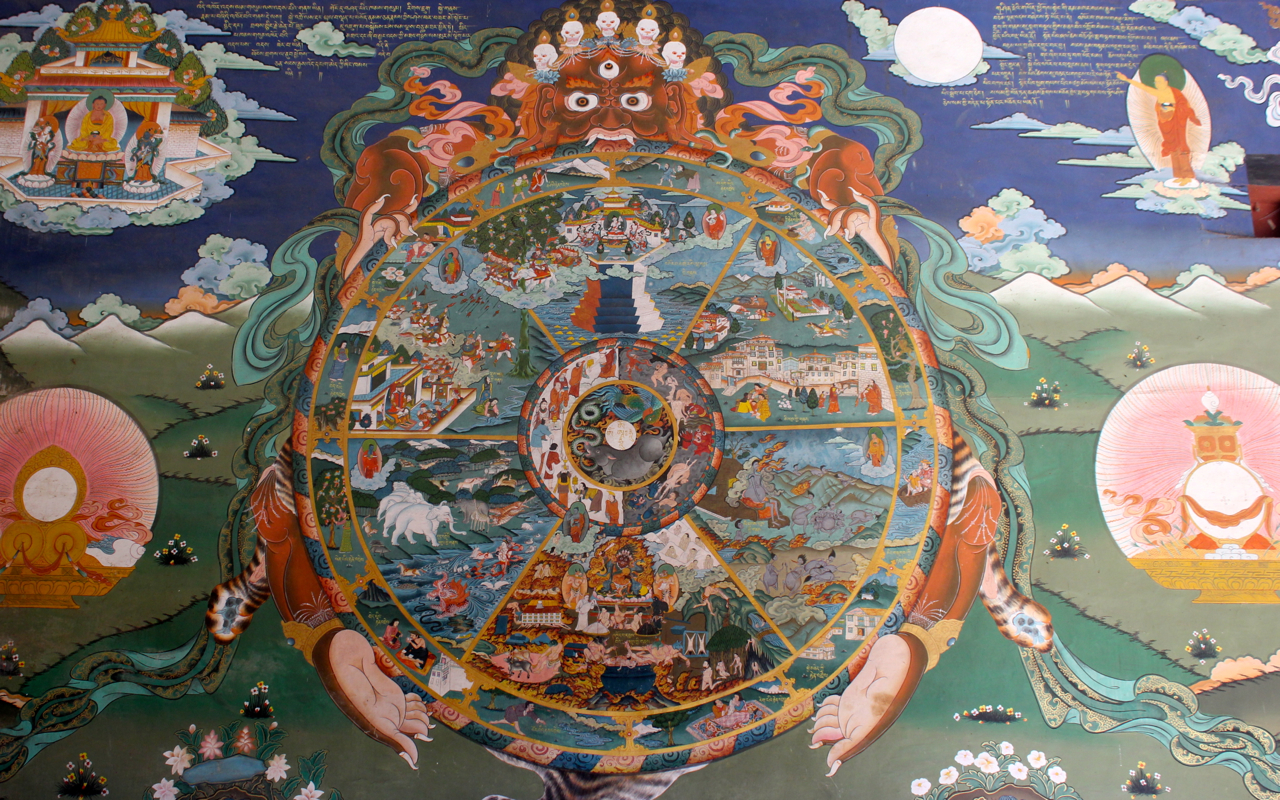
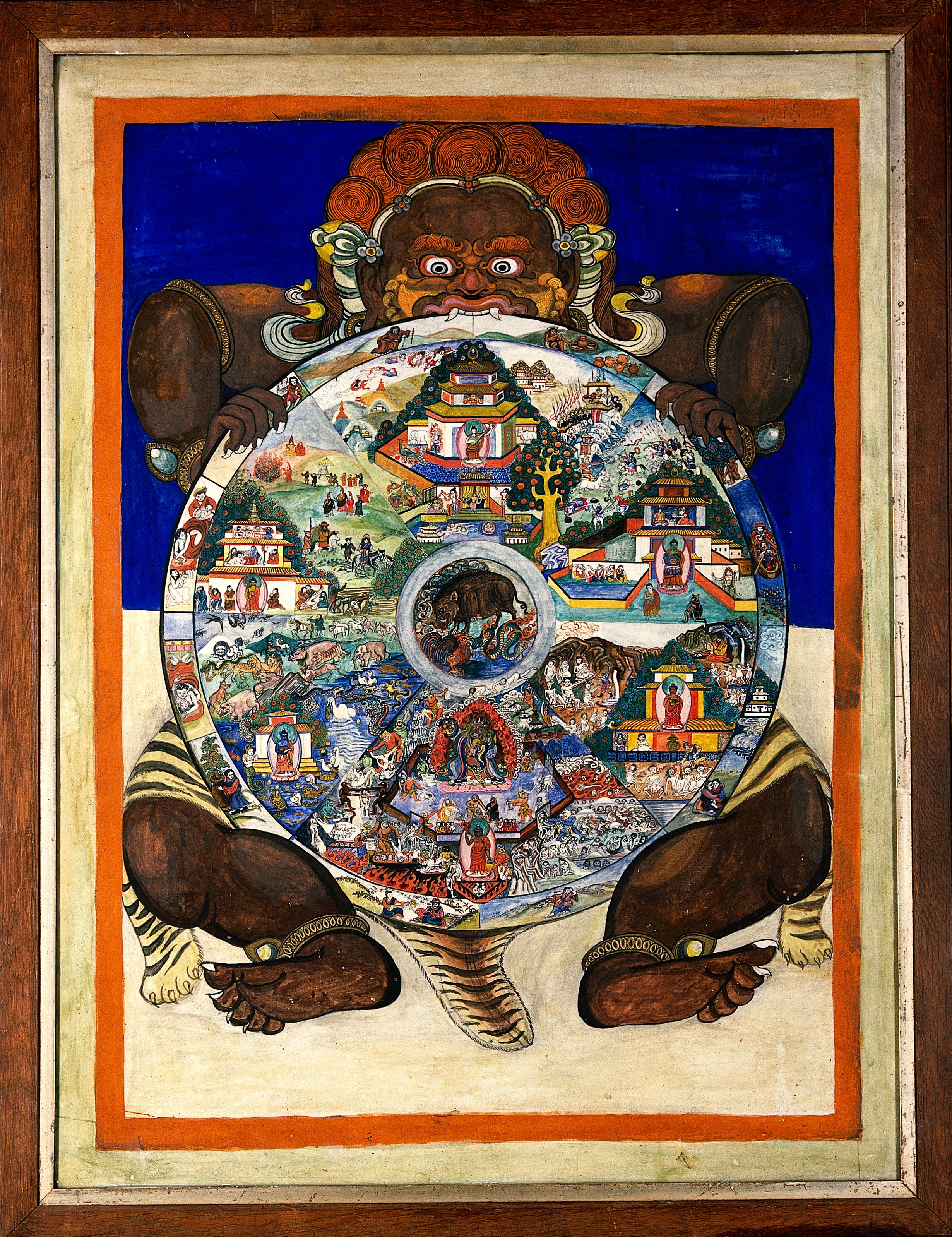
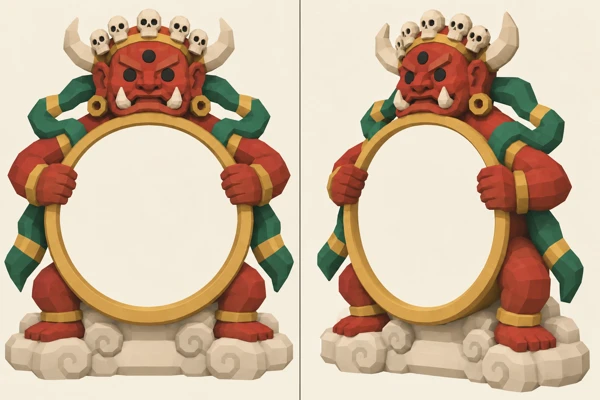
A fierce figure grips the Wheel in its claws and teeth: in the texts it is impermanence itself, and only in later usage Yama, Lord of Death.
Above the wheel, says the Chinese Vinaya, 'make the Great Demon of Impermanence with dishevelled hair and a gaping mouth', holding the wheel of birth and death in its outstretched arms. The Divyāvadāna says everything in the picture is to be shown swallowed by impermanence; Vimalamitra pictures impermanence as a rākṣasa. That is who the holder is: not a god, not a judge, but the fact that everything ends.
Jeff Watt stresses that the holder is mistaken for two others: Yama Dharmarāja, the judge of deeds who sits inside the hell realm with his stick and mirror, and Māra, a god of the desire realm. HAR item pages call the figure 'a personification of saṃsāra', sometimes identified as Yama, Lord of Death, or as a red female death demon, perhaps Yamī, his sister. The Rubin's own record and many catalogues simply say Yama; Eric Huntington says it 'is sometimes identified with Yama' and in the Rubin painting looks like him.
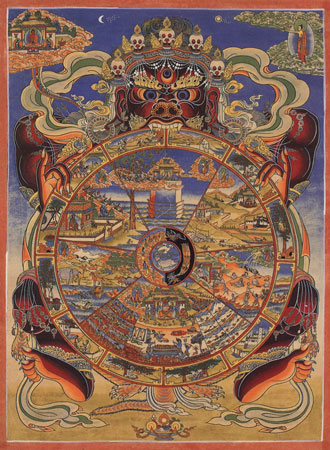
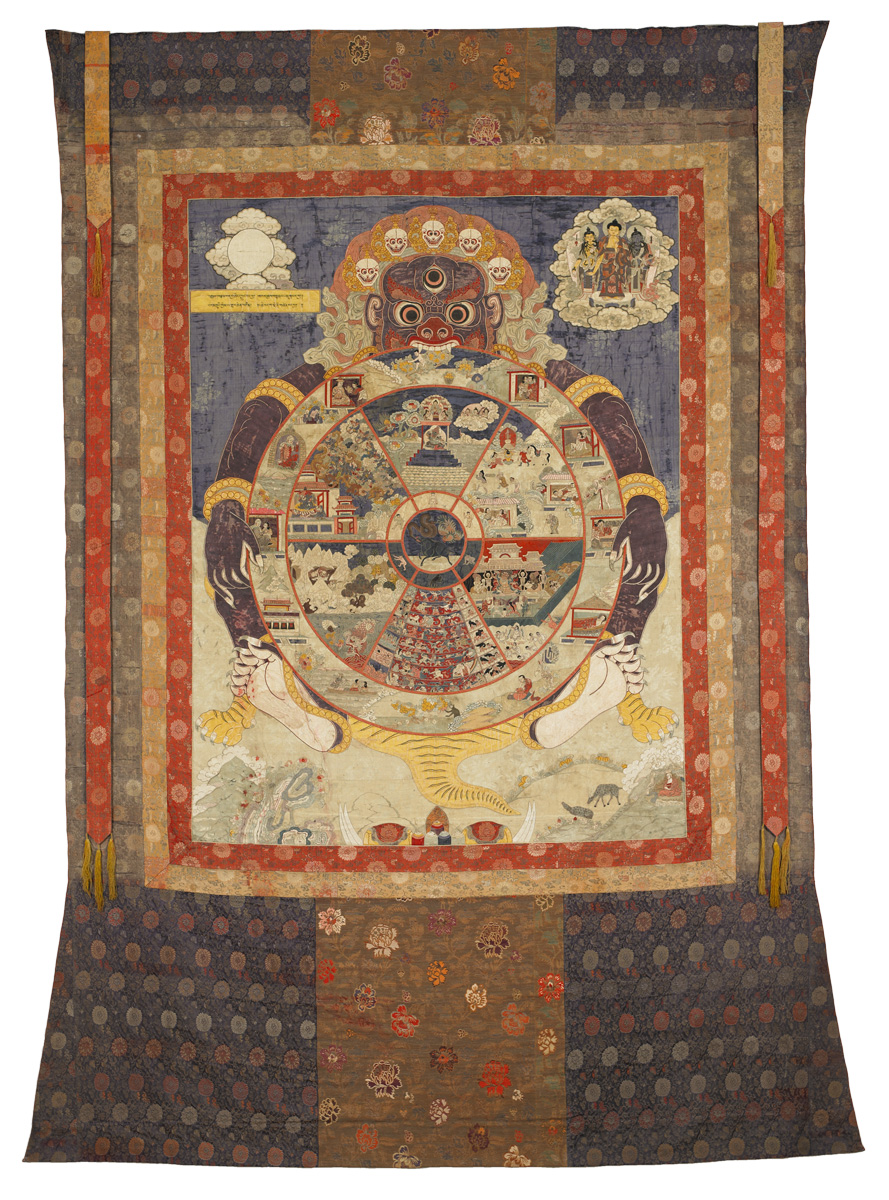
Two types appear. The unadorned demon, with no ornaments, is closer to the texts and typical of Mongolia; the repo's Wellcome gouache is one: a brown, bulging-eyed giant with a tiger skin, no skulls. The adorned demon wears a five-skull crown, wrathful ornaments, a tiger skin and a third eye, in the standard Tibetan wrathful style, and is typical of Tibet and the Himalayas; the Library of Congress scroll (green), the Sera and Seattle murals and the Birmingham textile (red or dark) are adorned.
In the game the holder is Death personified, red with five skulls, kept apart from the judge Yama of the hells, the Yāma heaven, Māra and the Story boss.
What canon fixes for the map
'Above the wheel make the Great Demon of Impermanence with dishevelled hair and a gaping mouth' holding it in outstretched arms [Teiser p. 56 via HAR 6928].
Everything shown gripped by impermanence; Vimalamitra: as a rākṣasa demon [Divy. XXI; Mejor].
Not the judge Yama (inside the hells) and not Māra [HAR 6928]; alternatively named Yama or Yamī [HAR 78; HAR 591; HAR 86935].
Unadorned type (Mongolia, closer to texts) vs adorned type (Tibet: skull crown, tiger skin, third eye) [HAR 6928].
Body colour varies: red (HAR 78, 591, 86935, Rubin C2004.21.1, Sera, Seattle), green (LoC scroll), brown (Wellcome gouache), dark (Birmingham) [items; Commons].
Who lives here
Impermanence personified (the holder).
Yama Dharmarāja, the judge, who sits inside the hell sector with stick and mirror: a different figure [HAR 78].
Yamī, Yama's sister, offered as an alternative identity [HAR 78].
In the game now
being:yama:death-holding-wheel built (section wheel-exterior, district wheel-exterior.holder): red body, five-skull crown, climbable limbs and scarves. Statue concept /atlas/statue-concepts/wheel-death-holder-600.webp. See built-wheel-exterior.
Wellcome Collection (repo copy, media.json painting-wellcome-L0069380; V0017705 is a second photograph of the same painting) · traditional · Public Domain Mark (Wellcome); V0017705 CC BY 4.0
The unadorned type: a brown giant with round staring eyes, fangs and a tiger skin, no skull crown; his claws grip the rim from both sides.
Rubin Museum of Himalayan Art · traditional · No open licence (link only)
The game's selected composition: white half left, black half right, Buddha upper right pointing to an inscription cartouche, dharma wheel and small white circle upper left. Eric Huntington's essay walks every part: https://rubinmuseum.org/projecthimalayanart/essays/wheel-of-existence/
Still missing: No open image of a Mongolian unadorned holder other than the Wellcome gouache.
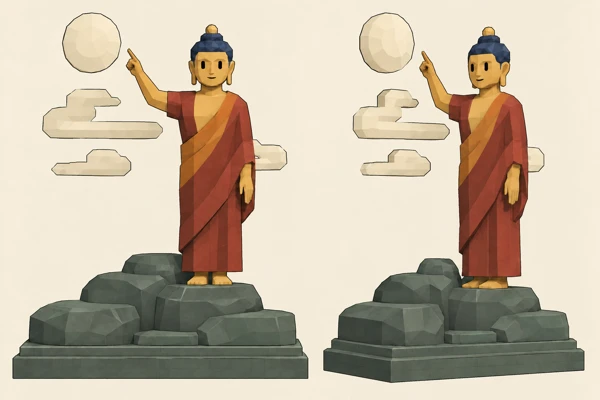
A standing Buddha outside the Wheel, usually at the upper right, points to the way out: a white circle, the moon, the verses, a dharma wheel or a palace.
The Divyāvadāna tells painters to make an image of the Buddha pointing at a white circle for nirvāṇa; the Chinese Vinaya says to make a round white altar above the demon of impermanence 'to symbolize the perfection and purity of nirvāṇa'. Vimalamitra and Guṇaprabha put the Buddha at the top. That is the root of the standing Buddha at the upper right of nearly every Tibetan Wheel, arm raised, pointing.
What he points at varies. Jeff Watt lists the verses, the white disc, a full moon, a dharma wheel, or a palace that may stand for a pure land or heaven. Most paintings make the white disc a moon, often with a rabbit in it. In Rubin C2004.21.1, the game's chosen composition, the Buddha points at a dark blue inscription cartouche with an eight-spoked dharma wheel on a lotus and a small white circle of liberation beside it; Huntington does not call it a moon. In the Library of Congress scroll he points at a crescent moon; in the Seattle mural at a dharma wheel and a moon; at Thiksey a seated Buddha gestures toward a full moon.
The upper left usually holds a second image: a Buddha in a palace (Amitābha in Sukhāvatī in Robert Beer's reading), a seated Maitreya (HAR 591), Avalokiteśvara (the Wellcome drawing and many Wheels), or the inscription cartouche (Seattle, Birmingham). HAR 591 instead has standing Śākyamuni on the left and seated Maitreya on the right. The repo's unsourced thangka shows a palace Buddha at the upper left joined to the holder's hand by a rainbow; that is where the game's palace and rainbow came from.
The pointing Buddha is a teaching image. He is not a resident of a country beside the Wheel, and the moon is not Meru's moon.
What canon fixes for the map
Buddha image pointing at a white circle of nirvāṇa [Divy. XXI; Mejor]; 'round, white altar' above the demon [Teiser p. 56 via HAR 6929].
Standing Buddha at upper right pointing; targets: verses, white disc, full moon, dharma wheel, palace [HAR 6929].
Rubin C2004.21.1: target is the inscription with dharma wheel and small white circle, upper left [Rubin essay figs. 12–13].
HAR 591: standing Śākyamuni left, seated Maitreya right; Robert Beer: Śākyamuni upper left pointing to a full moon, Amitābha with two attendants in Sukhāvatī upper right [HAR 591; repo dossier wheel-release-buddha].
Not a continent beside the Wheel [repo research note].
Who lives here
Śākyamuni (the pointing Buddha, where named).
Amitābha (Beer's palace), Maitreya (HAR 591), Avalokiteśvara (Wellcome drawing upper left) as the second outside figure.
In the game now
wheel-exterior.release (built, anonymous standing Buddha pointing toward a teaching target, old moon target retired) and wheel-exterior.palace (anonymous seated Buddha, rainbow to Yama's west hand); optional gateway wheel-exterior.release.gateway-sukhavati. Statue concepts wheel-release-buddha-600, wheel-palace-buddha-600. Iconography dossiers wheel-release-buddha.json, wheel-palace-buddha.json.
Art (9)
the pointing Buddhathe crescent moon he points atthe palace Buddha, upper left
Library of Congress, Prints and Photographs Division (via Wikimedia Commons) · traditional · Public domain (PD-old-assumed; LoC 2011432136)
Upper right: a standing Buddha in a green cloud mandorla pointing left across the sky to a crescent moon above the holder's crown; upper left: a seated Buddha in a palace on clouds.
the pointing Buddha on his cloudthe dharma wheel he points to
Rubin Museum of Himalayan Art · traditional · No open licence (link only)
The game's selected composition: white half left, black half right, Buddha upper right pointing to an inscription cartouche, dharma wheel and small white circle upper left. Eric Huntington's essay walks every part: https://rubinmuseum.org/projecthimalayanart/essays/wheel-of-existence/
Himalayan Art Resources / Rubin Museum of Art · traditional · No open licence (link only)
Five sections for six realms (gods and asuras share one), standing Shakyamuni left and seated Maitreya right outside the Wheel, twelve links from 12 o'clock.
Robert Beer (tibetanart.com) · traditional · No open licence (link only)
Beer's composition and commentary: Śākyamuni upper left pointing to a full moon, Amitābha with two attendants in Sukhāvatī upper right. Recorded in the repo as media ref-wheel-beer-overview.
Still missing: No open image of the plain 'round white altar' without a moon except Thiksey; Rubin C2004.21.1's cartouche target is link-only.
Skt. ārabhadhvaṃ niṣkrāmata… / yo hy asmin dharmavinaye…; Tib. brtsam par bya zhing…
Two stanzas are written beside the holder's head or below the Wheel: begin and go forth, trample Death's army like an elephant a reed hut; whoever walks heedfully in this Dharma and Vinaya will end suffering.
The Divyāvadāna and the Vinaya say two verses are to be inscribed on the Wheel. In the Sanskrit they begin 'ārabhadhvaṃ niṣkrāmata yujyadhvaṃ buddhaśāsane, dhunīta mṛtyunaḥ sainyaṃ naḍāgāram iva kuñjaraḥ' and 'yo hy asmin dharmavinaye apramattaś cariṣyati, prahāya jātisaṃsāraṃ duḥkhasyāntaṃ kariṣyati'. In plain English: Begin, go forth, apply yourselves to the Buddha's teaching; shake off the army of Death as an elephant shakes a hut of reeds. Whoever walks heedfully in this Dharma and Discipline, leaving the round of births, will make an end of suffering. The same pair stands in the Udānavarga.
The Chinese Vinaya says where to write them: 'to the two sides of the demon's head write two gāthās'. Guṇaprabha puts them at the bottom. In paintings they appear in a cartouche at the upper left (Rubin C2004.21.1, Seattle), below the moon (Birmingham: 'Make a beginning and renounce the world'), written across the sky (Bhutan), or along the bottom edge in gold Rañjanā script (HAR 591).
Huntington reads four passages on the Rubin painting: the first of the two verses; a short verse summarising dependent arising (the ye dharmā formula, also used to consecrate images); an exhortation to good deeds sometimes recited for the dead; and a mantra marking the painting's completion.
What canon fixes for the map
Two verses prescribed [Divy. XXI; Teiser p. 56 via HAR 6929]; Sanskrit text in Cowell–Neil p. 300.
Position: either side of the demon's head (Chinese Vinaya); at the bottom (Guṇaprabha); in practice a cartouche upper left, under the moon, across the sky or along the bottom [HAR 6929; Rubin essay; BMA record; HAR 591].
The first verse's opening is 'ārabhadhvaṃ' / 'brtsam par bya' ('begin') [Mejor].
In the game now
Nothing yet. No verse is written anywhere on the game's Wheel; the sections' Contemplate texts are authored, not quotations.
Rubin Museum of Himalayan Art · traditional · No open licence (link only)
The game's selected composition: white half left, black half right, Buddha upper right pointing to an inscription cartouche, dharma wheel and small white circle upper left. Eric Huntington's essay walks every part: https://rubinmuseum.org/projecthimalayanart/essays/wheel-of-existence/
Still missing: No legible open image of the verses in readable Tibetan at full size; the Seattle cartouche is small.
The texts prescribe a five-part Wheel (hells, animals, ghosts, humans, gods); Tibetan painters usually make six by giving the asuras their own wedge, or keep five by sharing the gods' wedge with them.
The Divyāvadāna's wheel has five parts: 'beneath the hub paint the hells, and on its two sides paint animals and hungry ghosts; then on the top paint humans and gods'. The asuras are not a destiny of their own in this scheme. Early Wheels follow it; the five-section Thiksey mural does so still, with hells at the bottom, animals and ghosts flanking them and two upper wedges.
Later Central Asian and Chinese Wheels split the gods into happy gods and jealous gods, always at war, and Tibetan painting mostly inherited six wedges. But five-section Wheels with six realms are common too: in HAR 591 the gods and asuras share the top-left wedge, the palace above and the battle below. Four-, five- and six-division Wheels all occur in the Himalayas.
Where the six go also varies. HAR 78: gods top, asuras right, humans left, animals below humans, pretas lower right, hells bottom. Rubin C2004.21.1: gods and asuras top left, humans top right, animals lower left, pretas lower right, hells bottom. The repo's Wellcome gouache: gods top, humans upper left, asuras upper right, animals lower left, pretas lower right, hells bottom. The game's six equal wedges, Deva north, follow the painted six, not the five of the text.
What canon fixes for the map
Five parts: hells below, animals and ghosts to either side, humans and gods above [Divy. XXI; Teiser p. 55 via HAR 6915].
Four continents round Sumeru to be shown within the human part; rarely painted (HAR 85113 hints at it) [HAR 6915].
Six-wedge Wheels split gods from asuras (Central Asian and Chinese development); five-wedge Wheels may share one wedge between gods and asuras [HAR 218; HAR 591].
Six wedges of 60° each, Deva at 0° (north) then Asura, Hungry Ghost, Naraka (south), Animal, Human clockwise (wheel-hub seams; adaptation). Samsara realms deva, asura, human, animal, hungry-ghost, naraka.
A true five-section Wheel: two upper wedges, animals lower left, hells at the bottom, hungry ghosts lower right, no asura wedge and no white-black ring.
Wellcome Collection (repo copy, media.json painting-wellcome-L0069380; V0017705 is a second photograph of the same painting) · traditional · Public Domain Mark (Wellcome); V0017705 CC BY 4.0
Six wedges: gods top, humans upper left, asuras upper right, animals lower left, pretas lower right, hells bottom, with a Buddha in each.
Library of Congress, Prints and Photographs Division (via Wikimedia Commons) · traditional · Public domain (PD-old-assumed; LoC 2011432136)
Six wedges with the white-black ring: gods top, humans upper left, asuras upper right (fighting the gods across the seam), animals lower left, pretas lower right, hells bottom.
Himalayan Art Resources / Rubin Museum of Art · traditional · No open licence (link only)
Five sections for six realms (gods and asuras share one), standing Shakyamuni left and seated Maitreya right outside the Wheel, twelve links from 12 o'clock.
Every Wheel keeps the hub, the realms, the rim and the holder, and every Wheel differs in the ring, the holder's type and colour, where the links start, what the Buddha points at and who sits in the corners.
The repo chose Rubin C2004.21.1 (Sikkim, c. 1930, attributed to Lhadripa Rinzing Chungyalpa; the older essay says Central Tibet, early 20th century) as its composition: white half left, black half right, six wedges with a Buddha in each, twelve links from the blind man at top right, a red tiger-skinned holder, a Buddha upper right pointing at an inscription with a dharma wheel and white circle upper left. The Rubin also holds HAR 591 (F1997.40.10, Eastern Tibet, 18th c.) with five wedges and Śākyamuni and Maitreya outside, and HAR 78 (P1994.3.6, Mongolia, 19th c.) with links from the bottom left; C2006.66.131 is a Tibetan or Mongolian second reference.
The Wellcome Collection's Wheels show the range. The repo's gouache (L0069380 / V0017705) has an unadorned brown holder, six wedges with Buddhas, no white-black ring and no twelve links at all. V0017709 and L0069368 are gouaches with red adorned holders. The ink drawing (47116i; V0018310, L0015314) was made for L. A. Waddell by a Tashilhunpo artist from a Samye original and is the repo's source W for the twelve pictures.
Murals: Sera (Lhasa) has a strong white-black ring and a red holder; Thiksey (Ladakh) keeps five sections and no ring, with a full moon and a seated Buddha beside it and an astrological chart on the other side; Paro Dzong and other Bhutanese walls add the palace and the verses across the sky; the Sakya Monastery in Seattle shows a fully standard modern program. Commons also holds Wheels at Labrang, Tawang, Kopan, Punakha and Trongsa, and Likir has none there.
Museum pieces: the Birmingham Museum of Art's appliqué and embroidered silk Wheel (Eastern Tibet, c. 1800, 283 by 203 cm) is a textile, not a painting, with the moon and inscription upper left and a Buddha triad upper right; the Library of Congress scroll (c. 1900) is a bright six-wedge Wheel with a green holder, a palace upper left and a Buddha pointing at a crescent moon. The Met's Open Access collection has no Wheel of Life.
What canon fixes for the map
Constant parts: hub with three animals, realm wedges, twelve-link rim, holder, Buddha outside [Divy. XXI; HAR 218].
Variable parts: white-black ring (present or absent), five or six wedges, link start position, holder type and colour, outside figures and the pointing target, verses and their place [HAR sets 6913–6929; Commons].
Rubin C2004.21.1 cataloguing differs: Sikkim c. 1930 (collection record) vs Central Tibet early 20th c. (essay) [Rubin record; Rubin essay].
In the game now
The game's Wheel = Rubin C2004.21.1 (DECISIONS default A) with the repo's unsourced thangka supplying the palace-and-rainbow exterior; see built-wheel-exterior. Repo media: painting-wellcome-L0069380, painting-wellcome-V0017705, painting-bhavacakra-thangka.
Wellcome Collection (repo copy, media.json painting-wellcome-L0069380; V0017705 is a second photograph of the same painting) · traditional · Public Domain Mark (Wellcome); V0017705 CC BY 4.0
The repo's gouache: unadorned holder, six Buddhas, no ring, no rim scenes.
Rubin Museum of Himalayan Art · traditional · No open licence (link only)
The game's selected composition: white half left, black half right, Buddha upper right pointing to an inscription cartouche, dharma wheel and small white circle upper left. Eric Huntington's essay walks every part: https://rubinmuseum.org/projecthimalayanart/essays/wheel-of-existence/
Himalayan Art Resources / Rubin Museum of Art · traditional · No open licence (link only)
Five sections for six realms (gods and asuras share one), standing Shakyamuni left and seated Maitreya right outside the Wheel, twelve links from 12 o'clock.
Repo research note: Great Wheel geography (docs/wheel-geography-canonical-research-2026-10-01.md = public/purelands/wheel-geography-research.md), Source register W and V-excerpt; 'Center, karmic bands and exterior'; rim table
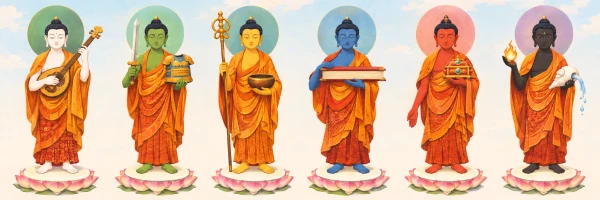
Tib. thub pa drug (the six Munis / six sages); Skt. ṣaṇmuni
In most Tibetan Wheels a Buddha stands in each of the six wedges, each holding the gift that realm needs.
The Divyāvadāna already asks for Buddhas with halos pointing out the way to nirvāṇa. Tibetan Wheels put one in every wedge: the six Munis. Their colours and emblems come from the peaceful-deity cycles (Karma Lingpa: white god, green asura, yellow human, blue animal, red preta, black hell being) and vary between treasure traditions; the Rubin Wheel shows a green animal sage and a dark blue hell sage, and HAR notes blue asura and blue hell variants. The Wheel's human sage is often seated while the others stand.
HAR's set 78 description says Buddhas or bodhisattvas occasionally appear in each realm; Huntington says the six Buddhas are sometimes read as emanations of Avalokiteśvara. The repo's Wellcome gouache has one in each wedge, as does the ink drawing.
What canon fixes for the map
Buddhas with halos 'pointing out the way to nirvāṇa' prescribed [Divy. XXI, Khantipalo].
One Buddha per wedge in most Tibetan Wheels; colours vary by treasure tradition [HAR 6930 via repo dossier; Rubin essay figs. 6–9].
Human sage shares Śākyamuni's identity; standing poses predominate except the human sage in the Wheel [repo dossier munis.json].
Who lives here
The six Munis: of the gods, asuras, humans, animals, hungry ghosts and hells.
In the game now
being:six-munis:gods/jealous-gods/humans/animals/hungry-ghosts/hells all built and placed, one shrine spot per realm (deva.pearl-road, asura.titan-ground, human.market, animal.muni-shrine, hungry-ghost.seven-bowls, naraka.lava-heart); rig parts/purelands/munis.js; iconography dossier munis.json.
Art (3)
the Buddha of the asuras, upper right wedgethe Buddha of the animals, left wedgethe Buddha of the pretas, right wedge
Wellcome Collection (repo copy, media.json painting-wellcome-L0069380; V0017705 is a second photograph of the same painting) · traditional · Public Domain Mark (Wellcome); V0017705 CC BY 4.0
Each wedge has its Buddha: the human realm's seated upper left, the asura realm's upper right, the animals' blue-green Buddha at the left, the pretas' red Buddha at the right.
The six Munis (concept)
AI concept study (repo) · concept · Project art
The game's ensemble concept; the dossier warns its coloured robes and caps are not a canonical palette.
Repo painting: the Wellcome gouache (L0069380 / V0017705)
The repo's one properly sourced Wheel painting: a Tibetan gouache with an unadorned brown holder, six wedges each with a Buddha, and neither the white-black ring nor the twelve links.
public/atlas/media/wheel-of-life/wellcome-L0069380.jpg (5898 by 7826 px) and wellcome-V0017705.jpg (2460 by 3196 px) are two photographs of the same Wellcome painting (Iconographic Collection; V0017705 is ICV No 18053). A brown, round-eyed giant with a tiger-skin skirt and no skull crown grips the disc at its sides; there is no Buddha outside, no moon, no verses. The hub holds a boar, a green snake and a red rooster on grey inside a white ring. Six wedges follow at once: gods at the top with a palace, humans upper left with a stupa and houses, asuras upper right with their palace and a battle at the seam, animals lower left in a landscape with a sea, hungry ghosts lower right, hells at the bottom with a red Yama Dharmarāja and a blue cold-hell Buddha. A Buddha stands or sits in every wedge. A plain outer band carries no scenes.
Because it has no rim the painting cannot illustrate the twelve links; its value to the repo is the unadorned holder, the six Munis and the simplest possible hub.
What canon fixes for the map
Six wedges, one Buddha each; no second circle; no twelve-link rim [the painting].
Unadorned holder type [HAR 6928].
In the game now
media.json painting-wellcome-L0069380 (Public Domain Mark) and painting-wellcome-V0017705 (CC BY 4.0), realm wheel, subjects yama, wheel-of-life. Both are in runtime-assets.
Art (2)
the hubthe holder's headgods' wedge with the palace, topasura wedge, upper righthuman wedge, upper lefthell wedge, bottomthe plain outer band with no rim scenes, lower right
Wellcome Collection (repo copy, media.json painting-wellcome-L0069380; V0017705 is a second photograph of the same painting) · traditional · Public Domain Mark (Wellcome); V0017705 CC BY 4.0
Topic-level entry: hub, the wedge seams and the holder cropped from the repo file.
Repo painting: the unsourced modern thangka (bhavacakra-thangka.png)
A modern Nepali-workshop style Wheel whose source is unknown: it is the model for the game's exterior palace and rainbow, but cannot be shown until its licence is found.
public/atlas/media/wheel-of-life/bhavacakra-thangka.png (1600 by 2253 px) came in with commit e3c2515091 with no source; media.json records that the Commons category and 336 shop listings were checked without a match (2026-10-26). It is not in runtime-assets, so this page cannot display it.
What it shows, for the record: a red adorned holder with five skulls and a third eye on a brown ground; upper left a seated Buddha in a palace on clouds joined to the holder's left hand by a rainbow; upper right a standing Buddha on clouds pointing. The hub has a bird, snake and pig issuing from one another; the second ring is white left and black right; six wedges follow (gods top with palace, humans upper right, asuras upper left, animals lower left, pretas lower right, hells bottom with Yama Dharmarāja); the rim has twelve cartouches with the standard scenes, the blind man and corpse at the top. The palace, rainbow and pointing Buddha are exactly the game's wheel-exterior program (decision 16).
What canon fixes for the map
Standard modern Tibetan/Nepali composition; the rainbow from palace to hand is a painter's device with no textual source [repo dossier wheel-palace-buddha].
In the game now
media.json painting-bhavacakra-thangka, licence Unknown, published false, 'not a runtime candidate until Josie decides'. Its palace-and-rainbow is built as wheel-exterior.palace.
Art (0)
Still missing: The file itself: not showable (no licence, not in runtime-assets). Find its painter or replace it with Rubin C2004.21.1 as the exterior reference.
Sources
Repo media ledger public/atlas/media.json, item painting-bhavacakra-thangka, note and evidence fields
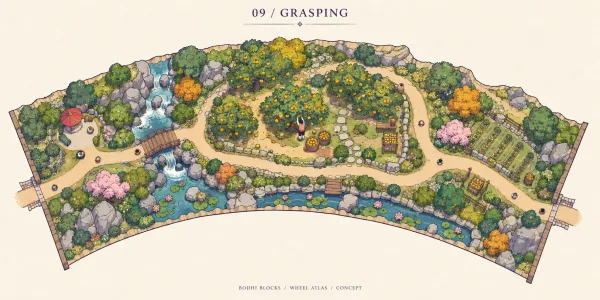
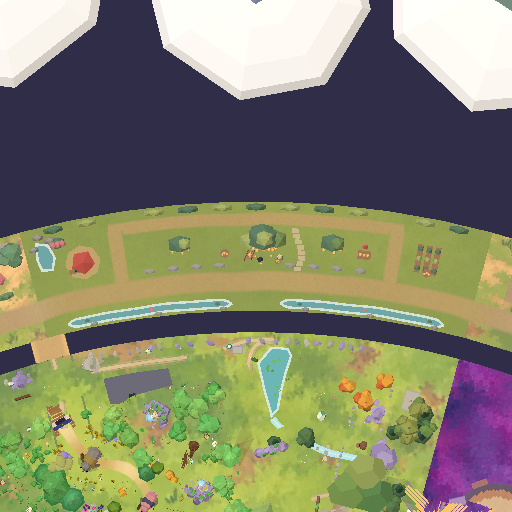
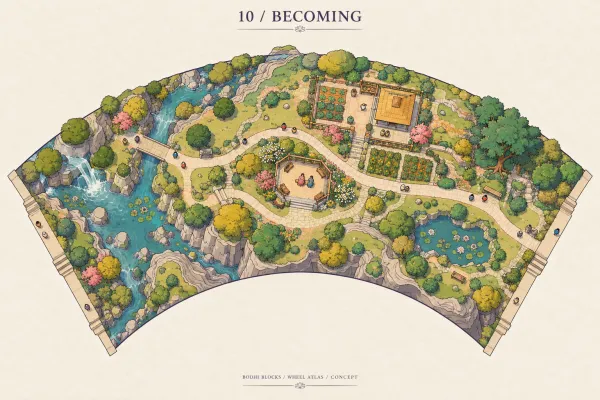
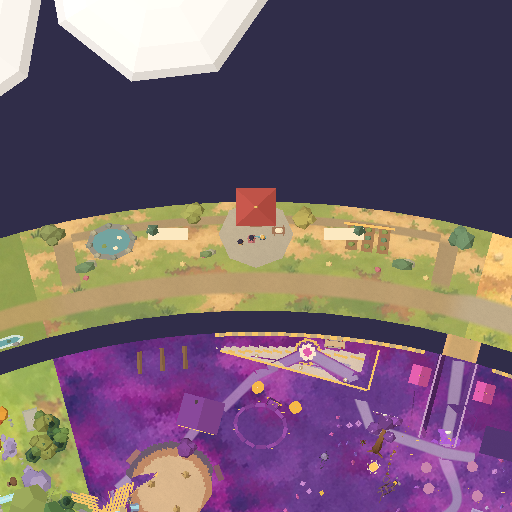
The rim as built (wheel-rim-0 to wheel-rim-11)
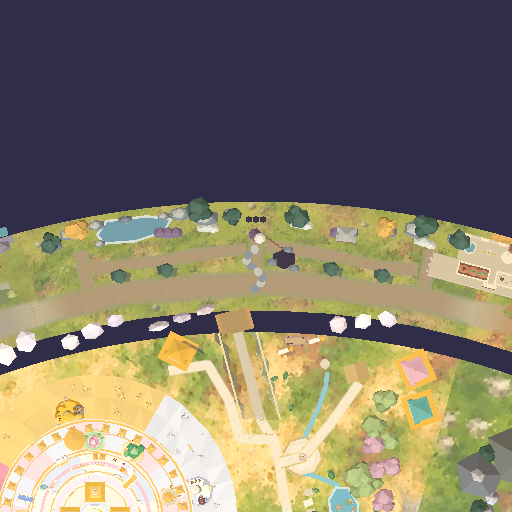
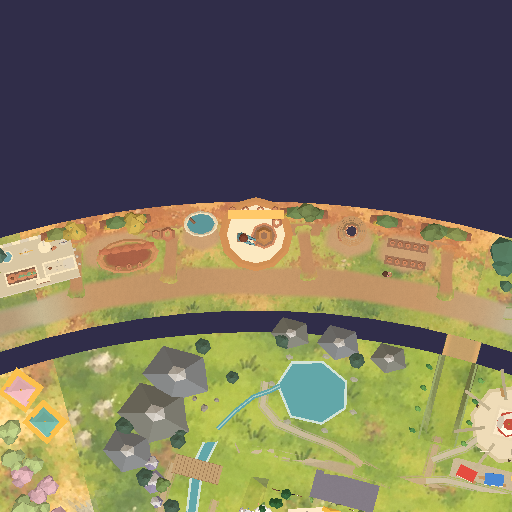
Twelve flat teaching gardens on the band r 74–84, one per link, read clockwise from the north seam, each with one sculpted picture, a Contemplate pause and no residents.
Each rim section is a 30° arc of the band r 74–84, flat at y 0, with the rim walk running through it and one picture staged beside the walk. In order from the north seam: the blind walker's wood with eight stepping pads to a hollow he cannot see (0); the potter's yard with four stations, clay, wheel, kiln and eight pots (1); the monkey's grove, the monkey mid-swing between two fruit trees (2); the boat on the canal, one rowing, one holding a lantern (3); the hexagonal house of six doors, empty inside (4); the meeting, two travellers who dropped their packs and hold each other (5); the arrow court, one figure on a plinth with an arrow in the eye and three seats (6); the drink stall, a bloated drinker whose cup is always refilled beside a pool nobody looks at (7); the fruit tree, a picker on a ladder, a laden neighbour, a clutching child and an unattended stall of wormy fruit (8); the waiting house, a pregnant woman with partner and child, empty cradle, closed lotus bud (9); the birth-house, a mother with a crying newborn, a helper and a sibling (10); the bier and the memorial, a covered corpse under a canopy, a young man carrying an old woman past it to a plain chorten (11).
Canon vs adaptation: the order of the links is The Rice Seedling's; each picture is the Wellcome drawing's (source W). Everything else is authored: the gardens, the clockwise reading from north, the stations, pads, lanterns, doors, seats, stalls, families, the seedling court at the 0/1 seam (an allusion to The Rice Seedling, not a thirteenth link), and the gore (R7: arrow with blood and tears, red running from the drinker's mouth, bruised fruit with flies, the geode belly with eight crystals, red-smeared wrap and cord, the stained shroud with a grey foot and a vulture). The research note's 'no gore' rows are outranked by R7.
Two compositions tie the rim to the holder: the birth-house stands under his fist, and the memorial stands before his mouth, so the walk passes under his chin from death into ignorance. Both are authored. No character has a home on the rim; the figures have no names, lines or biographies.
What canon fixes for the map
Band r 74–84, 12 × 30°, flat; one picture per section; rim walk continuous [sections wheel-rim-0..11 terrain].
Clockwise order from the north seam is the game's reading layout [research note rim table].
Pictures per W: blind man, potter, monkey, boat, six-window house, couple, arrow, drink, fruit, pregnancy, birth, corpse [wheel-geography-research source W].
Who lives here
None resident. Sculpted figures only.
In the game now
place:wheel-rim-0 … place:wheel-rim-11 all built (samsara `wheel`). Concepts /purelands/wheel-concepts/10–21; captures /atlas/terrain-review/in-world/wheel-rim-N.png; segment sheets /atlas/assets/images/segment-wheel-rim-N.png; statue concepts /atlas/statue-concepts/rim-*-600.webp; map studies in /atlas/terrain-review/alternatives/.
Art (7)
Ignorance, rim link 1: view from above
Project capture · world-view · Project art
The blind walker's wood with the seedling court at its seam.
Sensation, rim link 7: view from above
Project capture · world-view · Project art
The arrow court with its three seats.
Aging and death, rim link 12: view from above
Project capture · world-view · Project art
The bier, the carried elder and the chorten under the holder's mouth.
Statue concept: rim, sensation
AI concept study (repo) · concept · Project art
The arrow-in-eye figure.
Statue concept: rim, appropriation
AI concept study (repo) · concept · Project art
The fruit picker, neighbour and child.
Statue concept: rim, aging and death
AI concept study (repo) · concept · Project art
The bier and the carried elder.
Kit piece: outer rim segment
Project art · layout-study · Project art
The terrain kit piece every rim section is built on.
Still missing: No ground-level captures of the twelve pictures; the per-link topics carry the concepts and overhead captures.
Sources
Repo world plan: docs/world-plan/sections/wheel-rim-0.json, account, districts, claims, adaptation
Repo world plan: docs/world-plan/sections/wheel-rim-6.json, account, districts, claims, adaptation
Repo world plan: docs/world-plan/sections/wheel-rim-11.json, account, districts, claims, adaptation
Repo research note: Great Wheel geography (docs/wheel-geography-canonical-research-2026-10-01.md = public/purelands/wheel-geography-research.md), Source register W and V-excerpt; 'Center, karmic bands and exterior'; rim table
The white and black paths as built (wheel-ascent, wheel-descent)
The ring r 10–18 round the hub: a light western half where three tableaux of walkers rise through helping, giving light and arriving, and a dark eastern half where hooded figures fall through passing by, hoarding and being led down.
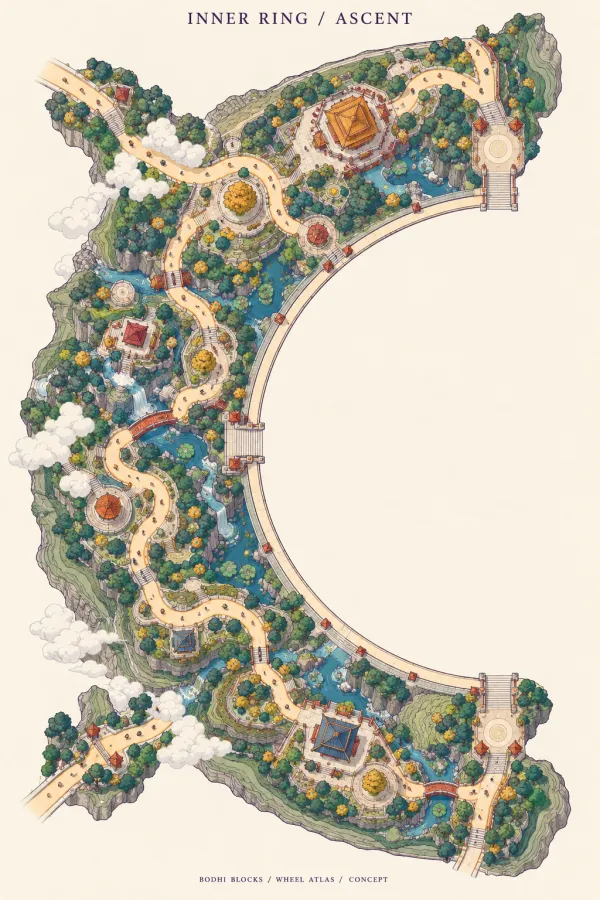
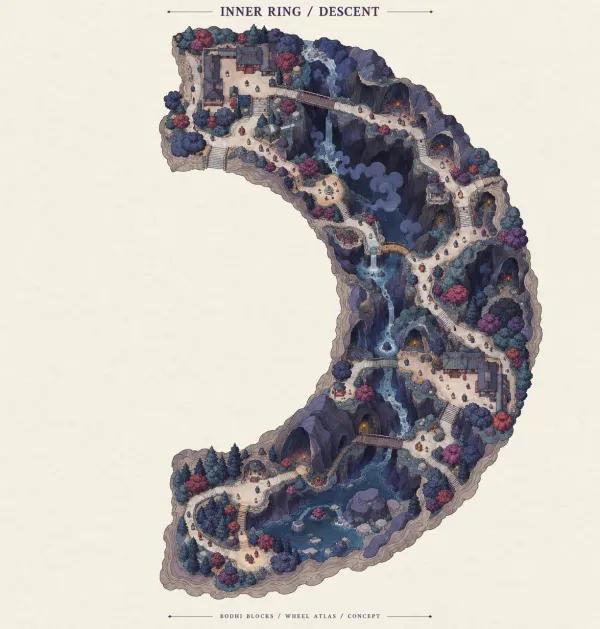
The plan follows Rubin C2004.21.1: a light half where beings rise and a dark half where they fall. The game puts the light half on the west (x < 0), read clockwise from the Naraka line in the south past the Animal and Human bridges to the Deva line in the north, and the dark half on the east, falling from the Deva line past the Asura and Hungry Ghost bridges to the Naraka line. Both halves are flat; the rise and fall are built as three plinths (0.3, 0.6, 0.9) with brightening lamps on the west and three terraces (0.9, 0.6, 0.3) with dimming lamps and three ravine pools on the east. One sandstone inner walk runs round both.
Ascent districts: wheel-ascent.helping (helping another up), wheel-ascent.giving (the lamp court, where the Contemplate point stands at r 11.7, 270°), wheel-ascent.arriving (the gate court). The nine limestone walkers were regrouped from nine plinths into three tableaux of three and lost their gold halos, because a halo marks an awakened being and these are beings reborn well inside saṃsāra. Four of them have atlas pages and concepts: the monk with the lamp, the nun, the layman and the laywoman (not yet placed as residents). Descent districts: wheel-descent.passing-by, wheel-descent.hoarding (the cold lamp court, Contemplate at 90°), wheel-descent.led-down (the court of the cord).
Canon vs adaptation: light ascent and dark descent are the painted convention (Rubin; HAR 78). The conduct shown in each court, the plinths, lamps, ravines and the clockwise one-turn reading are authored; no repository source lists the scenes of either half. The dark half is karmic descent, not the bardo, not hell geography and not a score. Favourable rebirth is not a pure field and not liberation: no halo, lotus or radiance on these figures. R7 would allow gore on the descent; none is planned only because no source describes the dark half's figures.
What canon fixes for the map
Ring r 10–18, flat; hub spokes are the only crossings of the r 8–10 gap [wheel-ascent, wheel-descent].
Light half west, dark half east, read clockwise as one turn [adaptation; sources fix only light ascent and dark descent].
Contemplate points at polar (11.7, 270°) and (11.7, 90°) [hooks].
Who lives here
The monk with the lamp, the nun, the layman, the laywoman (ascent walkers; concepts only, not yet placed).
Hooded falling figures (descent; unnamed).
In the game now
being:three-poisons:rising and being:three-poisons:falling built (samsara `wheel`); sections wheel-ascent and wheel-descent built; captures https://pub-414d081c298c457e96d9a5164750ea6d.r2.dev/atlas/terrain-review/in-world/wheel-ascent.png and wheel-descent.png.
Art (11)
Wheel ascent: concept (08-inner-ascent)
Project art (repo wheel-concepts) · concept · Project art
Numbered concept for the light half.
Wheel descent: concept (09-inner-descent)
Project art (repo wheel-concepts) · concept · Project art
Repo research note: Great Wheel geography (docs/wheel-geography-canonical-research-2026-10-01.md = public/purelands/wheel-geography-research.md), Source register W and V-excerpt; 'Center, karmic bands and exterior'; rim table
The exterior as built (wheel-exterior)
Outside the rim: Death holding the Wheel as climbable relief, a Buddha on a cloud beyond the east scarf pointing away from the Wheel, and an anonymous palace on clouds joined to the holder's west hand by a rainbow, with an optional gate to Sukhāvatī.
Rubin C2004.21.1 is the selected composition: a standing Buddha at the upper right points toward teachings and liberation symbols. The holder personifies Death and impermanence, red with a five-skull crown (the recorded concept adaptation), not the judge Yama, not the Yāma heaven, not Māra and not the Story boss; he has no talk, match or save identity. From above the painting's silhouette is kept: the tilted head biting the north rim, fists at ten and two, feet below, scarves looping out, nothing cut by the frame. Since owp-07 (Josie, 2026-10-01) his head, shoulders, arms, hands, legs, feet and scarves are ground she can climb; thighs and claws sink under the rim where they would cross its walk.
Districts: wheel-exterior.holder; wheel-exterior.release, the Buddha on his cloud reached from the crown along the east scarf loop and one cloud step (the old crescent-moon target is retired in favour of a teaching target, wheel-exterior.release.teaching-target), with an optional authored gateway wheel-exterior.release.gateway-sukhavati at [118, 294] that returns to the same cloud; wheel-exterior.palace, a red hall with two gold roofs at [-118, 294] holding an explicitly anonymous seated Buddha, no interior, door shut, and a five-coloured rainbow down to Yama's west hand that she can walk.
Canon vs adaptation: the holder as impermanence and the pointing Buddha are the painted and textual convention. The red body and skulls, the climbable routes, the palace (which the Rubin painting does not have; HAR 591's Maitreya and Beer's Amitābha stay alternatives, not identities), the rainbow and the Sukhāvatī gate are disclosed adaptations (decision 16). The palace, pointing Buddha and rainbow match the repo's unsourced thangka, not the Rubin painting.
What canon fixes for the map
Holder = impermanence; Yama name follows the chosen image tradition [wheel-exterior.holder claims; HAR 6928].
Buddha outside points away from the Wheel toward liberation; target per Rubin C2004.21.1 is teachings/symbols, not a moon [wheel-exterior.release; Rubin essay].
Palace figure anonymous until a composition names it [wheel-exterior.palace; dossier wheel-palace-buddha].
Positions in world units from the hub: release Buddha about [136, 272], palace hall [-118, 294], rainbow foot [-132, 230]; rim ends at r 84 [wheel-exterior frame].
Who lives here
Death holding the Wheel (being:yama:death-holding-wheel, built; no encounter).
The pointing Buddha (anonymous; Śākyamuni if a composition is named).
The palace Buddha (anonymous).
In the game now
being:yama:death-holding-wheel built; section wheel-exterior; source prototypes/world-map/wheel-symbols.js. Statue concepts wheel-death-holder-600, wheel-release-buddha-600, wheel-palace-buddha-600. Sukhāvatī beyond the gate belongs to the pure-lands page.
Rubin Museum of Himalayan Art · traditional · No open licence (link only)
The game's selected composition: white half left, black half right, Buddha upper right pointing to an inscription cartouche, dharma wheel and small white circle upper left. Eric Huntington's essay walks every part: https://rubinmuseum.org/projecthimalayanart/essays/wheel-of-existence/
Still missing: No in-world capture of the exterior (none in runtime-assets); the holder's climbable relief has no overhead sheet.
Sources
Repo world plan: docs/world-plan/sections/wheel-exterior.json, account, districts, claims, adaptation
Repo iconography data docs/buddhist-iconography/data/inline-depictions.json (#wheel-release-buddha, #wheel-palace-buddha), sources wheel-rubin-essay, wheel-beer, wheel-har-591
What the game has
missing Nothing in the game is this yet.sketch Something stands in: a model not yet placed, a placement drawn with a shared rig, a written voice, a court inside a shared room, or a place registered with no builder.built A placed character with its own model is this, or the place is built as its own room, zone or segment.
Beings
no art
Death, holding the Wheel built being
A personification of death and impermanence holding the circle of the Wheel of Life in painted depictions; not a living being, god or deity, and not Yama the judge.
The game’s wheel frame draws the holder as a five-skull-crowned Yama after Josie’s concept painting (wheel-symbols.js); that is her design, recorded and kept. The early instruction for the five-part wheel names no holder: it shows everything swallowed by impermanence (Divyāvadāna 21: WBD ‘The Translation’, para. 6). VIN (Toh 1-1) holds no wheel passage.
Source: Yama, Yamari, Yamantaka, HAR set 2254, entry 2 (and the introduction, which separates it from entry 1)
Why built: Wheel segment wheel-exterior: built; related: Yama (character:liberate-giant-yama) at mirror-hall, Liberate route; the Liberate Yama is drawn turning the Wheel; canon keeps the judge and the holder apart.
Concept no
Model no
Placed no
Home no
Dialogue no
Routine no
Dharmarāja, the sage of the hell beings built being
On the sixth day, one of the six emanational sages who are transcendent lords who also appear before the deceased: Dharmarāja, the sage of the hell beings.
BTG says nothing to make him King Yama (yama:king) or the protector Yama Dharmarāja (worldly-spirits:yama-dharmaraja); kept apart.
Jvālamukha, the sage of the anguished spirits built being
On the sixth day, one of the six emanational sages who are transcendent lords who also appear before the deceased: Jvālamukha, the sage of the anguished spirits.
On the sixth day, one of the six emanational sages who are transcendent lords who also appear before the deceased: Sthirasiṃha, the sage of the animals.
Those of bad karma, falling naked on the black half-circle built being
In the second circle, those who performed bad actions move downward on its black half, naked, led by attendants of the Lord of Death.
HAR item 78 colours the attendants red and green (‘Interpretation / Description’, para. 4, ‘Second’); HPN calls them imagined. Khantipalo has naked beings tumbling down in disorder, in some Tibetan versions chained together and pulled down by a female demon squatting at the bottom, whom he reads as craving (WBD ‘The First Ring’, para. 5). In the root text’s water wheel the dead have their feet out of the pails (HPN ‘Source Text’). The attendants are the painting’s figures; King Yama, his servants and the hell wardens are the yama and hot-hells groups’ items and are not repeated here.
Those of good karma, rising on the white half-circle built being
In the second circle, round the three poisons, those who performed meritorious actions move upward on its white half.
HAR item 78 says the same (‘Interpretation / Description’, para. 4, ‘Second’). The root text pictures instead a water wheel hung with pails, the living with their heads out (HPN para. 1 and ‘Source Text’); Divyāvadāna 21 says ordinary beings are shown sinking and rising again as by a water-wheel (WBD ‘The Translation’, para. 6). The circle is not in every Wheel (HPN para. 2). Khantipalo reads the white path as leading to the two good bourns, humans and gods (WBD ‘The First Ring’, para. 4): the rising stays inside samsara.
On the sixth day, one of the six emanational sages who are transcendent lords who also appear before the deceased: Vemacitra, the sage of the antigods.
BTG says nothing to make him the asura king Vemacitra (asura:vemacitra); kept apart.
That which perceives these same six elements (earth, water, fire, wind, space and consciousness) to be unitary, whole, permanent, constant, eternal, pleasurable, a self, a being, a life force, a creature, a soul, a man, an individual, a human, a person, me, and mine, along with the many other such variations of misapprehension; called ignorance in the sense of obscuring. Its presence brings desire, aversion, and delusion toward objects. Ignorance causes formations.
Picture: a blind old woman with a stick picks her way through a petrified forest strewn with bones; it is said that the original picture here should be an old blind she-camel led by a driver (WBD ‘First Link: Unknowing (avijja)’, para. 3).
Desire, aversion, and delusion toward objects, caused by ignorance; called formations in the sense of forming. If such an ignorance is present, three types of formations develop: those that lead to meritorious states, those that lead to unmeritorious states, and those that lead to immovable states. Formations cause consciousness.
Khantipalo writes that beings obstructed by unknowing “have been compared to a potter making pots”: successful and beautiful pottery (skillful kamma), and pots that crack and break up from various flaws (unskillful kamma) (WBD ‘Second Link: Volitions (sankhara)’, para. 2). HAR item 78’s picture: a potter & a potter’s wheel (HWL ‘Interpretation / Description’, para. 7).
That which distinguishes between individual objects; called consciousness in the sense of knowing. Consciousness causes name and form.
Picture: a monkey leaping from one tree, the old life, to another laden with fruits; the Tibetan picture shows a monkey devouring fruit, experiencing the fruits of deeds done in the past (WBD ‘Third Link: Consciousness (viññana)’, para. 3).
The four aggregates for appropriation that emerge in conjunction with consciousness, [along with the aggregate of material form]; called name and form in the sense of mutual support. Name and form cause the six sense sources.
Picture: mind punts the boat of psycho-physical states on the river of cravings while body is the passive passenger; the Tibetan picture shows a coracle being rowed over swirling waters with other passengers (WBD ‘Fourth Link: Mind-body (Nama-rupa)’, para. 2).
Attachment to sensation; called craving in the sense of thirst. Craving causes appropriation.
Picture: since the Sanskrit word means thirst, craving is shown as a toper guzzling intoxicants (WBD ‘Eighth Link Craving (tanha)’, para. 2, after the verses).
The intensification of craving; called appropriation in the sense of appropriating. Appropriation causes becoming.
Picture: a man reaching up to pick more fruit although his basket is full already (WBD ‘Ninth Link: Grasping (upadana)’, para. 1). HAR item 78 has a monkey with a fruit here (HWL ‘Interpretation / Description’, para. 7).
The emergence of the aggregates from such a cause; called birth in the sense of the emergence of the aggregates. Birth causes aging and death, sorrow, lamentation, suffering, despair, and anxiety.
Picture: a mother in the process of childbirth (WBD ‘Eleventh Link: Birth (jati)’, para. 1).
Aging is the maturation of the aggregates after birth, death the perishing of the decrepit aggregates; called aging in the sense of the maturation of the aggregates, death in the sense of perishing. Thus does this entire great heap of suffering arise.
Picture: the Tibetan picture shows an old man carrying off a bundled-up corpse upon his back, taking it away to some charnel ground (WBD ‘Twelfth Link: Old-age and death (jara-marana)’, para. 2).