What canon says about each realm of the Wheel and the lands beside it: Jambudvīpa and the four continents, the animal realm, the hidden lands, the heavens on and above Meru, the asuras, the hungry ghosts, the hells, the hub and rim of the Wheel, the dark and the bardo, the charnel grounds, Tanaduk and the pure lands. Each topic carries every piece of art that shows it and a zoomed crop where the art shows it only in part. Gathered 2026-10-30 for the overworld layout studies: lore first, then layout. The checklist follows at What the game has.
Chosen layout: B · The gap between three worlds
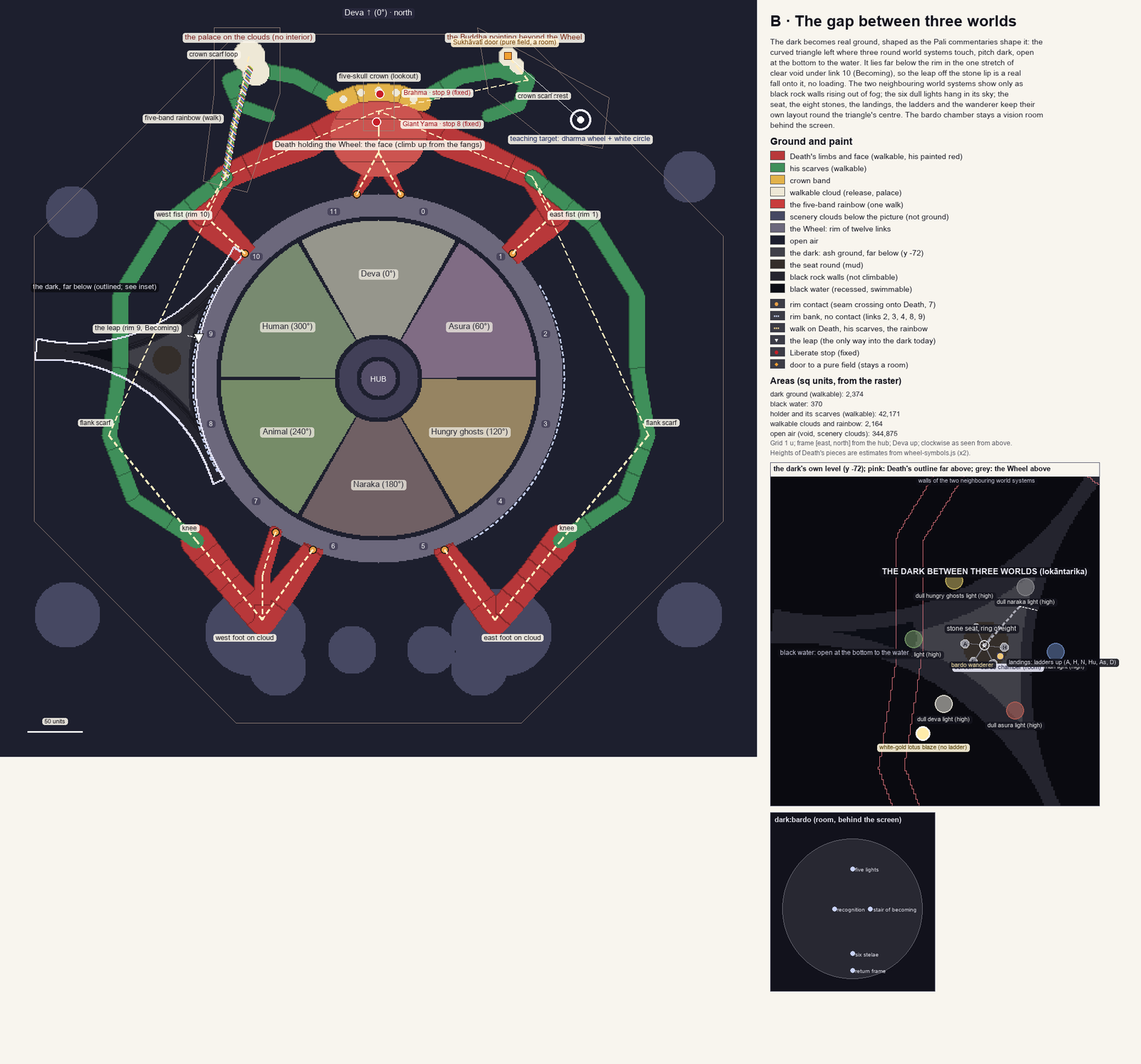
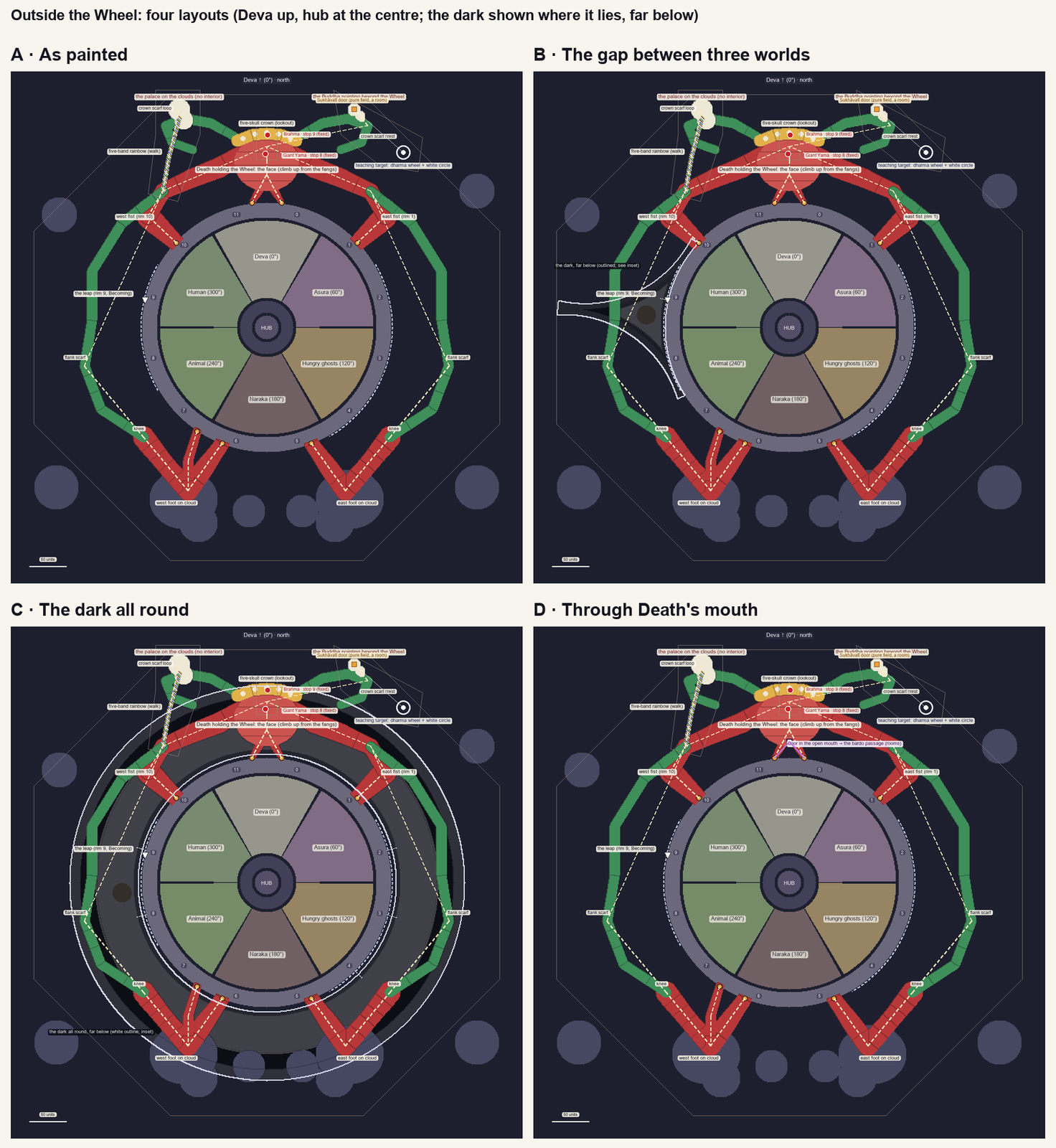
The dark becomes walkable ground in its canon shape, the curved triangle between three world systems, under link 10, so the existing leap is a real fall onto it. D's bardo passage through Death's mouth is the planned second step.
Two different things share the samsara page 'dark': the lightless gap the Pali canon puts between three touching world systems, and the intermediate states after death that Karma Lingpa's Bardo Thödol describes as visions of light, deities, storms and womb doors. Neither is a country with a map; the texts fix colours, directions, days, Buddha families and the order of what appears, and that is what this group records so the dark and its bardo chamber can be laid out from canon. Milarepa's and Rechungpa's dream journeys are gathered here too, because the repo files them with the bardo of dreams.
The dark between world systems (lokāntarika)
Pali lokantarikā (lok'antarika mahā-niraya); Skt. lokāntarikā; Chinese 'the darkness in-between' (zhongjian anming)
Between every three world systems lies a gap of utter darkness where sun and moon cannot reach, lit only when a Buddha is conceived, born, awakened or first teaches.
The Pali suttas describe it only as a marvel of the Buddha's life. When the bodhisatta descends into his mother's womb, and again when he is born, a great measureless radiance surpassing the gods' appears in the world, 'even in the inter-cosmic void of the unrestrained darkness, pitch-black darkness, where even the light of the sun and moon' does not reach. The beings born there see one another by it and say: 'So other beings have been reborn here, too!' Then the ten-thousand-fold cosmos trembles.
The commentaries and dictionaries give the shape. World systems (cakkavāḷa) are round and touch at their walls like three bowls or three coins pushed together; the triangular gap left between every three of them is the lokantarika, 8,000 yojanas across, pitch dark, open at the bottom to the water that supports the worlds. Later Pali tradition counts it as a hell (the great interworld hell) whose beings cling to the rock walls in the dark; the Pali-English Dictionary records that these spaces were filled with light when Gotama became the Buddha. The Mahāprajñāpāramitāśāstra tradition adds that its beings live and die in shadow and, when the light comes, judge themselves great sinners beside the others they now see.
Vasubandhu's Abhidharmakośa does not mention it. La Vallée Poussin's note at the cold hells (Kośa iii.59) records that the sūtra's 'Black Obscurity' hell between the universes is absent from the Kośa, so the Tibetan Abhidharma cosmology the game otherwise follows has no place for this darkness; it is a Pali and Mahāyāna sūtra feature.
What the texts never give is a door. Nothing in the canon walks into the lokantarika or out of it; it is the place a Buddha's light reaches last. The repo's ledger (topic `dark`) keeps this darkness and the after-death bardo as two separate ideas, and the world plan records the leap from the Wheel's rim as Josie's direction, not a source.
What canon fixes for the map
Lies between three adjacent world systems, outside every cakkavāḷa, where the three round walls touch [MN 123; DN 14; AN 4.127; PED s.v. lokantarika].
8,000 yojanas across; pitch dark; sun and moon never reach it [PED s.v. lokantarika, citing Vism 207, VbhA 4, J i.76].
Lit only at a Buddha's conception, birth, awakening and first turning of the wheel; the beings there then see each other for the first time [MN 123; AN 4.127; PED].
Beings do live there (Pali commentarial tradition: an interworld hell); they can be seen only by the Buddha's light [PED; Piya Tan's study of SN 56.46].
Not in the Abhidharmakośa; the Kośa's hell list has no interworld darkness [Pruden vol. I, note at iii.59a-c].
No entrance, path or neighbour is given anywhere; the game's rim-leap and six ladders are adaptation (docs/world-plan/places/dark.json gateway.adaptation).
Who lives here
The beings born in the interworld dark: unnamed; the suttas say only that they perceive one another by the Buddha's light [MN 123].
In the game now
The built place `dark` (district dark.ground, claim dark.ground.lokantarika, status adapted): a near-black round, radius 15, under a black sky, with a stone seat, a ring of eight stones, six far realm glows and six rope ladders. The samsara page's 91 `dark` items are all bardo and dream items; no item names the lokantarika itself.
Art (0)
Still missing: No traditional painting shows the lokantarika; it has no iconography. The only related traditional image is the Buddha's birth radiance in life-of-the-Buddha paintings, which does not depict the dark itself. The game's own place has no concept art and no in-world capture in media.json.
The bardo of dharmatā: the clear light and the lights that follow
Tib. chos nyid bar do (chönyi bardo); the inner radiance / clear light, 'od gsal
After the breath stops the inner radiance dawns like a cloudless sky; if it is not recognised, sounds, lights and rays follow and the peaceful deities appear day by day, each with a dull light of a realm beside them.
Karma Lingpa's Great Liberation by Hearing is read aloud beside the dead. First comes the bardo of the time of death: as the elements dissolve, the vital energy enters the central channel and the inner radiance of the ground, 'empty and radiant, like a cloudless sky', dawns for as long as it takes to eat a meal. Recognised, it is buddhahood on the spot. Most do not recognise it, faint, and wake after three and a half days into the bardo of dharmatā, where their own awareness appears outside them as sound, light and rays.
The text keeps a strict calendar of days. On each of the first five days one Buddha of the five families dawns from his field with consort and attendants, and from the couple's heart a single coloured wisdom light strikes the heart of the deceased, piercing and too bright to bear. Beside it, soft and inviting, shines the dull light of one of the six realms. The reader tells the deceased: do not flee the bright light, do not love the soft one. On the sixth day all five families arise together with the gatekeepers and the six munis, forty-two peaceful deities in all; on the seventh the awareness holders come from the pure realm of the sky-farers with a five-coloured light. From the eighth to the fourteenth day the fifty-eight blood-drinking wrathful deities blaze out of the brain.
Everything here is explicitly 'your own projection': the deities are the purity of the aggregates and elements, the lights the five wisdoms, the sounds the natural sound of reality. The thangkas painted for this teaching show the whole assembly in two round enclosures, the peaceful and the wrathful, with Samantabhadra and Samantabhadrī, naked and dark blue, above all.
What canon fixes for the map
Order: dying (elements dissolve, inner radiance) → three and a half days' faint → dharmatā bardo: days 1–5 one family each, day 6 the whole peaceful mandala, day 7 the awareness holders, days 8–14 the wrathful deities → the bardo of becoming [BTG; Dorje 2005 ch. 11].
The inner radiance of the ground lasts about the time of a meal and is 'like a cloudless sky' [BTG, the time of death; Fremantle & Trungpa, 'The Bardo of the Moment before Death'].
Each day pairs one bright wisdom light with one dull realm light: day 1 blue / dull white (gods), day 2 white / dull smoky (hells), day 3 yellow / dull blue (humans), day 4 red / dull yellow (hungry ghosts), day 5 green / dull red (asuras), day 7 five-coloured / dull green (animals) [BTG PDF pp. 139–250, 306, 324–352].
The lights strike at the level of the heart, from the heart of the couple; the Buddha comes 'to escort' the deceased [BTG, each day].
The appearances are the deceased's own awareness; there is no landscape, only lights, sounds and figures in space [BTG; MLH §2].
Painters show the peaceful forty-two and the wrathful fifty-eight in two concentric circular enclosures, often stacked (peaceful below or above), which HAR uses as the mark of a 'Bardo' painting [HAR set 227; HAR news post 196].
Who lives here
Samantabhadra and Samantabhadrī in union, dark blue and white, the primordial buddha above every Bardo painting (being:bardo-five:samantabhadra-union, missing).
The forty-two peaceful deities (listed under the five radiances and the sixth day), the five awareness holders with their consorts and retinue (the seventh day), the fifty-eight wrathful deities (days 8–14).
In the game now
The bardo chamber dark:bardo (district dark.bardo): six unlettered stelae for the six bardos, five light apertures in Minling Terchen's order with daises, a low pale light for recognition and a drifting light for renewed becoming; no deity figures. Samsara: place:bardo-five:blue-radiance, white-radiance, yellow-radiance, red-radiance, green-radiance built there; place:bardo-five:four-cognitions, five-coloured-light and sky-farers missing. The world plan marks the five-light sequence and the six stelae as adapted claims (dark.bardo.five-lights, dark.bardo.six-contexts, dark.bardo.not-full-cycle).
Art (6)
the peaceful circle, below: the forty-two peaceful deities round a white couplethe wrathful circle, above: the Heruka couple in flames with the five Heruka families round themthe three figures over the top rim; the dark-blue couple in the middle is where Bardo paintings put Samantabhadra and Samantabhadrī
Rubin Museum of Himalayan Art, Gift of Shelley and Donald Rubin (HAR 505; Rubin C2006.66.17, earlier P1998.2.6), via Wikimedia Commons · traditional · Public domain (PD-old, Public Domain Mark 1.0)
The classic stacked composition: the wrathful circle above with the flaming Heruka couple, the peaceful circle below, three figures over the top rim, two small side circles and flames of charnel grounds at the corners.
Samantabhadra and Samantabhadrī, dark blue and white, in the centrethe house of the deceased, bottom right, with the body laid out and lamas reading the text
Musée Guimet (MNAAG), Paris; RMN photograph (Thierry Ollivier), via Wikimedia Commons · traditional · Public domain (PD-Art, Public Domain Mark 1.0; the RMN photo credit claims copyright outside the US, so treat as US-safe only)
Only 494 px wide. The peaceful mandala alone: Samantabhadra and Samantabhadrī in the centre, the five families with consorts round them, bodhisattvas and gatekeepers in the outer ring, and at the bottom the household where the text is read to the dead.
the dark-blue centre: the Heruka couples in flamesSamantabhadra and Samantabhadrī above the wheel
Musée Guimet (MNAAG), Paris, via Wikimedia Commons (photo Djampa, CC BY-SA 4.0 / PD-Art) · traditional · Public domain artwork (PD-old); photograph CC BY-SA 4.0 / GFDL
The wrathful mandala as one great wheel: the Heruka couples in a dark-blue centre, the dancing goddesses in four coloured quarters (white, yellow, red, green), Samantabhadra above and the peaceful families in four corner roundels.
Himalayan Art Resources (Jeff Watt) · traditional · No open licence; link only
Items 505, 557, 1015, 4496, 15648, 15804 and more; the page explains that there are no literal pictures of the bardo, only its deities in round enclosures.
Himalayan Art Resources · traditional · No open licence; link only
Five paintings (505, 65860, 77051, 89182, 93812) with the two circles stacked, the format the game's chamber could echo.
Still missing: No open-licence picture of the inner radiance itself (painters never show it) and none of the daily sequence as a sequence; the Karling Shitro initiation cards (HAR set 1891) show each deity one by one but are link-only.
The Tibetan Book of the Dead: First Complete Translation, tr. Gyurme Dorje, ed. Graham Coleman with Thupten Jinpa (Penguin, 2005), ch. 11, 'The Great Liberation by Hearing', parts one and two
The Tibetan Book of the Dead, tr. Francesca Fremantle and Chögyam Trungpa (Shambhala, 1975), 'The Bardo of the Moment before Death', 'The Bardo of Dharmatā', 'The Peaceful Deities', 'The Wrathful Deities'
Skt. the five jñāna; Tib. ye shes lnga; the five families, rigs lnga
On each of five days one Buddha of the five families dawns from his coloured field on his animal throne with consort and attendants, and one piercing light of wisdom shines at the heart.
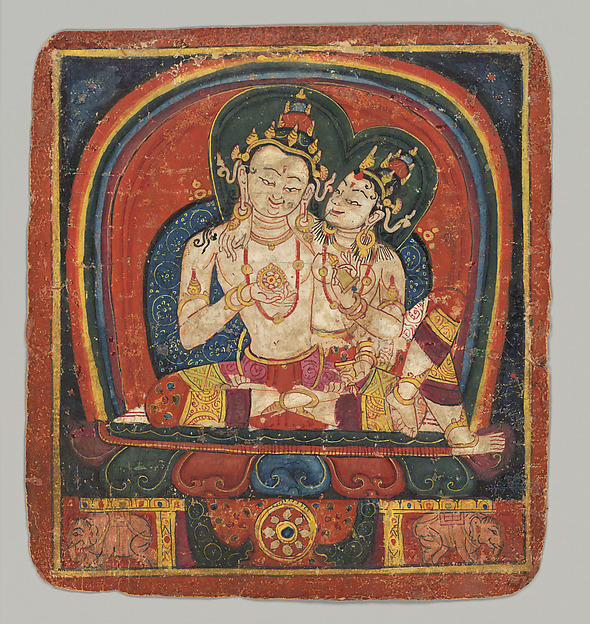
Day one: all space arises blue. Vairocana, white, holding an eight-spoked wheel, on a lion throne, embraced by Ākāśadhātvīśvarī, dawns from the central field called Pervasive Seminal Point. From their heart the blue light of the wisdom of reality's expanse, the purity of consciousness, pierces the heart. Beside it the dull white light of the gods.
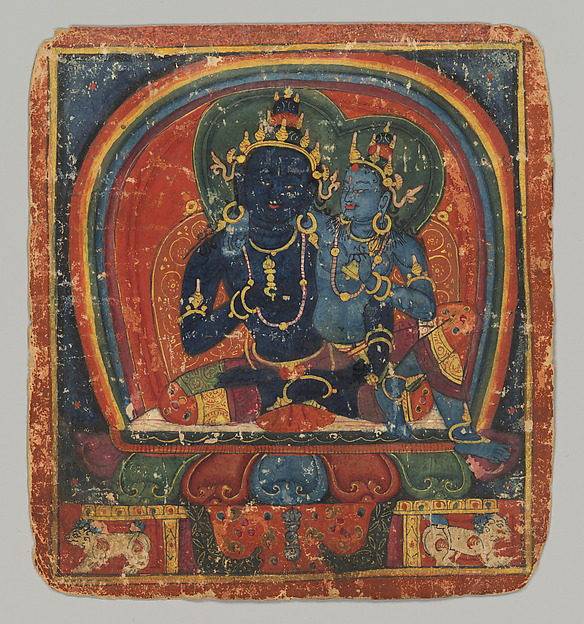
Day two: water's purity arises white. Akṣobhya-Vajrasattva, blue, with a five-pronged vajra, on an elephant throne, with Buddhalocanā, with Kṣitigarbha and Maitreya and the goddesses Lāsyā and Puṣpā, from the eastern field Abhirati; the white mirror-like wisdom, purity of form. Beside it the dull smoky light of the hells.
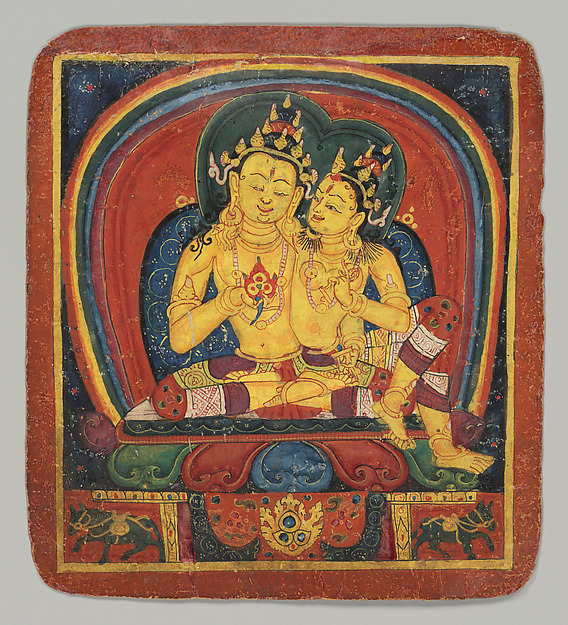
Day three: earth's purity arises yellow. Ratnasambhava, yellow, with a jewel, on a horse throne, with Māmakī, with Ākāśagarbha and Samantabhadra and the goddesses Mālyā and Dhūpā, from the southern field Śrīmat; the yellow wisdom of sameness, purity of feeling. Beside it the dull blue light of the humans.
Day four: fire's purity arises red. Amitābha, red, with a lotus, on a peacock throne, with Pāṇḍaravāsinī, with Avalokiteśvara and Mañjuśrī and the goddesses Gītā and Ālokā, from the western field Sukhāvatī; the red wisdom of discernment, purity of perception. Beside it the dull yellow light of the hungry ghosts.
Day five: wind's purity arises green. Amoghasiddhi, green, with a crossed vajra, on a throne of civaṃcivaka birds, with Samayatārā, with Vajrapāṇi and Nivaraṇaviṣkambhin and the goddesses Gandhā and Nartī, from the northern field Karmaprasiddhi (Matrix of Enlightened Activities); the green wisdom of accomplishment, purity of motivational tendencies. Beside it the dull red light of the asuras. Each day ends the same way: pray to the light, dissolve into the couple's heart as rainbow light, and awaken in that Buddha's field.
What canon fixes for the map
Colours and directions: centre white Vairocana (blue light), east blue Akṣobhya (white light), south yellow Ratnasambhava (yellow light), west red Amitābha (red light), north green Amoghasiddhi (green light); the body colour and the light colour differ for the first two [BTG PDF pp. 139–250].
Elements purified: space (day 1), water (2), earth (3), fire (4), wind (5); aggregates: consciousness, form, feeling, perception, motivational tendencies [BTG].
Attendants come from day two on: two male bodhisattvas and two offering goddesses per family; Vairocana comes with his consort only [BTG PDF pp. 153–250].
Minling Terchen's order of the five lights (used by the game's chamber) is the same day order: blue, white, yellow, red, green [MLH §2; docs/world-plan/places/dark.json claim dark.bardo.five-lights].
Who lives here
Vairocana and Ākāśadhātvīśvarī (being:bardo-five:akasadhatvisvari, missing).
Akṣobhya-Vajrasattva and Buddhalocanā (being:bardo-five:buddhalocana), with Kṣitigarbha, Maitreya, Lāsyā (being:bardo-five:lasya) and Puṣpā (being:bardo-five:puspa).
Ratnasambhava and Māmakī (being:bardo-five:mamaki), with Ākāśagarbha, Samantabhadra the bodhisattva, Mālyā (being:bardo-five:malya) and Dhūpā (being:bardo-five:dhupa).
Amitābha and Pāṇḍaravāsinī (being:bardo-five:pandaravasini), with Avalokiteśvara, Mañjuśrī, Gītā (being:bardo-five:gita) and Ālokā (being:bardo-five:aloka).
Amoghasiddhi and Samayatārā (being:bardo-five:samayatara), with Vajrapāṇi, Nivaraṇaviṣkambhin, Gandhā (being:bardo-five:gandha) and Nartī (being:bardo-five:narti).
In the game now
Built as light only: place:bardo-five:blue-radiance, white-radiance, yellow-radiance, red-radiance and green-radiance stand as five apertures with daises in dark:bardo (adapted claim dark.bardo.five-lights). All twenty-two named consorts and goddesses are missing beings; the five Buddhas themselves have iconography dossiers (public/atlas/iconography/dossiers/vairocana.json, akshobhya.json, ratnasambhava.json, amitabha.json, amoghasiddhi.json) and the eight bodhisattvas appear in the Meru pavilion and pure-land work, not here.
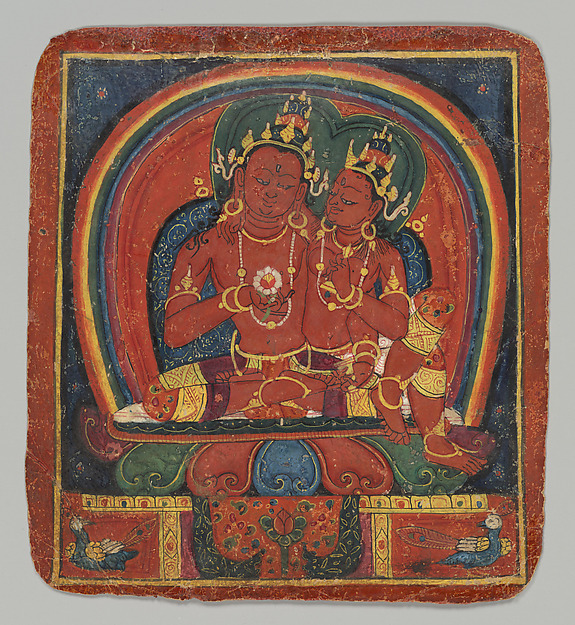
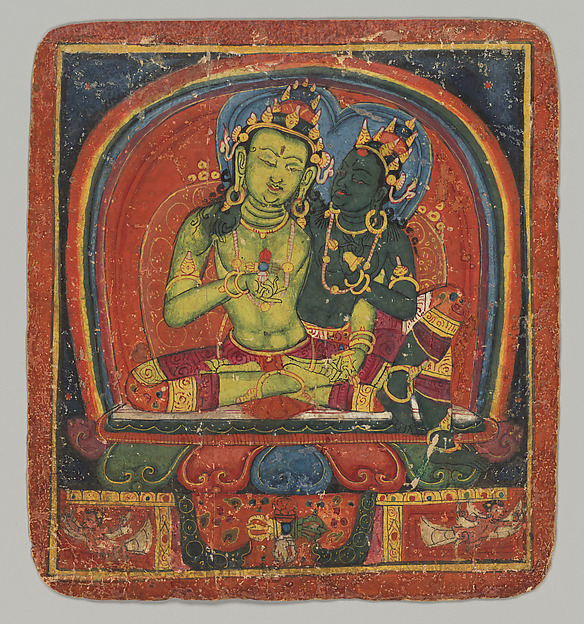
The Metropolitan Museum of Art, Rogers Fund 2000 (2000.282.2) · traditional · CC0 (Met Open Access)
White Vairocana in union, lions on the throne base: the first day's Buddha as a card held up to the dying. A generic 15th-century initiation set, not a Karling Shitro set.
Himalayan Art Resources · traditional · No open licence; link only
About 70 cards, one deity each, from the Karma Lingpa system itself (items 52950001 onward): the only set here that is certainly the Bardo Thödol's own cast.
Still missing: No open-licence image of the consorts and offering goddesses one by one; the Met cards cover the five Buddhas only, and the Karling Shitro cards are link-only.
Repo iconography dossiers for the five Buddhas, public/atlas/iconography/dossiers/{vairocana,akshobhya,ratnasambhava,amitabha,amoghasiddhi}.json; five-buddhas.md
The six dull lights of the realms
Tib. rigs drug gi 'od; the 'soft' or 'dull' lights
Beside each bright wisdom light a soft realm light invites the deceased; loving it, they fall into that realm.
The text pairs the realm lights with the days. On the first day, with Vairocana's blue, comes the dull white light of the gods, 'the inviting path made by your own habitual tendencies for deep delusion'. On the second, with the white, the dull smoky light of the hells, made by aversion. On the third, with the yellow, the dull blue light of humans, made by pride. On the fourth, with the red, the dull yellow light of the hungry ghosts, made by desire and miserliness. On the fifth, with the green, the dull red light of the asuras, made by envy. On the sixth day all six dull lights shine together with the whole mandala, and on the seventh, with the five-coloured light of the awareness holders, the dull green light of the animals, made by delusion.
The instruction is the same every day: 'Do not be attached to it, do not be weak.' The bright light hurts and the soft light comforts, and that is the trap. Minling Terchen's explanation gives a second, simpler scheme for the bardo of becoming: a white path to the gods and asuras, a black path to the hells, a red path to the hungry ghosts and a yellow path to humans and animals.
The game's dark shows all six soft lights at once, far off and high, each above a ladder, which is how the bardo wanderer drifts between them; the ledger (topic `bardo-six`) marks this as borrowed imagery, 'visionary appearances, not six physical towns'.
Day pairing: 1 gods, 2 hells, 3 humans, 4 hungry ghosts, 5 asuras, 6 all six, 7 animals [BTG].
Alternative scheme for the bardo of becoming: four coloured paths (white: gods and asuras; black: hells; red: pretas; yellow: humans and animals) and the direction of travel (head down: lower realms; head up: gods; straight: humans) [MLH §3 'Four Paths of Beings'].
The lights are visions in space with no distance or geography; the game's placement of them 'far off and high' over ladders is adaptation [dark.ground.six-lights, adapted].
In the game now
Built: place:bardo-six:gods, hells, humans, hungry-ghosts, antigods, animals as the six far glows of dark.ground (placements dark.ground.glow-*), each above a landing and rope ladder to its realm; place:rebirth-guidance:mlh-four-paths missing. The bardo wanderer (being:bardo-wanderer, built) drifts between the human and asura glows.
Art (1)
the hub: the three poisons, and the half-ring of beings rising (pale) and falling (dark)
Library of Congress, via Wikimedia Commons · traditional · Public domain (Library of Congress, no known restrictions)
Not a bardo picture, but the only traditional image of the six destinations side by side with their colours; the hub's half-ring shows beings rising on the pale side and falling on the dark side between lives.
Still missing: Painters do not depict the six dull lights; the subject has no traditional art of its own. The game's glows have no concept image.
Repo ledger topic `bardo-six`, docs/purelands-cosmology.json: 'visionary appearances, not six physical towns'
The sixth day's whole mandala and the seventh day's awareness holders
the four pristine cognitions combined; Skt. vidyādhara, Tib. rig 'dzin; the pure realm of the sky-farers (mkha' spyod)
On the sixth day all forty-two peaceful deities arise at once with the four lights woven like a spider's web; on the seventh the five awareness holders come from the sky-farers' realm in a five-coloured light.
On the sixth day the four coloured lights of the four elements dawn together and the five families rise from their five fields with the whole assembly: the eight male and eight female gatekeepers, the six munis of the six realms, Samantabhadra and Samantabhadrī above. Forty-two in all. From the five Buddhas' hearts the light of the four wisdoms combined shines, fine and clear like a spider's web: a sheet of white light from Vairocana with a white seminal point like a mirror facing downward, a sheet of blue from Vajrasattva with a point like a turquoise bowl, a sheet of yellow from Ratnasambhava like a gold cup, a sheet of red from Amitābha like a coral bowl, each hung with greater and lesser points of light with no centre or edge. The green light of accomplishment is missing: that wisdom is not yet perfected. This is called 'the hollow passageway of Vajrasattva'. The four gatekeepers at the four doors are Trailokyavijaya, Hayagrīvarāja, Amṛtakuṇḍalin and Yamāntaka-type wrathful forms with their consorts Aṅkuśā, Pāśā, Sphoṭā and Ghaṇṭā, who hold hook, noose, chain and bell.
On the seventh day a five-faceted multicoloured light arises, the purity of the deceased's habits, and the awareness holders come to escort them from the pure realm of the sky-farers: in the centre the Awareness Holder of Maturation (Padmanarteśvara), east the one who Abides on the Levels, south the one with Power over the Lifespan, west the one of the Great Seal, north the one of Spontaneous Presence, each embracing a ḍākinī consort, surrounded by heroes, heroines, retainers and protectors. From their hearts a five-coloured light of coemergent wisdom, like coloured threads twisted together, pulses at the heart while all the natural sounds of the teaching crash like a thousand thunders, pounding with wrathful mantras. Beside it shines the dull green light of the animals.
What canon fixes for the map
Day six: the full peaceful mandala of forty-two at once; the four lights of the elements dawn together; the green light is absent [BTG PDF pp. 256, 262–304, 317–320].
The four seminal points: white like a mirror (Vairocana), blue like a turquoise bowl (Vajrasattva), yellow like a gold cup (Ratnasambhava), red like a coral bowl (Amitābha), each bowl facing downward [BTG PDF pp. 282–304].
The eight gatekeepers stand at the four doors in couples: Trailokyavijaya, Hayagrīvarāja, Amṛtakuṇḍalin and the fourth male gatekeeper with Aṅkuśā (hook), Pāśā (noose), Sphoṭā (chain) and Ghaṇṭā (bell) [BTG, the sixth day].
Day seven: five awareness holders in the five directions, with five ḍākinī consorts, from the pure realm of the sky-farers; a five-coloured light and the dull green light of the animals [BTG PDF pp. 324–361].
The sky-farers' realm is named as a destination only; no description of it is given [BTG PDF pp. 324, 327, 354–361].
Who lives here
The eight gatekeepers: Trailokyavijaya (being:bardo-five:trailokyavijaya), Hayagrīvarāja (being:bardo-five:hayagrivaraja), Amṛtakuṇḍalin (being:bardo-five:amrtakundalin), with Aṅkuśā, Pāśā, Sphoṭā and Ghaṇṭā (being:bardo-five:ankusa, pasa, sphota, ghanta); all missing.
The five awareness holders: of maturation, Padmanarteśvara (being:bardo-five:vidyadhara-maturation), who abides on the levels (vidyadhara-levels), with power over the lifespan (vidyadhara-lifespan), of the great seal (vidyadhara-great-seal), of spontaneous presence (vidyadhara-spontaneous); their five consorts (vidyadhara-consorts), the ḍākinīs (vidyadhara-dakinis) and the heroes, heroines and protectors (vidyadhara-retinue); all missing.
In the game now
place:bardo-five:four-cognitions, five-coloured-light and sky-farers are missing; the chamber dark:bardo stops at five lights and claims no sixth or seventh day (dark.bardo.not-full-cycle).
Art (2)
the left side roundel beside the peaceful circlethe right side roundel beside the peaceful circle
Rubin Museum of Himalayan Art, via Wikimedia Commons · traditional · Public domain (PD-old, Public Domain Mark 1.0)
The four wrathful gatekeeper couples stand at the four doors of the peaceful circle's outer ring; the two small roundels either side of the circle hold the smaller groups painters set apart from the forty-two.
From the eighth day the peaceful assembly returns transformed: blood-drinking Herukas of the five families with their consorts, the eight Gaurī, the eight Piśācī, the four animal-headed gatekeepers and the twenty-eight Īśvarī, blazing out of the deceased's own brain.
If the deceased has not recognised the peaceful deities, the wrathful appear, and the text says they are the same deities in another form, arising from the brain as the peaceful arose from the heart. Day eight: the great glorious Buddha Heruka, dark brown, three faces and six arms, with his consort Krodhīśvarī, in a mass of fire. Days nine to twelve: Vajra Heruka (dark blue), Ratna Heruka (yellow), Padma Heruka (red) and Karma Heruka (green), each with his consort, each from his direction of the brain. Day thirteen: the eight Gaurī goddesses and the eight animal-headed Piśācī goddesses from the brain's eight directions. Day fourteen: the four animal-headed female gatekeepers with hook, noose, chain and bell, and the twenty-eight Īśvarī, animal-headed, in the four directions, seven to a quarter, holding skull cups, weapons and corpses.
The reader tells the deceased these are terrifying only because of fear: 'Recognise them as the natural expression of your own awareness.' Fremantle and Trungpa, Thurman and Dorje all keep the same cast and order. The paintings show them as a single flaming wheel: the Heruka couples in a dark centre, the Gaurī and Piśācī dancing in coloured quarters, the twenty-eight Īśvarī round the rim.
After the fourteenth day the bardo of dharmatā is over. What was not recognised fades and the bardo of becoming begins.
What canon fixes for the map
Days 8–12: five Heruka couples, Buddha (centre, dark brown), Vajra (east, dark blue), Ratna (south, yellow), Padma (west, red), Karma (north, green), each three-faced and six-armed [Dorje 2005 ch. 11 part two; Fremantle & Trungpa, 'The Wrathful Deities'].
Day 13: eight Gaurī and eight Piśācī (animal-headed); day 14: four female gatekeepers (horse-, sow-, lion- and snake-headed in the Dorje reading) and twenty-eight Īśvarī, seven per direction [same].
They arise from the brain (crown), the peaceful from the heart [same].
Painters fill the wrathful circle with a dark-blue field, flames and the coloured quarters; Samantabhadra sits above it [Guimet 58 wrathful thangka; HAR 505].
Who lives here
The five Herukas with consorts, the eight Gaurī, the eight Piśācī, the four gatekeepers and the twenty-eight Īśvarī: none has a samsara item yet.
In the game now
Nothing yet. No samsara item covers the wrathful deities; the chamber claims not to show the wrathful cycle (dark.bardo.not-full-cycle).
Art (3)
the Heruka couples in the dark-blue centrethe four coloured quarters of dancing animal-headed goddessestop-left corner roundel: a peaceful family group painted beside the wrathful wheel
Musée Guimet (MNAAG), Paris, via Wikimedia Commons (photo Djampa) · traditional · Public domain artwork (PD-old); photograph CC BY-SA 4.0 / GFDL
The whole wrathful mandala: Heruka couples in the dark centre, the Gaurī and Piśācī dancing in white, yellow, red and green quarters, the Īśvarī round the rim, wrathful protectors in the corners.
Huntington Archive, Ohio State University (museum no. 92.053, one of a set of five) · traditional · No open licence; link only
One Heruka family per painting with its sixteen goddesses: the set format the chamber could follow if the wrathful days are ever built.
Still missing: No open-licence image of the Gaurī, Piśācī or Īśvarī individually; the Huntington set is link-only.
Sources
The Tibetan Book of the Dead: First Complete Translation, tr. Gyurme Dorje (Penguin, 2005), ch. 11, part two, 'The intermediate state of reality: the wrathful deities', days 8–14
The Tibetan Book of the Dead, tr. Fremantle and Trungpa (Shambhala, 1975), 'The Wrathful Deities', days 8–14
The Tibetan Book of the Dead, tr. Robert Thurman (Bantam, 1994), 'The Reality Between', the wrathful deities
The bardo of becoming: the mental body, the storm and the three precipices
Tib. srid pa bar do (sipa bardo); the mental body, yid lus
Waking in a mental body that passes through mountains and casts no shadow, the deceased is blown by the hurricane of past actions toward a darkness full of cries, over three precipices of white, red and black.
Four and a half days after the faint the deceased wakes with a body like the old one, all senses complete, able to move anywhere unobstructed and with the clairvoyance of past actions, visible to others of the same kind. For three and a half days it keeps the old life's form, then the shape of the coming birth grows vivid. It passes through Mount Sumeru, earth and rock, everything except a mother's womb and the Indestructible Seat at Bodh Gayā; it can circle Sumeru and the four continents in an instant; it casts no reflection in water and no shadow; it feeds on smells. Minling Terchen lists the five sure signs: passing through walls, being unseen and unheard, leaving no footprint or shadow, subtle higher perception, and seeing darkness in place of sun, moon and stars.
Then the hurricane: 'a fierce, turbulent, utterly unbearable hurricane of past actions' at the back, driving the deceased on, and ahead 'a terrifying, dense and unfathomable darkness' echoing with cries of Strike! and Kill! Four dreadful sounds come as the elements stir again: mountains crumbling, lakes flooding, forests burning and the wind rising. The deceased imagines wild beasts and hordes of pursuers, snow, rain and blizzard. Suddenly the way ahead is cut by three precipices, white, red and black, and they feel themselves falling. The text says: these are aversion, attachment and delusion; even plunging over them does no harm. Minling Terchen gives them as three vast abysses, deep red, ashen grey and dark black, signs of the three lower realms.
The deceased sees the relatives left behind weeping and the ritual done for them, calls out and is not heard, and feels the uncertainty Minling Terchen counts as six: no fixed dwelling, companions, food, resting place, behaviour or mood. Spirits take shape from the mind: anguished spirits, malign forces and carnivorous ogres, the executors of cause and effect. The body of the past life fades; the next one brightens; and the wander toward the womb doors begins (next topic).
What canon fixes for the map
The mental body wakes four and a half days after the faint; three and a half days in the old form, then the coming form [BTR PDF pp. 258–272].
It passes through everything but the mother's womb and the Vajra Seat; circles Sumeru and the four continents in an instant; no shadow, no reflection; sees others of its kind [BTR PDF pp. 275–276, 284–287; MLH §3 'Five Definite Signs'].
Hurricane behind, darkness ahead with cries of Strike! and Kill! [BTR PDF pp. 277–278, 322, 370].
Four sounds: earth (avalanche), water (flood), fire (forest fire), wind (hurricane) [MLH §3 'Four Dreadful Sounds'; BTR p. 277].
Three precipices: white, red, black = aversion, attachment, delusion [BTR PDF pp. 278–279, 299]; or three abysses deep red, ashen grey, dark black [MLH §3 'Three Terrifying Abysses']. Both are canon; they are two texts of the same tradition.
The mental body lasts up to seven days at a time, dying and re-forming, to forty-nine days at most [MLH §3].
No ground, horizon or map: the bardo is a storm of perceptions; everything seen is 'your own bewildered perception' [BTR p. 278].
Who lives here
The deceased in the mental body (being:rebirth-guidance:mental-body, sketch).
The relatives and ritualists left behind, as the deceased sees them (being:rebirth-guidance:relatives-left-behind, missing).
The spirits that take shape in the mental body: anguished spirits, malign forces and carnivorous ogres (being:rebirth-guidance:mental-body-spirits, missing).
The carnivorous ogres and avenging forces, executors of cause and effect (being:rebirth-guidance:avenging-ogres, missing).
In the game now
place:rebirth-guidance:hurricane-and-darkness, three-precipices and mlh-three-abysses are missing; the chamber has a 'renewed becoming' threshold (dark.bardo.becoming): a stair of stones going down with a light that drifts clockwise while she is near. The bardo wanderer (built, dark.ground) is the game's invented traveller between lives (adaptation noted in docs/world-plan/places/dark.json characters).
Musée Guimet (MNAAG), Paris, via Wikimedia Commons · traditional · Public domain (PD-Art, Public Domain Mark 1.0; RMN photo credit claims rights outside the US)
Bottom right, the one traditional picture here of 'the relatives left behind': the body laid out in the house, lamas reading, the household at its tasks.
Library of Congress, via Wikimedia Commons · traditional · Public domain (Library of Congress, no known restrictions)
The half-ring round the hub is the painters' only picture of beings between lives: naked figures climbing on the pale side and tumbling head-down on the dark side, as Minling Terchen says the head-down traveller is bound for the lower realms.
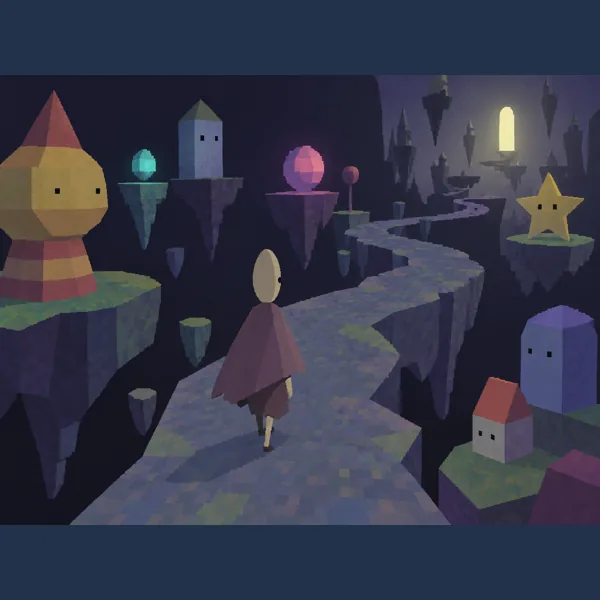
AI concept study (repo), OpenAI image generation, 2026-09-28 · concept · Project art
A cloaked figure on a floating path among drifting islands and soft lights; the game's invented traveller, not a canon being.
Still missing: No traditional picture of the mental body, the hurricane, the three precipices or the four sounds exists; the Bardo Thödol's manuscript illustrations (HAR manuscript sets 1270, 1443, 1437) are link-only and show deities, not the storm.
The Tibetan Book of the Dead, tr. Fremantle and Trungpa, 'The Bardo of Becoming'
Yama's judgement: the pebbles, the mirror and the acolytes
Yama Dharmarāja, Tib. gshin rje chos kyi rgyal po; the innate good and bad conscience, lhan cig skyes pa'i lha and 'dre
In the bardo of becoming the innate good conscience counts white pebbles and the bad one black; when the deceased lies, Yama consults the mirror of past actions and tears the mental body apart, which cannot die.
The deceased is brought before Yama Dharmarāja. The innate good conscience, born with them, counts out their good deeds in white pebbles; the innate bad conscience counts the bad in black. The deceased trembles and lies: 'I have not committed non-virtuous actions!' Yama says, 'I shall consult the mirror of past actions,' and in it every deed appears vividly and precisely. Then he ties a rope round the neck, drags the deceased forward, cuts off the head, pulls out the heart and entrails, licks the brains, drinks the blood, eats the flesh and gnaws the bones; but the mental body cannot die, and is revived to be cut up again.
The text's point is the same as everywhere else in the bardo: do not lie, and do not be afraid of him. Yama, the gods, the malign forces and the bull-headed Rakṣa are 'natural forms of emptiness', the deceased's own bewildered perception; emptiness cannot harm emptiness. A lay person who cannot meditate should say to Yama the name they received at empowerment.
Painters give Yama Dharmarāja a buffalo head, a mirror and a noose, and the Wheel-of-Life painters put a Lord of Death's fanged face over the whole Wheel. The repo ledger (topic `yama`) keeps four Yamas apart: the judge of the dead, heavenly Yāma of the desire heavens, the Death who holds the Wheel, and Yamāntaka; this topic's Yama is the judge.
What canon fixes for the map
Two consciences count white and black pebbles; Yama's mirror shows every deed [BTR PDF pp. 289–293].
Yama's dismemberment of the mental body, which revives each time [BTR PDF pp. 289–293, 299].
The bull-headed Rakṣa stands among the executors [BTR p. 292; being:rebirth-guidance:bull-headed-raksa].
All of it is the deceased's projection; a lay person names their empowerment name to Yama [BTR PDF pp. 292–293].
Not the Yama who holds the Wheel, nor heavenly Yāma, nor Yamāntaka [repo ledger topic `yama`].
Who lives here
Yama with the mirror of past actions (being:rebirth-guidance:yama, sketch).
The acolytes of Yama (being:rebirth-guidance:yama-acolytes, sketch).
The innate good conscience and the innate bad conscience, counting the pebbles (being:rebirth-guidance:consciences, missing).
The bull-headed Rakṣa (being:rebirth-guidance:bull-headed-raksa, missing).
In the game now
The Story-mode Yama boss and mirror hall are the Liberate path's (Josie's design, do not change); the bardo items being:rebirth-guidance:yama and yama-acolytes are sketches on the samsara page; consciences and the Rakṣa are missing. The repo concept public/purelands/concepts/yama.webp is filed under hungry-ghost.
Wellcome Collection (repo copy, media.json painting-wellcome-L0069380) · traditional · Public Domain Mark
The fanged Death who holds the Wheel: the painters' Lord of Death, kept apart in the ledger from the bardo's judge, but the closest the repo has to his face.
Still missing: No open image of the pebble-counting consciences or the mirror scene; Bardo Thödol manuscript illustrations of the judgement are link-only on HAR.
Repo ledger topic `yama` (Yama, death and the Wheel), docs/purelands-cosmology.json
The signs of rebirth, the shelters and the womb entrances
Tib. mngal sgo 'gag pa, closing the womb door; mngal sgo 'dam pa, choosing the womb door
Each coming birth shows itself as a landscape, a lake or a house; the text teaches first how to shut the womb door, then, failing that, which doors to refuse and which to take.
When the next life's body grows vivid the deceased wanders toward the womb entrances, and the realm of the coming birth shows itself as a sign. Gods: delightful many-storied celestial palaces of jewels. Asuras: exquisite groves and spinning wooden torches making wheels of fire. Humans of the eastern continent Videha: a lake with male and female swans. Of the southern continent Jambudvīpa: grand and delightful mansions. Of the western Aparagodānīya: a lake with male and female horses on its shores. Of the northern Uttarakuru: a lake with cattle round it, or a lake with trees. Animals: rocky caverns, empty hollows and straw sheds in mist. Hungry ghosts: tree stumps, black silhouettes, blind desolate gorges or total darkness. Hells: the songs of those with bad past actions, then a land of darkness with black and reddened houses, black earth-pits and black roads, from which there is no turning back.
Only two doors are approved: the jewel palaces of the gods and the mansions of Jambudvīpa, where the teachings flourish. The other three continents are happy but teaching-less; the lower realms are refused outright. Before any of this comes the closing of the womb door, in two ways: by stopping the one who would enter (seeing the parents in union, visualise your deity like the moon in water, then dissolve it into emptiness) and by stopping the womb itself through five methods, seeing the couple as teacher and consort, as the deity or Mahākāruṇika with consort, reversing attachment and aversion, seeing all as illusion, and resting in inner radiance, which closes all four modes of birth: egg, womb, heat-and-moisture and miraculous. Minling Terchen adds the rules of the moment: if you appear as a woman, do not desire the man; as a man, do not desire the woman; do not grasp at warmth or cold.
On the way the deceased seeks shelter from the hurricane under bridges, in mansions, temples, grass huts and beside stupas, and later, fleeing the avengers, in rock-shelters, holes in the ground, among trees or inside a lotus bud; growing attached to the hiding place, they take a body there, however bad. For those of highest ability there is a last choice: to transfer consciousness to a buddha field, Sukhāvatī, Abhirati, Ghanavyūha, Alakāvatī, Potalaka, the palace of Lotus Light or Maitreya's Tuṣita.
What canon fixes for the map
Signs by realm: gods jewel palaces; asuras groves and fire-wheels; animals caverns, hollows, straw sheds in mist; hungry ghosts stumps, black silhouettes, blind gorges, darkness; hells black and reddened houses, black pits and roads [BTR PDF pp. 365–368].
Signs by continent: Videha swan lake; Jambudvīpa mansions; Aparagodānīya horse lake; Uttarakuru cattle lake or tree lake [BTR PDF pp. 362–365].
Approved doors: gods' palaces and Jambudvīpa's mansions only [BTR pp. 363, 365].
Two ways to close the womb door; five methods for the second; closes all four birth modes [BTR PDF pp. 314–315, 321–392].
Shelters: bridges, mansions, temples, huts, stupas; then rock-shelters, holes, trees, a lotus bud [BTR PDF pp. 282, 370–372].
Transference destinations: Sukhāvatī, Abhirati, Ghanavyūha, Alakāvatī, Potalaka, Lotus Light, Tuṣita [BTR PDF pp. 379–382].
Signs of the birth mode: parents in union = womb or egg; attraction to scents = heat and moisture; attraction to a place = miraculous [MLH §3].
Who lives here
The male and female in union at the womb entrance (being:rebirth-guidance:parents-in-union, missing).
In the game now
All sign places are missing: place:rebirth-guidance:sign-gods, sign-antigods, sign-videha, sign-jambudvipa, sign-aparagodaniya, sign-uttarakuru, sign-animals, sign-anguished-spirits, sign-hells, plus shelters, womb-entrances and alakavati. These are the readiest canon for small vision rooms off the chamber: each sign is one picture (a lake with swans; a cattle lake; black houses on black roads).
Art (1)
the gods' sector with its palace, top centre of the Wheel
Library of Congress, via Wikimedia Commons · traditional · Public domain (Library of Congress, no known restrictions)
Not the signs themselves, but the six destinations as painters show them (palace, grove and fire, towns, beasts, gorges, black ground) sit round one Wheel; the gods' sector top centre has the jewel palace.
Still missing: No traditional art shows the womb-door signs (the swan lake, the horse lake, the cattle lake, the black houses). This is the realm's biggest art gap and would need concept studies grounded in the text.
The Tibetan Book of the Dead, tr. Fremantle and Trungpa, 'The Bardo of Becoming': closing the womb-entrance, choosing the womb-entrance
The six bardos and the Root Verses
Tib. bar do drug: skye gnas, rmi lam, bsam gtan, 'chi kha, chos nyid, srid pa
Karma Lingpa's Root Verses name six bardos in order, this life, dreams, meditation, dying, dharmatā and becoming, each opening 'Kyema!'
The Root Verses on the Six Bardos are the short heart of the cycle, one verse each. The bardo of this life: abandon laziness, enter study, reflection and meditation. The bardo of dreams: 'I will abandon the heedless, corpse-like sleep of ignorance... recognizing dreams, I will train in transformation and clear light.' The bardo of meditation: rest without distraction. The bardo of dying: let go of all attachment, enter the clear light. The bardo of dharmatā: recognise the sounds, lights and rays as your own. The bardo of becoming: hold one-pointed intention, close the womb door, choose a good birth.
The game's chamber stands six unlettered stelae for these six in an arc, and the repo marks their order as the source's own number while flagging the enumeration as an attributed interpretation needing a locator; the Lotsawa House verses supply it. The Milarepa and Tsongkhapa dream material in this group belongs to the second bardo.
What canon fixes for the map
Six bardos in this order: this life, dreams, meditation, dying, dharmatā, becoming [RVB, six verses].
Minling Terchen counts four (natural bardo of birth and death, dying, dharmatā, becoming), folding dream and meditation into the first [MLH §1].
In the game now
place:dream-travel:bardo-of-dreams built in dark:bardo; the six stelae (dark.bardo.stelae, claim dark.bardo.six-contexts, adapted).
Art (0)
Still missing: The six bardos have no iconography of their own; paintings of the cycle show its deities.
Tsongkhapa's account of Nāropa's dream yoga says a yogi who holds the dream may ride the sun's rays to the Thirty-three, or go to Amitābha's land, Maitreya's heaven or Akaniṣṭha, and jump the fire or cross the flood of a dream.
Tsongkhapa's Book of the Three Faiths sets out dream practice in four divisions. The second, developing the dream, has two ways. The mundane: the yogi thinks in the dream that he rides on the rays of the sun and moon and journeys to the thirty-three heavens or anywhere in this world, or walks and flies in the sky to enlarge his visions. The Buddhist: in the dream he goes to the Pure Land of Amitābha, the heaven-land of Maitreya or the Akaniṣṭha Pure Land, visits the buddhas and bodhisattvas, makes offerings and hears the Dharma. Only mastery of prāṇa lets a dream be created or transformed at will, and whatever is seen is a reflection of the pure land, not the land itself; prophecies had this way mostly fail.
The third division is training in the dream's illusory nature: seeing a fire or a flood and being frightened, the yogi recognises the dream, thinks 'How can the fire and water of dream ever harm me?', and jumps the fire and crosses the flood.
The repo ledger (topic `dream-travel`) frames the game's own night travel, sleeping after dark and revisiting discovered hidden places, as authored game fiction borrowing this imagery, kept apart from the death bardo.
What canon fixes for the map
Mundane dream travel: sun and moon rays to the Thirty-three or anywhere in this world; walking or flying in the sky [TSY ch. 6, division (2)].
Buddhist dream travel: Amitābha's Sukhāvatī, Maitreya's Tuṣita, Akaniṣṭha; a reflection, not the place [TSY ch. 6, division (2)].
Dream fire and flood to jump and cross [TSY ch. 6, division (3)].
Dream travel never reaches the dark or the death bardo in any source; the game keeps them apart [repo ledger `dream-travel`].
In the game now
Built as places in other realms: place:dream-travel:amitabha-land (sukhavati), maitreya-land (tushita), thirty-three (meru); place:dream-travel:akanistha and fire-and-flood missing. The dream doorway itself is game fiction (ledger `dream-travel`).
Art (0)
Still missing: No traditional art shows dream travel as such; the pure lands reached are covered by their own realm pages (Sukhāvatī, Tuṣita, Akaniṣṭha art).
Milarepa's dreams: the snow mountain of four pillars, the hard field, the ruined house
Mi la ras pa; Kyangatsa (skya rnga rtsa); the house Kazhi Dunggyé (ka bzhi gdung brgyad)
Milarepa's life gives four dreams the ledger files with the bardo of dreams: a snow mountain with a pillar in each direction, a hard field that yields to ploughing, his home in ruins, and the night he wandered the universe in hundreds of forms.
When Marpa bids his foremost disciples await their dreams, only Milarepa's holds a prophecy: in the world's broad northern quarter a great mountain of snows, its summit touching the sky, sun and moon circling its peak, its base covering the earth, rivers running to the four directions to satisfy all beings, every kind of flower blooming; and from it a great pillar raised in each direction. Marpa calls it excellent and sings its meaning: the mountain is himself and the whole Kagyu teaching; the four pillars are his four heart sons, each pillar with its own creature, lion, tigress, garuḍa and vulture.
Later, meditating near his old home without the least bliss-warmth, he dreams of ploughing an uncultivated field too hard to furrow; Marpa appears in the sky: 'Son, plow with diligence and perseverance.' He ploughs deep and crops spring up. Waking, he calls dreams the projections of mental imprints yet sings the field of equanimity, the seeds of pure mind, the plough of method and wisdom. Earlier, in retreat at Marpa's, he dreams at dawn of Kyangatsa: his house Kazhi Dunggyé cracked like an old donkey's ear, rain ruining the Ratnakūṭa scriptures, the field Orma Triangle overgrown, his mother dead, his sister a beggar; he wakes with a wet pillow and goes home to find it just so.
After he opens Marpa's scroll and practises at Drakar Taso, by day he can change his body and levitate, and at night in dreams he wanders the whole universe top to bottom, manifesting hundreds of mental and physical forms, each visiting a buddha realm to hear the Dharma and teach, and turning his body into blazing fire and gushing water.
What canon fixes for the map
The snow mountain stands in the world's northern quarter; sun and moon circle its peak; four rivers run to the four directions; one pillar per direction, each with its creature [LM ch. 7, PDF pp. 101–104].
The hard field is near Milarepa's old home; Marpa speaks from the sky [LM ch. 10, PDF pp. 130–131].
Kyangatsa and Kazhi Dunggyé: a cracked house, ruined scriptures, the weed-grown Orma Triangle field [LM ch. 8, p. 108; ch. 9, p. 120].
The hundreds of dream forms visit buddha realms; the body becomes fire and water [LM ch. 10, PDF pp. 144–145].
Milarepa's own verdict: dreams are mistaken projections, read only as signs [LM ch. 10].
Who lives here
The lion, tigress, garuḍa and vulture on the four pillars (being:dream-travel:four-pillar-creatures, missing).
Milarepa's hundreds of dream forms (being:dream-travel:milarepa-dream-forms, sketch).
Nāropa in Marpa's dream, the night before Milarepa comes (being:dream-travel:naropa-in-marpas-dream, missing).
The two women from Oḍḍiyāna in Dakmema's dream (being:dream-travel:oddiyana-women, missing).
The blue woman in Milarepa's dream who sends him to ask for Transference (being:dream-travel:blue-woman, missing).
In the game now
place:dream-travel:four-pillars-mountain, hard-field and kyangatsa-dreamed are missing. Milarepa himself is a built presence on the Human wedge (human.milarepa-ledge, concept public/purelands/concepts/milarepa.webp); the dream places could be vision rooms off his ledge or the chamber, which is a layout question for later.
Los Angeles County Museum of Art, Gift of Mr. and Mrs. Michael Phillips, via Wikimedia Commons · traditional · Public domain (LACMA public-domain release)
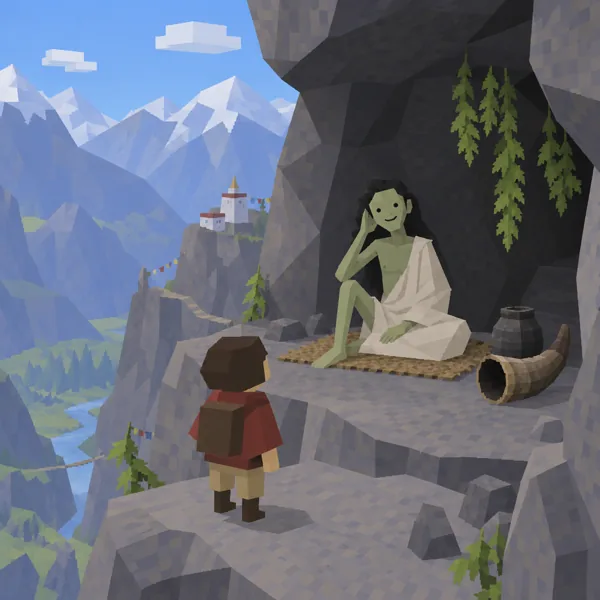
Green-skinned Milarepa in his white cotton, hand to his ear, among snow peaks; a lama above him in the place painters give Marpa, two seated lamas either side where the usual composition sets Rechungpa and Gampopa.
Tibet Museum, Gruyères (HAR 33257), via Wikimedia Commons · traditional · Public domain (author died 1674; Public Domain Mark 1.0)
Marpa's household at the moment Milarepa arrives, with Dakmema beside him: the only open picture here of the house where Marpa dreamed of Nāropa and Dakmema of the two women from Oḍḍiyāna.
Himalayan Art Resources / Statens Etnografiska Museum, Stockholm · traditional · No open licence; link only
Items 60061–60079: the fullest narrative set of the Life, where the dream episodes (the four pillars, the ploughed field) appear as vignettes; check item 60061 onward for the dream scenes.
Still missing: No open-licence painting shows the four-pillar snow mountain or the hard field as a scene; the Stockholm set probably does but is link-only.
Rechungpa's dream of Oḍḍiyāna Khandroling and the crystal stupa
Ras chung pa; Oḍḍiyāna Khandroling (o rgyan mkha' 'gro gling), the Garden of Ḍākinīs; Bharima; Chubar (chu dbar); Lorodol
The Life of Milarepa opens with Rechungpa's night-long dream of a city of gems where Akṣobhya teaches, and five maidens who tell him to ask for the Jetsün's life; it closes with ḍākinīs lifting a crystal stupa from Chubar.
While Milarepa stays at Dröpa Puk in Nyanam, Rechungpa rests in his retreat cell and dreams all night of a lovely land called Oḍḍiyāna Khandroling, the Garden of Ḍākinīs. He enters a great city whose houses and foundations are all precious gems; its people are beautiful. A woman named Bharima leads him into a house of gems with an inexhaustible store of delights, and at the city's centre, on a high throne of gems in an ocean-like assembly, the buddha Akṣobhya teaches the genealogies, births and deeds of all the buddhas and bodhisattvas, then of Tilopa, Nāropa and Marpa, more extensive than the Jetsün had told, and says he will tell Milarepa's life the next day. Then, in a state between dream and luminosity, five beautiful maidens of Oḍḍiyāna stand in a row before him and tell him to request the Jetsün's life story. He wakes as dawn breaks with his practice more potent than ever.
At the end of the Life, late one night at the hermitage of Lorodol, in a mixture of dreaming and luminosity, Rechungpa sees ḍākinīs at Chubar hold aloft a crystal stupa that fills the sky with light, preparing to carry it to a pure realm; the ground is full of his vajra brothers and sisters and the Jetsün's patrons, the sky full of gods and ḍākinīs singing. The Jetsün leans from the stupa's chamber, caresses his head and says he is delighted father and son have met this way. Rechungpa wakes afraid the lama has died and covers in one morning what takes a donkey two months.
The night before Milarepa first arrives, Marpa dreams of Nāropa, and his wife Dakmema dreams of two women from Oḍḍiyāna; both dreams foretell the disciple.
What canon fixes for the map
Oḍḍiyāna Khandroling: a great city of gems with Akṣobhya teaching at its centre on a throne of gems; Bharima's house of gems [LM ch. 1, PDF pp. 39–40].
Five maidens of Oḍḍiyāna appear in a row between dream and luminosity [LM ch. 1].
The crystal stupa rises from Chubar, seen from Lorodol; ḍākinīs carry it toward a pure realm [LM ch. 12, PDF pp. 192–193].
Marpa's dream of Nāropa and Dakmema's of the two women precede Milarepa's arrival [LM, Marpa chapters].
Who lives here
Akṣobhya teaching in Oḍḍiyāna (being:dream-travel:akshobhya-in-oddiyana, sketch) and his ocean-like assembly (akshobhya-assembly, missing).
Bharima, the principal figure of the city (being:dream-travel:bharima, missing).
The people of the city of gems (being:dream-travel:city-of-gems-people, missing).
The five maidens of Oḍḍiyāna (being:dream-travel:five-maidens, missing).
The dreamer in the illusory body of the yidam (being:dream-travel:dreamer-as-yidam, missing).
In the game now
place:dream-travel:oddiyana-khandroling and chubar-crystal-stupa are missing; Akṣobhya in Oḍḍiyāna is a sketch. Abhirati (Akṣobhya's own field) has its lore page (public/atlas/lore/abhirati/) under pure-lands, distinct from this dreamed city.
The dark and the bardo chamber today, and the leap from Becoming
world-plan place `dark` (rooms dark, dark:bardo); gateway from section wheel-rim-9 'Becoming'
A black round outside the world, reached by a leap off the Wheel's rim at the tenth link, with six rope ladders back, a stone seat for the freed, one invented wanderer, and a side chamber of six stelae and five lights.
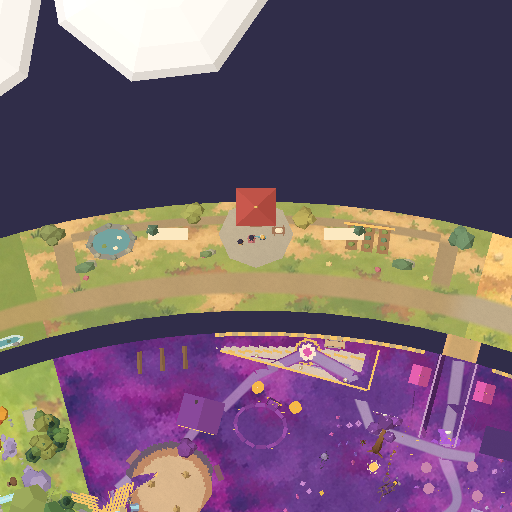
The gateway. Section wheel-rim-9 is the Wheel's tenth link, Becoming: a flat meadow ring at r 75–84 with a rim walk, an outer rill and the waiting house, a small round house with a red cone roof, a gold finial and an open dark door with a lamp beside it, the home made ready for a life not yet come (a pregnant woman is the Wellcome drawing's picture for the link). At plan u −3.6 on the outer edge (r 82.6–84) a stone lip is laid over the rill, reached by a spur of three flat stones from the garden track (wheel-rim-9.gateway-dark, kind fall). Stepped or jumped off, she falls into the dark; the link lies over clear void so she never lands on Yama. Josie's rule R21 and decision 33 (2026-10-11): the only way in is a leap off the rim; Meru's iron ring has no gap. The place opens with Story reach; before that the fall sets her back. The six openings once cut inside the realms are gone.
The dark (room dark, district dark.ground). One round of near-black ground, radius 15, under a black sky. In the middle a stone seat inside a ring of eight flat stones, paler than the ground, with one small light for each freed being round it and a bell beside the seat as the place's keepsake. Six eight-sided landings at radius 11, clockwise in route order from straight ahead of the fall, each with a kerb, two lamp posts and a rope ladder, each under its realm's dull glow far off and high (animal green, hungry-ghost yellow, naraka smoky grey, human blue, asura red, deva white); trails of eight flat stones run from the seat ring to each landing. Past the gods' glow a white-gold lotus blaze too bright to look at, with no ladder. The ladders climb to animal.west-river, hungry-ghost.gully, naraka.lava-heart, human.market, asura.lower-field and deva.pearl-road; nothing leads back to the rim.
The resident. The bardo wanderer (bound, liberatable, home at [−5.3, 9.2]) drifts from glow to glow between the Human and Asura landings, reaches toward one, lets the hand fall and turns away, and never heads for the lotus blaze; freed, she faces the bright light. The plan calls her an invented person: the teaching describes the pull of the dull lights, not this wanderer.
The bardo chamber (room dark:bardo, district dark.bardo). Between the Human and Asura landings a three-sided screen holds a pale frame; through it a second round room, radius 14.4: six unlettered stelae in an arc across the near side for the six bardos, five light apertures with daises round the far side in Minling Terchen's order (blue, white, yellow, red, green), a low pale steady light on the ground for recognition, a threshold and a stair of stones going down with a light that drifts clockwise only while she is near for renewed becoming, and the return frame always in sight between the stelae of dying and dharmatā. It stays its own room because it is a chosen vision and must not read as the dark's own ground. Nobody lives there.
What canon fixes for the map
Adaptation: the leap, the ladders, the seat, the eight stones, the bell and the wanderer have no source; the plan records them under R21/decision 33 and R8 (no freed-state change) [docs/world-plan/places/dark.json gateway, districts, characters].
Canon behind it: the lokantarika darkness (MN 123 and commentary), the six dull lights and five radiances (BTG), the six bardos (RVB) and Minling Terchen's order (MLH); see the topics above.
The ledger insists the dark and the after-death bardo are different concepts and that the chasms must not be described as post-mortem geography [docs/purelands-cosmology.json `dark`].
Threes and eights: the spur of three stones, the ring of eight, the trails of eight [AGENTS.md hard invariants, honoured by the plan].
Who lives here
The bardo wanderer (being:bardo-wanderer, built, bound and liberated forms; dialogue in residentLifeContent).
In the game now
Samsara realm `dark`: 91 items, 16 built, 5 sketch, 70 missing; built are the wanderer, the six dull-light places (dark.ground), the five radiances and the bardo of dreams (dark:bardo), and the three dream pure lands placed in other rooms. Rooms: dark (17 placements) and dark:bardo (5 placements), gateway wheel-rim-9.gateway-dark at [−7.2, 71.84] in section wheel-rim-9.
World capture (repo), public/atlas/terrain-review/in-world/wheel-rim-9.png · world-view · Project art
The red-roofed waiting house on its stone forecourt, the pond to its left, the rim walk, and the dark void beyond the outer edge where the leap goes; the stone lip itself is not visible at this size.
AI concept study (repo), OpenAI image generation, 2026-09-28 · concept · Project art
A cloaked wanderer on a floating path between drifting islands, with coloured lights on pedestals and a bright doorway far off: the picture the dark's glows and lotus blaze were built from.
Wellcome Collection (media.json painting-wellcome-L0069380) · traditional · Public Domain Mark
The link of Becoming sits in the outer ring of twelve; in this painting the outer-ring pictures run round the Wheel's edge, and the blank blue field outside the Wheel is the nearest a Wheel painting comes to 'outside the world'.
Still missing: No in-world capture of the dark or the bardo chamber exists in media.json or terrain-review (the places are in the plan and rooms but uncaptured); no concept for the chamber, the landings or the stone seat.
Sources
docs/world-plan/places/dark.json, gateway, layout, routes, districts dark.ground and dark.bardo, characters, hooks
docs/world-plan/sections/wheel-rim-9.json, account; district wheel-rim-9.waiting-house; placement wheel-rim-9.gateway-dark; terrain.water
missing Nothing in the game is this yet.sketch Something stands in: a model not yet placed, a placement drawn with a shared rig, a written voice, a court inside a shared room, or a place registered with no builder.built A placed character with its own model is this, or the place is built as its own room, zone or segment.
Beings
no art
Ākāśadhātvīśvarī, Vairocana’s consort missing being
Embracing Vairocana on the lion throne on the first day, she comes with him to escort the deceased; the day’s prayer asks her, the supreme consort, to support them from behind on the fearsome passageway of the intermediate state. On the sixth day she arises again with the whole maṇḍala of the five families, one of the five central couples (PDF pp. 264–268, 279); the prayer then asks the five supreme female buddhas, the purity of the expanse, to support the deceased from behind (p. 315).
Ālokā, female bodhisattva of the fourth day missing being
One of the four bodhisattvas, two male and two female, who encircle Amitābha and Pāṇḍaravāsinī on the fourth day: six Buddha-bodies shining from a space of rainbow light (with Avalokiteśvara, Mañjuśrī and Gītā). On the sixth day all the female bodhisattvas of the five families arise again with the whole maṇḍala (PDF pp. 280–281).
On the sixth day the four male gatekeepers, Trailokyavijaya, Yamāntaka, Hayagrīvarāja and Amṛtakuṇḍalin, and the four female gatekeepers, Aṅkuśā, Pāśā, Sphoṭā and Ghaṇṭā, arise encircling the male and female deities of the five families, among the forty-two deities of the Buddha-body of Perfect Resource, who emanate from within the deceased’s own heart and appear before them.
On the sixth day the four male gatekeepers, Trailokyavijaya, Yamāntaka, Hayagrīvarāja and Amṛtakuṇḍalin, and the four female gatekeepers, Aṅkuśā, Pāśā, Sphoṭā and Ghaṇṭā, arise encircling the male and female deities of the five families, among the forty-two deities of the Buddha-body of Perfect Resource, who emanate from within the deceased’s own heart and appear before them.
Bharima, the principal figure of the city in Rechungpa’s dream missing being
The female disciple of the lama Tipupa, whom Rechungpa had met in Nepal. In his dream she wears a red robe and carries herself as the city’s principal figure; she welcomes him as “Nephew”, serves him food and drink as a host her guest, asks the buddha’s permission for him to hear the Dharma, and at the end takes his hands and shakes them: “Nephew, you have understood. Nephew, you have understood.”
Waking, Rechungpa takes her listening, and the one teaching, as signs that he should request the Jetsün’s life story (PDF p. 41). Not built; no character.
Buddhalocanā, Akṣobhya-Vajrasattva’s consort missing being
Embracing Akṣobhya-Vajrasattva on the elephant throne on the second day; the white light emanates from the heart of the couple, and the day’s prayer asks her to support the deceased from behind. On the sixth day she arises again with the whole maṇḍala of the five families, one of the five central couples (PDF pp. 264–268, 279); the prayer then asks the five supreme female buddhas, the purity of the expanse, to support the deceased from behind (p. 315).
Dhūpā, female bodhisattva of the third day missing being
One of the four bodhisattvas, two male and two female, who encircle Ratnasambhava and Māmakī on the third day: six Buddha-bodies shining from a space of rainbow light (with Ākāśagarbha, Samantabhadra and Mālyā). On the sixth day all the female bodhisattvas of the five families arise again with the whole maṇḍala (PDF pp. 280–281).
Gandhā, female bodhisattva of the fifth day missing being
One of the four bodhisattvas, two male and two female, who encircle Amoghasiddhi and Samayatārā on the fifth day: six Buddha-bodies shining from a space of rainbow light (with Vajrapāṇi, Nivaraṇaviṣkambhin and Nartī). On the sixth day all the female bodhisattvas of the five families arise again with the whole maṇḍala (PDF pp. 280–281).
On the sixth day the four male gatekeepers, Trailokyavijaya, Yamāntaka, Hayagrīvarāja and Amṛtakuṇḍalin, and the four female gatekeepers, Aṅkuśā, Pāśā, Sphoṭā and Ghaṇṭā, arise encircling the male and female deities of the five families, among the forty-two deities of the Buddha-body of Perfect Resource, who emanate from within the deceased’s own heart and appear before them.
Gītā, female bodhisattva of the fourth day missing being
One of the four bodhisattvas, two male and two female, who encircle Amitābha and Pāṇḍaravāsinī on the fourth day: six Buddha-bodies shining from a space of rainbow light (with Avalokiteśvara, Mañjuśrī and Ālokā). On the sixth day all the female bodhisattvas of the five families arise again with the whole maṇḍala (PDF pp. 280–281).
On the sixth day the four male gatekeepers, Trailokyavijaya, Yamāntaka, Hayagrīvarāja and Amṛtakuṇḍalin, and the four female gatekeepers, Aṅkuśā, Pāśā, Sphoṭā and Ghaṇṭā, arise encircling the male and female deities of the five families, among the forty-two deities of the Buddha-body of Perfect Resource, who emanate from within the deceased’s own heart and appear before them.
Lāsyā, female bodhisattva of the second day missing being
One of the four bodhisattvas, two male and two female, who encircle Akṣobhya-Vajrasattva and Buddhalocanā on the second day: six Buddha-bodies shining from a space of rainbow light (with Kṣitigarbha, Maitreya and Puṣpā). On the sixth day all the female bodhisattvas of the five families arise again with the whole maṇḍala (PDF pp. 280–281).
Mālyā, female bodhisattva of the third day missing being
One of the four bodhisattvas, two male and two female, who encircle Ratnasambhava and Māmakī on the third day: six Buddha-bodies shining from a space of rainbow light (with Ākāśagarbha, Samantabhadra and Dhūpā). On the sixth day all the female bodhisattvas of the five families arise again with the whole maṇḍala (PDF pp. 280–281).
Embracing Ratnasambhava on the horse throne on the third day; the yellow light emanates from the heart of the couple, and the day’s prayer asks her to support the deceased from behind. On the sixth day she arises again with the whole maṇḍala of the five families, one of the five central couples (PDF pp. 264–268, 279); the prayer then asks the five supreme female buddhas, the purity of the expanse, to support the deceased from behind (p. 315).
Nāropa in Marpa’s dream, the night before Milarepa comes missing being
The night before Milarepa reaches Drowolung, Paṇchen Nāropa appears to Marpa in a dream and grants initiation, giving him a slightly soiled five-pronged vajra of lapis lazuli and a golden vase filled with nectar: cleanse the vajra with the vase’s water and mount it atop a victory banner. Marpa does so; the vajra’s light permeates the universe, and beings of the six realms, filled with a happiness devoid of suffering, bow down before him and the banner and make offerings. He wakes with a slight feeling of pride.
Marpa later tells Milarepa the dream was a sign he would benefit the Buddha’s teaching (ch. 6, PDF p. 93), and that Nāropa foretold his name in a dream before they met (ch. 6, PDF p. 92). Marpa is milarepa:marpa. Not built; no character.
Nartī, female bodhisattva of the fifth day missing being
One of the four bodhisattvas, two male and two female, who encircle Amoghasiddhi and Samayatārā on the fifth day: six Buddha-bodies shining from a space of rainbow light (with Vajrapāṇi, Nivaraṇaviṣkambhin and Gandhā). On the sixth day all the female bodhisattvas of the five families arise again with the whole maṇḍala (PDF pp. 280–281).
Padmanarteśvara, the awareness holder of maturation missing being
On the seventh day, at the centre of the awareness holders’ maṇḍala, suffused by rainbows and light, the unsurpassed awareness holder of maturation arises instantaneously, his body resplendent with the radiance of the five lights, embraced by his consort, a red ḍākinī dancing with a blood-filled skull and a curved knife raised in the gesture of pointing to the sky. With the other four principal awareness holders he sends the five-coloured light from his heart.
Their consorts are the bardo-five:vidyadhara-consorts item; their light, bardo-five:five-coloured-light.
Embracing Amitābha on the peacock throne on the fourth day; the red light emanates from the heart of the couple, and the day’s prayer asks her to support the deceased from behind. On the sixth day she arises again with the whole maṇḍala of the five families, one of the five central couples (PDF pp. 264–268, 279); the prayer then asks the five supreme female buddhas, the purity of the expanse, to support the deceased from behind (p. 315).
On the sixth day the four male gatekeepers, Trailokyavijaya, Yamāntaka, Hayagrīvarāja and Amṛtakuṇḍalin, and the four female gatekeepers, Aṅkuśā, Pāśā, Sphoṭā and Ghaṇṭā, arise encircling the male and female deities of the five families, among the forty-two deities of the Buddha-body of Perfect Resource, who emanate from within the deceased’s own heart and appear before them.
Puṣpā, female bodhisattva of the second day missing being
One of the four bodhisattvas, two male and two female, who encircle Akṣobhya-Vajrasattva and Buddhalocanā on the second day: six Buddha-bodies shining from a space of rainbow light (with Kṣitigarbha, Maitreya and Lāsyā). On the sixth day all the female bodhisattvas of the five families arise again with the whole maṇḍala (PDF pp. 280–281).
Samantabhadra and Samantabhadrī in union missing being
Accompanying the sixth day’s array, they arise in the form called Samantabhadra and Consort in Union, the coalescence that is the progenitor of all the buddhas, completing the forty-two deities of the Buddha-body of Perfect Resource, who emanate from within the deceased’s heart.
One item: BTG gives them one form. Not the bodhisattva Samantabhadra of the third day (close-son-08), whom the game’s samantabhadra character is. Also kept apart from the dharmakāya Samantabhadra of Copper Mountain (three-kayas:dharmakaya), another text’s account.
Embracing Amoghasiddhi on the bird throne on the fifth day; the green light emanates from the heart of the couple, and the day’s prayer asks her to support the deceased from behind. On the sixth day she arises again with the whole maṇḍala of the five families, one of the five central couples (PDF pp. 264–268, 279); the prayer then asks the five supreme female buddhas, the purity of the expanse, to support the deceased from behind (p. 315).
BTG says nothing to make her Tārā of the tara-grove group; kept apart.
On the sixth day the four male gatekeepers, Trailokyavijaya, Yamāntaka, Hayagrīvarāja and Amṛtakuṇḍalin, and the four female gatekeepers, Aṅkuśā, Pāśā, Sphoṭā and Ghaṇṭā, arise encircling the male and female deities of the five families, among the forty-two deities of the Buddha-body of Perfect Resource, who emanate from within the deceased’s own heart and appear before them.
The awareness holder of spontaneous presence missing being
On the seventh day he arises instantaneously from the north of the maṇḍala, his body green, his face both wrathful and smiling, embraced by his consort, a green ḍākinī dancing with a blood-filled skull and a curved knife.
Their consorts are the bardo-five:vidyadhara-consorts item; their light, bardo-five:five-coloured-light.
The awareness holder of the great seal missing being
On the seventh day he arises instantaneously from the west of the maṇḍala, his body red, his face radiant and smiling, embraced by his consort, a red ḍākinī dancing with a blood-filled skull and a curved knife.
Their consorts are the bardo-five:vidyadhara-consorts item; their light, bardo-five:five-coloured-light.
The awareness holder who abides on the levels missing being
On the seventh day he arises instantaneously from the east of the maṇḍala, his body white, his face radiant and smiling, embraced by his consort, a white ḍākinī dancing with a blood-filled skull and a curved knife.
Their consorts are the bardo-five:vidyadhara-consorts item; their light, bardo-five:five-coloured-light.
The awareness holder with power over the lifespan missing being
On the seventh day he arises instantaneously from the south of the maṇḍala, his body yellow and adorned by the eighty minor marks, embraced by his consort, a yellow ḍākinī dancing with a blood-filled skull and a curved knife.
Their consorts are the bardo-five:vidyadhara-consorts item; their light, bardo-five:five-coloured-light.
The blue woman in Milarepa’s dream, who sends him to ask for Transference missing being
While Marpa rests at Drowolung, a woman appears to Milarepa in a dream, blue in colour, beautifully adorned in garments of pure silk and bone ornaments, her eyebrows and facial hair brilliant gold: he has the Great Seal and the Six Dharmas, but not the special instructions on Ejection and Transference, through which one becomes a buddha by meditating for a single instant. “Request it!” Unsure whether she is a prophetic command of the ḍākinīs or a demonic obstacle, he pulls down the wall of his cell; Marpa says it is a prophetic command and, finding no text on it, sets off for India to request it from Nāropa.
Named with Yama, gods and malevolent forces among the appearances that do not substantially exist outside the deceased’s own bewildering perceptions. BTR says nothing more of him.
The carnivorous ogres and avenging forces, executors of the unfailing law of cause and effect missing being
For very negative beings a swarm of carnivorous ogres arises, executors of the unfailing law of cause and effect, brandishing an array of weapons and screaming “Strike!” and “Kill!”. Later the avenging forces pursue the deceased, who has no choice but to move forward while the avengers lead the way; the wish to hide from them is a sign of being obstructed by malignant forces and carnivorous ogres. Visualising Mahottara Heruka, Hayagrīva, Vajrapāṇi or one’s own meditational deity, huge and wrathful, insulates the deceased from them and secures the ability to choose a womb entrance; pursued and unable to resist entering a womb, meditate on Hayagrīva.
The ḍākinīs around the awareness holders missing being
Inestimable crowds of ḍākinīs encircle the awareness holders: the ḍākinīs of the eight charnel grounds, of the four enlightened families, of the three abodes, of the ten directions and of the twenty-four power-places, all wearing the six kinds of bone ornaments, playing drums, thigh-bone trumpets and skull drums, waving banners of the hide of ritually ‘liberated’ beings, under canopies and streamers of human hide in an incense cloud of burning human flesh, with music that makes all world systems quake. Dancing, they come to escort those who have kept their commitments and to bring to account those who have let them degenerate.
One class: BTG lists kinds, names none. The eight charnel grounds are the charnel group’s places.
The dreamer in the illusory body of the yidam missing being
Once the dream is recognized, the yogi visualizes himself in it as his Patron Buddha (yidam). In the practice on the real nature of dream, the dream body is clearly visualized becoming the yidam; a Hūṃ at its heart sends out rays that gather all the dream’s visions back into it, the body melts into the Hūṃ, and the Hūṃ vanishes into the non-discriminating light.
TSY also names the Illusory Body of Buddha appearing in the dream, and the Illusory Dream-Body that, raised after the light of sleep, lets the yogi recognize the Illusory Body of the bardo (ch. 6, the opening part on the Illusory Body and Light Yoga). Neither names a deity. Not built.
The five ḍākinī consorts of the awareness holders missing being
Each of the five principal awareness holders of the seventh day is embraced by a ḍākinī consort: a red ḍākinī for Padmanarteśvara at the centre (his body resplendent with the radiance of the five lights), and for each of the four others a ḍākinī of his own colour, white in the east, yellow in the south, red in the west and green in the north, each dancing with a blood-filled skull and a curved knife raised in the gesture of pointing to the sky. The day’s prayer asks the supreme consorts, the hosts of ḍākinīs, to support the deceased from behind.
The five maidens of Oḍḍiyāna, in Rechungpa’s dream and luminosity missing being
Praying after the dream, within an experience that mixes dream state and luminosity, Rechungpa sees five beautiful maidens standing in a row, white, blue, yellow, red and green, in the ornaments and clothing of Oḍḍiyāna. They say Milarepa’s life story will be told tomorrow and the senior heart-disciples will request it, while it falls to them to protect and spread the master’s teaching; all the while they flutter their eyes at him, then vanish like a rainbow. Waking, he understands them as the tidings of the five Sisters of Long Life.
The Life’s opening counts the five Sisters of Long Life among the rainbow-body ḍākinīs at Dröpa Puk (PDF p. 39). Tseringma has her own item (milarepa:tseringma); not made one with Gawa Lung’s five sister ḍākinīs (beyul:gawa-lung/five-sister-dakinis). Not built.
The heroes and heroines, faithful retainers and protectors of the teachings around the awareness holders missing being
With the ḍākinīs, spiritual heroes and heroines, faithful retainers and protectors of the sacred teachings encircle the awareness holders on the seventh day, wearing the six bone ornaments, with the same music, banners and dances, escorting those who have kept their commitments and bringing to account those who have let them degenerate.
The innate good conscience and the innate bad conscience, counting the pebbles missing being
If the deceased does not pray intensely, cannot meditate on the Great Seal or on a meditational deity, the innate good conscience within gathers all their virtuous actions, counting them out with white pebbles, and the innate bad conscience within gathers all their non-virtuous actions, counting them out with black pebbles; the deceased trembles with fear, awe and terror, and lies. From the moment the counting begins, do not be afraid.
MLH names no counters: “your virtues and misdeeds are judged with an array of white and black pebbles” (2.3 The Bardo of Becoming, under ‘Six Uncertainties’, para. 2).
The lion, tigress, garuḍa and vulture on the four pillars missing being
To the east a great lion stands regal on the pillar, turquoise mane spread, leaping about on the snow; to the south a tigress riles herself up, striped fur on end, smiling three times, leaping through the forest; to the west a large garuḍa hovers, plume fanned, horns raised to the sky, flying off into space; to the north a vulture hovers, its aerie on a crag, a sole chick born to it, the sky filled with small birds. Marpa reads them as his four great disciples: Tsurtön Wangé of Dol, Ngoktön Chödor of Zhung, Metön Tsönpo of Tsangrong and Milarepa of Gungtang; the vulture’s chick is Milarepa’s one unrivalled son and the small birds the spread of the Kagyu teachings.
The male and female in union at the womb entrance missing being
The perception arises of a male and a female in sexual intercourse; it comes before birth from an egg and birth from a womb alike. Do not enter between them: meditate on them as one’s spiritual teacher with consort, then as one’s meditational deity, or Mahākāruṇika, with consort, prostrating and offering in the mind, and the womb entrance is obstructed. Bound to be born male, one feels aversion to the father and jealousy and attachment towards the mother; bound to be female, envy and jealousy towards the mother and attachment to the father. That arousal draws one into the womb: the coemergent delight at the meeting of sperm and ovum, a faint, the embryo’s stages, and at last one emerges and opens one’s eyes, perhaps as a puppy, with no way back.
MLH: seeing an image of your parents having intercourse is a sign of impending womb-birth or birth from an egg; when birth is unavoidable, visualise the parents as the guru inseparable from the yidam deity, with consort, and enter their forms with powerful focus (2.3 The Bardo of Becoming, under ‘Six Uncertainties’, paras. 7 and 9). BTR too ends, for one who must be born, by entering a chosen womb perceived as a celestial palace of the deities (rebirth-guidance:womb-entrances).
The ocean-like assembly round Akṣobhya, in Rechungpa’s dream missing being
The assembly before Akṣobhya’s throne, completely overcome with faith at the lives of Tilopa, Nāropa and Marpa. When he promises Milarepa’s life for the next day, some say there could be nothing more excellent than what he has told; others say those masters’ qualities were the fruit of merit gathered over many lifetimes, while Milarepa attained qualities not inferior in one lifetime and one body; the first then say they would be unfit disciples if they failed to request it for the benefit of beings. Asked where Milarepa now resides, some say, “He resides either in Abhirati or Akaniṣṭha.” Waking, Rechungpa calls it an assembly of Oḍḍiyāna ḍākinīs.
Waking, Rechungpa scolds himself for having thought the Jetsün was in Tibet: wherever the Jetsün abides is itself Abhirati and Akaniṣṭha (PDF p. 41). Abhirati is the abhirati group’s; not repeated. Not built.
The people of the city of gems, in Rechungpa’s dream missing being
The inhabitants of the city are all dressed in silken robes and adorned with ornaments of bone and jewels; they have pleasing features and are beautiful to behold. Without uttering a word they all exchange glances, smiling joyfully. Bharima is among them, as the city’s principal figure.
The Life does not say they are the assembly round Akṣobhya (dream-travel:akshobhya-assembly), so the two are kept apart. Not built.
The relatives and ritualists left behind, as the deceased sees them missing being
Seen again as if in a dream, homeland and relatives do not answer the deceased’s calls (“I am here! Do not cry!”); seeing them weep, the deceased knows “I am dead” and suffers like a fish writhing on hot sand. If they sacrifice animals on the deceased’s behalf, the aversion it stirs can link even one about to be born in the higher realms to a birth in hell; attachment to the wealth they enjoy, and hatred of those using it, links to the hells or the anguished spirits. Rites seen with subtle cognition to be performed impurely and distractedly breed a loss of confidence that propels the deceased into lower existences; seeing relatives and teachers practise purely, the deceased’s joy turns them back towards the higher realms.
The rites BTR names are the Kankanidharani incantation for the dead and the Purification of the Lower Realms (Sarvadurgatipariśodhana Tantra) (PDF p. 304). MLH: the family neither sees nor hears the deceased; seeing their mourning, the deceased understands they have died, and seeing others carelessly abuse their possessions feels intense attachment and anger (2.3 The Bardo of Becoming, under ‘Six Uncertainties’, para. 2); those left behind make offerings, give charity and recite sūtras on their behalf, so do not worry (para. 10).
The spirits that take shape in the mental body: anguished spirits, malign forces and carnivorous ogres missing being
Certain classes of malevolent forces, including the anguished spirits, arise through a transformation of their mental body during this very intermediate state, by a shift in their mode of perception, and take the form of an anguished spirit, malign force or carnivorous ogre able to display diverse miraculous acts: the anguished spirits who reside in the ocean depths, the anguished spirits who move through space, the eighty thousand classes of obstructing forces and so forth, all while still in the mental body.
BTR sets them beside the gods of the form realms and similar beings of the higher realms, who take birth through the potency of their meditative stability (PDF pp. 374–375). The preta realm’s own populations are the pretas group.
The two women from Oḍḍiyāna in Dakmema’s dream missing being
The same night Dakmema dreams that two women, who say they are from Oḍḍiyāna in the north, bring a crystal stupa slightly soiled outside, with Nāropa’s command that Marpa consecrate it and set it on a mountain summit. Marpa washes it with water from the vase and places it on a mountaintop, where it radiates light as dazzling as the sun and moon and copies itself on the neighbouring peaks; the two women serve as stewards for them all. Marpa, elated that the dreams accord, tells her that dreams come out of nowhere.
Marpa later tells Milarepa these were ḍākinīs come to act as custodians of the dharma (ch. 6, PDF p. 93). Dakmema is milarepa:dakmema. Not built.
On the sixth day the four male gatekeepers, Trailokyavijaya, Yamāntaka, Hayagrīvarāja and Amṛtakuṇḍalin, and the four female gatekeepers, Aṅkuśā, Pāśā, Sphoṭā and Ghaṇṭā, arise encircling the male and female deities of the five families, among the forty-two deities of the Buddha-body of Perfect Resource, who emanate from within the deceased’s own heart and appear before them.
Akṣobhya teaching the Dharma in Oḍḍiyāna, in Rechungpa’s dream sketch being
Seated on a high throne of precious gems at the city’s centre, in the middle of an ocean-like assembly, more exalted than Rechungpa had imagined. He teaches the genealogies, births, deeds and lives of all the buddhas and bodhisattvas, then those of Tilopa, Nāropa and Marpa, more extensive than the Jetsün had told them, and says he will tell Milarepa’s life the next day, more excellent still.
Rechungpa, waking: even his listening to Akṣobhya is due to the Jetsün’s kindness (PDF p. 40).
Why sketch: related: Akshobhya (character:akshobhya) at abhirati; the buddha of Abhirati (abhirati:akshobhya), here seen in a dream in Oḍḍiyāna; the same buddha, so no new model.
Concept no
Model no
Placed no
Home no
Dialogue no
Routine no
no art
Milarepa’s hundreds of dream forms, each visiting a buddha realm sketch being
After he opens Marpa’s scroll and meditates with great perseverance at Drakar Taso, by day he can transform his body into any form and levitate; at night in his dreams he freely illuminates and wanders through the entire universe from top to bottom, manifesting many hundreds of mental and physical forms, each one visiting a buddha realm and listening to the Dharma as well as teaching countless sentient beings, and transforms his body into blazing fire, gushing water and the like. Encouraged, he meditates on and gains the ability to actually fly.
The Life names no buddha realm. His flight to Minkyük Dripma Dzong that follows is milarepa:minkyuk-dripma-dzong.
Why sketch: related: Milarepa (character:milarepa) at overworld; the same Milarepa (milarepa:jetsun); the game’s Milarepa sits at the ledge as a presence, and nothing draws his dream forms.
Concept no
Model no
Placed no
Home no
Dialogue no
Routine no
no art
The acolytes of Yama sketch being
Named after Yama’s judgement: in reality, like the deceased’s body, natural forms of emptiness, the deceased’s own bewildered perceptions; emptiness cannot harm emptiness.
BTR says nothing of their work. MLH: the deceased is “led along by the servants of Yama, lord of death, while pursued by terrible sounds of violence and slaughter” (2.3 The Bardo of Becoming, under ‘Six Uncertainties’, para. 2).
Why sketch: related: Yama’s servants (character:hot-yama-servants) at overworld; Yama’s servants of the hot hells, who throw the damned into hell on his order (naraka-hot-hells:guardians); a different source’s account.
Concept no
Model no
Placed no
Home no
Dialogue no
Routine no
no art
The deceased in the mental body of the intermediate state of rebirth sketch being
Waking four and a half days after fainting in the intermediate state of reality, the deceased has a body resembling the former one: “having the bodily form of one’s past and emergent existences, complete with all sense-faculties, and the power of unobstructed movement, endowed with miraculous abilities derived from past actions, visible to those similar in kind and through pure clairvoyance”. For three and a half days it keeps the form of the past life; then the apparitional field of the realm of the coming birth emerges. Blind, deaf or lame in life, now all the senses are complete; the body passes through Mount Sumeru, earth and mountains, everything but the mother’s womb and the Indestructible Seat, and can circle Sumeru and the four continents in an instant; those of a similar kind of birth see one another. It casts no reflection in water and no shadow. Blown by the vital energy of past actions like a feather on the wind, in a greyness like autumn twilight with neither day nor night, it has no food but what is dedicated to it and no certain companions. It roams up to forty-nine days, generally suffering for twenty-one, in search of a body: it may try many times to re-enter its own corpse, frozen, decayed, cremated, buried or given to the birds and wild animals, and squeeze into the crevices between stones and rocks.
MLH tells it in its own terms, kept apart: the subtle, unobstructed bardo form is made of wind-energy, mind and the four subtle elements; each bardo lasts seven human days, then one dies again, up to forty-nine days in all; the previous life’s appearance holds for the first half of the seven weeks and the next life’s from the halfway point; it can travel anywhere except the site of its future rebirth; scents sustain it, and it can receive what special rituals dedicate (2.3 The Bardo of Becoming, paras. 1–4). Its five definite signs: passing through mountains and walls, gestures unseen and words unheard, no footprints or shadow, subtle higher perceptions, and darkness in place of the sun, moon, planets and stars (‘Five Definite Signs’); its companions may be devas, pretas, or spirits and demons (‘Six Uncertainties’, para. 1). BTR gives no gloss of the Indestructible Seat. The tantra verse prints “the power of obstructed movement” on PDF p. 259; p. 265 restates it as “unobstructed”, followed here.
Why sketch: related: The bardo wanderer (character:bardo-wanderer) at dark; the game’s own wanderer of the dark, drawn drifting toward the six glows (dark.js); not a canonical individual (bardo-six note).
Concept no
Model no
Placed no
Home no
Dialogue no
Routine no
no art
Yama with the mirror of past actions sketch being
When the pebbles are counted and the deceased lies, “I have not committed non-virtuous actions!”, Yama says: “I shall consult the mirror of past actions”, in which every virtue and non-virtue is reflected vividly and precisely. Tying a rope around the neck, he drags the deceased forward, severs the head, extracts the heart, pulls out the entrails, licks the brains, drinks the blood, eats the flesh and sucks the bones; the mental body cannot die and is revived each time it is cut to pieces. Do not lie and do not fear him: Yama, gods, malevolent forces and the rest do not substantially exist outside the deceased’s own bewildering perceptions. A lay person who cannot meditate should say to Yama Dharmarāja the name received at empowerment and not be afraid of him.
A different account from King Yama of the Devadūta Sutta, who questions the wrongdoers about the five messengers (yama:king); not merged. MLH names no mirror: virtues and misdeeds are judged with an array of white and black pebbles while Yama’s servants lead the deceased along (2.3 The Bardo of Becoming, under ‘Six Uncertainties’, para. 2), and its closing verse speaks of those “led by terrifying Yama to the citadel of the other side”. The world plan’s mirror hall (docs/world-plan/places/mirror-hall.json) calls its mirror and pebbles invented staging; BTR names both.
Why sketch: related: Yama (character:liberate-giant-yama) at mirror-hall, Liberate route; the Liberate boss, judge with the karma mirror; BTR’s Yama is the deceased’s own bewildered perception (PDF p. 292); linked, not claimed as the same person.
Concept no
Model no
Placed no
Home no
Dialogue no
Routine no
The bardo wanderer built being
Source: an adaptation grounded in Six dull bardo lights, ledger topic `bardo-six` (Bardo Thodol: public retreat text): the realm lights are white, red, blue, green, yellow and smoky; visionary appearances, not six physical towns. No passage locator recorded
Alakāvatī, a buddha field named for the transference of consciousness missing place
Named among the buddha fields on which one of highest ability may fix the intention to transfer consciousness and take birth there, with Sukhāvatī, Abhirati, Ghanavyūha, Mount Potalaka, Padmasambhava’s palace of Lotus Light and Maitreya’s Tuṣita. BTR says nothing more of it.
No other group holds it; the other fields named with it are linked in the group note.
Kyangatsa and the house Kazhi Dunggyé, as Milarepa dreams them missing place
In retreat at Marpa’s, he falls asleep one dawn and dreams he reaches his village of Kyangatsa: his house Kazhi Dunggyé cracked like the ear of an old donkey, leaking water damaging the scriptures of the Ratnakūṭa, the field Orma Triangle overgrown with weeds, his mother dead and his sister gone wandering as a beggar. He wakes with his pillow damp with tears and breaks retreat to ask Marpa to let him go home. Arriving, he finds it as in the dream: the fields overrun with weeds and the house, once like a temple, buckled.
Oḍḍiyāna Khandroling, the Garden of Ḍākinīs, in Rechungpa’s dream missing place
While the Jetsün stays at Dröpa Puk in Nyanam, Rechungpa, resting in meditation in his retreat cell, dreams all night of a lovely and enchanting land called Oḍḍiyāna Khandroling, where he enters a great city whose houses and foundations are all of precious gems. Bharima leads him into a house of gems filled with an inexhaustible store of delights, and at the city’s centre the buddha Akṣobhya is teaching. He wakes as dawn breaks, his awareness clearer and his practice more potent than ever.
The dream moves Rechungpa (milarepa:rechungpa) to ask the Jetsün for his life story, the frame of the whole Life. Not built.
The Akaniṣṭha (Og-min) Pure Land, reached in a dream missing place
The third land TSY names for the Buddhist way of developing a dream: the dreamer goes to the Akaniṣṭha Pure Land, visits the buddhas and bodhisattvas, makes offerings and hears the Dharma; a reflection of the pure land, not the land itself.
TSY spells it Aog-min. It does not say whether it means the highest heaven of form (meru:ogmin) or Densely Ornamented Akaniṣṭha (field-dense-array), so it is matched to neither.
The crystal stupa carried from Chubar, in Rechungpa’s dream at Lorodol missing place
At the hermitage of Lorodol, late one night in a combination of dreaming and luminosity, Rechungpa sees ḍākinīs at Chubar hold aloft a crystal stupa that fills the sky with light, preparing to carry it to a pure realm; the ground is filled with his vajra brothers and sisters and the Jetsün’s patrons, the sky with gods and ḍākinīs singing and making offerings. The Jetsün leans out from within the chamber, caresses his head and says he is delighted that father and son have met in this way. Rechungpa wakes, fears the lama has passed, and in a single morning covers what a traveller on a donkey takes two months.
Two women in the sky then tell him the lama will depart for a pure celestial realm; on the path to Chubar the Jetsün appears on a boulder shaped like a stupa’s base, just as in the dream (PDF p. 193). Chubar is milarepa:chubar. Not built.
When the yogi sees a fire or a flood in a dream and is frightened, he recognizes the dream and thinks, “How can the fire and water of dream ever harm me?”, and tries to jump the fire and cross the flood.
In division (2), a man, an animal, a pillar, a vase or any other thing seen in a dream is multiplied from one to two, to four, to eight, up to hundreds and thousands; those are examples, not items. Not built.
The five-coloured light of coemergent pristine cognition, the seventh day missing place
On the seventh day a five-faceted multicoloured light, the purity of the deceased’s habitual tendencies in the expanse of reality, arises, and the awareness holders come to escort them from the pure realm of the sky-farers. From the hearts of the five principal awareness holders a five-coloured light of coemergent pristine cognition, coloured threads of light twisted together, pulsing, shimmering and translucent, shines piercingly at the heart. Within it all the natural sounds of the teachings resound like a thousand peals of thunder, pounding with wrathful mantras. Devoted to it, the deceased dissolve into rainbow light in the awareness holders’ heart and are born into the pure realm of the sky-farers.
Not one of the five families’ radiances: the light of the seventh day, last of the peaceful deities in BTG’s part one (PDF p. 363). MLH names no seventh day. The game’s bardo room does not draw it. Not a place: a visionary light, filed as place because its prayer asks to be led on the path of radiant light (PDF p. 359) and the schema has only being and place.
An area may feature a path of white light leading to the realms of devas and asuras, a black path to the hells, a red path to the preta realm or a yellow path to the human and animal realms. Moving with the head turned down marks the bardo leading to the lower realms, with the head turned up the bardo leading to the deva realms, and moving straight ahead the bardo leading to the human realm.
Minling Terchen’s scheme, kept apart from BTR’s six dull lights (the bardo-six group), which dawn again in BTR’s becoming bardo (group note). BTR has the perception of moving upwards, horizontally or downwards by the force of past actions without assigning them to realms (PDF p. 322), and at the last bids the deceased go forward with the head held high (p. 391). Visionary paths, filed as place because the schema has only being and place.
The hard, unploughed field of Milarepa’s dream missing place
Meditating near his old home, unable to achieve the slightest bliss-warmth, he dreams he is ploughing an uncultivated field too hard to furrow; Jetsün Marpa appears in the sky: “Son, plow with diligence and perseverance.” He ploughs deep furrows and excellent crops spring up. Waking, he calls dreams the mistaken projections of mental imprints, yet takes it as a sign that good qualities will come if he perseveres, and sings its meaning: the field of equanimity, the seeds of pure mind, the plough of method and wisdom.
The hurricane of past actions and the darkness ahead missing place
A fierce, turbulent, utterly unbearable hurricane of past actions swirls behind the deceased, driving them on; before them lies a terrifying, dense and unfathomable darkness echoing with cries of “Strike!” and “Kill!”. They imagine being pursued by wild animals and hordes of people, struggling through snow, rain, blizzards and darkness, amid the sound of mountains crumbling, lakes flooding, fire spreading and fierce winds springing up. It is their own bewildered perception.
BTR adds that those who gathered merit and practised are welcomed instead by visions of abundant riches and blissful states, and the indifferent meet only an apathetic delusion (PDF p. 280); the meritless feel they flee towards a place of suffering, those with merit that they arrive at a place of happiness (p. 323). Not a place: a visionary surrounding, filed as place because the schema has only being and place. MLH has four dreadful sounds, of earthquakes and avalanches, torrential rivers and crashing waves, blazing forest fires and fierce hurricane winds, as the wind-energies of the four subtle elements re-emerge (2.3 The Bardo of Becoming, ‘Four Dreadful Sounds’); in place of the sun, moon, planets and stars the deceased beholds darkness (‘Five Definite Signs’); and it adds blizzards of sleet and snow and showers of weapons (under ‘Six Uncertainties’, para. 2).
The momentary shelters and hiding places missing place
Seeking shelter from the hurricane of past actions below bridges, in mansions, in temples or grass huts or beside stūpas, the deceased finds it momentary. Later, fleeing the avengers and the storms, they find protection in an enclosed space, the mansions just described, rock-shelters, holes in the ground, among trees or within the bud of a lotus flower, and, afraid to go out, grow so attached to it that they assume a body there, however bad, and come to suffer.
MLH: the dwelling place is uncertain, an empty house, a cavern and the like; the resting place a bed of straw or the corner of a bridge (2.3 The Bardo of Becoming, ‘Six Uncertainties’, para. 1). Visionary refuges, filed as place because the schema has only being and place.
The pure realm from which the divine assembly of the awareness holders comes on the seventh day to escort the deceased; praying to the awareness holders, they dissolve into rainbow light in their heart and are born there.
BTG gives no Tibetan or Sanskrit for it, so it is not matched to the field-khechara group’s Khechara.
The sign of birth as a god: many-storied celestial palaces of jewels missing place
Delightful celestial palaces, many-storied and composed of diverse jewels. If indeed the deceased can, they should enter here.
At the last BTR bids one who cannot choose to enter the white light of the realm of the gods, or the blue light of the human realm, and the mansions of precious jewels and the gardens of delight (PDF p. 392). A vision of the becoming bardo, not the land itself; filed as place because the schema has only being and place.
The sign of birth as a hell being: a land of darkness, black and reddened houses, black pits and roads missing place
The songs of those of negative past actions are heard, or one simply feels powerless and compelled to enter; then the perception arises of moving into a land of darkness with black and reddened houses, black earth-pits and black roads. Drawn there, one enters the hells and their searing heat and cold, with no chance to turn back.
A vision of the becoming bardo, not the land itself; filed as place because the schema has only being and place.
The sign of birth as an anguished spirit: tree-stumps, black silhouettes and blind gorges missing place
Tree-stumps, black protruding silhouettes, blind desolate gorges, or total darkness. Going there, one is born an anguished spirit and suffers insatiable hunger and thirst. Do not enter there.
A vision of the becoming bardo, not the land itself; filed as place because the schema has only being and place.
The sign of birth in the eastern continent, Videha: a lake with male and female swans missing place
A lake adorned by male and female swans. Do not be drawn there: it is a happy and tranquil place, but the sacred teachings do not flourish.
The eastern continent is the continents group’s purvavideha (its companion isle Videha is a different land). BTR first bids the deceased reject three of the four continents (PDF pp. 362–365); for one who must enter a womb it later says to examine the continents again and enter a land where the sacred teachings flourish (p. 384). A vision of the becoming bardo, not the land itself; filed as place because the schema has only being and place.
The sign of birth in the northern continent, Uttarakuru: a lake with cattle, or with trees missing place
A lake adorned around its shores by cattle, or a lake adorned by trees. Do not enter: it is a place of longevity and merit, but the sacred teachings do not flourish.
The continents group’s uttarakuru and the uttarakuru group. BTR first bids the deceased reject three of the four continents (PDF pp. 362–365); for one who must enter a womb it later says to examine the continents again and enter a land where the sacred teachings flourish (p. 384). A vision of the becoming bardo, not the land itself; filed as place because the schema has only being and place.
The sign of birth in the southern continent, Jambudvīpa: grand and delightful mansions missing place
Grand and delightful mansions. If indeed the deceased can enter here, they should.
The continents group’s jambudvipa. BTR first bids the deceased reject three of the four continents (PDF pp. 362–365); for one who must enter a womb it later says to examine the continents again and enter a land where the sacred teachings flourish (p. 384). A vision of the becoming bardo, not the land itself; filed as place because the schema has only being and place.
The sign of birth in the western continent, Aparagodānīya: a lake with male and female horses missing place
A lake adorned around its shores by male and female horses. Do not be drawn there: it is a place of great wealth and abundant resources, but the sacred teachings do not flourish.
The continents group’s aparagodaniya. BTR first bids the deceased reject three of the four continents (PDF pp. 362–365); for one who must enter a womb it later says to examine the continents again and enter a land where the sacred teachings flourish (p. 384). A vision of the becoming bardo, not the land itself; filed as place because the schema has only being and place.
The snow mountain of the four pillars, in Milarepa’s dream missing place
When Marpa bids his foremost disciples await their dreams, Milarepa’s alone reveals a prophecy: in the world’s broad northern quarter a grand mountain of snows, its glacial summit touching the sky, sun and moon coursing round its peak, its base covering the earth, rivers running in the four directions to satisfy all beings and drain into the sea, all manner of flowers blooming; from it a great pillar raised in each direction. Marpa calls it an excellent dream and sings its meaning: the snow mountain is himself and the complete Kagyu teachings.
The three precipices, white, red and black missing place
Fleeing, the deceased finds the path ahead suddenly cut off by three awesomely frightening precipices, one white, one red and one black, and feels on the verge of falling. They are not truly precipices: they are aversion, attachment and delusion. Know that this is the intermediate state of rebirth and pray to Mahākāruṇika to be saved from falling into lower existences; even plunging over them would do no harm.
Kept apart from MLH’s three abysses (rebirth-guidance:mlh-three-abysses), which differ in colour and sense. Not a place in the world: a visionary appearance, filed as place because the schema has only being and place.
The three terrifying abysses, deep red, ashen grey and dark black (MLH) missing place
Three vast abysses, deep red, ashen grey and dark black, all unbearable to behold, appear through karmic vision based on the three poisons; seen, they indicate impending descent into the three lower realms.
Minling Terchen’s account; BTR’s white, red and black precipices are aversion, attachment and delusion (rebirth-guidance:three-precipices). MLH also says the deceased is flung across chasms repeatedly like a feather cast about in the wind (under ‘Six Uncertainties’, para. 2). A visionary appearance, filed as place because the schema has only being and place.
The vision of the four pristine cognitions combined, the sixth day (the hollow passageway of Vajrasattva) missing place
On the sixth day the four coloured lights, the pure forms of the four elements, dawn, and the five families arise together from their five fields with the whole peaceful assembly. From the hearts of the five families’ buddhas the light rays of the four pristine cognitions combined, very fine and clear like a spider’s web, dawn before the heart: a sheet of white light from Vairocana with a white seminal point above it like a mirror facing downwards; a sheet of blue light from Vajrasattva-Akṣobhya with a blue point like a turquoise bowl facing downwards; a sheet of yellow light from Ratnasambhava with a yellow point like a gold cup; a sheet of red light from Amitābha with a red point like a coral bowl; each point adorned by greater and lesser seminal points, the white and the red forming an array with no centre or horizon. The green light of accomplishment does not arise, because that pristine cognition, the deceased’s own awareness, is not yet perfected. Recognising these radiances as their own awareness’s expressive power, they attain buddhahood through this passage; even those of inferior ability can close the womb entrances of the six classes of beings by aspiration.
The colours of Vairocana’s and Akṣobhya’s sheets reverse those of their first and second days. MLH’s account differs: when union dissolves into wisdom, blankets of blue, white, yellow and red light with matching light-spheres, each ornamented with five lesser spheres, emerge from the heart into the space above, and above them a dome of light like a peacock’s tail fan (2.2, para. 6). The six dull lights arise with it (bardo-six). The game’s bardo room does not draw it. Not a place: a visionary light, filed as place because its prayer asks to be led on the path of radiant light (PDF pp. 150, 170, 194, 221, 247) and the schema has only being and place.
If the introductions fail, the body of the past life grows faint, that of the next life vivid, and the deceased wanders towards the womb entrances. They are closed in two ways: by obstructing the one who would enter (visualising the meditational deity like the moon in water, then dissolving it into radiance and emptiness) and by obstructing the womb to be entered, through five methods: seeing the couple in union as one’s teacher with consort; as one’s deity, or Mahākāruṇika, with consort; reversing attachment and aversion; seeing all as illusion-like; and resting in inner radiance, which closes the entrances to all four modes of birth (egg, womb, supernormal, warmth and moisture). Failing that, choose: those of highest ability transfer consciousness to a pure field; others, with subtle cognition, examine the signs and enter a land where the sacred teachings flourish, wary that a fetid mass may smell sweet and that a good entrance and a bad one may be mistaken for each other. Wishing to be born for beings’ sake as a universal monarch, into the brahman class, as an accomplished master’s child or into a devout family, enter the womb in equanimity, perceiving it as a celestial palace of the deities.
BTG lists this as the text’s third section, “a teaching on the means for obstructing the entrance to the womb during the intermediate state of rebirth” (BTG PDF p. 27). MLH: once the bardo connected to a future birth is determined there is no turning back, though the power of virtue can transform it (2.3 The Bardo of Becoming, para. 4); an attraction to scents is a sign of birth through heat and moisture and an attraction to place of miraculous birth, and seeking warmth from rain and wind, or coolness from fire, would only lead to the hot and cold hells (under ‘Six Uncertainties’, para. 7); resolve to take a pure body complete with all freedoms and opportunities (para. 9). A visionary threshold, filed as place because the schema has only being and place.
Maitreya’s heaven-land, reached in a dream built place
The second land TSY names for the Buddhist way of developing a dream: the dreamer goes to the heaven-land of Maitreya, visits the buddhas and bodhisattvas, makes offerings and hears the Dharma; a reflection of the pure land, not the land itself.
TSY does not name the heaven; the tushita group’s sources seat Maitreya as regent in Tuṣita (tushita:maitreya), so it is matched to the Tuṣita palace and not made a new place.
The second of the six bardos: “Kyema! Now when the bardo of dreams is dawning upon me, I will abandon the heedless, corpse-like sleep of ignorance, and settle the mind in its natural state without distraction; recognizing dreams, I will train in transformation and clear light. I must not simply slumber like an animal, but combine sleep with realization—this is crucial.”
Not a place: an intermediate state, filed as place as the bardo-six lights are, since the schema has only being and place. The bardo room’s crescent slab stands for it among the six contexts (zc-bardo.js). The other five verses (this life, samādhi, dying, dharmatā, becoming) are not this topic; dharmatā and becoming are the bardo-five and rebirth-guidance groups’.
The blue radiance of reality’s expanse, the first day built place
On the first day all space arises as a blue light. Vairocana dawns from the central Buddha-field called Pervasive Seminal Point, his body white, on a lion throne, an eight-spoked wheel in his right hand, embraced by his consort Ākāśadhātvīśvarī. From their heart a blue luminosity, the pristine cognition of reality’s expanse and the natural purity of the aggregate of consciousness, shines piercingly at the level of the deceased’s heart, too bright for the eyes. It is the light ray of Vairocana’s compassion, and in reality Vairocana and his consort come to escort the deceased; praying to it, they dissolve into rainbow light in the couple’s heart and attain buddhahood as the Buddha-body of Perfect Resource in the central field of the Dense Array (Ghanavyūha).
The light is blue though Vairocana’s body is white. MLH gives the same first day: Vairocana’s maṇḍala arises out of blue light like a cloudless autumn sky (2.2 The Bardo of Dharmatā, para. 2). The game’s bardo room draws this light with no Buddha figure (zc-bardo.js). Not a place: a visionary light, filed as place because its prayer asks to be led on the path of radiant light (PDF pp. 150, 170, 194, 221, 247) and the schema has only being and place.
Why built: place dark:bardo: built (room); related: Vairocana (character:vairocana), not placed; the buddha whose heart, with his consort’s, sends this light; the central-field group’s principal (field-dense-array:principal).
Placed: dark:bardo.
The dull blue light of the human realm built place
On the third day it dawns with Ratnasambhava’s yellow radiance and touches the heart; under the sway of pride the deceased turn from the yellow light and delight in this one. It is the inviting path made by their own habitual tendencies for deep-seated pride: attached to it, they tumble into the human realm and the sufferings of birth, old age, sickness and death.
Not a place: a visionary light, filed as place because BTG calls the dull lights the paths into their realms (the inviting path, PDF pp. 148, 166, 190, 217, 244; the light path, pp. 175, 201, 228, 324) and the schema has only being and place. Drawn as this realm’s far glow in the dark (dark.js); the rope ladder under it is the game’s.
On the seventh day, as the awareness holders come to escort the deceased, it emerges as the light path to the animal realm, formed of delusion, and arises with their five-coloured light; bewildered by past habitual tendencies, the deceased are frightened by the five-coloured light and drawn to this one. Attached to it, they fall into the obscured realms of the animals, enveloped by the sufferings of obfuscation, dumbness and servility.
Its day is the seventh, after the six together of the sixth day, so it is the only dull light that comes without one of the five families’ radiances. Not a place: a visionary light, filed as place because BTG calls the dull lights the paths into their realms (the inviting path, PDF pp. 148, 166, 190, 217, 244; the light path, pp. 175, 201, 228, 324) and the schema has only being and place. Drawn as this realm’s far glow in the dark (dark.js); the rope ladder under it is the game’s.
On the fifth day, as Amoghasiddhi’s assembly comes to escort the deceased, it emerges invitingly as the light path of the antigods’ realm, generated by envy, and dawns with his green radiance; under the sway of deep envy the deceased turn from the green light and feel delight and attachment towards this one. It is the inviting path of their own past actions done in envy: attached to it, they fall into the antigods’ realms and the unbearable sufferings of unrelenting conflict and quarrelling.
BTG asks for equanimity towards it, free of attachment or aversion (PDF p. 238). Not a place: a visionary light, filed as place because BTG calls the dull lights the paths into their realms (the inviting path, PDF pp. 148, 166, 190, 217, 244; the light path, pp. 175, 201, 228, 324) and the schema has only being and place. Drawn as this realm’s far glow in the dark (dark.js); the rope ladder under it is the game’s.
On the second day it dawns with Akṣobhya-Vajrasattva’s white radiance and touches the heart; under the sway of aversion the deceased turn from the white light and perceive this one with delight. It is the inviting path of the obscurations made by their own deep aversion: attached to it, they fall into the realms of hell, sinking into a swamp of unbearable suffering with no immediate chance of escape.
Not a place: a visionary light, filed as place because BTG calls the dull lights the paths into their realms (the inviting path, PDF pp. 148, 166, 190, 217, 244; the light path, pp. 175, 201, 228, 324) and the schema has only being and place. Drawn as this realm’s far glow in the dark (dark.js); the rope ladder under it is the game’s.
On the first day it dawns with Vairocana’s blue radiance and touches the heart; under the sway of past actions the deceased flee the blue light and perceive this one with delight. It is the inviting path made by their own habitual tendencies for deep delusion: attached to it, they roam in the god realms and are drawn into the cycles of the six classes of beings. An obstruction blocking the path to liberation: do not look at it.
Not a place: a visionary light, filed as place because BTG calls the dull lights the paths into their realms (the inviting path, PDF pp. 148, 166, 190, 217, 244; the light path, pp. 175, 201, 228, 324) and the schema has only being and place. Drawn as this realm’s far glow in the dark (dark.js); the rope ladder under it is the game’s.
The dull yellow light of the anguished spirits built place
On the fourth day, as Amitābha’s assembly comes to escort the deceased, it emerges as the light path of the anguished spirits’ realm, generated by desire and miserliness, and dawns with his red radiance; under the sway of deep desire the deceased turn from the red light and delight in this one. It is the inviting path made by their own habitual tendencies for deep-seated desire: attached to it, they fall into the anguished spirits’ realm and its unbearable hunger and thirst.
Not a place: a visionary light, filed as place because BTG calls the dull lights the paths into their realms (the inviting path, PDF pp. 148, 166, 190, 217, 244; the light path, pp. 175, 201, 228, 324) and the schema has only being and place. Drawn as this realm’s far glow in the dark (dark.js); the rope ladder under it is the game’s.
The green radiance of the pristine cognition of accomplishment, the fifth day built place
On the fifth day the purity of the wind element arises as a green light. Amoghasiddhi dawns from the green northern Buddha-field called Matrix of Enlightened Activities, his body green, a crossed vajra in his right hand, on a throne of civaṃcivaka birds (top half human, lower half bird), embraced by his consort Samayatārā and encircled by the male bodhisattvas Vajrapāṇi and Nivaraṇaviṣkambhin and the female bodhisattvas Gandhā and Nartī. From the couple’s heart a green light, the pristine cognition of accomplishment and the natural purity of the aggregate of motivational tendencies, shines piercingly at the heart: the deceased should rest in great equanimity, free of attachment and aversion. Praying to it, they attain buddhahood in the northern field, Karmaprasiddhi.
MLH: Amoghasiddhi’s maṇḍala arises from green light (2.2, para. 2). Vajrapāṇi and Nivaraṇaviṣkambhin are the eight-bodhisattvas group’s close-son-03 and close-son-07 (Sarvanīvaraṇaviṣkambhin). Not a place: a visionary light, filed as place because its prayer asks to be led on the path of radiant light (PDF pp. 150, 170, 194, 221, 247) and the schema has only being and place.
Why built: place dark:bardo: built (room); related: Amoghasiddhi (character:amoghasiddhi) at field-fulfilled-activity; the buddha whose heart, with his consort’s, sends this light; the north-field group’s principal.
Placed: dark:bardo.
The Pure Land of Amitābha, reached in a dream built place
The Buddhist way of developing a dream: in the dream one goes to the Pure Land of Amitābha, the heaven-land of Maitreya or the Akaniṣṭha Pure Land, visits the buddhas and bodhisattvas, makes offerings and hears the Dharma from them. Only mastery of prāṇa lets one create or transform a dream at will. Whether by intention or by prāṇa, what the yogi sees is merely a reflection of the Buddha’s pure land and cannot be considered real; by prāṇa some revelations or prophecies prove true, but most are not reliable.
TSY names no being met there. The land itself is sukhavati:land.
The red radiance of the pristine cognition of discernment, the fourth day built place
On the fourth day the purity of the element fire arises as a red light. Amitābha dawns from the red western Buddha-field of the Blissful (Sukhāvatī), his body red, a lotus in his right hand, on a peacock throne, embraced by his consort Pāṇḍaravāsinī and encircled by the male bodhisattvas Avalokiteśvara and Mañjuśrī and the female bodhisattvas Gītā and Ālokā. From the couple’s heart a red light, the pristine cognition of discernment and the natural purity of the aggregate of perceptions, adorned by greater and lesser seminal points, shines piercingly at the heart. It is the light-ray hook of Amitābha’s compassion; should the deceased turn away, the luminosity accompanies them inseparably. Praying to it, they attain buddhahood in Sukhāvatī.
MLH: Amitābha’s maṇḍala arises from red light (2.2, para. 2). Avalokiteśvara and Mañjuśrī are the eight-bodhisattvas group’s close-son-02 and close-son-01. Not a place: a visionary light, filed as place because its prayer asks to be led on the path of radiant light (PDF pp. 150, 170, 194, 221, 247) and the schema has only being and place.
Why built: place dark:bardo: built (room); related: Amitabha (character:amitabha) at sukhavati; the buddha whose heart, with his consort’s, sends this light; the sukhavati group’s buddha.
Placed: dark:bardo.
The thirty-three heavens, reached in a dream the mundane way built place
Of the two ways to develop a dream, the mundane: the yogi may think in the dream that he rides on the rays of the sun and moon and journeys to the thirty-three heavens or to any place in this world, or, to enlarge his visions, walks or flies in the sky.
Trāyastriṃśa itself is desire:thirty-three, also matched to meru; not repeated here.
The white radiance of mirror-like pristine cognition, the second day built place
On the second day the purity of the element water arises as a white light. Akṣobhya-Vajrasattva dawns from the eastern Buddha-field of Manifest Joy (Abhirati), his body blue, a five-pronged vajra in his right hand, on an elephant throne, embraced by his consort Buddhalocanā and encircled by the male bodhisattvas Kṣitigarbha and Maitreya and the female bodhisattvas Lāsyā and Puṣpā: six Buddha-bodies shining from a space of rainbow light. From the couple’s heart a white light, the mirror-like pristine cognition and the natural purity of the aggregate of form, shines piercingly at the heart; it is the light-ray hook of his compassion. Praying to it, the deceased dissolve into his heart and attain buddhahood in Abhirati.
The light is white though his body is blue. MLH: Akṣobhya’s maṇḍala arises from white light on the second day (2.2, para. 2). Kṣitigarbha and Maitreya are the eight-bodhisattvas group’s close-son-05 and close-son-04. Not a place: a visionary light, filed as place because its prayer asks to be led on the path of radiant light (PDF pp. 150, 170, 194, 221, 247) and the schema has only being and place.
Why built: place dark:bardo: built (room); related: Akshobhya (character:akshobhya) at abhirati; BTG’s Akṣobhya-Vajrasattva, whose heart, with his consort’s, sends this light; the abhirati group’s buddha.
Placed: dark:bardo.
The yellow radiance of the pristine cognition of sameness, the third day built place
On the third day the purity of the element earth arises as a yellow light. Ratnasambhava dawns from the yellow southern Buddha-field of the Glorious (Śrīmat), his body yellow, a jewel in his right hand, on a horse throne, embraced by his consort Māmakī and encircled by the male bodhisattvas Ākāśagarbha and Samantabhadra and the female bodhisattvas Mālyā and Dhūpā. From the couple’s heart a yellow light, the pristine cognition of sameness and the natural purity of the aggregate of feeling, adorned by greater and lesser seminal points, shines piercingly at the heart. Recognised as the natural luminosity of the deceased’s own awareness, all the Buddha-bodies and light rays dissolve into them and they attain buddhahood even without devotion or prayer; failing that, praying to it, they attain buddhahood in the southern field.
MLH: Ratnasambhava’s maṇḍala arises from yellow light (2.2, para. 2). Ākāśagarbha and this Samantabhadra are the eight-bodhisattvas group’s close-son-06 and close-son-08; this bodhisattva is not the primordial Samantabhadra of the sixth day (bardo-five:samantabhadra-union). Not a place: a visionary light, filed as place because its prayer asks to be led on the path of radiant light (PDF pp. 150, 170, 194, 221, 247) and the schema has only being and place.
Why built: place dark:bardo: built (room); related: Ratnasambhava (character:ratnasambhava), not placed; the buddha whose heart, with his consort’s, sends this light; the south-field group’s principal.