Thousand-armed Avalokiteśvara
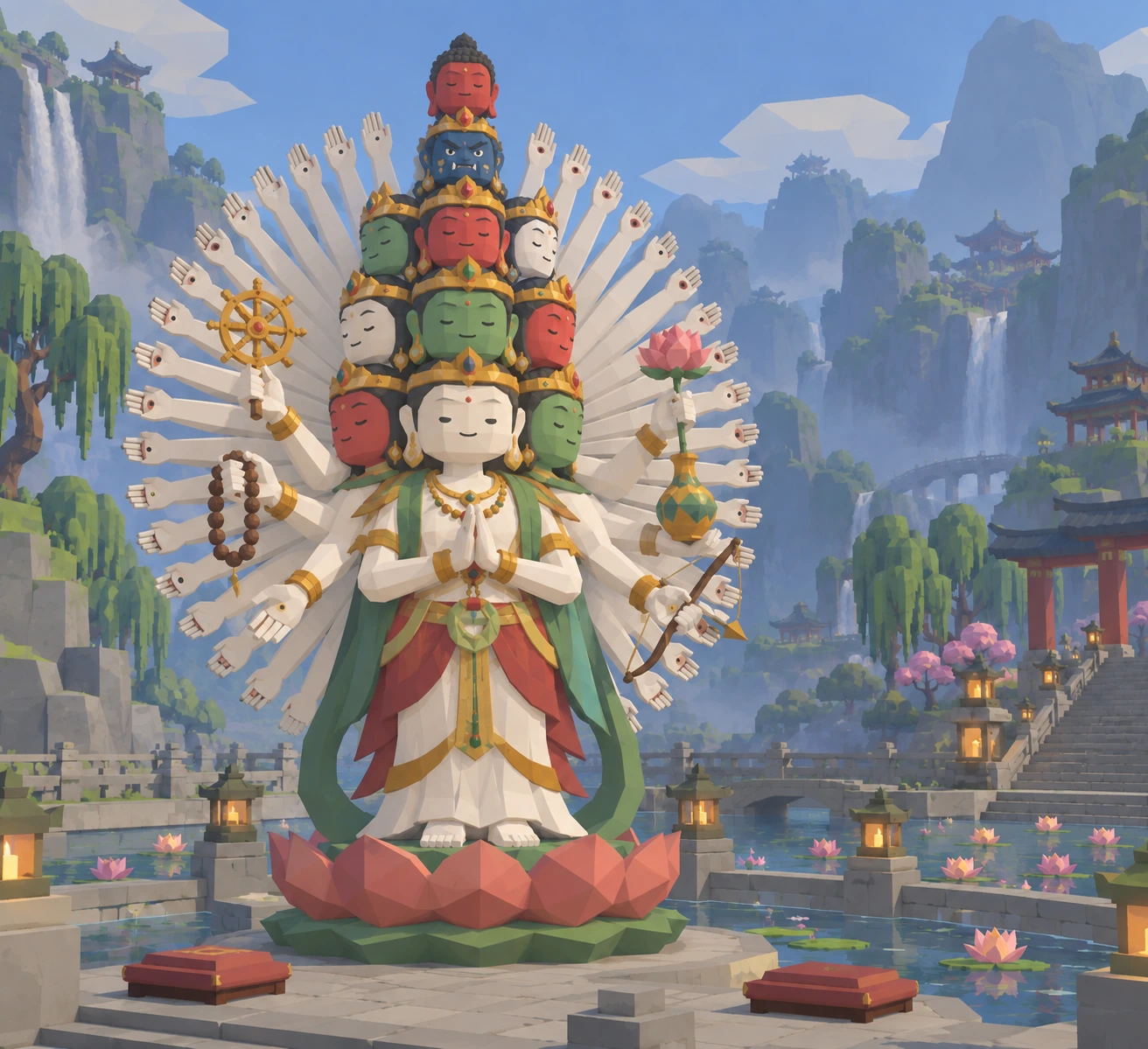
Eleven faces and a thousand arms, with an eye in every palm, mark this standing form of Avalokiteshvara. His body is white. Three tiers of three peaceful faces rise to one dark wrathful face, and above it sits the red head of Amitabha Buddha.
Eight principal arms carry his emblems. The first pair join at the heart. The other right hands hold a rosary, lower an open palm in the gesture of giving, and hold a Dharma wheel. The other left hands hold a lotus, a water pot, and a bow and arrow. The remaining 992 hands grant boons.
He stands with feet together on a lotus and moon disc, in fine garments, scarves and jewels, with an antelope skin across the left chest. The wrathful face has three eyes, bared fangs and hair streaming upward. Liturgies differ on the colours of the upper faces, and eleven-faced forms with only eight arms also exist.
In traditional art
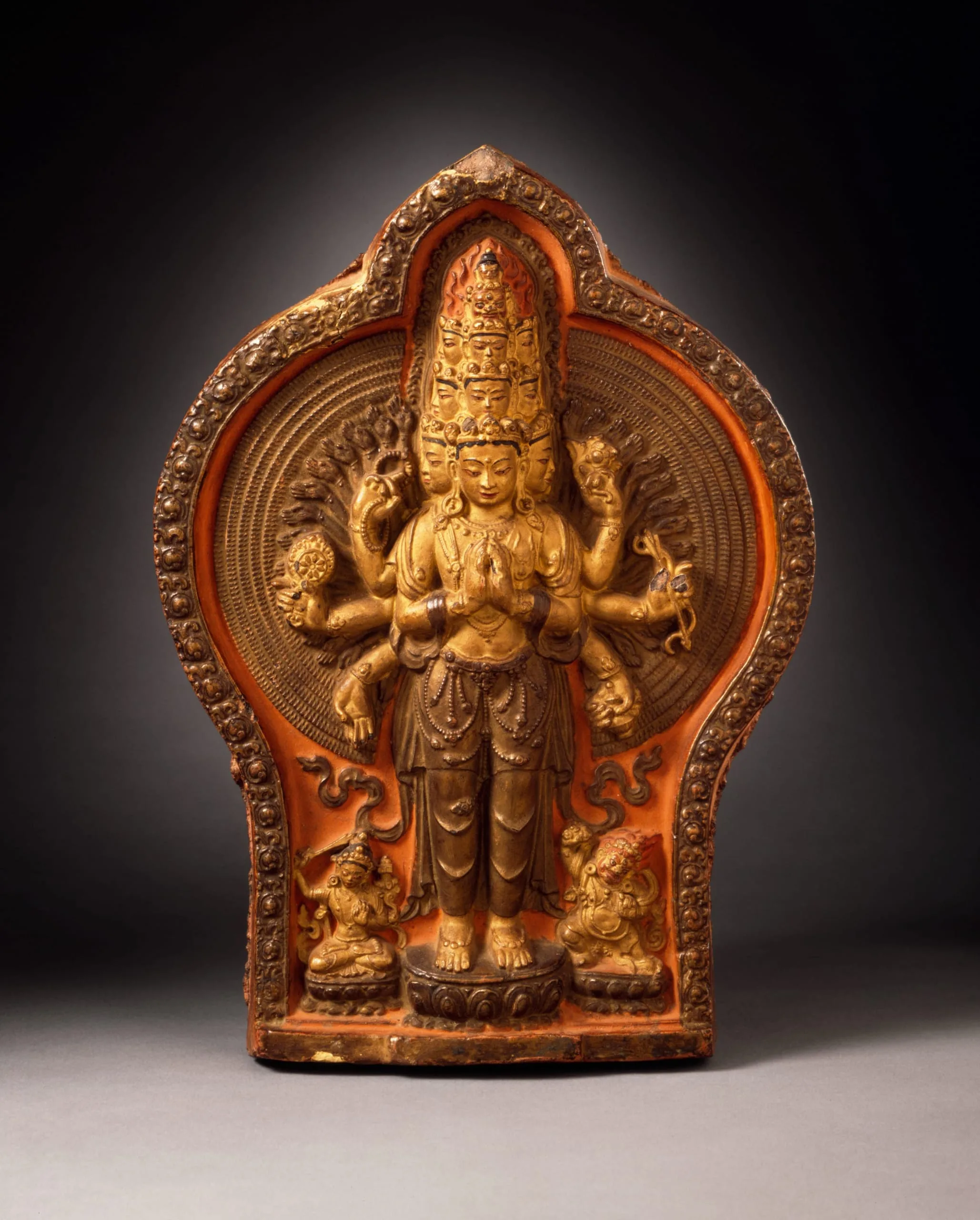
Cosmic Avalokiteshvara relief, LACMAAC1994.234.1Tibet · 17th centuryCurrent museum object data publicDomain:1 and no copyrightText; LACMA public-domain-use terms apply. Credit LACMA, Gift of Marilyn Walter Grounds.Object record ↗
In other collections
These images stay with the collections that hold them. Each link opens the collection's own page.
- Thousand-Armed All-Seeing Lord, Rubin F1996.31.12 ↗Tibet; Gelug attribution in HAR · 18th century · himalayanart.orgPhotographed image ©2004 Rubin Museum of Art; no open license established. Institutional educator guide identifies the same object.
Sources
Depiction requirements and work notes
Avalokiteshvara / Chenrezig, eleven-faced thousand-armed and thousand-eyed form
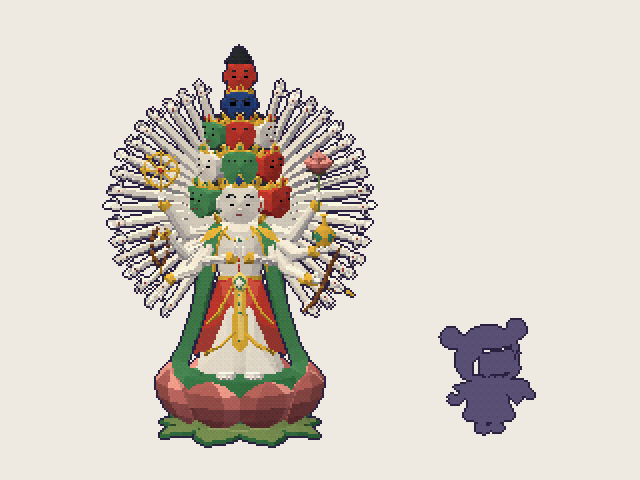
White standing body, eleven faces, eight principal arms and the thousand-eyed arm surround establish this form. Keep the upper Amitabha head distinct from the wrathful head below it. The model already reads as this identity, but its63-arm fan is an explicitly reduced game symbol and several diagnostic details need correction. Face-color order must be tied to a named source rather than generalized across lineages.
The model capture recipe or rig source changed. The visible model geometry changed. Rig source changed or is missing: prototypes/prerendered-look/parts/purelands/avalokiteshvara-thousand-armed.js Reinspect the model before relying on the recorded defects.
References, criteria, concept and model side by side
Traditional depictions
Earthenware with gold/paint; centered standing11-headed figure with multiple arm tiers. Study relief depth, principal gestures and subsidiary palm-eye tiers. Flanked by smaller Manjushri and wrathful Vajrapani; those attendants are not extra Avalokiteshvara heads. [aval11-lacma69136] [aval11-lacma-rights]
Object record ↗ · Source image ↗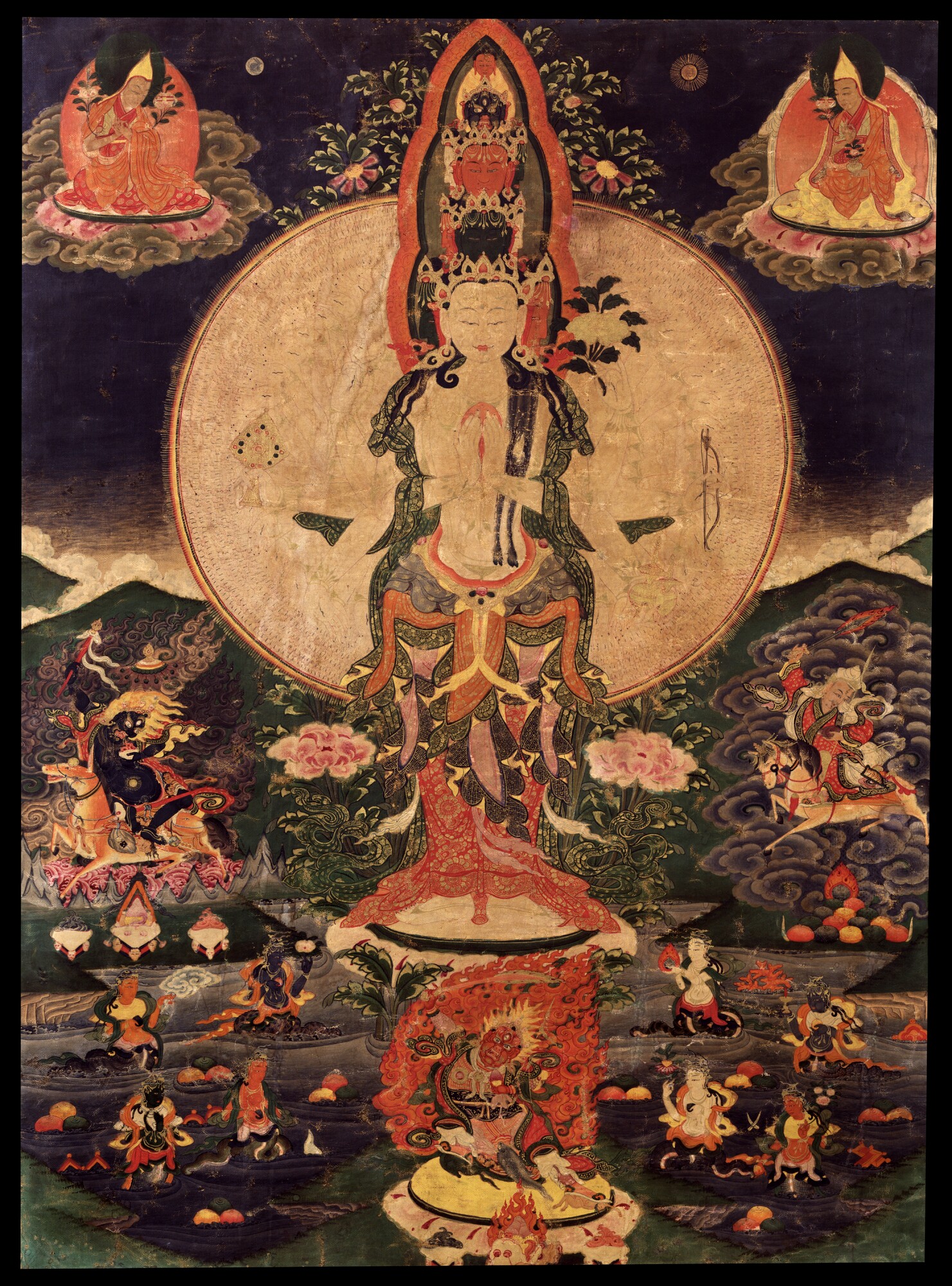
Central white standing eleven-faced thousand-armed figure in a Tibetan thangka. Use the central body, head tiers, hand surround and attributes; compare named textual descriptions instead of applying a global photographic mirror. [aval11-har525]
Object record ↗ · Source image ↗Criteria
The model must show
- Lineage variant: the Tibetan eleven-faced Nyungné-related form; head colours follow the Panchen Tenpai Nyima (1782–1853) liturgy on HAR 525, hands follow the FPMT Thirteenth Dalai Lama edition; the two accounts are not merged where they differ
- Body: white, standing upright with feet together
- Heads: exactly eleven: three tiers of three peaceful faces, then one wrathful dark face, then a peaceful red Amitābha head with ushnisha on top
- Head colours: bottom tier white centre, green at his own right (viewer-left), red at his own left; second tier green centre, white own-right, red own-left; third tier red centre, green own-right, white own-left
- Wrathful tenth face: dark or black, three eyes, bared fangs, upward tawny or yellow hair
- Hands: eight principal arms with visible shoulder-to-hand connections; first pair joined at the heart
- Held objects: own right hands hold a rosary, make the lowered boon-granting palm, and hold a Dharma wheel; own left hands hold a white eight-petalled lotus, a water pot, and a bow and arrow
- Subsidiary hands: a fan of hands, each reading as a palm with an eye; the 63-hand fan is labelled a reduced symbol of the 992
- Principal palm eyes: each of the eight principal palms also carries a peaceful eye wherever visible, rendered as a solid black silhouette with no whites, irises, pupils, highlights or glint under the project eye convention.
- Dress: an antelope skin across the own-left chest and shoulder, jewel ornaments, fine garments and scarves draping around the standing legs
- Faces: the ten peaceful faces are serene with small closed mouths; the wrathful face is fierce; Eyes: solid black silhouettes with no whites, irises, pupils, highlights or glint (project eye rule; a recorded game adaptation, not a claim about traditional painted eyes)
- Seat: standing on a lotus and moon
- Attendants: none required
The model must not show
- Cartoon smiley face: a wide U-shaped or crescent grin, open laughing mouth, rosy cheek dots or mascot cheeks
- Eye whites, irises, pupils, highlights or glint; glowing white-gold eyes (those belong only to freshly liberated beings)
- Any part of the figure (head, crown, hat, halo, raised hand or held object) touching or passing through its canopy, roof, lintel, pillars, throne back or seat in any capture angle
- The bottom side faces reversed (red at viewer-left, green at viewer-right), as in the current concept
- The wrathful face labelled Amitābha, or shown as a second smiling crowned face with no third eye or upward hair
- The fan drawn as rays, diamond leaves or a sunburst
- Calling the fan a literal thousand hands
- The seated four-armed form's posture
- Forty-two-hand East Asian arrangements
Original game concept
Current 3D model
presence
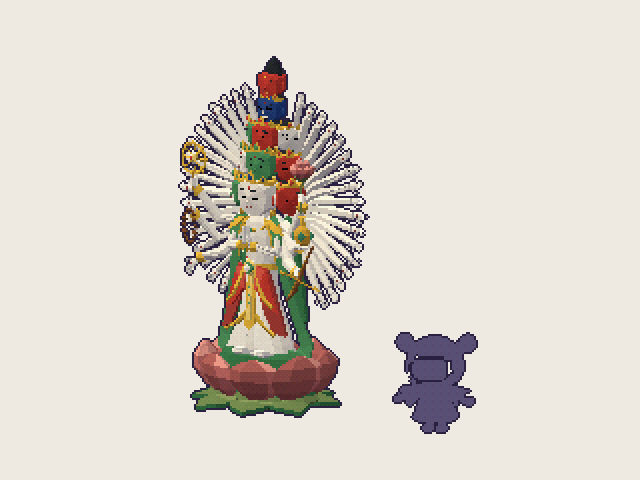
Depiction requirements
- Body and posture
- White body standing upright with feet placed evenly/together on lotus and moon support. Do not turn the existing standing form into the seated four-armed form. [aval11-fpmt13] [aval11-har525]
- Head count and hierarchy
- Exactly eleven faces: three tiers of three peaceful faces, then one wrathful dark face, then peaceful red Amitabha with ushnisha and monastic head appearance. Keep Amitabha above, rather than labeling the tenth wrathful face Amitabha. [aval11-har525] [aval11-lamayeshe]
- Head-color laterality
- Unambiguous shared root tier: white central face, green proper-right(face at viewer-left), red proper-left(viewer-right). For the Panchen Tenpai Nyima liturgy reproduced on HAR525, second tier is green center/white proper-right/red proper-left; third is red center/green proper-right/white proper-left. FPMT13th Dalai Lama gives upper triplets as green-red-white then red-white-green in abbreviated English. Do not merge these accounts or infer unspecified sides from the latter. [aval11-fpmt13] [aval11-har525]
- Wrathful face
- The named Panchen text specifies dark/black wrathful face with three eyes, bared fangs and upward tawny hair. FPMT describes black face and streaming yellow hair. A blue-dark stylization can be disclosed, but a second smiling crowned face without third eye/hair is incomplete. Keep eyes as solid black silhouettes under current game policy. [aval11-fpmt13] [aval11-har525]
- Eight principal hands
- First pair join at heart. Remaining proper-right hands: rosary, lowered generosity/boon-granting palm, Dharma wheel. Remaining proper-left: lotus, water pot, bow-and-arrow. Distinguish all six outer attributes and maintain visible shoulder-to-hand connections; vertical staging can follow the chosen object without swapping sides. [aval11-fpmt13] [aval11-lacma69136]
- Attributes and dress
- For the FPMT form use an eight-petaled white lotus; add the antelope skin across the proper-left chest/shoulder and readable jewel ornaments. Traditional fine garments and scarves should drape around the standing legs. Crystal rosary is conventional in Tibetan Chenrezig study; the13DL abbreviated text only calls it a rosary, so record the stronger color/material claim under its four-armed or object reference rather than pretend that text specifies crystal. [aval11-fpmt13] [aval11-har525]
- Thousand hands and palm eyes
- Full named traditional form has8 principal hands plus992 subsidiary boon-giving hands, with a peaceful eye in every palm. A63-hand fan can communicate multiplicity in this game, but must be labeled reduced symbolic representation. Keep the principal hand count exact and make each modeled subsidiary palm read as a palm with an eye, rather than rays or diamond leaves. The eight principal palms need eyes where visible too. [aval11-har525] [aval11-lacma69136]
Presentation contract
Ready to build from No readiness block is recorded in the plan.
Setting and sizing rule
A lotus-and-moon stand. The shrine clears the whole head tower and the full arm fan. Sizing (plan rule R4, not a sourced claim): the opening of any shrine, canopy or pavilion around the figure leaves at least one of the figure's own head-heights of clear air above its tallest point (the Amitābha head at the top of the tower) and a clear gap on each side of its widest span (the outer edge of the arm fan); a throne back or aureole sits behind the figure without passing through it; pillars and lintel do not cross the face, hands or held objects in the front or either three-quarter capture.
Recorded variants · 4
- Eleven-faced forms with only eight arms exist and are legitimate
- The Thirteenth Dalai Lama text gives the upper triplets as green-red-white then red-white-green without sides
- Small reliefs compress the subsidiary arms into tiers (LACMA AC1994.234.1)
- HAR counts Tenpai Nyima as fourth Panchen, Tashi Lhunpo as seventh; name and dates identify him
Recorded adaptations · 2
- The 63-hand fan as a reduced symbolic representation
- A blue-dark stylisation of the wrathful face, if disclosed
Where the plan places it · 1
- copper mountain · The palace of three floors
copper-mountain.palace· character Avalokiteshvara — thousand-armedavalokiteshvara-thousand-armed
Contract sources · 4
- Thirteenth Dalai Lama: Spontaneously Accomplishing Desired Aims
- HAR525: Thousand-handed Avalokiteshvara, Rubin F1996.31.12
- Lama Zopa Rinpoche: Chenrezig, Abiding in the Retreat ch.2
- LACMA: Cosmic Form of the Bodhisattva Avalokiteshvara
Model audit and next pass
Evidence basis: visual + source
Recorded observations
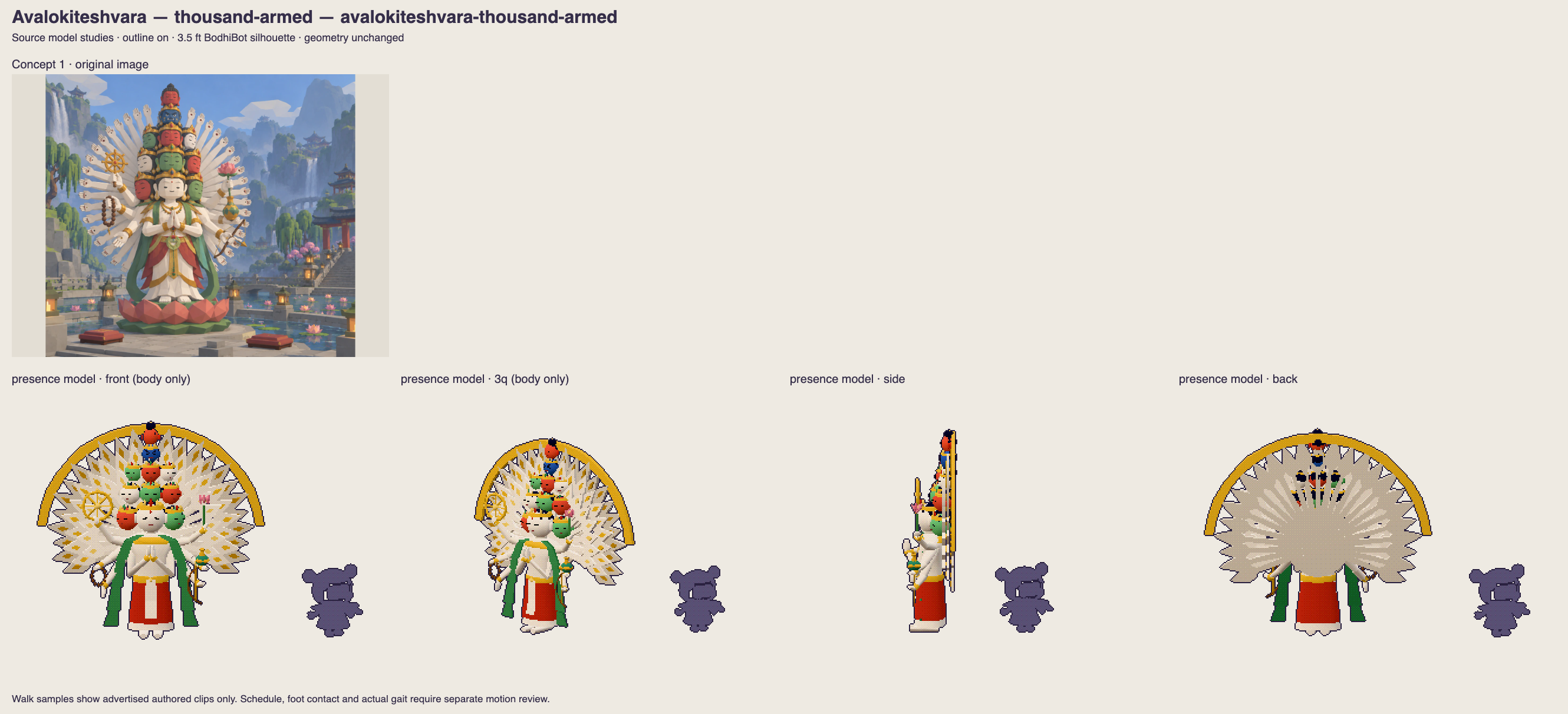
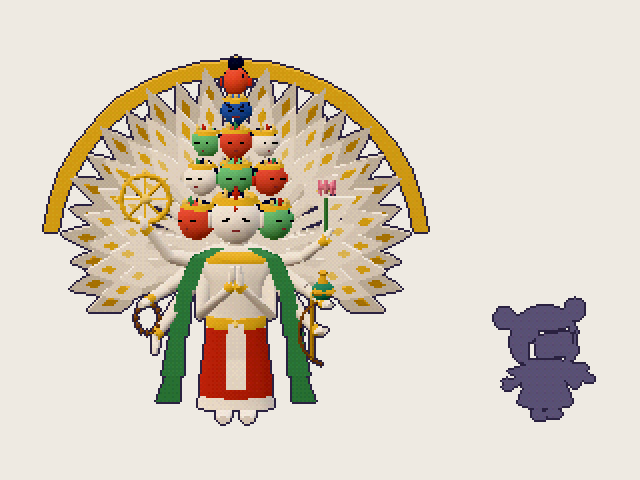
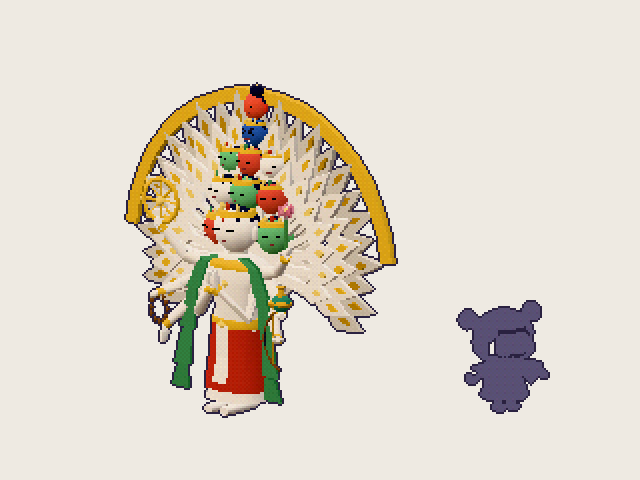
Viewed concept plus current front, three-quarter, side and back sheet. The standing white body,11-head tower, prayer pair, wheel/rosary/generosity on viewer-left and lotus/pot/bow on viewer-right are readable.
Root-tier colors are reversed: current viewer-left red/viewer-right green; both checked texts require proper-right green/viewer-left green and proper-left red/viewer-right red. Source calls this row red-WHITE-green. Upper source rows match the named Panchen description, so a blanket whole-tower mirror would introduce errors.
Wrathful head is dark blue with fangs but has only two modeled eyes, no upright yellow/tawny hair and a jeweled crown. Source makeHead(...{wrath:true}) creates two eye meshes; traditional three-eyed hair silhouette is absent.
Fan is exactly63 subsidiary ray/palm shapes in three layers25+21+17, plus eight principal arms. This is a deliberate reduced symbolic fan declared in the source comment. Gold diamond marks suggest palm eyes, but principal palm eyes are not separately modeled.
Source flower has six pink petals; FPMT selected form calls for eight white petals. Brown wooden rosary, absent antelope pelt, and narrow largely columnar lower robe are additional correction/polish points.
Directions for a future model pass
Correct only the unambiguously reversed bottom-row side colors first; select and record the intended upper-tier account before changing upper faces.
Give the dark wrathful face a third-eye silhouette, fangs and upward yellow/tawny hair while retaining project black-eye styling; preserve the red uncrowned Amitabha head and ushnisha above it.
Fix white eight-petal lotus and add sourced pelt/jewelry; keep all principal attributes legible at small size. Widen and wrap lower garments using references as well as the concept.
Document63-hand fan as deliberate game compression; assess palm shape, eye readability and coherent layered depth at front/back/side. A literal traditional reconstruction would require8+992 and must be separately planned, not claimed by this audit.
Assessed baseline captures
Documented forms and lineage variants · 4
Preserve one identified form consistently. A variant is usable only with its own source and context.
Eleven-faced forms with only eight arms also exist; these are legitimate forms, but a fanless eight-arm model must not silently be claimed to depict the literal thousand-arm arrangement.
The Panchen Tenpai Nyima and Thirteenth Dalai Lama descriptions are recorded by name. Upper face-color sequences and dark wrathful-face treatment need a selected lineage before a detailed reconstruction.
Small reliefs compress subsidiary arms into tiers; LACMAAC1994.234.1 is evidence of traditional visual compression, not authority for claiming an arbitrary mesh count is literally1000.
Author numbering
HAR labels Tenpai Nyima fourth under a counting scheme that omits the three retrospectively recognized predecessors. Tashi Lhunpo lists the same author seventh. Name and dates distinguish him from the full-succession fourth Panchen, Lobsang Chökyi Gyaltsen(1570–1662). [aval11-har525] [panchen-succession]
What not to copy · 4
Do not mirror the root tier from the current concept: its bottom side faces are reversed against both checked textual descriptions.
Do not omit the wrathful third eye or upward hair merely to preserve the existing concept.
Do not call the fan a literal thousand hands, or replace hands/palm eyes with a generic sunburst.
Do not import forty-two-hand East Asian Senju Kannon arrangements as an unmarked Tibetan Nyungné standard.
Sources and precise locations · 6
- [aval11-fpmt13] Thirteenth Dalai Lama: Spontaneously Accomplishing Desired Aims ↗
- [aval11-har525] HAR525: Thousand-handed Avalokiteshvara, Rubin F1996.31.12 ↗
- [aval11-lacma69136] LACMA: Cosmic Form of the Bodhisattva Avalokiteshvara ↗
- [aval11-lacma-rights] LACMA: Terms of Use ↗
- [aval11-lamayeshe] Lama Zopa Rinpoche: Chenrezig, Abiding in the Retreat ch.2 ↗
- [panchen-succession] Tashi Lhunpo Monastery: The Panchen Lamas ↗
Assessment freshness and evidence hashes
The frozen snapshot is authored evidence. Regeneration computes current hashes and leaves that snapshot as it is.
{
  "auditFreshness": {
    "status": "stale",
    "reasons": [
      "The model capture recipe or rig source changed.",
      "The visible model geometry changed.",
      "Rig source changed or is missing: prototypes/prerendered-look/parts/purelands/avalokiteshvara-thousand-armed.js"
    ]
  },
  "sourceSnapshot": {
    "captureHash": "7ff6f7cda523f792e0e50bc6f653fd5248c832542be17ab589b1eeacf2db09d2",
    "bodyGeometryHash": "485123f1514a8970d574a32652c3f9d542aa57f6e917d7ef3d2b5454506c2eb7",
    "sourceHashes": {
      "prototypes/prerendered-look/parts/purelands/avalokiteshvara-thousand-armed.js": "fbd379501011761cad477570483bdd636ea07ad2dac1d83cc2189e77fa89daba"
    },
    "captureHashes": {
      "/atlas/audit/characters/avalokiteshvara-thousand-armed-994aa93ab170-presence-3q-body.webp": "96203f4a96add1a3de075422287ce6b91346e59039a051b6739971dd9feea782",
      "/atlas/audit/characters/avalokiteshvara-thousand-armed-994aa93ab170-presence-front-body.webp": "b187cf102cecb214f4b7b8284ed4aa77f25d6f259aaa76f542bbd42175c37934",
      "/atlas/audit/sheets/avalokiteshvara-thousand-armed-994aa93ab170.webp": "fb3689fabc922ffc96ff878457e63a24d19b7a90977cb2fc4f62d02d2d6ecf1a",
      "/atlas/characters/avalokiteshvara-thousand-armed-07031474de70-presence-3q.webp": "d3c57d1af1350f51a1bf8059ecee08ac1b06260801aa4d5119f68657a1c2c85b",
      "/atlas/characters/avalokiteshvara-thousand-armed-07031474de70-presence-front.webp": "838f8745f43f5331ed368bf5f88d25be021cf57efec0f0de68c064874f9ce46e",
      "/atlas/characters/avalokiteshvara-thousand-armed-7ff6f7cda523-presence-3q.webp": "d3c57d1af1350f51a1bf8059ecee08ac1b06260801aa4d5119f68657a1c2c85b",
      "/atlas/characters/avalokiteshvara-thousand-armed-7ff6f7cda523-presence-front.webp": "838f8745f43f5331ed368bf5f88d25be021cf57efec0f0de68c064874f9ce46e"
    },
    "conceptHashes": {
      "/atlas/concepts/avalokiteshvara-thousand-armed.webp": "86934974b91d7abbd97dfd07977b43dfa22e329645fff1fa989264313ea755ec"
    },
    "activeConceptPaths": [
      "/atlas/concepts/avalokiteshvara-thousand-armed.webp"
    ]
  },
  "currentSnapshot": {
    "captureHash": "ffbe1c3632797f73102ce97b05852f493b0a3c27c2f39a4518c2418a679c5d69",
    "bodyGeometryHash": "d7392c7bf3c863fe5bbe3ba79c303c0198811920b184d4745e29f7a4bff8de0a",
    "activeConceptPaths": [
      "/atlas/concepts/avalokiteshvara-thousand-armed.webp"
    ],
    "sourceHashes": {
      "prototypes/prerendered-look/parts/purelands/avalokiteshvara-thousand-armed.js": "afea4940451ecadec528c0f54e4e9ecfee26aa2ce72b84770b12eb3e0e9d2904"
    },
    "captureHashes": {
      "/atlas/audit/characters/avalokiteshvara-thousand-armed-994aa93ab170-presence-3q-body.webp": "96203f4a96add1a3de075422287ce6b91346e59039a051b6739971dd9feea782",
      "/atlas/audit/characters/avalokiteshvara-thousand-armed-994aa93ab170-presence-front-body.webp": "b187cf102cecb214f4b7b8284ed4aa77f25d6f259aaa76f542bbd42175c37934",
      "/atlas/audit/sheets/avalokiteshvara-thousand-armed-994aa93ab170.webp": "fb3689fabc922ffc96ff878457e63a24d19b7a90977cb2fc4f62d02d2d6ecf1a",
      "/atlas/characters/avalokiteshvara-thousand-armed-07031474de70-presence-3q.webp": "d3c57d1af1350f51a1bf8059ecee08ac1b06260801aa4d5119f68657a1c2c85b",
      "/atlas/characters/avalokiteshvara-thousand-armed-07031474de70-presence-front.webp": "838f8745f43f5331ed368bf5f88d25be021cf57efec0f0de68c064874f9ce46e",
      "/atlas/characters/avalokiteshvara-thousand-armed-7ff6f7cda523-presence-3q.webp": "d3c57d1af1350f51a1bf8059ecee08ac1b06260801aa4d5119f68657a1c2c85b",
      "/atlas/characters/avalokiteshvara-thousand-armed-7ff6f7cda523-presence-front.webp": "838f8745f43f5331ed368bf5f88d25be021cf57efec0f0de68c064874f9ce46e",
      "/atlas/characters/avalokiteshvara-thousand-armed-ffbe1c363279-presence-3q.webp": "01ca1001a45eb61d9b303a1369e35c2cbb0e6c97b39a1e67e49e2f273beeed40",
      "/atlas/characters/avalokiteshvara-thousand-armed-ffbe1c363279-presence-front.webp": "75b05a3fc9ccec077ae72822205559e8f3e2cdd06a4b9d9c54d5633deece7bd5"
    },
    "conceptHashes": {
      "/atlas/concepts/avalokiteshvara-thousand-armed.webp": "86934974b91d7abbd97dfd07977b43dfa22e329645fff1fa989264313ea755ec"
    }
  }
}