Four-armed Avalokiteśvara
In this seated form Avalokiteshvara, Chenrezig in Tibetan, is white, with one peaceful face and four arms. His central hands press together at the heart in prayer. The outer right hand holds a crystal rosary and the outer left a white lotus.
He sits in vajra posture, legs fully crossed, on a lotus and moon seat. He wears silks and jewels and a bodhisattva's crown with a small image of Amitabha Buddha in it. Thangtong Gyalpo's practice text adds an antelope pelt across one shoulder.
Some images place a wish-fulfilling jewel between the praying palms. A Met work gives him a gold body, though its curator calls white the convention. Paintings of Potalaka may show other attendant figures around him.
In traditional art
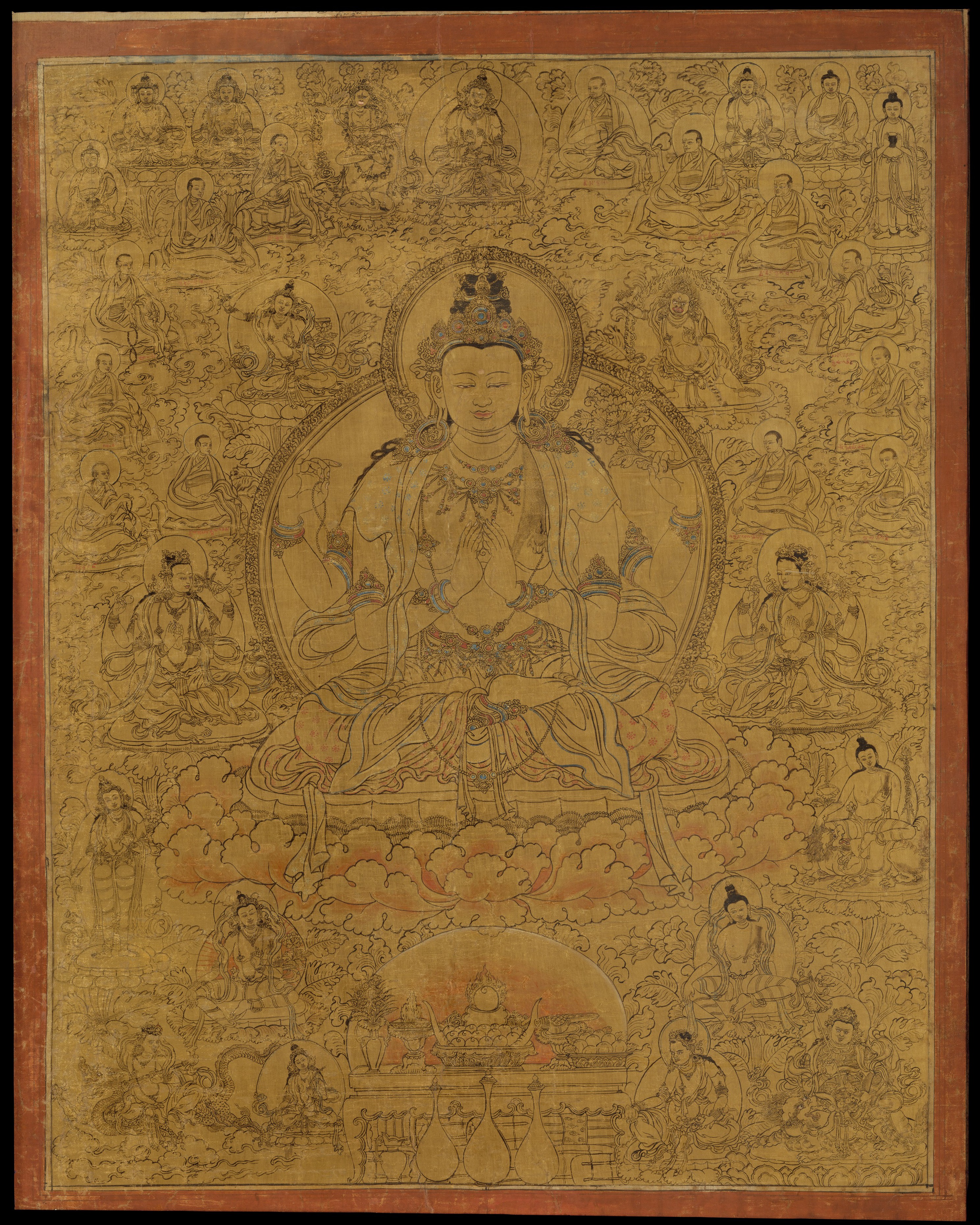
Sadaksari-Lokeshvara with manifestations and monks, The Met1985.390.3Tibet · late15th centuryPublic Domain / The Met Open Access; API isPublicDomain=true. Credit Gift of Margery and Harry Kahn,1985.Object record ↗
In other collections
These images stay with the collections that hold them. Each link opens the collection's own page.
- Four-armed Avalokiteshvara, Rubin C2006.38.1 ↗Tibet · 16th century · rubinmuseum.orgPhotographed image ©2004 Rubin Museum of Art per HAR65646; no open license established. Link/credit rather than assert unrestricted redistribution.
Sources
Depiction requirements and work notes
Avalokiteshvara / Chenrezig, white seated four-armed Shadakshari form
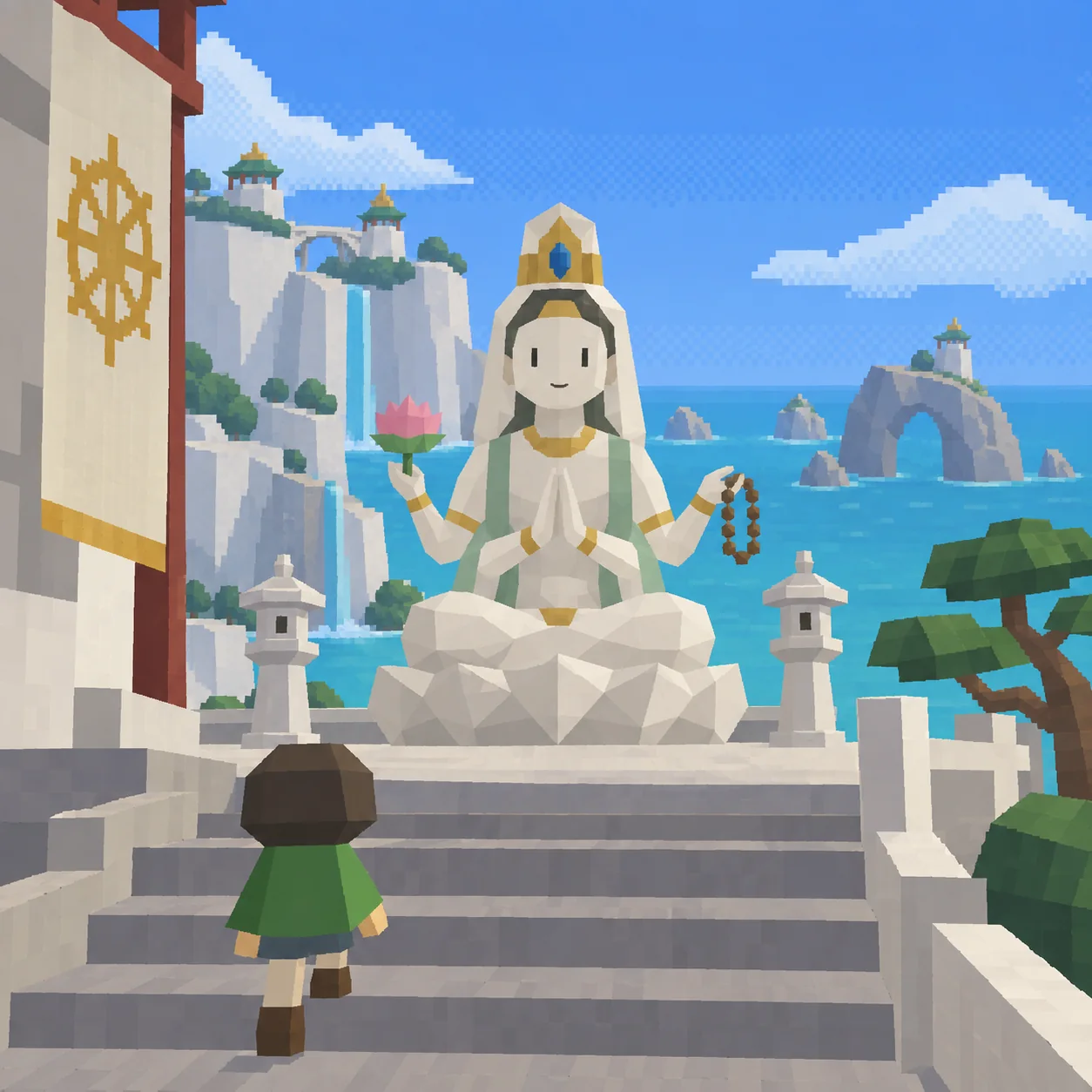
Preserve one peaceful white face, exactly four arms, joined central prayer hands at the heart, proper-right crystal rosary, proper-left white lotus, seated vajra posture, silk and jewel adornment and Amitabha in the crown. The current concept reproduces a mirrored attribute arrangement and invented hood; concept fidelity therefore does not establish traditional accuracy. Use the cited Tibetan form as the correction target while keeping the game’s low-poly register and solid black eye silhouettes.
The model capture recipe or rig source changed. The visible model geometry changed. Rig source changed or is missing: prototypes/prerendered-look/parts/purelands/avalokiteshvara-four-armed.js Reinspect the model before relying on the recorded defects.
References, criteria, concept and model side by side
Traditional depictions
Central gold-bodied four-armed Shadakshari: joined prayer hands, lateral mala and lotus, ornamented crown and vajra seat. Gold is a documented painting variant; use geometry and attribute sides, not its gold color as the white-form standard. [aval4-met37800]
Object record ↗ · Source image ↗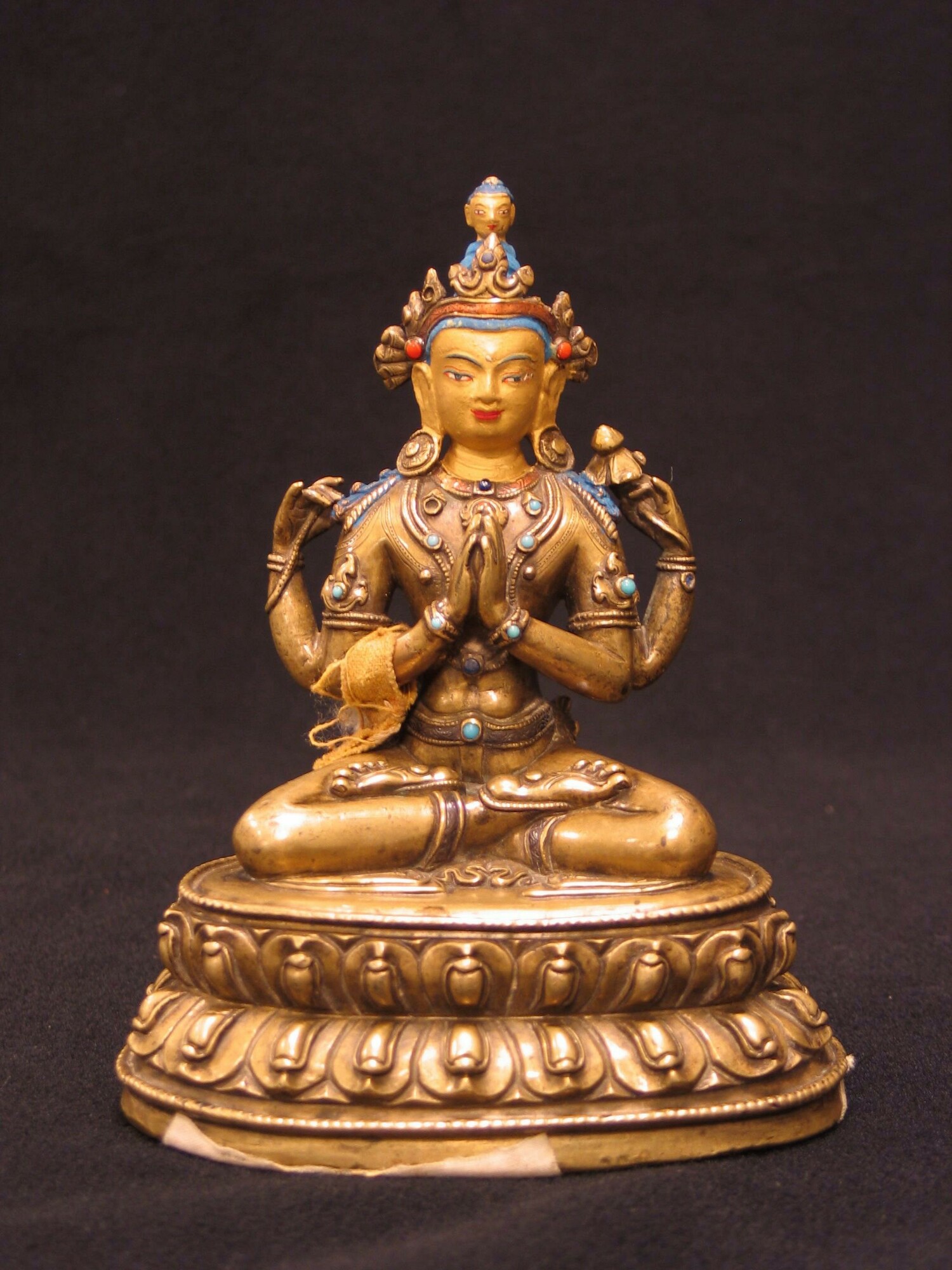
Copper-alloy sculpture with pigments, semi-precious stones and cloth: useful three-dimensional crown, ornaments, joined prayer hands and seated posture. Compare intact surviving attributes without reconstructing missing parts from guesswork. [aval4-rubin65646] [aval4-har65646]
Object record ↗ · Source image ↗Criteria
The model must show
- Lineage variant: Thangtong Gyalpo's visualization of the white seated four-armed form
- Body: white, one face, exactly four arms
- Hands: the central pair joined upright at the heart; the outer own-right hand (viewer-left) and outer own-left hand (viewer-right) raised to the sides
- Held objects: a pale crystal rosary in the outer right hand; an open white lotus in the outer left hand; grips meet the beads and the stem
- Head and ornaments: a jewelled bodhisattva crown and hair arrangement showing a small recognisable Amitābha figure; silk scarves and jewellery
- Dress: an antelope pelt across a shoulder, placed from a chosen reference
- Posture: seated vajra posture with a clear cross-legged lap
- Face: peaceful, compassionate and composed; a small closed mouth with at most a gentle curve
- Eyes: solid black silhouettes with no whites, irises, pupils, highlights or glint (project eye rule; a recorded game adaptation, not a claim about traditional painted eyes)
- Seat: a lotus with a moon disc
- Attendants: none required; Potalaka paintings may add Maṇidhara and Ṣaḍakṣarī
The model must not show
- Cartoon smiley face: a wide U-shaped or crescent grin, open laughing mouth, rosy cheek dots or mascot cheeks
- Eye whites, irises, pupils, highlights or glint; glowing white-gold eyes (those belong only to freshly liberated beings)
- Any part of the figure (head, crown, hat, halo, raised hand or held object) touching or passing through its canopy, roof, lintel, pillars, throne back or seat in any capture angle
- Lotus and rosary on the mirrored sides (the current concept's arrangement)
- A brown wooden rosary
- An ivory hood, nun-like veil or jewel-only mitre in place of the crown
- A blue jewel standing in for the Amitābha figure
- An unadorned monk silhouette
- A generic cloak passed off as the antelope pelt
- Southeast Asian Lokeśvara or East Asian Guanyin forms
Original game concept
Current 3D model
presence


Depiction requirements
- Color and count
- White luminous body; one peaceful face; exactly four visible arms. Keep a gentle smile and compassionate, composed expression. [aval4-tangtong]
- Hands and laterality
- Join the central palms upright at heart level. Outer proper-right hand (viewer-left when facing the model) holds the crystal rosary; outer proper-left (viewer-right) holds the white lotus. Track hands from their shoulders: variable names do not establish anatomical sides. [aval4-lh-intro] [aval4-har-symbols]
- Attributes
- Render the rosary as pale crystal, not brown wood; render a recognizably white open lotus. Make grips meet stems/beads. A wish-fulfilling jewel between the prayer palms is a documented iconographic option; do not make it mandatory across all four-armed sources. [aval4-tangtong] [aval4-har-symbols]
- Head and adornment
- Use a jeweled bodhisattva crown and hair arrangement that exposes an identifiable Amitabha effigy. A blue jewel or tall ivory mitre alone cannot stand in for Amitabha. Include readable silk scarves and jewelry rather than an unadorned monk silhouette. [aval4-tangtong] [aval4-rubin65646]
- Posture and pelt
- Seated vajra posture on lotus/moon support; retain a clear cross-legged lap. Thangtong Gyalpo specifies an antelope pelt across a shoulder. Select a reference for its exact placement before modelling; do not invent a generic cloak and claim equivalence. [aval4-tangtong]
- Game-style boundary
- Simplify ornament and anatomy geometry; retain identity-bearing counts, hand sides and attributes. The project’s black eye silhouettes, toy proportions, hard pixels and reduced detail are disclosed artistic adaptations, not claims about traditional painted eyes or sacred proportion grids. [aval4-rubin65646]
Presentation contract
Ready to build from No readiness block is recorded in the plan.
Setting and sizing rule
A lotus-and-moon seat. Sizing (plan rule R4, not a sourced claim): the opening of any shrine, canopy or pavilion around the figure leaves at least one of the figure's own head-heights of clear air above its tallest point (the crown and its Amitābha figure) and a clear gap on each side of its widest span (the two outer hands with rosary and lotus); a throne back or aureole sits behind the figure without passing through it; pillars and lintel do not cross the face, hands or held objects in the front or either three-quarter capture.
Recorded variants · 3
- Met 1985.390.3 shows a gold body; its note calls white conventional
- Standing white Dukngal Rangdrol and red Jinasāgara belong to other cycles
- A wish-fulfilling jewel between the prayer palms is a documented option, not mandatory
Recorded adaptations · 1
- Simplified ornament, toy proportions and black eye silhouettes
Where the plan places it · 2
- human · Potalaka, the white crag
human.potalaka· character Avalokiteshvara — four-armedavalokiteshvara-four-armed - sukhavati · The aisle and Amitabha's seat
sukhavati.assembly· placement lotusSeatsukhavati.assembly.seat-west
Contract sources · 5
- Thangtong Gyalpo: Avalokiteshvara Visualization and Recitation
- Lotsawa House: Introduction to Avalokiteshvara
- HAR: Chaturbhuja Symbolic Meanings
- Rubin Museum: Four-armed Avalokiteshvara
- The Met: Sadaksari-Lokeshvara Surrounded by Manifestations and Monks
Model audit and next pass
Evidence basis: visual + source
Recorded observations
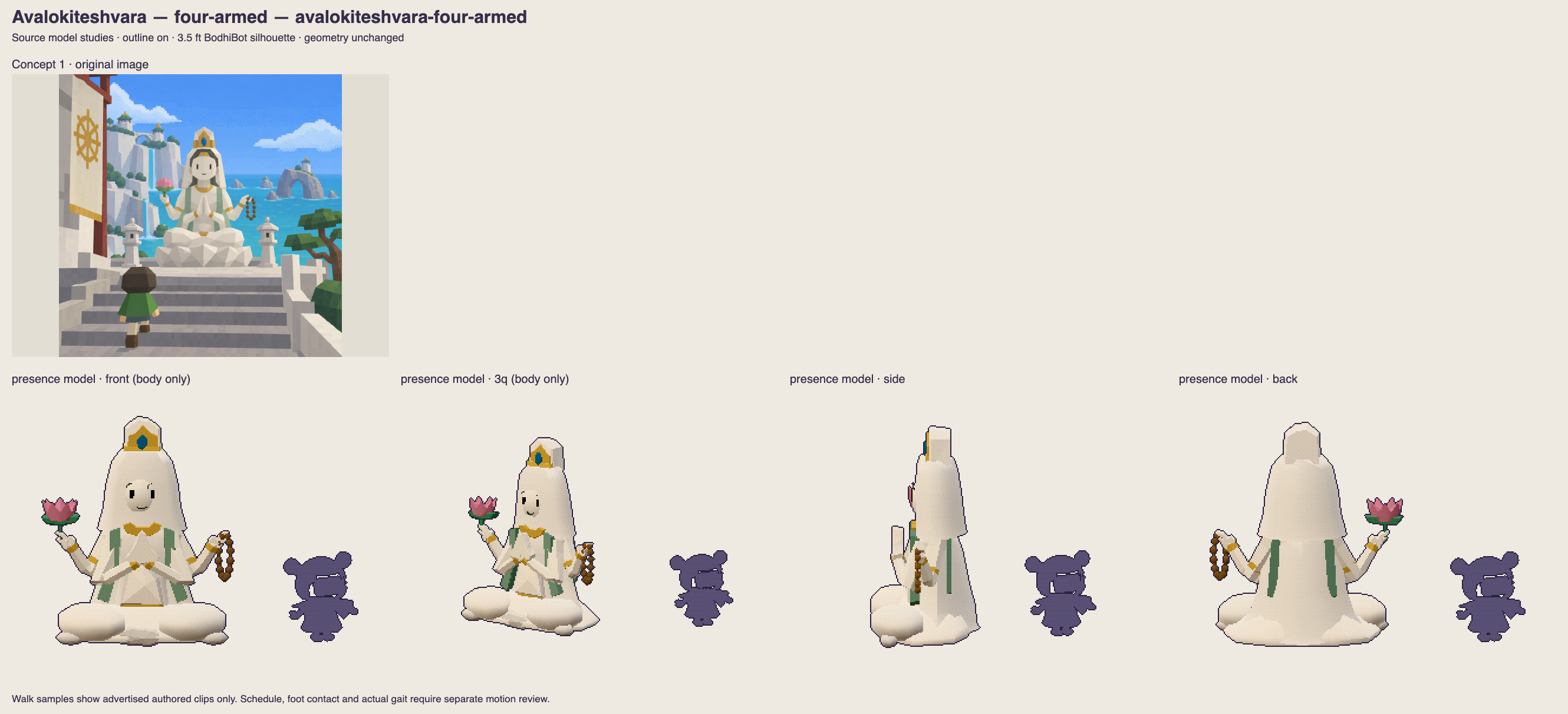
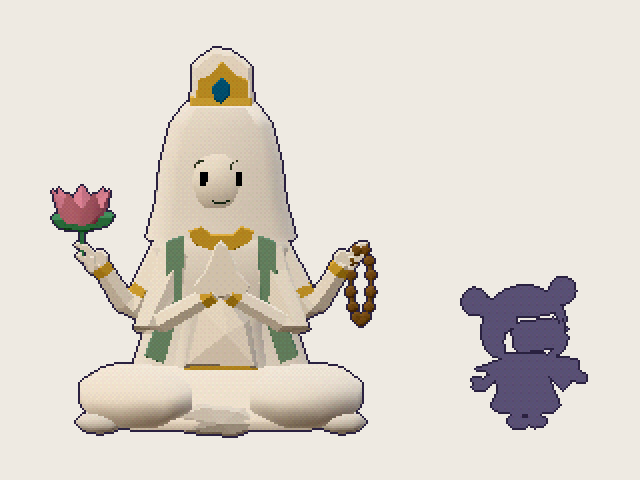
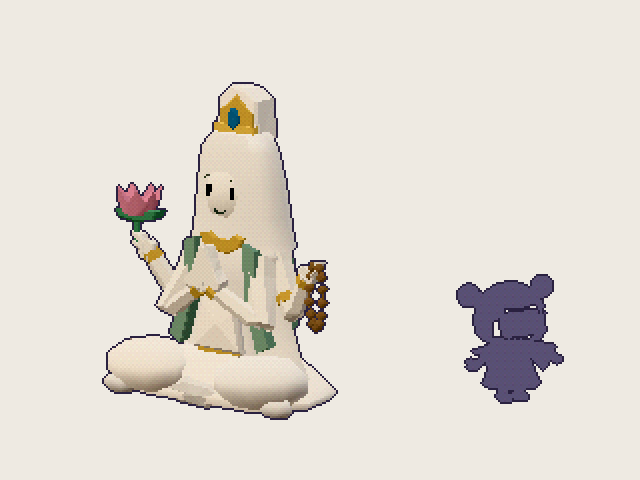
Viewed the concept and current front, three-quarter, side and back sheet. White body, four arms, seated lap, upright central prayer palms and calm expression remain legible.
Critical laterality mismatch: flower appears viewer-left and mala viewer-right. Canonical source puts lotus on outerL.hand at negative X and mala on outerR.hand at positive X, with +Z facing the visitor: anatomical sides are opposite the Tibetan baseline. The concept has the same error.
Current crown is a tall closed ivory arch with gold inset and blue gem; no Amitabha effigy appears. The broad ivory hood/mantle hides the hair and yields a cloaked silhouette.
Current lotus is pink and rosary brown; source materials M.pink and M.bead=0x805f3b confirm this. Antelope pelt is absent.
Source uses 9 lotus petals and 14 rosary positions, a separate game count-rule issue; do not silently call the miniature mala a literal traditional bead count.
Directions for a future model pass
First future pass: preserve the current Atlas pass, establish corrected concept/reference study, then move the rosary to proper-right and lotus to proper-left by anatomical shoulder chains.
Replace the invented headwear with a source-selected jeweled crown, hair/topknot and miniature Amitabha; retain a distinct silhouette rather than a generic human template.
Change the lotus to white, mala to crystal and add a clearly sourced pelt and jewelry. Re-review every angle and phone distance before any approval; no model changes were made in this audit.
Assessed baseline captures
Documented forms and lineage variants · 3
Preserve one identified form consistently. A variant is usable only with its own source and context.
The Met1985.390.3 depicts this form with a gold body; its curatorial note explicitly calls white conventional. Gold in a metal statue is also a material finish, not proof that the meditation-body color is gold.
Standing white Dukngal Rangdrol of Longchen Nyingtik and red Jinasagara belong to named different cycles; do not borrow their stance or color for this seated white rig.
Potalaka paintings may include Manidharin and Shadakshari attendants; an assembly reference is not permission to change this model’s count or identity.
What not to copy · 4
Do not follow the current concept’s horizontal mirror when assigning lotus and rosary.
Do not treat an ivory hood, nun-like veil or jewel-only mitre as the standard Tibetan crown.
Do not substitute Southeast Asian four-armed Lokeshvara or feminine East Asian Guanyin images as the chosen Tibetan form.
Do not add glints or white sclera to game eyes when refining traditional facial proportions.
Sources and precise locations · 6
- [aval4-tangtong] Thangtong Gyalpo: Avalokiteshvara Visualization and Recitation ↗
- [aval4-lh-intro] Lotsawa House: Introduction to Avalokiteshvara ↗
- [aval4-har-symbols] HAR: Chaturbhuja Symbolic Meanings ↗
- [aval4-met37800] The Met: Sadaksari-Lokeshvara Surrounded by Manifestations and Monks ↗
- [aval4-rubin65646] Rubin Museum: Four-armed Avalokiteshvara ↗
- [aval4-har65646] HAR65646: Four-handed Avalokiteshvara ↗
Assessment freshness and evidence hashes
The frozen snapshot is authored evidence. Regeneration computes current hashes and leaves that snapshot as it is.
{
  "auditFreshness": {
    "status": "stale",
    "reasons": [
      "The model capture recipe or rig source changed.",
      "The visible model geometry changed.",
      "Rig source changed or is missing: prototypes/prerendered-look/parts/purelands/avalokiteshvara-four-armed.js"
    ]
  },
  "sourceSnapshot": {
    "captureHash": "b45dac946059746fd9d2d89ee527e0c3fe896adc5abf24bfce485d08437149b7",
    "bodyGeometryHash": "87a570e5100e851a6a1904baca04adb75c6ac3972ff6c51bfb7fb2049ba904b4",
    "sourceHashes": {
      "prototypes/prerendered-look/parts/purelands/avalokiteshvara-four-armed.js": "4ff200fbbf778f99684b8f1c9d275764973820522ab089e59b558fe5c27e66e4"
    },
    "captureHashes": {
      "/atlas/audit/characters/avalokiteshvara-four-armed-42b514bd0dd5-presence-3q-body.webp": "96f807546990f91e424a2928995e1c23704c7b5868bb557aa8e8c88f4a137276",
      "/atlas/audit/characters/avalokiteshvara-four-armed-42b514bd0dd5-presence-front-body.webp": "5f5d15214ec62bb4383afcc0e8eba26232dbb78c40af4fe00a8b5adc83c30e69",
      "/atlas/audit/sheets/avalokiteshvara-four-armed-42b514bd0dd5.webp": "58c4247edaa098237c4c8c89922e0c5b6ae31f0cc88e7285382d412d6477969e",
      "/atlas/characters/avalokiteshvara-four-armed-942b5819af7e-presence-3q.webp": "f4533d111787315d6d189c7a3bbb0744ce890244d3d7313a3ad1593321ec9608",
      "/atlas/characters/avalokiteshvara-four-armed-942b5819af7e-presence-front.webp": "3f4c7ba37e5acf0dd27f25c022c411e0b357b237bee4b9bca22676318f765ee4",
      "/atlas/characters/avalokiteshvara-four-armed-b45dac946059-presence-3q.webp": "f4533d111787315d6d189c7a3bbb0744ce890244d3d7313a3ad1593321ec9608",
      "/atlas/characters/avalokiteshvara-four-armed-b45dac946059-presence-front.webp": "3f4c7ba37e5acf0dd27f25c022c411e0b357b237bee4b9bca22676318f765ee4"
    },
    "conceptHashes": {
      "/purelands/concepts/avalokiteshvara-four-armed.webp": "0498c3174fa806525eea7a7ae747279eef55d55091e1b63ebaee3f96f0be74ea"
    },
    "activeConceptPaths": [
      "/purelands/concepts/avalokiteshvara-four-armed.webp"
    ]
  },
  "currentSnapshot": {
    "captureHash": "2c4dba7c21db1f64bf33fe07dfc84dccd9161c67630204416a9460632c22a23d",
    "bodyGeometryHash": "c22506186c27b3dad28aa90c528dc4f224274d2dd729fb3b2a4a7ea49c8b8388",
    "activeConceptPaths": [
      "/purelands/concepts/avalokiteshvara-four-armed.webp"
    ],
    "sourceHashes": {
      "prototypes/prerendered-look/parts/purelands/avalokiteshvara-four-armed.js": "ec5446cd5bde7cb4aa1a0abc5f4c23d82793dafd44224741e217c0a9e53ecde9"
    },
    "captureHashes": {
      "/atlas/audit/characters/avalokiteshvara-four-armed-42b514bd0dd5-presence-3q-body.webp": "96f807546990f91e424a2928995e1c23704c7b5868bb557aa8e8c88f4a137276",
      "/atlas/audit/characters/avalokiteshvara-four-armed-42b514bd0dd5-presence-front-body.webp": "5f5d15214ec62bb4383afcc0e8eba26232dbb78c40af4fe00a8b5adc83c30e69",
      "/atlas/audit/sheets/avalokiteshvara-four-armed-42b514bd0dd5.webp": "58c4247edaa098237c4c8c89922e0c5b6ae31f0cc88e7285382d412d6477969e",
      "/atlas/characters/avalokiteshvara-four-armed-2c4dba7c21db-presence-3q.webp": "63b5675e24876ba0ad5dccd1d06533025bdb4e36d6eb614fe0da66cd5cb0138f",
      "/atlas/characters/avalokiteshvara-four-armed-2c4dba7c21db-presence-front.webp": "94ba05b3ad66a0b0085a00c0b1b18975bbb36e8611d2159c5d3c21f762f5be70",
      "/atlas/characters/avalokiteshvara-four-armed-942b5819af7e-presence-3q.webp": "f4533d111787315d6d189c7a3bbb0744ce890244d3d7313a3ad1593321ec9608",
      "/atlas/characters/avalokiteshvara-four-armed-942b5819af7e-presence-front.webp": "3f4c7ba37e5acf0dd27f25c022c411e0b357b237bee4b9bca22676318f765ee4",
      "/atlas/characters/avalokiteshvara-four-armed-b45dac946059-presence-3q.webp": "f4533d111787315d6d189c7a3bbb0744ce890244d3d7313a3ad1593321ec9608",
      "/atlas/characters/avalokiteshvara-four-armed-b45dac946059-presence-front.webp": "3f4c7ba37e5acf0dd27f25c022c411e0b357b237bee4b9bca22676318f765ee4"
    },
    "conceptHashes": {
      "/purelands/concepts/avalokiteshvara-four-armed.webp": "0498c3174fa806525eea7a7ae747279eef55d55091e1b63ebaee3f96f0be74ea"
    }
  }
}