Painted Buddha on Yama's Wheel
Adaptation
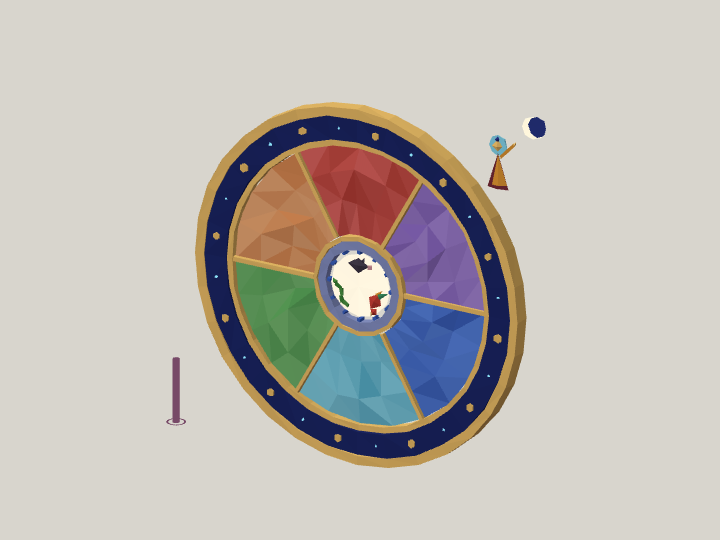
In the game, a small painting on Yama's Wheel, in a clearing at the end of the gods' realm, repeats a traditional motif. A standing monk Buddha outside the turning wheel of rebirth points beyond it, toward liberation.
Wheel paintings differ in what he points to. A Rubin Wheel of Life shows teaching text and symbols, and Robert Beer's commentary gives a full moon.
In traditional art
These images stay with the collections that hold them. Each link opens the collection's own page.
- Wheel of Existence — Rubin C2004.21.1 ↗Sikkim; Tibetan Buddhist tradition · c.1930, current Rubin attribution · rubinmuseum.org© Rubin Museum of Himalayan Art; no open license verified; source-hosted reference only
- Outside-wheel Buddha — detail of Rubin C2004.21.1 ↗Sikkim; Tibetan Buddhist tradition · c.1930, current Rubin attribution · rubinmuseum.org© Rubin Museum of Himalayan Art; no open license verified; source-hosted reference only
- Wheel of Life — Robert Beer Archive ↗Tibetan Buddhist tradition; modern artist archive · modern; exact artwork date unverified · tibetanart.com© Robert Beer / artist archive; all rights reserved; source-hosted reference only
Sources
Depiction requirements and work notes
Outside-wheel pointing Buddha in Yama’s secondary painting; identity unnamed in source
One small Buddha image is attached to the Yama Wheel prop in the deva-end clearing. It repeats the liberation-pointing motif at miniature scale. Audit it as sacred depicted content even though it is neither an independent rig nor a placed resident.
Rig source changed or is missing: prototypes/world-map/clearings/deva-end.js Reinspect the model before relying on the recorded defects.
References, criteria, concept and model side by side
Traditional depictions
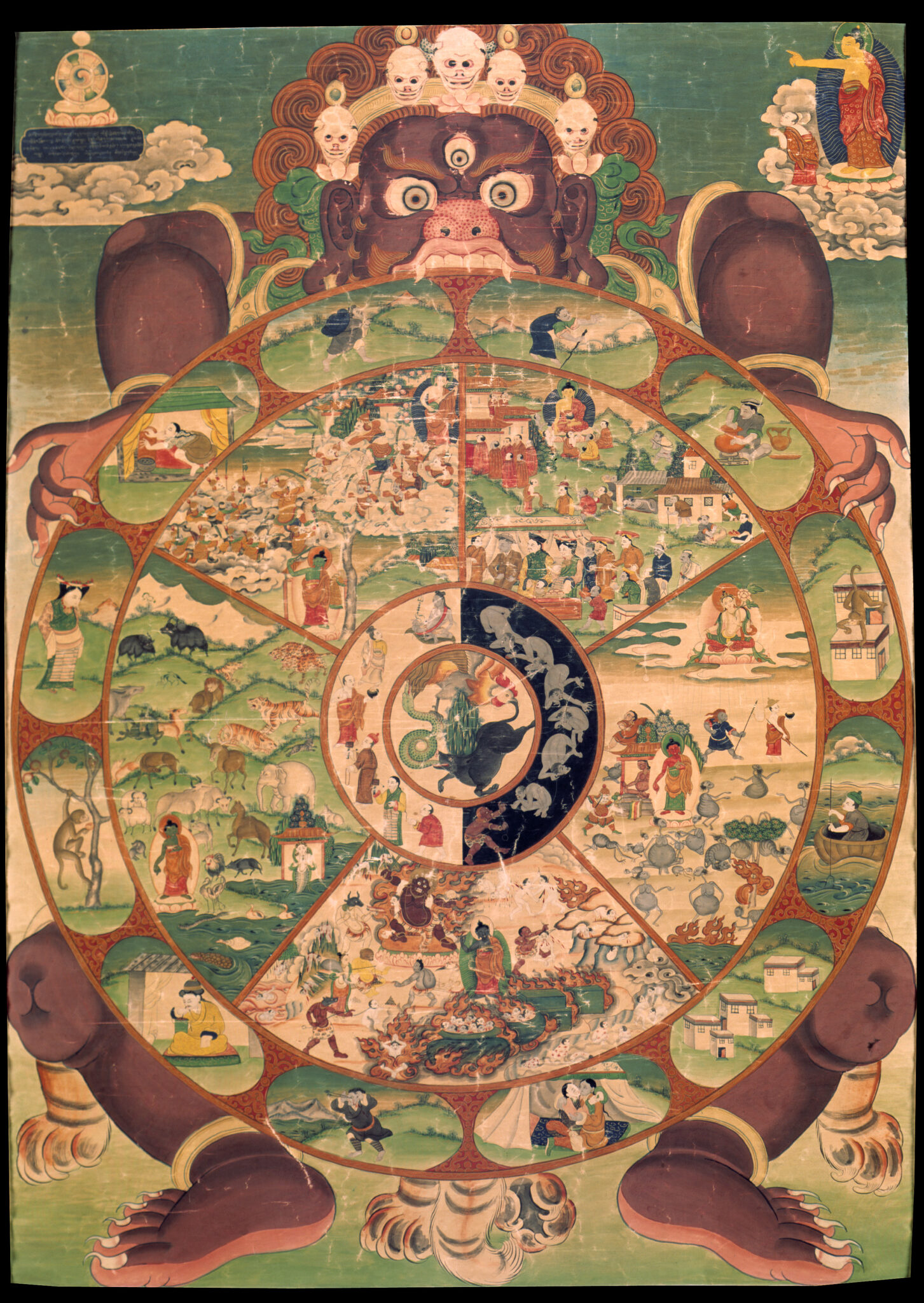
Whole traditional Wheel composition. Compare the outside figure’s relationship to the wheel and teachings; this painting does not identify the game’s palace figure. Current Rubin catalogue attributes this painting to Lhadripa Rinzing Chungyalpa in Sikkim c.1930; the Project Himalayan Art essay uses an older Tibet/early-20th-century label. This metadata discrepancy is preserved rather than harmonized silently. [wheel-rubin-essay] [wheel-rubin-current-catalog]
Object record ↗ · Source image ↗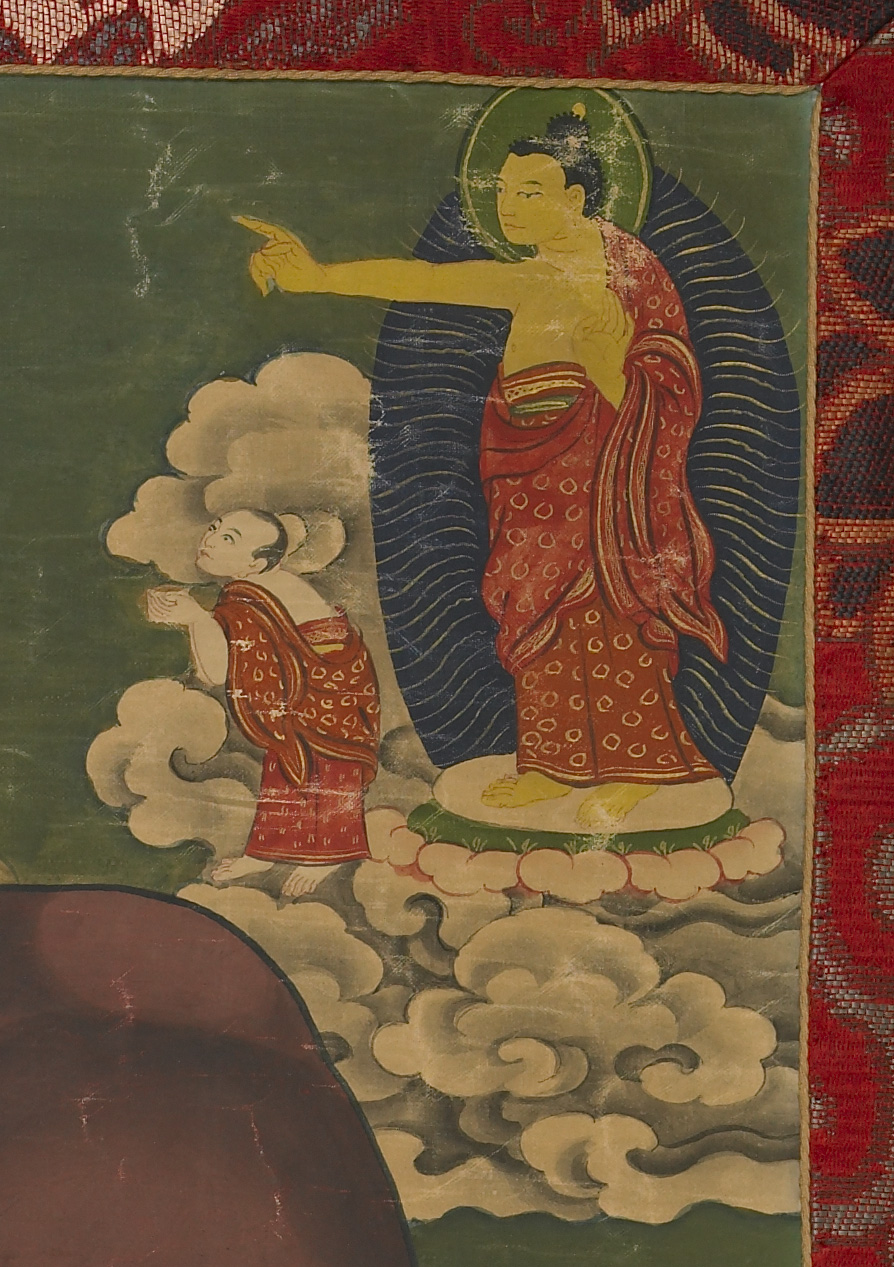
Detail useful for standing monastic robe, peaceful head/halo and directed pointing gesture. The game uses a moon target; the artifact’s caption describes teachings and symbols. Current Rubin catalogue attributes this painting to Lhadripa Rinzing Chungyalpa in Sikkim c.1930; the Project Himalayan Art essay uses an older Tibet/early-20th-century label. This metadata discrepancy is preserved rather than harmonized silently. [wheel-rubin-essay] [wheel-rubin-current-catalog]
Object record ↗ · Source image ↗
Named composition: Shakyamuni points to the moon; Amitabha’s Sukhavati occupies the opposite upper corner. Reference is not evidence that every Wheel palace is Amitabha. [wheel-beer]
Object record ↗ · Source image ↗Criteria
The model must show
- A small painted image, checked at actual gameplay size
- Position: outside the painted wheel, pointing clearly beyond it
- Body: a readable standing monastic silhouette with one clearly directed arm
- Target: a full moon (Robert Beer) or inscription and teaching symbols (Rubin C2004.21.1), the choice recorded
- Face, where it is large enough to show: serene; Eyes: solid black silhouettes with no whites, irises, pupils, highlights or glint (project eye rule; a recorded game adaptation, not a claim about traditional painted eyes)
The model must not show
- Cartoon smiley face: a wide U-shaped or crescent grin, open laughing mouth, rosy cheek dots or mascot cheeks
- Eye whites, irises, pupils, highlights or glint; glowing white-gold eyes (those belong only to freshly liberated beings)
- Any part of the figure (head, crown, hat, halo, raised hand or held object) touching or passing through its canopy, roof, lintel, pillars, throne back or seat in any capture angle
- A crown or generic deva headdress
- The Buddha and moon animated as if inside the spinning wheel
- A crescent moon described as universal
Original game concept
No original concept is recorded in the Atlas.
Current 3D model
Depiction requirements
- Semantic arrangement
- The painting’s Buddha must remain outside the revolving samsaric wheel and point clearly beyond it. [wheel-rubin-essay]
- Selected target
- Document whether the selected teaching-image reference uses a full moon. The game currently renders a crescent and must not describe that choice as universal. [wheel-beer]
- Miniature visual instruction
- Keep a readable monastic standing silhouette and clear directed arm at actual gameplay size. Compare the supplied standing-Buddha detail rather than adding an arbitrary crown or generic deva headdress. [wheel-rubin-essay]
Presentation contract
Ready to build from No readiness block is recorded in the plan.
Setting and sizing rule
Painted on the prop, outside the painted wheel's rim; the wheel and frame do not overlap the figure.
Recorded variants · 2
- Inscription or teaching-symbol target (Rubin C2004.21.1)
- Full-moon target (Robert Beer)
Recorded adaptations · 1
- A miniature simplification of the chosen Wheel image
Where the plan places it · 0
Nothing in the world plan references criteria:deva-end-painted-buddha: no character or placement uses this contract yet.
Contract sources · 3
- Rubin Museum / Eric Huntington — Wheel of Existence: A Visual Explanation of Buddhist Cosmology
- The Robert Beer Archive — Wheel of Life
- Rubin Museum — Wheel of Life attributed to Lhadripa Rinzing Chungyalpa, C2004.21.1
Model audit and next pass
Evidence basis: source-only for current geometry; historical rendered asset baseline inspected
Recorded observations
Source constructs saffron/maroon robe planes, small gold face, dark-blue topknot and pale halo, plus one raised arm directed toward the crescent.
The Buddha painting and moon meshes belong to the stationary parent; only the Wheel spin subgroup rotates when liberation changes.
Historical asset thumbnail was visually inspected: the tiny orange-robed figure and crescent are visible above/right of the Wheel. Fine hand/head anatomy is not resolved. Current-source visual acceptance remains pending.
Directions for a future model pass
P1 — Compare the small painting and full Wheel statue to the same documented composition, or explain why their traditions differ.
P1 — Capture a current-source front view of the prop at playable distance and a close-up; verify the pointing direction and stationary relationship.
P2 — Improve the few defining silhouette shapes before adding texture detail, keeping the miniature sacred image recognizable.
Assessed baseline captures
Documented forms and lineage variants · 2
Preserve one identified form consistently. A variant is usable only with its own source and context.
The miniature may simplify the chosen Wheel image, but it must retain its semantic separation from samsara.
An inscription/teaching-symbol target is documented in Rubin C2004.21.1; a full-moon target is documented by Robert Beer.
What not to copy · 3
Do not treat the miniature as a new canonical identity or ignore it because it is a painting.
Do not animate the outside Buddha and moon as if trapped in the spinning Wheel.
Do not present miniature gesture/head accuracy as verified from a broad prop thumbnail.
Sources and precise locations · 3
- [wheel-rubin-essay] Rubin Museum / Eric Huntington — Wheel of Existence: A Visual Explanation of Buddhist Cosmology ↗
- [wheel-beer] The Robert Beer Archive — Wheel of Life ↗
- [wheel-rubin-current-catalog] Rubin Museum — Wheel of Life attributed to Lhadripa Rinzing Chungyalpa, C2004.21.1 ↗
Assessment freshness and evidence hashes
The frozen snapshot is authored evidence. Regeneration computes current hashes and leaves that snapshot as it is.
{
  "auditFreshness": {
    "status": "stale",
    "reasons": [
      "Rig source changed or is missing: prototypes/world-map/clearings/deva-end.js"
    ]
  },
  "sourceSnapshot": {
    "captureHash": null,
    "bodyGeometryHash": null,
    "sourceHashes": {
      "prototypes/world-map/clearings/deva-end.js": "96a607e7765af279a46e3c2566e94aa329d851e7ed153ab927eb1cf277ee2012"
    },
    "captureHashes": {
      "/atlas/iconography/evidence/7a23fd60376a2622-library-asset-b48ebf38681a4c3a-00.png": "7a23fd60376a2622d868f03ef25e181f35b9e32dc25458d3eec8c6cdb45dd119"
    },
    "conceptHashes": {},
    "activeConceptPaths": []
  },
  "currentSnapshot": {
    "captureHash": null,
    "bodyGeometryHash": null,
    "activeConceptPaths": [],
    "sourceHashes": {
      "prototypes/world-map/clearings/deva-end.js": "b8bedc7282c848a291d5d374e421e43234301cc1c429241a79cedb5f049910d9"
    },
    "captureHashes": {
      "/atlas/iconography/evidence/7a23fd60376a2622-library-asset-b48ebf38681a4c3a-00.png": "7a23fd60376a2622d868f03ef25e181f35b9e32dc25458d3eec8c6cdb45dd119"
    },
    "conceptHashes": {}
  }
}