Buddha outside the Wheel
Outside the Wheel of Life stands a Buddha who points beyond it. This is a traditional sign of liberation, a way out of the turning wheel of rebirth. Robert Beer's commentary names the figure Shakyamuni and has him point to a full moon.
In the chosen images he is a peaceful, two-armed Buddha in a draped monastic robe, with a halo. Compositions differ. In a Rubin Wheel of Life he stands at upper right and points to teaching text and symbols, while Beer places him at upper left.
In traditional art
These images stay with the collections that hold them. Each link opens the collection's own page.
- Wheel of Existence — Rubin C2004.21.1 ↗Sikkim; Tibetan Buddhist tradition · c.1930, current Rubin attribution · rubinmuseum.org© Rubin Museum of Himalayan Art; no open license verified; source-hosted reference only
- Outside-wheel Buddha — detail of Rubin C2004.21.1 ↗Sikkim; Tibetan Buddhist tradition · c.1930, current Rubin attribution · rubinmuseum.org© Rubin Museum of Himalayan Art; no open license verified; source-hosted reference only
- Wheel of Life — Robert Beer Archive ↗Tibetan Buddhist tradition; modern artist archive · modern; exact artwork date unverified · tibetanart.com© Robert Beer / artist archive; all rights reserved; source-hosted reference only
Sources
Depiction requirements and work notes
Outside-wheel pointing Buddha; Shakyamuni identification source-qualified
The game builds one unnamed standing Buddha outside the Wheel, directing an arm toward the moon. This is a traditional liberation motif. Naming the figure Shakyamuni is supported by a specific artist account; its placement, gesture and target should follow a documented Wheel composition.
Rig source changed or is missing: prototypes/world-map/wheel-symbols.js Reinspect the model before relying on the recorded defects.
References, criteria, concept and model side by side
Traditional depictions
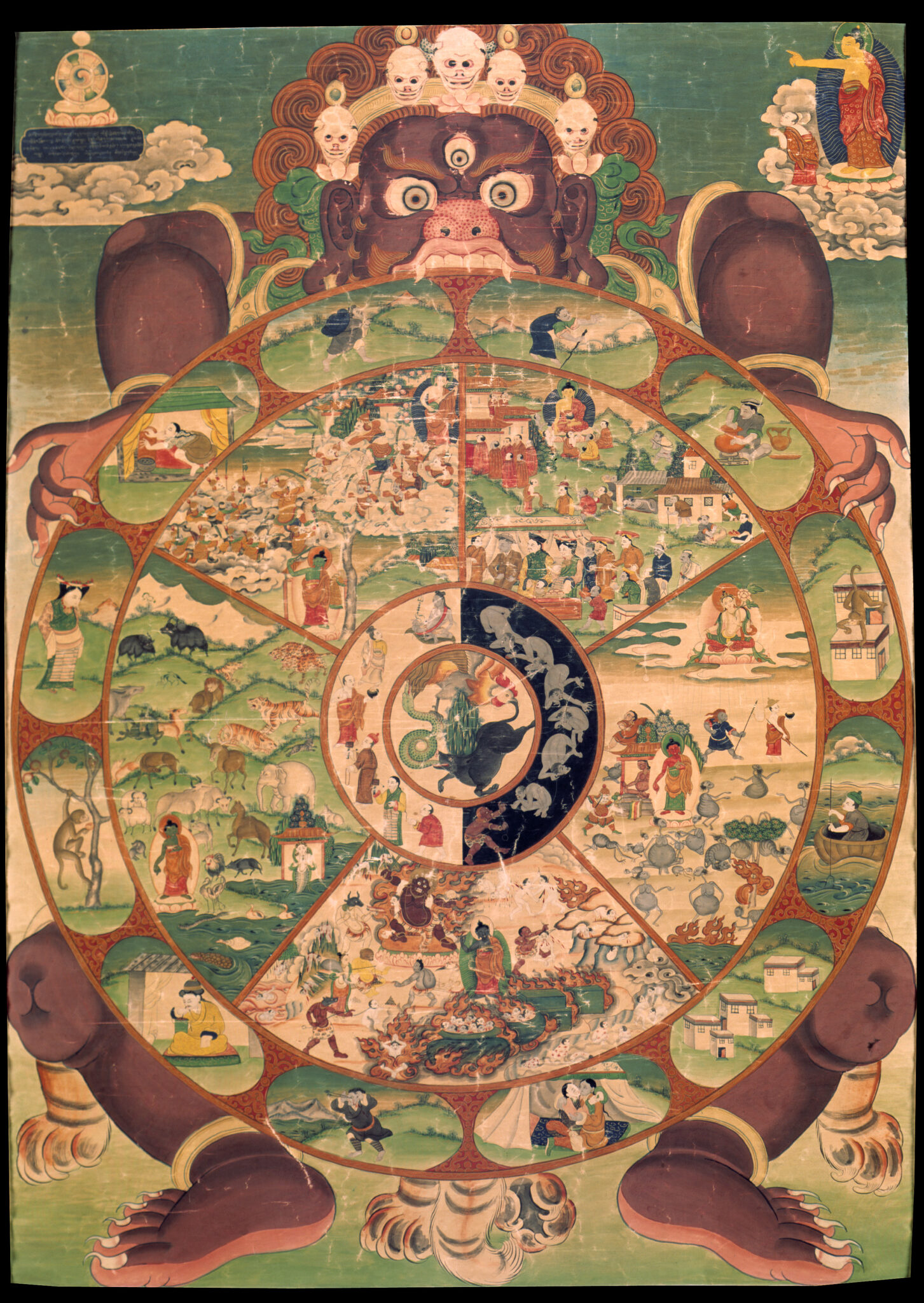
Whole traditional Wheel composition. Compare the outside figure’s relationship to the wheel and teachings; this painting does not identify the game’s palace figure. Current Rubin catalogue attributes this painting to Lhadripa Rinzing Chungyalpa in Sikkim c.1930; the Project Himalayan Art essay uses an older Tibet/early-20th-century label. This metadata discrepancy is preserved rather than harmonized silently. [wheel-rubin-essay] [wheel-rubin-current-catalog]
Object record ↗ · Source image ↗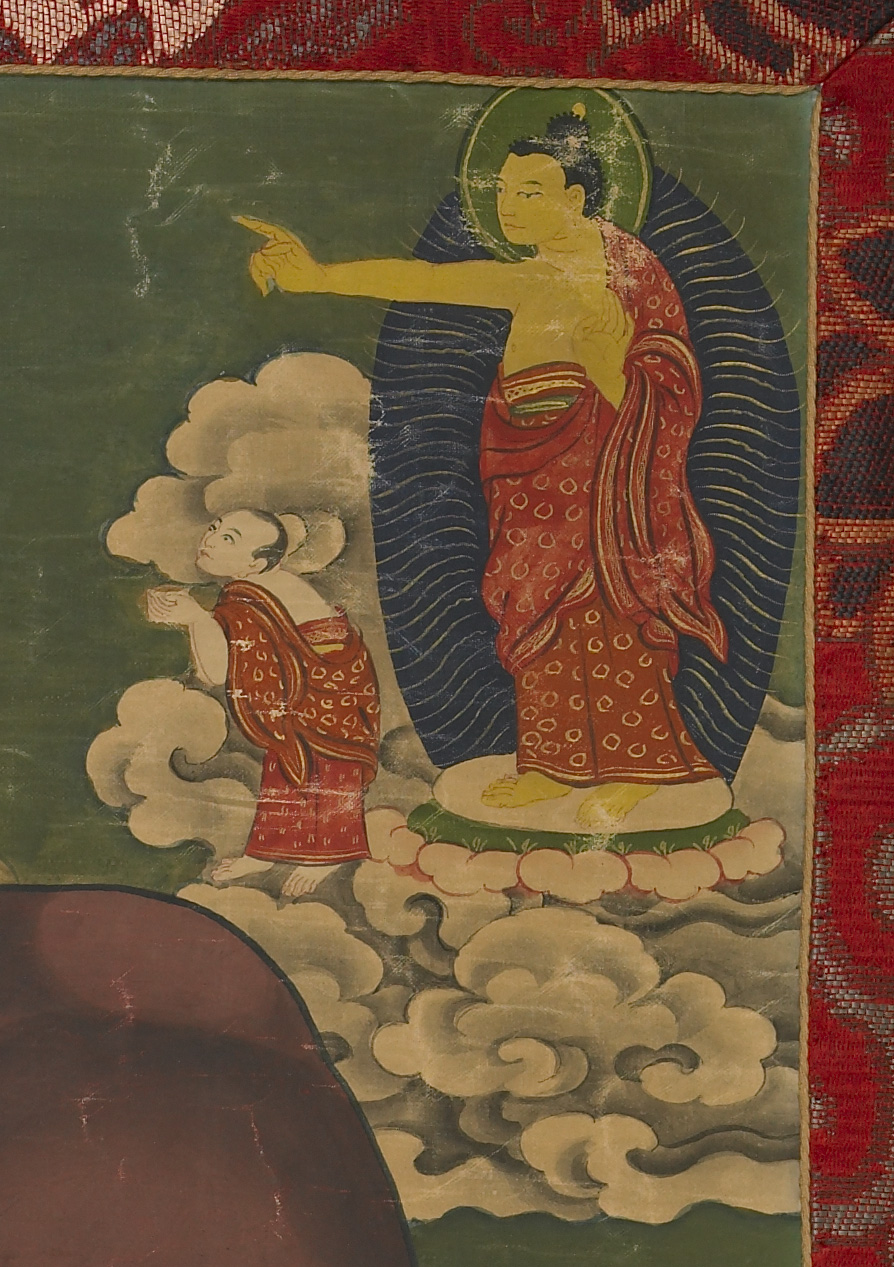
Detail useful for standing monastic robe, peaceful head/halo and directed pointing gesture. The game uses a moon target; the artifact’s caption describes teachings and symbols. Current Rubin catalogue attributes this painting to Lhadripa Rinzing Chungyalpa in Sikkim c.1930; the Project Himalayan Art essay uses an older Tibet/early-20th-century label. This metadata discrepancy is preserved rather than harmonized silently. [wheel-rubin-essay] [wheel-rubin-current-catalog]
Object record ↗ · Source image ↗
Named composition: Shakyamuni points to the moon; Amitabha’s Sukhavati occupies the opposite upper corner. Reference is not evidence that every Wheel palace is Amitabha. [wheel-beer]
Object record ↗ · Source image ↗Criteria
The model must show
- Lineage variant: one documented Wheel composition, named with the model; if he is called Śākyamuni it is Robert Beer's composition (upper left, pointing to a full moon)
- Position: outside the Wheel, never inside it
- Body: a peaceful standing figure, two arms
- Hands: one arm raised with a clear pointing silhouette aimed at the liberation target
- Dress: a readable draped monk's robe
- Head: rounded Buddha head, with a halo
- Face: serene and composed, as the library gives this peaceful form: narrow calm eye shapes, level brows, a small closed restrained mouth
- Eyes: solid black silhouettes with no whites, irises, pupils, highlights or glint (project eye rule; a recorded game adaptation, not a claim about traditional painted eyes)
- Target: a full moon in Beer's composition, or teaching text and symbols in Rubin C2004.21.1
The model must not show
- Cartoon smiley face: a wide U-shaped or crescent grin, open laughing mouth, rosy cheek dots or mascot cheeks
- Eye whites, irises, pupils, highlights or glint; glowing white-gold eyes (those belong only to freshly liberated beings)
- Any part of the figure (head, crown, hat, halo, raised hand or held object) touching or passing through its canopy, roof, lintel, pillars, throne back or seat in any capture angle
- A crescent moon described as required
- Identifying him as Yama or a deva
- A crown or deva headdress
- The Buddha or his moon turning with the Wheel
Original game concept
No original concept is recorded in the Atlas.
Current 3D model
Depiction requirements
- Relationship to the Wheel
- Keep the Buddha beyond the Wheel, with the pointing gesture directed clearly toward the liberation/teaching target. [wheel-rubin-essay]
- Working identification
- If named Shakyamuni, record the chosen Wheel image. Robert Beer’s commentary identifies that standing figure and a full-moon target. [wheel-beer]
- Modeling instruction derived from the references
- For this monastic standing form, retain a peaceful two-arm figure, readable draped robe, rounded Buddha head and halo; give the raised hand a clear pointing silhouette. These are visual modeling directions for the selected images, not a universal gesture requirement for all Buddhas. [wheel-rubin-essay] [wheel-beer]
- Moon variant
- Treat the full moon as the selected liberation symbol. The current crescent geometry needs comparison against a chosen reference before being described as canonical. [wheel-beer]
Presentation contract
Ready to build from No readiness block is recorded in the plan.
Open points recorded with the contract
- The exact Wheel composition is not yet selected; the current crescent moon has no chosen reference
Setting and sizing rule
He stands in open sky beyond the Wheel's rim, with nothing of the Wheel overlapping his body. Sizing (plan rule R4, not a sourced claim): the opening of any shrine, canopy or pavilion around the figure leaves at least one of the figure's own head-heights of clear air above its tallest point (the halo) and a clear gap on each side of its widest span (the pointing arm); a throne back or aureole sits behind the figure without passing through it; pillars and lintel do not cross the face, hands or held objects in the front or either three-quarter capture.
Recorded variants · 2
- Rubin C2004.21.1: standing Buddha at upper right pointing to teaching text and symbols
- Robert Beer: Śākyamuni at upper left pointing to a full moon
Recorded adaptations · 0
Where the plan places it · 1
- Death frame and release imagery · The Buddha pointing beyond the Wheel
wheel-exterior.release· placement build-wheel-symbolswheel-exterior.release.buddha
Contract sources · 3
- Rubin Museum / Eric Huntington — Wheel of Existence: A Visual Explanation of Buddhist Cosmology
- The Robert Beer Archive — Wheel of Life
- Rubin Museum — Wheel of Life attributed to Lhadripa Rinzing Chungyalpa, C2004.21.1
Model audit and next pass
Evidence basis: source-only for current geometry; historical rendered asset baseline inspected
Recorded observations
Current source builds a gold-faced standing figure, blue topknot, maroon/saffron cones, pale-blue/gold halo and black eyes. Its arm direction is computed toward the raised moon.
The source gives no named identity to this figure. It appears within buildWheelSymbols, with no independent character rig or concept.
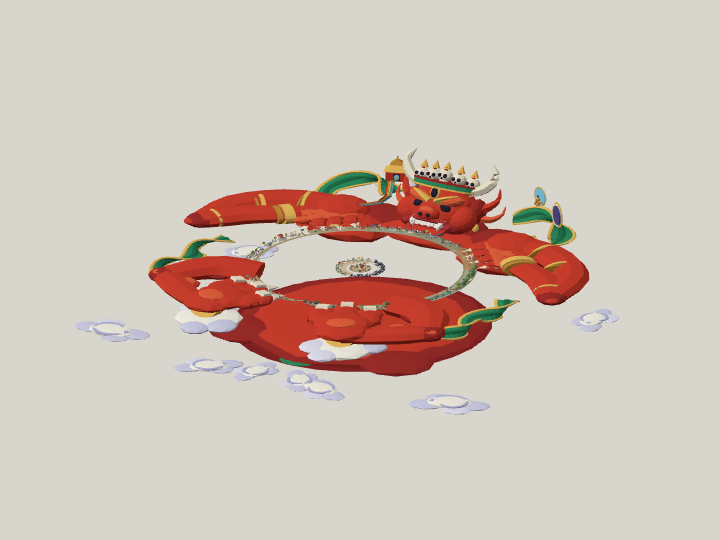
Historical full Wheel asset overview was inspected. The tiny outside figure is too small there to verify hand anatomy, robe folds or head proportions. This is rendered context evidence, not current close-up acceptance.
Directions for a future model pass
P1 — Select and cite one traditional Wheel composition and explicitly document whether the figure is Shakyamuni and the target is full moon, inscription or combined symbols.
P1 — Capture a current-source front/three-quarter close-up at the outside statue and a context shot showing the complete pointing line.
P2 — Polish the hand into a readable pointing shape and refine the robe/head silhouette using the chosen artifact; retain project solid-black eye policy.
Assessed baseline captures
Documented forms and lineage variants · 2
Preserve one identified form consistently. A variant is usable only with its own source and context.
Rubin C2004.21.1 has the standing Buddha at upper right pointing toward teaching text and symbols.
Robert Beer’s composition places Shakyamuni upper left and points to a full moon. The differences require a chosen composition rather than a universal left/right rule.
What not to copy · 3
Do not identify the outside Buddha as Yama or an ordinary deva merely because the figure belongs to Wheel scenery.
Do not claim a crescent moon is required by every traditional Wheel image.
Do not infer a complete anatomical Shakyamuni contract from the game’s gold face and blue topknot alone.
Sources and precise locations · 3
- [wheel-rubin-essay] Rubin Museum / Eric Huntington — Wheel of Existence: A Visual Explanation of Buddhist Cosmology ↗
- [wheel-beer] The Robert Beer Archive — Wheel of Life ↗
- [wheel-rubin-current-catalog] Rubin Museum — Wheel of Life attributed to Lhadripa Rinzing Chungyalpa, C2004.21.1 ↗
Assessment freshness and evidence hashes
The frozen snapshot is authored evidence. Regeneration computes current hashes and leaves that snapshot as it is.
{
  "auditFreshness": {
    "status": "stale",
    "reasons": [
      "Rig source changed or is missing: prototypes/world-map/wheel-symbols.js"
    ]
  },
  "sourceSnapshot": {
    "captureHash": null,
    "bodyGeometryHash": null,
    "sourceHashes": {
      "prototypes/world-map/wheel-symbols.js": "2caca3f7aa87e6ed7a4145041f87a6ef69654cd297a03e40c6d01133f395b0c2"
    },
    "captureHashes": {
      "/atlas/iconography/evidence/1b2bab2eef569f08-new-asset-adda57a559e5131f-00.png": "1b2bab2eef569f08d869ac7fb5aed2068776cfd1c9871d5da738472efe7089c3"
    },
    "conceptHashes": {},
    "activeConceptPaths": []
  },
  "currentSnapshot": {
    "captureHash": null,
    "bodyGeometryHash": null,
    "activeConceptPaths": [],
    "sourceHashes": {
      "prototypes/world-map/wheel-symbols.js": "d188917fd12914d05b14c7e25599a1ea86114b07254b3183159d42da744535bf"
    },
    "captureHashes": {
      "/atlas/iconography/evidence/1b2bab2eef569f08-new-asset-adda57a559e5131f-00.png": "1b2bab2eef569f08d869ac7fb5aed2068776cfd1c9871d5da738472efe7089c3"
    },
    "conceptHashes": {}
  }
}