Padmasambhava
Padmasambhava, also called Guru Rinpoche and Pema Jungne, is revered in the Nyingma school as the Second Buddha. In his usual form he wears a five-petalled lotus hat. His right hand holds a five-pointed vajra, and his left a skull cup with a long-life vase inside.
A khatvanga, a tantric staff with a three-pointed top, rests in the crook of his left arm. He has one face and two hands, a pale body tinged with red, and a composed, slightly wrathful dignity. A dark red brocade cloak covers layered Dharma robes. A common account of the lotus hat gives it sun and moon emblems, a vajra tip and a feather.
Jamyang Khyentse Wangpo seats him in vajra posture on a lotus, sun and moon above a lion throne. Jigme Lingpa seats him at royal ease instead. He also appears in eight manifestations, and they do not all share this hat and staff.
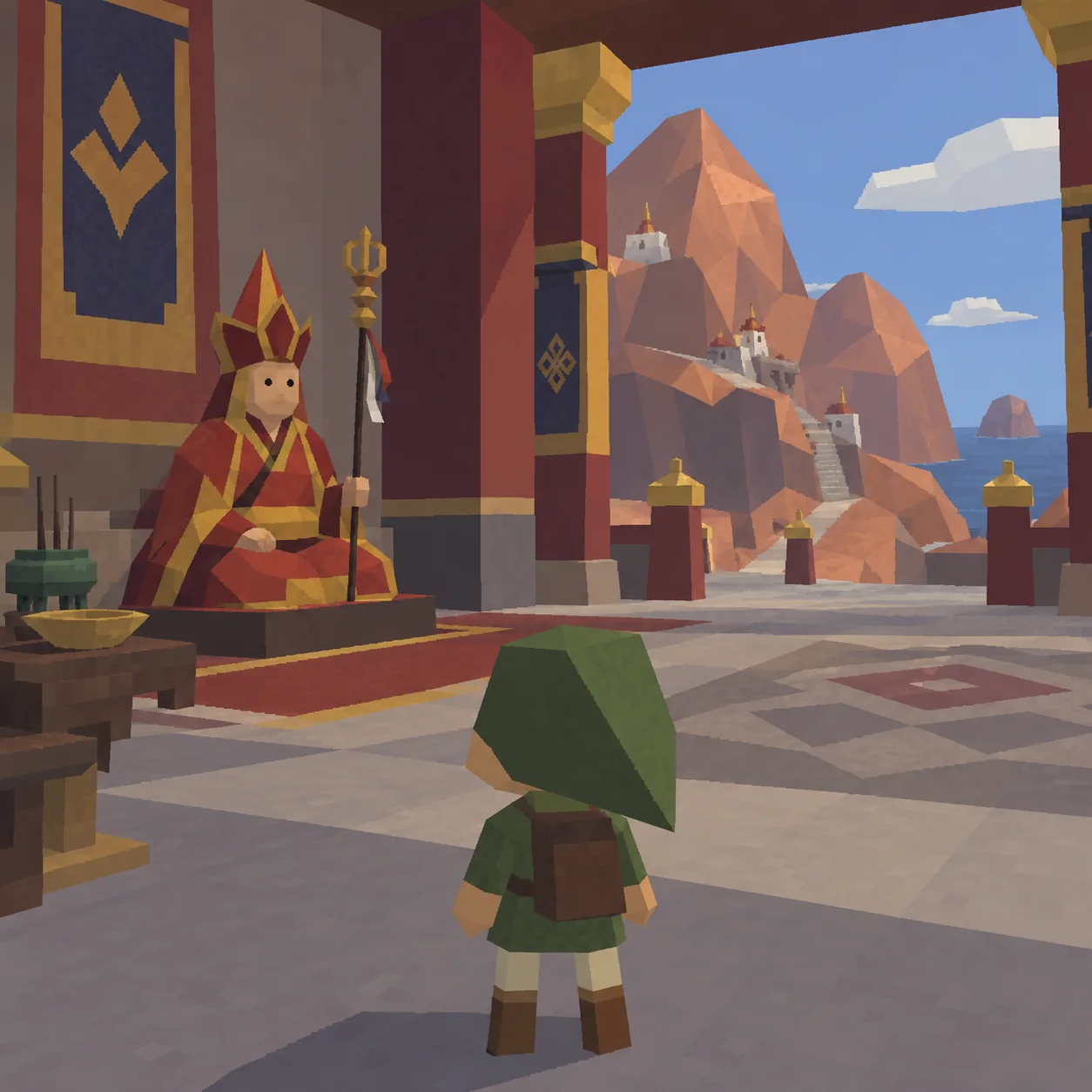
In traditional art
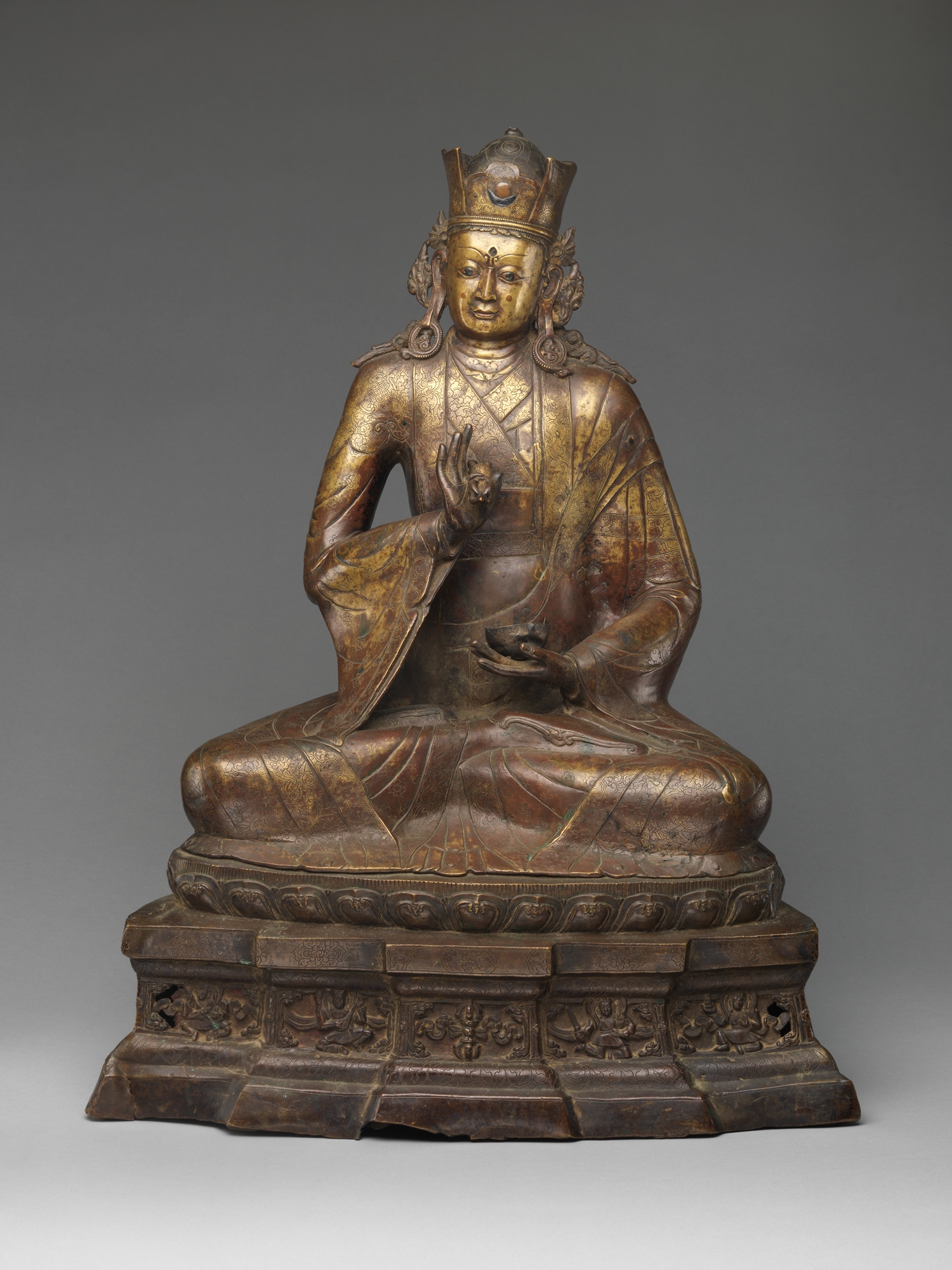
The Spiritual Master Padmasambhava, The Met 2012.459Western Tibet or Ladakh · 14th centuryPublic Domain / The Met Open Access; museum API isPublicDomain=true.Object record ↗
In other collections
These images stay with the collections that hold them. Each link opens the collection's own page.
- Padmasambhava, Rubin C2003.29.1 ↗Tibet · 18th century · rubinmuseum.orgMuseum photograph; no open reuse licence established. Link/reference only; museum credit is not a reuse licence.
- Padmasambhava and Eight Manifestations, Rubin C2003.51.1 ↗Tibet · ca.16th century (museum); HAR gives17th century · rubinmuseum.orgMuseum photograph; no open reuse licence established. Link/reference only; museum credit is not a reuse licence.
- Padmasambhava, Rubin C2002.19.1 — scholar-hat variant ↗Kham, Eastern Tibet · late18th–19th century · rubinmuseum.orgMuseum photograph; no open reuse licence established. Link/reference only; museum credit is not a reuse licence.
Sources
- Dudjom Rinpoche: Concise Benefits of the Festival of the Tenth Day ↗
- Padmasambhava and Eight Manifestations — Rubin C2003.51.1 ↗
- Padmasambhava and Eight Forms, annotated photograph — HAR 65283 ↗
- Jigme Lingpa: The Wish-Fulfilling Jewel, outer guru yoga ↗
- Jamyang Khyentse Wangpo: Essence of the Profound Path, general Guru Rinpoche visualization ↗
- Ritual staff (Khatvanga), Tibet, 18th century — NGV 2006.288 ↗
- Padmasambhava — Rubin C2002.19.1 ↗
- The Spiritual Master Padmasambhava — The Met 2012.459 ↗
- Padmasambhava — Rubin C2003.29.1 ↗
- Padmasambhava — Rigpa Wiki ↗
- Padmasambhava and His Manifestations — Project Himalayan Art ↗
Depiction requirements and work notes
Padmasambhava / Guru Rinpoche / Pema Jungne
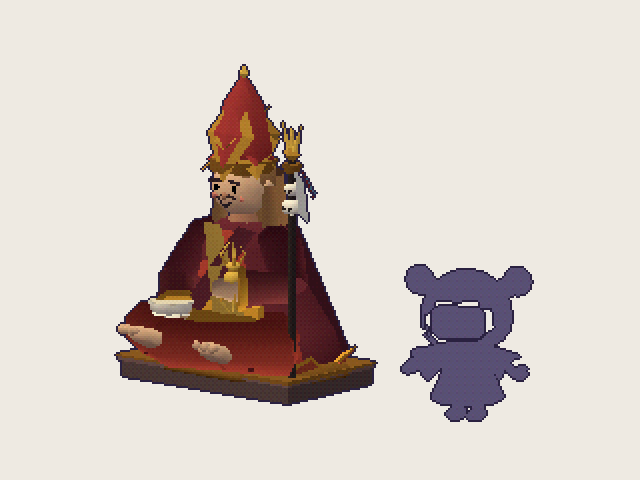
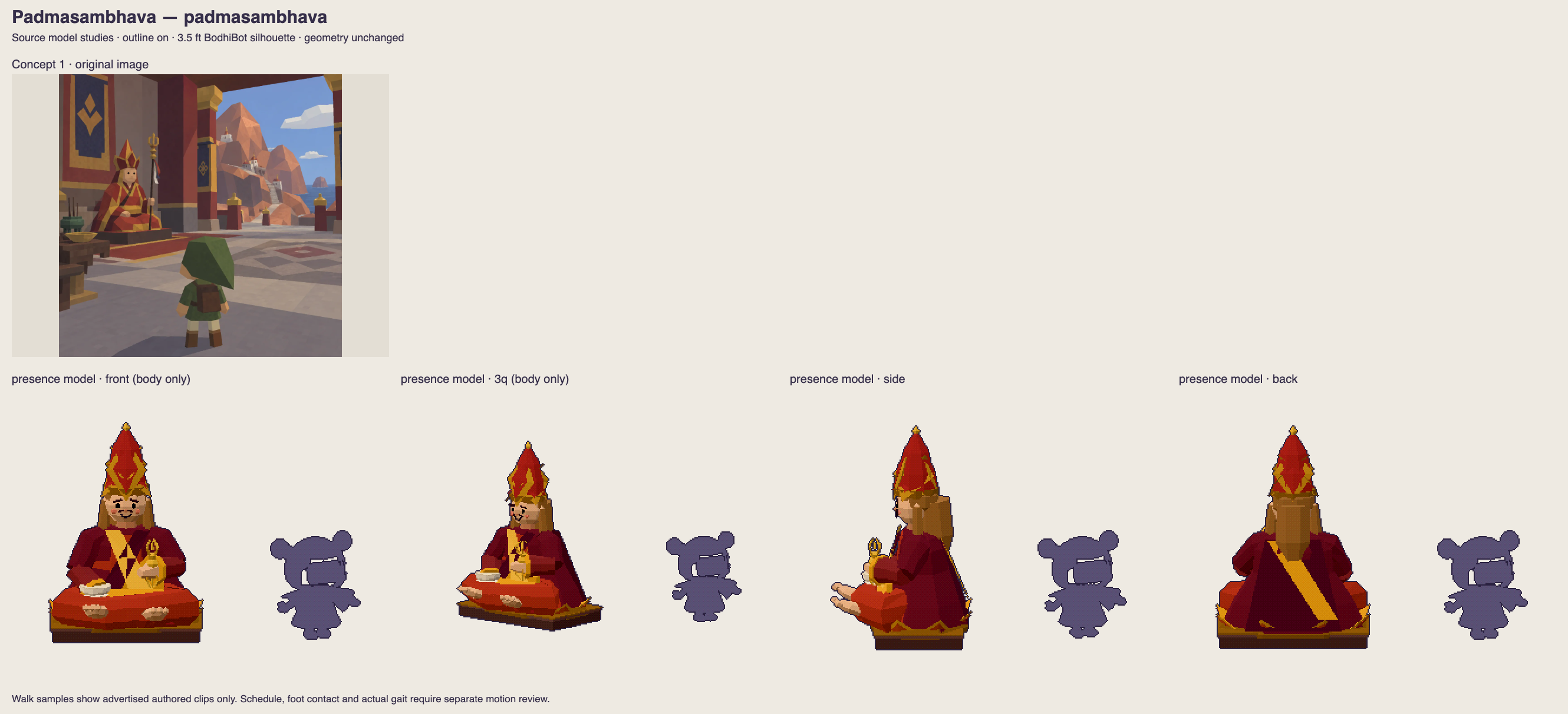
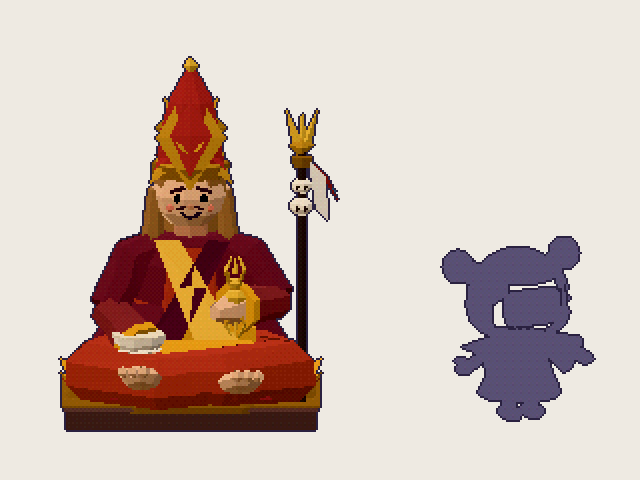
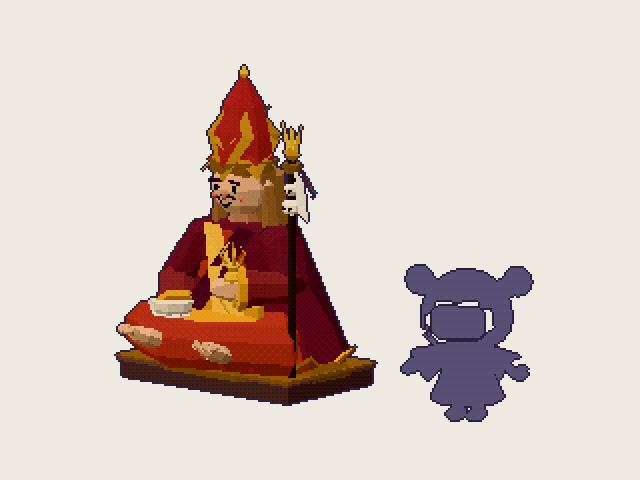
The regular lotus-hat guru has specific asymmetrical implements. The current model reverses the vajra and cup hands, omits the life vase, abbreviates the staff and substitutes a tall six-lobed cone for the detailed lotus hat.
The model capture recipe or rig source changed. Reinspect the model before relying on the recorded defects.
References, criteria, concept and model side by side
Traditional depictions

Large central lotus-hat Guru: right vajra, left cup/vase, left-side khatvanga and crossed-leg seat. Surrounding manifestations supply a contrasting set, not interchangeable accessories. [guru-padma-regular]
Object record ↗ · Source image ↗
Large central lotus-hat Guru, below the upper three figures; do not substitute the smaller upper-right red scholar-hat Pema Jungne. See linked HAR annotated image for identification; retinue figures are not additional Guru manifestations. [guru-group] [guru-group-labels]
Object record ↗ · Source image ↗Early seated copper-alloy Guru. Study surviving hat/robe/cup and calm alert expression; staff is physically missing, not a doctrinal permission to omit it. [guru-padma-met]
Object record ↗ · Source image ↗
Comparative variant only: central red pointed scholar-hat Guru, bare upper torso, different implements and royal-ease posture. This painting is NOT a blueprint for the game’s lotus-hat form. [guru-padma-art]
Object record ↗ · Source image ↗Criteria
The model must show
- Lineage variant: the regular lotus-hat Guru of Jamyang Khyentse Wangpo's general visualization (vajra posture); Jigme Lingpa's royal poise is the recorded alternative, and the one used is named
- Body: pale skin tinged with red, one face, two hands
- Hands: own right hand holds a five-pointed vajra; own left hand supports a skull cup
- Held objects: the skull cup contains a long-life vase; a khatvanga staff is cradled in the own left arm, with a three-pointed finial and three distinct head stages
- Dress: layered robes and gown with a dark-red brocade mantle
- Hat: a readable five-petalled lotus hat, with sun and moon emblem, vajra finial and feather where the chosen reference has them
- Posture: seated in vajra posture
- Face: composed, with a slightly wrathful dignity: firm brows and a small closed mouth
- Eyes: solid black silhouettes with no whites, irises, pupils, highlights or glint (project eye rule; a recorded game adaptation, not a claim about traditional painted eyes)
- Seat: lotus, sun and moon on a lion throne
- Attendants: none required; the eight manifestations surround him in Rubin C2003.29.1
The model must not show
- Cartoon smiley face: a wide U-shaped or crescent grin, open laughing mouth, rosy cheek dots or mascot cheeks
- Eye whites, irises, pupils, highlights or glint; glowing white-gold eyes (those belong only to freshly liberated beings)
- Any part of the figure (head, crown, hat, halo, raised hand or held object) touching or passing through its canopy, roof, lintel, pillars, throne back or seat in any capture angle
- Vajra and cup on the reversed hands (the current model's fault)
- A missing life vase
- A plain pointed monk hat or tall lobed cone instead of the lotus hat
- An abbreviated staff with no heads or finial
- Hands or attributes mirrored to the wrong side of the figure's own body (own right appears at viewer-left in a front view)
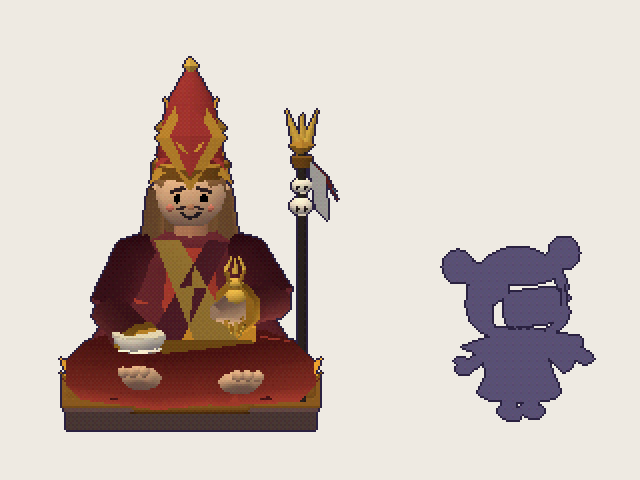
Original game concept
Current 3D model
presence
Depiction requirements
- Proper hands
- Figure-right holds the five-pointed vajra; figure-left supports the skull cup containing the long-life vase. Proper sides are the figure’s own sides: a frontal image puts the right hand on viewer-left. [guru-jkw] [guru-jigme]
- Left-arm staff
- Cradle the khatvanga on figure-left. For the cited outer-guru form retain the three-pointed finial; use three differentiated head stages when following the selected Tibetan staff/art convention. [guru-jigme] [guru-ngv-staff]
- Lotus hat
- Keep a readable five-petalled lotus hat. Sun/moon emblems, vajra finial and feather belong to the common institutional lotus-hat account; confirm a selected reference instead of reducing this to a plain pointed monk hat. [guru-jigme] [guru-rigpa]
- Body and clothing
- One face, two hands, pale body tinged red, layered Dharma/gown robes and dark-red brocade mantle; preserve a composed, slightly wrathful dignity. [guru-jkw]
- Seat and pose
- The public general visualization specifies vajra posture on lotus, sun and moon with a lion throne. Royal-poise seating is another attested public visualization, not a contradiction to hide. [guru-jkw] [guru-jigme]
Presentation contract
Ready to build from No readiness block is recorded in the plan.
Setting and sizing rule
Lotus, sun and moon on a lion throne. Sizing (plan rule R4, not a sourced claim): the opening of any shrine, canopy or pavilion around the figure leaves at least one of the figure's own head-heights of clear air above its tallest point (the feather or finial of the lotus hat and the top of the staff) and a clear gap on each side of its widest span (the staff on the left and the vajra hand on the right); a throne back or aureole sits behind the figure without passing through it; pillars and lintel do not cross the face, hands or held objects in the front or either three-quarter capture.
Recorded variants · 3
- Royal-poise seat (Jigme Lingpa; Rubin C2002.19.1)
- The red pointed pandita-hat scholarly Guru is a different representation
- Met 2012.459 has lost its staff
Recorded adaptations · 0
Where the plan places it · 1
- copper mountain · The palace of three floors
copper-mountain.palace· character Padmasambhavapadmasambhava
Contract sources · 6
- Jamyang Khyentse Wangpo: Essence of the Profound Path, general Guru Rinpoche visualization
- Jigme Lingpa: The Wish-Fulfilling Jewel, outer guru yoga
- Ritual staff (Khatvanga), Tibet, 18th century — NGV 2006.288
- Padmasambhava — Rigpa Wiki
- Padmasambhava — Rubin C2003.29.1
- Padmasambhava — Rubin C2002.19.1
Model audit and next pass
Evidence basis: visual + source
Recorded observations
Full canonical front visibly places vajra on viewer-right / figure-left and cup on viewer-left / figure-right. The source agrees (+X vajra, -X cup), despite opposite anatomical labels. Staff sits viewer-right / figure-left, which is the correct staff side.
The hat is a very tall red cone with six lobe panels, a small gold tip and no readable sun/moon or feather. The source comment says three skulls but creates two identical ivory skull objects. The cup is an empty smooth bowl with no life vase.
Pale skin, moustache, layered red/maroon robes and connected crossed legs are readable. The original scene concept itself does not show the standard cup/vajra pair clearly.
Reviewed original concept, Atlas all-angle sheet and source builder. Existing captures are historical evidence, not a fresh gameplay recapture; body-only views can omit scenery-classed attributes. The registry identityId is padmasambhava; its generic bodhisattva heightClass is a project scale label, not a doctrinal classification.
Directions for a future model pass
First correct implement handedness while retaining the staff on figure-left. Add a distinct small longevity vase to the cup.
Revise the hat silhouette and its identifying emblems; restore the selected staff’s three head stages and finial.
Improve the concept alongside the work order, because concept fidelity currently preserves omissions.
Keep solid-black eyes, low-detail PS1 geometry and outline as the explicit game style. Improve sacred-attribute silhouettes without ornamental noise. Preserve pass history and record concept fidelity separately from traditional accuracy; the entry is finished when its independent review passes; approval fields stay as found.
Assessed baseline captures
Documented forms and lineage variants · 2
Preserve one identified form consistently. A variant is usable only with its own source and context.
The main lotus-hat Pema Jungne type differs from red pointed pandita-hat scholarly Guru representations. Do not impose this hat and staff on all eight manifestations.
Jamyang Khyentse Wangpo specifies vajra posture; Jigme Lingpa specifies royal poise. Choose and record the version used.
What not to copy · 2
Do not use variable names R/L as anatomical proof; this builder currently assigns +X (viewer-right) to R.
Do not reproduce missing implements from the scene concept as canonical requirements.
Sources and precise locations · 11
- [guru-dudjom] Dudjom Rinpoche: Concise Benefits of the Festival of the Tenth Day ↗
- [guru-group] Padmasambhava and Eight Manifestations — Rubin C2003.51.1 ↗
- [guru-group-labels] Padmasambhava and Eight Forms, annotated photograph — HAR 65283 ↗
- [guru-jigme] Jigme Lingpa: The Wish-Fulfilling Jewel, outer guru yoga ↗
- [guru-jkw] Jamyang Khyentse Wangpo: Essence of the Profound Path, general Guru Rinpoche visualization ↗
- [guru-ngv-staff] Ritual staff (Khatvanga), Tibet, 18th century — NGV 2006.288 ↗
- [guru-padma-art] Padmasambhava — Rubin C2002.19.1 ↗
- [guru-padma-met] The Spiritual Master Padmasambhava — The Met 2012.459 ↗
- [guru-padma-regular] Padmasambhava — Rubin C2003.29.1 ↗
- [guru-rigpa] Padmasambhava — Rigpa Wiki ↗
- [guru-rubin-essay] Padmasambhava and His Manifestations — Project Himalayan Art ↗
Assessment freshness and evidence hashes
The frozen snapshot is authored evidence. Regeneration computes current hashes and leaves that snapshot as it is.
{
  "auditFreshness": {
    "status": "stale",
    "reasons": [
      "The model capture recipe or rig source changed."
    ]
  },
  "sourceSnapshot": {
    "captureHash": "dce24f82cd8c8bcca4478a950a9410a29d3e43612cc183b3db8acf8263a33817",
    "bodyGeometryHash": "d6bc4135538f83e2a097120cf0b95ea0ded3b33ee5c6770499622c22c86cc4be",
    "sourceHashes": {
      "prototypes/prerendered-look/parts/purelands/padmasambhava.js": "48343feb82a8e55aeaf59a24e17b64563658efaa94a48bf32e3731075155a884"
    },
    "captureHashes": {
      "/atlas/audit/sheets/padmasambhava-78f291a285d0.webp": "2eb6aa4066cbc401486969c1b05dd2e0b2e8bc89777caa19438d570386038f42",
      "/atlas/characters/padmasambhava-511577818f3b-presence-3q.webp": "c1fd140bf70e30ed2669443ca180a6c70ad50dda952e47aed61f11ddba1930cb",
      "/atlas/characters/padmasambhava-511577818f3b-presence-front.webp": "939173ec15577a694b1cb5a3f5974966752f98d2949325c6ca7be7cbc71cb2dc",
      "/atlas/characters/padmasambhava-dce24f82cd8c-presence-3q.webp": "c1fd140bf70e30ed2669443ca180a6c70ad50dda952e47aed61f11ddba1930cb",
      "/atlas/characters/padmasambhava-dce24f82cd8c-presence-front.webp": "939173ec15577a694b1cb5a3f5974966752f98d2949325c6ca7be7cbc71cb2dc"
    },
    "conceptHashes": {
      "/purelands/concepts/padmasambhava.webp": "6a0deed855fdbe21672aba00fcba14c257b83839cf7c15f33edc4db7079d7002"
    },
    "activeConceptPaths": [
      "/purelands/concepts/padmasambhava.webp"
    ]
  },
  "currentSnapshot": {
    "captureHash": "f3d0afd456c4d05e56198d732e0eb9c97116afbe0511cdf698b72ecd8f761563",
    "bodyGeometryHash": "d6bc4135538f83e2a097120cf0b95ea0ded3b33ee5c6770499622c22c86cc4be",
    "activeConceptPaths": [
      "/purelands/concepts/padmasambhava.webp"
    ],
    "sourceHashes": {
      "prototypes/prerendered-look/parts/purelands/padmasambhava.js": "48343feb82a8e55aeaf59a24e17b64563658efaa94a48bf32e3731075155a884"
    },
    "captureHashes": {
      "/atlas/audit/sheets/padmasambhava-78f291a285d0.webp": "2eb6aa4066cbc401486969c1b05dd2e0b2e8bc89777caa19438d570386038f42",
      "/atlas/characters/padmasambhava-511577818f3b-presence-3q.webp": "c1fd140bf70e30ed2669443ca180a6c70ad50dda952e47aed61f11ddba1930cb",
      "/atlas/characters/padmasambhava-511577818f3b-presence-front.webp": "939173ec15577a694b1cb5a3f5974966752f98d2949325c6ca7be7cbc71cb2dc",
      "/atlas/characters/padmasambhava-dce24f82cd8c-presence-3q.webp": "c1fd140bf70e30ed2669443ca180a6c70ad50dda952e47aed61f11ddba1930cb",
      "/atlas/characters/padmasambhava-dce24f82cd8c-presence-front.webp": "939173ec15577a694b1cb5a3f5974966752f98d2949325c6ca7be7cbc71cb2dc",
      "/atlas/characters/padmasambhava-f3d0afd456c4-presence-3q.webp": "276157be858d80fdc2bb55da620b1220ccd9e64a2b4c0cee8b43352b96c84cb4",
      "/atlas/characters/padmasambhava-f3d0afd456c4-presence-front.webp": "8cbf0c54c4a58a508caec964a5c198a643fe51f5c4efa7cbb5773693e5960f49"
    },
    "conceptHashes": {
      "/purelands/concepts/padmasambhava.webp": "6a0deed855fdbe21672aba00fcba14c257b83839cf7c15f33edc4db7079d7002"
    }
  }
}