Pha Trelgen Changchup Sempa
Pha Trelgen Changchup Sempa is the monkey bodhisattva, ancestor of the Tibetan people. In the Clear Mirror chronicle he is a magical monkey devoted to meditation on compassion, who takes lay vows from his teacher Avalokiteshvara. Another retelling calls him a divine form of Avalokiteshvara himself.
The chronicle opens with him in meditation. Tara and Bhrikuti advise and approve his marriage to the rock-ogress. Named narrative paintings of him exist, but no fixed ritual form, colour or dress for him has been found.
In traditional art
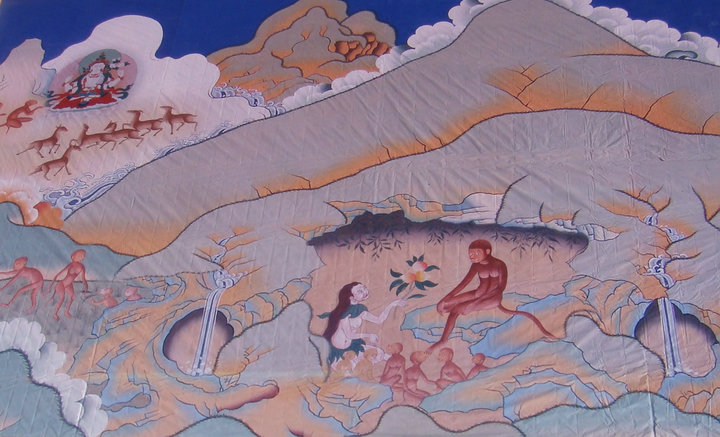
Pha Trelgen Changchup Sempa and rock-ogress narrative paintingTibetan ancestral narrative; original painting location and maker unverified · Painting date unknown; file dated16February2017CC BY-SA4.0, uploader སྤྲེའུ་དཀར་པོ།; attribution and license required, original location/date unverified.Object record ↗
In other collections
These images stay with the collections that hold them. Each link opens the collection's own page.
- Tibetan origin narrative mural — THL67451 ↗Tibetan monastery, Drotsang Gön Trashi Lhünpo, Qinghai · Mural date unspecified; photograph12October2011 · mms.thlib.orgCopyright Gya ye Drabo; only private uses permitted per THL record. Source link only; public republication not licensed.
Sources
- Sakyapa Sonam Gyaltsen: The Clear Mirror, chapter7 ↗
- Shambhala/Snow Lion: The Clear Mirror edition record ↗
- Vassar: Embodying Compassion in Buddhist Art (2015) ↗
- THL: Qinghai monastery wall painting, resource67451 ↗
- Pha Trelgen Changchup Sempa painting image/rights record ↗
- William F.Romain: Tombs of the Tibetan Emperors, RET63 (2022) ↗
Depiction requirements and work notes
Pha Trelgen Changchup Sempa, Tibetan ancestral monkey bodhisattva
This is the Tibetan ancestral monkey, not a generic monkey deity. The chosen chronicle portrays a vowed meditator guided by Avalokiteśvara; another museum retelling calls him Avalokiteśvara’s divine form. Named narrative paintings exist, but no universal ritual monkey iconographic program was verified.
The model capture recipe or rig source changed. Reinspect the model before relying on the recorded defects.
References, criteria, concept and model side by side
Traditional depictions
Named origin scene shared by the pair. At viewer-left a seated primate faces an upper-right primate grouping with young. Institution identifies the scene as monkey-and-ogress origin; it does not separately label each painted adult. Do not assign an uncertain individual or use this as a universal ogress body-color rule. [anc-thl-mural]
Object record ↗ · Source image ↗Named pair independently identified by Romain Figure11: in the central cave the red-brown monkey sits at viewer-right, the pale-faced clothed ogress at viewer-left offers fruit; children below, Avalokiteśvara upper-left. This is a narrative reference with incomplete object provenance, not a securely dated canonical master painting. [anc-commons-painting] [anc-romain-fig11]
Object record ↗ · Source image ↗Criteria
The model must show
- Lineage variant: The Clear Mirror, chapter 7: a magical monkey under lay vows, a meditator advised by Avalokiteśvara
- Body: a monkey's anatomy, one face, two arms, tail
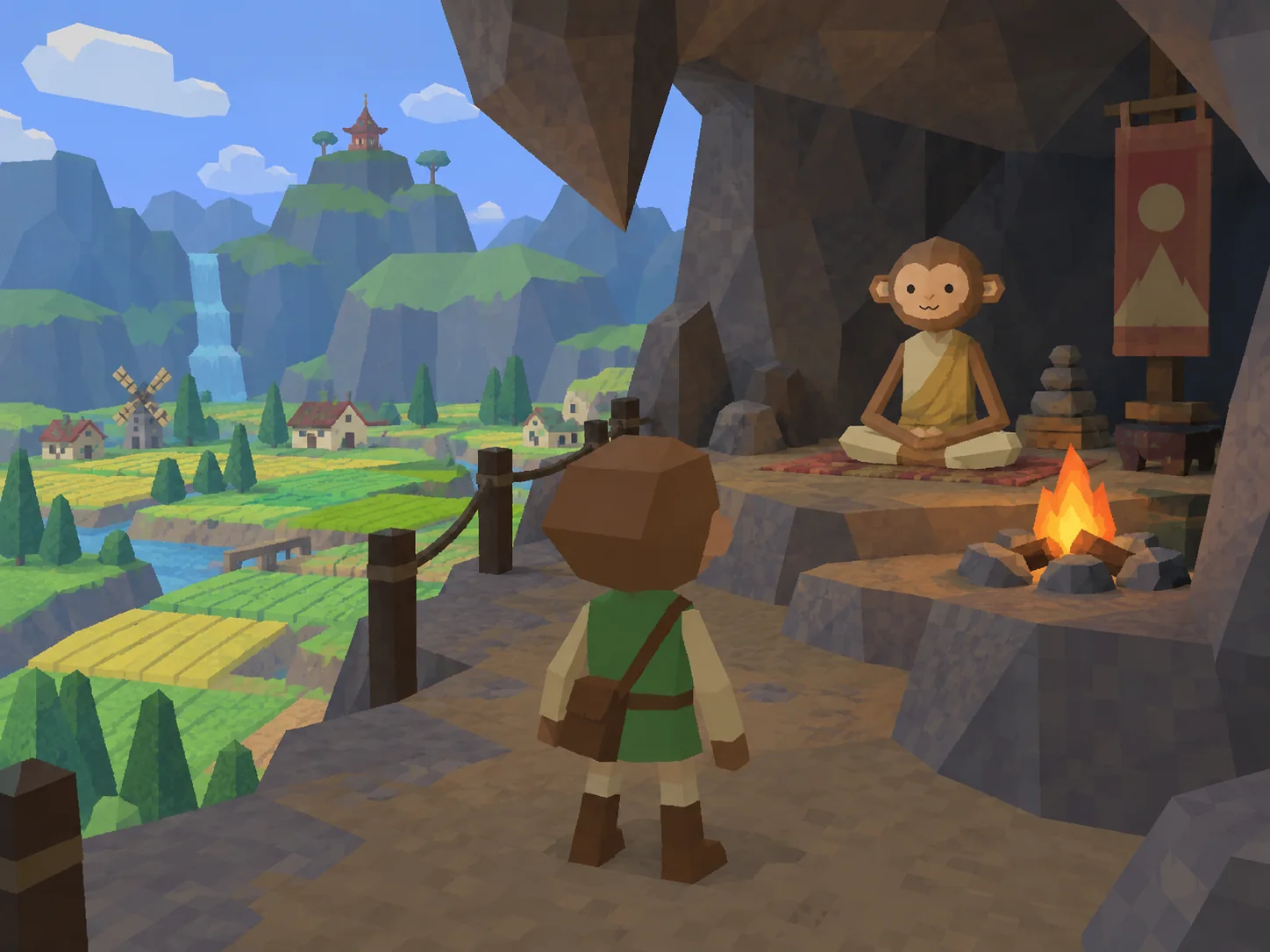
- Posture: seated in meditation beside a rock or cave for the opening scene; a walking ancestor may also appear
- Hands: low in the lap when meditating (the game pose); no deity mudra is prescribed
- Dress: not prescribed; brown fur, ochre robe and cream trousers are authored choices
- Face: a monkey's face with a quiet, compassionate expression; small closed mouth
- Eyes: solid black silhouettes with no whites, irises, pupils, highlights or glint (project eye rule; a recorded game adaptation, not a claim about traditional painted eyes)
- Attendants: the rock-ogress and their children in the family scene
The model must not show
- Cartoon smiley face: a wide U-shaped or crescent grin, open laughing mouth, rosy cheek dots or mascot cheeks
- Eye whites, irises, pupils, highlights or glint; glowing white-gold eyes (those belong only to freshly liberated beings)
- Any part of the figure (head, crown, hat, halo, raised hand or held object) touching or passing through its canopy, roof, lintel, pillars, throne back or seat in any capture angle
- Four arms or a princely crown borrowed from Avalokiteśvara
- Hanuman or Sun Wukong attributes
- A Buddha's ushnisha
Original game concept
Current 3D model
presence
Depiction requirements
- identity/witness
- Keep the Tibetan ancestral monkey identity and name. Under the selected Clear Mirror account show a magical monkey devoted to compassionate meditation and identify Avalokiteśvara as his adviser/teacher. If calling him an emanation, cite the alternate account explicitly. [anc-clear-mirror] [anc-vassar]
- posture and behavior
- A seated meditation scene beside rock/cave fits the selected opening; a walking ancestor can coexist as a game activity. Neither scene requires importing four Avalokiteśvara arms or a princely crown. [anc-clear-mirror] [anc-romain-fig11]
- body/costume limits
- Preserve monkey anatomy and legible compassionate expression. Brown fur, ochre robe, cream trousers and exact toy size are authored choices; the selected text does not prescribe them as a universal color/garment scheme. [anc-clear-mirror] [anc-thl-mural] [anc-commons-painting]
Presentation contract
Ready to build from No readiness block is recorded in the plan.
Open points recorded with the contract
- No fixed ritual or sādhana form exists for him in the library; the paintings are undated
Setting and sizing rule
A rock or cave seat; no throne. The cave mouth clears the seated and the standing body. Sizing (plan rule R4, not a sourced claim): the opening of any shrine, canopy or pavilion around the figure leaves at least one of the figure's own head-heights of clear air above its tallest point (the top of the head) and a clear gap on each side of its widest span (the shoulders and tail); a throne back or aureole sits behind the figure without passing through it; pillars and lintel do not cross the face, hands or held objects in the front or either three-quarter capture.
Recorded variants · 1
- Emanational retelling (Vassar 2015): the monkey is Avalokiteśvara's divine form
Recorded adaptations · 1
- Fur colour, robe, trousers and toy size
Where the plan places it · 1
- human · The monkey and the ogress’s cave
human.monkey-cave· character The monkey bodhisattvamonkey
Contract sources · 5
- Sakyapa Sonam Gyaltsen: The Clear Mirror, chapter7
- Vassar: Embodying Compassion in Buddhist Art (2015)
- William F.Romain: Tombs of the Tibetan Emperors, RET63 (2022)
- THL: Qinghai monastery wall painting, resource67451
- Pha Trelgen Changchup Sempa painting image/rights record
Model audit and next pass
Evidence basis: visual + source; original concept, canonical front/three-quarter and multi-angle audit sheet inspected 2 October 2026; traditional artifacts viewed in Chrome, no ritual or runtime acceptance
Recorded observations
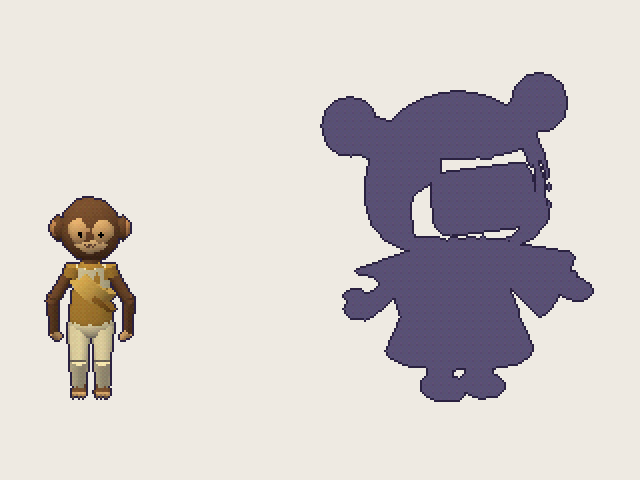
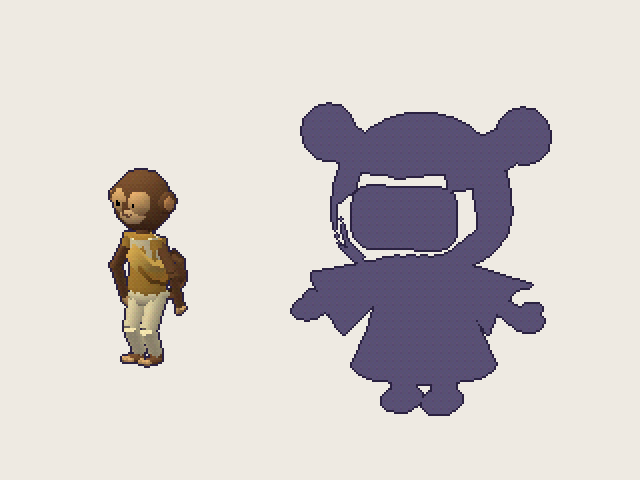
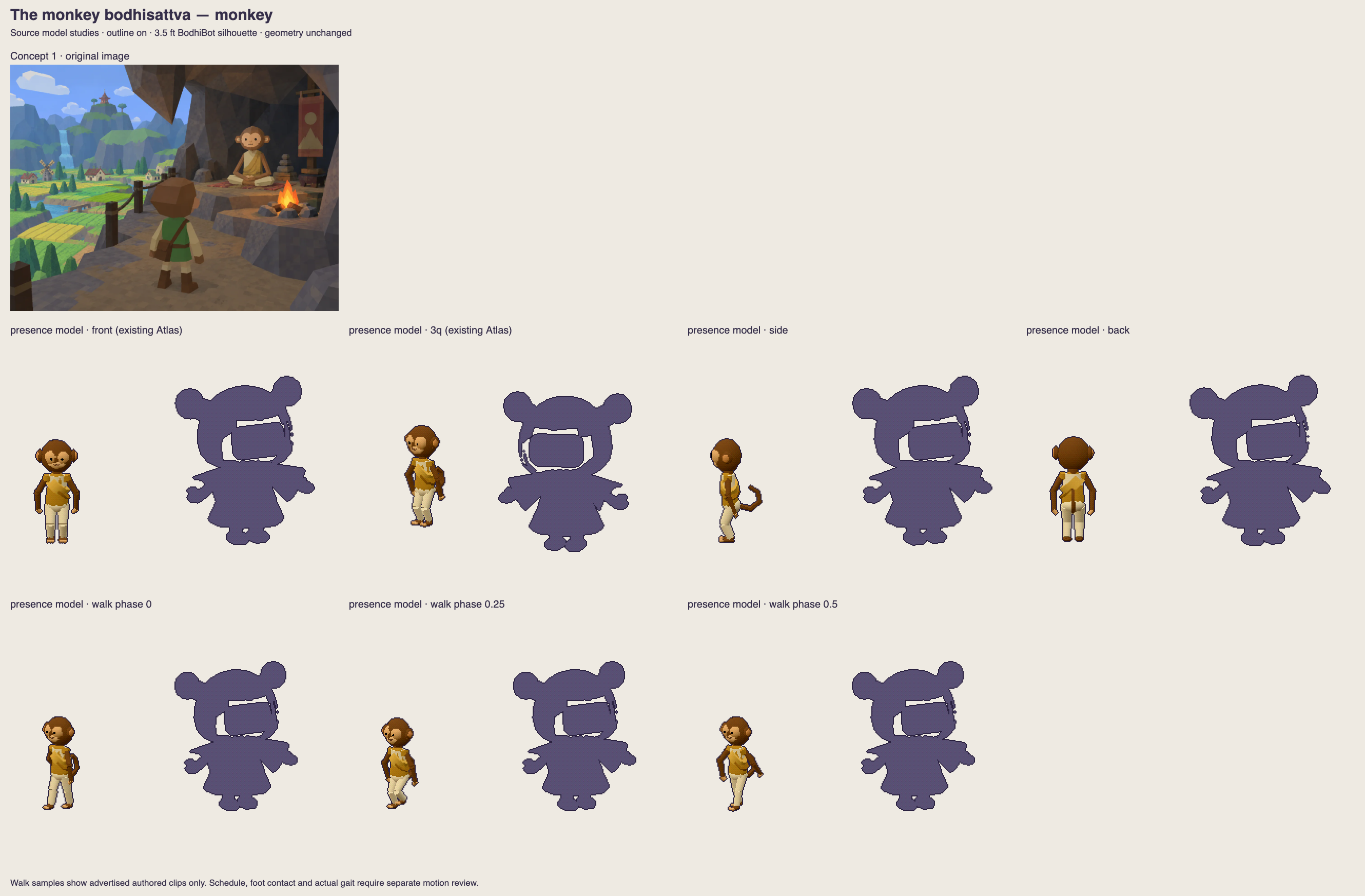
Original concept is a small brown monkey seated cross-legged in a cave, palms low in lap, ochre cloth across the torso and cream legs; canonical front/three-quarter and audit angles show the same monkey standing, with long arms, cream trousers and curled tail.
monkey.js preserves both standing and seated bodies and explicit meditate/sit-meditate clips. The standing Atlas capture alone does not establish that the original cave-meditation narrative is absent from gameplay.
Black simple eye silhouettes, quiet smile and small body are consistent with authored game art. Current robe/size are not verified ritual iconometry; the named paintings instead show varying unclothed or wrapped narrative monkey forms.
No extra arms, Buddha crown or misleading Hindu/Chinese monkey attributes are present. Emanational interpretation remains a textual-variant issue, not something settled by the mesh.
Directions for a future model pass
P1 — Add precise ancestral identity/witness language to work orders; keep Clear Mirror’s adviser distinction and the alternate emanation account visible.
P2 — For future concept/model accuracy prefer a clearly readable seated compassionate meditation pose in the cave presentation, preserving the existing walking form and its sourced narrative distinction.
P2 — Retain brown monkey silhouette and simple expression as declared game adaptation; do not add Avalokiteśvara’s human attributes or a supposed universal golden robe without a selected reference.
Assessed baseline captures
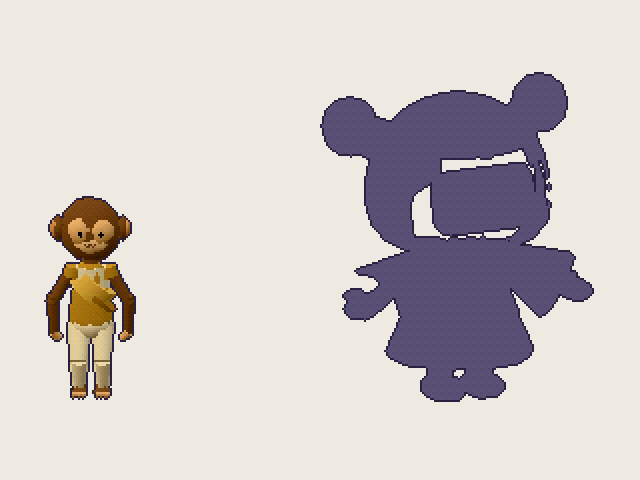
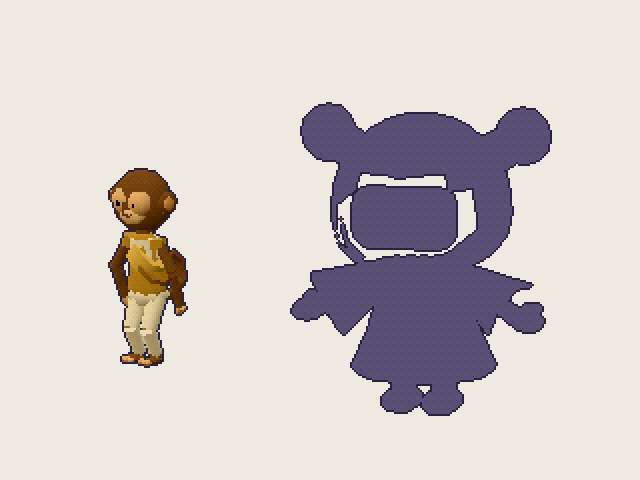
Documented forms and lineage variants · 3
Preserve one identified form consistently. A variant is usable only with its own source and context.
Disciple/adviser chronicle branch
Clear Mirror’s magical monkey receives lay vows from Avalokiteśvara; Tārā and Bhrikuti speak as approving advisers. This witness does not make the rock-ogress a green Tārā icon. [anc-clear-mirror]
Emanational retelling
The Vassar catalogue recounts Avalokiteśvara as divine monkey and identifies the ogress with Tārā. Treat this as the named account; do not claim every Tibetan witness uses the same mapping. [anc-vassar]
Dated photograph versus object date
Both named paintings have actual source images, but neither has a securely dated historical object record. The2011 photograph and2017 file date are evidence dates, not artwork ages. [anc-thl-mural] [anc-commons-painting]
What not to copy · 2
Do not replace the named ancestors
Avoid Hanuman, Sun Wukong, generic primates, ordinary Tārā icons or the separate supine geomantic Tibet demoness as unmarked exemplars for this ancestral pair. [anc-clear-mirror] [anc-thl-mural] [anc-romain-fig11]
Do not impose a deity mudrā
No universal fixed hand gesture, jewel count, crown, robe color or giant size was established by the selected chronicle/identified paintings. Choose the scene and source before prescribing those details. [anc-clear-mirror] [anc-thl-mural] [anc-commons-painting]
Sources and precise locations · 6
- [anc-clear-mirror] Sakyapa Sonam Gyaltsen: The Clear Mirror, chapter7 ↗
- [anc-clear-edition] Shambhala/Snow Lion: The Clear Mirror edition record ↗
- [anc-vassar] Vassar: Embodying Compassion in Buddhist Art (2015) ↗
- [anc-thl-mural] THL: Qinghai monastery wall painting, resource67451 ↗
- [anc-commons-painting] Pha Trelgen Changchup Sempa painting image/rights record ↗
- [anc-romain-fig11] William F.Romain: Tombs of the Tibetan Emperors, RET63 (2022) ↗
Assessment freshness and evidence hashes
The frozen snapshot is authored evidence. Regeneration computes current hashes and leaves that snapshot as it is.
{
  "auditFreshness": {
    "status": "stale",
    "reasons": [
      "The model capture recipe or rig source changed."
    ]
  },
  "sourceSnapshot": {
    "captureHash": "54481795f550dcc302b52983f3736de11f44a6591f3a6715a2dedf9acd10e94d",
    "bodyGeometryHash": "0cac5510ed9bd81f8e6ba4738998a51a4bada1637979bd59ea91664251767e05",
    "sourceHashes": {
      "prototypes/prerendered-look/parts/purelands/monkey.js": "b4842de9e14f3cd1a3159c098f0313d79f3778426390b82c0eb91cda10342e6f"
    },
    "captureHashes": {
      "/atlas/audit/sheets/monkey-9e49bc96359f.webp": "98ce1a9dbc9b4132db0c0d05c97f671176bb048ba58e530e09071561abb664be",
      "/atlas/characters/monkey-54481795f550-presence-3q.webp": "c22ad26a91bca347fd6c92a496566fb021b493e8ab9770bbff2beac482556e50",
      "/atlas/characters/monkey-54481795f550-presence-front.webp": "f025dfba3f4245ef040bf537d244b364a685623ec6925501921e40562ee03056",
      "/atlas/characters/monkey-d522975494fc-presence-3q.webp": "c22ad26a91bca347fd6c92a496566fb021b493e8ab9770bbff2beac482556e50",
      "/atlas/characters/monkey-d522975494fc-presence-front.webp": "f025dfba3f4245ef040bf537d244b364a685623ec6925501921e40562ee03056"
    },
    "conceptHashes": {
      "/purelands/concepts/monkey.webp": "249180d5e7d833eb1fd440ada2fa06acf247718028c19c0f9c3ab1ca17fde416"
    },
    "activeConceptPaths": [
      "/purelands/concepts/monkey.webp"
    ]
  },
  "currentSnapshot": {
    "captureHash": "532ce1e25249946ebe747989a3c05388697a0bca1da42a7a160a17c91dc38d92",
    "bodyGeometryHash": "0cac5510ed9bd81f8e6ba4738998a51a4bada1637979bd59ea91664251767e05",
    "activeConceptPaths": [
      "/purelands/concepts/monkey.webp"
    ],
    "sourceHashes": {
      "prototypes/prerendered-look/parts/purelands/monkey.js": "b4842de9e14f3cd1a3159c098f0313d79f3778426390b82c0eb91cda10342e6f"
    },
    "captureHashes": {
      "/atlas/audit/sheets/monkey-9e49bc96359f.webp": "98ce1a9dbc9b4132db0c0d05c97f671176bb048ba58e530e09071561abb664be",
      "/atlas/characters/monkey-532ce1e25249-presence-3q.webp": "07c233ec8b539416461556ae5ed2224dc8716054e8dbbc46b1120bae0569e371",
      "/atlas/characters/monkey-532ce1e25249-presence-front.webp": "3a204a9950e28602999575505f537b790f81d0b82891bc63ac9ebae1dd41e4f3",
      "/atlas/characters/monkey-54481795f550-presence-3q.webp": "c22ad26a91bca347fd6c92a496566fb021b493e8ab9770bbff2beac482556e50",
      "/atlas/characters/monkey-54481795f550-presence-front.webp": "f025dfba3f4245ef040bf537d244b364a685623ec6925501921e40562ee03056",
      "/atlas/characters/monkey-d522975494fc-presence-3q.webp": "c22ad26a91bca347fd6c92a496566fb021b493e8ab9770bbff2beac482556e50",
      "/atlas/characters/monkey-d522975494fc-presence-front.webp": "f025dfba3f4245ef040bf537d244b364a685623ec6925501921e40562ee03056"
    },
    "conceptHashes": {
      "/purelands/concepts/monkey.webp": "249180d5e7d833eb1fd440ada2fa06acf247718028c19c0f9c3ab1ca17fde416"
    }
  }
}