Samantabhadra as Amitābha
Adaptation
On the upper level of the palace on the Copper Mountain, Zangdok Palri, Jigme Lingpa's prayer places the primordial Buddha Samantabhadra appearing as Amitabha. The game shows this presence as an abstract red-gold disc. The prayer supports the identity and the place, not the disc.
In this prayer Guru Rinpoche is at the bottom, Avalokiteshvara above him, and Samantabhadra as Amitabha at the top, in the realm of the dharmakaya, the truth body of a Buddha. This Samantabhadra is not the bodhisattva of the same name. Visionary accounts of the palace differ, as the artist Pema Namdol Thaye explains.
In traditional art
These images stay with the collections that hold them. Each link opens the collection's own page.
- Zangdok Palri Mandala — Pema Namdol Thaye ↗Tibetan-Bhutanese traditional artist; contemporary · 2021 photograph · rubinmuseum.org© Padma Studios 2021; no open license verified; source-hosted reference only
- Zangdok Palri Nepal — four-side temple elevation ↗Nyingma Buddhist temple project, Phulchok/Pharping, Nepal · contemporary project; drawing date unverified · zangdokpalrinepal.orgZangdok Palri Nepal project image; no open license verified; source-hosted reference only
Sources
Depiction requirements and work notes
Primordial Buddha Samantabhadra appearing as Amitabha in Jigme Lingpa’s Copper-Mountain prayer
The Copper-Mountain upper level uses an abstract red-gold disc for Samantabhadra as Amitabha. The prayer supports that identity and its position above Avalokiteshvara and Guru. It does not prescribe this disc as the traditional Buddha body. Preserve the distinction between a source-grounded identity and a game-designed visual symbol.
Rig source changed or is missing: prototypes/world-map/interiors/zi-copper-assemblies.js Reinspect the model before relying on the recorded defects.
References, criteria, concept and model side by side
Traditional depictions
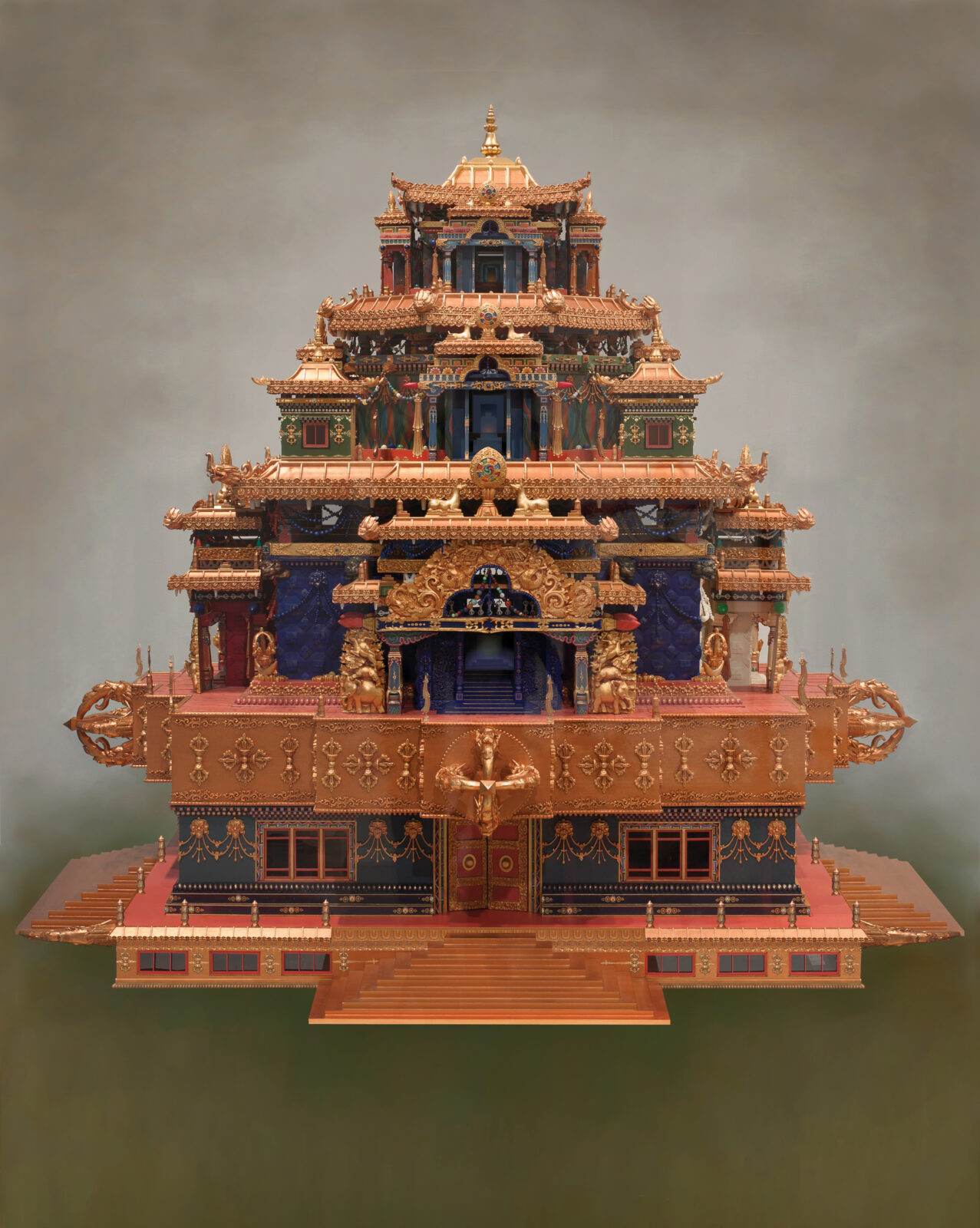
Traditional three-dimensional palace program comparison. It demonstrates coherent sacred architecture; it does not authenticate the game’s abstract disc as a prescribed Buddha body. [copper-pema-namdol]
Object record ↗ · Source image ↗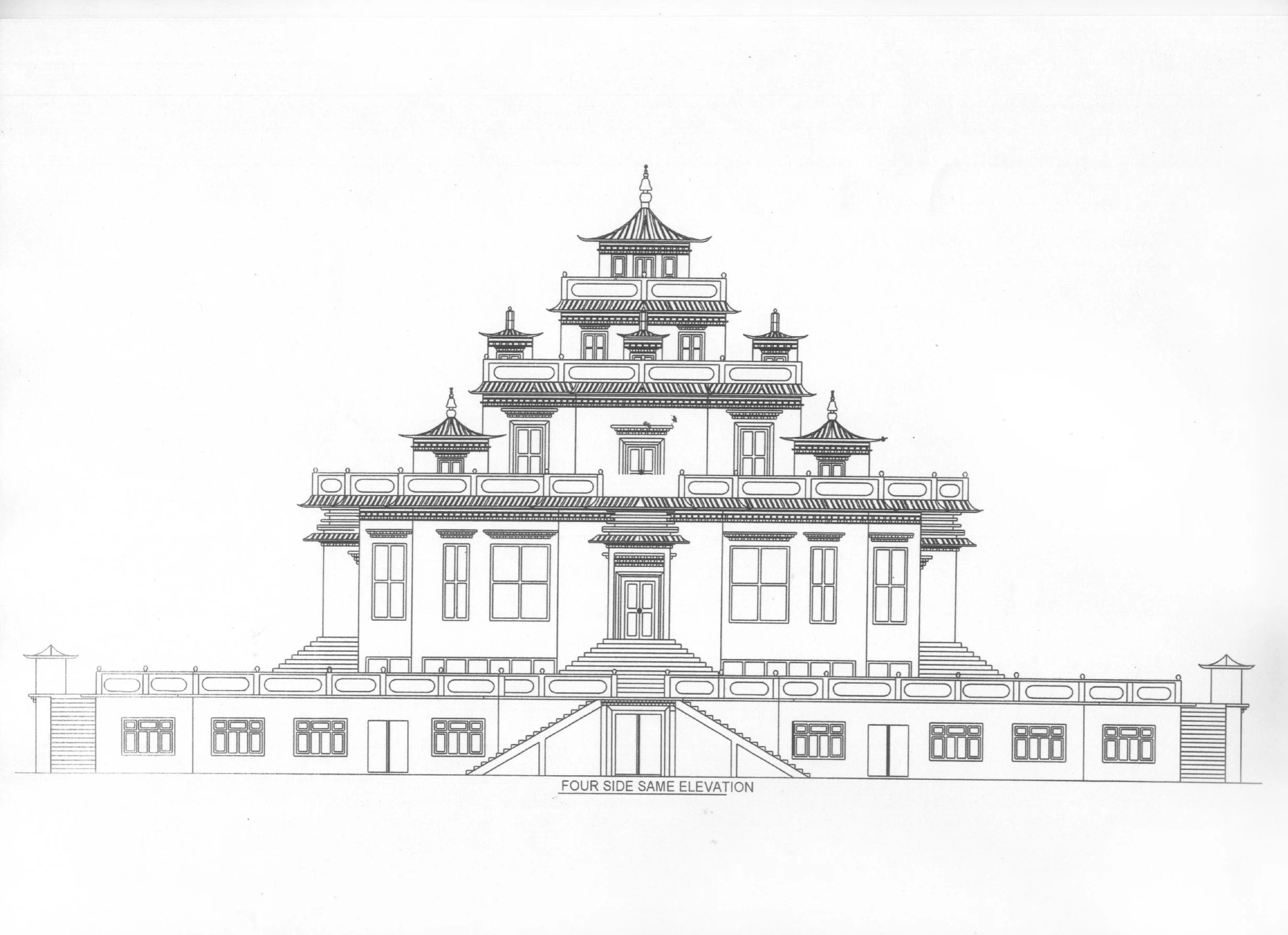
Architectural context for three sacred levels and Amitabha uppermost. This is an architectural drawing rather than a Buddha-body image, and supplies no justification for the red disc. [copper-nepal]
Object record ↗ · Source image ↗Criteria
The model must show
- Lineage variant: Jigme Lingpa's Secret Path to the Mountain of Glory
- Form: an abstract red-gold disc with sixteen petals and eight rays, labelled a game adaptation; the prayer prescribes no such disc
- Position: the top level, above Padmapāṇi / Avalokiteśvara, who is above the Guru
- No body, face or eyes are drawn; if a body is ever built it takes a chosen Amitābha form reference and its own criteria, with solid black eyes
The model must not show
- Cartoon smiley face: a wide U-shaped or crescent grin, open laughing mouth, rosy cheek dots or mascot cheeks
- Eye whites, irises, pupils, highlights or glint; glowing white-gold eyes (those belong only to freshly liberated beings)
- Any face, cartoon or otherwise, drawn on the disc
- The bodhisattva Samantabhadra or his elephant
- A naked blue primordial-Buddha body placed in the red Amitābha manifestation
- Calling the disc a prescribed canonical depiction
- The disc cutting into the palace roof, finial or walls of its level
Original game concept
No original concept is recorded in the Atlas.
Current 3D model
Depiction requirements
- Identity boundary
- Keep the upper presence identified as primordial Buddha Samantabhadra appearing as Amitabha in this particular prayer. It is distinct from the Eight Sons bodhisattva Samantabhadra rig. [copper-jigme-lingpa]
- Three-kaya ordering
- For this selected account, preserve Guru below, Padmapani/Avalokiteshvara above, and the dharmakaya Samantabhadra-as-Amitabha above that. [copper-jigme-lingpa]
- Honest iconographic status
- Label the existing red-gold disc, sixteen petals and eight rays as an abstract game adaptation. The cited prayer supplies no disc-construction specification. A traditional body depiction would require a separate chosen Amitabha/form reference and its own visual audit. [copper-jigme-lingpa]
- Palace variant control
- Maintain a named source for the palace program rather than presenting a synthesis as the only canonical Zangdok Palri. Pema Namdol Thaye explains that visionary sources differ and deity-specific source study precedes three-dimensional construction. [copper-pema-namdol]
- Architectural comparison
- Use the contemporary Phulchok temple as a secondary comparison for three sacred levels; its Amitabha statue program supports ordering, not the game’s disc geometry. [copper-nepal]
Presentation contract
Ready to build from No readiness block is recorded in the plan.
Setting and sizing rule
The upper storey of the three-level Zangdok Palri palace. The disc with its petals and rays fits inside that level with clear space on every side and does not pass through roof, pillars or floor.
Recorded variants · 2
- Phulchok temple: an upper Amitābha statue above Avalokiteśvara and Guru
- Pema Namdol Thaye's three-dimensional Zangdok Palri: visionary sources differ
Recorded adaptations · 1
- The abstract disc itself
Where the plan places it · 1
- copper mountain · The palace of three floors
copper-mountain.palace· placement inline:prototypes/world-map/interiors/zi-copper-assemblies.js#kaya-disccopper-mountain.palace.top-vision
Contract sources · 3
- Jigme Lingpa — Secret Path to the Mountain of Glory, Lotsawa House translation
- Rubin Museum — Celestial Visions in Three Dimensions, interview with Pema Namdol Thaye
- Zangdok Palri Nepal — About Zangdok Palri
Model audit and next pass
Evidence basis: source-only for current geometry; historical rendered asset baseline inspected
Recorded observations
KAYAS source explicitly names samantabhadra-as-amitabha, mode vision, top floor and Buddha rather than bodhisattva.
Geometry is a transparent red central circle, gold/pale concentric rings, two sets of eight petals, eight rays and a pale light shaft. There are no face, arms, robes, hands or anthropomorphic body.
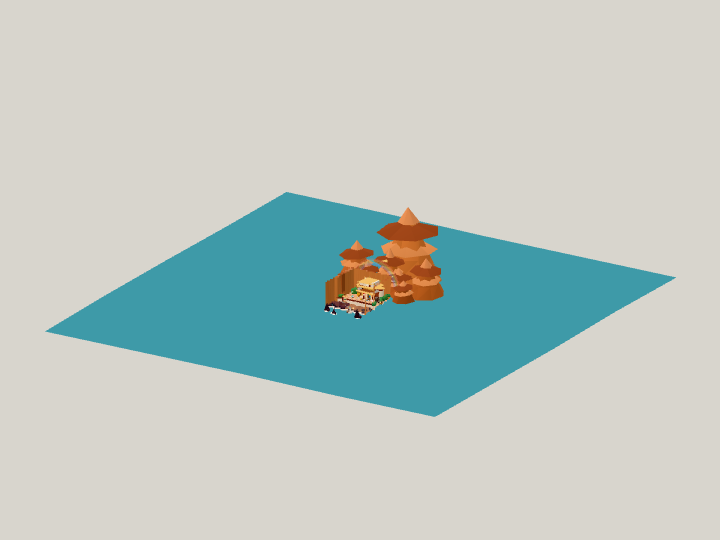
Historical Copper-Mountain assembly overview was inspected; the palace is very small and the upper disc cannot be resolved. This is real rendered environment context only. No isolated current disc capture or dedicated concept was identified.
Directions for a future model pass
P1 — Preserve the source-qualified identity in captions and explicitly flag abstract representation status in the asset guide.
P1 — Capture the current disc/upper palace close-up from below and front, along with the three-level arrangement.
P2 — If a full Buddha body is later desired, adopt one traditional Amitabha manifestation reference with specialist review; do not treat conversion to a body as routine polish.
Assessed baseline captures
Documented forms and lineage variants · 3
Preserve one identified form consistently. A variant is usable only with its own source and context.
Jigme Lingpa prayer: Samantabhadra manifests as Amitabha in the upper dharmakaya realm. This is the game’s explicitly chosen identity source.
Phulchok temple program uses an upper Amitabha statue above Avalokiteshvara and Guru. It has two additional public lower storeys; these are not extra kaya levels.
Pema Namdol Thaye’s photographed three-dimensional Zangdok Palri is a traditional-artist architectural comparison, not evidence that every visionary account has identical details.
What not to copy · 4
Do not replace this with the bodhisattva Samantabhadra on his elephant merely because the names match.
Do not say that the red disc is a prescribed canonical depiction of primordial Samantabhadra.
Do not import a naked blue primordial-Buddha body into a red Amitabha manifestation without selecting a coherent new source and documenting the distinction.
Do not count this abstract vision as a full independently rigged person.
Sources and precise locations · 3
- [copper-jigme-lingpa] Jigme Lingpa — Secret Path to the Mountain of Glory, Lotsawa House translation ↗
- [copper-pema-namdol] Rubin Museum — Celestial Visions in Three Dimensions, interview with Pema Namdol Thaye ↗
- [copper-nepal] Zangdok Palri Nepal — About Zangdok Palri ↗
Assessment freshness and evidence hashes
The frozen snapshot is authored evidence. Regeneration computes current hashes and leaves that snapshot as it is.
{
  "auditFreshness": {
    "status": "stale",
    "reasons": [
      "Rig source changed or is missing: prototypes/world-map/interiors/zi-copper-assemblies.js"
    ]
  },
  "sourceSnapshot": {
    "captureHash": null,
    "bodyGeometryHash": null,
    "sourceHashes": {
      "prototypes/world-map/interiors/zi-copper-assemblies.js": "b5a96474995df9537855f63da9fcf4ffe89c2408e755b5bfe8438801c74e0094"
    },
    "captureHashes": {
      "/atlas/iconography/evidence/4f05101298bf9796-new-asset-c366344ef4fec8b9-00.png": "4f05101298bf97962fe1e01124796b7e39c9cf1efecdf3fe8c2d80bc6a48965a"
    },
    "conceptHashes": {},
    "activeConceptPaths": []
  },
  "currentSnapshot": {
    "captureHash": null,
    "bodyGeometryHash": null,
    "activeConceptPaths": [],
    "sourceHashes": {
      "prototypes/world-map/interiors/zi-copper-assemblies.js": "5e5f14d41305cf0d0a96a6294e92ccbc3c940041a3e0554be986d508381216e7"
    },
    "captureHashes": {
      "/atlas/iconography/evidence/4f05101298bf9796-new-asset-c366344ef4fec8b9-00.png": "4f05101298bf97962fe1e01124796b7e39c9cf1efecdf3fe8c2d80bc6a48965a"
    },
    "conceptHashes": {}
  }
}