Ratnasambhava
Yellow in body, Ratnasambhava is the Jewel-born Buddha, Rinchen Jungné in Tibetan, and belongs to the south. His right hand hangs past the right knee, palm out and fingers down, in the gesture of giving. His left hand rests palm up in his lap.
Some forms give him a jewel emblem. Horses hold up his throne in a Met crown panel and a LACMA painting, and one catalogued text seats him on a lotus and sun disc. Early Tibetan examples show him crowned, with jewels at neck and arms and silk below.
In the LACMA painting the bodhisattvas Vajraratna is at his right and Vajrahasa at his left, among other figures of his family.
In traditional art
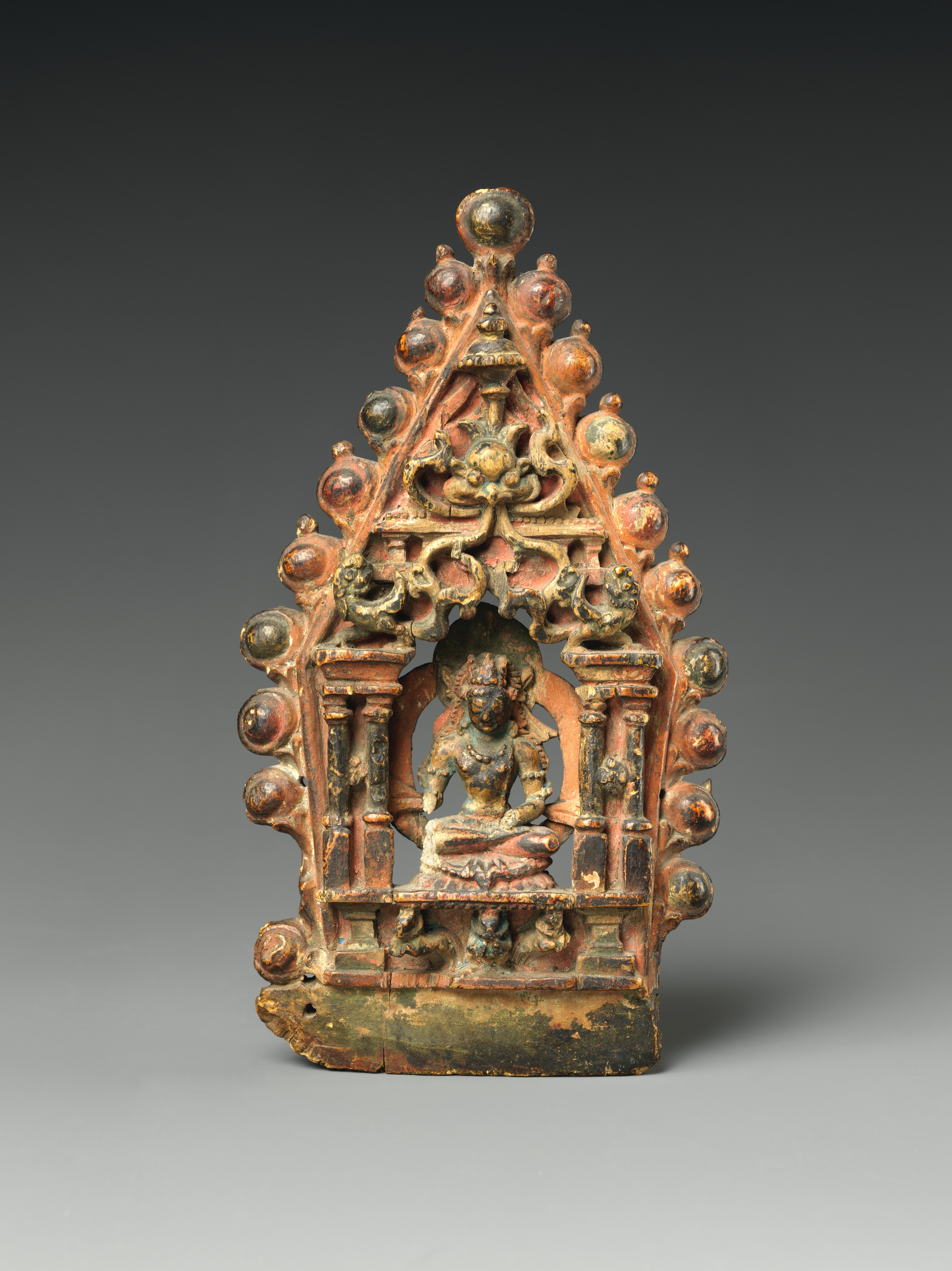
Ratnasambhava ritual-crown relief — Met 1992.299India (Jammu and Kashmir) or western Tibet; attribution remains open · 10th–11th centuryPublic Domain, Met Open Access (CC0).Object record ↗ 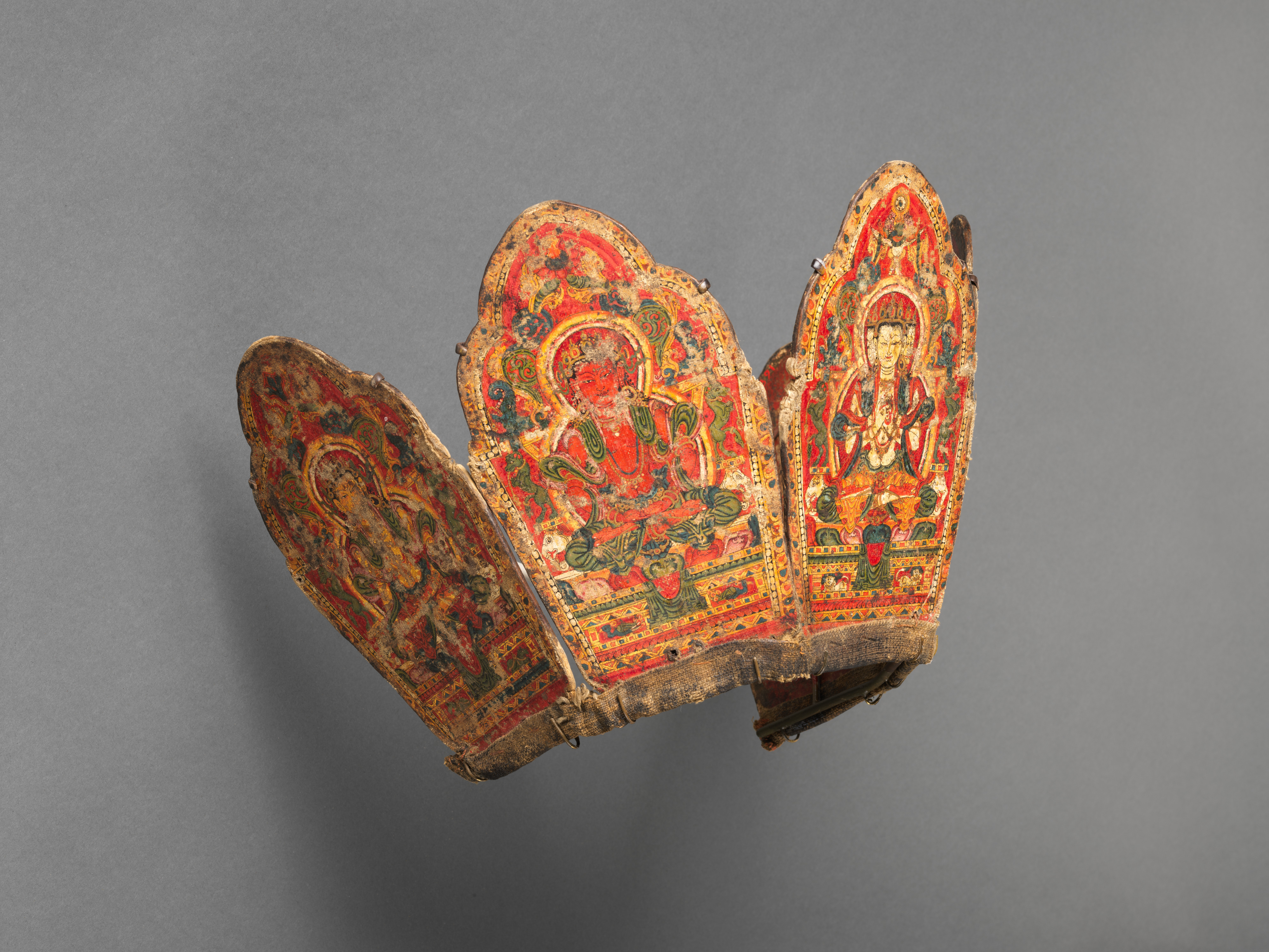
Yellow Ratnasambhava end panel, Five Buddha crown — Met 1985.391Tibet; probably a Newari artist working in Tibet · Late 14th–early 15th centuryPublic Domain, Met Open Access (CC0).Object record ↗
In other collections
These images stay with the collections that hold them. Each link opens the collection's own page.
- The Jina Buddha Ratnasambhava — LACMA M78.9.2 ↗Central Tibet, Kadampa monastery context · Circa 1150–1225 · collections.lacma.org© Museum Associates/LACMA; no open reuse licence asserted. Linked museum reference only.
Sources
Depiction requirements and work notes
Ratnasambhava — Rinchen Jungné, Jewel-born Buddha
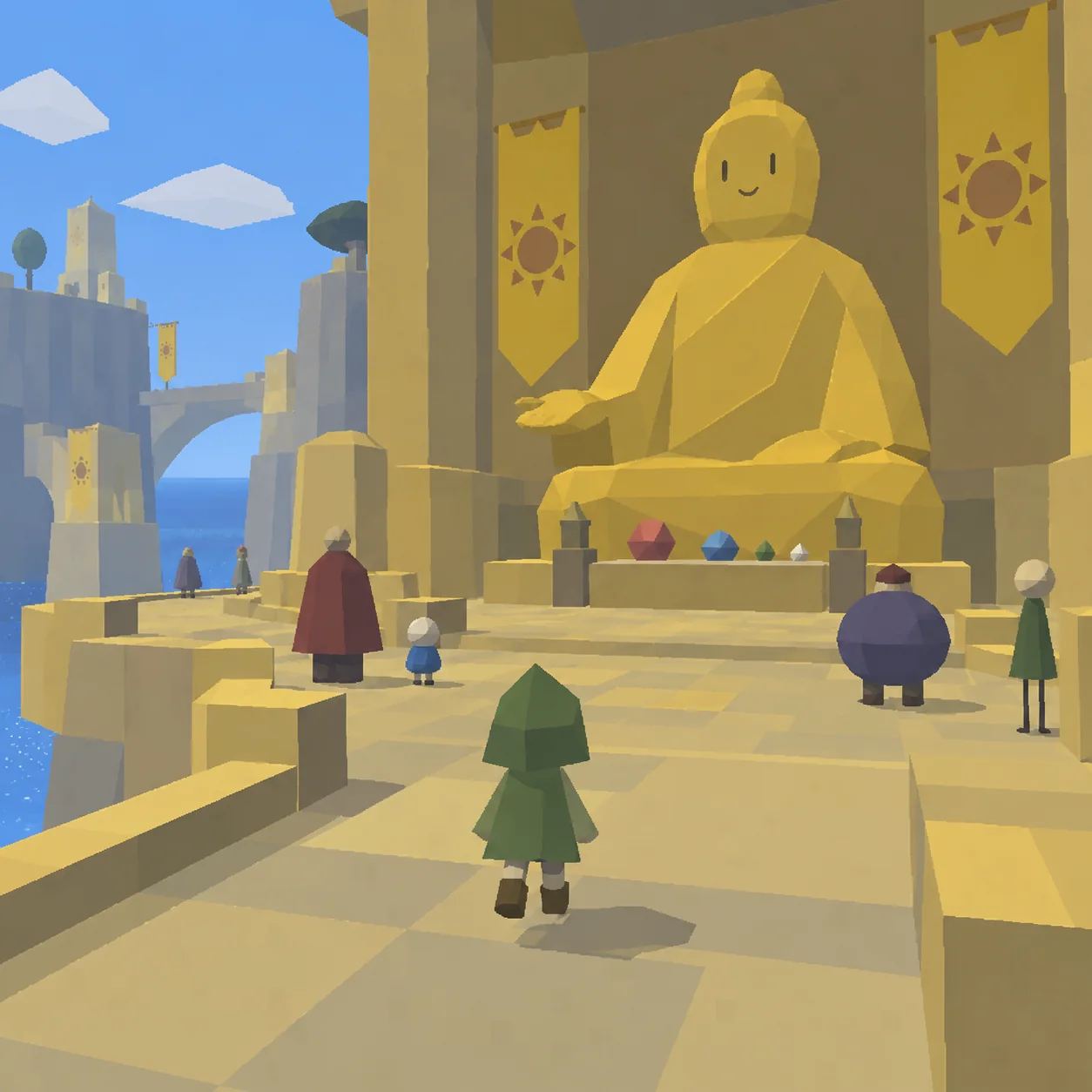
The current yellow/gold figure has the proper right offering arm and left lap hand, but the right palm reads as a horizontal tray rather than a lowered generosity gesture. Improve that defining hand, separate body from garment values and identify the selected jewel/throne treatment.
The model capture recipe or rig source changed. The visible model geometry changed. Rig source changed or is missing: prototypes/prerendered-look/parts/purelands/ratnasambhava.js Reinspect the model before relying on the recorded defects.
References, criteria, concept and model side by side
Traditional depictions
Carved crowned figure, lowered right palm, left lap and crossed legs on lotus; horses under the seat. Weathered wood is not a skin-color guide. [ra-met38581]
Object record ↗ · Source image ↗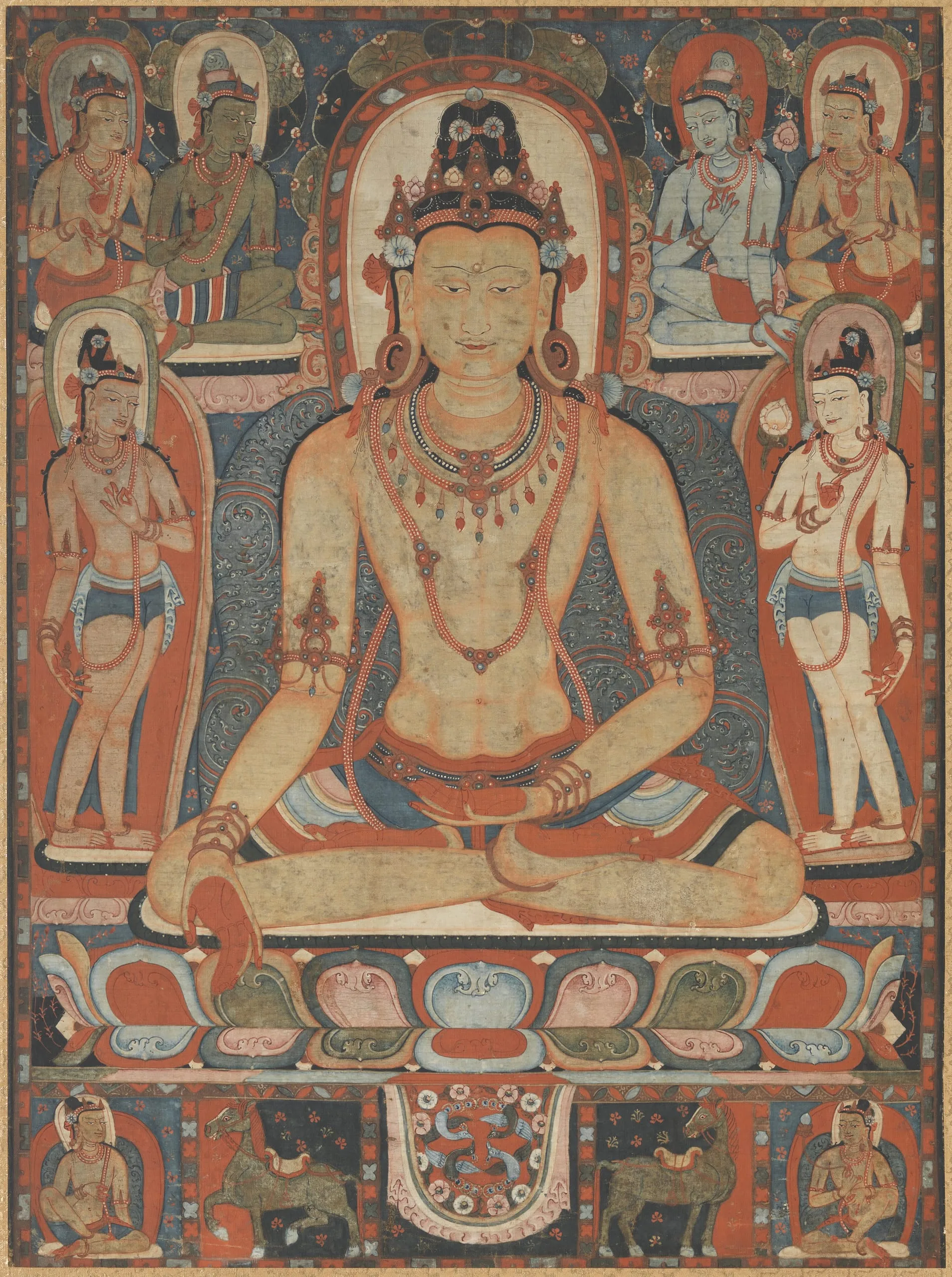
Yellow central Ratnasambhava with varada, horse throne and named vajra-family attendants; use the complete object for assembly positions. [ra-lacma]
Object record ↗ · Source image ↗Yellow end panel at photograph's left edge. The oblique, worn panel gives family color and ensemble context, not the clearest finger study. [five-crown]
Object record ↗ · Source image ↗Criteria
The model must show
- Lineage variant: the yellow southern five-family Ratnasambhava; the monk-robed game form rests on Lama Zopa's Buddha-aspect gesture account and is recorded as such
- Body: yellow skin, one face, two arms; skin reads apart from the garment rather than one gold material
- Hands: own right hand lowered over or outside the right knee, palm facing outward, fingers pointing down (generosity); own left palm upward in the lap
- Held object: a jewel only where the chosen reference puts it; never in the right hand at the cost of the generosity gesture
- Dress: one coherent programme, monastic or crowned and ornamented, named with the model
- Posture: centred upright torso over full crossed vajra legs
- Head: long earlobes, forehead mark, a coherent hair-and-ushnisha or crown shape
- Face: serene and composed, as the library gives this peaceful form: narrow calm eye shapes, level brows, a small closed restrained mouth
- Eyes: solid black silhouettes with no whites, irises, pupils, highlights or glint (project eye rule; a recorded game adaptation, not a claim about traditional painted eyes)
- Seat: a lotus seat; horses appear only if the full horse throne is reproduced
- Attendants: none required; LACMA M78.9.2 places Vajraratna at his right and Vajrahāsa at his left within its own tantric assembly
The model must not show
- Cartoon smiley face: a wide U-shaped or crescent grin, open laughing mouth, rosy cheek dots or mascot cheeks
- Eye whites, irises, pupils, highlights or glint; glowing white-gold eyes (those belong only to freshly liberated beings)
- Any part of the figure (head, crown, hat, halo, raised hand or held object) touching or passing through its canopy, roof, lintel, pillars, throne back or seat in any capture angle
- A level right palm held like an offering tray
- Figure, robe, hair and shrine all in one gold material
- Sun pennants or loose foreground gems treated as his attributes
- Generic wealth gods standing in as attendants
Original game concept
Current 3D model
presence
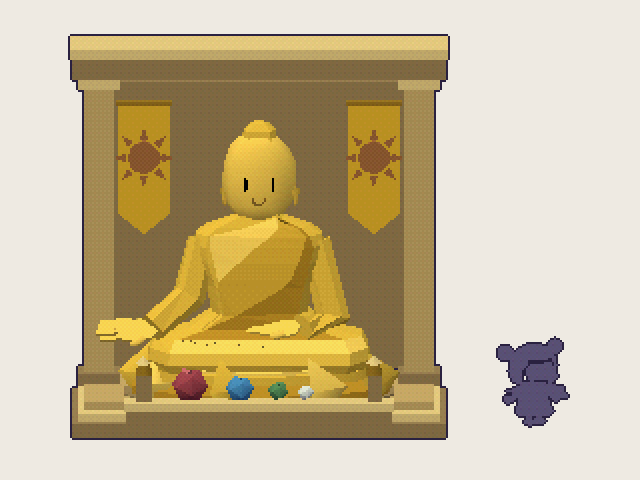
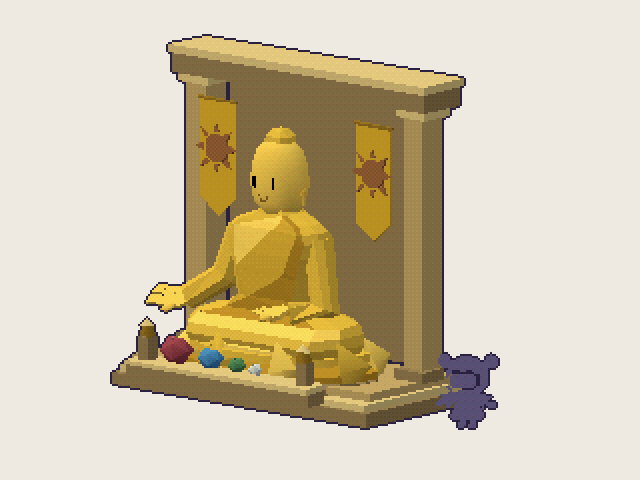
Depiction requirements
- Color and identity
- Use yellow skin for the selected southern five-family account. Distinguish actual yellow body color from the surface appearance of an all-gold statue. Keep one peaceful face and two arms; a sun banner is scene decoration rather than a replacement for the Buddha's identifying gesture. [five-crown] [ra-lacma]
- Anatomical right generosity mudrā
- Lower the anatomical right hand over/outside the right knee with palm facing forward/outward and fingers generally directed downward in varada, rather than a level palm used as an offering tray. Keep the left palm upward in the lap in meditation. Compare thumb placement and finger direction at full size. [ra-har15] [ra-met38581] [ra-lywa]
- Jewel attribute
- Use a clearly recognizable jewel emblem if the selected appearance calls for one. Match its actual location in the chosen reference; do not add a jewel to the right hand at the cost of the generosity gesture. Loose gems placed before a shrine are offerings and do not establish a hand-held attribute. [ra-lacma] [ra-har15]
- Clothing and crown
- The collected early Tibetan examples are crowned/ornamented, with jeweled neck/arm ornaments and lower silks. The current monk-robed form is a separate art decision supported by the Buddha-aspect gesture account; do not declare its costume identical to those objects. Select a coherent monastic or ornamented source program before adding decoration. [ra-met38581] [ra-lacma] [ra-lywa]
- Posture and horse support
- Keep a centered upright torso over full crossed vajra legs and a lotus seat. Horses are documented throne supports in the crown relief and LACMA painting; add them if reproducing that complete throne. HAR 15 quotes a lotus/sun support, so do not universalize a moon disc from another family's depiction. [ra-met38581] [ra-lacma] [ra-har15]
- Face and proportion
- Use elongated earlobes, a readable ūrṇā, coherent crown or hair/uṣṇīṣa construction and a serene expression. Let the selected artwork guide the shoulder/neck/head balance and generosity arm's relaxed descent. Keep simplified black eyes in game, and record toy proportions separately from a traditional iconometric construction. [ra-met38581] [ra-har15]
- Assembly
- LACMA M78.9.2 documents Vajraratna at anatomical right and Vajrahāsa at left, with additional vajra-family figures. Those positions belong to its tantric assembly. Do not replace these identified attendants with generic wealth gods or require them around every standalone Ratnasambhava. [ra-lacma]
Presentation contract
Ready to build from No readiness block is recorded in the plan.
Open points recorded with the contract
- Monastic or ornamented dress, and where the jewel emblem sits, are not fixed by the library
Setting and sizing rule
A lotus seat is required; HAR 15 gives lotus and sun, so a moon disc is not assumed. A horse throne only if that whole throne is reproduced. Sizing (plan rule R4, not a sourced claim): the opening of any shrine, canopy or pavilion around the figure leaves at least one of the figure's own head-heights of clear air above its tallest point (the ushnisha or crown) and a clear gap on each side of its widest span (the lowered right hand and the left knee); a throne back or aureole sits behind the figure without passing through it; pillars and lintel do not cross the face, hands or held objects in the front or either three-quarter capture.
Recorded variants · 2
- Sarvadurgati crowned Ratnasambhava (HAR 15): crowned, yellow, horse, lotus and sun support
- Buddha-aspect monastic gesture account (Lama Zopa): supports the hands, not every costume or throne detail
Recorded adaptations · 0
Where the plan places it · 1
- field glorious beauty · Glorious Beauty
field-glorious-beauty.court· character Ratnasambhavaratnasambhava
Contract sources · 5
- Met — Ritual Crown with the Five Transcendent Buddhas, 1985.391
- LACMA — The Jina Buddha Ratnasambhava, M78.9.2
- HAR 15 — Ratnasambhava (Sarvadurgati Tantra), Rubin P1994.9.1
- Met — Ritual Crown Panel with Ratnasambhava, 1992.299
- Lama Zopa Rinpoche — Ganden Lha Gyäma commentary, 12. Prostration
Model audit and next pass
Evidence basis: visual + source
Recorded observations
Inspected original concept, canonical front/three-quarter captures and source rig; no new runtime capture or pose acceptance.
Figure is yellow/gold throughout, with a monk-robed torso, anatomical right arm extending to the side and left hand at the lap. The shrine has sun pennants and several foreground gems.
The right palm is nearly horizontal/upward and the mitten-like fingers project sideways. This reads as offering a tray; the cited varada hands descend palm outward over the knee.
The body, robe, hair cap and throne have closely related yellows. The head is smooth with a pointed protuberance and very round open eyes; an ūrṇā is not clearly legible.
No horse throne supports or securely located jewel attribute are visible. The lower robe does not make both upward feet easy to identify. The anatomical right generosity arm is registered as leftShoulder/leftElbow in source.
Directions for a future model pass
First rotate/lower the right hand into a readable generosity gesture and shape descending digits; retain correct anatomical right placement.
Separate yellow skin from robe and shrine values so the hand silhouette survives dither and distance.
Choose the costume/throne program before adding a crown, jewel or horses. If retaining a compressed monastic form, record omitted throne details as adaptation.
Clarify full-vajra feet and forehead/hair markers, restrain the round-eye mascot effect through peaceful silhouettes while keeping solid-black eyes.
Correct or document the reversed joint names, preserve the current Atlas pass and review all changed angles without changing owner approval.
Assessed baseline captures
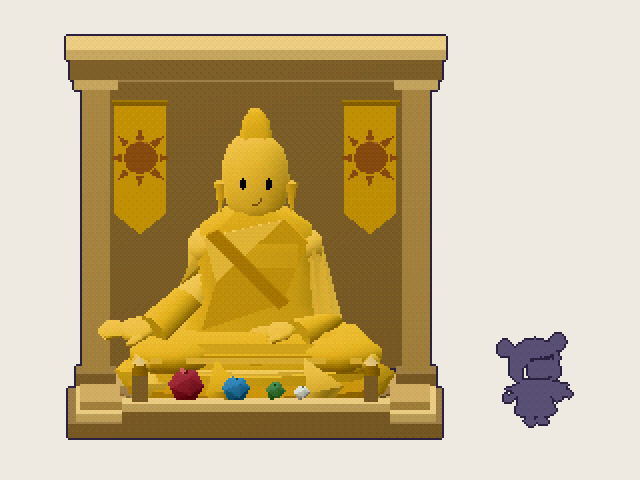
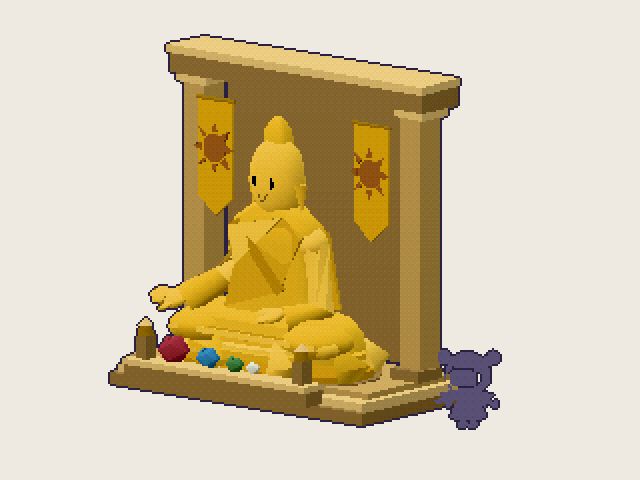
Documented forms and lineage variants · 2
Preserve one identified form consistently. A variant is usable only with its own source and context.
Sarvadurgati / crowned Ratnasambhava
HAR 15 catalogues a crowned yellow form with generosity right, meditation left and horse/lotus/sun support. Its retinue belongs to that tantra; it is not a template for a generic Sukhāvatī assembly. [ra-har15]
Buddha-aspect monastic gesture account
Lama Zopa's Thirty-five Buddha explanation uses Ratnasambhava aspect with left concentration and right granting realization. It corroborates the hand family, not every costume or throne detail of the current game scene. [ra-lywa]
What not to copy · 3
Do not call any outward arm varada without checking palm orientation and descending fingers.
Do not turn the whole figure, robe, hair and shrine into one gold material and then claim that alone establishes canonical yellow skin.
Do not treat invented sun pennants or foreground gems as traditional obligatory attributes.
Sources and precise locations · 5
- [five-crown] Met — Ritual Crown with the Five Transcendent Buddhas, 1985.391 ↗
- [ra-met38581] Met — Ritual Crown Panel with Ratnasambhava, 1992.299 ↗
- [ra-lacma] LACMA — The Jina Buddha Ratnasambhava, M78.9.2 ↗
- [ra-har15] HAR 15 — Ratnasambhava (Sarvadurgati Tantra), Rubin P1994.9.1 ↗
- [ra-lywa] Lama Zopa Rinpoche — Ganden Lha Gyäma commentary, 12. Prostration ↗
Assessment freshness and evidence hashes
The frozen snapshot is authored evidence. Regeneration computes current hashes and leaves that snapshot as it is.
{
  "auditFreshness": {
    "status": "stale",
    "reasons": [
      "The model capture recipe or rig source changed.",
      "The visible model geometry changed.",
      "Rig source changed or is missing: prototypes/prerendered-look/parts/purelands/ratnasambhava.js"
    ]
  },
  "sourceSnapshot": {
    "captureHash": "0f5579c28cd7538310490983b7102edc5dae47e5b642d80597b9a5d64d810988",
    "bodyGeometryHash": "dff8b94813d4cac83cdd89a800f8265727a9cc2197e345e253c8f60f7343a90b",
    "sourceHashes": {
      "prototypes/prerendered-look/parts/purelands/ratnasambhava.js": "e78c70769178cd3867bbb51656a5a66baa08649dd9ba2302e02c2eb819a399b3"
    },
    "captureHashes": {
      "/atlas/characters/ratnasambhava-0f5579c28cd7-presence-3q.webp": "680b35b7463990d5f23967d6812589bf3d9bb8b2a43106260a7524b9bc2ecd0b",
      "/atlas/characters/ratnasambhava-0f5579c28cd7-presence-front.webp": "d07e7b4bc44a7324004731336d9f12c3cb2b307f320f79f09a1b8b2bee65155f",
      "/atlas/characters/ratnasambhava-3d7a5be0dfc6-presence-3q.webp": "680b35b7463990d5f23967d6812589bf3d9bb8b2a43106260a7524b9bc2ecd0b",
      "/atlas/characters/ratnasambhava-3d7a5be0dfc6-presence-front.webp": "d07e7b4bc44a7324004731336d9f12c3cb2b307f320f79f09a1b8b2bee65155f"
    },
    "conceptHashes": {
      "/purelands/concepts/ratnasambhava.webp": "98673d7aa5a742a5387665bedd1994dc8eccf6a8f1fa7a1e0fa561186490655c"
    },
    "activeConceptPaths": [
      "/purelands/concepts/ratnasambhava.webp"
    ]
  },
  "currentSnapshot": {
    "captureHash": "2a44b9f6ec8cb16c1583542cd41b8dcee031023f95fe95282a10ed647cf91461",
    "bodyGeometryHash": "d9562cf9901c5eed12b8e5ec7c45229357ead026842097c8919a7f485a04cd11",
    "activeConceptPaths": [
      "/purelands/concepts/ratnasambhava.webp"
    ],
    "sourceHashes": {
      "prototypes/prerendered-look/parts/purelands/ratnasambhava.js": "7a3c76b795f8bca4cfc04ae495f23c935bad9d10d6909b7469cca4f528bea493"
    },
    "captureHashes": {
      "/atlas/characters/ratnasambhava-0f5579c28cd7-presence-3q.webp": "680b35b7463990d5f23967d6812589bf3d9bb8b2a43106260a7524b9bc2ecd0b",
      "/atlas/characters/ratnasambhava-0f5579c28cd7-presence-front.webp": "d07e7b4bc44a7324004731336d9f12c3cb2b307f320f79f09a1b8b2bee65155f",
      "/atlas/characters/ratnasambhava-2a44b9f6ec8c-presence-3q.webp": "56bacb3b1d4f3d04aae7500fd9aaf5c3c32c52750b76441f3fb09e292e9ea3d2",
      "/atlas/characters/ratnasambhava-2a44b9f6ec8c-presence-front.webp": "17578248bcd366f16e5a1b244212a5ad91fabf058e60e259ff4c3f46165b7d2b",
      "/atlas/characters/ratnasambhava-3d7a5be0dfc6-presence-3q.webp": "680b35b7463990d5f23967d6812589bf3d9bb8b2a43106260a7524b9bc2ecd0b",
      "/atlas/characters/ratnasambhava-3d7a5be0dfc6-presence-front.webp": "d07e7b4bc44a7324004731336d9f12c3cb2b307f320f79f09a1b8b2bee65155f"
    },
    "conceptHashes": {
      "/purelands/concepts/ratnasambhava.webp": "98673d7aa5a742a5387665bedd1994dc8eccf6a8f1fa7a1e0fa561186490655c"
    }
  }
}