Green Tārā
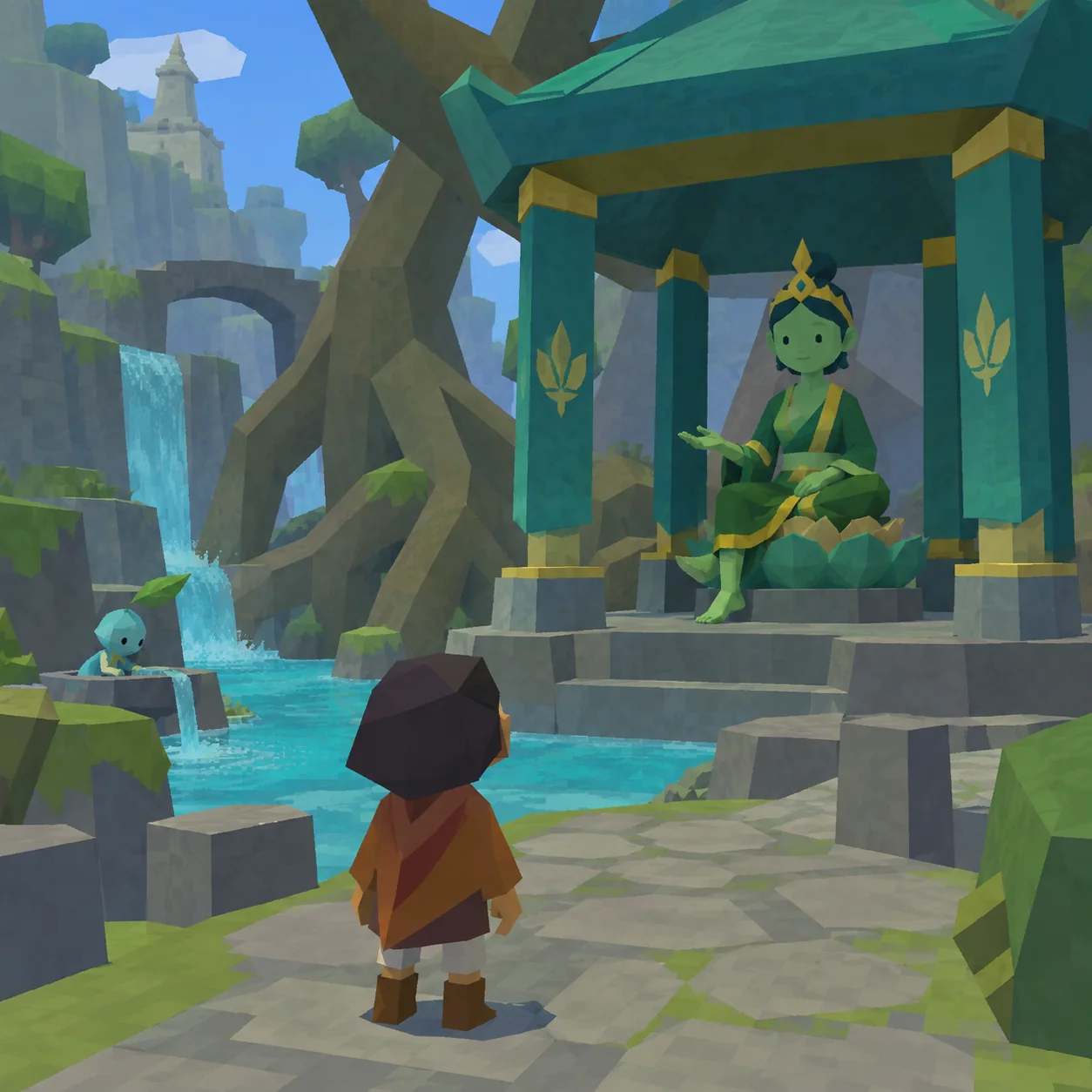
Green Tara, Arya Tara or Dölma in Tibetan, is a female Buddha, the feminine form of awakened, compassionate activity. She is green, with one face and two arms. Her right hand reaches out past the knee, palm open, granting wishes. Her left hand at the heart holds a blue utpala flower.
She sits with her left leg folded on a lotus and moon seat and her right leg stepping down to a small lotus stool. Her left thumb and ring finger meet, the other three fingers raised, and hold the stem so the blossom opens by her left shoulder. Some catalogue descriptions give thumb and forefinger instead.
She is youthful and calm, with a slight smile. A jewelled diadem crowns her dark topknot, and she wears earrings, necklaces, armlets, bracelets and anklets with layered silks and a scarf. She is a separate presence from the twenty-one numbered Taras of Atisha's set.
In traditional art
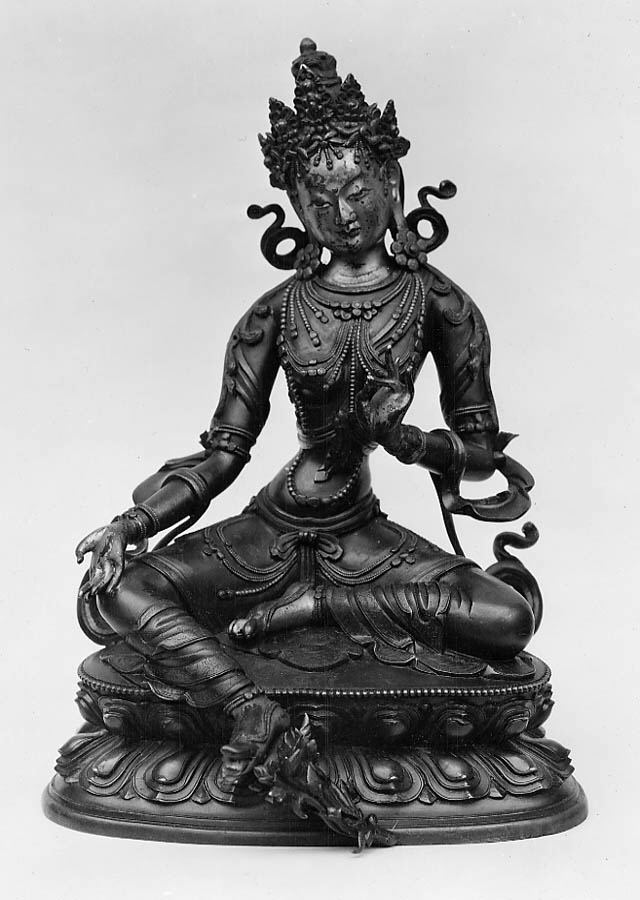
Seated Green Tara — Met 50.138.3Tibet · seventeenth–eighteenth centuryPublic Domain / The Metropolitan Museum of Art Open Access; verified object page and API isPublicDomain:true.Object record ↗
In other collections
These images stay with the collections that hold them. Each link opens the collection's own page.
- Green Tara — Rubin C2005.16.45 ↗Tibet · fifteenth century · rubinmuseum.orgRubin Museum of Himalayan Art; no open reuse licence stated on object page.
Sources
Depiction requirements and work notes
Ārya Tārā / Green Tara (Śyāmatārā; Dölma)
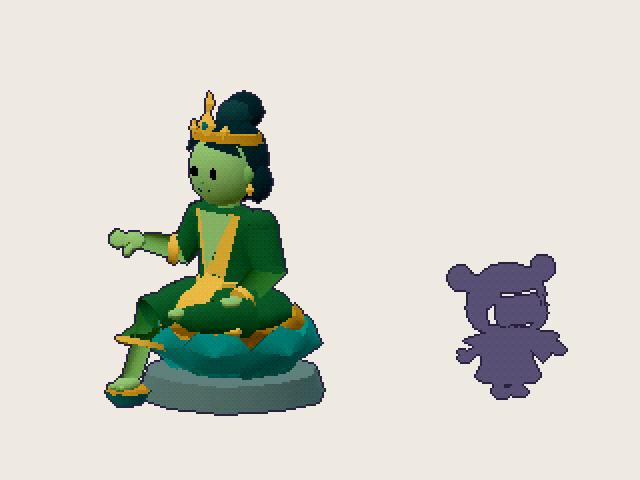
Green, one face/two arms/two eyes; own right giving hand and pendant leg; own left heart-level utpala. Current grove model lacks the defining flower.
The model capture recipe or rig source changed. The visible model geometry changed. Rig source changed or is missing: prototypes/prerendered-look/parts/purelands/green-tara.js Reinspect the model before relying on the recorded defects.
References, criteria, concept and model side by side
Traditional depictions

Complete left stem/flower, lowered own right generosity hand, pendant own right foot on floral support, jeweled diadem and layered skirt; silver surface is not visualization color. [green-rubin]
Object record ↗ · Source image ↗Compare graceful torso, jewelry, skirt and right pendant leg/hand. Missing extant flower does not license omitting Tara’s utpala. [green-met]
Object record ↗ · Source image ↗Criteria
The model must show
- Lineage variant: Tibetan Green Tara as principal (Rubin C2005.16.45; Met 50.138.3); one Tārā, not a twenty-second numbered form
- Body: green, one face, two arms; youthful and feminine
- Posture: own right leg (viewer-left) extended down to a small lotus with the foot touching it; own left leg folded on the seat; thigh, knee, shin, ankle and foot continuous
- Right hand: own right arm extends over or by the right knee, palm open toward the viewer, fingers down and outward (generosity)
- Left hand: own left hand (viewer-right) at the heart holds a green utpala stem, thumb and ring finger meeting and three fingers raised; a blue or blue-white blossom with distinct leaves sits by the left shoulder or ear, visibly joined to the hand
- Held object: the blue utpala with stem and leaves; no vase
- Dress and ornaments: jewelled diadem over dark hair and topknot, earrings, necklaces, armlets, bracelets and anklets, layered silk lower garment and scarf reading as silk; a graceful youthful feminine body without sexual exaggeration; the closed green robe is the current game costume, not a monastic identity
- Face: youthful feminine calm with a slight compassionate curve to a small closed mouth
- Eyes: two ordinary facial eyes; Eyes: solid black silhouettes with no whites, irises, pupils, highlights or glint (project eye rule; a recorded game adaptation, not a claim about traditional painted eyes)
- Seat: lotus and moon seat, with a small lotus flower stool under the right foot
- Attendants: none required
The model must not show
- Cartoon smiley face: a wide U-shaped or crescent grin, open laughing mouth, rosy cheek dots or mascot cheeks
- Eye whites, irises, pupils, highlights or glint; glowing white-gold eyes (those belong only to freshly liberated beings)
- Any part of the figure (head, crown, hat, halo, raised hand or held object) touching or passing through its canopy, roof, lintel, pillars, throne back or seat in any capture angle
- No utpala in the left hand, or the left hand resting in the lap (the current model's fault, repeated from its concept)
- A nearly horizontal right palm with undivided fingers
- A seated monk's robe and meditation hands
- The numbered Atiśa vase
- Seven eyes, extra heads or extra arms
- Her head, diadem, topknot or utpala cutting into the gazebo roof or pillars (the fault Josie named)
- Hands or attributes mirrored to the wrong side of the figure's own body (own right appears at viewer-left in a front view)
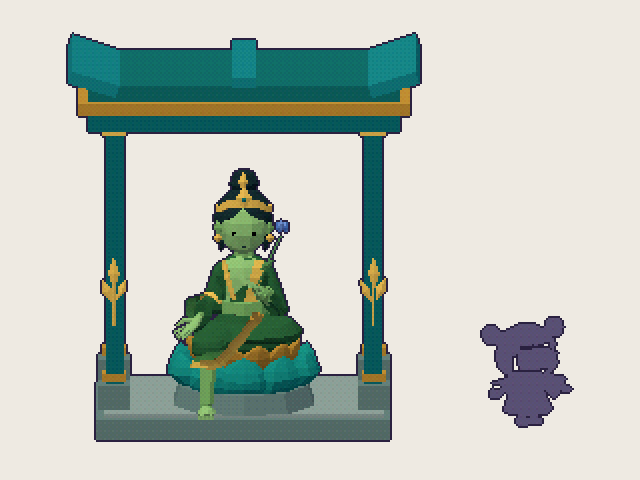
Original game concept
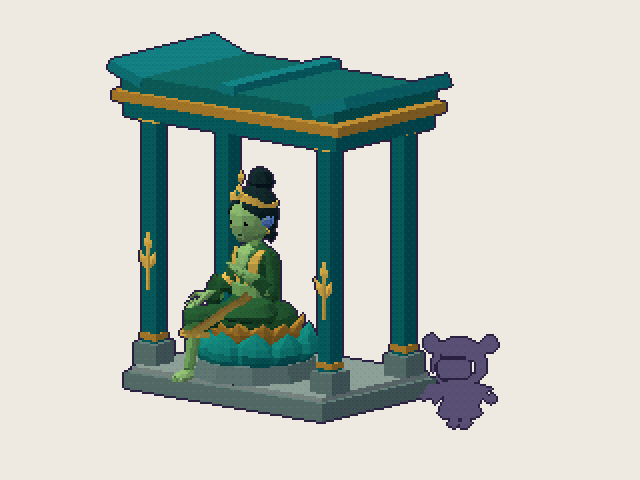
Current 3D model
presence
Depiction requirements
- Identity and appearance
- Ārya Tārā/Green Tārā: feminine awakened compassionate activity; one face, two arms, two ordinary facial eyes, green body. Primary grove identity remains one Tārā; not a twenty-second numbered stanza. [tara-awakened] [green-rubin]
- Anatomical legs
- Own right leg (viewer-left/-X) pendant/extended to small lotus flower stool; own left folded onto lotus/moon seat. Continuous gracious posture rather than rigid cross-legged monk seat. [green-rubin] [green-met]
- Own right generosity hand
- Lower/right arm extends outward over/by right knee with palm open toward viewer/upward and fingers down/out, granting wishes. Keep gesture legible; do not substitute lap meditation or generic waving. [green-rubin] [green-met]
- Own left utpala hand
- Own left hand (viewer-right/+X) rises at heart; chosen depiction uses thumb-ring contact with three fingers raised, holding green stem whose blue utpala blossoms by left shoulder/ear. Flower, leaves and stem must be distinct and visibly connected to the hand. [tara-mudra] [green-rubin]
- Costume and presence
- Youthful feminine calm with slight compassionate smile; jeweled diadem and dark topknot/hair, earrings, necklaces/armlets/bracelets/anklets; layered lower silk/skirt and scarf. Simplify fine patterning but retain graceful body and open gesture; full green closed robe is current game costuming, not a required monastic identity. [green-rubin] [green-met]
- Eyes and proportions
- Use solid-black eye silhouettes and current low-poly outlined/dithered art convention; document that stylized toy proportions and unpainted eyes are game adaptations. No glowing eyes, sclera, pupils or highlights for this long-awakened presence. [game-adaptation]
Presentation contract
Ready to build from No readiness block is recorded in the plan.
Setting and sizing rule
A lotus and moon seat with a small lotus under the right foot. Her grove pavilion is authored scenery kept separate from the figure, and is rebuilt around her rather than her being fitted into it. Sizing (plan rule R4, not a sourced claim): the opening of any shrine, canopy or pavilion around the figure leaves at least one of the figure's own head-heights of clear air above its tallest point (the diadem, topknot and the utpala blossom) and a clear gap on each side of its widest span (the lowered right hand with its vase and the utpala at the left shoulder); a throne back or aureole sits behind the figure without passing through it; pillars and lintel do not cross the face, hands or held objects in the front or either three-quarter capture.
Recorded variants · 3
- Metal statues identified as Green Tara may be unpainted, gold or silver; that is material, not skin colour
- The surviving Met sculpture has lost its flower
- HAR prose sometimes names thumb and forefinger for the stem hold
Recorded adaptations · 2
- The closed green robe
- Toy proportions, outline and black eye silhouettes
Where the plan places it · 2
- field turquoise leaves · The centre throne
field-turquoise-leaves.centre· placement ltOpenfield-turquoise-leaves.centre.throne - tara grove · Tara's pavilion
tara-grove.pavilion· character Green Taragreen-tara
Contract sources · 5
- Lama Zopa Rinpoche, Tara the Liberator
- Rubin Museum, Green Tara, C2005.16.45
- The Metropolitan Museum of Art, Seated Green Tara, 50.138.3
- Venerable Thubten Chodron, Compassion from Tara (2011)
- Bodhi Blocks Design Intent and Purelands rig contract
Model audit and next pass
Evidence basis: visual + source
Recorded observations
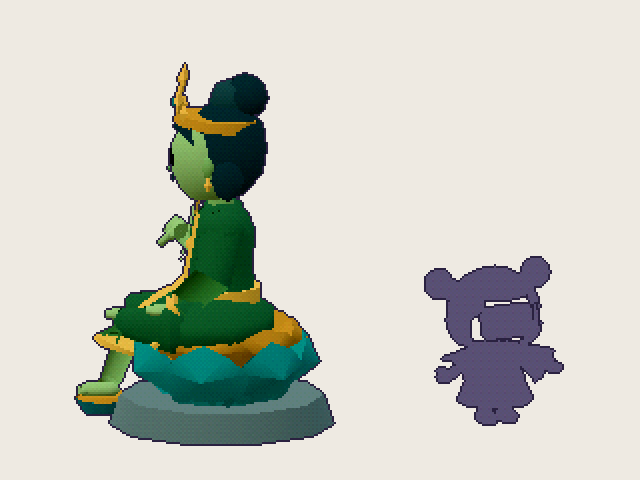
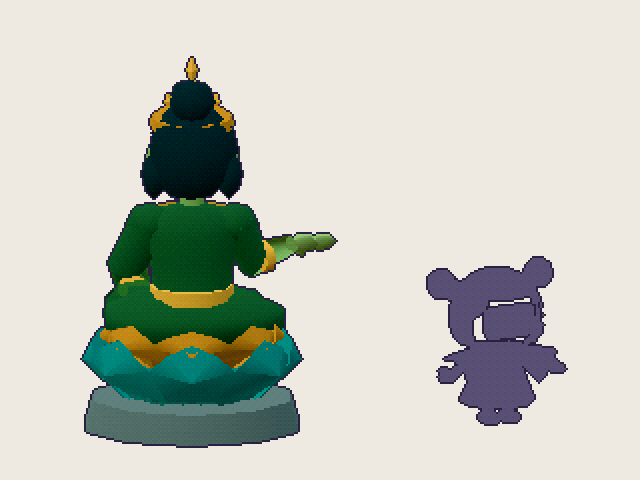
Green feminine figure, own right pendant foot on small lotus, crown/topknot and two dark eyes are visible; model follows generated pavilion concept.
No left-hand blue utpala, stem or flower exists in source or front/three-quarter/side/back captures. Own left hand sits near lap instead of heart. Concept repeats the omission.
Own right hand is open but nearly horizontal, with thumb/fingers undifferentiated; current closed green robe and simplified crown read as a game-costume adaptation.
Rig variables name negative-X/pendant limb leftHip and open negative-X hand leftShoulder despite +Z-facing figure; anatomy is own right. Review geometry, not misleading joint names.
Directions for a future model pass
Priority: add complete left-hand heart-level mudra/stem/blue utpala by left ear; mark concept reference defect so future passes do not re-remove it.
Refine own right generosity palm with deliberate fingers lowered/outward and direct forearm continuity; retain lotus-contacted right foot.
Polish feminine graceful silhouette, layered silk and jeweled diadem within game register, comparing both traditional sculpture references; preserve authored pavilion as separate scenery.
Assessed baseline captures
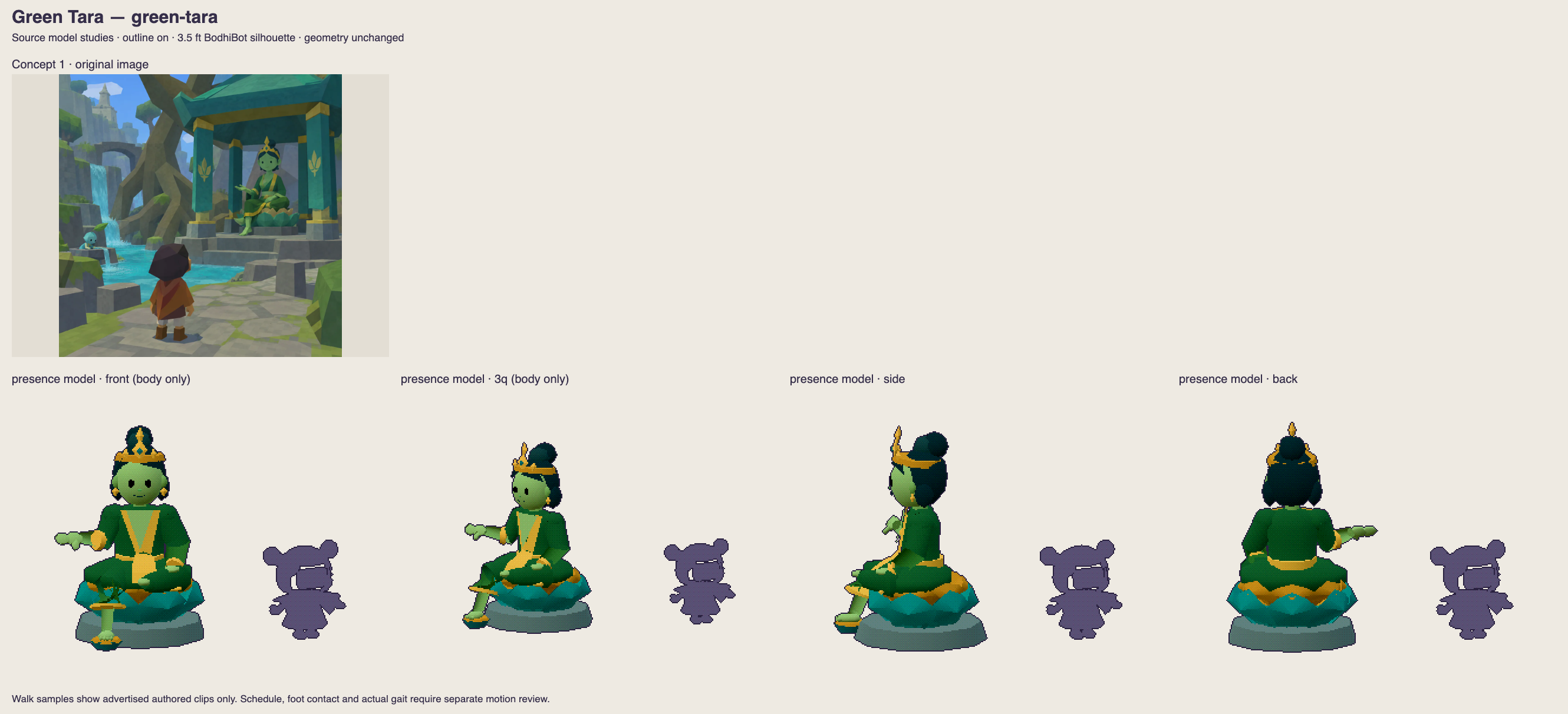
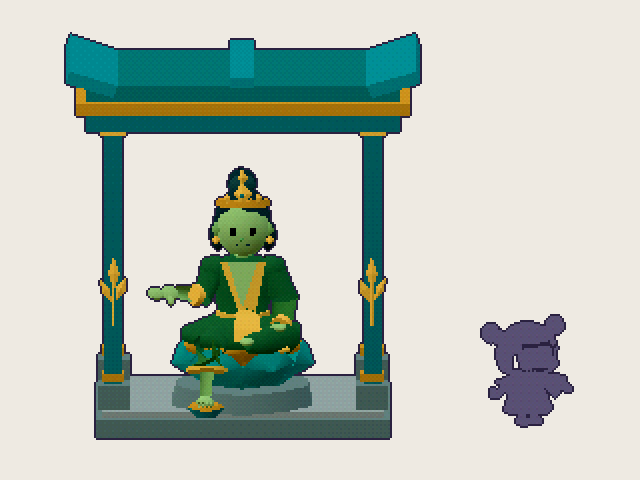
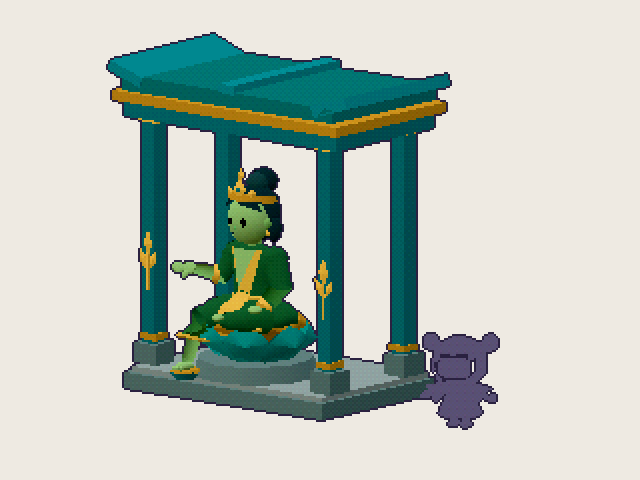
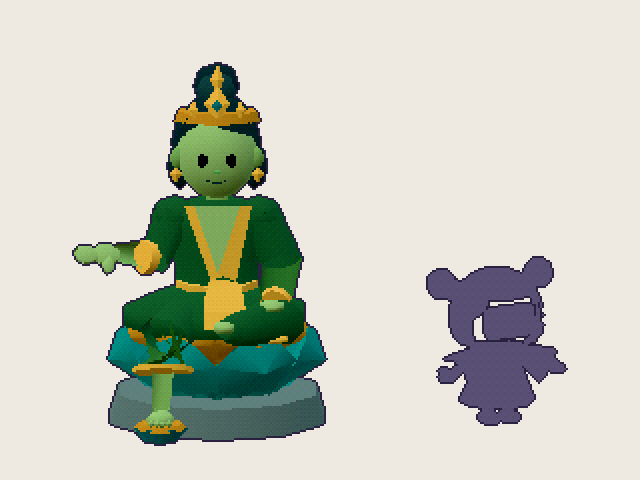
Documented forms and lineage variants · 3
Preserve one identified form consistently. A variant is usable only with its own source and context.
Classical metal statues may show unpainted/gold/silver surfaces although identified as Green Tara; metal material alone does not prescribe green or gold visualization skin.
Some sculptural flowers/attributes are lost; surviving museum object is evidence of posture/ornament, not authority to omit a complete utpala.
Thumb-ring convention follows cited teacher explanation; HAR prose sometimes labels thumb/index. Inspect selected visual/reference and do not invent one universal finger attribution.
What not to copy · 4
Generic seated monk robe/meditation hands replacing active Tara gesture.
Adding numbered Atisha vase automatically.
Copying missing museum attribute as intentional omission.
Seven-eyed longevity White Tara or extra heads/arms without a separately sourced form.
Sources and precise locations · 6
- [tara-mudra] Venerable Thubten Chodron, Compassion from Tara (2011) ↗
- [tara-awakened] Lama Zopa Rinpoche, Tara the Liberator ↗
- [lywa-rights] LYWA Policies, Conditions of Use ↗
- [game-adaptation] Bodhi Blocks Design Intent and Purelands rig contract · repository source
docs/DESIGN-INTENT.md - [green-rubin] Rubin Museum, Green Tara, C2005.16.45 ↗
- [green-met] The Metropolitan Museum of Art, Seated Green Tara, 50.138.3 ↗
Assessment freshness and evidence hashes
The frozen snapshot is authored evidence. Regeneration computes current hashes and leaves that snapshot as it is.
{
  "auditFreshness": {
    "status": "stale",
    "reasons": [
      "The model capture recipe or rig source changed.",
      "The visible model geometry changed.",
      "Rig source changed or is missing: prototypes/prerendered-look/parts/purelands/green-tara.js"
    ]
  },
  "sourceSnapshot": {
    "captureHash": "fca4e52e873efce1839e9a1feeaed0ff1db2645a24d5141c8c99806735865caa",
    "bodyGeometryHash": "5e7493972682c03a8fa4382636705b4e9f0ba98c9423e1c8748aff8341fbb350",
    "sourceHashes": {
      "prototypes/prerendered-look/parts/purelands/green-tara.js": "bdd472efda38082b59e44193270394dbc75a9c3fcd3047a098e4d968cba36d29"
    },
    "captureHashes": {
      "/atlas/audit/characters/green-tara-9c387c3748d0-presence-3q-body.webp": "a29dc97fe63539380171c1d9baa0adaa0ce4b65ae0968dd08a73cf52fdbcfe5c",
      "/atlas/audit/characters/green-tara-9c387c3748d0-presence-back.webp": "aa4536fb4fd586519aad29b0021fedc006c073515b858d5cacbb0696fe31a6ab",
      "/atlas/audit/characters/green-tara-9c387c3748d0-presence-front-body.webp": "832e5768e5e6c59614aa2791aefd1de3524d21fb775f350c2213f10c7dba5dc7",
      "/atlas/audit/characters/green-tara-9c387c3748d0-presence-side.webp": "f02db3929cf726fcc9f457a4bb4addff3967c3b31f76961495ebe576816dea6e",
      "/atlas/audit/sheets/green-tara-9c387c3748d0.webp": "02f87353c1e4f206ef0d733e82c202a10f1bbf21ead76e6aefe96b30601c56b4",
      "/atlas/characters/green-tara-6ab8aabd5c14-presence-3q.webp": "c2d6574ba74ca80d61219d07e718fd474a3b91d7147863e288c733a1aca36cf1",
      "/atlas/characters/green-tara-6ab8aabd5c14-presence-front.webp": "a1fb48d0852c90269568a24ebc4b2b9976a1bc443bb6dd89ab0d813084877bdf",
      "/atlas/characters/green-tara-fca4e52e873e-presence-3q.webp": "c2d6574ba74ca80d61219d07e718fd474a3b91d7147863e288c733a1aca36cf1",
      "/atlas/characters/green-tara-fca4e52e873e-presence-front.webp": "a1fb48d0852c90269568a24ebc4b2b9976a1bc443bb6dd89ab0d813084877bdf"
    },
    "conceptHashes": {
      "/purelands/concepts/green-tara.webp": "524f32aafb9f9768acb332c4b71e32a54a1fcc3c4b69888355b6e27a8be71b11"
    },
    "activeConceptPaths": [
      "/purelands/concepts/green-tara.webp"
    ]
  },
  "currentSnapshot": {
    "captureHash": "a5808a10a2b3690d9b28dcc5e6ee579f3bd0a759975e85ec1d3d956c7ed1b989",
    "bodyGeometryHash": "ee95f3661bacc2b6302b97ee050a6cadf42719f6c748e4ef202b9ecf21e1b5cc",
    "activeConceptPaths": [
      "/purelands/concepts/green-tara.webp"
    ],
    "sourceHashes": {
      "prototypes/prerendered-look/parts/purelands/green-tara.js": "d0dd19adebf0fd96038a7beb253c58772cbfb87865fd2d4f2bd4b9dd8db13926"
    },
    "captureHashes": {
      "/atlas/audit/characters/green-tara-9c387c3748d0-presence-3q-body.webp": "a29dc97fe63539380171c1d9baa0adaa0ce4b65ae0968dd08a73cf52fdbcfe5c",
      "/atlas/audit/characters/green-tara-9c387c3748d0-presence-back.webp": "aa4536fb4fd586519aad29b0021fedc006c073515b858d5cacbb0696fe31a6ab",
      "/atlas/audit/characters/green-tara-9c387c3748d0-presence-front-body.webp": "832e5768e5e6c59614aa2791aefd1de3524d21fb775f350c2213f10c7dba5dc7",
      "/atlas/audit/characters/green-tara-9c387c3748d0-presence-side.webp": "f02db3929cf726fcc9f457a4bb4addff3967c3b31f76961495ebe576816dea6e",
      "/atlas/audit/sheets/green-tara-9c387c3748d0.webp": "02f87353c1e4f206ef0d733e82c202a10f1bbf21ead76e6aefe96b30601c56b4",
      "/atlas/characters/green-tara-6ab8aabd5c14-presence-3q.webp": "c2d6574ba74ca80d61219d07e718fd474a3b91d7147863e288c733a1aca36cf1",
      "/atlas/characters/green-tara-6ab8aabd5c14-presence-front.webp": "a1fb48d0852c90269568a24ebc4b2b9976a1bc443bb6dd89ab0d813084877bdf",
      "/atlas/characters/green-tara-a5808a10a2b3-presence-3q.webp": "64305ae2bb90983ab2326c66538628074c3bdbe6e7734be9113c4f60fa71e139",
      "/atlas/characters/green-tara-a5808a10a2b3-presence-front.webp": "8e01d726dbb14d6e47327b83a931c8680b029d7ced12a0199ef656ad5a44fb44",
      "/atlas/characters/green-tara-fca4e52e873e-presence-3q.webp": "c2d6574ba74ca80d61219d07e718fd474a3b91d7147863e288c733a1aca36cf1",
      "/atlas/characters/green-tara-fca4e52e873e-presence-front.webp": "a1fb48d0852c90269568a24ebc4b2b9976a1bc443bb6dd89ab0d813084877bdf"
    },
    "conceptHashes": {
      "/purelands/concepts/green-tara.webp": "524f32aafb9f9768acb332c4b71e32a54a1fcc3c4b69888355b6e27a8be71b11"
    }
  }
}