Amoghasiddhi
Green and peaceful, Amoghasiddhi raises his right palm outward, fingers up, in the gesture of protection, while his left hand rests in his lap. His name means Unfailing Accomplishment. Tibetans call him Dönyö Drubpa, and the five-family account places him in the north.
A different form holds the crossed vajra instead: two vajras, the pronged ritual sceptre, set at right angles through one centre. A Western Tibetan sculpture at the Met holds it in the right hand at the chest. Garuda, the great bird, kneels beneath that sculpture's throne.
Both that sculpture and a Met painting show him crowned and jewelled, in silks. The sculpture sits with legs fully crossed, soles upward. The painting surrounds him with eight bodhisattvas.
In traditional art
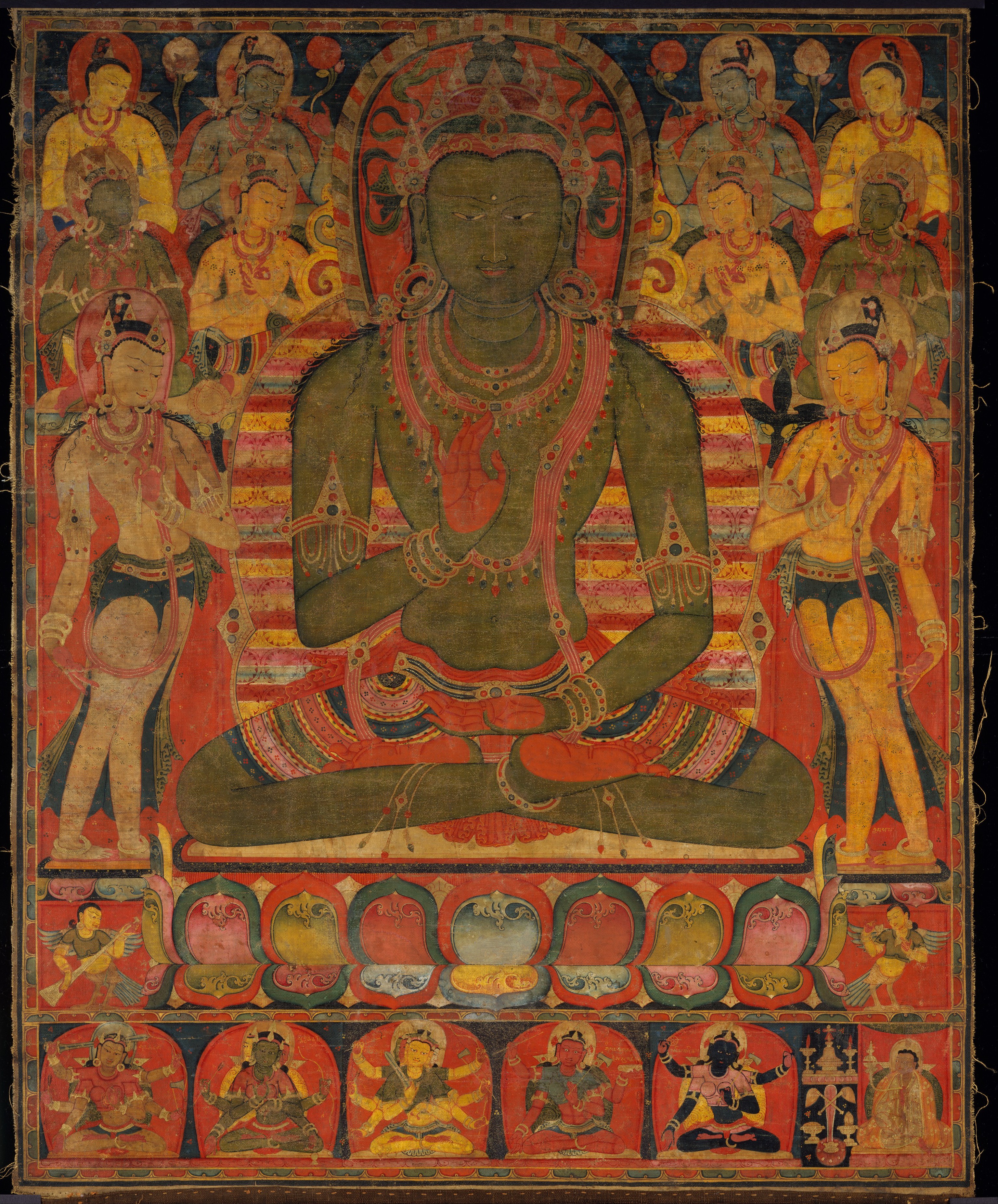
Buddha Amoghasiddhi with Eight Bodhisattvas — Met 1991.74Central Tibet · Circa 1200–50Public Domain, Met Open Access (CC0).Object record ↗ 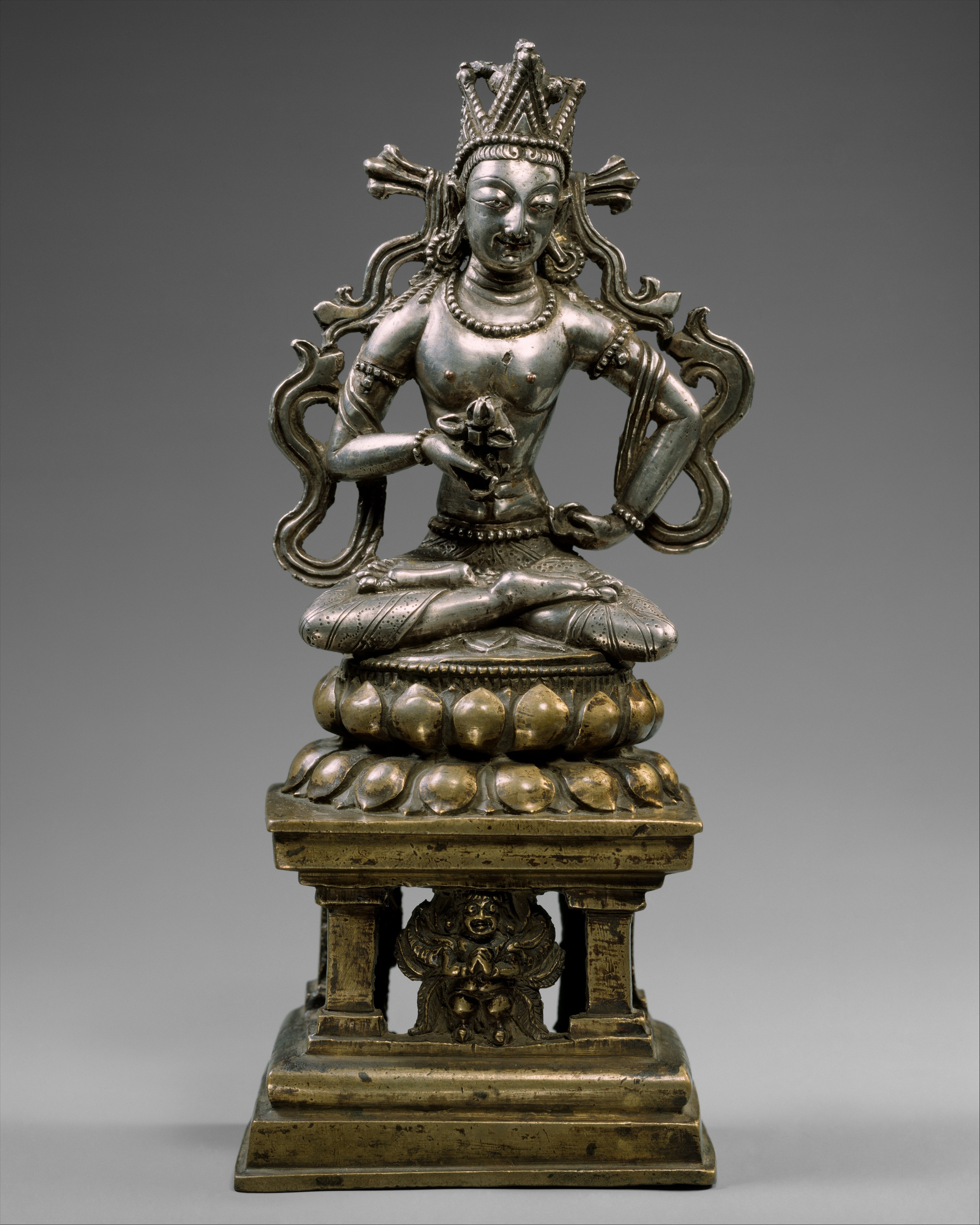
Amoghasiddhi sculpture — Met 1984.211Western Tibet; Kashmiri stylistic relationships · Late 10th–early 11th centuryPublic Domain, Met Open Access (CC0).Object record ↗ 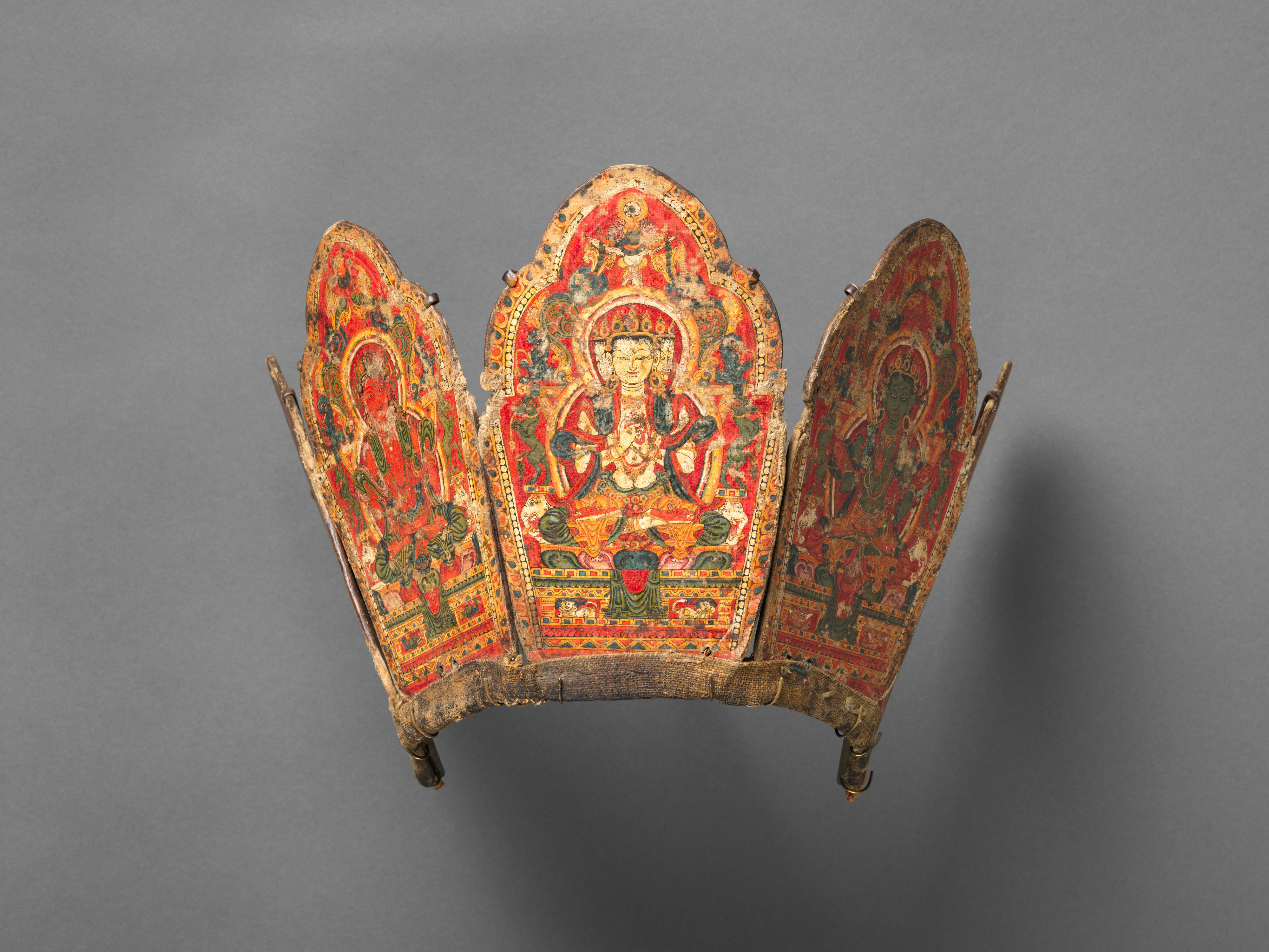
Green Amoghasiddhi panel, Five Buddha crown — Met 1985.391Tibet; probably a Newari artist working in Tibet · Late 14th–early 15th centuryPublic Domain, Met Open Access (CC0).Object record ↗
Sources
Depiction requirements and work notes
Amoghasiddhi — Dönyö Drubpa, Unfailing Accomplishment Buddha
The model's green color and anatomical right upright protection palm are recognizable. Its tiny lap implement is built as a single-axis vajra despite being described as a double vajra, and its layered cylindrical seat lacks visible lotus petals. Resolve the attribute variant and improve the seat's identity.
The model capture recipe or rig source changed. The visible model geometry changed. Rig source changed or is missing: prototypes/prerendered-look/parts/purelands/amoghasiddhi.js Reinspect the model before relying on the recorded defects.
References, criteria, concept and model side by side
Traditional depictions
Green ornamented Amoghasiddhi with right abhaya, lotus throne and eight bodhisattvas; principal source for the selected protection gesture. [ag-met37966]
Object record ↗ · Source image ↗Distinct held-crossed-vajra form: right implement at chest, jeweled crown, patterned silks, upward soles and Garuda beneath throne. [ag-met38258]
Object record ↗ · Source image ↗Green panel to the viewer's right of central white Vairocana: raised right palm, lap hand, crown and jewelry. [five-crown]
Object record ↗ · Source image ↗Criteria
The model must show
- Lineage variant: the green northern five-family Amoghasiddhi with the protection gesture (Met 1991.74); the monk-robed dress is a recorded game adaptation
- Body: green skin, one face, two arms; skin, hair and garment are different enough in value for the face and hands to read
- Hands: own right hand raised before the shoulder or chest, palm outward, fingers up (protection); own left palm upward in the lap; the open palm is the main silhouette
- Held object: if a crossed vajra is kept, it has two axes crossing through one centre with four ends, and does not hide the raised palm
- Dress: unornamented monk's robes, recorded as a game adaptation of the ornamented sources
- Posture: full vajra posture, centred torso
- Head: long earlobes, a coherent hair-and-ushnisha shape, small forehead mark
- Face: serene and composed, as the library gives this peaceful form: narrow calm eye shapes, level brows, a small closed restrained mouth
- Eyes: solid black silhouettes with no whites, irises, pupils, highlights or glint (project eye rule; a recorded game adaptation, not a claim about traditional painted eyes)
- Seat: a lotus with visible large petal lobes
- Attendants: none required; Garuda beneath the throne and the eight bodhisattvas belong to the cited sculpture and painting
The model must not show
- Cartoon smiley face: a wide U-shaped or crescent grin, open laughing mouth, rosy cheek dots or mascot cheeks
- Eye whites, irises, pupils, highlights or glint; glowing white-gold eyes (those belong only to freshly liberated beings)
- Any part of the figure (head, crown, hat, halo, raised hand or held object) touching or passing through its canopy, roof, lintel, pillars, throne back or seat in any capture angle
- A single-axis two-ended vajra presented as the crossed vajra
- An oversized held object covering the raised palm
- A stack of plain cylinders standing in for the lotus
- Gold or silver skin taken from metal sculpture
- The seat or disc cutting through hidden feet
Original game concept
Current 3D model
presence
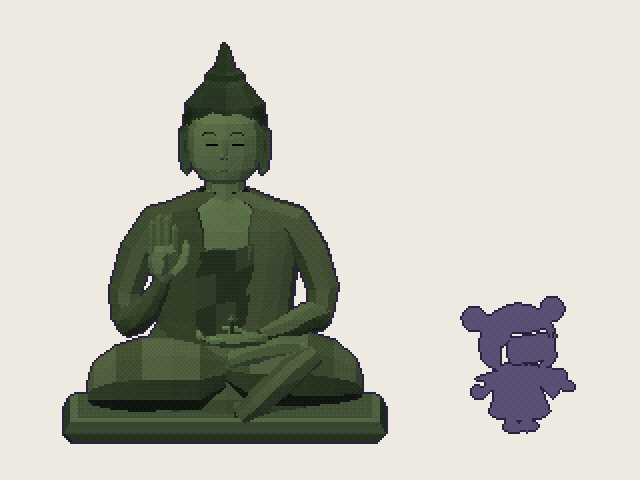
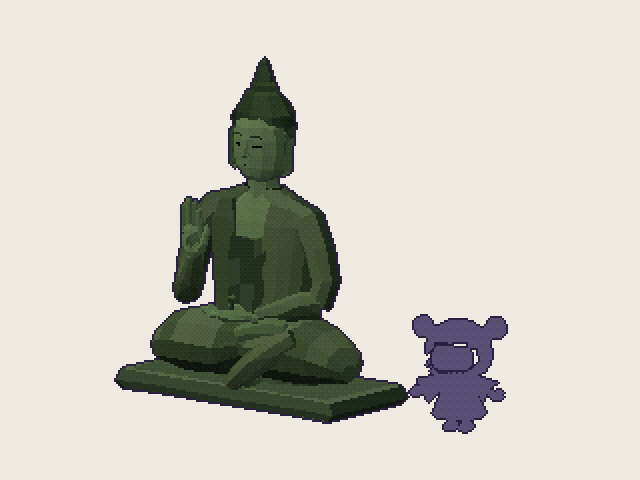
Depiction requirements
- Body and peaceful expression
- For the selected northern five-family account, use green skin, one peaceful face and two arms. Separate skin, hair and garment values enough for the face and hands to read. Green is prescribed by this painted account; silver/bronze sculpture color is a material fact. [ag-met37966] [five-crown] [ag-met38258]
- Anatomical right protection mudrā
- Raise the anatomical right hand before the shoulder/chest with palm outward and fingers upward in abhaya; keep the left hand resting upward at the lap for this form. The right is viewer-left when frontal. Let the open palm remain the main silhouette. [ag-met37966] [five-crown]
- Crossed vajra option
- If retaining a viśvavajra attribute, model two vajra axes crossing orthogonally through a common center, with four outward ends. A single spindle with prongs at two ends is an ordinary vajra, not a crossed double vajra. Choose its placement from a complete identified form: Met 38258 holds it in the anatomical right hand at the chest, a different gesture from the current open palm. [ag-met38258]
- Costume and crown
- The collected thangka and sculpture use jeweled crown, ear/neck/arm ornaments and silks. Preserve their ornamented appearance if selecting either as a whole costume reference. If retaining the existing unornamented monk-robed game adaptation, say so and do not claim the artwork mandates that costume. [ag-met37966] [ag-met38258]
- Posture and lotus
- Use full vajra legs with both upward soles as in the sculpture, centered torso and a recognizable lotus seat. Large low-poly petal lobes are preferable to a stack of plain cylinders labelled lotus. A throne and disc should support the body rather than intersect hidden feet. [ag-met38258] [ag-met37966]
- Throne support and entourage
- Garuda kneels beneath the historical sculpture's throne. The painting supplies an eight-bodhisattva assembly; preserve that specific context if reproducing its setting. Its lower five female figures are only tentatively identified as Taras by the online record, so do not use them as a universal mandatory retinue. [ag-met38258] [ag-met37966]
- Head and proportions
- Maintain elongated ears, a coherent uṣṇīṣa/hair or jeweled crown silhouette, small ūrṇā and serene brows/mouth. Compare neck, head and shoulders with the chosen complete reference. Keep solid-black eyes in game; source-like expression and clear anatomy can coexist with faceted toy geometry. [ag-met37966] [ag-met38258]
Presentation contract
Ready to build from No readiness block is recorded in the plan.
Setting and sizing rule
A recognisable lotus seat that supports the body. Garuda throne only if the Met 1984.211 throne is reproduced. Sizing (plan rule R4, not a sourced claim): the opening of any shrine, canopy or pavilion around the figure leaves at least one of the figure's own head-heights of clear air above its tallest point (the ushnisha and the fingertips of the raised hand) and a clear gap on each side of its widest span (the raised right hand and the knees); a throne back or aureole sits behind the figure without passing through it; pillars and lintel do not cross the face, hands or held objects in the front or either three-quarter capture.
Recorded variants · 2
- Green abhaya painting (Met 1991.74): ornamented, eight bodhisattvas
- Western Tibetan viśvavajra-holder (Met 1984.211): crossed vajra at the chest in the right hand, other hand near the hip, crown, Garuda throne; a different whole pose
Recorded adaptations · 1
- Monk's robes in place of the crown, jewels and silks of the cited artworks
Where the plan places it · 1
- field fulfilled activity · Fulfilled Activity
field-fulfilled-activity.court· character Amoghasiddhiamoghasiddhi
Contract sources · 3
- Met — Buddha Amoghasiddhi with Eight Bodhisattvas, 1991.74
- Met — Ritual Crown with the Five Transcendent Buddhas, 1985.391
- Met — Amoghasiddhi, Transcendent Buddha of the North, 1984.211
Model audit and next pass
Evidence basis: visual + source
Recorded observations
Inspected original concept, canonical front/three-quarter captures and source rig. This audit uses existing captures and does not establish animated runtime behavior.
Green skin/robes, anatomical right outward raised palm, left lap hand and ring halo are visible. The same general protection arrangement appears in the concept.
The lap implement is a tiny vertical spike at capture scale. Source constructs one vertical shaft with paired end cones/prongs, rather than two orthogonal vajra axes; this does not make a crossed viśvavajra.
Source comments describe twelve lotus petals, but the visible seat is plain layered cylindrical geometry without recognizable petals. The robe lap has no clearly readable upward soles.
The skin, hair and robe remain very close green values. The raised x-negative arm is named leftShoulder and the lap arm rightShoulder, reversing anatomical labels. The bare head is a compressed pointed cap; a forehead ūrṇā is not obvious.
Directions for a future model pass
Keep the correct anatomical right protection palm. Choose either an attribute-free abhaya depiction or a separately documented held-viśvavajra variant; do not silently hybridize them.
If a crossed-vajra emblem is retained as an explicit game adaptation, replace the single spindle with a readable orthogonal four-ended form and record its chosen location.
Replace the plain seat silhouette with a recognizable low-poly lotus and clarify crossed feet; retain enough color separation for face and hands.
Clarify forehead/cranial markers, preserve black eyes and restrained peaceful expression, and map anatomical joints before animation changes.
Preserve this baseline in Atlas, assess changed front/three-quarter/side views and leave the Atlas approval fields as found.
Assessed baseline captures
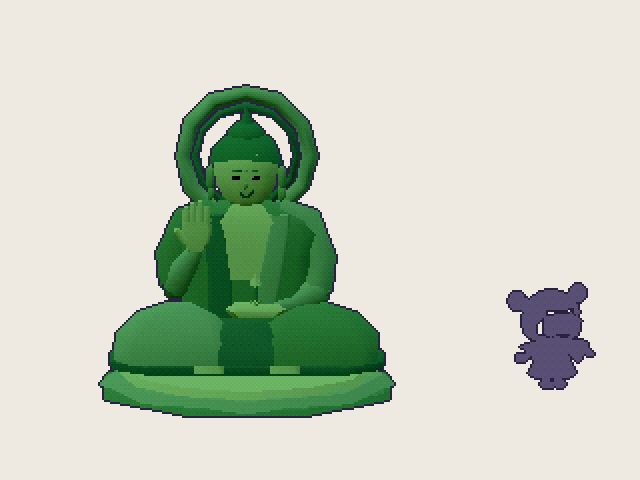
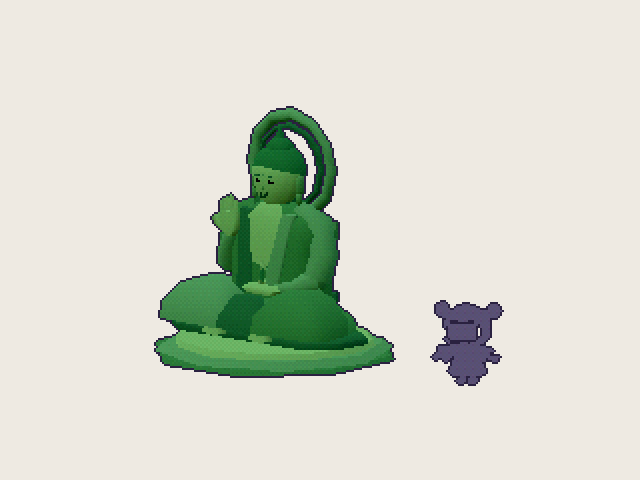
Documented forms and lineage variants · 2
Preserve one identified form consistently. A variant is usable only with its own source and context.
Green abhaya painting
Met 1991.74 depicts green Amoghasiddhi with raised right protection palm, ornamented costume and eight bodhisattvas. It supports the current gesture's identity while differing from the game's monastic clothing. [ag-met37966]
Western Tibetan viśvavajra-holder
Met 1984.211 carries the crossed vajra at the chest in the right hand; its other hand is near the hip, and it has crown, silks, ornaments and Garuda throne. Do not transfer only the implement while claiming the entire abhaya pose reproduces this sculpture. [ag-met38258]
What not to copy · 3
Do not call a single-axis two-ended vajra a viśvavajra because of a source comment or filename.
Do not obscure the blessing palm with an oversized object copied from a different variant.
Do not use the metal sculpture's gold/silver surface as evidence against green in the selected painted form.
Sources and precise locations · 3
Assessment freshness and evidence hashes
The frozen snapshot is authored evidence. Regeneration computes current hashes and leaves that snapshot as it is.
{
  "auditFreshness": {
    "status": "stale",
    "reasons": [
      "The model capture recipe or rig source changed.",
      "The visible model geometry changed.",
      "Rig source changed or is missing: prototypes/prerendered-look/parts/purelands/amoghasiddhi.js"
    ]
  },
  "sourceSnapshot": {
    "captureHash": "ce497cef9c69df66d1ae58ac777a43766d5d92fc1f4460723bfcaa640bd2e8cc",
    "bodyGeometryHash": "e4c1eb97af4dd1c5df62c290bec2ad5fcce073f5cc53d82ebe3029856afd3211",
    "sourceHashes": {
      "prototypes/prerendered-look/parts/purelands/amoghasiddhi.js": "ae5d22621abebc47a337549286bb1916eee96068a20f1436ef676ebfd4c48794"
    },
    "captureHashes": {
      "/atlas/characters/amoghasiddhi-22df724475a0-presence-3q.webp": "e654f12eab04c7672c86e5c0610a6b8e6e30c8e5aa2ccee52e3111cd91714dc0",
      "/atlas/characters/amoghasiddhi-22df724475a0-presence-front.webp": "bf2200f167f44e7449fbec43da142445528d911729a57cd6d5f84738d91c36fc",
      "/atlas/characters/amoghasiddhi-ce497cef9c69-presence-3q.webp": "e654f12eab04c7672c86e5c0610a6b8e6e30c8e5aa2ccee52e3111cd91714dc0",
      "/atlas/characters/amoghasiddhi-ce497cef9c69-presence-front.webp": "bf2200f167f44e7449fbec43da142445528d911729a57cd6d5f84738d91c36fc"
    },
    "conceptHashes": {
      "/purelands/concepts/amoghasiddhi.webp": "45a0370a773aa33588383cce344642a842375887c36bc073c30ec14e90f76809"
    },
    "activeConceptPaths": [
      "/purelands/concepts/amoghasiddhi.webp"
    ]
  },
  "currentSnapshot": {
    "captureHash": "19b7339b414580f20a34aee5e9bb269e8fef96f49542a6ac80d480790c966033",
    "bodyGeometryHash": "180577c668f9fa2ec017907660ecc0971c510e3581ec03fedae6dd2e9968914e",
    "activeConceptPaths": [
      "/purelands/concepts/amoghasiddhi.webp"
    ],
    "sourceHashes": {
      "prototypes/prerendered-look/parts/purelands/amoghasiddhi.js": "9234212384896c2388ed850e17a14b66b590c06fd9df4b54879821e257475378"
    },
    "captureHashes": {
      "/atlas/characters/amoghasiddhi-19b7339b4145-presence-3q.webp": "113f220c9dcb183e8617d29aef87ba1b4bd5432b230b73e752b4a3146ba5e4fc",
      "/atlas/characters/amoghasiddhi-19b7339b4145-presence-front.webp": "272426b8ef9c4170625c12280fc06222bf3f26269b098fe17d1f64929fcb5feb",
      "/atlas/characters/amoghasiddhi-22df724475a0-presence-3q.webp": "e654f12eab04c7672c86e5c0610a6b8e6e30c8e5aa2ccee52e3111cd91714dc0",
      "/atlas/characters/amoghasiddhi-22df724475a0-presence-front.webp": "bf2200f167f44e7449fbec43da142445528d911729a57cd6d5f84738d91c36fc",
      "/atlas/characters/amoghasiddhi-ce497cef9c69-presence-3q.webp": "e654f12eab04c7672c86e5c0610a6b8e6e30c8e5aa2ccee52e3111cd91714dc0",
      "/atlas/characters/amoghasiddhi-ce497cef9c69-presence-front.webp": "bf2200f167f44e7449fbec43da142445528d911729a57cd6d5f84738d91c36fc"
    },
    "conceptHashes": {
      "/purelands/concepts/amoghasiddhi.webp": "45a0370a773aa33588383cce344642a842375887c36bc073c30ec14e90f76809"
    }
  }
}