Amitābha
Amitabha, the Buddha of Limitless Light, is Öpagme in Tibetan. In the form chosen here he is red, with one face and two arms, and dressed as a monk. Both hands rest palm up in his lap in meditation and hold an alms bowl of nectar.
He sits in vajra posture, legs fully crossed with each foot on the opposite thigh, on a lotus and moon-disc seat. He wears the three Dharma robes and no crown or jewellery. His head has a Buddha's cranial rise, short curls and long earlobes, with the urna, a small mark, between the brows.
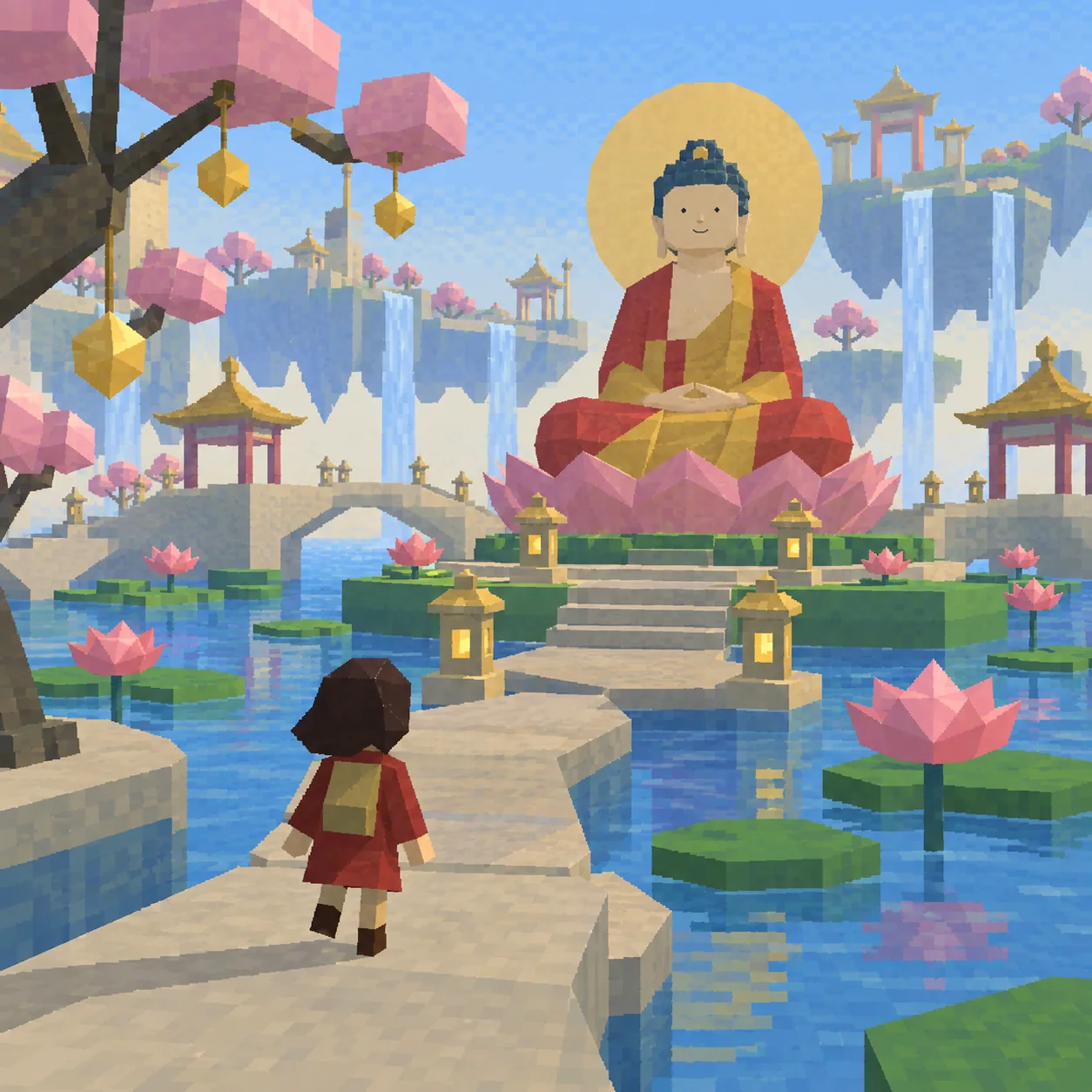
Paintings of his pure realm, Sukhavati, show a palace, a pond, beings born from lotuses and attendant bodhisattvas. A crowned, jewelled red Amitabha also appears in five-family art. Amitayus, his longevity aspect, is usually ornamented and holds a long-life vase.
In traditional art
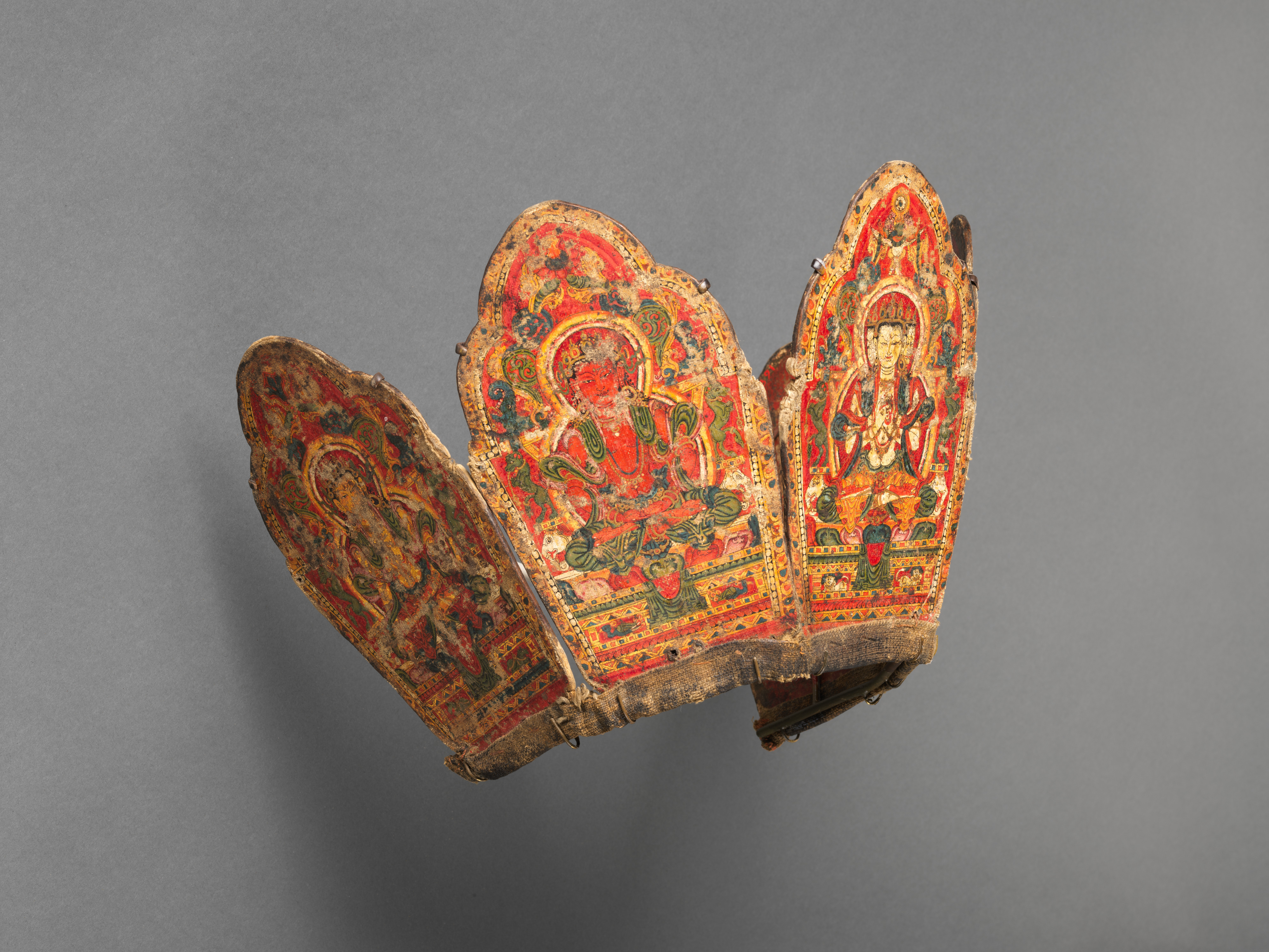
Red Amitābha panel, Ritual Crown with Five Buddhas — Met 1985.391Tibet; probably a Newari artist working in Tibet · Late 14th–early 15th centuryPublic Domain, Met Open Access (CC0).Object record ↗
In other collections
These images stay with the collections that hold them. Each link opens the collection's own page.
- Buddha Amitabha in His Pure Realm — Rubin C2006.66.185 ↗Central Tibet · Late 18th century · rubinmuseum.orgRubin Museum photograph; no open reuse licence stated. Linked museum reference only.
Sources
Depiction requirements and work notes
Amitābha — Öpagme, Buddha of Limitless Light
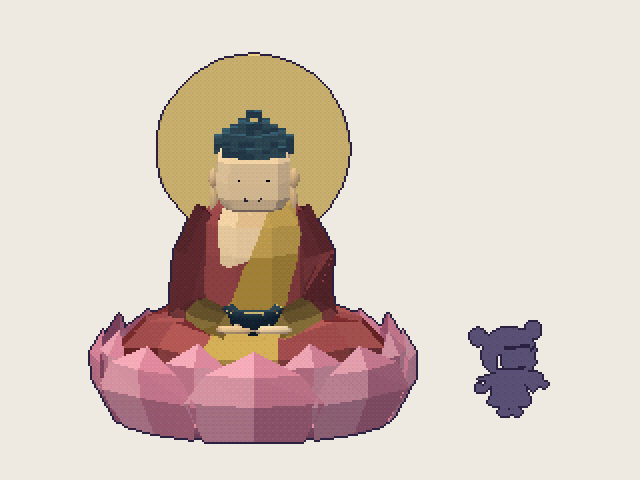
For this game presence, use the red, one-faced, two-armed monastic Amitābha with meditation hands supporting a nectar alms bowl, full vajra seat and lotus/moon support. The model's beige body and ambiguous palm stacking need correction; its robes, bowl, curls and lotus already provide a useful foundation.
The model capture recipe or rig source changed. The visible model geometry changed. Rig source changed or is missing: prototypes/prerendered-look/parts/purelands/amitabha.js Reinspect the model before relying on the recorded defects.
References, criteria, concept and model side by side
Traditional depictions

Selected monastic-form reference: red central Buddha, meditation bowl and patchwork robes within a palace assembly. [am-rubin185]
Object record ↗ · Source image ↗Red meditation Buddha in the middle of this photograph; crown, jewelry and silks identify the ornamented variant. [five-crown]
Object record ↗ · Source image ↗Criteria
The model must show
- Lineage variant: the unornamented monastic Amitābha of Lerab Lingpa's Swift Path to Great Bliss, corroborated by Sakya Paṇḍita
- Body: red skin, one face, two arms; the skin is clearly a different value from the red robes so the face and hands read
- Hands: both palms face up in the lap, own right palm over the left, thumbs approaching at the centre (meditation mudra)
- Held object: an open alms bowl of nectar resting on the stacked palms
- Posture: full crossed vajra posture, with two legs readable beneath the robe rather than one lap mound
- Dress: the three Dharma robes, shown with a few large patchwork or fold facets; no crown and no jewellery
- Head: rounded cranial mound (ushnisha) over compact dark curled hair, long earlobes, a small forehead mark (urna)
- Face: serene and composed, as the library gives this peaceful form: narrow calm eye shapes, level brows, a small closed restrained mouth
- Eyes: solid black silhouettes with no whites, irises, pupils, highlights or glint (project eye rule; a recorded game adaptation, not a claim about traditional painted eyes)
- Seat: a lotus with a moon disc
- Attendants: none required on the lone figure; the palace, pond, lotus births and eight bodhisattvas belong to the Sukhāvatī assembly setting
The model must not show
- Cartoon smiley face: a wide U-shaped or crescent grin, open laughing mouth, rosy cheek dots or mascot cheeks
- Eye whites, irises, pupils, highlights or glint; glowing white-gold eyes (those belong only to freshly liberated beings)
- Any part of the figure (head, crown, hat, halo, raised hand or held object) touching or passing through its canopy, roof, lintel, pillars, throne back or seat in any capture angle
- Beige or gold skin
- A longevity vase in place of the alms bowl (that is Amitāyus)
- A crown or bodhisattva jewellery on this monastic form
- Enlarged smiling cheeks or oversized hair curls that turn the face into a mascot
- Hands or attributes mirrored to the wrong side of the figure's own body (own right appears at viewer-left in a front view)
Original game concept
Current 3D model
presence

Depiction requirements
- Selected body and color
- Keep one peaceful face and two arms. Make the visible skin red, with enough value separation from the red robes to preserve hands and face. Beige skin in the generated concept does not match this selected Tibetan visualization. [am-lh-sogyal] [am-lh-sakya] [five-crown]
- Meditation mudrā and bowl
- Both palms face upward at the lap; place the anatomical right palm over the left, thumbs approaching at the center, and support an alms bowl. Verify palm order against the traditional artwork rather than the rig's reversed left/right names. Keep the vessel recognizably an open alms bowl containing nectar, rather than a longevity vase. [am-lh-sogyal] [am-rubin185]
- Posture and seat
- Use full crossed vajra posture: both feet rest on opposite thighs with upward-facing soles where visible. Construct a leg silhouette beneath the robe instead of a single undifferentiated lap mound. Use a lotus and moon-disc seat; preserve a stable centered torso. [am-lh-sogyal] [am-rubin185]
- Clothing and ornaments
- For this monastic form, use the three Dharma robes, with patchwork/fold logic visible through a few large facets. Keep crown and bodhisattva jewelry absent. A jeweled crowned Amitābha exists in five-family art, but belongs to a separately identified ornamented form. [am-lh-sogyal] [am-rubin185] [five-crown]
- Head and peaceful proportions
- Preserve the cranial protuberance, compact curled hair and elongated earlobes. Add a readable small ūrṇā between the eyebrows if it is absent at game scale. Use calm, narrow eyes and a restrained mouth, following the reference's balanced head/torso relationship. The game's black eyes and toy proportions remain explicit adaptations, not traditional iconometry. [am-lh-sogyal] [am-rubin185]
- Sukhāvatī setting and entourage
- Treat palace, pond, lotus births and bodhisattvas as a sourced assembly setting, not required accessories on every isolated statue. The Rubin painting supplies an eight-bodhisattva palace example. Locate particular attendants individually before using it to dictate their identities or positions. [am-rubin185]
Presentation contract
Ready to build from No readiness block is recorded in the plan.
Setting and sizing rule
A lotus-and-moon seat is required. A Sukhāvatī palace with pond is a sourced assembly setting (Rubin C2006.66.185), not a required accessory. Sizing (plan rule R4, not a sourced claim): the opening of any shrine, canopy or pavilion around the figure leaves at least one of the figure's own head-heights of clear air above its tallest point (the ushnisha) and a clear gap on each side of its widest span (the knees); a throne back or aureole sits behind the figure without passing through it; pillars and lintel do not cross the face, hands or held objects in the front or either three-quarter capture.
Recorded variants · 2
- Crowned five-family Amitābha (Met 1985.391): a red, ornamented meditation figure; valid but a separately identified form
- Amitāyus, the longevity aspect: ornamented, holds a longevity vase; comparison only (Met 2004.139 identification unresolved)
Recorded adaptations · 1
- Solid black eyes and toy proportions are game conventions, not traditional iconometry
Where the plan places it · 1
- sukhavati · The aisle and Amitabha's seat
sukhavati.assembly· character Amitabhaamitabha
Contract sources · 4
- Lerab Lingpa/Tertön Sogyal — The Swift Path to Great Bliss
- Sakya Paṇḍita — Meditation on Amitābha
- Met — Ritual Crown with the Five Transcendent Buddhas, 1985.391
- Rubin Museum — Buddha Amitabha in His Pure Realm, C2006.66.185
Model audit and next pass
Evidence basis: visual + source
Recorded observations
Inspected the original concept and canonical front/three-quarter captures, then the source rig. Existing captures were reviewed; no fresh runtime recapture or animation acceptance was performed.
Both concept and current model have beige skin. The model preserves red/saffron robe blocks, blue curls/uṣṇīṣa, elongated ears, gold halo, an open dark bowl and a faceted pink lotus.
The bowl hides most palm contact. Source places the x-negative palm lower and x-positive palm higher, while commenting that sign -1 is left. For this +Z-front rig, x-negative is anatomical right; the modeled stack therefore needs verification/correction to right over left.
The crossed robe lap does not clearly expose two feet or upward soles. The small frontal face does not show a readily legible ūrṇā.
Source assigns x-negative arm to leftShoulder and x-positive to rightShoulder. This semantic reversal can mislead later gesture or animation changes. Source greeting/blessing clips separate the hands from the static bowl; support continuity requires a later animated inspection.
Directions for a future model pass
First correct the visible body to the selected red Amitābha form and revise the concept's color note so future agents do not reintroduce beige skin.
Inspect the hands without the bowl, resolve the anatomical palm stack, and preserve bowl contact throughout any pose transition.
Give the robe lap a leg/foot construction and readable moon-disc support; keep the pink faceted lotus and monastic silhouette.
Correct or explicitly map reversed anatomical joint names before animation work; inspect front, three-quarter and side after any pose change.
Add a restrained forehead mark and maintain solid-black eye silhouettes. Preserve this baseline through the Atlas workflow; leave the Atlas approval fields as found.
Assessed baseline captures


Documented forms and lineage variants · 2
Preserve one identified form consistently. A variant is usable only with its own source and context.
Crowned five-family Amitābha
The five-panel Tibetan ritual crown shows a red, ornamented meditation figure. This establishes a valid crowned form; it does not override the selected unornamented Sukhāvatī form. [five-crown]
Amitāyus comparison
Amitāyus, the longevity aspect, is commonly ornamented and holds a longevity vase. Met 72419 is titled Amitabha while its prose calls the central figure Amitayus. Use that record only for contextual comparison until the central identification and vessel are resolved. [am-met72419]
What not to copy · 3
Do not change the bowl to a longevity vase or add a crown by copying an Amitāyus image.
Do not infer canonical skin color from gilded metal, gold paint or the existing beige concept.
Do not enlarge smiling cheeks or hair curls until the face becomes a generic mascot; keep the chosen peaceful form identifiable.
Sources and precise locations · 5
- [am-lh-sogyal] Lerab Lingpa/Tertön Sogyal — The Swift Path to Great Bliss ↗
- [am-lh-sakya] Sakya Paṇḍita — Meditation on Amitābha ↗
- [am-rubin185] Rubin Museum — Buddha Amitabha in His Pure Realm, C2006.66.185 ↗
- [five-crown] Met — Ritual Crown with the Five Transcendent Buddhas, 1985.391 ↗
- [am-met72419] Met — Amitabha, Buddha of the Western Pure Land, 2004.139 ↗
Assessment freshness and evidence hashes
The frozen snapshot is authored evidence. Regeneration computes current hashes and leaves that snapshot as it is.
{
  "auditFreshness": {
    "status": "stale",
    "reasons": [
      "The model capture recipe or rig source changed.",
      "The visible model geometry changed.",
      "Rig source changed or is missing: prototypes/prerendered-look/parts/purelands/amitabha.js"
    ]
  },
  "sourceSnapshot": {
    "captureHash": "48e66d5d2c4dad533880dc72a98fa990d4018f479981673971306b5d220699ad",
    "bodyGeometryHash": "30c753f89aa376ef4bef8d5f5282d9baa1f46e88e6d104bbc25d5a3464699222",
    "sourceHashes": {
      "prototypes/prerendered-look/parts/purelands/amitabha.js": "56f7be1f201f5763231b1c10ad975ddc8735b540b7ad30b68abae845cbd174b3"
    },
    "captureHashes": {
      "/atlas/characters/amitabha-48e66d5d2c4d-presence-3q.webp": "dcf3bfb63bbd7164106b82c33ae6c1a4f6160f1866581f0ea3178e15224681c8",
      "/atlas/characters/amitabha-48e66d5d2c4d-presence-front.webp": "db8fbb829393195537c1989e488a4c512970369add229376e4a97a69b9954db5",
      "/atlas/characters/amitabha-fbdba5d5ac48-presence-3q.webp": "dcf3bfb63bbd7164106b82c33ae6c1a4f6160f1866581f0ea3178e15224681c8",
      "/atlas/characters/amitabha-fbdba5d5ac48-presence-front.webp": "db8fbb829393195537c1989e488a4c512970369add229376e4a97a69b9954db5"
    },
    "conceptHashes": {
      "/purelands/concepts/amitabha.webp": "1c82d4ededa5257520ac69d70077897c3eb464f76c87ace1e432dac3c701630e"
    },
    "activeConceptPaths": [
      "/purelands/concepts/amitabha.webp"
    ]
  },
  "currentSnapshot": {
    "captureHash": "6a2602eeb18b62e677cfd79eb3e104a26e3faebe75cfc9d4b49b16ac63395846",
    "bodyGeometryHash": "7ae0cdeb15f9f9e5f7c22c98afea2852c77e73fb5763d9de8bdcca91abbccfab",
    "activeConceptPaths": [
      "/purelands/concepts/amitabha.webp"
    ],
    "sourceHashes": {
      "prototypes/prerendered-look/parts/purelands/amitabha.js": "f65c6d8f91f45773cde4ebbbc73d79d48f8719c966bd997a9ee70146cd211004"
    },
    "captureHashes": {
      "/atlas/characters/amitabha-48e66d5d2c4d-presence-3q.webp": "dcf3bfb63bbd7164106b82c33ae6c1a4f6160f1866581f0ea3178e15224681c8",
      "/atlas/characters/amitabha-48e66d5d2c4d-presence-front.webp": "db8fbb829393195537c1989e488a4c512970369add229376e4a97a69b9954db5",
      "/atlas/characters/amitabha-6a2602eeb18b-presence-3q.webp": "5886061faf9b4641e28e8fc372074c5fc9137960292ec9f3bfaade3ccb5564ee",
      "/atlas/characters/amitabha-6a2602eeb18b-presence-front.webp": "979994d84279a5bd041f284c7081f193ee93a349872967333b71474cada1e6fb",
      "/atlas/characters/amitabha-fbdba5d5ac48-presence-3q.webp": "dcf3bfb63bbd7164106b82c33ae6c1a4f6160f1866581f0ea3178e15224681c8",
      "/atlas/characters/amitabha-fbdba5d5ac48-presence-front.webp": "db8fbb829393195537c1989e488a4c512970369add229376e4a97a69b9954db5"
    },
    "conceptHashes": {
      "/purelands/concepts/amitabha.webp": "1c82d4ededa5257520ac69d70077897c3eb464f76c87ace1e432dac3c701630e"
    }
  }
}