Akṣobhya
Akshobhya, the Immovable Buddha, is Mitrugpa in Tibetan. He is deep blue, with one peaceful face and two arms. His right hand reaches down over the right knee to touch the earth, and his left rests palm up in his lap. His emblem is the vajra, a pronged sceptre.
Karma Chakmé's daily practice dresses him in a monk's robes and seats him on a throne held up by elephants. He sits with legs fully crossed on a lotus and disc. In the five-family account used here he belongs to the east, though other systems arrange the families differently.
Crowned forms with jewellery and silks also exist. A Met painting of him is one of a set of five. It sets the vajra before his throne and surrounds him with other sacred figures.
In traditional art
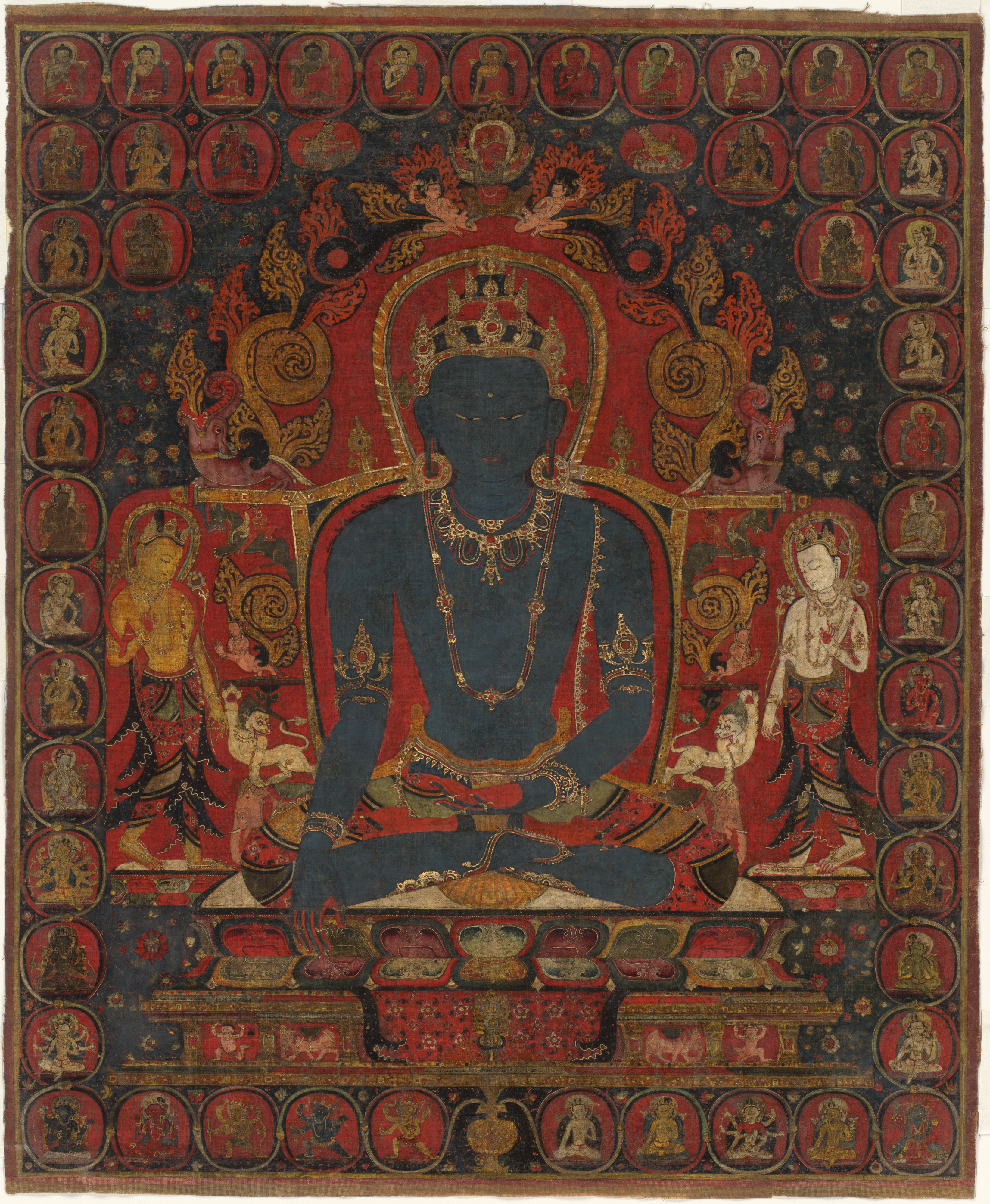
The Transcendent Buddha Akshobhya — Met 2021.288Central Tibet; Newari artist working in Tibet · 13th or early 14th centuryPublic Domain, Met Open Access (CC0).Object record ↗ 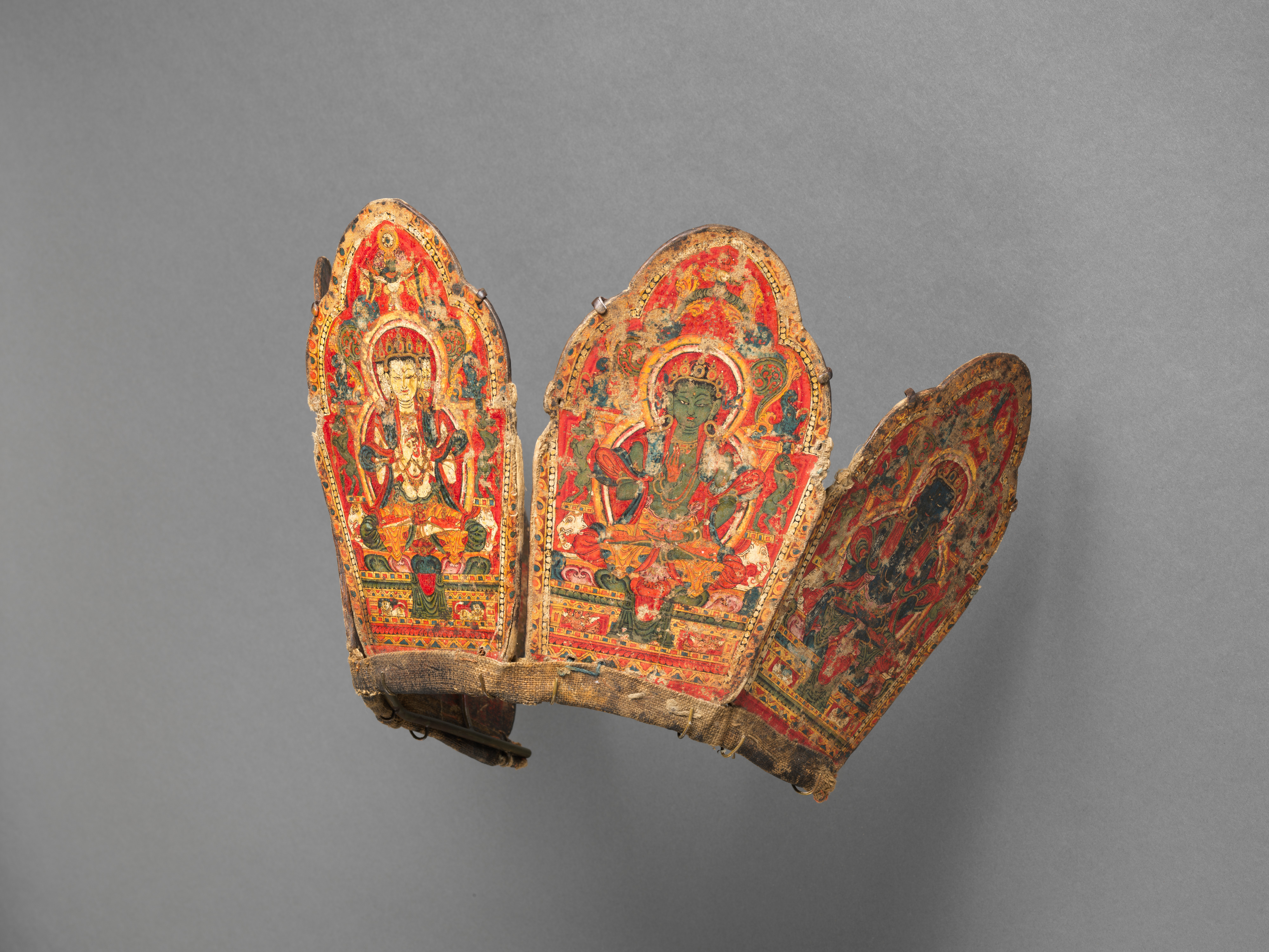
Blue Akṣobhya end panel, Five Buddha crown — Met 1985.391Tibet; probably a Newari artist working in Tibet · Late 14th–early 15th centuryPublic Domain, Met Open Access (CC0).Object record ↗
Sources
Depiction requirements and work notes
Akṣobhya — Mitrugpa, the Immovable Buddha
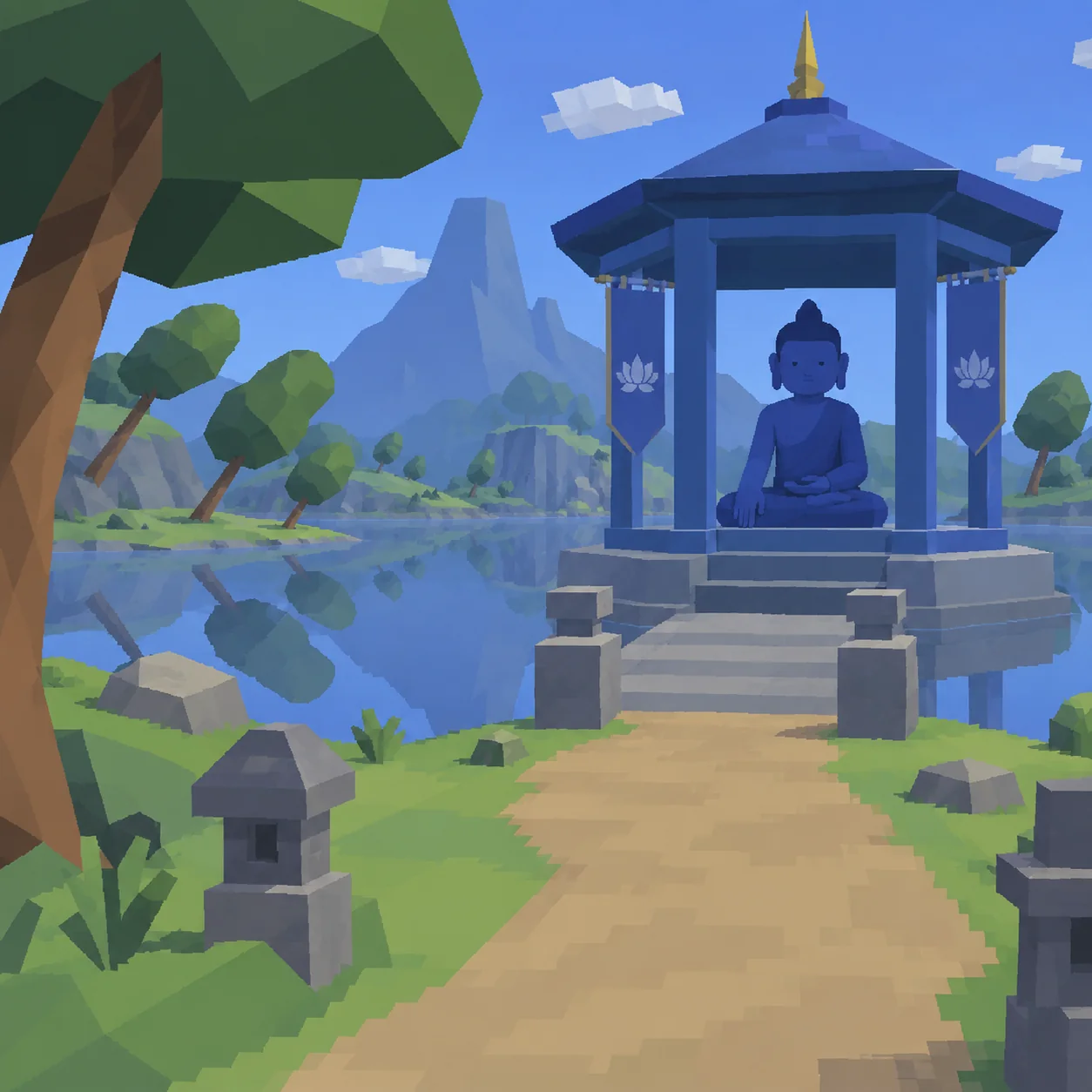
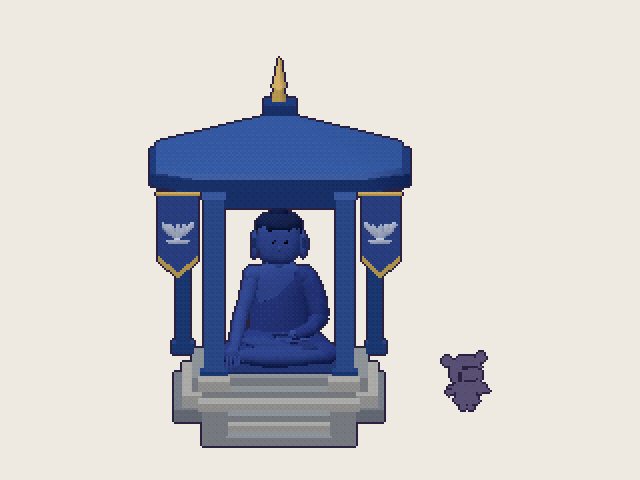
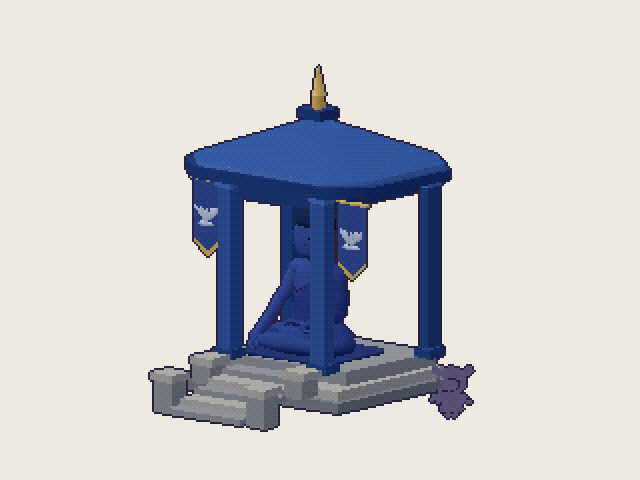
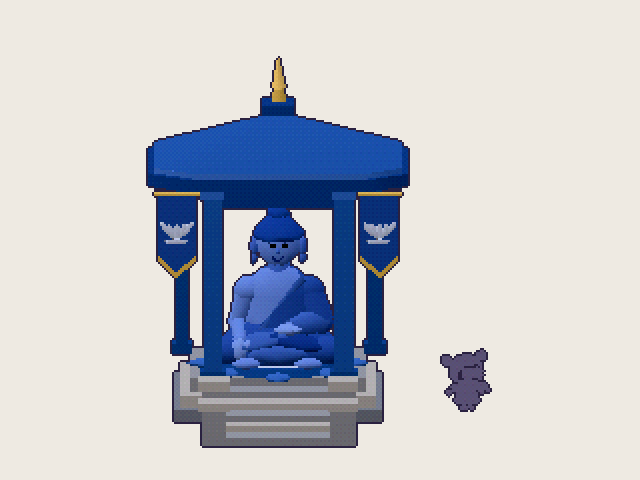
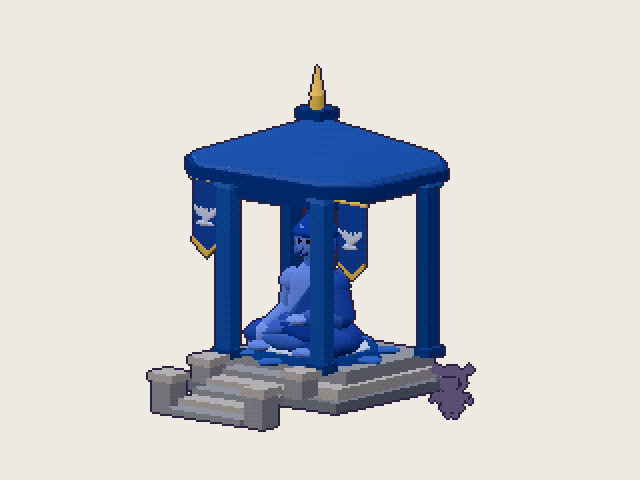
The blue model preserves the correct anatomical right earth-touching arm and left lap hand. The pavilion obscures the identifying gesture and face in the three-quarter view, and the vajra emblem is absent. Keep a source-supported monastic form while improving gesture, seat and visibility.
The model capture recipe or rig source changed. The visible model geometry changed. Rig source changed or is missing: prototypes/prerendered-look/parts/purelands/akshobhya.js Reinspect the model before relying on the recorded defects.
References, criteria, concept and model side by side
Traditional depictions
Blue crowned Akṣobhya: right fingers descend over the knee, left hand rests in lap; vajra is before the throne. Costume is the ornamented alternate. [ak-met854905]
Object record ↗ · Source image ↗Blue end panel at photograph's right edge. Angled, darkened surface limits finger inspection; use the independent thangka for detailed hands. [five-crown]
Object record ↗ · Source image ↗Criteria
The model must show
- Lineage variant: the blue eastern five-family Akṣobhya in monastic (nirmāṇakāya) dress, after Karma Chakmé
- Body: deep blue skin, one face, two arms
- Hands: own right arm reaches down over the right knee, fingers toward the ground, palm turned inward (earth-touching); own left palm rests upward in the lap
- Held object: none in the hands; a vajra (symmetric pronged sceptre) stands before the seat, as in Met 2021.288
- Dress: Dharma robes with visible robe construction; no crown or jewellery
- Posture: full vajra posture with crossed legs readable beneath the robes
- Head: rounded cranial mound (ushnisha) over compact dark curled hair, long earlobes, a small forehead mark (urna)
- Face: serene and composed, as the library gives this peaceful form: narrow calm eye shapes, level brows, a small closed restrained mouth
- Eyes: solid black silhouettes with no whites, irises, pupils, highlights or glint (project eye rule; a recorded game adaptation, not a claim about traditional painted eyes)
- Seat: a lotus with a disc; Karma Chakmé gives an elephant-supported throne, which is either built or recorded as omitted
- Attendants: none required on the lone figure
The model must not show
- Cartoon smiley face: a wide U-shaped or crescent grin, open laughing mouth, rosy cheek dots or mascot cheeks
- Eye whites, irises, pupils, highlights or glint; glowing white-gold eyes (those belong only to freshly liberated beings)
- Any part of the figure (head, crown, hat, halo, raised hand or held object) touching or passing through its canopy, roof, lintel, pillars, throne back or seat in any capture angle
- The earth-touching hand on the figure's own left
- A medicine plant or bowl (that is the blue Medicine Buddha)
- A crown or jewellery on this monastic form
- A vajra pushed into the earth-touching hand
- A pavilion or pillar hiding the face, the right hand or the vajra in the three-quarter view
Original game concept
Current 3D model
presence
Depiction requirements
- Body and direction
- For the selected eastern five-family account, preserve deep blue skin, one peaceful face and two arms. Record the mandala account before assigning a universal central/eastern role; other systems arrange the families differently. [ak-met854905] [five-crown]
- Anatomical right earth-touching hand
- Bring the anatomical right arm down over the right knee, fingers extending toward the ground, palm turned inward/back toward the body. Keep the left palm upward in the lap in meditation. In a frontal view the right earth-touching hand appears on the viewer's left. [ak-har373] [ak-lywa]
- Vajra attribute
- Make the vajra recognizably a symmetric pronged scepter, placed as in the chosen reference: the Met painting uses the vajra before the throne. Do not invent a new hand-held arrangement merely to add an emblem; retain correct earth-touching hand contact. [ak-met854905]
- Clothes and ornaments
- For the current monastic interpretation, retain Dharma robes and visible robe construction rather than adding crown/jewelry automatically. Karma Chakmé explicitly gives nirmāṇakāya garb. The crowned Met and Rubin examples are separate valid ornamented forms. [ak-lh-chakme] [ak-met854905] [ak-har373]
- Legs, seat and supports
- Use full vajra posture with crossed feet/soles that can be understood beneath the robes. Build a lotus and appropriate disc support. An elephant-supported throne belongs to Karma Chakmé's description and the cited ornamented account; include it if reproducing that full throne, or label its omission in the compressed game scene. [ak-lh-chakme] [ak-har373]
- Peaceful face and head
- Keep elongated ears, ūrṇā and a coherent hair/uṣṇīṣa structure. Use a calm mouth and narrow black eye silhouettes in the game. The reference painting's arched brows, balanced neck and long eyes can guide the silhouette; do not claim the current toy head satisfies a traditional proportion grid. [ak-met854905] [ak-lh-chakme]
- Entourage and display
- The Met painting belongs to a five-painting group and contains surrounding sacred figures. It supports a directional assembly, not a mandatory list of attendants for every standalone Akṣobhya. In the asset library, keep face, right hand and vajra visible before emphasizing architectural scenery. [ak-met854905]
Presentation contract
Ready to build from No readiness block is recorded in the plan.
Setting and sizing rule
A lotus-and-disc seat, with the elephant throne built or its omission recorded. The face, earth-touching hand and vajra stay visible from the front and both three-quarter views. Sizing (plan rule R4, not a sourced claim): the opening of any shrine, canopy or pavilion around the figure leaves at least one of the figure's own head-heights of clear air above its tallest point (the ushnisha) and a clear gap on each side of its widest span (the right hand at the knee and the left knee); a throne back or aureole sits behind the figure without passing through it; pillars and lintel do not cross the face, hands or held objects in the front or either three-quarter capture.
Recorded variants · 1
- Crowned ornamented Akṣobhya (Met 2021.288; HAR 373): a separate valid form that does not overwrite the monastic one
Recorded adaptations · 1
- Leaving out the elephant-supported throne in the compressed game scene is a recorded omission
Where the plan places it · 1
- abhirati · The blue pavilion
abhirati.pavilion· character Akshobhyaakshobhya
Contract sources · 5
- Met — The Transcendent Buddha Akshobhya, 2021.288
- Met — Ritual Crown with the Five Transcendent Buddhas, 1985.391
- HAR 373 — Akshobhya, Rubin P1996.20.21
- Lama Zopa Rinpoche — Ganden Lha Gyäma commentary, 12. Prostration
- Karma Chakmé — A Daily Practice of Buddha Akṣobhya
Model audit and next pass
Evidence basis: visual + source
Recorded observations
Inspected original concept, canonical front/three-quarter captures and rig source. This assessment uses existing captures; no runtime recapture.
Blue skin and monastic cloth, anatomical right down over the knee and left lap hand agree with the selected gesture family. The concept has the same core arrangement.
The full pavilion shrinks the figure in the front view. A front pillar covers most of the face and part of the hand/torso in the three-quarter view; the model's primary identity is difficult to inspect.
No clear vajra appears at the hand, lap or front of the throne. The crossed feet and lotus/disc support are difficult to read beneath the blue seated mass.
The earth-touching arm is on x-negative, which is anatomical right, but the source registers it as leftShoulder/leftElbow. The hair cap and protuberance are pointed, with limited separation from the blue head.
Directions for a future model pass
First provide an unobstructed review/display view and adjust the pavilion opening or framing so the face and anatomical right hand remain visible from the required three-quarter angle.
Clarify the fingers reaching over the right knee and add the cited vajra at the selected throne location without disturbing that gesture.
Expose full-vajra leg structure, lotus and disc support; disposition elephant throne supports if adopting Karma Chakmé's full described setting.
Refine the calm head/cranial silhouette and preserve monastic robes unless a separately identified crowned form is commissioned.
Correct or map reversed anatomical joints, preserve the baseline and review every angle through Atlas. Leave approval fields unchanged.
Assessed baseline captures
Documented forms and lineage variants · 1
Preserve one identified form consistently. A variant is usable only with its own source and context.
Crowned ornamented Akṣobhya
Met 2021.288 depicts deep-blue skin, crown, jewelry and silks. HAR 373 catalogues a gold-painted ornamented example while quoting a blue visualization. Neither surface color nor crown should silently overwrite the selected monastic game form. [ak-met854905] [ak-har373]
What not to copy · 3
Do not confuse Akṣobhya's blue earth-touching form with a blue Medicine Buddha holding a medicine plant and bowl.
Do not move the earth-touching gesture to anatomical left based on mislabeled rig joints.
Do not make pavilion dimensions dictate a camera that hides the sacred figure's identity markers.
Sources and precise locations · 5
- [ak-met854905] Met — The Transcendent Buddha Akshobhya, 2021.288 ↗
- [five-crown] Met — Ritual Crown with the Five Transcendent Buddhas, 1985.391 ↗
- [ak-lh-chakme] Karma Chakmé — A Daily Practice of Buddha Akṣobhya ↗
- [ak-har373] HAR 373 — Akshobhya, Rubin P1996.20.21 ↗
- [ak-lywa] Lama Zopa Rinpoche — Ganden Lha Gyäma commentary, 12. Prostration ↗
Assessment freshness and evidence hashes
The frozen snapshot is authored evidence. Regeneration computes current hashes and leaves that snapshot as it is.
{
  "auditFreshness": {
    "status": "stale",
    "reasons": [
      "The model capture recipe or rig source changed.",
      "The visible model geometry changed.",
      "Rig source changed or is missing: prototypes/prerendered-look/parts/purelands/akshobhya.js"
    ]
  },
  "sourceSnapshot": {
    "captureHash": "ca0433f9c93f254acbaa7d535c9c01e6bd6d361feaff5d8d16e3503e60644408",
    "bodyGeometryHash": "f91f3b2e6fc5d1017045ed3c04caf10610207eaf043dde10d8737f7f0705280a",
    "sourceHashes": {
      "prototypes/prerendered-look/parts/purelands/akshobhya.js": "ddda7741ef9bfa05732303a16a9e4661f3a9f698bfc9f2a00e32842d3f89a3fa"
    },
    "captureHashes": {
      "/atlas/characters/akshobhya-1b0b6a7676f8-presence-3q.webp": "d3187dc4f9e5962cfab7e48ee8f47c9c66231060926d925d21888bf317b148c8",
      "/atlas/characters/akshobhya-1b0b6a7676f8-presence-front.webp": "c80380d03db7501718dfe59c271a62d51c649d814b2f3fbe68d2fe9e7f2ee5ec",
      "/atlas/characters/akshobhya-ca0433f9c93f-presence-3q.webp": "d3187dc4f9e5962cfab7e48ee8f47c9c66231060926d925d21888bf317b148c8",
      "/atlas/characters/akshobhya-ca0433f9c93f-presence-front.webp": "c80380d03db7501718dfe59c271a62d51c649d814b2f3fbe68d2fe9e7f2ee5ec"
    },
    "conceptHashes": {
      "/purelands/concepts/akshobhya.webp": "c58d86e17a0540e1e25020fbbeea118adb32f80dacff794805145c77f777280d"
    },
    "activeConceptPaths": [
      "/purelands/concepts/akshobhya.webp"
    ]
  },
  "currentSnapshot": {
    "captureHash": "216d7aa52a91439f7e655971a1c594e019178b890e04f37f26299e114bd071d9",
    "bodyGeometryHash": "3ae519c82d582033f2adeaed9d76da5a3c640acc9a10f59035541ad3af1f8dc6",
    "activeConceptPaths": [
      "/purelands/concepts/akshobhya.webp"
    ],
    "sourceHashes": {
      "prototypes/prerendered-look/parts/purelands/akshobhya.js": "5f589b917a5f2cba22152a9e43101d2a9a1985047c2b60f534d9dd2c8cd532ba"
    },
    "captureHashes": {
      "/atlas/characters/akshobhya-1b0b6a7676f8-presence-3q.webp": "d3187dc4f9e5962cfab7e48ee8f47c9c66231060926d925d21888bf317b148c8",
      "/atlas/characters/akshobhya-1b0b6a7676f8-presence-front.webp": "c80380d03db7501718dfe59c271a62d51c649d814b2f3fbe68d2fe9e7f2ee5ec",
      "/atlas/characters/akshobhya-216d7aa52a91-presence-3q.webp": "17d64a465c4ccd0deb7832d90b14393fa2f4f56e430029a4da72e4f7f3f6a5e5",
      "/atlas/characters/akshobhya-216d7aa52a91-presence-front.webp": "52e8cc918c1075dcd6f644a6b30989c9370891a62dea2d37ed32475e8c49ae74",
      "/atlas/characters/akshobhya-ca0433f9c93f-presence-3q.webp": "d3187dc4f9e5962cfab7e48ee8f47c9c66231060926d925d21888bf317b148c8",
      "/atlas/characters/akshobhya-ca0433f9c93f-presence-front.webp": "c80380d03db7501718dfe59c271a62d51c649d814b2f3fbe68d2fe9e7f2ee5ec"
    },
    "conceptHashes": {
      "/purelands/concepts/akshobhya.webp": "c58d86e17a0540e1e25020fbbeea118adb32f80dacff794805145c77f777280d"
    }
  }
}