Ākāśagarbha
Akashagarbha, Namkhé Nyingpo in Tibetan, is the Essence of Space, one of the Eight Close Sons. Mipham's verses give him the sword as his emblem, and a peaceful, blue-green sword form is well attested in Tibetan art. Which hand holds the sword, and how, varies.
A Palpung painting has him hold the sword low across his body. Other forms carry a disc or jewel on a lotus. The Three Hundred Icons plate shows that round emblem in his raised right hand, with the left lowered. In tantric assemblies he can appear with a consort, as on a Met initiation card where he is yellow.
One Rubin painting titled Akashagarbha may instead show Sarvanivaranavishkambhin, because a near-identical painting carries that name in an inscription.
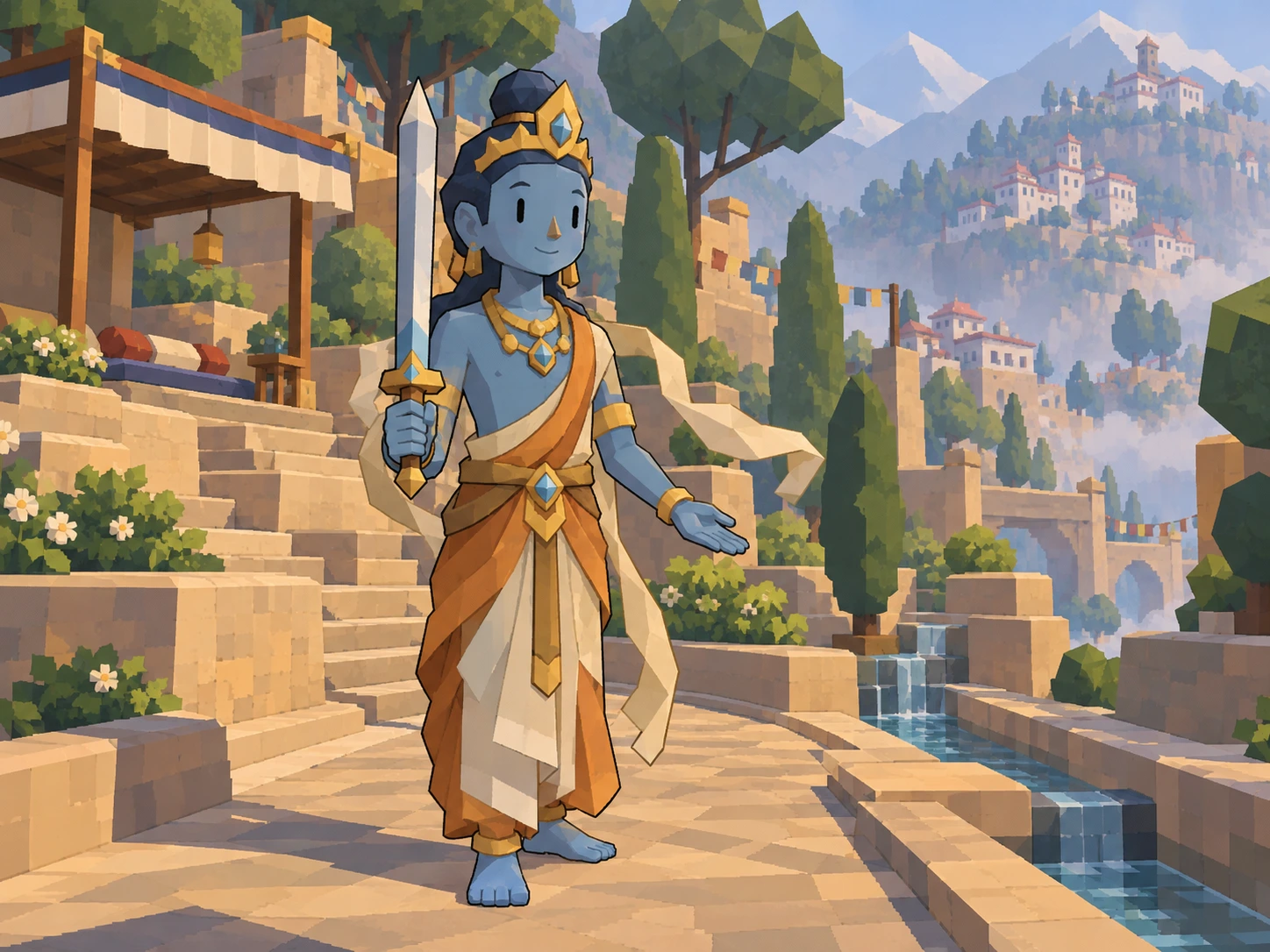
In traditional art
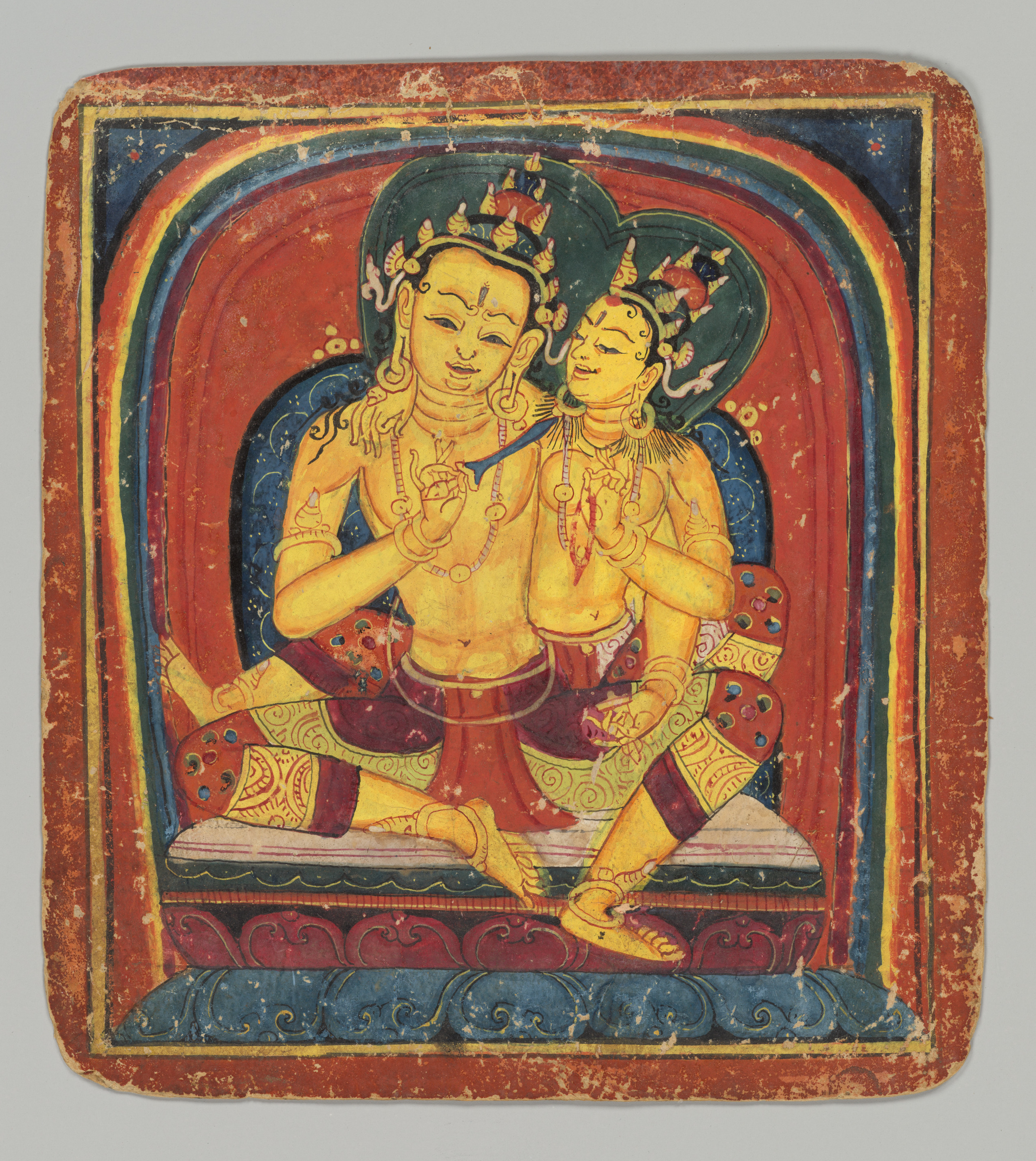
Special tantric form with consort — Ākāśagarbha, Met 2000.282.7Tibet; probably Nepali artist for Tibetan Nyingma patron · Early 15th centuryPublic Domain; Met Open Access API isPublicDomain=true, verified 2026-10-02.Object record ↗
In other collections
These images stay with the collections that hold them. Each link opens the collection's own page.
- Standing sword-form Ākāśagarbha — HAR 916 / P1999.29.11 ↗Eastern Tibet · 1700–1799 · himalayanart.orgHAR record: Photographed Image Copyright © 2004 Shelley & Donald Rubin Foundation; reproduction licence not established.
- Alternative lotus-emblem Ākāśagarbha — Three Hundred Icons / HAR 78250 ↗Tibet, Gelug · 1900–1959 (HAR record) · himalayanart.orgHAR record: Photographed Image Copyright © 2003 Publication: Three Hundred Icons; reproduction licence not established.
- DISPUTED: Ākāśagarbha OR Nivāraṇaviṣkambhin — Rubin C2003.11.2 ↗Tibet (Rubin); Eastern Tibet (HAR) · 19th century · rubinmuseum.orgRubin Museum copyrighted image; limited noncommercial educational/personal use under Section 5 terms with credit; no open commercial licence.
Sources
- Mipham Rinpoche, Verses of the Eight Noble Auspicious Ones ↗
- Akashagarbha, HAR 916, P1999.29.11 ↗
- Three Hundred Icons plate, Akashagarbha, HAR 78250 ↗
- Metropolitan Museum, Initiation Card (Tsakalis): Akashagarbha, 2000.282.7 ↗
- Rubin Museum, Akashagarbha, C2003.11.2 ↗
- HAR 65280, Akashagarbha OR Nivaranavishkambhin ↗
Depiction requirements and work notes
Ākāśagarbha (Nam mkha’i snying po), bodhisattva; contested artwork identifications must remain labeled
Ākāśagarbha (Tibetan Namkhé Nyingpo, Essence of Space) belongs to the Eight Close Sons. A sword is supported by Mipham's Tibetan liturgy; a blue/green sword form is well attested in Tibetan art. Other forms carry a lotus-borne disk/jewel or appear with a consort in tantric assemblies. The current blue crowned sword figure is defensible; preserve its identity while specifying the reference tradition.
The model capture recipe or rig source changed. Reinspect the model before relying on the recorded defects.
References, criteria, concept and model side by side
Traditional depictions

Visually inspected: blue-green standing peaceful figure with halo, long earrings and layered orange/red garments, sword held horizontally across the lower torso, within the Konchog Pende/Palpung Eight Sons set. This shows a defensible sword/color combination, while its robed dress and standing composition are source-specific. [akasha-har-pal-pung]
Object record ↗ · Source image ↗
Visually inspected named plate: seated crowned jeweled figure on lotus, raised anatomical right hand supporting a lotus flower with round emblem, left hand lowered. Monochrome; no body-color claim. A documented alternative rather than a license to remove the sword from the selected Mipham form. [akasha-three-hundred]
Object record ↗ · Source image ↗Visually inspected initiation card: yellow crowned male with consort on lotus/throne, broad red aureole, necklaces and silks, sword crossing chest. Specialized mandala context. Do not use it to assert that the game's isolated blue peaceful sword resident is wrong. [akasha-met-tsakali]
Object record ↗ · Source image ↗
Disputed identity must stay in caption: museum labels Akashagarbha; HAR notes near-identical inscribed Hahn composition names Nivaranavishkambhin. Blue figure and attendant-held sword are identification clues, not decisive proof. Use as a cautionary comparison, not sole canonical template. [akasha-rubin-contested] [akasha-har-rubin-contested] [rubin-rights]
Object record ↗ · Source image ↗Criteria
The model must show
- Selected account: the yellow standing Chokling Tersar assembly form from Second Neten Chokling, Vast Clouds of Samantabhadra’s Display, with Mipham’s seventh emblem, sword, as already selected in the lhakhang home. The shared text and emblem stanza have different scopes; neither supplies a complete visual prototype.
- Body and posture: yellow, peaceful standing bodhisattva in silk and jewels, smiling toward the principal figure. Preserve the restrained expression under R3 and the project low-poly art register.
- Hands and emblem: hold emblem-bearing lotus stems with the anatomical right hand teaching and the left protecting; the lotus supports the sword emblem. Do not transfer the direct sword grip, low open left palm, blade angle or garments of the blue-green handheld-sword alternative.
- Detailed sword/stem side, finger contacts, blade orientation and exact support remain pending a compatible whole-form reference. Mipham supplies the sword identity, not its hand placement or body colour.
- Keep the sword readable as the selected emblem without substituting Mañjuśrī’s flaming-sword-and-scripture pairing. The Three Hundred Icons disk form remains a separate legitimate alternative.
- Eyes: solid black silhouettes with no whites, irises, pupils, highlights or glint (project eye rule; a recorded game adaptation, not a claim about traditional painted eyes)
- Maintain a readable complete standing silhouette, both hands and lotus emblem; the crown, sword and support must clear the enclosure in every capture angle (R4).
The model must not show
- Cartoon smiley face: a wide U-shaped or crescent grin, open laughing mouth, rosy cheek dots or mascot cheeks
- Eye whites, irises, pupils, highlights or glint; glowing white-gold eyes (those belong only to freshly liberated beings)
- Any part of the figure (head, crown, hat, halo, raised hand or held object) touching or passing through its canopy, roof, lintel, pillars, throne back or seat in any capture angle
- Removing the sword because Mañjuśrī also carries one
- A consort or tantric assembly dress (Met 2000.282.7 context)
- Japanese Kokūzō imagery
- Rubin C2003.11.2 used as undisputed identification
- Recolouring the blue-green handheld-sword form yellow while retaining its direct sword grip and calling it the Chokling lotus-emblem form.
- Importing an unsupported hand side, garment, seat or blade orientation from a different composition to fill gaps in the selected standing account.
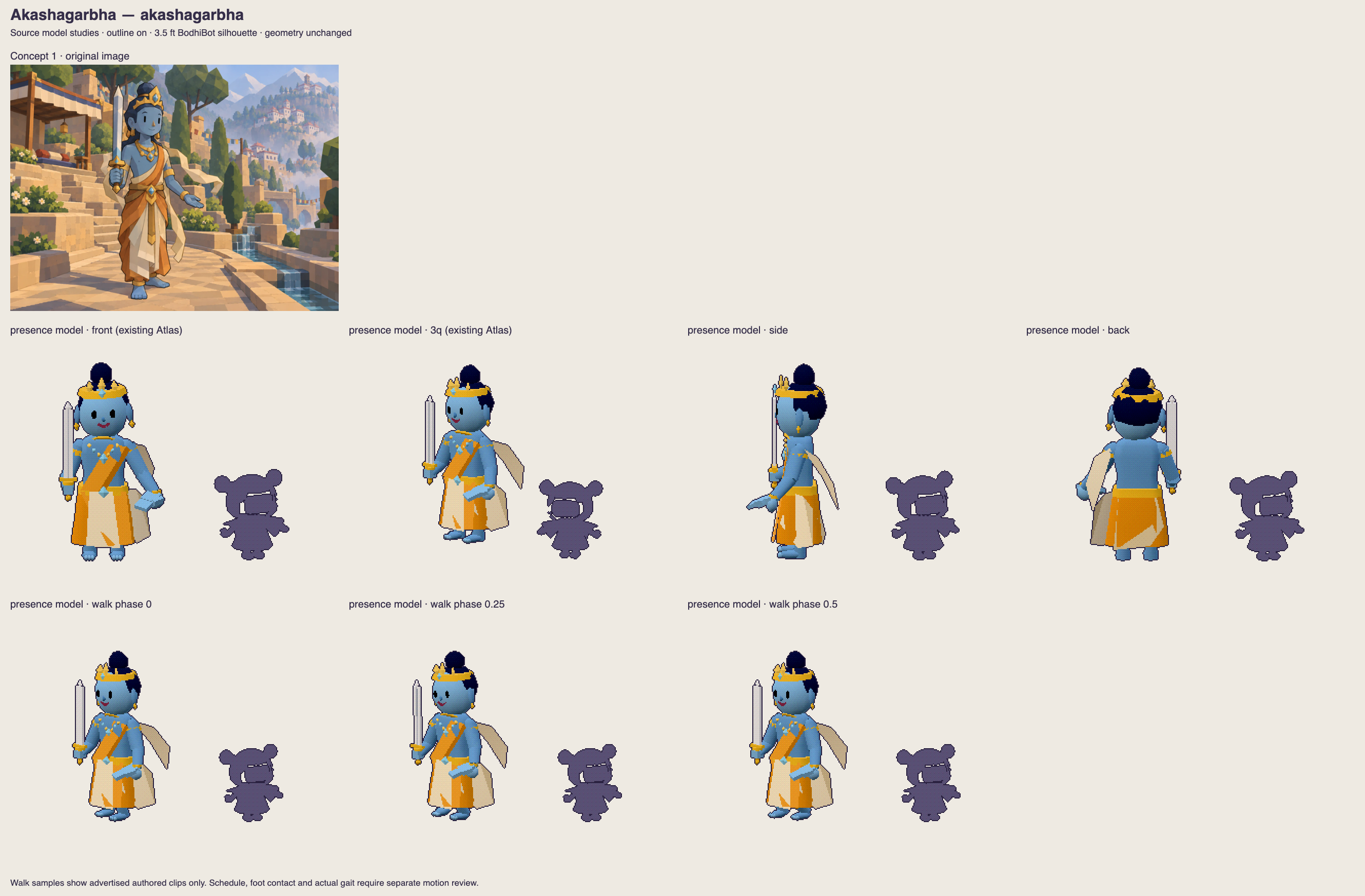
Original game concept
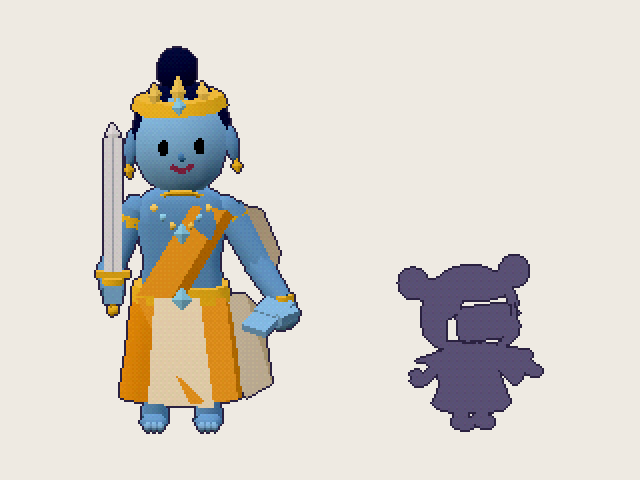
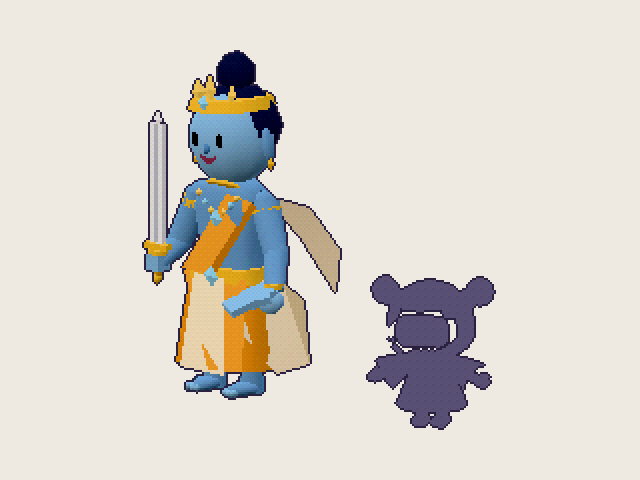
Current 3D model
presence
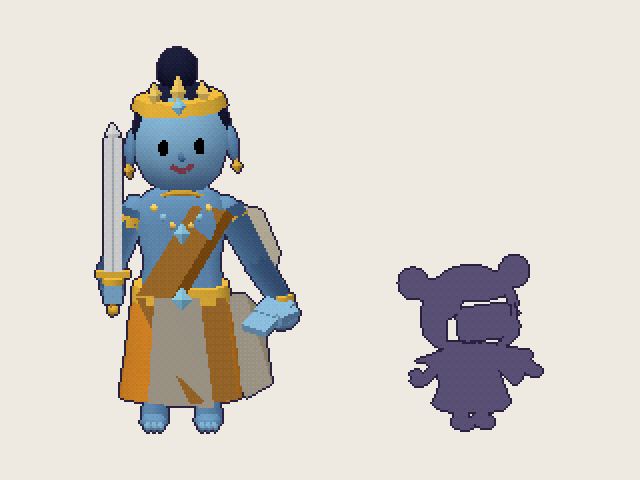
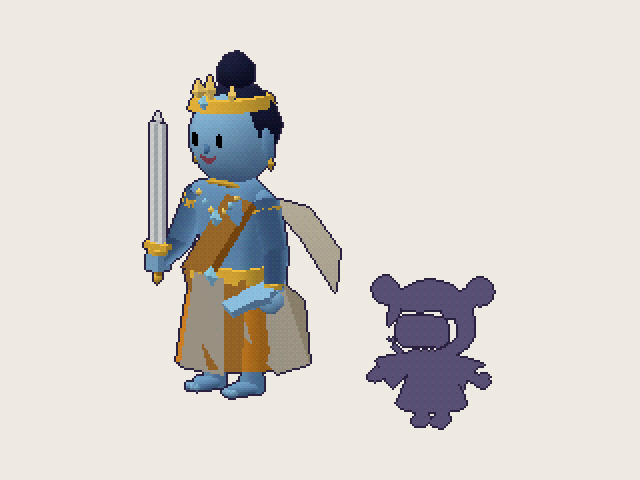
Depiction requirements
- Identity emblem
- Keep the sword clearly legible if following Mipham's Eight Auspicious Ones emblem sequence. This text associates Ākāśagarbha with the seventh emblem, sword, but does not prescribe the hand, blade orientation or body color. [eight-auspicious-mipham]
- Body and dress
- Blue/green color is defensible for a Tibetan sword appearance. Maintain peaceful expression, elongated ears and coherent robes/silks or ornaments from a selected reference. Do not mix the green standing robed Palpung form's exact dress with a jeweled tantric consort form and call that one universal standard. [akasha-har-pal-pung] [akasha-har-rubin-contested] [akasha-met-tsakali]
- Hands and sword
- For visual polish, verify the sword as a sacred identity attribute in all intended views, with grip, blade and hand clearly separated. Which hand holds it varies with composition. HAR 916 holds the sword low across the body; Rubin's contested image has an attendant holding it. Neither proves that all forms must use an overhead fighting pose. [akasha-har-pal-pung] [akasha-har-rubin-contested]
- Lineage variation
- The Three Hundred Icons plate depicts a lotus-borne circular emblem in the raised anatomical right hand and left hand lowered. Treat this as an alternative named plate. The monochrome image does not establish a required body color, and its circular emblem should not be relabeled a sword. [akasha-three-hundred]
- Attribution strength
- Do not use Rubin C2003.11.2 as unquestioned identification evidence. Museum title says Akashagarbha; HAR explicitly proposes Akashagarbha OR Nivaranavishkambhin because a near-identical Hahn painting has an inscription naming the latter. Keep the disputed identification in every reuse caption. [akasha-rubin-contested] [akasha-har-rubin-contested]
Presentation contract
Blocked · not ready to build from The plan holds this contract back (status pending · modelReady false · buildBlocked true) until the points below are settled.
Why it is blocked: unresolved form and pending research
- Obtain a compatible securely identified complete depiction or located prescription for the selected yellow standing lotus-sword form, including exact sword/stem side, finger contacts, blade orientation and support. Do not infer those details from the distinct blue-green handheld-sword, tantric consort or disk-emblem alternatives.
- The former blue handheld-sword game combination retains its own unresolved reference question as an alternative; moving it out of the active selection does not establish its source accuracy.
Setting and sizing rule
Selected standing court form: support and niche are authored staging, sized to the complete crown, lotus-sword and both hands under R4. Exact traditional support remains pending; the cited shared passage does not prescribe the former handheld-sword silhouette or a particular throne/base.
Selected form
- account
- Chokling Tersar yellow standing court with Mipham sword emblem
- source
- docs/buddhist-iconography/data/eight-bodhisattvas.json#sharedAssemblyAccount
- emblemSource
- docs/buddhist-iconography/data/eight-bodhisattvas.json#akashagarbha/eight-auspicious-mipham
- selectionBasis
- Already selected in docs/world-plan/places/lhakhang.json characters[id=akashagarbha].home.stationary and notes.selectedAccount
- wholeVisualReference
- pending compatible complete depiction; no full visual acceptance claimed
Recorded variants · 5
- Three Hundred Icons plate (HAR 78250): seated, crowned, a lotus-borne circular emblem in the raised right hand, left lowered
- Met 2000.282.7: yellow male with consort in an initiation-card mandala
- Chokling assembly account: yellow
- Rubin C2003.11.2 / HAR 65280: Ākāśagarbha or Nīvaraṇaviṣkambhin, disputed
- HAR 916 / P1999.29.11 and the former blue-green handheld-sword game contract remain separate comparison evidence; the exact game combination still requires a secure reference. They are not recoloured into the Chokling court form.
Alternative forms kept for comparison · 1
- Prior blue/blue-green handheld-sword game contract, now an alternative rather than the active Chokling court selection. The exact current handheld combination still needs a secure whole-form reference; HAR 916 is comparative evidence, not permission to recolour this form yellow.
Recorded adaptations · 1
- The existing blue rig’s costume and colour are recorded by the library modelAudit as game adaptations; preserve that provenance. The current right-hand upright sword and low open left palm are design history, not the selected Chokling hand program.
Where the plan places it · 1
- The lha-khang, a small temple, and its teaching precinct · The teaching precinct
lhakhang.precinct· character Akashagarbhaakashagarbha
Contract sources · 7
- Mipham Rinpoche, Verses of the Eight Noble Auspicious Ones
- Akashagarbha, HAR 916, P1999.29.11
- HAR 65280, Akashagarbha OR Nivaranavishkambhin
- Metropolitan Museum, Initiation Card (Tsakalis): Akashagarbha, 2000.282.7
- Three Hundred Icons plate, Akashagarbha, HAR 78250
- Rubin Museum, Akashagarbha, C2003.11.2
- Second Neten Chokling: Vast Clouds of Samantabhadra’s Display
Model audit and next pass
Evidence basis: visual + source
Recorded observations
Visual: Concept and front/three-quarter/side/back captures show a blue peaceful standing bodhisattva, dark gathered hair, gold crown, earrings/armlets/necklace, ochre-and-cream silks, an upright silver sword in anatomical right hand, and a low open left palm.
Source: akashagarbha.js explicitly makes the sword anatomical right (-X), with left (+X) open. It records color/costume as game adaptations rather than a ritual assertion.
Source: The sword remains an actor attachment, so it does not suffer the scripture/scenery extraction problem seen in Mañjuśrī.
Audit limit: A sword is supported by Mipham’s ordered auspicious-emblem program for Ākāśagarbha. Do not remove it on the mistaken premise that only Mañjuśrī may carry a sword.
Audit limit: Rubin C2003.11.2’s Ākāśagarbha identification is disputed by an inscription on a closely related Hahn painting naming Nīvaraṇaviṣkambhin; it is not secure authority for a universal color/form.
Directions for a future model pass
P1 — Keep the sword defensible but bind the full appearance to an identified program. If choosing Mipham’s emblem program, make the lotus/emblem relationship explicit; if choosing the blue handheld-sword variant, supply a secure reference for that exact combination.
P1 — Document blue as a chosen variant; the Chokling assembly program is yellow and should not be mixed indiscriminately with other gestures/colors.
P2 — Refine open palm gesture, crown leaves and draped silks against the chosen artifact. Ensure the sword remains distinct from Mañjuśrī’s flaming sword-and-scripture pairing at gameplay scale.
P2 — Do not use tantric consort imagery or disputed single-figure paintings as unmarked default-model instructions.
Assessed baseline captures
Documented forms and lineage variants · 3
Preserve one identified form consistently. A variant is usable only with its own source and context.
Mipham auspiciousness / Tibetan sword form: sword emblem; blue-green body can be supported by specific art, with peaceful appearance. Posture and exact garment vary.
Three Hundred Icons named plate: seated crowned figure, lotus-borne circular emblem in raised right hand and lowered left hand. A distinct traditional alternative; do not make a blanket sword-only rule.
Met 2000.282.7: yellow male figure with consort in an initiation-card mandala context. This special tantric composition is not the same as an isolated peaceful pure-land resident.
What not to copy · 4
Do not identify every blue sword-holder as Ākāśagarbha from color and weapon alone; evaluate inscription, assembly and catalogue evidence.
Do not turn an identification dispute into a model correction command.
Do not borrow Japanese Kokūzō imagery or a tantric consort assembly as an unlabeled replacement for the game's peaceful Tibetan resident.
Do not demand a sword for every historical form, or demand blue from a monochrome plate.
Sources and precise locations · 7
- [eight-auspicious-mipham] Mipham Rinpoche, Verses of the Eight Noble Auspicious Ones ↗
- [akasha-har-pal-pung] Akashagarbha, HAR 916, P1999.29.11 ↗
- [akasha-three-hundred] Three Hundred Icons plate, Akashagarbha, HAR 78250 ↗
- [akasha-met-tsakali] Metropolitan Museum, Initiation Card (Tsakalis): Akashagarbha, 2000.282.7 ↗
- [akasha-rubin-contested] Rubin Museum, Akashagarbha, C2003.11.2 ↗
- [akasha-har-rubin-contested] HAR 65280, Akashagarbha OR Nivaranavishkambhin ↗
- [rubin-rights] Rubin Museum, Terms & Conditions ↗
Assessment freshness and evidence hashes
The frozen snapshot is authored evidence. Regeneration computes current hashes and leaves that snapshot as it is.
{
  "auditFreshness": {
    "status": "stale",
    "reasons": [
      "The model capture recipe or rig source changed."
    ]
  },
  "sourceSnapshot": {
    "captureHash": "c2e878a55d381da1e4b624e1181f7817f69fac0e461a83f5e57d0bbf4dd63116",
    "bodyGeometryHash": "1b32043b7f105a7a99fde15d770982a4bbfaf6c19a545aa1e76546dd1b05a8f5",
    "sourceHashes": {
      "prototypes/prerendered-look/parts/purelands/akashagarbha.js": "ce140ba142514d163a1599f452378173f63646c7a23bf5446add06257f3811b1"
    },
    "captureHashes": {
      "/atlas/audit/sheets/akashagarbha-6228c09b7a3e.webp": "c2e82a8e860dd7871ccf387bbf72c4121924a6dc1671596875d294662ee14528",
      "/atlas/characters/akashagarbha-6cf565407952-presence-3q.webp": "db72d731a8312410e85b5648fc31eff52f4cd732f59e0652e599a245be25abcd",
      "/atlas/characters/akashagarbha-6cf565407952-presence-front.webp": "4816a415e4ebf5d58c190e0a6690c0a4d2ddc0c5be7441d3e81bae04eeac6284",
      "/atlas/characters/akashagarbha-c2e878a55d38-presence-3q.webp": "db72d731a8312410e85b5648fc31eff52f4cd732f59e0652e599a245be25abcd",
      "/atlas/characters/akashagarbha-c2e878a55d38-presence-front.webp": "4816a415e4ebf5d58c190e0a6690c0a4d2ddc0c5be7441d3e81bae04eeac6284"
    },
    "conceptHashes": {
      "/atlas/concepts/akashagarbha.webp": "f6bab73c23b00d89e4175559cb9af49b8b3680d9a2b09272ec5c9cc4b7426dcc"
    },
    "activeConceptPaths": [
      "/atlas/concepts/akashagarbha.webp"
    ]
  },
  "currentSnapshot": {
    "captureHash": "bfaa1de08a662053925ad410243a905281202cc5064cdc27e1270d2fa31334f3",
    "bodyGeometryHash": "1b32043b7f105a7a99fde15d770982a4bbfaf6c19a545aa1e76546dd1b05a8f5",
    "activeConceptPaths": [
      "/atlas/concepts/akashagarbha.webp"
    ],
    "sourceHashes": {
      "prototypes/prerendered-look/parts/purelands/akashagarbha.js": "ce140ba142514d163a1599f452378173f63646c7a23bf5446add06257f3811b1"
    },
    "captureHashes": {
      "/atlas/audit/sheets/akashagarbha-6228c09b7a3e.webp": "c2e82a8e860dd7871ccf387bbf72c4121924a6dc1671596875d294662ee14528",
      "/atlas/characters/akashagarbha-6cf565407952-presence-3q.webp": "db72d731a8312410e85b5648fc31eff52f4cd732f59e0652e599a245be25abcd",
      "/atlas/characters/akashagarbha-6cf565407952-presence-front.webp": "4816a415e4ebf5d58c190e0a6690c0a4d2ddc0c5be7441d3e81bae04eeac6284",
      "/atlas/characters/akashagarbha-bfaa1de08a66-presence-3q.webp": "f8fd11fd7b8647bbf2411723e864b9bf23d8c1d7894cf7fbfdd9bbf72279478f",
      "/atlas/characters/akashagarbha-bfaa1de08a66-presence-front.webp": "775e5f25066120aaf0eee07556ca1deb2d3713d8b3681d91c5483158f954dbb4",
      "/atlas/characters/akashagarbha-c2e878a55d38-presence-3q.webp": "db72d731a8312410e85b5648fc31eff52f4cd732f59e0652e599a245be25abcd",
      "/atlas/characters/akashagarbha-c2e878a55d38-presence-front.webp": "4816a415e4ebf5d58c190e0a6690c0a4d2ddc0c5be7441d3e81bae04eeac6284"
    },
    "conceptHashes": {
      "/atlas/concepts/akashagarbha.webp": "f6bab73c23b00d89e4175559cb9af49b8b3680d9a2b09272ec5c9cc4b7426dcc"
    }
  }
}