Pavilion Buddhas of the Thirty-Three
Adaptation
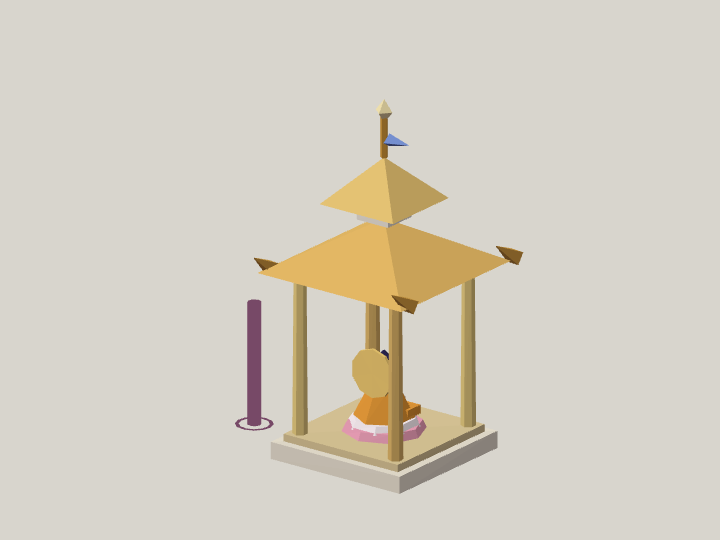
Thirty-three copies of one Buddha-like figure, robed in three warm colours, sit in pavilions on the game's terrace of the Thirty-Three gods on Meru. They are anonymous shrine figures. No source names them, and their number does not make them a canonical group of thirty-three Buddhas.
A Met sculpture and a Met manuscript cover used for comparison show the general marks of a Buddha: the ushnisha, a rise on the crown, long earlobes and a calm face, with a draped monk's robe. Tibetan art also has crowned, princely Buddhas.
In traditional art
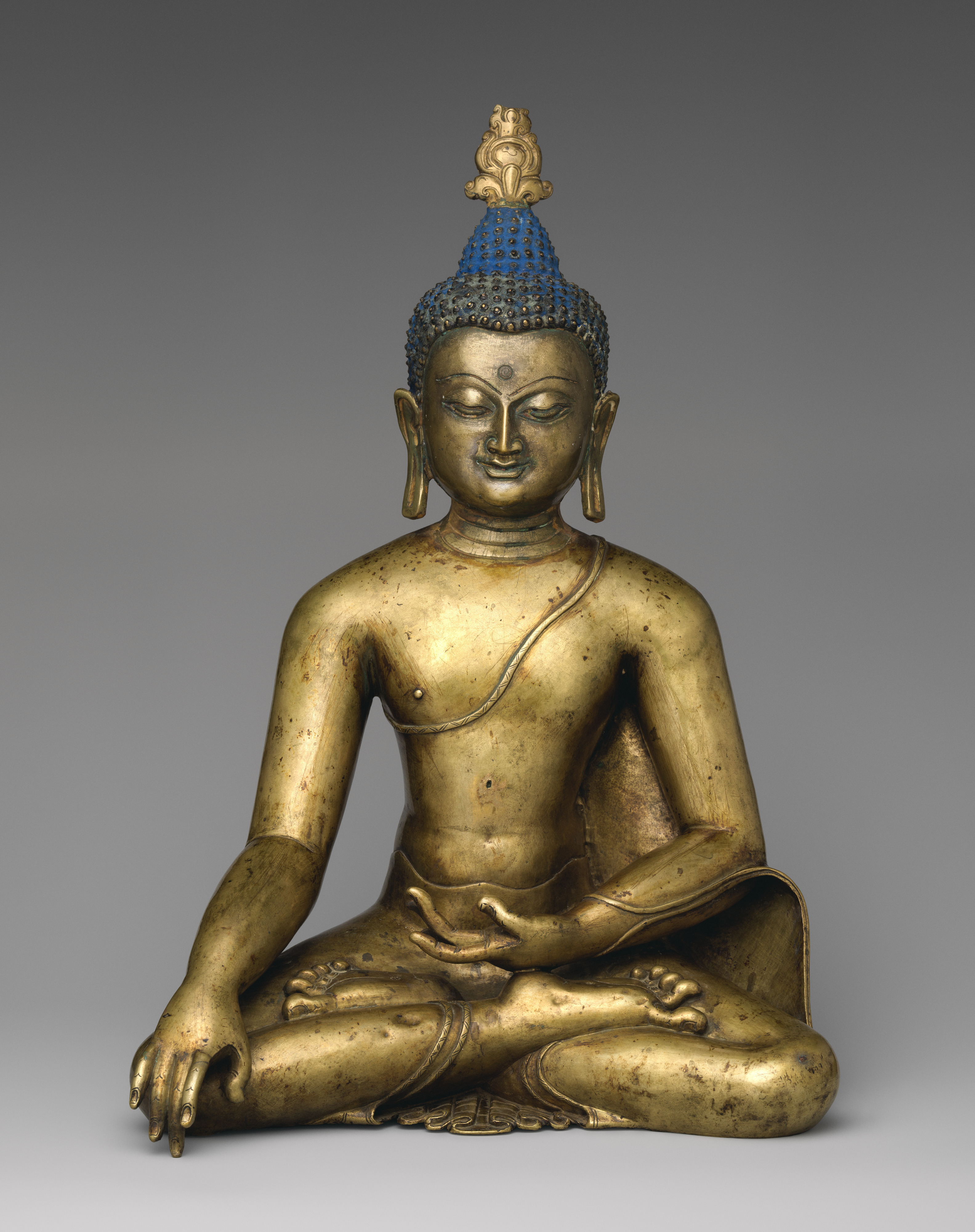
Buddha Shakyamuni — Met 2012.458Central Tibet · 12th centuryPublic Domain / Met Open Access; museum API isPublicDomain=true verified 2026-10-02Object record ↗ 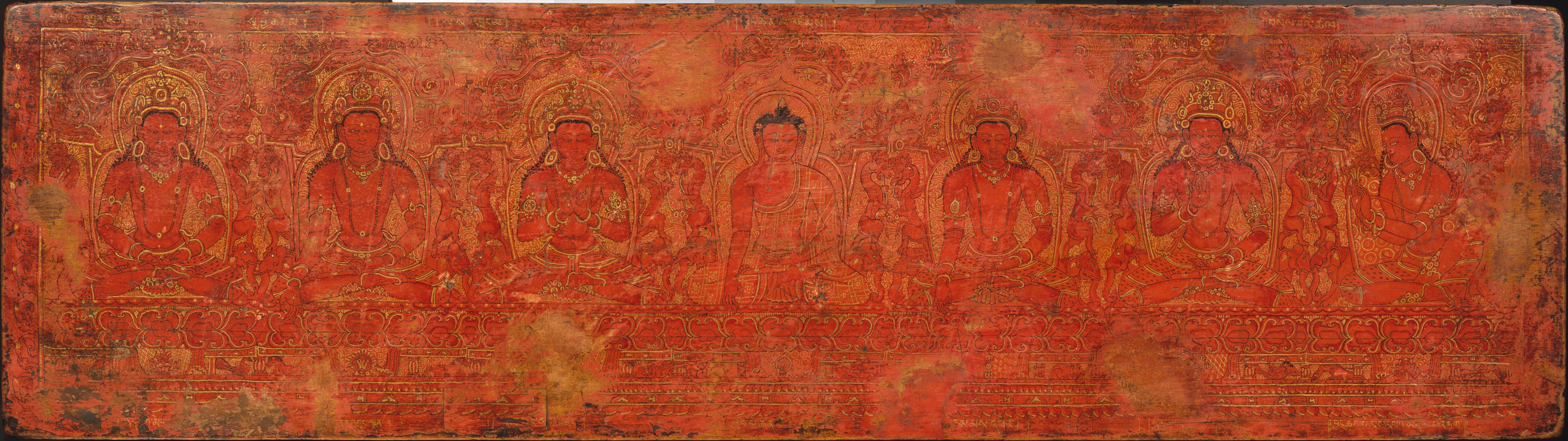
Buddha assembly manuscript cover — Met 1983.548Tibet · ca.15th centuryPublic Domain / Met Open Access; museum API isPublicDomain=true verified 2026-10-02Object record ↗
Sources
Depiction requirements and work notes
33 repeated anonymous Buddha-like shrine figures; no named canonical identities established
The Meru loop instantiates the same Buddha-like shrine figure 33 times, varying robe colors among three warm tones. The count describes authored shrine instances. It does not establish 33 named Buddhas, a canonical Thirty-Three Buddha group, or that deva residents possess Buddha marks. The general Buddha references below support visual appearance comparisons only.
Rig source changed or is missing: prototypes/world-map/interiors/meru.js Rig source changed or is missing: prototypes/world-map/interiors/wheel-meru.js Reinspect the model before relying on the recorded defects.
References, criteria, concept and model side by side
Traditional depictions
General seated Buddha appearance and three-dimensional modeling comparison only. Earth-touching hand and rare flame tip belong to this Shakyamuni artifact; neither identifies anonymous Meru shrines. [general-buddha-met-78191]
Object record ↗ · Source image ↗Comparative monastic versus crowned Buddha appearances. An appearance chart, not a roster of the 33 Meru occupants. [general-buddha-met-38348]
Object record ↗ · Source image ↗Criteria
The model must show
- Status: recorded as either Buddha statues worshipped by devas or living deva occupants; the library leaves this open
- If statues: one anonymous monastic Buddha family, with no personal names
- Head (if statues): ushnisha, long earlobes, a forehead mark where the chosen reference has one
- Dress (if statues): a coherent draped monk's robe
- Posture and hands (if statues): distinct folded legs, lap, shoulders and hands
- Face: serene and composed, as the library gives this peaceful form: narrow calm eye shapes, level brows, a small closed restrained mouth
- Eyes: solid black silhouettes with no whites, irises, pupils, highlights or glint (project eye rule; a recorded game adaptation, not a claim about traditional painted eyes)
- Count: 33 is the game's authored shrine count, recorded as adaptation
The model must not show
- Cartoon smiley face: a wide U-shaped or crescent grin, open laughing mouth, rosy cheek dots or mascot cheeks
- Eye whites, irises, pupils, highlights or glint; glowing white-gold eyes (those belong only to freshly liberated beings)
- Any part of the figure (head, crown, hat, halo, raised hand or held object) touching or passing through its canopy, roof, lintel, pillars, throne back or seat in any capture angle
- Naming 33 distinct Buddhas, or equating them with the Thirty-Three gods
- A cone, knee bar and single hand blob standing in for a seated body and mudra
- Śākyamuni's earth-touching gesture copied as a universal marker
- The rare flame above the ushnisha on all of them
- Deva residents left with ushnishas and Buddha seats while described as ordinary gods
Original game concept
No original concept is recorded in the Atlas.
Current 3D model
Depiction requirements
- Resolve narrative status before polishing
- Decide and document whether these are Buddha statues worshipped by devas or living deva occupants. General Buddha artifact references cannot supply the missing identity or authorize labeling 33 gods as Buddhas. [general-buddha-met-78191] [general-buddha-met-38348]
- General Buddha marks, if retained as statues
- For the chosen Buddha statue form, make the ushnisha, elongated earlobes and calm facial treatment legible; assess a forehead urna where the selected reference uses it. The Met sculpture supplies concrete three-dimensional comparison, not a full specification for every Buddha. [general-buddha-met-78191]
- Choose clothing register
- For an anonymous monastic shrine family, retain a coherent draped monk’s robe. If assigning named crowned Buddhas instead, select their actual form first; Tibetan Buddha art also includes crowned princely appearances. [general-buddha-met-38348]
- Posture and hand instruction
- Use a real seated artifact as the modeling reference: resolve distinct folded legs, lap, shoulders and hands instead of treating a cone, knee bar and single hand blob as a complete mudra. Earth-touching gesture belongs to the cited Shakyamuni and must not be copied as a universal identity marker. [general-buddha-met-78191]
- Reference limits
- The unusual flame above the cited ushnisha is specifically rare; do not propagate it to all 33 anonymous miniatures. No cited source mandates the current three robe colors, identical halo, count, or repeated pavilion arrangement. [general-buddha-met-78191] [general-buddha-met-38348]
Presentation contract
Ready to build from No readiness block is recorded in the plan.
Open points recorded with the contract
- Statues or living devas
Setting and sizing rule
Each figure sits in its own small pavilion. Sizing (plan rule R4, not a sourced claim): the opening of any shrine, canopy or pavilion around the figure leaves at least one of the figure's own head-heights of clear air above its tallest point (the ushnisha) and a clear gap on each side of its widest span (the knees); a throne back or aureole sits behind the figure without passing through it; pillars and lintel do not cross the face, hands or held objects in the front or either three-quarter capture. This holds for every one of the 33.
Recorded variants · 2
- A named multi-Buddha assembly would need an actual lineage source and member-by-member criteria
- Met 1983.548 shows both monk and crowned Buddha registers
Recorded adaptations · 1
- The count of 33, the three warm robe colours, the identical halo and the repeated pavilion
Where the plan places it · 0
Nothing in the world plan references criteria:meru-pavilion-buddhas: no character or placement uses this contract yet.
Contract sources · 2
- The Metropolitan Museum of Art — Buddha Shakyamuni, 2012.458
- The Metropolitan Museum of Art — The Buddha Shakyamuni, Five Past Buddhas, and Maitreya, 1983.548
Model audit and next pass
Evidence basis: source-only for current geometry; historical rendered asset baseline inspected
Recorded observations
Current source loop q<33 builds identical seated figures under two-tier gold pavilions on the Thirty-Three level. Each has a two-tier pink/white seat, orange robe cone, folded-knee bar, one lap-hand blob, tan head, dark brow, blue ushnisha and gold halo.
The variable name says deva pavilion; the source comment calls its occupant a seated Buddha. No canonical identity list or statue/live-deva distinction is provided.
Existing inventory identifies 33 placement calls for asset-47a7be7f16a2bc9f. Historical rendered pavilion image was inspected; the rear view shows roof/halo/robe/seat, while halo obscures the head and hands. It cannot establish canonical facial/gesture accuracy.
Directions for a future model pass
P1 — Resolve shrine-statue versus live-deva semantics and record the explicit identity disposition for all 33 repeated instances.
P1 — Capture a current front/three-quarter view of one full figure without roof/halo occlusion, plus walking-height views of several placements.
P2 — Polish the one family model’s Buddha marks, draped robe and seated anatomy using a selected coherent reference; then inspect repeated orientation and shelter visibility around the terrace.
Assessed baseline captures
Documented forms and lineage variants · 3
Preserve one identified form consistently. A variant is usable only with its own source and context.
Anonymous repeated temple statues can be reviewed as one model family plus repeated placement quality, with no invented personal identities.
A named multi-Buddha assembly would require an actual lineage/program source and member-by-member contracts before replacing the anonymous figures.
The manuscript cover documents differing monk and crowned Buddha registers; it is a comparison, not the selected Meru program.
What not to copy · 4
Do not name 33 distinct Buddhas from the loop index or equate them with the Thirty-Three gods.
Do not use warm robe color to infer a Buddha’s prescribed body color.
Do not advertise the general Shakyamuni/art-assembly references as identity evidence for these anonymous figures.
Do not leave gods with ushnishas and Buddha shrine seats while describing them as ordinary deva residents without resolving that ambiguity.
Sources and precise locations · 2
- [general-buddha-met-78191] The Metropolitan Museum of Art — Buddha Shakyamuni, 2012.458 ↗
- [general-buddha-met-38348] The Metropolitan Museum of Art — The Buddha Shakyamuni, Five Past Buddhas, and Maitreya, 1983.548 ↗
Assessment freshness and evidence hashes
The frozen snapshot is authored evidence. Regeneration computes current hashes and leaves that snapshot as it is.
{
  "auditFreshness": {
    "status": "stale",
    "reasons": [
      "Rig source changed or is missing: prototypes/world-map/interiors/meru.js",
      "Rig source changed or is missing: prototypes/world-map/interiors/wheel-meru.js"
    ]
  },
  "sourceSnapshot": {
    "captureHash": null,
    "bodyGeometryHash": null,
    "sourceHashes": {
      "prototypes/world-map/interiors/meru.js": "2f2c0ee9d1ba91524efaddd7d1808f91d7178610906c2b7881ecea8dd923dd81",
      "prototypes/world-map/interiors/wheel-meru.js": "06bb818b888e73f7943ce70b8b3ecb71a10883bbfca60b03baf7dbf83e239a60"
    },
    "captureHashes": {
      "/atlas/iconography/evidence/32c6b8bd624cf382-library-asset-47a7be7f16a2bc9f-00.png": "32c6b8bd624cf382dd8dce558f3ed4f3f7a36cf9cf8f8a3a5bf80d2c1e3408ac"
    },
    "conceptHashes": {},
    "activeConceptPaths": []
  },
  "currentSnapshot": {
    "captureHash": null,
    "bodyGeometryHash": null,
    "activeConceptPaths": [],
    "sourceHashes": {
      "prototypes/world-map/interiors/meru.js": "092db67785e3d6460731c3ab939f533e608de41025367dab4ed128c9446025eb",
      "prototypes/world-map/interiors/wheel-meru.js": "5b9b2e2e05e6e03e35e64944e4611ace516d156812326cf3e1e70f6c20d7e59a"
    },
    "captureHashes": {
      "/atlas/iconography/evidence/32c6b8bd624cf382-library-asset-47a7be7f16a2bc9f-00.png": "32c6b8bd624cf382dd8dce558f3ed4f3f7a36cf9cf8f8a3a5bf80d2c1e3408ac"
    },
    "conceptHashes": {}
  }
}