Guru Shakya Senge
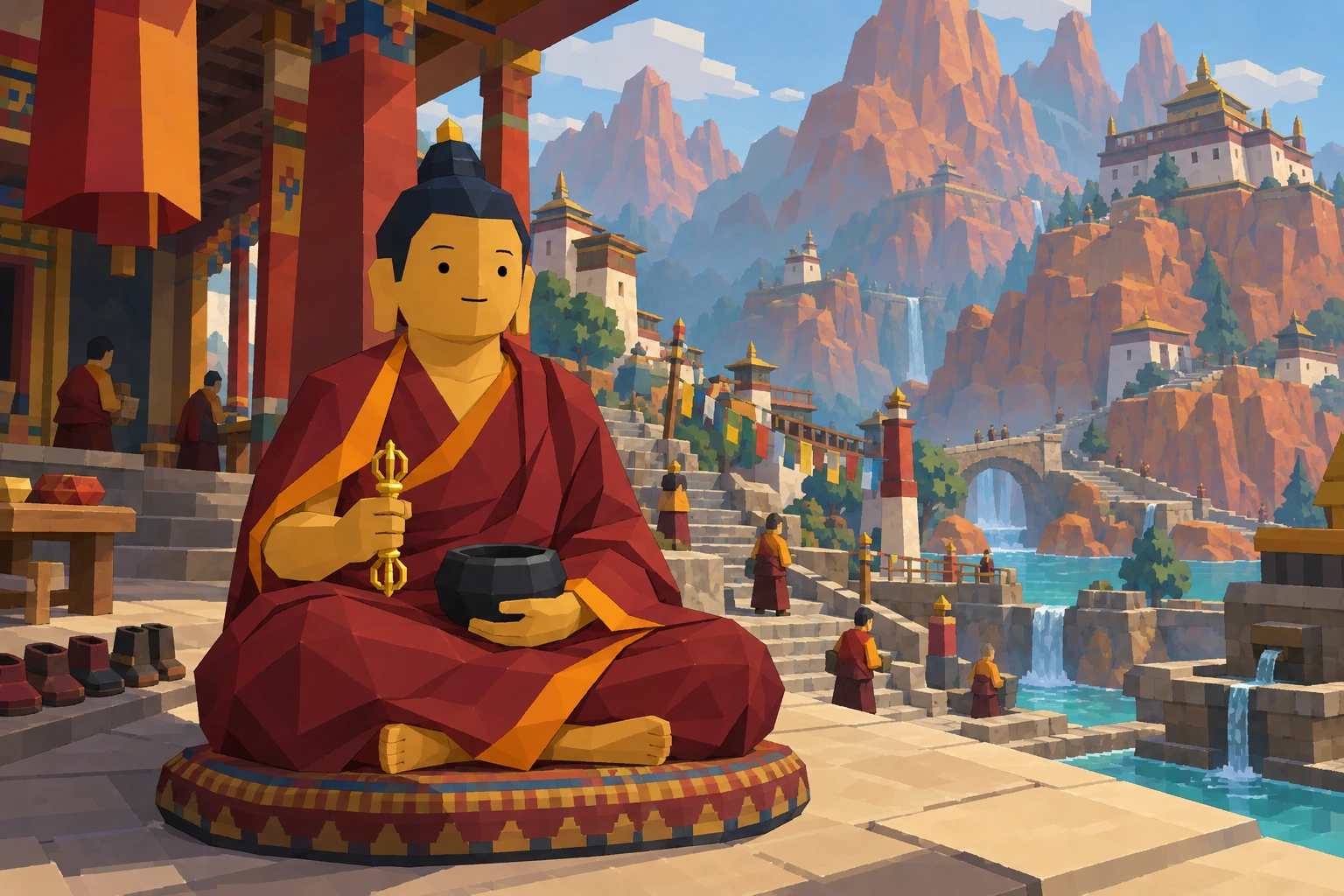
As Shakya Senge, Lion of the Shakyas, Guru Rinpoche appears as a monk. This form of his ordination is meant to resemble the Buddha Shakyamuni, yet it remains Padmasambhava. He wears monk's robes, sits in a restrained pose and holds an alms bowl.
Some examples pair the bowl with a vajra, and others give him a Buddha's hand gestures. A Tibet House painting catalogued by Himalayan Art Resources raises his right hand in the gesture of fearlessness.
In traditional art
These images stay with the collections that hold them. Each link opens the collection's own page.
- Padmasambhava with his Eight Manifestations, Hayagriva, Yeshe Tsogyel and Shantarakshita — Shakya Senge detail ↗Tibet, Nyingma · ca. 16th century · rubinmuseum.orgRubin Museum of Himalayan Art, C2003.51.1. No open image license stated; source-linked scholarly reference, rights reserved pending verification.
- Padmasambhava and His Manifestations — Shakya Sengge detail ↗Tibet · ca. late 13th century or later, as cautiously dated by the museum essay · rubinmuseum.orgPhotograph courtesy Tibet Museum–Fondation Alain Bordier. No open image license stated; retain the museum and photographer credit and link to the source.
- Shakya Senge: Padmasambhava as a young monk — tentative museum identification ↗Tibetan · 20th century (?) · umma.umich.eduUniversity of Michigan Museum of Art, 1973/1.808C. Museum requires its image-rights request process for publication; no open image license stated.
Sources
- Dudjom Rinpoche: Concise Benefits of the Festival of the Tenth Day ↗
- Padmasambhava and Eight Manifestations — Rubin C2003.51.1 ↗
- Padmasambhava and Eight Forms, annotated photograph — HAR 65283 ↗
- Padmasambhava and His Manifestations — Project Himalayan Art ↗
- Rubin Museum: Padmasambhava with his Eight Manifestations, C2003.51.1 ↗
- HAR 65283z: annotated eight-manifestation sculpture ↗
- Rubin Project Himalayan Art: Padmasambhava and His Manifestations, Tibet Museum–Fondation Alain Bordier ↗
- UMMA: Shakya Senge: Padmasambhava as a young monk ↗
- HAR 90743: Shakya Sengge from Tibet House, New York ↗
Depiction requirements and work notes
Guru Shakya Senge / Lion of the Shakyas
A monastic manifestation of Guru Rinpoche which can resemble Shakyamuni. Current golden monk, right vajra and left alms bowl are a recognizable form; asset identity must remain Guru Shakya Senge.
The model capture recipe or rig source changed. Reinspect the model before relying on the recorded defects.
References, criteria, concept and model side by side
Traditional depictions
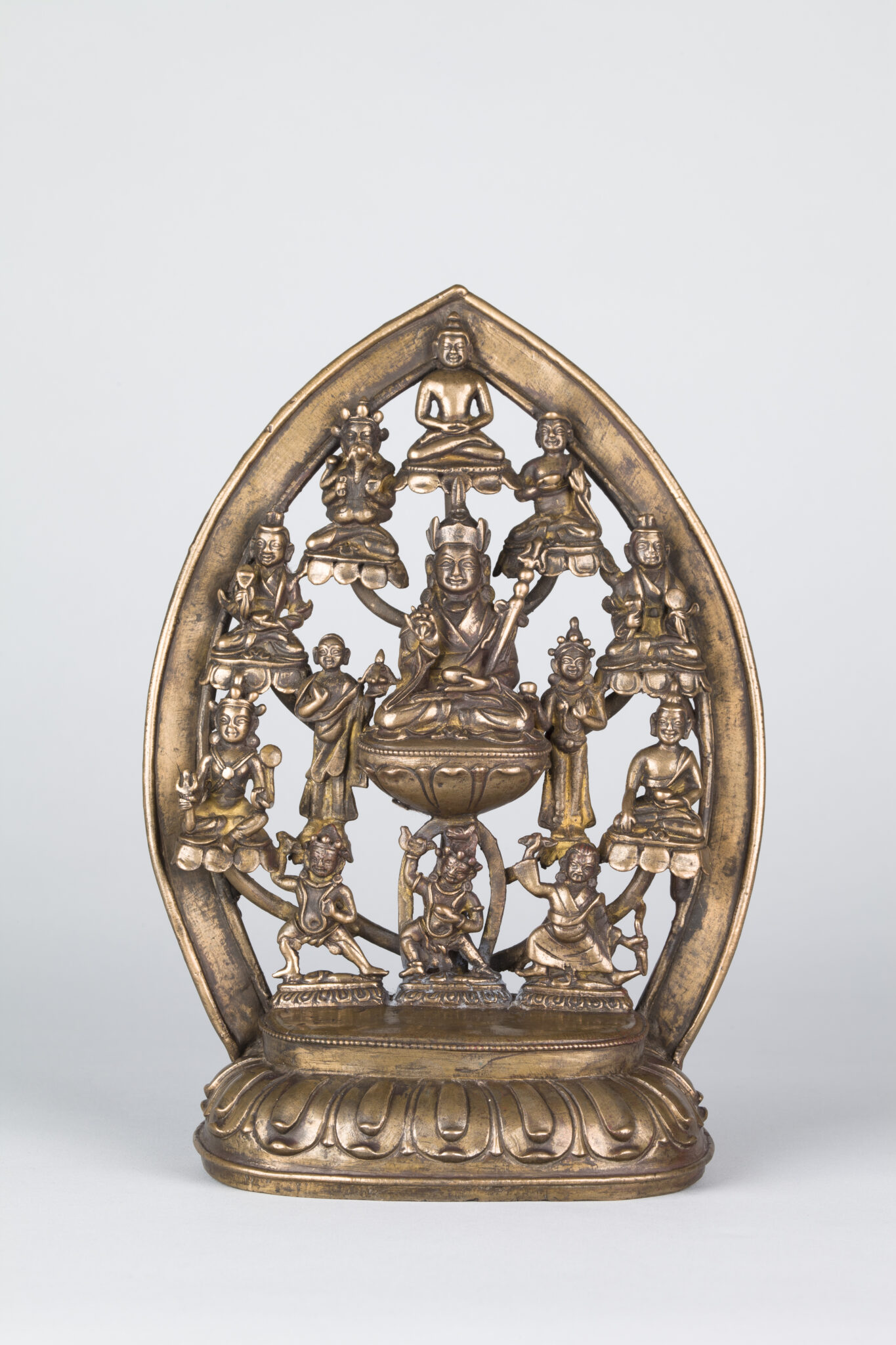
Shakya Senge is the Buddha-like figure on the viewer's lower right, immediately below Pema Gyalpo in this copper-alloy manifestation group. The locator is cross-checked against the labeled HAR 65283z image; the central seated Guru is a different manifestation. Use the monastic Buddha appearance and legible seated posture as silhouette guidance. [rubin-eight-forms-bronze] [har-65283-annotated]
Object record ↗ · Source image ↗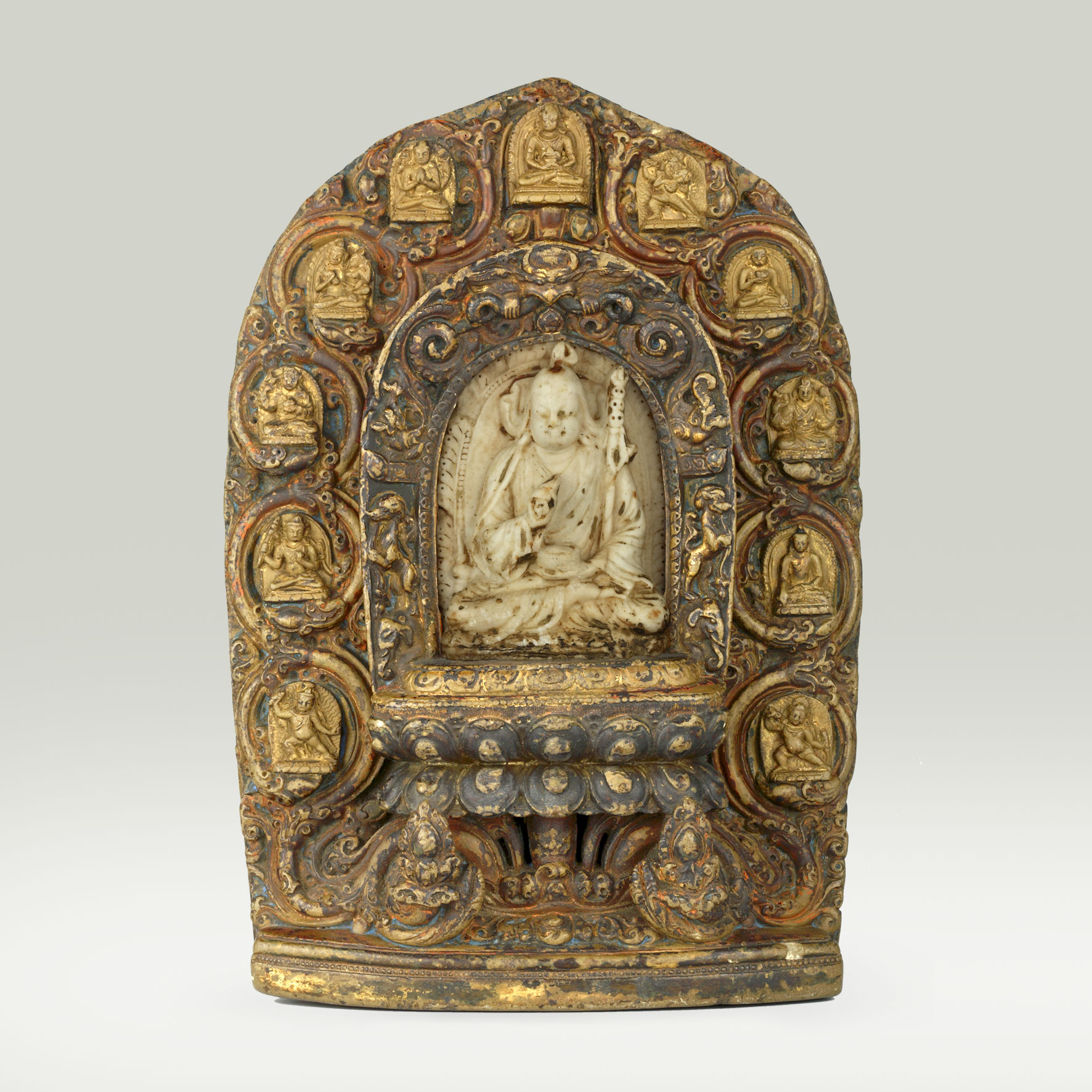
Shakya Sengge occupies the viewer-right lowest roundel above the fierce bottom figures; the matching viewer-left roundel holds the tantric Nyima Wozer. The essay explicitly identifies this pair and says Shakya Sengge looks like Shakyamuni. Position and monastic appearance were checked in the displayed museum image; wear and small scale limit its use for finger-level details. [rubin-bordier-stone]
Object record ↗ · Source image ↗
Supplemental comparison only: UMMA explicitly calls the identification tentative and describes worn/broken woodblock lines. Do not treat this print alone as authority for the identity of attendants or fine attributes. [umma-shakya-senge]
Object record ↗ · Source image ↗Criteria
The model must show
- Identity: an appearance of Padmasambhava (Guru Rinpoche), not a separate Buddha or person; the monastic manifestation, which resembles Śākyamuni on purpose
- Lineage variant: the golden monk with vajra and alms bowl is the current provisional game choice; an exact whole-form source artwork for that pair remains to be selected. This is not a source-verified form contract.
- Provisional game appearance: golden body, one face, two arms; verify the complete selected form before a model pass, without inferring skin colour from a gilt sculpture.
- Provisional game hands and held objects: own-right vajra and supported own-left alms bowl. Preserve this documented current choice as provisional; do not claim it is established by HAR 90743, whose right hand makes fearlessness.
- Dress: monk's robes; Buddha appearance
- Posture: seated, restrained silhouette
- Face: serene, small closed mouth
- Eyes: solid black silhouettes with no whites, irises, pupils, highlights or glint (project eye rule; a recorded game adaptation, not a claim about traditional painted eyes)
- Seat: the library names none for this form; whatever seat is built is recorded as authored
- Attendants: none
The model must not show
- Cartoon smiley face: a wide U-shaped or crescent grin, open laughing mouth, rosy cheek dots or mascot cheeks
- Eye whites, irises, pupils, highlights or glint; glowing white-gold eyes (those belong only to freshly liberated beings)
- Any part of the figure (head, crown, hat, halo, raised hand or held object) touching or passing through its canopy, roof, lintel, pillars, throne back or seat in any capture angle
- The main Guru's lotus hat, royal jewellery or khatvanga
- Śākyamuni's earth-touching hand copied in by default
- Labelling the figure as the historical Śākyamuni
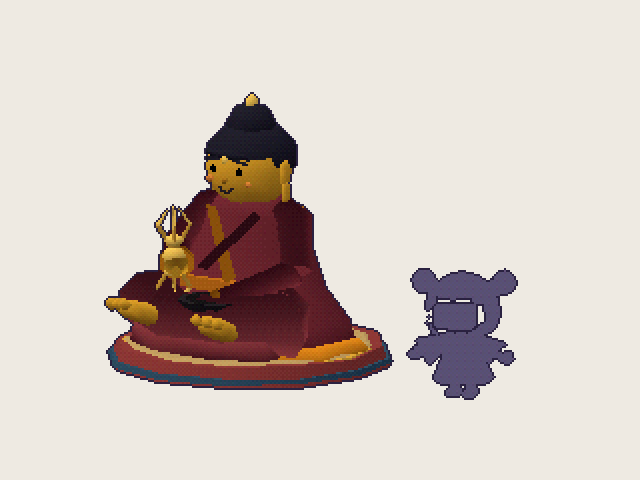
Original game concept
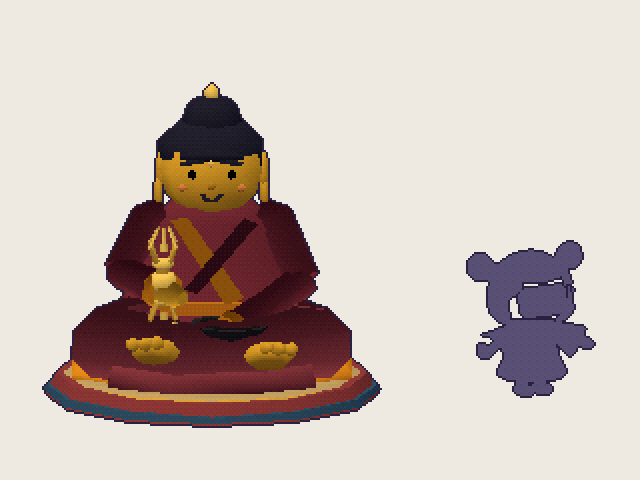
Current 3D model
presence
Depiction requirements
- Identity
- Record this as Padmasambhava’s monastic manifestation. Resemblance to the historical Buddha is intentional traditional iconography; it does not change the character’s identity. [guru-rubin-essay] [guru-group-labels]
- Monastic form
- Keep monk robes, a seated restrained silhouette and a supported alms bowl. Attribute/gesture variants must be documented from the chosen artwork instead of automatically copying Shakyamuni’s earth-touching hand. [guru-group] [guru-group-labels]
Presentation contract
Blocked · not ready to build from The plan holds this contract back (status pending · modelReady false · buildBlocked true) until the points below are settled.
Why it is blocked: unresolved form and pending research
- Select and record an exact artwork or textual cycle supporting the complete vajra-and-bowl form, including body colour, posture and support. The general library acknowledgement of vajra/bowl variants does not identify that exemplar; block model work until the selection is sourced.
Setting and sizing rule
No seat is named by the library; an authored seat is recorded as such. Sizing (plan rule R4, not a sourced claim): the opening of any shrine, canopy or pavilion around the figure leaves at least one of the figure's own head-heights of clear air above its tallest point (the top of the head) and a clear gap on each side of its widest span (the vajra hand and the knees); a throne back or aureole sits behind the figure without passing through it; pillars and lintel do not cross the face, hands or held objects in the front or either three-quarter capture.
Recorded variants · 3
- HAR 90743: right hand in the fearlessness gesture, left hand with a black begging bowl
- Other examples use Buddha-like gestures
- UMMA 1973/1.808C is only tentatively identified
Recorded adaptations · 1
- The current golden vajra-and-bowl concept/model is a provisional game selection awaiting an exact supporting whole-form reference; it is not silently replaced by HAR 90743's fearlessness-and-black-bowl variant.
Where the plan places it · 1
- copper mountain · The band of eight forms
copper-mountain.guru-band· character Guru Shakya Sengeguru-form-02
Contract sources · 5
- Padmasambhava and His Manifestations — Project Himalayan Art
- Padmasambhava and Eight Forms, annotated photograph — HAR 65283
- Padmasambhava and Eight Manifestations — Rubin C2003.51.1
- HAR 90743: Shakya Sengge from Tibet House, New York
- Rubin Project Himalayan Art: Padmasambhava and His Manifestations, Tibet Museum–Fondation Alain Bordier
Model audit and next pass
Evidence basis: visual + source
Recorded observations
Golden face/body, black rounded topknot, maroon/saffron monastic robes, connected crossed legs, figure-right vajra and figure-left dark alms bowl agree with the authored concept.
The visual similarity to a Buddha is strong. The generic bodhisattva scale text would mislead future agents if read as identity.
Reviewed original concept, Atlas all-angle sheet and source builder. Existing captures are historical evidence, not a fresh gameplay recapture; body-only views can omit scenery-classed attributes. The registry identityId is padmasambhava; its generic bodhisattva heightClass is a project scale label, not a doctrinal classification.
Directions for a future model pass
Strengthen the bowl’s supported shape and restrained monk silhouette. Add explicit identity text wherever this image appears beside historical Shakyamuni assets.
Keep solid-black eyes, low-detail PS1 geometry and outline as the explicit game style. Improve sacred-attribute silhouettes without ornamental noise. Preserve pass history and record concept fidelity separately from traditional accuracy; the entry is finished when its independent review passes; approval fields stay as found.
Assessed baseline captures
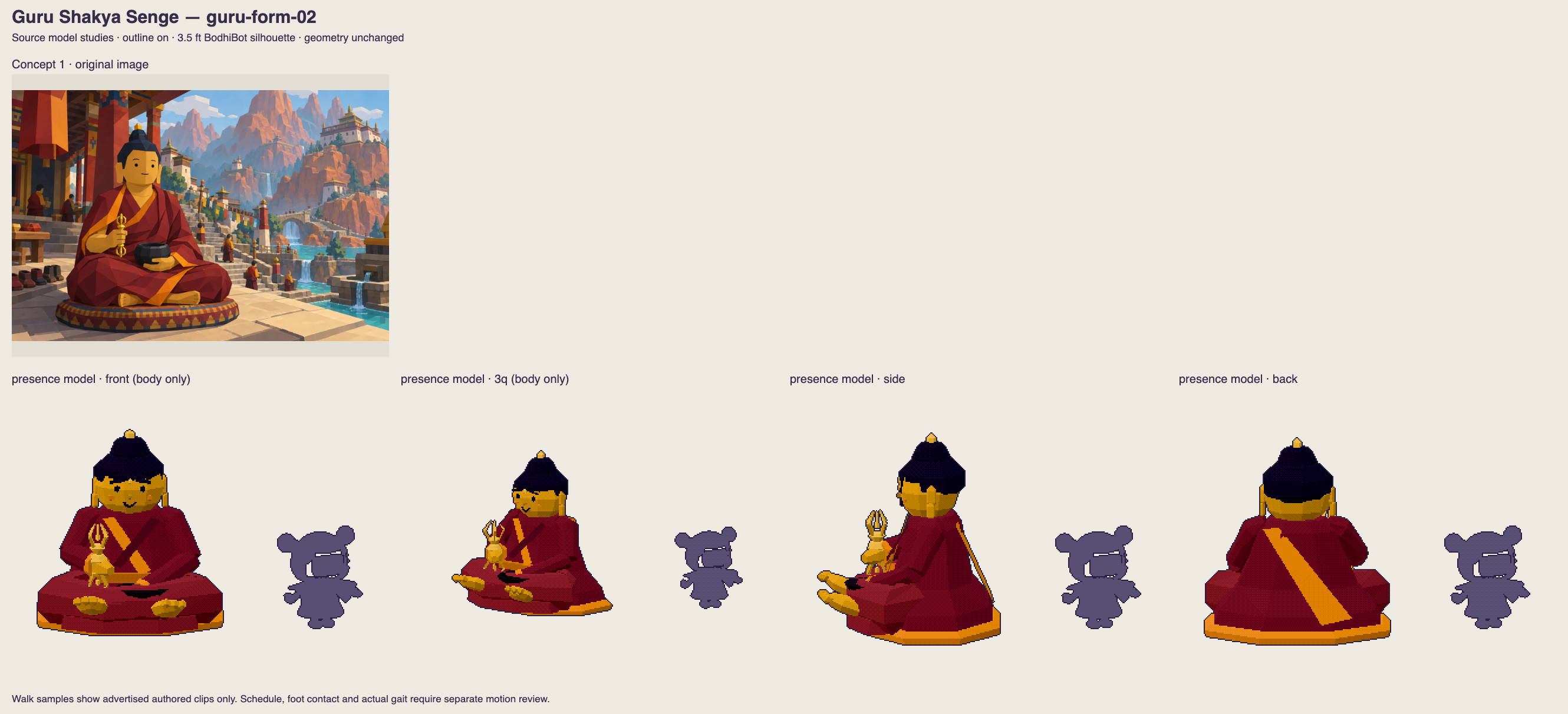
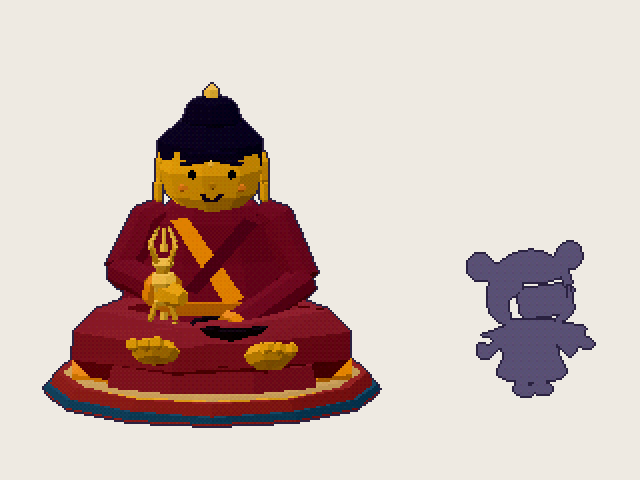
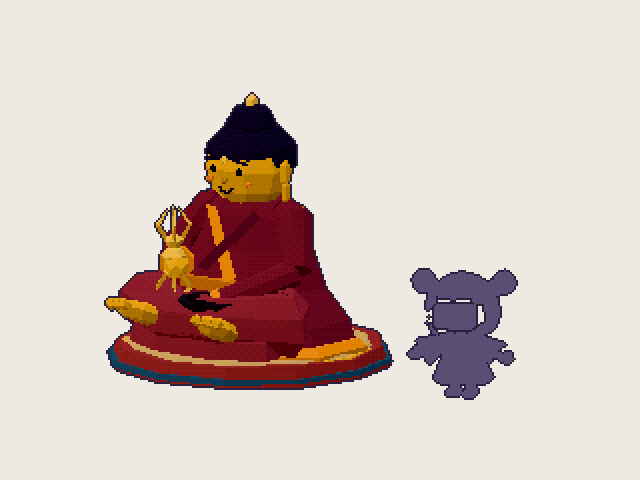
Documented forms and lineage variants · 3
Preserve one identified form consistently. A variant is usable only with its own source and context.
Some examples use a vajra and bowl; others use Buddha-like gestures. Maintain the selected image’s pair.
The two definite references are separately identified historical manifestation sculptures; the UMMA print is an additional comparison with its tentative identification preserved.
Shakya Sengge is Padmasambhava's Buddha-appearance/ordination manifestation, not a duplicate record of historical Shakyamuni. Reference-specific right-hand gestures vary: HAR 90743 documents fearlessness. Do not prescribe one gesture as mandatory without naming the selected source/cycle.
What not to copy · 2
Do not add the main Guru’s lotus hat, royal jewellery or khatvanga automatically.
Do not use an uncertain museum identification as definitive evidence for an exact form.
Sources and precise locations · 9
- [guru-dudjom] Dudjom Rinpoche: Concise Benefits of the Festival of the Tenth Day ↗
- [guru-group] Padmasambhava and Eight Manifestations — Rubin C2003.51.1 ↗
- [guru-group-labels] Padmasambhava and Eight Forms, annotated photograph — HAR 65283 ↗
- [guru-rubin-essay] Padmasambhava and His Manifestations — Project Himalayan Art ↗
- [rubin-eight-forms-bronze] Rubin Museum: Padmasambhava with his Eight Manifestations, C2003.51.1 ↗
- [har-65283-annotated] HAR 65283z: annotated eight-manifestation sculpture ↗
- [rubin-bordier-stone] Rubin Project Himalayan Art: Padmasambhava and His Manifestations, Tibet Museum–Fondation Alain Bordier ↗
- [umma-shakya-senge] UMMA: Shakya Senge: Padmasambhava as a young monk ↗
- [har-shakya-senge-90743] HAR 90743: Shakya Sengge from Tibet House, New York ↗
Assessment freshness and evidence hashes
The frozen snapshot is authored evidence. Regeneration computes current hashes and leaves that snapshot as it is.
{
  "auditFreshness": {
    "status": "stale",
    "reasons": [
      "The model capture recipe or rig source changed."
    ]
  },
  "sourceSnapshot": {
    "captureHash": "64b670931d71b5240e8ec5a8895ec1c6f94d96b3f9372df2e3591b43657acb39",
    "bodyGeometryHash": "b015a9414a3f10cad0a78e6685e554e6ab616229cb6198e05722af9ab997a406",
    "sourceHashes": {
      "prototypes/prerendered-look/parts/purelands/guru-form-02.js": "b495148053a182aead4f02e1f2d907dc5c5e82a52fc7824806079077c54a073b"
    },
    "captureHashes": {
      "/atlas/audit/sheets/guru-form-02-3588c0d98663.webp": "e01c039c7f9d20770420ab8c98927c879743fa310a3ed978e4ba7140d7158d14",
      "/atlas/characters/guru-form-02-64b670931d71-presence-3q.webp": "f66ff01c0f941a999eed3ea6c0d1e7c7a54edd8a4e4723cfd7416b23fdb49716",
      "/atlas/characters/guru-form-02-64b670931d71-presence-front.webp": "14613eb736d9cd136fe5b2d56365f3ecf12b187ca35b03804fde83cae01bf1fa",
      "/atlas/characters/guru-form-02-9056f06a6d48-presence-3q.webp": "f66ff01c0f941a999eed3ea6c0d1e7c7a54edd8a4e4723cfd7416b23fdb49716",
      "/atlas/characters/guru-form-02-9056f06a6d48-presence-front.webp": "14613eb736d9cd136fe5b2d56365f3ecf12b187ca35b03804fde83cae01bf1fa"
    },
    "conceptHashes": {
      "/atlas/concepts/guru-form-02.webp": "0a0cb8196fb99901b91d6b2c19bc5b3b1b25296d47a05b395977785a47382170"
    },
    "activeConceptPaths": [
      "/atlas/concepts/guru-form-02.webp"
    ]
  },
  "currentSnapshot": {
    "captureHash": "1861c39b3afb55589e874c64721abc42a402ece7519fb672b6bf43c2bd3e37eb",
    "bodyGeometryHash": "b015a9414a3f10cad0a78e6685e554e6ab616229cb6198e05722af9ab997a406",
    "activeConceptPaths": [
      "/atlas/concepts/guru-form-02.webp"
    ],
    "sourceHashes": {
      "prototypes/prerendered-look/parts/purelands/guru-form-02.js": "b495148053a182aead4f02e1f2d907dc5c5e82a52fc7824806079077c54a073b"
    },
    "captureHashes": {
      "/atlas/audit/sheets/guru-form-02-3588c0d98663.webp": "e01c039c7f9d20770420ab8c98927c879743fa310a3ed978e4ba7140d7158d14",
      "/atlas/characters/guru-form-02-1861c39b3afb-presence-3q.webp": "171922dbb01e5d779ca5e6b9964ec4f4a642d647fa6740ca1809865bc41dcd94",
      "/atlas/characters/guru-form-02-1861c39b3afb-presence-front.webp": "9ce9a27602c4e14d2a430d8c21137116d74baea0fec27af79bf7c9fe61ec0682",
      "/atlas/characters/guru-form-02-64b670931d71-presence-3q.webp": "f66ff01c0f941a999eed3ea6c0d1e7c7a54edd8a4e4723cfd7416b23fdb49716",
      "/atlas/characters/guru-form-02-64b670931d71-presence-front.webp": "14613eb736d9cd136fe5b2d56365f3ecf12b187ca35b03804fde83cae01bf1fa",
      "/atlas/characters/guru-form-02-9056f06a6d48-presence-3q.webp": "f66ff01c0f941a999eed3ea6c0d1e7c7a54edd8a4e4723cfd7416b23fdb49716",
      "/atlas/characters/guru-form-02-9056f06a6d48-presence-front.webp": "14613eb736d9cd136fe5b2d56365f3ecf12b187ca35b03804fde83cae01bf1fa"
    },
    "conceptHashes": {
      "/atlas/concepts/guru-form-02.webp": "0a0cb8196fb99901b91d6b2c19bc5b3b1b25296d47a05b395977785a47382170"
    }
  }
}