Guru Tsokye Dorje
Guru Tsokye Dorje, the Lake-born Vajra, is Guru Rinpoche at his birth from a lotus. Lists of the Guru's manifestations, and how each one looks, vary between traditions. The name alone does not fix one image, since it is also used in other peaceful Guru practices.
Another list of eight manifestations includes the blue Orgyen Dorje Chang, shown with a consort. He is a separate form. He is also distinct from the primordial Buddha Samantabhadra, though some images make the two look much alike.
In traditional art
These images stay with the collections that hold them. Each link opens the collection's own page.
- Padmasambhava and Eight Manifestations, Rubin C2003.51.1 ↗Tibet · ca.16th century (museum); HAR gives17th century · rubinmuseum.orgMuseum photograph; no open reuse licence established. Link/reference only; museum credit is not a reuse licence.
- Guru Tsokye Dorje and the Eight Manifestations ↗Tibetan Nyingma devotional painting, published by Lotsawa House/Rigpa Translations · Artwork date not supplied by this source · lotsawahouse.orgImage credited © Tertön Sogyal Trust. The webpage text carries CC BY-NC 4.0; do not assume that the separately credited image carries the same license.
- Orgyen Dorje Chang, One of the Eight Manifestations of Padmasambhava ↗Eastern Tibet, Nyingma · 19th century · rubinmuseum.orgRubin Museum of Art, gift of Shelley and Donald Rubin, C2006.66.284. No open image license stated on the object page; source-linked reference, rights reserved pending verification.
Sources
- Dudjom Rinpoche: Concise Benefits of the Festival of the Tenth Day ↗
- Padmasambhava and Eight Manifestations — Rubin C2003.51.1 ↗
- Padmasambhava and Eight Forms, annotated photograph — HAR 65283 ↗
- Padmasambhava and His Manifestations — Project Himalayan Art ↗
- Mipham: The Prayer which is the Source of All True Realization ↗
- Rubin Museum: Orgyen Dorje Chang, C2006.66.284 ↗
- Hirshberg and Pakhoutova: Padmasambhava and His Manifestations ↗
- Rigpa Wiki: Guru Tsokyé Dorje ↗
Depiction requirements and work notes
Guru Tsokye Dorje / Lake-born Vajra
This is the named lotus-birth manifestation of Guru Rinpoche. The current youthful flesh-coloured, clothed lotus child must not be conflated with the blue Orgyen Dorje Chang consort-form used in another eight-manifestation enumeration.
The model capture recipe or rig source changed. Reinspect the model before relying on the recorded defects.
References, criteria, concept and model side by side
Traditional depictions

Upper-left seated Orgyan Dorje Chang below apex Samantabhadra; labeled traditional enumeration variant, not direct child-form precedent. See linked HAR annotated image for identification; retinue figures are not additional Guru manifestations. [guru-group] [guru-group-labels]
Object record ↗ · Source image ↗The publisher identifies the central figure as Guru Tsokye Dorje and the surrounding figures as the Eight Manifestations. Use the central peaceful Guru form as an explicit Tsokye Dorje reference; the source does not identify this as a separate historical buddha or certify a childhood-only iconographic standard. [lotsawa-tsokye-manifestations]
Object record ↗ · Source image ↗
A documented Orgyen Dorje Chang manifestation, pigments on cloth, C2006.66.284. This is a named alternative in the eight-manifestation corpus. Do not use its peaceful deity/consort presentation as a requirement that a model explicitly designated Tsokye Dorje's youthful lotus birth must also be blue or in union. [rubin-orgyen-dorje-chang] [rubin-padmasambhava-forms]
Object record ↗ · Source image ↗Criteria
The model must show
- Identity: an appearance of Padmasambhava (Guru Rinpoche), not a separate Buddha or person; the lotus-birth manifestation
- Lineage variant: the lotus-birth child of the birth narrative; the source for the exact appearance is not yet chosen and stays recorded as open
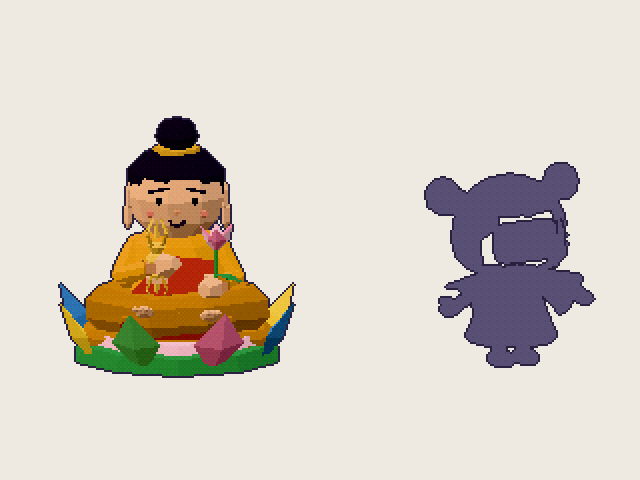
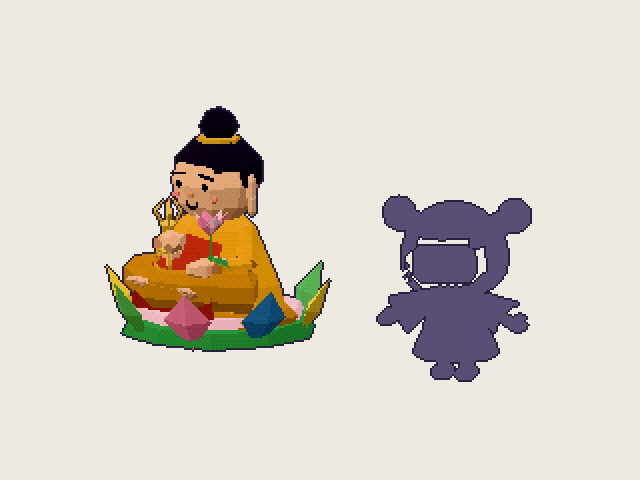
- Body: a youthful, child-like figure with flesh-coloured skin, as the current model; one face, two arms
- Hands and held objects (current model, awaiting a source): a vajra in the own right hand, a lotus in the own left
- Dress: clothed (the model's saffron and red dress), black topknot
- Posture: seated
- Face: peaceful and youthful, small closed mouth
- Eyes: solid black silhouettes with no whites, irises, pupils, highlights or glint (project eye rule; a recorded game adaptation, not a claim about traditional painted eyes)
- Seat: a large lotus, the lotus-birth setting
- Attendants: none
The model must not show
- Cartoon smiley face: a wide U-shaped or crescent grin, open laughing mouth, rosy cheek dots or mascot cheeks
- Eye whites, irises, pupils, highlights or glint; glowing white-gold eyes (those belong only to freshly liberated beings)
- Any part of the figure (head, crown, hat, halo, raised hand or held object) touching or passing through its canopy, roof, lintel, pillars, throne back or seat in any capture angle
- The blue Orgyen Dorje Chang consort form, or its attributes added piecemeal
- Primordial Buddha Samantabhadra's appearance
- The main Guru's lotus hat and khatvanga added by default
- Presenting him as a new child Buddha separate from Padmasambhava
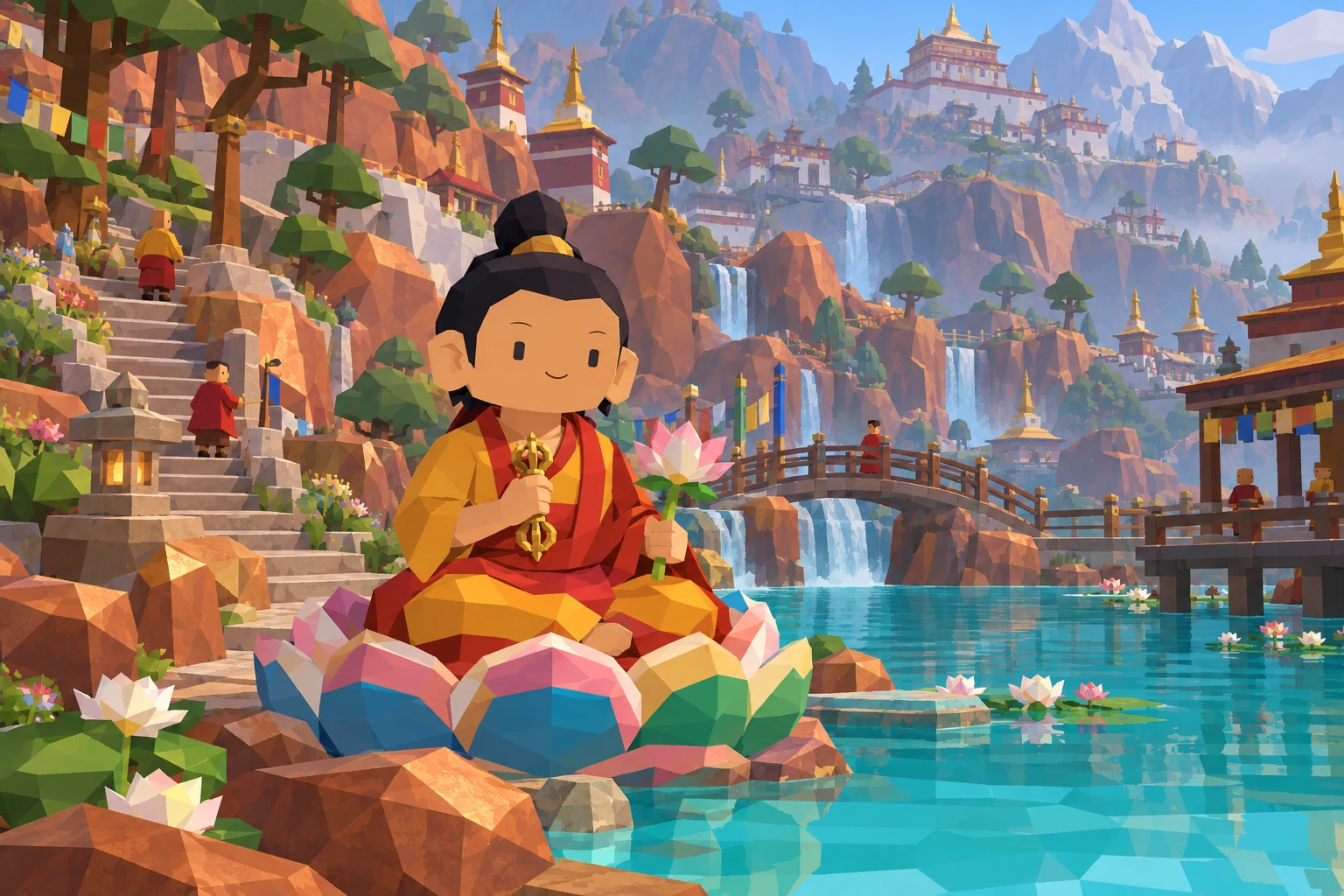
Original game concept
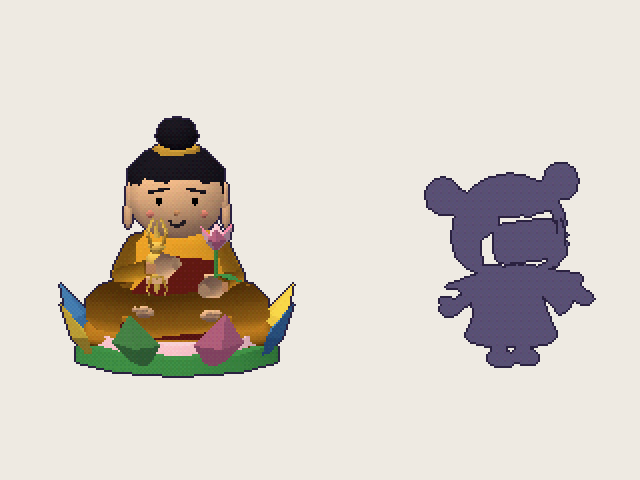
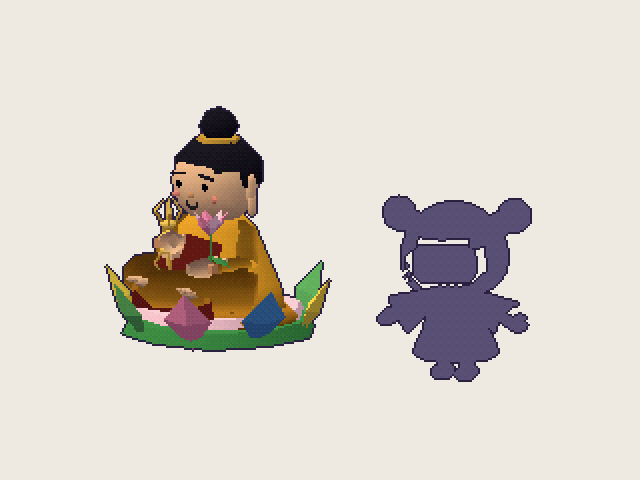
Current 3D model
presence
Depiction requirements
- Identity
- Keep the lake-born Guru identity and lotus birth setting. Document which source defines the chosen appearance, because traditional lists and their appearances vary. [guru-dudjom] [guru-rubin-essay]
- Variant control
- For the current youthful lotus-birth concept, keep the child-like proportions separate from Orgyen Dorje Chang’s blue sambhogakaya/consort iconography. Do not add that form’s attributes piecemeal. [guru-rubin-essay] [guru-group-labels]
Presentation contract
Ready to build from No readiness block is recorded in the plan.
Open points recorded with the contract
- No precisely identified traditional image of the clothed flesh-coloured child with right vajra and left lotus has been found
Setting and sizing rule
Seated in an open lotus on the lake. Sizing (plan rule R4, not a sourced claim): the opening of any shrine, canopy or pavilion around the figure leaves at least one of the figure's own head-heights of clear air above its tallest point (the topknot) and a clear gap on each side of its widest span (the lotus petals and the held vajra and lotus); a throne back or aureole sits behind the figure without passing through it; pillars and lintel do not cross the face, hands or held objects in the front or either three-quarter capture.
Recorded variants · 3
- Orgyen Dorje Chang (upper-left on Rubin C2003.51.1): blue sambhogakāya form with consort, an alternative enumerated form
- Rigpa Wiki: a peaceful Guru holding a vajra at the heart; A Great Treasure of Blessings describes an eight-year-old child arising in a lotus
- The name Tsokye Dorje is also used for the central Pema Jungne
Recorded adaptations · 0
Where the plan places it · 1
- copper mountain · The band of eight forms
copper-mountain.guru-band· character Guru Tsokye Dorjeguru-form-01
Contract sources · 5
- Dudjom Rinpoche: Concise Benefits of the Festival of the Tenth Day
- Padmasambhava and His Manifestations — Project Himalayan Art
- Padmasambhava and Eight Forms, annotated photograph — HAR 65283
- Rigpa Wiki: Guru Tsokyé Dorje
- Hirshberg and Pakhoutova: Padmasambhava and His Manifestations
Model audit and next pass
Evidence basis: visual + source
Recorded observations
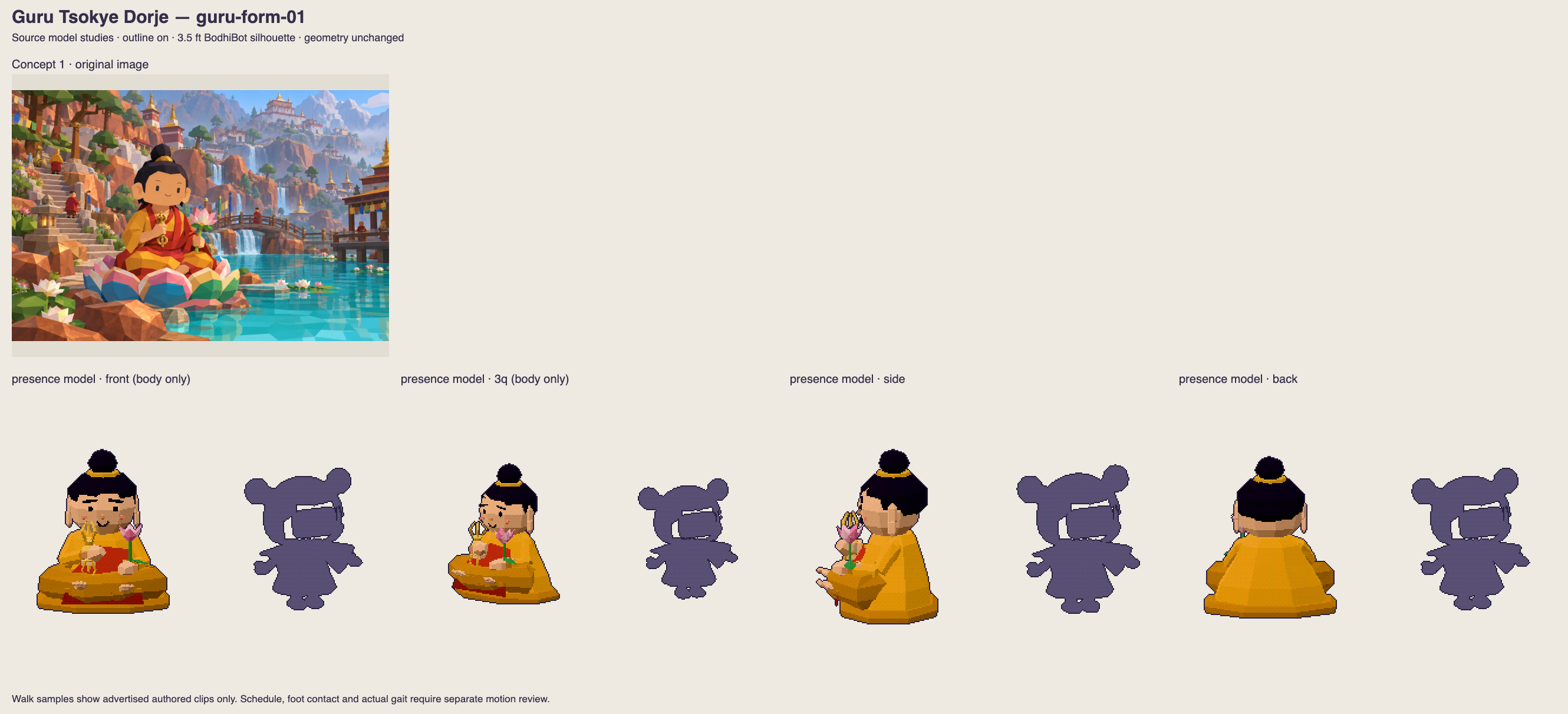
Concept and all-angle model show a small seated youthful figure, black topknot, flesh skin, saffron/red dress, right vajra and left lotus, on a large pink lotus. The asymmetrical hands are anatomically assigned correctly here.
Lotus-birth identity is clear; the precise costume/lotus-in-hand combination needs an explicit appearance source before declaring traditional compliance.
Reviewed original concept, Atlas all-angle sheet and source builder. Existing captures are historical evidence, not a fresh gameplay recapture; body-only views can omit scenery-classed attributes. The registry identityId is padmasambhava; its generic bodhisattva heightClass is a project scale label, not a doctrinal classification.
Directions for a future model pass
Keep this entry in form-selection review until an exact youthful appearance source is selected. Preserve lotus birth; resolve implements/costume with the reference, not a generalized Guru kit.
Keep solid-black eyes, low-detail PS1 geometry and outline as the explicit game style. Improve sacred-attribute silhouettes without ornamental noise. Preserve pass history and record concept fidelity separately from traditional accuracy; the entry is finished when its independent review passes; approval fields stay as found.
Assessed baseline captures
Documented forms and lineage variants · 5
Preserve one identified form consistently. A variant is usable only with its own source and context.
The shared sculpture depicts Orgyan Dorje Chang at upper-left as an alternative enumerated form; it is comparative evidence, not a direct colour/costume target for this model.
The exact traditional precedent for a clothed flesh-coloured child holding right vajra and left lotus remains less secure than the lotus-birth identity. See reference cautions.
No single universally binding depiction can be inferred from the name Tsokye Dorje alone. The name is used for the lotus-birth Guru and also in other peaceful Guru practice contexts. Choose and state the intended cycle before refining the model.
A childhood lotus-birth model is supported by the birth narrative, but neither supplied painting should be described as an authoritative exact childhood costume sheet. There is an unresolved need for a precisely identified traditional eight-year-old lotus-birth image if that variant remains the project's target.
Do not conflate Orgyen Dorje Chang's deity/consort form with primordial Buddha Samantabhadra, whose appearance may be closely similar in some imagery.
What not to copy · 2
Do not call this a new child Buddha separate from Padmasambhava.
Do not treat youthful toy proportions or the current left lotus as established solely by the word Tsokye.
Sources and precise locations · 8
- [guru-dudjom] Dudjom Rinpoche: Concise Benefits of the Festival of the Tenth Day ↗
- [guru-group] Padmasambhava and Eight Manifestations — Rubin C2003.51.1 ↗
- [guru-group-labels] Padmasambhava and Eight Forms, annotated photograph — HAR 65283 ↗
- [guru-rubin-essay] Padmasambhava and His Manifestations — Project Himalayan Art ↗
- [lotsawa-tsokye-manifestations] Mipham: The Prayer which is the Source of All True Realization ↗
- [rubin-orgyen-dorje-chang] Rubin Museum: Orgyen Dorje Chang, C2006.66.284 ↗
- [rubin-padmasambhava-forms] Hirshberg and Pakhoutova: Padmasambhava and His Manifestations ↗
- [rigpa-tsokye-birth] Rigpa Wiki: Guru Tsokyé Dorje ↗
Assessment freshness and evidence hashes
The frozen snapshot is authored evidence. Regeneration computes current hashes and leaves that snapshot as it is.
{
  "auditFreshness": {
    "status": "stale",
    "reasons": [
      "The model capture recipe or rig source changed."
    ]
  },
  "sourceSnapshot": {
    "captureHash": "5fd7a4df3b87830cbe451eb554acb23882a800a93068f0bb456772d772d6c97f",
    "bodyGeometryHash": "b7084ee26127694bf80900c75c0c65843dfe71e4b5dbc83d83742e1aae17de05",
    "sourceHashes": {
      "prototypes/prerendered-look/parts/purelands/guru-form-01.js": "f1c1f3e9c250097b47ff6e185eb2c7a8e8f8f19cef8499f72af65e268c887e54"
    },
    "captureHashes": {
      "/atlas/audit/sheets/guru-form-01-2bf3f8f5ed9c.webp": "ac230e549862a8dcf2eb84fb8574c576c4546e9cf40ceda397be396839c95389",
      "/atlas/characters/guru-form-01-5fd7a4df3b87-presence-3q.webp": "5a071d50174b2fa5ea9e581dcc72aa9193eb165c301bd0628c64b1a1601e3e81",
      "/atlas/characters/guru-form-01-5fd7a4df3b87-presence-front.webp": "7a665659b6708b08d0d134ceb7d66eac2a775ef9ac25d0970a0b0ff3928663af",
      "/atlas/characters/guru-form-01-6d7dd2c6e0be-presence-3q.webp": "5a071d50174b2fa5ea9e581dcc72aa9193eb165c301bd0628c64b1a1601e3e81",
      "/atlas/characters/guru-form-01-6d7dd2c6e0be-presence-front.webp": "7a665659b6708b08d0d134ceb7d66eac2a775ef9ac25d0970a0b0ff3928663af"
    },
    "conceptHashes": {
      "/atlas/concepts/guru-form-01.webp": "138d4533b7181d7daaac3f2023bd4835218d19c30fa7f8a57e73d7499de12817"
    },
    "activeConceptPaths": [
      "/atlas/concepts/guru-form-01.webp"
    ]
  },
  "currentSnapshot": {
    "captureHash": "0df735972187dab3adecc4d0c0869a835d0213d26bf026fbe6ec6ae4d8c1a324",
    "bodyGeometryHash": "b7084ee26127694bf80900c75c0c65843dfe71e4b5dbc83d83742e1aae17de05",
    "activeConceptPaths": [
      "/atlas/concepts/guru-form-01.webp"
    ],
    "sourceHashes": {
      "prototypes/prerendered-look/parts/purelands/guru-form-01.js": "f1c1f3e9c250097b47ff6e185eb2c7a8e8f8f19cef8499f72af65e268c887e54"
    },
    "captureHashes": {
      "/atlas/audit/sheets/guru-form-01-2bf3f8f5ed9c.webp": "ac230e549862a8dcf2eb84fb8574c576c4546e9cf40ceda397be396839c95389",
      "/atlas/characters/guru-form-01-0df735972187-presence-3q.webp": "ab473f576c211197f5c4fc14d7cd9d23837f5f26185b3f6eaa9d8ec3245181db",
      "/atlas/characters/guru-form-01-0df735972187-presence-front.webp": "ed461f3c7b44caaf04a8b467ed91e210daaa80fefa3dfd54ee4678ed069c4698",
      "/atlas/characters/guru-form-01-5fd7a4df3b87-presence-3q.webp": "5a071d50174b2fa5ea9e581dcc72aa9193eb165c301bd0628c64b1a1601e3e81",
      "/atlas/characters/guru-form-01-5fd7a4df3b87-presence-front.webp": "7a665659b6708b08d0d134ceb7d66eac2a775ef9ac25d0970a0b0ff3928663af",
      "/atlas/characters/guru-form-01-6d7dd2c6e0be-presence-3q.webp": "5a071d50174b2fa5ea9e581dcc72aa9193eb165c301bd0628c64b1a1601e3e81",
      "/atlas/characters/guru-form-01-6d7dd2c6e0be-presence-front.webp": "7a665659b6708b08d0d134ceb7d66eac2a775ef9ac25d0970a0b0ff3928663af"
    },
    "conceptHashes": {
      "/atlas/concepts/guru-form-01.webp": "138d4533b7181d7daaac3f2023bd4835218d19c30fa7f8a57e73d7499de12817"
    }
  }
}