Kṣitigarbha
Kshitigarbha, Sa yi Nyingpo in Tibetan, is one of the Eight Close Sons. Tibetan examples include a crowned, jewelled, youthful bodhisattva in princely court dress. East Asian art shows him instead as a shaven monk with a ringed staff and a wish-fulfilling jewel.
Read in order, Mipham's verses match him with the jewel. A plate in the traditional Three Hundred Icons set puts it in his right hand at the chest, with the left hand lowered. His colour, posture and implements vary, and one Rubin painting shows him green.
A Rubin statue is identified by a name inscribed on the back of its base. The museum dates it to seventeenth-century Tibet; Himalayan Art Resources lists it as from China, 1500 to 1599.
In a Korean painting at the Met the monk holds the staff in his right hand and the jewel in his left. FPMT's statue at Land of Medicine Buddha copies a Taiwanese original, made at Lama Zopa Rinpoche's direction for a community with Chinese devotees.
In traditional art
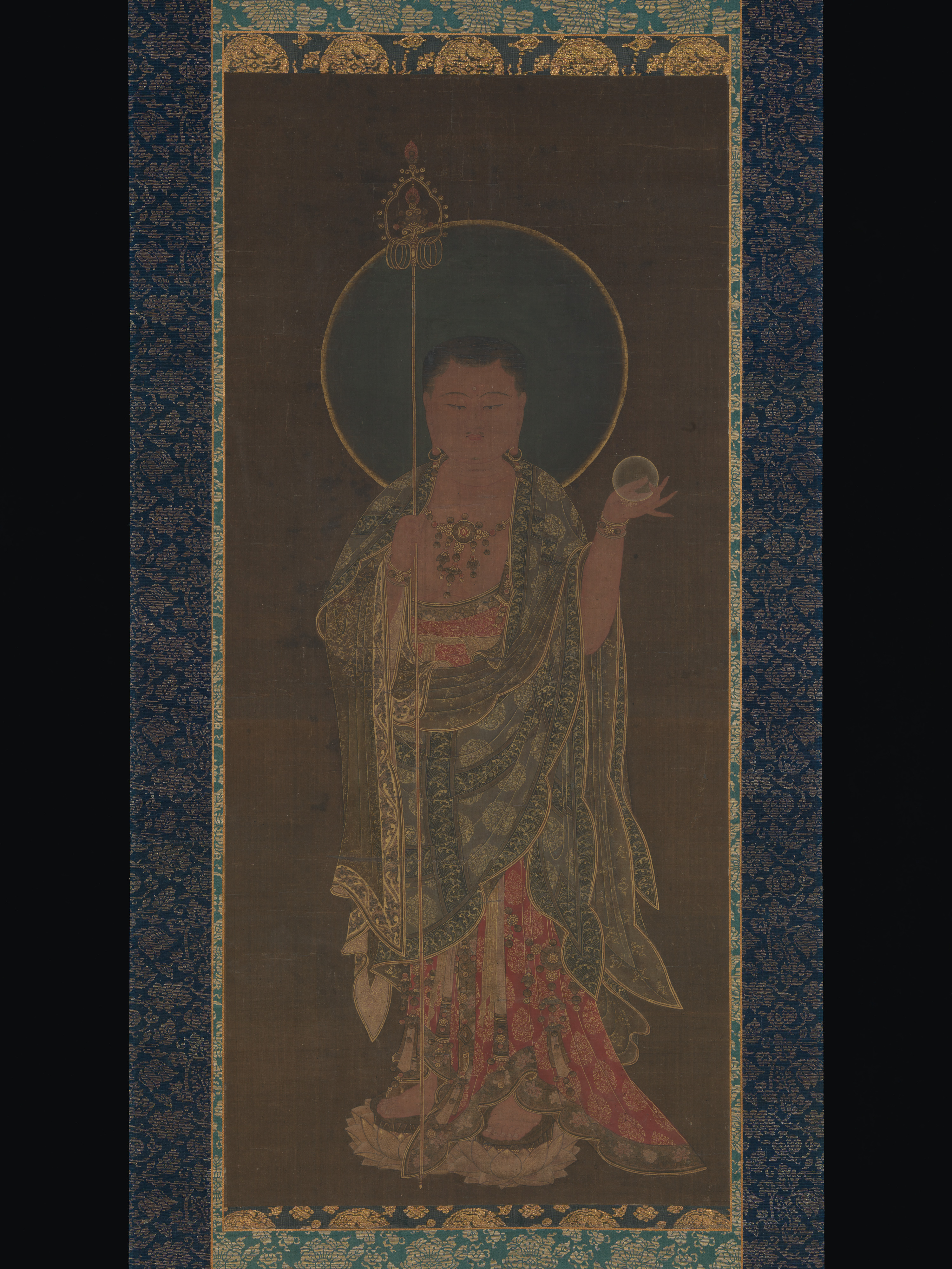
East Asian monastic comparison — Kṣitigarbha, Met 29.160.32Korea, Goryeo dynasty · First half of the 14th centuryPublic Domain; Met Open Access API isPublicDomain=true, verified 2026-10-02.Object record ↗
In other collections
These images stay with the collections that hold them. Each link opens the collection's own page.
- Inscribed crowned Kṣitigarbha — Rubin F1997.12.4 (catalogue origin/date disagreement) ↗Rubin: Tibet. HAR: China. Disagreement unresolved. · Rubin: 17th century. HAR: 1500–1599. Disagreement unresolved. · rubinmuseum.orgHAR record: Photographed Image Copyright © 2004 Rubin Museum of Art. Rubin permits limited noncommercial educational/personal use subject to its terms; no open commercial licence.
- Green court-form Kṣitigarbha — Rubin C2005.26.1 (catalogue date disagreement) ↗Eastern Tibet (Rubin); Tibet (HAR) · Rubin: 19th century. HAR: 1700–1799. Disagreement unresolved. · rubinmuseum.orgRubin Museum copyrighted image; limited noncommercial educational/personal use under Section 5 of its terms, with source credit; no open commercial licence.
- Kṣitigarbha with chest-held jewel — Three Hundred Icons / HAR 78248 ↗Tibet · 1900–1959 (HAR record) · himalayanart.orgHAR record: Photographed Image Copyright © 2003 Publication: Three Hundred Icons; reproduction licence not established.
Sources
- Mipham Rinpoche, Verses of the Eight Noble Auspicious Ones ↗
- Rubin Museum, Bodhisattva Kshitigarbha, F1997.12.4 ↗
- HAR 700040, Kshitigarbha ↗
- Rubin Museum, Bodhisattva Kshitigarbha, C2005.26.1 ↗
- HAR 65766, Kshitigarbha ↗
- Three Hundred Icons plate, Kshitigarbha, HAR 78248 ↗
- Metropolitan Museum, Kshitigarbha, 29.160.32 ↗
- FPMT Mandala, The Making of a Buddha, Joyce Smith (1999) ↗
Depiction requirements and work notes
Kṣitigarbha (Sa yi snying po); current asset slug ksitigarbha
Kṣitigarbha (Tibetan Sa yi Nyingpo) is an Eight Close Sons bodhisattva. Tibetan examples include crowned, jeweled court appearance rather than exclusively the East Asian shaven monk. His color, posture and implements vary. Choose and name a complete tradition before polishing; the game's monk-and-staff silhouette needs an explicit East Asian or cross-tradition attribution if retained in a Tibetan pure-land assembly.
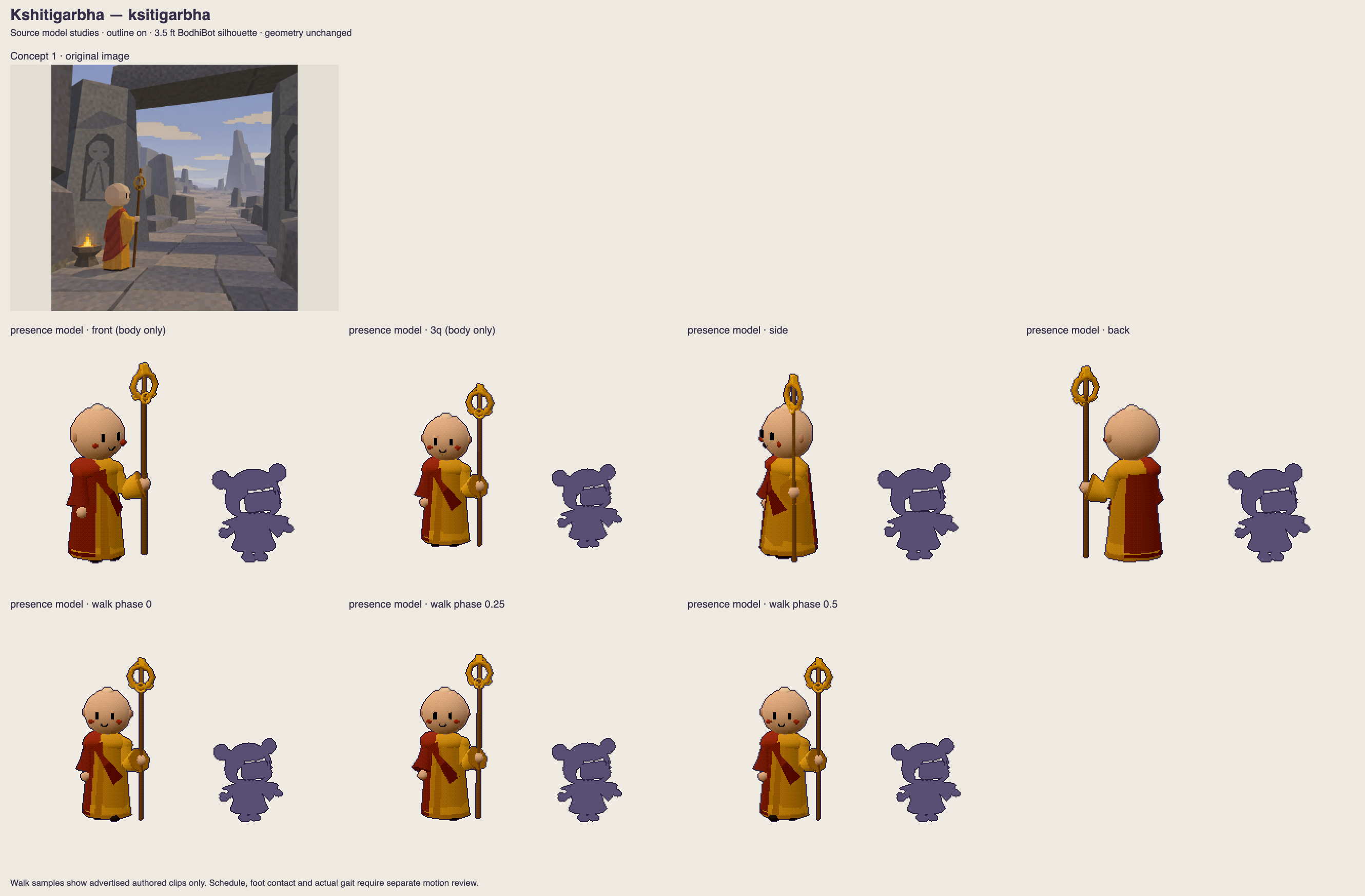
The model capture recipe or rig source changed. The visible model geometry changed. Rig source changed or is missing: prototypes/prerendered-look/parts/purelands/ksitigarbha.js Reinspect the model before relying on the recorded defects.
References, criteria, concept and model side by side
Traditional depictions

Visually inspected: standing jeweled figure with elaborate crown, long earrings, necklaces and draped silks, on a round lotus pedestal. Left palm raised near chest; right hand low. The rear-base inscription supports identity. A court-form silhouette study; do not infer a universal required implement from the empty/preserved hands. [ksiti-rubin-sculpture] [ksiti-har-sculpture] [rubin-rights]
Object record ↗ · Source image ↗
Visually inspected: central green peaceful bodhisattva, tall crown, earrings, ornaments, colored draped clothing, flower stem and broad halo, seated in a relaxed crossed-ankle pose on an ornamented low throne. Incense makers below. Shows that green and relaxed seating are attested rather than automatic errors. [ksiti-rubin-painting] [ksiti-har-painting] [rubin-rights]
Object record ↗ · Source image ↗
Visually inspected named traditional plate: seated crowned bodhisattva with anatomical right hand holding a round jewel at the chest and left hand lowered. Lotus pedestal, long hair, jewelry, scarf. The scan is monochrome, so it cannot settle a skin-color question. [ksiti-three-hundred]
Object record ↗ · Source image ↗Visually inspected: shaven standing monk in gold-patterned robes, anatomical right holding a long ringed staff and left supporting a round jewel, with halo and lotus underfoot. Regional comparison for the current monk silhouette; this is Korean Pure Land imagery, not a Tibetan Eight Sons default. [ksiti-met-korea]
Object record ↗ · Source image ↗Criteria
The model must show
- Selected plan account: the standing Chokling Tersar assembly form from Second Neten Chokling, Vast Clouds of Samantabhadra’s Display, sharedAssemblyAccount II.A.4, English lines 664–719 (2026-10-02), with the recorded emblem program. DECISIONS.md B and the reconciled home select this account; other forms remain separate alternatives.
- Body: white, peaceful bodhisattva appearance; retain one coherent standing court form instead of choosing colours from another artwork.
- Posture and dress: standing in silk and jewels, smiling toward the principal figure; use a restrained peaceful expression under R3 and retain the project low-poly art register.
- Hands: anatomical right teaches and anatomical left protects; retain emblem-bearing lotus stems as the selected shared account states. Do not import the lap, earth-touching, directly held weapon or monastic staff gestures of an alternative form.
- Identity emblem: wish-fulfilling jewel, carried by the lotus program. Exact object/stem side and hand contacts beyond the cited shared gestures require a compatible identified reference; do not borrow them from another form to fill this gap.
- Eyes: solid black silhouettes with no whites, irises, pupils, highlights or glint (project eye rule; a recorded game adaptation, not a claim about traditional painted eyes)
- Maintain readable whole-body posture, both hands, emblem and support from front and three-quarter views. No figure or attribute clips its enclosure (R4).
The model must not show
- Cartoon smiley face: a wide U-shaped or crescent grin, open laughing mouth, rosy cheek dots or mascot cheeks
- Eye whites, irises, pupils, highlights or glint; glowing white-gold eyes (those belong only to freshly liberated beings)
- Any part of the figure (head, crown, hat, halo, raised hand or held object) touching or passing through its canopy, roof, lintel, pillars, throne back or seat in any capture angle
- A crown added to the monk, or any blend of the court and monk forms
- The monk form presented as the Tibetan Eight Sons standard with no cross-tradition label
- A monk with a staff and an empty other hand
- One colour or one jewel-and-staff gesture enforced across all lineages
Original game concept
Current 3D model
presence
Depiction requirements
- Form decision
- For a Tibetan Eight Sons court form, preserve a peaceful youthful bodhisattva with crown, earrings, necklaces, arm ornaments, flowing silks and a clear lotus/throne seat. Do not silently blend this with a Jizō monk silhouette. [ksiti-rubin-sculpture] [ksiti-rubin-painting] [ksiti-har-painting]
- Identity emblem
- Mipham's Eight Auspicious Ones places the jewel fifth in the ordered emblem sequence, corresponding to Kṣitigarbha. A source-specific implementation can use a legible wish-fulfilling jewel; the Three Hundred Icons plate places it in the anatomical right hand at the chest, with the left hand lowered. This is an attested form, not a universal rule for every Kṣitigarbha image. [eight-auspicious-mipham] [ksiti-three-hundred]
- Color
- Do not declare green erroneous or white universally mandatory. Rubin C2005.26.1 is visibly green; other lineages and ritual assemblies use other forms. Record the chosen source and its palette before changing body color. [ksiti-rubin-painting] [ksiti-har-painting]
- Monastic variant
- If retaining the monk form, document the East Asian provenance and compare a complete staff-and-jewel model. The Korean Met painting has staff in anatomical right hand and jewel in left; do not call a left-held staff universally wrong without choosing that specific reference. [ksiti-met-korea] [ksiti-fpmt-cross-tradition]
- Evidence label
- A traditional object attributed by an inscription is stronger identity evidence than a generic bald monk with a staff. Rubin F1997.12.4 is identified by a name inscription on the rear base according to HAR. Its museum and HAR dates/origins disagree; retain both catalogue statements visibly. [ksiti-rubin-sculpture] [ksiti-har-sculpture]
Presentation contract
Blocked · not ready to build from The plan holds this contract back (status pending · modelReady false · buildBlocked true) until the points below are settled.
Why it is blocked: unresolved form and pending research
- Complete the selected standing form with a compatible securely identified reference for detailed anatomy, emblem/stem contacts and support; do not mix the separate historical forms retained in variants and alternativeForms. A sourced written baseline is not model readiness.
Setting and sizing rule
Selected standing court form: provide an authored support and enclosure sized to its complete crown, emblem-bearing lotus and hand span. The cited shared passage does not fix an exact throne/base. Apply R4; an alternative seated form's lap, throne contact, staff or elephant support is not part of this selection.
Selected form
- account
- Chokling Tersar standing court, recorded emblem program
- source
- docs/buddhist-iconography/data/eight-bodhisattvas.json#sharedAssemblyAccount
- selectionBasis
- docs/world-plan/DECISIONS.md B; reconciled home record
- wholeVisualReference
- pending compatible complete depiction; shared written account is not a claim of all-angle visual verification
Recorded variants · 4
- Tibetan Eight Sons court appearance: crown, jewels, silks; standing or seated; no fixed colour or attribute
- East Asian Dizang / Jizō monastic appearance
- FPMT's Land of Medicine Buddha statue, copied from a Taiwanese original at Lama Zopa Rinpoche's direction: intentional cross-tradition use
- Rubin and HAR disagree on the dates and origin of both cited objects; both statements are kept
Alternative forms kept for comparison · 1
- Prior variant-aware contract, retained as comparison history; not the selected Chokling standing contract. Conditional branches must be selected whole, never assembled together.
Recorded adaptations · 1
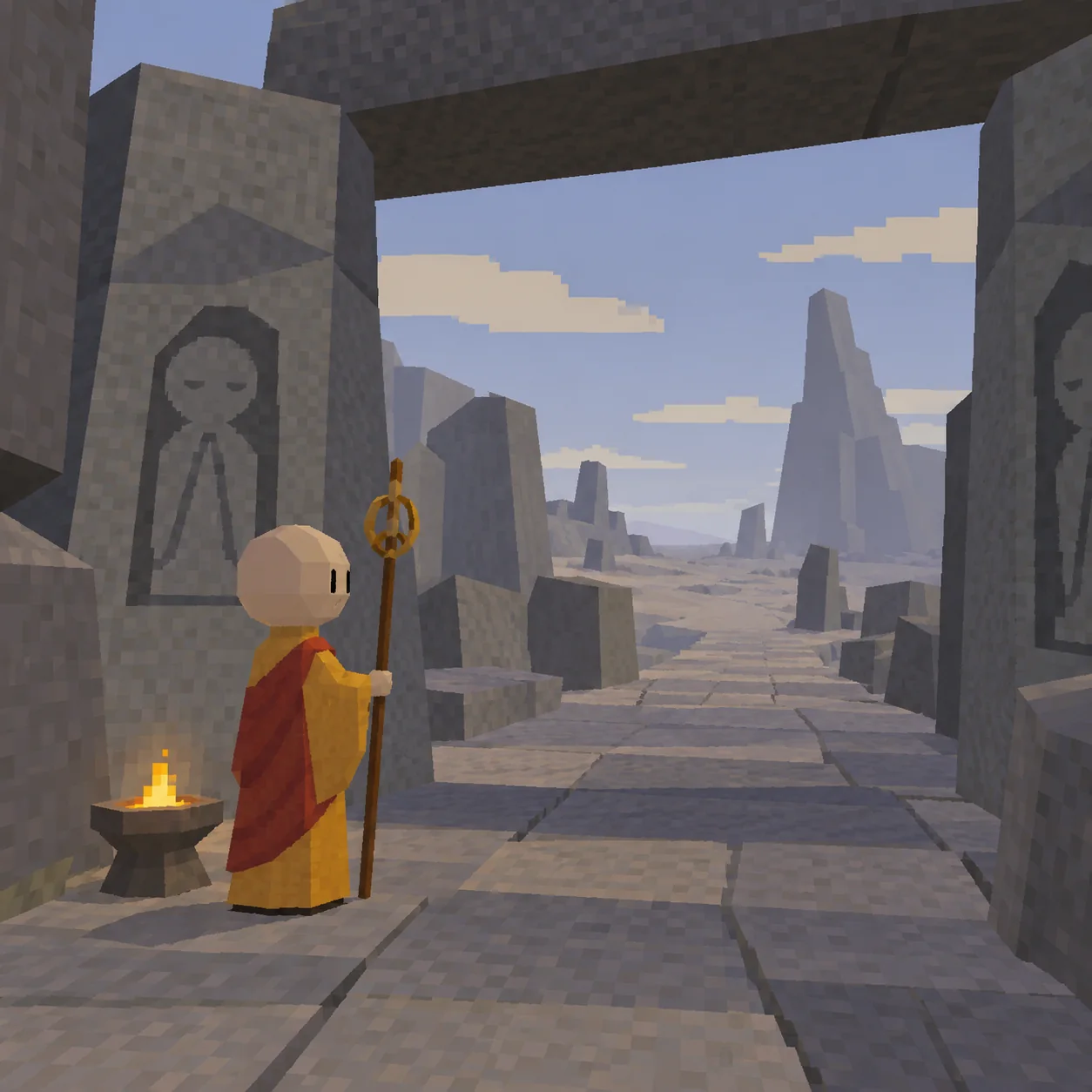
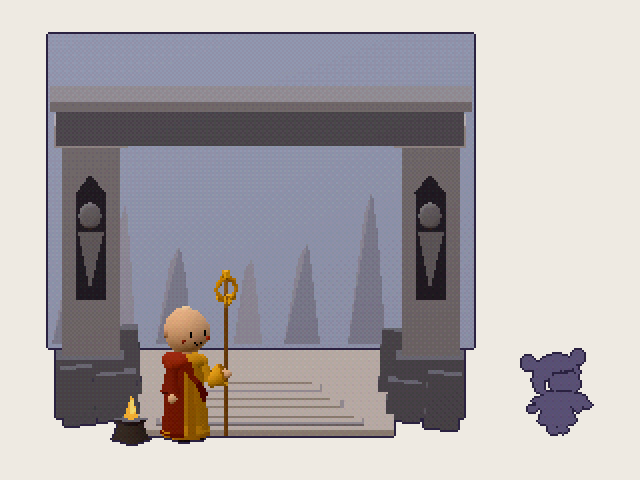
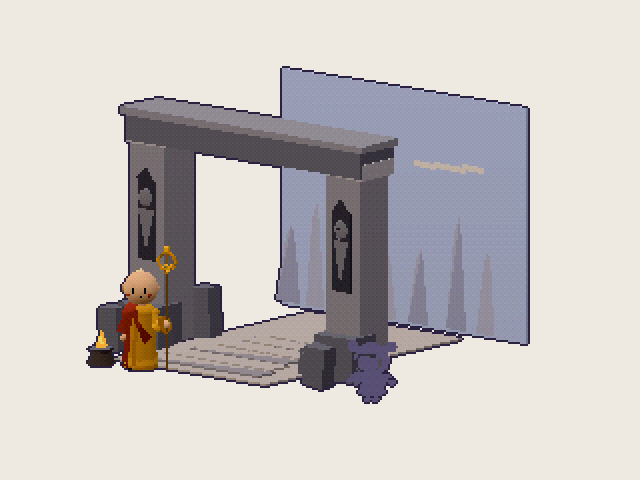
- The small bald monk with a ringed staff at the under-stone threshold follows the game concept
Where the plan places it · 1
- naraka hot hells · The refuge below Avīci
naraka-hot-hells.refuge· character Kshitigarbhaksitigarbha
Contract sources · 9
- Rubin Museum, Bodhisattva Kshitigarbha, F1997.12.4
- Rubin Museum, Bodhisattva Kshitigarbha, C2005.26.1
- HAR 65766, Kshitigarbha
- Mipham Rinpoche, Verses of the Eight Noble Auspicious Ones
- Three Hundred Icons plate, Kshitigarbha, HAR 78248
- Metropolitan Museum, Kshitigarbha, 29.160.32
- FPMT Mandala, The Making of a Buddha, Joyce Smith (1999)
- HAR 700040, Kshitigarbha
- Second Neten Chokling: Vast Clouds of Samantabhadra’s Display
Model audit and next pass
Evidence basis: visual + source
Recorded observations
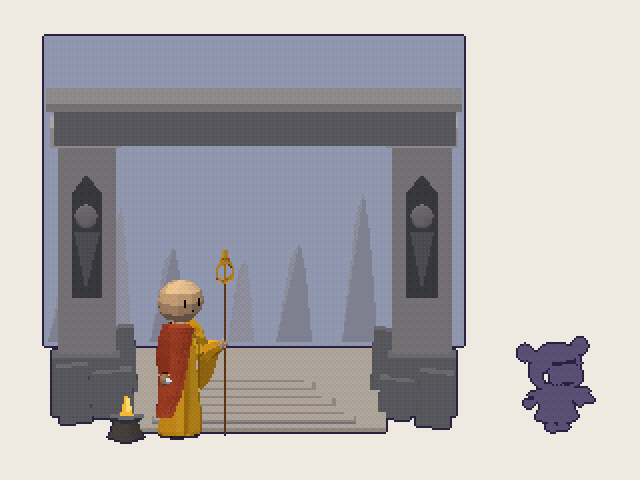
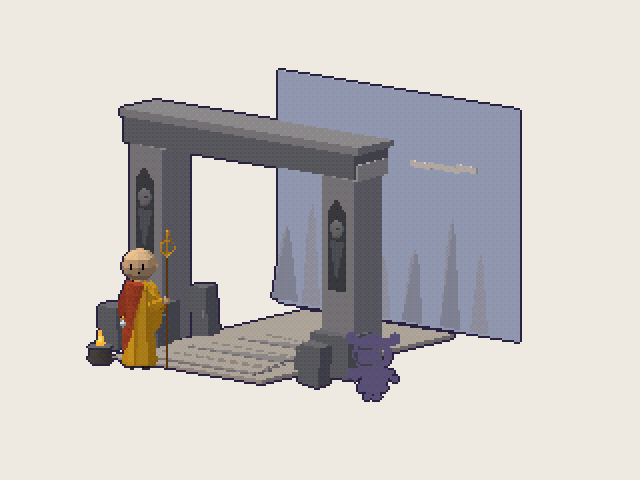
Visual: Concept and current multi-angle captures show a small bald monk in ochre robes with a red kāṣāya-like drape, a ringed staff on the viewer’s right (anatomical left), and an empty other hand. No jewel, princely crown, or bodhisattva jewelry is visible.
Source: ksitigarbha.js calls this a chibi monk and follows the staged under-stone threshold concept. The held staff is at positive X; the source calls that arm right, but for +Z-facing anatomy it is left.
Source: zi-lhakhang-precinct.js reuses the same monk rig as ksitigarbha-court, while the threshold remains the identity’s home.
Audit limit: Monastic Kṣitigarbha is authentic in East Asian traditions and has deliberate cross-tradition use in Tibetan institutions. That does not establish it as the default Tibetan Eight Sons court depiction.
Directions for a future model pass
P1 — Give the Tibetan Eight Sons court appearance the selected program’s jeweled youthful bodhisattva dress and readable emblem (jewel in Mipham’s program); record the particular body color and hand arrangement from that program.
P1 — Treat the bald staff-bearing threshold appearance as an explicitly sourced cross-tradition variant if retained. Do not silently describe it as the universal Tibetan canonical form.
P2 — If retaining a monastic staff/jewel branch, use the selected reference’s anatomical staff hand and wish-fulfilling jewel together; the current empty hand and arbitrary ring arrangement need a source-specific check.
P2 — Preserve short toy proportions, low-detail cloth and compassionate face; new traditional reference must guide a concept revision before a future model alteration.
Assessed baseline captures
Documented forms and lineage variants · 3
Preserve one identified form consistently. A variant is usable only with its own source and context.
Tibetan Eight Sons court appearance: crown, jewels and silks; standing or seated examples are attested. Body color and hand attributes are not fixed across all depictions.
East Asian Dizang/Jizō monastic appearance: shaven head, robe, ringed staff and wish-fulfilling jewel. This is a real Buddhist tradition but should not be mislabeled as the sole Tibetan Eight Sons standard.
Contemporary cross-tradition use is documented: FPMT's Land of Medicine Buddha statue was copied from a Taiwanese original at Lama Zopa Rinpoche's direction for a community with Chinese devotees. That establishes intentional adoption, not historical equivalence of all iconographic traditions.
What not to copy · 4
Do not use East Asian Jizō imagery as proof that every Tibetan Kṣitigarbha must be an unadorned monk.
Do not add a crown to the existing monk while leaving its provenance undefined; choose a complete court or monastic form.
Do not enforce a single color or jewel/staff gesture across all lineages. HAR explicitly notes that this figure lacks a fixed readily identifiable iconic appearance.
Do not treat the museum's 19th-century date for C2005.26.1 and HAR's 18th-century date as a resolved chronology.
Sources and precise locations · 9
- [eight-auspicious-mipham] Mipham Rinpoche, Verses of the Eight Noble Auspicious Ones ↗
- [ksiti-rubin-sculpture] Rubin Museum, Bodhisattva Kshitigarbha, F1997.12.4 ↗
- [ksiti-har-sculpture] HAR 700040, Kshitigarbha ↗
- [ksiti-rubin-painting] Rubin Museum, Bodhisattva Kshitigarbha, C2005.26.1 ↗
- [ksiti-har-painting] HAR 65766, Kshitigarbha ↗
- [ksiti-three-hundred] Three Hundred Icons plate, Kshitigarbha, HAR 78248 ↗
- [ksiti-met-korea] Metropolitan Museum, Kshitigarbha, 29.160.32 ↗
- [ksiti-fpmt-cross-tradition] FPMT Mandala, The Making of a Buddha, Joyce Smith (1999) ↗
- [rubin-rights] Rubin Museum, Terms & Conditions ↗
Assessment freshness and evidence hashes
The frozen snapshot is authored evidence. Regeneration computes current hashes and leaves that snapshot as it is.
{
  "auditFreshness": {
    "status": "stale",
    "reasons": [
      "The model capture recipe or rig source changed.",
      "The visible model geometry changed.",
      "Rig source changed or is missing: prototypes/prerendered-look/parts/purelands/ksitigarbha.js"
    ]
  },
  "sourceSnapshot": {
    "captureHash": "6599ca6311beae2ae3473434a5eb305096b18f5f3e76f1ddee86d859ef06b33c",
    "bodyGeometryHash": "c9cde7182bcd5b2edc02a6cdfa6bd7e1f2a1725ef7885fd5d247f6dcf29c4029",
    "sourceHashes": {
      "prototypes/prerendered-look/parts/purelands/ksitigarbha.js": "2e6b2f86ebb58908fb6c86e846bdbff51ddb218d552d982117c6d54efc72f3e0"
    },
    "captureHashes": {
      "/atlas/audit/sheets/ksitigarbha-f80792efcf08.webp": "12160a9823a95ca401adb9e2c060bfd384e1740964190d7019545cae72bd3393",
      "/atlas/characters/ksitigarbha-6599ca6311be-presence-3q.webp": "5464dd4918e8422fbe0751360d0f9d47edfedff1b5e2a1d21460b33b88109586",
      "/atlas/characters/ksitigarbha-6599ca6311be-presence-front.webp": "1b7e895d4f87268b7ecf1862214e7258b559ac88e79f960f1fc8ccbddc715ac1",
      "/atlas/characters/ksitigarbha-bc7a001da334-presence-3q.webp": "5464dd4918e8422fbe0751360d0f9d47edfedff1b5e2a1d21460b33b88109586",
      "/atlas/characters/ksitigarbha-bc7a001da334-presence-front.webp": "1b7e895d4f87268b7ecf1862214e7258b559ac88e79f960f1fc8ccbddc715ac1"
    },
    "conceptHashes": {
      "/purelands/concepts/ksitigarbha.webp": "25f3c007dc92929118f2e9770bd366364f1c5f4d3e13eb17f7c6fee1aacf3f3e"
    },
    "activeConceptPaths": [
      "/purelands/concepts/ksitigarbha.webp"
    ]
  },
  "currentSnapshot": {
    "captureHash": "69c6e1c847bdd6d6a0921bbdd9e46f419cd855d38f13c6e38721e95a5e1a859f",
    "bodyGeometryHash": "16a520d87d84eb8f6348b47b0d103d32d4f911bac97f91128a1c663fad7499a8",
    "activeConceptPaths": [
      "/purelands/concepts/ksitigarbha.webp"
    ],
    "sourceHashes": {
      "prototypes/prerendered-look/parts/purelands/ksitigarbha.js": "c0856ba19a6800eb3eeace9d74eaa408a573d557567264ee39daa3d8385fe75e"
    },
    "captureHashes": {
      "/atlas/audit/sheets/ksitigarbha-f80792efcf08.webp": "12160a9823a95ca401adb9e2c060bfd384e1740964190d7019545cae72bd3393",
      "/atlas/characters/ksitigarbha-6599ca6311be-presence-3q.webp": "5464dd4918e8422fbe0751360d0f9d47edfedff1b5e2a1d21460b33b88109586",
      "/atlas/characters/ksitigarbha-6599ca6311be-presence-front.webp": "1b7e895d4f87268b7ecf1862214e7258b559ac88e79f960f1fc8ccbddc715ac1",
      "/atlas/characters/ksitigarbha-69c6e1c847bd-presence-3q.webp": "465c89ac1543caeb06d10bac1c483be092572451fe0463388d9c2a7e905c9ed5",
      "/atlas/characters/ksitigarbha-69c6e1c847bd-presence-front.webp": "dea0dc78c4a33748ec2f65be44cd46b61ae52e3cd5b598635c6054af2d090af9",
      "/atlas/characters/ksitigarbha-bc7a001da334-presence-3q.webp": "5464dd4918e8422fbe0751360d0f9d47edfedff1b5e2a1d21460b33b88109586",
      "/atlas/characters/ksitigarbha-bc7a001da334-presence-front.webp": "1b7e895d4f87268b7ecf1862214e7258b559ac88e79f960f1fc8ccbddc715ac1"
    },
    "conceptHashes": {
      "/purelands/concepts/ksitigarbha.webp": "25f3c007dc92929118f2e9770bd366364f1c5f4d3e13eb17f7c6fee1aacf3f3e"
    }
  }
}