Maitreya
Maitreya, Jampa in Tibetan, is the bodhisattva of loving kindness and the future Buddha. He now lives in Tushita as the Buddha's regent. Tibetan art shows him both as a jewelled bodhisattva and as a Buddha, and no single pose belongs to all his images.
In one Tibetan form he sits upright on a high throne with both legs hanging down in front. His raised hands hold the stems of two lotuses at the chest. In a cross-legged Rubin painting they make the teaching gesture. The flowers carry a Dharma wheel and a water flask. One Rubin painting puts the wheel at his right and the flask at his left, and another reverses them.
He is yellow or golden, with one face and two arms, a jewelled crown, earrings, necklaces, bracelets and silk scarves. A small stupa, a domed shrine with a spire, set in his piled hair is a strong sign of him. Cross-legged and standing forms exist too, and a separate tantric form has three faces and four arms.
In traditional art
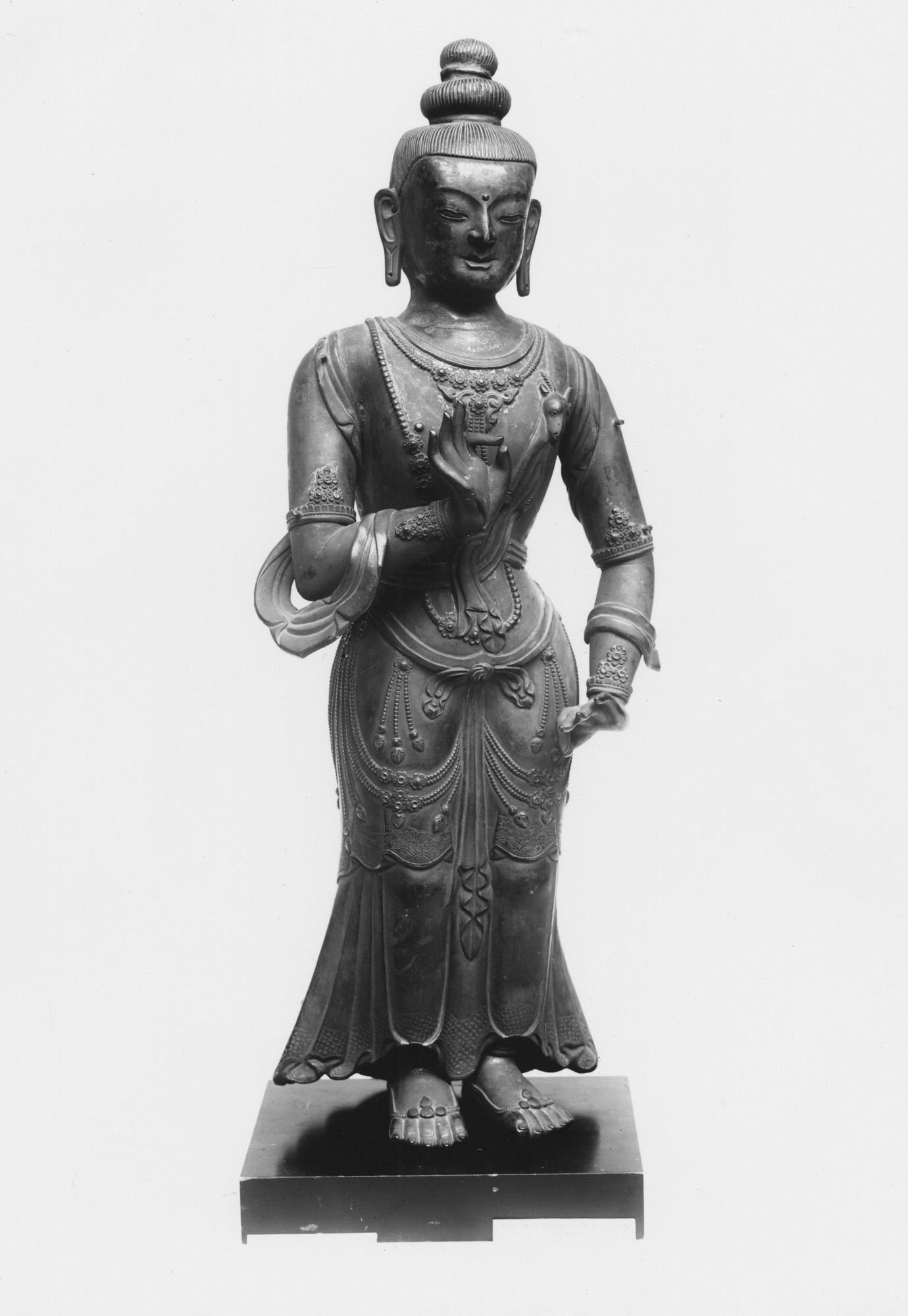
Standing Maitreya — Met 12.37.165Tibet · 1700–1750Public Domain, explicitly marked on the Met artifact record; Met Open Access permits unrestricted commercial and noncommercial use.Object record ↗
In other collections
These images stay with the collections that hold them. Each link opens the collection's own page.
- Bodhisattvas Maitreya and Manjushri in Tushita Pure Realm — C2002.21.3 ↗Tibet; Gelug lineage attributed by Himalayan Art Resources · Early 20th century (museum); HAR range 1900–1959 · api.rubinmuseum.orgPhotographed Image Copyright © 2004 Rubin Museum of Art, as stated by HAR65114. No open license verified; link/reference use only unless separately authorized.
- Maitreya — C2008.28 / HAR57011 ↗Tibet · 17th century · rubinmuseum.orgPhotographed Image Copyright © 2004 Rubin Museum of Art, as stated by HAR57011. No open license verified; link/reference use only unless separately authorized.
- Maitreya — P1994.2.1 / HAR5 ↗Tibet · 17th century · himalayanart.orgPhotographed Image Copyright © 2004 Rubin Museum of Art, as stated by HAR5. No open license verified; link/reference use only unless separately authorized.
Sources
- Trulshik Rinpoche — Homage to the Buddhas and Bodhisattvas ↗
- Himalayan Art Resources — Maitreya Main Page ↗
- Rubin Museum — Bodhisattvas Maitreya and Manjushri in Tushita Pure Realm, C2002.21.3 ↗
- Himalayan Art Resources — Maitreya and Manjushri, HAR65114 ↗
- Himalayan Art Resources — Maitreya, HAR5 / Rubin P1994.2.1 ↗
- Rubin Museum — Maitreya, C2008.28 ↗
- Rubin Project Himalayan Art — Rock Carving of Four-Armed Bodhisattva Maitreya ↗
- The Metropolitan Museum of Art — Standing Maitreya, 12.37.165 ↗
Depiction requirements and work notes
Maitreya (Byams pa), the future Buddha currently teaching as a bodhisattva in Tuṣita
Maitreya (Tibetan Jampa) is the bodhisattva of loving kindness and the future Buddha, presently associated with Tuṣita. Tibetan traditions depict him both in peaceful, jeweled bodhisattva appearance and in Buddha appearance. Pendant legs are a traditional seated posture and should be preserved in this game's existing sitter. Accuracy requires selecting a named traditional form and restoring its identifiers; there is no single universal Maitreya pose or fixed allocation of every attribute to the same side.
The model capture recipe or rig source changed. The visible model geometry changed. Rig source changed or is missing: prototypes/prerendered-look/parts/purelands/maitreya.js Reinspect the model before relying on the recorded defects.
References, criteria, concept and model side by side
Traditional depictions
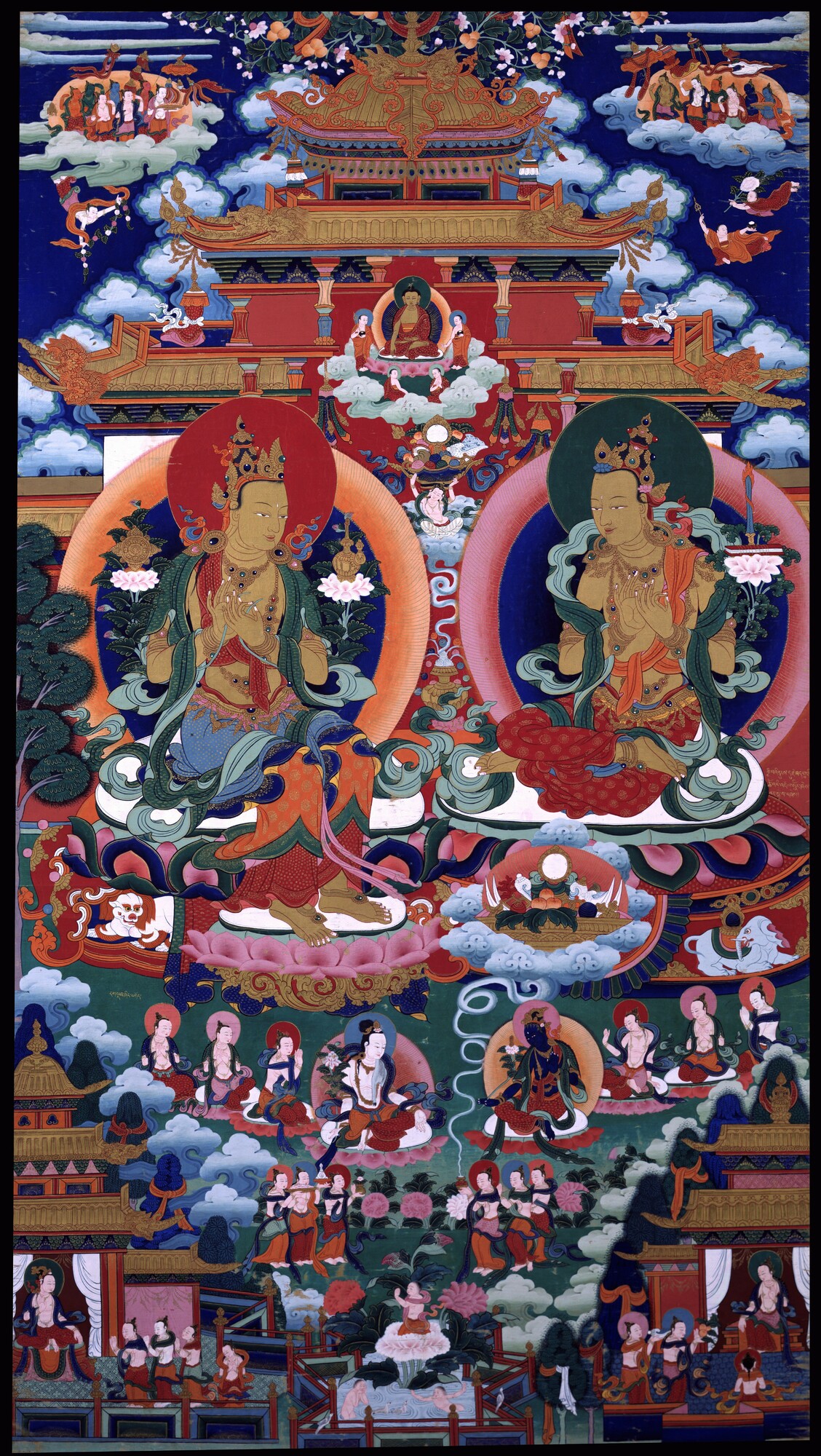
Primary sitter comparison: Maitreya is at viewer left, feet down the front of his throne, with hand-connected lotuses bearing wheel at his anatomical right and flask at his left. Manjushri beside him has sword/book on a lotus: a narrative variant, not the selected raised-sword anatomy. [maitreya-rubin-tushita] [maitreya-har-tushita]
Object record ↗ · Source image ↗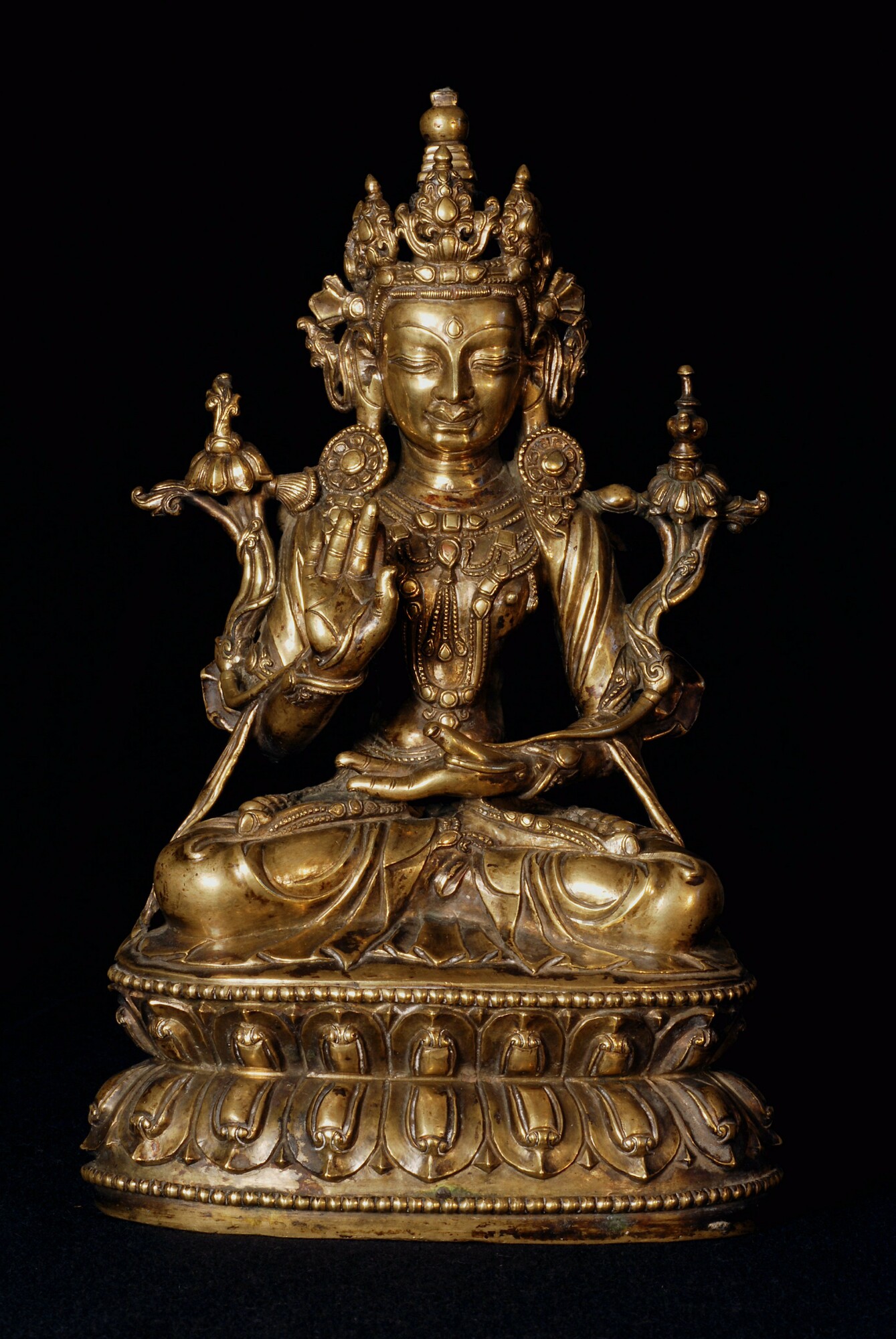
Sculptural study: crown and piled headdress, necklaces and bracelets, flanking attribute-bearing lotus stems, crossed legs and a tiered lotus base. Use the museum's additional angles to understand the ornaments as volumes rather than painting patterns. [maitreya-rubin-seated]
Object record ↗ · Source image ↗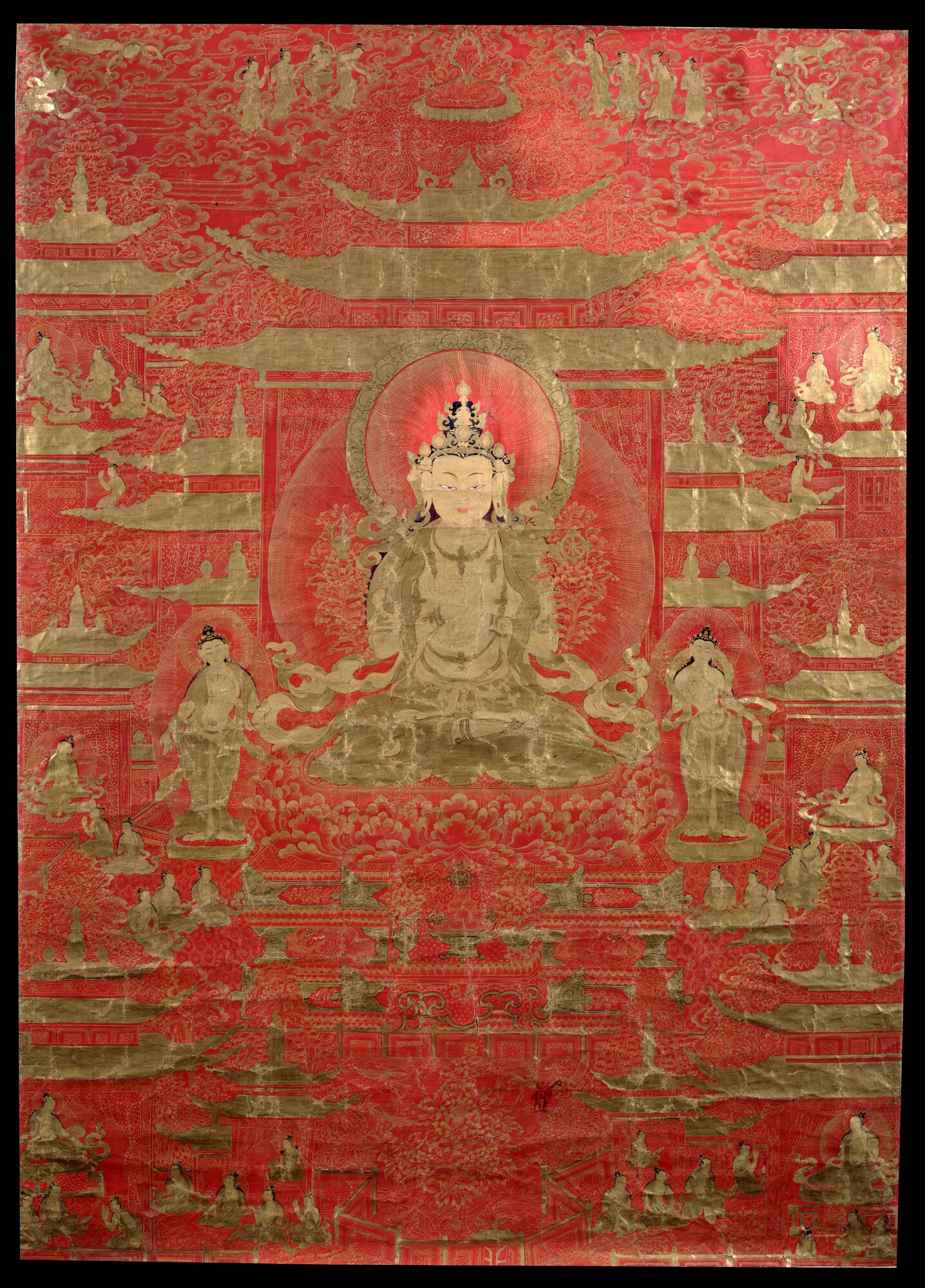
Alternative peaceful form: cross-legged, teaching hands at heart, jeweled crown and ornaments, silk scarves, lotus/moon-disc. Its flask is anatomical right and wheel left, opposite the pendant-leg painting; record the chosen reference before allocating sides. [maitreya-har-redground]
Object record ↗ · Source image ↗Standing comparison with stacked chignon, elongated ears, necklaces and arm ornaments, calm face and long lower garment. The black-and-white photograph does not establish original ritual body color. Secondary reference for volume and drapery, not a mandate to replace the sitter. [maitreya-met-standing]
Object record ↗ · Source image ↗Criteria
The model must show
- Lineage variant: the pendant-leg Tuṣita bodhisattva of Rubin C2002.21.3 (Gelug), which the library recommends for the existing sitter
- Body: yellow or golden, one face, two arms
- Hands: both raised at chest or heart height in a teaching gesture while grasping lotus stems; fingers and stems readable
- Held objects: two lotus blossoms on stems that reach the hands; a Dharma wheel on the flower at his own right and a water flask on the flower at his own left
- Dress and ornaments: the peaceful bodhisattva court dress: a jewelled crown or diadem, earrings, necklaces, armlets and bracelets, flowing silk scarf and lower garment, as clear low-poly shapes
- Headdress: a small stupa (base, dome, spire) in the piled hair is his strong identifier and is built where the chosen form has it
- Posture: upright on a high throne with both legs hanging down the front, feet grounded
- Face: peaceful, youthful and composed; a small closed mouth with at most a slight gentle curve
- Eyes: solid black silhouettes with no whites, irises, pupils, highlights or glint (project eye rule; a recorded game adaptation, not a claim about traditional painted eyes)
- Seat: a high throne, tall enough for the hanging legs to make sense
- Attendants: none required; the Rubin painting pairs him with Mañjuśrī in Tuṣita
The model must not show
- Cartoon smiley face: a wide U-shaped or crescent grin, open laughing mouth, rosy cheek dots or mascot cheeks
- Eye whites, irises, pupils, highlights or glint; glowing white-gold eyes (those belong only to freshly liberated beings)
- Any part of the figure (head, crown, hat, halo, raised hand or held object) touching or passing through its canopy, roof, lintel, pillars, throne back or seat in any capture angle
- A single pointed gold cap and plain robe with no crown, jewels or silks
- Low closed fists at the knees with no teaching gesture
- Missing flask, wheel or lotus stems
- A wheel that reads as a gear or floating collectible
- A cone or jewel standing in for the stupa
- The laughing pot-bellied Budai
- Three faces or four arms from the tantric form
- Forcing the legs into a cross-legged seat
Original game concept
Current 3D model
presence


Depiction requirements
- Identity and realm
- Describe the Tuṣita resident as the Buddha's regent and future Buddha, embodying loving kindness. Keep his peaceful presence and do not turn him into an ordinary monk or an invented crowned king. The title Buddha does not by itself require changing a Tuṣita bodhisattva model to monk's robes. [maitreya-trulshik] [maitreya-har-profile]
- Selected seated form
- For the existing sitter, use the pendant-leg Tuṣita bodhisattva as the working reference: upright on a high throne, both legs extending down the front, peaceful face, and visible attributes on flanking lotus blossoms. Rubin C2002.21.3 explicitly documents this posture with a Dharma wheel and water flask. Do not call pendant legs a defect or force cross-legged posture merely because other buddhas sit that way. [maitreya-rubin-tushita] [maitreya-har-tushita]
- Body, head and clothing
- Keep one face and two arms for the chosen peaceful sitter. Use yellow or golden body color, a composed youthful face, a recognizable jeweled crown/diadem, earrings, necklaces and bracelets, flowing silk scarves and a lower garment. Translate these into clear low-polygon shapes. A single pointed cap and robe alone omit much of the peaceful bodhisattva register. [maitreya-har-profile] [maitreya-har-redground] [maitreya-rubin-seated]
- Hands and teaching gesture
- Make the hands legible as a teaching gesture at chest/heart height while grasping lotus stems, rather than closed fists resting by the knees. This is the documented arrangement in the cross-legged red-ground Maitreya; the pendant-leg painting also shows the hands raised near the chest in its photograph. The fingers, stem grip and distance from the torso must remain readable in the game's normal camera. [maitreya-har-redground] [maitreya-rubin-tushita]
- Flask and wheel
- Restore a clearly shaped water flask and Dharma wheel, each supported by its lotus, with stems physically reaching the hands. For the pendant-leg C2002.21.3 reference, put the wheel at Maitreya's anatomical right and flask at his anatomical left. Treat that as this selected reference's arrangement, not a rule for all Maitreya images: P1994.2.1 reverses those two attributes. Preserve the wheel as a religious wheel, not a gear or floating game collectible. [maitreya-har-tushita] [maitreya-har-redground]
- Stupa in the headdress
- A small stupa nested in the piled hair/chignon is a strong traditional Maitreya identifier. If incorporated, model a miniature stupa with a recognizable base, dome and ascending spire rather than a generic cone or jewel. Do not infer that its absence invalidates every Maitreya variant: flask/wheel/posture also identify selected forms. [maitreya-rubin-mulbekh] [maitreya-har-profile]
- Seat and visual polish
- Use the reference's lotus/throne relationship and leave visual space around both attribute-bearing flowers. Preserve dignity through an upright torso, calm face, balanced shoulders and coherent scarf silhouette. A lotus and moon-disc are documented for the cross-legged form; keep the pendant-leg throne high enough that the feet and hanging legs make sense. Review front and both three-quarter angles before declaring the identifiers readable. [maitreya-har-redground] [maitreya-rubin-tushita] [maitreya-rubin-seated]
Presentation contract
Ready to build from No readiness block is recorded in the plan.
Open points recorded with the contract
- The Eight Close Sons court reuses this sitter; its court costume and posture have no separately chosen programme
Setting and sizing rule
A high throne with visual space around both attribute-bearing flowers. Sizing (plan rule R4, not a sourced claim): the opening of any shrine, canopy or pavilion around the figure leaves at least one of the figure's own head-heights of clear air above its tallest point (the crown or stupa) and a clear gap on each side of its widest span (the two lotus blossoms with wheel and flask); a throne back or aureole sits behind the figure without passing through it; pillars and lintel do not cross the face, hands or held objects in the front or either three-quarter capture.
Recorded variants · 4
- Cross-legged peaceful bodhisattva (Rubin P1994.2.1): flask at own right, wheel at own left, lotus and moon seat
- Cross-legged metal bodhisattva (Rubin C2008.28)
- Standing Maitreya (Met 12.37.165)
- Buddha appearance and a tantric three-face four-arm form also exist
Recorded adaptations · 0
Where the plan places it · 1
- tushita · The teaching court
tushita.court· character Maitreyamaitreya
Contract sources · 8
- Trulshik Rinpoche — Homage to the Buddhas and Bodhisattvas
- Himalayan Art Resources — Maitreya Main Page
- Rubin Museum — Bodhisattvas Maitreya and Manjushri in Tushita Pure Realm, C2002.21.3
- Himalayan Art Resources — Maitreya and Manjushri, HAR65114
- Himalayan Art Resources — Maitreya, HAR5 / Rubin P1994.2.1
- Rubin Museum — Maitreya, C2008.28
- Rubin Project Himalayan Art — Rock Carving of Four-Armed Bodhisattva Maitreya
- The Metropolitan Museum of Art — Standing Maitreya, 12.37.165
Model audit and next pass
Evidence basis: visual + source
Recorded observations
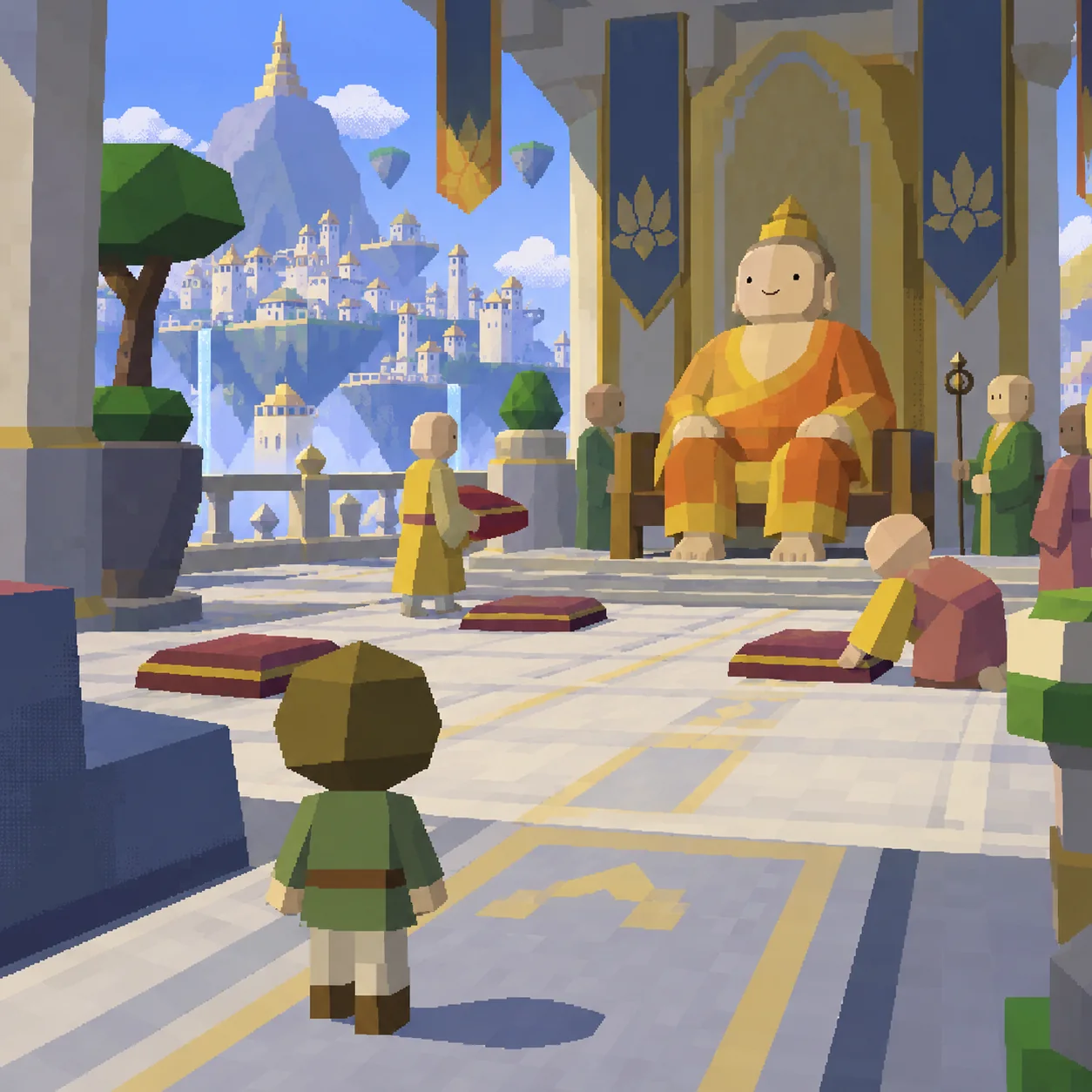
Visual: The original concept and current front/three-quarter/side/back captures show a broad, serene orange-robed figure with pendant feet and a pointed gold cap. The throne is visible in canonical captures but intentionally absent from body-only views.
Visual: Both hands remain low, fist-like shapes over the knees. No distinct teaching gesture, lotus stems, flask, wheel, or readable stūpa appears in the inspected neutral pose.
Source: maitreya.js constructs a single tapered gold cap without a stūpa structure; it names the sitter stationary and the throne scenery. The model is reused for maitreya-court in zi-lhakhang-precinct.js.
Audit limit: Pendant legs are a legitimate Tibetan Maitreya form. Broad toy proportions and solid black eyes are project adaptations, not iconographic errors by themselves.
Directions for a future model pass
P1 — Give the Tuṣita appearance an explicit source-form contract. Preserve pendant legs, but model a readable teaching gesture and the exact selected reference’s lotus-supported attributes; include a recognizable stūpa where the chosen form specifies it.
P1 — Replace the generic pointed cap with the selected form’s crown/topknot/stūpa arrangement. A little gold hat does not identify Maitreya.
P2 — The court appearance may reuse the identity, but its costume, attributes and posture must be assessed against a named Eight Sons program independently of the Tuṣita throne version.
P2 — Preserve the grounded feet, welcoming face and orange cloth hierarchy; improve small attribute silhouettes before adding surface detail.
Assessed baseline captures


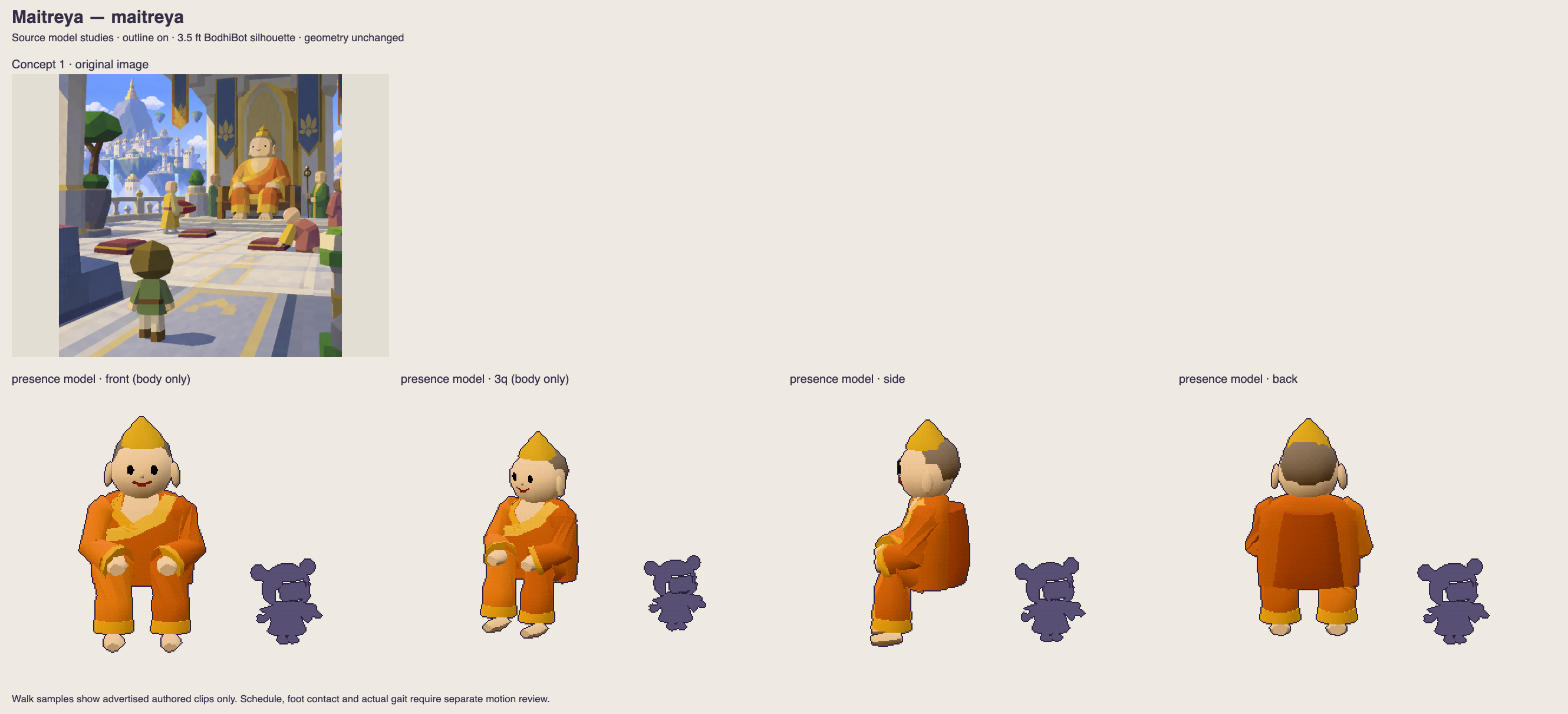
Documented forms and lineage variants · 5
Preserve one identified form consistently. A variant is usable only with its own source and context.
Tuṣita bodhisattva with pendant legs: Rubin C2002.21.3, Tibetan/Gelug, early 20th century. Wheel on anatomical right, water flask on anatomical left. Recommended reference for preserving the game's sitter.
Cross-legged peaceful bodhisattva: Rubin P1994.2.1, Tibet, 17th century. Yellow/gold, two hands teaching at heart, right lotus supports flask and left supports wheel; jeweled ornaments, silks, lotus and moon-disc.
Cross-legged metal bodhisattva: Rubin C2008.28, Tibet, 17th century. Useful three-dimensional crown, ornament, lotus-prop and throne reference, with multiple photographed angles.
Standing Maitreya: Met 12.37.165, Tibet, 1700–1750. Standing posture is traditional, but this sculpture is a secondary comparison rather than a reason to replace the current sitter.
Buddha appearance and peaceful bodhisattva appearance coexist. A separate tantric three-face/four-arm form is recorded by HAR; do not add its anatomy to the peaceful two-arm sitter.
What not to copy · 4
Do not label all Maitreya depictions identical, or treat the right/left order of flask and wheel as universal.
Do not leave him as an unidentified gold-capped figure with low fists and no teaching gesture, lotus connection, flask, wheel or recognizable stupa.
Do not import Chinese Budai's laughing, potbellied monk appearance as the default Tibetan Tuṣita Maitreya. The selected Tibetan artifact references depict a different form.
Do not require every possible historical attribute at once. Choose one coherent reference/form, record it, then preserve its pose, clothing and attributes together.
Sources and precise locations · 8
- [maitreya-trulshik] Trulshik Rinpoche — Homage to the Buddhas and Bodhisattvas ↗
- [maitreya-har-profile] Himalayan Art Resources — Maitreya Main Page ↗
- [maitreya-rubin-tushita] Rubin Museum — Bodhisattvas Maitreya and Manjushri in Tushita Pure Realm, C2002.21.3 ↗
- [maitreya-har-tushita] Himalayan Art Resources — Maitreya and Manjushri, HAR65114 ↗
- [maitreya-har-redground] Himalayan Art Resources — Maitreya, HAR5 / Rubin P1994.2.1 ↗
- [maitreya-rubin-seated] Rubin Museum — Maitreya, C2008.28 ↗
- [maitreya-rubin-mulbekh] Rubin Project Himalayan Art — Rock Carving of Four-Armed Bodhisattva Maitreya ↗
- [maitreya-met-standing] The Metropolitan Museum of Art — Standing Maitreya, 12.37.165 ↗
Assessment freshness and evidence hashes
The frozen snapshot is authored evidence. Regeneration computes current hashes and leaves that snapshot as it is.
{
  "auditFreshness": {
    "status": "stale",
    "reasons": [
      "The model capture recipe or rig source changed.",
      "The visible model geometry changed.",
      "Rig source changed or is missing: prototypes/prerendered-look/parts/purelands/maitreya.js"
    ]
  },
  "sourceSnapshot": {
    "captureHash": "00e51af9259bcef5eec129c62206a2d376260b3fa3aca9e6a91aab67d3478bfc",
    "bodyGeometryHash": "fb20521828c03016b846d58f29888d53fe24497738caa1e1ac510c72944a5d04",
    "sourceHashes": {
      "prototypes/prerendered-look/parts/purelands/maitreya.js": "95a4cde84ec80259e58cc01b59e980de153d32f1dc5c8ebac75b60c59b4c6b78"
    },
    "captureHashes": {
      "/atlas/audit/sheets/maitreya-17a809d4fa73.webp": "87b179e1a48ae9fa9c608aa7cd0555eaec8493c1a639f8d0a8cd9a25989a6360",
      "/atlas/characters/maitreya-00e51af9259b-presence-3q.webp": "b1df6c009282e69591c7624b705757dcba321d6cc84a3635460faf5d1cdac4fe",
      "/atlas/characters/maitreya-00e51af9259b-presence-front.webp": "8d7ba36adda5afa0de965e9f81e7a107df1a00f91b5f3e9487c4a95949cd46cf",
      "/atlas/characters/maitreya-3cee4cabb615-presence-3q.webp": "b1df6c009282e69591c7624b705757dcba321d6cc84a3635460faf5d1cdac4fe",
      "/atlas/characters/maitreya-3cee4cabb615-presence-front.webp": "8d7ba36adda5afa0de965e9f81e7a107df1a00f91b5f3e9487c4a95949cd46cf"
    },
    "conceptHashes": {
      "/purelands/concepts/maitreya.webp": "201edb06898236f28fbd9c3d6d910f38bd36ee149f8650e20634a58fcca04756"
    },
    "activeConceptPaths": [
      "/purelands/concepts/maitreya.webp"
    ]
  },
  "currentSnapshot": {
    "captureHash": "fa1423f1dfd5f67515c54f018c58d3df0e9e98fff54251b3118ef5b2746b1b49",
    "bodyGeometryHash": "2ae4d18ff3c7eecddd686e66e83c215b81fca7e9854b87d37c50ca67b02ffd98",
    "activeConceptPaths": [
      "/purelands/concepts/maitreya.webp"
    ],
    "sourceHashes": {
      "prototypes/prerendered-look/parts/purelands/maitreya.js": "8e38f2b41c8204f1d48a8de0477b5ecd0134158fd0b80880b2e42b70c5826e0e"
    },
    "captureHashes": {
      "/atlas/audit/sheets/maitreya-17a809d4fa73.webp": "87b179e1a48ae9fa9c608aa7cd0555eaec8493c1a639f8d0a8cd9a25989a6360",
      "/atlas/characters/maitreya-00e51af9259b-presence-3q.webp": "b1df6c009282e69591c7624b705757dcba321d6cc84a3635460faf5d1cdac4fe",
      "/atlas/characters/maitreya-00e51af9259b-presence-front.webp": "8d7ba36adda5afa0de965e9f81e7a107df1a00f91b5f3e9487c4a95949cd46cf",
      "/atlas/characters/maitreya-3cee4cabb615-presence-3q.webp": "b1df6c009282e69591c7624b705757dcba321d6cc84a3635460faf5d1cdac4fe",
      "/atlas/characters/maitreya-3cee4cabb615-presence-front.webp": "8d7ba36adda5afa0de965e9f81e7a107df1a00f91b5f3e9487c4a95949cd46cf",
      "/atlas/characters/maitreya-fa1423f1dfd5-presence-3q.webp": "53b001e50a3f3934e0b76eea36fa0d88a77e7ecb93d5897afe5070c349d8ad34",
      "/atlas/characters/maitreya-fa1423f1dfd5-presence-front.webp": "3d3f9bc3edcd53709d18546e9c5f3e88ef33ab8fa77df46c393da41d20d51e6a"
    },
    "conceptHashes": {
      "/purelands/concepts/maitreya.webp": "201edb06898236f28fbd9c3d6d910f38bd36ee149f8650e20634a58fcca04756"
    }
  }
}