Mañjuśrī
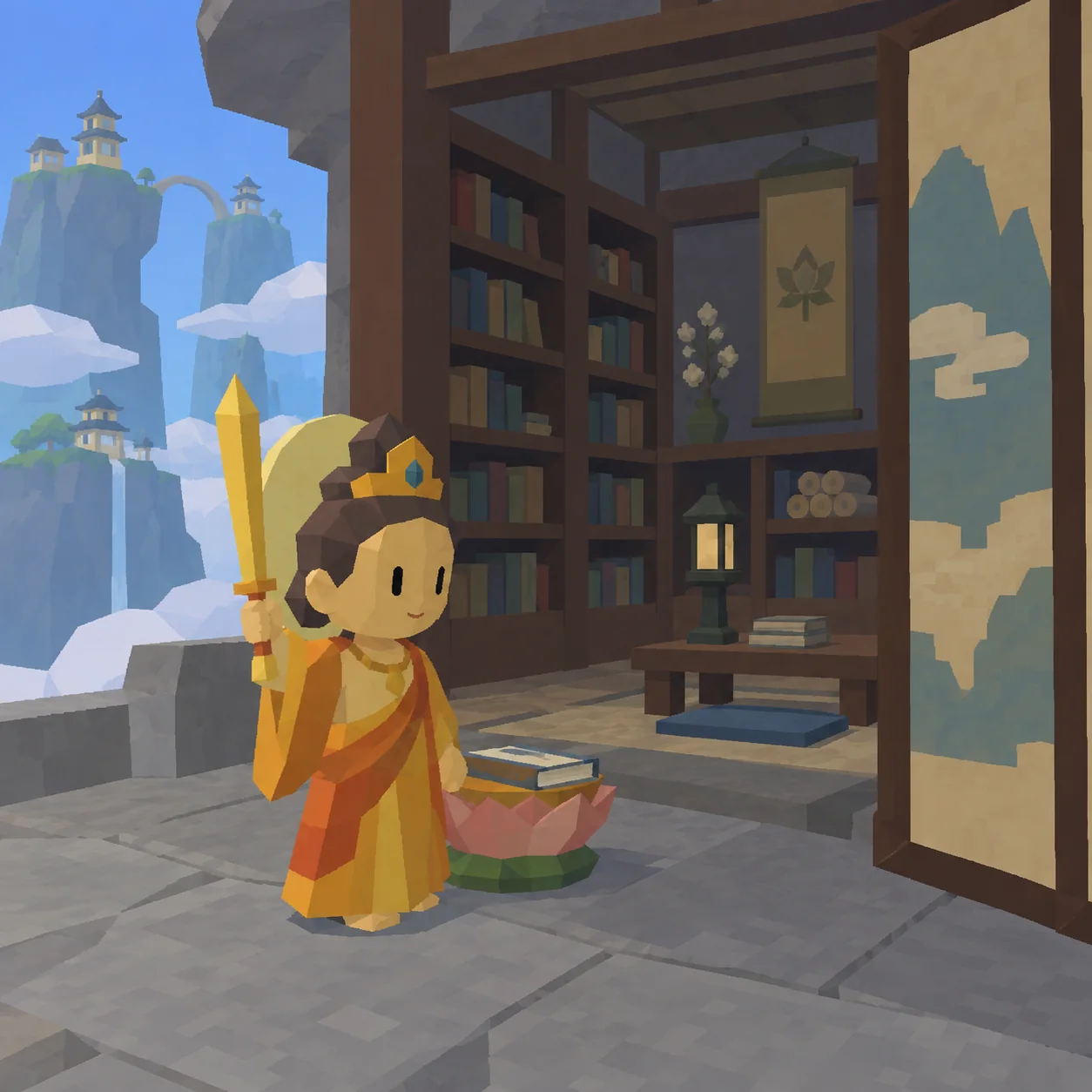
Manjushri is the bodhisattva of wisdom. In the form chosen here he is orange, youthful and smiling, with one face and two arms. His right hand raises a sword above his head. His left holds a lotus that carries the Prajnaparamita, the scripture of perfect wisdom.
The sword is awakened knowledge cutting through delusion. A Tibetan praise gives it a dark blue blade wrapped in flames of wisdom. The scripture rests on the flower near his left shoulder. He wears a jewelled crown, earrings, necklaces, armlets, silks and a flowing scarf.
The orange liturgies seat him with legs crossed on a lotus and moon disc, though Tibetan sculpture also shows him standing. White Manjushri, in Mipham's practice, is a separate form: moon-white, his right hand giving and his left holding an utpala flower. Many-armed and lion-riding forms follow their own sources.
In traditional art
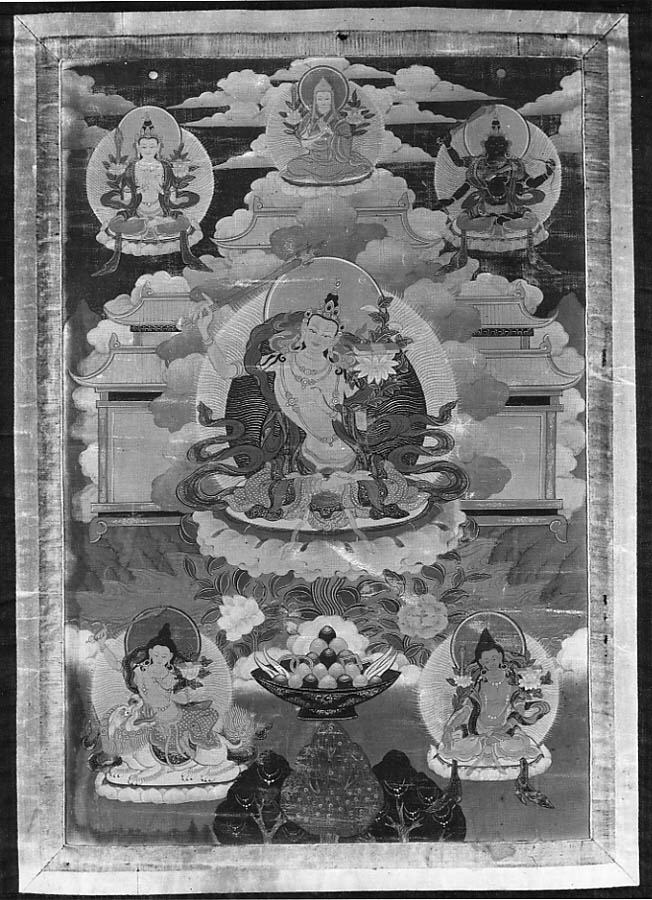
Manjushri — Met 60.43.9Tibet · 17th–18th centuryPublic Domain, explicitly marked on the Met artifact record; Met Open Access permits unrestricted commercial and noncommercial use.Object record ↗ 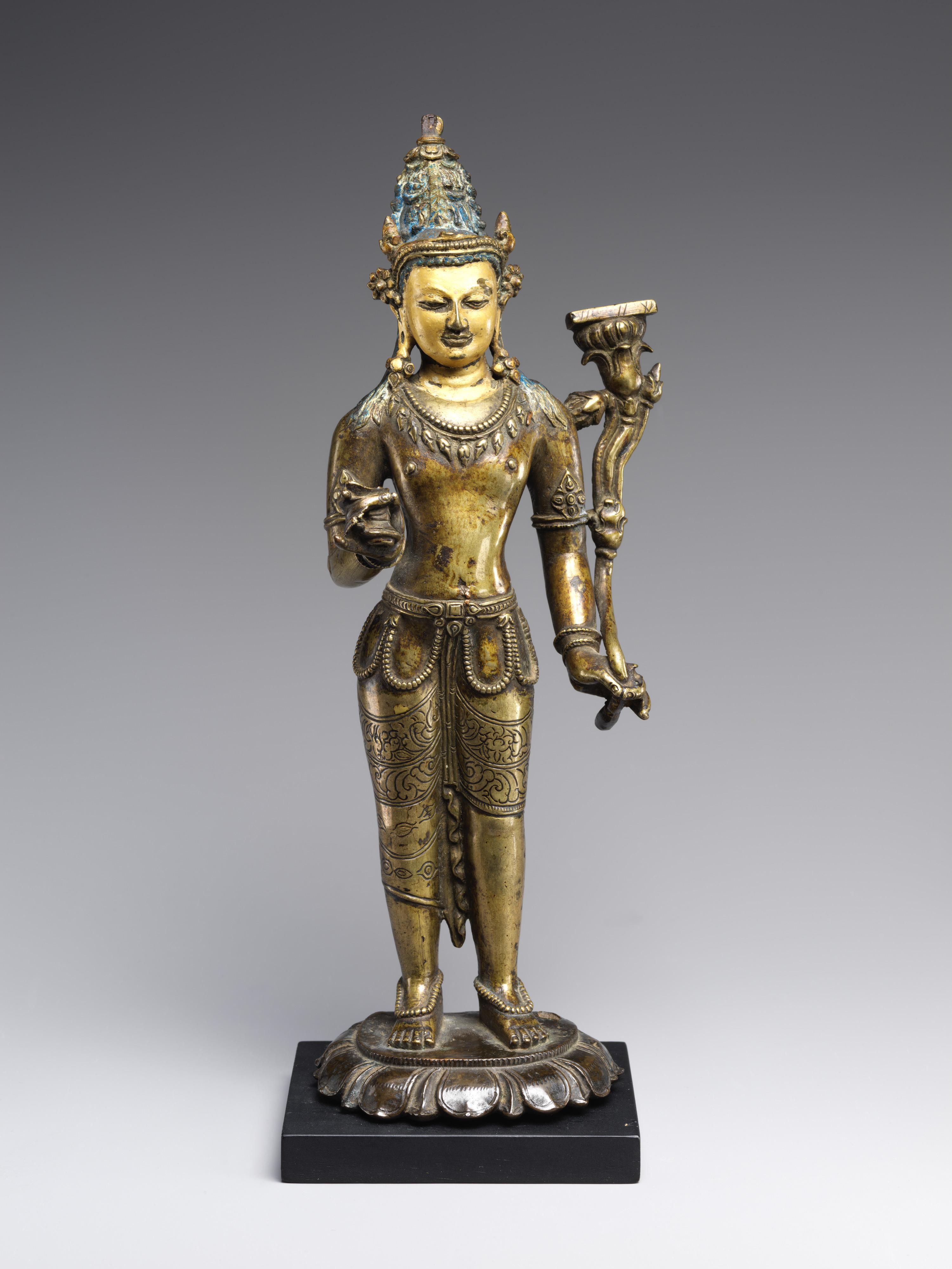
Manjushri, the Bodhisattva of Transcendent Wisdom — Met 1983.554.2Tibet · 12th centuryPublic Domain, explicitly marked on the Met artifact record; Met Open Access permits unrestricted commercial and noncommercial use.Object record ↗
In other collections
These images stay with the collections that hold them. Each link opens the collection's own page.
- Bodhisattvas Maitreya and Manjushri in Tushita Pure Realm — C2002.21.3 ↗Tibet; Gelug lineage attributed by Himalayan Art Resources · Early 20th century · api.rubinmuseum.orgPhotographed Image Copyright © 2004 Rubin Museum of Art, as stated by HAR65114. No open license verified; link/reference use only unless separately authorized.
Sources
- Dilgo Khyentse Rinpoche — Golden Mañjuśrī Sādhana ↗
- Alak Zenkar Rinpoche — Light from the Wisdom Sun ↗
- Do Dasal Wangmo — The Flourishing Splendour of Intelligence: In Praise of Mañjuśrī ↗
- The Metropolitan Museum of Art — Manjushri, the Bodhisattva of Transcendent Wisdom, 1983.554.2 ↗
- The Metropolitan Museum of Art — Manjushri, 60.43.9 ↗
- Mipham Rinpoche — White Mañjuśrī Practice ↗
- Himalayan Art Resources — Maitreya and Manjushri, HAR65114 ↗
Depiction requirements and work notes
Mañjuśrī (’Jam dpal / ’Jam pa’i dbyangs), wisdom bodhisattva
For the game's orange/golden, raised-sword Mañjuśrī, the coherent Tibetan reference is the youthful peaceful two-arm wisdom bodhisattva: sword in anatomical right, lotus bearing the Prajñāpāramitā manuscript at anatomical left, princely jewels and silks, calm smiling face. His sword signifies wisdom cutting delusion. White, multi-arm, lion-riding and narrative lotus-supported-sword forms are distinct traditional variants, not interchangeable details to combine at will.
The model capture recipe or rig source changed. The visible model geometry changed. Rig source changed or is missing: prototypes/prerendered-look/parts/purelands/manjushri.js Reinspect the model before relying on the recorded defects.
References, criteria, concept and model side by side
Traditional depictions
Intact sword/book anatomy comparison: central Manjushri raises the sword with anatomical right and holds the left lotus supporting scripture; jeweled diadem, long scarf and lotus seat. The museum's available main photograph is grayscale despite the color-and-gold medium; it supplies shapes, not a body-color decision. [manjushri-met-painting]
Object record ↗ · Source image ↗Standing sculptural reference: elongated ears, ornate high headdress, multiple ornaments, floral lower garment and pearl-loop belt. The left lotus carries a long palm-leaf manuscript. Sword blade is missing but the right-hand hilt survives; use the sculpture for book, ornament and volume study, not as permission to omit the blade. [manjushri-met-sculpture]
Object record ↗ · Source image ↗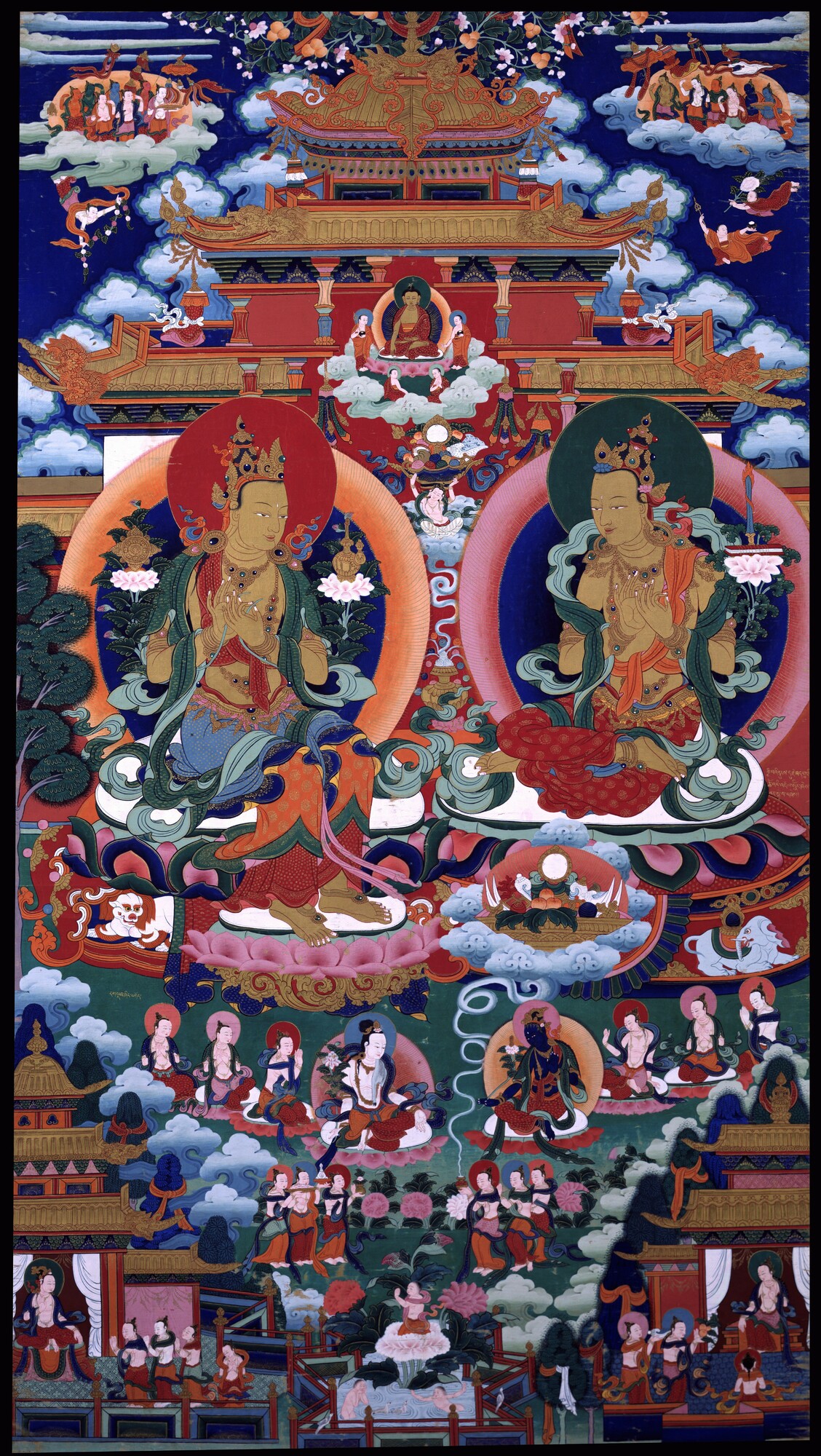
Variant comparison only: Manjushri is at viewer right, holding a lotus with upright sword above the folio manuscript while conversing with Maitreya. Do not merge its lotus-supported sword arrangement into the chosen sword-wielding form without changing the documented form contract. [manjushri-har-tushita]
Object record ↗ · Source image ↗Criteria
The model must show
- Lineage variant: the orange two-armed sword-and-scripture Mañjuśrī of the Tibetan liturgies (Dilgo Khyentse, Alak Zenkar, Do Dasal Wangmo)
- Body: orange or golden, one face, two arms, youthful proportions
- Hands: own right hand raises the sword above the head; own left hand holds a lotus stem
- Held objects: a sword with clear blade, guard and grip, a dark-blue blade with a simple flame silhouette; a lotus at the left shoulder carrying a long Tibetan-style scripture volume, present in the ordinary idle pose
- Dress and ornaments: the peaceful bodhisattva court dress: a jewelled crown or diadem, earrings, necklaces, armlets and bracelets, flowing silk scarf and lower garment, as clear low-poly shapes
- Posture: the liturgies give crossed legs on a lotus and moon; the standing game rig is a recorded standing peaceful adaptation (standing is attested by Met 1983.554.2)
- Face: serene and youthful; a small closed mouth with at most a gentle curve; never angry
- Eyes: solid black silhouettes with no whites, irises, pupils, highlights or glint (project eye rule; a recorded game adaptation, not a claim about traditional painted eyes)
- Seat: lotus and moon disc when seated
- Attendants: none required
The model must not show
- Cartoon smiley face: a wide U-shaped or crescent grin, open laughing mouth, rosy cheek dots or mascot cheeks
- Eye whites, irises, pupils, highlights or glint; glowing white-gold eyes (those belong only to freshly liberated beings)
- Any part of the figure (head, crown, hat, halo, raised hand or held object) touching or passing through its canopy, roof, lintel, pillars, throne back or seat in any capture angle
- An empty left hand, or the book appearing only in a reading animation
- The lotus and book left behind as detached scenery
- A modern upright codex
- A plain generic gold sword with no flame treatment
- A threatening warrior face
- A white body with the sword form's details
- Extra arms, a lion mount, skull ornaments
- Hands or attributes mirrored to the wrong side of the figure's own body (own right appears at viewer-left in a front view)
Original game concept
Current 3D model
presence


Depiction requirements
- Color, anatomy and expression
- Keep the selected orange/golden body, one face and two arms, youthful proportions and peaceful smiling expression. Orange is positively supported by Tibetan liturgies; a gilt bronze's golden metal surface alone is not evidence that every Manjushri practice specifies gold body color. [manjushri-dilgo] [manjushri-zenkar] [manjushri-dasal]
- Sword in anatomical right
- Retain the sword in Manjushri's own right hand, raised above his head in the selected sword-wielding form. Render the blade, guard, grip and hand connection clearly. The Tibetan praise describes a dark-blue blade surrounded by wisdom flames: add a simple readable flame silhouette and consider a dark-blue blade with golden hilt. This is an iconographic flame treatment, not a new combat identity. [manjushri-zenkar] [manjushri-dasal] [manjushri-met-painting]
- Left-hand lotus and wisdom book
- His anatomical left hand should visibly hold the lotus/utpala stem; its flower near the left shoulder supports the Prajnaparamita manuscript. Build the book as a recognizable long palm-leaf/folio volume, not a modern upright codex. It must remain visible in the normal idle/game pose and follow the hand/stem relationship. A detached scenery flower removed in body-only or world actor extraction does not communicate this identifier. [manjushri-zenkar] [manjushri-dasal] [manjushri-met-sculpture]
- Crown, ornaments and silks
- Use a legible jeweled diadem/crown, earrings, necklaces, bracelets and upper-arm ornaments with a lower silk garment and flowing scarf. Low detail is acceptable when the silhouettes still read as the jeweled peaceful bodhisattva register. A tiny single crest and lone pendant should be expanded thoughtfully using the sculpture's ornament construction rather than arbitrary fantasy armor. [manjushri-dilgo] [manjushri-met-sculpture]
- Posture and seat
- Cross-legged vajra posture on a lotus and moon-disc is prescribed by the cited orange liturgies. Standing is also attested in Tibetan sculpture, so an existing standing game rig is not inherently wrong; explicitly name it a standing peaceful adaptation and keep its sword/book anatomy coherent. Do not silently claim a moving or standing adaptation exactly reproduces a seated sadhana. [manjushri-dilgo] [manjushri-met-sculpture]
- Readability and meaning
- Give the raised sword and left lotus/book clear separation from head and torso in front and three-quarter views. Keep the face serene; the sword embodies awakened knowledge cutting obstacles and delusion. Do not change him to a threatening warrior with an angry face or use a missing-blade museum sculpture as proof that the sword can be omitted in an intact raised-sword design. [manjushri-met-sculpture] [manjushri-dasal] [manjushri-zenkar]
Presentation contract
Ready to build from No readiness block is recorded in the plan.
Setting and sizing rule
Lotus and moon seat when seated. The raised sword and the lotus with its book stay clear of the head and torso and of any canopy. Sizing (plan rule R4, not a sourced claim): the opening of any shrine, canopy or pavilion around the figure leaves at least one of the figure's own head-heights of clear air above its tallest point (the tip of the raised sword and its flames) and a clear gap on each side of its widest span (the sword arm and the lotus with its book); a throne back or aureole sits behind the figure without passing through it; pillars and lintel do not cross the face, hands or held objects in the front or either three-quarter capture.
Recorded variants · 3
- Standing peaceful Mañjuśrī (Met 1983.554.2): blade lost, not absent by design
- White Mañjuśrī (Mipham): moon-white, right giving gesture, left utpala; a separate form
- Narrative Tuṣita form (Rubin C2002.21.3): sword upright above a book on one lotus
Recorded adaptations · 1
- A standing, moving figure in place of the seated sadhana form
Where the plan places it · 1
- vimalakirti · The room that holds everyone
vimalakirti.room· character Manjushrimanjushri
Contract sources · 7
- Dilgo Khyentse Rinpoche — Golden Mañjuśrī Sādhana
- Alak Zenkar Rinpoche — Light from the Wisdom Sun
- Do Dasal Wangmo — The Flourishing Splendour of Intelligence: In Praise of Mañjuśrī
- The Metropolitan Museum of Art — Manjushri, 60.43.9
- The Metropolitan Museum of Art — Manjushri, the Bodhisattva of Transcendent Wisdom, 1983.554.2
- Mipham Rinpoche — White Mañjuśrī Practice
- Himalayan Art Resources — Maitreya and Manjushri, HAR65114
Model audit and next pass
Evidence basis: visual + source
Recorded observations
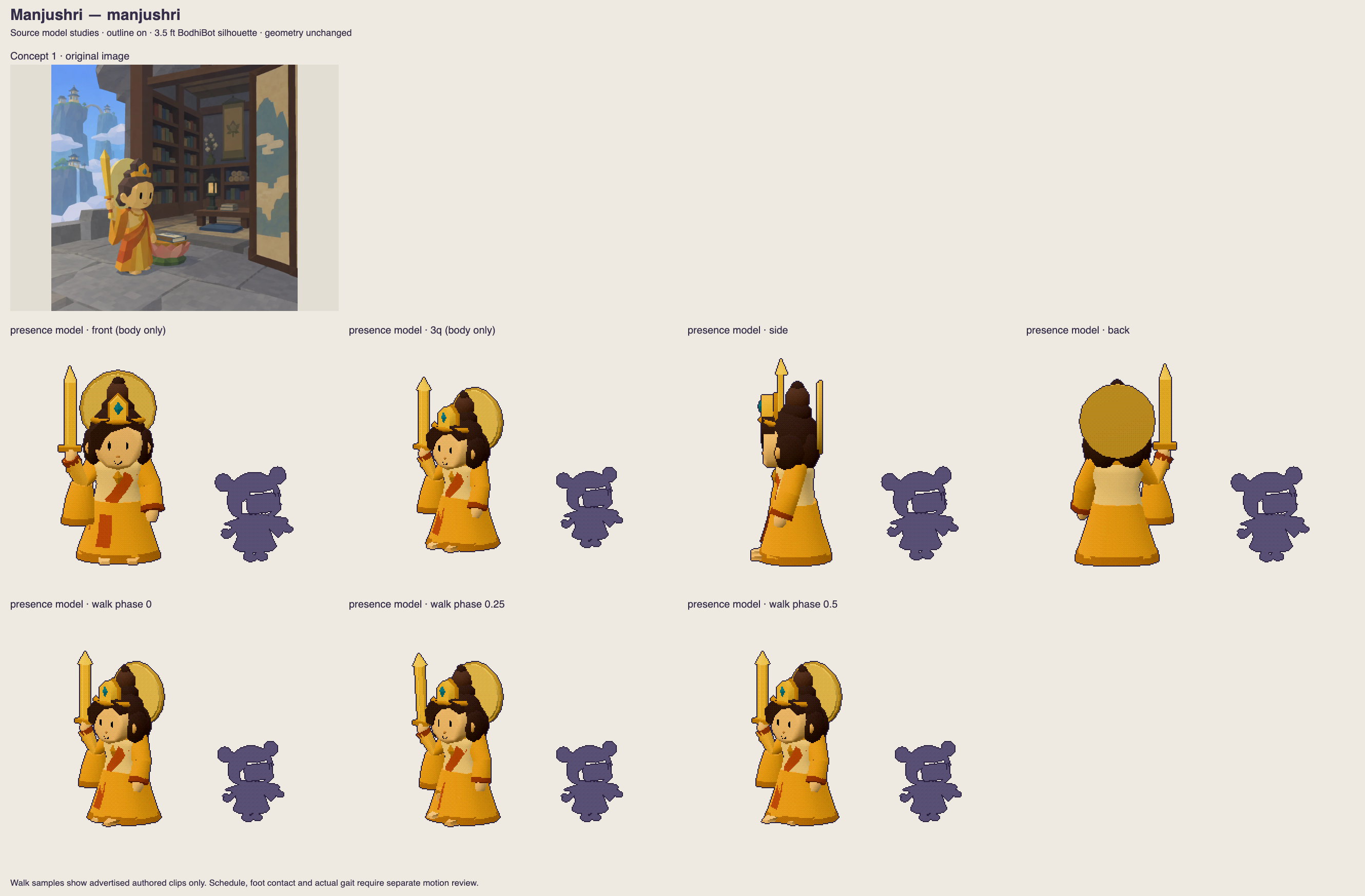
Visual: Concept and current canonical capture show youthful warm-gold skin, dark gathered hair, small diadem, round gold nimbus, raised straight gold sword on the viewer’s left (anatomical right), and a blue-covered book on a separate low pink lotus.
Visual: In the body-only multi-angle sheet the left hand hangs empty; the lotus and book have disappeared. The sword has a clean pointed blade without a visible flame motif.
Source: manjushri.js registers lotus as scenery. bookHeld is hidden in neutral pose and becomes visible only during reading clips. It therefore does not give a persistent scripture identifier to the ordinary actor.
Source: For +Z-facing geometry the sword is at negative X, anatomically right, although exported joint names call it leftShoulder/leftWrist. Future attribute edits must use body anatomy rather than these misleading variable labels.
Audit limit: A standing mobile wisdom presence is a game adaptation. The inspected concept is not a traditional iconographic authority.
Directions for a future model pass
P1 — Keep the sword in the anatomical right hand. For the selected orange sword-and-book form, make the left hand hold a continuous lotus stem with the Prajñāpāramitā scripture visibly supported near the left shoulder; ensure it remains an actor attachment in idle and world extraction.
P1 — Add a recognizable wisdom-flame treatment to the sword when following the cited sword form, preserving a clear low-poly blade silhouette.
P2 — Refine the diadem and jeweled bodhisattva dress from one chosen artifact. Retain youthful simplicity, dark hair and solid black eyes; do not turn him into a generic monk or warrior.
P2 — Treat the staged library book as environmental storytelling in addition to the sacred identifying scripture, and document any standing/free-roam posture adaptation.
Assessed baseline captures


Documented forms and lineage variants · 5
Preserve one identified form consistently. A variant is usable only with its own source and context.
Selected orange two-arm Manjushri: Tibetan liturgies specify orange body, sword/text, silks/jewels, crossed legs and lotus/moon seat. Alak Zenkar explicitly allocates sword to anatomical right and lotus to anatomical left.
Standing peaceful Manjushri: Met 1983.554.2, Tibet, 12th century, provides a valid standing sculpture with wisdom manuscript on a lotus and surviving sword hilt. Its blade is lost, not intentionally absent.
White Manjushri is a separate traditional form. Mipham's White Manjushri Practice specifies moon-white body, anatomical right giving gesture and left utpala, crossed legs, jewels/silks. Do not recolor the orange sword model white while keeping every detail unchanged and call it the same form.
Narrative form in Rubin C2002.21.3 shows sword upright above a folio book on a single lotus while conversing with Maitreya in Tuṣita. This validates a different peaceful depiction, but it does not repair an empty left hand in the game's selected raised-sword form.
Other multi-arm, lion-riding and tantric forms require their own named reference and anatomical contract; no extra arms, lion mount, skull ornaments or wrathful face are inferred for this current orange peaceful rig.
What not to copy · 5
Do not leave the lotus/book unconnected to the anatomical left hand or only show the book in a reading animation.
Do not treat a plain generic gold sword as a complete depiction when polishing the Tibetan wisdom-flame form; establish the selected blade/flame reference.
Do not mirror anatomical right and left to match viewer right/left or misleading rig variable names.
Do not copy the Met sculpture's lost sword blade or the Met painting photograph's grayscale as intended complete iconography or body color.
Do not combine White Manjushri gestures, orange raised-sword anatomy and narrative lotus-supported sword without recording a source for the combined form.
Sources and precise locations · 7
- [manjushri-dilgo] Dilgo Khyentse Rinpoche — Golden Mañjuśrī Sādhana ↗
- [manjushri-zenkar] Alak Zenkar Rinpoche — Light from the Wisdom Sun ↗
- [manjushri-dasal] Do Dasal Wangmo — The Flourishing Splendour of Intelligence: In Praise of Mañjuśrī ↗
- [manjushri-met-sculpture] The Metropolitan Museum of Art — Manjushri, the Bodhisattva of Transcendent Wisdom, 1983.554.2 ↗
- [manjushri-met-painting] The Metropolitan Museum of Art — Manjushri, 60.43.9 ↗
- [manjushri-mipham-white] Mipham Rinpoche — White Mañjuśrī Practice ↗
- [manjushri-har-tushita] Himalayan Art Resources — Maitreya and Manjushri, HAR65114 ↗
Assessment freshness and evidence hashes
The frozen snapshot is authored evidence. Regeneration computes current hashes and leaves that snapshot as it is.
{
  "auditFreshness": {
    "status": "stale",
    "reasons": [
      "The model capture recipe or rig source changed.",
      "The visible model geometry changed.",
      "Rig source changed or is missing: prototypes/prerendered-look/parts/purelands/manjushri.js"
    ]
  },
  "sourceSnapshot": {
    "captureHash": "78cb3f23c07e75472cbde3ee2337d6e1b7017b7ae0ec1c0dc1374295d37fa956",
    "bodyGeometryHash": "d700a54ca3a946c9c10748847b914e3971efe514441f821aac3da11353de5ca2",
    "sourceHashes": {
      "prototypes/prerendered-look/parts/purelands/manjushri.js": "9ab5455a03c6f080c1f141261316af36d053f7d0e0753945bf1879f7a36e73e7"
    },
    "captureHashes": {
      "/atlas/audit/sheets/manjushri-86d34f7993a9.webp": "5bb1c89ea8607990635b9155e72a595884cee3f633d3404f456631a4ea82175c",
      "/atlas/characters/manjushri-725d705c592a-presence-3q.webp": "444ec20861d6b0586c16b8227d1ee0706bb4dbf6c82afb8a7ceb5f3c45ded3a3",
      "/atlas/characters/manjushri-725d705c592a-presence-front.webp": "0a8c434303a835af4fd8713244ea8dc5fa466eb54882c64f8c5a2287111cb567",
      "/atlas/characters/manjushri-78cb3f23c07e-presence-3q.webp": "444ec20861d6b0586c16b8227d1ee0706bb4dbf6c82afb8a7ceb5f3c45ded3a3",
      "/atlas/characters/manjushri-78cb3f23c07e-presence-front.webp": "0a8c434303a835af4fd8713244ea8dc5fa466eb54882c64f8c5a2287111cb567"
    },
    "conceptHashes": {
      "/purelands/concepts/manjushri.webp": "72174cb123aaffcedcc55ab3cb2e888f327e0098819fdfd2c2970f743a1b8d28"
    },
    "activeConceptPaths": [
      "/purelands/concepts/manjushri.webp"
    ]
  },
  "currentSnapshot": {
    "captureHash": "82446a9b0df2f45406237c4e8555139d44c40c98adf487be4c85d5f80ba353c3",
    "bodyGeometryHash": "611600eaf903e2cb3b9707b6ad0e96c8aa12fca59184413b18d008e5b8a4a936",
    "activeConceptPaths": [
      "/purelands/concepts/manjushri.webp"
    ],
    "sourceHashes": {
      "prototypes/prerendered-look/parts/purelands/manjushri.js": "0820358b633caf49d44702d5210f868dce74c705befcec110b2a29b224162879"
    },
    "captureHashes": {
      "/atlas/audit/sheets/manjushri-86d34f7993a9.webp": "5bb1c89ea8607990635b9155e72a595884cee3f633d3404f456631a4ea82175c",
      "/atlas/characters/manjushri-725d705c592a-presence-3q.webp": "444ec20861d6b0586c16b8227d1ee0706bb4dbf6c82afb8a7ceb5f3c45ded3a3",
      "/atlas/characters/manjushri-725d705c592a-presence-front.webp": "0a8c434303a835af4fd8713244ea8dc5fa466eb54882c64f8c5a2287111cb567",
      "/atlas/characters/manjushri-78cb3f23c07e-presence-3q.webp": "444ec20861d6b0586c16b8227d1ee0706bb4dbf6c82afb8a7ceb5f3c45ded3a3",
      "/atlas/characters/manjushri-78cb3f23c07e-presence-front.webp": "0a8c434303a835af4fd8713244ea8dc5fa466eb54882c64f8c5a2287111cb567",
      "/atlas/characters/manjushri-82446a9b0df2-presence-3q.webp": "81157c5a3869e8564f6deaeb70f40a4051266cda0dddf38dccdd6dcbe3b2c0fb",
      "/atlas/characters/manjushri-82446a9b0df2-presence-front.webp": "c86120306965fbcb354e6d3fffe338178cd32d42d4f33a67717e6fa77479cb3f"
    },
    "conceptHashes": {
      "/purelands/concepts/manjushri.webp": "72174cb123aaffcedcc55ab3cb2e888f327e0098819fdfd2c2970f743a1b8d28"
    }
  }
}