Samantabhadra bodhisattva
This Samantabhadra, Kuntuzangpo in Tibetan, is the bodhisattva of good conduct and aspiration and one of the Eight Close Sons. He shares a name with the primordial Buddha Samantabhadra but is a different figure. Tradition gives him several colours, emblems and postures.
In the Second Neten Chokling's liturgy he is yellow, smiling and standing in silk and jewels, holding a lotus with his emblem, his right hand teaching and his left protecting. Read in order, Mipham's verses match him with the sun. A red form holds a vase in its right hand and a sun on the flower in its left.
The Lotus Sutra has him ride a white elephant with six tusks, and an Inner Mongolian painting shows him yellow-orange on that mount. An unusual Palpung painting set shows him blue, holding a book in both hands. The prayer named for him, the Aspiration to Good Actions, concerns awakened conduct, dedication and the wish for Amitabha's pure land, Sukhavati.
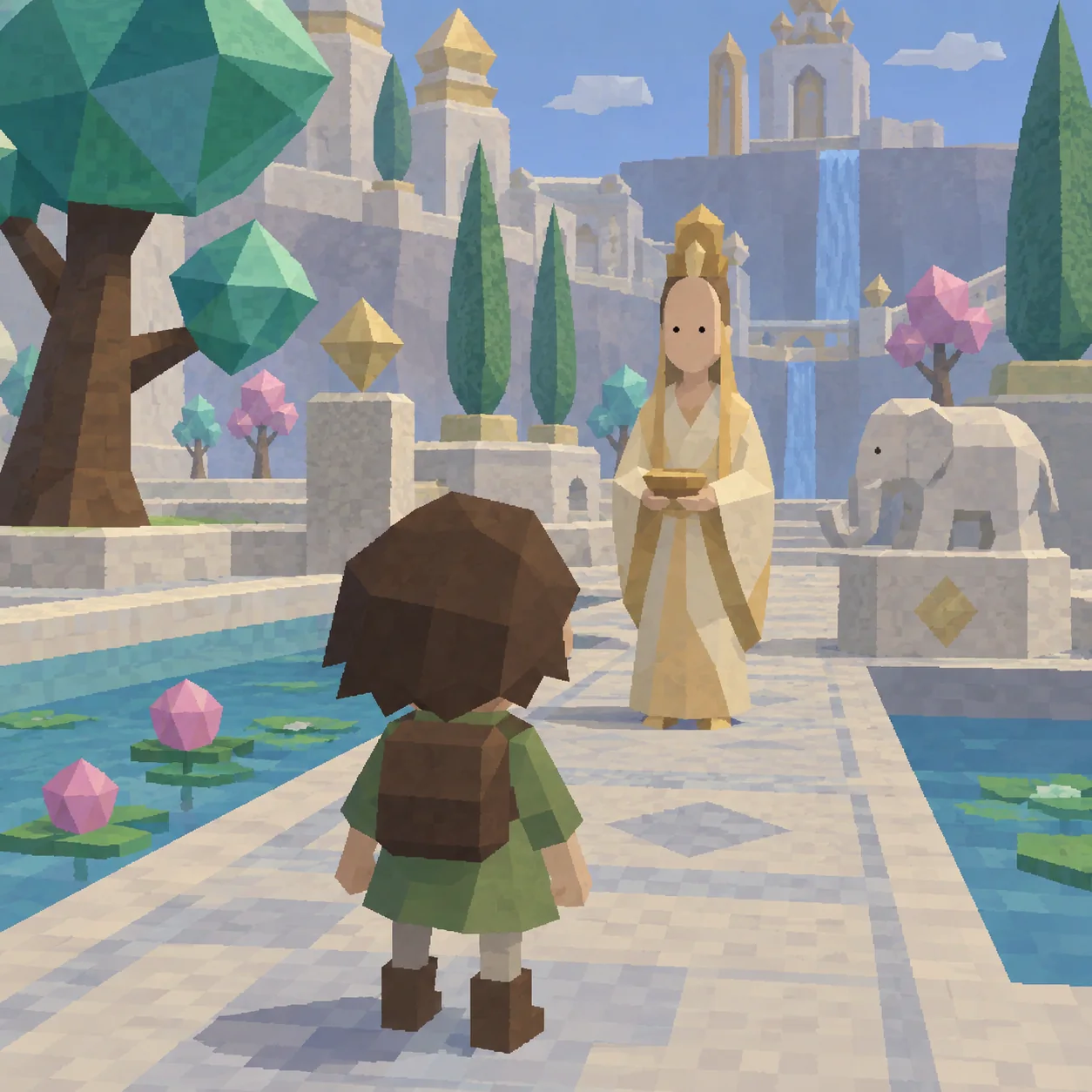
In traditional art
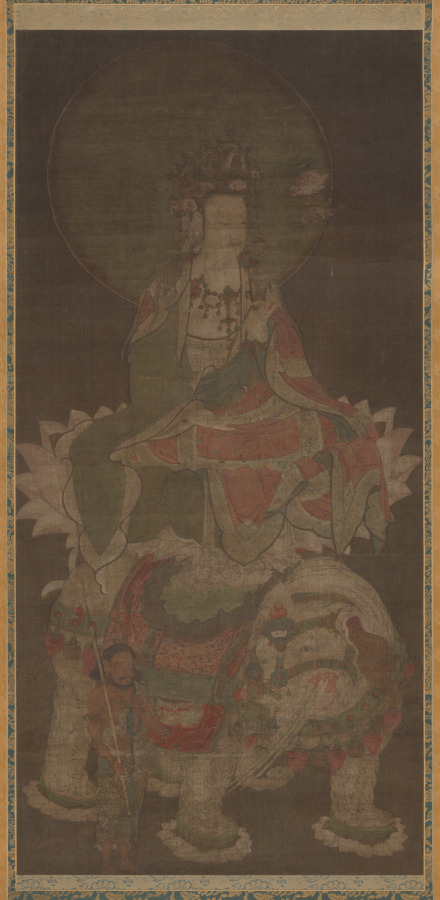
Samantabhadra (普賢菩薩)China, Southern Song dynasty (1127–1279) · 1100sCC0: verified share_license_status=CC0 in the museum page's embedded official artwork data; page permits copying, modification and distribution. Credit: The Cleveland Museum of Art, Mr. and Mrs. William H. Marlatt Fund, 1962.161.Object record ↗
In other collections
These images stay with the collections that hold them. Each link opens the collection's own page.
- Samantabhadra ↗Inner Mongolia · 19th century · rubinmuseum.orgNo open license established. Photograph by Bruce M. White, Rubin Museum of Himalayan Art, 2011. Credit: Gift of Martin Brauen, Switzerland; C2011.6. Rubin image-use permission policy applies.
- Samantabhadra (From Situ's set of Eight Great Bodhisattvas) ↗Kham region, Eastern Tibet · 19th century · api.rubinmuseum.orgNo open license established. Museum collection F1997.40.4; gift of the Shelley and Donald Rubin Foundation. Image-use permission policy applies. Photographer attribution was not established in the fetched metadata; do not invent it.
Sources
- Samantabhadra Bodhisattva Page ↗
- Vast Clouds of Samantabhadra's Display ↗
- The Verses of the Eight Noble Auspicious Ones ↗
- Samantabhadra, C2011.6 ↗
- Samantabhadra (From Situ's set of Eight Great Bodhisattvas), F1997.40.4 ↗
- The Lotus Sutra, BDK English Tripiṭaka, revised second edition (2007) ↗
- Samantabhadra, 1962.161 ↗
- The Root Manual of the Rites of Mañjuśrī ↗
- The King of Aspiration Prayers: Samantabhadra's Aspiration to Good Actions ↗
Depiction requirements and work notes
Samantabhadra (Kun tu bzang po), the bodhisattva of conduct and aspiration
Samantabhadra Bodhisattva (Tibetan: 'Phags pa Kun tu bzang po, Noble Kuntuzangpo) is the Mahāyāna bodhisattva of good conduct and aspiration among the Eight Close Sons. He is a different iconographic identity from the primordial Buddha Samantabhadra. Tibetan, Mongolian and East Asian sources preserve several traditional colors, emblems and postures; an elephant is a documented branch, not a universal requirement.
The model capture recipe or rig source changed. The visible model geometry changed. Rig source changed or is missing: prototypes/prerendered-look/parts/purelands/samantabhadra.js Reinspect the model before relying on the recorded defects.
References, criteria, concept and model side by side
Traditional depictions

Visually reviewed official photograph: peaceful yellow/orange, crowned and ornamented bodhisattva seated on a white elephant, with halo and surrounding assembly. This is genuine traditional Himalayan Buddhist cultural evidence for the elephant branch; the available full JPEG is small, so its tusk count and fine hand emblems were not visually certified. [samantabhadra-mongolia-rubin] [rubin-image-rights]
Object record ↗ · Source image ↗
Visually reviewed official photograph: blue clothed peaceful figure supporting a long book in both hands, red/orange robe and halo, seated on a rocky landscape. A documented Konchok Phende/Situ-derived artistic composition; museum warns that the set does not follow standard textual descriptions or standard Tibetan visual conventions. [samantabhadra-situ-rubin] [samantabhadra-har] [rubin-image-rights]
Object record ↗ · Source image ↗Explicit East Asian comparison, not Tibetan default. Museum describes a crowned figure in red and green clothes, seated on a lotus above a white elephant, holding a lotus whose blossom supports a sutra. The six-tusked elephant is explained through the Lotus Sutra. Direct CDN returned HTTP 403 to the research downloader; metadata and museum description were verified, but this image was not visually inspected in this subtask. [samantabhadra-cma] [samantabhadra-lotus-bdk]
Object record ↗ · Source image ↗Criteria
The model must show
- Selected plan account: the standing Chokling Tersar assembly form from Second Neten Chokling, Vast Clouds of Samantabhadra’s Display, sharedAssemblyAccount II.A.4, English lines 664–719 (2026-10-02), with the recorded emblem program. DECISIONS.md B and the reconciled home select this account; other forms remain separate alternatives.
- Body: yellow, peaceful bodhisattva appearance; retain one coherent standing court form instead of choosing colours from another artwork.
- Posture and dress: standing in silk and jewels, smiling toward the principal figure; use a restrained peaceful expression under R3 and retain the project low-poly art register.
- Hands: anatomical right teaches and anatomical left protects; retain emblem-bearing lotus stems as the selected shared account states. Do not import the lap, earth-touching, directly held weapon or monastic staff gestures of an alternative form.
- Identity emblem: sun, carried by the lotus program. Exact object/stem side and hand contacts beyond the cited shared gestures require a compatible identified reference; do not borrow them from another form to fill this gap.
- Eyes: solid black silhouettes with no whites, irises, pupils, highlights or glint (project eye rule; a recorded game adaptation, not a claim about traditional painted eyes)
- Maintain readable whole-body posture, both hands, emblem and support from front and three-quarter views. No figure or attribute clips its enclosure (R4).
- This is Samantabhadra the bodhisattva, not primordial Samantabhadra. The selected standing sun-emblem form has no elephant mount; the elephant-riding, vase-and-sun and book-bearing forms remain distinct alternatives.
The model must not show
- Cartoon smiley face: a wide U-shaped or crescent grin, open laughing mouth, rosy cheek dots or mascot cheeks
- Eye whites, irises, pupils, highlights or glint; glowing white-gold eyes (those belong only to freshly liberated beings)
- Any part of the figure (head, crown, hat, halo, raised hand or held object) touching or passing through its canopy, roof, lintel, pillars, throne back or seat in any capture angle
- The nude blue primordial Buddha Samantabhadra or his consort imagery
- The two-handed offering bowl presented as his identifying emblem (it is an authored thematic adaptation)
- A tiny background elephant or a single modelled tusk counted as the mounted form
- An unlabelled composite of the vase-and-sun, book, gem-and-whisk and elephant variants
- A cream robe, three-spire crown or long golden veil-like hair claimed as canonical
- Hands or attributes mirrored to the wrong side of the figure's own body (own right appears at viewer-left in a front view)
Original game concept
Current 3D model
presence
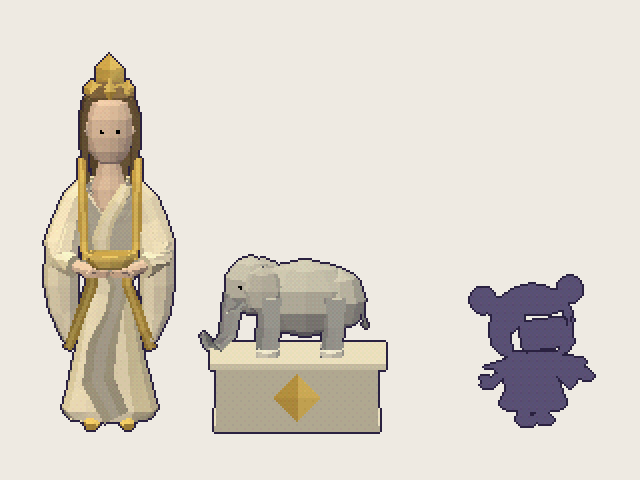
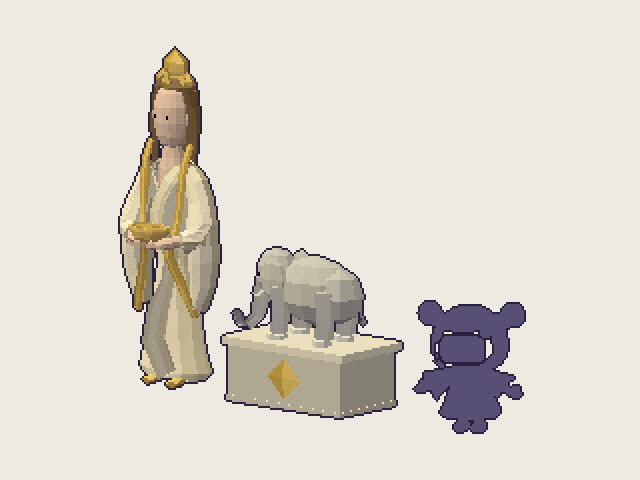
Depiction requirements
- Identity
- Label the asset and chosen reference Samantabhadra Bodhisattva. Never repair this model by copying the nude blue Nyingma primordial Buddha or that Buddha's consort/union imagery. Shared Sanskrit and Tibetan names do not make their depiction contracts interchangeable. [samantabhadra-har]
- Named form and complexion
- Select a cited form before fixing color or props. Documented branches include yellow/orange elephant-riding imagery, red Shakyashri Rakshita imagery, and the blue book-holding Konchok Phende/Palpung composition. No single complexion is universal. A cream robe alone does not identify him. [samantabhadra-har] [samantabhadra-mongolia-rubin] [samantabhadra-situ-rubin]
- Close Sons assembly option
- The Second Neten Chokling liturgy gives yellow Samantabhadra, smiling and standing in silk and jewels, holding a lotus with his emblem; anatomical right hand teaches and left protects. This is a coherent court option, distinct from an elephant-riding portrayal. [close-sons-chokling]
- Sun emblem option
- Mipham's Eight Auspicious Ones names the bodhisattvas and emblems in matching order; that reading pairs Samantabhadra with the sun. The attribution is an ordered-list inference, corroborated by the specialist description of a sun on his anatomical left-hand flower. If adopting this form, model a readable sun disk on a blossom rather than substituting an offering bowl. [eight-auspicious-mipham] [samantabhadra-har]
- Elephant-riding option
- If choosing the Lotus Sūtra elephant presentation, show a meaningful rider-and-mount relationship with a white elephant. The sutra specifies six tusks; make all six legible or record any stylized reduction explicitly. A tiny background elephant is an association, not the same depiction as a bodhisattva seated on his mount. This six-tusk prescription is supported here by BDK's Chinese-canon translation; do not present it as the only Tibetan form. [samantabhadra-lotus-bdk] [samantabhadra-mongolia-rubin] [samantabhadra-cma]
- Palpung book option
- For the named Konchok Phende / Situ / Palpung variant, preserve blue skin and the book supported by both hands, and use the actual composition as the pose reference. Rubin says this traditional artistic set is unusual and departs from standard textual/visual conventions; it remains a labeled lineage example, not a universal template. [samantabhadra-situ-rubin] [samantabhadra-har]
- Another canonical textual variant
- The Mañjuśrī Root Manual describes Samantabhadra beside Mañjuśrī as dark blue, ornamented, in blue silk trousers and a pearl sacred thread, standing on a white lotus, waving a white yak-tail whisk and holding a wish-fulfilling gem in the anatomical left hand. Retain this as a specific manual's alternative rather than adding its whisk and jewel to every other form. [samantabhadra-manjushri-root]
- Dress, crown and hair aesthetics
- Use the selected traditional image to design silk folds, jewelry, crown and hair as one recognizable peaceful bodhisattva ensemble. Avoid claiming an invented three-spire crown or long golden veil-like hair is prescribed canonically. Their accuracy is unresolved unless a chosen source supports them. Preserve the game's simple polygons while giving the identifying lotus, sun, book or mount priority over generic gold decoration; this is an audit recommendation. [samantabhadra-mongolia-rubin] [samantabhadra-situ-rubin] [samantabhadra-cma]
- Pure-land context and thematic props
- Samantabhadra's Aspiration to Good Actions provides authentic Tibetan devotional context: enlightened conduct, dedication, and aspiration to Amitābha's Sukhāvatī. It does not prescribe the current two-handed offering bowl as his identifying sculptural emblem. Treat that bowl as an authored thematic adaptation unless further form-specific evidence is supplied. [samantabhadra-good-actions]
Presentation contract
Blocked · not ready to build from The plan holds this contract back (status pending · modelReady false · buildBlocked true) until the points below are settled.
Why it is blocked: unresolved form and pending research
- Complete the selected standing form with a compatible securely identified reference for detailed anatomy, emblem/stem contacts and support; do not mix the separate historical forms retained in variants and alternativeForms. A sourced written baseline is not model readiness.
Setting and sizing rule
Selected standing court form: provide an authored support and enclosure sized to its complete crown, emblem-bearing lotus and hand span. The cited shared passage does not fix an exact throne/base. Apply R4; an alternative seated form's lap, throne contact, staff or elephant support is not part of this selection.
Selected form
- account
- Chokling Tersar standing court, recorded emblem program
- source
- docs/buddhist-iconography/data/eight-bodhisattvas.json#sharedAssemblyAccount
- selectionBasis
- docs/world-plan/DECISIONS.md B; reconciled home record
- wholeVisualReference
- pending compatible complete depiction; shared written account is not a claim of all-angle visual verification
Recorded variants · 5
- Yellow standing close-son form (Chokling), sun-on-lotus emblem (Mipham, by ordered-list inference)
- Red Shakyashri Rakshita form: right-hand vase, left flower with sun
- Yellow or orange elephant-riding form (Rubin C2011.6, Inner Mongolia; Cleveland 1962.161 as East Asian comparison); six tusks from the Lotus Sūtra
- Blue book-holding Konchok Phende / Palpung form (Rubin F1997.40.4), a set Rubin calls unusual
- Dark-blue gem-and-whisk form (Mañjuśrī Root Manual, Toh 543 §§7.16–7.18)
Alternative forms kept for comparison · 1
- Prior variant-aware contract, retained as comparison history; not the selected Chokling standing contract. Conditional branches must be selected whole, never assembled together.
Recorded adaptations · 1
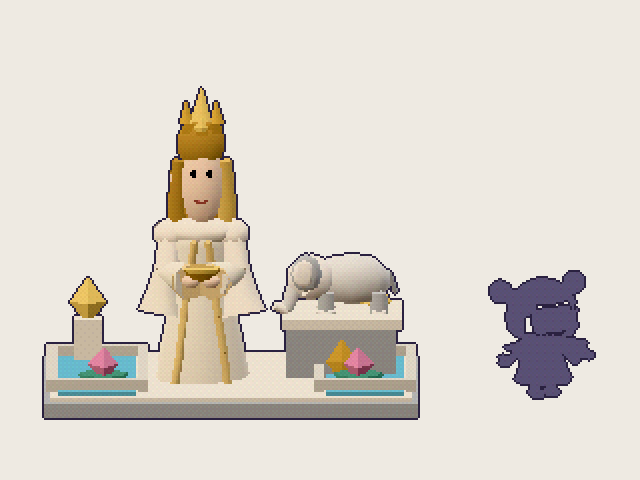
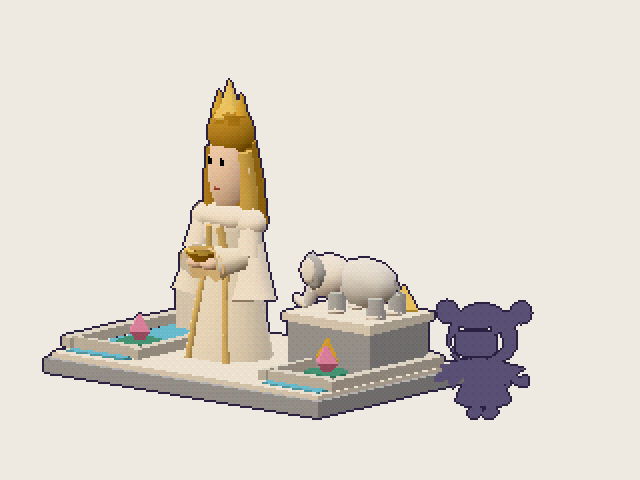
- The current cream-robed figure with offering bowl and a small scenic elephant follows the generated garden concept, not a source form
Where the plan places it · 1
- The lha-khang, a small temple, and its teaching precinct · The teaching precinct
lhakhang.precinct· character Samantabhadra bodhisattvasamantabhadra
Contract sources · 10
- Samantabhadra Bodhisattva Page
- Samantabhadra, C2011.6
- Samantabhadra (From Situ's set of Eight Great Bodhisattvas), F1997.40.4
- Vast Clouds of Samantabhadra's Display
- The Verses of the Eight Noble Auspicious Ones
- The Lotus Sutra, BDK English Tripiṭaka, revised second edition (2007)
- Samantabhadra, 1962.161
- The Root Manual of the Rites of Mañjuśrī
- The King of Aspiration Prayers: Samantabhadra's Aspiration to Good Actions
- Second Neten Chokling: Vast Clouds of Samantabhadra’s Display
Model audit and next pass
Evidence basis: visual + source
Recorded observations
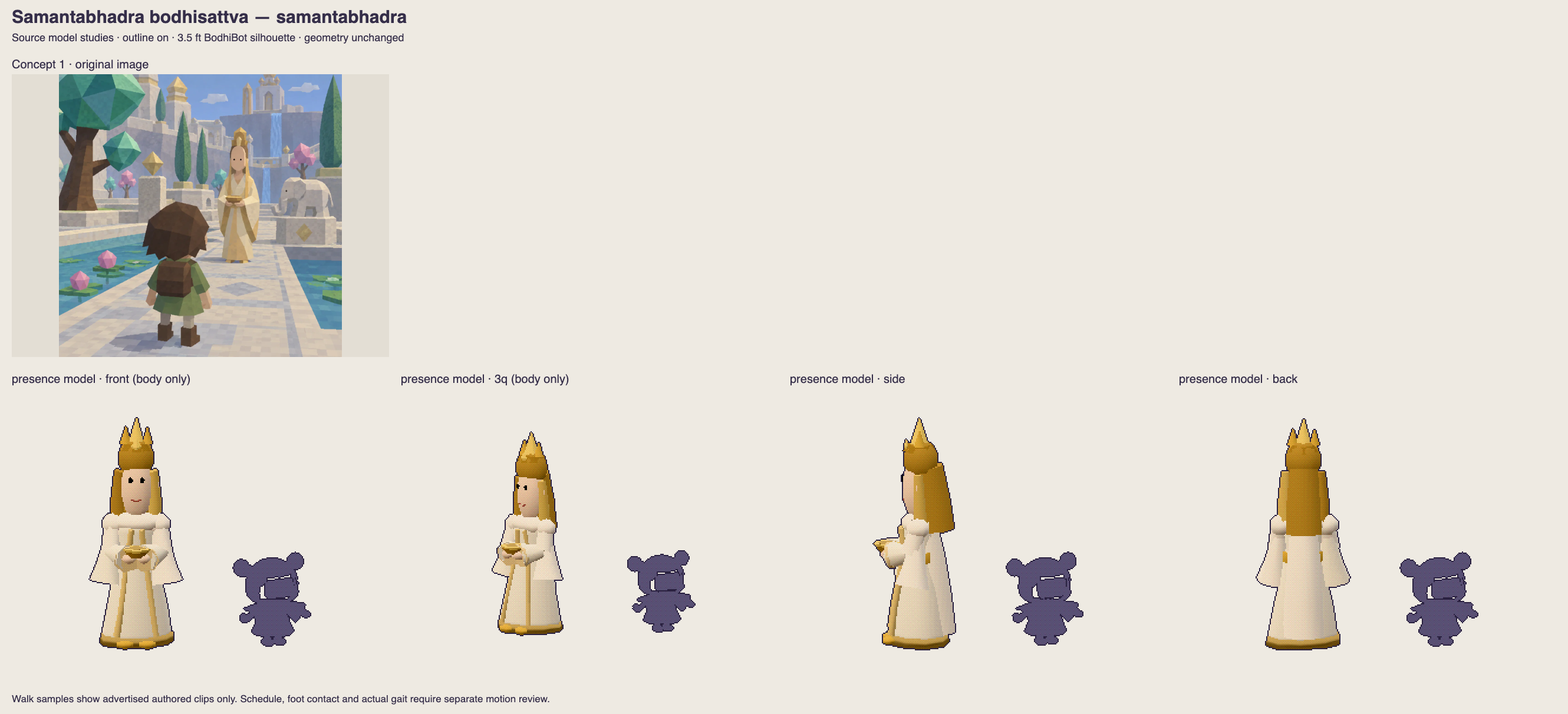
Visual: Concept and canonical capture show a tall cream-robed figure, long gold hair resembling a veil, a three-spire gold crown, and a small bowl cupped in both hands. A miniature white elephant sits on an adjacent plinth.
Visual: The body-only front/three-quarter/side/back sheet removes the elephant and surrounding garden; only the bowl, robe, gold hair and crown remain as identifiers.
Source: samantabhadra.js explicitly distinguishes the bodhisattva from the primordial Buddha, but its iconographic design follows the generated garden concept. The elephant is scenery, not an actor attachment or mount.
Source: The elephant code contains one tusk rod; it does not model a six-tusked elephant. This matters only if choosing the six-tusk elephant branch, not as a requirement for every Tibetan Samantabhadra.
Audit limit: The bowl is an authored offering motif; no fetched Tibetan source identifies this neutral bowl-and-cream-robes design as a complete canonical Samantabhadra form.
Directions for a future model pass
P1 — Preserve the identity distinction from the blue nude primordial Buddha. Select a Tibetan bodhisattva form and give the actor its actual identifying emblem; Mipham’s auspicious program uses a sun emblem.
P1 — If selecting the elephant-mounted branch, make the white elephant an integrated mount with the reference’s tusk treatment and seated bodhisattva, rather than a disposable tiny scenic prop. If selecting an unmounted Tibetan Eight Sons form, use that program’s lotus emblem and gestures without forcing an elephant.
P2 — Rework the tall generic crown and gold veil from the selected artifact’s jeweled crown, gathered hair and silk/jewel arrangement. Preserve the existing narrow silhouette and calm face where compatible.
P2 — Keep bowl presentation as a clearly labeled game activity after the normal iconographic identifying pose is readable.
Assessed baseline captures
Documented forms and lineage variants · 5
Preserve one identified form consistently. A variant is usable only with its own source and context.
Yellow standing close-son form: Second Neten Chokling's Tibetan liturgy. Sun-on-lotus is a separately supported emblem option; identify both sources when combining their compatible instructions.
Red Shakyashri Rakshita form: anatomical right hand holds a vase, anatomical left flower supports a sun. This is a vase, not an interchangeable alms bowl.
Yellow/orange elephant-riding form: represented in the Rubin's 19th-century Inner Mongolian painting. The Chinese Southern Song scroll provides a separately labeled East Asian comparison, not Tibetan default authority.
Blue book-holding form: Konchok Phende composition transmitted through Situ Panchen and Palpung artists. Distinguished from the primordial blue Buddha by clothes, book, bodhisattva identity and composition.
Dark-blue, gem-and-whisk form: The Root Manual of the Rites of Mañjuśrī §7.16–7.18. A precise textual alternative without an elephant.
What not to copy · 6
Do not assert that every Samantabhadra must be white or must ride an elephant. Tibetan iconography is variable.
Do not count a barely visible elephant prop or a single modeled tusk as acceptance of the six-tusked mounted presentation.
Do not mix the red vase-and-sun, blue book, gem-and-whisk and elephant variants into an unlabelled composite.
Do not use the current offering bowl as proof of canonical identification; it was not established as the distinguishing attribute in the audited references.
Do not infer colors from aged metal, gilding, fading pigments or the name All-Good alone. Match the selected textual/artistic form.
Do not confuse anatomical left and right with viewer-left and viewer-right.
Sources and precise locations · 10
- [samantabhadra-har] Samantabhadra Bodhisattva Page ↗
- [close-sons-chokling] Vast Clouds of Samantabhadra's Display ↗
- [eight-auspicious-mipham] The Verses of the Eight Noble Auspicious Ones ↗
- [samantabhadra-mongolia-rubin] Samantabhadra, C2011.6 ↗
- [samantabhadra-situ-rubin] Samantabhadra (From Situ's set of Eight Great Bodhisattvas), F1997.40.4 ↗
- [samantabhadra-lotus-bdk] The Lotus Sutra, BDK English Tripiṭaka, revised second edition (2007) ↗
- [samantabhadra-cma] Samantabhadra, 1962.161 ↗
- [samantabhadra-manjushri-root] The Root Manual of the Rites of Mañjuśrī ↗
- [samantabhadra-good-actions] The King of Aspiration Prayers: Samantabhadra's Aspiration to Good Actions ↗
- [rubin-image-rights] Rubin Rights and Reproductions ↗
Assessment freshness and evidence hashes
The frozen snapshot is authored evidence. Regeneration computes current hashes and leaves that snapshot as it is.
{
  "auditFreshness": {
    "status": "stale",
    "reasons": [
      "The model capture recipe or rig source changed.",
      "The visible model geometry changed.",
      "Rig source changed or is missing: prototypes/prerendered-look/parts/purelands/samantabhadra.js"
    ]
  },
  "sourceSnapshot": {
    "captureHash": "dcca598c5b4440b2aabf75357d41858e14244be2fb4c476306b79d0d33d56a69",
    "bodyGeometryHash": "98fbb3ff2398827675960db1584ae9ea85a592bc10c2e0e3078df35afc7fbbae",
    "sourceHashes": {
      "prototypes/prerendered-look/parts/purelands/samantabhadra.js": "4208ccf73ffbea9e6e9f3a0c44e325add2f76fadbcfb0697c89f6ed7751c87bc"
    },
    "captureHashes": {
      "/atlas/audit/sheets/samantabhadra-13991a7b24e2.webp": "7c40613c882ac606ba0a3602bc97495ed5fe5a80f598f1156461c18b28e302af",
      "/atlas/characters/samantabhadra-4709acbed974-presence-3q.webp": "6a2b60a1e1b882023e67c52f775f58f266d6935ca6cc4208cac94436f977ee5a",
      "/atlas/characters/samantabhadra-4709acbed974-presence-front.webp": "6d55922cbb3e8209938c1b3ad3ad28e371033f4c8f2d62e8fb0f6ba6bfc930de",
      "/atlas/characters/samantabhadra-dcca598c5b44-presence-3q.webp": "6a2b60a1e1b882023e67c52f775f58f266d6935ca6cc4208cac94436f977ee5a",
      "/atlas/characters/samantabhadra-dcca598c5b44-presence-front.webp": "6d55922cbb3e8209938c1b3ad3ad28e371033f4c8f2d62e8fb0f6ba6bfc930de"
    },
    "conceptHashes": {
      "/purelands/concepts/samantabhadra.webp": "2727f745ce9ada3b83ff254eb0032ca501538e83000640749774cdd679b73a02"
    },
    "activeConceptPaths": [
      "/purelands/concepts/samantabhadra.webp"
    ]
  },
  "currentSnapshot": {
    "captureHash": "25789d604eaf3da3a8bec0a0407e73b595f34f4eea4b03048879c1d77d355949",
    "bodyGeometryHash": "7356e0caecf9769045581b23d7151fdee559a4cbc2d1a765f03b2066e0c7a03d",
    "activeConceptPaths": [
      "/purelands/concepts/samantabhadra.webp"
    ],
    "sourceHashes": {
      "prototypes/prerendered-look/parts/purelands/samantabhadra.js": "01b7a347d8b5b57dd3002e5b13dd2f58899773131665d30745a8ee60e6fa922e"
    },
    "captureHashes": {
      "/atlas/audit/sheets/samantabhadra-13991a7b24e2.webp": "7c40613c882ac606ba0a3602bc97495ed5fe5a80f598f1156461c18b28e302af",
      "/atlas/characters/samantabhadra-25789d604eaf-presence-3q.webp": "797050eb347d039474d5a1d7c5822c2dee4fa379099443c841263332988dd236",
      "/atlas/characters/samantabhadra-25789d604eaf-presence-front.webp": "ea9a801eed6175b6e0d5aa3655a48ca24b2826eb558edb7e0cce44d1f4263c8d",
      "/atlas/characters/samantabhadra-4709acbed974-presence-3q.webp": "6a2b60a1e1b882023e67c52f775f58f266d6935ca6cc4208cac94436f977ee5a",
      "/atlas/characters/samantabhadra-4709acbed974-presence-front.webp": "6d55922cbb3e8209938c1b3ad3ad28e371033f4c8f2d62e8fb0f6ba6bfc930de",
      "/atlas/characters/samantabhadra-dcca598c5b44-presence-3q.webp": "6a2b60a1e1b882023e67c52f775f58f266d6935ca6cc4208cac94436f977ee5a",
      "/atlas/characters/samantabhadra-dcca598c5b44-presence-front.webp": "6d55922cbb3e8209938c1b3ad3ad28e371033f4c8f2d62e8fb0f6ba6bfc930de"
    },
    "conceptHashes": {
      "/purelands/concepts/samantabhadra.webp": "2727f745ce9ada3b83ff254eb0032ca501538e83000640749774cdd679b73a02"
    }
  }
}