Sarvanīvaraṇaviṣkambhin
His long name, Sarvanivaranavishkambhin, means remover of obscurations. In Tibetan he is Dribpa Nampar Sel. He is one of the Eight Close Sons, and Mipham's verses link him with the moon. No single standard form exists for him.
Tibetan court forms show him crowned, with earrings, necklaces, armlets, bracelets, silks and a lotus throne. In the Three Hundred Icons plate a moon disc rests on a lotus beside his right shoulder. His right hand holds its stem near the chest, and his left rests in his lap.
Some Tibetan paintings show him pale and seated. A Palpung painting has him relaxed, one knee raised. A gilded Sino-Tibetan statue of the Qing dynasty seats him at ease in court dress with a flower stem. A Nepalese form belongs to a separate tradition.
In traditional art
These images stay with the collections that hold them. Each link opens the collection's own page.
- Sino-Tibetan court-form Sarvanīvaraṇaviṣkambhin — TNM TC-269 ↗China, Tibetan Buddhist style · Qing dynasty, 18th century · tnm.jp© Tokyo National Museum. This www.tnm.jp exhibition image is excluded from TNM's automatic free-use conditions; reference link only, reproduction licence not established.
- Tibetan relaxed-seated Nivāraṇaviṣkambhin — HAR 51882 ↗Tibet, Karma Kagyu; Konchog Pende/Palpung-copy Eight Sons set · 1800–1899 · himalayanart.orgHAR record: Images Provided Courtesy of Private Collections; © Himalayan Art Resources. Open reproduction licence not established.
- Moon-on-lotus Nivāraṇaviṣkambhin — Three Hundred Icons / HAR 78249 ↗Tibet, Gelug · 1900–1959 (HAR record) · himalayanart.orgHAR record: Photographed Image Copyright © 2003 Publication: Three Hundred Icons; reproduction licence not established.
Sources
- Mipham Rinpoche, Verses of the Eight Noble Auspicious Ones ↗
- HAR, Nivaranavishkambhin Main Page ↗
- Three Hundred Icons plate, Nivaranavishkambhin, HAR 78249 ↗
- Nivaranavishkambhin, HAR 51882 ↗
- Tokyo National Museum, Sarvanīvaraṇaviṣkambhin, One of the Eight Great Bodhisattvas ↗
- Tokyo National Museum, Mystical Beauty: Tibetan Buddhist Art pamphlet (2022) ↗
Depiction requirements and work notes
Sarvanīvaraṇaviṣkambhin (Sgrib pa thams cad rnam par sel ba), remover of obscurations
Sarvanīvaraṇaviṣkambhin (Tibetan Dribpa Nampar Sel, remover of obscurations) is an Eight Close Sons bodhisattva. Mipham's liturgy associates him with the moon. Tibetan court forms with crown, jewels, silks and lotus-borne moon are documented, but the entire figure has no universal standardized iconography. A Nepalese śāntikaraṇa interpretation needs its own clear attribution rather than being passed off as the Tibetan pure-land norm.
The model capture recipe or rig source changed. The visible model geometry changed. Rig source changed or is missing: prototypes/prerendered-look/parts/purelands/sarvanivaranavishkambhin.js Reinspect the model before relying on the recorded defects.
References, criteria, concept and model side by side
Traditional depictions

Visually inspected: gilded peaceful bodhisattva in relaxed seated posture on lotus pedestal, elaborate crown, long earrings, necklaces, armlets and bracelets, draped scarves. Right hand near chest holds a flower stem; left lies above raised thigh. Study the whole court silhouette; gilded metal does not prove a gold body-color prescription. [sarva-tnm] [sarva-tnm-pamphlet] [tnm-rights]
Object record ↗ · Source image ↗
Visually inspected: pale peaceful figure with long dark hair, jewels, flowing green/blue scarf and orange leg garments; one knee raised, right hand lifted, on a pale blue low throne with halo. A traditional Tibetan alternative to rigid symmetrical lotus posture; details of a small handheld emblem are not clear in this preview. [sarva-har-pal-pung]
Object record ↗ · Source image ↗
Visually inspected named plate: seated crowned jeweled bodhisattva on lotus, anatomical right holding a flower stem near chest, round disk above the right shoulder, left palm up in lap. The named moon association comes from Mipham's liturgy; scan is monochrome and supplies no color evidence. [sarva-three-hundred] [eight-auspicious-mipham]
Object record ↗ · Source image ↗Criteria
The model must show
- Selected plan account: the standing Chokling Tersar assembly form from Second Neten Chokling, Vast Clouds of Samantabhadra’s Display, sharedAssemblyAccount II.A.4, English lines 664–719 (2026-10-02), with the recorded emblem program. DECISIONS.md B and the reconciled home select this account; other forms remain separate alternatives.
- Body: white, peaceful bodhisattva appearance; retain one coherent standing court form instead of choosing colours from another artwork.
- Posture and dress: standing in silk and jewels, smiling toward the principal figure; use a restrained peaceful expression under R3 and retain the project low-poly art register.
- Hands: anatomical right teaches and anatomical left protects; retain emblem-bearing lotus stems as the selected shared account states. Do not import the lap, earth-touching, directly held weapon or monastic staff gestures of an alternative form.
- Identity emblem: moon, carried by the lotus program. Exact object/stem side and hand contacts beyond the cited shared gestures require a compatible identified reference; do not borrow them from another form to fill this gap.
- Eyes: solid black silhouettes with no whites, irises, pupils, highlights or glint (project eye rule; a recorded game adaptation, not a claim about traditional painted eyes)
- Maintain readable whole-body posture, both hands, emblem and support from front and three-quarter views. No figure or attribute clips its enclosure (R4).
- Alternative contacts, not active standing-form instructions: only the retained Nepalese seated form has lowered left fingertips to assess against its seat; the Three Hundred Icons moon form HAR 78249 has the left palm in the lap. Neither contact is universal or transferred to the Chokling standing form.
The model must not show
- Cartoon smiley face: a wide U-shaped or crescent grin, open laughing mouth, rosy cheek dots or mascot cheeks
- Eye whites, irises, pupils, highlights or glint; glowing white-gold eyes (those belong only to freshly liberated beings)
- Any part of the figure (head, crown, hat, halo, raised hand or held object) touching or passing through its canopy, roof, lintel, pillars, throne back or seat in any capture angle
- A blank-handed sitter in the Tibetan court with no moon, lotus or other emblem
- The Nepalese form presented as the Tibetan Eight Sons moon form
- The lowered hand read or labelled as Śākyamuni's earth-touching gesture
- The flower-top disc labelled a sun
- Gold skin taken from the gilded Qing statue
- Hands or attributes mirrored to the wrong side of the figure's own body (own right appears at viewer-left in a front view)
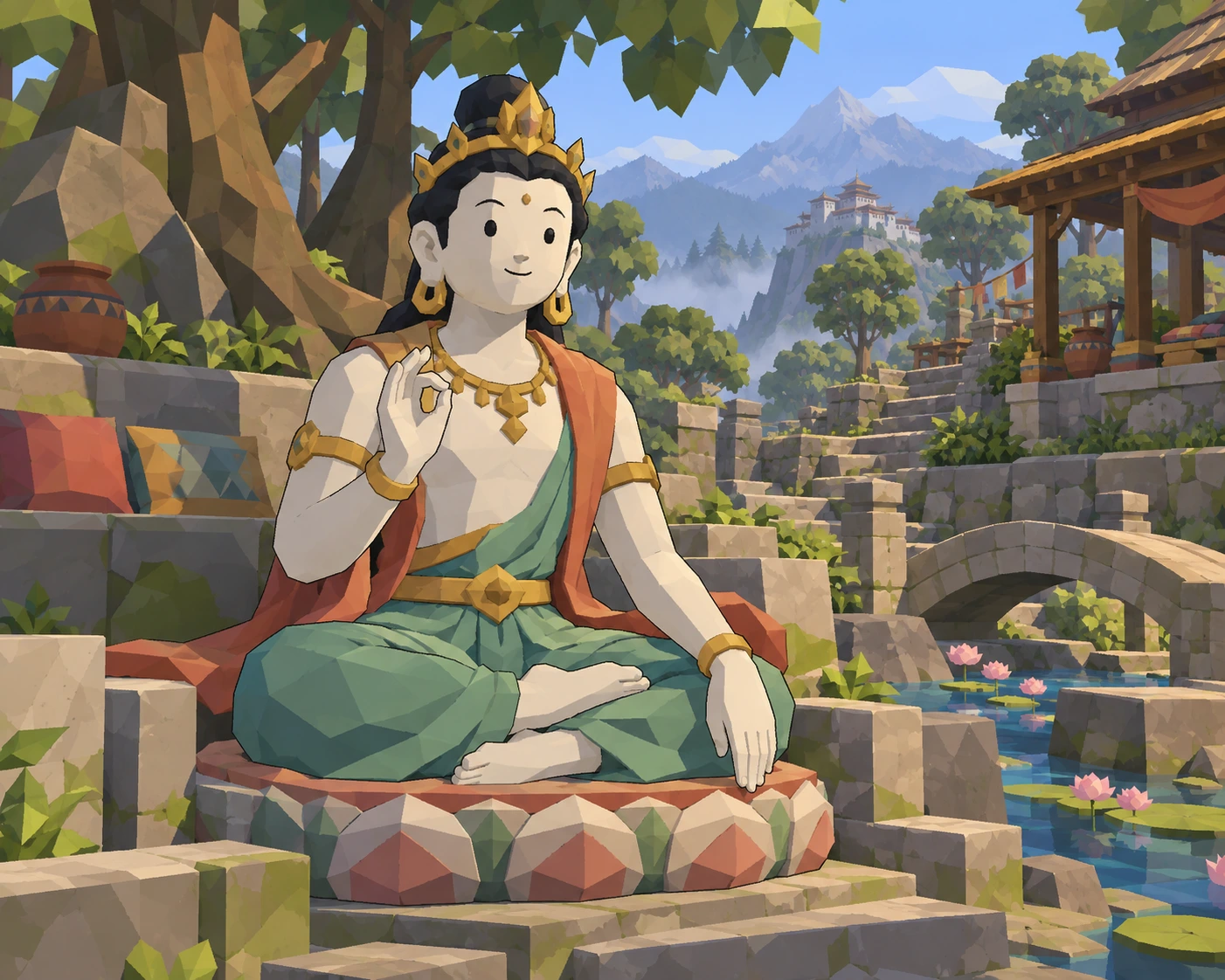
Original game concept
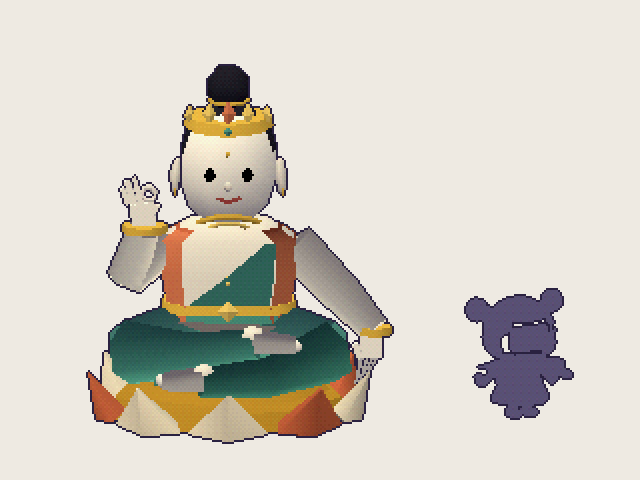
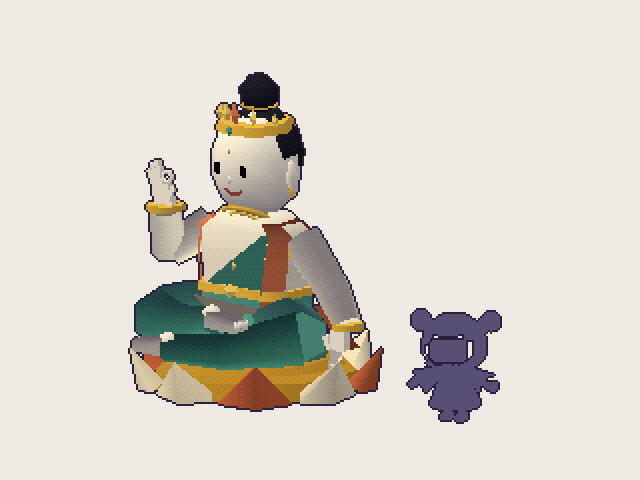
Current 3D model
presence
Depiction requirements
- Identity emblem
- If selecting Mipham's Tibetan Eight Sons form, provide a readable moon emblem. A Three Hundred Icons plate shows it as a round disk on a lotus beside the anatomical right shoulder, its stem held near the chest by the right hand; left hand rests in the lap. [eight-auspicious-mipham] [sarva-three-hundred]
- Court appearance
- For a Tibetan-style pure-land court form, preserve peaceful face, crown and coiffure, earrings, necklaces, armlets, bracelets, silks and a lotus throne. The TNM Eight Sons statue is a strong sculpture study for jewelry hierarchy and fabric silhouette. [sarva-tnm] [sarva-tnm-pamphlet] [sarva-three-hundred]
- Color and posture
- White/pale color and seated form are defensible in particular Tibetan paintings. Do not declare all other colors or standing forms noncanonical: HAR notes no standardized form. Match the selected artwork's posture rather than treating a generic earth-touching hand as the figure's identifying sign. [sarva-har-main] [sarva-har-pal-pung]
- Handedness
- Use anatomical right/left and verify in front and side views. The chosen Three Hundred Icons moon form has right hand holding the flower stem near the chest, left palm in the lap. This is not Śākyamuni's right-handed earth-touching gesture. Do not mirror it casually or merge it with a separate Nepalese ritual form. [sarva-three-hundred]
- Source confidence
- Keep the generic name as an identity, but attach a specific Tibetan, Sino-Tibetan or Nepalese form label to the model. Lack of a moon is a mismatch only when the chosen contract is the Mipham moon form; it is not proof that every historical Sarvanīvaraṇaviṣkambhin image is invalid. [eight-auspicious-mipham] [sarva-har-main]
Presentation contract
Blocked · not ready to build from The plan holds this contract back (status pending · modelReady false · buildBlocked true) until the points below are settled.
Why it is blocked: unresolved form and pending research
- Complete the selected standing form with a compatible securely identified reference for detailed anatomy, emblem/stem contacts and support; do not mix the separate historical forms retained in variants and alternativeForms. A sourced written baseline is not model readiness.
Setting and sizing rule
Selected standing court form: provide an authored support and enclosure sized to its complete crown, emblem-bearing lotus and hand span. The cited shared passage does not fix an exact throne/base. Apply R4; an alternative seated form's lap, throne contact, staff or elephant support is not part of this selection.
Selected form
- account
- Chokling Tersar standing court, recorded emblem program
- source
- docs/buddhist-iconography/data/eight-bodhisattvas.json#sharedAssemblyAccount
- selectionBasis
- docs/world-plan/DECISIONS.md B; reconciled home record
- wholeVisualReference
- pending compatible complete depiction; shared written account is not a claim of all-angle visual verification
Recorded variants · 3
- Konchog Pende / Palpung copy (HAR 51882): pale, one knee raised, right hand lifted
- Sino-Tibetan Qing sculpture (Tokyo National Museum TC-269): gilded court appearance, relaxed seat, flower stem
- Nepalese śāntikaraṇa form: white, own right hand raised with thumb-index loop, own left fingertips down beside the knee, no implements
Alternative forms kept for comparison · 1
- Prior variant-aware contract, retained as comparison history; not the selected Chokling standing contract. Conditional branches must be selected whole, never assembled together.
Recorded adaptations · 0
Where the plan places it · 1
- The lha-khang, a small temple, and its teaching precinct · The teaching precinct
lhakhang.precinct· character Sarvanivaranavishkambhinsarvanivaranavishkambhin
Contract sources · 7
- Mipham Rinpoche, Verses of the Eight Noble Auspicious Ones
- Three Hundred Icons plate, Nivaranavishkambhin, HAR 78249
- Tokyo National Museum, Sarvanīvaraṇaviṣkambhin, One of the Eight Great Bodhisattvas
- Tokyo National Museum, Mystical Beauty: Tibetan Buddhist Art pamphlet (2022)
- HAR, Nivaranavishkambhin Main Page
- Nivaranavishkambhin, HAR 51882
- Second Neten Chokling: Vast Clouds of Samantabhadra’s Display
Model audit and next pass
Evidence basis: visual + source
Recorded observations
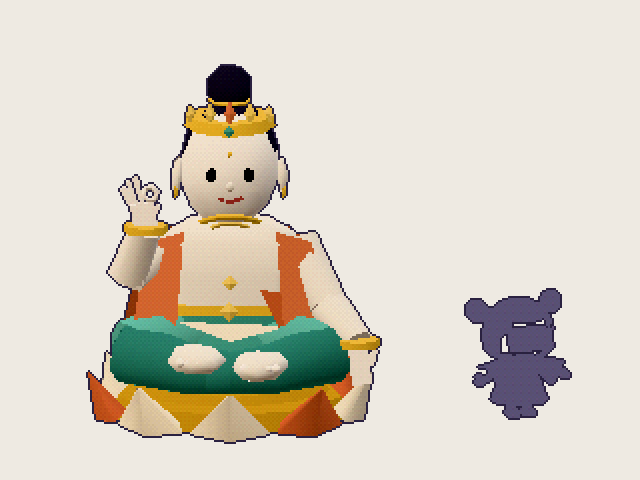
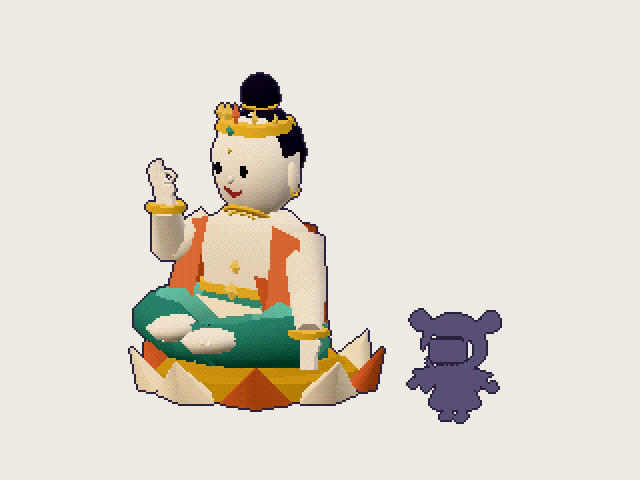
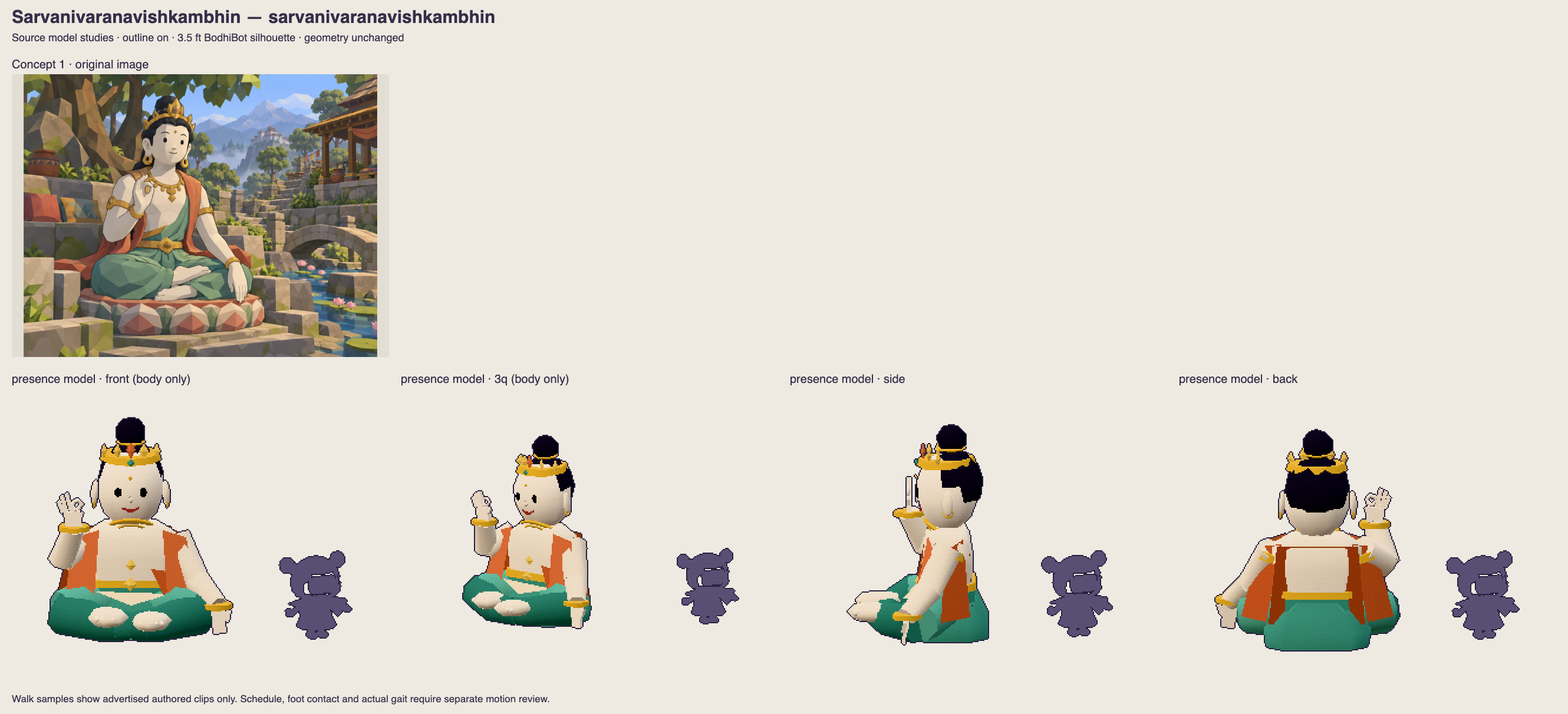
Visual: Concept and canonical/body-only multi-angle captures show a white peaceful seated figure, crossed legs, gold jeweled crown/topknot, bare jeweled torso, green lower cloth and terracotta scarf.
Visual: Anatomical right hand is raised with thumb/index loop; anatomical left fingertips point down beside the knee. No visible moon, lotus stem or other distinguishing implement appears.
Source: sarvanivaranavishkambhin.js explicitly cites a white Nepalese form from Shakya’s Iconography of Nepalese Buddhism: left earth-touch, right śāntikaraṇa gesture, no implements. It is not written as a Tibetan textual program.
Source: The lotus seat is scenery removed in body-only views; the figure’s lowered hand must be assessed for contact on the actual in-world seat in a later runtime pass.
Audit limit: The current reversed-side earth-touch/loop hand arrangement is coherent with its declared Nepalese source header; it must not be mislabeled Śākyamuni’s right-hand earth-touch gesture.
Audit limit: Rare Eight Sons paintings have disputed Ākāśagarbha/Nīvaraṇaviṣkambhin identifications. A generic peaceful white figure alone cannot securely identify this bodhisattva.
Directions for a future model pass
P1 — For the Tibetan Eight Sons court select a named program and supply its identifying moon emblem (Mipham’s program), coherent lotus and mudrās. A blank-handed sitter is not adequately differentiated by name alone.
P1 — Keep the Nepalese śāntikaraṇa form explicitly labeled as that tradition if retained; do not import it as a universal Tibetan rule. Verify the actual Shakya passage before treating the source comment as proof.
P2 — Retain the coherent seated silhouette and white/green/terracotta hierarchy where the selected form permits; improve necklace and crown readability before adding ornament.
P2 — Validate seat/left-fingertip contact in gameplay separately from this static iconography audit, and maintain all eight identities rather than renaming the contested neighbors to solve a visual resemblance.
Assessed baseline captures
Documented forms and lineage variants · 4
Preserve one identified form consistently. A variant is usable only with its own source and context.
Mipham auspiciousness / Three Hundred Icons: peaceful crowned bodhisattva, moon disk carried by a lotus at right shoulder, right stem-holding hand near chest, left hand in lap.
Konchog Pende/Palpung painting copy: pale-bodied relaxed figure with one knee raised, flowing scarf, throne/halo and right hand lifted; differs from the symmetrical crossed-leg plate.
Sino-Tibetan Qing Eight Sons sculpture: gilded court appearance and relaxed seating, with elaborate crown, jewels and flower stem. Its metallic gilding is not evidence of a required gold visualization color.
Nepalese śāntikaraṇa form is a separate tradition. The current source attribution to that form must be preserved until an explicit Tibetan form choice is made.
What not to copy · 5
Do not enforce a universal color from generic web summaries; the traditional form is context-dependent.
Do not identify Sarvanīvaraṇaviṣkambhin simply because a figure is white and makes a teaching gesture.
Do not claim the current Nepalese ritual depiction already satisfies a specifically Tibetan Eight Sons moon-form brief.
Do not use the disputed Akashagarbha/Nivaranavishkambhin Rubin painting as the sole model template.
Do not label a flower-top disk as sun without consulting the exact named plate and chosen liturgical association.
Sources and precise locations · 7
Assessment freshness and evidence hashes
The frozen snapshot is authored evidence. Regeneration computes current hashes and leaves that snapshot as it is.
{
  "auditFreshness": {
    "status": "stale",
    "reasons": [
      "The model capture recipe or rig source changed.",
      "The visible model geometry changed.",
      "Rig source changed or is missing: prototypes/prerendered-look/parts/purelands/sarvanivaranavishkambhin.js"
    ]
  },
  "sourceSnapshot": {
    "captureHash": "e6d95a8b9104522fa1d9bd3d6dceb3423a93f1bde9d1767aa75665b084c4acbb",
    "bodyGeometryHash": "8f4d817491f187b7bdae0bb0221d3340ddfde02c924aeab09ae4ed085c39a506",
    "sourceHashes": {
      "prototypes/prerendered-look/parts/purelands/sarvanivaranavishkambhin.js": "d3557c5049614879687cf342c0440b3df96f50933eeb0d052f6f355c3736216e"
    },
    "captureHashes": {
      "/atlas/audit/sheets/sarvanivaranavishkambhin-8b5b5dd2f07a.webp": "a22f0fe5cc0f35ff9286265179938906dde3c4eef577859614d26cd413fd6a61",
      "/atlas/characters/sarvanivaranavishkambhin-720b65014bb6-presence-3q.webp": "490d2c7cd61b314b19186afbebebb0d9c6344fba8567bcf31d81b1303374c82f",
      "/atlas/characters/sarvanivaranavishkambhin-720b65014bb6-presence-front.webp": "59b648d090bfb98885dfc5c433b1930bab4c49154c5e9bd25253675faf0209bd",
      "/atlas/characters/sarvanivaranavishkambhin-e6d95a8b9104-presence-3q.webp": "490d2c7cd61b314b19186afbebebb0d9c6344fba8567bcf31d81b1303374c82f",
      "/atlas/characters/sarvanivaranavishkambhin-e6d95a8b9104-presence-front.webp": "59b648d090bfb98885dfc5c433b1930bab4c49154c5e9bd25253675faf0209bd"
    },
    "conceptHashes": {
      "/atlas/concepts/sarvanivaranavishkambhin.webp": "0476c5b668c16b4b2590da179093f55891ccc474623be7279e8e393bcaaaeaaf"
    },
    "activeConceptPaths": [
      "/atlas/concepts/sarvanivaranavishkambhin.webp"
    ]
  },
  "currentSnapshot": {
    "captureHash": "8cda71e733a1c733142d6ea0497aaefa51c2192a1065270a0c508823aef22063",
    "bodyGeometryHash": "91417b33c763169ce43d51498419e954cf3e6482c7e545c0f5fcd831f5f637a0",
    "activeConceptPaths": [
      "/atlas/concepts/sarvanivaranavishkambhin.webp"
    ],
    "sourceHashes": {
      "prototypes/prerendered-look/parts/purelands/sarvanivaranavishkambhin.js": "cc7ed5cefb2bd9f331b60d68c6214cf46ad5b51067cc4e14edfef7cca58dabc9"
    },
    "captureHashes": {
      "/atlas/audit/sheets/sarvanivaranavishkambhin-8b5b5dd2f07a.webp": "a22f0fe5cc0f35ff9286265179938906dde3c4eef577859614d26cd413fd6a61",
      "/atlas/characters/sarvanivaranavishkambhin-720b65014bb6-presence-3q.webp": "490d2c7cd61b314b19186afbebebb0d9c6344fba8567bcf31d81b1303374c82f",
      "/atlas/characters/sarvanivaranavishkambhin-720b65014bb6-presence-front.webp": "59b648d090bfb98885dfc5c433b1930bab4c49154c5e9bd25253675faf0209bd",
      "/atlas/characters/sarvanivaranavishkambhin-8cda71e733a1-presence-3q.webp": "75661f657a72e6f7f4ec55c4d36164269813cbd702b92f968b90d04cf3cb365c",
      "/atlas/characters/sarvanivaranavishkambhin-8cda71e733a1-presence-front.webp": "661bac200e2ef4f7b3aec66b477eb401a57daf6d4f4a9bcf3d1576516bee1b32",
      "/atlas/characters/sarvanivaranavishkambhin-e6d95a8b9104-presence-3q.webp": "490d2c7cd61b314b19186afbebebb0d9c6344fba8567bcf31d81b1303374c82f",
      "/atlas/characters/sarvanivaranavishkambhin-e6d95a8b9104-presence-front.webp": "59b648d090bfb98885dfc5c433b1930bab4c49154c5e9bd25253675faf0209bd"
    },
    "conceptHashes": {
      "/atlas/concepts/sarvanivaranavishkambhin.webp": "0476c5b668c16b4b2590da179093f55891ccc474623be7279e8e393bcaaaeaaf"
    }
  }
}