Vimalakīrti
Vimalakirti is a lay bodhisattva of the Licchavis, a householder rather than a monk. In the Teaching of Vimalakirti, without rising from his couch, he holds out in his right hand a miniature of Abhirati, the Buddha-field of Akshobhya, with its inhabitants.
The sutra dresses him in white lay clothes. It sets no hand gesture for him, and no age or beard. His sickbed debate is a different scene from the same text.
East Asian art shows him in its own ways. A Japanese painting of 1665 makes him a bearded, mature sage in a cap and layered cloth. A Chinese stele sets him in a pavilion, in debate.
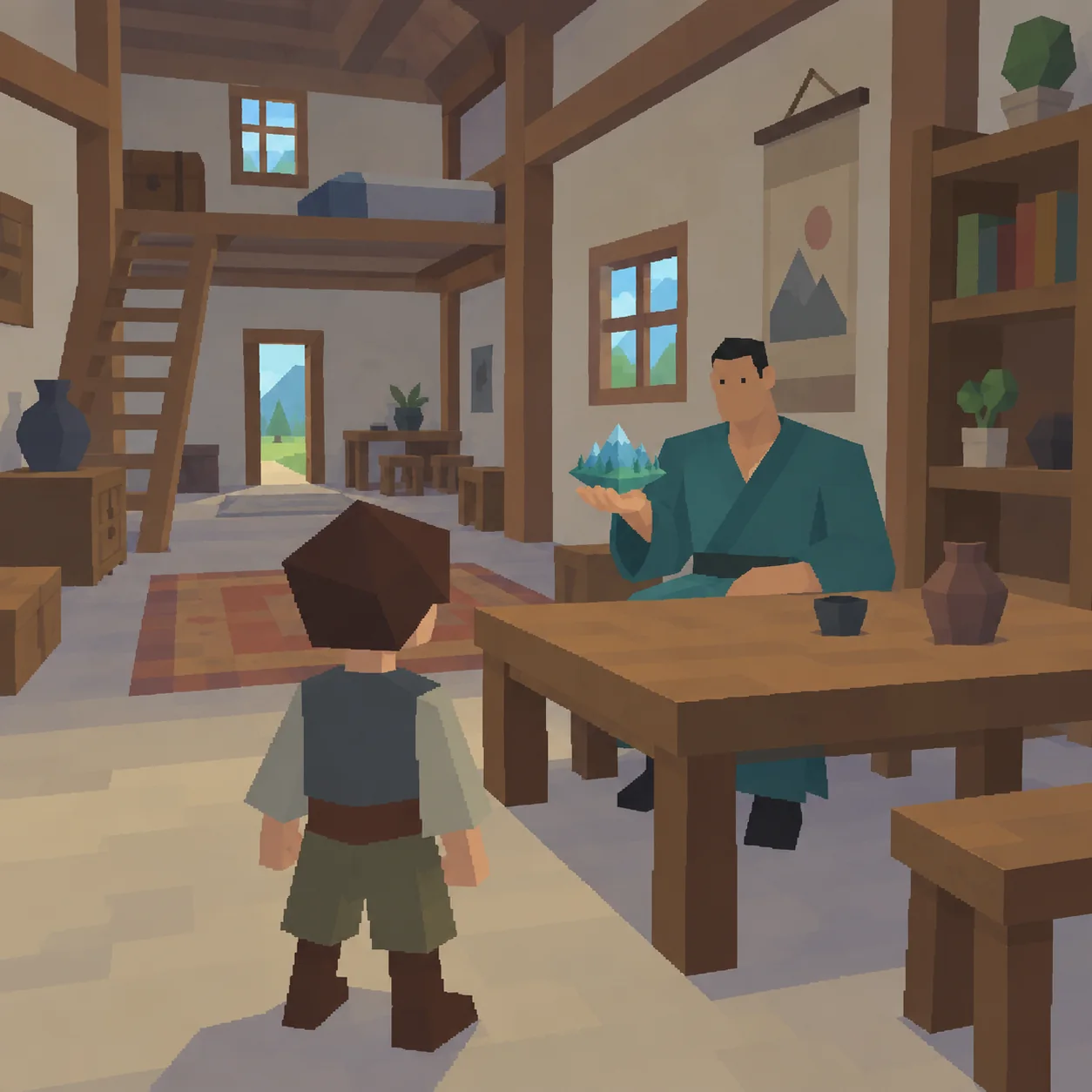
In traditional art
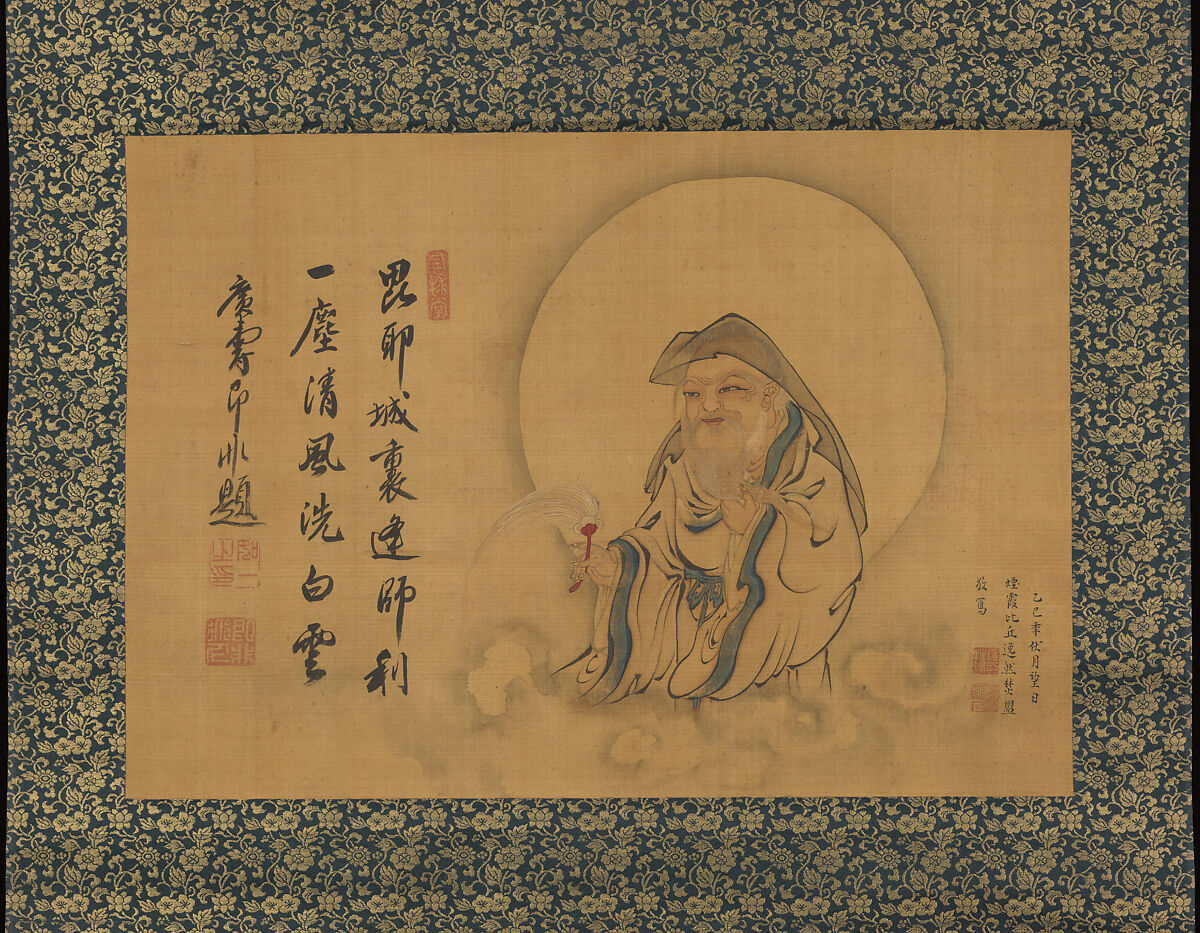
The Lay Buddhist Vimalakirti — Met 2024.412.11Japan; Chinese Ōbaku artist Yiran Xingrong · 1665Public Domain, explicitly marked by The Met.Object record ↗ 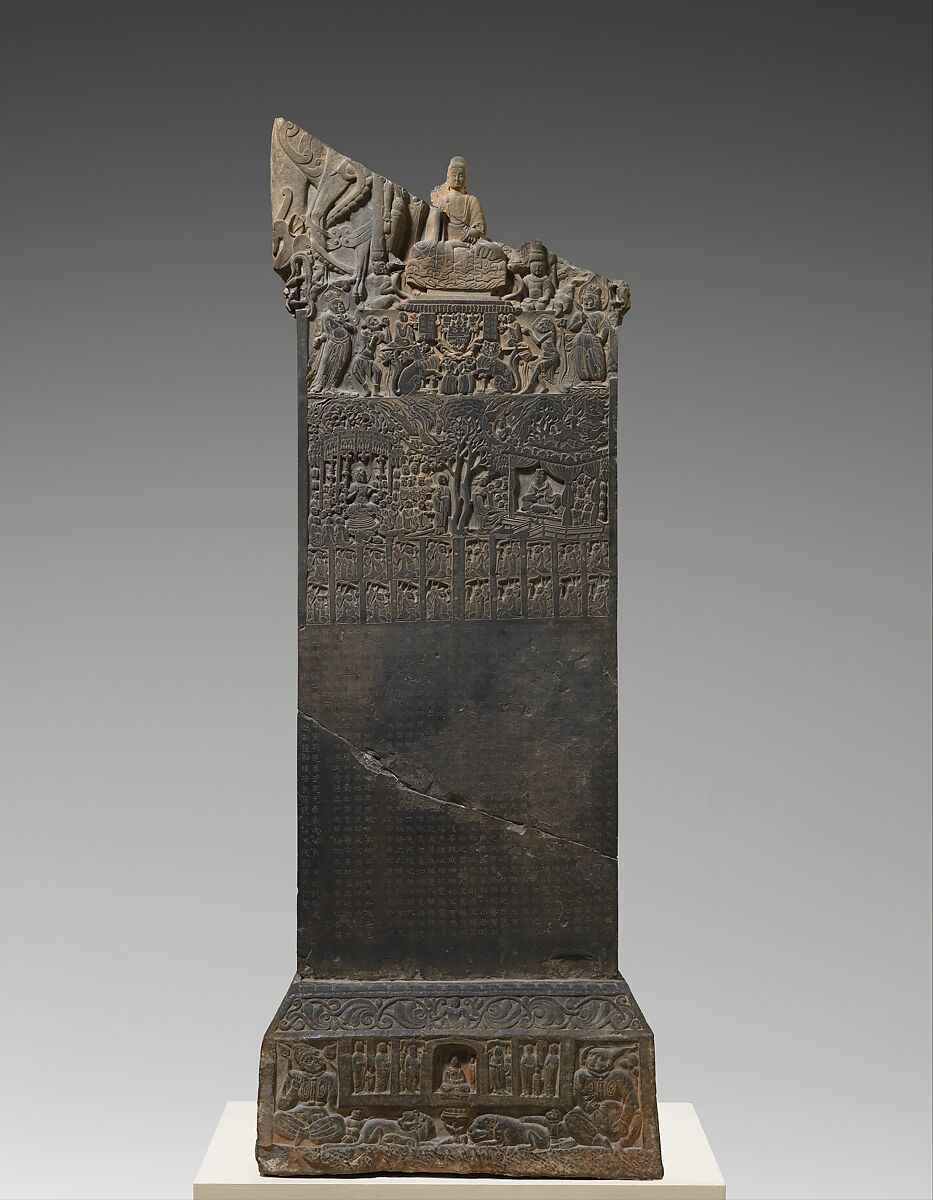
Vimalakirti debate in Helian Ziyue stele — Met 29.72China, Eastern Wei dynasty · Dated 533–43Public Domain, explicitly marked by The Met.Object record ↗
Sources
Depiction requirements and work notes
Vimalakīrti (Dri med grags pa), enlightened Licchavi lay bodhisattva
Select the Abhirati demonstration scene: a lay teacher whose own right hand presents a miniaturized Buddha-field. The current teal-clothed householder is recognizable as a narrative adaptation, but differs from the text’s white lay clothing. No universal Vimalakīrti mudrā or fixed beard/age follows from the cited sūtra.
The model capture recipe or rig source changed. Reinspect the model before relying on the recorded defects.
References, criteria, concept and model side by side
Traditional depictions
Named sage at picture-right: mature beard, cap, layered lay cloth, pale aureole and held implement. Compare human lay dress and drape. This East Asian appearance does not prescribe a Tibetan beard, cap or mudrā. [vim-met-painting]
Object record ↗ · Source image ↗Assembly locator: Vimalakirti is in the curtained pavilion at viewer right of the central debate band, beneath the upper Buddha assembly. Entire object is shown; the topmost Buddha is not Vimalakirti. Chinese narrative composition, not Tibetan iconometry. [vim-met-stele]
Object record ↗ · Source image ↗Criteria
The model must show
- Lineage variant: the Abhirati demonstration scene of the Tibetan Kangyur Teaching of Vimalakīrti (Toh 176)
- Body: a human lay man, one face, two arms; age and beard are not fixed by the sūtra
- Hands: his own right hand (viewer-left) presents the miniature Buddha-field; this is a story action, not a named mudra
- Held object: a miniature Abhirati field; where detail is shown it includes Akṣobhya and an inhabited land; a few peaks alone is a recorded symbolic compression
- Dress: white lay clothes; no monk's robe, no crown
- Posture: seated; the miracle is performed without rising from his couch
- Face: composed, a human teacher's calm; small closed mouth
- Eyes: solid black silhouettes with no whites, irises, pupils, highlights or glint (project eye rule; a recorded game adaptation, not a claim about traditional painted eyes)
- Seat: a couch; the current stool and table are game adaptations
- Attendants: none required
The model must not show
- Cartoon smiley face: a wide U-shaped or crescent grin, open laughing mouth, rosy cheek dots or mascot cheeks
- Eye whites, irises, pupils, highlights or glint; glowing white-gold eyes (those belong only to freshly liberated beings)
- Any part of the figure (head, crown, hat, halo, raised hand or held object) touching or passing through its canopy, roof, lintel, pillars, throne back or seat in any capture angle
- The teal robe of the current concept presented as the sourced clothing
- A Buddha's ushnisha, crown, lotus throne, sword or monk's robe
- The held field described as a generic mountain, Sukhāvatī or Tibet
- Hands or attributes mirrored to the wrong side of the figure's own body (own right appears at viewer-left in a front view)
Original game concept
Current 3D model
presence
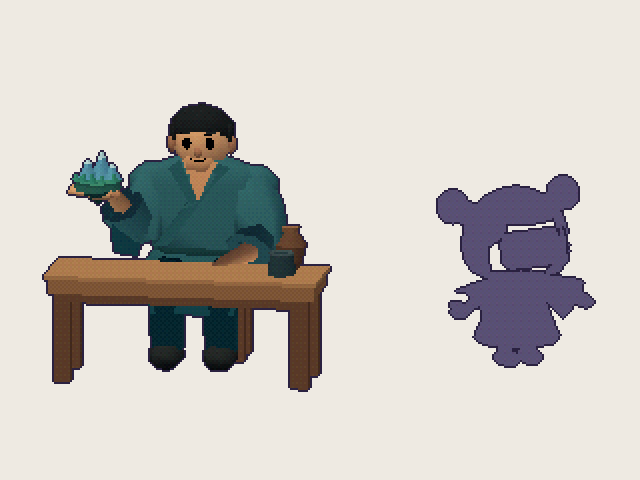
Depiction requirements
- identity and clothing
- Retain lay appearance; for the selected Toh 176 form use white lay clothes. Do not automatically turn him into a monastic Buddha or a jeweled Eight Sons deity. [vim-toh176]
- anatomical right hand
- Keep the miniature field in his own right hand, viewer-left for a front-facing body. This is a narrative action, not a generic named teaching mudrā. [vim-toh176]
- miniature field identification
- Treat the displayed field as Abhirati, including Akṣobhya and its inhabited environment when details are represented. A few peaks alone are a deliberate symbolic compression; label that limit. [vim-toh176]
- seat and expression
- The selected miracle is performed without rising from a couch. Preserve a seated human teacher and composed presence; the current stool/table and youthful smile are game adaptations. Historical elderly/bearded paintings are separate appearance choices, not universal textual requirements. [vim-toh176] [vim-met-painting] [vim-met-stele]
Presentation contract
Ready to build from No readiness block is recorded in the plan.
Open points recorded with the contract
- No securely identified historical Tibetan Vimalakīrti artwork was found
Setting and sizing rule
A couch he does not rise from; no shrine is required. Sizing (plan rule R4, not a sourced claim): the opening of any shrine, canopy or pavilion around the figure leaves at least one of the figure's own head-heights of clear air above its tallest point (the top of the head) and a clear gap on each side of its widest span (the raised right hand with the field); a throne back or aureole sits behind the figure without passing through it; pillars and lintel do not cross the face, hands or held objects in the front or either three-quarter capture.
Recorded variants · 2
- East Asian learned lay-sage appearance: bearded mature sage with cap (Met 2024.412.11, Japan 1665); pavilion debate (Met 29.72, China)
- The sickbed debate is a different scene
Recorded adaptations · 2
- Stool, table and youthful face
- Peaks standing for the whole field
Where the plan places it · 2
- vimalakirti · The room that holds everyone
vimalakirti.room· character Vimalakirticharacter:vimalakirti· retired record - vimalakirti · The room that holds everyone
vimalakirti.room· character Vimalakirtivimalakirti
Contract sources · 3
- 84000: The Teaching of Vimalakīrti (Toh 176)
- The Met: The Lay Buddhist Vimalakirti, 2024.412.11
- The Met: Helian Ziyue stele, 29.72
Model audit and next pass
Evidence basis: visual + source; original concept, canonical front/three-quarter and multi-angle audit sheet inspected 2 October 2026; traditional artifacts viewed in Chrome, no ritual or runtime acceptance
Recorded observations
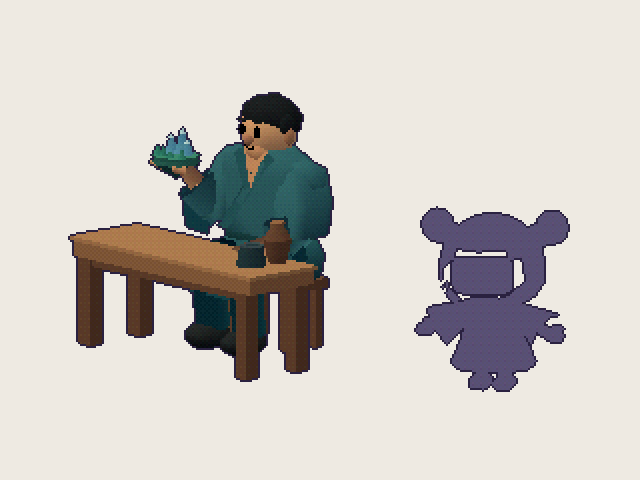
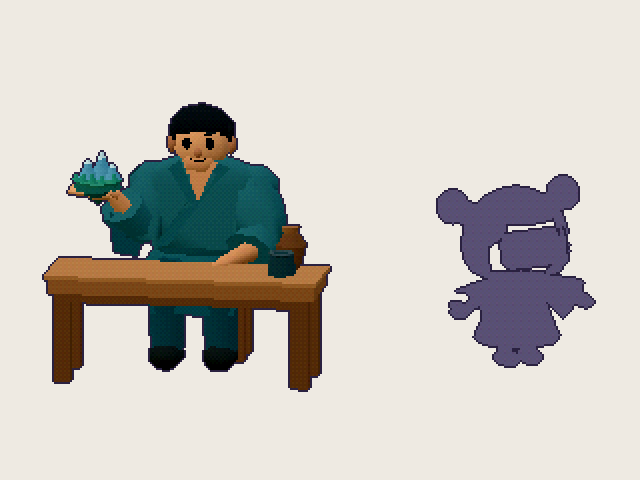
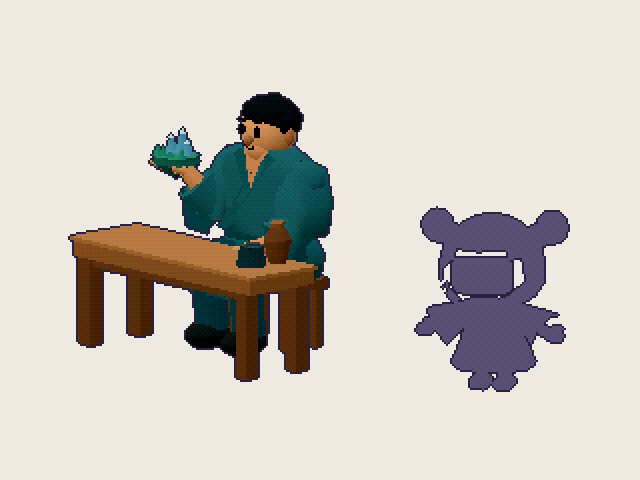
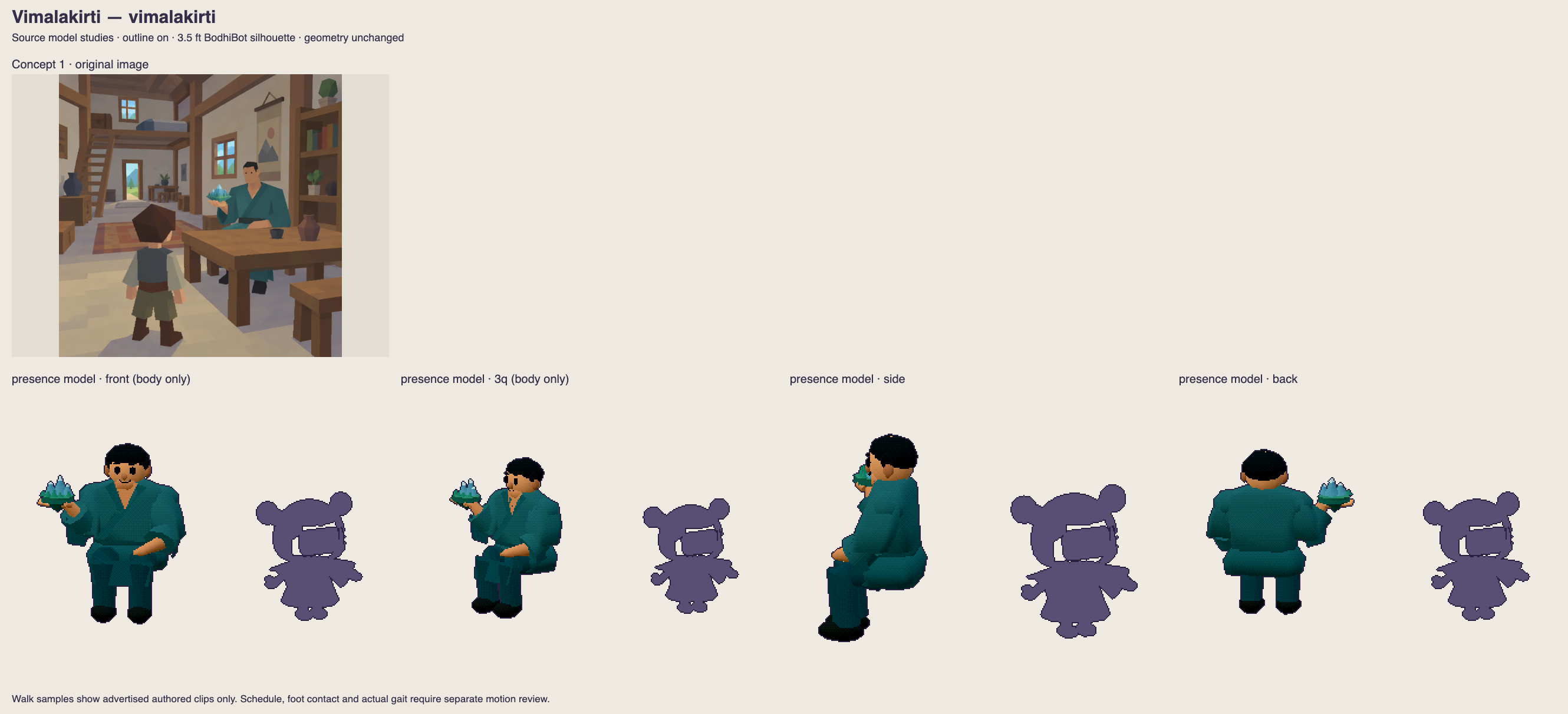
Original concept and current canonical front show a black-haired lay man at a low wooden table, wearing a saturated teal wrap/robe, dark sash and black shoes; left hand rests low, right palm supports three blue peaks on a small green island.
Multi-angle body sheet retains the right-hand field after scenery extraction; side/back views preserve a continuous cloth silhouette. No tiny Akṣobhya, assembly, water or ladders are visible on the island.
Source vimalakirti.js locates the offering at anatomical right and explicitly follows the generated concept; table/stool are scenery/activity props, while the little field remains attached to the actor.
The teal garment is a concept-level deviation from white lay clothes in the selected primary text. Lack of beard is not by itself a textual error; historical Japanese bearded appearance is a different selected artistic form.
Directions for a future model pass
P1 — Revise the selected-form concept toward white lay clothing before a future model pass, preserving the original concept and unrelated human silhouette.
P1 — Make the Abhirati narrative legible through a modest identified Akṣobhya/inhabited-field motif if feasible; otherwise record the miniature island as symbolic compression instead of claiming complete depiction.
P2 — Refine the cloth drape and seated support from the chosen lay-sage artwork. Retain the correct anatomical-right offering and avoid copying a Japanese cap/beard into Tibetan form without an explicit variant decision.
Assessed baseline captures
Documented forms and lineage variants · 2
Preserve one identified form consistently. A variant is usable only with its own source and context.
East Asian learned lay-sage appearance
The 1665 Japanese painting uses a bearded mature sage, cap, broad layered cloth and pale aureole; the Chinese stele uses a pavilion debate composition. These are named Vimalakīrti works, not Tibetan default costume prescriptions. [vim-met-painting] [vim-met-stele]
Narrative alternatives
Sickbed debate and miniature-field display are different scenes; retain the selected episode rather than accumulating every historical attribute. [vim-toh176]
What not to copy · 2
Do not substitute a deity template
Avoid mandatory Buddha uṣṇīṣa, crown, lotus, sword or monk robe unless a specifically selected Vimalakīrti representation warrants them. [vim-toh176] [vim-met-painting]
Do not confuse fields
Do not describe the held field as a generic mountain, Sukhāvatī or Tibet; the cited episode identifies Abhirati and Akṣobhya. [vim-toh176]
Sources and precise locations · 3
- [vim-toh176] 84000: The Teaching of Vimalakīrti (Toh 176) ↗
- [vim-met-painting] The Met: The Lay Buddhist Vimalakirti, 2024.412.11 ↗
- [vim-met-stele] The Met: Helian Ziyue stele, 29.72 ↗
Assessment freshness and evidence hashes
The frozen snapshot is authored evidence. Regeneration computes current hashes and leaves that snapshot as it is.
{
  "auditFreshness": {
    "status": "stale",
    "reasons": [
      "The model capture recipe or rig source changed."
    ]
  },
  "sourceSnapshot": {
    "captureHash": "65da592736e07e05d59c70f2f86b2f167b171718799dc34b0ccac8f34d8118c4",
    "bodyGeometryHash": "e53e607f7c8688adaffb9421ac2e277a44a6bd58a451b65eeac5902961f600a2",
    "sourceHashes": {
      "prototypes/prerendered-look/parts/purelands/vimalakirti.js": "bb985a8ad3fa7c5ee418b3095fb4ab0b65cacc78c05ca5860007c721ab3cef4b"
    },
    "captureHashes": {
      "/atlas/audit/sheets/vimalakirti-2d3dc2367311.webp": "c67db99be4789fadbd4272aef02fa85a574a2a1eee5dac4eaca76c9d203a2f0a",
      "/atlas/characters/vimalakirti-65da592736e0-presence-3q.webp": "8beca6921fd0a70a0f32550e1418167afbfcad05c355dae9c431abeb6715d419",
      "/atlas/characters/vimalakirti-65da592736e0-presence-front.webp": "14a5f3b0d0d5ed3fa264a1bf1ea1443eeae651df250ce2ef6c298d53da66c272",
      "/atlas/characters/vimalakirti-98838067b950-presence-3q.webp": "8beca6921fd0a70a0f32550e1418167afbfcad05c355dae9c431abeb6715d419",
      "/atlas/characters/vimalakirti-98838067b950-presence-front.webp": "14a5f3b0d0d5ed3fa264a1bf1ea1443eeae651df250ce2ef6c298d53da66c272"
    },
    "conceptHashes": {
      "/purelands/concepts/vimalakirti.webp": "d1dd58553639cdff93ed9cd475211699b3f249a3a1f8165aef1d8358d3c9428c"
    },
    "activeConceptPaths": [
      "/purelands/concepts/vimalakirti.webp"
    ]
  },
  "currentSnapshot": {
    "captureHash": "5ca2c8780b2e4ee6cd46153845cc357e5392733fd3211743bb00835f2e90bcbc",
    "bodyGeometryHash": "e53e607f7c8688adaffb9421ac2e277a44a6bd58a451b65eeac5902961f600a2",
    "activeConceptPaths": [
      "/purelands/concepts/vimalakirti.webp"
    ],
    "sourceHashes": {
      "prototypes/prerendered-look/parts/purelands/vimalakirti.js": "bb985a8ad3fa7c5ee418b3095fb4ab0b65cacc78c05ca5860007c721ab3cef4b"
    },
    "captureHashes": {
      "/atlas/audit/sheets/vimalakirti-2d3dc2367311.webp": "c67db99be4789fadbd4272aef02fa85a574a2a1eee5dac4eaca76c9d203a2f0a",
      "/atlas/characters/vimalakirti-5ca2c8780b2e-presence-3q.webp": "bcbe235c975bc17bbc79c4befcf243488c619013f23223cc550c6167a7ea6441",
      "/atlas/characters/vimalakirti-5ca2c8780b2e-presence-front.webp": "98e652f000ebc39ac788f18d9c129200968e3282a4fe0c6e78594703e3216464",
      "/atlas/characters/vimalakirti-65da592736e0-presence-3q.webp": "8beca6921fd0a70a0f32550e1418167afbfcad05c355dae9c431abeb6715d419",
      "/atlas/characters/vimalakirti-65da592736e0-presence-front.webp": "14a5f3b0d0d5ed3fa264a1bf1ea1443eeae651df250ce2ef6c298d53da66c272",
      "/atlas/characters/vimalakirti-98838067b950-presence-3q.webp": "8beca6921fd0a70a0f32550e1418167afbfcad05c355dae9c431abeb6715d419",
      "/atlas/characters/vimalakirti-98838067b950-presence-front.webp": "14a5f3b0d0d5ed3fa264a1bf1ea1443eeae651df250ce2ef6c298d53da66c272"
    },
    "conceptHashes": {
      "/purelands/concepts/vimalakirti.webp": "d1dd58553639cdff93ed9cd475211699b3f249a3a1f8165aef1d8358d3c9428c"
    }
  }
}