Vajrayoginī
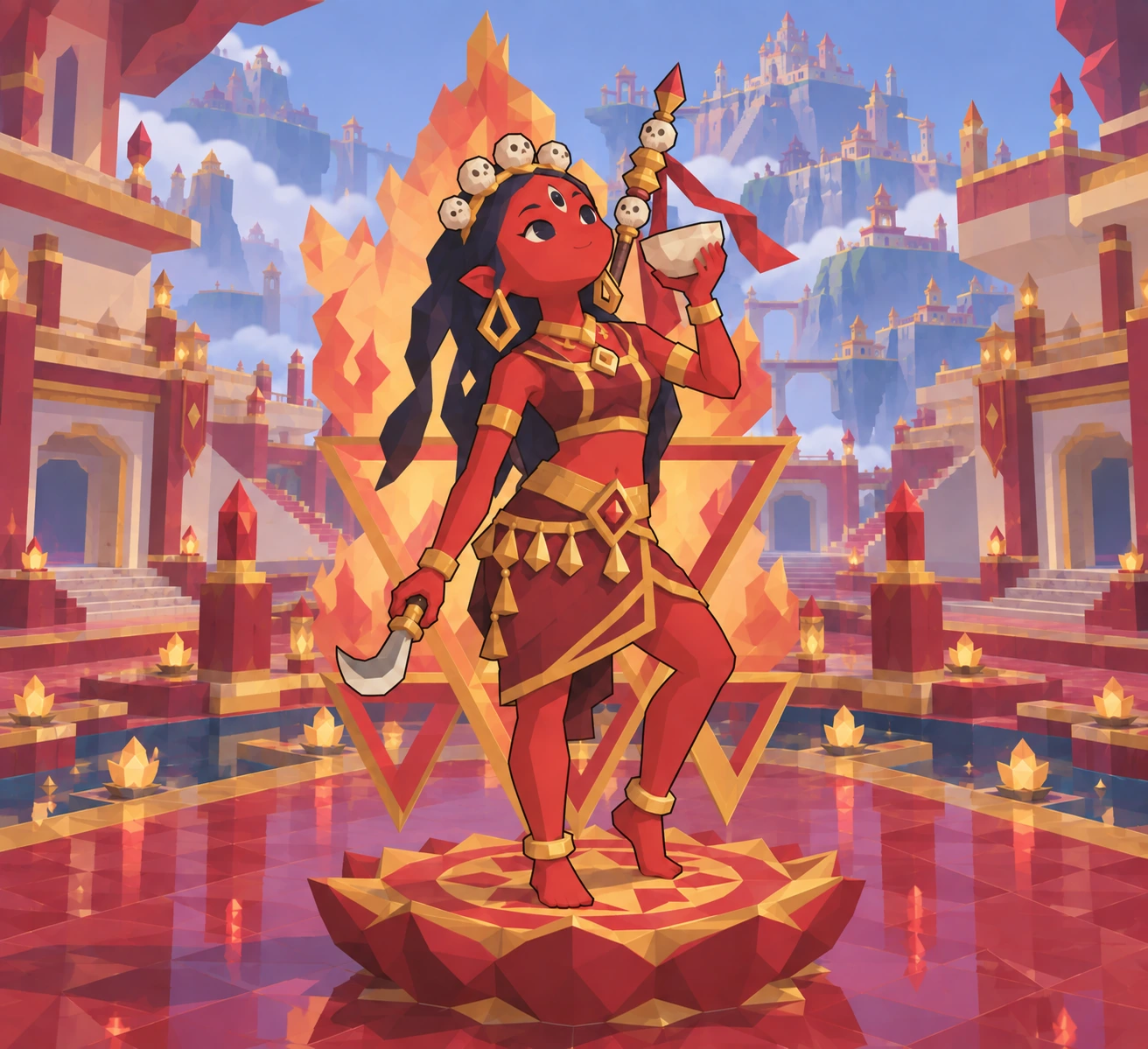
Vajrayogini in her Naro Khechari form is a wisdom dakini, full Buddhahood in female form. She is red, with one face, three eyes and two arms. Her left hand raises a skull cup toward her mouth, and her right reaches down with a curved knife.
Her form comes from Naropa, whose teaching passed through the Phamting brothers into the Sakya school, and Gelug also transmits it. She lunges with both feet planted on Kalaratri and Bhairava, above a sun disc and lotus. A khatvanga, a tantric staff, rests on her left shoulder. Her black hair flows and her head turns upward.
One Naro painting shows her unclothed apart from bone ornaments and a wafting scarf. Another gives her a skull crown and a garland of fifty dry skulls. Flames ring her. One painting of her pure land, Khechara, builds its palace as a double tetrahedron. Vajravarahi, who has a sow's head, is a different form.
In traditional art
These images stay with the collections that hold them. Each link opens the collection's own page.
- Vajrayogini, Naro Khechari — Rubin F1997.19.2 ↗Kham region, eastern Tibet; Sakya/Ngor attribution in HAR 290 · Late 19th century · rubinmuseum.orgPhoto by Dave De Armas © Rubin Museum of Himalayan Art, 2024. Reference link only; no open reuse licence asserted.
- Vajrayogini in the Pure Realm of Khechara — Rubin C2006.66.243 ↗Kham region, eastern Tibet; Sakya/Gelug Naro Khechari pure-realm composition · 19th century · rubinmuseum.orgRubin Museum of Himalayan Art, Gift of Shelley and Donald Rubin. Museum photograph; no open reuse licence stated in the object record; linked reference only.
- Vajrayogini, Naropa Tradition — Rubin F1996.31.16 / HAR 530 ↗Tibet; Sakya attribution · 18th century (1700–1799) · himalayanart.orgPhotographed image copyright © 2004 Rubin Museum of Art; catalogue © Himalayan Art Resources. Linked reference; no open reuse licence asserted.
- Vajrayogini and the Pure Land of Khechara — Rubin F1997.22.1 / HAR 334 ↗Central Tibet; Sakya/Ngor attribution · 19th century (1800–1899) · himalayanart.orgPhotographed image copyright © 2004 Rubin Museum of Art; catalogue © Himalayan Art Resources. Linked reference; no open reuse licence asserted.
Sources
- Mahāsiddha Nāropa — The Sakya Tradition ↗
- Vajrayogini — Rubin Museum, F1997.19.2 ↗
- Vajrayogini, Naropa Tradition — HAR 290 / Rubin F1997.19.2 ↗
- Vajrayogini in the Pure Realm of Khechara — Rubin C2006.66.243 ↗
- Vajrayogini and the Pure Land of Khechara — HAR 334 / Rubin F1997.22.1 ↗
- Vajrayogini, Naropa Tradition — HAR 530 / Rubin F1996.31.16 ↗
- Vajrayogini, Naro-shaped Drukpa/Kagyu appearance — HAR 61 / Rubin F1997.3.3 ↗
- Vajravarahi — Rubin C2006.34.1 ↗
- Vajrayogini, unresolved possible Maitri Kachod form — HAR 65177 / Rubin C2002.47.2 ↗
Depiction requirements and work notes
Vajrayoginī — Naro Khechari (Dorje Naljorma, Naro Khachöma)
The named game form calls for the red, three-eyed, two-armed Naro appearance with raised left skull cup, lowered right curved knife, left-shoulder khatvāṅga and a grounded lunge. The current costumed, one-foot-balancing model preserves identifying attributes but is an adaptation rather than traditional compliance.
The model capture recipe or rig source changed. Reinspect the model before relying on the recorded defects.
References, criteria, concept and model side by side
Traditional depictions
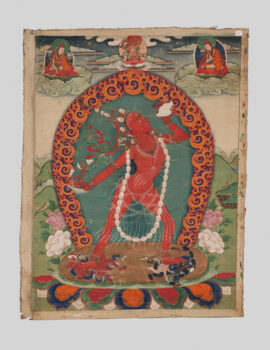
Primary single-figure Naro reference for the raised cup, downward knife, grounded lunge and skull garland; use HAR 290 to resolve the museum caption's duplicated right-hand wording. [vyg-rubin290] [vyg-har290]
Object record ↗ · Source image ↗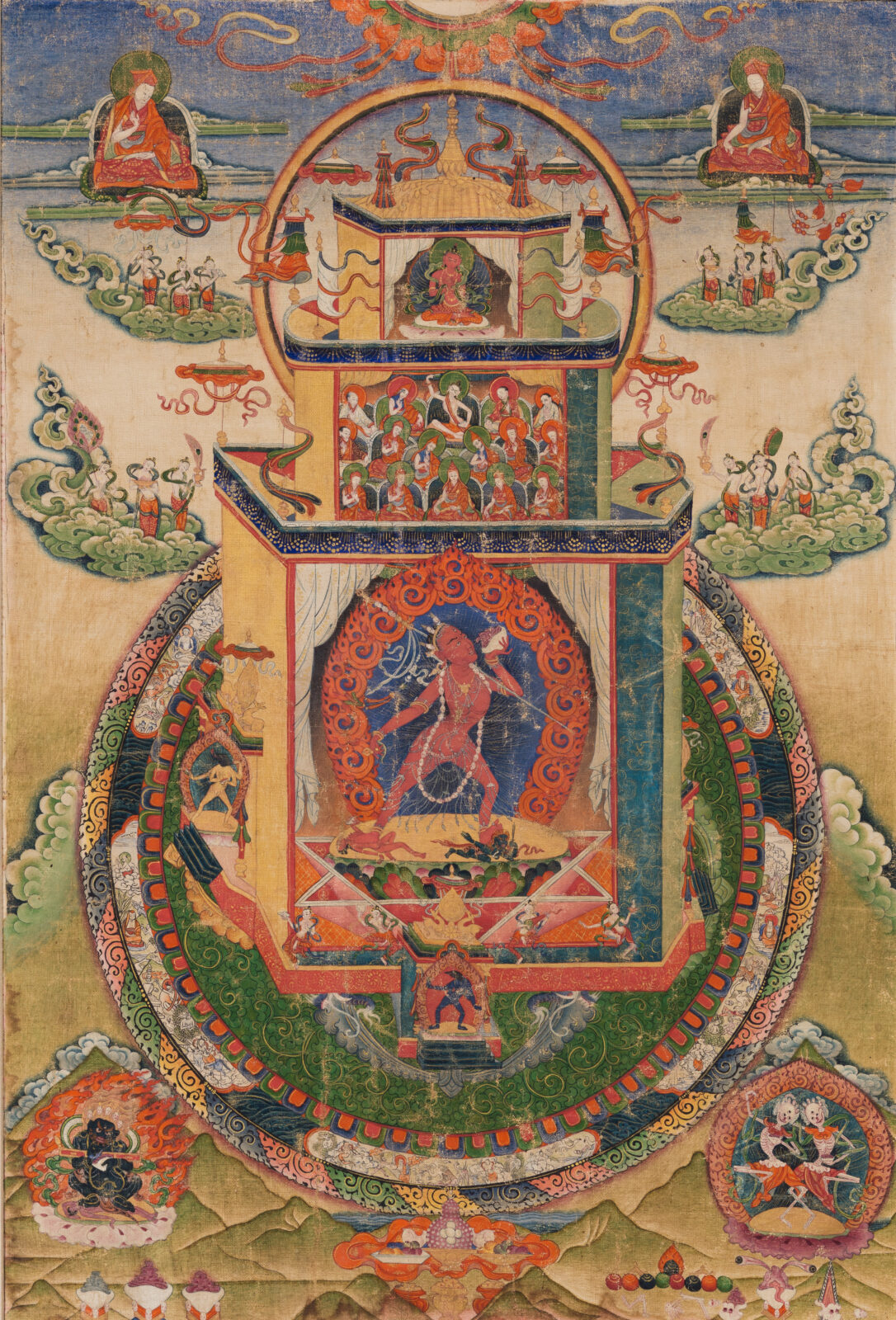
Primary museum source for the archer's lunge and Vajrayoginī at the center of a three-dimensional Khechara palace mandala. [vyg-rubin318]
Object record ↗ · Source image ↗
Supplemental Naro painting for the traditional unclothed body, bone ornaments, dry-skull garland, flowing scarf and supporting figures. [vyg-har530]
Object record ↗ · Source image ↗
Supplemental palace/mandala reference for the double-tetrahedral structure and distinct red Vajradharma appearance in the top story. [vyg-har334] [vyg-rubin318]
Object record ↗ · Source image ↗Criteria
The model must show
- Lineage variant: the Naropa-derived Sakya Naro Khechari appearance (HAR 290 / Rubin F1997.19.2)
- Body: red, one face, exactly two arms; head turned upward; black flowing hair
- Hands: own right hand extends downward with the curved knife; own left hand raises the skull cup toward the mouth
- Held objects: a curved knife; a skull cup that does not read as a bowl or mug; a khatvanga at the left shoulder with its stack of heads and vajra finial
- Ornaments: skull crown, bone ornaments, a garland of dry skulls (fifty in the source; fewer if simplified, but recognisable as skulls)
- Dress: the source shows an unclothed red body with bone ornaments and a wafting scarf; the game's opaque tunic and skirt is a recorded costume adaptation
- Posture: a dynamic lunge with both feet planted
- Face: semi-wrathful, lifted toward the cup; not cheerful
- Eyes: three, the third a vertical eye on the forehead that reads as an eye and not a jewel; all three are solid black silhouettes with no whites, irises, pupils, highlights or glint (project eye rule; recorded game adaptation)
- Seat: sun disc and lotus, with the Kālarātri and Bhairava support figures underfoot or their omission recorded
- Aureole: a flame aureole behind her
The model must not show
- Cartoon smiley face: a wide U-shaped or crescent grin, open laughing mouth, rosy cheek dots or mascot cheeks
- Eye whites, irises, pupils, highlights or glint; glowing white-gold eyes (those belong only to freshly liberated beings)
- Any part of the figure (head, crown, hat, halo, raised hand or held object) touching or passing through its canopy, roof, lintel, pillars, throne back or seat in any capture angle
- One foot lifted in a dance balance (the current model's fault)
- A sow's head or extra arms (Vajravārāhī and other forms)
- A garland of eight plain beads
- An empty abstract cup
- A cheerful front-facing face
- Showing her as an ordinary opponent
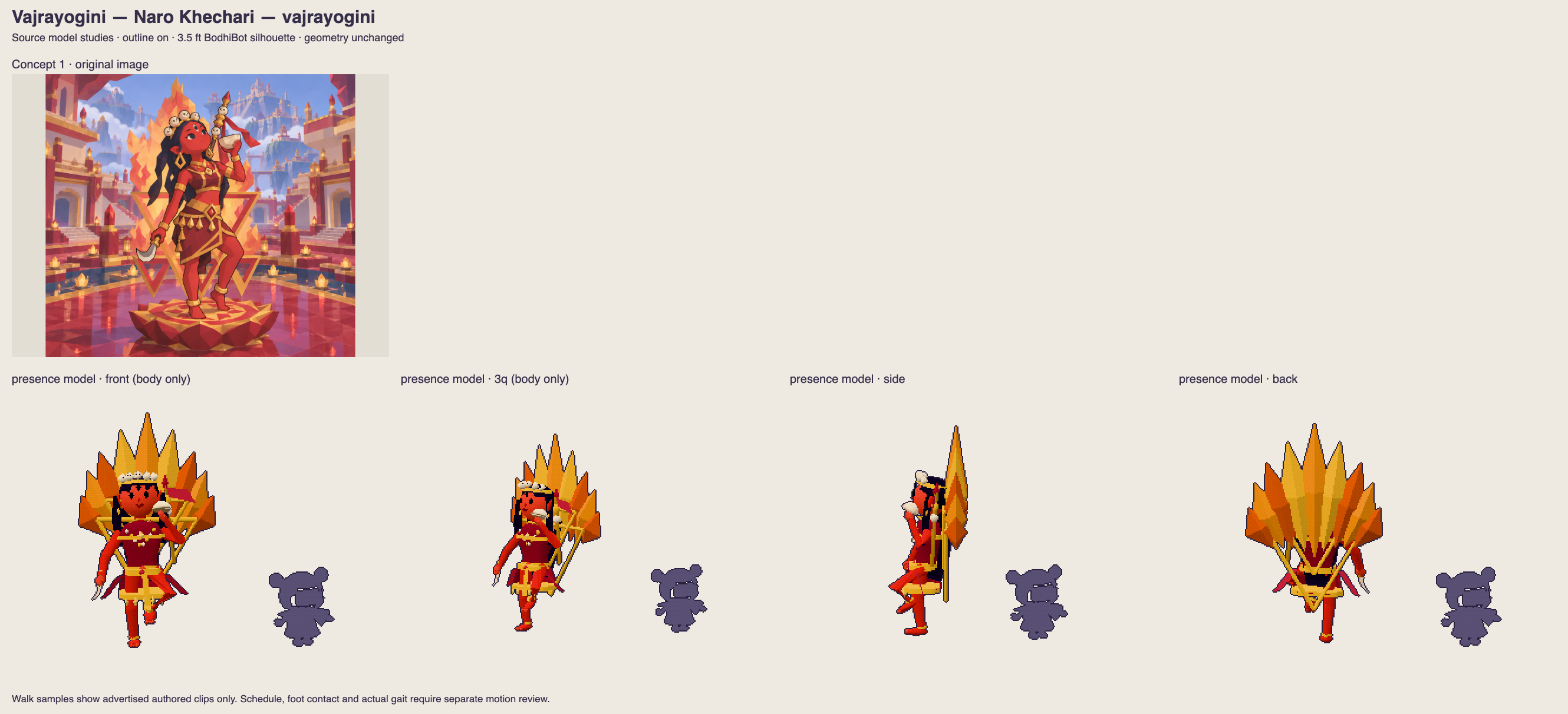
Original game concept
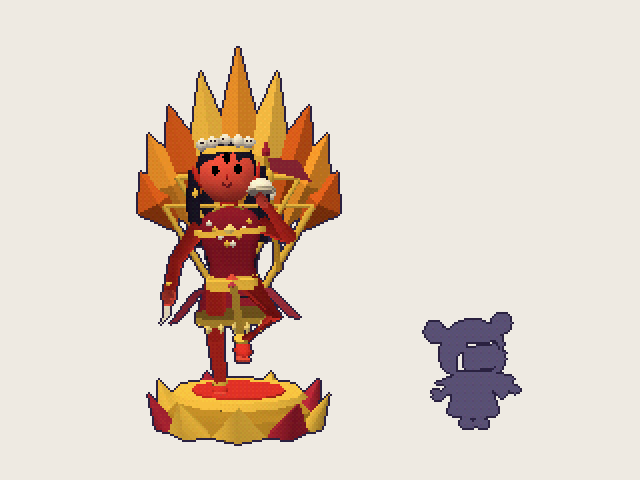
Current 3D model
presence
Depiction requirements
- Identity and lineage
- Treat her as awakened presence, not an ordinary opponent. Anchor the Naro name to Naropa's transmission through the Phamting brothers into Sakya; do not infer lineage from a generic Vajrayoginī object title. [vyg-sakya-naropa] [vyg-har334]
- Body, face and eyes
- Preserve a red body, one face, three eyes and exactly two arms. Make the vertical forehead eye read as an eye. Keep upward head direction and black flowing hair. Solid-black eye silhouettes are the game's explicit style adaptation, not a claim about traditional eye anatomy. [vyg-har61] [vyg-rubin290]
- Proper right and left attributes
- Figure's right hand extends down with the curved knife; figure's left raises the skull cup toward the mouth. Keep the left-side shoulder/elbow staff. Proper right means the figure's right, not screen right. [vyg-har290]
- Pose and supporting figures
- Use a dynamic lunge with both feet planted; bending the left knee does not lift its foot into a dance balance. Restore the referenced Kālārātri/Bhairava support over sun disc and lotus or explicitly retain that omission as adaptation. [vyg-har61] [vyg-rubin318]
- Skull and bone ornaments
- For the chosen Sakya Naro reference, preserve a skull crown, bone ornaments and fifty dry skulls in the garland. Geometry can simplify, but skulls should remain identifiable. Do not replace the traditional garland with eight generic beads. [vyg-har290]
- Costume
- The cited Naro painting shows an unclothed red body with bone ornaments and a wafting scarf. An opaque tunic/skirt is authored game costume, requiring an explicit adaptation label if retained. [vyg-har530]
- Cup and khatvāṅga recognizability
- Make the skull cup distinguishable from a bowl/mug and preserve the chosen reference's head/skull stack and vajra finial on the staff. Museum nectar terminology and symbolic-blood terminology should not be silently collapsed into a claim about every form's contents. [vyg-rubin290] [vyg-rubin318] [vyg-har530]
- Aureole and Khechara setting
- Retain a flame aureole with the lotus/sun support. A palace depiction uses a double-tetrahedral structure, so two flat triangle outlines are an adaptation. Name the specific visionary mandala account rather than describing this as generic heavenly urban geography. [vyg-har334] [vyg-rubin318]
Presentation contract
Ready to build from No readiness block is recorded in the plan.
Setting and sizing rule
Sun and lotus under the feet, flame aureole behind. In Khechara her palace is a double-tetrahedral structure with Vajradharma at the top; two flat triangle outlines are a recorded adaptation. Sizing (plan rule R4, not a sourced claim): the opening of any shrine, canopy or pavilion around the figure leaves at least one of the figure's own head-heights of clear air above its tallest point (the raised cup, the staff finial and the flame tips) and a clear gap on each side of its widest span (the lunging legs and the lowered knife arm); a throne back or aureole sits behind the figure without passing through it; pillars and lintel do not cross the face, hands or held objects in the front or either three-quarter capture.
Recorded variants · 3
- HAR 61 (Drukpa/Kagyu): Naro-shaped, with a garland of severed heads
- Vajravārāhī (Rubin C2006.34.1): sow head, raised knife, cup at the heart
- Rubin C2002.47.2 / HAR 65177: not securely identified, possibly Maitri Kachod
Recorded adaptations · 3
- The opaque red-and-gold costume
- Omitted support figures, if they stay omitted
- Flat triangle outlines for the double tetrahedron
Where the plan places it · 1
- field khechara · The five-gem palace
field-khechara.palace· character Vajrayogini — Naro Khecharivajrayogini
Contract sources · 9
- Mahāsiddha Nāropa — The Sakya Tradition
- Vajrayogini and the Pure Land of Khechara — HAR 334 / Rubin F1997.22.1
- Vajrayogini, Naro-shaped Drukpa/Kagyu appearance — HAR 61 / Rubin F1997.3.3
- Vajrayogini — Rubin Museum, F1997.19.2
- Vajrayogini, Naropa Tradition — HAR 290 / Rubin F1997.19.2
- Vajrayogini in the Pure Realm of Khechara — Rubin C2006.66.243
- Vajrayogini, Naropa Tradition — HAR 530 / Rubin F1996.31.16
- Vajravarahi — Rubin C2006.34.1
- Vajrayogini, unresolved possible Maitri Kachod form — HAR 65177 / Rubin C2002.47.2
Model audit and next pass
Evidence basis: visual + source
Recorded observations
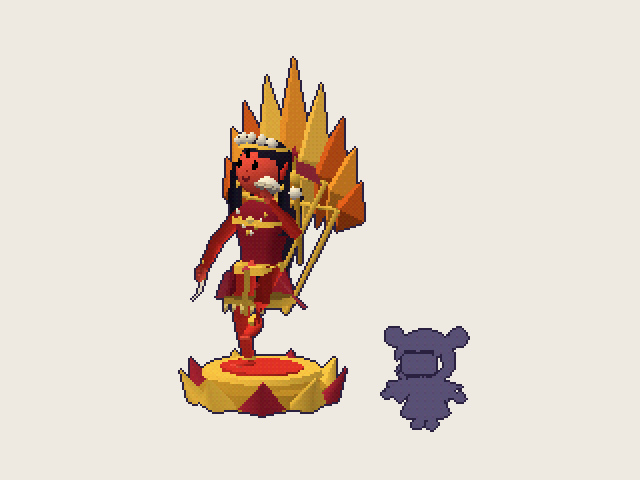
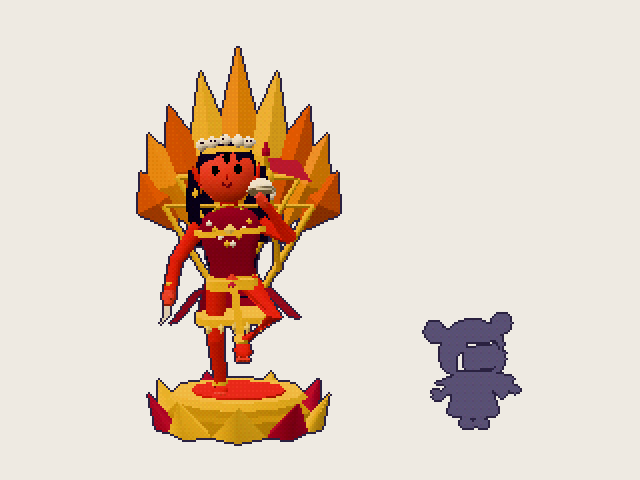
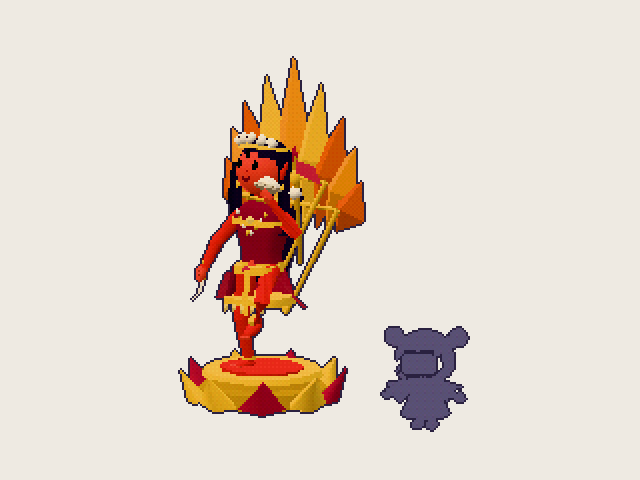
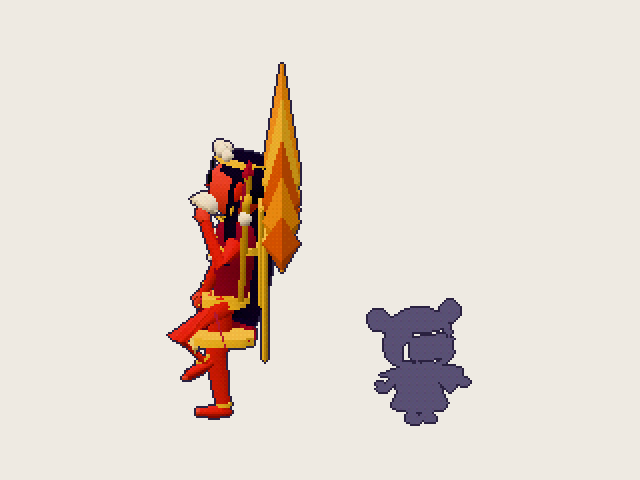
Reviewed the original concept, current front capture, all-angle sheet and individual side capture; also inspected prototypes/prerendered-look/parts/purelands/vajrayogini.js and shared-principals.js. This was not a fresh runtime recapture.
The red body, one face, three eyes, two arms, right lowered knife, left raised cup, left-side staff, black hair, skull-like crown and flame backdrop retain recognizable identity.
The side capture visibly raises the left foot. Source gives the left ankle height 1.0 versus right 0.2, despite a header claiming a toe on the sun disc. The concept plants both feet but omits the traditional support figures.
Both concept and model use opaque red-and-gold costume. The model has eight chest beads instead of the dry-skull garland, no Kālārātri/Bhairava supports, an explicitly empty smooth cup and an abbreviated staff stack.
The cheerful front-facing model weakens the upward semi-wrathful/cup-drinking presentation. The flame/triangle silhouette is readable, but flat outlines do not reproduce a double tetrahedron.
Directions for a future model pass
First correct the stance to a grounded Naro lunge, then reassess the head/cup relationship from front and side.
Restore or explicitly disposition the skull garland, bone ornaments, supporting figures and complete staff attributes using the chosen Sakya Naro reference.
Revise the concept's iconography alongside the model work order; copying the current concept would preserve traditional inaccuracies.
Keep black eye silhouettes and PS1 geometry; improve recognizable sacred attributes through proportion, placement and silhouette rather than fine ornamental noise.
For later model work follow docs/atlas.md: preserve the current pass, capture all angles/forms, record traditional accuracy separately from concept fidelity, and leave the Atlas approval fields as found.
Assessed baseline captures
Documented forms and lineage variants · 3
Preserve one identified form consistently. A variant is usable only with its own source and context.
HAR 61 is a Drukpa/Kagyu painting with Naro-shaped appearance and a severed-head garland; HAR 290 is a Sakya/Ngor painting with dry skulls. Keep their ornaments and lineage attributions separate.
Vajravārāhī's cited form has the distinguishing sow head, a raised knife and a cup at the heart. These are not interchangeable with the game's Naro presentation (Rubin C2006.34.1).
Rubin C2002.47.2 / HAR 65177 is not securely identified: HAR suggests a Maitri Kachod relationship. It is a variant caution, not a definitive Naro pose model.
What not to copy · 5
Do not add a sow head, extra arms or a dancing one-foot balance merely because another Vajrayoginī form uses it.
Do not claim the costumed concept, empty abstract cup, bead necklace or omitted support figures are traditional requirements.
Do not use generalized tantric symbolism to invent ritual details, gestures or decorative implements absent from the chosen form's reference.
Do not copy apparent handedness caption slips: Rubin F1997.19.2 repeats right hand, HAR 530 repeats left hand; HAR 61 and 290 resolve right knife / left raised cup.
Do not present a research audit, historical capture or museum image as a review of the game model.
Sources and precise locations · 9
- [vyg-sakya-naropa] Mahāsiddha Nāropa — The Sakya Tradition ↗
- [vyg-rubin290] Vajrayogini — Rubin Museum, F1997.19.2 ↗
- [vyg-har290] Vajrayogini, Naropa Tradition — HAR 290 / Rubin F1997.19.2 ↗
- [vyg-rubin318] Vajrayogini in the Pure Realm of Khechara — Rubin C2006.66.243 ↗
- [vyg-har334] Vajrayogini and the Pure Land of Khechara — HAR 334 / Rubin F1997.22.1 ↗
- [vyg-har530] Vajrayogini, Naropa Tradition — HAR 530 / Rubin F1996.31.16 ↗
- [vyg-har61] Vajrayogini, Naro-shaped Drukpa/Kagyu appearance — HAR 61 / Rubin F1997.3.3 ↗
- [vyg-rubinvarahi] Vajravarahi — Rubin C2006.34.1 ↗
- [vyg-har65177] Vajrayogini, unresolved possible Maitri Kachod form — HAR 65177 / Rubin C2002.47.2 ↗
Assessment freshness and evidence hashes
The frozen snapshot is authored evidence. Regeneration computes current hashes and leaves that snapshot as it is.
{
  "auditFreshness": {
    "status": "stale",
    "reasons": [
      "The model capture recipe or rig source changed."
    ]
  },
  "sourceSnapshot": {
    "captureHash": "0f4810e09321256e1e0be5fa0dcb92b9599f1bbeb5a06b7ed09a9bcfb1164ea9",
    "bodyGeometryHash": "ed5181e986225ae911101a467322c4aaf8caa7bc70d6fb9ddd27438592dd6580",
    "sourceHashes": {
      "prototypes/prerendered-look/parts/purelands/vajrayogini.js": "68b93104f39649cee7170dd464295ef677bda9dec8ce4399177f0c22c15e61ab"
    },
    "captureHashes": {
      "/atlas/audit/characters/vajrayogini-9dc903519f6f-presence-side.webp": "322378c5fef6b7a195b3344e717505bc9aa6729e9f31a6254e5b4e47bed807ba",
      "/atlas/audit/sheets/vajrayogini-9dc903519f6f.webp": "27bcd3a5eca75b398eaca522440e4ad686a56d35474c3ac2c67a2d9170e9ebc8",
      "/atlas/characters/vajrayogini-0f4810e09321-presence-3q.webp": "9ded073f0ebd830962aab80fd0b1ae210737d494415d8323504bbff505b0984b",
      "/atlas/characters/vajrayogini-0f4810e09321-presence-front.webp": "bee6e2f79372f4762f9d00d02007c616359d17c4bc49d8cdb356ef35f81d8f64",
      "/atlas/characters/vajrayogini-48a2bcbb16c2-presence-3q.webp": "9ded073f0ebd830962aab80fd0b1ae210737d494415d8323504bbff505b0984b",
      "/atlas/characters/vajrayogini-48a2bcbb16c2-presence-front.webp": "bee6e2f79372f4762f9d00d02007c616359d17c4bc49d8cdb356ef35f81d8f64"
    },
    "conceptHashes": {
      "/atlas/concepts/vajrayogini.webp": "42c3b641cb917c636a82ba93c925b78e6285421be5dab12c005fc74d0bef8775"
    },
    "activeConceptPaths": [
      "/atlas/concepts/vajrayogini.webp"
    ]
  },
  "currentSnapshot": {
    "captureHash": "89d667fe5d232c4064ae004111ab294f0be85a6fd0528116378639936cb28053",
    "bodyGeometryHash": "ed5181e986225ae911101a467322c4aaf8caa7bc70d6fb9ddd27438592dd6580",
    "activeConceptPaths": [
      "/atlas/concepts/vajrayogini.webp"
    ],
    "sourceHashes": {
      "prototypes/prerendered-look/parts/purelands/vajrayogini.js": "68b93104f39649cee7170dd464295ef677bda9dec8ce4399177f0c22c15e61ab"
    },
    "captureHashes": {
      "/atlas/audit/characters/vajrayogini-9dc903519f6f-presence-side.webp": "322378c5fef6b7a195b3344e717505bc9aa6729e9f31a6254e5b4e47bed807ba",
      "/atlas/audit/sheets/vajrayogini-9dc903519f6f.webp": "27bcd3a5eca75b398eaca522440e4ad686a56d35474c3ac2c67a2d9170e9ebc8",
      "/atlas/characters/vajrayogini-0f4810e09321-presence-3q.webp": "9ded073f0ebd830962aab80fd0b1ae210737d494415d8323504bbff505b0984b",
      "/atlas/characters/vajrayogini-0f4810e09321-presence-front.webp": "bee6e2f79372f4762f9d00d02007c616359d17c4bc49d8cdb356ef35f81d8f64",
      "/atlas/characters/vajrayogini-48a2bcbb16c2-presence-3q.webp": "9ded073f0ebd830962aab80fd0b1ae210737d494415d8323504bbff505b0984b",
      "/atlas/characters/vajrayogini-48a2bcbb16c2-presence-front.webp": "bee6e2f79372f4762f9d00d02007c616359d17c4bc49d8cdb356ef35f81d8f64",
      "/atlas/characters/vajrayogini-89d667fe5d23-presence-3q.webp": "37f537ad6d47e2a323720d6b1f1c47d2f067f948388650236b2494bb5bc9d71c",
      "/atlas/characters/vajrayogini-89d667fe5d23-presence-front.webp": "318d9c5f07276a3cb7b860ebca3a22043d9c838ce5629622a2a6c54fe531ab9b"
    },
    "conceptHashes": {
      "/atlas/concepts/vajrayogini.webp": "42c3b641cb917c636a82ba93c925b78e6285421be5dab12c005fc74d0bef8775"
    }
  }
}