Vajrapāṇi
Vajrapani, Chagna Dorje in Tibetan, is the bodhisattva who holds the vajra, a ritual sceptre with pronged ends on either side of a central grip. He is one of Shakyamuni's Eight Close Sons, the Buddha's eight great bodhisattva companions. His peaceful and wrathful forms are depicted differently.
In his peaceful form he is blue or green, in bodhisattva silks and jewels. He holds the vajra in his right hand or on a flower over his right shoulder, and some forms add a bell at the left. In the Second Neten Chokling's liturgy he is green, smiling and standing, his right hand teaching and his left protecting.
Each wrathful form follows its own named source. A Tibet House thangka, a painted scroll, shows him blue and striding inside flames, with the vajra raised in his right hand, a bell in his left, a tiger-skin loincloth, a crown, jewels and a snake necklace. The Blue-Clad Vajrapani is another fierce form, with fangs and fiery eyes.
In traditional art
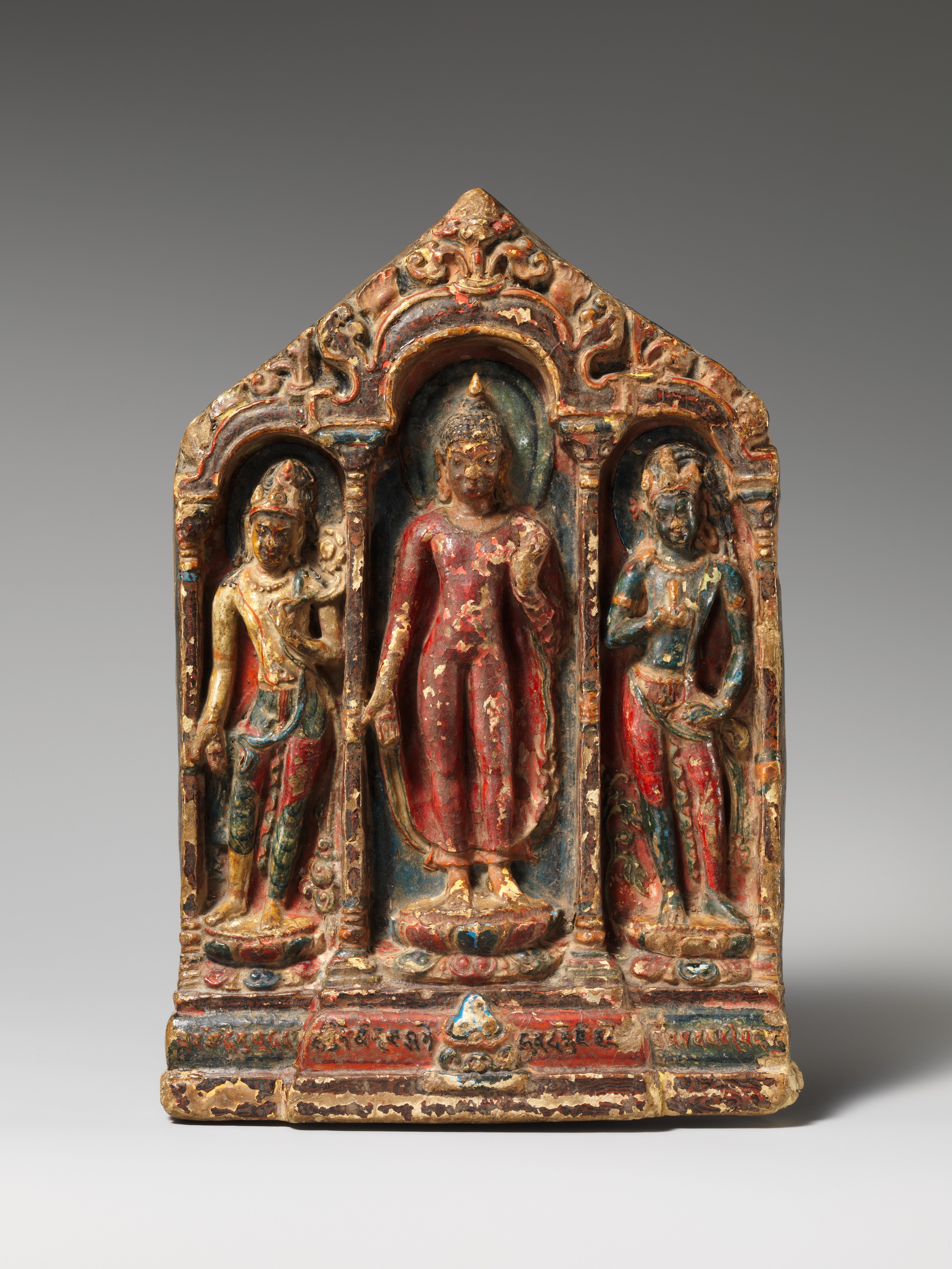
Buddha flanked by Avalokiteshvara-Padmapani and VajrapaniTibet · 11th centuryPublic domain / Met Open Access; verified isPublicDomain=true in official Collection API for object 75202. Credit: Purchase, Friends of Asian Art Gifts, 2008; object 2008.504.Object record ↗
In other collections
These images stay with the collections that hold them. Each link opens the collection's own page.
- Vajrapani (From Situ's set of Eight Great Bodhisattvas) ↗Kham region, Eastern Tibet · 19th century · api.rubinmuseum.orgNo open license established. Photograph by David De Armas, Rubin Museum of Himalayan Art, 2018. Rubin's Rights and Reproductions policy requires an image-use permission application; treat as a linked museum study reference, not a cleared redistributable game asset.
- Vajrapani ↗Tibet · 18th century · rubinmuseum.orgNo open license established. Photography by David De Armas Photography, The Rubin Museum of Himalayan Art, 2013. Museum image-use permission policy applies. Collection C2002.17.2.
Sources
- Vajrapani, Peaceful, Main Page ↗
- Vajrapani Main Page ↗
- Vast Clouds of Samantabhadra's Display: A Ritual of Worship to Delight the Teacher, his Eight Heart-Sons, and their Retinue ↗
- Vajrapani (From Situ's set of Eight Great Bodhisattvas), F1997.40.5 ↗
- Buddha flanked by Avalokiteshvara-Padmapani and Vajrapani, 2008.504 ↗
- Vajrapani, C2002.17.2 ↗
- Chakrasamvara, Vajrapani ↗
- Rituals for the Blue-Clad Vajrapāṇi ↗
Depiction requirements and work notes
Vajrapāṇi (Phyag na rdo rje), power/protection bodhisattva
Vajrapāṇi (Tibetan: Phyag na rdo rje, Chagna Dorje) is the vajra-bearing bodhisattva among Śākyamuni's Eight Close Sons. His peaceful assembly form and his wrathful tantric forms have different depiction contracts. A blue body and a vajra alone do not validate a mixture of the two. Establish which form the game intends before polishing its anatomy, face, dress or aura.
The model capture recipe or rig source changed. The visible model geometry changed. Rig source changed or is missing: prototypes/prerendered-look/parts/purelands/vajrapani.js Reinspect the model before relying on the recorded defects.
References, criteria, concept and model side by side
Traditional depictions
Historical Tibetan molded-clay shrine. Peaceful, adorned standing bodhisattvas flank the central Buddha; the viewer-right attendant is the Vajrapāṇi context. Use the whole labeled trio for identification, and inspect the surviving attributes before inferring details from damaged surfaces. The Met record dates it 11th century while its descriptive prose calls it tenth-century: preserve that catalog inconsistency rather than silently resolving it. [vajrapani-tibet-met]
Object record ↗ · Source image ↗
Visually reviewed official photograph: blue, relaxed seated figure in red silk, anatomical right hand raised with vajra, simple jewelry and circular halo. A specific Konchok Phende/Situ-derived composition. Museum cautions that this set does not follow standard textual descriptions or other standard Tibetan visual conventions. [vajrapani-situ-rubin] [rubin-image-rights]
Object record ↗ · Source image ↗
Visually reviewed traditional wrathful sculpture: stocky forceful figure, fierce face, lifted anatomical right-hand vajra, left-hand gesture at the waist, jeweled crown and adornments, vigorous stance, hide/apron and surrounding flame arch. It supplies an actual sculptural wrathful comparison, rather than establishing mandatory motifs for peaceful Vajrapāṇi. [vajrapani-wrath-rubin] [rubin-image-rights]
Object record ↗ · Source image ↗Criteria
The model must show
- Selected plan account: the standing Chokling Tersar assembly form from Second Neten Chokling, Vast Clouds of Samantabhadra’s Display, sharedAssemblyAccount II.A.4, English lines 664–719 (2026-10-02), with the recorded emblem program. DECISIONS.md B and the reconciled home select this account; other forms remain separate alternatives.
- Body: green, peaceful bodhisattva appearance; retain one coherent standing court form instead of choosing colours from another artwork.
- Posture and dress: standing in silk and jewels, smiling toward the principal figure; use a restrained peaceful expression under R3 and retain the project low-poly art register.
- Hands: anatomical right teaches and anatomical left protects; retain emblem-bearing lotus stems as the selected shared account states. Do not import the lap, earth-touching, directly held weapon or monastic staff gestures of an alternative form.
- Identity emblem: vajra, carried by the lotus program. Exact object/stem side and hand contacts beyond the cited shared gestures require a compatible identified reference; do not borrow them from another form to fill this gap.
- Eyes: solid black silhouettes with no whites, irises, pupils, highlights or glint (project eye rule; a recorded game adaptation, not a claim about traditional painted eyes)
- Maintain readable whole-body posture, both hands, emblem and support from front and three-quarter views. No figure or attribute clips its enclosure (R4).
The model must not show
- Cartoon smiley face: a wide U-shaped or crescent grin, open laughing mouth, rosy cheek dots or mascot cheeks
- Eye whites, irises, pupils, highlights or glint; glowing white-gold eyes (those belong only to freshly liberated beings)
- Any part of the figure (head, crown, hat, halo, raised hand or held object) touching or passing through its canopy, roof, lintel, pillars, throne back or seat in any capture angle
- Peaceful and wrathful motifs mixed: muscles, furrowed brows and a flame aureole on a figure with no named wrathful prototype
- A vajra that reads as a club or plain bar
- A bell added only because vajra holders seem to need one
- Treating the invented traveller as a required retinue figure
- Decorative triangles ahead of a readable emblem, gesture and face
- Hands or attributes mirrored to the wrong side of the figure's own body (own right appears at viewer-left in a front view)
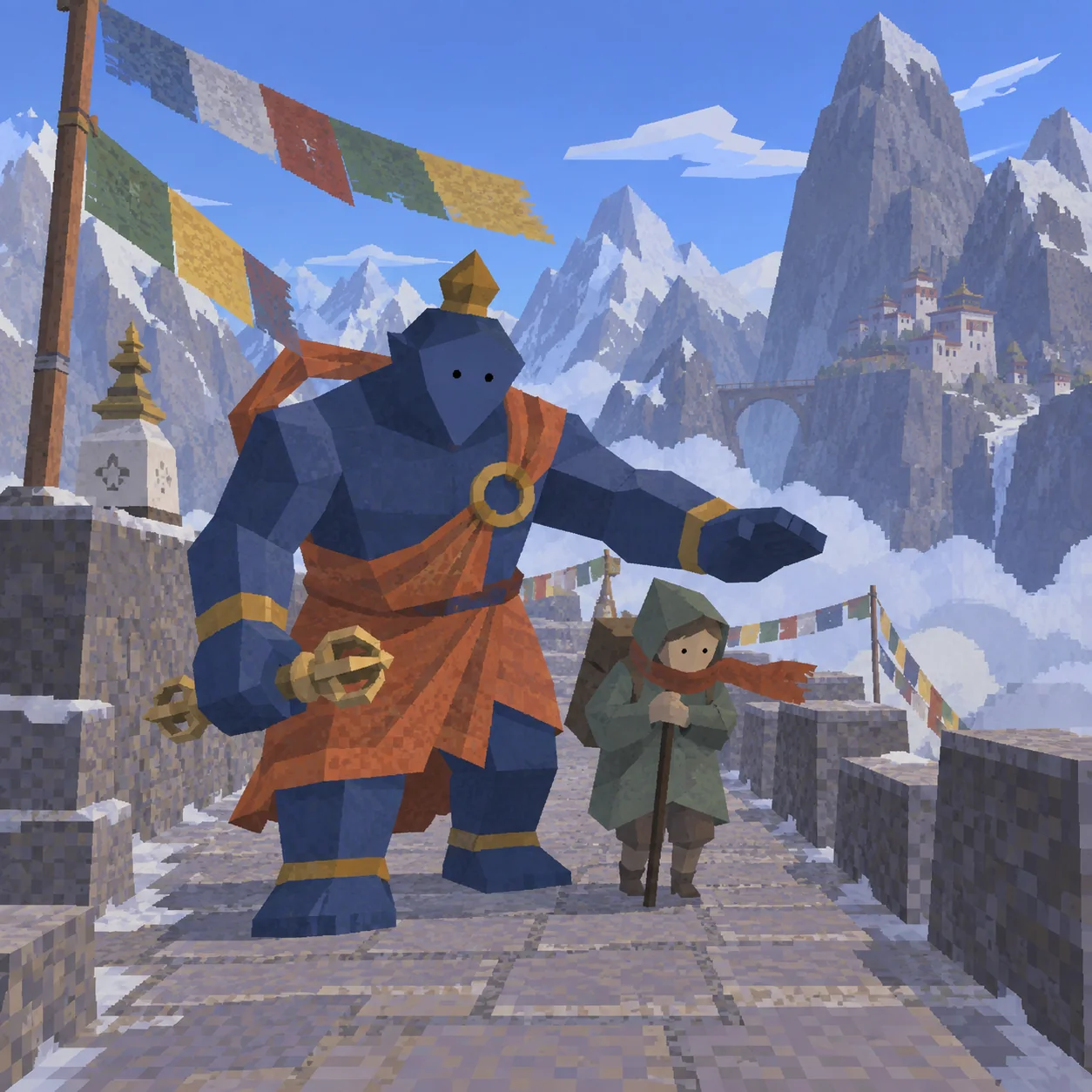
Original game concept
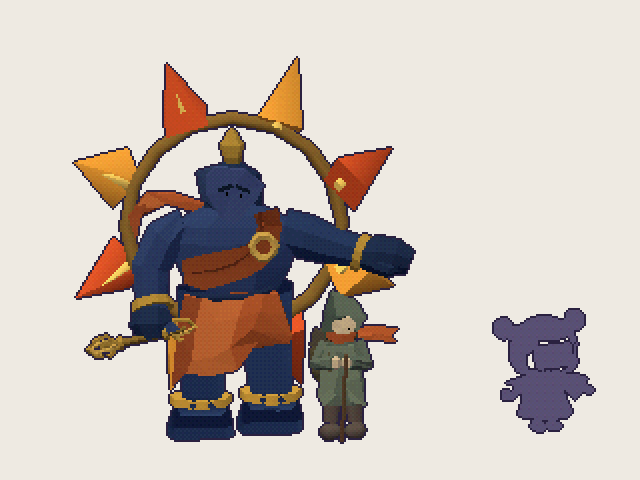
Current 3D model
presence

Depiction requirements
- Identity and chosen form
- For the Eight Close Sons assembly, use a named peaceful presentation. Do not treat a giant guardian with flames as the standard sutra-assembly form. If a separate wrathful encounter is intended, document its particular tantric form and keep that contract separate. [vajrapani-peaceful-har] [vajrapani-main-har]
- Primary emblem
- Make the vajra unmistakable in the model silhouette: a ritual scepter with a central grip and recognizable paired pronged ends, rather than a club or generic bar. Holding it in the anatomical right hand or supporting it on a blossom over the right shoulder are documented peaceful options. Preserve the selected artifact's orientation. The request for legible geometry is an audit recommendation based on the depicted attribute, not a prescribed polygon count. [vajrapani-peaceful-har] [vajrapani-situ-rubin] [vajrapani-tibet-met]
- Peaceful complexion and disposition
- Blue or green are documented Eight Close Sons choices. Give this form a calm, youthful, composed expression and peaceful stance or seat. Vajrapāṇi need not look like a monk; peaceful bodhisattva jewelry and silk belong to the assembly presentation. [vajrapani-peaceful-har] [close-sons-chokling]
- One complete liturgical option
- The Second Neten Chokling liturgy gives a coherent option: green Vajrapāṇi, smiling and standing in silk and jewels, holding a lotus with his emblem; anatomical right hand teaches and left protects. Adopt the option as a whole if selected. [close-sons-chokling]
- Bell
- A bell is optional in peaceful Vajrapāṇi iconography. Where the selected form includes it, the anatomical left hand may hold it, or it may rest on a blossom above the left shoulder. Do not add a bell simply because every vajra holder seems to need one. [vajrapani-peaceful-har]
- Wrathful presentation
- For a wrathful model, choose an identified complete prototype rather than combining isolated motifs. The Tibet House thangka shows a blue striding figure, raised anatomical right-hand vajra, left-hand bell, tiger-skin loincloth, crown, jewelry and snake necklace within flames. Rubin C2002.17.2 supplies another traditional sculptural prototype whose left-hand gesture differs. These are alternatives, not a universal combined checklist. [vajrapani-thus] [vajrapani-wrath-rubin]
- Aesthetic simplification
- Keep the hand-held emblem, hand gesture, peaceful or wrathful face, clothing register, and selected stance readable before adding decorative triangles. Use simplified toy geometry for the game, but retain the source figure's distinctive proportions and iconographic relationships. This is the audit's production recommendation, not a traditional textual prescription. [vajrapani-situ-rubin] [vajrapani-wrath-rubin] [vajrapani-tibet-met]
Presentation contract
Blocked · not ready to build from The plan holds this contract back (status pending · modelReady false · buildBlocked true) until the points below are settled.
Why it is blocked: unresolved form and pending research
- Complete the selected standing form with a compatible securely identified reference for detailed anatomy, emblem/stem contacts and support; do not mix the separate historical forms retained in variants and alternativeForms. A sourced written baseline is not model readiness.
Setting and sizing rule
Selected standing court form: provide an authored support and enclosure sized to its complete crown, emblem-bearing lotus and hand span. The cited shared passage does not fix an exact throne/base. Apply R4; an alternative seated form's lap, throne contact, staff or elephant support is not part of this selection.
Selected form
- account
- Chokling Tersar standing court, recorded emblem program
- source
- docs/buddhist-iconography/data/eight-bodhisattvas.json#sharedAssemblyAccount
- selectionBasis
- docs/world-plan/DECISIONS.md B; reconciled home record
- wholeVisualReference
- pending compatible complete depiction; shared written account is not a claim of all-angle visual verification
Recorded variants · 4
- Eight Close Sons peaceful: green or blue, standing or seated
- Konchok Phende / Situ Panchen / Palpung set (Rubin F1997.40.5): blue, relaxed seat, raised right-hand vajra; Rubin calls the set unusual
- Wrathful forms: Tibet House thangka; Rubin C2002.17.2 with a different left-hand gesture
- Blue-Clad Vajrapāṇi (Toh 748): a specific fierce form with fangs and nāga adornments
Alternative forms kept for comparison · 1
- Prior variant-aware contract, retained as comparison history; not the selected Chokling standing contract. Conditional branches must be selected whole, never assembled together.
Recorded adaptations · 1
- The current giant blue guardian sheltering a small traveller, with flames and a low horizontal vajra, is an authored adaptation that matches no single source form
Where the plan places it · 2
- The lha-khang, a small temple, and its teaching precinct · The teaching precinct
lhakhang.precinct· character Vajrapanivajrapani - sukhavati · The aisle and Amitabha's seat
sukhavati.assembly· placement lotusSeatsukhavati.assembly.seat-east
Contract sources · 9
- Vajrapani, Peaceful, Main Page
- Vajrapani Main Page
- Vajrapani (From Situ's set of Eight Great Bodhisattvas), F1997.40.5
- Buddha flanked by Avalokiteshvara-Padmapani and Vajrapani, 2008.504
- Vast Clouds of Samantabhadra's Display: A Ritual of Worship to Delight the Teacher, his Eight Heart-Sons, and their Retinue
- Chakrasamvara, Vajrapani
- Vajrapani, C2002.17.2
- Rituals for the Blue-Clad Vajrapāṇi
- Second Neten Chokling: Vast Clouds of Samantabhadra’s Display
Model audit and next pass
Evidence basis: visual + source
Recorded observations
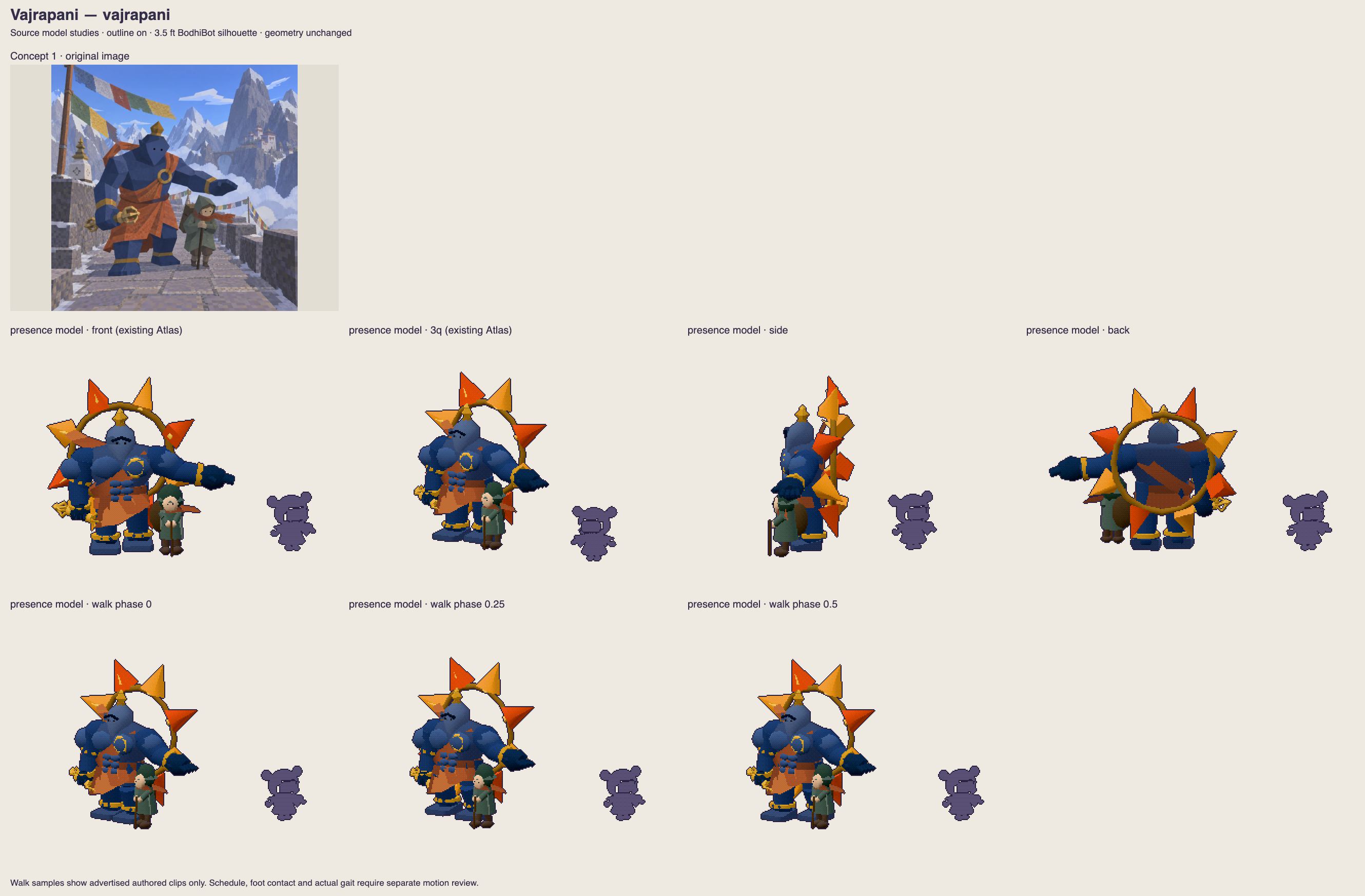
Visual: Concept shows an immense blue protective being beside a small hooded traveler. Current front/three-quarter/side/back sheet adds exaggerated muscles, furrowed brows and an eight-tongue flame aureole.
Visual: A gold vajra is held horizontally at the anatomical right hip; the anatomical left arm reaches out in a low sheltering gesture over the traveler. The face has two black eyes, no visible third eye/fangs; the costume has orange wraps and gold bands rather than a clearly selected peaceful princely or wrathful ritual costume.
Source: vajrapani.js packages guardian and traveler together as actors, with no scenery groups removed. Its flame aureole is explicitly scenery-exempt ornament, so the entire ensemble persists in actor extraction.
Source: The vajra arm is negative X, anatomically right for the +Z-facing figure; leftArm/leftShoulder variable names are reversed relative to anatomy.
Source: zi-lhakhang-precinct.js uses this same rig for the Eight Close Sons court; no separate peaceful iconographic appearance is selected.
Audit limit: Blue color and muscular scale alone do not prove a wrathful ritual form. The combined traveler/flames/low vajra shelter pose is an authored adaptation.
Directions for a future model pass
P1 — Resolve the court’s peaceful-versus-wrathful appearance before polishing. The default Eight Sons comparison should use a crowned, jeweled peaceful form with readable vajra and coherent mudrā; a named wrathful variant needs its own complete attribute/costume/face/posture contract.
P1 — For a peaceful court appearance, separate the invented traveler vignette from the iconographic figure and omit wrathful flame cues unless the selected peaceful reference justifies them.
P1 — If retaining a wrathful appearance elsewhere, follow one complete cited program for raised anatomical-right vajra, anatomical-left threatening hand, third eye, crown/hair, skin/garments and stance instead of assembling cues from unrelated forms.
P2 — Keep the toy-scale faceting and protective personality; improve vajra silhouette and hand readability at gameplay scale, and correct misleading joint-side names in a future authorized model pass.
Assessed baseline captures


Documented forms and lineage variants · 4
Preserve one identified form consistently. A variant is usable only with its own source and context.
Eight Close Sons peaceful: green or blue, standing or seated, identifiable vajra; this is the relevant default family for a close-son court.
Konchok Phende / Situ Panchen / Palpung painting tradition: blue, relaxed seated pose, raised anatomical right-hand vajra and restrained princely ornaments. Rubin explicitly calls this set unusual and outside standard textual/visual conventions; retain the lineage label.
Wrathful Tibetan protector/meditational forms: multiple distinct traditions exist. Raised vajra, flames, threatening gestures, snake adornments and tiger skin must follow a particular source, not be borrowed indiscriminately.
Blue-Clad Vajrapāṇi (Toh 748) is a specific fierce form, with fangs, fiery eyes and named nāga adornments in its canonical dhāraṇī. Do not silently apply this source to every Vajrapāṇi.
What not to copy · 5
Do not equate Vajrapāṇi with Vajrasattva or Vajradhara solely because a peaceful figure holds vajra and bell; inscriptions, assembly and textual context can be necessary to distinguish them.
Do not claim that a wrathful figure is traditionally angry or evil. Museum interpretation presents wrath as intentional protective energy.
Do not mirror the reference and thereby swap anatomical right and left. Image-left is the figure's right in a frontal view.
A protective hand extended over an invented traveler is a narrative adaptation; the traveler is not a required identifying retinue in the audited peaceful sources.
Absence of fangs, tiger skin or a skull crown is not automatically a defect in a peaceful close-son model. Conversely, blue muscles and an aura do not establish compliance with a specific wrathful form.
Individual ensemble members · 2
Identify each authored member before changing an ensemble. A whole-group picture cannot establish every member’s iconographic accuracy.
No named iconography member mapping has been researched. Existing captures show authored model members only.
Sources and precise locations · 9
- [vajrapani-peaceful-har] Vajrapani, Peaceful, Main Page ↗
- [vajrapani-main-har] Vajrapani Main Page ↗
- [close-sons-chokling] Vast Clouds of Samantabhadra's Display: A Ritual of Worship to Delight the Teacher, his Eight Heart-Sons, and their Retinue ↗
- [vajrapani-situ-rubin] Vajrapani (From Situ's set of Eight Great Bodhisattvas), F1997.40.5 ↗
- [vajrapani-tibet-met] Buddha flanked by Avalokiteshvara-Padmapani and Vajrapani, 2008.504 ↗
- [vajrapani-wrath-rubin] Vajrapani, C2002.17.2 ↗
- [vajrapani-thus] Chakrasamvara, Vajrapani ↗
- [vajrapani-blue-clad] Rituals for the Blue-Clad Vajrapāṇi ↗
- [rubin-image-rights] Rubin Rights and Reproductions ↗
Assessment freshness and evidence hashes
The frozen snapshot is authored evidence. Regeneration computes current hashes and leaves that snapshot as it is.
{
  "auditFreshness": {
    "status": "stale",
    "reasons": [
      "The model capture recipe or rig source changed.",
      "The visible model geometry changed.",
      "Rig source changed or is missing: prototypes/prerendered-look/parts/purelands/vajrapani.js"
    ]
  },
  "sourceSnapshot": {
    "captureHash": "ec15d70110de0169729180e8ccca062acf22b0cd06dfbc2e71cee3e519e938db",
    "bodyGeometryHash": "5c1a9bd8dec00ef0cad90046b80057b89ab786498ddce9e06b29629d36ce86fe",
    "sourceHashes": {
      "prototypes/prerendered-look/parts/purelands/vajrapani.js": "ac62f69a815985d6ad4d7059c283e0f314aac027fbd357fbc6ef27259d89f3e0"
    },
    "captureHashes": {
      "/atlas/audit/sheets/vajrapani-6364483b3764.webp": "385cdbf114634371e4f91629fd6eeeae51f980fd897f29456df431ef5ce75458",
      "/atlas/characters/vajrapani-7e3858ea50bb-presence-3q.webp": "b82d561765e6b19dd5250ba9f151a3d0f50b59527cc9207a0284aef9cc1c78d1",
      "/atlas/characters/vajrapani-7e3858ea50bb-presence-front.webp": "eeb2ea66ef563c9e8efe9ab1e1457bfb208e934c2e50c2604301499d390538a4",
      "/atlas/characters/vajrapani-ec15d70110de-presence-3q.webp": "b82d561765e6b19dd5250ba9f151a3d0f50b59527cc9207a0284aef9cc1c78d1",
      "/atlas/characters/vajrapani-ec15d70110de-presence-front.webp": "eeb2ea66ef563c9e8efe9ab1e1457bfb208e934c2e50c2604301499d390538a4"
    },
    "conceptHashes": {
      "/purelands/concepts/vajrapani.webp": "8095b599f536c822cca923a6386d08df70b3bd52aeda2bb99acc2a4bc140adde"
    },
    "activeConceptPaths": [
      "/purelands/concepts/vajrapani.webp"
    ]
  },
  "currentSnapshot": {
    "captureHash": "cecfcd5cecfe148ff2365c6f6c54b39ed38a904f529c07181732543cb5c936a9",
    "bodyGeometryHash": "56c566fa16f460ad9fd938098239380af29e9b72143a7b12084e47f708635b11",
    "activeConceptPaths": [
      "/purelands/concepts/vajrapani.webp"
    ],
    "sourceHashes": {
      "prototypes/prerendered-look/parts/purelands/vajrapani.js": "ebeea5b737a87ef5ec9fe8821497cdad174f9b039dfd060dd9ba812a8ffef66d"
    },
    "captureHashes": {
      "/atlas/audit/sheets/vajrapani-6364483b3764.webp": "385cdbf114634371e4f91629fd6eeeae51f980fd897f29456df431ef5ce75458",
      "/atlas/characters/vajrapani-7e3858ea50bb-presence-3q.webp": "b82d561765e6b19dd5250ba9f151a3d0f50b59527cc9207a0284aef9cc1c78d1",
      "/atlas/characters/vajrapani-7e3858ea50bb-presence-front.webp": "eeb2ea66ef563c9e8efe9ab1e1457bfb208e934c2e50c2604301499d390538a4",
      "/atlas/characters/vajrapani-cecfcd5cecfe-presence-3q.webp": "dcda921a5f63951a3cd4377bed61251bcdc81cb91700eed5d7d8a01c3b103313",
      "/atlas/characters/vajrapani-cecfcd5cecfe-presence-front.webp": "e7b17b0d1648bd177e28eb6e1c142c8b72c37442db2426282c0e3d74c4a30d10",
      "/atlas/characters/vajrapani-ec15d70110de-presence-3q.webp": "b82d561765e6b19dd5250ba9f151a3d0f50b59527cc9207a0284aef9cc1c78d1",
      "/atlas/characters/vajrapani-ec15d70110de-presence-front.webp": "eeb2ea66ef563c9e8efe9ab1e1457bfb208e934c2e50c2604301499d390538a4"
    },
    "conceptHashes": {
      "/purelands/concepts/vajrapani.webp": "8095b599f536c822cca923a6386d08df70b3bd52aeda2bb99acc2a4bc140adde"
    }
  }
}