Vairocana
Called the Illuminator, Vairocana is Nampar Nangdzé in Tibetan. In the familiar five-family account he is white and peaceful, with one face and two arms. White alone does not mark him out. His documented one-faced forms bring both hands together before the chest.
Two such mudras, or hand gestures, are documented for him. In the wisdom fist, the raised index finger of one hand is enclosed by the other fist. In the teaching gesture, both hands meet at the heart, thumb and index finger forming circles. A Met crown panel also puts a vajra, a pronged ritual sceptre, in his right hand.
He sits with legs crossed and soles upturned on a lotus, and some thrones rest on lions. Met crown paintings show him crowned and jewelled, in silk. Accounts differ on his colour and direction. A separate four-faced form, Sarvavid Mahavairocana, sits in meditation.
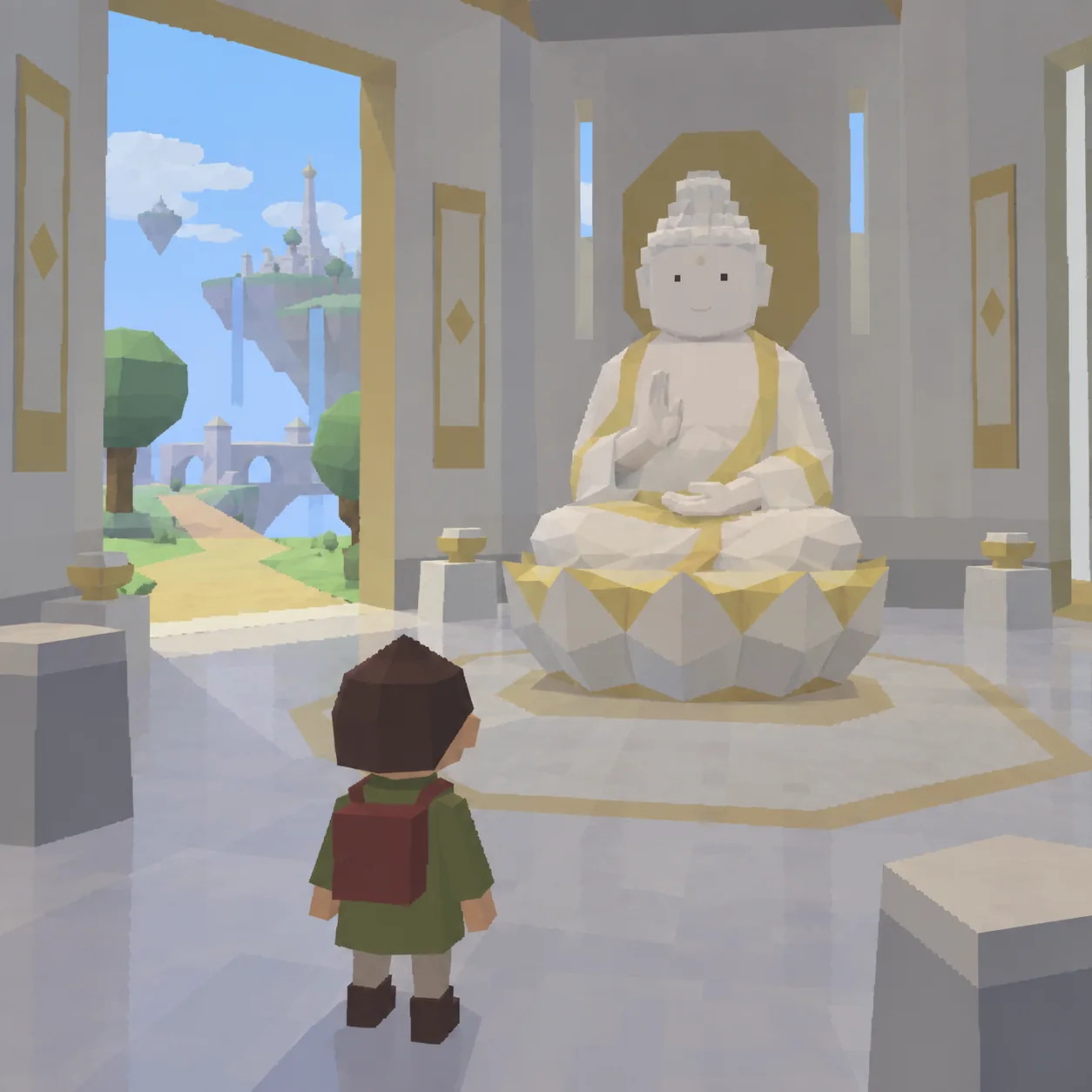
In traditional art
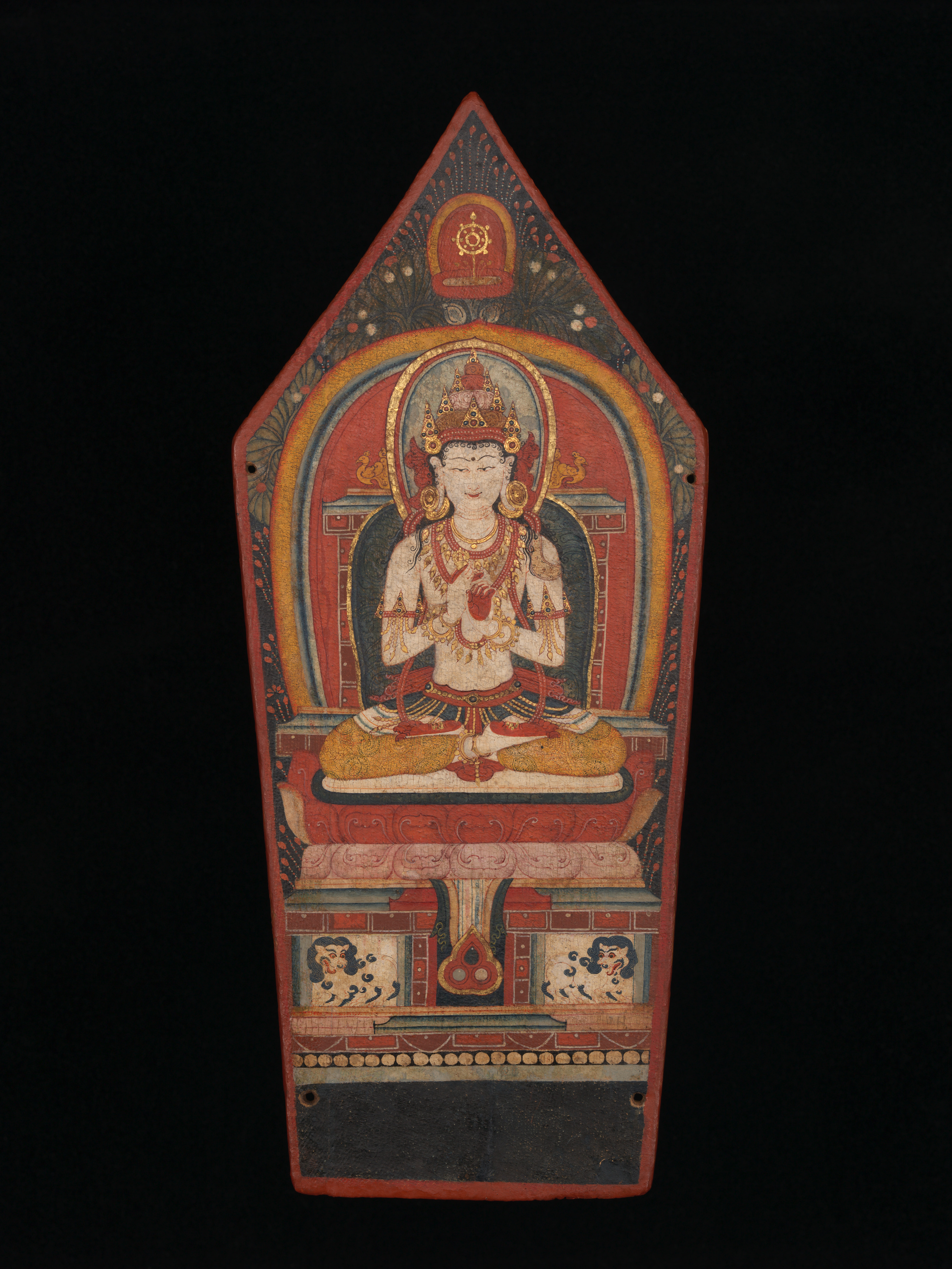
Vairocana ritual-crown panel — Met 1997.152Tibet · Late 13th–early 14th centuryPublic Domain, Met Open Access (CC0).Object record ↗ 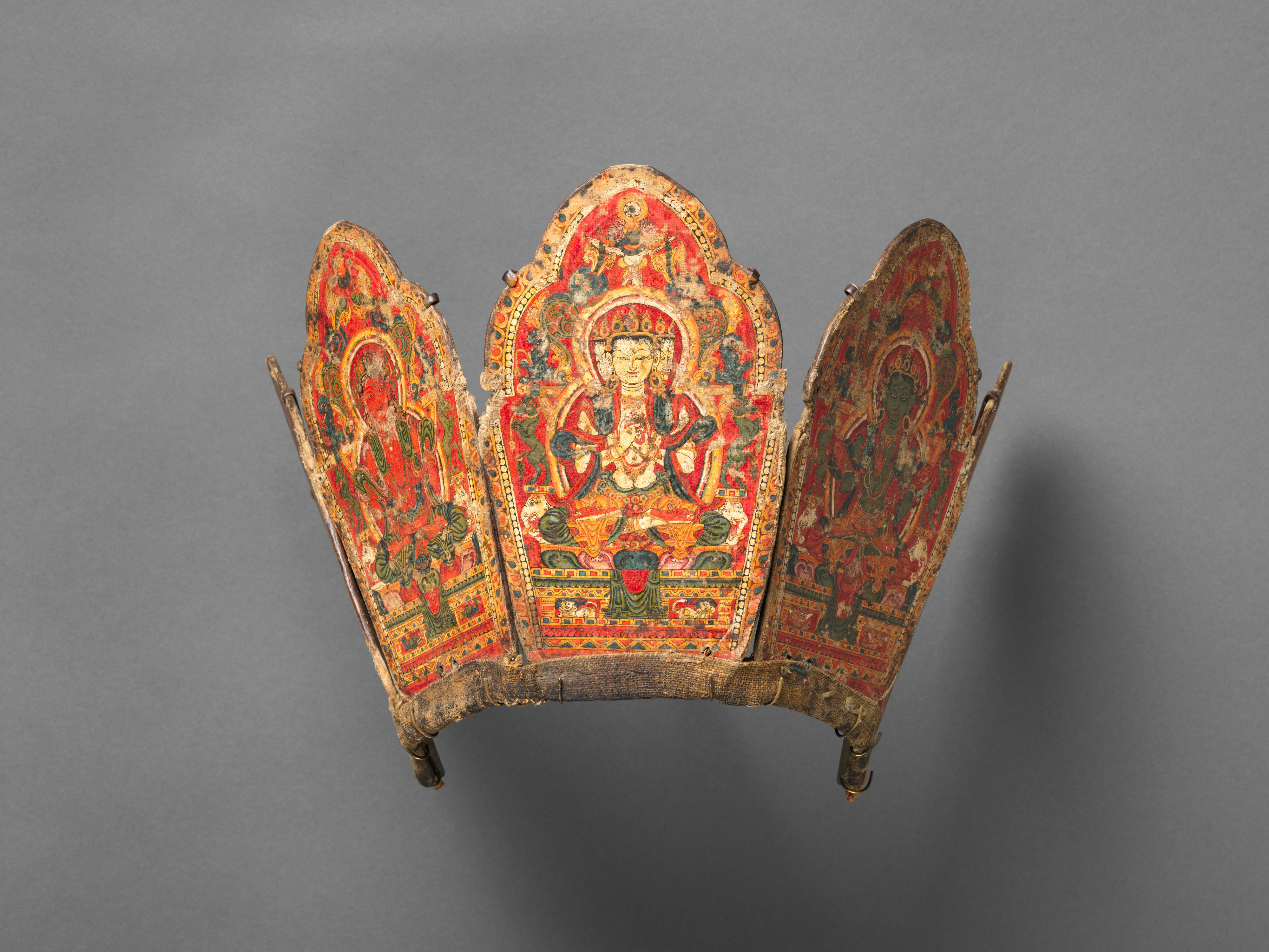
Central white Vairocana panel, Five Buddha crown — Met 1985.391Tibet; probably a Newari artist working in Tibet · Late 14th–early 15th centuryPublic Domain, Met Open Access (CC0).Object record ↗
In other collections
These images stay with the collections that hold them. Each link opens the collection's own page.
- Four-faced Vairocana sculpture — Ashmolean EA2000.43 ↗Western Tibet (possible attribution) · 11th–12th century · jameelcentre.ashmolean.org© Ashmolean Museum; no open reuse licence stated. Linked alternate-form reference only.
Sources
- Met — Ritual Crown with the Five Transcendent Buddhas, 1985.391 ↗
- Met — Panel from a Buddhist Ritual Crown Depicting Vairocana, 1997.152 ↗
- Lama Zopa Rinpoche — Ganden Lha Gyäma commentary, 12. Prostration ↗
- HAR 69402 — Vairocana, Asian Art Museum 1992.58 ↗
- HAR — Vairochana-like Appearance ↗
- Ashmolean — Seated figure of Vairocana Buddha, EA2000.43 ↗
Depiction requirements and work notes
Vairocana — Nampar Nangdzé, the Illuminator
White color alone is insufficient. The current model repeats its concept's right open protection palm with the left in the lap. A future pass should select and build Vairocana's documented two-hand teaching or supreme-enlightenment gesture and keep its clothing, crown and throne consistent with that form.
The model capture recipe or rig source changed. The visible model geometry changed. Rig source changed or is missing: prototypes/prerendered-look/parts/purelands/vairocana.js Reinspect the model before relying on the recorded defects.
References, criteria, concept and model side by side
Traditional depictions
White crowned figure with interlocking chest-level hands, right-hand vajra, silk skirt, upward soles, lotus and paired lions. [va-met39486]
Object record ↗ · Source image ↗Center panel: white, crowned, both hands joined before the chest; compare the complete hand construction, not an isolated open palm. [five-crown]
Object record ↗ · Source image ↗
Alternate Sarvavid form: four faces, shared cranial protuberance, crown, jewelry and meditation hands; brass is not a body-color prescription. [va-ashmolean]
Object record ↗ · Source image ↗Criteria
The model must show
- Lineage variant: a one-faced Tibetan five-family Vairocana in one coherent, named two-hand form; the library leaves the choice between the two below open and it must be recorded with the model
- Body: white skin, one face, two arms
- Hands, option A (supreme-enlightenment / wisdom-fist, Met 1997.152 and Lama Zopa): both hands raised before the chest, a lower upward index finger enclosed by the upper fist
- Hands, option B (teaching / dharmachakra, HAR 69402): both hands together at heart level with thumb and index circles, own right palm facing outward, left inward or upward
- Dress: either unornamented monk's robes or the crowned, jewelled, silk-clad form, kept whole and named; not a mixture
- Posture: full crossed vajra posture with both crossed legs readable, upright centred torso
- Head: dark curled hair with a cranial mound (or the crown of the chosen ornamented form), long earlobes, small forehead mark
- Face: serene and composed, as the library gives this peaceful form: narrow calm eye shapes, level brows, a small closed restrained mouth
- Eyes: solid black silhouettes with no whites, irises, pupils, highlights or glint (project eye rule; a recorded game adaptation, not a claim about traditional painted eyes)
- Seat: a lotus seat; lions belong to the crown-panel throne and appear only if that throne variant is chosen
- Attendants: none required; a mandala or assembly is selected before any attendants are built
The model must not show
- Cartoon smiley face: a wide U-shaped or crescent grin, open laughing mouth, rosy cheek dots or mascot cheeks
- Eye whites, irises, pupils, highlights or glint; glowing white-gold eyes (those belong only to freshly liberated beings)
- Any part of the figure (head, crown, hat, halo, raised hand or held object) touching or passing through its canopy, roof, lintel, pillars, throne back or seat in any capture angle
- One open raised palm with the other hand in the lap (the current model's gesture, which is not Vairocana's)
- A hybrid of a blessing hand, a lap hand and a loose vajra
- Everything white: hair, cloth, jewellery and seat keep their own colours
- White hair
- Four faces on this one-faced form (four-faced Sarvavid Mahāvairocana is a separate form)
Original game concept
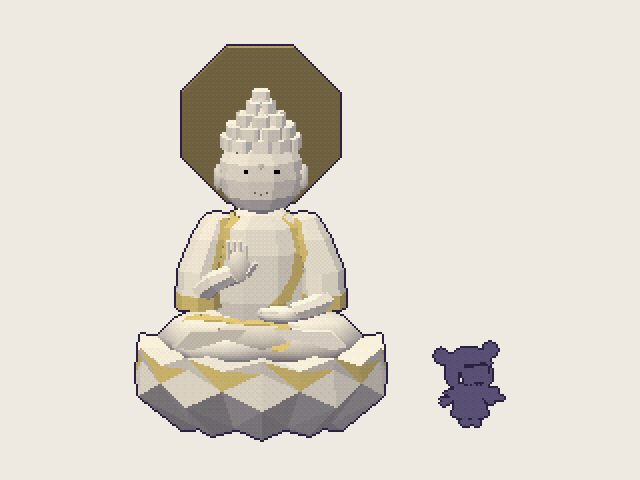
Current 3D model
presence
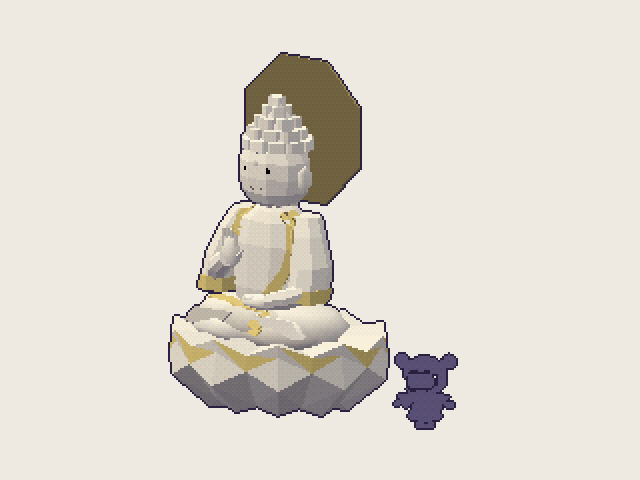
Depiction requirements
- Identity and color
- For this familiar five-family account, retain a white body and peaceful expression. Record the chosen source program; directional and color systems differ across tantric accounts. Do not make whiteness alone the identifying feature. [five-crown] [va-lywa] [va-har69402]
- Two-hand supreme-enlightenment option
- If choosing the wisdom-fist/bodhyagrī form, raise both hands before the chest: a lower upward index is enclosed by the upper fist. Lama Zopa's text describes the interlocking construction without fixing which anatomical hand is upper; use the selected complete artwork to resolve that choice. Met 39486 also documents a vajra in the anatomical right hand. Do not substitute one open abhaya palm. [va-lywa] [va-met39486]
- Two-hand teaching option
- If choosing dharmacakra instead, bring both hands together at heart level with thumb/index teaching circles; the anatomical right palm faces outward and the left inward/upward according to the chosen reference. Model the two interacting hands clearly. Do not combine an isolated blessing hand, lap hand and unrelated vajra into an invented hybrid. [va-har69402]
- Clothes and crown
- Keep unornamented monk and ornamented sambhogakāya appearances separate. The two Met crown paintings provide crowned, jeweled silk-clad examples; HAR 69402 documents another ornamented form. A monastic game form can remain unornamented, but its source selection must be explicit rather than claiming these paintings prescribe the same costume. [va-met39486] [five-crown] [va-har-appearance]
- Posture and supports
- Make both crossed legs and upward soles readable, with an upright centered torso. Use a lotus seat; lions belong to the cited crown-panel throne and are useful identity supports if that throne variant is selected. Do not require animal supports on every isolated representation. [va-met39486] [va-har69402]
- Face and proportions
- Use a calm face, elongated ears, a small forehead ūrṇā and coherent cranial protuberance/hair silhouette. Balance head, neck, shoulders and folded legs against the selected artifact. White hair is not prescribed merely by a white body; crown paintings show dark curled hair. Preserve the game's black eye convention as an adaptation. [va-met39486] [five-crown]
- Entourage and alternate face counts
- Select the mandala or assembly before building attendants. Sarvavid/Kunrig forms may have four faces and meditation hands. The Ashmolean object documents that account; it is a valid alternate, not evidence that every one-faced Vairocana is missing faces. [va-ashmolean]
Presentation contract
Ready to build from No readiness block is recorded in the plan.
Open points recorded with the contract
- The library does not choose between the wisdom-fist and the teaching gesture, or between monastic and ornamented dress
Setting and sizing rule
A lotus seat is required; a lion throne only with the chosen crown-panel variant. Sizing (plan rule R4, not a sourced claim): the opening of any shrine, canopy or pavilion around the figure leaves at least one of the figure's own head-heights of clear air above its tallest point (the ushnisha or crown) and a clear gap on each side of its widest span (the elbows of the raised hands); a throne back or aureole sits behind the figure without passing through it; pillars and lintel do not cross the face, hands or held objects in the front or either three-quarter capture.
Recorded variants · 3
- Crowned wisdom-fist Vairocana (Met 1997.152): bodhyagrī gesture, vajra in the right hand, multi-tiered crown, lions
- Ornamented Dharma-teaching Vairocana (HAR 69402): gold-painted object despite its white visualization
- Four-faced Sarvavid Mahāvairocana (Ashmolean EA2000.43): jewelled, in meditation; not to be merged into the one-faced form
Recorded adaptations · 0
Where the plan places it · 1
- field dense array · Densely Ornamented Akanishtha
field-dense-array.court· character Vairocanavairocana
Contract sources · 6
- Met — Ritual Crown with the Five Transcendent Buddhas, 1985.391
- Lama Zopa Rinpoche — Ganden Lha Gyäma commentary, 12. Prostration
- HAR 69402 — Vairocana, Asian Art Museum 1992.58
- Met — Panel from a Buddhist Ritual Crown Depicting Vairocana, 1997.152
- HAR — Vairochana-like Appearance
- Ashmolean — Seated figure of Vairocana Buddha, EA2000.43
Model audit and next pass
Evidence basis: visual + source
Recorded observations
Inspected original concept, canonical front/three-quarter captures and rig source; no fresh recapture or animated runtime acceptance.
White body, long earlobes, a small forehead mark and octagonal gold halo are visible. The cranial cap is a stack of large white spheres; broad yellow strips decorate both shoulders.
Both concept and model raise an open anatomical right hand while the left remains in the lap. The two hands never form the cited teaching or supreme-enlightenment construction in the baseline.
Source turn-dharma rotates the raised hand without joining the lap hand. The x-negative raised arm is named leftShoulder in the joint contract, which reverses anatomical naming.
The robe/lap silhouette hides a clear full-vajra foot arrangement. The friendly smile and large hair beads are authored toy styling, not evidence of traditional proportions.
Directions for a future model pass
Prioritize a documented two-hand Vairocana gesture. State the selected form in the work order; create the hand contact and finger grouping before decorative polish.
Revise the concept's pose note as part of that correction; concept fidelity alone would preserve the gesture defect.
Resolve whether the intended costume is monastic or crowned/ornamented. Keep a coherent reference rather than mixing ornaments from several variants.
Rework large hair beads into a calmer cranial silhouette, separate hair color from body color, and expose crossed-foot logic without losing the low-poly style.
Correct or map anatomical joint names before animating. Preserve the baseline and review every changed angle; the model is finished when its independent review passes.
Assessed baseline captures
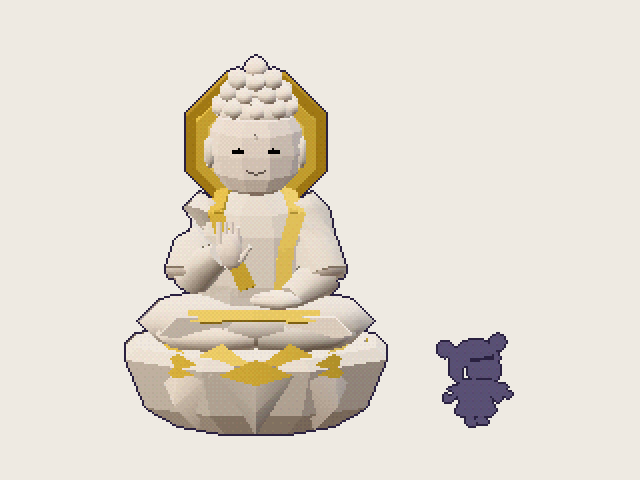
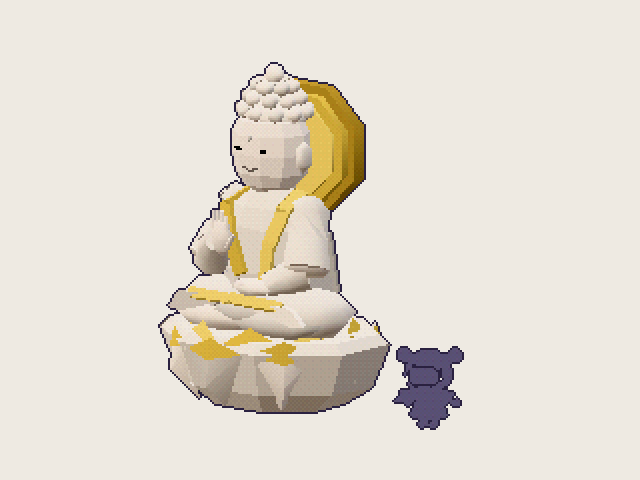
Documented forms and lineage variants · 3
Preserve one identified form consistently. A variant is usable only with its own source and context.
Crowned wisdom-fist Vairocana
Met 39486 depicts bodhyagrī, right-hand vajra, multi-tiered crown and lions. Its hand construction, silks and ornaments form a coherent historical example. [va-met39486]
Ornamented Dharma-teaching Vairocana
Asian Art Museum 1992.58, catalogued in HAR 69402, has two hands at the heart in a teaching gesture and is gold-painted despite its cited white-color visualization. Gold paint is an object surface, not a universal prescribed body color. [va-har69402]
Four-faced Sarvavid Mahāvairocana
Ashmolean EA2000.43 documents a Western Tibetan four-faced jeweled form in meditation; its catalogue cites Sarvadurgatipariśodhana and discusses differences between the textual lion throne and the object's lotus seat. Do not merge it into a one-faced teaching form. [va-ashmolean]
What not to copy · 3
Do not rename an abhaya animation turn-dharma and treat the clip name as iconographic evidence.
Do not demand a crown, four faces or one gesture universally; identify the precise form first.
Do not recolor every part white. Body, hair, cloth, jewelry and seat have distinct visual roles.
Sources and precise locations · 6
- [five-crown] Met — Ritual Crown with the Five Transcendent Buddhas, 1985.391 ↗
- [va-met39486] Met — Panel from a Buddhist Ritual Crown Depicting Vairocana, 1997.152 ↗
- [va-lywa] Lama Zopa Rinpoche — Ganden Lha Gyäma commentary, 12. Prostration ↗
- [va-har69402] HAR 69402 — Vairocana, Asian Art Museum 1992.58 ↗
- [va-har-appearance] HAR — Vairochana-like Appearance ↗
- [va-ashmolean] Ashmolean — Seated figure of Vairocana Buddha, EA2000.43 ↗
Assessment freshness and evidence hashes
The frozen snapshot is authored evidence. Regeneration computes current hashes and leaves that snapshot as it is.
{
  "auditFreshness": {
    "status": "stale",
    "reasons": [
      "The model capture recipe or rig source changed.",
      "The visible model geometry changed.",
      "Rig source changed or is missing: prototypes/prerendered-look/parts/purelands/vairocana.js"
    ]
  },
  "sourceSnapshot": {
    "captureHash": "0cc040ed5e3cfa6020c914168461126a7622fb8d331d026d62d9fd6487f35731",
    "bodyGeometryHash": "ec553a5f78f5064b2750807de40c23b3fae60d0694dda438837933d5bff8ca9d",
    "sourceHashes": {
      "prototypes/prerendered-look/parts/purelands/vairocana.js": "baf686b66d69cbee1415ff35768718516e9b8e587bf13460119eeb1892173a52"
    },
    "captureHashes": {
      "/atlas/characters/vairocana-0cc040ed5e3c-presence-3q.webp": "ac18f7d61f31210b8f057a1acfc303081e9544794368e0864872d51ea4205648",
      "/atlas/characters/vairocana-0cc040ed5e3c-presence-front.webp": "1630338bac43ed4f799913b36c34901396fe6023707ac551ee12da59300e1b3c",
      "/atlas/characters/vairocana-6f9b878b767c-presence-3q.webp": "ac18f7d61f31210b8f057a1acfc303081e9544794368e0864872d51ea4205648",
      "/atlas/characters/vairocana-6f9b878b767c-presence-front.webp": "1630338bac43ed4f799913b36c34901396fe6023707ac551ee12da59300e1b3c"
    },
    "conceptHashes": {
      "/purelands/concepts/vairocana.webp": "407af7637cf3d67cb16a9f16d8399aebb8fde7ae7a4213d78568461425be50ad"
    },
    "activeConceptPaths": [
      "/purelands/concepts/vairocana.webp"
    ]
  },
  "currentSnapshot": {
    "captureHash": "501362b203434e3a06e66bdce590cbd0d632ad9b357ed01e87991d1b6b1a6082",
    "bodyGeometryHash": "d7ec7fadab273dee0692fc58a24ebde1f133dd1b5ad23d99ba121b74aa925b85",
    "activeConceptPaths": [
      "/purelands/concepts/vairocana.webp"
    ],
    "sourceHashes": {
      "prototypes/prerendered-look/parts/purelands/vairocana.js": "6ba639a4e3f0fd365821f3fdb6c4de30b08bbd620277585103e145a1bec9fb43"
    },
    "captureHashes": {
      "/atlas/characters/vairocana-0cc040ed5e3c-presence-3q.webp": "ac18f7d61f31210b8f057a1acfc303081e9544794368e0864872d51ea4205648",
      "/atlas/characters/vairocana-0cc040ed5e3c-presence-front.webp": "1630338bac43ed4f799913b36c34901396fe6023707ac551ee12da59300e1b3c",
      "/atlas/characters/vairocana-501362b20343-presence-3q.webp": "81d8965cfad43fa09eee81c6808b38ec2c981c1f1986af306743a8365156fcd0",
      "/atlas/characters/vairocana-501362b20343-presence-front.webp": "a67444d87b604fdb39f4f5cda41a5b5465f598a3bcf51370b749bf6c3b155060",
      "/atlas/characters/vairocana-6f9b878b767c-presence-3q.webp": "ac18f7d61f31210b8f057a1acfc303081e9544794368e0864872d51ea4205648",
      "/atlas/characters/vairocana-6f9b878b767c-presence-front.webp": "1630338bac43ed4f799913b36c34901396fe6023707ac551ee12da59300e1b3c"
    },
    "conceptHashes": {
      "/purelands/concepts/vairocana.webp": "407af7637cf3d67cb16a9f16d8399aebb8fde7ae7a4213d78568461425be50ad"
    }
  }
}