Buddha in the cloud palace
A small seated Buddha rests in a palace among clouds, in an upper corner outside the Wheel of Life. Tradition does not settle who he is. Wheel paintings name the upper seated Buddha differently, so this figure has no fixed name.
A Rubin Wheel of Life, catalogued by Himalayan Art Resources, shows a seated Maitreya at right and a standing Shakyamuni at left. Robert Beer's Wheel shows Amitabha with two attendants in his pure land, Sukhavati, at upper right.
In traditional art
These images stay with the collections that hold them. Each link opens the collection's own page.
- Wheel of Life — Rubin F1997.40.10 ↗Tibet · 18th century · rubinmuseum.org© Rubin Museum of Himalayan Art; no open license verified; source-hosted reference only
- Wheel of Life — Robert Beer Archive ↗Tibetan Buddhist tradition; modern artist archive · modern; exact artwork date unverified · tibetanart.com© Robert Beer / artist archive; all rights reserved; source-hosted reference only
Sources
Depiction requirements and work notes
Unnamed seated Buddha in outside-wheel cloud palace; canonical identity unresolved
The source constructs one tiny gold seated figure in a palace outside the Wheel. A palace or upper corner alone does not determine its identity. Traditional Wheel programs can identify an upper seated Buddha differently; preserve the unresolved label until an exact reference is adopted.
Rig source changed or is missing: prototypes/world-map/wheel-symbols.js Reinspect the model before relying on the recorded defects.
References, criteria, concept and model side by side
Traditional depictions

Traditional alternative: standing Shakyamuni and seated Maitreya, as identified in HAR’s commentary. This demonstrates why a palace/upper-corner figure requires an explicit reference before being named. [wheel-rubin-591] [wheel-har-591]
Object record ↗ · Source image ↗
Named composition: Shakyamuni points to the moon; Amitabha’s Sukhavati occupies the opposite upper corner. Reference is not evidence that every Wheel palace is Amitabha. [wheel-beer]
Object record ↗ · Source image ↗Criteria
The model must show
- Identity: unresolved, and labelled so, until a specific Wheel composition is chosen: HAR 591 names a seated Maitreya; Robert Beer's composition names Amitābha in Sukhāvatī with two attendants
- Once chosen, the figure takes all the criteria of that figure's own entry (maitreya or amitabha) for body colour, dress, hands, seat and attendants
- Until a complete Wheel composition and figure are selected, posture, hands and support remain unresolved. Any provisional readable silhouette is authored staging, not a traditional crossed-leg prescription.
- Face: serene and composed, as the library gives this peaceful form: narrow calm eye shapes, level brows, a small closed restrained mouth
- Eyes: solid black silhouettes with no whites, irises, pupils, highlights or glint (project eye rule; a recorded game adaptation, not a claim about traditional painted eyes)
- Check the complete selected Wheel composition for outside-wheel palace placement, pathways and relationship to the standing Buddha; retain the palace only if that composition supports it. Do not combine the contexts of HAR 591 (Rubin F1997.40.10) and Robert Beer's Wheel.
The model must not show
- Cartoon smiley face: a wide U-shaped or crescent grin, open laughing mouth, rosy cheek dots or mascot cheeks
- Eye whites, irises, pupils, highlights or glint; glowing white-gold eyes (those belong only to freshly liberated beings)
- Any part of the figure (head, crown, hat, halo, raised hand or held object) touching or passing through its canopy, roof, lintel, pillars, throne back or seat in any capture angle
- Naming him Amitābha, Maitreya or primordial Samantabhadra with no chosen composition
- Maitreya's identity combined with Amitābha's palace
- Counting the palace as another named resident
Original game concept
No original concept is recorded in the Atlas.
Current 3D model
Depiction requirements
- Identity contract
- Choose a specific traditional Wheel composition before assigning a name. HAR591 names seated Maitreya; Robert Beer’s different composition names Amitabha in Sukhavati. [wheel-har-591] [wheel-beer]
- Coherent program
- Once selected, use that subject’s own dossier for body color, clothing, hands, seat and attendants. Do not combine Maitreya’s identity with Amitabha’s palace merely to fill missing detail. [wheel-har-591] [wheel-beer]
- Reference framing
- Retain the outside-wheel setting only if it agrees with the selected complete composition; use its contextual photograph to check palace, pathways and relationship to the standing Buddha. [wheel-rubin-591] [wheel-beer]
Presentation contract
Blocked · not ready to build from The plan holds this contract back (status pending · modelReady false · buildBlocked true) until the points below are settled.
Why it is blocked: unresolved form and pending research
- Which Wheel composition, and so which Buddha
- Reconcile the global Rubin C2004.21.1 default in DECISIONS.md with this entry's distinct HAR 591 / Rubin F1997.40.10 and Robert Beer alternatives. The C2004.21.1 default does not select either of these compositions or establish its palace figure. Record a whole-composition source before model work.
Setting and sizing rule
A small palace outside the Wheel, kept only if the chosen composition has it. Sizing (plan rule R4, not a sourced claim): the opening of any shrine, canopy or pavilion around the figure leaves at least one of the figure's own head-heights of clear air above its tallest point (the top of the head or crown) and a clear gap on each side of its widest span (the knees); a throne back or aureole sits behind the figure without passing through it; pillars and lintel do not cross the face, hands or held objects in the front or either three-quarter capture.
Recorded variants · 2
- Rubin F1997.40.10 / HAR 591: seated Maitreya at right, standing Śākyamuni at left
- Robert Beer Archive: Amitābha with two attendants in Sukhāvatī at upper right
Recorded adaptations · 1
- Any provisional silhouette and the game's walkable approach are authored staging; neither establishes the Buddha's identity, posture or a canonical palace location.
Where the plan places it · 1
- Death frame and release imagery · The palace on the clouds
wheel-exterior.palace· placement build-wheel-symbolswheel-exterior.palace.seated-buddha
Contract sources · 3
- Himalayan Art Resources — Wheel of Life, HAR591
- The Robert Beer Archive — Wheel of Life
- Rubin Museum — Wheel of Life, F1997.40.10
Model audit and next pass
Evidence basis: source-only for current geometry; historical rendered asset baseline inspected
Recorded observations
Source builds cloud, red hall, dark door, two gold roof levels, a pale-blue halo ring, and a small gold blob labeled the seated one. It gives no personal identity or body/hand attribute contract.
A rainbow connects the palace toward Yama’s hand in the game adaptation. Its doctrinal interpretation is not established in the cited sources.
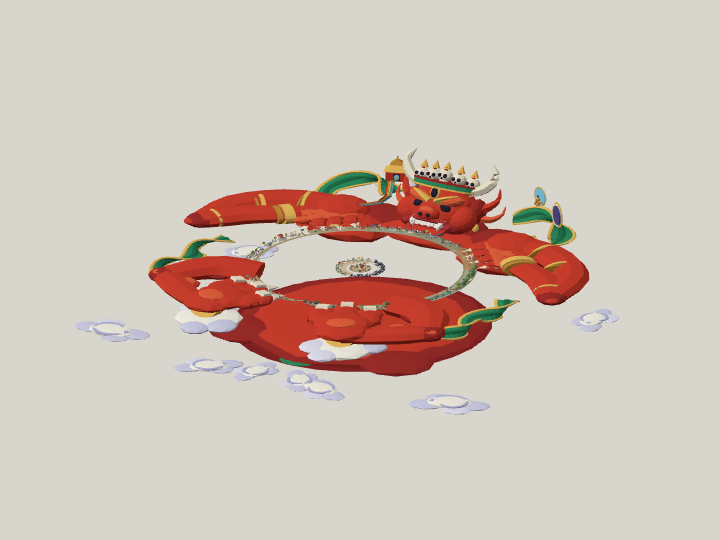
The historical full Wheel asset overview contains the palace as a tiny context feature. No current close-up or separate concept is available; identity and anatomy remain unverified.
Directions for a future model pass
P1 — Resolve the selected traditional upper-palace program and give the model a source-qualified identity, or retain it explicitly anonymous.
P1 — Make a current close-up so the seated figure’s body, head, hands and seat can be compared. The current geometry description is insufficient for canonical acceptance.
P2 — Model a readable seated figure and any required attendants only after the chosen subject’s contract is recorded.
Assessed baseline captures
Documented forms and lineage variants · 2
Preserve one identified form consistently. A variant is usable only with its own source and context.
Rubin F1997.40.10 / HAR591: seated Maitreya at right, standing Shakyamuni at left.
Robert Beer Archive: Amitabha with two attendants in Sukhavati at upper right.
What not to copy · 3
Do not silently call the current seated dot Amitabha, Maitreya, or primordial Samantabhadra.
Do not count a palace location as an additional named resident.
Do not claim the current single head/blob establishes a complete traditional body, posture or mudra.
Sources and precise locations · 3
- [wheel-rubin-591] Rubin Museum — Wheel of Life, F1997.40.10 ↗
- [wheel-har-591] Himalayan Art Resources — Wheel of Life, HAR591 ↗
- [wheel-beer] The Robert Beer Archive — Wheel of Life ↗
Assessment freshness and evidence hashes
The frozen snapshot is authored evidence. Regeneration computes current hashes and leaves that snapshot as it is.
{
  "auditFreshness": {
    "status": "stale",
    "reasons": [
      "Rig source changed or is missing: prototypes/world-map/wheel-symbols.js"
    ]
  },
  "sourceSnapshot": {
    "captureHash": null,
    "bodyGeometryHash": null,
    "sourceHashes": {
      "prototypes/world-map/wheel-symbols.js": "2caca3f7aa87e6ed7a4145041f87a6ef69654cd297a03e40c6d01133f395b0c2"
    },
    "captureHashes": {
      "/atlas/iconography/evidence/1b2bab2eef569f08-new-asset-adda57a559e5131f-00.png": "1b2bab2eef569f08d869ac7fb5aed2068776cfd1c9871d5da738472efe7089c3"
    },
    "conceptHashes": {},
    "activeConceptPaths": []
  },
  "currentSnapshot": {
    "captureHash": null,
    "bodyGeometryHash": null,
    "activeConceptPaths": [],
    "sourceHashes": {
      "prototypes/world-map/wheel-symbols.js": "d188917fd12914d05b14c7e25599a1ea86114b07254b3183159d42da744535bf"
    },
    "captureHashes": {
      "/atlas/iconography/evidence/1b2bab2eef569f08-new-asset-adda57a559e5131f-00.png": "1b2bab2eef569f08d869ac7fb5aed2068776cfd1c9871d5da738472efe7089c3"
    },
    "conceptHashes": {}
  }
}