Samsara checklist · Pure lands
No home chosen yet
1 built · 1 sketch · 43 missing, of 45. 45 cite a canon source; 0 are adaptations.
Beings
- no art
Amoghapāśa Avalokiteśvara missing being
Amoghapāśa, ‘unfailing lasso’: an unfailing compassion like a lasso which brings all sentient beings out of suffering and into a state of happiness leading to enlightenment. Sometimes Amoghapāśa is described as a form, or emanation, of Avalokiteśvara, which HAR finds easiest to call Amoghapāśa Avalokiteśvara; in a basic form, central in a five-deity configuration, he is identical to Khasarpaṇa Avalokiteśvara.
One of AVI’s six principal iconographic forms (Vajrayāna). AVA para. 1: at other times Amoghapāśa is a retinue figure when Avalokiteśvara is the maṇḍala’s central deity, which HAR calls the Amoghapāśa deity: male, red, with one face and four hands, standing; scholars frequently conflate Amoghapāśa and Avalokiteśvara. AVG: these forms arise from the Ārya Amoghapāśa Kalparāja, the Ārya Amoghapāśa Hṛdaya Nāma Mahāyāna Sūtra and the Ārya Amoghapāśa Pāramitā Ṣaṭparipūraya Nāma Dhāraṇī; Bhṛkuṭī is found in the retinue of the Five Deity Amoghapāśa practice, and Ekajaṭī (worldly-spirits:ekajati) in Amoghapāśa’s retinue.
- Concept no
- Model no
- Placed no
- Home no
- Dialogue no
- Routine no
- no art
Begtse Chen missing being
A protector generally accepted as a wisdom deity, though some within some traditions believe it a worldly protector.
HEP lists Begtse Chen among the principal wisdom protectors.
- Concept no
- Model no
- Placed no
- Home no
- Dialogue no
- Routine no
- no art
Buddha Heruka missing being
Brown. One of the Guhyagarbha Tantra’s six heruka deities (the Five Buddhas and Mahottara), which are also the main wrathful deities represented in the Bardo (Shitro) paintings.
- Concept no
- Model no
- Placed no
- Home no
- Dialogue no
- Routine no
- no art
Cāmuṇḍā, consort of Yama Dharmarāja missing being
In his outer form, buffalo-headed and riding a buffalo, Yama Dharmarāja is generally depicted with the consort Cāmuṇḍā.
HY says nothing more of her.
- Concept no
- Model no
- Placed no
- Home no
- Dialogue no
- Routine no
- no art
Ekādaśamukha, the Eleven-faced Lokeśvara missing being
The Eleven Faced form of Lokeśvara described in the Ārya Avalokiteśvara Ekādaśamukha Nāma Dhāraṇī.
One of AVI’s six principal iconographic forms (Vajrayāna). AVG: Bhikṣuṇī Śrī, a tenth–eleventh-century Buddhist nun from Kashmir, popularised the Eleven-faced Lokeśvara’s practices along with a three-day fasting retreat; Gaganarāja Lokeśvara, of King Songtsen Gampo’s tradition, and the Sandalwood Lokeśvara, made in one night from sandalwood and placed in the Jokhang in Lhasa by Songtsen Gampo, are forms of the Eleven-faced Lokeśvara. The thousand-armed form is chenrezig:thousand-armed.
Source: Jeff Watt · Glossary: Avalokiteshvara, Technical Glossary · Himalayan Art Resources set 4832; locators name the glossary entry, entry “Ekadashamukha”
- Concept no
- Model no
- Placed no
- Home no
- Dialogue no
- Routine no
- no art
Ekajaṭī missing being
One of the principal wisdom (enlightened) protectors.
Source: Jeff Watt · Protector Deities: Wisdom Deity Protectors · Himalayan Art Resources set 2404; locators are its list of principal wisdom protectors and the paragraphs of its description, from “Enlightened Protector”, list of principal wisdom protectors
- Concept no
- Model no
- Placed no
- Home no
- Dialogue no
- Routine no
- no art
Gongpo demons missing being
The powers and strength of the hosts of gongpo demons are to be averted.
Source: Gyalse Shenpen Taye · The Gentle Rain of Benefit and Joy: An Explanation of the Practice of Sang Offering (Riwo Sangchö) · Lotsawa House; locators count its paragraphs, verse stanzas included, from “Without ever straying”, paras. 87 and 94
- Concept no
- Model no
- Placed no
- Home no
- Dialogue no
- Routine no
- no art
Herukas (Nyingma) missing being
In the Nyingma tradition the term heruka (blood drinker) generally refers to any male meditational deity that is wrathful in appearance, typically with three faces, six arms, eight legs, a consort and sometimes a pair of wings. A few are readily identified by a unique attribute: the horse head of Hayagrīva, the kīla (purba) peg of Vajrakīla, and Yamāri/Yamāntaka standing atop a buffalo; the rest are relatively difficult to identify.
HHN para. 2: the most common heruka figures are the Five Buddha Herukas of the Guhyagarbha Tantra, the Five Wrathful Deities of the bardo, based more or less on the Guhyagarbha, and the Eight Pronouncement Herukas; the most common individual forms in art are Vajrakīla, Hayagrīva and Chemchog Heruka. Hayagrīva appears in this file as ‘Mighty Lotus’ Hayagrīva (windhorse-and-flags:hayagriva), as Hayagrīvarāja, a gatekeeper of the bardo’s sixth day (bardo-five:hayagrivaraja), and among the Ten Wrathful Ones (worldly-spirits:ten-wrathful).
Source: Jeff Watt · Subject: Heruka (Nyingma) · Himalayan Art Resources set 6517; locators count the paragraphs of its description, from “In the Nyingma (Old) Tradition”, paras. 1–2
- Concept no
- Model no
- Placed no
- Home no
- Dialogue no
- Routine no
- no art
Jinasāgara, Ocean of Conquerors missing being
A form of Lokeśvara, typically, but not always, red, with one face and four arms, embracing a consort.
One of AVI’s six principal iconographic forms (Vajrayāna). AVJ para. 1: of the three common traditions, Rechung, Mitra and Mindrolling, Rechung’s is most likely the earliest; Rechungpa, the famous student of Milarepa, returned from India with a number of different versions of Jinasāgara. The forms differ by solitary appearance or embracing a consort, by standing or seated posture, and by the number of retinue figures in the maṇḍala; the Mitra Yogin form has two arms and stands embracing a consort.
Source: Jeff Watt · Glossary: Avalokiteshvara, Technical Glossary · Himalayan Art Resources set 4832; locators name the glossary entry, entry “Jinasagara (Ocean of Conquerors)”
- Concept no
- Model no
- Placed no
- Home no
- Dialogue no
- Routine no
- no art
Jungpo demons missing being
Malicious beings who create obstacles such as sickness.
Source: Gyalse Shenpen Taye · The Gentle Rain of Benefit and Joy: An Explanation of the Practice of Sang Offering (Riwo Sangchö) · Lotsawa House; locators count its paragraphs, verse stanzas included, from “Without ever straying”, paras. 52 and 57
- Concept no
- Model no
- Placed no
- Home no
- Dialogue no
- Routine no
- no art
Karma Heruka missing being
Green. One of the Guhyagarbha Tantra’s six heruka deities (the Five Buddhas and Mahottara), which are also the main wrathful deities represented in the Bardo (Shitro) paintings.
- Concept no
- Model no
- Placed no
- Home no
- Dialogue no
- Routine no
- no art
Khasarpaṇa (Khasarpaṇī), the Sky Flyer missing being
‘Sky flyer’, written Khasarpaṇī in Tibetan texts; the term refers to several types of figure. The first is a generic peaceful male with one face and two hands, white, the right hand in a gesture of generosity and a lotus stem in the left; often a seated Amitābha in the crown and a kṛṣṇasāra deer skin over the left shoulder.
One of AVI’s six principal iconographic forms (Vajrayāna). AVK para. 2: another common type, iconographic and based on tantric literature, can be solitary or part of a five- or thirteen-deity configuration. In Ngorchen Könchog Lhündrub’s text based on the Bari Gyatsa, as AVK quotes it, Green Tārā and yellow Maṇidharin are at his right side, yellow Bhṛkuṭī and red Hayagrīva at his left. AVA para. 1: Amoghapāśa Avalokiteśvara in a basic form, central in a five-deity configuration, is identical to Khasarpaṇa Avalokiteśvara.
- Concept no
- Model no
- Placed no
- Home no
- Dialogue no
- Routine no
- no art
Krodha Yama, Mañjuśrī’s retinue figure missing being
A retinue figure of Mañjuśrī in the Kriyā Tantra classification. In the Bari Gyatsa’s Vādirāja Mañjuśrī (no. 6), as HAR quotes it: at the front left, blue, with one face and two hands, the right supporting the Blessed One’s shin and the left holding a lasso; three eyes, bared fangs, yellow hair bristling upward, the head adorned with a garland of skulls, a lower garment of tiger skin; standing looking at the Lord’s face.
- Concept no
- Model no
- Placed no
- Home no
- Dialogue no
- Routine no
- no art
Kṛṣṇa (Black) Yamāri missing being
A tantric Buddhist meditational deity of the Anuttarayoga classification, an emanation of Mañjuśrī, and in all cases a wrathful form of Mañjuśrī. Kṛṣṇa and Rakta are the two main forms, with different traditions and different numbers of retinue deities in the maṇḍala; the Drigung Kagyu and Nyingma traditions have their own forms of Kṛṣṇa Yamāri.
- Concept no
- Model no
- Placed no
- Home no
- Dialogue no
- Routine no
- no art
Mahākāla missing being
A wisdom protector, a wrathful form of the primordial Buddha Vajradhara; in other forms an emanation of Akṣobhya or of other buddhas. Hevajra, Cakrasaṃvara and Guhyasamāja each have their own Mahākāla: Pañjara Mahākāla of the Panjarnata Tantra (Hevajra), Caturmukha Mahākāla of the Guhyasamāja Tantra, and Caturbhuja Mahākāla of the Cakrasaṃvara tantras.
HP para. 3 says the same. HY: the eight Yamas and the nine Bhairavas stand in the retinues of some forms of Mahākāla, Six-armed Mahākāla among them (entries 3 and 13).
Source: Jeff Watt · Protector Deities: Wisdom Deity Protectors · Himalayan Art Resources set 2404; locators are its list of principal wisdom protectors and the paragraphs of its description, from “Enlightened Protector”, description, para. 2; list of principal wisdom protectors
- Concept no
- Model no
- Placed no
- Home no
- Dialogue no
- Routine no
- no art
Mahottara Heruka (Chemchog) missing being
Dark brown or maroon. One of the Guhyagarbha Tantra’s six heruka deities (the Five Buddhas and Mahottara), which are also the main wrathful deities represented in the Bardo (Shitro) paintings. There is a more complex form with nine stacked faces and eighteen arms, and an even more complex form with twenty-one faces and forty-two arms.
HHN para. 5 counts the eight famous Pronouncement Herukas along with Mahottara (Chemchog); the names Yangdag and Chemchog, sometimes found as inscriptions, are often interchanged. HPH: Mahottara is also included in the Eight Herukas’ origin myths, and in some rituals combined with them into a maṇḍala practice of 725 deities in all.
Source: Jeff Watt · Subject: Heruka (Nyingma) · Himalayan Art Resources set 6517; locators count the paragraphs of its description, from “In the Nyingma (Old) Tradition”, paras. 3–4
- Concept no
- Model no
- Placed no
- Home no
- Dialogue no
- Routine no
- no art
Mamo Rigkyi missing being
In the Sakya tradition, a popular member of the class of witches called Bamo, claimed to be in fact an emanation of Panjarnata Mahākāla.
- Concept no
- Model no
- Placed no
- Home no
- Dialogue no
- Routine no
- no art
Namkha Drolma, one of the Bamo Sum missing being
In Sakya, a monk gone bad was reborn a mamo spirit (witch) and, after subjugation, transformed into a Bamo protector named Namkha Drolma, one of the Bamo Sum.
- Concept no
- Model no
- Placed no
- Home no
- Dialogue no
- Routine no
- no art
Padma Heruka missing being
Red. One of the Guhyagarbha Tantra’s six heruka deities (the Five Buddhas and Mahottara), which are also the main wrathful deities represented in the Bardo (Shitro) paintings.
- Concept no
- Model no
- Placed no
- Home no
- Dialogue no
- Routine no
- no art
Rakta (Red) Yamāri missing being
A tantric Buddhist meditational deity of the Anuttarayoga classification, an emanation of Mañjuśrī, and in all cases a wrathful form of Mañjuśrī. There are several forms, with three principal traditions from India, associated especially with the mahāsiddhas Virūpa and Śrīdhara.
- Concept no
- Model no
- Placed no
- Home no
- Dialogue no
- Routine no
- no art
Ratna Heruka missing being
Yellow. One of the Guhyagarbha Tantra’s six heruka deities (the Five Buddhas and Mahottara), which are also the main wrathful deities represented in the Bardo (Shitro) paintings.
- Concept no
- Model no
- Placed no
- Home no
- Dialogue no
- Routine no
- no art
Samaya-breakers missing being
The powers and strength of the obstructive samaya-breakers are to be averted.
Source: Gyalse Shenpen Taye · The Gentle Rain of Benefit and Joy: An Explanation of the Practice of Sang Offering (Riwo Sangchö) · Lotsawa House; locators count its paragraphs, verse stanzas included, from “Without ever straying”, paras. 87 and 94
- Concept no
- Model no
- Placed no
- Home no
- Dialogue no
- Routine no
- no art
Siṃhanāda, the Lion’s Roar missing being
Siṃhanāda Lokeśvara belongs to the Kriyā classification of Buddhist tantra. His primary activity is to remove sickness and disease, especially illness caused by nāgas and serpents. In Tibet it was principally Jowo Atiśa and Mal Lotsāwa who popularised the practice.
One of AVI’s six principal iconographic forms (Vajrayāna). AVG: one face and two hands, seated in a relaxed posture on the back of a lion.
- Concept no
- Model no
- Placed no
- Home no
- Dialogue no
- Routine no
- no art
Śrīṣṭhikaṇṭha Lokeśvara, red missing being
A popular form of red Lokeśvara in Kathmandu, Nepal. Like Caturbhuja, it arises from the Kāraṇḍavyūha Sūtra.
AVT paras. 1–2: the depiction’s origins are rooted in chapter 4 of the prose Kāraṇḍavyūha Sūtra, which describes Hindu gods arising from Lokeśvara’s body; the sūtra does not describe Lokeśvara as red or standing, and the paintings are most likely based on the much later, extended verse Kāraṇḍavyūha popularised in Kathmandu in the first half of the second millennium. KV 1.22: Āditya and Candra came from his eyes, Maheśvara from his forehead, Brahmā from his shoulders, Nārāyaṇa from his heart, Devi Sarasvatī from his canines, Vāyu from his mouth, Dharaṇī from his feet and Varuṇa from his stomach.
Source: Jeff Watt · Glossary: Avalokiteshvara, Technical Glossary · Himalayan Art Resources set 4832; locators name the glossary entry, entry “Shristhikantha (Rakta)”
- Concept no
- Model no
- Placed no
- Home no
- Dialogue no
- Routine no
- no art
Subjugated gyalpo (king) spirits missing being
A few famous subjugated gyalpo spirits: Dorje Shugden of the Gelug, Sakya and Drugpa, Geshe Pongku (Donkey-Faced) of the Gelug, Karma Tansrung of the Karma Kagyu, and Dorje Dragtsen of the Sakya, all generally perceived as monks who went bad for various reasons.
HWW para. 1 and HMG para. 3: certain Gelug followers hold Dorje Shugden a wisdom protector.
- Concept no
- Model no
- Placed no
- Home no
- Dialogue no
- Routine no
- no art
Terangs missing being
Named among the karmic creditors, with the ghouls who inhabit towns and other places.
Source: Gyalse Shenpen Taye · The Gentle Rain of Benefit and Joy: An Explanation of the Practice of Sang Offering (Riwo Sangchö) · Lotsawa House; locators count its paragraphs, verse stanzas included, from “Without ever straying”, paras. 52 and 57
- Concept no
- Model no
- Placed no
- Home no
- Dialogue no
- Routine no
- no art
The Eight Pronouncement Herukas missing being
Eight famous Pronouncement Heruka deities, along with Mahottara (Chemchog). Generally they have three faces and six hands, though some Treasure traditions (terma) have them with one face and two hands.
HPH: the Eight Herukas are believed to have been discovered by eight Indian teachers known as the Eight Vidyādharas; they were found in a stupa at the Cool Grove Charnel Ground (Sitavana), some several miles from the modern-day location of Bodhgaya. There are several competing origin myths. Copper Mountain’s eight kings teach the Kagyé, the Eight Pronouncements (copper-mountain:eight-kings).
- Concept no
- Model no
- Placed no
- Home no
- Dialogue no
- Routine no
- no art
The forces of impurity, obscuration and madness missing being
Forces, male and female, that bring impurity and obstructions, and demons that cause insanity and illness.
The verse: forces that bring obscuration and madness (para. 52).
- Concept no
- Model no
- Placed no
- Home no
- Dialogue no
- Routine no
- no art
The forms he teaches in missing being
He teaches the Dharma in whatever form a being can be taught through: in the form of a tathāgata, a pratyekabuddha, an arhat, a bodhisattva, Maheśvara, Nārāyaṇa, Brahmā, Śakra, Āditya, Candra, Agni, Varuṇa, Vāyu, a nāga, Vighnapati, a yakṣa, Vaiśravaṇa, a king, a paṇḍita, a king’s soldier or parents, to beings who are to be taught by each.
Bhagavat Śikhin’s answer to Ratnapāṇi. In the same sūtra Śākyamuni, once leader of five hundred merchants stranded on the island of the rākṣasīs, alone escapes on Avalokiteśvara in the form of a horse (KV i.43, outline VI.1; balaha:horse).
- Concept no
- Model no
- Placed no
- Home no
- Dialogue no
- Routine no
- no art
The Guardians of the Ten Directions missing being
Secondary figures in many maṇḍalas of the kriyā, caryā and yoga tantras. As the Medicine Buddha maṇḍala gives them: Brahmā, yellow, with a wheel, on a goose; Indra, white, with a vajra, on an elephant; Agni, red, with a fire pot, on a goat; Yama, blue, with a stick, on a buffalo; Rākṣasa, black-maroon, with a sword, on a zombie; Varuṇa, white, with a snake lasso, on a makara; Vāyu, smoke-coloured, with a banner, on a deer; Yakṣa, yellow, with a mongoose, on a horse; Īśāna (Śiva), in the north-east, white, with a trident, on a buffalo; and Bhūdevī, yellow, with a vase, on a sow.
Descriptions and names vary a little by maṇḍala (HTD). HY entry 4 gives, by one system, eight worldly direction gods drawn in the eight great cemeteries of Hevajra, Cakrasaṃvara and Vajrabhairava: Śakra (east, elephant), Yama (south, buffalo), Varuṇa (west, makara), Yakṣa (north, horse), Īśāna (north-east, bull), Agni (south-east, goat), Rākṣasa (south-west, zombie) and Vāyu (north-west, deer); there Yama is a god of the classical Indian pantheon, not King Yama the judge. HP para. 4 counts the Hindu gods among the worldly protectors. Indra is Śakra, Meru’s resident shakra.
Source: Jeff Watt · Buddhist Protectors, Worldly Deities: Guardians of the Ten Directions · Himalayan Art Resources set 6938; locators are its description and its list of guardians, description and list of guardians
- Concept no
- Model no
- Placed no
- Home no
- Dialogue no
- Routine no
- no art
The karmic creditors missing being
The guests to whom we owe karmic debt: above all those who would steal our life-spirit, deplete our life-force or kill us, and those we have not repaid for food, dwelling places, wealth and possessions. In short, all the obstructing spirits of the various classes of ghosts and demons, male and female.
The fourth of the four kinds of guest, after the Three Jewels, the protectors and the beings of the six classes (paras. 53–57). The sang’s flames repay the debts (para. 60). The arrogant spirits who bring bad dreams and evil omens, and the eight classes of negative spirits, are among them; their items are copper-mountain:drekpas and copper-mountain:eight-classes.
- Concept no
- Model no
- Placed no
- Home no
- Dialogue no
- Routine no
- no art
The seventy-five glorious protectors of the pure abodes missing being
Invited with their retinues among the guests invited for their qualities, the protectors.
Not the seventy protectors at Copper Mountain’s gates (copper-mountain:protectors).
- Concept no
- Model no
- Placed no
- Home no
- Dialogue no
- Routine no
- no art
The Tathāgata Unsurpassed Standard missing being
The tathāgata from whom the Buddha received the Dhāraṇī of Dhvajāgrakeyūrā when he was a bodhisattva; recalling it, he has not felt fear, anxiety, gooseflesh or physical harm for an instant.
Source: The Dhāraṇī of Dhvajāgrakeyūrā, Toh 612, tr. Gyurme Avertin · 84000; locators are its passage numbers, 1.3; introduction i.1
- Concept no
- Model no
- Placed no
- Home no
- Dialogue no
- Routine no
- no art
The Ten Wrathful Ones missing being
The inner protection-wheel deities of Anuttarayoga maṇḍalas such as Hevajra, Cakrasaṃvara and Vajrabhairava, each an emanation of the maṇḍala’s central figure. By the Vajrabhairava Tantra: Aparājita, Yamāntaka, Hayagrīva, Ṭakkirāja, Amṛtakuṇḍalin, Nīladaṇḍa, Cakravartin, Mahābala, Acala and Uṣṇīṣa Cakravartin.
Other tantra systems may have Prajñāntaka, Padmāntaka and Hūṃkara. HEP lists the Ten Wrathful Ones among the principal wisdom protectors. Yamāntaka’s own item is wrathful-forms:yamantaka.
- Concept no
- Model no
- Placed no
- Home no
- Dialogue no
- Routine no
- no art
The Yamāri retinue deities missing being
Yamāri, with an additional name added in front, is the name of a number of retinue deities of the maṇḍalas of Vajrabhairava, Kṛṣṇa Yamāri or Rakta Yamāri. Retinue figures often have names like the central figure’s, or names that play on the principal deity’s metaphor. HAR’s example, white Moha Yamāri, is, as the other retinue figures are, an emanation of the maṇḍala’s central deity, here Vajrabhairava.
- Concept no
- Model no
- Placed no
- Home no
- Dialogue no
- Routine no
- no art
Vajra Heruka missing being
White. One of the Guhyagarbha Tantra’s six heruka deities (the Five Buddhas and Mahottara), which are also the main wrathful deities represented in the Bardo (Shitro) paintings.
- Concept no
- Model no
- Placed no
- Home no
- Dialogue no
- Routine no
- no art
Vajrabhairava missing being
A tantric Buddhist meditational deity, an emanation of Mañjuśrī; in all cases a wrathful form of Mañjuśrī and a meditational deity of the Method classification of Anuttarayoga Tantra. His main iconographic feature is a buffalo face. His forms run from one face and two hands up to nine faces, thirty-four arms and sixteen legs; the nine-faced is considered the principal form.
HY: Western publications have often incorrectly categorized him as a protector (dharmapāla) rather than a meditational deity (iṣṭadevatā, Tibetan yi dam). Yama Dharmarāja, a protector exclusive to the Vajrabhairava cycle, is worldly-spirits:yama-dharmaraja. HY entry 6 names Vajrabhairava among the central figures of whom each of the Ten Wrathful Ones is an emanation.
- Concept no
- Model no
- Placed no
- Home no
- Dialogue no
- Routine no
- no art
Vajrakīla missing being
One of the most common individual Nyingma heruka forms found in art, readily identified by his kīla (purba) peg.
- Concept no
- Model no
- Placed no
- Home no
- Dialogue no
- Routine no
- no art
Vajravega missing being
One of the principal wisdom (enlightened) protectors.
Source: Jeff Watt · Protector Deities: Wisdom Deity Protectors · Himalayan Art Resources set 2404; locators are its list of principal wisdom protectors and the paragraphs of its description, from “Enlightened Protector”, list of principal wisdom protectors
- Concept no
- Model no
- Placed no
- Home no
- Dialogue no
- Routine no
- no art
Wisdom (enlightened) protectors missing being
The first and more important of the two kinds of Dharma protector: wrathful emanations of the buddhas, fully enlightened beings, beyond saṃsāra or worldly existence. Mahākāla, for example, is a wrathful form of the primordial Buddha Vajradhara.
HEP para. 3: Buddhism tends to treat all or almost all protectors that came from India as wisdom protectors, except the Four Guardian Kings and the traditional Hindu gods. HP para. 2: ‘protector’ is a function, not an appearance; a protector may look peaceful, semi-peaceful and semi-wrathful, or wrathful. HEP’s principal wisdom protectors are this group’s items below, with Śrī Devī, which HSD calls a category of female wisdom protector, not one entity (para. 1); the vision lake’s Palden Lhamo is vision-lake:palden-lhamo.
Source: Jeff Watt · Protector Deities: Wisdom Deity Protectors · Himalayan Art Resources set 2404; locators are its list of principal wisdom protectors and the paragraphs of its description, from “Enlightened Protector”, description, paras. 1–2
- Concept no
- Model no
- Placed no
- Home no
- Dialogue no
- Routine no
- no art
Worldly protectors missing being
Not enlightened, and not considered completely reliable. Chief among them are the Four Guardian Kings and the traditional Hindu gods the tantras call worldly gods. Numerous mountain gods and native Tibetan and Himalayan deities have been taken into the tantric pantheon as worldly deities with a protector’s work: to safeguard Buddhism in general, their own regions, particular monasteries or traditions, and sometimes a single treasure text.
HWP’s classes of worldly protector are the Four Guardian Kings, the Guardians of the Ten Directions, Indian gods, subjugated spirits, mountain and valley gods, tsen spirits and drala warriors, and others. The Four Guardian Kings are the four-kings group’s items; HAR sets them on the innermost ring of islands or the lower slopes of Meru (HWP para. 2).
- Concept no
- Model no
- Placed no
- Home no
- Dialogue no
- Routine no
- no art
Yama Dharmarāja, the protector missing being
A protector deity exclusive to the Vajrabhairava cycle of tantra and, in all its outer, inner and secret forms, a wrathful form of Mañjuśrī. In the outer form, buffalo-headed and riding a buffalo, he is generally shown with the consort Cāmuṇḍā. From the fifteenth century on, one of the three principal protectors of the Gelug.
HWW para. 3: he is sometimes described as the worldly Yama, judge of the hell realm, subjugated and made a Buddhist protector, but is in fact an emanation of Mañjuśrī, as Vajrabhairava is; the hell-and-death narrative is borrowed as metaphor. Not King Yama the judge, whom HY entry 1 calls a living being of the ghost realm and not a god or deity (yama:king, whom P titles Dharma King Yama). HEP lists him among the principal wisdom protectors.
- Concept no
- Model no
- Placed no
- Home no
- Dialogue no
- Routine no
- no art
Yamāntaka, one of the Ten Wrathful Ones missing being
One of the Ten Wrathful Ones, the inner protection-wheel deities of Anuttarayoga maṇḍalas such as Hevajra, Cakrasaṃvara and Vajrabhairava; second in the Vajrabhairava Tantra’s list, after Aparājita. Each is an emanation of the maṇḍala’s central figure.
HY gives him his own entry (6), apart from King Yama the judge (entry 1) and Death holding the Wheel (entry 2), the only entries it calls directly associated with death; the Yama spirits, the direction god Yama and Yama Dharmarāja are entries 3, 4 and 11. Unhomed: no source read sets him in a realm or field the game has.
- Concept no
- Model no
- Placed no
- Home no
- Dialogue no
- Routine no
- no art
Caturbhuja, the four-armed Avalokiteśvara sketch being
A form of Lokeśvara with one face and four arms, white, peaceful and seated in vajra posture. The original Caturbhuja is described in the Kāraṇḍavyūha Sūtra with the maṇi mantra; other forms of Caturbhuja are found, such as the one described in the Maṇi Kabum and the later Jinasāgara, red and embracing a consort.
One of AVI’s six principal iconographic forms (Vajrayāna). AVC para. 1: of the several forms of Lokeśvara with four hands, the earliest and most famous is the Three Deity Chaturbhuja originating in the Kāraṇḍavyūha Sūtra, also famous for the first use of the six-syllable mantra om mani padme hum. AVG: Ṣaḍakṣara, the Six Syllable One, refers to Caturbhuja and the mantra; Ṣaḍakṣarī is the female retinue figure of the Caturbhuja Three Deity configuration, and Maṇidharin the male one, seated on Lokeśvara’s right.
Source: Jeff Watt · Glossary: Avalokiteshvara, Technical Glossary · Himalayan Art Resources set 4832; locators name the glossary entry, entry “Chaturbhuja (Four Armed)”
Why sketch: related: Avalokiteshvara — four-armed (character:avalokiteshvara-four-armed) at overworld, lhakhang:precinct; the game’s four-armed Chenrezig, Avalokiteśvara’s one identity (eight-bodhisattvas close-son-02 is matched to him).
- Concept no
- Model no
- Placed no
- Home no
- Dialogue no
- Routine no
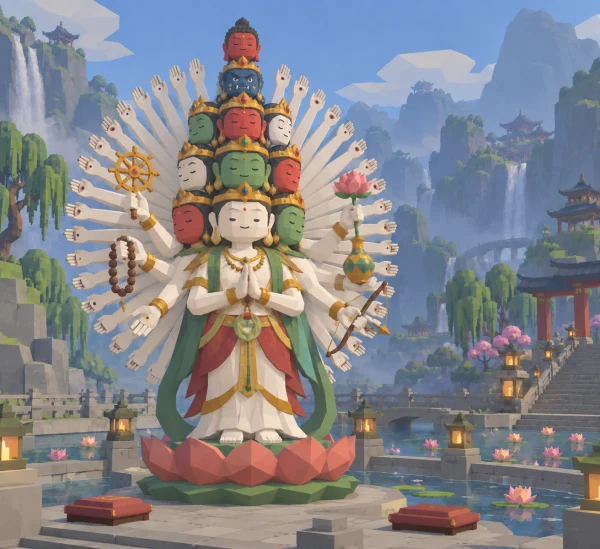
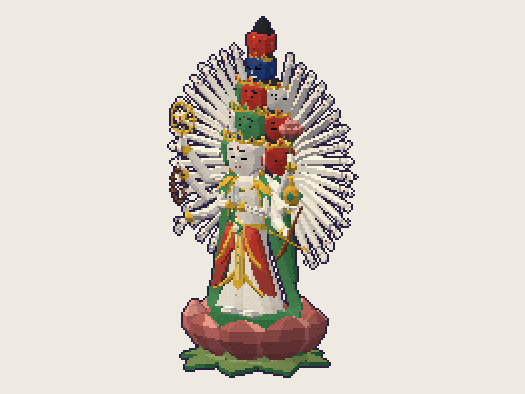
Avalokiteśvara, thousand-armed built being
Eleven Faces & One Thousand Arms: a form of Lokeśvara described in the Mahākaruṇika Dhāraṇī Sūtra.
AVE para. 1: there are a number of different forms and traditions of the Eleven-faced Lokeśvara, a universal form of Avalokiteśvara, seated or standing. Unhomed: no source read puts this form on the Copper Mountain, where SPM verse 12 names Padmapāṇi, Lord of the World (three-kayas:sambhogakaya).
Source: Jeff Watt · Glossary: Avalokiteshvara, Technical Glossary · Himalayan Art Resources set 4832; locators name the glossary entry, entry “Eleven Faces & One Thousand Arms”
Why built: Avalokiteshvara — thousand-armed (character:avalokiteshvara-thousand-armed) placed at copper-mountain.
Placed: copper-mountain (copper-mountain.palace). Forms: presence. Polish 38 (moderate). Atlas page · Iconography
- Concept yes
- Model yes
- Forms yes
- Placed yes
- Home yes
- Dialogue yes
- Routine yes