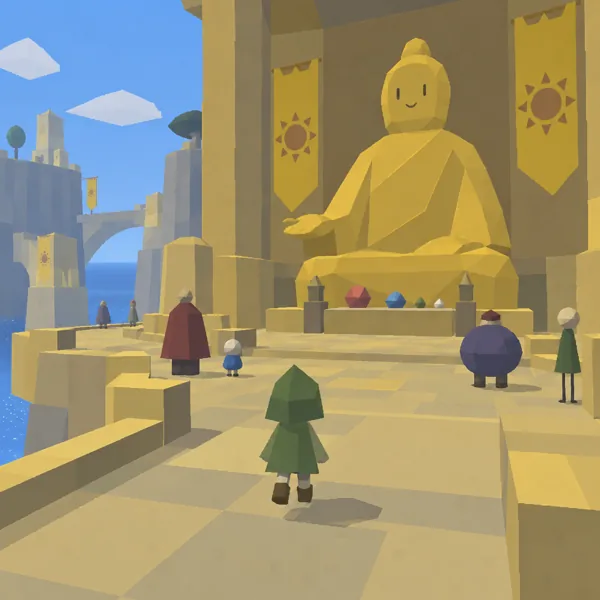
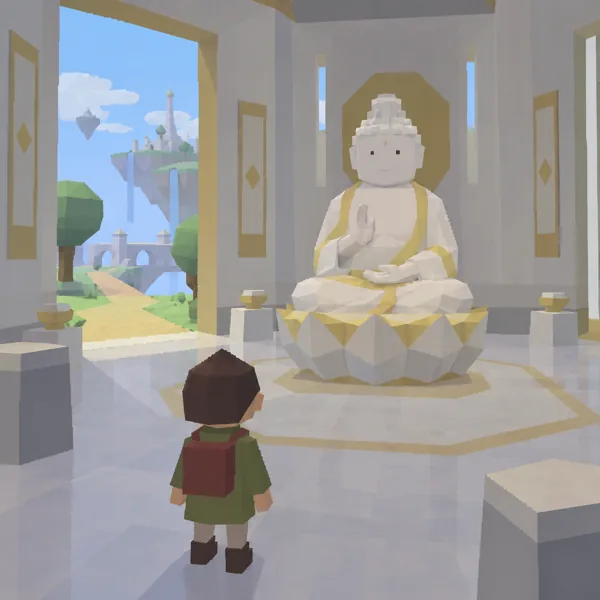
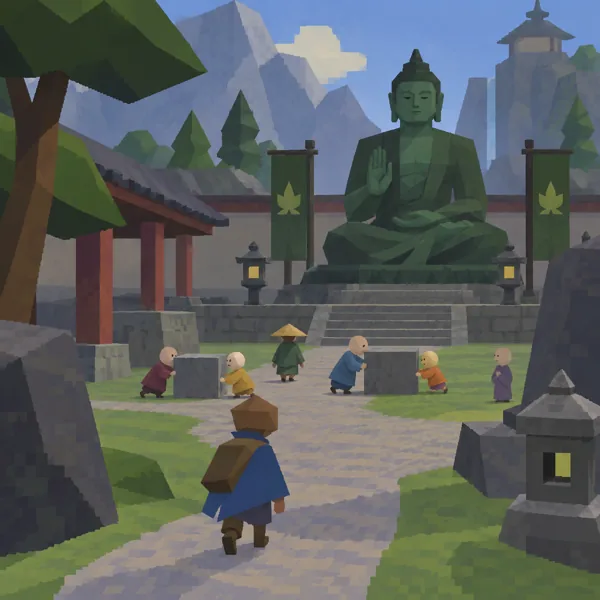
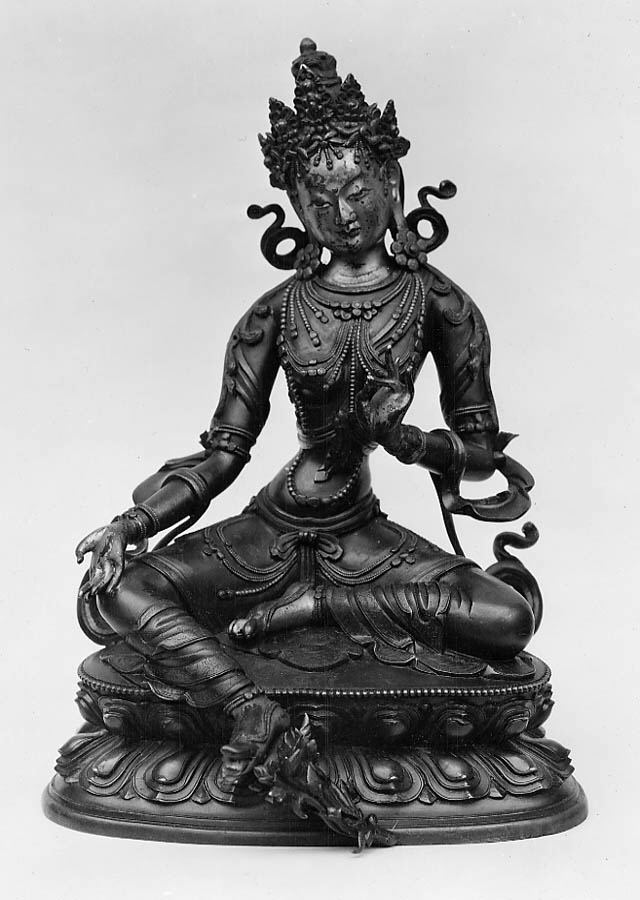
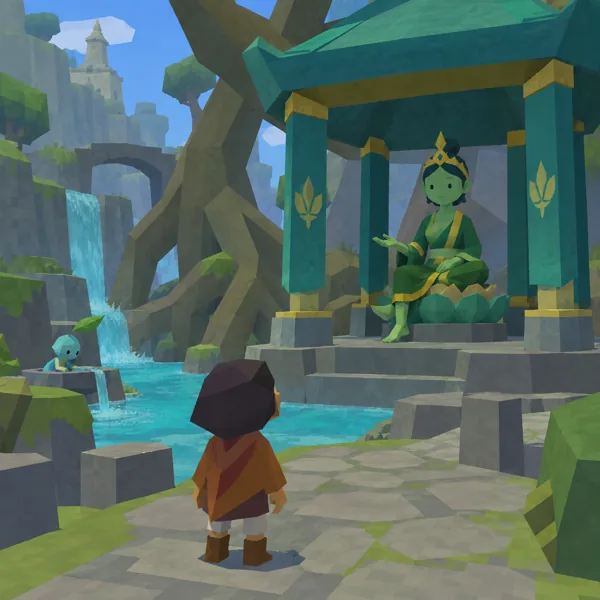
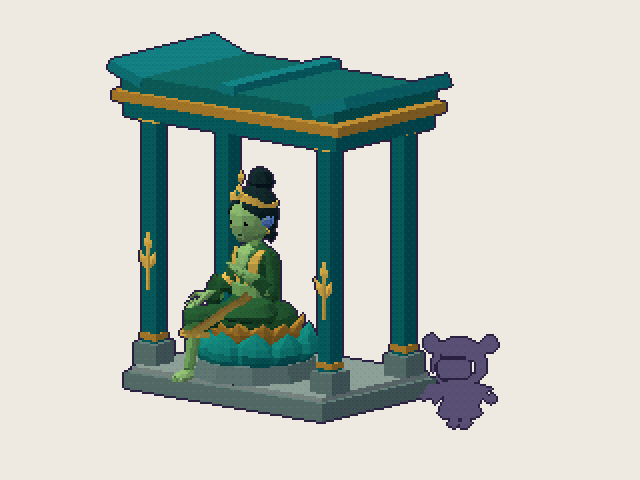
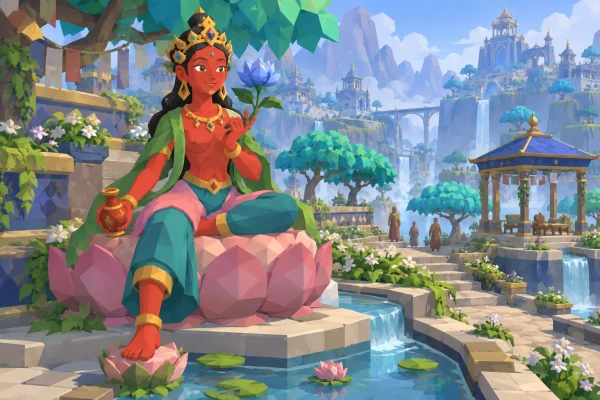
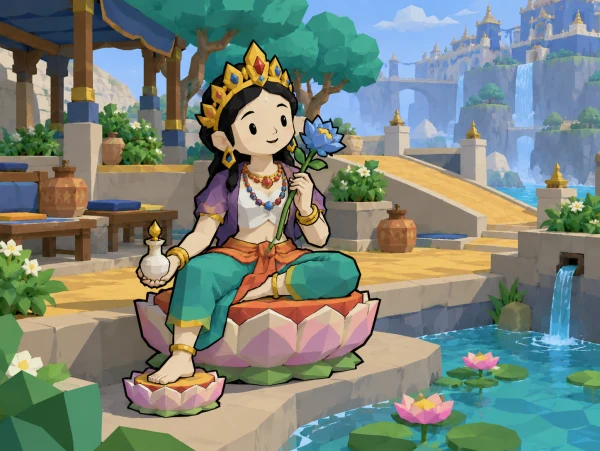
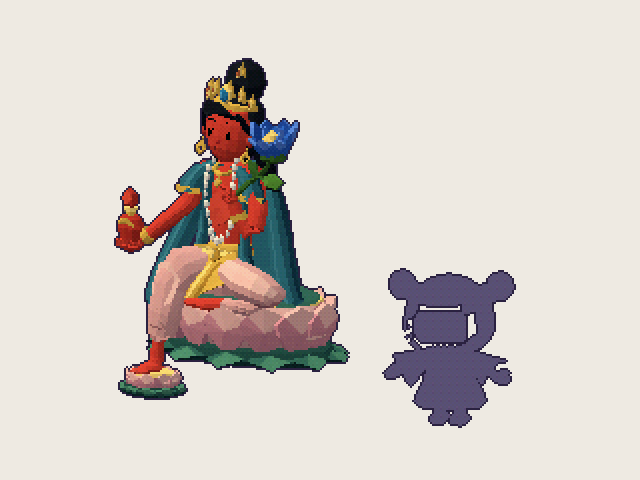
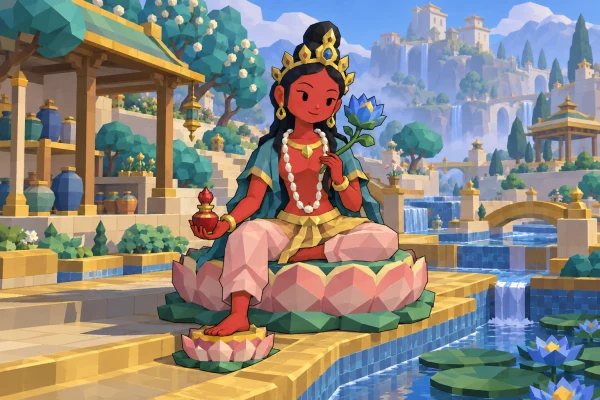
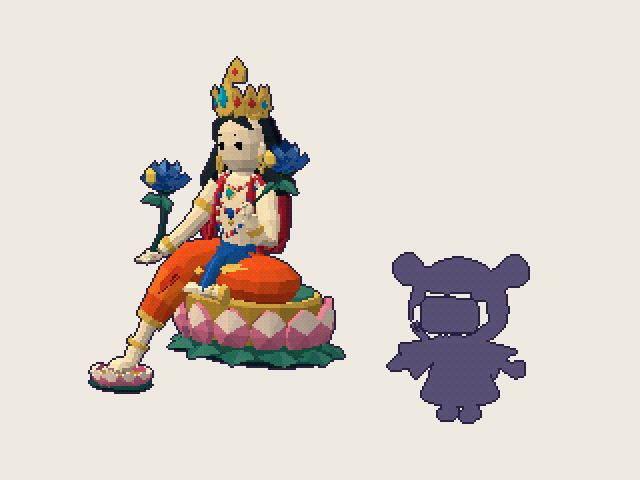
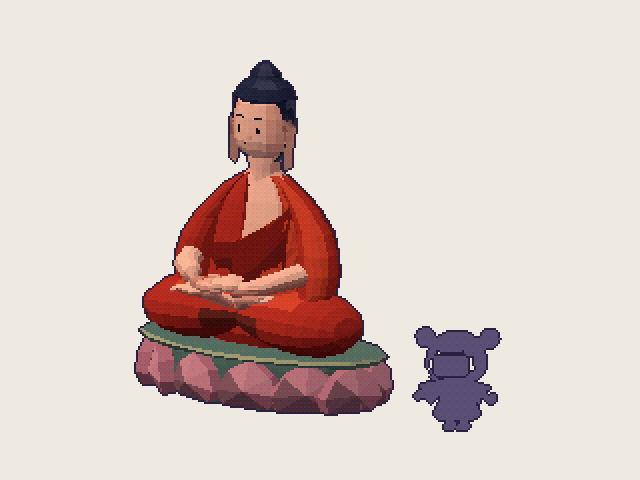
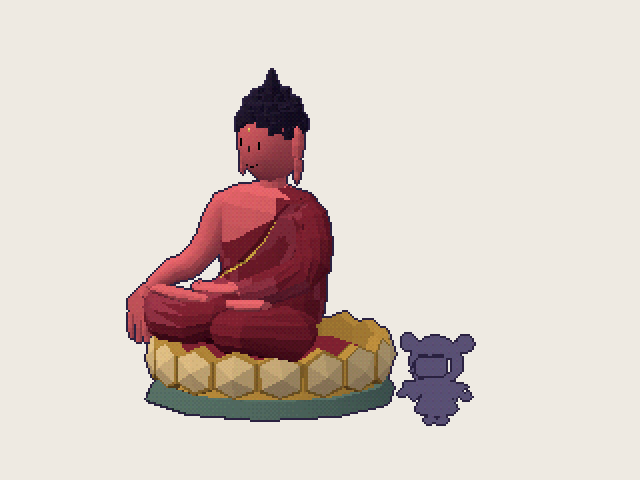
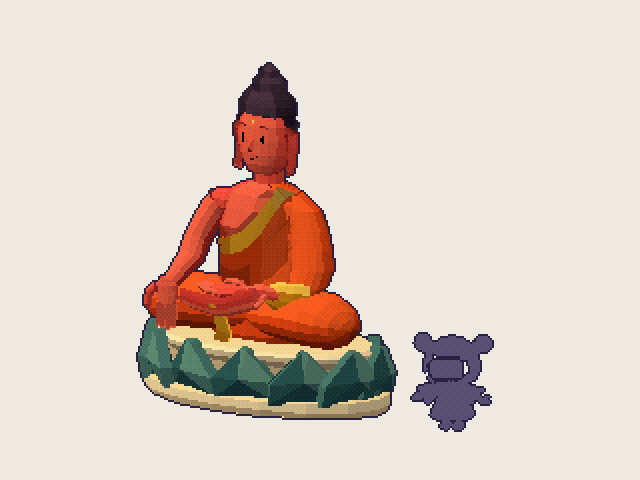
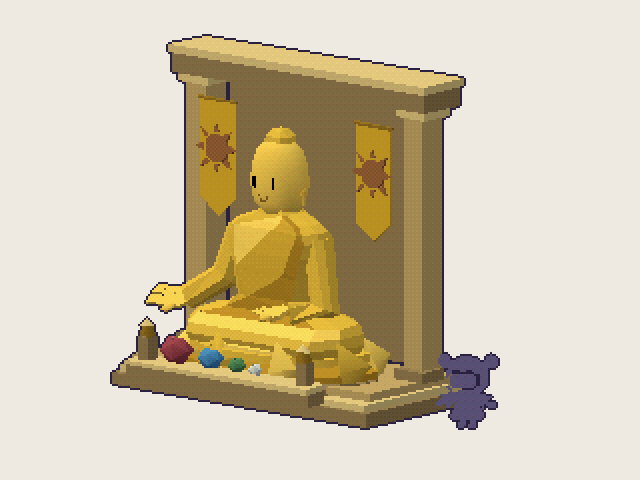
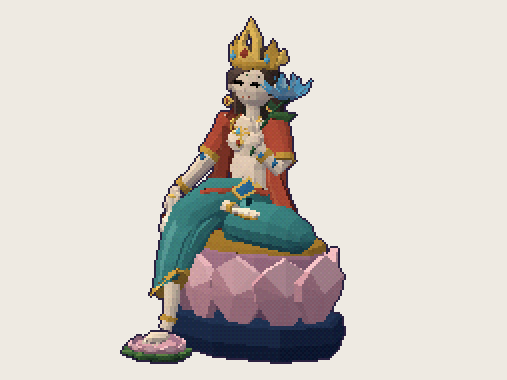
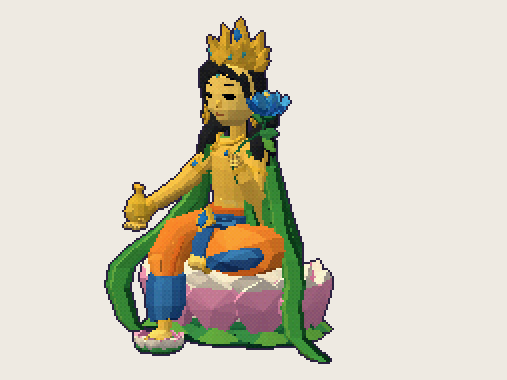
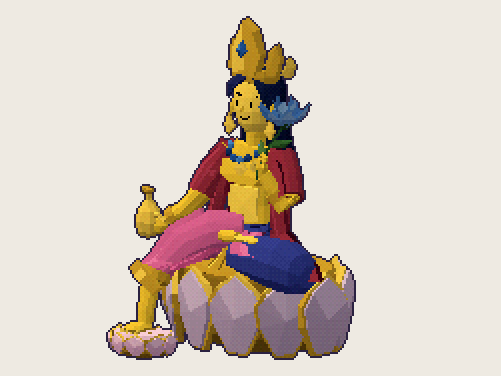
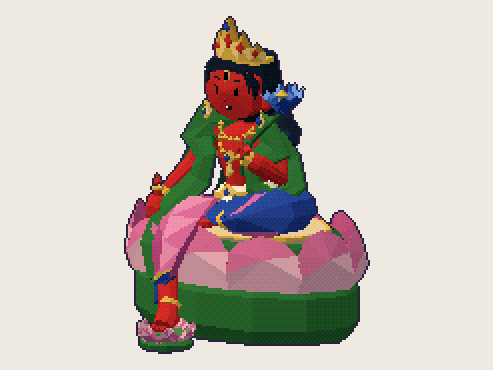
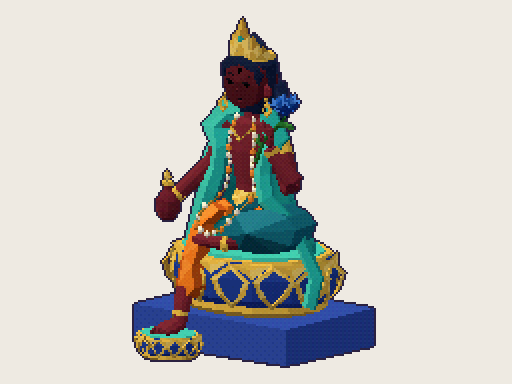
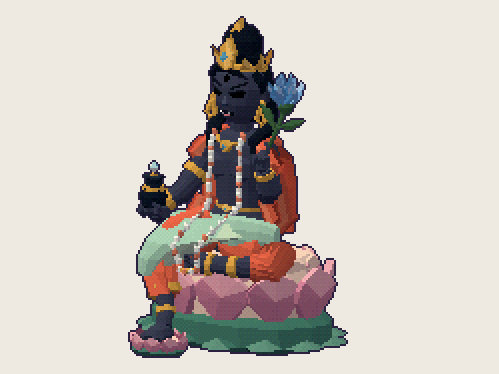
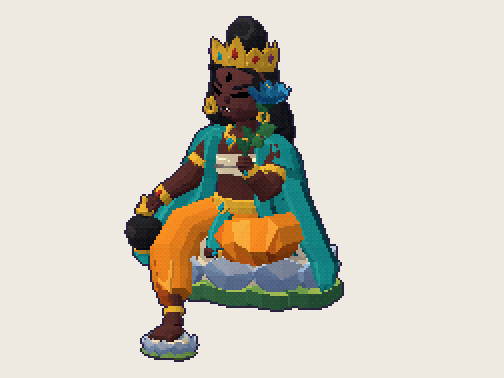
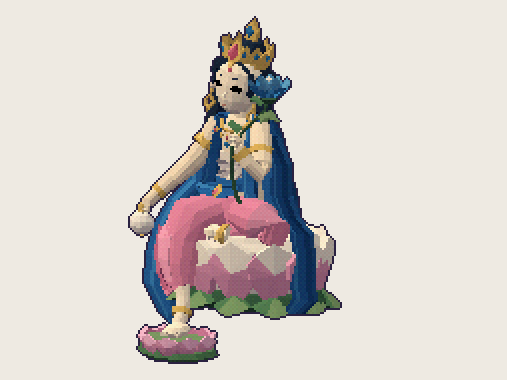
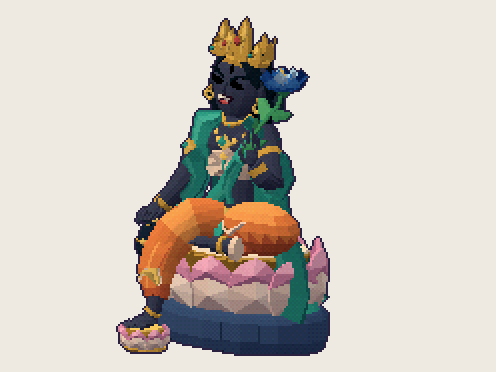
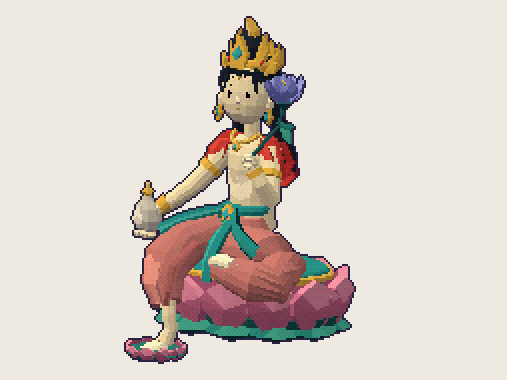
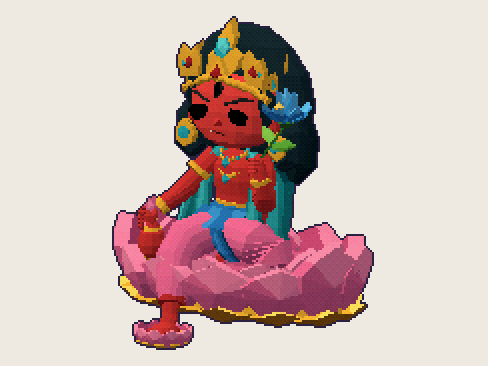
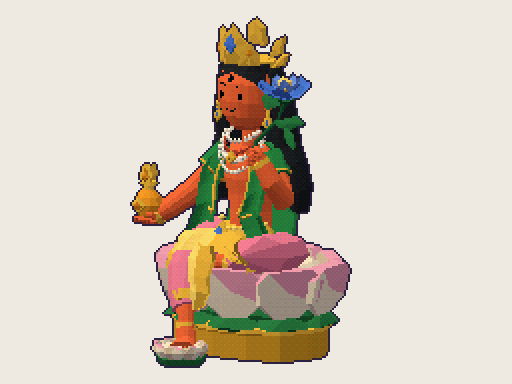
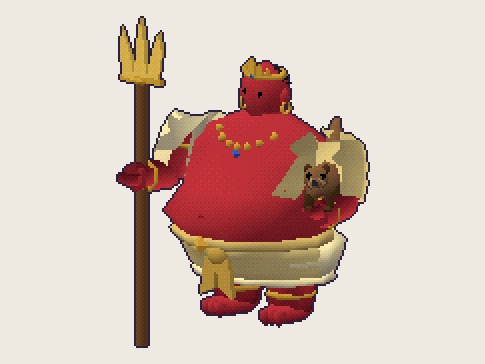
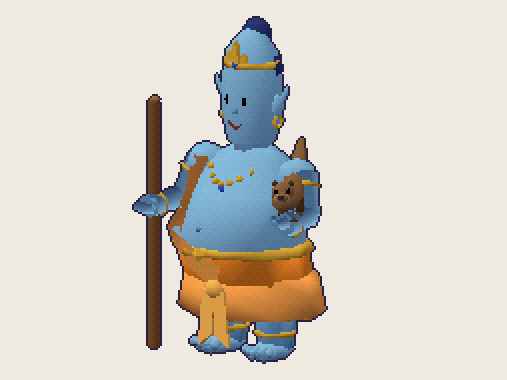
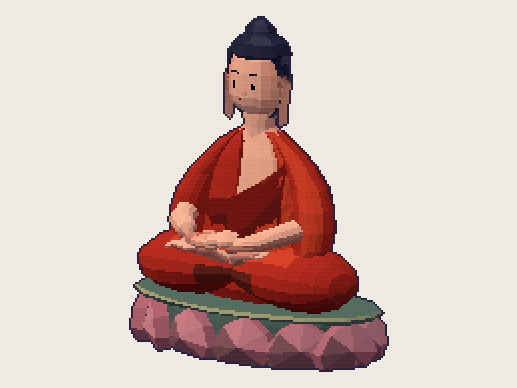
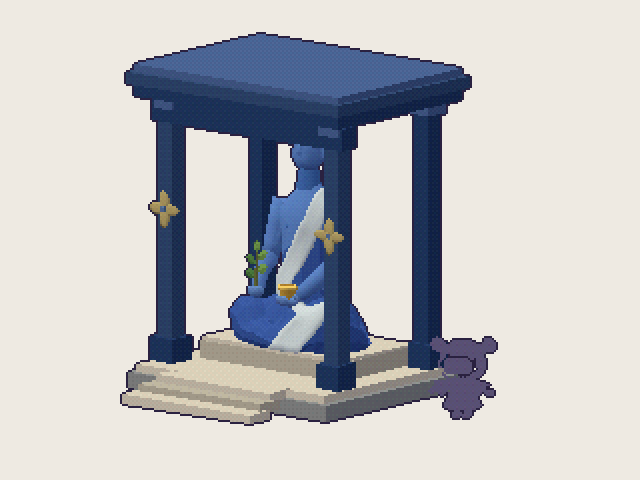
What canon says about each realm of the Wheel and the lands beside it: Jambudvīpa and the four continents, the animal realm, the hidden lands, the heavens on and above Meru, the asuras, the hungry ghosts, the hells, the hub and rim of the Wheel, the dark and the bardo, the charnel grounds, Tanaduk and the pure lands. Each topic carries every piece of art that shows it and a zoomed crop where the art shows it only in part. Gathered 2026-10-30 for the overworld layout studies: lore first, then layout. The checklist follows at What the game has.
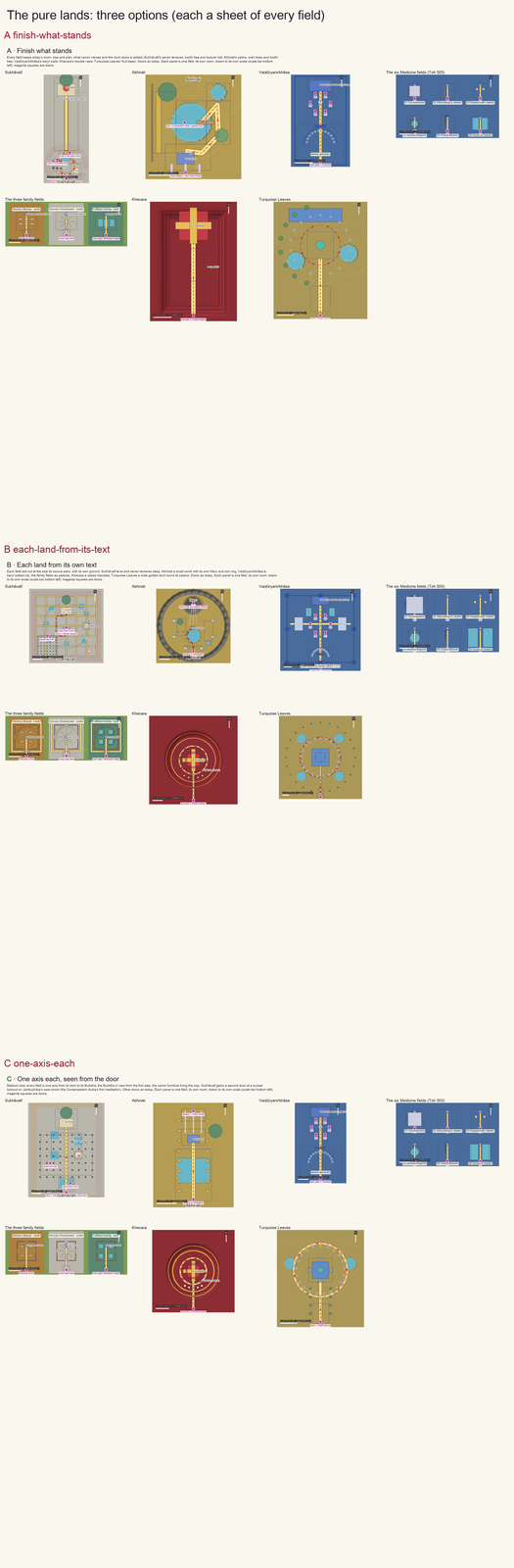
Chosen layout: B for Sukhāvatī, Abhirati and Turquoise Leaves; A for the rest
The three lands the texts describe in full are built at their texts' size, each a whole world; the named but undescribed fields keep their rooms and gain what canon names. A sunset door to Sukhāvatī on the west shore is pending a check against the Contemplation Sutra.
The buddha-fields the game visits lie outside the Wheel: Amitābha's Sukhāvatī in the west, Akṣobhya's Abhirati in the east, the Medicine Buddha's Vaiḍūryanirbhāsa and the six fields of his companions, the three lesser-known fields of the five families, Vajrayoginī's Khecara, Tārā's Turquoise Leaves and Guru Rinpoche's Copper-Coloured Mountain on Cāmara. This group gathers what the sutras, aspiration prayers and guidebooks fix about each land's ground, trees, ponds, palaces and inhabitants, how painters have shown them, and what the eleven built hidden places already render, so that each can be grown from its own source rather than laid out as terrain beside a realm.
A pure land is a Buddha's own world, reached by aspiration and rebirth, not a country beside the six realms; the game's doors into them are all adaptation.
A buddha-field is a world a Buddha has purified by his vows. Beings reach it by being born there, in a lotus or spontaneously, through faith, aspiration and merit. No sutra gives a road, ferry or stair from Jambudvīpa into one. Sukhāvatī lies past a hundred thousand myriad buddha realms to the west; Abhirati a thousand fields to the east; Vaiḍūryanirbhāsa east beyond innumerable fields.
Pure lands have no lower realms. Sukhāvatī's beings know no physical pain or mental suffering, and the word 'lower realm' is not spoken there. Abhirati has no hell beings, animals or beings of Yama. Vaiḍūryanirbhāsa has no stones, no cries of suffering and no lower realms. So nothing in them can be 'liberated' by the panel game: their Buddhas and bodhisattvas keep one presence form.
HAR's Jeff Watt sums up the tradition: buddhafields are the idealized, often described geographic locations where a bodhisattva has reached complete buddhahood, as told in Mahāyāna sūtras; a few tantric deities (Vajrayoginī, Padmasambhava) also have a pure land tied to their own texts.
The repo's 2026-10-10 proposal and the canonical research table both keep every pure field hidden from the overworld: entered through a devotional threshold at a place of practice, never laid out as terrain next to a realm.
What canon fixes for the map
Sukhāvatī: west, past a hundred thousand myriad buddha realms [SSV 1.2]. Abhirati: east, a thousand buddhafields away [AKV 1.9]. Vaiḍūryanirbhāsa: east, beyond buddhafields as numerous as the sands of ten Ganges rivers [BGS 1.6].
No lower realms, no pain, no 'lower realm' word in Sukhāvatī [SSV 1.5–1.6]; no hells, animals or Yama's beings in Abhirati [AKV 2.19]; no stones, suffering or lower realms in Vaiḍūryanirbhāsa [BGS 1.21].
Every gateway the game has (lotus threshold, tabletop, ferry, vision gates, niche, light-well, cairn, arch) is marked adaptation in its place record [docs/world-plan/places/*.json gateway.adaptation].
Josie's rules: already-liberated beings keep one presence form and cannot be played against [AGENTS.md, Forms (R26)].
In the game now
Samsara realm `pure-lands`: 225 items, 113 built, 41 sketch, 71 missing (173 beings, 52 places). Eleven pure places are built as hidden zones or rooms; see the built-* topics below.
Art (1)
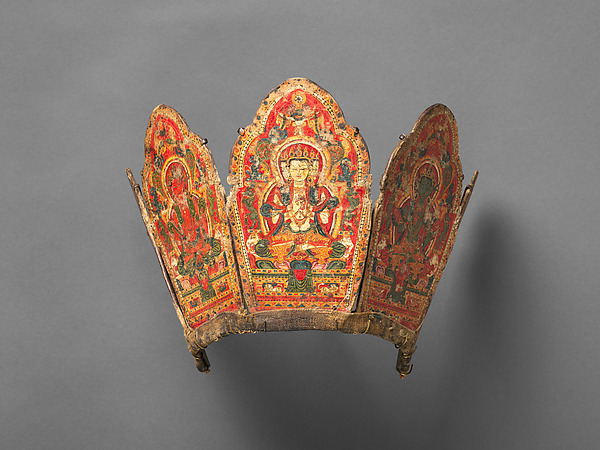
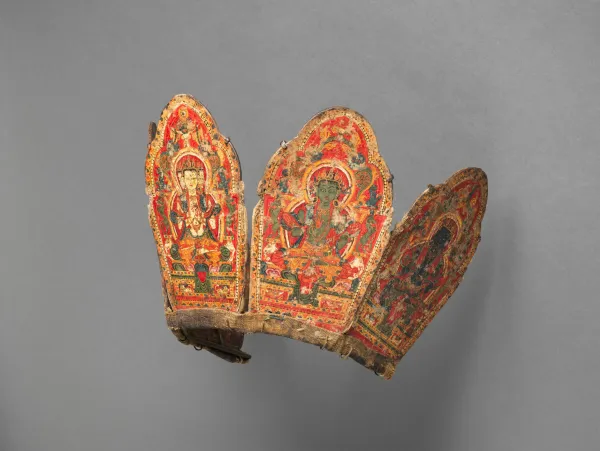
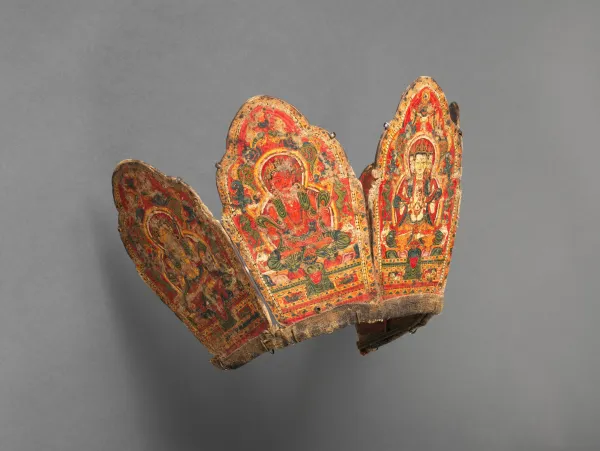
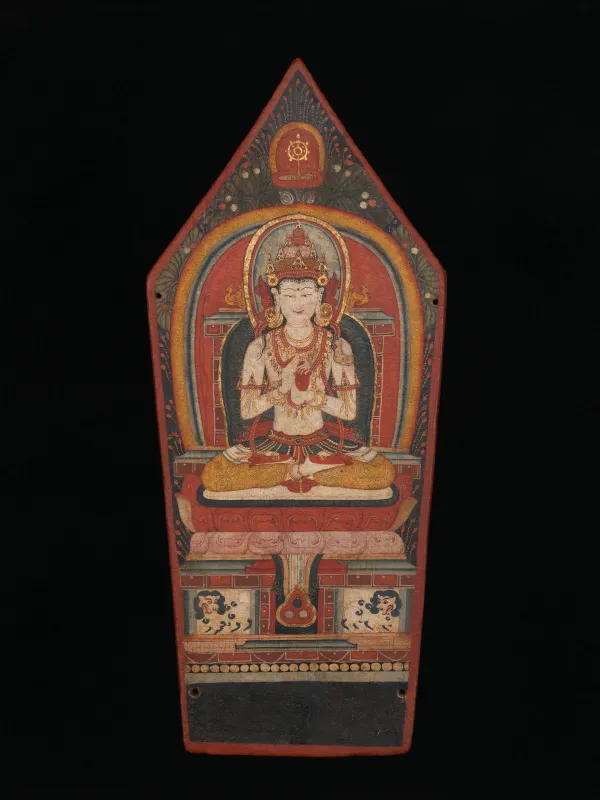
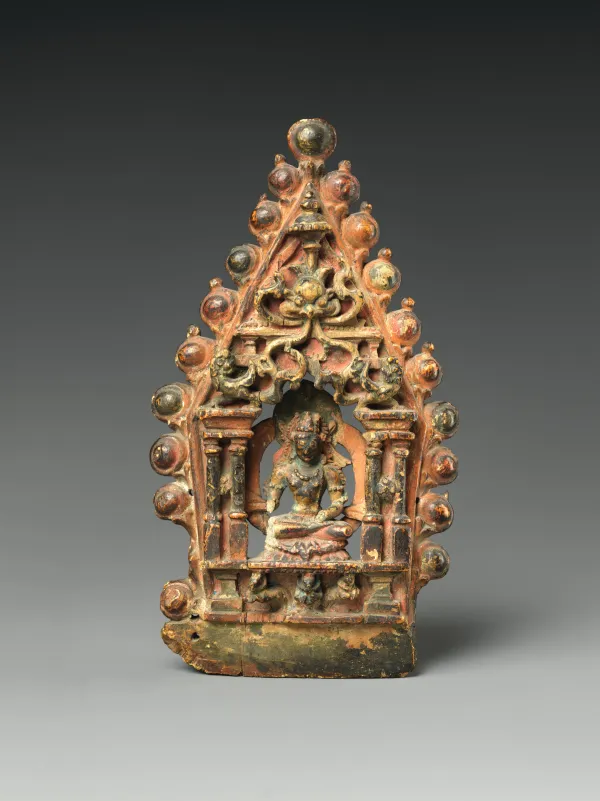
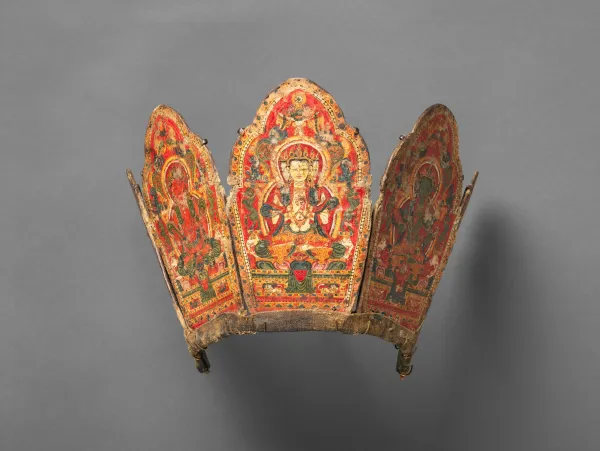
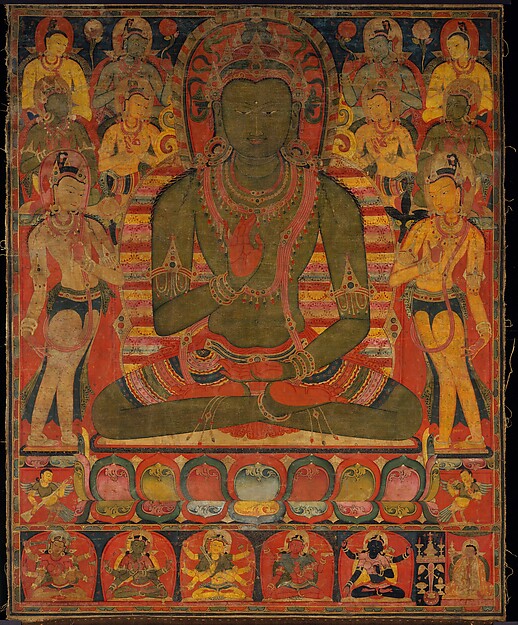
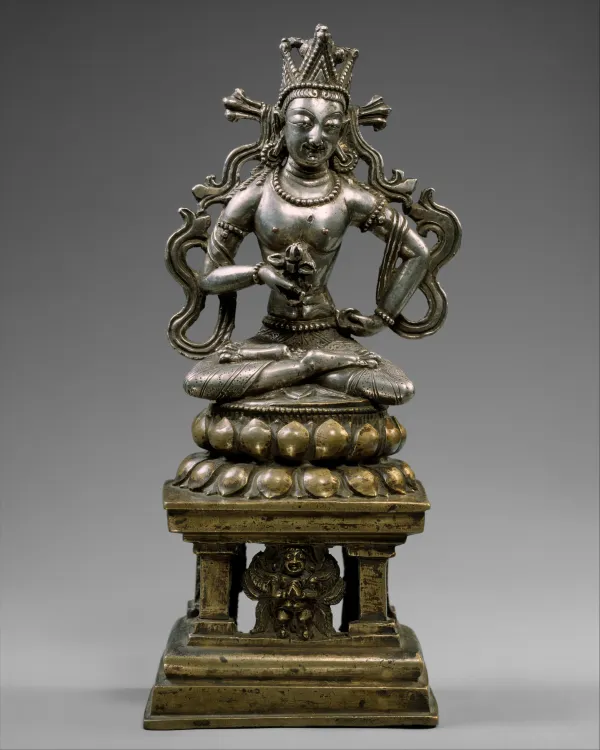
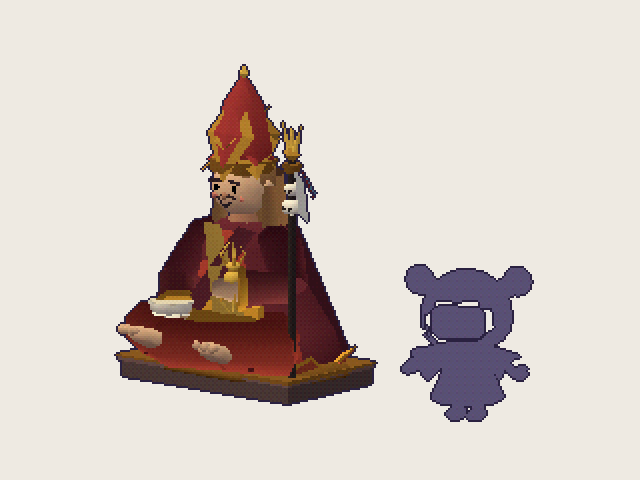
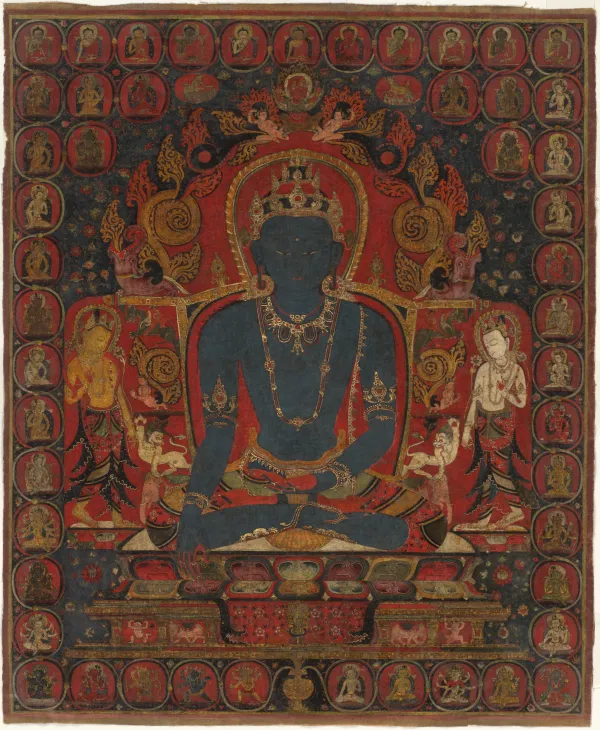
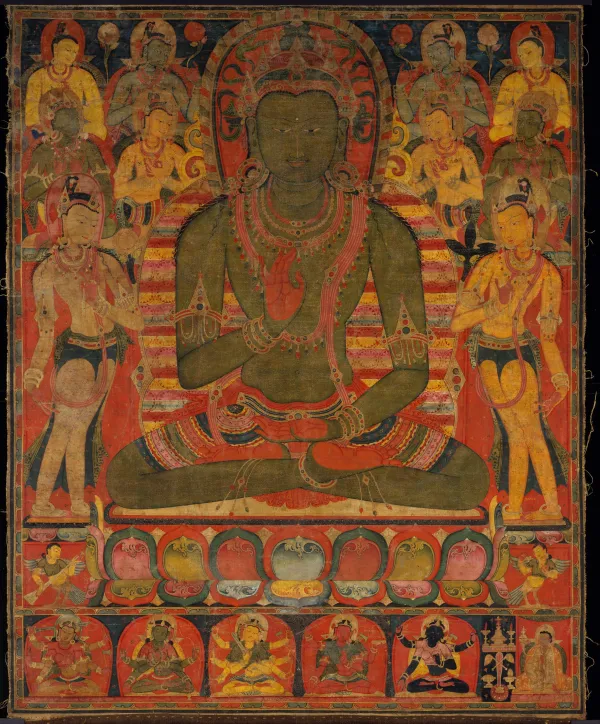
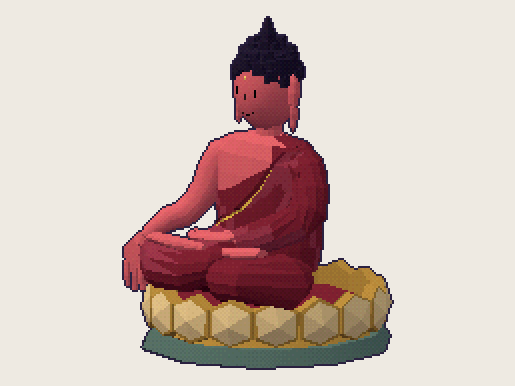
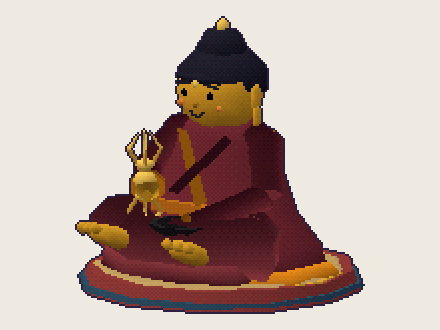
the painted panels: Vairocana at centre with two family Buddhas beside him
Repo: docs/wheel-geography-canonical-research-2026-10-01.md, Hidden places table and section 'Khecara: primary praise now verified'
Repo: docs/world-plan/hidden-to-overworld-proposal.md (2026-10-10), 'All pure fields … are outside samsara' (should stay hidden)
Sukhāvatī, the Land of Bliss
Skt. Sukhāvatī; Tib. bde ba can (Dewachen); Ch. Jílè / Jp. Gokuraku
Amitābha's western field: a flat jewel land ringed by seven terraces and seven rows of palms, hung with chime nets, where no one suffers and every sound teaches.
Sukhāvatī lies to the west, past a hundred thousand myriad buddha realms. Amitābha dwells there now, teaching. He is called Amitāyus, Immeasurable Life, because his lifespan cannot be measured, and Amitābha, Immeasurable Light, because his light shines unimpeded through all buddha realms. He awakened ten eons ago.
The land is surrounded on all sides by seven layers of terraces, seven rows of palm trees and filigrees of chimes, all of gold, silver, beryl and crystal. The sound of divine cymbals is heard everywhere. Its beings know neither physical pain nor mental suffering; the words 'lower realm' do not exist there.
The Larger Sutra adds the ground: no Mount Sumeru, no iron mountains, no oceans or hells, only a level land of the seven jewels, and a climate neither hot nor cold. Innumerable jewelled nets hang over it, strung with gold thread, pearls and bells; when the gentle breeze of virtue moves them, countless Dharma sounds ring out and fragrances spread.
It is a land of a single Buddha and a single time of day: Jigme Lingpa's aspiration says there are no planets or stars, neither day nor night, and no households, while heavenly goddesses produce clouds of offerings that inspire delight.
What canon fixes for the map
Direction and distance: west, past a hundred thousand myriad buddha realms [SSV 1.2].
Boundary: seven terraces, seven rows of palms and chime filigrees of four jewels all the way round [SSV 1.3].
Ground: level, of the seven jewels, no Sumeru, no iron ring, no oceans or hells; climate temperate [TPL Larger Sutra §§13–14, printed pp. 24–25].
Nets of jewels and bells over the whole land; wind in them sounds the Dharma [TPL Larger Sutra §20, printed pp. 29–30].
No day or night, no planets or stars [JLS verse 12]. No pain, no 'lower realm' [SSV 1.5–1.6].
The Wheel's Buddha pointing beyond is the game's gate here; the sutras support rebirth through aspiration, never a walked gate [docs/world-plan/places/sukhavati.json gateway.adaptation].
Who lives here
Amitābha / Amitāyus (being:sukhavati:amitabha, built): the Buddha of the land, teaching now [SSV 1.2, 1.8]
Dharmākara (being:sukhavati:dharmakara, sketch): the monk-king who made the vows that built this land [TPL Larger Sutra §§5–6]
In the game now
Built as a hidden zone (built-sukhavati below). Samsara: place:sukhavati:land (built), place:sukhavati:bell-nets (built), place:sukhavati:palaces (built: sukhavati.assembly.palaces, three palaces with their bathing ponds down the assembly field's east side), being:sukhavati:offering-goddesses (sketch).
Art (7)
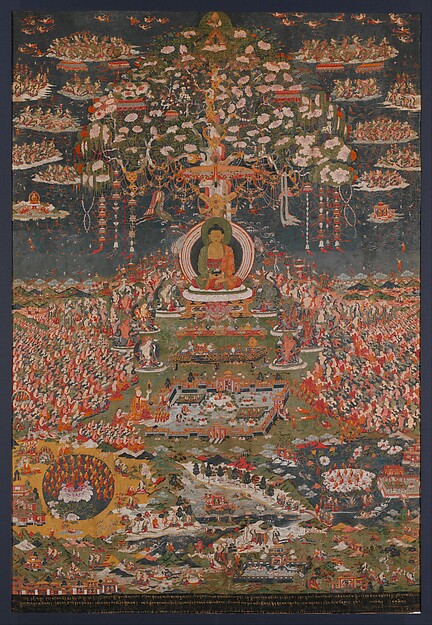
the whole land seen from the palaces up to the tree
The Metropolitan Museum of Art (Open Access) · traditional · CC0 1.0
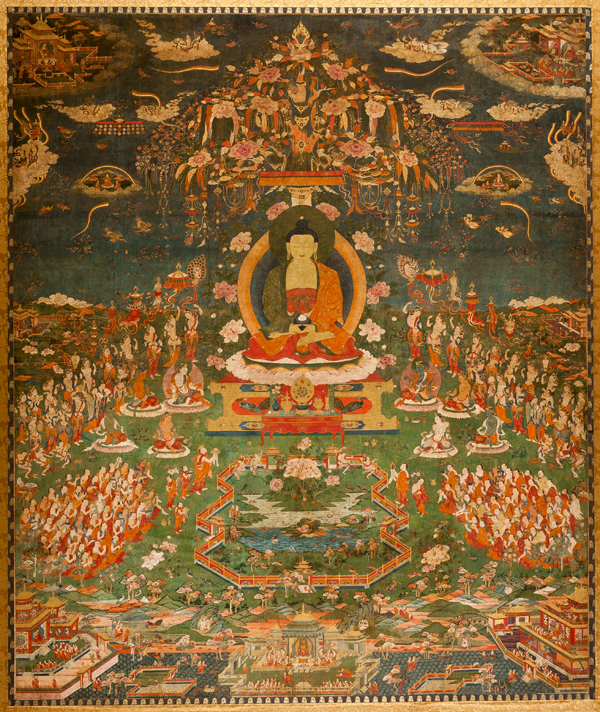
A whole Tibetan Sukhāvatī: the bodhi tree hung with nets and bells above, Amitābha enthroned, the jewel pond at centre, palaces and lotus births below.
the pavilions and the jewel canopy with hanging ornaments, upper centre
the seven-jewelled trees; the ponds of eight-quality water; the bodhi tree of Amitāyus
Rows of trees each made of a different jewel, bathing ponds with four jewel stairs and chariot-wheel lotuses, and a beryl ground netted with golden paths.
Seven-jewelled trees fill the land in parallel rows: trees of one jewel with leaves, flowers and fruit of another, and trees whose roots, trunks, branches, twigs, leaves, flowers and fruit are each a different jewel. When a fresh breeze passes through them, music of the five tones sounds by itself.
Amitāyus's bodhi tree stands four million li high and five thousand yojanas round at its base, a natural cluster of every precious stone, hung with jewelled ornaments and covered with nets of gems. When a breeze stirs it, Dharma sounds spread to the buddha lands of the ten directions. The Contemplation Sutra gives seven rows of jewel trees, each eight thousand yojanas high, covered with nets of pearls; between the nets are five hundred koṭis of flower palaces where celestial children dwell.
The ponds are of seven jewels, full of water with the eight qualities, filled to the brim so a crow could drink, lined with golden sand. On each of their four sides is a stair of gold, silver, beryl or crystal, and jewel trees stand on their banks. Their lotuses are as large as chariot wheels: blue ones blue-lit, yellow, red and white likewise. The water rises or falls to the bather's wish and is warm or cool as wished.
The Contemplation Sutra's second contemplation sees the ground: water frozen and turned to beryl, shining inside and out, held up on eight-sided columns of diamond and the seven jewels; golden paths cross it like a net of cords, dividing the land into clear-jewelled sections.
What canon fixes for the map
Trees in parallel rows, each part a different jewel; wind makes pentatonic music [TPL Larger Sutra §14, printed pp. 24–25].
Bodhi tree: 4,000,000 li high, 5,000 yojanas round at the base, netted with gems [TPL Larger Sutra §15, printed pp. 25–26].
Seven rows of trees 8,000 yojanas high under pearl nets with palaces between the nets [TPL Contemplation Sutra §12, printed pp. 70–71].
Ponds: seven jewels, eight-quality water, golden sand, a jewel stair on each of four sides, trees on the banks, lotuses the size of chariot wheels [SSV 1.3–1.4].
Ground: beryl over frozen water, on eight-sided jewel columns, golden paths crossing like a net [TPL Contemplation Sutra §§10–11, printed pp. 69–70].
Each being's abode, palace and pavilion suits the size of its body; bathing ponds inside and out [TPL Larger Sutra §§16, 20, printed pp. 26, 29].
In the game now
Samsara: place:sukhavati:jewel-trees (built), place:sukhavati:ponds (built), place:sukhavati:bell-nets (built), place:jewel-net:beryl-ground (built), place:jewel-net:pearl-nets (built), place:sukhavati:bodhi-tree (built: sukhavati.assembly.bodhi-tree, behind Amitābha's throne), place:sukhavati:palaces (built: sukhavati.assembly.palaces, three palaces with their bathing ponds down the assembly field's east side). In the zone: the jewel orchard (sukhavati.orchard) and the bathing pond ringed by 24 gold pavers (sukhavati.pond).
Art (5)
the bodhi tree with nets, bells and hanging ornaments, topthe walled jewel pond with lotus-born beings, centre
Beings are born in Sukhāvatī inside lotus buds that open sooner or later by their merit; doubters spend five hundred years in a jewel palace inside a closed lotus at the border.
Whoever hears Amitāyus's name and holds it unwaveringly for one to seven nights dies undeluded. Amitābha stands before them with his śrāvakas and bodhisattvas, and they are born in Sukhāvatī. No one is born there with small roots of virtue; those who are born are bodhisattvas who will not regress.
The Contemplation Sutra sorts the newcomers into nine grades. At the top the lotus opens at once; at the lowest level of the lowest grade, evil-doers who called the Buddha's name ten times at death are born in closed buds that open only after twelve great kalpas. On the highest level of the lowest grade the bud opens after seven weeks.
Doubters have their own place. The Larger Sutra says those who did good and aspired to be born but doubted the Buddha's wisdom are born in palaces inside lotus buds: for five hundred years they cannot see the Buddha, hear the Dharma or meet the bodhisattvas and śrāvakas. Śākyamuni warns that whoever doubts or gives up may be born into the seven-jewelled palace in the border region of the Pure Land and suffer these disadvantages for five hundred years. There is no ill-treatment, only delay.
Jigme Lingpa gives the Tibetan version: those who reach the realm with virtue obscured appear enclosed within the womb of a lotus, then sit cross-legged, arise a second time and gain the marks of a great being.
What canon fixes for the map
Rebirth by holding the name one to seven nights; Amitābha comes at death with his assembly [SSV 1.10–1.11].
Nine grades; lowest bud opens after twelve great kalpas, highest-of-lowest after seven weeks [TPL Contemplation Sutra §§28–30, printed pp. 83–85].
Doubters: palaces inside lotus buds, five hundred years without seeing Buddha or Dharma [TPL Larger Sutra §§43–45, printed pp. 58–59].
The seven-jewelled palace in the border region, five hundred years of disadvantages [TPL Larger Sutra §33, printed p. 47].
Lotus womb, arising a second time with the marks of a great being [JLS verse 14].
Repo rule: no punitive closed-lotus level; the border is delay, not punishment [ledger border-lotus disposition].
Who lives here
Those reborn through aspiration (being:sukhavati:newcomers, missing) [SSV 1.10–1.11]
The lowest grade, born in closed buds (being:border-lotus:lowest-grade, missing) [TPL Contemplation Sutra §§28–30]
Those enclosed in the lotus womb (being:border-lotus:lotus-womb, missing) [JLS 14]
The doubters in the embryonic state (being:border-lotus:doubters, missing) [TPL Larger Sutra §§43–45]
In the game now
Nothing built for the border: place:border-lotus:palace (missing) and its three being items are missing. The zone's lotus arrival pad (sukhavati.arrival) and the room in an open lotus (sukhavati:lotus) carry the lotus-birth image.
Amitābha's assembly: attendants, lecture hall, birds and offerings
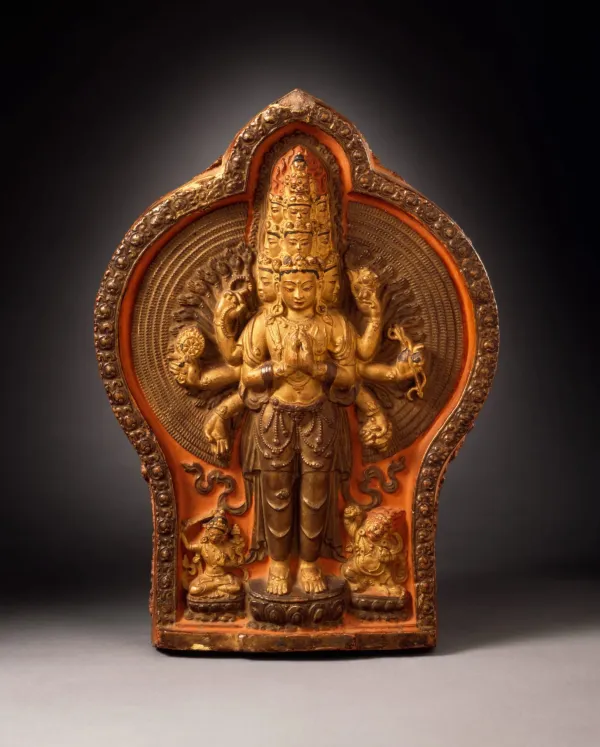
Avalokiteśvara and Mahāsthāmaprāpta (Tib. identifies him with Vajrapāṇi); kalaviṅka and jīvaṃjīvaka
Amitābha teaches in a seven-jewelled lecture hall to countless śrāvakas and bodhisattvas, flanked by Avalokiteśvara and Mahāsthāmaprāpta, while manifested birds sing the Dharma and goddesses rain offerings.
Amitābha has an immeasurable saṅgha of śrāvakas, all pure arhats, and bodhisattvas too many to count, all bound by one more birth. In a single morning they visit hundreds of thousands of Buddhas in other realms, tossing bouquets to each, and return for the midday meal. Countless bodhisattvas from other lands visit him in turn, as many as the sands of the Ganges.
When he teaches, the assembly gathers in the seven-jewelled lecture hall. Breezes from the four directions stir the jewel trees and flowers fall like rain; devas come and go with flowers, aromatic wood and instruments. Jewel lotuses fill the land, each petal glowing its own colour, each ray sending forth purple-gold Buddhas who teach in the ten directions.
Two bodhisattvas stand foremost: Avalokiteśvara and Mahāsthāmaprāpta. In Tibetan painting the pair is Avalokiteśvara and Vajrapāṇi; Karma Chakmé's Sukhāvatī prayer gives this trio, and the repo keeps both names in the record. Tibetan paintings set the eight great bodhisattvas around the throne.
Swans, cranes and peacocks assemble three times each day and three times each night and sing, each its own melody, sounding the powers, strengths and branches of awakening. They are not animal births: Amitāyus manifests them so that those born there remember the Buddha, Dharma and Saṅgha. The game's kalaviṅka and jīvaṃjīvaka follow this rule and cannot be liberated.
What canon fixes for the map
Immeasurable śrāvakas (all arhats) and bodhisattvas; morning visits to other realms [SSV 1.5, 1.9].
Visiting bodhisattvas from every direction [TPL Larger Sutra §26, printed p. 32].
Seven-jewelled lecture hall; breezes from four directions; flower rain; devas bringing offerings [TPL Larger Sutra §29, printed pp. 37–38].
Lotus light sends forth Buddhas who teach in the ten directions [TPL Larger Sutra §21, printed p. 30].
Teaching birds, not animal rebirths; six singing times a day [SSV 1.6].
Attendants: Avalokiteśvara and Mahāsthāmaprāpta (Chinese sutras); Tibetan trio uses Vajrapāṇi [ledger sukhavati-attendants; KV Toh 116 for Avalokiteśvara's seat in the west].
Offering goddesses produce clouds of offerings [JLS verse 12].
Samsara: place:sukhavati:lecture-hall (built: sukhavati.assembly.lecture-hall, beside Amitābha's throne on the field's west side); the zone has a gathering pavilion (sukhavati.pavilion) and an aisle between two attendants' seats to Amitābha's throne (sukhavati.assembly). The eight offering bearers (being:offering-water … being:offering-music, sketch) stand in for the goddesses.
Art (13)
Amitābha's throne with the eight bodhisattvas and offering tables
The Metropolitan Museum of Art (Open Access) · traditional · CC0 1.0
Amitābha on his lotus throne with the eight bodhisattvas and two standing attendants; offering tables before him; the assembly in red rows to either side.
Amitābha with Avalokiteśvara and Vajrapāṇi attending, and the eight bodhisattvas
Indra's net (Skt. Indrajāla); the pearl nets and reflecting canopies of Sukhāvatī
Nets of pearls over the jewel trees, canopies in which the whole universe is reflected, and the Huayan image of Indra's net where every jewel mirrors every other.
In Sukhāvatī the seven rows of jewel trees are covered with nets of pearls, and between the nets are five hundred koṭis of flower palaces, like the palace of the Brahmā king, where celestial children dwell wearing gems that light a hundred yojanas. From the fruits of the trees pour floods of light that become banners and jewelled canopies, and inside the canopies are seen the activities of the Buddha through a thousand million worlds and the buddha lands of the ten directions.
The wider image is Indra's net. In the myth the Huayan school adopts from the Avataṃsaka, the god Indra has a net with a jewel at every crossing of two strands, each jewel so bright that it reflects every other jewel, and the reflections within reflections, without end. Huayan reads it as each thing's dependence on and presence in every other.
The game's jewel-net room under Sukhāvatī's orchard is an observatory in which changed places elsewhere in the world are reflected. The repo marks it as a wider Mahāyāna visualization, not a feature of Toh 115, and asks for one clear reciprocal reflection with a source.
What canon fixes for the map
Pearl nets over seven rows of trees 8,000 yojanas high; palaces between the nets [TPL Contemplation Sutra §12, printed p. 70].
Canopies from the tree-fruits' light reflect the Buddha's work in all worlds [TPL Contemplation Sutra §12, printed p. 71].
Celestial children in the net palaces, gems lighting a hundred yojanas [TPL Contemplation Sutra §12, printed pp. 70–71].
Indra's net: a jewel at every crossing, each reflecting all [SEH §1.3 par. 3; §3 pars. 7, 9; §4.3 par. 3].
The observatory is adaptation [ledger jewel-net].
Who lives here
The celestial children of the palaces between the nets (being:jewel-net:net-palace-children, missing) [TPL Contemplation §12]
In the game now
Samsara: place:jewel-net:indra-net (built, sukhavati:net), place:jewel-net:beryl-ground (built), place:jewel-net:pearl-nets (built), place:jewel-net:reflecting-canopies (missing). Reached by the stair in the jewel orchard (sukhavati.orchard).
Skt. Abhirati (Joy); Tib. mngon par dga' ba (Ngönpar Gawa); its Buddha Akṣobhya, mi bskyod pa
A thousand fields to the east: a palm-smooth golden land with its own Meru and Thirty-Three heaven joined by three jewel ladders, wish trees, golden palms, storied mansions and Akṣobhya's lotus footprints.
Abhirati lies in the east, a thousand buddhafields from here. Long ago a monk there, before the Buddha Great Eyes, vowed never to bear anger, malice or a disturbed mind toward any being until awakening; another monk thought 'he will be unperturbed (akṣobhya)', and the name stayed. He is now the Buddha of that world, its only king, the Unsurpassable Dharma King.
Its great earth is smooth as the palm of a hand, soft as kācalindika cloth and gold-coloured, set with gems and lotuses and strewn with māndārava flowers. There are no hell beings, animals or beings of Yama, and all who are born there keep the ten virtues. Humans there have no lords or servants, no illness of wind, bile or phlegm, no bad complexion or odour; food appears in jewelled dishes. Garments grow on the wish-fulfilling trees, which bow down to give ornaments and are always in bloom. Rows of golden palms rustle in the wind more sweetly than any musician.
Every human dwelling is a storied mansion of the seven precious materials with thrones and soft cushions, and ponds of eight-quality water with golden sand, ringed by divine aśoka trees. Wherever Akṣobhya sets foot, golden thousand-petalled lotuses bloom; they gather where a devotee wishes or hang in space to be venerated. His bodhi tree is of the seven precious substances, a hundred thousand leagues high, with a canopy forty thousand leagues across; the breeze in its leaves makes melodies beyond any instrument.
Abhirati has its own Heaven of the Thirty-Three, joined to its Jambudvīpa by jewelled staircases. Gods come down them to honour Akṣobhya and aspire to be born as humans, for human abundance there is no less than theirs; humans climb to see the gods and do not aspire to that heaven. Vimalakīrti lifted the whole universe in his right hand, from its watery base to its Akaniṣṭha, with its Sumeru, hills, sun, moon and stars, its nāgas, yakṣas, gandharvas and asuras, and its three jewel ladders, and set it down in his room for the assembly to see.
What canon fixes for the map
East, a thousand buddhafields away [AKV 1.9]. Ground gold, palm-smooth, no lower realms [AKV 2.19, 2.21].
Three jewelled ladders from the earth to its Trāyastriṃśa [VKN 11.14; AKV 2.47–2.48]. Its own Sumeru, mountain ranges, sun, moon and Cakravāḍa ring [VKN 11.14].
Wish trees give garments and ornaments [AKV 2.24, 2.32]. Rows of golden palms [AKV 2.40]. Storied mansions with ponds and aśoka trees [AKV 2.27].
Thousand-petalled golden lotuses wherever Akṣobhya treads [AKV 2.43–2.46]. Bodhi tree 100,000 leagues high [AKV 2.16–2.17].
Humans without lords or servants, without illness; food appears [AKV 2.20–2.26, 2.36, 2.38–2.39].
Game access by Vimalakīrti's tabletop, the Human reflection pool and a Deva stair are adaptation [docs/world-plan/places/abhirati.json gateway.adaptation].
Traditions differ: the Great Chariot's commentary puts Vajrasattva in the eastern field where its root verse and Toh 50 put Akṣobhya; Chokgyur Lingpa's prayer names Vajrasattva in 'Profound Joy' [LCH; CVG stanza 3].
The bodhisattvas of Abhirati, mostly gone forth (being:abhirati:bodhisattvas, missing) [AKV 4.2–4.22]
Akṣobhya's śrāvakas, 'the lazy ones' who need four teachings (being:abhirati:sravakas, missing) [AKV 3.1–3.14]
The humans of Abhirati (being:abhirati:humans, missing) [AKV 2.20–2.39]
The gods of its Thirty-Three (being:abhirati:gods, built) [AKV 2.47]
Its Brahmā and retinues (being:abhirati:brahma, missing); its nāgas, yakṣas, gandharvas and asuras (being:abhirati:nonhumans, sketch) [VKN 11.14]
Those reborn through aspiration or by making a thousand images of him (being:abhirati:newcomers, missing) [AKV 2.33–2.34, 6.2–6.22]
In the game now
Built as a hidden zone (built-abhirati below). Samsara: place:abhirati:land, :meru, :trayastrimsa, :ladders (built); :bodhi-tree, :golden-palms, :lotuses, :wish-trees, :mansions (sketch: map-table assets, not yet placed).
Art (5)
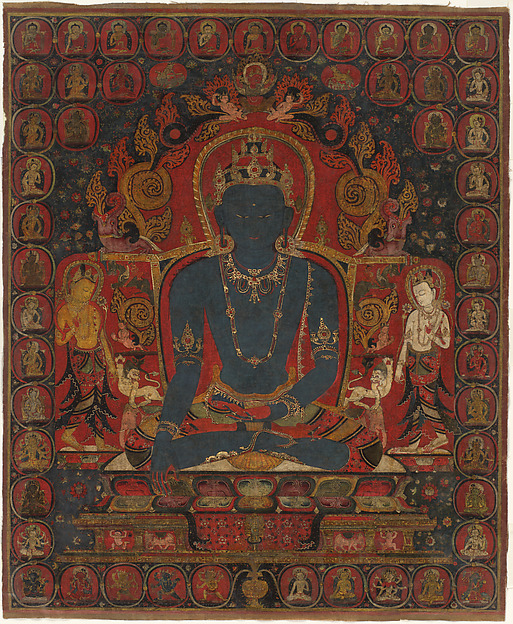
Akṣobhya with his two attendants and the elephant throne
The Metropolitan Museum of Art (Open Access) · traditional · CC0 1.0
Blue Akṣobhya, earth-touching, on a throne with his elephant mount below, flanked by two standing bodhisattvas; the early Tibetan icon of Abhirati's Buddha.
Still missing: Abhirati paintings are rare: HAR lists one (Brooklyn 78.138). No open-licence image shows its ladders, golden palms or wish trees; a layout study would be new art.
Two sutra lands with different doors: Sukhāvatī is reached by holding Amitābha's name; Abhirati by practising as Akṣobhya practised, and it keeps gods, humans, women and a Meru that Sukhāvatī does without.
Sukhāvatī is entered by faith: hear the name, keep it in mind one to seven nights, and Amitābha comes at death. Abhirati is entered by conduct: practise the perfections as Akṣobhya did and dedicate them to being in his company, or make a thousand images of him. Both Buddhas appear at the deathbed with their assemblies.
Sukhāvatī has no Sumeru, no iron mountains and, in the Larger Sutra, no day or night; Abhirati has its own Sumeru, ranges, sun, moon and stars, and its gods and humans go up and down three jewel ladders. Sukhāvatī's newcomers arrive in lotuses; Abhirati's humans are born as humans, keep households and the ten virtues, and women there bear children without pain.
Both have jewel ponds, trees that sound the Dharma, and a bodhi tree of vast size. Both have no lower realms. Sukhāvatī's assembly sits in a lecture hall; Abhirati's hears Akṣobhya wherever they stand or sit. HAR notes that Milarepa and Sakya Paṇḍita are said to have completed buddhahood in Abhirati, where Vimalakīrti also dwells; Sukhāvatī is the land of nearly every Tibetan aspiration prayer.
Game consequence (adaptation): Sukhāvatī is reached from the Wheel's release cloud, Abhirati from Vimalakīrti's table. Neither is a neighbour of anything.
What canon fixes for the map
Doors: name-recollection [SSV 1.10–1.11] versus practice, dedication and images [AKV 2.33–2.34, 6.2–6.22].
Sukhāvatī: no Sumeru, no iron mountains, no oceans [TPL Larger Sutra §13]. Abhirati: own Sumeru, ranges, sun and moon [VKN 11.14].
Abhirati has gods and humans with ladders between them [AKV 2.47–2.48]; Sukhāvatī's devas visit from elsewhere [TPL Larger Sutra §29].
Both: no lower realms [SSV 1.6; AKV 2.19].
Vimalakīrti came from Abhirati and showed it to the assembly [VKN 11.13–11.18].
In the game now
Both zones are built (built-sukhavati, built-abhirati). Nothing compares them in play.
Vaiḍūryanirbhāsa, the field of the Medicine Buddha
Skt. Vaiḍūryanirbhāsa; Tib. bai ḍūrya snang ba; its Buddha Bhaiṣajyaguruvaiḍūryaprabha (sangs rgyas sman bla)
Far to the east, a field whose ground, walls, gates and turrets are blue beryl, with no stones, no suffering and no lower realms, where Sunlight and Moonlight keep the Medicine Buddha's Dharma.
East of here, beyond buddhafields as numerous as the sands of ten Ganges rivers, is the world Vaiḍūryanirbhāsa, where the thus-gone Bhaiṣajyaguruvaiḍūryaprabha dwells. He made twelve great aspirations as a bodhisattva: that his body shine like beryl and light the dark, that the sick be healed, the maimed made whole, the poor fed and clothed, the imprisoned freed, and those who hear his name be reborn in his field.
The field is utterly pure: no stones, pebbles or gravel, no faults of desire, no cries of suffering, no lower realms, and no female gender. Its foundation, walls, fences, archways, lattice windows and turrets are of blue beryl, its parapets of the seven precious substances. Its array is like Sukhāvatī's.
Two bodhisattva great beings are foremost among its immeasurable bodhisattvas: Sūryavairocana (Sunlight) and Candravairocana (Moonlight). Together they maintain the treasury of the holy Dharma of Bhaiṣajyaguru. Twelve great yakṣa generals, each with seven thousand yakṣas, vow at the end of the sutra to protect whoever holds his name; the game posts them in the field's hemicycle.
This field is not Tanaduk. Tanaduk is the medicine city of the Four Tantras where medicine is taught on four mountains in the human world; Vaiḍūryanirbhāsa is a buddha-field. The repo joins them by a vision gate because the same Buddha is met in both.
What canon fixes for the map
East beyond buddhafields as many as the sands of ten Ganges rivers [BGS 1.6].
Beryl ground, walls, fences, gates, lattices and turrets; parapets of the seven precious substances; no stones, no suffering, no lower realms, no women [BGS 1.21].
Sūryavairocana and Candravairocana foremost; they keep the Dharma treasury [BGS 1.22].
Twelve yakṣa generals with seven thousand yakṣas each [BGS, closing section; FPMT sadhana names].
Different place from Tanaduk; the lapis gate is a game link [docs/world-plan/places/field-lapis-radiance.json gateway.adaptation; ledger medicine-field].
The Metropolitan Museum of Art, via Wikimedia Commons · traditional · Public domain
A Yuan wall-painting of the Medicine Buddha's pure land: Bhaiṣajyaguru enthroned between Sunlight and Moonlight, with the twelve generals and attendants in rows.
Bhaiṣajyaguru with his two attendants under the canopy
Repo iconography dossier: public/atlas/iconography/dossiers/medicine-buddha.json, requirements, references HAR 125 and HAR 32921
The seven Medicine Buddhas and their eastern fields
Tib. sman bla bde gshegs bdun; with Śākyamuni, the Eight Medicine Buddha Brothers
Toh 503 names seven Buddhas in seven fields far apart in the east, each with his own vows; Bhaiṣajyaguru's Vaiḍūryanirbhāsa is the seventh.
The Sūtra of the Seven Thus-Gone Ones tells of seven Buddhas, each dwelling in his own field in the east, each having made aspirations for beings while a bodhisattva. The repo lists them from Toh 503, with the field names the game uses:
1. Suparikīrtitanāmadheyaśrīrāja in Unconquered. 2. Kuśalatejonirghoṣarāja in Abounding in Jewels. 3. Suvarṇabhadravimalaratnaprabhāsavratasiddhi in Heaped with Jewels and Full of Perfume. 4. Aśokottamaśrī in Without Anguish. 5. Dharmakīrtisāgaraghoṣa in Victory Banner of the Dharma. 6. Dharmasāgarāgramativikrīḍitābhijñārāja in Standing in an Ocean of Jewels. 7. Bhaiṣajyaguruvaiḍūryaprabha in Vaiḍūryanirbhāsa.
Tibetan painting gathers the seven around Bhaiṣajyaguru as the Eight Medicine Buddha Brothers, adding Śākyamuni: HAR 32921 puts the seven in gold directly above and below the blue central Buddha. Each of the seven is his own Buddha, not a form of Bhaiṣajyaguru; the sutra joins their fields by no doors.
What canon fixes for the map
Seven Buddhas, seven eastern fields, each with its own vows [T503].
Field names and Buddha names as the repo records from Toh 503 [samsara place:medicine-field-01…06, place:field-lapis-radiance].
The fields are far apart; the vision gates from the Medicine court are a game link [docs/world-plan/places/medicine-field-0N.json gateway.adaptation].
Eight Brothers composition with Śākyamuni [HAR 32921].
Still missing: No open-licence Eight Medicine Buddhas painting; HAR 32921 is a link card. The six companion fields have no traditional depiction of their landscapes at all.
centre Ghanavyūha-Akaniṣṭha (stug po bkod pa 'og min); east Abhirati; south Śrīmat (dpal dang ldan pa); west Sukhāvatī; north Karmaprasiddhi (las rab rdzogs pa)
The five Buddha families each have a field in their own direction; Longchenpa's Great Chariot and Chokgyur Lingpa's prayer agree on the arrangement, with the eastern Buddha named Akṣobhya or Vajrasattva by tradition.
Longchenpa's Great Chariot sets the teachers of the self-arisen nirmāṇakāya in their five fields: Akaniṣṭha, Abhirati, Śrīmat, Sukhāvatī and Karmaprasiddhi. At the centre, in Akaniṣṭha, is Vairocana; in the east, in Abhirati, the realm of true joy, Akṣobhya (the commentary gives Vajrasattva); in the south, in Śrīmat, the realm endowed with splendour, Ratnasambhava; in the west, in Sukhāvatī, the realm of great bliss, Amitābha; in the north, in Karmaprasiddhi, the realm of accomplished action, Amoghasiddhi.
Chokgyur Lingpa's Prayer to the Vidyādhara Gurus gives the same five as palaces of the five purified poisons: in Densely-Ornamented Akaniṣṭha the mirror-like palace of immaculate ignorance (Vairocana); in the eastern Profound Joy the emptiness palace of immaculate anger (Vajrasattva); in the southern Glorious Beauty the equality palace of immaculate pride (Ratnasambhava); in the western Great Bliss the discriminating palace of immaculate desire (Amitābha); in the northern Fulfilled Activity the all-accomplishing palace of immaculate jealousy (Amoghasiddhi).
HAR's outline uses other Sanskrit names for the lesser-known two: Ratnakūṭa for Ratnasambhava's south and Karmaparipūraṇa for Amoghasiddhi's north. The repo's rule is to attribute one chosen arrangement (Chokgyur Lingpa's) rather than merge lists, and never to claim one composite universal mandala.
Ghanavyūha-Akaniṣṭha, the Densely Arrayed, is the saṃbhogakāya field above the highest form heaven; it is not the worldly Akaniṣṭha (Ogmin) at the top of Meru's form realm, which the game builds as meru:ogmin.
What canon fixes for the map
Five fields and teachers: Akaniṣṭha/Vairocana, Abhirati/Akṣobhya (Vajrasattva), Śrīmat/Ratnasambhava, Sukhāvatī/Amitābha, Karmaprasiddhi/Amoghasiddhi [LCH root verse and commentary].
Chokgyur Lingpa: Densely-Ornamented Akaniṣṭha, Profound Joy (east, Vajrasattva), Glorious Beauty (south), Great Bliss (west), Fulfilled Activity (north), each a palace of a purified poison [CVG stanzas 2–6].
Alternative Sanskrit names: Ratnakūṭa (south), Karmaparipūraṇa (north) [HAR4514].
Ghanavyūha is a pure field, distinct from the form-heaven Akaniṣṭha [84000 Toh 191 glossary; ledger central-field].
Directions are the fields' own, not places on the Wheel [docs/world-plan/places/field-*.json gateway.adaptation].
In the game now
Samsara: place:five-fields:centre-palace (missing), :east-palace (sketch), :south-palace (missing), :west-palace (sketch), :north-palace (sketch). Three small courts are built: field-glorious-beauty, field-dense-array, field-fulfilled-activity; Sukhāvatī and Abhirati are zones. No eastern Vajrasattva field exists; Abhirati stands in the east.
Art (5)
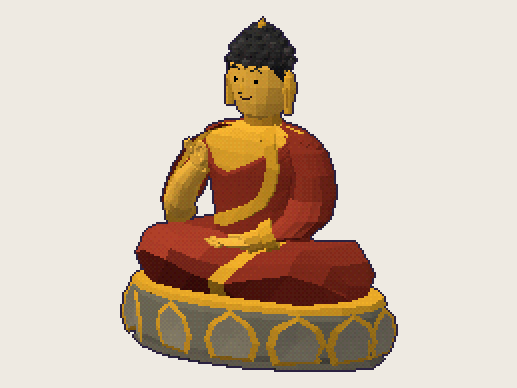
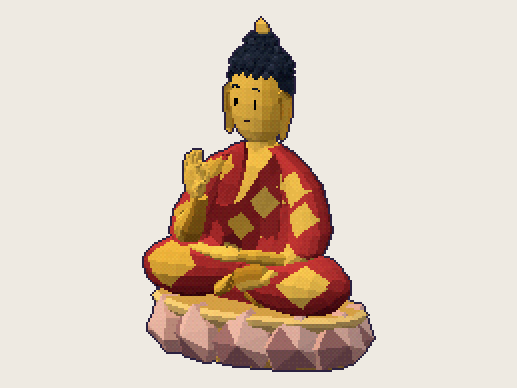
the painted panels: Vairocana and two family Buddhas
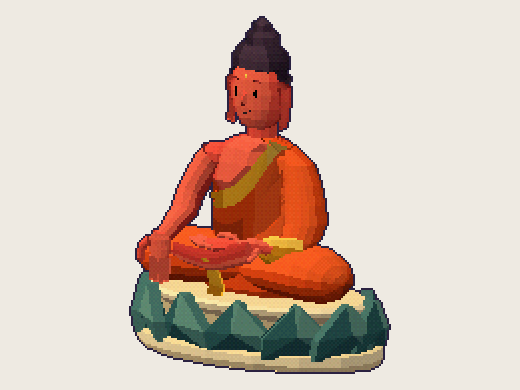
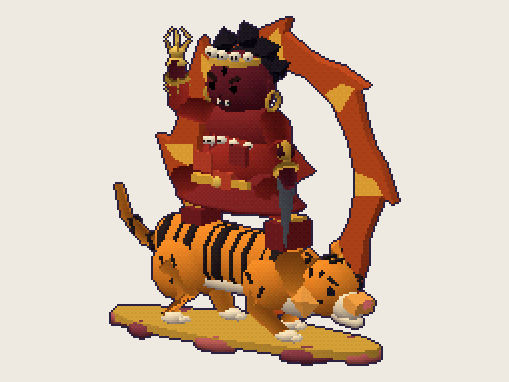
The three fields the game builds as small courts: Ratnasambhava's south, Vairocana's centre and Amoghasiddhi's north, each named by the five-families literature but never described as a landscape.
Śrīmat, 'Endowed with Glory', is Ratnasambhava's southern field. Chokgyur Lingpa calls it Glorious Beauty and places in it the equality palace of immaculate pride. Ratnasambhava is yellow, makes the gesture of giving, and heads the Jewel family. No sutra describes Śrīmat's ground or beings; it is known from the five-families and bardo literature, where he appears on the third day of the bardo of dharmatā with yellow light.
Ghanavyūha-Akaniṣṭha, the Densely Arrayed Highest, is Vairocana's central field. Chokgyur Lingpa sets the mirror-like palace of immaculate ignorance there. The Mahāyāna Ghanavyūha and Laṅkāvatāra traditions make it the saṃbhogakāya realm where Buddhas awaken; the repo keeps it apart from the worldly Akaniṣṭha heaven on Meru. Vairocana is white, in the teaching gesture, head of the Buddha family.
Karmaprasiddhi, 'Accomplished Action' (HAR: Karmaparipūraṇa), is Amoghasiddhi's northern field. Chokgyur Lingpa calls it Fulfilled Activity, the all-accomplishing palace of immaculate jealousy. Amoghasiddhi is green, in the gesture of fearlessness, head of the Action family.
For all three the literature names the field, its direction, its Buddha and its wisdom, and stops. Everything the game puts in them (hospitality tables, jewel towers, water wheels) is adaptation; the records say so.
What canon fixes for the map
Śrīmat, south, Ratnasambhava, equality wisdom, pride purified [LCH; CVG stanza 4]. HAR names it Ratnakūṭa [HAR4514].
Ghanavyūha-Akaniṣṭha, centre, Vairocana, mirror-like wisdom, ignorance purified [LCH; CVG stanza 2]; not the form-heaven Akaniṣṭha [Toh 191 glossary].
Karmaprasiddhi, north, Amoghasiddhi, all-accomplishing wisdom, jealousy purified [LCH; CVG stanza 6]. HAR names it Karmaparipūraṇa [HAR4514].
No source describes their landscapes [ledger south-field, central-field, north-field: 'the field prayer names only the field, its direction and its principal'].
Skt. Khecara (sky-going); Tib. mkha' spyod (Khachö); Vajrayoginī in the form Nāro Khecarī (nā ro mkha' spyod ma)
An elevated jewelled realm in Akaniṣṭha: ruby ground under a red sky, a central palace of five gems with four doors and three floors, red Vajrayoginī within, Vajradharma at the top, ḍākinīs in the air.
Khecara is the pure land of Vajrayoginī in the tradition of the mahāsiddha Nāropa, carried by the Sakya and later the Gelug. It is reached in vision by practice, not by travel. Ngorchen Könchok Lhündrup's Staircase Ascending to Khecara praises it as an elevated jewelled realm with a ruby ground and, at its centre, a palace of five gems: four-sided, with four doors, three floors and a pinnacle.
Vajrayoginī stands within: red, one face, two hands, with a curved knife and a skull cup, encircled by flame, on a double tetrahedron. Above her is the lineage assembly; Vajradharma, the red Buddha of the ḍākinī lineage, sits at the top holding vajra and bell crossed at his heart. Around the palace fly vīras and ḍākinīs, yogis and monks who have attained the realm.
HAR's painting F1997.22.1 shows the whole: the three-storey palace on a great double vajra inside a circular mandala within the greater buddha realm of Akaniṣṭha; six offering goddesses and two animal-headed door guardians on the ground floor; Heruka Cakrasaṃvara and the Sakya gurus of the lineage on the middle floor; Vajradharma at the top; rows of lamas above; Sakya protectors below.
The HAR Mahāsiddha glossary puts Khecara on the same Akaniṣṭha level as Sukhāvatī and Abhirati. The Tsarchen aspiration on the same HAR page recounts visionary access from Oḍḍiyāna and a Ganges island; nothing joins Khecara to the Copper-Coloured Mountain, which the game uses as its door.
What canon fixes for the map
Ruby ground; five-gem palace, four sides, four doors, three floors, pinnacle; Vajrayoginī inside; lineage above; Vajradharma on top; airborne vīras and ḍākinīs [NGOR; HAR2395; repo WGR 'Khecara: primary praise now verified'].
Painted layout: palace on a double vajra in a circular mandala within Akaniṣṭha; offering goddesses and door guardians below; Cakrasaṃvara and gurus mid-floor [HAR 334, Jeff Watt].
A Nāropa-tradition arrangement, not a generic sky island; the red-sky ledges and the passage from Copper are adaptation [WGR; docs/world-plan/places/field-khechara.json gateway.adaptation].
Named a Vajrayāna deity pure land tied to its own source literature [HAR4514].
Rubin Museum of Art, via Himalayan Art Resources · traditional · No open licence (link card)
The whole Khecara: red Vajrayoginī in a three-storey palace on a double vajra inside a circular mandala; six offering goddesses below, Cakrasaṃvara and Sakya gurus on the middle floor, red Vajradharma on top; flying ḍākinīs and yogis in the sky; Sakya protectors at the bottom.
Tib. g.yu lo bkod (Yulokö, 'Arrayed with Turquoise Leaves'); Skt. given as Khadiravana (Acacia/Sandalwood Grove) by HAR and some teachers; Tārā, sgrol ma
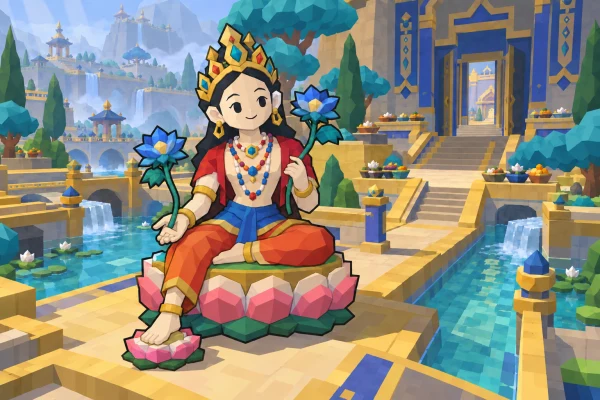
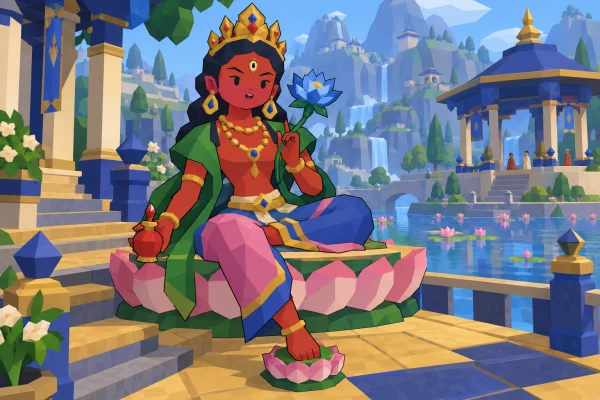
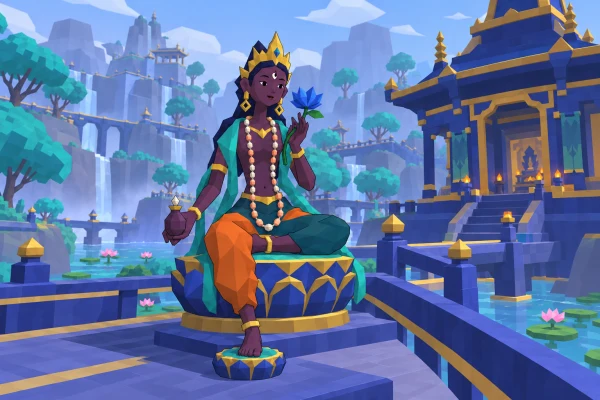
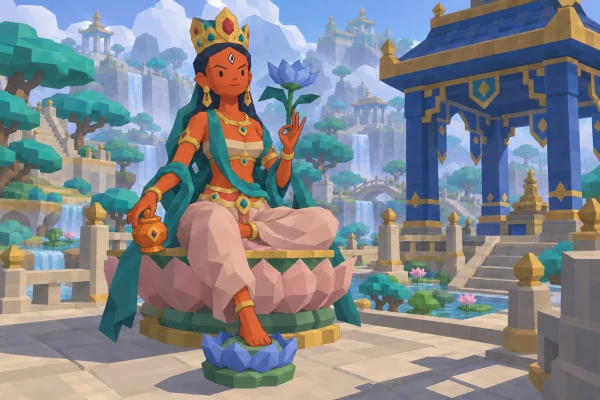
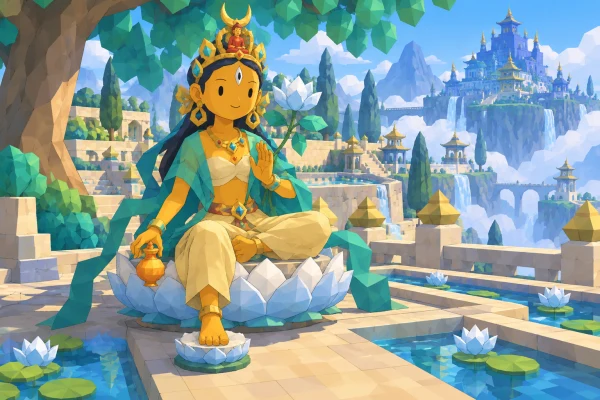
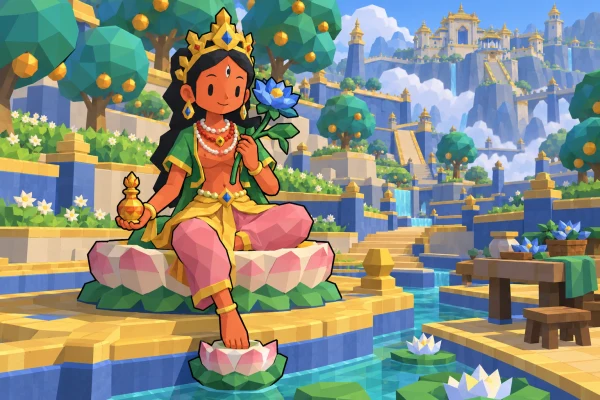
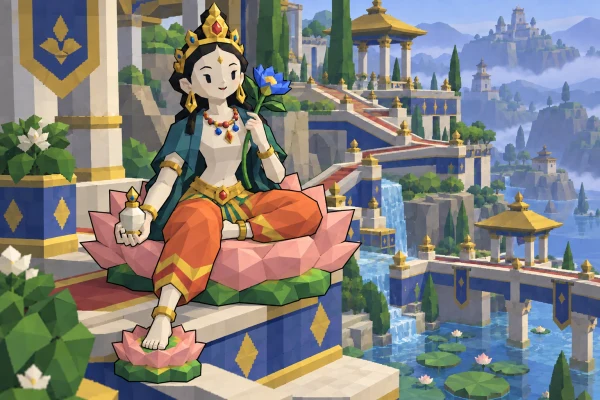
Tārā's own realm: a vast golden ground with eight-quality pools and fruit trees, Dharma-speaking birds and beasts, and at its centre a transparent lapis palace, square with four doors, where Tārā sits amid her twenty-one forms and ḍākinīs.
Sera Khandro's aspiration describes the Land of Turquoise Leaves as the supreme realm of perfect purity, self-arisen and spontaneously perfect: a vast golden ground, bathing waters and pools with the eight qualities, trees, flowers and fruits of many kinds, and the sweetest incense in every direction. Birds and wild animals proclaim the Dharma; divine youths, male and female, constantly offer gifts and praise.
In the centre, on a carpet of jewels, stands an immense mansion of lapis lazuli, a spontaneously arisen palace delightful to behold: transparent inside and out, square with four main doors, with steps, porticoes, Dharma wheels, banners of victory, parasols and ornaments. Tārā sits within, surrounded by Buddhas and bodhisattvas, her twenty-one forms and hundreds of thousands of ḍākinīs, all proclaiming the Dharma of Secret Mantra without interruption. The aspirant prays that by remembering Tārā they will be reborn there directly.
Painters show Tārā's land as a green wooded grove: HAR calls it the Sandalwood Grove, Khadiravana, and sets story vignettes and the twenty-one Tārās around her. Where other pure lands are jewel and mineral, Turquoise Leaves is living and organic. Some teachers (Bokar Rinpoche, following the Potalaka tradition) place Tārā with Avalokiteśvara on Potalaka instead; the two accounts stand side by side.
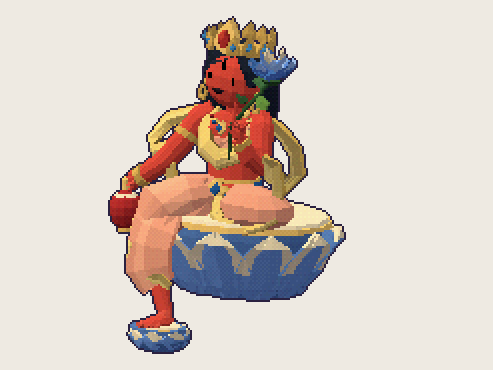
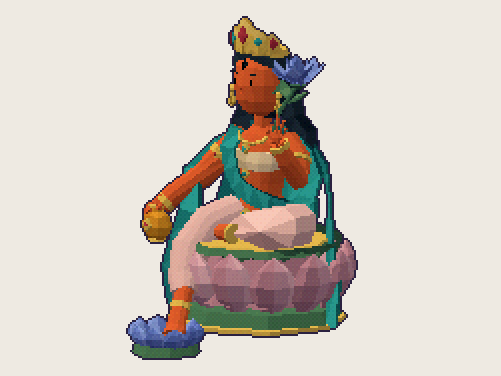
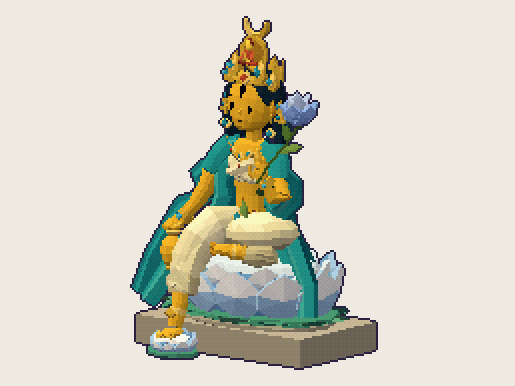
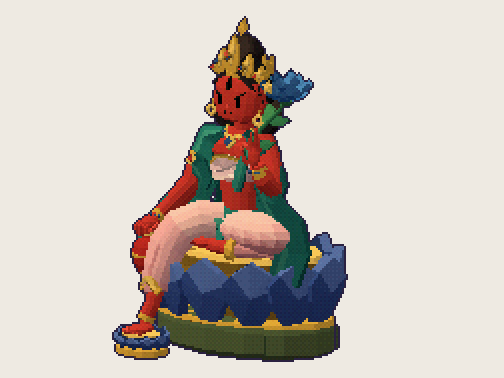
Tārā's rescue from the eight dangers (lions, elephants, fire, snakes, robbers, waters, disease, demons) is the sutra ground for the game's grove on this side of the arch; the grove itself is the game's invention.
What canon fixes for the map
Golden ground, eight-quality pools, fruit trees, incense [SKT lines 1–6]. Dharma-speaking birds and beasts [SKT 5]; divine youths offering [SKT 7–8].
Central lapis palace: on jewels, transparent, square, four doors, steps, porticoes, wheels, banners, parasols [SKT lines 9–16].
Tārā surrounded by Buddhas, bodhisattvas, twenty-one forms and ḍākinīs teaching Secret Mantra [SKT lines 19–22]. Rebirth there by remembering her [SKT 38–42].
Name: Yulokö (Turquoise Leaves) in the Tibetan aspiration; Khadiravana (Sandalwood/Acacia Grove) in HAR's catalogue and some teachers; a naming conflict, not two lands [SKT; HAR 310].
The arch from the grove is a game link; the grove is invented [docs/world-plan/places/field-turquoise-leaves.json and tara-grove.json gateway.adaptation].
Who lives here
Tārā (being:tara-grove:tara, built) [TED]
Her twenty-one forms (being:tara-atisha-01…21, built) [T438]
The Buddhas and bodhisattvas around her (being:turquoise-leaves:buddhas-bodhisattvas, missing) [SKT 19–22]
The ḍākinīs (being:turquoise-leaves:dakinis, missing) [SKT 20–22]
The divine youths (being:turquoise-leaves:divine-youths, missing) [SKT 7–8]
The Dharma-speaking birds and animals (being:turquoise-leaves:birds-animals, missing) [SKT 5]
In the game now
Built as a hidden zone (built-field-turquoise-leaves below). Samsara: place:field-turquoise-leaves (built), place:turquoise-leaves:palace (built); the four being groups above are missing.
Still missing: No open-licence painting of Tārā's pure land with the lapis palace; HAR 310 and 65257 are link cards. Tāranātha-tradition paintings were not found on open-licence sites.
Zangdok Palri, the Copper-Coloured Mountain of Glory on Cāmara
Tib. zangs mdog dpal ri; the island rnga yab gling (Ngayab Ling), Skt. Cāmaradvīpa; the palace Padma 'od (Lotus Light)
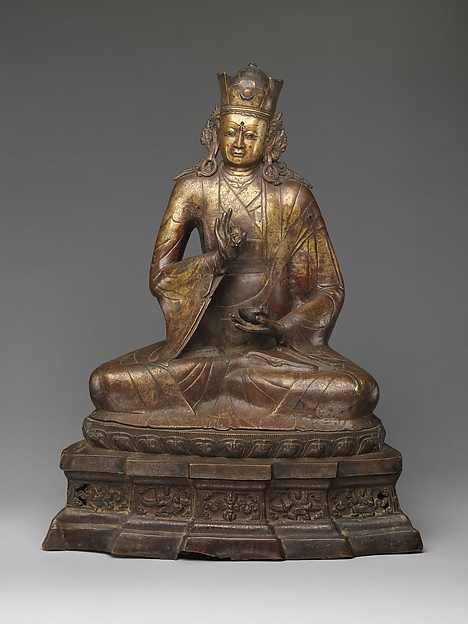
South-west of Tibet on the rākṣasa isle Cāmara, a heart-shaped mountain rooted among nāgas, girdled by ḍākinīs and topped in the form heavens, amid eight rākṣasa isles, with the three-storey palace of Lotus Light where Guru Rinpoche holds court.
South-west of Tibet and north-west of the Vajra Seat lies Cāmara, the rākṣasas' domain, the country of Laṅkā, and in it the mountain. It takes the form of a warrior's heart: its base deep in the nāgas' realm, its slopes in the abodes of the ḍākinīs, its summit reaching the heavens of the form-realm gods. Chokgyur Lingpa sees it as a heart-shaped jewel amid eight rākṣasa isles, its forests full of ḍākinīs, birds and deer under skies of rainbow light.
Reaching Ngayab Ling, the Guru went to the summit, liberated Raksha Tötreng, king of the rākṣasas, and took his form. On the summit he created the palace of Lotus Light with inconceivable adornments, and sent a replica of himself to each of the eight surrounding isles: the eight kings who teach the Eight Pronouncements (Kagyé).
The courtyards have wish-fulfilling trees, bathing pools of nectar, soft grass and wide gardens where incarnate birds, cuckoos and the like, sing the Dharma. In the heart of the palace, on an eight-cornered jewel, a lotus and sun and moon seat, Padmākara sits as all the sugatas in one. Around him in rows: the vidyādharas and paṇḍitas of India and Tibet, the eighty siddhas, the king and twenty-five subjects, tertöns, in postures of vajra dance; ṛṣis, vidyādharas, flocks of birds and swarms of bees quiver with Dharma sound; in every direction yidams of the four and six tantras, throngs of vīras and ḍākinīs crying phaṭ and pheṃ, gods and goddesses with clouds of offerings. In the outer court and at the four gates: the seventy protectors, the twenty-eight īśvarīs, the oath-bound guardians, the four great kings and the eight classes beating their victory drum.
The aspirant prays to be born there not from a rākṣasa womb but spontaneously from a blue lotus in the amṛta pools, to join the vidyādhara lords and ladies and behold the Lotus-Born, as the ḍākinīs once led Kharchen Za (Yeshe Tsogyal) and Yuthok by the hand. HAR's survey of some fifty paintings: the mountain and palace at the centre of the canvas, surrounded by water; Amitābha on the top floor, Avalokiteśvara on the middle, Padmasambhava on the ground floor ringed by his eight forms; the land below the mountain full of wild, fearsome demons; the attendant figures varying by Nyingma sub-lineage.
What canon fixes for the map
Position: south-west of Tibet, north-west of the Vajra Seat; on Cāmara, the rākṣasa land of Laṅkā [CSW verses 2, 4, 5].
Shape: a warrior's heart; base in the nāga realm, slopes among ḍākinīs, summit in the form heavens [CSW 4–5]. A heart-shaped jewel amid eight rākṣasa isles [CTA line 3].
Raksha Tötreng liberated and his form assumed; palace of Lotus Light created; eight emanated kings on the eight isles [KPL p. 9].
Courtyards: wish trees, nectar pools, grass, gardens, Dharma birds [CSW 8]. Blue-lotus birth in the amṛta pools [CTA 21–26].
Assembly rows and gate guardians as listed [CSW 10–15; SPM 6–11; DJC 5].
Painted canon: three floors (Padmasambhava, Avalokiteśvara, Amitābha), eight forms on the ground floor, water round the mountain, demons below [HAR491].
The Potalaka ferry is a game link; the sources support a sea crossing south-west, not adjacent coasts [docs/world-plan/places/copper-mountain.json gateway.adaptation; WGR].
Who lives here
Padmasambhava (being:guru-form-04, built) and his eight forms (being:guru-form-01…08, built)
Raksha Tötreng, king of the rākṣasas (being:copper-mountain:raksha-totreng, sketch) [KPL 9]
The eight kings on the isles (being:copper-mountain:eight-kings, sketch) [KPL 9]
The rākṣasas of Cāmara (being:copper-mountain:rakshasas, built) [CSW 2]
Vidyādharas and paṇḍitas (being:copper-mountain:vidyadharas, built); the eighty siddhas, king and twenty-five subjects, tertöns, ṛṣis (missing) [CSW 10; SPM 6, 10]
Photo gje, Wikimedia Commons · photo · CC BY-SA 4.0
A built Zangdok Palri temple: three tiered roofs for the three floors, the Guru's mantra over the door; a modern architectural reading of the palace of Lotus Light.
Still missing: All Zangdok Palri paintings found are HAR/Rubin link cards; no open-licence painting of the mountain, the eight isles or the palace. The Rewalsar photo is architecture, not a thangka.
nirmāṇakāya: Padmākara; saṃbhogakāya: Padmapāṇi, Lord of the World (Avalokiteśvara); dharmakāya: Samantabhadra as Amitābha
Jigme Lingpa's guidebook stacks the three kāyas in the palace: the Guru's throne at the heart, a limitless palace of Avalokiteśvara above, and highest the joyful dharmakāya land where Samantabhadra as Amitābha teaches an entourage no different from himself.
In the heart of the vast palace, on an eight-cornered jewel with a lotus and sun and moon disc seat, Padmākara spontaneously appears as all the sugatas in one, embodying the three kāyas, resplendent in rainbow light. This is the ground floor of the paintings, where the Guru sits ringed by his eight forms.
Above lies the palace of the saṃbhogakāya, limitless, an array of utter beauty, where Padmapāṇi, Lord of the World, presides, encircled by an entourage beyond imagination, destroying discursive thought and habitual patterns.
Above that, in the joyful pure land of the dharmakāya, Samantabhadra, the appearance from the ground and essence of primordial wisdom, as Amitābha, Limitless Light, symbolically grants teachings to an entourage no different from his own awareness, where teacher and disciples have equal realization.
HAR's painters put Amitābha on the top floor and Avalokiteśvara in the middle, matching Jigme Lingpa; the FPMT Zangdok Palri temple reads the top as Amitāyus. The repo's rule: the upper floors are shrine or vision appearances, never duplicate living bodies of Avalokiteśvara and Amitābha, and never three worldly heavens.
What canon fixes for the map
Ground: eight-cornered jewel seat, Padmākara as all sugatas in one [SPM verse 7].
Middle: limitless saṃbhogakāya palace of Padmapāṇi [SPM 12].
Top: dharmakāya land, Samantabhadra as Amitābha [SPM 13].
Painted order: Padmasambhava, Avalokiteśvara, Amitābha from the ground up [HAR491].
Upper floors as vision, not residents; not three heavens [ledger three-kayas disposition].
Who lives here
Padmasambhava on the ground floor (built)
Avalokiteśvara, thousand-armed, on the middle floor (being:chenrezig:thousand-armed, built; the same person as Potalaka's four-armed form)
Samantabhadra as Amitābha, a vision of light at the top, never reached (dossier copper-samantabhadra-amitabha-vision)
In the game now
Samsara: place:three-kayas:nirmanakaya, :sambhogakaya, :dharmakaya (built) inside copper-mountain.palace. The top floor is a vision of light the player never reaches.
Rainbow body: the places where masters dissolved into light
Tib. 'ja' lus; the great transference, 'ja' lus 'pho ba chen po
Not a land but a departure: Dzogchen masters whose bodies dissolved into rainbow light at named places, which the game marks with an empty robe and a faint rainbow in the Copper Mountain's practice cave.
Dzogchen accounts tell of accomplished practitioners whose material bodies dissolve into rainbow light at death. Dudjom Rinpoche says that in this lineage, today as in the past, there are those who through Trekchö and Tögal have reached the final realization and dissolved their gross body into the rainbow body of radiant light.
Named cases: Śrī Siṃha, whose last testament The Seven Spikes fell from the sky into Jñānasūtra's hands as he attained the rainbow body; Jñānasūtra himself, after teaching Vimalamitra; Vimalamitra, who after thirteen years in Tibet returned to Wutai Shan in China and achieved the rainbow body of great transference, living on for centuries; Nyang Tingdzin Zangpo, one of the few said to have attained the great transference; Chetsün Sengge Wangchuk, who past a hundred entrusted his lineage to Shangtön Tashi Dorje and dissolved into rainbow light at the cave of Oyuk.
The game does not depict or teach the practice. The empty robe and faint rainbow in the Copper Mountain's practice cave are an environmental allusion, not the death of a particular teacher.
What canon fixes for the map
Rainbow body through Trekchö and Tögal [DRT]. Śrī Siṃha and Jñānasūtra [HVB pars. 5, 7]. Vimalamitra at Wutai Shan, great transference [HVB par. 11; YLB stanza 3 n. 1]. Nyang Tingdzin Zangpo [KCC note 13]. Chetsün at Oyuk [HCS par. 5].
Game: an allusion only [ledger rainbow-body disposition].
Practitioners of the lineage (being:rainbow-body:practitioners, missing)
In the game now
Samsara: place:rainbow-body:oyuk and place:rainbow-body:wutai-shan (missing); the robe and rainbow are in copper-mountain.courtyard's practice cave. Wutai Shan is also Mañjuśrī's Five-Peaked Mountain on the Human page.
Art (0)
Still missing: No art: rainbow-body events are not a painted subject in open collections, and the repo has no capture of the cave's robe.
Avalokiteśvara's mountain is on Jambudvīpa, in the southern sea, and is covered on the Human page; it is listed here only because its ferry is the game's door to the Copper-Coloured Mountain.
Potalaka is a bodhisattva's residence on the human continent, not a buddha-field. The Stem Array sets it in the southern region, in the centre of the king of waters, with jewel trees, parks, lotus ponds and streams, and Avalokiteśvara teaching on a diamond rock in a grove on its western slope. HAR lists it among bodhisattva pure lands beside Mañjuśrī's Five-Peaked Mountain and Maitreya's Tuṣita.
Its 18 samsara items (place:potalaka:mountain and :western-grove built; the Marvelous Display of Buddhafields assembly mostly missing) are described on the Human page. The only pure-land fact here: the ferry from Potalaka's pier to Cāmara is a game link; no checked text puts the two coasts side by side.
What canon fixes for the map
Southern region, in the sea, western-slope grove [SA 29.19–29.21, 30.2].
A bodhisattva pure land on Earth, not a buddha-field [HAR4514].
Ferry to Cāmara is adaptation [docs/world-plan/places/copper-mountain.json gateway].
In the game now
See the Human page. place:potalaka:mountain, place:potalaka:western-grove (built).
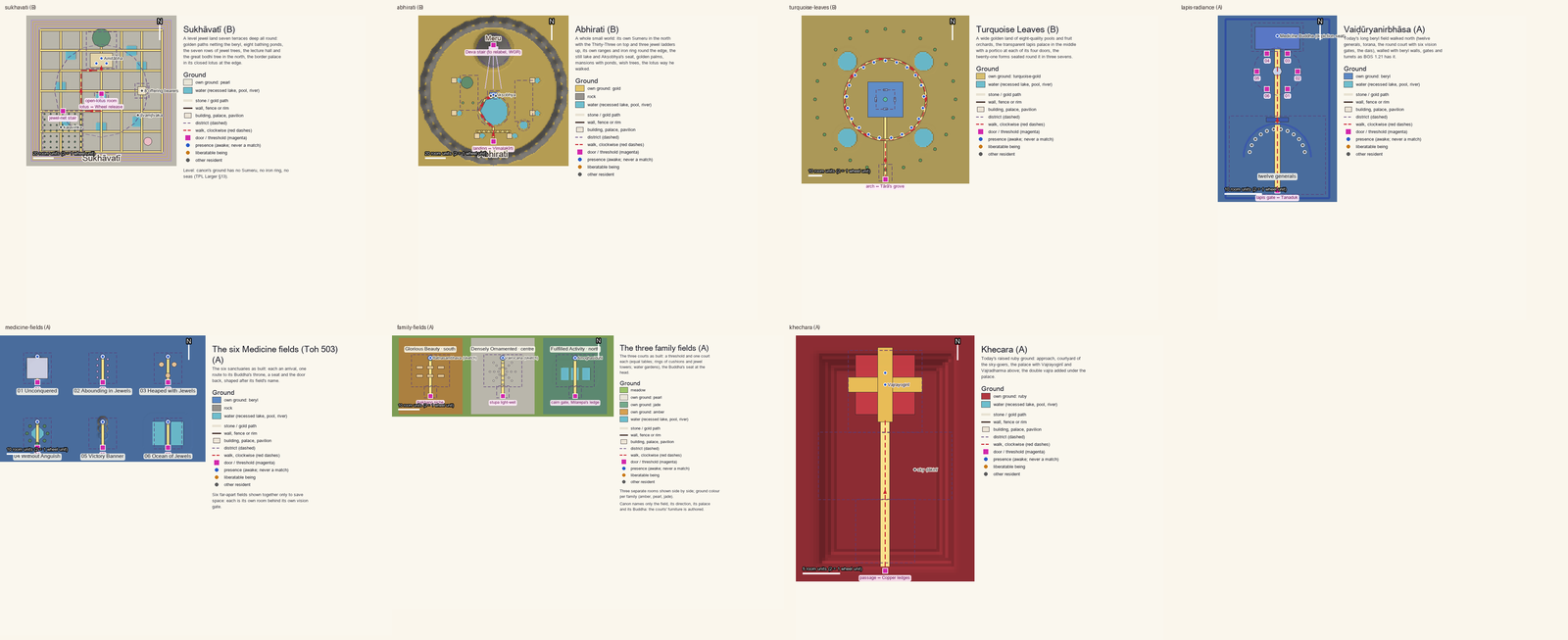
One round jewel garden walked clockwise: lotus arrival, jewel orchard with a stair down to the jewel-net room, bathing pond ringed by 24 gold pavers with a room in an open lotus, gathering pavilion, and an aisle north between the two attendants' seats to Amitābha's distant throne.
The zone is a loop, clockwise from above: the lotus arrival pad (south), the jewel orchard (west) with a stair down to the jewel-net observatory, the bathing pond (north) ringed by a lane of 24 gold pavers and holding the room in an open lotus, the gathering pavilion (east), and back. From the pond an aisle runs north between the two attendants' seats to Amitābha's lotus throne, far off and very large. Five districts: sukhavati.arrival, .orchard, .pond, .pavilion, .assembly.
The gateway is the Wheel's exterior. In wheel-exterior.release ('The Buddha pointing beyond the Wheel', after Rubin C2004.21.1) the standing Buddha on his cloud at [118, 294] carries an optional field gateway, wheel-exterior.release.gateway-sukhavati, reached from the Wheel's crown along the east scarf loop to its crest and one cloud step onto his cloud. The section record says walking here does not claim liberation or a literal continent beyond the Wheel; the return is back through the same lotus threshold, and the ending does not replay. The release Buddha points toward teachings and liberation symbols, not the old crescent moon; the Robert Beer composition with Amitābha at upper right is noted as an alternative, not an identity.
Residents: Amitābha, the two teaching birds, the eight offering bearers and their ensemble, three white birds. Ledger pending: the attendants' seats await a chosen composition (Avalokiteśvara and Vajrapāṇi as representations or visits, not duplicate bodies); the border lotus is held until a longer-sutra account is chosen; the jewel-net observatory is a wider Mahāyāna visualization.
What canon fixes for the map
Canon supports rebirth by aspiration, not a walked gate; the lotus threshold on the release cloud is adaptation [sukhavati.json gateway.adaptation; wheel-exterior.json release.entrances note].
The ring of 24 pavers, the orchard stair, the open-lotus room and the pavilion are authored; the sutra's jewel ponds, trees, nets and lotus birth are what they stand for [SSV 1.3–1.6; TPL Larger §§14–20].
Teaching birds are not liberatable [SSV 1.6; ledger sukhavati-birds].
Groups of three and eight follow the game's grouping rule, not a canonical count [sukhavati.json characters reasons].
Who lives here
Amitābha (awake): on his lotus throne at the north end of the aisle, far off and very large (sukhavati.assembly)
Kalaviṅka (teaching bird, not liberatable): in the jewel orchard
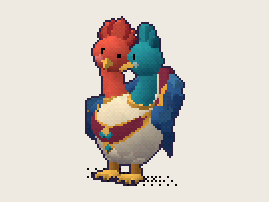
Jīvaṃjīvaka (two-headed teaching bird, not liberatable): at the bathing pond
The eight offering bearers: water, washing-water, flower, incense, lamp, fragrance, food and music (sketch records), the ensemble 'Offering goddess' ×8 (built, one ensemble, never eight more bodies)
White birds ×3 (ambient, an authored group of three)
In the game now
Built zone, 5 districts, 13 character records. Samsara: place:sukhavati:land, :ponds, :jewel-trees, :bell-nets (built); :palaces (missing); :bodhi-tree, :lecture-hall (built: behind and beside Amitābha's throne); being:sukhavati:amitabha, :kalavinka, :jivajivaka, being:offering-goddess, being:ambient-white-birds (built); attendants (sketch).
Built: Abhirati, one shore on a lake that never moves
interiors abhirati, abhirati:heaven
One small shore on a still lake with Akṣobhya's blue pavilion and three jewel ladders to its own divine terrace, entered by leaning into a tiny land on Vimalakīrti's table.
Clockwise round the lake from the first pool (north-east): the low pier, the still-water court of eight lotus lamps on the east shore, the blue pavilion on the south shore with Akṣobhya's seat in earth-witness posture, three jewel ladders behind it, the two-layer garden wall on the west shore (a path found by its reflection from the pier), and the outer shore. The ladders climb to Abhirati's own divine terrace (abhirati:heaven, an octagon of radius 7.5); a separately authored portal there leads to the Deva palace.
From the pure land's side: the zone keeps Toh 50's Akṣobhya, its Thirty-Three heaven and Vimalakīrti's three ladders; his bodhi tree stands in the lake behind his seat, and one storied mansion with its pond on a meadow across the water; its golden palms, wish trees and lotus footprints are built as map-table assets awaiting placement. Three lake birds cross so the water is seen not to move; a yakṣa and a deva of the shore attend the seat.
Gateway: Vimalakīrti's room (vimalakirti.room.gateway-abhirati, the tiny blue land on his table) and, as a second authored entry, the reflection of a blue mountain in the Human town's still pool. Both return to their callers; the Deva stair portal never clears a realm gate.
What canon fixes for the map
Akṣobhya's field is shown to the assembly by Vimalakīrti, lifted whole [VKN 11.13–11.18]; the tabletop, pool and Deva stair are game access [abhirati.json gateway.adaptation].
Three jewelled ladders to its Thirty-Three are canon [VKN 11.14; AKV 2.47–2.48]; the octagon terrace and the Deva portal are authored.
The research note asks that the separate Deva stair be relabelled or rerouted, and that Akṣobhya never be duplicated [WGR Abhirati row].
Who lives here
Akshobhya (awake): seated in the earth-witness posture beside the water at Abhirati: right hand presses toward the earth, left lap hand lifts to receive a visitor
Yaksha of the Shore (attendant): Abhirati: in the sutras yakshas vow to guard the Dharma and those who keep it; this one keeps the cushion beside Akshobhya's seat and carries for the
Deva of the Shore (attendant): a god come down Abhirati's jewel stair to sit near Akshobhya (Vimalakirti sutra), cross-legged on the shore tending the basket (enter with 'sit', leav
The lake birds (bound, liberatable, x3): They cross the lake so that it can be seen not to move
In the game now
Built zone, 6 districts, 4 character records. Samsara: being:abhirati:akshobhya, :gods, being:ambient-abhirati-birds, being:four-kings:yakshas (built); place:abhirati:land, :meru, :trayastrimsa, :ladders (built); :bodhi-tree, :golden-palms, :lotuses, :wish-trees, :mansions (sketch: map-table assets, not yet placed); :brahma, :sravakas, :bodhisattvas, :humans, :newcomers, Gandhahastin, Gajagandhahastin (missing).
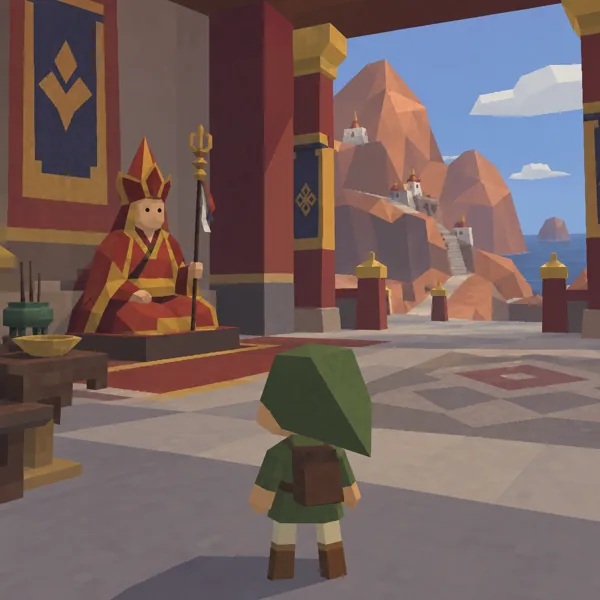
An island in open ocean: dark-sand rākṣasa shore and quay, three white banners at the one gate, practitioners' courtyard with the practice cave, the paved band of eight Guru stations, and the palace of three floors with the lamp chamber and red-sky ledges behind.
South: the stone quay and the dark-sand rākṣasa shore (a family at dinner, a tide pool, a guard at the one gate in the courtyard wall). Three white banners inside the gate mark the change from Cāmara's shore to the sacred mountain. Middle: the practitioners' courtyard with three worn cushions, a bench of wrapped bundles, a water jar, a garden of eight shrubs in its south-west corner and the practice cave in the west wall (the empty robe and faint rainbow). Along the palace front, a paved band of eight stations for the eight forms of the Guru; the fourth is an arch through which the Guru is seen on his throne.
North: the palace of three floors (the Guru's throne; thousand-armed Avalokiteśvara above; a vision of light at the top, never reached), the lamp chamber off the middle floor (the far doorway reads only once three lamps are lit), and through a balcony slit the red-sky ledges, three ledges on a clockwise path toward Khecara.
From the pure land's side: of Zangdok Palri's canon the zone has the rākṣasa shore, the gardens, the palace of Lotus Light and its three kāya floors, the eight forms, Yeshe Tsogyal, Mandarava, vidyādharas, ḍāka and ḍākinī, a snow lion. It lacks the heart shape, the nāga base and form-heaven summit, the eight isles and their eight kings, Raksha Tötreng, the nectar pools and blue-lotus births, the outer court of seventy protectors and the four kings at four gates, and the many assemblies (17 missing being items).
Gateway: only Potalaka's pier ferry (human.potalaka.entrance-3); the harbour's old gateway is retired. The return boat leaves the shore for the pier. Twenty-one character records; keepsake a copper bell; palette copper, dark sand, red sky.
What canon fixes for the map
Cāmara south-west of the human continent is canon; adjacent coasts with Potalaka are not [CSW 2; copper-mountain.json gateway.adaptation].
Three floors are Jigme Lingpa's hierarchy; upper floors are visions, not residents [SPM 7, 12, 13; ledger three-kayas].
Eight forms are one Padmasambhava at stations [ledger eight-gurus]. The band, the lamp chamber and the ledges are authored.
Missing canon: place:copper-mountain:eight-isles; Raksha Tötreng and the eight kings (sketch) [CTA 3; KPL 9].
The shore strip is contested ground between the rākṣasa land and the sacred mountain (shoreRealm) [proposal risks].
Who lives here
Padmasambhava (awake): This is his mountain and his palace: he sits where every student in the courtyard can see him
Guru Tsokye Dorje (awake): Guru Tsokye Dorje: one of the eight forms of the one Guru, shown at its own station before his palace
Guru Shakya Senge (awake): Guru Shakya Senge: one of the eight forms of the one Guru, shown at its own station before his palace
Guru Nyima Ozer (awake): Guru Nyima Ozer: one of the eight forms of the one Guru, shown at its own station before his palace
Guru Loden Chokse (awake): Guru Loden Chokse: one of the eight forms of the one Guru, shown at its own station before his palace
Guru Pema Gyalpo (awake): Guru Pema Gyalpo: one of the eight forms of the one Guru, shown at its own station before his palace
Guru Senge Dradrok (awake): Guru Senge Dradrok: one of the eight forms of the one Guru, shown at its own station before his palace
Guru Dorje Drolo (awake): Guru Dorje Drolo: one of the eight forms of the one Guru, shown at its own station before his palace
Avalokiteshvara — thousand-armed (awake): The palace's middle level is Avalokiteshvara's: his thousand-armed form stands there. He is the same person as Potalaka's four-armed Avalokiteshvara
Yeshe Tsogyal (attendant): The Guru's foremost student: she stands at the courtyard's north-west, nearest the palace
Mandarava (attendant): The Guru's student: she keeps the west side of the courtyard, by the practice cave
Vidyadhara practitioner (attendant): One of the realized practitioners of the Guru's assembly: he sits at the practice cave
Retreat practitioner (bound, liberatable): A student still on the way: he sits on one of the three worn cushions
Lamp tender (bound, liberatable): Keeps the palace lamps: he works between the courtyard water jar and the lamp chamber door
Daka (bound, liberatable): One of the dakas who make offerings on the mountain: he keeps the courtyard's east side
Dakini of the Copper Halls (bound, liberatable): Guru Rinpoche's Copper-Coloured Mountain is crowded with dakas and dakinis making offerings; she dances in its halls
Snow lion (bound, liberatable): The mountain's lion: it lies at the east foot of the palace, by the stair tower
The Gate Rakshasa (bound, liberatable): fills the gateway, counts his teeth with a fingertip, loses count (setback) and starts again
The rākṣasī on the shore (bound, liberatable): A rakshasi of Camara at her dinner table on the dark sand
The rākṣasa child (bound, liberatable): Her child, practising scary faces in the tide pool's reflection
Sky Dakini (bound, liberatable): An authored sky-dakini visitor on Copper Mountain’s approach ledges; these ledges are not the distinct Khechara field
In the game now
Built zone, 5 districts, 21 character records. Samsara copper-mountain group: 28 items, 4 built beings, 3 sketch, 17 missing; places :zangdok-palri, :lotus-light-palace, :gardens built, :eight-isles missing; three-kayas 3 built.
Still missing: No capture of the island, shore or palace in the repo; the Atlas captures cover residents only. HAR's Copper Mountain paintings are link cards.
A round green valley (the game's invention) where Tārā's pavilion and the eight personified dangers sit on one clockwise loop, with a turquoise arch on its east side into the pure field.
Clockwise from above: the fern crack (south), up a rock spine to the high rock and lookout (west), along the spine as it becomes the bent tree's roots and over the stream on them (north), down to Tārā's open pavilion (north-east), through the flower garden and the water garden (east), over the stream crossing and back. Under the roots is one warm dry chamber. On the east side, past the water garden, a low turquoise arch leads into Turquoise Leaves.
Residents: Green Tārā (one identity; the twenty-one forms beyond the arch are her appearances), the eight dangers as people and beasts (the robber in the ferns, the one the flood took, the lion on the high rock, the woman in her own chains, the coiled one, the doubter, the elephant in the mud, the ember child), a grove caretaker, a waiting sheep, a pika, a grove guardian and three pool fish.
From the pure land's side: this grove is not Turquoise Leaves and not Khadiravana; it is the game's threshold, grounded only in Tārā as refuge from the eight dangers. The ledger forbids claiming the fear characters as a canonical retinue. Gateway: an authored fern crack in Anavatapta's ox-mouth grotto (spring-ox.grotto); a secondary root path to the Animal orchard.
What canon fixes for the map
The grove and its door are invented; the sources give Tārā as refuge from eight dangers and no grove behind a spring [tara-grove.json gateway.adaptation; TED 1.20–1.27].
Fear personifications are not a canonical retinue [ledger tara-grove pending].
Eight dangers: lions, elephants, fire, snakes, robbers, waters, disease, demons [TED 1.27]; the game personifies seven plus 'the doubter', and 'infectious diseases' is missing (being:tara-grove:danger-disease).
Who lives here
Green Tara (awake): The grove is hers: she sits in its pavilion with one foot down, ready to rise for whoever is afraid
The robber in the ferns (bound, liberatable): Sits on his sack in the ferns by the way in, watching who comes
The one the flood took (bound, liberatable): Hangs from the branch that dams the ford, still holding on though the water is shallow
The lion on the high rock (bound, liberatable): Held on the high rock by pride: he will not climb down while anyone watches
The woman in her own chains (bound, liberatable): Wrapped in chains she keeps closed herself, beside the root path
The coiled one (bound, liberatable): Coiled tight round the pavilion's outer post, as near Tara as envy lets it come. The coil stays on the post and never crosses her figure
The doubter (bound, liberatable): Hesitates on the ledge behind the pavilion, in sight of Tara and unable to step down
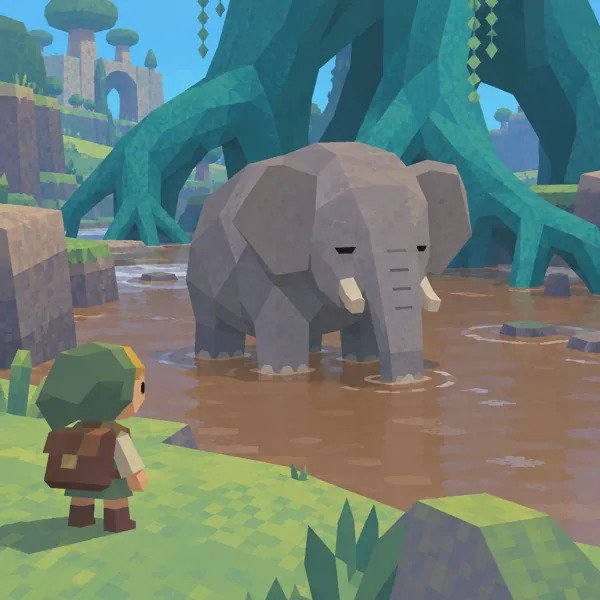
The Elephant in the Mud (bound, liberatable): Stuck knee-deep in the garden's mud, too stubborn to back out
The ember child (bound, liberatable): Curled on a garden stone, glowing with a temper that has nothing left to burn
Grove Caretaker (bound, liberatable): Took refuge here with his lame sheep and stayed: he tends the flower garden
Waiting Sheep (bound, liberatable): Tara saves from the eight dangers; the caretaker and his lame sheep took refuge in her grove and stayed
Grove Pika (bound, liberatable): keeps to its nook among the roots and rocks of Tara's grove, where the eight fears pass it by
Grove Guardian (bound, liberatable): Guards the root path, the grove's back way out to the Animal realm
The three pool fish (bound, liberatable, x3): They live in the sunny pool and want the shade
In the game now
Built zone, 5 districts, 14 character records. Samsara: place:tara-grove (built); being:tara-grove:tara (built); eight fear beings built; danger-* items sketch; danger-disease missing.
A raised ruby ground under a red sky: an approach, an open courtyard where the sky-goers gather, and the central five-gem palace, four-sided with four doors and three floors under a pinnacle, Vajrayoginī at its centre and Vajradharma seen at the top.
South: the approach from the Copper ledges. Middle: an open courtyard where the sky-goers gather. North: the central palace of five gems, four-sided with four doors and three floors under a pinnacle; Vajrayoginī stands at its centre and Vajradharma is seen at the top (today only as a window depiction). Three districts: field-khechara.approach, .courtyard, .palace.
From the pure land's side: the ruby ground and palace follow Ngorchen's praise, the arrangement the research note verified (HAR set 2395). Not yet built: the double vajra and circular mandala the paintings set the palace on, the six offering goddesses and two door guardians of the ground floor, Cakrasaṃvara and the lineage gurus on the middle floor, the flying vīras and ḍākinīs and the protectors' register.
Gateway: khechara-passage at [4.04, -2.21] on the far red-sky ledge behind the Copper palace (copper-mountain.ledges); the gate behind the arrival returns to the ledge. The ledges themselves are an authored inter-field transition; no text makes Khecara the Copper Mountain's neighbour.
What canon fixes for the map
Ruby ground, five-gem palace, four doors, three floors, pinnacle, Vajrayoginī, Vajradharma on top: canon [NGOR; HAR2395; WGR].
Crossing from Copper is adaptation [field-khechara.json gateway.adaptation; WGR Copper → Khecara row].
Keep the no-gore simplifications and teacher identities when matching the painted arrangement [WGR plan].
Who lives here
Vajrayogini — Naro Khechari (awake): Khechara is her field and this is its central palace
Vajradharma (awake): The praise puts Vajradharma at the top of Vajrayogini's palace, above her
In the game now
Built room, 3 districts, 2 character records. Samsara: place:field-khechara (built); being:field-khechara:principal (built); being:vajradharma (built); being:copper-mountain:khechara:dakini:1 (sketch).
Golden ground, a living garden with two pools and turquoise-leaf trees, a luminous lapis palace across the north, and the twenty-one Tārās seated on a ring about an empty central throne under a halo of eight turquoise leaves.
She arrives from the south. The twenty-one forms sit on a ring about the centre in three groups of seven, clockwise from above: the palace arc across the north (forms 1 to 7), the east pool (8 to 14), the west pool (15 to 21), in the written order of the Praise. At the centre is one empty lotus throne under a halo of eight turquoise leaves, a depiction of the grove's Tārā: she is one identity, met in the grove. Five districts: approach, centre, palace-arc, east-pool, west-pool.
From the pure land's side: the golden ground, the pools, the trees, the incense and the lapis palace come from Sera Khandro's aspiration; the measured ring, the three garden groups and the Atīśa forms are labelled staging. Not yet present: the palace's transparency, four doors, steps and porticoes as a walkable building; the Buddhas and bodhisattvas, ḍākinīs, divine youths and Dharma-speaking birds and beasts.
Gateway: the low turquoise arch at the grove's east edge (tara-grove.gardens.gateway-field-turquoise-leaves at [10.3, -1.6]); return beside the arch.
What canon fixes for the map
Setting from Sera Khandro [SKT 1–16]; the ring and groups are staging [field-turquoise-leaves.json layout].
Rebirth there by remembering Tārā, not a doorway in a wood [SKT 38–42; gateway.adaptation].
Twenty-one forms per the Praise [T438]; the game uses the Atīśa iconographic set (dossiers tara-atisha-01…21).
Who lives here
Tara 01: Heroic swiftness (awake): Sits in lotus station 1 of the twenty-one-form garden assembly, one leg folded and the extended foot supported, raising the utpala, offering the vase
Tara 02: Autumn-moon whiteness (awake): Sits in lotus station 2 of the twenty-one-form garden assembly, one leg folded and the extended foot supported, raising the utpala, offering the vase
Tara 03: Golden radiance (awake): Sits in lotus station 3 of the twenty-one-form garden assembly, one leg folded and the extended foot supported, raising the utpala, offering the vase
Tara 04: Tathagata crown (awake): Sits in lotus station 4 of the twenty-one-form garden assembly, one leg folded and the extended foot supported, raising the utpala, offering the vase
Tara 05: Hum proclamation (awake): Sits in lotus station 5 of the twenty-one-form garden assembly, one leg folded and the extended foot supported, raising the utpala, offering the vase
Tara 06: Three-world victory (awake): Sits in lotus station 6 of the twenty-one-form garden assembly, one leg folded and the extended foot supported, raising the utpala, offering the vase
Tara 07: Overcoming adversaries (awake): Sits in lotus station 7 of the twenty-one-form garden assembly, one leg folded and the extended foot supported, raising the utpala, offering the vase
Tara 08: Supreme ability; defeating maras (awake): Sits in lotus station 8 of the twenty-one-form garden assembly, one leg folded and the extended foot supported, raising the utpala, offering the vase
Tara 09: Granting gifts (awake): Sits in lotus station 9 of the twenty-one-form garden assembly, one leg folded and the extended foot supported, raising the utpala, offering the vase
Tara 10: Ending sorrow (awake): Sits in lotus station 10 of the twenty-one-form garden assembly, one leg folded and the extended foot supported, raising the utpala, offering the vase
Tara 11: Summoning; averting misfortune (awake): Sits in lotus station 11 of the twenty-one-form garden assembly, one leg folded and the extended foot supported, raising the utpala, offering the vase
Tara 12: Auspicious illumination (awake): Sits in lotus station 12 of the twenty-one-form garden assembly, one leg folded and the extended foot supported, raising the utpala, offering the vase
Tara 13: Ripening (awake): Sits in lotus station 13 of the twenty-one-form garden assembly, one leg folded and the extended foot supported, raising the utpala, offering the vase
Tara 14: Wrathful brow (awake): Sits in lotus station 14 of the twenty-one-form garden assembly, one leg folded and the extended foot supported, raising the utpala, offering the vase
Tara 15: Deep peace (awake): Sits in lotus station 15 of the twenty-one-form garden assembly, one leg folded and the extended foot supported, raising the utpala, offering the vase
Tara 16: Releasing attachment (awake): Sits in lotus station 16 of the twenty-one-form garden assembly, one leg folded and the extended foot supported, raising the utpala, offering the vase
Tara 17: Accomplishing bliss (awake): Sits in lotus station 17 of the twenty-one-form garden assembly, one leg folded and the extended foot supported, raising the utpala, offering the vase
Tara 18: Victory (awake): Sits in lotus station 18 of the twenty-one-form garden assembly, one leg folded and the extended foot supported, raising the utpala, offering the vase
Tara 19: Removing suffering (awake): Sits in lotus station 19 of the twenty-one-form garden assembly, one leg folded and the extended foot supported, raising the utpala, offering the vase
Tara 20: Accomplishments (awake): Sits in lotus station 20 of the twenty-one-form garden assembly, one leg folded and the extended foot supported, raising the utpala, offering the vase
Tara 21: Completion (awake): Sits in the twenty-first lotus station at the west pool, holding two utpala flowers and the open giving palm while greeting the end of the visitor arc
In the game now
Built zone, 5 districts, 21 character records. Samsara: place:field-turquoise-leaves, place:turquoise-leaves:palace (built); being:tara-atisha-01…21 (built); turquoise-leaves beings (missing ×4).
A long blue-beryl field walked north: a hemicycle of twelve niches where the yakṣa generals keep watch, a torana into the round Medicine court with six vision gates to the other Medicine fields, and an assembly dais under a lapis roof.
She arrives at the south end, passes through a hemicycle of twelve niches where the twelve generals keep watch (six each side, clockwise from the west), under a torana into the round Medicine court with its six vision gates, one for each of the other six Medicine Buddhas' fields, and on to the assembly dais under a lapis roof. Three districts: hemicycle, court, dais.
The dais is a secondary depiction of Tanaduk's Medicine Buddha with Sunlight and Moonlight: the identities are kept, not duplicated as residents. The twelve generals stand at their own posts with their iconography-readiness flags still in force.
From the pure land's side: the beryl ground, walls and turrets of Toh 504 are what the field renders; its bodhisattva population (being:field-lapis-radiance/beings) and the two foremost bodhisattvas as present figures are missing or sketch. Gateway: a lapis arch in Tanaduk's pavilion (tanaduk.pavilion.gateway-field-lapis-radiance at [6.4, -7.7]); return behind the arrival.
What canon fixes for the map
Beryl ground, walls, gates and turrets, no stones, no lower realms [BGS 1.21]; the hemicycle, torana and dais are authored.
East beyond innumerable fields; Tanaduk's gate is a vision, not a neighbour [BGS 1.6; field-lapis-radiance.json gateway.adaptation; WGR].
Six vision gates to six separate fields are a game link [medicine-field-0N.json gateway.adaptation].
Who lives here
Kiṃbhīra, Medicine Buddha general (attendant): Keeping the first arrival-court watch with the vajra at ease and mongoose supported
Vajra, Medicine Buddha general (attendant): Keeping the second quiet watch with the sword at rest, greeting and listening
Mekhila, Medicine Buddha general (attendant): Receiving conversations at the tea ledge, leaning on the short staff and checking the mongoose
Antila, Medicine Buddha general (attendant): Watching arrivals beside the blue beryl wall before greeting them
Anila, Medicine Buddha general (attendant): Attending the warm niche for cold visitors with the trident held at ease
Saṇṭhila, Medicine Buddha general (attendant): Keeping the slow misty watch with the sword at rest
Indala, Medicine Buddha general (attendant): Keeps his watch at his own niche in the hemicycle, one of the twelve who vowed to protect those who keep the Medicine Buddha's name
Pāyila, Medicine Buddha general (attendant): Receiving visitors at the food-and-chat station with staff and mongoose supported
Mahāla, Medicine Buddha general (attendant): Keeps his watch at his own niche in the hemicycle, one of the twelve who vowed to protect those who keep the Medicine Buddha's name
Cidāla, Medicine Buddha general (attendant): Receiving lost-item enquiries at the niche with the relaxed lasso coiled
Caundhula, Medicine Buddha general (attendant): Listening for the echoing niche to answer with the upright staff at rest
Vikala, Medicine Buddha general (attendant): Keeping the court gate in view and receiving late arrivals with the wheel upright
In the game now
Built zone, 3 districts, 12 character records. Samsara: place:field-lapis-radiance, place:medicine-field:beryl-ground (built); being:twelve-generals:01–12 (built); being:medicine-buddha:7 (built); Sūryavairocana, Candravairocana (sketch); bodhisattvas (missing).
Six small sanctuaries, one per Medicine Buddha of Toh 503, each an arrival, one route to the Buddha's throne, a quiet seat and the door back, each shaped after its field's name and entered through a vision gate in the Medicine court.
Each field is a room about 12 wide in its Buddha's colours, with one district and one resident seated on the lotus seat, a keepsake at the throne, and the door behind the arrival returning to its own vision gate on the ray it came from. 01: Unconquered, the field of Suparikīrtitanāmadheyaśrīrāja, built as a walled citadel terrace. 02: Abounding in Jewels, the field of Kuśalatejonirghoṣarāja, built as a jewel avenue. 03: Heaped with Jewels and Full of Perfume, the field of Suvarṇabhadravimalaratnaprabhāsavratasiddhi, built as a plaza of three fragrant heaps. 04: Without Anguish, the field of Aśokottamaśrī, built as an aśoka grove round a pool. 05: Victory Banner of the Dharma, the field of Dharmakīrtisāgaraghoṣa, built as a stepped banner ridge. 06: Standing in an Ocean of Jewels, the field of Dharmasāgarāgramativikrīḍitābhijñārāja, built as a causeway across a jewel sea.
From the pure land's side: Toh 503 names the Buddhas and their fields and gives each his vows. For field 03, §1.40 explicitly describes level fragrant ground, snake’s-delight sandalwood trees adorned with jewels, pearl garlands and silk streamers, precious thread webs between trees, and jewel pools filled with perfumed water. The retained small plaza stages three adorned trees and three shallow jewel-water basins alongside its three heaps. Its architecture and finite scale are game adaptations; cosmic breadth, billions of attendants, the full vow and rebirth conditions, and spontaneous bodhisattva Dharma music remain unrepresented. The six fields lie far apart in the east and are joined by no doors; the six vision gates in field-lapis-radiance.court (lapis-vision-01…06, at six points round the court) are a game link. Each of the seven is his own Buddha, not a form of Bhaiṣajyaguru, though their records name his as head of the seven.
What canon fixes for the map
Names and Buddhas from Toh 503 [T503]; architecture authored [medicine-field-0N.json gateway.note].
Fields far apart, no doors; vision gates are game links [gateway.adaptation].
Who lives here
Suparikīrtitanāmadheyaśrīrāja (being:medicine-buddha:1, built): seated on the lotus seat of medicine-field-01
Kuśalatejonirghoṣarāja (being:medicine-buddha:2, built): seated on the lotus seat of medicine-field-02
Suvarṇabhadravimalaratnaprabhāsavratasiddhi (being:medicine-buddha:3, built): seated on the lotus seat of medicine-field-03
Aśokottamaśrī (being:medicine-buddha:4, built): seated on the lotus seat of medicine-field-04
Dharmakīrtisāgaraghoṣa (being:medicine-buddha:5, built): seated on the lotus seat of medicine-field-05
Dharmasāgarāgramativikrīḍitābhijñārāja (being:medicine-buddha:6, built): seated on the lotus seat of medicine-field-06
In the game now
Built rooms: place:medicine-field-01…06 (built), being:medicine-buddha:1…6 (built).
A modest open field in two parts: the threshold (south) and an equal-hospitality court with tables and seats set the same for everyone, fruit trees and baskets that circle clockwise as she passes, with Ratnasambhava's lotus seat at its head (north).
The court renders the equality wisdom of the Jewel family as hospitality: the same table and seat for everyone, fruit trees, baskets that turn clockwise as she passes. Two districts: threshold, court. One resident: Ratnasambhava, whose rig is still a reserve awaiting review, so the lotus seat is empty in the ledger's account.
From the pure land's side: Śrīmat has no described landscape in any source; the prayer names the field, its direction and its Buddha. Gateway: a shrine niche in the lha-khang's side wall (lhakhang.hall.gateway-field-glorious-beauty at [-3.05, -0.5]); return to the hall.
What canon fixes for the map
Southern field, equality palace of immaculate pride, Ratnasambhava [CVG stanza 4; LCH]; nothing more is canon [ledger south-field].
Niche threshold is a game link; the direction is the field's own [field-glorious-beauty.json gateway.adaptation].
Who lives here
Ratnasambhava (awake): Glorious Beauty is his field. The registry holds his rig and concept with no place; today the seat is empty and pending
In the game now
Built room, 2 districts, 1 character record. Samsara: place:field-glorious-beauty (built); being:field-glorious-beauty:principal (sketch); place:five-fields:south-palace (missing).
Built: Densely Ornamented Akaniṣṭha, Vairocana's central court
Ghanavyūha-Akaniṣṭha / stug po bkod pa 'og min; interiors field-dense-array
A modest open field in two parts: the threshold (south) and a spacious reflective assembly of three rings of cushions and jewel towers, with jewels that circle clockwise as she passes, and Vairocana's lotus seat at its head (north).
The court renders the mirror-like wisdom as reflection: three rings of cushions and jewel towers, jewels that turn clockwise as she passes. Two districts: threshold, court. One resident: Vairocana, still a reserve model in the ledger until his teaching gesture passes review; the moon-disc lotus seat is described as empty.
From the pure land's side: this is the saṃbhogakāya field of the Densely Arrayed, never the worldly Ogmin on Meru (meru:ogmin). Gateway: a well of light in the great stūpa's relic chamber (stupa.chamber.gateway-field-dense-array at [1.75, -1.75]); return beside the light-well.
What canon fixes for the map
Central field, mirror-like palace of immaculate ignorance, Vairocana [CVG stanza 2; LCH].
Distinct from the form-heaven Akaniṣṭha [Toh 191 glossary; ledger central-field; gateway.adaptation].
Light-well threshold is a game link.
Who lives here
Vairocana (awake): Densely Ornamented Akanishtha is his field. The registry holds his rig and concept with no place; today the seat is empty and pending
In the game now
Built room, 2 districts, 1 character record. Samsara: place:field-dense-array (built); being:field-dense-array:principal (sketch); place:five-fields:centre-palace (missing).
Karmaprasiddhi / las rab rdzogs pa; interiors field-fulfilled-activity
A modest open field in two parts: the threshold (south) and coordinated water gardens with sluice gates and water wheels that work only together, with Amoghasiddhi's lotus seat at its head (north).
The court renders the all-accomplishing wisdom as cooperation: sluice gates and water wheels that move only when worked together. Two districts: threshold, court. One resident: Amoghasiddhi, seated at its head (built).
From the pure land's side: Karmaprasiddhi has no described landscape; the prayer names the field, its direction and its Buddha. Gateway: a cairn gate on Milarepa's practice ledge in the Human east common (human.milarepa-ledge.gateway-field-fulfilled-activity); return to the ledge.
missing Nothing in the game is this yet.sketch Something stands in: a model not yet placed, a placement drawn with a shared rig, a written voice, a court inside a shared room, or a place registered with no builder.built A placed character with its own model is this, or the place is built as its own room, zone or segment.
Beings
no art
Abhirati’s Brahmā and his retinues missing being
Abhirati has its own Brahmā with his retinues, lifted with the rest of that universe.
Not our world’s Brahmā (the Liberate rig); AKV does not name him.
An immeasurable, countless saṅgha of worthy ones, mostly meditators on the eight liberations, called ‘the excellence of remaining in the essence of purity’. Those not freed at their first teaching reach the four fruits in four teachings, and are called the lazy ones there. Food appears in their bowls and robes appear when needed; their only training is mindfulness of emptiness, signlessness and wishlessness. When Akṣobhya rises into the sky to teach, all the monks rise with him and listen suspended in space.
They pass into parinirvāṇa seated cross-legged in the air: some burn their bodies with their own inner fire, some vanish like dispersing clouds, some rise with streams of water flowing from their bodies that never fall (3.15–3.16). Shown the field, Śāradvatīputra sees no end to them in any direction, motionless as they listen (4.30–4.31). VKN names Akṣobhya’s great disciples among those the multitude longed to see, and has them cry out as they are carried away (11.13, 11.15).
An immeasurable saṅgha of śrāvakas, all pure arhats, whose number cannot easily be expressed.
TPL’s Larger Sutra: countless reckoners like Mahāmaudgalyāyana counting for koṭis of kalpas could not number the śrāvakas of his first assembly (§13, printed pp. 23–24 / PDF pp. 49–50); each śrāvaka there gives off light a fathom round his body (§28, printed p. 36 / PDF p. 62). JLS: the arhats there too actualize cessation (verse 17).
Ānanda, to whom the sūtra is entrusted missing being
The Buddha tells the venerable Ānanda to uphold this samādhi; Ānanda promises to uphold it and teach it to all beings, asks its name, and the Buddha gives him its titles.
Ananyagāmin, the bodhisattva come from the east missing being
He comes from the east through the sky and alights on a peak of the Cakravāla range: the Sahā world shakes in six ways and turns to jewels, his light outshines the sun and moon and every god, and it lights the hells, the animals and Yama’s world, ending their sufferings. He appears before Avalokiteśvara, who sends Sudhana to him.
He has come from Śrīgarbhavatī, the eastern buddha realm of the Tathāgata Samantaśrīsaṃbhava (31.9).
She offers flowers, incense and fine garments, touches the Buddha’s feet and, recalling a promise made before him at Ghoṣila’s pleasure garden in Kauśāmbī, asks leave to uphold the essence of all vidyādharas for beings’ benefit and happiness.
Called mahādevī here, she worships the Buddha with golden flowers and promises mantra words that bring wealth, jewels, long life and the subjugation of enemies, and her protection, to all who teach, uphold, recite and worship the sūtra.
Bodhisattvas visiting from other buddha lands missing being
Countless bodhisattvas from the buddha lands of every direction, as many as the sands of the Ganges, visit Amitāyus to worship and make offerings to him and his assembly; having heard the teaching, they expound it to lead people onto the Buddha’s path.
The Larger Sutra counts sixty-seven koṭis of non-retrogressive bodhisattvas from this world who will be born there, and names the buddha lands whose bodhisattvas go too, beginning with Far-reaching Illumination’s (§46, printed pp. 59–61 / PDF pp. 85–87).
When he was more than a hundred years old he met Shangtön Tashi Dorje and entrusted him with the teachings of his lineage; after this he dissolved his body into rainbow light at the cave of Oyuk.
HCS spells him Chetsun Sengge Wangchug: the main disciple of Dangma Lhungyal (paragraph 1), who received teachings from Vimalamitra in a two-week visionary experience in retreat at Chimpug (paragraph 3). HVB has Dangma Lhungyel as Vimalamitra’s first known emanation (paragraph 15). No source read here names the kind.
Named with Gandhahastin among Abhirati’s immeasurable bodhisattvas who are themselves regarded as thus-gone ones, buddhas and omniscient ones; noble sons and daughters who hear their names and make aspirations toward them are reborn there.
Gandhahastin, the bodhisattva who will become Golden Lotus missing being
One of Abhirati’s bodhisattvas, themselves regarded as thus-gone ones, buddhas and omniscient ones, whose names, heard with an aspiration toward them, bring rebirth there. At his great parinirvāṇa Akṣobhya will prophesy that seven days after his Dharma disappears Gandhahastin will awaken in Abhirati as the buddha Golden Lotus, whose field, śrāvakas and bodhisattvas will be just like Akṣobhya’s.
With the ḍākas and ḍākinīs, gods and goddesses fill the four cardinal and eight intermediate directions, the corners and inner galleries, moving like a mirage with vajra hymns and dances and sending out clouds of offerings, outer, inner and secret.
CTA: gift-bearing gods and goddesses in skies filled with rainbow light (lines 7–8).
Infectious diseases, the seventh of the eight dangers missing being
The seventh of the eight dangers from which Tārā protects, in this world and in others.
A more common enumeration gives imprisonment here (TED glossary, “eight dangers”; LTI note 15), and Gendün Drupa’s inner list has the chains of greed (LTI para. 5): the grove’s woman in her own chains (fear-chains) draws that variant, not this list’s disease, so no grove being draws this danger, and the item asks for no character. Not a being: the item stands for those it endangers, the petitioners of 1.27 (the schema has only being and place).
Jñānasūtra, who passed into the rainbow body after teaching Vimalamitra missing being
After teaching Vimalamitra, Jñānasūtra passes into the rainbow body just as Śrī Siṃha had before him; as Śrī Siṃha’s last will fell from the sky, Jñānasūtra’s The Four Methods of Establishing [Absorption] (bzhag thabs bzhi pa) descends into Vimalamitra’s hands.
YLB: Jñānasūtra, who saw the luminosity that is an adornment of basic space (stanza 2). No source read here names the kind.
A fine and gentle rain of flowers floats down from a tent of rainbows upon kiṃkaras at play in their blissful dance.
DJC’s note: deities who attend the main deities in some maṇḍalas, appearing as skeletons who beat a drum, with a triangular pennant in their hair and fan-like ear ornaments. CTA names kiṃkaras among the envoys the Guru commands (line 13).
A key figure in the establishment of Buddhism in Tibet, and more particularly in the early transmission of the Vima Nyingtik: one of the few masters in history said to have attained the rainbow body of great transference.
The note is the translators’, on Jigme Lingpa’s “the cave of Nyangben” at Chimpu, below which is the cave of King Tri Songdeutsen; Jigme Lingpa’s text says no more of him. HVB: he had a vision prophesying that Vimalamitra would spread the esoteric scriptures in Tibet and told Tri Songdetsen of it (paragraph 9), and Vimalamitra taught him the Nyingtik by night (paragraph 11); HVB does not tell of his passing.
Called mahādevī here, she worships the Buddha with flowers and incense, circumambulates him and promises to make his teaching remain long and to protect Dharma teachers with mantra words that fulfil their hopes; the Buddha and the retinues praise her as ‘sister’.
Śrī Siṃha, whose last testament fell as he achieved the rainbow body missing being
Jñānasūtra obtained the higher teachings and their texts, above all Śrī Siṃha’s last testament, The Seven Spikes (gzer bu bdun pa), which fell into his hands as Śrī Siṃha achieved the rainbow body.
HVB later says Śrī Siṃha’s last will fell from the sky (paragraph 7). YLB praises him as one who perfected the four visions of luminosity (stanza 2), CPL as the very form of changeless primordial wisdom (stanza 2); neither names a rainbow body for him, and no source read here names its kind.
In the ponds of the Land of Utmost Bliss the water springs from a wish-fulfilling king maṇi-gem, which emits a splendid golden light that transforms itself into birds with the colours of a hundred jewels. Their songs are melodious and elegant, constantly praising the virtue of mindfulness of Buddha, Dharma and Sangha.
All who are born there are pure bodhisattvas who will not regress and are bound by only one more birth, too many to count. In a single morning they go from buddha realm to buddha realm paying homage to hundreds of thousands of buddhas, tossing bouquets of flowers to each, and return to Sukhāvatī for their daily rest.
TPL’s Larger Sutra: those born there are all of one form, called devas and humans only by analogy with other worlds; at mealtimes food of a hundred tastes appears on jewel plates, satisfies by sight and smell alone, and vanishes after (§17, printed pp. 27–28 / PDF pp. 53–54). A bodhisattva’s light there shines a hundred yojanas; by the Buddha’s power they visit the buddhas of the ten directions and are home before their meal (§28, printed pp. 36–37 / PDF pp. 62–63).
A vast congregation of countless billions, most of whom have gone forth; few live as householders. Each upholds, recites and widely teaches what Akṣobhya teaches, and those who cannot attend still hear his teachings wherever they stand or sit. They discourse on the perfection of wisdom and regard one another as teachers. At a thought they travel to other buddhafields to honour those buddhas and hear the Dharma, then return to Akṣobhya’s field. All are irreversible, and no Māra can reach them.
Before death they see the buddha of the field where they will be reborn, and their remains disperse into the sky like smoke (5.14–5.15). VKN: its hundreds of thousands of bodhisattvas, who cry out with the disciples as they are carried away (11.14–11.15). Its named members are abhirati:gandhahastin and abhirati:gajagandhahastin.
The bodhisattvas of Vaiḍūryanirbhāsa missing being
The immeasurable and innumerable bodhisattvas of that world, among whom Sūryavairocana and Candravairocana are foremost; that is why a faithful son or daughter of good family should aspire to be born in that buddhafield.
One class: the sūtras name no other member. SBS 1.82. Not built.
A countless assembly of bodhisattvas, seated upon rocks of various jewels, encircling Avalokiteśvara as he gives the teaching called The Clear Teaching of the Gateway to Love and Compassion.
The buddhas and bodhisattvas around Tārā missing being
Surrounding Tārā are buddhas and bodhisattvas, with her twenty-one forms and the ḍākinīs, all proclaiming the Dharma of Secret Mantra without interruption, their wisdom minds filled with great love and compassion.
The buddhas sent forth from the lotus light missing being
Jewel lotuses fill the land, each of a hundred thousand koṭis of petals glowing its own colour, outshining sun and moon. Each emits thirty-six hundred thousand koṭis of rays, each ray sending forth as many purple-gold buddhas, who each emit a hundred thousand rays and teach beings in the ten directions.
The celestial children of the palaces between the nets missing being
Celestial children dwell naturally in the palaces between the pearl nets, each wearing ornaments of five hundred koṭis of śakra-abhilagna-maṇi gems that light a hundred yojanas in every direction, like a hundred koṭis of suns and moons shining together.
Hundreds and thousands of ḍākinīs surround Tārā with the buddhas, bodhisattvas and her twenty-one forms, all proclaiming the Dharma of Secret Mantra without interruption.
The Tibetan reads ’bum phrag, hundreds of thousands. One class: none is named. Not built.
The ducks, geese and mandarin ducks of the eighth contemplation missing being
In the eighth contemplation, the visualisation of the buddha image, the meditator perceives the streams, rays of light, jewelled trees, ducks, geese, male and female mandarin ducks and so forth, all expounding the wonderful Dharma.
Eighty mahāyakṣiṇīs who had obtained the wisdom of bodhisattvas, prophesied and nonregressing, among them Anopamā, Vimalaprabhā, Prabhāvatī, Bhīmā, Śrī, Hārītī and Śaṅkhinī.
Dutt’s Sanskrit reads Bhīmā and Śrī as one yakṣiṇī and lacks Hārītī and Śaṅkhinī (nn. 16–17). Anopamā, Śaṅkhinī and Bhīmā each give a dhāraṇī and have their own items.
Named with the vidyādharas, paṇḍitas, and king and twenty-five subjects in the rows around the Guru, moving in postures of vajra dance.
CSW gives eighty; the mahasiddhas group’s eighty-four are one assembly in the charnel grounds, kept apart. SPM names sovereigns among the siddhas with the tertöns (verse 10).
They have no lords or servants, for they have no attachment to ‘I’ and ‘mine’; no illness of wind, bile or phlegm; no bad complexions or odours, for their desire, anger and delusion are slight. Whatever food they wish for appears in dishes of precious substances, fit for the gods, and they have no excrement, urine, spittle or snot. They live in great ease, without trade or farming, sing no songs of sensual longing, and all live with heedfulness.
Its women have the qualities of goddesses; men and women do not join in intercourse: a man’s lust is pacified by a single glance, the woman conceives, and the child stays seven days in the womb in bliss (2.30–2.31). When Śākyamuni shows the field, the fourfold community and Śakra take its humans for gods of the Thirty-Three; he tells Śakra they have all the means and resources of gods (6.79–6.80). VKN lists its men, women and houses among what Vimalakīrti lifted, and says that while those with the divine eye cried out, its other men and gods had no awareness of being carried (11.14–11.16). No human resident stands on the game’s shore.
Around the rows of vidyādharas and scholars, the king and subjects, the twenty-five disciples, practise the cycles of the nine graded vehicles, keeping the yogic discipline of one-pointed, unwavering realization.
CSW counts them in the rows around the Guru (verse 10); CTA: the king, twenty-five subjects, myriad deities (line 11). KPL, telling of Tibet and not the mountain, names the king Trisong Deutsen and says the Guru taught chiefly the king, his sons and the twenty-five disciples in Tibet (pp. 6–7); none of these texts lists the twenty-five.
The lineal host in the upper palace’s dome missing being
Inside the dome of the upper celestial palace: the great guru Nāropa, Tsewa Che, the Lord of Dharma Tsarchen and the like, the beautiful lineal host.
HKV, describing one painting: on the upper floor is Heruka Cakrasaṃvara and the Sakya gurus of the Vajrayoginī lineage (paragraph “The dakini Vajrayogini”).
The lowest grade of aspirants, born in closed lotus buds missing being
Evil-doers who at death meet a good teacher (hearing the scriptures’ titles and calling Amitāyus’s name, hearing of his powers and virtues, or calling his name ten times) are born within lotus buds in the Land of Utmost Bliss. On the highest level of the lowest grade the bud opens after seven weeks; on the middle level after six kalpas; on the lowest level, for those who committed the five grave offenses and the ten evil acts, after twelve great kalpas. When it opens, Avalokiteśvara and Mahāsthāmaprāpta teach them and they awaken aspiration for enlightenment.
A separate account from the Larger Sutra’s doubters: no border region and no doubt, but buds that open late after grave evil. The two who teach them are the sukhavati-attendants group’s Avalokiteśvara and second attendant; nothing here is built, so no character is linked.
Oath-bound guardians of the sacred commands, spread out like a galaxy of stars in the outer court and at the four gates.
SPM: an ocean of oath-bound protectors beat the victory drum to show their might (verse 14). CTA names guardians among the envoys the Guru commands (line 13).
Named among the rare and beautiful birds of various colours always in that land, whose songs six times during the day and night proclaim the Dharma; manifested by Amitāyus.
Named among the rare and beautiful birds of various colours always in that land, whose songs six times during the day and night proclaim the Dharma; manifested by Amitāyus.
Named among the rare and beautiful birds of various colours always in that land, whose songs six times during the day and night proclaim the Dharma; manifested by Amitāyus. TPL’s glossary: a talking bird; possibly a mynah.
In the outer court and at the gates on the four sides, the seventy awesome protectors, with the twenty-eight īśvarīs and the oath-bound guardians, eliminate every obstacle, outer, inner and secret.
Named among the rare and beautiful birds of various colours always in that land, whose songs six times during the day and night proclaim the Dharma; manifested by Amitāyus.
The aspirant prays, once there, not to be born from rākṣasa wombs but spontaneously from blue lotuses amid the surrounding amṛta-filled pools; as the flower opens they join the ranks of vidyādhara lords and ladies and behold the Lotus-Born.
CTA also says that there ills, evil, foes and demons are unheard of, and food and clothes appear without effort (lines 15–16).
Those enclosed within the womb of a lotus missing being
Those who reach the realm with virtue obscured appear enclosed within the womb of a lotus; then, sitting cross-legged, they immediately arise a second time and gain the marks of a great being.
A later Tibetan aspiration drawn from Toh 49 and translated following Rigdzin Gargyi Wangchuk’s commentary; it gives no span of time and names no palace. Kept apart from the Chinese sūtras’ accounts.
Beings who did meritorious deeds and aspired to birth there while doubting the Buddha’s wisdom, though they believed in retribution for evil and reward for virtue, are born in palaces within lotus buds. For five hundred years they cannot behold the Buddha, hear the Dharma, see the bodhisattvas and śrāvakas, make offerings or cultivate virtue. They receive no punishment or ill treatment even for a moment, yet this is distressing to them and they do not enjoy living there. If they become aware of their former faults and deeply repent, they can leave as they wish and go to where Amitāyus dwells.
Śākyamuni likens them to princes who offended a wheel-turning monarch, fettered with gold chains in a seven-jewelled chamber and given every comfort, who would still seek someone to help them escape (§45): a parable, not a place of the field, so not an item. Those of resolute faith are born instead by transformation in the lotuses (sukhavati:newcomers).
Those reborn in Abhirati through aspiration missing being
Bodhisattvas who practise as Akṣobhya practised, or dedicate each perfection with the wish to be in his company, are reborn there. As he vowed, he appears at their death with his śrāvakas and bodhisattvas, so they die undistracted and are born in his field; whoever makes a thousand images of him on lotuses atop an elephant throne sees him so. It is not reached by desire: a monk who longed for birth there on hearing of its women was told that those consumed by desire cannot be born there.
VKN: when Vimalakīrti showed Abhirati, a hundred and forty thousand men and gods of the Sahā world conceived the spirit of awakening and prayed to be reborn there, and the Buddha prophesied that all would be (11.19).
Those reborn in Sukhāvatī through aspiration missing being
Sons and daughters of good family who hear Amitāyus’s name and keep it in mind unwaveringly for one to seven nights depart undeluded at death; Amitābha stands before them with his śrāvakas and bodhisattvas, and they are born in Sukhāvatī. No one is born there with minimal roots of virtue.
TPL’s Larger Sutra sorts aspirants into three grades: monks who think singlemindedly of Amitāyus meet him and a host of sages at death; lay aspirants meet his transformed body; those who think of him even ten times see him in a dream (§§23–25, printed pp. 31–32 / PDF pp. 57–58). It excludes those who committed the five grave offenses and abused the Right Dharma (§22, printed p. 31 / PDF p. 57). Those of resolute faith are born by transformation, seated cross-legged in seven-jewelled lotus flowers (§43, printed p. 58 / PDF p. 84). The game’s lotus arrival pad stands for this birth (claim sukhavati.arrival.lotus).
Those who have dissolved the gross body into the rainbow body missing being
In this precious lineage, today as well as in the past, there are those who through the path of Trekchö and Tögal have attained the final realization and dissolved their gross material body into the rainbow body of radiant light.
Dudjom names no one and no kind. HRI: a rainbow body is achieved after a high degree of spiritual realization is attained; sometimes it appears at the time of death and no corporeal body remains (paragraph 6).
In a secluded forest of Oḍḍiyāna, after protecting the lord of siddhas, Vajra Ghaṇṭapa, with the bliss of an embrace and kiss, Khecharī led him to the realm of Khechara.
Vimalamitra, in the body of great transference missing being
Vimalamitra, who gained the immortal body of great transference. The translators’ note: the rainbow body of great transference (’ja lus ’pho ba chen po) is an accomplishment of the practice of direct crossing, Tögal, whereby the master dissolves his or her body into rainbow light and lives for centuries in order to benefit others.
CPL: Vimalamitra, unchanging in the rainbow body of great transference (stanza 2). HVB: after thirteen years in Tibet, translating by day and teaching the Nyingtik by night to Tri Songdetsen, Nyang Tingdzin Zangpo and others, he returned to Wutai Shan in China and achieved the rainbow body (paragraph 11); on passing into it he promised to appear in Tibet once every century as an emanation, the first known being Dangma Lhungyel (paragraph 15). HVB records scholars’ doubts about the history of his life (paragraph 12).
All the beings of the trichiliocosm, come to listen sketch being
Encouraged by the light of the Buddha’s samādhi, devas leave their divine pleasures and humans theirs; nāgas, yakṣas, rākṣasas, pretas and piśācas come with love for all beings; and those born in the thick darkness of Yama’s world remember the buddhas, see one another and escape the darkness: all come before the Blessed One to listen to the Dharma.
The ledger’s source-based reason for Potalaka’s mixed assembly.
Why sketch: related: Garuda (character:garuda) at overworld; the game’s garuḍa listener on Potalaka; garuḍas, kinnaras and mahoragas rejoice with the assembled retinues at the close (1.123), added to the Sanskrit edition after the Tibetan (n. 79).
Concept no
Model no
Placed no
Home no
Dialogue no
Routine no
no art
Avalokiteśvara, attending Amitābha sketch being
One of the two most dignified bodhisattvas in the land of Amitāyus, whose majestic light reaches everywhere in the universe of a thousand million worlds; he performed bodhisattva practices in this world and at the end of his life was born there by transformation. Amitāyus appeared in the air attended on his left and right by Avalokiteśvara and Mahāsthāmaprāpta.
KCP’s visualisation sets Lokeśvara, Lord of the World, at Amitābha’s right: white, with one face and four hands, two joined at the palms and two holding a rosary and lotus, standing upon a lotus and moon (1. Training in Transference).
Why sketch: related: Avalokiteshvara — four-armed (character:avalokiteshvara-four-armed) at overworld, lhakhang:precinct; one identity, primary at Potalaka; its Sukhāvatī seat is a depiction seat with no body (cosmology sukhavati/field: pending-seat).
Concept no
Model no
Placed no
Home no
Dialogue no
Routine no
no art
Candravairocana (Moonlight), foremost bodhisattva of Vaiḍūryanirbhāsa sketch being
Second of the two bodhisattva great beings foremost among that world’s bodhisattvas; with Sūryavairocana he maintains the treasury of the holy Dharma of Bhaiṣajyaguruvaiḍūryaprabha.
Why sketch: related: Moonlight Bodhisattva (character:moonlight-bodhisattva) at tanaduk; one identity, primary at Tanaduk beside the Medicine Buddha (tanaduk.pavilion; the plan puts Sunlight at his right, Moonlight at his left); its field-lapis-radiance dais seat is a depiction seat with no body (cosmology medicine-field).
Concept no
Model no
Placed no
Home no
Dialogue no
Routine no
no art
Demons (piśācas), the eighth of the eight dangers sketch being
The eighth of the eight dangers from which Tārā protects, in this world and in others. The word is sha za, piśāca, “meat eater”: nonhumans of spontaneous birth, ranked below rākṣasas and more akin to pretas, who dwell in impure and perilous places and feed on impure things, flesh among them; often unpleasant to see, at times with animal bodies.
Why sketch: related: The doubter (character:fear-doubt) at tara-grove; the doubter: the game’s being, after Gendün Drupa’s demons of doubt (LTI para. 5), not a canonical figure (cosmology tara-grove).
Concept no
Model no
Placed no
Home no
Dialogue no
Routine no
no art
Dharmākara, Amitāyus as a bodhisattva monk sketch being
A king who heard Buddha Lokeśvararāja teach renounced his throne and became the monk Dharmākara. At his plea Lokeśvararāja showed him two hundred and ten koṭis of buddha lands; for five kalpas he contemplated his vows, chose the practices for his own land, and proclaimed them.
JLS tells the same vow before Lokeśvararāja (verse 2). Lokeśvararāja is a buddha of the distant past, not a being of Sukhāvatī, so he is not an item.
Why sketch: related: Amitabha (character:amitabha) at sukhavati; the same being before his awakening (Larger Sutra §10: Dharmākara has attained buddhahood and dwells in the western land); a past situation, so the Amitābha rig does not draw him.
Concept no
Model no
Placed no
Home no
Dialogue no
Routine no
no art
Elephants, the second of the eight dangers sketch being
The second of the eight dangers from which Tārā protects, in this world and in others.
Why sketch: related: The Elephant in the Mud (character:fear-elephant) at tara-grove; the Elephant in the Mud: the game’s being, after Gendün Drupa’s elephant of ignorance (LTI para. 5), not a canonical figure (cosmology tara-grove).
Concept no
Model no
Placed no
Home no
Dialogue no
Routine no
no art
Fire, the third of the eight dangers sketch being
The third of the eight dangers from which Tārā protects, in this world and in others.
Not a being: the item stands for those it endangers, the petitioners of 1.27 (the schema has only being and place).
Why sketch: related: The ember child (character:fear-fire) at tara-grove; the ember child: the game’s being, after Gendün Drupa’s fire of anger (LTI para. 5), not a canonical figure (cosmology tara-grove).
Concept no
Model no
Placed no
Home no
Dialogue no
Routine no
no art
Lions, the first of the eight dangers sketch being
First of the eight dangers from which Tārā protects: lions, elephants, fire, snakes, robbers, waters, infectious diseases and demons. Her petitioners pay her homage and ask her protection from these eight in this world and in others.
Why sketch: related: The lion on the high rock (character:fear-lion) at tara-grove; the lion on the high rock, held there by his own pride: the game’s being, after Gendün Drupa’s lion of pride (LTI para. 5), not a canonical figure (cosmology tara-grove).
Concept no
Model no
Placed no
Home no
Dialogue no
Routine no
no art
Raksha Tötreng, king of the rākṣasas sketch being
Reaching Ngayab Ling, the Guru went to the summit of Zangdok Palri, where he liberated Raksha Tötreng, king of the rākṣasas, and assumed his form.
Why sketch: related: Padmasambhava (character:padmasambhava) at copper-mountain; the Guru, who took the liberated king’s form; CTA: inside the palace the Vajradhara Lotus-Born is King Raksha Tötreng, with five kāyas and eight forms (lines 9–10). No rig draws that form.
Concept no
Model no
Placed no
Home no
Dialogue no
Routine no
Ratnasambhava, its principal sketch being
Buddha Ratnasambhava is prayed to in the southern pure realm of Glorious Beauty, within the equality palace of immaculate pride, that one may realize the utter purity of pride.
BTG: Ratnasambhava dawns from the yellow southern Buddha-field of the Glorious, Śrīmat, his body yellow, holding in his right hand a jewel, seated on a horse throne and embraced by his supreme consort Māmakī (PDF pp. 178–179). His light is bardo-five:yellow-radiance. The game holds his model in reserve; his lotus seat in field-glorious-beauty is empty.
Why sketch: related: The robber in the ferns (character:fear-robber) at tara-grove; the robber in the ferns: the game’s being, after Gendün Drupa’s thieves of false views (LTI para. 5), not a canonical figure (cosmology tara-grove).
Concept no
Model no
Placed no
Home no
Dialogue no
Routine no
Sky Dakini sketch being
Source: an adaptation grounded in Khechara and Vajrayogini, Ngorchen: Staircase Ascending to Khecara, https://www.lotsawahouse.org/tibetan-masters/ngorchen-konchok-lhundrup/staircase-ascending-to-khechara
Why sketch: related: The coiled one (character:fear-snake) at tara-grove; the coiled one: the game’s being, after Gendün Drupa’s snake of jealousy (LTI para. 5), not a canonical figure (cosmology tara-grove).
Concept no
Model no
Placed no
Home no
Dialogue no
Routine no
no art
Sudhana, the head merchant’s son, come to ask sketch being
Sent south by the householder Veṣṭhila, he climbs Potalaka searching for Avalokiteśvara, finds him on the western slope, bows and circumambulates him, and asks how a bodhisattva should train. Avalokiteśvara lays his golden right hand on his head and teaches him the unimpeded gateway to great compassion, then sends him on to Ananyagāmin.
Why sketch: related: Sudhana, the young pilgrim (character:sudhana) at tushita; the one Sudhana, whose world-plan home is Tuṣita; Potalaka is a station of his pilgrimage.
Concept no
Model no
Placed no
Home no
Dialogue no
Routine no
no art
Sūryavairocana (Sunlight), foremost bodhisattva of Vaiḍūryanirbhāsa sketch being
First of the two bodhisattva great beings foremost among the immeasurable, innumerable bodhisattvas of that world; with Candravairocana he maintains the treasury of the holy Dharma of Bhaiṣajyaguruvaiḍūryaprabha.
Why sketch: related: Sunlight Bodhisattva (character:sunlight-bodhisattva) at tanaduk; one identity, primary at Tanaduk beside the Medicine Buddha (tanaduk.pavilion; the plan puts Sunlight at his right, Moonlight at his left); its field-lapis-radiance dais seat is a depiction seat with no body (cosmology medicine-field).
Concept no
Model no
Placed no
Home no
Dialogue no
Routine no
no art
The Blessed One on the lion throne sketch being
The Buddha stays on Potalaka, Avalokiteśvara’s dwelling, on a divine lion throne of precious śrīgarbha gems strewn with flowers. He enters the samādhi of great compassion’s knowledge directed toward all beings, and the trichiliocosm fills with light: the blind see, the deaf hear, the sick are healed and the poor grow rich.
Why sketch: related: Shakyamuni (character:shakyamuni) at lhakhang:precinct; the sūtra’s Blessed One, who entrusts it to Ānanda (MDB 1.113–1.122); MDB’s glossary (Sukusumajyoti) names him Buddha Śākyamuni.
Concept no
Model no
Placed no
Home no
Dialogue no
Routine no
no art
The eight kings on the isles sketch being
Having created the palace, the Guru emanated a replica of himself to reside on each of the surrounding eight islands: the eight kings who teach the Kagyé, the Eight Pronouncements, among other teachings.
Not the eight forms of the Guru (the eight-gurus group). KPL names none of them.
Why sketch: related: Dhritarashtra (character:dhritarashtra) at overworld; the king of the east, at one of the four gates; related: Virupaksha (character:virupaksha) at overworld; the king of the west, at one of the four gates; related: Virudhaka (character:virudhaka) at overworld; the king of the south, at one of the four gates; related: Vaishravana (character:vaishravana) at overworld; the king of the north, at one of the four gates.
Concept no
Model no
Placed no
Home no
Dialogue no
Routine no
The fragrance bearer sketch being · one of offering-goddess
Source: Offering figures and meaningful ensembles, Thirty-seven-point offering, https://www.lotsawahouse.org/tibetan-masters/chogyal-pakpa-lodro-gyaltsen/thirty-seven-point-mandala-offering
Why sketch: drawn with the shared offering-goddess rig.
The goddesses who make clouds of offerings sketch being
With no planets or stars, neither day nor night, and no households or possession of them, heavenly goddesses there produce clouds of offerings that inspire the utmost delight.
A later Tibetan account only; neither SSV nor TPL’s Larger Sutra names goddesses here. The Larger Sutra’s offerers are the devas who bring flowers, aromatic wood and music to the lecture hall (§29; sukhavati:lecture-hall).
Why sketch: related: Offering goddess (character:offering-goddess), not placed; the game’s eight offering bearers keep the pavilion (offering-flower … offering-water); JLS names offering goddesses but neither their number nor their offerings, so they are related, not matched.
Concept no
Model no
Placed no
Home no
Dialogue no
Routine no
no art
The guardians of the world sketch being
Śakra, Brahmā, Vaiśravaṇa, Dhṛtarāṣṭra, Virūḍhaka, Virūpākṣa, Maṇibhadraputra, Pūrṇabhadra and others, present in the assembly.
Why sketch: related: Shakra / Indra (character:shakra) at meru:sudharma; the one Śakra; related: Dhritarashtra (character:dhritarashtra) at overworld; the one Dhṛtarāṣṭra (four-kings group); related: Virudhaka (character:virudhaka) at overworld; the one Virūḍhaka (four-kings group); related: Virupaksha (character:virupaksha) at overworld; the one Virūpākṣa (four-kings group); related: Vaishravana (character:vaishravana) at overworld; the one Vaiśravaṇa (four-kings group).
Concept no
Model no
Placed no
Home no
Dialogue no
Routine no
The incense bearer sketch being · one of offering-goddess
Source: Offering figures and meaningful ensembles, Thirty-seven-point offering, https://www.lotsawahouse.org/tibetan-masters/chogyal-pakpa-lodro-gyaltsen/thirty-seven-point-mandala-offering
Why sketch: drawn with the shared offering-goddess rig.
The monk who became the bodhisattva Akṣobhya sketch being
In Abhirati, while the buddha Great Eyes taught there, a monk asked to train as a bodhisattva. Told it was very difficult, since a bodhisattva must remain unperturbed toward beings, he vowed never to bear anger, malice or a disturbed mind toward any being until his awakening. Another monk thought he should be named Akṣobhya, the Unperturbed; Great Eyes rejoiced at the name and prophesied his buddhahood.
Asked to prove his pledges, he made the great earth of the trichiliocosm quake with the toe of his right foot (1.47–1.48). Great Eyes, Abhirati’s buddha of that past age, appears only in this story, so he is not an item.
Why sketch: related: Akshobhya (character:akshobhya) at abhirati; the same being before his awakening; a past situation, so the Akṣobhya rig does not draw him.
Concept no
Model no
Placed no
Home no
Dialogue no
Routine no
The music bearer sketch being · one of offering-goddess
Source: Offering figures and meaningful ensembles, Thirty-seven-point offering, https://www.lotsawahouse.org/tibetan-masters/chogyal-pakpa-lodro-gyaltsen/thirty-seven-point-mandala-offering
Why sketch: drawn with the shared offering-goddess rig.
The nāgas, yakṣas, gandharvas and asuras of Abhirati sketch being
Among what Vimalakīrti lifted in his right hand: Abhirati’s abodes of devas, nāgas, yakṣas, gandharvas and asuras, and those beings themselves.
AKV has the gods, humans, nāgas, yakṣas, gandharvas, asuras, garuḍas, kinnaras and mahoragas of that world system bow toward Akṣobhya at his parinirvāṇa (5.9), a future event. Its devas are abhirati:gods.
Why sketch: related: Yaksha (character:yaksha) at abhirati; the game’s Yaksha keeps the cushion beside Akṣobhya’s seat and carries for the shore; those errands are the game’s, and the registry already counts this rig among the Four Kings’ yakṣas (four-kings:yakshas).
Concept no
Model no
Placed no
Home no
Dialogue no
Routine no
no art
The seven hundred bodhisattva mahāsattvas sketch being
Seven hundred bodhisattvas on the eighth to tenth bhūmis, with from one to a hundred births remaining, among them Avalokiteśvara, Mañjuśrī, Vimalaketu, Ratnaśrī, Vidyutketu, Vimalaprabha, Candana and Amṛtaketu. Mañjuśrī urges Avalokiteśvara to ask the Buddha to teach; Vajrapāṇi gives the dhāraṇī called the splendor of fearlessness, and Avalokiteśvara the dhāraṇī called the miracle of seeing.
Amṛtaketu is reconstructed from the Tibetan (n. 14). Avalokiteśvara is close-son-02 and not repeated here.
Why sketch: related: Manjushri (character:manjushri) at vimalakirti, lhakhang:precinct; the one Mañjuśrī (eight-bodhisattvas close-son-01); related: Vajrapani (character:vajrapani) at lhakhang:precinct; the one Vajrapāṇi (eight-bodhisattvas close-son-03).
Concept no
Model no
Placed no
Home no
Dialogue no
Routine no
no art
The swans, cranes and peacocks Amitāyus manifests sketch being
Swans, cranes and peacocks assemble three times each day and three times each night and sing, each its own melody, sounding the powers, strengths and branches of awakening, so that those born there contemplate the Buddha, Dharma and Saṅgha. They are not animal births: there are not even words there for birth as a hell being, an animal or in the Lord of Death’s world; Amitāyus himself manifests these flocks to voice the Dharma.
TPL’s Smaller Sutra (Kumārajīva’s Chinese) names white geese, peacocks, parrots, śāris, kalaviṅkas and jīvaṃjīvakas singing six times a day and night (§3, printed p. 92 / PDF p. 118); JLS lists swans, cranes, wild geese, ducks, karaṇḍa birds, parrots, sārikas, peacocks, kulana birds and kalaviṅkas on the golden sands (verse 9). Three accounts, kept apart; TPL’s birds are the sukhavati-birds group’s items.
Why sketch: related: Kalavinka (character:kalavinka) at sukhavati; the sukhavati-birds group’s teaching bird; SSV does not name it, TPL’s Smaller Sutra and JLS do; related: Jivajivaka (character:jivajivaka) at sukhavati; the sukhavati-birds group’s teaching bird; SSV does not name it, TPL’s Smaller Sutra does.
Concept no
Model no
Placed no
Home no
Dialogue no
Routine no
no art
The vīras and ḍākinīs of the courtyard sketch being
In the courtyard and surroundings of the celestial palace, a host of vīras and ḍākinīs moving in the sky, all dwelling like a gathering of massive clouds.
Why sketch: related: Sky Dakini (character:copper-mountain:khechara:dakini:1) at copper-mountain:khechara; the Sky Dakini the game places on the Copper Mountain’s red-sky ledges (copper-mountain:khechara), the way in, not in the palace courtyard.
Concept no
Model no
Placed no
Home no
Dialogue no
Routine no
The washing-water bearer sketch being · one of offering-goddess
Source: Offering figures and meaningful ensembles, Thirty-seven-point offering, https://www.lotsawahouse.org/tibetan-masters/chogyal-pakpa-lodro-gyaltsen/thirty-seven-point-mandala-offering
Why sketch: drawn with the shared offering-goddess rig.
Buddha Vairocana is prayed to in the Densely-Ornamented Realm of Akaniṣṭha, within the mirror-like palace of immaculate ignorance, that one may realize the utter purity of ignorance.
BTG: Vairocana dawns from the central Buddha-field called Pervasive Seminal Point, his body white in colour, seated on a lion throne, holding in his right hand an eight-spoked wheel and embraced by his consort Ākāśadhātvīśvarī (PDF p. 140). His light is bardo-five:blue-radiance. The game holds his model in reserve; his lotus seat in field-dense-array is empty.
Vajrapāṇi (Mahāsthāmaprāpta), attending Amitābha sketch being
Amitābha, in the heavenly realm of Sukhāvatī, has the great compassionate lord Avalokiteśvara to his right and Vajrapāṇi, the one of great power and might, on his left, surrounded by an assembly of countless buddhas and bodhisattvas. In the visualisation Vajrapāṇi has one face and two hands and is blue, holding a vajra in his right hand and a bell in his left, standing upon a lotus and moon; the translation adds “(i.e., Mahāsthāmaprāpta)” after that name and epithet.
The Chinese sūtras call him Mahāsthāmaprāpta (see the group note); TPL’s glossary: one of the two bodhisattvas attending Amitābha, he represents Amitābha’s wisdom (printed p. 115 / PDF p. 141).
Why sketch: related: Vajrapani (character:vajrapani) at lhakhang:precinct; one identity, primary in the lha-khang precinct; its Sukhāvatī seat is a depiction seat with no body (cosmology sukhavati/field: pending-seat).
Concept no
Model no
Placed no
Home no
Dialogue no
Routine no
no art
Waters, the sixth of the eight dangers sketch being
The sixth of the eight dangers from which Tārā protects, in this world and in others.
LTI para. 5 renders this outer danger as floods. Not a being: the item stands for those it endangers, the petitioners of 1.27 (the schema has only being and place).
Why sketch: related: The one the flood took (character:fear-flood) at tara-grove; the one the flood took: the game’s being, after Gendün Drupa’s water of desire (LTI para. 5), not a canonical figure (cosmology tara-grove).
Concept no
Model no
Placed no
Home no
Dialogue no
Routine no
1. Tārā the heroine built being
Praise 1: “Homage! Tārā, swift, heroic! / Eyes like lightning instantaneous! / Sprung from op’ning stamens of the / Lord of three world’s tear-born lotus!”
Praise 2: “Homage! She whose face combines a / Hundred autumn moons at fullest! / Blazing with light rays resplendent / As a thousand star collection!”
Praise 5: “Homage! Filling with TUTTARE, / HUM, desire, direction, and space! / Trampling with her feet the seven worlds, / Able to draw forth all beings!”
6. Tārā victorious over the three worlds built being
Praise 6: “Homage! Worshipped by the all-lords, / Shakra, Agni, Brahma, Marut! / Honored by the hosts of spirits, / Corpse-raisers, gandharvas, yakshas!”
Praise 7: “Homage! With her TRAD and PHAT sounds / Destroying foes’ magic diagrams! / Her feet pressing, left out, right in, / Blazing in a raging fire-blaze!”
Praise 13: “Homage! She ’mid wreath ablaze like / Eon-ending fire abiding! / Right stretched, left bent, joy surrounds you, / Troops of enemies destroying!”
Praise 14: “Homage! She who strikes the ground with / Her palm, and with her foot beats it! / Scowling, with the letter HUM the / Seven levels she does conquer!”
Praise 19: “Homage! She whom gods and their kings, / And the kinnaras do honor! / Armored in all joyful splendor, / She dispels bad dreams and conflicts!”
Praise 21: “Homage! Full of liberating / Pow’r by the set of three natures! / Destroys hosts of spirits, yakshas, / And raised corpses! Supreme! TURE!”
Now resides, lives and flourishes in the world system Abhirati, teaching the Dharma. There is no other king there: he is known as the Unsurpassable Dharma King, and its gods and humans gather round him to behold, honour and serve him and hear the Dharma, as the gods of the Thirty-Three gather round Śakra. The sun and moon do not for the most part light that field; his light illuminates the whole world system day and night, like a jewel shining inside a sealed chamber.
Wherever he sets foot, thousand-petalled golden lotuses bloom (2.43; abhirati:lotuses). His lifespan is a million great eons, and his Dharma remains a million more after his great parinirvāṇa, when his body is burnt by its own inner fire and his golden relics are housed in stūpas of the seven precious materials (5.12–5.13, 5.18): events still to come, so not items. Whoever makes a thousand images of him seated on lotuses atop an elephant throne sees him at death (6.22). VKN shows him seated in the middle of an assembly vast as an ocean, teaching the Dharma (11.14); when Vimalakīrti carries the world away, he tells those who cry out to him that it is not his affair (11.16). KSA: in the eastern buddhafield Intense Joy, the immaculate King Akṣobhya resides, blazing with the myriad lights of marvellous signs and marks (verses 1–2). The game seats him in the blue pavilion on the south shore (abhirati.pavilion).
Amitābha (Amitāyus), the buddha of Sukhāvatī built being
Dwells, lives and abides in Sukhāvatī, teaching the Dharma. He is called Amitāyus (Immeasurable Life) because his lifespan is immeasurable, and Amitābha (Immeasurable Light) because his light shines unimpeded through all buddha realms; he awakened ten eons ago.
TPL’s Larger Sutra gives him twelve names of light, from Infinite Light to the Light Outshining the Sun and Moon; beings even in the three realms of suffering who see his light are relieved, and no one could reckon his lifespan (§§11–12, printed pp. 22–23 / PDF pp. 48–49). It names Avalokiteśvara and Mahāsthāmaprāpta as the two most dignified bodhisattvas there, whose light reaches the whole universe of a thousand million worlds (§28, printed p. 36 / PDF p. 62): they are the sukhavati-attendants group, not items here. The game seats him on a lotus-and-moon throne at the head of the aisle (sukhavati.assembly).
Buddha Amoghasiddhi is prayed to in the northern pure realm of Fulfilled Activity, within the all-accomplishing palace of immaculate jealousy, that one may realize the utter purity of jealousy.
BTG: Amoghasiddhi dawns with his retinue from the green northern Buddha Field called Matrix of Enlightened Activities, his body green, holding in his right hand a crossed-vajra, seated on a civaṃcivaka bird throne (top half human, lower half bird) and embraced by the supreme consort Samayatārā (PDF pp. 231–232). His light is bardo-five:green-radiance. The game seats him at the head of field-fulfilled-activity.
One of the twelve great yakṣa generals gathered in that assembly; each great yakṣa general had seven hundred thousand yakṣa attendants. With a single voice they told the Blessed One that, having heard the name of the blessed Thus-Gone Bhaiṣajyaguruvaiḍūryaprabharāja, they will no longer have any fear of proceeding to the lower realms; for as long as they live they take refuge in the Buddha, the Dharma and the Saṅgha, and they will protect any being who practices this sūtra in villages, towns, provinces, and forests, and who remembers his name, makes offerings to him, and serves him.
One of the twelve great yakṣa generals gathered in that assembly; each great yakṣa general had seven hundred thousand yakṣa attendants. With a single voice they told the Blessed One that, having heard the name of the blessed Thus-Gone Bhaiṣajyaguruvaiḍūryaprabharāja, they will no longer have any fear of proceeding to the lower realms; for as long as they live they take refuge in the Buddha, the Dharma and the Saṅgha, and they will protect any being who practices this sūtra in villages, towns, provinces, and forests, and who remembers his name, makes offerings to him, and serves him.
He lives in the world Without Anguish, to the east of this buddhafield, past as many buddhafields as there are grains of sand in seven Gaṅgā rivers; there he lives, resides, and teaches the Dharma. Long ago, when he was practicing bodhisattva conduct, he proclaimed four great aspirations.
Bālāha, the divine king of horses (Avalokiteśvara) built being
A divine king of horses with compassion for the desolate and destitute. On Siṃhala Island he eats the herb sarvaśetāna, rolls back and forth on the golden sand and shakes his body, and the island shakes; then he asks three times who is going to cross over to the far shore. He forbids his riders to look back at the island; the head merchant mounts first, then the five hundred. Śākyamuni says Avalokiteśvara was Bālāha, and rescued him from the fear of death.
The Tibetan asks the question twice, not three times (nn. 192, 196). The herb is unidentified; the Vinaya version has wild rice that needs no farming (n. 190). The jātaka’s horse is its own item (balaha:valahassa).
Why built: Balāha, the cloud horse (character:balaha) placed at overworld; related: Avalokiteshvara — four-armed (character:avalokiteshvara-four-armed) at overworld, lhakhang:precinct; Avalokiteśvara was Bālāha (KV 2.17): his emanation, drawn with its own rig.
He lives in the world Vaiḍūryanirbhāsa, to the east of this buddhafield, past as many buddhafields as there are grains of sand in ten Gaṅgā rivers: a thus-gone, worthy, and perfect buddha, endowed with knowledge and good conduct, a well-gone one, a knower of the world, a charioteer who tames people, an unsurpassed being, and a teacher of gods and humans. Long ago, when he was practicing bodhisattva conduct, he proclaimed twelve great aspirations.
SBS glossary: “The Medicine Buddha”. SBS also names him Bhaiṣajyaguruvaiḍūryaprabharāja (1.81). SBS i.3: its second section opens with a discourse on his previous aspirations that is nearly identical to the shorter sūtra that bears his name, Toh 504 (BGS).
Atop the palace is the root guru, non-differentiated from the Family Lord, Buddha Vajradharma, with a body red in colour, holding to the heart a vajra and bell.
HKV: on the top story is buddha Vajradharma, red, holding a vajra and bell crossed at the heart, seated (paragraph “The dakini Vajrayogini”).
One of the twelve great yakṣa generals gathered in that assembly; each great yakṣa general had seven hundred thousand yakṣa attendants. With a single voice they told the Blessed One that, having heard the name of the blessed Thus-Gone Bhaiṣajyaguruvaiḍūryaprabharāja, they will no longer have any fear of proceeding to the lower realms; for as long as they live they take refuge in the Buddha, the Dharma and the Saṅgha, and they will protect any being who practices this sūtra in villages, towns, provinces, and forests, and who remembers his name, makes offerings to him, and serves him.
One of the twelve great yakṣa generals gathered in that assembly; each great yakṣa general had seven hundred thousand yakṣa attendants. With a single voice they told the Blessed One that, having heard the name of the blessed Thus-Gone Bhaiṣajyaguruvaiḍūryaprabharāja, they will no longer have any fear of proceeding to the lower realms; for as long as they live they take refuge in the Buddha, the Dharma and the Saṅgha, and they will protect any being who practices this sūtra in villages, towns, provinces, and forests, and who remembers his name, makes offerings to him, and serves him.
In every direction throngs of vīras and ḍākinīs perform exquisite dances with sweet-sounding mystic songs, beside themselves in raptures of bliss and emptiness, crying out ‘phaṭ’ and ‘pheṃ’.
SPM: its slopes throng with formless ḍākas and ḍākinīs at the tsok feast (verse 3), and ḍākas, ḍākinīs, gods and goddesses fill every direction, corner and gallery with vajra hymns and dances, sending out offering clouds (verse 11). CTA: ḍākinīs in its forests, and among the envoys the Guru commands (lines 7 and 13). DJC: clouds of lavishly adorned ḍākinīs fan out across the sky with sensual delights (verse 6).
He lives in the world Victory Banner of the Dharma, to the east of this buddhafield, past as many buddhafields as there are grains of sand in eight Gaṅgā rivers; there he lives, resides, and teaches the Dharma. Long ago, when he was practicing bodhisattva conduct, he proclaimed four great aspirations.
Dharmasāgarāgramativikrīḍitābhijñārāja built being
He lives in the world Standing in an Ocean of Jewels, to the east of this buddhafield, past as many buddhafields as there are grains of sand in nine Gaṅgā rivers; there he lives, resides, and teaches the Dharma. Long ago, when he was practicing bodhisattva conduct, he proclaimed four great aspirations.
In the thirteen places named Taktsang, ‘Tiger’s Lair’, at Mönka Nering Sengé Dzong and so forth, he manifested in the terrifying wrathful form of crazy wisdom, binding all the haughty spirits great and small and entrusting them under oath to guard the terma-treasures. Then he was known as Dorjé Drolö, ‘Wild Wrathful Vajra’.
OLP: “Perfect embodiment of all bliss, I am Guru Dorje Drolö, Wild Wrathful Vajra.”
One of the twelve great yakṣa generals gathered in that assembly; each great yakṣa general had seven hundred thousand yakṣa attendants. With a single voice they told the Blessed One that, having heard the name of the blessed Thus-Gone Bhaiṣajyaguruvaiḍūryaprabharāja, they will no longer have any fear of proceeding to the lower realms; for as long as they live they take refuge in the Buddha, the Dharma and the Saṅgha, and they will protect any being who practices this sūtra in villages, towns, provinces, and forests, and who remembers his name, makes offerings to him, and serves him.
Named among the rare and beautiful birds of various colours always in that land, whose songs six times during the day and night proclaim the Dharma; manifested by Amitāyus. TPL’s glossary: a mythological two-headed bird.
Named among the rare and beautiful birds of various colours always in that land, whose songs six times during the day and night proclaim the Dharma; manifested by Amitāyus. TPL’s glossary: a mythological bird with a woman’s head said to possess a wonderful voice.
Kharchen Za (Yeshe Tsogyal), led there by ḍākinīs built being
The aspirant asks that at death the ḍākinīs, messengers of Padma, take them by the hand and lead them to the paradise of Lotus Light, just as they did Kharchen Za.
The note identifies Kharchen Za as Khandro Yeshé Tsogyal. KPL has her travel with the Guru through Tibet’s sacred places (p. 7), not to the mountain.
One of the twelve great yakṣa generals gathered in that assembly; each great yakṣa general had seven hundred thousand yakṣa attendants. With a single voice they told the Blessed One that, having heard the name of the blessed Thus-Gone Bhaiṣajyaguruvaiḍūryaprabharāja, they will no longer have any fear of proceeding to the lower realms; for as long as they live they take refuge in the Buddha, the Dharma and the Saṅgha, and they will protect any being who practices this sūtra in villages, towns, provinces, and forests, and who remembers his name, makes offerings to him, and serves him.
Adorned with a precious jewel, a moon, and a lotus, he lives in the world Abounding in Jewels, to the east of this buddhafield, past as many buddhafields as there are grains of sand in seven Gaṅgā rivers; there he lives, resides, and teaches the Dharma, teaching only the instructions of the Great Vehicle to bodhisattvas. Long ago, when he was practicing bodhisattva conduct, he made eight great aspirations.
SBS n.23: the phrase containing his adornments is actually a part of his name, rendered as a description by the translation’s convention.
Loden Choksé, ‘Wise Seeker of the Sublime’ built being
He studied and received all the sūtras, tantras and sciences from numerous learned and accomplished masters in India, mastering a teaching the first time he encountered it and experiencing visions of deities without needing to practise. Displaying his attainment of the first vidyadhara level, the vidyadhara level of maturation, he was known as Loden Choksé, ‘Wise Seeker of the Sublime’.
OLP: “Knowing the entirety of phenomena, I am Guru Loden Choksé, Wise Seeker of the Sublime.”
One of the twelve great yakṣa generals gathered in that assembly; each great yakṣa general had seven hundred thousand yakṣa attendants. With a single voice they told the Blessed One that, having heard the name of the blessed Thus-Gone Bhaiṣajyaguruvaiḍūryaprabharāja, they will no longer have any fear of proceeding to the lower realms; for as long as they live they take refuge in the Buddha, the Dharma and the Saṅgha, and they will protect any being who practices this sūtra in villages, towns, provinces, and forests, and who remembers his name, makes offerings to him, and serves him.
One of the twelve great yakṣa generals gathered in that assembly; each great yakṣa general had seven hundred thousand yakṣa attendants. With a single voice they told the Blessed One that, having heard the name of the blessed Thus-Gone Bhaiṣajyaguruvaiḍūryaprabharāja, they will no longer have any fear of proceeding to the lower realms; for as long as they live they take refuge in the Buddha, the Dharma and the Saṅgha, and they will protect any being who practices this sūtra in villages, towns, provinces, and forests, and who remembers his name, makes offerings to him, and serves him.
In great charnel grounds like Kuladzokpa, ‘Perfected in Body’, he taught the secret mantra to dakinis, and he bound outer and inner spirits as protectors of the Dharma. He was then known as Nyima Özer, ‘Rays of the Sun’.
OLP: “Equality of all yānas, pervading space, I am Guru Nyima Özer, Rays of the Sun.”
Padmasambhava, given the name Padmakara, ‘Lotus-Born’ built being
Moved by compassion, Buddha Amitabha sent from his heart a golden vajra marked with the syllable hriḥ into the bud of a multi-coloured lotus on an island close to the land of the rakshasas; it transformed into an eight-year-old child with all the major and minor marks of perfection, holding a vajra and a lotus, who instructed the island’s devas and dakinis in the profound Dharma. King Indrabhūti took him home to the royal palace, where he was given the name Padmakara, ‘Lotus-Born’.
KPL gives this name and Tsokyé Dorjé at once (guru-form-01). OLP counts two forms here: “Gathering into great bliss all sentient beings of the three realms, I am Guru Pema Jungé, the Lotus-Born” and “Sovereign of the teachings, Lord of the Dharma, I am Guru Padmasambhava.”
One of the twelve great yakṣa generals gathered in that assembly; each great yakṣa general had seven hundred thousand yakṣa attendants. With a single voice they told the Blessed One that, having heard the name of the blessed Thus-Gone Bhaiṣajyaguruvaiḍūryaprabharāja, they will no longer have any fear of proceeding to the lower realms; for as long as they live they take refuge in the Buddha, the Dharma and the Saṅgha, and they will protect any being who practices this sūtra in villages, towns, provinces, and forests, and who remembers his name, makes offerings to him, and serves him.
For thirteen years he and Mandarava remained in Uddiyana as teachers by royal appointment, establishing the whole kingdom in the Dharma. He gave the empowerment and teachings for the Kadü Chökyi Gyatso, through which the king and queen and all the destined ones accomplished the supreme vidyadhara level, and was then known as Pema Gyalpo, ‘Lotus King’.
OLP: “Never tainted by flaws, embodying the three baskets, I am Guru Pema Gyalpo, the Lotus-King.”
One of the twelve great yakṣa generals gathered in that assembly; each great yakṣa general had seven hundred thousand yakṣa attendants. With a single voice they told the Blessed One that, having heard the name of the blessed Thus-Gone Bhaiṣajyaguruvaiḍūryaprabharāja, they will no longer have any fear of proceeding to the lower realms; for as long as they live they take refuge in the Buddha, the Dharma and the Saṅgha, and they will protect any being who practices this sūtra in villages, towns, provinces, and forests, and who remembers his name, makes offerings to him, and serves him.
At Bodh Gaya’s Vajra Throne, where five hundred heretical teachers had attacked the Buddhist teachings, he met them in a competition of debate and power and won. When some cast evil spells, the dakini Marajita granted him a wrathful mantra with which he caused lightning to strike and liberate them; the survivors were converted, and the banner of the Dharma was raised to the skies. He became known as Sengé Dradrok, ‘Lion’s Roar’.
OLP: “Proclamation of the Dharma throughout the six realms, I am Guru Sengé Dradrok, Lion’s Roar.”
Seeing the many good reasons for having a teacher, he made his way to Zahor, where he took ordination from Prabhahasti and was given the name Shakya Sengé, ‘Lion of the Shakyas’. He received the teachings on yoga-tantra from him eighteen times and had visions of the deities.
OLP: “Embodying all eight manifestations in a single form, I am Guru Śākya Senge, Lion of the Śākyas.”
He lives in the world Unconquered, to the east of this buddhafield, past as many buddhafields as there are grains of sand in the Gaṅgā river, accompanied by billions of bodhisattva attendants; there he lives, resides, and teaches the Dharma. From the moment he first generated the mind of awakening and while he was practicing bodhisattva conduct, he continually proclaimed eight great aspirations.
Suvarṇabhadravimalaratnaprabhāsavratasiddhi built being
He lives in the world Heaped with Jewels and Full of Perfume, to the east of this buddhafield, past as many buddhafields as there are grains of sand in five Gaṅgā rivers, and teaches the Dharma accompanied by billions of bodhisattva attendants. Long ago, when he was practicing bodhisattva conduct, he proclaimed four great aspirations. Their power led him to sit at the foot of the Bodhi tree and see that all beings are veiled by desire, hatred, and delusion; for their benefit he taught dhāraṇī mantra verses that eliminate all karmic obscurations.
Tārā, who protects from the eight dangers built being
The goddess who is herself the embodiment of buddhahood, acting with immense compassion for the good of beings: she has all the major and minor marks, a ravishing smile and eyes like flax blossoms; her left hand holds a lotus, her right grants protection to all beings, and she is seated on the sun and moon of method and wisdom. Those who take refuge in her pay homage to her as protector from the eight dangers and ask her protection from them in this world and in others.
84000 marks “herself the embodiment of buddhahood” (1.20) a tentative rendering (note 12). TED does not give her colour. SKT: at the centre of the Land of Turquoise Leaves, on a lotus and full moon, she is blue-green, with one face and two hands, swift to act, peaceful and resplendent (lines 15–18). The game seats her one body at the grove’s pavilion (tara-grove.pavilion); the field’s centre throne is a depiction seat with no body (field-turquoise-leaves.centre). Her twenty-one forms are the twenty-one-taras group.
The gods of Abhirati’s Heaven of the Thirty-Three built being
When they wish to behold, honour and serve Akṣobhya they come down the jewelled staircases, and having come down they aspire to human birth there, for humans’ abundance is no less than theirs and Akṣobhya teaches in that Jambudvīpa. Humans who climb to their heaven do not aspire to it.
VKN: they descend the three jewelled ladders to see, honour and serve him and to hear the Dharma (11.14). Abhirati’s other gods, of the desire and form realms, will grieve at Akṣobhya’s parinirvāṇa (5.4), a future event. The game’s Deva is a god come down the stair to sit near Akṣobhya on the shore.
Cāmara is the rākṣasas’ domain, the country of Laṅka, where the mountain lies.
KPL: the Guru left Tibet for the land of the rākṣasa demons (p. 7); having liberated their king, created the palace and emanated the eight kings, he saved the people of Jambudvīpa from mortal danger (p. 9). CTA: rākṣasas are among the envoys he commands, and the aspirant prays, once there, not to be born from rākṣasa wombs (lines 13–14 and 21). No source read here names a rākṣasa but their king: the game’s rākṣasī at her table, her child and the gate guard are its own residents of the class.
Why built: The rākṣasī on the shore (character:rak-shore) placed at copper-mountain; The rākṣasa child (character:rak-child) placed at copper-mountain; The Gate Rakshasa (character:rak-gate) placed at copper-mountain.
The miraculously born child on an island in the oceans around Uddiyana, whom King Indrabhūti, returning from his voyage upon the great lake, regarded as the answer to his prayers and took home to the royal palace, where he was given the name Padmakara, ‘Lotus-Born’, as well as Tsokyé Dorjé, ‘Lake-Born Vajra’, and seated on a throne of precious jewels.
KPL gives this name and Padmakara at once (guru-form-04). OLP has no Tsokyé Dorje among its eight.
One of the twelve great yakṣa generals gathered in that assembly; each great yakṣa general had seven hundred thousand yakṣa attendants. With a single voice they told the Blessed One that, having heard the name of the blessed Thus-Gone Bhaiṣajyaguruvaiḍūryaprabharāja, they will no longer have any fear of proceeding to the lower realms; for as long as they live they take refuge in the Buddha, the Dharma and the Saṅgha, and they will protect any being who practices this sūtra in villages, towns, provinces, and forests, and who remembers his name, makes offerings to him, and serves him.
Above a lotus, sun, Bhairava and Kālarātrī in the middle of the celestial palace: Vajrayoginī, blazing with the marks and examples. One face, two hands and three eyes gazing upward; a curved knife in the right, a skullcup in the left and a khaṭvāṅga on the left shoulder; beautiful with the five mudrās.
HKV: the small central red figure with one face and two hands surrounded by a ring of flame (paragraph “The dakini Vajrayogini”).
Vidyādharas and paṇḍitas of India and Tibet built being
In rows on left and right and all around the Guru, vidyādharas and erudite paṇḍitas of India and Tibet, appearing just as they choose, move in postures of vajra dance.
SPM: on his right the rows of vidyādharas from India and Tibet, minds suffused in the Dzogchen view; on his left the rows of scholars and saints of India and Tibet, voicing their experience and realization (verse 9). CTA: vidyādhara lords and ladies on all storeys (line 12). DJC: Padmākara in the centre of the gathered vidyādharas’ ranks (verse 7).
One of the twelve great yakṣa generals gathered in that assembly; each great yakṣa general had seven hundred thousand yakṣa attendants. With a single voice they told the Blessed One that, having heard the name of the blessed Thus-Gone Bhaiṣajyaguruvaiḍūryaprabharāja, they will no longer have any fear of proceeding to the lower realms; for as long as they live they take refuge in the Buddha, the Dharma and the Saṅgha, and they will protect any being who practices this sūtra in villages, towns, provinces, and forests, and who remembers his name, makes offerings to him, and serves him.
Where Chetsun Sengge Wangchug, past a hundred years old, dissolved his body into rainbow light.
HCS also names Uyuk (u yug) among the three places in Central Tibet where Chetsun concealed the Nyingtik teachings and Shang Tashi Dorje found them in 1117 (paragraph 4); it does not say the cave of Oyuk is at Uyuk, so the two are not made one. Not built.
The mountain stands as a heart-shaped jewel amid eight rākṣasa isles.
KPL: the Guru emanated a replica of himself to reside on each of the surrounding eight islands (p. 9; copper-mountain:eight-kings). Not Aparacāmara, the continents group’s other companion land of Jambudvīpa (isle-aparacamara). Not built.
The equality palace in Glorious Beauty, the southern field missing place
In the southern pure realm of Glorious Beauty, within the equality palace of immaculate pride, Buddha Ratnasambhava is prayed to, that one may realize the utter purity of pride.
BTG: Ratnasambhava dawns from the yellow southern Buddha-field of the Glorious, Śrīmat, yellow, holding a jewel, on a horse throne, embraced by Māmakī (PDF pp. 178–179, 266). The field is the south-field group’s field-glorious-beauty. Not built: the game’s field is an equal-hospitality court with a lotus seat.
Why missing: related: Ratnasambhava (character:ratnasambhava), not placed; the buddha of this palace; a reserve model, not yet seated in field-glorious-beauty.
no art
The great celestial palace of Khecarī missing place
In the middle of the ruby ground, well made from the five gems: the great celestial palace of the powerful Khecarī, with four sides, four doors, lintels, three floors and a pinnacle, with a vajra peak. In the middle of the palace are two dharmākaras, stacked.
HKV: a three-storied heavenly palace, Vajrayoginī standing on a double tetrahedron within it (paragraph “The dakini Vajrayogini”). The game builds it as field-khechara’s palace.
The jewelled canopies in which the universe is reflected missing place
From the fruits of the jewel trees issue great floods of light that become banners and innumerable jewelled canopies. Inside the canopies can be seen reflections of all the activities of the Buddha throughout the universe of a thousand million worlds, and the buddha lands of the ten directions are reflected in them too.
The game’s jewel-net observatory (sukhavati:net) reflects changed places in the jewels of a net, not in canopies; it is not this. The image contemplation sees jewelled nets spreading over Sukhāvatī’s sky (§16, printed p. 74 / PDF p. 100).
The mirror-like palace in Densely-Ornamented Akaniṣṭha missing place
In the Densely-Ornamented Realm of Akaniṣṭha, within the mirror-like palace of immaculate ignorance, Buddha Vairocana is prayed to, that one may realize the utter purity of ignorance.
K: in the self-manifesting, spontaneously appearing realm Richly Adorned dwells Illuminator, Great Glacial Lake of Wisdom, a billion realms in his every pore; its celestial palace of pristine wisdom is without direction or division, adorned with an endless array of ornaments, and clouds of offerings fill all space (PDF p. 6). BTG: Vairocana dawns from the central Buddha-field called Pervasive Seminal Point, white, on a lion throne, holding an eight-spoked wheel, embraced by Ākāśadhātvīśvarī (PDF p. 140); that day’s prayer ends in buddhahood in the central Buddha field of the Dense Array, Ghanavyūha (p. 152). CVG pairs the mirror-like palace with Vairocana; BTG gives Vairocana the pristine cognition of reality’s expanse and Akṣobhya-Vajrasattva the mirror-like one (the bardo-five group). Not the form heaven meru:ogmin (the ogmin group). Not built: the game’s field is an open assembly with a lotus seat (docs/world-plan/places/field-dense-array.json).
Why missing: related: Vairocana (character:vairocana), not placed; the buddha of this palace; a reserve model, not yet seated in field-dense-array.
no art
The seven-jewelled palace in the border region missing place
Śākyamuni warns that whoever entertains doubt or gives up their endeavour may, by that fault, be born into the seven-jewelled palace in the border region of the Pure Land and be subject to various disadvantages for five hundred years.
Ānanda sees those in the embryonic state dwelling in palaces a hundred or five hundred yojanas high, spontaneously enjoying pleasures as in the Heaven of the Thirty-three (Larger Sutra §42, printed p. 58 / PDF p. 84).
The all-accomplishing palace in Fulfilled Activity, the northern field sketch place
In the northern pure realm of Fulfilled Activity, within the all-accomplishing palace of immaculate jealousy, Buddha Amoghasiddhi is prayed to, that one may realize the utter purity of jealousy.
BTG: Amoghasiddhi dawns from the green northern Buddha Field called Matrix of Enlightened Activities (Karmaprasiddhi, PDF pp. 250, 268), green, holding a crossed vajra, on a civaṃcivaka-bird throne, embraced by Samayatārā (PDF pp. 231–232). The field is the north-field group’s field-fulfilled-activity. Not built: the game’s field is coordinated water gardens with a lotus seat.
Why sketch: related: Amoghasiddhi (character:amoghasiddhi) at field-fulfilled-activity; the buddha of this palace; the game seats him in field-fulfilled-activity.
no art
The discriminating palace in Great Bliss, the western field sketch place
In the western pure realm of Great Bliss, within the discriminating palace of immaculate desire, Buddha Amitābha is prayed to, that one may realize the utter purity of desire.
CVG’s Great Bliss renders bde ba can, Sukhāvatī: the field is the sukhavati group’s sukhavati:land. BTG: Amitābha dawns from the red western Buddha field of the Blissful, Sukhāvatī, red, holding a lotus, on a peacock throne, embraced by Pāṇḍaravāsinī (PDF pp. 204–205, 267). The sūtras that group follows (SSV, TPL) name no palace of this name; their halls and palaces are sukhavati:palaces. Not built.
Why sketch: related: Amitabha (character:amitabha) at sukhavati; the buddha of this palace; the game seats him in sukhavati.
no art
The emptiness palace in Profound Joy, the eastern field sketch place
In the eastern pure realm of Profound Joy, within the emptiness palace of immaculate anger, Buddha Vajrasattva is prayed to, that one may realize the utter purity of anger.
BTG: Akṣobhya-Vajrasattva dawns from the eastern Buddha field of Manifest Joy, Abhirati, blue, holding a five-pronged vajra, on an elephant throne, embraced by Buddhalocanā (PDF pp. 157–158). CVG’s Profound Joy renders the same Tibetan, mngon par dga’ ba: the field is the abhirati group’s abhirati:land, and AKV describes it with no palace of this name. Not built.
Why sketch: related: Akshobhya (character:akshobhya) at abhirati; CVG names the eastern buddha Vajrasattva; BTG names him Akṣobhya-Vajrasattva (Vajrasattva-Akṣobhya on p. 265), one buddha dawning from Abhirati (PDF pp. 157, 265), so the game’s Akṣobhya in abhirati stands for him; AKV knows him only as Akṣobhya.
The rows of golden palms sketch place
When the wind blows through the rows of golden palms they rustle with sounds so melodious, gentle and delightful that the most skilled musicians on the finest celestial instruments could not make their like.
Why sketch: map-table asset flora_goldenPalm: in the Place tray, not placed.
The thousand-petalled golden lotuses sketch place
Wherever Akṣobhya sets foot, golden lotuses with a thousand petals sprout and bloom; though he seldom travels to villages and cities, they appear at those homes, and at the wish of a noble son or daughter there they gather in one place, or stay suspended in space as objects of veneration. They bloom too in every world system where he teaches or sends his emanations.
Its earth is also set with lotuses of billions of golden petals (2.21). VKN names, among what Vimalakīrti lifted, the lotuses that accomplish the buddha-work among the living beings (11.14); it does not say they are these. Kept apart.
Why sketch: map-table asset ltGoldenLotus: in the Place tray, not placed.
The wish-fulfilling trees sketch place
Garments of five colours grow on the wish-fulfilling tree; once plucked their colour and fragrance never fade, and people change them again and again. Whenever men, women, boys or girls wish for ornaments, the wish-fulfilling trees bow down and give them. The trees there are always in bloom and bearing fruit.
Why sketch: map-table asset flora_abhiratiWishTree: in the Place tray, not placed.
Abhirati’s Heaven of the Thirty-Three built place
Abhirati has its own Heaven of the Thirty-Three, joined to its Jambudvīpa by jewelled staircases. There gods are visible to humans and humans to gods: from that Jambudvīpa, humans see the celestial mansions of the desire-realm gods as we see the stars, sun and moon.
VKN calls it its Trāyastriṃśa heaven, reached by three jewelled ladders (11.14; abhirati:ladders). The game’s divine terrace stands for it (abhirati.heaven).
Abhirati’s Mount Sumeru and Cakravāḍa mountains built place
Abhirati has its own Mount Sumeru with other hills and mountain ranges, its own moon, sun and stars, and its own abodes of gods and other beings, bounded by its Cakravāḍa mountains. Vimalakīrti lifted that universe whole, from its watery base up to its Akaniṣṭha heaven.
The game raises Abhirati’s own Meru and ranges behind its divine terrace (cosmology abhirati, destination abhirati:heaven), so they are not our world’s. AKV says only that the sun and moon do not for the most part light that field (2.42).
Abounding in Jewels, the buddhafield of Kuśalatejonirghoṣarāja built place
Even, wide, spacious, and flat like the palm of a hand, with divinely scented trees and flowers, the music of celestial instruments and melodious songs, webs of tinkling bells made of divine jewels, a divine jeweled lion throne and divine jeweled pools; no mountains, stones, pebbles or thorns, no female gender, no derivative afflictions. Everyone is at the level of a nonregressing bodhisattva, miraculously born on a lion throne in the center of a lotus. All clothing, food, drink and the necessities of a living being appear as soon as they think of them: that is why that world is called Abounding in Jewels.
Above: the saṃbhogakāya palace of the Lord of the World built place
Above lies the palace of the saṃbhogakāya, limitless, an array of utter beauty, where Padmapāṇi, Lord of the World, presides, encircled by an entourage that surpasses the imagination, utterly destroying discursive thought and habitual patterns.
CSW: above lies the heavenly saṃbhogakāya realm of five certainties, with the Lord of the World and his retinue in clusters around him, all their bodies translucent and adorned with the thirteen ornaments, like the wheels of bone (verse 13).
Why built: place copper-mountain: built (zone); related: Avalokiteshvara — thousand-armed (character:avalokiteshvara-thousand-armed) at copper-mountain; the Lord of the World, Avalokiteśvara; the game shows his thousand-armed form on the middle floor, where SPM names Padmapāṇi and CSW names no form.
Placed: copper-mountain.
Akṣobhya’s bodhi tree built place
The tree before which Akṣobhya sat and awakened: formed of the seven precious substances and a hundred thousand leagues high, its trunk a hundred leagues high and half a furlong thick, its branches seven thousand leagues long and its canopy forty thousand. The breeze in its leaves makes melodies beyond celestial music, sounding the perfections, superknowledges, faculties, powers, factors of awakening and branches of the path; whoever hears them attains the samādhi called mindfulness of the mind devoid of desire.
VKN names the tree of enlightenment of the Tathāgata Akṣobhya among what Vimalakīrti lifted (11.14); KSA prays to meet him before the jewelled tree that pervades the trichiliocosm (verse 7).
Why built: map-table asset flora_abhiratiBodhiTree placed in abhirati.pavilion.
Amitāyus’s bodhi tree built place
Four million li high and five thousand yojanas round at its base, a natural cluster of every kind of precious stone, hung with jewelled ornaments and covered with nets of gems. When a breeze stirs it, Dharma sounds spread to the buddha lands of the ten directions; whoever hears it, sees its colours, smells its perfume or tastes its flavours dwells in the stage of non-retrogression.
JLS describes the realm’s wish-fulfilling tree of seven jewels, a thousand yojanas wide and six hundred high, its branches festooned with golden chains (verses 4–5); it does not call it the bodhi tree. A later account, kept apart.
Why built: map-table asset flora_sukhavatiBodhiTree placed in sukhavati.assembly.
Densely Ornamented Akaniṣṭha, the central field built place
The Densely-Ornamented Realm of Akaniṣṭha, in which, within the mirror-like palace of immaculate ignorance, Buddha Vairocana is prayed to.
BTG’s names for the field: Vairocana dawns from the central Buddha-field called Pervasive Seminal Point (PDF p. 140); by that day’s prayer the deceased dissolve into rainbow light in the heart of Vairocana and his consort and attain Buddhahood, as the Buddha-body of Perfect Resource, in the central Buddha field of the Dense Array (Ghanavyūha) (p. 152); on the sixth day Vairocana and his consort arise, as before, from the central Buddha field of the Pervasive Seminal Point, i.e. Akaniṣṭha-Ghanavyūha (p. 264). The game’s field is reached through a well of light in the great stupa’s relic chamber, its moon-disc lotus seat empty.
Fulfilled Activity, the northern field built place
The northern pure realm of Fulfilled Activity, in which, within the all-accomplishing palace of immaculate jealousy, Buddha Amoghasiddhi is prayed to.
BTG’s name for the field: Amoghasiddhi dawns with his retinue from the green northern Buddha Field called Matrix of Enlightened Activities (PDF p. 231); by that day’s prayer the deceased dissolve into rainbow light in the heart of Amoghasiddhi and his consort and attain buddhahood, as the Buddha-body of Perfect Resource, in the northern Buddha-field called Matrix of Enlightened Activities (Karmaprasiddhi) (pp. 249–250); on the sixth day he and his consort, together with their retinue, arise from it (p. 268). The game’s field is a small court reached through a cairn gate on Milarepa’s practice ledge.
Why built: place field-fulfilled-activity: built (zone).
Placed: field-fulfilled-activity.
Glorious Beauty, the southern field built place
The southern pure realm of Glorious Beauty, in which, within the equality palace of immaculate pride, Buddha Ratnasambhava is prayed to.
BTG’s name for the field: Ratnasambhava dawns from the yellow southern Buddha-field of the Glorious, Śrīmat (PDF p. 178); by that day’s prayer the deceased dissolve into rainbow light in his heart and attain Buddhahood, as the Buddha-body of Perfect Resource, in the southern Buddha field of the Glorious (Śrīmat) (pp. 196–197); on the sixth day he and his consort, together with their retinue, arise from it (p. 266). The game’s field is a small court reached through a shrine niche in the lha-khang, its lotus seat empty.
Why built: place field-glorious-beauty: built (zone).
Placed: field-glorious-beauty.
Heaped with Jewels and Full of Perfume, the buddhafield of Suvarṇabhadravimalaratnaprabhāsavratasiddhi built place
The ground contains various precious fragrances and has the sweet smell of snake’s delight sandalwood. It is even, spacious and wide, beautified by fragrant snake’s delight sandalwood trees hung with divine jewels, pearl garlands and precious jewels, festooned with silk streamers and webbed with precious threads, and by pools of divine, precious gems filled with perfumed water. There are no derivative afflictions, no suffering or unhappiness, and no female gender; the music, instruments and songs of bodhisattvas are heard without anyone playing them.
Above, in the joyful pure land of the dharmakāya, Samantabhadra, the appearance from the ground and essence of primordial wisdom, as Amitābha, Limitless Light, symbolically grants teachings to an entourage no different from his own awareness, where teacher and disciples have equal realization and enlightened activity.
CSW: higher still, in the dharmakāya realm, pure and limitless, is Samantabhadra, self-knowing unborn rigpa, his unobstructed radiance appearing as his entourage as he turns the Dharma wheel of threefold purity (verse 14); CSW names no Amitābha. This is the primordial buddha, not the bodhisattva Samantabhadra of the eight-bodhisattvas group (samantabhadra), and not Sukhāvatī’s Amitābha rig. The game shows it as a vision of light at the top of copper-mountain.palace, never reached.
In the myth the Huayan school adopts, the god Indra has a net with a jewel at the crossing of every two strands, each jewel so bright that it reflects every other: Huayan’s image, taken as a metaphor from the Avataṃsaka, of each thing’s dependence on every other. Zhiyan’s second mystery makes each thing reflect all others and be reflected by them, reflections of reflections without end, like a jewel of Indra’s net; Fazang uses it for mutual inclusion and identity.
The encyclopedia calls the myth pre-Buddhist. The observatory is the game’s visualization of it, set in Sukhāvatī by the game: a net with a jewel at each of its 108 crossings, eight hanging low with reflections of places changed by care. No source puts Indra’s net in Sukhāvatī, and the Stem Array does not give the simile (see the group note). Indra himself is Śakra at Meru (character `shakra`).
In the southern region, the mountain where the bodhisattva Avalokiteśvara dwells. In verse: in the center of the glorious king of the waters, beautiful Potalaka, king of mountains, the residence of heroes, with excellent trees made of jewels, covered with flowers, with parks, lotus ponds and flowing streams.
SA’s glossary (Potalaka) puts it in South India as Potikai, notes that the verse seems to set it in the ocean while the prose puts it on land, and that Tibet and China took it for an island; ‘glorious king of the waters’ may instead name a region (n. 1243). MDB 1.2 calls it the dwelling place of noble Avalokiteśvara. The game stands it as a white crag in the sea beside the Human harbour.
Why built: place potalaka: built (pocket); related: Avalokiteshvara — four-armed (character:avalokiteshvara-four-armed) at overworld, lhakhang:precinct; he dwells on Potalaka (SA 29.21; MDB 1.2); his item is eight-bodhisattvas close-son-02.
Placed: potalaka.
Standing in an Ocean of Jewels, the buddhafield of Dharmasāgarāgramativikrīḍitābhijñārāja built place
The array of good qualities of his buddhafield is just like that in the world Abounding in Jewels.
Sukhāvatī’s beryl ground and its net of golden paths built place
The second contemplation: water seen frozen and turned to beryl, the ground shining inside and out on eight-sided columns of diamond and the seven jewels; the light of their jewels reflected on the beryl like a thousand koṭis of suns. Golden paths intercross on it like a net of cords, the land divided into areas of the seven jewels; their light becomes platforms of ten million jewel pavilions in the sky, where eight pure breezes play instruments proclaiming suffering, emptiness, impermanence and no-self.
Given as a visualization that, accomplished, is the general perception of the ground of the Land of Utmost Bliss (the third contemplation, §11).
Source: an adaptation grounded in Tara’s grove and eight dangers, Green Tara practice: eight dangers, https://thubtenchodron.org/2007/06/medtation-tara-front/
Placed: tara-grove.
The Abhirati world system built place
In the east, a thousand buddhafields from here. It has no hell beings, animals or beings of Yama’s realm, and all born there keep the ten virtues. Its great earth is as smooth as the palm of a hand, soft as kācalindika cloth and gold-coloured, set with gems and lotuses and strewn with māndārava flowers, with no brambles, gravel, gullies, stones or hills; it sinks gently underfoot and springs back. Its breezes are neither warm nor cold, carry scents that serve as incense, and blow only for those who wish them.
There is no buying, selling, trade or farming (2.38), no murder, confinement or torture and no non-Buddhist sites (2.24), and no Māra or māra deities (4.14, 4.22). VKN lists its rivers, lakes, fountains, streams and oceans and its villages, cities, towns, provinces and kingdoms among what Vimalakīrti lifted (11.14); brought into the Sahā world, neither world grew or shrank, and he set it back in its place (11.17, 11.19). The game’s field is one small shore on a lake that never moves (docs/world-plan/places/abhirati.json): the still lake is the game’s image of the Immovable, not a lake either sūtra singles out.
Why built: place abhirati: built (zone); related: Vimalakirti (character:vimalakirti) at vimalakirti; came to the Sahā world from Abhirati (VKN 11.9) and carried the whole world there in his right hand (11.14–11.19); his item is vimalakirti:vimalakirti.
Placed: abhirati.
The blue-beryl ground, walls and turrets of Vaiḍūryanirbhāsa built place
The buddhafield is utterly pure: no stones, pebbles or gravel, no faults of desire, no cries of suffering and no lower realms, and no female gender. Its foundation, walls, fences, archways, latticework windows and turrets are of blue beryl, its parapets of the seven precious substances; its array of good qualities equals Sukhāvatī’s.
It lies to the east, past as many buddhafields as there are grains of sand in ten Gaṅgā rivers (BGS 1.6). SBS 1.81 is nearly the same passage (pillar capitals where BGS has parapets). The game’s field has a blue-beryl ground with a lapis-roofed dais (field-lapis-radiance.dais).
Why built: place field-lapis-radiance: built (zone).
Placed: field-lapis-radiance.
The courtyards and gardens built place
The courtyards are graced with wish-fulfilling trees and bathing pools of nectar, with soft grass underfoot and wide gardens.
SPM: wish-fulfilling trees, fountains of nectar and green groves sweet with healing plants (verse 6). CTA: the mansion opens on vast grounds of five pleasures: green meadows, ponds of nectar and forests (lines 5–6). DJC: a sandalwood forest sanctuary with a turquoise meadow, and rivers of camphor-scented nectar trickling into swirling pools where youthful dancers swim and play (verses 3–4). The game’s practitioners’ courtyard with its eight-shrub garden is copper-mountain.courtyard.
The grove on the western slope, where Avalokiteśvara teaches built place
On the upper slope of the mountain’s western side: a fresh, gentle, verdant pasture like a circle of blue beryl, beautified by springs, waterfalls and streams, an open grove within a great forest. Avalokiteśvara sits cross-legged on a diamond rock, teaching, encircled by bodhisattvas on rocks of various jewels.
The verse retelling sees him in a cleft in a precious mountain, at the center of a lotus on a lion throne on the side of the diamond mountain (30.17–30.18, verses 1–2). For ‘slope’ and ‘side’ the Tibetan has sman ljongs, a valley or land of herbs, and the Chinese ‘the western side of the valley’ (nn. 1249, 1262). The game seats him on the listening terrace up the west flank, by the spring shelf and its falls.
The halls, monasteries, palaces and pavilions built place
Spontaneous apparitions adorned with the seven jewels and hung with curtains of pearls and moonbright maṇi-gems, with bathing ponds inside and out; each being’s abode, palace and pavilion is exactly suited to the size of its body.
Ānanda also sees the inhabitants ride seven-jewelled airborne palaces a hundred thousand yojanas across to worship the buddhas of the ten directions (Larger Sutra §42, printed p. 57 / PDF p. 83). JLS: the immeasurable palace manifests in mid-air, wonders unrivalled even in Controlling Others’ Emanations (verse 11). The doubters’ palaces are the border-lotus group.
Why built: map-table asset palSukhavatiPalace placed in sukhavati.assembly.
The jewel ponds built place
Ponds of seven jewels full of water of the eight qualities, covered with jewelled lotuses, filled to the brim so crows could drink and lined with golden sand, with a stair of gold, silver, beryl or crystal on each of their four sides and jewel trees on their banks. Their lotuses bloom as large as chariot wheels: gold, blue, yellow, red, white and iridescent, each with its own hue and sheen.
TPL’s Larger Sutra: bathing ponds of ten to a hundred thousand yojanas, each jewel with another’s sand, sandalwood trees on their banks; the water rises to ankle, knee, waist or neck, pours over the body or recedes, warm or cool as the bather wishes, and its ripples sound whatever teaching one wishes to hear (§16, printed pp. 26–27 / PDF pp. 52–53). The game’s bathing pond (district sukhavati.pond) stands for them.
Innumerable jewelled nets adorned with gold thread, pearls and a hundred thousand kinds of treasure, hung all round with shining jewelled bells. When the gentle breeze of virtue blows over the nets and the jewel trees, countless sounds of the Dharma are heard and fragrances spread; whoever smells them, their passions cease to arise.
SSV: the wind sways the rows of palms and the filigree net of chimes, sounding like divine cymbals in a skilled hand, and those who hear settle into recollection of the Buddha, Dharma and Saṅgha (1.7). The game hangs a net of bells from crown to crown of the pond’s jewel trees (prototypes/world-map/interiors/sukhavati.js).
The Land of Turquoise Leaves (g.yu lo bkod), Tārā’s realm built place
The supreme realm of perfect purity, self-arisen and spontaneously perfect: a vast golden ground, bathing waters and pools that possess the eight qualities, trees, flowers and fruits of many kinds, and the sweetest perfumed incense filling all directions. The aspirant prays that, by thinking of Tārā, they and all beings be reborn there directly, without an intervening birth, and having taken birth there receive the prophecy of enlightenment.
The aspiration opens: “My own perception is the supreme realm of perfect purity” (line 1). TED names no realm. The game’s field has the golden ground at its approach and an east and a west pool under turquoise-leaf trees (field-turquoise-leaves.approach, .east-pool, .west-pool); the arch into it from the grove is the game’s.
Why built: place field-turquoise-leaves: built (zone).
Placed: field-turquoise-leaves.
The lapis lazuli palace at the centre of Turquoise Leaves built place
In the centre, upon a carpet of jewels, an immense mansion of lapis lazuli, a spontaneously arisen palace delightful to behold: transparent inside and out, square with four main doors, with steps, porticoes, dharma-wheels, banners of victory, parasols, ornaments and all the proper surroundings and features. Tārā is at its centre.
The Tibetan of line 10 is bai Dūrya, here rendered lapis lazuli. Drawn as the lapis assembly palace across the field’s north (field-turquoise-leaves.palace-arc).
Why built: place field-turquoise-leaves: built (zone).
Placed: field-turquoise-leaves.
The palace heart: Padmākara’s throne built place
In the heart of the vast palace, on an eight-cornered jewel, a lotus and sun and moon disc seat, Padmākara spontaneously appears as all the sugatas in one, embodying the three kāyas, resplendent in an aura of rainbow light.
SPM opens with this pure land as the nirmāṇakāya’s appearance (verse 1). CSW: at the very centre of the great mansion, on an eight-cornered jewelled throne, lotus, sun and moon, presides Tsokyé Dorje, the personification of all buddhas, turning the Dharma wheel of the secret vajrayāna (verse 9); there Tsokyé Dorje names the presiding Guru, whom the eight-gurus group holds as guru-form-04; that list’s first form (guru-form-01) also bears the name Tsokyé Dorje and is a separate station.
Why built: place copper-mountain: built (zone); related: Padmasambhava (character:padmasambhava) at copper-mountain; the Guru on this throne; the game seats him on the ground floor of copper-mountain.palace.
Placed: copper-mountain.
The palace of Lotus Light built place
Reaching the mountain’s summit, the Guru miraculously created the palace of Lotus Light, endowed with inconceivable adornments.
CSW: a celestial mansion of the five wisdoms, its east crystal white, south lapis lazuli, west ruby and north emerald, its outer and inner enclosures in an iridescent trellis of light; walls of many jewels, terraces, friezes, many-coloured garlands, hanging tassels, parapets and porticoes at four doors, crowned by a parasol, pinnacle and Dharma wheel (verses 6–7). SPM: the same four colours, all translucent like a rainbow with no outside, inside or in-between; corridors, corners and parapets pulsing in rainbow outlines, water-spouts, roofs, door ornaments and porches (verses 4–5). CTA: a boundless mansion of five gems on the peak (line 4). Its levels are the three-kayas group’s items. The game’s palace of three floors is copper-mountain.palace.
The pearl nets over Sukhāvatī’s jewel trees built place
Seven rows of jewel trees, each eight thousand yojanas high, are covered with splendid nets of pearls; between the seven rows of nets covering each tree are five hundred koṭis of palaces adorned with flowers, like the palace of the Brahmā king.
The game’s net of bells, hung crown to crown of the pond’s jewel trees, is the Larger Sutra’s (sukhavati:bell-nets), not these pearl nets.
The dwelling of innumerable ḍākinīs, the great celestial palace of the supreme Vajra Queen. Ascending in a direction high above here, in the middle of a ground strewn with rubies, completely constructed of jewels in every direction.
TKP stanza 7 calls it Khechara, the city of Joyful Ones. HKV, describing one painting: resting on a large double vajra within a circular maṇḍala within the larger buddha realm of Akaniṣṭha, this is the pure buddha-realm of Vajrayoginī (paragraph “The dakini Vajrayogini”). The game’s way in is copper-mountain:khechara, an authored connection.
When Amitāyus teaches the śrāvakas and bodhisattvas they assemble in the seven-jewelled lecture hall. Breezes from the four directions stir the jewel trees and flowers fall like rain, and the devas come and go in succession with flowers, aromatic wood and instruments as offerings.
The game’s gathering pavilion (district sukhavati.pavilion) is not this hall. Amitābha teaches from his open throne at the aisle’s head, so the hall stands beside it on the field’s west side, its bays turned to him (sukhavati.assembly.lecture-hall).
Why built: map-table asset palLectureHall placed in sukhavati.assembly.
The seven-jewelled trees built place
Seven-jewelled trees fill the land: trees of one jewel with leaves, flowers and fruit of another, and trees whose roots, trunks, branches, twigs, leaves, flowers and fruit are each a different jewel, standing in parallel rows. When a fresh breeze passes through them, music of the pentatonic scales arises of itself.
SSV sets jewel trees of gold, silver, beryl, crystal, rosy pearl, emerald and coral on the ponds’ banks (1.3). The Larger Sutra: all the music of the sixth heaven is a thousand koṭis of times inferior to one sound of these trees, and the land’s spontaneous music is all the sound of the Dharma (§15, printed p. 26 / PDF p. 52). The game’s jewel orchard (district sukhavati.orchard) stands for them.
Every human dwelling is a storied mansion of the seven precious materials, with thrones of the seven precious materials and cushions of soft cotton inside, and ponds for bathing and swimming, brimming with water of the eight qualities, strewn with golden sand and ringed by divine aśoka trees. Whoever wishes for such a pond sees it appear; it follows them if they wish, and vanishes when they wish.
Its pond is its own map-table asset, set beside the mansion (flora_abhiratiPond): golden sand, still water and eight aśoka trees. The wished-for pond that follows its wisher and vanishes needs a room's clock, so no placement draws it.
Why built: map-table asset palAbhiratiMansion placed in abhirati.court.
The Sukhāvatī world built place
Past a hundred thousand myriad buddha realms to the west. Its beings know neither physical pain nor mental suffering. It is surrounded on all sides by seven layers of terraces, seven rows of palm trees and filigrees of chimes, adorned with gold, silver, beryl and crystal; the sound of divine cymbals is always heard, and its vast ground is as if golden. Three times each day and three times each night a shower of mandārava flowers falls.
TPL’s Larger Sutra: its earth is of seven jewels and boundless; it has no Sumeru or Encircling Adamantine Mountains, no oceans, valleys or gorges, no hells, hungry ghosts or animals, and no seasons, never cold or hot (§10, printed p. 21 / PDF p. 47); six times a day the breeze scatters flowers that sink four inches underfoot and rise again, and the earth opens to take them when they are spent (§21, printed p. 30 / PDF p. 56). JLS: the ground is as even and supple as an infant’s palms (verse 3). The game’s field is one round jewel garden walked as a loop (docs/world-plan/places/sukhavati.json).
Three jewelled ladders rise from Abhirati’s earth to its Trāyastriṃśa heaven: the gods of that heaven descend them to the world to see, honour and serve Akṣobhya and hear the Dharma, and the men of the earth climb them to visit those gods.
AKV, kept apart, gives no number: staircases of gold, silver, beryl and the seven precious materials, set up in Jambudvīpa and reaching the Heaven of the Thirty-Three (2.47). The game builds three, as VKN has them, behind Akṣobhya’s pavilion (abhirati.pavilion.ladders).
Why built: place abhirati: built (zone); place abhirati:heaven: built (room).
Placed: abhirati.
Unconquered, the buddhafield of Suparikīrtitanāmadheyaśrīrāja built place
Utterly pure, many hundreds of thousands of leagues across and flat like the palm of one’s hand: no lower realms of rebirth or cries of suffering, no female gender, no thorny plants or steep cliffs, no mountains, boulders, rocks or pebbles. The ground is soft and pleasing to the touch; it has a divine fragrance, divine jeweled trees decorated with flowers and fruit, a jeweled lion throne, and pools ornamented with gold from the Jambū river, gems and pearls. Its bodhisattvas have attained the stage of nonregression and take a miraculous birth, emerging from a lotus made of the seven precious substances.
Vaiḍūryanirbhāsa, the buddhafield of Bhaiṣajyaguruvaiḍūryaprabha built place
Utterly pure: no stones, pebbles, or gravel, no faults related to desire, no cries of suffering and the lower realms, and no female gender. The foundation, walls, fences, archways, latticework windows, and turrets are made of blue beryl, and the pillar capitals of the seven precious substances; its array of good qualities is equal to that of the world Sukhāvatī.
Its two foremost bodhisattvas, Sūryavairocana and Candravairocana (1.82), are items of the medicine-field group.
Why built: place field-lapis-radiance: built (zone).
Placed: field-lapis-radiance.
Victory Banner of the Dharma, the buddhafield of Dharmakīrtisāgaraghoṣa built place
Utterly pure, even, stainless, luminous, and like blue sapphire; its outer walls, fences, windows, archways, latticework and turrets are made of crystal. The ground is adorned with trees made of divine jewels and covered with golden threads in a checkered pattern; the jeweled trees are draped with lattices of tinkling bells, and pools of the seven precious substances are filled with perfumed water. The Dharma sound of the nature devoid of substance fills the air and the Dharma sound of the Great Vehicle resounds from divine instruments: beings who hear it become free from desire, hatred, and delusion. There are no lower realms, no cries of suffering, no derivative afflictions and no female gender.
Without Anguish, the buddhafield of Aśokottamaśrī built place
Even like the palm of one’s hand, wide and spacious: no mental anguish, no lower realms or cries of suffering, no female gender. The ground is soft and very smooth, the scent of divine perfume fills the air, trees of divine precious jewels and of the seven precious substances are covered with flowers and fruit, divine pools of gold from the Jambū river are filled with perfumed water, and divine music fills it. In short, it is just like Amitābha’s buddhafield Sukhāvatī.
Zangdok Palri, the Copper-Coloured Mountain of Glory built place
South-west of Tibet and north-west of the Vajra Seat lies Cāmara, the rākṣasas’ domain, the country of Laṅka, and the mountain in it. It takes the form of a warrior’s heart: its base deep in the nāgas’ realm, its slopes in the abodes of ḍākinīs, its summit reaching the heavens of the form-realm gods. Swathed on all eight sides in rainbow light, it resounds with the music of gods, nāgas and humans while flowers of five precious gems fall like rain; the mere sight of it ends deluded perception.
CSW: its peak was blessed by Rudra’s heart when, in ages past, the buddhas arose as Hayagrīva and Vajravārāhī and the eight parts of Rudra’s body were transformed (verse 3). SPM: north-west of the Vajra Seat lies Ngayab Langké Ling; the mountain rises in the shape of a heart, its base on the crown of the hooded king of the nāgas, its slopes thronged with formless ḍākas and ḍākinīs at the tsok feast, its peak reaching the form realms’ meditative absorptions (verses 2–3). CTA: south from where the sun sets, a heart-shaped jewel amid eight rākṣasa isles (lines 1–3). KPL: Ngayab Ling, the Cāmara continent (p. 9). DJC: a king of mountains of enticing ruby (verse 2).