What canon says about each realm of the Wheel and the lands beside it: Jambudvīpa and the four continents, the animal realm, the hidden lands, the heavens on and above Meru, the asuras, the hungry ghosts, the hells, the hub and rim of the Wheel, the dark and the bardo, the charnel grounds, Tanaduk and the pure lands. Each topic carries every piece of art that shows it and a zoomed crop where the art shows it only in part. Gathered 2026-10-30 for the overworld layout studies: lore first, then layout. The checklist follows at What the game has.
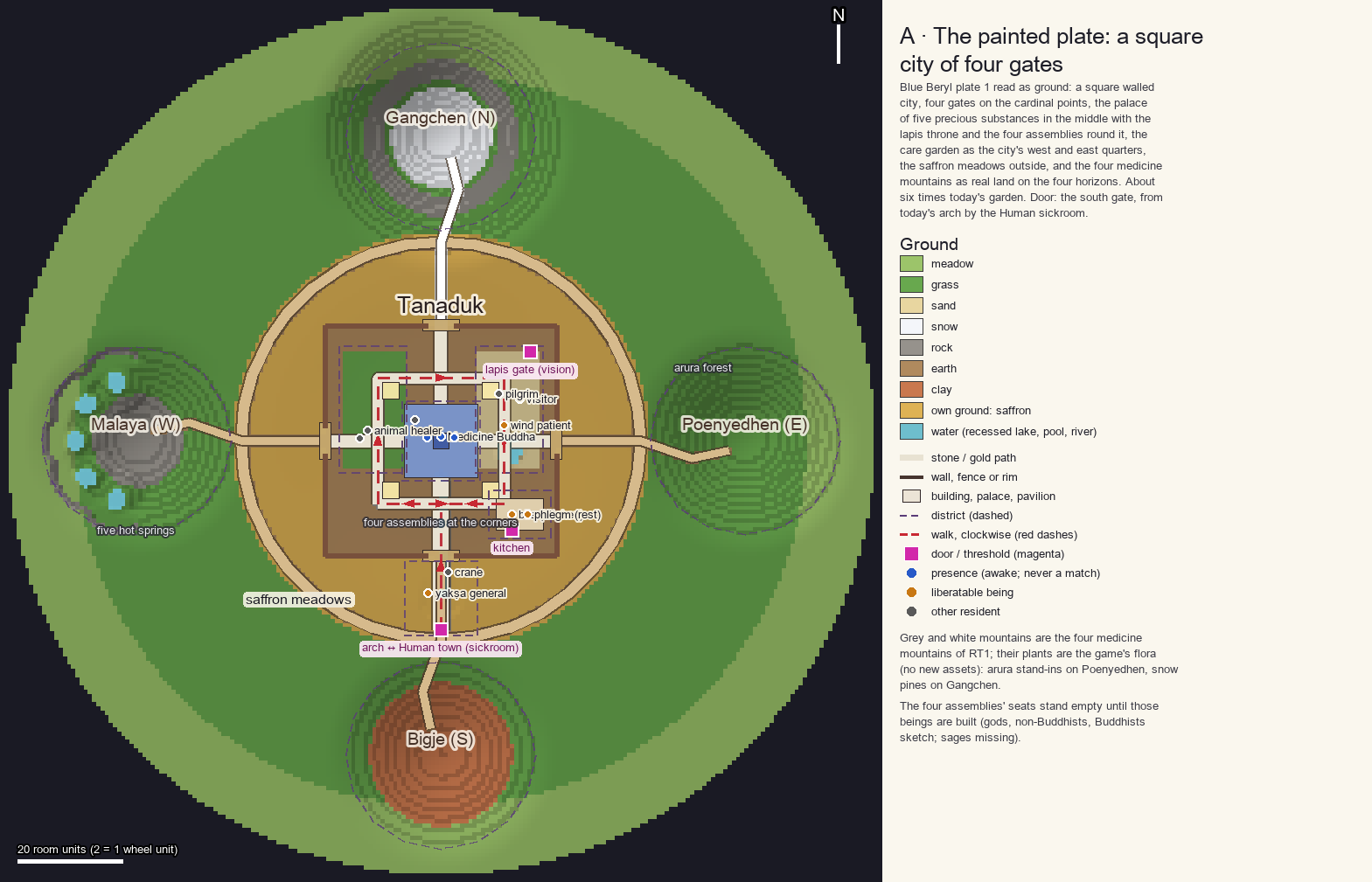
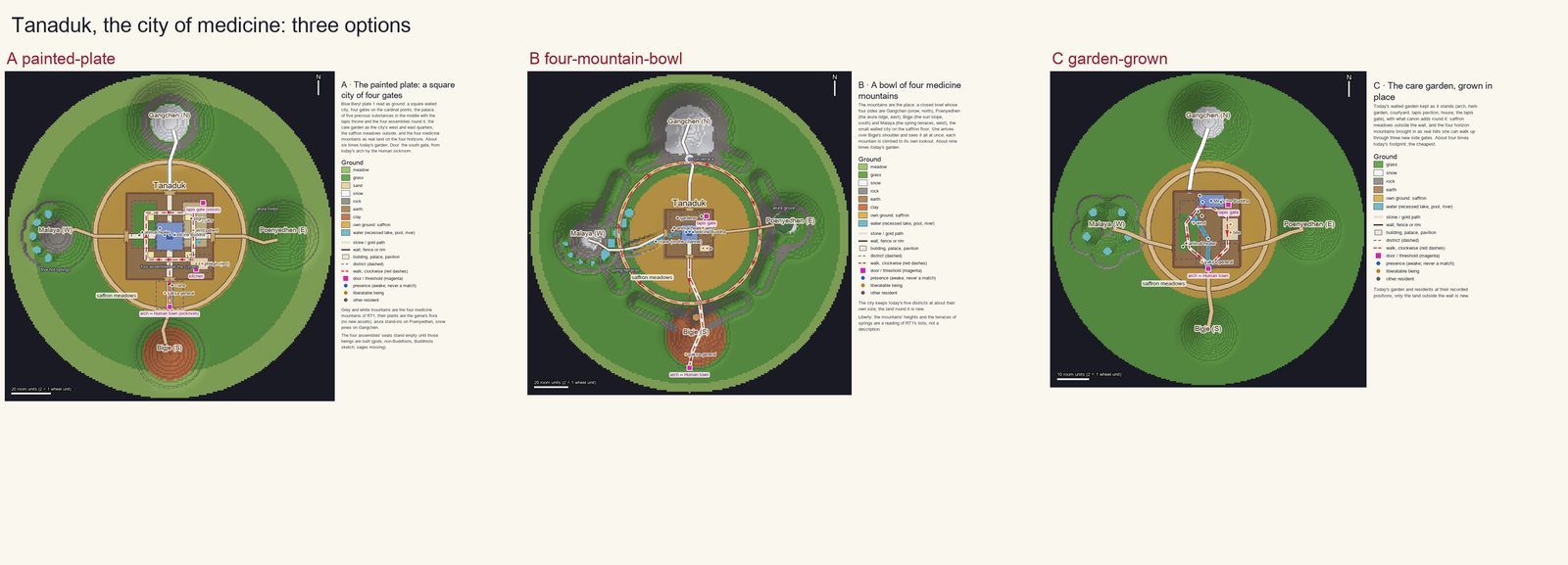
Chosen layout: A · The painted plate
Tanaduk as Blue Beryl plate 1: a square walled city of four gates with the palace and lapis throne at its centre and the four assemblies round it. The four medicine mountains stand outside as real land, each climbed from its gate.
Tanaduk (lta na sdug, Sanskrit Sudarśana, "Beautiful to Behold") is the city where the Medicine Buddha teaches the Four Tantras: a jewel palace on a saffron plain with a medicine mountain on each of the four horizons, each growing the plants of one kind of cure. This group gathers what the Root Tantra fixes about the city, its mountains, its four assemblies and its two emanated sages, what the Medicine Buddha sūtra adds (his twelve vows, his separate eastern field), the human lineage of medicine from Jīvaka to Yuthok, and every painting of the place we can show, above all the first plate of Desi Sangye Gyatso's Blue Beryl set. The game's walled care garden is a small adaptation of this; the canon city is far larger and laid out like a mandala.
Tanaduk, the City of Medicine
Tib. lta na sdug (Tanaduk, Tanadug); Skt. Sudarśana; "Beautiful to Behold"
A city of medicine in the abode of the sages, ringed by saffron meadows and four medicine mountains, where nothing that heals is missing.
The Root Tantra opens here. The Medicine Buddha says he spoke these words once in the abode of the sages, in the City of Medicine called Tanaduk, beautiful to behold. In it stands an inconceivable palace of five precious substances, set with medicinal jewels.
The city is surrounded by meadows of saffron and filled with the fragrance of incense. Every kind of medicinal stone and salt lies in its rocks. The text insists on completeness: the place is fully adorned with all medicinal substances, and there is no medicine that does not grow there or cannot be reached.
Four mountains stand around it, one in each direction: Bigje to the south, Gangchen to the north, Poenyedhen to the east and Malaya to the west. Each grows the medicines of one kind of cure, and each is its own topic below.
The medical paintings draw the city as a mandala: a square walled palace with four gates, the Medicine Buddha at its centre, his four assemblies in its four quarters, an outer ring of pavilions and houses, and the four mountains painted as four broad bands of plants and animals outside the walls. Painted copies of this first plate hang in medical colleges, and physicians recite the chapter it illustrates every morning.
What canon fixes for the map
The city lies in the abode of the sages; the Buddha of Medicine teaches there [RT1 p. 2].
A palace of five precious substances stands in it; the Medicine Buddha sits at its centre on a lapis throne [RT1 pp. 2, 6].
Four mountains, one per cardinal direction: south Bigje, north Gangchen, east Poenyedhen, west Malaya [RT1 pp. 3–5].
Saffron meadows ring the city; incense scents it; medicinal stones and salts lie in its rocks [RT1 p. 5].
Birds sing in the tops of the medicinal forest; elephants, bears and musk deer walk the ground [RT1 p. 5].
Painted plan: square, walled, four gates on the cardinal points, palace at centre, four mountains outside the walls [Blue Beryl plate 1; Rubin SC2013.6 page; Hofer p. 4].
The Root Tantra gives no measurements, no roads and no link to any human town; the game's arch from the Human town is adaptation [docs/world-plan/places/tanaduk.json gateway.adaptation].
Tanaduk is not the Medicine Buddha's eastern buddha field Vaiḍūryanirbhāsa (Toh 504 §1.6): the first is where medicine is taught, the second where he presides; keep them distinct [docs/purelands-lore-source-notes.md].
Who lives here
The Medicine Buddha, Bhaiṣajyaguru, King of Aquamarine Light: the teacher on the lapis throne [RT1 p. 6].
The four assemblies: gods, sages, non-Buddhists and Buddhists, each named in its own topic below [RT1 pp. 6–7].
Rigpé Yeshé and Yilé Kyé, the two sages emanated from the Buddha's heart and tongue [RT2 pp. 1–3].
Peacocks, shang shang and parrots in the forest tops; elephants, bears and musk deer on the ground [RT1 p. 5].
In the game now
place:tanaduk:city is built (zone). The game's Tanaduk is a small walled care garden walked clockwise (arch, herb garden, care courtyard, lapis pavilion, house) with the four mountains as horizon shapes beyond the wall (docs/world-plan/places/tanaduk.json; prototypes/world-map/interiors/tanaduk.js MOUNTAINS). Samsara realm `healing`: 26 items, 12 built, 7 sketch, 7 missing. See built-tanaduk.
Art (5)
the walled city and palace, with the ring of houses and the four gatesthe four mountains: the top bandthe four mountains: the bottom band, with its animals
Desi Sangye Gyatso (design); Wikimedia Commons, The_Blue_Beryl-Medicine_Buddha.jpg · traditional · Public domain (PD-Art, PD-old-100; CC Public Domain Mark 1.0)
The whole city as a mandala: square walled palace with four gates, the blue Medicine Buddha at centre, four assemblies in the four quarters, a ring of pavilions and houses, and the four mountains as bands outside the walls (left band shows springs and waters; right band one forest of like trees; the bottom band has animals). Twelve buddhas and a lama along the top.
the walled city with its gates and ring of housesthe top mountain band (the northern Snow Mountain per the published description)
Sangye Gyamtso (design); image via Gyurme Dorje; Wikimedia Commons · traditional · Public domain (CC Public Domain Mark 1.0)
Same composition on a white ground, brighter and easier to read: the walled square city with its four gates, the ring of houses, and the four mountain bands. The Commons description (after Dorje & Meyer pp. 17, 173) puts the northern Snow Mountain at the top with sandalwood, camphor, areca and chiretta and a moon at top centre, and says each other mountain holds the plants of its climate.
Rubin Museum of Art, SC2013.6 · traditional · No open licence (Rubin Museum)
A crisp modern copy, with the Rubin's reading of the plate: the palace as a mandala ringed by four mountains, the Medicine Buddha as the teacher Rigpa Yeshe teaching four groups of disciples including Yilekye. Look at the centre square and the four outer bands.
Himalayan Art Resources (Jeff Watt) · traditional · No open licence (HAR / Rubin Museum)
The whole Blue Beryl chart series across several painted sets, with Hofer's essay linked. Browse for the city plate and the materia medica plates; the Rubin's own plates on HAR (e.g. item 956, plate 49) are anatomy, not the city.
Wellcome Collection · traditional · CC BY-NC 4.0 (non-commercial only; link card)
A modern summary painting of the whole medical cosmos: the Medicine Buddha at top centre between the two sages Yilé Kyé (right, red) and Rigpé Yeshé (left, blue) joined to him by a golden thread, Yuthok the Elder at centre, Jīvaka above him with a myrobalan, eight medicine goddesses, and at the base the four medicine mountains with their plants.
Still missing: No open image of the Ulan-Ude plate 1 itself (the two Commons files are other painted copies of the same design). No in-world capture of the game's Tanaduk exists in the Atlas.
Barry Clark (tr.), The Quintessence Tantras of Tibetan Medicine (Snow Lion, 1995), Root Tantra ch. 1; Clark's Sanskrit names for the mountains (Vindhya, Himavat, Malaya, Gandhamādana) are reported here from secondary summaries, page not verified
Tib. gzhal yas khang (the inconceivable palace); the throne of lapis lazuli (bai ḍū rya)
At the centre of the city a palace of five precious substances, set with jewels that cure every disorder, and in its centre the Medicine Buddha on a lapis throne.
The palace is made of five precious substances and decorated with precious medicinal jewels. The jewels do more than shine: they cure the four hundred and four disorders of wind, bile, phlegm, combined and compound illness. They are cool medicine against hot disorders and warm medicine against cold ones. They drive off the obstructing forces and fulfil every wish and need.
At the centre of the palace, on the jewel throne of lapis lazuli, sits the Medicine Buddha: the Master, the Victorious Conqueror, the Supreme Healer, the King of Aquamarine Light. Around him sit four assemblies.
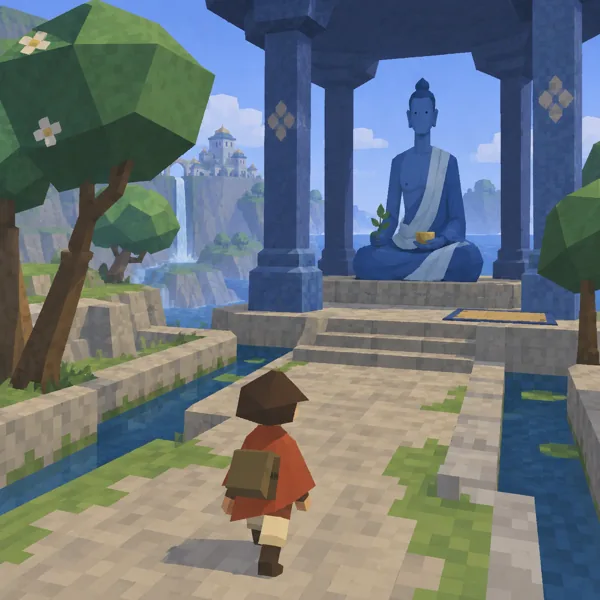
In the painted plate the palace is a square mandala with a gate on each side and a golden roof at the centre; the Buddha sits in a red-and-gold shrine in the middle of a jewelled courtyard, with the assemblies in the four quarters and an outer ring of houses and gardens. The game builds no palace: its Medicine Buddha sits in an open lapis pavilion.
What canon fixes for the map
Five precious substances; decorated with medicinal jewels [RT1 p. 2].
The jewels cure the 404 disorders, cool hot illness, warm cold illness, and pacify obstructing forces: the Tibetan reads eighty thousand kinds of obstructors, the English on the same page one thousand and eighty [RT1 p. 2; repo ledger note on tanaduk:palace].
Centre of the palace: a jewel throne of lapis lazuli; the Medicine Buddha seated on it, surrounded by four retinues [RT1 p. 6].
Painted plan: square palace, four gates, central shrine, assemblies in the four quarters [Blue Beryl plate 1].
Who lives here
The Medicine Buddha, King of Aquamarine Light, on the throne [RT1 p. 6].
In the game now
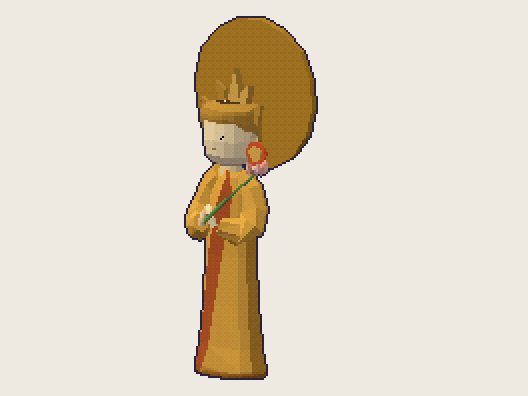
place:tanaduk:palace is sketch. The game's lapis pavilion (district tanaduk.pavilion) seats character medicine-buddha between sunlight-bodhisattva and moonlight-bodhisattva; a stone pavilion is an authored setting (iconography dossier medicine-buddha, 'seat and posture'). Samsara: being:sunlight-bodhisattva built, being:moonlight-bodhisattva built.
Art (7)
the palace centre: the Medicine Buddha on the lapis throne among the four assemblies
Wellcome Collection, via Wikimedia Commons · traditional · CC BY 4.0 (Wellcome Library, London)
The standard seated form: right hand down in the giving gesture, left hand holding the lapis bowl with three myrobalan fruits. Good reference for the throne figure.
Himalayan Art Resources / Rubin Museum of Art (repo media.json ref-med-rubin125-04) · traditional · No open licence
The repo's selected iconography reference: blue Menla with arura in the right hand, dark bowl in the left, Sunlight and Moonlight beside him. Look at the central figure and the two standing attendants.
Repo iconography dossier: public/atlas/iconography/dossiers/medicine-buddha.json, requirements: right hand with arura in giving gesture, left hand with nectar bowl, red monastic robes, lotus and moon seat
Repo ledger: docs/purelands-lore-populations.json, item tanaduk:palace, note on eighty thousand vs one thousand and eighty
Bigje, the sun mountain to the south
Tib. 'bigs byed (Bigje, "Penetrative"); Skt. Vindhya in Clark's translation
The southern mountain, charged with the sun's energy, whose hot, sharp forest cures cold disorders.
South of the city rises a mountain called Bigje, the Penetrative, endowed with energy like the sun's. A medicinal forest covers it: pomegranate (se 'bru), black pepper (na le sham), long pepper (pi pi ling), plumbago (tsi tra ka) and the rest.
These medicines are hot, sour and salty in taste, hot and sharp in potency, and they cure cold disorders. Roots, trunk, branches, leaves, flowers and fruit are all rich in fragrance and beautiful to behold. Wherever that fragrance spreads, no cold disorder arises.
In the painted plates the mountains are not separate pictures: each is a wide band of plants outside the city wall, labelled plant by plant in Tibetan. The band that carries the animals of the grounds, elephants, deer and bears among palms, is the warm, sun-facing side.
What canon fixes for the map
Direction: south of the city [RT1 p. 3].
Energy like the sun's [RT1 p. 3].
Plants named: se 'bru, na le sham, pi pi ling, tsi tra ka, and others [RT1 p. 3].
Taste hot, sour, salty; potency hot and sharp; cures cold disorders; no cold disorder where its scent reaches [RT1 p. 3].
The game draws it as the southern horizon mountain named vindhya, low and yellow-green, no snow [prototypes/world-map/interiors/tanaduk.js MOUNTAINS].
In the game now
place:tanaduk:bigje is built (zone): a horizon shape south of the garden (tanaduk.js MOUNTAINS 'vindhya'). The herb garden holds some of the mountains' plants as an adaptation (district tanaduk.herb-garden claim tanaduk.herb-garden.mountains).
Art (3)
the bottom mountain band: labelled trees with animals on the ground
Desi Sangye Gyatso (design); Wikimedia Commons · traditional · Public domain (PD-Art; CC Public Domain Mark 1.0)
The warm band at the bottom of the plate: palms, flowering and fruiting trees labelled in Tibetan, with elephants, deer and other animals walking the ground. Read as the southern, sun-facing mountain by elimination (left = springs of Malaya, top = snow mountain per the published description).
Wellcome Collection, via Wikimedia Commons · traditional · CC BY 4.0 (Wellcome Library, London)
How Tibetan painters draw single medicinal plants, each labelled: the model for any plant prop on the four mountains. Two manuscript leaves with plants, a yak and a musk deer.
Still missing: The Blue Beryl set has no separate plate for Bigje; the plant portraits of plates 23–33 (Hofer p. 5) show its named species individually but no open copy of those plates was found.
Barry Clark (tr.), The Quintessence Tantras of Tibetan Medicine (Snow Lion, 1995), Root Tantra ch. 1; the name Vindhya for the southern mountain is reported from secondary summaries, page not verified
Gangchen, the snow mountain to the north
Tib. gangs can (Gangchen, "Snow-Capped"); Skt. Himavat in Clark's translation
The northern snow mountain, charged with the moon's energy, whose cool, bitter forest cures hot disorders.
North of the city rises Gangchen, the Snow-Capped, endowed with energy like the moon's. Its medicinal forest is sandalwood (tsan dan), camphor (ga bur), eaglewood (a ga ru), neem (nim pa) and the rest.
These are bitter, sweet and astringent in taste, cool and blunt in potency, and they cure hot disorders. Roots, trunks, branches, leaves, flowers and fruit are fragrant and beautiful; no hot disorder arises where the fragrance reaches.
The published description of the first plate puts this mountain at the top: the Snow Mountain with sandalwood, camphor, areca palm and chiretta, and a moon at top centre.
What canon fixes for the map
Direction: north of the city [RT1 p. 4].
Energy like the moon's; snow-capped by name [RT1 p. 4].
Plants named: tsan dan, ga bur, a ga ru, nim pa, and others [RT1 p. 4].
Taste bitter, sweet, astringent; potency cool and blunt; cures hot disorders [RT1 p. 4].
In the painted plate it is the top band, with a moon at top centre [Commons description of the Healing Palace plate, after Dorje & Meyer pp. 17, 173]. The Blue Beryl copy on Commons shows an orange rayed disc there; followed the published description.
The game draws it as the snowy northern horizon mountain named himavat, the tallest of the four [tanaduk.js MOUNTAINS].
In the game now
place:tanaduk:gangchen is built (zone): the snowy horizon shape north of the garden (tanaduk.js MOUNTAINS 'himavat', snow: true).
Sangye Gyamtso (design); image via Gyurme Dorje; Wikimedia Commons · traditional · Public domain (CC Public Domain Mark 1.0)
The top band: sandalwood, camphor, areca and chiretta drawn as labelled trees under a sky of clouds; the moon at top centre per the published description.
The eastern mountain, one whole forest of arura, the king of medicines, whose five ripe fruits cure every disorder.
East of the city rises Poenyedhen, the Fragrant, covered entirely with a forest of arura. Every part of the tree heals a different part of the body: roots cure the bones, trunks the muscle, branches the channels and tendons, bark the skin, leaves the vessel organs, flowers the sense organs and fruit the vital organs.
At the tops of these trees ripen five kinds of arura, fully endowed with the six tastes, eight potencies, three post-digestive tastes and seventeen qualities, curing every kind of disorder. The medicines there are fragrant and beautiful, and none of the four hundred and four disorders arises where that fragrance spreads.
This is the fruit the Medicine Buddha holds in his right hand in every Tibetan painting: the arura sprig in the giving gesture. The repo's dossier insists the sprig is arura and not an arbitrary leaf.
What canon fixes for the map
Direction: east of the city [RT1 p. 4]. The task brief had Malaya east and Pönyé Dän west; RT1 and the repo ledger give the reverse, followed here.
One forest of arura; root/trunk/branch/bark/leaf/flower/fruit cure bone/muscle/channels/skin/vessel organs/sense organs/vital organs [RT1 p. 4].
Five kinds of arura ripen at the tree tops with six tastes, eight potencies, three post-digestive tastes, seventeen qualities [RT1 p. 4].
No disorder arises where the fragrance reaches [RT1 p. 4].
The game draws it as the eastern horizon mountain named gandhamadana, dark green [tanaduk.js MOUNTAINS]; the arura trees along the herb garden's west wall are the game's own [repo ledger note].
In the game now
place:tanaduk:poenyedhen is built (zone): the eastern horizon shape (tanaduk.js 'gandhamadana'). The herb garden's arura trees and the Medicine Buddha's arura sprig are the only arura in the game.
Art (3)
the right-hand mountain band: the repeated forest of one tree
Desi Sangye Gyatso (design); Wikimedia Commons · traditional · Public domain (PD-Art; CC Public Domain Mark 1.0)
The right band is painted as rows of one repeated tree with labels, unlike the mixed bands elsewhere: it reads as the arura forest of the east (with left = Malaya's springs, this is the east side).
Wellcome Collection, via Wikimedia Commons · traditional · CC BY 4.0 (Wellcome Library, London)
The fruit of this mountain as painters draw it: three pale myrobalan fruits with leaves in the lapis bowl.
Still missing: No single portrait of the arura tree with its five fruits was found under an open licence; the materia medica plates (23–33) would have it.
Repo iconography dossier: medicine-buddha.json, avoid: 'the sprig is arura/myrobalan (Terminalia chebula)'
Repo ledger: docs/purelands-lore-populations.json, item tanaduk:poenyedhen, note: eastern horizon mountain (gandhamadana); herb-garden arura trees are the game's own
Malaya, the garlanded mountain of the six good medicines to the west
Tib. ma la ya (Malaya, "Garlanded"); the six superlative medicines = bzang drug (the six good ones)
The western mountain where the six superlative medicines grow, with five kinds of calcite, five of mineral pitch, five medicinal waters and five hot springs.
West of the city rises Malaya, the Garlanded, where the six superlative medicines grow. The mountain holds the five types of cong zhi (calcite), the five types of brag zhun (mineral pitch, shilajit), the five types of medicinal water and the five types of hot springs, which pacify all disorders.
The Root Tantra chapter names the six only as a set; the Tibetan pharmacopoeia's six good ones (bzang drug) are nutmeg, clove, saffron, cardamom, greater cardamom and bamboo manna. The repo's samsara entry keeps to the chapter's wording.
This is the only mountain the painted plate marks with water: the left band of the first plate is full of white springs, pools and cascades among its plants, which is why that side reads as the west.
What canon fixes for the map
Direction: west of the city [RT1 p. 5]. The task brief had Malaya east; RT1 and the repo give west, followed here.
Six superlative medicines grow there [RT1 p. 5].
Five types each of cong zhi, brag zhun, medicinal water and hot spring [RT1 p. 5].
In the painted plate the band with springs and waters is on the left [observed on both Commons copies].
The game draws it as the western horizon mountain named malaya [tanaduk.js MOUNTAINS].
In the game now
place:tanaduk:malaya is built (zone): the western horizon shape (tanaduk.js 'malaya'). The game's channel and round basin are authored water, not these springs (tanaduk:crane:1 placement note).
Art (2)
the left-hand mountain band: springs and waters among the plants
Sangye Gyamtso (design); image via Gyurme Dorje; Wikimedia Commons · traditional · Public domain (CC Public Domain Mark 1.0)
The same band with blue cascades and an orange mineral seam, clearer on the white ground.
Still missing: No open image of the six good medicines as a set (Commons has a 'SixSubstances.jpg' in the Tibetan medicine category, unverified); no painting of the hot springs on their own.
Repo ledger: docs/purelands-lore-populations.json, item tanaduk:malaya, condition text
The four assemblies around the Medicine Buddha
Tib. 'khor rnam bzhi: lha (gods), drang srong (sages), mu stegs (non-Buddhists), nang pa (Buddhists)
Gods, sages, non-Buddhists and Buddhists sit around the throne, and each hears the same words in the terms of its own master.
Four retinues surround the Master on his throne. The gods' retinue is led by the celestial physician Prajāpati Dakṣa, the twin Aśvins, Indra the sovereign of gods, and the goddess Amṛtā Devī. The sages' retinue holds the great physicians of India: Ātreya, Agniveśa, Nimindhara, Kāśyapa, Caraka, Bharadvāja, Dhanvantari and Punarvasu.
The non-Buddhists are led by the forefather Brahmā, by Śiva, Viṣṇu and six-faced Kumāra. The Buddhists are Mañjuśrī, Avalokiteśvara, Vajrapāṇi, Ānanda and the physician Kumāra Jīvaka, with many more.
Each word the Master taught was understood by each retinue in the tradition and system of its own master. This is why the teaching is called the Tradition of the Sage: it mends body, speech and mind and balances the humours of others.
The chapter gives no seating directions. The painted plate puts one group in each quarter of the palace courtyard: in the Commons copies, crowned gods on clouds at the upper left, white-robed bodhisattvas and monks at the upper right, bearded ascetics at the lower right and the red and blue non-Buddhist gods at the lower left, with the two emanated sages below the throne. The Rubin's reading of its copy is the same: four groups of disciples around the teacher.
What canon fixes for the map
Four retinues around the throne: gods, sages, non-Buddhists, Buddhists [RT1 p. 6].
Each retinue understood the teaching in its own master's system [RT1 p. 8].
Seating by direction is a painters' arrangement (one group per quarter of the courtyard), not fixed by the chapter [Blue Beryl plate 1; Rubin SC2013.6 page].
Who lives here
Prajāpati Dakṣa, the celestial physician; the Aśvins; Indra; Amṛtā Devī, goddess of nectar [RT1 p. 6].
Ātreya, Agniveśa, Nimindhara, Kāśyapa, Caraka Parivrājaka, Bharadvāja, Dhanvantari, Punarvasu: the sages of Indian medicine [RT1 p. 7].
Brahmā the forefather, Śiva, Viṣṇu, Ṣaḍmukha Kumāra: the non-Buddhist teachers [RT1 p. 7].
Mañjuśrī, Avalokiteśvara, Vajrapāṇi, Ānanda, Kumāra Jīvaka: the Buddhists [RT1 p. 7].
In the game now
being:tanaduk:retinue-gods sketch (Indra is one identity with character:shakra at Meru); being:tanaduk:retinue-sages missing; being:tanaduk:retinue-non-buddhists sketch (the Liberate path's Brahmā is not marked as this Brahmā); being:tanaduk:retinue-buddhists sketch (Mañjuśrī, Avalokiteśvara and Vajrapāṇi exist elsewhere; Ānanda and Jīvaka have no character). None are placed at Tanaduk.
Art (2)
the courtyard: four assemblies around the throneupper left quarter: the gods on cloudsupper right quarter: the Buddhistslower right quarter: the bearded sageslower left quarter: the non-Buddhist gods
Desi Sangye Gyatso (design); Wikimedia Commons · traditional · Public domain (PD-Art; CC Public Domain Mark 1.0)
Gods on clouds upper left, white-robed Buddhists upper right, bearded sages lower right, red and blue non-Buddhist gods lower left; the pair of sages kneeling below the throne.
Repo ledger: docs/purelands-lore-populations.json, items tanaduk:retinue-*, related identities and notes
Rigpé Yeshé and Yilé Kyé, the two emanated sages
Tib. drang srong rig pa'i ye shes (Rigpé Yeshé, "Wisdom of Awareness"), emanation of the Master's heart; drang srong yid las skyes (Yilé Kyé, "Mind-Born"), emanation of the Master's speech
The Medicine Buddha enters the King of Medicine concentration and two sages appear from his light, one to teach and one to ask; the whole Four Tantras is their dialogue.
The Master enters the meditative concentration called the King of Medicine, to relieve the four hundred and four disorders. Hundreds of thousands of coloured rays go out from his heart to the ten directions, clear the defects of the negative emotions of every being, and return to his heart. From it emanates the Master's emanation, the sage Rigpé Yeshé, who appears in space and tells the sages that anyone who wishes to stay healthy, heal others, live long, practise Dharma or be happy must learn the Science of Healing.
Then rays go out from the Master's tongue, clear the faults of speech of every being, and return. From them emerges the emanation of his speech, the sage Yilé Kyé. He prostrates, circumambulates, kneels in the lion's posture before the Master and asks, on behalf of all the sages, how one should learn the Science of Healing.
Rigpé Yeshé answers with the plan of the whole work: four tantras, eight branches, eleven sections, fifteen categories, four compendia and one hundred and fifty-six chapters. Every later chapter is this question and answer continued. In the painted plate the two kneel below the throne; in the Chundu painting a golden thread runs from the Buddha's heart and mouth to the two sages.
What canon fixes for the map
Rigpé Yeshé emanates from the heart after the King of Medicine concentration and appears in space [RT2 p. 1].
Yilé Kyé emanates from the tongue, prostrates, circumambulates and kneels in the lion's posture before the Master [RT2 p. 2].
The Four Tantras: Root, Explanatory, Oral Instruction, Subsequent; 156 chapters [RT2 pp. 4, 10].
Painters: Rigpé Yeshé blue-bodied at the Buddha's left, Yilé Kyé red-bodied at his right, joined by a golden thread [Wellcome 47108i description].
Who lives here
Rigpé Yeshé: the heart emanation, the teacher of the Four Tantras [RT2 pp. 1–3].
Yilé Kyé: the speech emanation, the questioner [RT2 pp. 2–3].
In the game now
being:tanaduk:rigpe-yeshe missing; being:tanaduk:yile-kye missing. Nothing built or placed.
Art (2)
below the throne: the figures either side of the offering, where the two sages are placed
Desi Sangye Gyatso (design); Wikimedia Commons · traditional · Public domain (PD-Art; CC Public Domain Mark 1.0)
Below the throne, between the gods' and sages' groups, small figures sit either side of the lapis offering: the place where painters put the emanated teacher and questioner before the Master.
Wellcome Collection · traditional · CC BY-NC 4.0 (link card)
Top centre: the Medicine Buddha with Yilé Kyé (red, right) asking and Rigpé Yeshé (blue, left) reciting, a golden thread from the Buddha's heart and mouth to them. The clearest painting of the pair.
Still missing: No open-licence painting shows the two sages large; only the Chundu thangka (non-commercial) does.
rma bya (peacock), shang shang (the bird-bodied shang-shang), ne tso (parrot); glang po che (elephant), dom (bear), gla ba (musk deer)
Peacocks, shang shang and parrots sing in the forest tops; elephants, bears and musk deer of medicinal value walk the grounds.
The chapter gives the city its sounds and its herds in one sentence. At the top of the medicinal forest peacocks, shang shang and parrots and other birds sing melodiously. On the grounds dwell elephants, bears, musk deer and others who have good medicinal value.
The animals are named for what they give to medicine: musk, bear bile, elephant products are all materia medica in the Tibetan pharmacopoeia, and the plates and manuscripts draw them beside the plants. On the first plate the animals wander the bottom band among the trees.
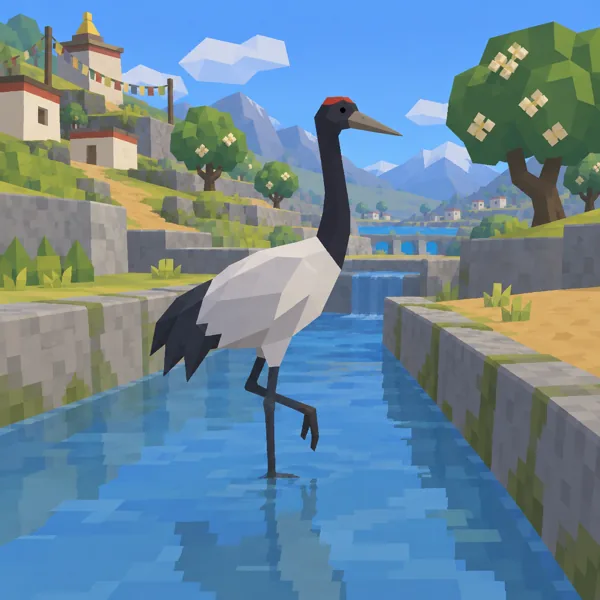
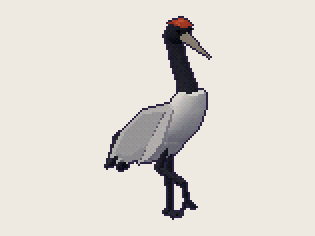
The game's herb-garden crane and garden sheep are its own residents; neither kind is named in the chapter.
What canon fixes for the map
Birds in the forest tops: peacocks, shang shang, parrots and others, singing [RT1 p. 5].
Animals on the grounds: elephants, bears, musk deer and others of medicinal value [RT1 p. 5].
Animals and plants are drawn together in the materia medica manuscripts [Wellcome L0038345].
Who lives here
Peacocks, shang shang, parrots [RT1 p. 5].
Elephants, bears, musk deer [RT1 p. 5].
In the game now
being:tanaduk:birds missing; being:tanaduk:animals missing. The game's being:tanaduk:crane:1 (sketch, shared crane rig) and being:tanaduk-sheep (sketch) are adaptations and not among the named kinds. The repo has a shang-shang-like jivajivaka rig (atlas/beings/jivajivaka) placed elsewhere.
Art (3)
the bottom band: animals on the ground under the trees
The game's adapted waterside bird at the channel; not one of the chapter's birds.
Still missing: No open image of a shang shang (the bird-bodied, human-headed singer) in a medical context; no peacock or parrot portrait from the plates.
Repo ledger: docs/purelands-lore-populations.json, items tanaduk:birds, tanaduk:animals, notes: the crane and sheep are not among the kinds named
The Medicine Buddha, his twelve vows and his own eastern field
Skt. Bhaiṣajyaguruvaiḍūryaprabha; Tib. sangs rgyas sman bla (Sangye Menla), bai ḍū rya 'od kyi rgyal po (King of Aquamarine/Lapis Light); his field Vaiḍūryanirbhāsa
The blue Buddha of healing who vowed twelve things as a bodhisattva, presides over a field of blue beryl far to the east, and teaches medicine at Tanaduk.
In the sūtra the Buddha Śākyamuni sits under the musical tree at Vaiśālī with monks, bodhisattvas, kings and gods, and Mañjuśrī asks him to teach the names and former aspirations of the buddhas for the sake of beings in degenerate times. Śākyamuni tells of Bhaiṣajyaguru, King of Lapis Light, whose field lies far to the east beyond as many buddha fields as there are grains of sand in ten Ganges rivers.
As a bodhisattva he made twelve great aspirations: that his light would fill countless worlds and all beings bear the marks of a buddha; that his body would be like pure lapis, outshining sun and moon, lighting those in darkness; that none would lack anything; that those on wrong paths and the hearers would be led to the Great Vehicle; that hearers of his name would keep pure discipline and escape the lower realms; that the blind, deaf, lame, mad and sick would be made whole on hearing his name; that the ill and uncared-for would be healed and stay healthy until awakening; that women who wished it would be reborn as men; that he would free beings from Māra's nets and wrong views; that those bound, beaten and condemned by kings would be freed; that he would feed the hungry and then satisfy them with Dharma; that he would clothe the naked and give them ornaments, perfume and music.
His field, Vaiḍūryanirbhāsa, is entirely pure: no stones or gravel, no sounds of suffering or lower realms, its walls, gates, windows and turrets all of blue beryl, its parapets of the seven precious substances, its qualities like Sukhāvatī's. Its two foremost bodhisattvas are Sūryavairocana, Sunlight, and Candravairocana, Moonlight, who keep his treasury of Dharma. Twelve yakṣa generals, each with seven hundred thousand attendants, vow to guard anyone who keeps the sūtra or remembers his name.
This field is not Tanaduk. The Root Tantra's city is where he teaches medicine among sages and gods; the sūtra's field is where he presides over the awakened. The repo keeps them apart, reaching Vaiḍūryanirbhāsa from Tanaduk by an authored lapis gate.
In Tibetan painting he is blue, in red monastic robes, seated on lotus and moon, his right hand down in the giving gesture holding the arura sprig and his left in his lap holding the lapis bowl of nectar; the game's dossier fixes this form.
What canon fixes for the map
Setting of the sūtra: Vaiśālī, under the musical tree; Mañjuśrī the questioner [Toh 504 §§1.2–1.5].
His field lies east, beyond buddha fields as numerous as the sand of ten Ganges [Toh 504 §1.6].
Twelve aspirations [Toh 504 §§1.7–1.20].
Vaiḍūryanirbhāsa: no stones, no suffering, no lower realms, buildings of blue beryl, parapets of seven jewels, qualities like Sukhāvatī [Toh 504 §1.21].
Sunlight and Moonlight are its foremost bodhisattvas [Toh 504 §1.22].
Form: blue body, red monastic robes, right hand giving with arura, left with nectar bowl, lotus and moon seat [repo dossier medicine-buddha.json; HAR 125].
Tanaduk and Vaiḍūryanirbhāsa are different places [docs/purelands-lore-source-notes.md; wheel-geography-research: 'Preserve distant-field identity'].
Who lives here
Bhaiṣajyaguru, the Medicine Buddha [Toh 504; RT1 p. 6].
Sūryavairocana (Sunlight) and Candravairocana (Moonlight), his two bodhisattvas [Toh 504 §1.22].
The twelve yakṣa generals [Toh 504 §1.53].
In the game now
character:medicine-buddha sits in Tanaduk's lapis pavilion (presence, not liberatable); being:sunlight-bodhisattva and being:moonlight-bodhisattva built beside him; being:medicine-yaksha-general built at the arch (one adapted talkable general; the twelve named generals stand as reliefs in Vaiḍūryanirbhāsa, place field-lapis-radiance, reached by the lapis gate). The six other Medicine Buddhas have concepts in public/atlas/concepts/medicine-buddha-01..06.
Wellcome Collection, via Wikimedia Commons · traditional · CC BY 4.0 (Wellcome Library, London)
The standard form, here with gold skin: right hand earth-touching, left with the lapis bowl of three myrobalans; Padmasambhava between Mandāravā and Yeshe Tsogyal below.
the Medicine Buddha with his two standing attendants
Wellcome Collection, via Wikimedia Commons · traditional · CC BY 4.0 (Wellcome Library, London)
The Medicine Buddha with the arura sprig in his right hand and the bowl in his left, two standing monk attendants with bowls either side, wrathful protectors below and Tsongkhapa above.
the mural: Bhaiṣajyaguru enthroned among his assemblythe central Buddha
The Metropolitan Museum of Art, 65.29.2 (Open Access) · traditional · CC0 (Met Open Access)
Chinese, not Tibetan, but the grandest open-access Bhaiṣajyaguru assembly: the Buddha enthroned with Sunlight and Moonlight and the twelve generals ranged around him. The gallery photograph shows the whole mural.
Bodhi Blocks live rig capture · world-view · Project art
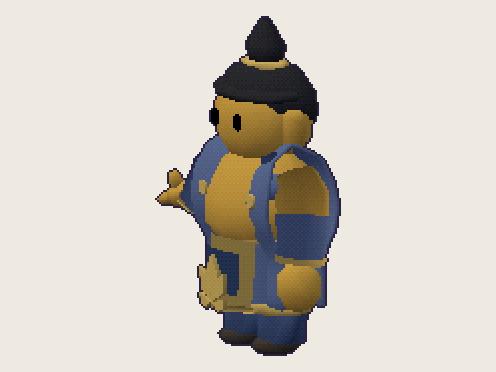
How the general stands today; samsara lists forms as presence-only though he is liberatable (forms check fails).
Still missing: No open-licence Tibetan painting of the twelve generals as a set; no open image of Vaiḍūryanirbhāsa itself (painters show the Buddha, not the field's blue-beryl walls).
From the Buddha's own physician Jīvaka, who sits in Tanaduk's Buddhist assembly, to Yuthok who compiled the Four Tantras and the regent who painted them.
Jīvaka is the physician of the Buddha's time. The Vinaya tells it: a courtesan of Rājagaha had her newborn son thrown on a rubbish heap; Prince Abhaya found him there surrounded by crows, asked if he was alive, and had him raised. Not wanting to live in a royal house without a trade, Jīvaka went without leave to Takkasilā, where the foremost physician in the world taught him. He cured a merchant's wife at Sāketa with a nose-medicine of cooked ghee, treated King Bimbisāra, opened a merchant's son's belly and sewed it back, tricked the ghee-hating King Pajjota of Ujjenī into drinking it, and gave the Buddha a gentle purgative of thirty purgings. The Root Tantra seats him, Kumāra Jīvaka, among the Buddhists around the Medicine Buddha's throne.
Yuthok Yönten Gönpo the Younger (1126–1202) is the figure Tibetan medicine traces itself to. At fourteen he met Rokton Könchok Kyab, who transmitted the Four Tantras to him; at eighteen he went to India to study the Eight Branches of medicine; at twenty-one he returned, set up a clinic and taught. He is said to have gone to India six times and to have compiled the Four Tantras in their 156 chapters; his heart-disciple Sumtön Yeshé Zung received them with the Yuthok Heart Essence. Tradition also tells of an Elder Yuthok of the eighth century, whom historians now treat as a legend of the family; the Chundu painting puts the Elder at its centre.
In 1687–1703 the regent Desi Sangye Gyatso wrote the Blue Beryl, his commentary on the Four Tantras, and commissioned seventy-nine paintings to illustrate it for the Chakpori medical college in Lhasa. The first plate is the city of medicine; the next five finish the Root Tantra; then anatomy, diet, materia medica, bloodletting, moxibustion, pulse and urine. Copies spread to Buryatia and Mongolia; a complete early-twentieth-century set survives in Ulan-Ude and was published by Parfionovitch, Dorje and Meyer.
Painters show Yuthok as a clean-shaven layman in a flower crown, seated on a lotus, holding a lotus with book and sword and a vase of nectar, a bowl of myrobalan on a table before him, with the five buddhas above, medicine goddesses at his sides and black Hayagrīva below.
What canon fixes for the map
Jīvaka: found by Prince Abhaya on a rubbish heap in Rājagaha; trained at Takkasilā; cures at Sāketa, for Bimbisāra, for a merchant's son, for King Pajjota of Ujjenī; the Buddha's thirty purgings [Vinaya, Khandhaka 8 (Cīvarakkhandhaka), accounts 1–8].
Kumāra Jīvaka sits in the Buddhist assembly at Tanaduk [RT1 p. 7].
Yuthok the Younger 1126–1202, Nyingma, teacher Könchok Kyab, student Sumtön Yeshé Zung, author or compiler of the Four Tantras [Treasury of Lives P3005].
The Four Tantras: four volumes, 156 chapters [RT2 p. 10; Hofer p. 2].
The Blue Beryl set: 79 paintings, late 17th c. Lhasa, for Chakpori (opened 1696); first plate the Medicine Buddha teaching in his palace; a complete early-20th-c. Lhasa set preserved in Buryatia [Hofer pp. 2, 4, 11].
Yuthok's painted form: layman, flower headdress, lotus with book and sword, nectar vase, myrobalan bowl, five buddhas above, Hayagrīva below [HAR 185].
Who lives here
Jīvaka Komārabhacca / Kumāra Jīvaka: the Buddha's physician [Vinaya Kd 8; RT1 p. 7].
Yuthok Yönten Gönpo the Younger: compiler of the Four Tantras [Treasury of Lives].
Sumtön Yeshé Zung: his heart-disciple [Treasury of Lives].
Desi Sangye Gyatso: regent, author of the Blue Beryl, patron of the paintings [Hofer p. 2].
In the game now
Nothing yet: Jīvaka has no character (repo ledger note on tanaduk:retinue-buddhists); Yuthok and Sangye Gyatso are not in samsara.json.
Art (5)
Yuthok on his lotus with the book-and-sword lotus and the vaseHayagrīva and the dancing goddesses below
Wellcome Collection · traditional · CC BY-NC 4.0 (link card)
The lineage in one picture: the Medicine Buddha and the two sages at top, Jīvaka with a myrobalan and a book above Yuthok the Elder at centre, eight medicine goddesses, the protector Shanglön below, the four mountains at the base.
World-plan place `tanaduk` (rooms tanaduk, tanaduk:kitchen, tanaduk:rest)
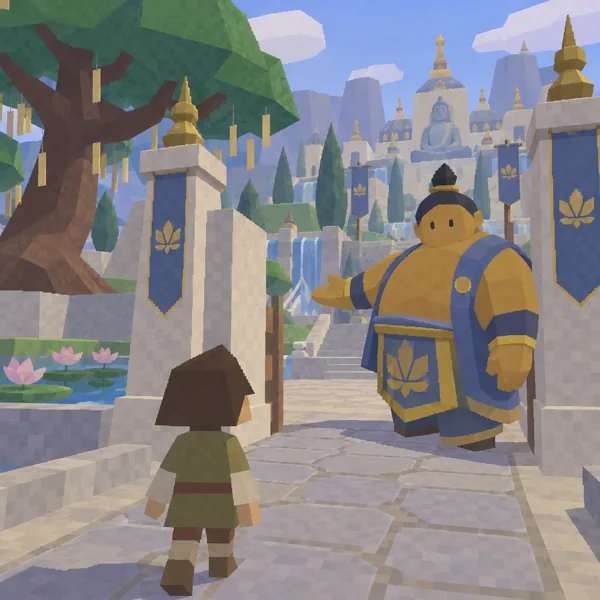
A small walled garden city off the Human town: arch, herb garden, care courtyard, lapis pavilion and house, with the four mountains as horizons and a lapis gate to Vaiḍūryanirbhāsa.
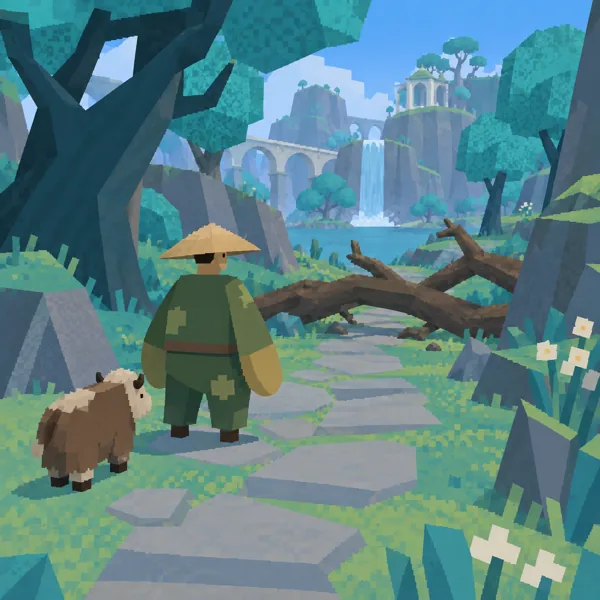
The game reaches Tanaduk from the Human section: an authored vision threshold in human.town, beside the Human sickroom, leads along the water to Tanaduk's lapis arch. The plan calls this a game link, since the sources give a city and four mountains and no road from any town.
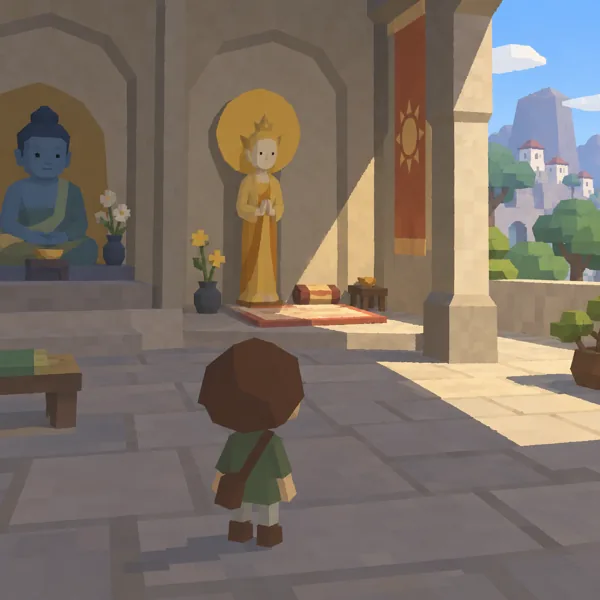
Inside, the garden is walked clockwise. The arch and channel (south) are kept by one yakṣa general; the herb garden (west) has eight raised beds either side of a gravel path and arura trees along its shaded wall; the care courtyard (north-west) has benches, a parasol and the round basin where the channel ends; the lapis pavilion (north) is the teaching seat where the Medicine Buddha sits facing down the channel with Sunlight at his right and Moonlight at his left; the house (east) holds a kitchen and a resting room whose side door opens back by the arch. In the north-east corner a small lapis gate leads to Vaiḍūryanirbhāsa.
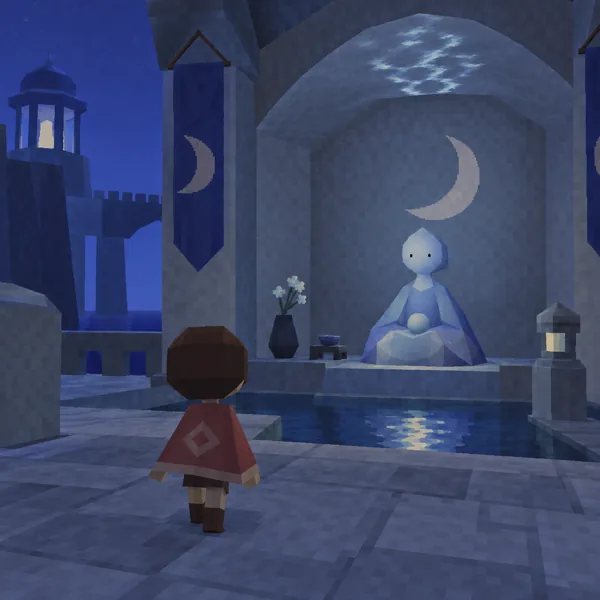
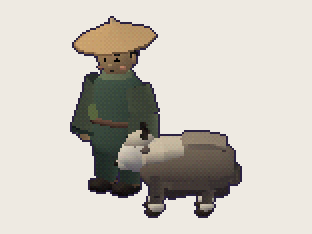
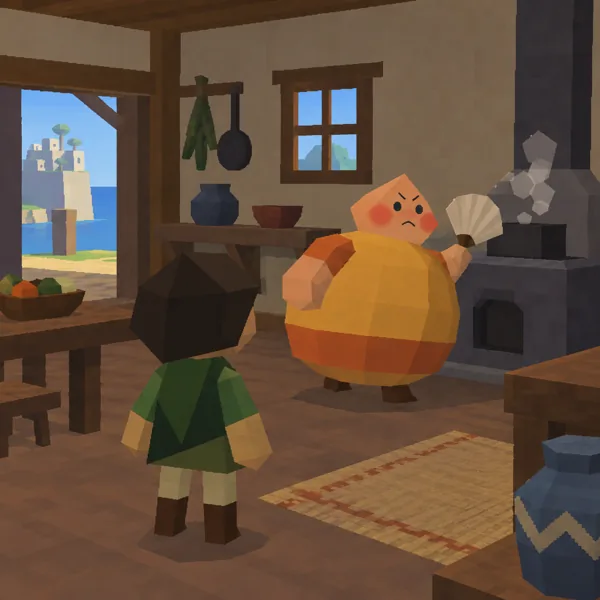
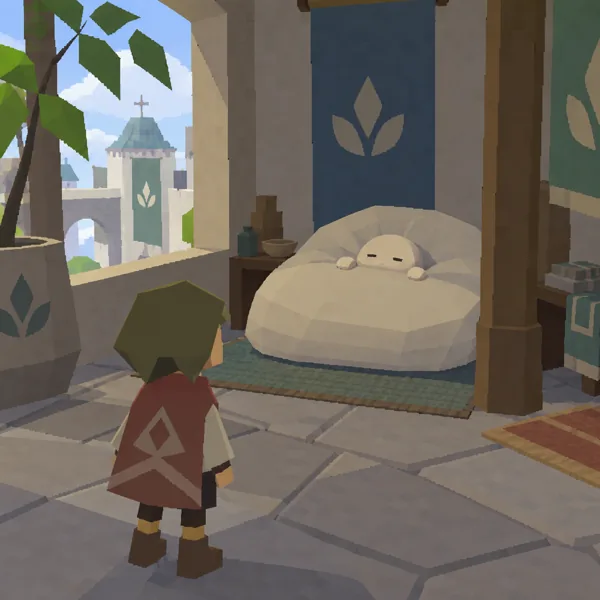
Residents: the Medicine Buddha, Sunlight and Moonlight (presences); the yakṣa general at the arch; the Garden Tender at the pavilion's herb strip; the Animal Healer and the garden sheep in the herb garden; the Herb-Garden Crane in the channel; three patients, one per humour: the one who cannot sit (wind) pacing the courtyard, the fevered one (bile) fanning himself at the kitchen stove, the heavy sleeper (phlegm) sunk in the resting room's cushion; the Garden Visitor and the Pilgrim of the Herb Garden in the courtyard. The gardener, healer, sheep, crane, visitor, pilgrim and the three humour patients are the game's own.
What is canon and what is adaptation: the city, the Medicine Buddha teaching, the four mountains and the arura are from the Root Tantra; the arch, the walled garden, the courtyard of patients, the kitchen and resting room, the three humour patients and the gate to Vaiḍūryanirbhāsa are authored. The ledger's standing instruction: never rename this place Vaiḍūryanirbhāsa.
Districts, one line each:
tanaduk.arch: the way in along the water, kept by a general, with the whole walk and the pavilion in view up the channel [1 resident: the yakṣa general; crane at the channel edge].
tanaduk.herb-garden: where medicine is grown, eight raised beds and arura trees along the west wall [2 residents: Animal Healer, garden sheep].
tanaduk.courtyard: where patients wait and are looked after, benches, basin, parasol [3 residents: the one who cannot sit, Garden Visitor, Pilgrim of the Herb Garden].
tanaduk.pavilion: the teaching seat, the Medicine Buddha between Sunlight and Moonlight [4 residents incl. the Garden Tender at the herb strip].
tanaduk.house: exterior footprint of the kitchen and resting room [0 residents].
tanaduk.kitchen (room tanaduk:kitchen): stove with a fan beside it, butter bench, cushion pile, guest stool [1 resident: the fevered one].
tanaduk.rest (room tanaduk:rest): sunken cushion, mat, sliding screen [1 resident: the heavy sleeper].
What canon fixes for the map
Gateway: from human at human.town (authored threshold human.town.gateway-tanaduk [12.6, 7.9]); return by the arch [0, 9.95] to the same threshold [docs/world-plan/places/tanaduk.json gateway].
Layout: arch south, herb garden west, courtyard north-west, pavilion north, house east; south is +z in the room frame [tanaduk.json layout].
Horizons: himavat north (snow, tallest), gandhamadana east, vindhya south, malaya west [prototypes/world-map/interiors/tanaduk.js MOUNTAINS].
Lapis gate to field-lapis-radiance at [6.4, -7.7]; the Medicine Buddha, Sunlight and Moonlight have their one primary appearance here and empty depiction seats there [docs/purelands-cosmology.json tanaduk destinations].
Adaptation list: arch link, walled garden, patients, kitchen and rest, three humour residents, caretakers [tanaduk.json district claims; docs/purelands-lore-populations.json tanaduk note].
The place is gated from the Human section, not laid into the open world [task brief].
Who lives here
Medicine Buddha, Sunlight Bodhisattva, Moonlight Bodhisattva: presences in the pavilion.
Medicine Buddha yaksha general: bound, liberatable, at the arch.
Desi Sangye Gyatso (design); Wikimedia Commons · traditional · Public domain (PD-Art; CC Public Domain Mark 1.0)
What the canon city looks like next to the game's garden: a square walled mandala city with a gate on each side and the mountains outside, not a garden with horizons.
Still missing: No in-world capture of Tanaduk exists (public/atlas/terrain-review/in-world/ has none and media.json has no tanaduk world-view); the Garden Visitor and Pilgrim have no concept or rig.
Sources
Repo world plan: docs/world-plan/places/tanaduk.json, gateway, layout, districts, characters, residents
missing Nothing in the game is this yet.sketch Something stands in: a model not yet placed, a placement drawn with a shared rig, a written voice, a court inside a shared room, or a place registered with no builder.built A placed character with its own model is this, or the place is built as its own room, zone or segment.
The great sages Ātreya (rgyun shes kyi bu), Agniveśa (me bzhin ’jug), Nimindhara (mu khyud ’dzin), Kāśyapa (’gro ba skyong gi bu), Caraka Parivrājaka (gshol ’gro skyes), Bharadvāja (dka’ gnyis spyod), Dhanvantari (thang la ’bar) and Punarvasu (nabs so skyes), with many other sages.
The translation spells them Atreya, Agni Vesa, Nimin Dhara, Kasyapa, Caraka Pariv Rajika, Bharadvaja, Dhanwantari and Punarvasu. The teaching is named the Tradition of the Sage (p. 8). Not built.
The sage Rigpé Yeshé (rig pa’i ye shes), emanation of the Master’s heart missing being
When the Medicine Buddha entered the concentration called the King of Medicine, coloured rays from his heart cleared the defects of the negative emotions of all beings of the ten directions and returned; the Emanated Master, the sage Rigpé Yeshé, then emanated from his heart, appeared in space and spoke to the assembled sages: those who wish to stay healthy, to cure others, to live long, to practise Dharma and be happy must learn the Science of Healing.
The sage Yilé Kyé (yid les skyes), emanation of the Master’s speech missing being
Rays from the Master’s tongue cleared the negative speech of all beings of the ten directions and returned; the sage Yilé Kyé emerged as the emanation of the Master’s speech, prostrated, circumambulated, knelt in the lion’s posture before the Master and made requests on behalf of the assembled sages.
Why sketch: related: Manjushri (character:manjushri) at vimalakirti, lhakhang:precinct; named in this retinue; one identity, primary elsewhere (the eight-bodhisattvas group’s close-son-01); related: Avalokiteshvara — four-armed (character:avalokiteshvara-four-armed) at overworld, lhakhang:precinct; named in this retinue; one identity, primary elsewhere (close-son-02); related: Vajrapani (character:vajrapani) at lhakhang:precinct; named in this retinue; one identity, primary in the lha-khang precinct (close-son-03).
Concept no
Model no
Placed no
Home no
Dialogue no
Routine no
no art
The retinue of gods sketch being
The first of the four retinues surrounding the Master: the celestial physician Prajāpati Dakṣa (myur ba), the Aśvinīkumāras (tha skar), the divine sovereign Indra (brgya byin) and the goddess Amṛtā Devī (lha mo bdud rtsi ma), with many other celestial beings.
Each retinue understood every word the Master taught in accordance with its own master’s tradition (p. 8). Not built.
Why sketch: related: Shakra / Indra (character:shakra) at meru:sudharma; Indra, named in this retinue; one identity, primary at Meru.
Concept no
Model no
Placed no
Home no
Dialogue no
Routine no
no art
The retinue of non-Buddhists sketch being
The forefather Brahmā (tshangs pa), Śiva (ma hA de ba shrI ral pa can), Viṣṇu (khyab ’jug) and Ṣaḍmukha Kumāra (gzhon nu gdong drug), with many other non-Buddhists.
Why sketch: related: Brahma (character:liberate-brahma) at meru, Liberate route; the game’s Brahmā, the Liberate path’s; this retinue names Brahmā as the non-Buddhists’ forefather. not marked as one identity: this source does not say the forefather of the non-Buddhists and the Liberate path’s Brahmā are one.
Concept no
Model no
Placed no
Home no
Dialogue no
Routine no
Medicine Buddha yaksha general built being
Source: an adaptation grounded in Twelve yaksha generals, Seven Medicine Buddhas, https://84000.co/translation/toh503
The inconceivable palace and its lapis throne sketch place
An inconceivable palace made of five precious substances, decorated with precious medicinal jewels that cure the four hundred and four disorders of rlung, mkhris pa, bad kan, ldan pa and ’dus pa, cool hot disorders and warm cold ones, pacify the eighty thousand kinds of obstructing forces and fulfil all wishes. At its centre, on the jewel throne of lapis lazuli, sits the Medicine Buddha, the King of Aquamarine Light.
The game builds no palace: the Medicine Buddha sits in its lapis pavilion (tanaduk.pavilion). The Tibetan on p. 2 reads bgegs rigs stong phrag brgyad cu, eighty thousand kinds of obstructors; the English there gives one thousand and eighty.
Why sketch: related: Medicine Buddha (character:medicine-buddha) at tanaduk; the Medicine Buddha on the throne (the seven-medicine group’s medicine-buddha:7).
Bigje (’bigs byed, “Penetrative”), the mountain to the south built place
Endowed with energy like the sun’s. Its medicinal forest of se ’bru, na le sham, pi pi ling, tsi tra ka and others is hot, sour and salty in taste, hot and sharp in potency, and cures cold disorders; roots, trunks, branches, leaves, flowers and fruits are fragrant and beautiful, and no cold disorder arises where the fragrance pervades.
Gangchen (gangs can, “Snow-Capped”), the mountain to the north built place
Endowed with energy like the moon’s. Its medicinal forest of tsan dan, ga bur, a ga ru, nim pa and others is bitter, sweet and astringent in taste, cool and blunt in potency, and cures hot disorders; no hot disorder arises where the fragrance pervades.
The game’s snowy northern horizon mountain (himavat).
Malaya (ma la ya, “Garlanded”), the mountain to the west built place
Where the six superlative medicines grow; it holds the five types of cong zhi, the five types of brag zhun, the five types of medicinal water and the five types of hot springs, which pacify all disorders.
Poenyedhen (spos ngad ldan, “Fragrant”), the mountain to the east built place
Covered with a forest of a ru ra whose roots, trunks, branches, bark, leaves, flowers and fruits cure disorders of bone, muscle, channels and tendons, skin, vessel organs, sense organs and vital organs. At the tops of the trees ripen five kinds of a ru ra with the six tastes, eight potencies, three post-digestive tastes and seventeen qualities, curing every kind of disorder; the four hundred and four disorders do not arise where the fragrance permeates.
The game’s eastern horizon mountain (gandhamadana). The herb garden’s arura trees along the west wall are the game’s own.
Tanaduk (lta na sdug, “Beautiful to Behold”), the City of Medicine built place
The City of Medicine in the abode of the sages, surrounded by saffron (gur gum) meadows and filled with the fragrance of incense. Medicinal stones and salts of every kind lie in its rocks; it is adorned and enriched with all medicinal substances, and there is none that does not grow there or is not accessible.
The game’s walled care garden is its version of the city (world plan tanaduk).