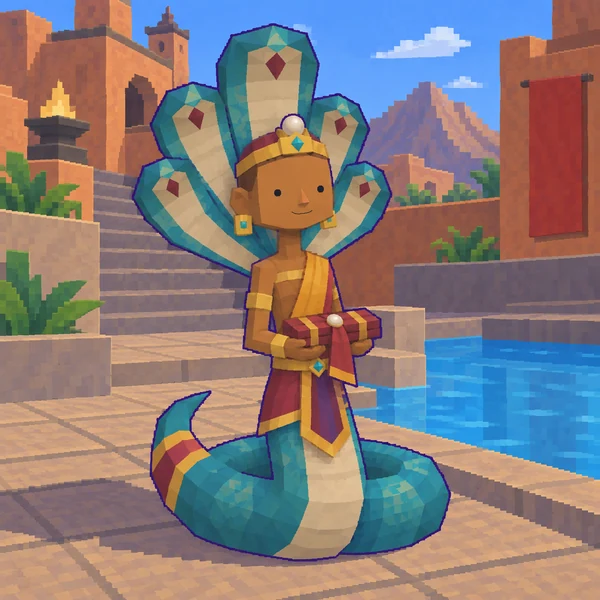
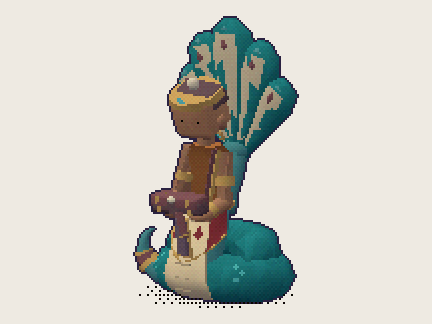
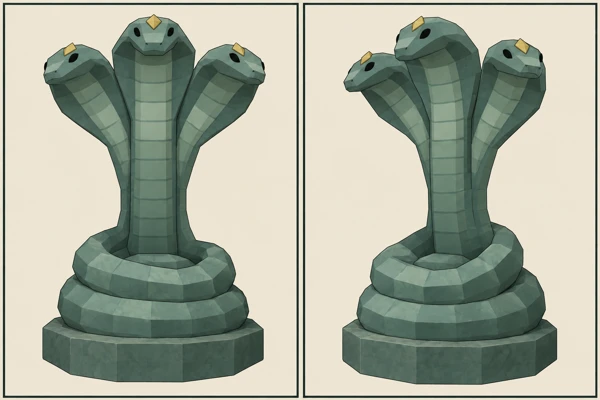
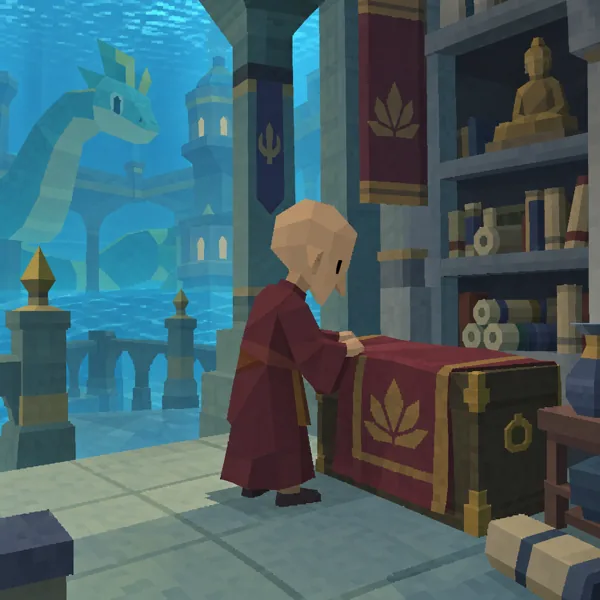
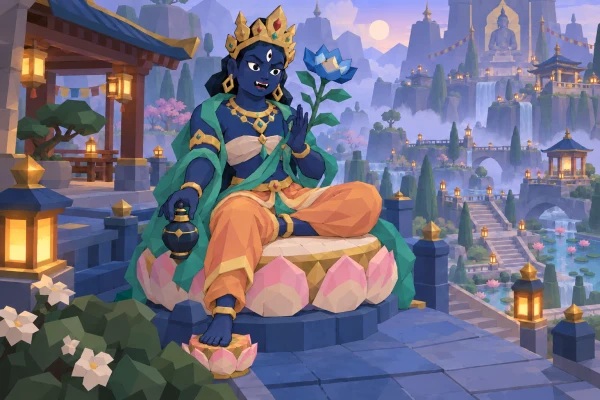
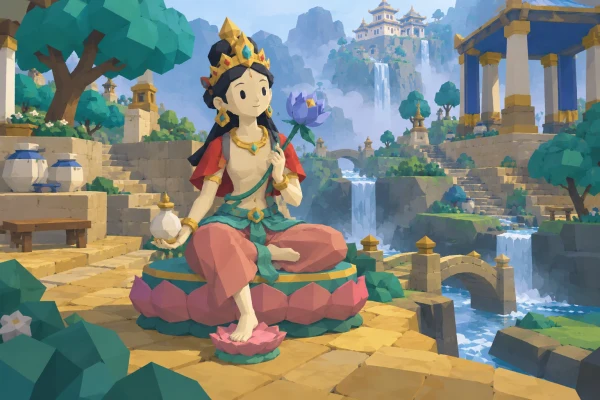
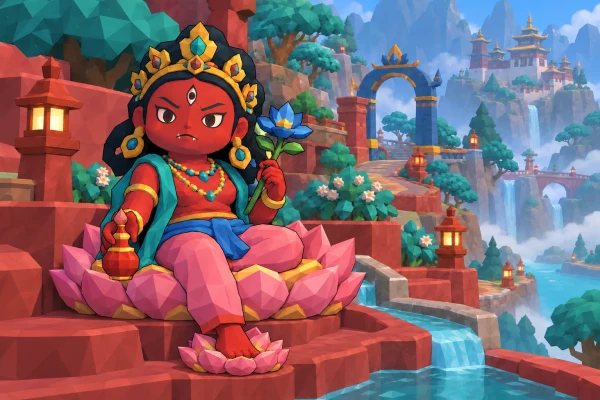
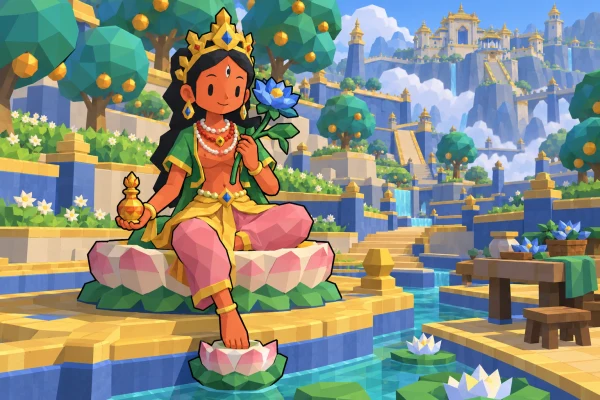
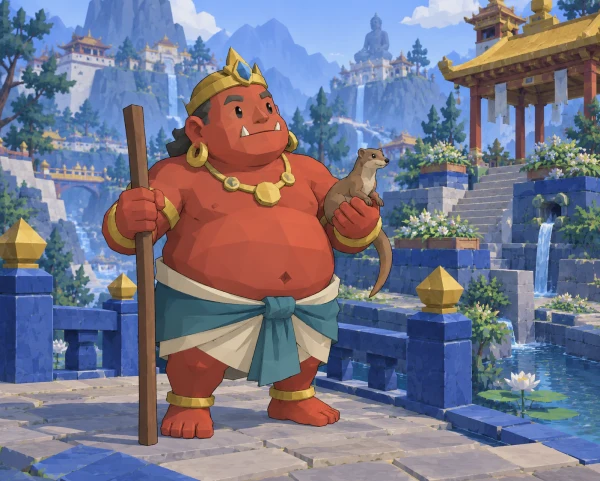
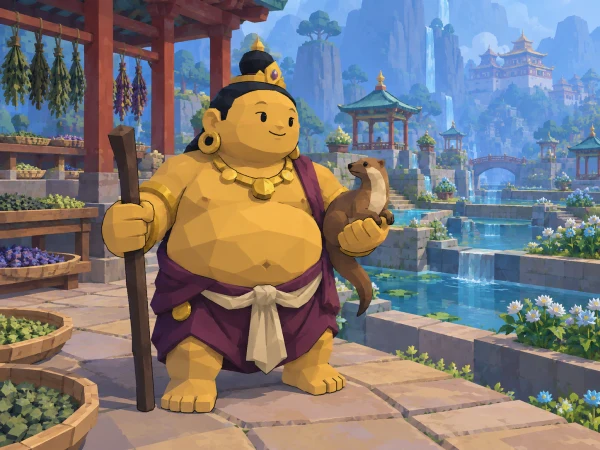
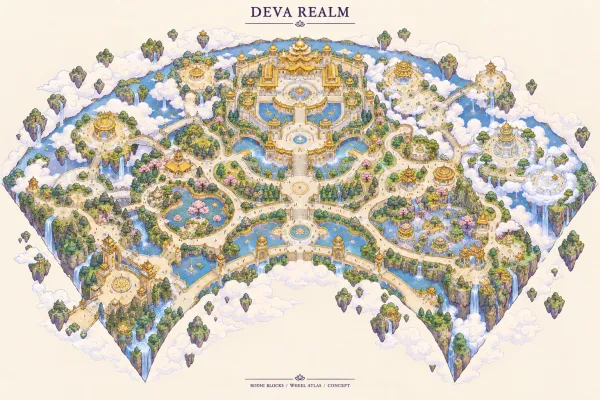
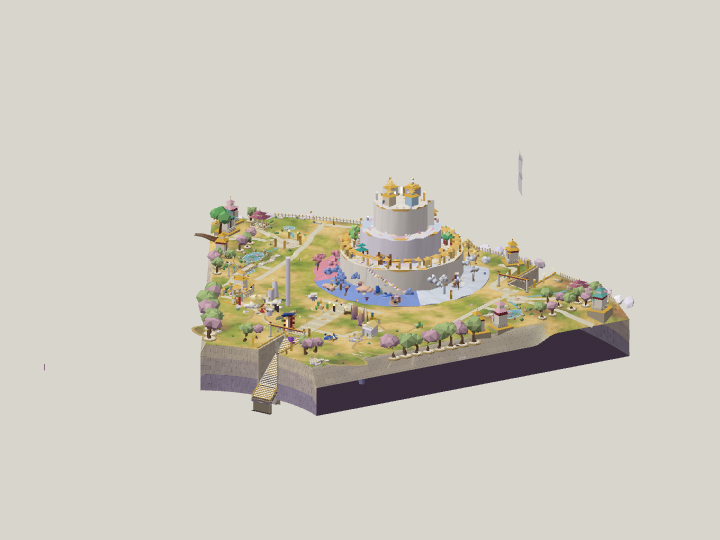
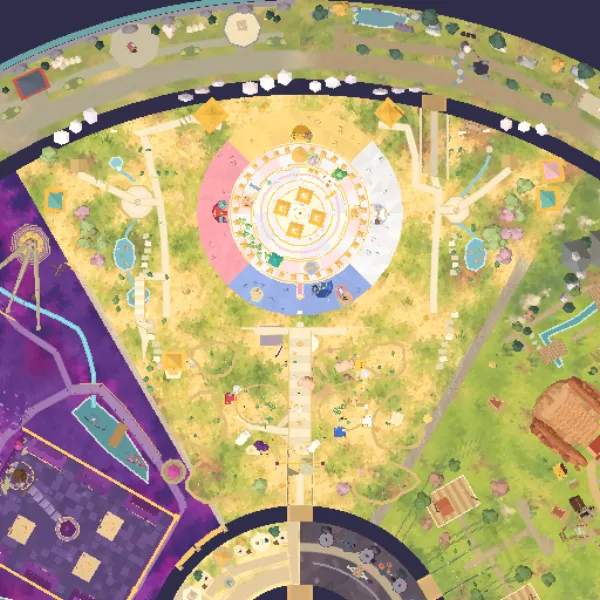
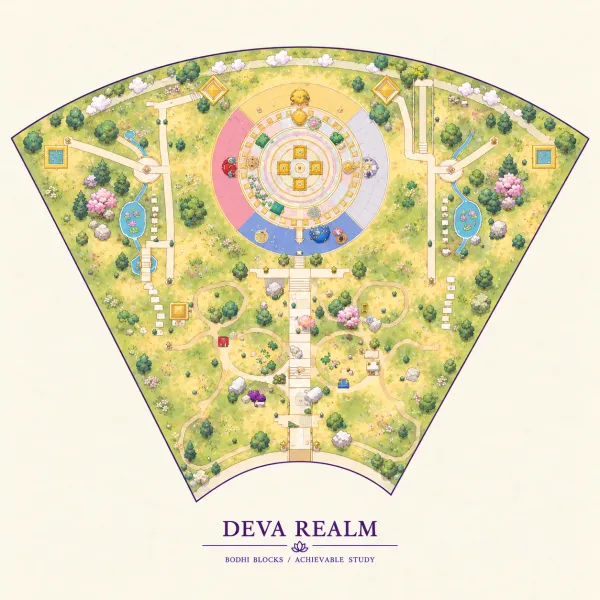
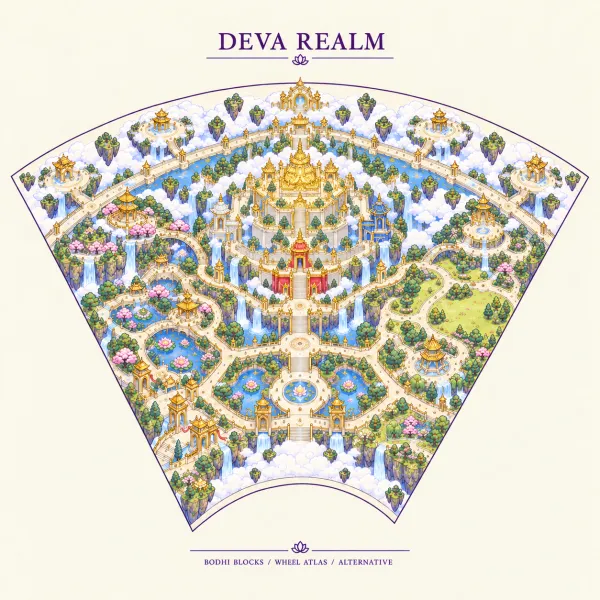
What canon says about each realm of the Wheel and the lands beside it: Jambudvīpa and the four continents, the animal realm, the hidden lands, the heavens on and above Meru, the asuras, the hungry ghosts, the hells, the hub and rim of the Wheel, the dark and the bardo, the charnel grounds, Tanaduk and the pure lands. Each topic carries every piece of art that shows it and a zoomed crop where the art shows it only in part. Gathered 2026-10-30 for the overworld layout studies: lore first, then layout. The checklist follows at What the game has.
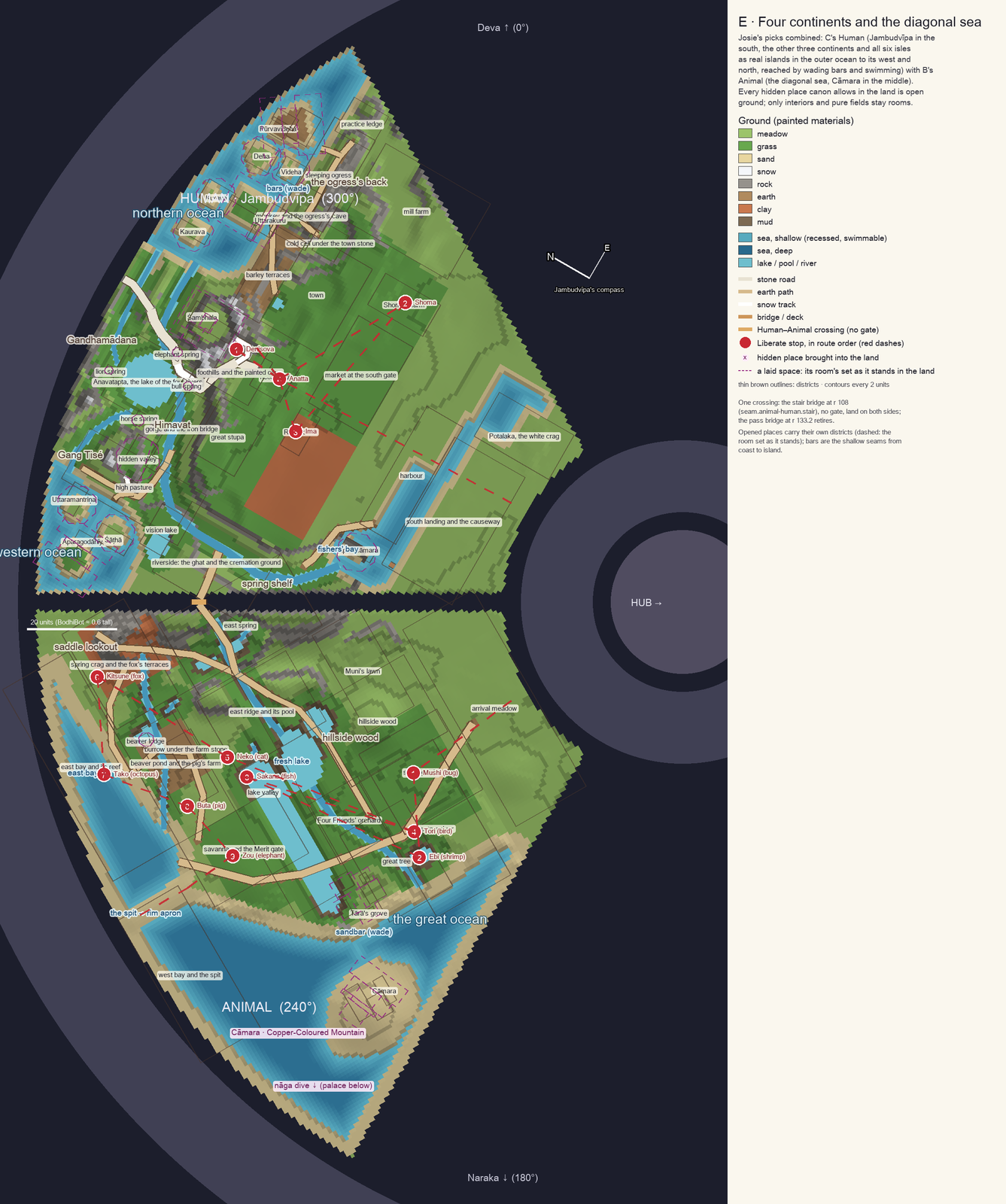
Chosen layout: Layout E
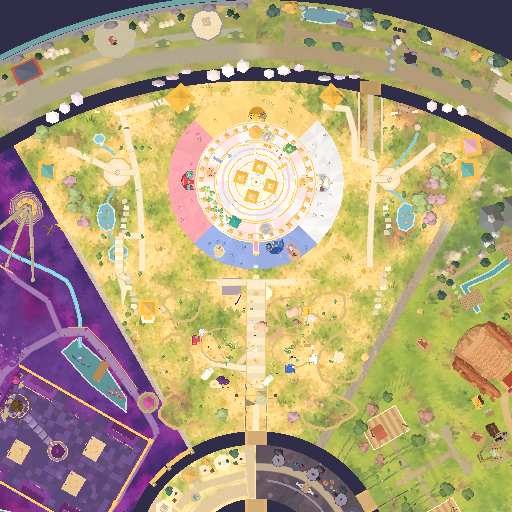
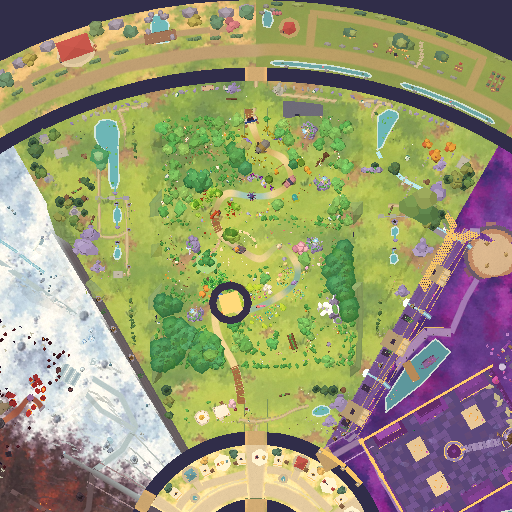
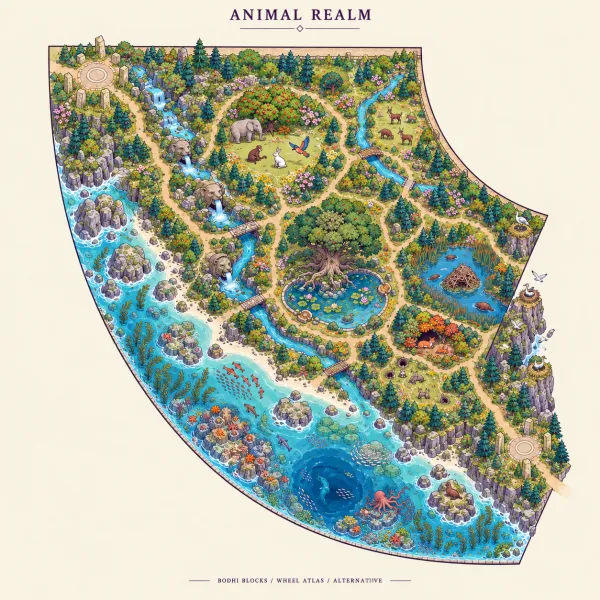
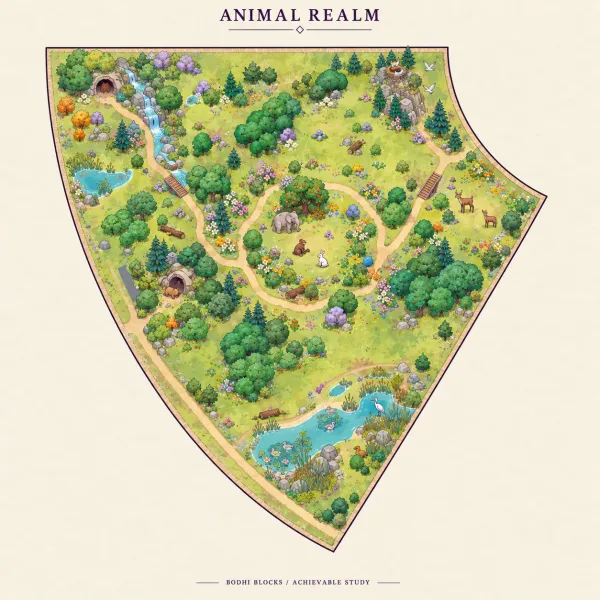
Layout E is in the game: its landforms, waters, paths and paint in Human and Animal, the district moves and the hidden places opened as land. It is being finished in the world editor now; the handoff lists what still needs the editor and the code.
Everything around and between the four continents: Mount Meru and its coloured faces, the golden ranges and sweet seas, the salt ocean, the iron rim, the sun and moon, the four continents and their eight islands, and Siṃhala's island of rākṣasīs. Canon fixes directions, shapes, sizes and who lives where, so this is the frame the Human continents and the Animal ocean will sit in. Where the Abhidharmakośa, Phagpa, Kongtrul, the Dīrgha Āgama and the Kālacakra disagree, each card says so.
The ground under everything: wind, water and gold
vāyumaṇḍala, jalamaṇḍala, kāñcanamaṇḍala; Tib. rlung gi dkyil 'khor, chu, gser gyi sa gzhi
The whole four-continent world floats on a disc of golden ground, set on a layer of water, set on a cross of wind in empty space.
After the long empty age, winds blow in from the ten directions and lock into a solid cross of wind. A cloud like a golden yoke forms above it and rains for ages, drops as thick as a chariot shaft. The water is held up by the wind.
Wind churns the water until its top sets like cream on boiled milk and turns to gold. That golden ground is the floor on which Meru, the seven golden ranges, the continents and the iron rim all stand. Every mountain and continent reaches eighty thousand leagues down through the ocean to rest on it.
In the middle of the first great ocean a thousand golden lotuses appear. The gods read them as a sign that a thousand Buddhas will come, and call this the Fortunate Age.
Rain falls again on the gold and becomes the great ocean. Wind sorts its stuff into three grades: the finest makes Meru, the middle makes the golden ranges, the coarsest makes the continents and the iron rim.
What canon fixes for the map
Layered from the bottom: wind, then water, then golden ground; the ocean lies on the gold [K pp.20–21; AK iii.45–47, pp.451–452].
Wind layer 1,600,000 yojanas thick and immeasurable round; water 800,000 thick after the gold forms; gold 320,000 thick; water and gold discs 1,203,450 yojanas across [AK iii.45–48, pp.451–452].
Phagpa colours the wind disc light blue [P printed p.12].
Meru, ranges, continents and rim all go down 80,000 yojanas to the gold [K pp.21–22; P printed p.16].
Kālacakra variant: four concentric half-spheres of wind, fire, water and earth, 400,000 / 300,000 / 200,000 / 100,000 leagues across, nested like bowls with level rims [K pp.72, 76].
Who lives here
The gods of the pure domains who see the thousand lotuses and name the Fortunate Age [K p.20].
In the game now
meru:system/foundation is built: a three-layer cutaway plinth (wind, water, golden ground) on the Meru chart's foot ring (docs/purelands-cosmology.json, entry meru). No samsara item of its own.
Sumeru / Meru; Tib. ri rab, ri'i rgyal po ri rab lhun po
The king of mountains stands in the middle of the world, each face a different jewel, and each continent's sky takes the colour of the face it looks at.
Meru rises 80,000 leagues out of the ocean and goes 80,000 leagues down to the golden ground. Seen from above it is square. Four terraces step out from its sides, from the sea up to half its height; the Four Great Kings and their peoples live there, and the Thirty-Three gods live on its flat top.
Each face is made of one jewel and colours the sky in front of it. Our continent faces the blue face, so our sky is blue. In Kongtrul's account the east face is crystal, the south blue beryl, the west ruby and the north gold.
The Abhidharma gives a different set: north gold, east silver, south lapis (beryl), west crystal. Phagpa follows it, and adds that the outer ocean takes the colours too: white in the east, bluish green in the south, red in the west, yellow in the north.
Gelug teachers commonly teach east silver-white, south lapis, west ruby, north gold, and say the eastern continent has a white sky, the western a red sky and the northern a yellow sky.
What canon fixes for the map
Centre of the world-system; square from above; 80,000 yojanas above water, 80,000 below; as wide as it is high [K p.22; AK iii.50–51, pp.453–454].
Faces (Kongtrul): east crystal, south blue beryl, west ruby, north gold; each colours the sky on its side [K p.22].
Faces (Kośa): north gold, east silver, south lapis, west crystal; the lapis face is why Jambudvīpa's sky is blue [AK iii.49d–50a, p.453]. Phagpa and the Dīrgha Āgama agree with the Kośa [P printed p.12; DA SC 31].
Sky colours by continent (Gelug oral teaching): east white, south blue, west red, north yellow [LZ, Kopan 1977].
Four terraces at 10,000-yojana steps, jutting 16,000, 8,000, 4,000 and 2,000 yojanas, reaching half Meru's height [AK iii.63–64, p.462; K p.22].
Shape varies: Abhidharma square; Kālacakra round and cup-shaped, 16,000 leagues across at the base and 50,000 at the top, with a 'neck', 'face' and 'crown' of thin air above [K pp.73–74]. The game's round, terraced Meru is an adaptation.
Asuras live in crevices of Meru's base below the waterline [K p.29].
Who lives here
The Four Great Kings and their retinues on the fourth terrace; the Vessel-Bearers, Garland-Bearers and Inebriates on terraces one to three [K p.30] (deva group covers them).
The Thirty-Three gods on the summit [K p.30].
Asuras in the crevices of the base [K p.29].
In the game now
Meru is built as the Deva section's mountain (docs/world-plan/places/meru.json): round, four terraces with four coloured faces, summit city, sky platforms, and the nested world-system chart room meru:system. Terrace peoples being:meru:terrace-1/2/3 built; place:asura:meru-crevices built.
Rubin Museum of Himalayan Art / Himalayan Art Resources item 877 · traditional · All rights reserved (link only)
Mongolian, 19th century. Top centre: Meru with the four continents as coloured shapes, each with its two islands; Jambudvīpa in the foreground, coloured blue.
Yugaṃdhara, Īṣādhara, Khadiraka, Sudarśana, Aśvakarṇa, Vinataka, Nimiṃdhara; Tib. gnya' shing 'dzin, gshol mda' 'dzin, seng ldeng can, blta na sdug, rta rna, rnam 'dud, mu khyud 'dzin
Seven rings of golden mountains stand round Meru like curtains, each half the height of the one inside it.
Beyond Meru seven ranges of gold stand round it, each forming a square. They are named for the shape of their peaks: Yoke, Plough, Acacia Forest, Pleasing-to-the-Eye, Horse's Ear, Bent, and Rim.
The first, Yoke, rises 40,000 leagues out of the water; each range after it is half as high, down to Rim at 625. Each is as wide as it is high.
Some of the Four Kings' retinue live on these ranges as well as on Meru's terraces. Above Yoke, the highest, there is no night and day: the light never changes, and beings there tell the time by flowers opening and closing.
Between the ranges lie the seven seas of pleasant water.
What canon fixes for the map
Seven concentric square ranges of gold between Meru and the outer ocean [K p.22; AK iii.48b–50a, pp.452–453; P printed p.13 'all lie in a square'].
Names in Tibetan order: Yoke, Plough, Acacia Forest, Pleasing-to-the-Eye, Horse's Ear, Bent, Rim [K p.22]; Phagpa gives the Tibetan commentary's last two as Elephant's Tusk and Fish Mouth [P printed p.13].
Some Four Kings' retinue live on the ranges [K p.30; AK iii.64, p.462].
Above Yoke, day and night are told by flowers [K pp.60–61].
The Dīrgha Āgama orders the ranges differently and gives other heights; keep it as a variant [DA SC 40–53].
Who lives here
Members of the Four Kings' company who live on the ranges [K p.30; P printed p.29].
In the game now
Drawn as rings inside the meru:system chart room; place:sun-moon:above-yoke built. No separate samsara item for the ranges.
Between the golden ranges lie seven seas of sweet water with eight good qualities, where the nāga kings play.
The spaces between the golden ranges are filled with seas whose water has eight qualities: cool, tasty, light, soft, clear, odourless, harmless to the throat and harmless to the stomach.
The first sea, between Meru and Yoke, is 80,000 leagues wide. Each sea after it is half as wide, down to 1,250 at the seventh.
Kongtrul calls them the seas enjoyed by the nāgas. Phagpa names the place where the nāga kings amuse themselves among the golden ranges Lalitasāgara.
These seven are the inner ocean. The salt ocean lies only outside the last range.
What canon fixes for the map
Seven seas, one between each pair of ranges from Meru to Nimiṃdhara [K p.22; AK iii.51c–52c, p.454].
mahāsamudra; Tib. rgya mtsho chen po, lan tshwa'i rgya mtsho
Outside the last golden range a vast salt ocean holds the four continents and runs out to the iron rim, and it is the animal realm's main home.
Beyond the golden ranges, everything up to the outer rim is salt water, except for the continents. The four continents and their islands sit in it, one opposite each face of Meru.
The fires of the iron rim keep this ocean from spilling over its edge.
Animals live on land, in water and in the air, but their main home is this great ocean. Nāgas and other creatures crowd its depths like fermenting grains of beer.
The sea takes Meru's colours: Phagpa says it is white in the east, bluish green in the south, red in the west and yellow in the north, and so it is called the four seas.
What canon fixes for the map
Between Nimiṃdhara and the iron rim; 322,000 yojanas wide [AK iii.52c, p.454; P printed p.13].
Salt; holds the four continents and eight islands [K pp.23–24].
Its edge touches the iron rim; the rim's volcanic fire keeps it in bounds [K p.24].
Animals' principal place [AK p.460; K pp.28–29].
Four coloured seas: east white, south bluish green, west red, north yellow [P printed pp.13–14].
The Kośa notes the ocean has no steep drop round the continents: continents are wider at the base, like heaps of grain [AK p.459].
Who lives here
The ocean's animals, nāgas in the depths [K pp.28–29]; asura kingdoms at levels above the ocean floor [K p.29]. Animal and asura groups write these.
In the game now
place:iron:salt-ocean built inside the meru:system chart; place:naga-palace:ocean-depths built. The Human section's ferries cross a sea to the continents.
A ring of iron mountains closes the world-system off at the edge of the salt ocean.
The outer rim is a mountain range of iron. Kongtrul calls it the Horse-faced range and says it is volcanic: its fires stop the ocean from going past its limits.
It is called Cakravāḍa because it circles the four continents and is shaped like a wheel. It is the lowest of the mountains, 312½ leagues out of the water.
Every world-system has its own rim. A thousand of them make a small thousand-world system, which has its own rim too, and so on up to the great thousand.
Beyond the rim is darkness. In the Dīrgha Āgama two chains of diamond mountains stand outside, with hells in the dark between them. In the Kālacakra, fire and then wind surround the rim, and beyond that is only empty space.
What canon fixes for the map
Outermost ring, made of iron, encircling the four continents [K p.24; AK iii.48b–50a, pp.452–453; P printed p.12].
312½ yojanas high and as wide [AK p.454; P printed p.13]. The Dīrgha Āgama gives 300 yojanas and says it is made of the seven treasures [DA SC 53].
Its volcanic fires hold the ocean back [K p.24].
Each thousand world-systems is ringed by a further Cakravāḍa [P printed p.20].
Kālacakra: the seventh ring is the Great Indestructible Perimeter, girdled by the Horse-faced Fire and then wind, each 50,000 leagues wide; beyond is vacuity [K pp.75–76].
Dīrgha Āgama: two chains of great diamond mountains outside the ocean, utter darkness and hells between them [DA SC 200–201, 300–303].
Who lives here
The Four Kings' company also lives on Mount Cakravāḍa [P printed p.29].
In the game now
place:iron:cakravada built in the meru:system chart. Missing: being:iron:cakravada/beings, place:iron:chiliocosm-rims, place:iron:indestructible-perimeter, place:iron:vajra-chains.
One sun and one moon, each a crystal palace of a god, ride a wind round Meru at the height of the first golden range.
The sun and moon rest on wind and circle Meru as if carried by a whirlpool. They move at the height of Yoke, the first golden range, which is halfway up Meru.
The sun's disc is fire crystal, 51 leagues across, with a golden rim and four spires. It is the palace of the Sun God and his retinue. The moon's disc is water crystal, 50 leagues across. It is the palace of the Moon God.
One sun lights all four continents, so it is never the same hour on two of them: when it is midday in Jambudvīpa it is sunset in the east, sunrise in the west and midnight in Kuru.
The moon wanes because it comes near the sun and its own shadow falls across it. In the Dīrgha Āgama, the moon's ministers put on blue robes and the moon shrinks.
The stars are smaller palaces of sky gods, one to six krośa across, all of the Four Kings' class.
What canon fixes for the map
At the height of Yugaṃdhara, half Meru's height, on wind [AK iii.60a, p.460]; Phagpa says 40,000 yojanas up [P printed p.16].
Sun disc 51 yojanas, moon 50 [AK iii.60b, p.460; P printed p.17].
They circle clockwise ('from the right') [P printed p.16].
One sun and moon per four-continent world [AK p.461; DA SC 7].
Times of day on the four continents [AK iii.61, p.461; DA SC 889].
Six months north, six south: days lengthen and shorten [P printed p.17; AK p.461].
Kālacakra: sun and moon are among ten planets on a celestial belt of wind between Meru's outer enclosure and the ring of fire; most planets move counterclockwise [K pp.81–85]. Their light never reaches the six inner ring continents [K pp.74–75].
Who lives here
The Sun God, called Quickness, in his golden hall [DA SC 832–839].
The Moon God, in his hall of beryl [DA SC 870–884].
The moon's blue-robed ministers [DA SC 880, 883].
The gods who live in the star palaces [P printed p.17].
In the game now
place:sun-moon:sun and place:sun-moon:moon built (chariots circling the meru:system chart, clockwise). Missing: being:sun-moon:sun-god, moon-god, moon-ministers, sky-gods, planets; place:sun-moon:celestial-sphere, enclosures.
Nāga kings play in the sweet seas between the golden ranges, and nāgas crowd the depths of the great salt ocean; this card is only about where.
Kongtrul calls the seven inner seas 'the seas enjoyed by the nāgas'. Phagpa names the nāga kings' pleasure-ground among the seven golden mountains Lalitasāgara.
In the great outer ocean, nāgas and other animals live in the depths, packed close like grains in brewing beer. Some asuras counted as animals live on the ocean floor, and the asura kings live at levels above it.
In the Kālacakra model the nāgas live inside the earth disc itself, in the lower part of its upper half, just below the asuras.
What canon fixes for the map
Seven inner seas: the nāgas' pleasure seas [K p.22]; Lalitasāgara among the golden mountains [P printed p.13].
Outer ocean depths: nāgas' principal home among the animals [K pp.28–29; AK p.460].
Asuras: crevices of Meru's base below water and levels above the ocean floor [K p.29].
Kālacakra variant: nāgas in the earth sphere, under the asuras [K p.80].
Who lives here
Nāga kings (the animal group writes them as beings).
In the game now
place:naga-palace:ocean-depths built; the game's naga-palace room is entered from a pond (docs/world-plan/places/naga-palace.json, game adaptation). place:naga-palace:lalitasagara missing.
Tibetan practitioners heap rice on a plate as the whole world-system, Meru, continents, islands, treasures, sun and moon, and offer it.
The practitioner says the ground is golden, ringed by an iron mountain wall, with Meru in the middle. East is Pūrvavideha, south Jambudvīpa, west Aparagodānīya, north Uttarakuru, each with its two islands.
Then come the jewel mountain, the wish-fulfilling tree, the wish-fulfilling cow and the harvest that needs no sowing; one belongs to each continent. Then the seven royal treasures, the treasure vase, eight offering goddesses, and last the sun, the moon, the precious umbrella and the victory banner.
In the heaps, east is set toward the one who offers. The treasures go east, south, west and north in that order: jewel mountain east, wish tree south, cow west, unsown harvest north.
This rite is how most Tibetans picture the world-system. Teachers explain the colours of the four skies while teaching it.
What canon fixes for the map
Order and names of all 37 points [M37].
Treasures by direction: jewel mountain east, wish tree south, cow west, unsown harvest north (FPMT placement instructions) [LZ2; Thubten Chodron].
Sun and moon: Pabongkha puts the sun south and the moon north; others put them south-east and north-west [LZ2].
East faces the practitioner on the plate [Thubten Chodron].
Rubin Museum of Himalayan Art / Himalayan Art Resources item 877 · traditional · All rights reserved (link only)
Mongolian, 19th century. Top centre: Meru with the four continents as coloured shapes, each with its two islands; Jambudvīpa in the foreground, coloured blue.
The Wheel of Time Tantra draws a different world: a round, cup-shaped Meru, six ring continents in seas of honey and milk, and our continents in a seventh ring.
The Kālacakra builds the world on four round discs of wind, fire, water and earth. Meru stands 100,000 leagues tall, narrow at the base and wide at the top like a porcelain cup. Above it are a 'neck', 'face' and 'crown' made only of wind and space.
Meru's centre is green and its sides are blue in the east, white in the north, red in the south and yellow in the west, made of emerald, blue beryl, crystal, ruby and topaz.
Five curtains hang from Meru's rim. Under them lie six ring continents named Moon, White, Most Excellent, Kuśa Grass, Centaur and Crane, between seas of honey, butter, yogurt, milk, water and beer, with ranges between. Sun and moon never shine there; the people glow with their own light.
Outside the last range, Cool, is the seventh ring, the Greater Land of Jambu: twelve lands like lotus petals, with the four great continents in the cardinal directions. Then a salt ocean, the Great Indestructible Perimeter, a ring of fire, a ring of wind, and empty space.
What canon fixes for the map
Meru round and cup-shaped, base 16,000 and top 50,000 leagues [K p.74]; contrast the Abhidharma's square Meru [K p.22].
Face colours east blue, north white, south red, west yellow, centre green [K p.73].
Six ring continents and six seas inside the Cool range [K p.75].
Great continents: east semicircular (wind) 7,000; south triangular (fire) 8,000; west round (water) 9,000; north square (earth) 10,000 leagues [K p.77]. The Abhidharma has no 'Tail-Fan' islands here [K p.77].
Salt ocean 50,000 leagues; perimeter, fire and wind rings each 50,000 [K p.76].
Kongtrul: 'there are many different models of this world-system' [K p.74].
Who lives here
The self-luminous people of the six ring continents [K p.74].
In the game now
Kālacakra items exist only as missing samsara entries: place:sun-moon:enclosures, place:sun-moon:celestial-sphere, place:iron:indestructible-perimeter, being:sun-moon:planets.
Canon puts the animals mainly in the great salt ocean, crowded in the dark depths and eating one another, with nāgas in jewel palaces below and garuḍas hunting them from above; the rest live scattered among humans and gods as livestock and hunted wild beasts. This group gathers what the texts fix about that ocean and its beings, the animal stories the game can draw on, and how Wheel of Life painters picture the animal sector, so the Animal realm can grow a real sea.
Where the animals live
Skt. tiryañc; Tib. dud 'gro ("moving bent over")
Animals live on land, in water and in the air, but their main home is the great ocean.
The animal realm is not a separate country. Animals live in three places: the land, the water and the air. Their principal home is the great ocean; the animals found anywhere else are, in Vasubandhu's words, the surplus of the animals.
Kongtrul repeats this and adds a picture: in the great ocean, animals such as nāgas inhabit the depths, living crowded together like fermenting grains of beer. Gampopa gives the same answer to 'where are they located?': ocean, plain or forest, and for most of them the ocean.
Patrul and Dudjom split all animals into two kinds: those living in the depths (the great outer oceans) and those scattered in different places (the realms of gods and humans). Dudjom says the scattered ones fill everything: ground, mountains, valleys and air.
The Tibetan word for animal, dud 'gro, means 'moving stooped over', because animals go about bent over; Kongtrul reads the Sanskrit tiras the same way, as bent, crooked or horizontal.
What canon fixes for the map
Principal habitat: the great ocean; secondary: land, water and air anywhere [AK p. 460; K pp. 28–29].
Most animals abide in the ocean; others on plains and in forests [JOL ch. 5].
Two classes: animals of the depths (outer oceans) and animals scattered among gods and humans [WMPT pp. 76–77; DT p. 96].
Phagpa: animals mostly live in rivers and seas, in turbid water like dregs; some dwell among humans and gods [P pp. 25–26].
Any mountain, cliff, tree, temple or house of the human world can serve as a secondary home for beings of the lower realms [K p. 30].
No source gives a fixed boundary, bearing or share of the world to the animal realm; the game's southwest wedge is adaptation (docs/world-plan/sections/animal.json account.adaptation).
In the game now
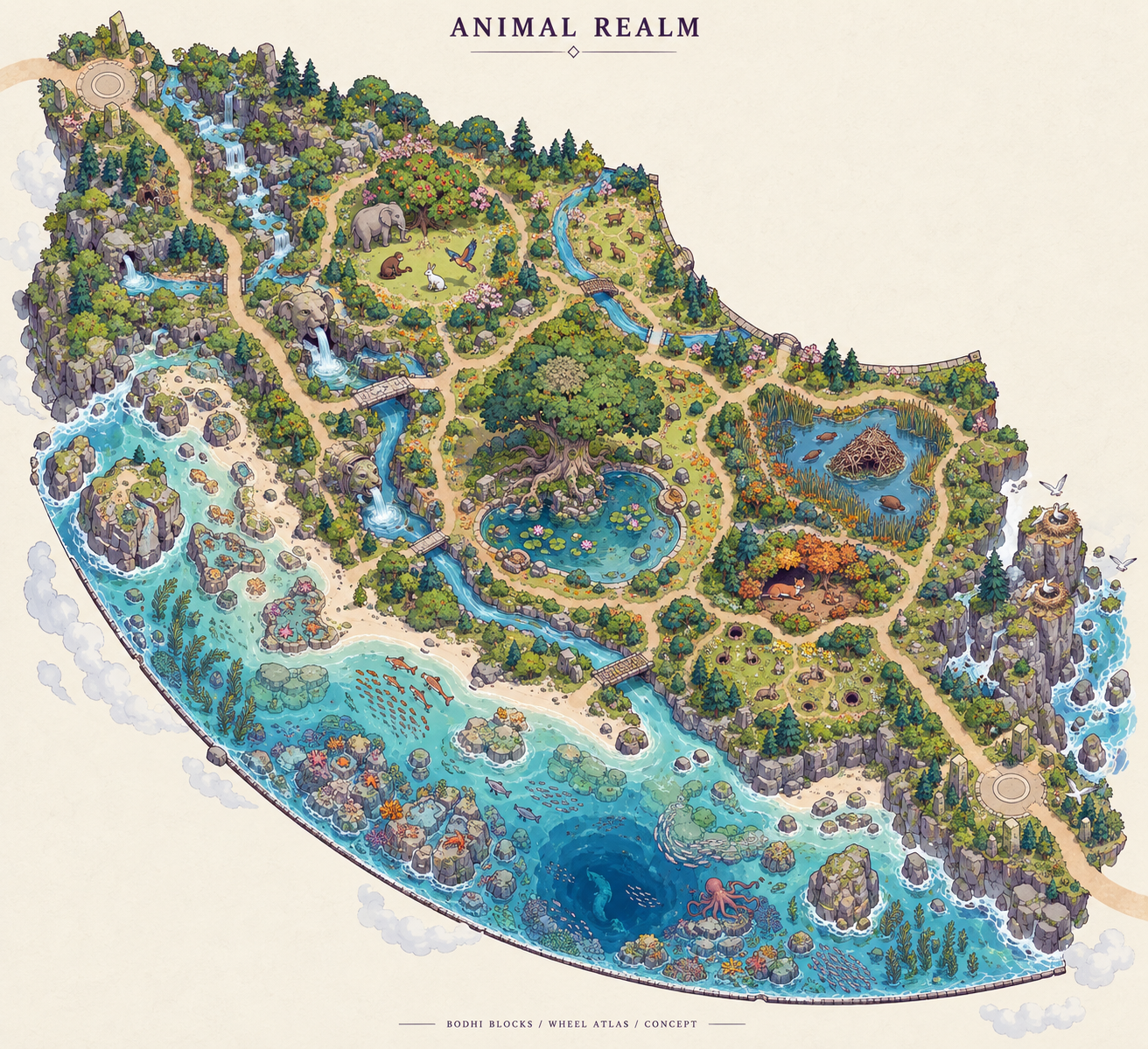
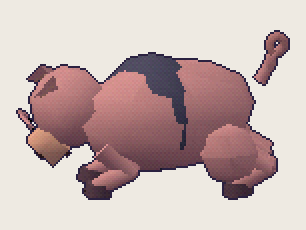
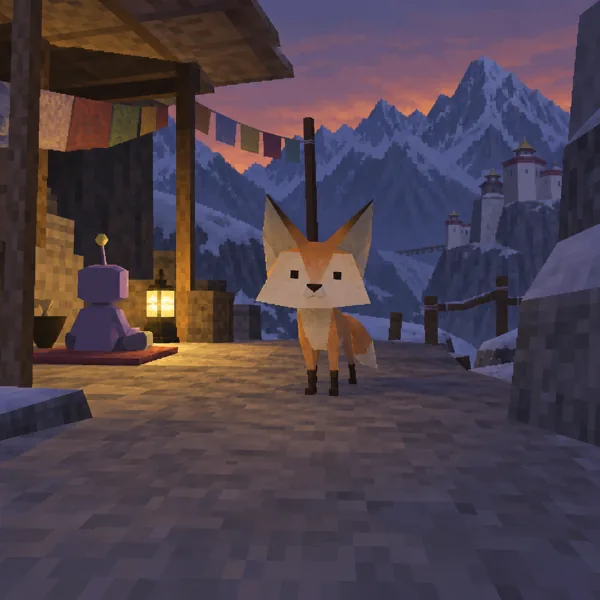
Adaptation: the Animal wedge (southwest) with two bays of the outer ocean at its rim end, a lake, rivers, a hillside wood, a great tree and a farm (docs/world-plan/sections/animal.json). Samsara realm `animal`: 60 items, 35 built, 4 sketch, 21 missing. Places built: place:naga-palace:ocean-depths, place:beaver-lodge, place:naga-palace:naga-region, place:naga-palace:land-of-nagas, place:naga-palace:mahanaga-palace. Ladder beings built: being:liberate-bug, being:liberate-shrimp, being:liberate-fish, being:liberate-bird, being:liberate-cat, being:liberate-fox, being:liberate-octopus, being:liberate-pig, being:liberate-elephant.
Art (10)
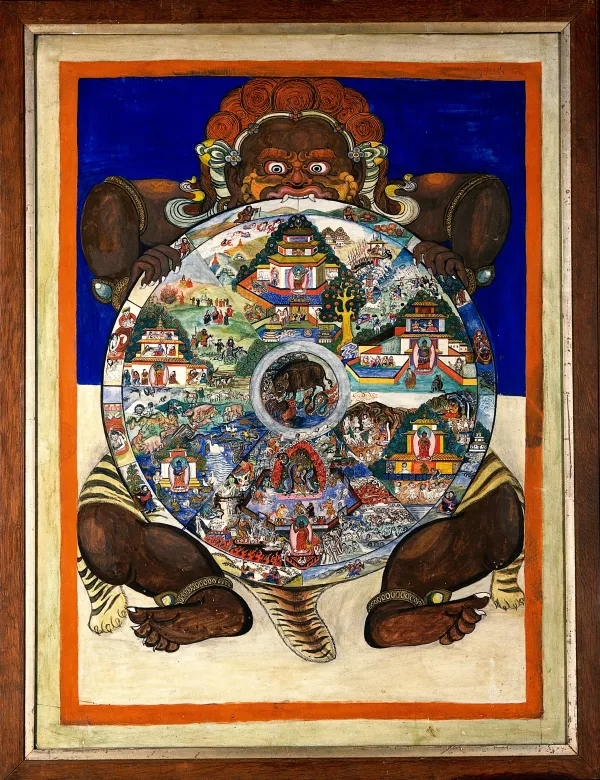
the animal sector, lower left: herds, wild beasts, the Muni's shrine and the sea
Wellcome Collection (repo copy, media.json painting-wellcome-L0069380; same painting as V0017705) · traditional · Public Domain Mark
A whole animal sector: herds driven by men at the top, wild beasts in the middle, the sea with nāgas and fish at the bottom. Land and water in one wedge.
the animal sector, left: elephant, camel, deer, cattle, then the sea
Salt Water Ocean; Skt. lavaṇa samudra / mahāsamudra; Tib. rgya mtsho chen po, lan tshva'i rgya mtsho
The salt sea between the last golden range and the iron rim: the animals' main home, holding the four continents and their islands.
Around Meru stand seven square golden ranges with seven sweet seas between them. Beyond the last golden range, all the way to the outer rim of iron mountains, lies one great salt-water ocean. The four continents and their eight islands sit in it, with countless small islands besides.
The ocean is deep. Every mountain and every continent stands in it to a depth of eighty thousand leagues and rests on the golden disc below; the continents are like piles of grain, much wider at the bottom. The outer ocean is 322,000 leagues across.
Fire keeps the sea in place. Its edge touches the iron Horse-faced Range, whose volcanic fires make the water evaporate so that it never spills past its limits.
Phagpa adds colour: the outer ocean is one water, but Meru's sides tint it. The sea is white in the east, bluish green in the south, red in the west and yellow in the north, and so it is called the four seas. Kongtrul says the sky on each side of Meru takes the colour of its face: crystal east, blue beryl south, ruby west, gold north.
The Pali discourse to Pahārāda, a separate tradition, adds that the ocean slopes gradually from the shore with no sudden drop, has one taste, salt, and holds pearls, gems, beryl, conch, quartz, coral, silver, gold, rubies and emeralds.
What canon fixes for the map
Position: between the seventh golden range (Rim, Nimiṃdhara) and the outer iron range [K pp. 22–24; AK pp. 454].
Width: 322,000 leagues of salt water [AK III.52c, p. 454; P p. 13 gives the same distance].
Depth: mountains and continents reach 80,000 leagues below the surface to the golden disc [K pp. 21–22; AK p. 454; P p. 14].
Shore: touches the iron Horse-faced Range, whose fires stop it overflowing [K p. 24].
Contains the four continents (east semicircle, south trapezoid, west round, north square), eight islands of matching shape, and countless small islands [K p. 23].
Colour of the water: white east, bluish green south, red west, yellow north [P p. 13]; sky colours by Meru's faces [K p. 22].
The rivers end in it: the four rivers from Lake Anavatapta circle the lake seven times clockwise, then run to the great ocean [K p. 25].
Variant: in the Wheel of Time (Kālacakra), a salt ocean 50,000 leagues wide surrounds the ring of twelve lands and is ringed by the Indestructible Perimeter, then fire and wind; inner rings include oceans of honey, butter, yogurt, milk, water and beer [K pp. 75–76]. Keep the two systems apart.
Corroboration (Pali): gentle slope, no precipice, salt taste, treasures [AN 8.19 §§2.6, 7.1, 8.1].
Who lives here
Animals of the depths, chief among them nāgas [K pp. 28–29].
Animal-class asuras at the ocean floor (see sea-floor-asuras topic) [K p. 29; AMSD 3.62–3.63].
In the game now
Adaptation: two recessed bays of the outer ocean at the Animal wedge's rim end, either side of a spit to the outer bridge (animal.shore, animal.tidal-cove; DECISIONS 57). The Meru-system room has an iron boundary round a salt ocean (iron-enclosure topic, partial). place:naga-palace:ocean-depths is built (it maps to the wedge's sea). place:iron:indestructible-perimeter (deva realm) is missing.
Library of Congress, via Wikimedia Commons · traditional · Public domain
Painters draw the animals' ocean as a band of blue waves with creatures in it.
Still missing: No open-licence cosmology painting yet that shows the outer ocean as a ring with its creatures; human-group Meru art may cover the geography.
The outer oceans are packed with creatures, as thick as grains of malt at the bottom of a beer barrel.
Patrul: 'The great outer oceans teem with fish, reptiles, turtles, shellfish, worms and other creatures, as numerous as the grains of malt in the bottom of a beer-barrel.'
Kongtrul gives the same image: the animals of the depths live crowded together 'like fermenting grains of beer'. Phagpa says they dwell 'in turbid waters like dregs'.
Numbers matter in the teaching. There are as many animals as grains in a beer barrel, while gods and humans together are as few as the dust on a fingernail. Think how many bugs live in one clod of earth in summer; there are hardly that many humans in the world.
Dudjom adds that the animals are the fewest of the three lower realms, and yet the beings of the depths are beyond counting.
A sūtra adds a karmic count: when most people of Jambudvīpa act wrongly, countless nāgas are born at the ocean shores; when most act rightly, five hundred and seventy million appear.
What canon fixes for the map
Density: grains of malt at the bottom of a beer barrel [WMPT p. 76]; fermenting grains of beer [K p. 29]; turbid water like dregs [P p. 25].
Comparative numbers: hells like the dust of the world, pretas like Ganges sand, animals like grains in a beer barrel, asuras like snowflakes in a blizzard, gods and humans like dust on a fingernail [WMPT p. 34].
Animals are the least numerous of the three lower realms, but still inconceivable in number [DT PDF p. 61].
Nāga numbers rise and fall with human conduct in Jambudvīpa [AMSD 3.60].
Who lives here
Fish, reptiles, turtles, shellfish, worms 'and other creatures' [WMPT p. 76].
In the game now
being:ambient-sea-shoal (built, 108 fish in the east bay, an authored group expressing the crowded habitat, not a census). being:animal.tidal-cove.ocean-neighbours (missing: a ray, a crab and a fish, adaptation).
Art (2)
the sea below the Muni's shrine, crowded with fish, conches and jewels
Some sea creatures are born in the sunless waters between the continents, unable to see even their own limbs.
Patrul: 'Some of these creatures are born between the continents, where the sun does not shine and where they cannot even see whether their limbs are bent in or stretched out.'
Kongtrul says the same in a cosmological voice: domestic animals have some trace of happiness, but those born in the darkness of the areas between the continents, and some other animals, are tormented by unremitting suffering.
Nothing in these texts says how deep this dark water lies; it is defined by place, between the continents, out of the sun's reach.
What canon fixes for the map
Location: the ocean between the continents, where the sun does not shine [WMPT p. 76; K p. 47].
Its beings suffer without break; contrast with domestic animals, who have some happiness [K p. 47].
Depth, size and exact bearings of this dark water are not given in these sources.
In the game now
Nothing yet.
Art (0)
Still missing: No painting found that shows the sunless water between the continents; Wheel sectors show only lit seas.
In the sea the big swallow the small, the small bore into the big, and nothing has a home.
Patrul: 'The bigger ones swallow up the smaller ones. The small ones burrow into the big ones and eat them alive in their turn. The big animals all have many tiny ones living inside them, feeding on their flesh.'
Sizes run to both extremes. 'There are serpents and monsters so big that their bodies can wind many times around Mount Meru. Other creatures are as small as particles of dust or the tip of a needle.' Kongtrul: there are innumerable possible shapes and features.
Dudjom: the animals of the great oceans have no dwelling to protect them; they are carried by the waves, drifting at random, and each is food for the other. Phagpa: because of the waves their dwelling places are not fixed, and they all fear one another.
Gampopa calls this the suffering of being eaten by one another, the lot of the majority who live in the big oceans: 'They eat whatever falls into their mouths.'
The Mindfulness sūtra sees fish, sea monsters, whales, crocodiles and shellfish tormenting one another in the deep sea, burning as if with acid, always thirsty, and living in fear of mutual killing.
What canon fixes for the map
No shelter: sea creatures drift with the waves and have no fixed home [DT p. 96; P p. 26].
Size range: from dust motes and needle tips to serpents that wind round Meru [WMPT p. 76].
Parasites live inside the great animals [WMPT p. 76; DT p. 96].
Being eaten by one another is the special suffering of the ocean majority [JOL ch. 5].
In the game now
The herons spearing the lake's fish and predation traces at the nest crag show predation on land and fresh water (ANI-P02, DECISIONS 61). Nothing shows predation in the sea yet.
Art (2)
a serpent seizing a frog, a crocodile, and a heron with a fish
makara (Tib. chu srin, 'water monster'); timi, timiṅgala, timirapiṅgala (Pali, AN 8.19); turtle (Tib. rus sbal)
Fish, turtles, shellfish, sea monsters, whales and crocodile-like makaras fill the sea, some hundreds of leagues long.
The Tibetan teachers list the ocean's animals plainly: fish, reptiles, turtles, shellfish and worms (Patrul). The Mindfulness sūtra names fish, sea monsters, whales, crocodiles and shellfish, and elsewhere fish, sea monsters, crocodiles, alligators, oysters and conches.
The chu srin, the 'water monster', is the makara. Kongtrul's translators describe it as a mythical creature, perhaps a blend of sea animals Indian sailors met: a dolphin's lower body and a head with a long snout and horns. In the gods' and asuras' war the sūtra lists 'fish, shellfish, crocodiles, infant-eating crocodiles, sea crocodiles, great sea crocodiles, alligators', whose hearts burst at the noise of battle.
The Pali discourse to Pahārāda names the ocean's great beings: timi, timiṅgala and timirapiṅgala (Sujato: leviathans, leviathan-gulpers, leviathan-gulper-gulpers), with asuras, nāgas and gandhabbas, and bodies a hundred to five hundred leagues long. This is Pali corroboration, not the Tibetan account.
Egg-born sea creatures (fish, sea monsters, crocodiles, oysters, conches) are said to grow on 'the food of volition': a parent merely thinks of its offspring and the young are fed.
Patrul tells two sea birth-stories of the Buddha: as a giant turtle he carried five hundred shipwrecked merchants to shore, then let eighty thousand flies drink his blood rather than kill them by rolling into the water; as King Padma he was reborn a rohita fish in the Nivritta river and gave his flesh to cure an epidemic.
Giant turtle and rohita fish are bodhisattva births told at sea and river [WMPT pp. 230–231].
Who lives here
The giant turtle (the Buddha in a past life) who carried five hundred merchants [WMPT p. 231].
The rohita fish, King Padma reborn [WMPT pp. 230–231].
In the game now
being:liberate-octopus (Tako, built, on the east bay reef), being:liberate-shrimp (Ebi, built, western river), being:liberate-fish (Sakana, built, lake head), being:ambient-sea-shoal (built), being:inline-snail (built, shore snail), being:golden-koi (sketch). being:makara (human realm, built). being:animal.tidal-cove.ocean-neighbours (missing). No turtle, whale or great fish yet.
Art (6)
golden fish, a horned fish-monster, conches and jewels
Skt. sītā; 'seas of enjoyment'; Tib. rol pa'i rgya mtsho; AMSD 'middle ocean' (rgya mtsho bar ma)
Between Meru's golden ranges lie seven sweet seas enjoyed by the nāgas, water of eight good qualities.
Between Meru and the seven square golden ranges lie seven seas. Kongtrul calls them the seas enjoyed by the nāgas. Their water has eight qualities: cool, tasty, light, soft, clear, odourless, harmless to the throat and harmless to the stomach.
The first sea, between Meru and Yoke, is eighty thousand leagues wide; each next one is half as wide, down to 1,250 leagues for the seventh. Together they are the inner ocean.
The Mindfulness sūtra places a nāga realm called Endowed with Enjoyments in the 'middle ocean', a thousand leagues across and full of nāga kings, righteous and unrighteous. Its translators take 'middle ocean' to mean the seas between Meru and the outer ring. Phagpa names one of these seas Lalitasāgara, where the nāga kings amuse themselves.
What canon fixes for the map
Seven seas between the eight mountains, each square [K p. 22; P p. 13].
Widths: 80,000 leagues, halving each time to 1,250 [AK III.51c–52c, p. 454; P p. 13].
Water of eight qualities [K pp. 22–23; AK p. 454].
Enjoyed by the nāgas [K p. 22 and n. 8]; nāga realm Endowed with Enjoyments, 1,000 leagues, in the middle ocean [AMSD 3.37, 3.51, n. 212].
Lalitasāgara, between the Seven Golden Mountains [P p. 13, per repo ledger naga-palace:lalitasagara].
Who lives here
Righteous and unrighteous nāga kings (see naga-kings topic) [AMSD 3.42, 3.51].
The nāga kings of the Lalitasāgara, first of Śakra's five protectors against the asuras [P pp. 27–28].
In the game now
place:naga-palace:lalitasagara (deva, missing); being:asura:lalitasagara-nagas (asura, missing). The Meru-system room shows the ranges and seas compressed (meru topic, partial).
Skt. nāga; Tib. klu (lu); female nāgī, Tib. klu mo
Nāgas are serpent beings of the water and the underground, counted among the animals, rich, powerful and often afraid.
Nāgas are classed among the animals (Kongtrul's note allows animals or demi-gods). They live under the earth and in water, generally as snakes, though some take human form. They guard treasures hidden under the earth, and when provoked they cause illness.
Dudjom: a nāga is serpent-like, lives in water or under the earth, has magical powers and wealth, and the most powerful have several heads. Kongtrul names them first among the animals of the ocean depths.
Their life is double-edged. Patrul: the nāgas 'pass their lives in misery being tormented by garuḍas and rains of burning sand. In addition they are stupid, aggressive and poisonous.' Dudjom: they are burned daily by hot sand and always fear something hostile appearing.
The Mindfulness sūtra explains the burning: in the realms of unrighteous nāga kings a rain of 'nāga particles', like burning sand, falls on their heads and burns the female nāgas again and again. Righteous nāgas, who keep the Dharma, are spared it. Anger is what brings beings to birth as nāgas of the middle sea, where they shoot poison at one another.
Kongtrul's Kālacakra chapter places the nāgas in the lower half of the earth's upper sphere, below the demi-gods. Great nāgas are among the longest-lived animals.
What canon fixes for the map
Classed as animals (or demi-gods), living under the earth and in water [K n. 8, p. 175; DT glossary 'Naga'].
Principal home among the animals of the ocean depths [K p. 29].
Kālacakra variant: nāgas below the demi-gods in the upper half of the earth sphere [K p. 80].
Hot-sand rain falls only in the realms of unrighteous nāga kings [AMSD 3.37–3.39].
Nāga sufferings: garuḍas and burning sand [WMPT p. 76; DT p. 96].
Who lives here
Ordinary nāgas and nāgīs; the game's palace resident (being:naga-palace:region-nagas).
In the game now
being:naga-palace:region-nagas (built, rig naga, bound), being:naga-palace:nagas (sketch). place:naga-palace:naga-region and place:naga-palace:land-of-nagas (built: the coral hall under the Animal lake, reached by a dive, docs/world-plan/places/naga-palace.json; its lake setting is adaptation). Carved naga gateposts on open ground (ANI-P05).
Art (8)
a nāga woman with a serpent's tail, hands joined, in the sea
Endowed with Enjoyments (AMSD); Sāgara's abode; Mahānāga's palace
Righteous nāgas live in radiant jewel-fenced palaces under the sea, with ponds, cascades and blue lotuses.
The Mindfulness sūtra describes the righteous nāgas' homes: abodes ringed by jewel fences of the seven precious substances, radiant, with perfect ponds, cascades and blue lotuses. The nāgas there live on elixir and are always happy, wear flowers, powders and ointments, have serpents' heads but can take any form, and appear wherever they wish to go.
Their city Endowed with Enjoyments lies underneath the ocean; the sūtra says that below it, at the sea floor, live the animal-class asuras.
Sāgara, nāga king of the ocean, receives the Buddha in his abode in the depths. He paves its wide courtyard with blue beryl and Jambu-river gold, hangs nets of jewels and tiny bells, and sets up a jewelled lion throne twelve leagues high. He builds a three-step stair of gold, beryl and red pearl from the shore down to it. The Buddha makes the ocean's water invisible and harmless and walks down; every creature touched by his light stops harming the others.
In Kumārajīva's life of Nāgārjuna, the bodhisattva Mahānāga takes Nāgārjuna to his palace in the sea and opens its seven-treasure stores of scriptures. Bu-ston tells it differently: an unnamed nāga king invites Nāgārjuna to the region of the nāgas beneath the earth.
What canon fixes for the map
Righteous nāga abodes: jewel fences of seven precious substances, ponds, cascades, blue lotuses [AMSD 3.41].
Endowed with Enjoyments is 'situated underneath the ocean' [AMSD 3.61]; 1,000 leagues, in the middle ocean [AMSD 3.37].
Sāgara's abode is in the ocean's depths, reached by a stair from the shore; the shore has the magnolia forest Joyful [QNS 6.8, 6.19, 6.22–6.23, 6.41].
Mahānāga's palace is in the sea (Kumārajīva); Bu-ston's nāga region is beneath the earth. Two accounts; keep both [repo naga-palace:mahanaga, naga-palace:naga-king].
The game puts its palace under a fresh lake, not the sea; that is adaptation (docs/world-plan/places/naga-palace.json).
Who lives here
Sāgara, nāga king of the ocean [QNS 1.6–1.9, 6.1–6.5].
Sāgara's daughter, Adorned with Various Jewels, and ten thousand nāga women [QNS 7.31–7.39].
Mahānāga Bodhisattva (Kumārajīva's account) [LN pp. 23–24].
Sāgara; Anavatapta (Tib. Ma dros pa, 'Cool'); Nanda; Upananda; Aśvatara; Takṣaka; Vāsuki
Great nāga kings live for an age; some keep the Dharma and bring good rain, others bring hail and poison.
The longest-lived animals are the great nāga kings, Nanda, Upananda, Aśvatara and others. Vasubandhu quotes the Buddha: there are eight great nāga kings who live for a kalpa and sustain the earth.
The Mindfulness sūtra splits the nāga kings of Endowed with Enjoyments in two. The righteous ones are Seven-Headed, Gajānana, Vāsuki, Takṣaka, Bhadraka, Janaka, Undefeatable, Meghamālin, Kuṇḍalin and Shining. They trust the Three Jewels, protect the Buddha's relics, and bring timely rain. The unrighteous ones are Pramatha, Aṭopa, Kāla and Huluhulu; they eat frogs, sand or air.
Sāgara, king of the ocean, has lived there since the start of the eon and comes to the Buddha with 840 million male and 720 million female nāgas. The nāga kings Breath, Great Breath, Takṣaka and Infinite Color speak for the ocean's nāgas against the garuḍas.
Anavatapta, 'Cool', is the nāga king of the lake north of the Snowy Mountains. Kongtrul says the nāga kings take the form of fish to eat the jambu fruit, and what they leave becomes the gold of Jambudvīpa's rivers.
What canon fixes for the map
Longest animal life: one antarakalpa, the great nāga kings Nanda, Upananda, Aśvatara [AK III.83b–d, pp. 472–473]. Kongtrul: an entire intermediate age [K p. 47]. Phagpa: half an intermediate kalpa [P p. 26]. Sources differ.
Righteous and unrighteous kings, named [AMSD 3.42, 3.51].
Sāgara lives in the ocean depths [QNS 5.4, 6.8].
Anavatapta lives in Cool Lake between the Snowy and Fragrant Mountains; the lake is 50 leagues deep and wide [K p. 25].
Nāga kings eat the jambu fruit in fish form; leftovers become river gold [K p. 26].
Who lives here
Sāgara [QNS].
Anavatapta [QNA; K p. 25].
Nanda, Upananda, Aśvatara [AK p. 473].
Breath, Great Breath, Takṣaka, Infinite Color [QNS 7.74].
Good nāgas send the right rain to all four continents; angry ones send hail, poison and storms; nāgas keep jewels and treasure.
Rain follows human conduct. When people are righteous, the righteous nāga kings grow strong and send timely, gentle rain to all four continents, and harvests have fine smell, taste and colour. When people turn from the Dharma, unrighteous nāgas move in black clouds, spoil the water, grow poison trees and raise hail that flattens barley and rice.
Each continent fears something different. Jambudvīpa fears failed harvests, war, poison and wind, and floods. The people of the west fear unclean water. The gentle people of the east fear thunder and lightning; angry nāgas there show eyes as large as chariots, bodies like black mountains and three fiery heads. In Kuru in the north, nāga clouds hide the sun, wither the lotuses and make the lutes sound harsh.
Kongtrul gives the same note for the north: the sun on Unpleasant Sound is sometimes clouded by unruly nāgas, and so its music turns to cacophony, which is how the continent got its name.
Nāgas guard treasure. Kongtrul's note says they guard treasures hidden under the earth; Dudjom says the wish-fulfilling jewel is found in the realms of gods or nāgas. A universal monarch's rain-proof canopy, ten leagues long, is the hide of a nāga from the ocean.
What canon fixes for the map
Righteous nāgas water all four human continents [AMSD 3.42–3.49, 3.59].
Unrighteous nāgas: hail, black clouds, poison, thunder; continent by continent [AMSD 3.52–3.55, 3.58].
Northern continent's name comes from nāga clouds spoiling its music [K p. 26].
Nāgas guard underground treasure; they cause illness when provoked [K n. 8].
Wish-fulfilling jewel in gods' or nāgas' realms [DT glossary, per repo ledger naga-palace:nagas].
Nāga-hide canopy among a universal monarch's possessions [K p. 58].
Who lives here
The nāgas who rain on Kuru [repo: being:kuru:rain-nagas]; the unruly nāgas who cloud Kuru's sun [being:kuru:cloud-nagas].
In the game now
being:kuru:rain-nagas (human, missing), being:kuru:cloud-nagas (human, missing). being:four-kings:nagas (deva, built: retinue of the west).
Art (1)
jewels and conches strewn in the sea round the nāga woman
The garuḍas, kings of the birds, hunt the ocean's nāgas until the Buddha's shawl protects them.
The garuḍa is a great bird, master of the skies, which traditionally preys on the nāgas (Dudjom). Patrul and Dudjom both count garuḍas among the nāgas' chief torments.
In the Questions of the Nāga King Sāgara, the nāga kings Breath, Great Breath, Takṣaka and Infinite Color tell the Buddha that the four garuḍas, kings of the birds, take their weak young nāga boys and girls and frighten every nāga in the ocean.
The Buddha gives Sāgara his shawl: 'Wherever a single strand of this shawl lies in this ocean, the garuḍas will not go.' However many pieces are cut from it, it is never used up.
The four garuḍas, displeased, come and ask: 'If we do not kill our prey, what shall we do?' The Buddha teaches them which foods lead to the lower realms; they take refuge and vow never to frighten a nāga. In Kanakamuni's time they had been four proud monks.
Nāgas know the shape. When Maudgalyāyana rises over Lake Anavatapta in the form of a garuḍa, the nāgas and nāgīs flee in terror, until their king calms them.
What canon fixes for the map
Four garuḍa kings prey on the ocean's nāgas [QNS 7.74].
A strand of the Buddha's shawl in the ocean keeps garuḍas away [QNS 7.75–7.76].
The garuḍas' conversion [QNS 8.1–8.6].
Garuḍa shape terrifies the nāgas of Anavatapta [QNA 1.144].
The game's own garuḍa (being:garuda) is a different being from these four [repo naga-palace:four-garudas note].
Who lives here
The four garuḍas, kings of the birds (in Kanakamuni's time the monks Nanda, Mahānanda, Superior and Superior Teacher) [QNS 8.1–8.6].
In the game now
being:naga-palace:four-garudas (sketch). being:garuda (human realm, built; not one of the four).
Art (5)
a garuḍa diving at the sea over the nāgas' pavilion
Some asuras count as animals and live at the ocean floor, on the sunken terraces of Meru.
Kongtrul: one kind of demi-god classified as an animal lives at the bottom of the ocean, while the chief demi-gods, Rāhu, Garland Necklace and others, live at different levels above the ocean floor.
The Mindfulness sūtra: under the nāga city at the sea bottom live the asuras who compete with the gods. Some belong to the starving spirits, some to the animal realm. Those of the animal realm live at the bottom of the sea, on which rests Meru's sunken base, with four plateaus, the first 21,000 leagues across.
When gods and asuras fight over the ocean, the sea suffers: falling rocks kill hundreds of thousands of sea beings, and the din makes the hearts of fish, shellfish and crocodiles burst.
What canon fixes for the map
An animal-class demi-god lives at the ocean bottom [K p. 29].
Animal-class asuras live at the sea bottom on Meru's base, which has four plateaus [AMSD 3.62–3.63]; the fourth level, Immovable, is 'included in the animal realm' [AMSD 3.184].
Their wars kill sea creatures [AMSD 3.243, 3.274].
Canon conflict: the game counts asuras as their own realm (Liberate path); these texts file some of them under animals. Keep both statements; this belongs mainly to the asura group.
Who lives here
Rāhu, Garland Necklace (Kaṇṭhamāla) and other asura lords above the sea floor [K p. 29; AMSD 3.64, 3.94].
In the game now
Asura realm content only (asura group). Nothing in the Animal wedge.
Art (0)
Still missing: No art found for the ocean-floor asuras.
Animals kept by humans are milked, loaded, pierced and yoked, and none of them dies a natural death.
Patrul: domestic animals 'are milked, loaded down, castrated, pierced through the nose and yoked to the plough. Not one of them escapes this continual round of slavery. Horses and yaks continue to be loaded and ridden even when their backs are nothing but one big sore. When they can go no further, they are whipped and pelted with stones.'
'Cattle and sheep are exploited until they die. Once they are too old, they are sold off or killed by the owners themselves... a natural death is unknown to them.' When the butcher comes with his knife, they only stare.
Dudjom adds having their hair pulled out and being killed for meat, blood, hide and bones. Gampopa calls this the suffering of being used: 'Powerless, they are tortured. Hands, feet, whips, and iron hooks enslave them.'
Kongtrul gives the one softer line: domesticated animals have some trace of happiness, unlike the creatures in the dark between the continents. Patrul's instruction: if you have animals of your own, treat them with kindness and love.
What canon fixes for the map
These animals live 'scattered' among humans and gods, not in a separate land [WMPT p. 76; DT p. 96].
Wild animals never eat a mouthful without fear: hawks kill small birds, small birds kill insects, and hunters kill them all.
Patrul: wild animals 'live in constant fear. They cannot eat a single mouthful of food without being on their guard... Hawks kill small birds, small birds kill insects, and so on, continually amassing evil actions in an endless round of killing and being killed.'
Hunters use nets, snares, traps and guns. Animals die for their own bodies: oysters for pearls, elephants for tusks and bones, tigers, leopards, otters and foxes for fur, musk deer for musk, wild asses and yaks for flesh and blood.
Gampopa calls this the suffering of slaughter, quoting: 'Some die for pearls, wool, bone, blood, meat, and skin.' Dudjom: they are preyed on by birds and carnivores and cannot resist being killed by humans.
The Mindfulness sūtra adds that animals differ in whether they live in harmony: some live together, some are enemies, like snakes and mongooses, crows and owls, horses and buffalo.
What canon fixes for the map
Wild animals 'share our human world' [WMPT p. 76].
Predation chain: hawk, small bird, insect [WMPT p. 76].
Hunted for body products, named per animal [WMPT p. 77].
Natural enemies: snakes and mongooses, crows and owls [AMSD 3.7, 3.9].
In the game now
Animal ladder: being:liberate-bug, being:liberate-bird, being:liberate-cat, being:liberate-fox, being:liberate-elephant (built). Ambient: kites, herons, sparrows, songbirds, ducks, terns, dragonflies, fireflies, butterflies (built). Predation traces at the nest crag and torn den (ANI-P02). being:animal.den-hillside.burrowers (missing).
Art (3)
a lion bringing down a deer, a tiger leaping, a rhinoceros, an elephant
A blind turtle rises once a century in a shoreless sea; human birth is rarer than its head passing through a drifting yoke.
Patrul: imagine the whole cosmos as one vast ocean. On it floats a yoke, a piece of wood with a hole that fits round a draught ox's horns, tossed east and west by the waves. Deep in the ocean lives a blind turtle who comes to the surface once every hundred years.
The yoke cannot look; the turtle cannot see; the yoke never stays still; the turtle rarely surfaces. By sheer chance it might still slip its neck through. Gaining a human life with the freedoms is harder than that.
Nāgārjuna and Śāntideva both use the image ('like a turtle that perchance can place its head within a yoke adrift upon a shoreless sea'). The Mindfulness sūtra uses it for the rarity of the causes for buddhas, found only in Jambudvīpa.
What canon fixes for the map
Setting: one great ocean, waves always moving the yoke; turtle in the depths, surfacing once a century [WMPT p. 33].
Quoted from Nāgārjuna's letter and Śāntideva [WMPT p. 34].
Sūtra use: the sea turtle and the yoke [AMSD 3.56].
Who lives here
The blind turtle (an image, not a named being).
In the game now
Nothing yet.
Art (1)
a sea turtle swimming in the animal sector's water
Tib. mthun pa spun bzhi; Pali Tittira Jātaka (Ja 37)
A partridge, a hare, a monkey and an elephant settle who is eldest by who knew the tree first, and live in respect.
In the Pali telling, a partridge, a monkey and an elephant live by a great banyan on the slopes of the Himalayas without respect for one another. They ask who is eldest. The elephant walked over the tree when it was a bush; the monkey ate its top shoots sitting on the ground; the partridge ate the seed of another banyan and voided it here, so the tree grew. The partridge is eldest, and teaches the others the precepts.
The Buddha tells this to honour seniority after Sāriputta was kept out of a night's lodging. Moggallāna was the elephant, Sāriputta the monkey, the Buddha the partridge.
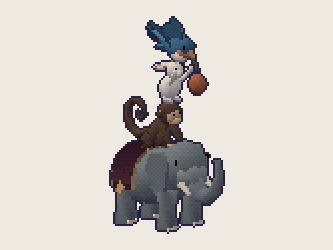
Tibetan and Bhutanese painting shows four friends, adding a hare, stacked on one another under a fruit tree: elephant, monkey, hare, bird.
What canon fixes for the map
Setting: a great banyan tree on the slopes of the Himalayas [Tittira Jātaka, Ja 37; Vinaya Cullavagga 6].
Pali has three animals; Tibetan art has four, adding the hare [HAR set 1179]. Name both.
The tree in Tibetan paintings bears fruit; species varies by painter.
Who lives here
The partridge (the Buddha), the monkey (Sāriputta), the elephant (Moggallāna) [Ja 37]; the hare in Tibetan tellings.
In the game now
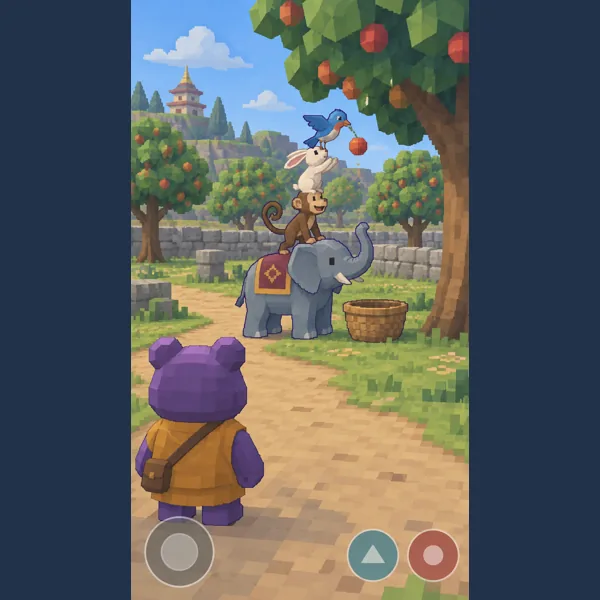
being:four-harmonious-friends (built), being:four-friends:bird, :hare, :monkey, :elephant (built), in the Four Friends' orchard (animal.friends-orchard) with the age-order activity (game invention).
A hare with nothing but grass to give offers its own body; Sakka paints its sign on the moon.
The Bodhisatta is born a young hare in a wood bounded by a mountain foot, a river and a border village. His friends are an otter, a jackal and a monkey. Seeing the moon, he knows the next day is the fast day.
Sakka comes disguised as a brahmin. The otter offers seven red fish dug from a fisherman's cache on the Ganges bank; the jackal a lizard and curds from a field-watcher's hut; the monkey mangoes. The hare has only grass, so he offers himself, shakes himself three times so no insect in his coat will die, and leaps into the fire, which is icy cold.
Sakka squeezes essence from a mountain and paints the sign of a hare on the moon, so that his virtue is known for a whole aeon.
What canon fixes for the map
The wood: a mountain foot on one side, a river on another, a border village on the third [SJ para. 2].
The otter, Ānanda; the jackal, Moggallāna; the monkey, Sāriputta [SJ].
The game omits the bodily sacrifice (repo moon-hare entry).
Who lives here
The wise hare (the Bodhisatta)
The otter (Ānanda)
The jackal (Moggallāna)
The monkey (Sāriputta)
Sakka, disguised as a brahmin
The fisherman on the Ganges bank
The field-watcher
In the game now
being:moon-hare:wise-hare (built), being:moon-hare:sakka (sketch); being:moon-hare:otter, :jackal, :monkey, :fisherman, :field-watcher, :landowner (missing); place:moon-hare:wood (built: the hillside wood, with the hare's kusa glade, flora_kusaGlade, at the mouth of the hollow log on the Muni's lawn where he stands).
Art (2)
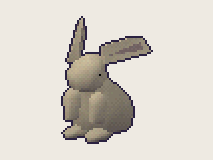
Moon hare: concept
AI concept study (repo) · concept · Project art
The repo's concept.
Moon hare: in-game render
Game capture (repo) · world-view · Project art
As built.
Still missing: No open-licence traditional painting of the hare jātaka found in this pass.
Skt. Bālāha; Pali Valāhassa ('cloud horse'); Tib. rta'i rgyal po sprin gyi shugs can
A divine horse king on the ogresses' island carries shipwrecked merchants across the ocean, if they never look back.
In the Kāraṇḍavyūha, the Buddha tells how, as a head merchant, he was stranded with five hundred others on Siṃhala Island, where each man lived with a rākṣasī. A talking lamp warns him and shows him an iron fortress where other merchants are kept and eaten.
The lamp tells of Bālāha, king of horses, who has compassion for the desolate. He eats the herb sarvaśetāna, rolls back and forth on the golden sand, shakes his body until the island shakes, and asks three times: 'Who is going to cross over to the far shore?'
None may look back at the island. The others turn, fall and are eaten; the head merchant alone reaches Jambudvīpa, circles the horse three times and goes home. Avalokiteśvara was the horse. The Pali Valāhassa Jātaka tells the same tale with the Bodhisatta as the horse.
What canon fixes for the map
Place: Siṃhala Island, across the ocean from Jambudvīpa; golden sand on its shore [KV 2.13–2.16].
Kongtrul lists Siṃhala among sixteen regions around Jambudvīpa [K p. 23].
Who the horse is differs: Avalokiteśvara (Kāraṇḍavyūha) or the Bodhisatta (Pali Valāhassa Jātaka) [KV n. 17].
Who lives here
Bālāha, king of horses (Avalokiteśvara)
The rākṣasīs of Siṃhala
The head merchant (Śākyamuni) and five hundred merchants
Tib. Bya chos rin chen 'phreng ba; the cuckoo, Tib. khu byug
In a Tibetan classic the cuckoo, Avalokiteśvara in disguise, teaches the birds, and each bird answers with its own call.
In Tibet the cuckoo's arrival announces spring. In this anonymous classic the cuckoo is Avalokiteśvara in hiding. He teaches the gathered birds about waking up to the mind's true nature.
Each bird in turn says what it understood. Their calls, which sound like nothing at first, sound in Tibetan like reminders of the Buddha's teaching and like proverbs. The next year the birds of India fly north to the Land of Snows.
It is not a canonical sūtra. Some scholars attribute it to the Tenth Karmapa, Chöying Dorje (1604–1674); it was first translated in the West in 1953.
What canon fixes for the map
A Tibetan literary teaching text, not scripture; use it for bird dialogue, not cosmology [Lo Bue ed.].
The cuckoo is the teacher, as Avalokiteśvara [Lo Bue ed.].
Authorship: anonymous, or the Tenth Karmapa per some scholars [The Mirror 146].
Who lives here
The cuckoo (Avalokiteśvara)
The assembly of birds
In the game now
Ambient birds only: being:ambient-songbirds, being:ambient-sparrows, being:ambient-kites, being:ambient-herons, being:ambient-shorebirds, being:ambient-waterfowl (built); being:liberate-bird (Tori, built, the great tree). No cuckoo.
Art (1)
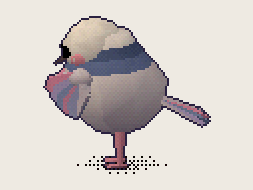
Bird (Tori): in-game render
Game capture (repo) · world-view · Project art
The great tree's bird as built.
Still missing: No traditional illustration found; verses not checked against a full translation in this pass.
Edward Conze, tr., The Buddha's Law Among the Birds (1955)
The animal sector of the Wheel of Life
Tib. srid pa'i 'khor lo; Muni of the animals, Sthirasiṃha (Seng ge rab brtan)
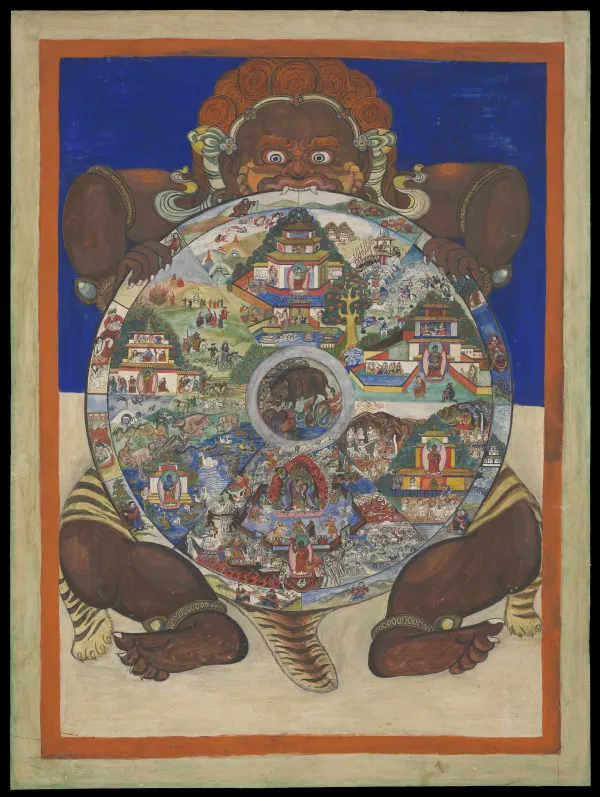
Wheel painters show the animals in the lower left: herds and beasts on land above, a crowded sea with nāgas below, and a Muni holding a book.
In most Tibetan Wheels the animal sector sits in the lower left, beside the hells and under the humans. Painters usually split it: land animals on hills above, herders driving horses, goats and mules, wild beasts hunting; then a sea full of fish, conches, serpents, makaras and nāgas below.
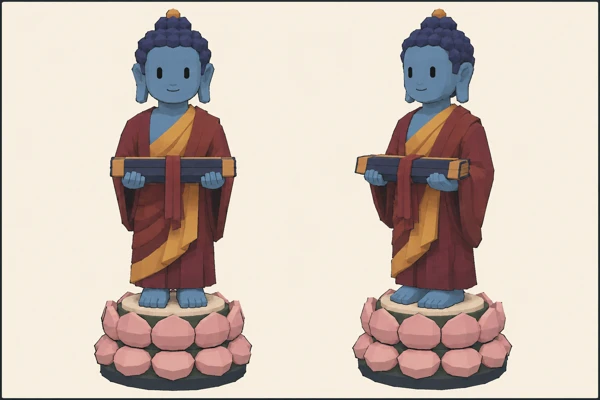
A Muni stands in each realm with a gift its beings need. For the animals he holds a book. In the Wellcome gouache he is blue-skinned in a red robe, holding a book, in a shrine on the shore; a nāga woman prays to him from the water.
Some painters show more sea than others. The Library of Congress scroll gives a wide band of waves with sea monsters; the Thikse mural shows a huge coiled nāga in a lake; a Wellcome line drawing shows a garuḍa diving on nāgas who sit under a canopy beneath the waves.
What canon fixes for the map
Position on the wheel: lower left in the paintings checked (Rubin C2004.21.1, HAR 78, Wellcome L0069380, LoC Bhavachakra); mirrored lower right in Wellcome V0018310.
Painters show land and sea animals together; the sea part carries nāgas, fish, conches and jewels [paintings above].
The animal Muni's gift is a book [repo six-munis topic; Wellcome L0069380 shows it].
Who lives here
Muni of the animals (being:animal.muni-shrine.muni)
In the game now
being:animal.muni-shrine.muni (missing as a placed resident; the six Munis rig is shared). The Muni's lawn district (animal.muni-shrine) and its reading hook. Statue concept: Sthirasiṃha, animal Muni.
Animal lives run from an instant to a whole age, and their shapes are without number.
Unlike most beings, animals have no fixed lifespan. At one end, great nāgas and certain other animals live for an entire intermediate age; at the other, some live for an instant (Kongtrul). Phagpa: from a nāga king's half an intermediate kalpa to a gnat's single instant.
Their shapes are as many as their lifespans. Gampopa sorts them by legs: many legs, four legs, two legs and none.
Animals also differ in birth and food. The Mindfulness sūtra lists egg-born animals (birds, water and shore animals, nāgas, snakes, burrowers) and says a great ajagara snake in dark dungeons lives on 'the food of joy'.
What canon fixes for the map
Longest life: one antarakalpa [AK p. 472–473]; 'an entire intermediate age' [K p. 47]; half an intermediate kalpa [P p. 26]; 'a kalpa' [DT p. 96, quoting Letter to a Friend]. Sources differ; name them.
The Copper-Coloured Mountain, Potalaka, Śambhala, the hidden valleys (beyul) and the sacred mountains Padmasambhava and Milarepa blessed, with Tanaduk and the nāga palaces briefly. Canon puts most of them inside our own world, reached across the sea, over the snows or through a guarded door, which is why they can be found from the overworld. Each topic's last canonFixes line says whether canon puts it in the human overworld, across the ocean, or apart.
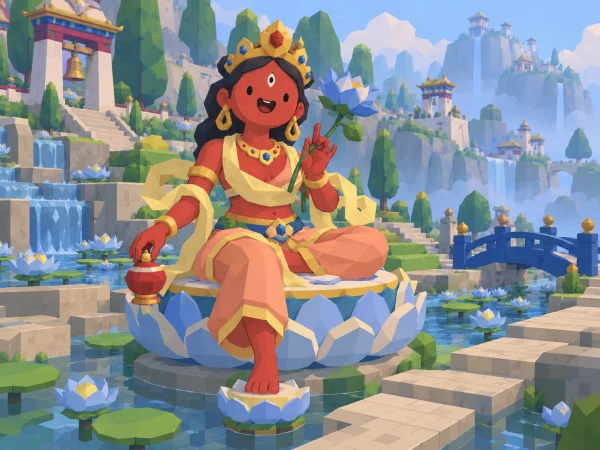
Zangdok Palri, the Copper-Coloured Mountain and the palace of Lotus Light
Zangdok Palri (zangs mdog dpal ri), 'Glorious Copper-Coloured Mountain'; palace of Lotus Light (Padma Ö, pad ma 'od)
A heart-shaped mountain rises from the nāgas' realm to the form heavens, with the Guru's palace on its summit in three levels.
The mountain has the shape of a heart, a warrior's heart. Its base rests deep in the nāgas' realm, on the crown of the hooded nāga king. Its slopes are full of ḍākas and ḍākinīs at their feast. Its peak reaches the heavens of the form-realm gods. Rainbow light wraps it on all eight sides, music of gods, nāgas and humans fills it, and flowers of five jewels fall like rain.
On the summit stands a palace beyond measure, made of the five wisdoms. Its east side is white crystal, the south lapis lazuli, the west ruby and the north emerald, all see-through like a rainbow. It has corridors, parapets, terraces, friezes, jewel tassels, water-spouts and porches at the four doors, and on top a parasol, a pinnacle and a Dharma wheel. Dudjom Rinpoche calls the whole mountain 'made of enticing ruby'.
In the heart of the palace, on an eight-cornered jewel with a lotus, sun and moon seat, sits Padmākara (Tsokyé Dorje), all the buddhas in one. Above him lies the saṃbhogakāya palace where Avalokiteśvara, Lord of the World, presides. Higher still is the dharmakāya realm.
The two Lotsawa House prayers disagree on the top. Jigme Lingpa puts Samantabhadra there appearing as Amitābha. Khangsar Tenpé Wangchuk puts Samantabhadra alone, with no Amitābha. The paintings HAR describes show Amitābha on the third floor.
What canon fixes for the map
Heart-shaped; base in the nāga realm, slopes the ḍākinīs' abodes, summit at the form-realm heavens [CSW v.4; SPM v.3]
Rainbow light on all eight sides [CSW v.5]
Palace colours by direction: east crystal white, south lapis, west ruby, north emerald [CSW v.6; SPM v.4]
Four doors with porticoes; parasol, pinnacle and wheel on top [CSW v.7; SPM v.5]
Three levels: ground, the Guru (nirmāṇakāya); above, Avalokiteśvara/Padmapāṇi (saṃbhogakāya); top, dharmakāya [SPM vv.7, 12–13; CSW vv.9, 13–14]
Top level: Samantabhadra as Amitābha [SPM v.13] versus Samantabhadra alone [CSW v.14]: traditions differ
Paintings: Amitābha third floor, Avalokiteśvara second, the Guru with his eight forms on the ground floor [HAR set 491]
Placement: a nirmāṇakāya pure land inside our world [SPM v.1]; Dudjom calls it 'within pure personal perception … the spontaneously perfected Akaniṣṭha' [DJC v.1]. It is seen by pure vision, so the palace stays a sacred apart-place even if the island is in the overworld.
Who lives here
Padmākara / Tsokyé Dorje on the eight-cornered throne (ground level)
Avalokiteśvara (Padmapāṇi, Lord of the World) with his retinue (middle level)
Samantabhadra, appearing as Amitābha in SPM (top level)
Vidyādharas of India and Tibet in rows to his right; scholars and saints to his left [SPM v.9]
The king and twenty-five disciples, nirmāṇakāya tertöns, the eighty siddhas [SPM v.10; CSW v.10]
In the game now
place:copper-mountain:zangdok-palri (built), place:copper-mountain:lotus-light-palace (built): the palace of three floors (copper-mountain.palace), the Guru's throne, Avalokiteśvara above, a never-reached vision of light at the top. being:guru-form-04 Padmasambhava (built), being:chenrezig:thousand-armed (built), being:copper-mountain:vidyadharas (built), being:copper-mountain:kharchen-za (built), being:mandarava (built). The eight-form station band (copper-mountain.guru-band, guru-form-01…08). Game additions no source names: the lamp chamber, Mandāravā on the mountain, the ledges toward Khechara.
Himalayan Art Resources, set 491 (Jeff Watt) · traditional · Link only
The set's essay: the mountain stands in the middle of the island, surrounded by water; demons fill the land below; Amitābha top floor, Avalokiteśvara second, the Guru with his eight forms on the ground floor.
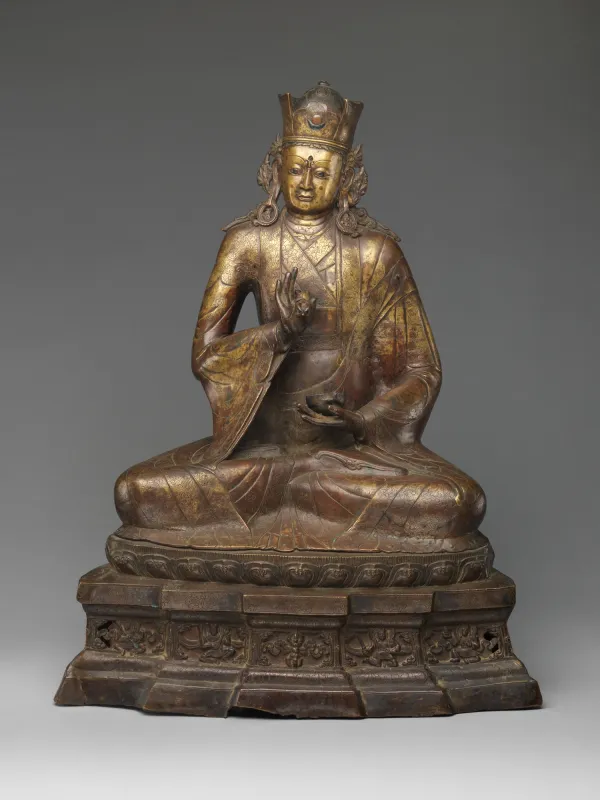
The Met 2012.459, Western Tibet or Ladakh, 14th century · traditional · Public domain
Iconography reference for the Guru on the palace's ground floor.
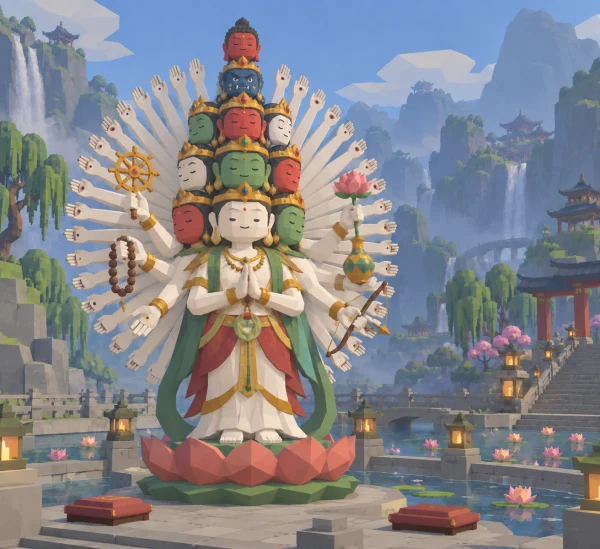
Avalokiteśvara, thousand-armed
AI concept study (repo) · concept · Project art
The middle-floor presence as the game draws it.
Padmasambhava
AI concept study (repo) · concept · Project art
The game's Guru on the ground floor (being:guru-form-04).
Yeshe Tsogyal (Kharchen Za)
AI concept study (repo) · concept · Project art
Kharchen Za, whom the ḍākinīs led to Lotus Light (SPM).
Mandāravā
AI concept study (repo) · concept · Project art
In the game's palace; no source read names her on the mountain.
Still missing: No open-licence traditional painting of the mountain; only link-only museum pieces and two CC BY-SA photos of modern temples modelled on it.
Four great kings guard the four gates; protectors fill the outer court, and gardens of wish-fulfilling trees and nectar pools surround the palace.
At the four gates wait the four great kings: Dhṛtarāṣṭra, Virūpākṣa, Virūḍhaka and Vaiśravaṇa. With them an army of the eight classes of gods and demons beats a victory drum over the māras' legions.
In the outer court and at the gates on four sides stand the seventy awesome protectors, the twenty-eight īśvarīs and the oath-bound guardians, spread out like a galaxy of stars.
The courtyards have wish-fulfilling trees, bathing pools of nectar and soft grass. Incarnate birds such as cuckoos sing the Dharma. In the groves ṛṣis, vidyādharas, flocks of birds and swarms of bees hum with the Dharma of the three vehicles, and there are fountains of nectar and green groves sweet with healing plants.
Dudjom Rinpoche adds a sandalwood forest with a turquoise meadow, rivers of camphor-scented nectar flowing into swirling pools, a tent of rainbows, and kiṃkaras, drum-beating skeleton attendants, dancing under a rain of flowers. Chokgyur Lingpa adds deer and birds in the forests.
What canon fixes for the map
Four gates, one per side, guarded by the four great kings; CSW names the four but not which gate each keeps [CSW v.15; SPM v.14]
The four cardinal and eight intermediate directions, corners and inner galleries are filled with ḍākas, ḍākinīs, gods and goddesses [SPM v.11]
Sandalwood forest, turquoise meadow, nectar rivers and pools [DJC vv.3–4]
Forests with ḍākinīs, birds and deer [CTA lines 6–7]
No charnel grounds named around the palace in any of the five texts read
Who lives here
Dhṛtarāṣṭra, Virūpākṣa, Virūḍhaka, Vaiśravaṇa: the four great kings at the gates
The gods and demons of the eight classes
The seventy protectors, the twenty-eight īśvarīs, the oath-bound guardians
Kiṃkaras, skeletal attendants who beat drums [DJC n.1]
Drekpas male and female, among the Guru's envoys [CTA lines 13–14]
Ṛṣis, incarnate birds, bees and deer
In the game now
place:copper-mountain:gardens (built): the practitioners' courtyard with eight shrubs (copper-mountain.courtyard). being:copper-mountain:four-kings (sketch), being:copper-mountain:dakas-dakinis (built). Missing: being:copper-mountain:protectors, :ishvaris, :oath-bound, :kimkaras, :drekpas, :eight-classes, :rishis, :birds, :bees, :deer, :lotus-born. The game's shore wall has one gate where both CSW and SPM give four.
Himalayan Art Resources, set 491 (Jeff Watt) · traditional · Link only
The set's essay: the mountain stands in the middle of the island, surrounded by water; demons fill the land below; Amitābha top floor, Avalokiteśvara second, the Guru with his eight forms on the ground floor.
Pema Namdol Thaye (Rubin Museum essay 'Celestial Visions in Three Dimensions') · traditional · No open licence (repo media ref-copper-pema-mandala)
A sculpted model of the palace: useful for the four-sided, stepped plan and colour by direction.
Dhṛtarāṣṭra, the eastern king
AI concept study (repo) · concept · Project art
One of the four kings at the gates.
Ḍāka
AI concept study (repo) · concept · Project art
Ḍākas dancing in every direction.
Ḍākinī
AI concept study (repo) · concept · Project art
Ḍākinīs of the slopes and court.
Vidyādhara
AI concept study (repo) · concept · Project art
The vidyādhara rows.
Still missing: No art of the kiṃkaras, the seventy protectors or the outer court on its own; the museum paintings show them small around the palace (link-only).
The sages' city where the Medicine Buddha taught the Four Tantras, with a medicine mountain on each side.
The Root Tantra opens in the abode of the sages, the City of Medicine called Tanaduk. There stands an inconceivable palace of five precious substances, hung with medicinal jewels that cure the four hundred and four disorders.
To the south is Bigje, a mountain with the sun's energy, covered in hot medicines for cold disorders. To the north is Gangchen, snow-capped, with the moon's energy and cool medicines. To the east is Poenyedhen, fragrant with a forest of arura trees. To the west is Malaya, with the six superlative medicines, mineral exudates, medicinal waters and hot springs.
Saffron meadows surround the city. Peacocks, parrots and shang-shang birds sing in the forests; elephants, bears and musk deer live on the ground. At the centre of the palace, on a lapis throne, sits the Medicine Buddha, with four retinues: gods, sages, non-Buddhists and Buddhists, each hearing the teaching in its own way.
What canon fixes for the map
Four mountains: S Bigje, N Gangchen, E Poenyedhen, W Malaya [RT1 pp.3–5]
Saffron meadows round the city; medicinal stones and salts in the rocks [RT1 p.5]
Palace of five precious substances; lapis throne at its centre [RT1 pp.2, 6]
Four retinues (gods, sages, non-Buddhists, Buddhists) [RT1 pp.6–7]
Placement: the Root Tantra gives no place in our world's geography. Treat it as apart (a teaching abode), not as human ground; the game's arch from the Human town is its own link [tanaduk.json adaptation]
Who lives here
The Medicine Buddha, King of Aquamarine Light
Rigpé Yeshé and Yilé Kyé, sages emanated from his heart and speech (the dialogue's speakers)
Gods' retinue: Prajāpati Dakṣa, the Aśvins, Indra, Amṛta Devī
Sages: Ātreya, Agniveśa, Kāśyapa, Caraka, Bharadvāja, Dhanvantari and others
place:tanaduk:city (built), place:tanaduk:bigje / :gangchen / :malaya / :poenyedhen (built, on the horizons), place:tanaduk:palace (sketch). A small walled care garden reached by an arch from human.town. being:animal-caretaker (built); retinues are sketches; being:tanaduk:rigpe-yeshe and :yile-kye missing.
Art (4)
the palace and the four retinues, centremedicine forest and mountains, top bandmedicine forest, bottom band
Commissioned by Desi Sangye Gyatso, 1687–1703 (Wikimedia Commons) · traditional · Public domain
The whole city: the square palace with the Medicine Buddha and four retinues, streets of houses round it, medicine forests and mountains on all four sides.
The nāgas' palaces lie in the ocean depths and under lakes; the Copper Mountain's own base rests on the nāga king's crown.
The nāgas live in the depths of the great ocean. Sāgara, the nāga king of the ocean, has his abode there, and Mahānāga kept a seven-treasure store in his palace in the sea, which Nāgārjuna visited to bring back scriptures.
The Copper-Coloured Mountain's base rests on the crown of the hooded nāga king, deep in the nāgas' realm, so the hidden nāga world lies directly under the hidden mountain.
In the beyul guides, nāgas guard the ways in: a female nāga in Khembalung's cave receives offerings before pilgrims go on.
What canon fixes for the map
Nāgas dwell in the ocean depths [K PDF pp.28–29]
Sāgara's abode in the ocean depths [QNS 6.8, 6.22–6.44]
The Copper Mountain's base on the nāga king's crown [SPM v.3; CSW v.4]
A female nāga in the Khembalung cave [REIN text ¶10]
Placement: under the waters, apart from the walkable surface. The dive is the canon way; the animal group writes the nāgas themselves.
Who lives here
Sāgara, nāga king of the ocean
Mahānāga, keeper of the sea palace's treasure
Nāgārjuna, who went down to them
The hooded nāga king under the Copper Mountain
In the game now
place:naga-palace:mahanaga-palace (built), place:naga-palace:ocean-depths (built), place:naga-palace:naga-region (built): the coral hall under Animal's lake valley (naga-palace.hall), reached by a dive at animal.lake-valley. being:naga-palace:nagarjuna (built), being:naga-palace:region-nagas (built). place:naga-palace:sagara-abode (missing).
Art (2)
Nāga
AI concept study (repo) · concept · Project art
The game's nāgas of the region.
Nāgārjuna
AI concept study (repo) · concept · Project art
Who went down to the nāgas.
Still missing: Hidden-place art only; the animal group gathers nāga paintings.
An honest inventory of every non-retired place whose gateway chain leads to the Human or Animal section, plus the two sections themselves: what is built there, who lives there, how it is reached, and what canon says about where it sits relative to the human world. It exists so the layout overhaul can decide which of these can be folded into the open land and which canon keeps across the sea, under water, or outside samsara. Nothing here proposes a layout.
The Animal section today
Skt tiryagyoni; Tib. dud ’gro (düdro)
The Animal wedge as planned and built: 17 districts from the arrival meadow through orchard, rivers, lake, wood and great tree to two bays of the outer ocean, with 34 residents.
The animals' principal dwelling is the Great Ocean; they also live dispersed on land, in water and in the air. The salt ocean lies outside the continents toward the iron rim, so the island's rim end is its sea: two bays of the outer ocean either side of the spit to the outer bridge, the broad east bay facing Asura's sea across the chasm. Inward: a wooded hillside of dens on the Naraka side, one lake fed by the realm's rivers, the great tree and its birds at the centre, crags, springs and the fox's wood on the Asura side, and one worked farm [section account].
Relief: base y 0, flat meadow with two terraced hills (the west bank in the western river's bend, the east ridge); each wing one tread up (the west spring shelf, the east spring shelf along the Human lip); the rim end between u -18.8 and 26 is sea, two recessed bays of salt water 0.6 below base held by a low reef lip, either side of a dry spit 4.4 wide [section terrain].
Districts, one line each:
animal.arrival: Where she steps off the inner bridge: the path turns west onto the Liberate road at the trailhead, on the old camp ground now planted as meadow (her house is under the Wh [1 resident: Sparrows]
animal.near-meadow: The grassy field the game opens on (Josie’s design): the first being of the ladder, the bug, in its clover just past the trailhead, and the fork where the route turns wes [2 residents: Mushi, butterflies]
animal.muni-shrine: The realm’s teaching place: the Muni of the animals reads on his seat beside the way in, where every arrival passes. [2 residents: The six realm Munis, Muni of the Animals]
animal.friends-orchard: The meadow’s middle, as the to-scale map draws it: one fruit tree taller than anything round it, the four who share it, and the ring path round them that every other path [5 residents: Four Harmonious Friends, Bird, Hare, Orchard Monkey, Elephant]
animal.west-river: A small river valley on the Naraka side of the meadow: the shrimp’s pebble brook, the waterfall with the grotto behind it, the terraced west bank in the river’s bend, and [2 residents: Ebi, Dragonflies]
animal.lake-valley: The realm’s fresh water: a spring under a rock shelf fills one long lake down the Naraka-side valley to the rim. [4 residents: Sakana, Shore snail, Herons, Ducks]
animal.den-hillside: The wooded hillside between the lake and the Naraka edge, out to the rim: the realm’s wood of three groves of eight, where land animals shelter. [3 residents: Moon hare, Fireflies, The hillside burrow household]
animal.great-tree: The realm’s landmark: a great old tree in blossom over a still pond, the bird’s meadow under it and a nest in its low bough. [2 residents: Tori, songbirds]
animal.far-meadow: The open ground from the long river out to the gate: the elephant, last and largest of the ladder, stands before the Merit gate, and the way runs through it to the shore. [1 resident: Zou]
animal.east-ridge: The meadow’s east side: the cat’s ruined courtyard on the terraced ridge, a still pool under it, and the long river’s east reach. [2 residents: Neko, Golden pond fish]
animal.east-spring: The Human-side shelf along the island’s lip: a spring rising under the lip fills a pool whose water sinks underground and feeds the long river; [1 resident: Kites]
animal.spring-crag: The Human-side hillside as the to-scale map draws it: a spring cave and its falls under a great tree, a brook down to a plank bridge, and above them meadow terraces with [1 resident: Kitsune]
animal.tidal-cove: The Great Ocean’s broad inlet on the Human side, where the animals’ principal dwelling is seen: the octopus’s reef under the jetty, the shoal, the creatures below the tid [3 residents: Tako, The shoal, The neighbours below the tide line]
animal.beaver-water: The eastern river’s reach from the spring crag to the sea. [1 resident: Buta]
animal.shore: The realm’s sea edge on the Naraka side and the way out: the west bay, a lagoon of the outer ocean fed by the lake’s outlet; [1 resident: Terns]
grotto: A quiet seat behind the river fall provides a small pleasant refuge. [0 residents]
animal.hell-hollow: One of the occasional (ephemeral) hells: beings born in everyday objects, always used and unable to leave, in the world of the living (Kongtrul, Treasury of Knowledge, My [1 resident: The door]
34 residents in all (the nine Liberate beings Mushi, Ebi, Sakana, Tori, Neko, Kitsune, Tako, Buta, Zou; the Four Harmonious Friends; the moon hare; the Muni of the Animals; flocks and shoals).
What canon fixes for the map
Animals' principal dwelling is the Great Ocean; dispersed on land, in water and in the air [Abhidharmakośabhāṣya III, Pruden vol. II p. 460; Kongtrul TOK I pp. 28–29].
The salt ocean lies outside the continents toward the iron rim [K pp. 23–24]: the realm's sea is already at its rim end, the natural home for the real ocean Josie wants.
Already brought into the open: the Four Friends' orchard (Decision 27), the ephemeral hell hollow; the nāga palace and the beaver lodge stay under water by canon and by their doors.
Proposal 2026-10-10 said: ephemeral hells (incl. hell-animal) second batch, keep the push as the reveal (done as animal.hell-hollow); naga palace stays hidden under water.
Who lives here
Mushi: animal.near-meadow
Ebi: animal.west-river
Sakana: animal.lake-valley
Tori: animal.great-tree
Neko: animal.east-ridge
Kitsune: animal.spring-crag
Tako: animal.tidal-cove
Buta: animal.beaver-water
Zou: animal.far-meadow
Four Harmonious Friends: animal.friends-orchard
Bird: animal.friends-orchard
Hare: animal.friends-orchard
Orchard Monkey: animal.friends-orchard
Elephant: animal.friends-orchard
Moon hare: animal.den-hillside
The six realm Munis: animal.muni-shrine
Shore snail: animal.lake-valley
Muni of the Animals: animal.muni-shrine
butterflies: animal.near-meadow
home-koi: home
songbirds: animal.great-tree
BodhiBot: home
Golden pond fish: animal.east-ridge
The door: animal.hell-hollow
The shoal: animal.tidal-cove
Terns: animal.shore
Herons: animal.lake-valley
Ducks: animal.lake-valley
Dragonflies: animal.west-river
Fireflies: animal.den-hillside
Sparrows: animal.arrival
Kites: animal.east-spring
The hillside burrow household: animal.den-hillside
The neighbours below the tide line: animal.tidal-cove
the lake valley (long teal lake, west side of the Animal wedge) whose deep lily lobe is the divethe east side: spring crag, the eastern river and the beaver water down to the Asura seam
A raised ruby ground under a red sky with a five-gem palace; Vajrayoginī at its centre, Vajradharma above. Reached from the Copper Mountain’s red-sky ledges.
A room of the Copper Mountain zone (interiors/zc-tara-khechara.js, 490 lines shared with Turquoise Leaves): a raised ruby ground under a red sky. South: the approach. Middle: an open courtyard where the sky-goers gather, kept clear so the palace's south door frames Vajrayoginī. North: the central palace of five gems, four-sided with four doors and three floors under a pinnacle, about 10 by 11.
Residents: Vajrayoginī (Naro Khechari) standing at the palace centre; Vajradharma seated at its top. Keepsake: a banner in the courtyard. Reached through khechara-passage on the far red-sky ledge of copper-mountain:khechara; the gate behind the arrival returns to the ledge. Palette: ruby, red sky, gold.
What canon fixes for the map
Khechara is an elevated jewelled realm with ruby ground and a central five-gem palace [Ngorchen Konchog Lhundrub, Staircase Ascending to Khechara, tr. Jeff Watt, HAR set 2395; docs/wheel-geography-canonical-research-2026-10-01.md].
Reached in vision by practice; no passage makes it a neighbour of the Copper-Coloured Mountain [record gateway.adaptation]. Outside samsara by canon.
places.js registers it host 'outside-wheel', interpretation 'distinct-buddha-field'.
Proposal 2026-10-10 said: "All pure fields (Sukhāvatī, Abhirati, Lapis Radiance and the six Medicine fields, the three family fields, Khechara, Turquoise Leaves, Copper Mountain): they are outside samsara" (should stay hidden).
Who lives here
Vajrayogini — Naro Khechari (awake): Khechara is her field and this is its central palace
Vajradharma (awake): The praise puts Vajradharma at the top of Vajrayogini's palace, above her
In the game now
Built as a room/interior (3 districts, 2 character records). Samsara: being:vajradharma (built); being:field-khechara:principal (built); place:field-khechara (built)
Repo: docs/wheel-geography-canonical-research-2026-10-01.md, Section "Khecara: primary praise now verified": HAR set 2395, The Staircase Ascending to Khechara, Ngorchen Konchog Lhundrub, tr. Jeff Watt, opening through courtyard verses and colophon
Repo: docs/buddhist-iconography/data/guru-vajrayogini.json#vajrayogini, entry "vajrayogini": requirements, avoid list and model audit
Repo: docs/buddhist-iconography/data/avalokiteshvara-attendants.json#vajradharma, entry "vajradharma": requirements, avoid list and model audit
The nāga palace under the pond
Skt nāga; Tib. klu (lu); the hall is the game’s
A drowned coral hall under the lake valley’s lily lobe, dived into from the pond: eight coral columns, three shut scripture chests, Nāgārjuna at the chests and a nāga who keeps the hall.
An interior (interiors/naga-palace.js, 333 lines, plus zc-naga.js arrival court): one round coral hall 8.4 across, an air pocket under the pond, pink and sea-green, eight coral columns whose branches rib the vault, eight coral clusters at the wall's foot, daylight through the round opening in the roof. Under the shaft a pale inlaid ring with eight pearls is the arrival court. Three shut scripture chests on a low dais (two with carved locks), the custodian's desk, a great clam on a coral plinth as the seat, a niche looking out on the palace roof. No straight wall and no carpentry door (Animal rule D-07).
Residents: Nāgārjuna standing at the chests, the nāga who tends the hall. Keepsake: a shell by the clam. On the bank the shore is kept by two carved nāga with three hoods each.
Reached by a dive: swimming over the pond's deep middle at animal.lake-valley.naga-dive [-21.4, 14.6], the use button dives and she surfaces in the hall; the bright shaft under the roof returns her to the pond. Palette: teal and pink, underwater light.
What canon fixes for the map
An aquatic nāga community lives in the water; nāgas held Mahāyāna scriptures that Nāgārjuna brought back [ledger naga-palace: Dudjom Rinpoche, A Torch Lighting the Way to Freedom, glossary p. 276; Four kinds of guests (Gyalse Shenpen Taye)].
Animals live dispersed on land, in water and in the air; their principal dwelling is the Great Ocean [Abhidharmakośabhāṣya III.59, Pruden vol. II p. 460; Kongtrul TOK I pp. 28–29]. Samsara names the ocean depths, Sāgara's abode and the mahānāga palace as nāga places (place:naga-palace:*), two still missing.
Underwater by canon: it can sit under any Animal water, including the ocean Josie wants, but it stays beneath the surface; the dive is the canon.
Proposal 2026-10-10 said: "Naga palace: the nāgas live under waters, so the dive is the canon" (should stay hidden).
Who lives here
Naga (bound, liberatable): The palace’s own ordinary resident: it lives in this water and keeps the hall
Nagarjuna (awake): He came for the teachings the nāgas were keeping; he stands at the chests they are in
In the game now
Built as a room/interior (1 district, 2 character records). Samsara: place:naga-palace:lalitasagara (missing); being:naga-palace:nagarjuna (built); being:naga-palace:region-nagas (built); place:naga-palace:joyful-forest (missing); place:naga-palace:sagara-abode (missing); place:naga-palace:relics (missing); place:naga-palace:mahanaga-palace (built); place:naga-palace:ocean-depths (built); place:naga-palace:land-of-nagas (built); place:naga-palace:naga-region (built)
Art (6)
the lake valley (long teal lake, west side of the Animal wedge) whose deep lily lobe is the dive
Repo: docs/wheel-geography-canonical-research-2026-10-01.md, K: Kongtrul, Treasury of Knowledge, book one, Tsadra edition, PDF/printed pp. 28–29: animal land/water/air habitats, Great Ocean and submerged nāgas.
The beaver lodge
the game’s example of an animal-built shelter
A dry stick-and-mud dome on the eastern river, entered by a dive beside the dam: a sleeping platform of three nests, a clay model of the dam and the winter’s log stacks.
An interior (interiors/beaver-lodge.js, 244 lines): a dry round dome of woven sticks over plastered mud, 6.6 across, amber daylight through the gaps and a vent in the crown. Back left a raised mud platform with three nests of shredded wood; right, the square-cut pool she surfaces in with a wading shelf and a ring of eight stick ribs framing the tunnel, lit teal from the river. A clay model of the dam, three stacks of three peeled logs, a cut stump to sit on.
Residents: the beaver household of three (liberatable), a crane at the pool's edge, a marmot of the lodge wall, a pika of the food stacks. Keepsake: a shell.
Reached by a dive in the deep water beside the lodge at animal.beaver-water.lodge-dive [17.0, 12.2] (the lodge reads from the bank: a mud slide, a stick-ringed dark hole at the waterline, gnawed logs, a ripple ring over the dive); the inside pool returns her to the river. Palette: amber, teal.
What canon fixes for the map
Animals live dispersed in water and on land and need shelter [ledger animal-habitats: Transformation of Karma, 84000 Toh 339; Abhidharmakośabhāṣya III.59]; a beaver lodge is the game's example [record gateway.adaptation].
A beaver's door is under the waterline, so the way in is a dive [record gateway.reason]. In the Animal land already; the inside is a closed dome, so it keeps a room (rule R1).
Proposal 2026-10-10 said: not ranked; building interiors stay rooms of buildings ("Building interiors: they are rooms of buildings").
Who lives here
Crane at the Pool's Edge (bound): The lore and placement audit finds the lodge household “filled with unrelated reused characters” (marmot, pika and crane) and holds that “an empty lodge with signs of its owners is better grounded than those three filler copies”; the animal-habitats ledger’s pending asks for “Original inhabitants for empty dens and the beaver lodge.” The habitat awaits its own beaver household
Marmot of the Lodge Wall (bound): The lore and placement audit finds the lodge household “filled with unrelated reused characters” (marmot, pika and crane) and holds that “an empty lodge with signs of its owners is better grounded than those three filler copies”; the animal-habitats ledger’s pending asks for “Original inhabitants for empty dens and the beaver lodge.” The habitat awaits its own beaver household
Pika of the Food Stacks (bound): The lore and placement audit finds the lodge household “filled with unrelated reused characters” (marmot, pika and crane) and holds that “an empty lodge with signs of its owners is better grounded than those three filler copies”; the animal-habitats ledger’s pending asks for “Original inhabitants for empty dens and the beaver lodge.” The habitat awaits its own beaver household
The beaver household (bound, liberatable, x3): The ledger requests original lodge inhabitants; the beavers and household size are adaptation replacing unrelated copied animals
In the game now
Built as a room/interior (1 district, 4 character records). Samsara: place:beaver-lodge (built)
Art (7)
the east side: spring crag, the eastern river and the beaver water down to the Asura seam
Repo: docs/purelands-cosmology.json#animal-habitats, pending: “Original inhabitants for empty dens and the beaver lodge. No copied human caretakers.”
Turquoise Leaves, Tārā’s field
Skt Harītāvanaprabhā? (unverified); Tib. g.yu lo bkod pa (Yulokö)
Golden ground, two pools and a lapis palace where the twenty-one Tārās sit in a ring round an empty throne; past a turquoise arch at the grove’s east edge.
A room of the Tārā grove (interiors/zc-tara-khechara.js): golden ground about 25 by 32, a living garden with two pools and turquoise-leaf trees, a luminous lapis palace across the north. The twenty-one forms sit on a ring in three groups of seven, clockwise from above: the palace arc (1–7), the east pool (8–14), the west pool (15–21). At the centre one empty lotus throne under a halo of eight turquoise leaves, a depiction of the grove's Tārā.
Residents: the twenty-one Tārās of Atiśa's lineage, each at her lotus station. Keepsake: a seedpod at the east pool. Reached by the turquoise arch at tara-grove.gardens [10.3, -1.6]; the arch behind the arrival returns. Palette: gold, turquoise, lapis.
What canon fixes for the map
Tārā's realm is where those who remember her are reborn [Sera Khandro aspiration, Lotsawa House, via docs/wheel-geography-canonical-research-2026-10-01.md 'Hidden places' table].
The twenty-one are one Tārā's forms, not twenty-one people [Praise in Twenty-one Homages, 84000 Toh 438].
A pure field reached by rebirth and remembrance, not a doorway in a wood; the arch is a game link [record gateway.adaptation]. Outside samsara by canon.
Proposal 2026-10-10 said: "All pure fields (Sukhāvatī, Abhirati, Lapis Radiance and the six Medicine fields, the three family fields, Khechara, Turquoise Leaves, Copper Mountain): they are outside samsara" (should stay hidden).
Who lives here
Tara 01: Heroic swiftness (awake): Sits in lotus station 1 of the twenty-one-form garden assembly, one leg folded and the extended foot supported, raising the utpala, offering the vase
Tara 02: Autumn-moon whiteness (awake): Sits in lotus station 2 of the twenty-one-form garden assembly, one leg folded and the extended foot supported, raising the utpala, offering the vase
Tara 03: Golden radiance (awake): Sits in lotus station 3 of the twenty-one-form garden assembly, one leg folded and the extended foot supported, raising the utpala, offering the vase
Tara 04: Tathagata crown (awake): Sits in lotus station 4 of the twenty-one-form garden assembly, one leg folded and the extended foot supported, raising the utpala, offering the vase
Tara 05: Hum proclamation (awake): Sits in lotus station 5 of the twenty-one-form garden assembly, one leg folded and the extended foot supported, raising the utpala, offering the vase
Tara 06: Three-world victory (awake): Sits in lotus station 6 of the twenty-one-form garden assembly, one leg folded and the extended foot supported, raising the utpala, offering the vase
Tara 07: Overcoming adversaries (awake): Sits in lotus station 7 of the twenty-one-form garden assembly, one leg folded and the extended foot supported, raising the utpala, offering the vase
Tara 08: Supreme ability; defeating maras (awake): Sits in lotus station 8 of the twenty-one-form garden assembly, one leg folded and the extended foot supported, raising the utpala, offering the vase
Tara 09: Granting gifts (awake): Sits in lotus station 9 of the twenty-one-form garden assembly, one leg folded and the extended foot supported, raising the utpala, offering the vase
Tara 10: Ending sorrow (awake): Sits in lotus station 10 of the twenty-one-form garden assembly, one leg folded and the extended foot supported, raising the utpala, offering the vase
Tara 11: Summoning; averting misfortune (awake): Sits in lotus station 11 of the twenty-one-form garden assembly, one leg folded and the extended foot supported, raising the utpala, offering the vase
Tara 12: Auspicious illumination (awake): Sits in lotus station 12 of the twenty-one-form garden assembly, one leg folded and the extended foot supported, raising the utpala, offering the vase
Tara 13: Ripening (awake): Sits in lotus station 13 of the twenty-one-form garden assembly, one leg folded and the extended foot supported, raising the utpala, offering the vase
Tara 14: Wrathful brow (awake): Sits in lotus station 14 of the twenty-one-form garden assembly, one leg folded and the extended foot supported, raising the utpala, offering the vase
Tara 15: Deep peace (awake): Sits in lotus station 15 of the twenty-one-form garden assembly, one leg folded and the extended foot supported, raising the utpala, offering the vase
Tara 16: Releasing attachment (awake): Sits in lotus station 16 of the twenty-one-form garden assembly, one leg folded and the extended foot supported, raising the utpala, offering the vase
Tara 17: Accomplishing bliss (awake): Sits in lotus station 17 of the twenty-one-form garden assembly, one leg folded and the extended foot supported, raising the utpala, offering the vase
Tara 18: Victory (awake): Sits in lotus station 18 of the twenty-one-form garden assembly, one leg folded and the extended foot supported, raising the utpala, offering the vase
Tara 19: Removing suffering (awake): Sits in lotus station 19 of the twenty-one-form garden assembly, one leg folded and the extended foot supported, raising the utpala, offering the vase
Tara 20: Accomplishments (awake): Sits in lotus station 20 of the twenty-one-form garden assembly, one leg folded and the extended foot supported, raising the utpala, offering the vase
Tara 21: Completion (awake): Sits in the twenty-first lotus station at the west pool, holding two utpala flowers and the open giving palm while greeting the end of the visitor arc
Still missing: No capture of the field; the twenty-one Tārās have Atlas captures.
Sources
Repo: docs/wheel-geography-canonical-research-2026-10-01.md, Hidden places table, row "Tārā / Turquoise Leaves": Sera Khandro aspiration (https://www.lotsawahouse.org/tibetan-masters/sera-khandro/tara-pureland-aspiration): remembered Tārā and direct rebirth in her realm
Repo: docs/purelands-cosmology.json, entries[id=twenty-one-taras] and registered Sera Khandro source in geography research, opening golden-ground/pools/mansion/central-Tārā/twenty-one-forms stanzas; https://www.lotsawahouse.org/tibetan-masters/sera-khandro/tara-pureland-aspiration
Repo: docs/buddhist-iconography/data/tara.json#tara-atisha-01, entry "tara-atisha-01": requirements, avoid list and model audit
Repo: docs/buddhist-iconography/data/tara.json#tara-atisha-02, entry "tara-atisha-02": requirements, avoid list and model audit
Repo: docs/buddhist-iconography/data/tara.json#tara-atisha-03, entry "tara-atisha-03": requirements, avoid list and model audit
Repo: docs/buddhist-iconography/data/tara.json#tara-atisha-04, entry "tara-atisha-04": requirements, avoid list and model audit
Repo: docs/buddhist-iconography/data/tara.json#tara-atisha-05, entry "tara-atisha-05": requirements, avoid list and model audit
Repo: docs/buddhist-iconography/data/tara.json#tara-atisha-06, entry "tara-atisha-06": requirements, avoid list and model audit
Repo: docs/buddhist-iconography/data/tara.json#tara-atisha-07, entry "tara-atisha-07": requirements, avoid list and model audit
Repo: docs/buddhist-iconography/data/tara.json#tara-atisha-08, entry "tara-atisha-08": requirements, avoid list and model audit
Repo: docs/buddhist-iconography/data/tara.json#tara-atisha-09, entry "tara-atisha-09": requirements, avoid list and model audit
Vaiḍūryanirbhāsa, the Medicine Buddha’s field
Skt Vaiḍūryanirbhāsa; Tib. bai ḍūrya’i snang ba
A long blue-beryl field walked north: twelve generals’ niches, a round Medicine court with six vision gates, and the assembly dais under a lapis roof.
A zone (interiors/zc-g2-medicine.js): a long blue-beryl field about 26 by 46, walked north. She arrives at the south end, passes a hemicycle of twelve niches where the twelve yaksha generals keep watch (six each side, clockwise from the west), under a torana into the round Medicine court with six vision gates (one for each other Medicine Buddha's field), and on to the assembly dais under a lapis roof, a secondary depiction of Tanaduk's Medicine Buddha with Sunlight and Moonlight.
Residents: the twelve named generals (Kiṃbhīra, Vajra, Mekhila, Antila, Anila, Saṇṭhila, Indala, Pāyila, Mahāla, Cidāla, Caundhula, Vikala), each at a niche with a small job (tea ledge, lost-item enquiries, late arrivals). Keepsake: a cup in the court.
Reached through the small lapis gate in Tanaduk's north-east corner (tanaduk.pavilion.gateway-field-lapis-radiance [6.4, -7.7]); the gate behind the arrival returns. Palette: lapis and beryl blue.
What canon fixes for the map
Vaiḍūryanirbhāsa is the Medicine Buddha's own field, far to the east beyond countless worlds, with blue-beryl ground and the bodhisattvas Sunlight and Moonlight [Seven Medicine Buddhas, 84000 Toh 503; ledger medicine-field].
Twelve named yaksha generals vowed to protect whoever keeps the Medicine Buddha's name [Toh 503; ledger twelve-generals].
It is a different place from Tanaduk; the lapis gate is a vision, a game link [record gateway.adaptation]. Outside samsara by canon.
Proposal 2026-10-10 said: "All pure fields (Sukhāvatī, Abhirati, Lapis Radiance and the six Medicine fields, the three family fields, Khechara, Turquoise Leaves, Copper Mountain): they are outside samsara" (should stay hidden).
Who lives here
Kiṃbhīra, Medicine Buddha general (attendant): Keeping the first arrival-court watch with the vajra at ease and mongoose supported
Vajra, Medicine Buddha general (attendant): Keeping the second quiet watch with the sword at rest, greeting and listening
Mekhila, Medicine Buddha general (attendant): Receiving conversations at the tea ledge, leaning on the short staff and checking the mongoose
Antila, Medicine Buddha general (attendant): Watching arrivals beside the blue beryl wall before greeting them
Anila, Medicine Buddha general (attendant): Attending the warm niche for cold visitors with the trident held at ease
Saṇṭhila, Medicine Buddha general (attendant): Keeping the slow misty watch with the sword at rest
Indala, Medicine Buddha general (attendant): Keeps his watch at his own niche in the hemicycle, one of the twelve who vowed to protect those who keep the Medicine Buddha's name
Pāyila, Medicine Buddha general (attendant): Receiving visitors at the food-and-chat station with staff and mongoose supported
Mahāla, Medicine Buddha general (attendant): Keeps his watch at his own niche in the hemicycle, one of the twelve who vowed to protect those who keep the Medicine Buddha's name
Cidāla, Medicine Buddha general (attendant): Receiving lost-item enquiries at the niche with the relaxed lasso coiled
Caundhula, Medicine Buddha general (attendant): Listening for the echoing niche to answer with the upright staff at rest
Vikala, Medicine Buddha general (attendant): Keeping the court gate in view and receiving late arrivals with the wheel upright
In the game now
Built as a zone (3 districts, 12 character records). Samsara: being:twelve-generals:05 (built); being:twelve-generals:04 (built); being:twelve-generals:11 (built); being:twelve-generals:10 (built); being:twelve-generals:07 (built); being:twelve-generals:01 (built); being:twelve-generals:09 (built); being:twelve-generals:03 (built); being:twelve-generals:08 (built); being:twelve-generals:06 (built); being:twelve-generals:02 (built); being:twelve-generals:12 (built); place:medicine-field:beryl-ground (built); place:field-lapis-radiance (built)
Repo: docs/wheel-geography-canonical-research-2026-10-01.md, Hidden places table, row "Vaiḍūryanirbhāsa / Medicine fields": Toh504 §1.6 (https://84000.co/translation/toh504), east beyond innumerable fields
Repo: docs/buddhist-iconography/data/medicine-buddhas.json#medicine-buddha, entry "medicine-buddha": requirements, avoid list and model audit
Unconquered, the field of Suparikīrtitanāmadheyaśrīrāja
Skt Suparikīrtitanāmadheyaśrīrāja; one of the seven eastern Medicine Buddha fields
A small sanctuary built as a walled citadel terrace, one route to the Buddha’s throne, seen as a vision from the Medicine court and entered through its gate.
A room (interiors/zc-g2-medicine.js, 789 lines for all seven): a small sanctuary about 12 wide, built as a walled citadel terrace: an arrival, one route to the Buddha's throne, a quiet seat to pause on, and the door back. In the Buddha's colours.
One resident: Suparikīrtitanāmadheyaśrīrāja, seated on the lotus seat. Keepsake at the throne. Reached from field-lapis-radiance.court through vision gate lapis-vision-01; the door behind the arrival returns to that gate.
What canon fixes for the map
Unconquered is the field of Suparikīrtitanāmadheyaśrīrāja, one of seven eastern fields each with its own Buddha and vows [Seven Medicine Buddhas, 84000 Toh 503].
The sutra sets the seven fields far apart in the east and joins them by no doors; the vision gate is a game link [record gateway.adaptation]. Outside samsara by canon.
Proposal 2026-10-10 said: "All pure fields (Sukhāvatī, Abhirati, Lapis Radiance and the six Medicine fields, the three family fields, Khechara, Turquoise Leaves, Copper Mountain): they are outside samsara" (should stay hidden).
Who lives here
Suparikīrtitanāmadheyaśrīrāja (awake): Sits cross-legged on the lotus seat of medicine-field-01, offering the teaching-ring gesture with the other hand in the lap while receiving visitors
In the game now
Built as a room/interior (1 district, 1 character record). Samsara: being:medicine-buddha:1 (built); place:medicine-field-01 (built)
Repo: docs/wheel-geography-canonical-research-2026-10-01.md, Hidden places table, row "Vaiḍūryanirbhāsa / Medicine fields": Toh504 §1.6 (https://84000.co/translation/toh504), east beyond innumerable fields
Repo: docs/buddhist-iconography/data/medicine-buddhas.json#medicine-buddha-01, entry "medicine-buddha-01": requirements, avoid list and model audit
Abounding in Jewels, the field of Kuśalatejonirghoṣarāja
Skt Kuśalatejonirghoṣarāja; one of the seven eastern Medicine Buddha fields
A small sanctuary built as a jewel avenue, one route to the Buddha’s throne, seen as a vision from the Medicine court and entered through its gate.
A room (interiors/zc-g2-medicine.js, 789 lines for all seven): a small sanctuary about 12 wide, built as a jewel avenue: an arrival, one route to the Buddha's throne, a quiet seat to pause on, and the door back. In the Buddha's colours.
One resident: Kuśalatejonirghoṣarāja, seated on the lotus seat. Keepsake at the throne. Reached from field-lapis-radiance.court through vision gate lapis-vision-02; the door behind the arrival returns to that gate.
What canon fixes for the map
Abounding in Jewels is the field of Kuśalatejonirghoṣarāja, one of seven eastern fields each with its own Buddha and vows [Seven Medicine Buddhas, 84000 Toh 503].
The sutra sets the seven fields far apart in the east and joins them by no doors; the vision gate is a game link [record gateway.adaptation]. Outside samsara by canon.
Proposal 2026-10-10 said: "All pure fields (Sukhāvatī, Abhirati, Lapis Radiance and the six Medicine fields, the three family fields, Khechara, Turquoise Leaves, Copper Mountain): they are outside samsara" (should stay hidden).
Who lives here
Kuśalatejonirghoṣarāja (awake): Sits cross-legged on the lotus seat of medicine-field-02, offering the teaching-ring gesture with the other hand in the lap while receiving visitors
In the game now
Built as a room/interior (1 district, 1 character record). Samsara: being:medicine-buddha:2 (built); place:medicine-field-02 (built)
Repo: docs/wheel-geography-canonical-research-2026-10-01.md, Hidden places table, row "Vaiḍūryanirbhāsa / Medicine fields": Toh504 §1.6 (https://84000.co/translation/toh504), east beyond innumerable fields
Repo: docs/buddhist-iconography/data/medicine-buddhas.json#medicine-buddha-02, entry "medicine-buddha-02": requirements, avoid list and model audit
Heaped with Jewels and Full of Perfume, the field of Suvarṇabhadravimalaratnaprabhāsavratasiddhi
Skt Suvarṇabhadravimalaratnaprabhāsavratasiddhi; one of the seven eastern Medicine Buddha fields
A small sanctuary built as a plaza of three fragrant heaps, one route to the Buddha’s throne, seen as a vision from the Medicine court and entered through its gate.
A room (interiors/zc-g2-medicine.js, 789 lines for all seven): a small sanctuary about 12 wide, built as a plaza of three fragrant heaps: an arrival, one route to the Buddha's throne, a quiet seat to pause on, and the door back. In the Buddha's colours.
One resident: Suvarṇabhadravimalaratnaprabhāsavratasiddhi, seated on the lotus seat. Keepsake at the throne. Reached from field-lapis-radiance.court through vision gate lapis-vision-03; the door behind the arrival returns to that gate.
What canon fixes for the map
Heaped with Jewels and Full of Perfume is the field of Suvarṇabhadravimalaratnaprabhāsavratasiddhi, one of seven eastern fields each with its own Buddha and vows [Seven Medicine Buddhas, 84000 Toh 503].
The sutra sets the seven fields far apart in the east and joins them by no doors; the vision gate is a game link [record gateway.adaptation]. Outside samsara by canon.
Proposal 2026-10-10 said: "All pure fields (Sukhāvatī, Abhirati, Lapis Radiance and the six Medicine fields, the three family fields, Khechara, Turquoise Leaves, Copper Mountain): they are outside samsara" (should stay hidden).
Who lives here
Suvarṇabhadravimalaratnaprabhāsavratasiddhi (awake): Sits cross-legged on the lotus seat of medicine-field-03, offering the teaching-ring gesture with the other hand in the lap while receiving visitors
In the game now
Built as a room/interior (1 district, 1 character record). Samsara: being:medicine-buddha:3 (built); place:medicine-field-03 (built)
Repo: docs/wheel-geography-canonical-research-2026-10-01.md, Hidden places table, row "Vaiḍūryanirbhāsa / Medicine fields": Toh504 §1.6 (https://84000.co/translation/toh504), east beyond innumerable fields
Repo: docs/buddhist-iconography/data/medicine-buddhas.json#medicine-buddha-03, entry "medicine-buddha-03": requirements, avoid list and model audit
Without Anguish, the field of Aśokottamaśrī
Skt Aśokottamaśrī; one of the seven eastern Medicine Buddha fields
A small sanctuary built as an asoka grove round a pool, one route to the Buddha’s throne, seen as a vision from the Medicine court and entered through its gate.
A room (interiors/zc-g2-medicine.js, 789 lines for all seven): a small sanctuary about 12 wide, built as an asoka grove round a pool: an arrival, one route to the Buddha's throne, a quiet seat to pause on, and the door back. In the Buddha's colours.
One resident: Aśokottamaśrī, seated on the lotus seat. Keepsake at the throne. Reached from field-lapis-radiance.court through vision gate lapis-vision-04; the door behind the arrival returns to that gate.
What canon fixes for the map
Without Anguish is the field of Aśokottamaśrī, one of seven eastern fields each with its own Buddha and vows [Seven Medicine Buddhas, 84000 Toh 503].
The sutra sets the seven fields far apart in the east and joins them by no doors; the vision gate is a game link [record gateway.adaptation]. Outside samsara by canon.
Proposal 2026-10-10 said: "All pure fields (Sukhāvatī, Abhirati, Lapis Radiance and the six Medicine fields, the three family fields, Khechara, Turquoise Leaves, Copper Mountain): they are outside samsara" (should stay hidden).
Who lives here
Aśokottamaśrī (awake): Sits cross-legged on the lotus seat of medicine-field-04, resting and settling the joined meditation hands while receiving visitors
In the game now
Built as a room/interior (1 district, 1 character record). Samsara: being:medicine-buddha:4 (built); place:medicine-field-04 (built)
Repo: docs/wheel-geography-canonical-research-2026-10-01.md, Hidden places table, row "Vaiḍūryanirbhāsa / Medicine fields": Toh504 §1.6 (https://84000.co/translation/toh504), east beyond innumerable fields
Repo: docs/buddhist-iconography/data/medicine-buddhas.json#medicine-buddha-04, entry "medicine-buddha-04": requirements, avoid list and model audit
Victory Banner of the Dharma, the field of Dharmakīrtisāgaraghoṣa
Skt Dharmakīrtisāgaraghoṣa; one of the seven eastern Medicine Buddha fields
A small sanctuary built as a stepped banner ridge, one route to the Buddha’s throne, seen as a vision from the Medicine court and entered through its gate.
A room (interiors/zc-g2-medicine.js, 789 lines for all seven): a small sanctuary about 12 wide, built as a stepped banner ridge: an arrival, one route to the Buddha's throne, a quiet seat to pause on, and the door back. In the Buddha's colours.
One resident: Dharmakīrtisāgaraghoṣa, seated on the lotus seat. Keepsake at the throne. Reached from field-lapis-radiance.court through vision gate lapis-vision-05; the door behind the arrival returns to that gate.
What canon fixes for the map
Victory Banner of the Dharma is the field of Dharmakīrtisāgaraghoṣa, one of seven eastern fields each with its own Buddha and vows [Seven Medicine Buddhas, 84000 Toh 503].
The sutra sets the seven fields far apart in the east and joins them by no doors; the vision gate is a game link [record gateway.adaptation]. Outside samsara by canon.
Proposal 2026-10-10 said: "All pure fields (Sukhāvatī, Abhirati, Lapis Radiance and the six Medicine fields, the three family fields, Khechara, Turquoise Leaves, Copper Mountain): they are outside samsara" (should stay hidden).
Who lives here
Dharmakīrtisāgaraghoṣa (awake): Sits cross-legged on the lotus seat of medicine-field-05, extending the generous hand with the other hand in the lap while receiving visitors
In the game now
Built as a room/interior (1 district, 1 character record). Samsara: being:medicine-buddha:5 (built); place:medicine-field-05 (built)
Repo: docs/wheel-geography-canonical-research-2026-10-01.md, Hidden places table, row "Vaiḍūryanirbhāsa / Medicine fields": Toh504 §1.6 (https://84000.co/translation/toh504), east beyond innumerable fields
Repo: docs/buddhist-iconography/data/medicine-buddhas.json#medicine-buddha-05, entry "medicine-buddha-05": requirements, avoid list and model audit
Standing in an Ocean of Jewels, the field of Dharmasāgarāgramativikrīḍitābhijñārāja
Skt Dharmasāgarāgramativikrīḍitābhijñārāja; one of the seven eastern Medicine Buddha fields
A small sanctuary built as a causeway across a jewel sea, one route to the Buddha’s throne, seen as a vision from the Medicine court and entered through its gate.
A room (interiors/zc-g2-medicine.js, 789 lines for all seven): a small sanctuary about 12 wide, built as a causeway across a jewel sea: an arrival, one route to the Buddha's throne, a quiet seat to pause on, and the door back. In the Buddha's colours.
One resident: Dharmasāgarāgramativikrīḍitābhijñārāja, seated on the lotus seat. Keepsake at the throne. Reached from field-lapis-radiance.court through vision gate lapis-vision-06; the door behind the arrival returns to that gate.
What canon fixes for the map
Standing in an Ocean of Jewels is the field of Dharmasāgarāgramativikrīḍitābhijñārāja, one of seven eastern fields each with its own Buddha and vows [Seven Medicine Buddhas, 84000 Toh 503].
The sutra sets the seven fields far apart in the east and joins them by no doors; the vision gate is a game link [record gateway.adaptation]. Outside samsara by canon.
Proposal 2026-10-10 said: "All pure fields (Sukhāvatī, Abhirati, Lapis Radiance and the six Medicine fields, the three family fields, Khechara, Turquoise Leaves, Copper Mountain): they are outside samsara" (should stay hidden).
Who lives here
Dharmasāgarāgramativikrīḍitābhijñārāja (awake): Sits cross-legged on the lotus seat of medicine-field-06, extending the generous hand with the other hand in the lap while receiving visitors
In the game now
Built as a room/interior (1 district, 1 character record). Samsara: being:medicine-buddha:6 (built); place:medicine-field-06 (built)
Repo: docs/wheel-geography-canonical-research-2026-10-01.md, Hidden places table, row "Vaiḍūryanirbhāsa / Medicine fields": Toh504 §1.6 (https://84000.co/translation/toh504), east beyond innumerable fields
Repo: docs/buddhist-iconography/data/medicine-buddhas.json#medicine-buddha-06, entry "medicine-buddha-06": requirements, avoid list and model audit
Abhirati, Akṣobhya’s eastern field
Skt Abhirati; Tib. mngon par dga’ ba (Ngönpar Gawa)
One small shore on a lake that never moves, with Akṣobhya’s blue pavilion and jewel ladders to its own heaven; entered by leaning into a tiny land on Vimalakīrti’s table.
A zone (interiors/abhirati.js, 717 lines, plus zc-h1-abhirati.js for the terrace and ladders): one shore on a still lake, about 18 by 20. Clockwise from the first pool (north-east): the low pier, the still-water court of eight lotus lamps on the east shore, the blue pavilion on the south shore with Akṣobhya's seat, three jewel ladders behind it, the two-layer garden wall on the west shore with a real path through found by its reflection from the pier, and the outer shore.
The ladders climb to Abhirati's own divine terrace (abhirati:heaven, an octagon of radius 7.5) and a stair room; a separately authored portal there leads to the Deva palace.
Residents: Akṣobhya in earth-witness posture, a yaksha and a deva of the shore, three lake birds that cross so the water is seen not to move. Keepsake: a cup on the west shore.
Reached two ways: leaning close to the tiny blue land on Vimalakīrti's table (vimalakirti.room.gateway-abhirati) or wading into the reflection of a blue mountain in the Human town's still pool (human.town, the pool with the shouter and the stone thrower). Mood: cold blue stillness.
What canon fixes for the map
Akṣobhya's world Abhirati is shown to the assembly by Vimalakīrti, who brings it into the room without rising [Vimalakīrti sutra, 84000 Toh 176, §§11.13–11.18]; its gods and humans are its own [record abhirati.heaven claim].
A pure buddha-field: outside samsara by canon. The tabletop, the reflection pool and the Deva stair are game access, not roads [record gateway.adaptation].
Proposal 2026-10-10 said: "All pure fields (Sukhāvatī, Abhirati, Lapis Radiance and the six Medicine fields, the three family fields, Khechara, Turquoise Leaves, Copper Mountain): they are outside samsara" (should stay hidden).
Who lives here
Akshobhya (awake): seated in the earth-witness posture beside the water at Abhirati: right hand presses toward the earth, left lap hand lifts to receive a visitor
Yaksha of the Shore (attendant): Abhirati: in the sutras yakshas vow to guard the Dharma and those who keep it; this one keeps the cushion beside Akshobhya's seat and carries for the
Deva of the Shore (attendant): a god come down Abhirati's jewel stair to sit near Akshobhya (Vimalakirti sutra), cross-legged on the shore tending the basket (enter with 'sit', leav
The lake birds (bound, liberatable, x3): They cross the lake so that it can be seen not to move
In the game now
Built as a zone (6 districts, 4 character records). Samsara: being:four-kings:yakshas (built); being:abhirati:akshobhya (built); being:abhirati:gods (built); being:ambient-abhirati-birds (built); place:abhirati:bodhi-tree (built: abhirati.pavilion.bodhi-tree, in the lake straight behind his seat); place:abhirati:golden-palms (sketch: map-table asset flora_goldenPalm, not yet placed); place:abhirati:mansions (built: abhirati.court.mansion and abhirati.court.bathing-pond, on a meadow across the lake east of the court); place:abhirati:lotuses (sketch: map-table asset ltGoldenLotus, not yet placed); place:abhirati:wish-trees (sketch: map-table asset flora_abhiratiWishTree, not yet placed); place:abhirati:trayastrimsa (built); place:abhirati:meru (built); place:abhirati:land (built); place:abhirati:ladders (built)
Repo: docs/purelands-connection-guidance.json, vimalakirti-abhirati: plan and boundary; narrative transfer differs from reciprocal walking access
Repo: docs/buddhist-iconography/data/five-buddhas.json#akshobhya, entry "akshobhya": requirements, avoid list and model audit
Repo: docs/wheel-geography-canonical-research-2026-10-01.md, Hidden places table, row "Abhirati": Toh50 introduction i.6, its own gods and humans connected by stairs
Glorious Beauty, Ratnasambhava’s field
Skt Śrīmat; Tib. dpal dang ldan pa
A modest open field in two parts, a threshold and an equal-hospitality court, with Ratnasambhava’s lotus seat at its head; reached by devotion through the amber shrine niche in the lha-khang's side wall.
A room (interiors/zc-family-fields.js, 528 lines for the three): a modest open field about 18 by 20 in two parts: the threshold where she arrives (south) and an equal-hospitality court: tables and seats set the same for everyone, fruit trees, and baskets that circle clockwise as she passes, with the Buddha's lotus seat at its head (north).
Resident: Ratnasambhava on the lotus seat. Keepsake in the court. Reached from lhakhang.hall through the amber shrine niche in the lha-khang's side wall; back through the threshold. Palette: the family's colour.
What canon fixes for the map
The south field is named Glorious Beauty and is Ratnasambhava's [Chokgyur Lingpa, prayer to the vidyādhara gurus, Lotsawa House; ledger south-field].
The prayer names the field, its direction and its Buddha, nothing more; the direction is the field's own, not a place on the Wheel; the threshold is a game link [record gateway.adaptation]. Outside samsara by canon.
Proposal 2026-10-10 said: "All pure fields (Sukhāvatī, Abhirati, Lapis Radiance and the six Medicine fields, the three family fields, Khechara, Turquoise Leaves, Copper Mountain): they are outside samsara" (should stay hidden).
Who lives here
Ratnasambhava (awake): Glorious Beauty is his field. The registry holds his rig and concept with no place; today the seat is empty and pending
In the game now
Built as a room/interior (2 districts, 1 character record). Samsara: place:field-glorious-beauty (built)
Repo: docs/buddhist-iconography/data/five-buddhas.json#ratnasambhava, entry "ratnasambhava": requirements, avoid list and model audit
Densely Ornamented Akaniṣṭha, Vairocana’s field
Skt Ghanavyūha Akaniṣṭha; Tib. ’og min stug po bkod pa
A modest open field in two parts, a threshold and a spacious reflective assembly, with Vairocana’s lotus seat at its head; reached by devotion through the well of light in the great stupa's relic chamber.
A room (interiors/zc-family-fields.js, 528 lines for the three): a modest open field about 18 by 20 in two parts: the threshold where she arrives (south) and a spacious reflective assembly: three rings of cushions and jewel towers, with jewels that circle clockwise as she passes, with the Buddha's lotus seat at its head (north).
Resident: Vairocana on the lotus seat. Keepsake in the court. Reached from stupa.chamber through the well of light in the great stupa's relic chamber; back through the threshold. Palette: the family's colour.
What canon fixes for the map
The centre field is named Densely Ornamented Akaniṣṭha and is Vairocana's [Chokgyur Lingpa, prayer to the vidyādhara gurus, Lotsawa House; ledger central-field]. Not the worldly Ogmin on Meru (meru:ogmin) [record gateway.adaptation].
The prayer names the field, its direction and its Buddha, nothing more; the direction is the field's own, not a place on the Wheel; the threshold is a game link [record gateway.adaptation]. Outside samsara by canon.
Proposal 2026-10-10 said: "All pure fields (Sukhāvatī, Abhirati, Lapis Radiance and the six Medicine fields, the three family fields, Khechara, Turquoise Leaves, Copper Mountain): they are outside samsara" (should stay hidden).
Who lives here
Vairocana (awake): Densely Ornamented Akanishtha is his field. The registry holds his rig and concept with no place; today the seat is empty and pending
In the game now
Built as a room/interior (2 districts, 1 character record). Samsara: place:field-dense-array (built)
Repo: docs/buddhist-iconography/data/five-buddhas.json#vairocana, entry "vairocana": requirements, avoid list and model audit
Fulfilled Activity, Amoghasiddhi’s field
Skt Karmaprasiddhi; Tib. las rab rdzogs pa
A modest open field in two parts, a threshold and coordinated water gardens, with Amoghasiddhi’s lotus seat at its head; reached by devotion through a cairn gate on Milarepa's practice ledge in the Human east common.
A room (interiors/zc-family-fields.js, 528 lines for the three): a modest open field about 18 by 20 in two parts: the threshold where she arrives (south) and coordinated water gardens: sluice gates and water wheels that work only together, with the Buddha's lotus seat at its head (north).
Resident: Amoghasiddhi on the lotus seat. Keepsake in the court. Reached from human.milarepa-ledge through a cairn gate on Milarepa's practice ledge in the Human east common; back through the threshold. Palette: the family's colour.
What canon fixes for the map
The north field is named Fulfilled Activity and is Amoghasiddhi's [Chokgyur Lingpa, prayer to the vidyādhara gurus, Lotsawa House; ledger north-field].
The prayer names the field, its direction and its Buddha, nothing more; the direction is the field's own, not a place on the Wheel; the threshold is a game link [record gateway.adaptation]. Outside samsara by canon.
Proposal 2026-10-10 said: "All pure fields (Sukhāvatī, Abhirati, Lapis Radiance and the six Medicine fields, the three family fields, Khechara, Turquoise Leaves, Copper Mountain): they are outside samsara" (should stay hidden).
Who lives here
Amoghasiddhi (awake): Fulfilled Activity is his field
In the game now
Built as a room/interior (2 districts, 1 character record). Samsara: being:field-fulfilled-activity:principal (built); place:field-fulfilled-activity (built)
Repo: docs/buddhist-iconography/data/five-buddhas.json#amoghasiddhi, entry "amoghasiddhi": requirements, avoid list and model audit
What the game has
missing Nothing in the game is this yet.sketch Something stands in: a model not yet placed, a placement drawn with a shared rig, a written voice, a court inside a shared room, or a place registered with no builder.built A placed character with its own model is this, or the place is built as its own room, zone or segment.
Beings
no art
Adorned with Various Jewels, Sāgara’s daughter, and the ten thousand nāga women missing being
Sāgara’s daughter, related to the asura ruler Vemacitrin, came with ten thousand nāga women bearing pearl garlands and set her mind on awakening. When Mahākāśyapa said one cannot become a buddha in a female body, she answered that neither can one in a male body, since the senses are empty and neither female nor male. The Buddha prophesied that she will be the buddha Samantavipaśyin in the world Light, and that the nāga women will be born there.
Source: an adaptation grounded in Tara’s grove and eight dangers, Green Tara practice: eight dangers, https://thubtenchodron.org/2007/06/medtation-tara-front/
Concept no
Model no
Forms no
Placed no
Home no
Dialogue no
Routine no
Liberation no
no art
Grove Pika missing being
Source: an adaptation grounded in Tara’s grove and eight dangers, Green Tara practice: eight dangers, https://thubtenchodron.org/2007/06/medtation-tara-front/
Concept no
Model no
Forms no
Placed no
Home no
Dialogue no
Routine no
Liberation no
no art
Mahānāga Bodhisattva missing being
Seeing Nāgārjuna alone in a quiet crystal chamber after he had, in his pride, set up rules and robes of his own, he felt pity and took him to his palace in the sea. He opened his seven-treasure store and seven-treasure cases and gave him many profound Vaipulya scriptures. After ninety days he asked whether Nāgārjuna had read them all, and told him there were many more scriptures elsewhere than in his palace; then he sent him to southern India, where he spread the Dharma and subdued the heretics.
Kumārajīva’s account only; Bu-ston’s nāga king is unnamed and has no palace (naga-palace:naga-king). No character is this bodhisattva.
Source: A Muni in each realm, Six realm Buddhas (HAR item 36); Wheel of Life (HAR item 78)
Concept no
Model no
Forms no
Placed no
Home no
Dialogue no
Routine no
no art
Sāgara, nāga king of the ocean missing being
He has lived in the ocean since the beginning of the eon. Heralded by a jewelled parasol over the whole four-continent world, he came to the Buddha at Vulture Peak with 840 million male and 720 million female nāgas. He invited the Buddha to his abode, built a three-level stair of gold, beryl and red pearl from the shore down to it, and served the Buddha and the saṅgha a feast. He cut the Buddha’s shawl into pieces for every nāga, and told the nāga kings to venerate it as the Teacher.
Toh 154 and Toh 155 are two more sūtras by this title (QNS i.7). The game has no Sāgara.
The animals that live scattered in different places, in the realms of gods and humans missing being
Those that live scattered in different places are those in the realms of gods and humans; they fill everything: the ground, mountains, valleys and the air.
Phagpa: some dwell among humans and gods (P printed p. 26 / PDF p. 39).
Source: an adaptation grounded in Animal rebirth and animal habitats, Transformation of Karma; https://84000.co/translation/toh339; repo topic animal-habitats (lore and pending paragraphs)
Concept no
Model no
Forms no
Placed no
Home no
Dialogue no
Routine no
Liberation no
no art
The countless nāgas of Sāgara’s ocean missing being
Few in Krakucchanda’s time, now numberless: householders and monastics of the three past buddhas’ teachings who let their discipline lapse but kept a right view were reborn in the nāga realms, and those of Śākyamuni’s teaching who do so will be. Some are strong, some weak and small, and the four garuḍas carry off their weak young; with a strand of the Buddha’s shawl wherever they live, the garuḍas will not come. All of them took refuge and the training.
Source: an adaptation grounded in Animal rebirth and animal habitats, Transformation of Karma; https://84000.co/translation/toh339; repo topic animal-habitats (lore and pending paragraphs)
Concept no
Model no
Forms no
Placed no
Home no
Dialogue no
Routine no
Liberation no
no art
The jackal (Moggallāna) missing being
He finds in a field-watcher’s hut two spits, a lizard and a pot of milk-curd, cries three times for an owner, and carries them to his lair with the pot’s rope round his neck. He offers them to the brahmin, owning in his verse that he stole them.
In the present, he sets up a pavilion at his house door, feeds the Buddha and the monastics for a week and on the seventh day gives the Buddha and five hundred monastics all the requisites. The Buddha tells him this story, and at its end he attains the fruition of the first path.
He gathers a bunch of mangoes from the clump of trees and lays them up in his part of the jungle, then offers the brahmin an icy stream, a ripe mango and the greenwood shade.
Not the Four Friends’ monkey (four-friends:monkey).
Source: an adaptation grounded in docs/wheel-geography-canonical-research-2026-10-01.md, AK: Vasubandhu, Abhidharmakośabhāṣya III, Pruden vol. II printed p. 460 (PDF p. 116); K: Kongtrul, Treasury of Knowledge book one (Tsadra), pp. 28–29
Concept no
Model no
Forms no
Placed no
Home no
Dialogue no
Routine no
Liberation no
no art
The nondomesticated animals missing being
Constantly tormented by the fear of something hostile appearing, their minds never at ease; preyed on by birds and carnivores, and helpless to resist being killed by humans.
Chökyi Drakpa: animals living in the wild are in constant dread of being eaten by one another or killed by hunters (H, d. The Defects of Saṃsāra).
On the Uposatha morning he goes down to the bank of the Ganges, digs up seven red fish a fisherman had strung and buried in the sand, cries three times for an owner, and lays them in his own part of the jungle. He offers them to the brahmin, who answers, “Let be till tomorrow.”
The two nāga boys who listened at Nālandā missing being
Two boys listened to Śrīman’s teaching at Nālandā and then vanished beneath the earth; they were nāgas. He bade them fetch “the mould of the Yakṣas” for the temples and monuments he had to build; they told the nāga king, and he bade them invite the teacher.
Ten factors lead to rebirth as an animal: a middling bad deed with one’s body, with one’s speech and with one’s mind; actions motivated by different kinds of desire, of anger and of confusion; giving inappropriate gifts; being aggressive toward those who have been reborn as animals; being reborn as a lion through the power of aspiration of the bodhisattva; and being reborn as a monkey, like a certain brahmin, due to making a foulmouthed remark.
Source: an adaptation grounded in Tara’s grove and eight dangers, Green Tara practice: eight dangers, https://thubtenchodron.org/2007/06/medtation-tara-front/
Serpent-like beings classed in the animal realm, living in the water or under the earth, endowed with magical powers and wealth; the most powerful have several heads. Among the animals of the depths, they suffer from being burned daily by hot sand and preyed on by the garuḍas, ever fearful of something hostile appearing.
P: the longest animal life is that of a nāga king, half an intermediate kalpa (printed p. 26 / PDF p. 39). DT: the wish-fulfilling jewel is found in the realms of the gods or nāgas (glossary, PDF p. 288). In the topic’s Gentle Rain, nāgas are among the local deities invited as guests for their qualities. QNS: householders and monastics who let their discipline lapse while keeping a right view are reborn in the nāga realms (5.5–5.6).
Why sketch: related: Naga (character:naga) at naga-palace; the game’s palace resident, counted under naga-palace:region-nagas.
Concept no
Model no
Placed no
Home no
Dialogue no
Routine no
no art
Sakka, king of the devas, disguised as a brahmin sketch being
His white marble throne grows hot at the hare’s resolve, and he comes to test him disguised as a brahmin, asking each animal for food after the fast and putting the otter, the jackal and the monkey off till tomorrow. At the hare’s word he makes a heap of burning coals appear; when the fire will not burn, he names himself, marks the hare’s sign on the moon and returns to his place in heaven.
Why sketch: related: Shakra / Indra (character:shakra) at meru:sudharma; the king of the devas; the page’s summary makes this Sakka Anuruddha in a former life.
Concept no
Model no
Placed no
Home no
Dialogue no
Routine no
no art
The animals that live in the depths, in the great oceans sketch being
With no dwelling to protect them they are carried along by the waves, drifting at random. Each is food for the other: the smaller are gulped down by the larger, and the larger have their bodies bored into and eaten by the smaller. They are perpetually fearful of something hostile appearing and suffer unbearable distress. Of the three lower realms the animals are the least numerous, yet an inconceivable number live in the depths, in the great oceans.
Why sketch: related: Tako (character:liberate-octopus) at Liberate route; the Liberate path’s octopus, on the reef of the Animal realm’s east bay of the outer ocean (the being is Josie’s design; docs/world-plan/sections/animal.json).
Concept no
Model no
Placed no
Home no
Dialogue no
Routine no
no art
The domestic animals sketch being
They suffer from having their hair pulled out and their noses pierced, and from being castrated, burdened with heavy loads, beaten and exploited, and killed for their meat, blood, hide and bones.
Chökyi Drakpa: domestic animals are exploited and worked until exhaustion, forced to pull ploughs or carry heavy loads, made to carry people on their backs, and often killed (H, d. The Defects of Saṃsāra). Kongtrul: the domesticated animals have some vestige of happiness (K, The Beings of Our World-System, PDF p. 47).
Why sketch: related: Buta (character:liberate-pig) at Liberate route; the Liberate path’s pig, on the farm where the Animal realm keeps a domestic animal (the being is Josie’s design; docs/world-plan/sections/animal.json).
Concept no
Model no
Placed no
Home no
Dialogue no
Routine no
no art
The four garuḍas, kings of the birds sketch being
They prey on the ocean’s nāgas and carry off their weak young. Displeased when they heard of the Buddha’s blessing of his shawl, they came and asked what they should do if they did not kill; they took refuge, confessed and vowed never to scare any nāga. In Kanakamuni’s time they were four arrogant monks, Nanda, Mahānanda, Superior and Superior Teacher, and the Buddha let them remember it.
DT: the garuḍa traditionally preys on the nāgas (glossary, Garuda, PDF p. 272).
Source: an adaptation grounded in docs/wheel-geography-canonical-research-2026-10-01.md, AK: Vasubandhu, Abhidharmakośabhāṣya III, Pruden vol. II printed p. 460 (PDF p. 116): animals live in water, on land and in the air; their principal dwelling is the Great Ocean
Placed: overworld (animal.west-river).
Concept no
Model yes
Forms no
Placed yes
Home yes
Dialogue yes
Routine no
Liberation no
no art
Ducks built being
Source: an adaptation grounded in docs/wheel-geography-canonical-research-2026-10-01.md, AK: Vasubandhu, Abhidharmakośabhāṣya III, Pruden vol. II printed p. 460 (PDF p. 116): animals live in water, on land and in the air; their principal dwelling is the Great Ocean
Placed: overworld (animal.lake-valley).
Concept no
Model yes
Forms no
Placed yes
Home yes
Dialogue yes
Routine no
Liberation no
Ebi built being
Source: an adaptation grounded in The six rebirth realms, Transformation of Karma (84000 Toh 339); Wheel of Life (HAR item 78)
Source: an adaptation grounded in docs/wheel-geography-canonical-research-2026-10-01.md, AK: Vasubandhu, Abhidharmakośabhāṣya III, Pruden vol. II printed p. 460 (PDF p. 116): animals live in water, on land and in the air; their principal dwelling is the Great Ocean
Source: an adaptation grounded in docs/wheel-geography-canonical-research-2026-10-01.md, AK: Vasubandhu, Abhidharmakośabhāṣya III, Pruden vol. II printed p. 460 (PDF p. 116): animals live in water, on land and in the air; their principal dwelling is the Great Ocean
Source: an adaptation grounded in docs/wheel-geography-canonical-research-2026-10-01.md, AK: Vasubandhu, Abhidharmakośabhāṣya III, Pruden vol. II printed p. 460 (PDF p. 116): animals live in water, on land and in the air; their principal dwelling is the Great Ocean
Placed: overworld (animal.east-spring).
Concept no
Model yes
Forms no
Placed yes
Home yes
Dialogue yes
Routine no
Liberation no
Kitsune built being
Source: an adaptation grounded in The six rebirth realms, Transformation of Karma (84000 Toh 339); Wheel of Life (HAR item 78)
Source: an adaptation grounded in Camara and the Copper-Coloured Mountain, Crystal Stairway, https://www.lotsawahouse.org/tibetan-masters/khangsar-tenpe-wangchuk/crystal-stairway-aspiration
Source: Camara and the Copper-Coloured Mountain, Crystal Stairway, https://www.lotsawahouse.org/tibetan-masters/khangsar-tenpe-wangchuk/crystal-stairway-aspiration
Source: an adaptation grounded in docs/purelands-lore-populations.json#animal-habitats, animal-habitats:wild and animal-habitats:scattered: Dudjom Rinpoche, Torch, ch. 7, PDF p. 96 (the wild animals constantly tormented by the fear of something hostile appearing, preyed on by birds and carnivores; animals filling the ground, mountains, valleys and the air)
Placed: overworld (animal.arrival).
Concept yes
Model yes
Forms no
Placed yes
Home yes
Dialogue yes
Routine yes
Liberation yes
Mushi built being
Source: an adaptation grounded in The six rebirth realms, Transformation of Karma (84000 Toh 339); Wheel of Life (HAR item 78)
Ordained at Nālandā as the monk Śrīman. While he taught there, two boys who listened vanished beneath the earth: they were nāgas. Their king invited him, and knowing it would serve a great aim he went down into the region of the nāgas and taught the Dharma there. Asked to stay, he said he had come for clay to build sanctuaries and for the Prajñāpāramitā in a hundred thousand ślokas, and had no time to stay but might come afterwards. He took much clay, the Śatasāhasrikā and the Svalpākṣara; with the clay he built ten million sanctuaries, the nāgas became his friends, and from then on he was known as Nāgārjuna.
Kumārajīva tells it otherwise: Mahānāga Bodhisattva takes him to a palace in the sea (naga-palace:mahanaga, LN printed p. 24 / PDF p. 37), and he is named Nāgārjuna because the nāga helped him achieve the Dharma, Arjuna for the arjuna tree he was born under (LN printed p. 27 / PDF p. 40). Bu-ston glosses the name instead: like a nāga born in the sea he is born from the ocean of the absolute, and like a nāga’s wealth he holds the treasury of the jewels of scripture (BU printed p. 128). TH ch. 15, p. 108: when he brought the Śatasāhasrikā and many dhāraṇīs, the śrāvakas said he had composed them himself. DT: he rediscovered the Prajñāpāramitā in the realm of the nāgas (glossary, Nagarjuna, PDF p. 276). The Svalpākṣara is a short Prajñāpāramitā sūtra (BU note 896). He visits: neither account makes the nāga realm his home.
Source: an adaptation grounded in docs/purelands-lore-populations.json#animal-habitats, animal-habitats:wild and animal-habitats:scattered: Dudjom Rinpoche, Torch, ch. 7, PDF p. 96 (the wild animals constantly tormented by the fear of something hostile appearing, preyed on by birds and carnivores; animals filling the ground, mountains, valleys and the air)
Placed: overworld (animal.arrival).
Concept yes
Model yes
Forms no
Placed yes
Home yes
Dialogue yes
Routine yes
Liberation yes
Retreat practitioner built being
Source: an adaptation grounded in Camara and the Copper-Coloured Mountain, Crystal Stairway, https://www.lotsawahouse.org/tibetan-masters/khangsar-tenpe-wangchuk/crystal-stairway-aspiration
Source: an adaptation grounded in docs/wheel-geography-canonical-research-2026-10-01.md, AK: Vasubandhu, Abhidharmakośabhāṣya III, Pruden vol. II printed p. 460 (PDF p. 116)
Source: an adaptation grounded in Camara and the Copper-Coloured Mountain, Crystal Stairway, https://www.lotsawahouse.org/tibetan-masters/khangsar-tenpe-wangchuk/crystal-stairway-aspiration
Source: an adaptation grounded in docs/wheel-geography-canonical-research-2026-10-01.md, AK: Vasubandhu, Abhidharmakośabhāṣya III, Pruden vol. II printed p. 460 (PDF p. 116): animals live in water, on land and in the air; their principal dwelling is the Great Ocean
Placed: overworld (animal.arrival).
Concept no
Model yes
Forms no
Placed yes
Home yes
Dialogue yes
Routine no
Liberation no
Tako built being
Source: an adaptation grounded in The six rebirth realms, Transformation of Karma (84000 Toh 339); Wheel of Life (HAR item 78)
Source: an adaptation grounded in docs/wheel-geography-canonical-research-2026-10-01.md, AK: Vasubandhu, Abhidharmakośabhāṣya III, Pruden vol. II printed p. 460 (PDF p. 116): animals live in water, on land and in the air; their principal dwelling is the Great Ocean
Placed: overworld (animal.shore).
Concept no
Model yes
Forms no
Placed yes
Home yes
Dialogue yes
Routine no
Liberation no
The coiled one built being
Source: an adaptation grounded in Tara’s grove and eight dangers, Green Tara practice: eight dangers, https://thubtenchodron.org/2007/06/medtation-tara-front/
Source: an adaptation grounded in Tara’s grove and eight dangers, Green Tara practice: eight dangers, https://thubtenchodron.org/2007/06/medtation-tara-front/
One of three friends who dwell near a great banyan tree on the slopes of the Himālayas. When he was a baby the banyan was a mere bush he used to walk over, its topmost branches just reaching up to his belly as he stood astride it. With the monkey he owns the partridge the oldest and promises him honour and homage; established in the Precepts, the three make themselves sure of rebirth in heaven at this life’s close.
Source: an adaptation grounded in Tara’s grove and eight dangers, Green Tara practice: eight dangers, https://thubtenchodron.org/2007/06/medtation-tara-front/
Source: an adaptation grounded in Tara’s grove and eight dangers, Green Tara practice: eight dangers, https://thubtenchodron.org/2007/06/medtation-tara-front/
Second of the Four Harmonious Brothers as the set lists them: 1. Partridge 2. Hare 3. Monkey 4. Elephant.
FHF: in ‘The Story of the Four Harmonious Brothers’, after the Vinayavastu, a pheasant, a rabbit, a monkey and an elephant live in friendship and harmony, and citing the Vinaya teaching Dülwa rlung it says the rabbit was Shariputra; in Ribur Rinpoche’s telling there, the rabbit lifts the bird on its back so that the bird can reach the growing tree. Not in the Pali tale (TJ), whose identifications differ. Not the moon-hare group’s hare (moon-hare:wise-hare).
Source: an adaptation grounded in Tara’s grove and eight dangers, Green Tara practice: eight dangers, https://thubtenchodron.org/2007/06/medtation-tara-front/
When he was a youngster he had only to stretch out his neck as he sat on the ground to eat the topmost sprouts of the banyan, so he has known it since it was very tiny. With the elephant he owns the partridge the oldest and promises him honour and homage.
Not the moon-hare group’s monkey (moon-hare:monkey).
They prayed Nāgārjuna to stay with them; a small part of the Śatasāhasrikā, it is said, was not delivered to him; they became his friends, and he subdued the greater part of them, all but some who were not there.
The game has one ordinary resident nāga in its palace (cosmology naga-palace); neither account names a nāga there.
Source: an adaptation grounded in Tara’s grove and eight dangers, Green Tara practice: eight dangers, https://thubtenchodron.org/2007/06/medtation-tara-front/
Source: an adaptation grounded in Tara’s grove and eight dangers, Green Tara practice: eight dangers, https://thubtenchodron.org/2007/06/medtation-tara-front/
Of old there was a great banyan tree at such and such a spot; he ate its seeds and voided them here, and that was the origin of this tree, so he has knowledge of it from before it was born and is the oldest. Thenceforth he gives the monkey and the elephant counsel and establishes them in the Precepts, which he also undertakes to keep; the aims of the three came to be known as the ‘Holiness of the Partridge’.
Source: an adaptation grounded in docs/wheel-geography-canonical-research-2026-10-01.md, AK: Vasubandhu, Abhidharmakośabhāṣya III, Pruden vol. II printed p. 460 (PDF p. 116): animals live in water, on land and in the air; their principal dwelling is the Great Ocean
Placed: overworld (animal.tidal-cove).
Concept no
Model yes
Forms no
Placed yes
Home yes
Dialogue yes
Routine no
Liberation no
The three pool fish built being
Source: An adaptation: the plan's own, with no canon source on its record.
The Bodhisatta born a young hare in a wood, who preaches to his three friends that alms are to be given, the moral law kept and fast days observed. Seeing the moon, he knows the next day is the Uposatha. With only grass to give, he resolves to give his own flesh; when Sakka asks as a brahmin, he bids him kindle a fire, shakes himself three times so no insect in his coat will die, and springs like a royal swan onto the coals, which are icy-cold. Sakka daubs the sign of a hare on the orb of the moon with essence squeezed from a mountain, so his virtue is known for a whole aeon, and lays him on young kusa grass.
Source: an adaptation grounded in Tara’s grove and eight dangers, Green Tara practice: eight dangers, https://thubtenchodron.org/2007/06/medtation-tara-front/
Joyful, the magnolia forest on the ocean shore missing place
Like a pleasure grove, on the shores of the ocean; the Buddha and his assembly came there through the sky and went down from it by Sāgara’s stair into the ocean.
Sāgara’s abode in the depths of the ocean missing place
Its wide courtyard was set with blue beryl and Jambū-river gold and adorned with gems, a net of jewels and a net of tiny bells, silken tassels, a canopy, banners and the ocean’s finest incense; in it stood a jewelled lion throne twelve leagues high under a canopy, surrounded by an offering shrine of the seven precious materials. The Buddha blessed the ocean’s water to become invisible and harmless, went down the stair into its depths and taught there.
The Buddha’s visit, not Nāgārjuna’s, and in the ocean: not the game’s palace under Animal’s lake.
The Buddha’s relics kept by the nāgas missing place
Of the eight shares of the relics, the one given to Rāvaṇa was carried off by the nāgas, and the king of the nāgas worships it in the city of Rāvaṇa, with one of the Buddha’s four eye-teeth. Before his passing Mahākāśyapa worshipped the tooth kept in the realm of the nāgas, then rose to the Thirty-Three.
Rāvaṇa is Obermiller’s rendering of Tibetan Sgra-sgrogs (BU note 463).
Source: an adaptation grounded in docs/purelands-lore-populations.json, Jamgön Kongtrul · Treasury of Knowledge, book one (Myriad Worlds), Tsadra edition; PDF p. 28; https://dharmacloud.tsadra.org/wp-content/uploads/2024/09/TOK-VOL-1.pdf
Placed: hell-animal (animal.hell-hollow).
Mahānāga’s palace in the sea, with its seven-treasure store built place
In the sea. Its seven-treasure store and cases held numberless profound Vaipulya scriptures: what Nāgārjuna read there in ninety days was ten times what he had in Jambudvīpa. Fixing on one box of scriptures, he attained the understanding that all things have no origination.
The game’s palace, under a lake not the sea, with three shut chests, is its own staging of this and naga-palace:naga-region (docs/world-plan/places/naga-palace.json).
The Animal Realm of the painted Wheel, below the Human Realm built place
One of the six realms in the widest circle of the Wheel, each segregated by a red dividing line: to the left is the Human Realm and below that is the Animal Realm. In each realm the various beings are portrayed engaged in their respective activities, along with the occasional buddha or bodhisattva.
The depths of the great ocean, where the nāgas live built place
Animals live in the sky, the water and on the earth, but their principal habitat is the great ocean, where animals such as nāgas inhabit the depths, crowded together like fermenting grains of beer.
The land of the nāgas, from which most Mahāyāna sūtras came built place
When about five hundred teachers of the Mahāyāna appeared, most of them invited by the brahmin Kulika, most of the sūtras were obtained from the lands of the gods, nāgas, gandharvas and rākṣasas, and particularly from the land of the nāgas: the Ratnakūṭa in a hundred thousand, the Avataṃsaka in a hundred thousand with a thousand chapters, the Laṅkāvatāra in twenty-five thousand, the Ghanavyūha and the Dharmasaṃcaya in twelve thousand, and others.
Before Nāgārjuna’s time in Tāranātha’s order (his period is ch. 15). The translators’ note 15 points to BU printed p. 124 for Nāgārjuna’s own visit.
The region of the nāgas, beneath the earth, where Nāgārjuna taught built place
Reached by going down beneath the earth. Nāgārjuna taught the Dharma there and left with much clay, the Śatasāhasrikā and the Svalpākṣara; a small part of the Śatasāhasrikā is said not to have been delivered to him by the nāgas.
BU printed p. 50: four parts of the Śatasāhasrikā, the chapter of Maitreya’s questions, the one on Eternity, the sermon to Dharmodgata and the closing summary, are absent because Nāgārjuna did not bring them from the realm of the nāgas. Bu-ston describes no palace, hall or chest; the game’s palace under Animal’s lake is its own staging (docs/world-plan/places/naga-palace.json).
The rivers and seas where the animals mostly live built place
They dwell in turbid waters like dregs. Since the big ones eat the small ones and the small ones eat the big ones, they all fear one another; because of the waves of the sea their dwelling places are not fixed.
A wood with the foot of a mountain on one side, a river on another and a border village on the third. The four live together, each getting his food on his own hunting ground and coming together in the evening; after Sakka leaves, they dwell there happily and harmoniously, keeping the moral law and the fast days.
The game’s wood is the hillside wood (animal.den-hillside.wood); the hare stands at the mouth of the hollow log on the Muni’s lawn among its groves, and his kusa glade with his bed of young kusa (paras. 6, 10–11) is beside it. The mountain foot, river and border village are not all there (no village).