What canon says about each realm of the Wheel and the lands beside it: Jambudvīpa and the four continents, the animal realm, the hidden lands, the heavens on and above Meru, the asuras, the hungry ghosts, the hells, the hub and rim of the Wheel, the dark and the bardo, the charnel grounds, Tanaduk and the pure lands. Each topic carries every piece of art that shows it and a zoomed crop where the art shows it only in part. Gathered 2026-10-30 for the overworld layout studies: lore first, then layout. The checklist follows at What the game has.
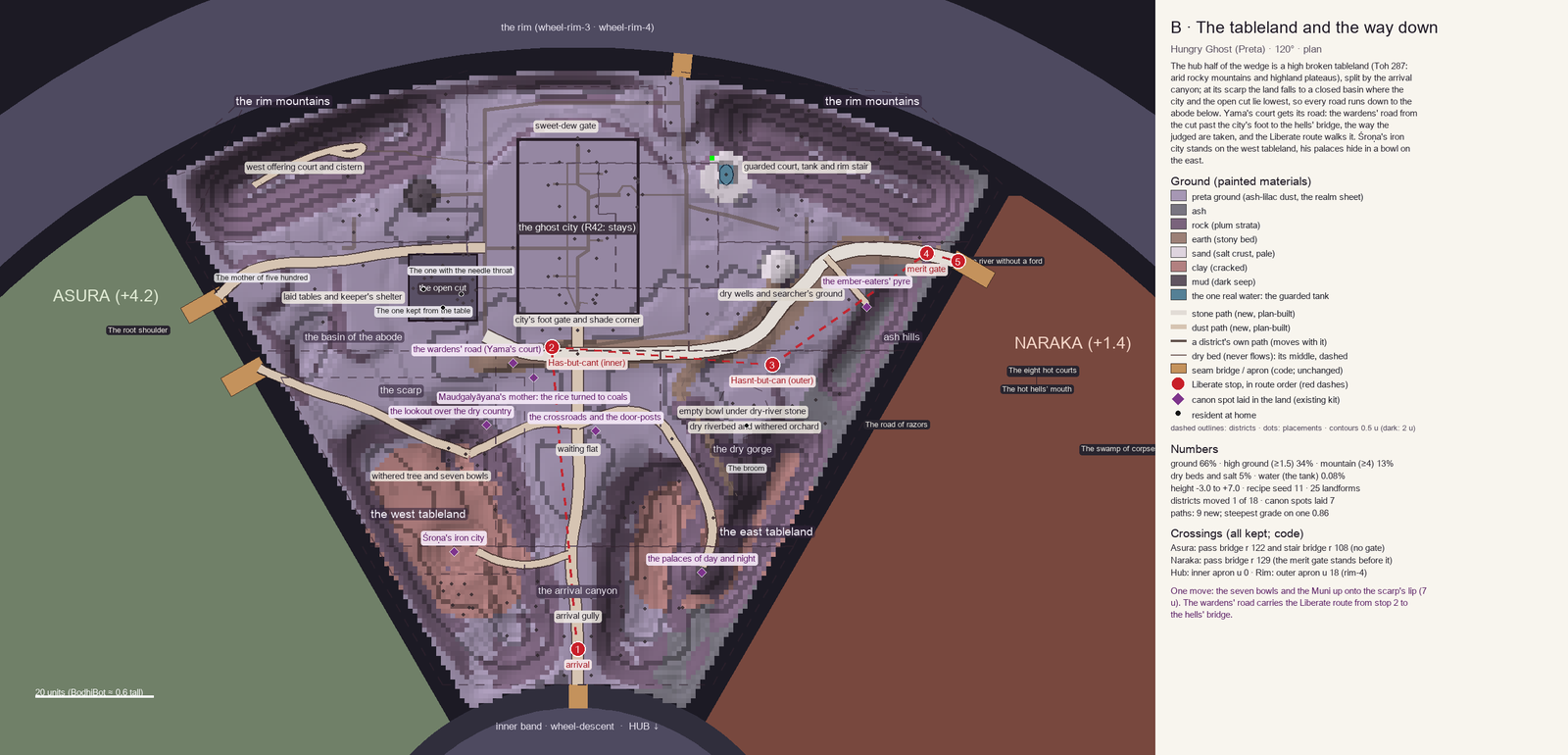
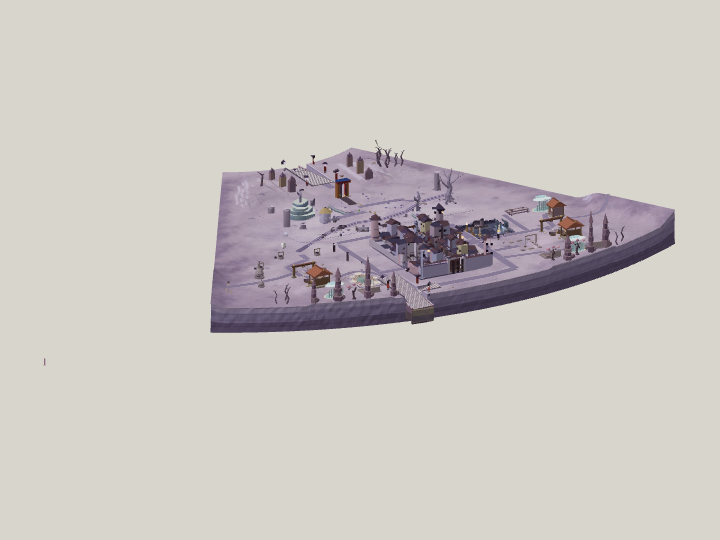
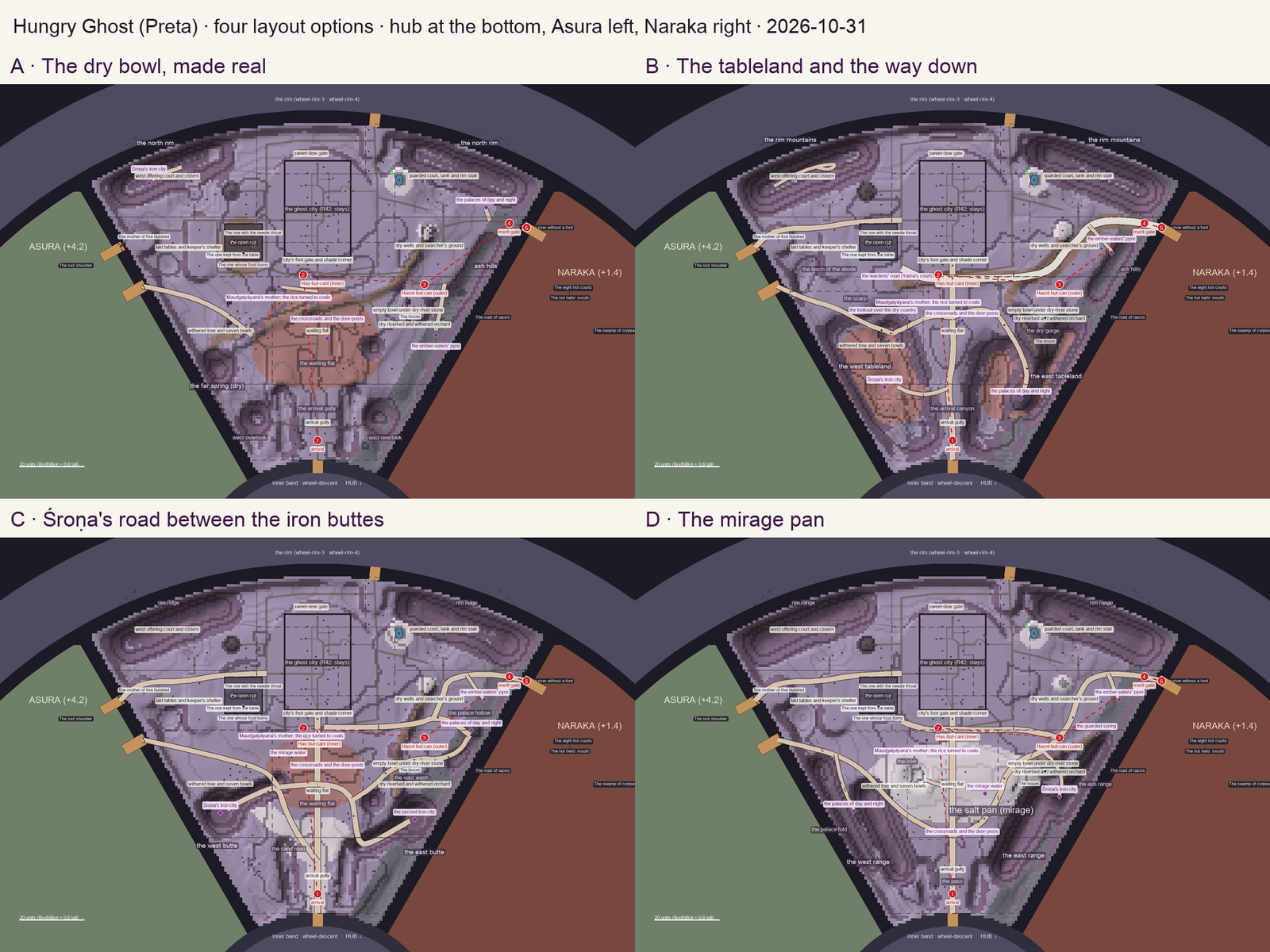
Chosen layout: B · The tableland and the way down
A high broken tableland split by the arrival canyon falls at its scarp to a closed basin where the city and the open cut lie lowest. Yama's wardens' road runs from the cut to the hells' bridge, and the Liberate route walks it.
The hungry ghosts: Yama's capital below Jambudvīpa and the dry country
Canon puts the pretas' capital five hundred leagues under Jambudvīpa, where Yama their king sits and judges, and scatters the rest of them through dry places, charnel grounds, crossroads and the human world, seen only at night. This group gathers what the texts fix about that capital and its king, the classes and bodies of the pretas, their lifespan, the landscape of mirage and guarded water they wander, the named pretas of the Petavatthu and the avadānas, the offerings the living make for them, and the bodhisattva who cools them, so the Preta realm can be laid out from canon rather than from one starving stereotype. It also records what the game has already built there.
Where the pretas live: the capital below and the scattered rest
Skt. preta; Pāli peta; Tib. yi dwags (yidak), 'departed, not returning' or 'tormented by hunger and thirst'
The pretas' principal dwelling is a city five hundred leagues under Jambudvīpa ruled by Yama; every other preta is the overflow, with no fixed place.
Vasubandhu settles it in one sentence: the king of the pretas is Yama, and his residence, the pretas' principal dwelling, lies five hundred leagues under Jambudvīpa and is five hundred leagues deep and wide. The pretas found anywhere else are the surplus. They differ greatly from one another; some have supernatural powers and enjoy a glory like the gods'.
Phagpa gives the city a name and an address: five hundred yojanas under the city of Rājagṛha lies the city of the hungry ghosts, Kapila ('yellowish white'), also called Candan ('sombre'); the demon king there is Dharma King Yama, dwelling with thirty-six attendants. Himalayan Art Resources repeats the same placing, 500 below Rajgir.
Kongtrul follows Vasubandhu and adds the Application of Mindfulness: the king of the starving spirits, Lord of the Dead, lives five hundred leagues below the Land of Jambu and rules thirty-six types of starving spirits; his abode is their principal habitat, but they live in many other places. Gampopa says the same with the game's own words: Yama, king of the hungry ghosts, lives 500 yojanas underneath Jambudvīpa; the scattered hungry ghosts have indefinite locations 'such as dry places'.
The Application of Mindfulness of the Sacred Dharma, the long sūtra behind all of these, sorts pretas into two: those that course through the world, whom humans may see at night, and those that stay in their own realms, five hundred leagues below the surface. It adds a ring the others leave out: within a radius of three thousand six hundred leagues of Jambudvīpa the conditions for a preta realm are incomplete; beyond that, no one can say how near or far they are.
Dudjom Rinpoche sums the tradition up for practice: the hungry spirits mostly live more than five hundred leagues beneath our world, but some are scattered through the earth, mountains and rivers.
What canon fixes for the map
Principal dwelling: five hundred leagues under Jambudvīpa, five hundred leagues deep and wide, with Yama as king [AK III.59 bhāṣya, printed p. 460].
The same capital placed under Rājagṛha and named Kapila or Candan, with thirty-six attendants [P printed p. 25].
Yama's abode is the principal habitat; pretas also live in many other places [K p. 28; AK p. 460 'the surplus'].
Scattered pretas have no fixed place, 'such as dry places' [JOL ch. 5, PDF p. 27]; 'scattered through the earth, mountains and rivers' [DT ch. 7, PDF p. 94].
Two sorts: those that course through the world (seen by humans at night) and those that remain in their own realm five hundred leagues below [Toh 287, 2.1283].
No preta realm within 3,600 leagues of Jambudvīpa; beyond that the distance is undetermined [Toh 287, 2.1283].
Secondary abodes anywhere: the mountains, cliffs, trees, temples and homes of the human realm can house beings from hell up to the Four Kings' heaven [K p. 30].
Some pretas with miraculous powers live in splendour like gods; Kongtrul counts the asuras classified as pretas among them [AK p. 460; K p. 28].
Who lives here
Yama, king of the pretas (Dharma King Yama in Phagpa), who sits in the capital with his thirty-six attendants [AK; P; K].
The pretas of the capital (the 'principal dwelling') and the surplus pretas scattered elsewhere [AK p. 460].
In the game now
place:ghost-city:below (built, the open cut hungry-ghost.city-below) stands for the principal abode; place:hungry-ghost (built) is the surface wedge given to the dispersed pretas; being:pretas:dispersed is missing. The plan keeps the capital and Yama's seat together below (docs/world-plan/sections/hungry-ghost.json, account r37). The retired hidden place ghost-city.json (R27) was the earlier walled-city room; only its save ids survive.
Art (3)
the preta sector, right side: grey figures on bare ground, the red Buddha's palace
Wellcome Collection (repo copy, media.json painting-wellcome-L0069380) · traditional · Public Domain Mark
The preta sector sits at the right, below the asura sector: grey emaciated figures on bare ground and the realm's red Buddha in a palace. Painters never show the capital below; the sector is the dry surface country.
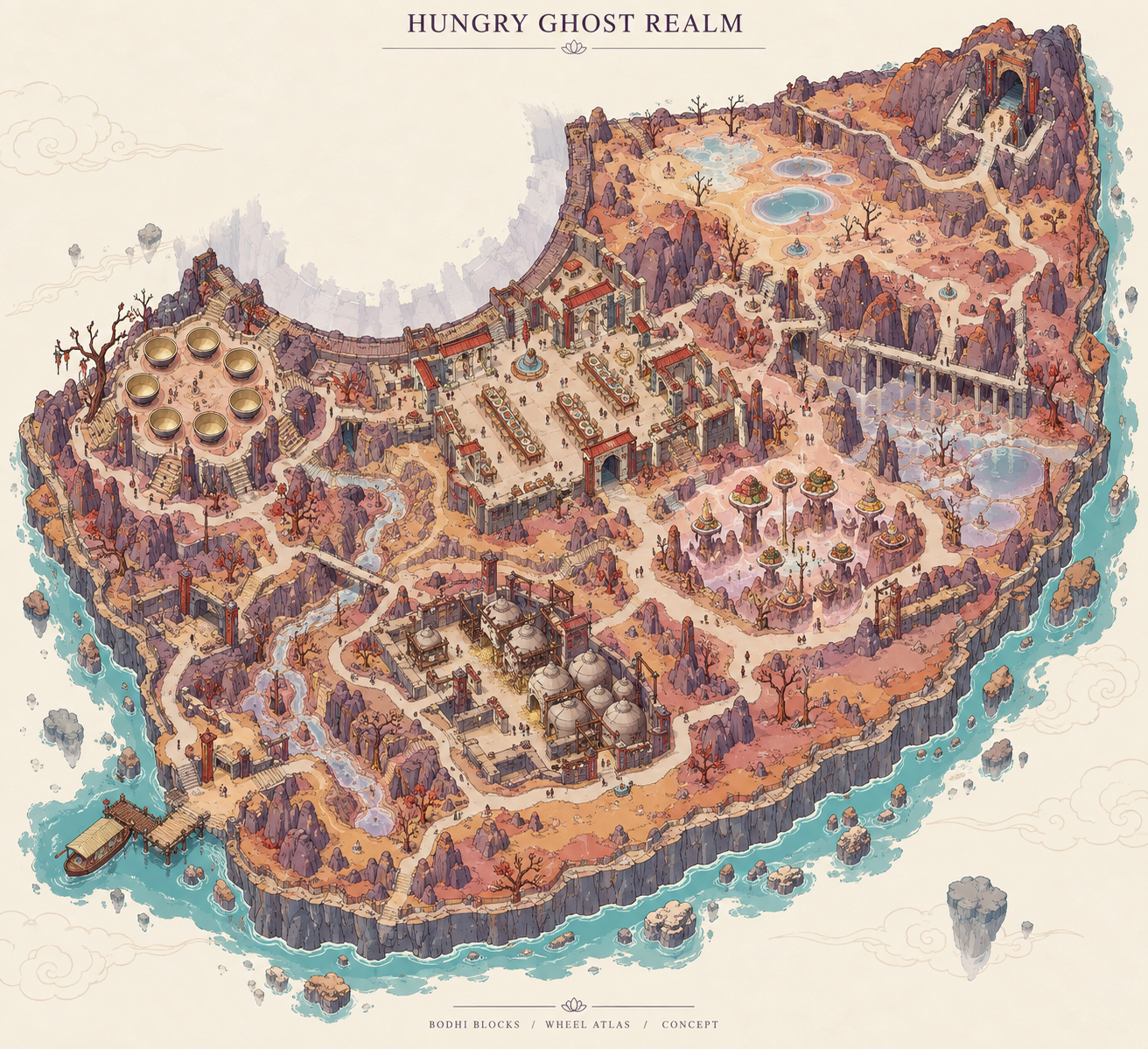
Hungry ghost realm: the game's own sector concept
AI concept study (repo), media.json wheel-02-preta · concept · Project art
The wedge as first imagined: a dry basin with a walled city; no capital below.
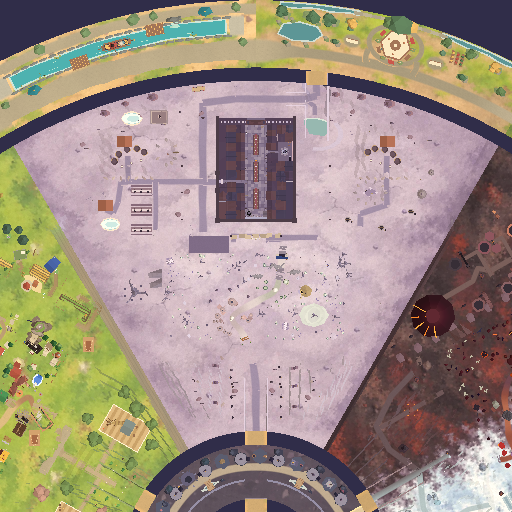
Hungry ghost realm: view from above (world capture)
Repo world capture, media.json terrain-hungry-ghost · world-view · Project art
What is built today: the dry bowl, the city and the open cut beside it.
Still missing: No traditional painting shows the capital five hundred leagues below or Kapila's walls; Wheel paintings only ever show the dry surface. A cosmological diagram placing the preta city under Jambudvīpa was not found.
The Yama who judges the dead is a living being of the preta realm, not of hell: his seat is in the pretas' capital, and the wardens bring the hell-bound to him there.
In the Abhidharma, Yama is the pretas' king and his residence is their capital under Jambudvīpa. Phagpa names him Dharma King Yama, 'the demon king', and gives him thirty-six attendants in the city Kapila. Kongtrul reads the thirty-six as the thirty-six kinds of starving spirit he rules, taken from the Application of Mindfulness. Jeff Watt's HAR glossary puts the two points together: Yama 'is understood to be a living being of the Ghost Realm who acts as the judge of the beings entering the Hell Realm'; he is not a god or a deity.
The Pāli Devadūta Sutta shows his court at work. The wardens of hell seize a wrongdoer by the arms and present him to King Yama, who asks whether he saw the five messengers of the gods: a newborn, an old person, a sick person, a criminal under punishment, a corpse. The man admits he saw them and was negligent; Yama tells him the deed was his alone, and falls silent; then the wardens take him away to the tortures. Yama himself wishes to be born human and meet a Buddha.
The Application of Mindfulness has its own version inside the preta realm: a class called 'the starving spirits punished by the Lord of Death'. Terrifying henchmen with hair like darkness, jutting lips and bellies and dangling earlobes seize the wrongdoer, chain him, drag him before the Lord of Death and ask for judgment; the royal Lord of Death answers in verse ('Landing on a veritable island of jewels, why did you not practice the Dharma?'). Those born this way swore allegiance to a king and abandoned the Dharma without compassion.
The traditions differ on where to put him. The Abhidharma, Phagpa, Kongtrul, Gampopa and HAR all seat Yama among the pretas; Wheel of Life painters put him in the hell sector, blue, with a club and the mirror that shows each being its deeds, because that is where his judging matters. The Tibetan word gshin rje is also used for the heavenly Yāma (a desire heaven), for the wrathful Yamāntaka and for the Gelug protector Yama Dharmarāja, an emanation of Mañjuśrī; HAR and the repo keep all of these apart from the preta king, and from the Death that holds the Wheel, which is a personification and not a being at all.
Phagpa's Yama is 'the demon king'; the hell wardens who work for him are, by the Abhidharma, not hell beings but creatures produced by karma, and the HAR beings page says plainly that Yama's attendants are pretas like him. So his court is a preta court: a king, thirty-six attendants (or thirty-six kinds), henchmen who fetch the judged, and the judged themselves passing through on their way down.
What canon fixes for the map
Yama is king of the pretas; his residence is the pretas' principal dwelling under Jambudvīpa [AK III.59, p. 460].
Named Dharma King Yama, a demon king, dwelling with thirty-six attendants in Kapila/Candan under Rājagṛha [P p. 25]; Kongtrul reads thirty-six as the kinds of preta he rules [K p. 28].
A living being of the ghost realm who judges those entering hell; not a god, not a deity; his attendants are pretas too [HAR set 2254 entry 1; HAR set 6581].
His court: wardens bring the wrongdoer, Yama questions him about the five messengers, pronounces the deed his own, falls silent; the wardens then punish [DS §§3–10].
Inside the preta realm there is a class 'punished by the Lord of Death', fetched by shape-changing henchmen with weapons [Toh 287 §§2.1361–2.1366].
In paintings he sits in the hell sector, blue, with a stick and a karma mirror; this is a painter's placement, not his dwelling [HAR set 6021].
Kept apart from: the Death holding the Wheel (a personification, HAR entry 2); heavenly Yāma (a desire heaven); Yamāntaka and the protector Yama Dharmarāja (emanations of Mañjuśrī, HAR entries 6–11).
Who lives here
King Yama, Lord of the Dead, judge of the hell-bound, a preta [AK; DS; HAR].
His thirty-six attendants, or the thirty-six kinds of preta he rules [P; K].
The henchmen of the Lord of Death: hairy, weapon-bearing, shape-changing, who chain the wrongdoer and bring him in [Toh 287 §2.1362].
The judged: wrongdoers who did not honour parents, ascetics and elders, brought before him by the wardens [DS §§2–10].
Yama's servants, who throw the damned into hell on his order (the hells' item, not placed here) [K p. 28; AK III.59].
In the game now
being:yama:king is sketch (the Liberate boss being:liberate-giant-yama, built, is this Yama, judge with the karma mirror, at place:mirror-hall, built). The Toh 287 roadside pause is source-authored as preta-yama-henchman and preta-yama-chained, with pending acceptance. The separate Devadūta being:yama:the-judged and HY class being:worldly-spirits:yama-spirits remain missing; being:worldly-spirits:nine-bhairavas missing. The hall is adaptation: docs/world-plan/places/mirror-hall.json says the hall, mirror and pebbles are invented staging and only Yama's seat below with the pretas is sourced. Josie's design makes him the Liberate path's last being and has his rig turn the Wheel; canon keeps the holder and the judge apart (docs/purelands-lore-populations.json, yama).
Art (7)
the hell sector, bottom centre: Yama enthroned above the tortures
Himalayan Art Resources, Jeff Watt · traditional · No open licence
Entries 1 and 2 are the judge and the Wheel-holder; 3 and 13 are preta classes called Yama and Bhairava.
Still missing: No image of Yama's court among the pretas (his hall, the thirty-six attendants, the henchmen fetching the judged); every traditional image puts him in hell. The 'court' would have to be built from the Devadūta and Toh 287 descriptions.
Tib. phyi'i sgrib pa can (outer), nang gi sgrib pa can (inner), zas skom gyi sgrib pa can (of food and drink)
Practice texts sort the pretas who live together into three obstructions: the food is kept from them, their own bodies refuse it, or the food itself turns on them.
Patrul gives the grouping the game uses. Pretas who live collectively suffer external, internal or specific obscurations. External: centuries pass without a mention of water; a stream seen far off is a stony bed when reached, an orchard is withered, a feast is guarded by armed men who beat them off; summer moonlight burns, winter sun freezes. Internal: a mouth no bigger than a needle's eye, a throat as narrow as a horse-hair, a stomach the size of a whole country, grass-like limbs that cannot lift the belly; anything that reaches the stomach bursts into flame at night. Specific: each one's own torment, such as creatures living on the body and eating it, or food that turns to chaff, iron, flesh, pus and blood as it is given.
Gampopa keeps the first two and names the third the obscuration of food and drink, in two groups: the fire garland, whose stomachs burn as soon as they eat or drink, and the filth eaters, who eat excrement, drink urine or eat their own flesh. Dudjom follows Gampopa: any food they ingest bursts into flames and burns their entrails; the filth eaters live on excrement, urine, pus, blood, spittle, snot, poison and glowing embers. He adds the weather: in spring the moon burns them, in winter the sun feels cold, the summer clouds rain fire, and their dislocating joints burst into flame.
Phagpa, older than both, counts four: outer obstacle (they cannot even hear the sound of eating and drinking), inner obstacle (needle mouth, horse-tail throat, mountain belly, stalk legs), an obstacle to food and drink (countless armed guards keep it from them) and an obstacle to eating and drinking (iron balls and molten bronze are put in their mouths and run straight out below).
All of these are a teacher's grouping of the thirty-six kinds in the Application of Mindfulness, which the game records as 'a practice-text grouping, not a census'. Kongtrul and Dudjom both say so: the sūtra's thirty-six 'can be condensed into three categories'.
What canon fixes for the map
Two sorts: pretas who live collectively (external, internal, specific obscurations) and pretas who move through space [WMPT pp. 72–75].
External obscuration: stream found dry to the stony bed, orchard withered, feast guarded by armed men; moon burns in summer, sun freezes in winter [WMPT p. 72; H 'hungry spirits'].
Internal obscuration: needle's-eye mouth, horse-hair throat, country-sized stomach, grass limbs; what reaches the stomach burns at night [WMPT p. 73].
Third class: Patrul's 'specific' (creatures devour the body; food turns to chaff, iron, flesh, pus and blood) vs Gampopa's and Dudjom's 'food and drink' (the fire garland, the filth eaters) [WMPT p. 73; JOL p. 27; DT p. 95]. The game follows the food-and-drink reading and cites both (section r37).
Phagpa counts four classes, splitting guarded food from food that turns to iron balls and molten bronze [P p. 25].
Outer obscuration in Gampopa: they see food and drink as pus and blood and perceive guards [JOL p. 27]; the game therefore does not place the guards as beings (section r37).
Who lives here
The four pretas tied to the throne of the brahmin woman Śroṇa met: her husband (chaff), son (iron), daughter-in-law (own flesh), servant (pus and blood) [WMPT pp. 73–74].
The fire garland and the filth eaters, Gampopa's two groups of the third class [JOL p. 27].
In the game now
Built: being:pretas:external (preta-guarded, 'The one kept from the table'), being:pretas:internal (preta-throat, 'The one with the needle throat'), being:pretas:food-and-drink (preta-embers, 'The one whose food burns'), each at a court in the cut: place:ghost-city:below:external, :internal, :food-and-drink (all sketch, courts inside the room). Liberate beings being:liberate-pinhole-neck-one (Has-but-cant, internal) and being:liberate-legs-only-wanderer (Hasnt-but-can, external) are built; both are Josie's coinages, only the class is sourced.
Art (7)
The one kept from the table (external obscuration), concept
AI concept study (repo), media.json concept-preta-guarded · concept · Project art
The game's external-obscuration ghost.
The one with the needle throat (internal obscuration), concept
AI concept study (repo), media.json concept-preta-throat · concept · Project art
The game's internal-obscuration ghost.
The one whose food burns (food-and-drink obscuration), concept
AI concept study (repo), media.json concept-preta-embers · concept · Project art
Repo renders (preta-throat, preta-embers, preta-guarded) · world-view · Project art
Needle throat as built; embers at /atlas/beings/renders/preta-embers-9ad0d2325813-bound-3q.webp and the guarded one at /atlas/beings/renders/preta-guarded-6c926ca8ca55-bound-3q.webp.
lower right: the pretas at the water's edge wrapped in flame
Kyoto National Museum, via Wikimedia Commons (late 12th c., National Treasure) · traditional · Public domain
Pretas who cannot drink: as they stoop to the stream the water they take bursts into flame around them, the third obscuration drawn eight hundred years ago.
Wellcome Collection, via Wikimedia Commons · traditional · CC BY 4.0
A six-sector drawing: the preta sector (lower left) shows the bodies in outline, big bellies and thin necks, one being pierced by guards' arrows, and a bodhisattva with a vase among them.
Still missing: No traditional image of the guarded feast (armed men driving pretas from food) or of the withered orchard; the V0018310 arrows are the nearest. Śroṇa's palace with the four tied pretas has no picture.
Needle mouths, hair-thin throats, bellies like mountains on stalk legs, bodies like scorched posts, flames at the mouth: the texts agree on the silhouette.
Every account starts with the throat. Phagpa: the mouth is like the eye of a needle; the throat like a horse's tail hair; the belly has the dimensions of a mountain and can never be filled; the legs are like the stalk of a plant and cannot lift it. Patrul widens the belly to the size of a country and adds that even the whole ocean would evaporate in the heat of their breath before it passed the throat. Gampopa quotes Nāgārjuna: bellies like mountains, mouths as small as eyes in needles.
The Application of Mindfulness gives the rest. Prostrate-belly pretas carry bellies twice the size of their bodies and go hunched over; all the apertures of the body are filled with embers; the body resembles a scorched pine. Water-drinkers are dark like a bee or charcoal, rough all over, faces covered by long hair, bodies ablaze. Those who feed on Dharma offerings look like withered trees, long hair, dark faces. Śroṇa's iron city is full of pretas 'with bodies like scorched posts, mountain-like bellies and mouths like the eye of a needle', and Patrul's crowd look 'like lumps of burnt wood'.
Dudjom describes the externally obstructed: dried-up, emaciated mouths and bodies, scrawny necks and limbs, shaggy hair. They have no clothes, so heat burns and cold numbs them; their joints dislocate and burst into flame.
The flaming mouth is its own figure. In the Kangyur's Bali Ritual, the female preta Flaming Mouth appears to Ānanda at night in the Banyan Grove at Kapilavastu: wasted, ugly, emaciated, flames issuing from her mouth, belly and mouth shrivelled, matted hair, long nails and body hair. HAR's Wheel of Life entry describes the preta sector as 'four naked ghostly figures breathing fire from their mouths'. The Pala sculptors gave Avalokiteśvara a tiny pot-bellied preta, Sūcīmukha, 'needle-nosed', with a funnel of a nose to catch the nectar from his hand.
Some are different. The Abhidharma and Kongtrul both say certain pretas with supernatural powers enjoy a glory like the gods'; Śroṇa met one as a bejewelled woman in a palace; the Application of Mindfulness counts 'the powerful ones' and 'those of desirable form' among the thirty-six, and says most pretas are born female.
What canon fixes for the map
Mouth like a needle's eye; throat like a horse hair; belly like a mountain (Phagpa) or a country (Patrul); legs like plant stalks or grass [P p. 25; WMPT p. 73; JOL p. 27].
Bodies like scorched posts or lumps of burnt wood; apertures full of embers; dark as charcoal; long hair over the face; body ablaze [Toh 287 §§2.1288, 2.1311; Toh 1-5 §1.56; WMPT p. 72].
No clothes; heat and cold both torture; joints dislocate and catch fire [DT p. 95].
Flaming Mouth: flames from the mouth, shrivelled belly and mouth, matted hair, long nails and body hair [Toh 1079 §1.5].
Most pretas are born female; stinginess and envy are the cause [Toh 287 §§2.1282, 2.1295].
Some pretas have miraculous powers and live like gods [AK p. 460; K p. 28; Toh 287 list].
Game rule: cute and gross, Binding of Isaac style, solid black eyes; never gritty-realistic [AGENTS.md].
Who lives here
Flaming Mouth (Jvālāmukhī, Khabarma), the female preta who warned Ānanda [Toh 647/1079 §§1.2–1.5].
Sūcīmukha, 'needle-mouth', the preta fed by Avalokiteśvara's hand in Pala sculpture [Asia Society 1979.040].
In the game now
The built ghosts (preta-throat, preta-embers, preta-guarded, Has-but-cant, Hasnt-but-can) carry the silhouette; the mother of five hundred (being:preta-waiting-mother, missing) is the next body to model, 'a repulsive body' with a husband who has 'all nine marks of ugliness'.
Art (7)
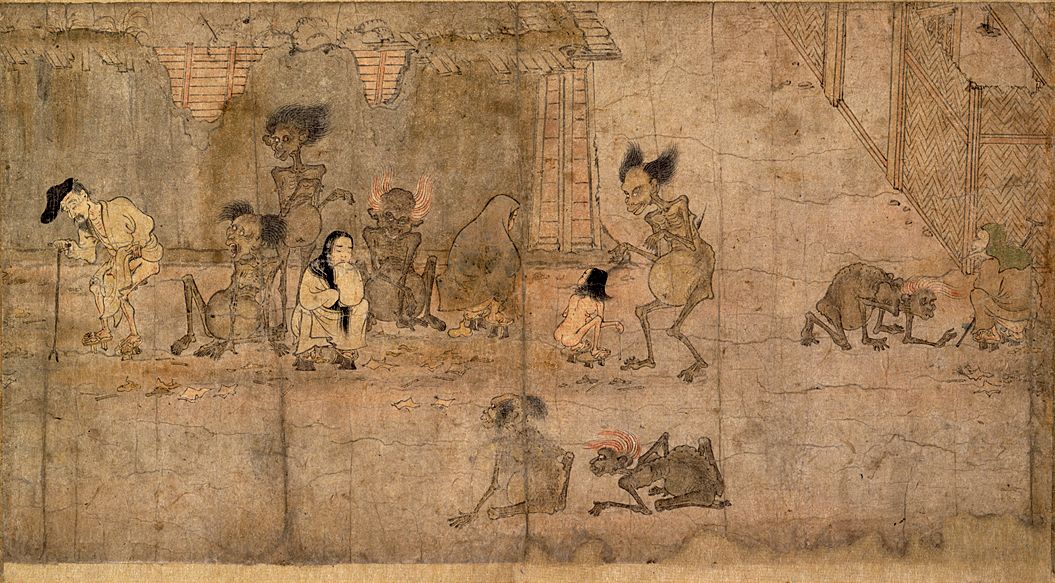
Flaming Mouth crouched before the monk, fire from her mouth
Kyoto National Museum, via Wikimedia Commons · traditional · Public domain
The canonical preta body in one figure: grey, ribbed, bristling hair, a swollen belly on bony limbs, fire pouring from the mouth, crouched before a kneeling monk.
Asia Society Museum, Mr. and Mrs. John D. Rockefeller 3rd Collection · traditional · No open licence
Look under the bodhisattva's lowered right hand for the tiny pot-bellied Sūcīmukha catching the nectar.
Still missing: No open-licence image of a preta with miraculous powers in godlike splendour (Śroṇa's jewelled woman), and none of the dog-faced or bird-formed pretas Patrul mentions.
Five hundred years, each day a human month: fifteen thousand human years; other texts say five or ten thousand, or five hundred lives of days ten human years long.
The Treasury of Abhidharma fixes it in a half-verse: the life of the pretas is five hundred years with its days the duration of a month. Gampopa spells the arithmetic out: one human month is one preta day, thirty such days a month, twelve months a year, five hundred such years. Phagpa does the sum: fifteen thousand human years.
Dudjom records the variants without choosing. Nāgārjuna's Letter to a Friend says 'for five, ten thousand years they will not die', so some live five thousand years and some ten thousand. The Application of Mindfulness, speaking of particular kinds, says ten human years are a day and a night among them and they live five hundred such lives, though they may die earlier.
The Petavatthu's Nandā and others are freed early, the moment a living relative's gift is dedicated to them; the Ullambana's Maudgalyāyana frees his mother from 'a kalpa' of hunger in a day. Lifespan in the preta realm is a limit, not a sentence: the offerings of the living can end it.
What canon fixes for the map
Five hundred years, one day equal to one human month [AK III.83c–d, printed pp. 471–472; JOL p. 27; P p. 25 ('fifteen thousand human years')].
Five or ten thousand years [Nāgārjuna, Letter to a Friend, as quoted in DT p. 95].
For specific kinds, ten human years are a day and a night; five hundred lives of those; an earlier death is possible [Toh 287 §§2.1289, 2.1293].
Pretas who move through space relive their death every week [WMPT p. 75].
Maudgalyāyana's mother suffered 'for a kalpa' before the offering freed her [Ullambana, BDK p. 22].
In the game now
Nothing yet; no day/night or calendar rule for the realm. The section gives the ghosts a routine by the clock (06:00 courts, 18:00 lean-to), an authored schedule.
Art (0)
Still missing: Nothing to picture; lifespan has no iconography.
The dry country: riverbeds, mirages and guarded water
H: 'a grim place of rocks and charred tree stumps'
The pretas' ground is arid rock and highland without rivers, where water is a mirage, orchards wither on arrival, guards stand at any real water, and iron cities wait with red-eyed gatekeepers.
Chökyi Drakpa gives the shortest description: a grim place of rocks and charred tree stumps, where food, drink and comfort have never been mentioned; streams and fruit trees seen afar are dried up or withered, or guarded by beings carrying weapons. Patrul walks the same ground: far away a stream of clear water; the joints too fragile for the belly; arrival to find nothing but the stony river bed; an orchard of huge trees all dried and withered; an abundance of food guarded by armed men who chase and beat them.
The Application of Mindfulness makes the land itself the punishment. Their negative acts render any land they wander devoid of rivers, pools, waterfalls, lakes, cascades, streams and ponds; no groves, forests, houses or meadows; they hallucinate groves and see every hill and valley engulfed by fire. The water-drinkers roam arid and rocky mountains, highland plateaus and wildernesses. Like thirsting deer they see clear water in the distance, rush to it over sharp grass that lacerates their feet, and find a mirage, 'false, fake and hollow, like the appearance of a wheel when a torch is swung in a circle'. Drunken pretas with swords and clubs harass them.
Water is there, but owned. Rare drops fall from the feet of someone crossing a stream; a practitioner sprinkles a riverbank and dedicates it to the thirsty, and they are nourished; but a person who drinks from a river without wishing to give them anything is harmed by 'the starving spirits that guard the river' as they hover and cluster, and runs away crying. The guards at the water, in this sūtra, are pretas themselves.
Śroṇa Koṭikarṇa saw the cities. Lost from his caravan, his donkeys freed, he came to a high broad city of iron with a gatekeeper 'dark black, intimidating, fierce, red eyed, with a massive body, holding an iron club', who would not answer when asked for water; inside, hundreds of thousands of pretas told him that in twelve years only that day had they heard the words 'water, water'. A second iron city was the same. Then came palaces: a heavenly house with four apsarās where a former butcher is fed by night and torn by four piebald dogs by day, and another where a centipede coils seven times round its lord each night. Patrul tells the iron castle with the sombre red-eyed figure and the crowd 'like lumps of burnt wood'; Gampopa's 'Nawa Chewari' saw the filth eaters 'in the dry desert'.
The weather is wrong. In summer even the moonlight burns them; in winter even the sun is icy; in spring the moon burns and the summer clouds rain fire. Those who course through the world are seen only at night.
What canon fixes for the map
Ground: rocks and charred tree stumps; no water ever mentioned [H 'hungry spirits'].
Seen far off and found otherwise: a clear stream (stony bed), an orchard (withered), a feast (armed guards) [WMPT p. 72; DT p. 94].
No rivers, pools, lakes, streams, groves, forests, houses or meadows in the land they wander; hallucinated groves on fire [Toh 287 §2.1302].
Arid rocky mountains, highland plateaus, wildernesses; mirage water like a thirsting deer's; sharp grass [Toh 287 §§2.1311, 2.1320s].
Real water is guarded by river-guarding pretas; a dedicated sprinkling nourishes them [Toh 287 §2.1311].
Iron cities with a red-eyed club-bearing gatekeeper; hundreds of thousands inside who have not heard the word water in twelve years [Toh 1-5 §§1.54–1.63; WMPT p. 72].
Palaces where a powerful preta enjoys pleasure half the day and is devoured the other half [Toh 1-5 §§1.73–1.93; WMPT p. 73].
Summer moon burns, winter sun freezes; summer clouds rain fire [WMPT pp. 72, 75; DT p. 95].
Direction, bearing and size of the dry country are not fixed by any source; the game's southeast wedge (120°) is adaptation (section frame).
Who lives here
The red-eyed gatekeeper of the iron city, with an iron club [Toh 1-5 §1.54; WMPT p. 72].
The starving spirits that guard the river [Toh 287 §2.1311].
Drunken pretas with swords and clubs who harass the foodless [Toh 287 §2.1302].
The butcher of Vāsava in his day-palace, torn by four piebald dogs; the man coiled by the centipede [Toh 1-5 §§1.77, 1.91].
In the game now
The surface wedge: hungry-ghost.gully, .route, .dry-river ('the dry riverbed and the withered orchard'), .east-flank ('the dry wells and the searcher's ground'), .east-court ('the guarded court, the tank and the rim stair', with a tank of water guarded by men only the pretas see), .west-flank ('the laid tables'), and the one real water hungry-ghost:mirage-basin (section terrain). The iron cities and Śroṇa's palaces are not built.
Art (8)
the preta sector, lower right: the orange plain, pots, fire and the descending bodhisattva
Library of Congress, via Wikimedia Commons · traditional · Public domain
The preta sector as a burnt-orange plain: naked figures with pots and fire, a bodhisattva descending at the top, the sea of the animal sector beside it.
the preta sector, right: house, bare slope, fire, bodhisattva with vessel
Kyoto National Museum, via Wikimedia Commons · traditional · Public domain
A dry sandy riverbed with a trickle of water; a man with a stick drives a preta from it while another preta crouches over a dead horse: the guarded water and the dry bed in one picture.
Kyoto National Museum, via Wikimedia Commons · traditional · Public domain
At the left, bare dun hills with scrubby red-leaved trees where pretas crouch: the nearest old picture to 'rocks and charred stumps'.
Hungry ghost realm, whole segment (build image)
Repo terrain image, media.json segment-hungry-ghost · world-view · Project art
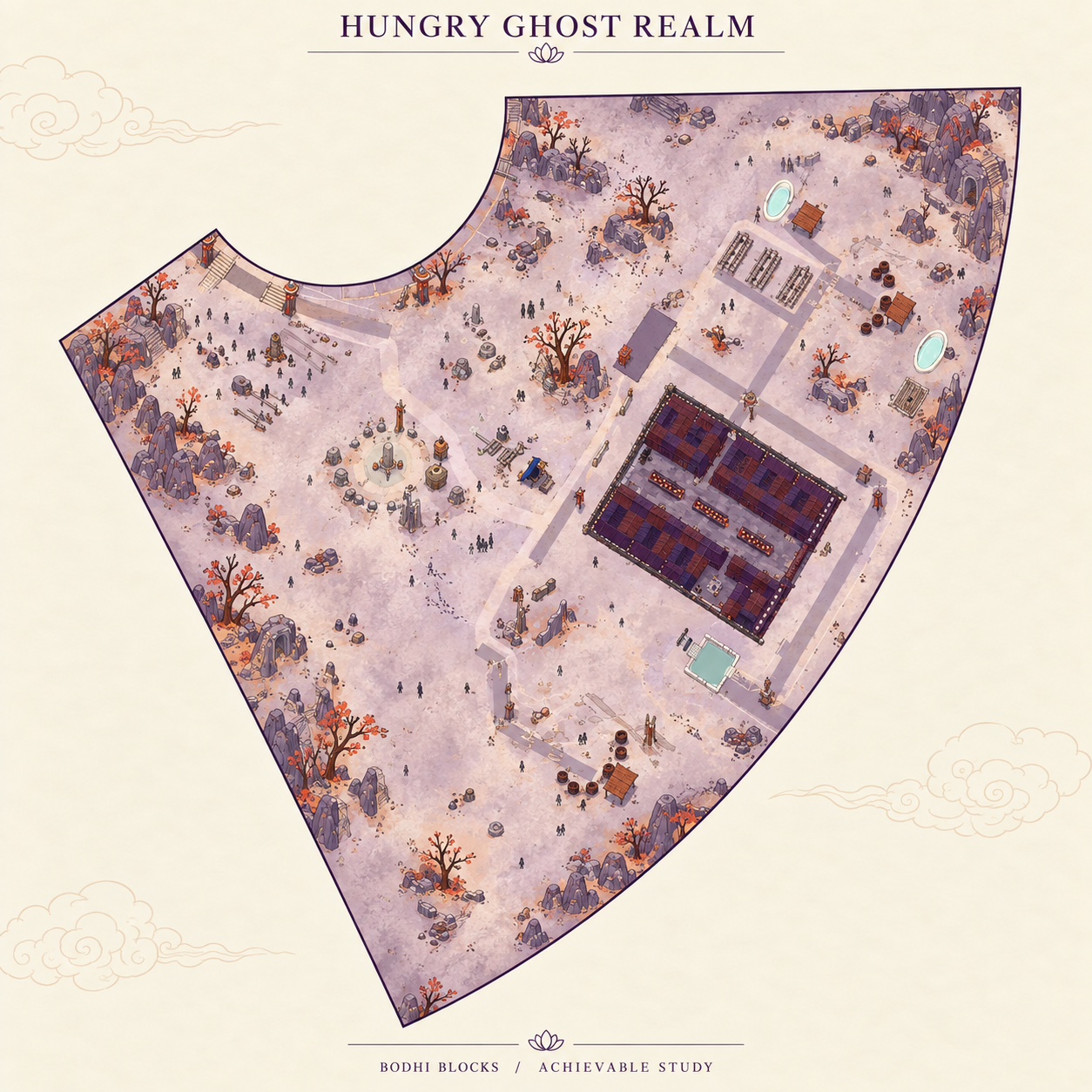
The built wedge from above: gully, city, two offering courts, the dry pond and cistern.
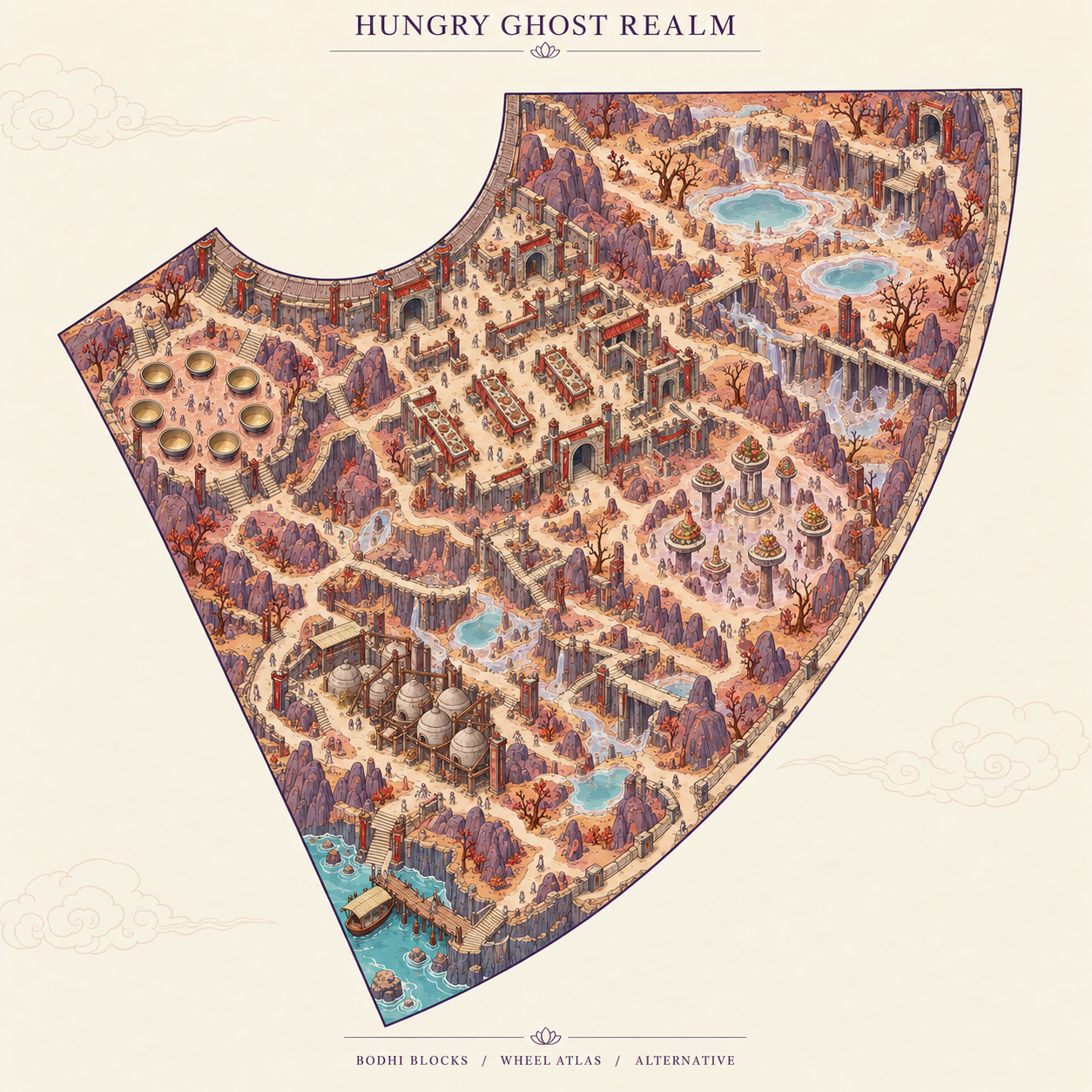
Hungry ghost realm: ambitious map study (historical, retired)
AI layout study (repo), media.json map-02-preta-alternative · layout-study · Project art
An unapproved map proposal from 1 October 2026, retired from the plan on 22 October; kept as history of how the dry country was imagined.
Still missing: No image of the iron city with its red-eyed gatekeeper, of the mirage water, or of pretas guarding a river; the Wheel sectors give crowds and fire, not the landscape.
Skt. ṣaṭtriṃśat pretāḥ; Tib. yi dwags sum cu rtsa drug
The Application of Mindfulness names thirty-six preta realms by what they eat and where they haunt, from needle-throats and excrement-eaters to crossroads-dwellers and the staff of the Lord of Death.
The sūtra lists them in one breath: those with prostrate bellies; those with throats as narrow as a needle; those that feed on excrement; those that teach; those that feed on smells; those that consume Dharma offerings; those that consume donations; those that drink water; those sustained by thinking; those that feed on spit; on garlands; on blood; on flesh; on incense; those of savage conduct; the malevolent; the subterranean; the powerful ones; those that light up at night; those waiting to snatch humans; those of desirable form; those that live between the continents; the staff of the Lord of Death; the infant eaters; the Brahmā demons; the husk eaters; those that eat filth; those dwelling at highways; the overeaters; the ember eaters; the poison eaters; those dwelling in isolated places; the charnel ground dwellers; the tree dwellers; those dwelling at crossroads; and the māra class. 'On a vast scale, one may enumerate infinitely many.'
Each kind has a cause and a ground. The prostrate-bellied were day labourers who killed cattle for wages; they lie five hundred leagues down in darkness, crushed between two mountains, bodies a league long. Needle-throats were the stingy who said 'we have nothing ourselves'. Vomit-eaters were women who ate the household's food. Water-drinkers were tavern-keepers who watered the drink; they roam the rocky highlands and guard rivers. Incense-feeders become yakṣas haunting road forks, highways, temples, parks and housetops, drunk on black agarwood. Ember-eaters feed at charnel-ground pyres, and the embers slightly cool their burning. Those between the continents live on the sea's dry islands. The staff of the Lord of Death were those who served a king without compassion.
Kongtrul and Dudjom both cite this list as the full count that the three obstructions condense; Phagpa's 'thirty-six attendants' of Yama are the same number read as a court. The game records the list only as what its three courts are not: 'a practice-text grouping, not a 36-type census'.
What canon fixes for the map
Thirty-six classes, distinguished by thinking, suffering, sustenance, movement and dwelling; all born from envy and stinginess [Toh 287 §§2.1284–2.1285].
Grounds named in the list: between the continents (sea islands), highways, crossroads, isolated places, charnel grounds, trees, underground, temples and parks (incense-feeders) [Toh 287 §2.1285 and the kind-by-kind sections].
Prostrate-bellied pretas lie five hundred leagues down between two mountains in darkness [Toh 287 §2.1289].
The thirty-six are Yama's attendants (Phagpa) or his subjects (Kongtrul) [P p. 25; K p. 28].
Who lives here
The thirty-six kinds as listed above, each a class not an individual [Toh 287 §2.1285].
In the game now
Nothing by kind. The three courts of the cut and the surface ghosts cover three; the charnel-ground dwellers overlap with being:worldly-spirits:ghosts-of-the-dead (built at charnel.ground-8); 'the staff of the Lord of Death' would be Yama's court (missing).
Art (5)
left: pretas at the shrine pillar among the peoplecentre: the crowd with buckets and the pretas underfoot
Kyoto National Museum, via Wikimedia Commons; the scroll's own text says this section tells of one of the thirty-six kinds · traditional · Public domain
Pretas squat unseen among townsfolk at a shrine pillar and a street latrine; the Japanese scroll painters took the thirty-six kinds as their programme.
Himalayan Art Resources, set 2554 'Tibetan Worldly Spirits, Sprites & Ogres' · traditional · No open licence
A Tibetan spirit-catalogue's single preta, dust-coloured, among tsen, gyalpo, mamo and teurang: the Tibetan equivalent of the kinds list.
Still missing: Only a few of the thirty-six have pictures (needle-throat, filth-eaters, charnel dwellers, water-seekers); none for those between the continents, the subterranean, the tree-dwellers or the staff of the Lord of Death.
Repo ledger: docs/purelands-cosmology.json#pretas, currentSource.destinations[ghost-city:below].notes ('not a 36-type census')
The scattered pretas among humans
Tib. btsan (tsen), rgyal po (gyalpo), gshin 'dre (shindre), 'byung po (jungpo), ma mo (mamo), the'u rang (theurang)
Most pretas are not in the capital: they course through the human world, seen at night, at crossroads, trees, charnel grounds and the walls of houses, and the Tibetan spirit classes are counted among them.
The Application of Mindfulness divides pretas first by where they are: those in their own realm below, and those that course through the world, 'perceived by humans at night'. Its kinds include dwellers at highways, crossroads, trees, isolated places and charnel grounds, and incense-eaters who haunt road forks, temples, gardens, castles and housetops and are worshipped as yakṣas. Phagpa says some stay among humans 'in such places as cemeteries, eating flesh and blood'. Kongtrul extends every lower realm into the human one: its mountains, cliffs, trees, temples and homes may house any of these beings.
Patrul's second sort, the pretas who move through space, are the Tibetan spirit classes: tsen, gyalpo, shindre, jungpo, mamo, theurang and the rest, 'all of whom live out their lives in constant terror and hallucination'. Every week they relive their death. They visit former friends and bring only sickness and madness; magicians bury them, burn them, pound them with mustard seed and split their heads. Gyalse Shenpen Taye's sang commentary counts 'the spirits of the dead included in the class of pretas' and the terangs and ghouls who inhabit towns among the guests of the smoke offering. HAR's spirit catalogue lists a dust-coloured yidag beside the tsen and mamo, and counts the eight Yamas and the nine Bhairavas of the protectors' retinues as preta classes.
The Pāli Petavatthu's most famous poem, Outside the Walls, is addressed to these: the departed stand outside the walls, at the junctions and crossroads, at the door-posts, come back to their old homes, and no one remembers them; when a gift is given and dedicated, they rejoice.
The game's rule keeps the human streets ordinary: Tibetan ritual literature supports rare, located encounters with such spirits, not random monsters (source notes). The section leaves the pretas who move through space unplaced, 'they belong to the ground they haunt'.
What canon fixes for the map
Pretas that course through the world are seen by humans at night [Toh 287 §2.1283].
Grounds among humans: cemeteries (flesh and blood) [P p. 25]; highways, crossroads, trees, temples, parks, housetops, charnel grounds [Toh 287 §2.1285, incense-feeders].
Human mountains, cliffs, trees, temples and homes are secondary abodes [K p. 30].
Pretas who move through space: tsen, gyalpo, shindre, jungpo, mamo, theurang; weekly re-death; haunting of former homes [WMPT p. 75].
The departed stand outside the walls, at junctions and crossroads, at door-posts [Pv 5, Tirokuṭṭa].
Spirits of the dead are pretas; terangs and ghouls inhabit towns [GR para. 57 and the four guests].
The game does not scatter them on the wedge or in Human streets (section r37 (5); source notes).
Who lives here
The spirits of the dead (shidre) counted among the pretas [GR para. 57].
Tsen, gyalpo, jungpo, mamo, theurang: named Tibetan classes [WMPT p. 75].
The eight Yamas and the nine Bhairavas, preta classes in protector retinues [HAR set 2254 entries 3 and 13].
Incense-eating yakṣas at road forks and housetops [Toh 287, incense-feeders section, PDF p. 432].
In the game now
being:worldly-spirits:ghosts-of-the-dead is built (shidre, 'The woman setting the table', at charnel.ground-8). being:pretas:dispersed, being:worldly-spirits:yama-spirits and being:worldly-spirits:nine-bhairavas are missing. The hungry-ghost.gully carries the dispersed pretas 'by their traces: bowls left out, nothing in them' (adapted).
Tokyo National Museum, via Wikimedia Commons · traditional · Public domain
Phagpa's cemetery pretas 'eating flesh and blood', with grave-stupas and an exposed corpse.
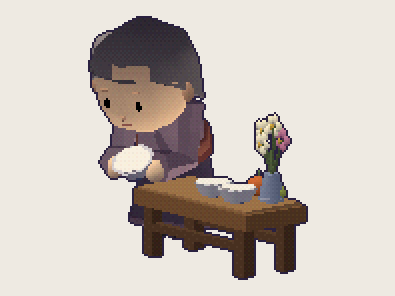
The woman setting the table (shidre), concept
AI concept study (repo), media.json concept-shidre · concept · Project art
The game's one built ghost of the dead, placed at the charnel ground.
Still missing: No open image of the Tibetan classes (tsen, gyalpo, mamo, theurang) beyond HAR's link-only catalogue; no image of the departed at the door-posts from the Tirokuṭṭa.
The Vinaya's long tale of a merchant's son lost from his caravan who walks for twelve years among iron cities and karmic palaces, carrying the pretas' messages home.
Śroṇa Koṭikarṇa, the vinā-player who later became the Buddha's disciple, fell asleep doing accounts while his caravan loaded its jewels and left. He woke to two donkeys and a sand-covered road. Beating the donkeys made them lose the way; he freed them out of pity and walked into a śāla forest. He came to a high broad city of iron. At its gate a huge dark red-eyed man with an iron club said nothing. Inside, hundreds of thousands of pretas with scorched-post bodies and needle mouths begged him to pour water, and said that in twelve years only that day had they heard the word. They told him in verse they had given nothing, and asked whether anyone had ever left such a city alive. A second iron city was the same.
Then the palaces. In one, a man adorned among four apsarās fed and bathed him, and told him to leave before sunrise; by day the palace vanished and four piebald dogs tore the flesh from the man's back until sunset. He had been a sheep butcher in Vāsava whom Mahākātyāyana had persuaded to keep pure conduct by night. In another, a man with one apsarā enjoyed the day and was coiled seven times each night by a great centipede that ate his brains. Each gave him a message for the living: tell my son to leave the butcher's trade; there is a pot of gold dust under the block; give alms to Mahākātyāyana and dedicate the merit.
Patrul tells the same journey in two scenes. In the land of the pretas, their avarice gave Śroṇa a fever and a dry mouth; at the iron castle with the sombre red-eyed figure, the crowd 'like lumps of burnt wood' begged him for water. In a palace he met a beautiful jewelled woman with a preta tied to each leg of her throne; the food he gave them turned to chaff, to iron, to their own flesh, to pus and blood. They were her husband, son, daughter-in-law and servant, who had each refused or lied about the food she offered the elder Kātyāyana; she had asked to be born where she could watch. Her message: tell my prostitute daughter to stop, show her the four iron pots of gold, the golden stick and the ablution jar under the old house, and have her make offerings to Kātyāyana in our name.
Gampopa knows the traveller as Nawa Chewari, who saw the filth eaters in the dry desert. The story is the source of the game's third class: Patrul's 'specific obscurations' are these four.
What canon fixes for the map
Lost from a caravan on the coast after the Isle of Jewels; sand covers the road; two donkeys; a śāla forest [Toh 1-5 §§1.35–1.53].
Two iron cities with red-eyed club-bearing gatekeepers; pretas who have not heard 'water' in twelve years [Toh 1-5 §§1.54–1.72; WMPT p. 72].
Palaces where pleasure and torment alternate by day and night: dogs by day, a centipede by night [Toh 1-5 §§1.73–1.93].
The jewelled woman's palace with four pretas tied to her throne [WMPT pp. 73–74].
Messages home to Vāsava: the butcher's son, the pot of gold under the block, offerings to Mahākātyāyana [Toh 1-5 §§1.85–1.87]; the daughter and the four iron pots of gold [WMPT p. 74].
Who lives here
Śroṇa Koṭikarṇa, the traveller, later ordained; a human visitor, not a resident [Toh 1-5; WMPT glossary 'Srona'].
The red-eyed gatekeeper of the iron city [Toh 1-5 §1.54].
The butcher of Vāsava, torn by four piebald dogs by day [Toh 1-5 §§1.77–1.84].
The man coiled by the centipede each night [Toh 1-5 §1.91].
The brahmin woman, a powerful preta by her own wish, and her four tied pretas [WMPT pp. 73–74].
Mahākātyāyana / Kātyāyana, the elder whose alms the family refused [Toh 1-5; WMPT p. 74].
In the game now
The saved palace bowl contains the separate day/night encounters and a rear-shelf jewelled throne with five unique resident rigs: the woman, her husband, son, daughter-in-law and servant. The four bound relatives connect to its four legs and show the sourced chaff, iron, own-flesh and pus/blood obstructions. Local bodies, speech, repeated activities and individual game liberations are adaptations. No Śroṇa/Kātyāyana duplicate or offering rite is staged. Independent review remains pending.
Art (0)
Still missing: No painting of Śroṇa's journey was found in open collections or on HAR; the iron city, the palace with the dogs and the throne with four tied pretas are all unpictured.
The mother of five hundred and the pretas at Bodh Gaya
Patrul's one named preta household: a mother of five hundred waiting twelve years for a husband who went to Bodh Gaya for food and found only a fight over a monk's snot.
The master Jetari, travelling, met a female preta with a repulsive body, the mother of five hundred children. Her husband had gone to Bodh Gaya twelve years before looking for food and had not come back; if Jetari went there, he should tell him that unless he returned soon the children would all have died of hunger. How to know him, when all pretas look alike? 'He's got a huge mouth, a squashed nose, he's blind in one eye and has all nine marks of ugliness.'
At Bodh Gaya Jetari saw a novice monk throwing many food and water torma offerings outside. When the novice had gone, a horde of pretas jostled for them, and the husband was among them. Given the message, he said he had wandered twelve years and got nothing, except once when a pure monk let fall some snot, and even then not much, because so many were fighting for it; in that battle he had been badly wounded.
The story gives the realm three things at once: a family, the twelve-year scale of a preta's search, and the reason water tormas are thrown outside the door.
What canon fixes for the map
A female preta, mother of five hundred, waiting; husband gone to Bodh Gaya twelve years [WMPT p. 74].
Pretas crowd a monastery's door for the food and water tormas a novice throws out [WMPT pp. 74–75].
The husband: huge mouth, squashed nose, one blind eye, nine marks of ugliness [WMPT p. 74].
Who lives here
The mother of five hundred children [WMPT p. 74].
Her husband, the one-eyed preta at Bodh Gaya [WMPT pp. 74–75].
The master Jetari, the messenger [WMPT p. 74].
The novice who throws the tormas [WMPT p. 74].
In the game now
being:preta-waiting-mother ('The mother of five hundred') is missing; the plan seats her on a stone by the farm track in hungry-ghost.west-flank, facing the pass to Jambudvīpa the way her husband went. Her husband belongs to Bodh Gaya in the Human realm and is not placed.
Art (0)
Still missing: No image of Jetari's preta or of pretas jostling for tormas at a monastery door; the Gaki-zōshi offering scenes (see 'Offerings for the pretas') are the nearest picture of a crowd at thrown food.
The sūtra behind the Ghost Festival: Maudgalyāyana finds his mother among the pretas, his rice turns to burning coals in her hand, and the Buddha prescribes the offering to the saṅgha that frees her.
When Mahāmaudgalyāyana attained the six supernatural powers he looked for his dead parents to repay them, and saw that his mother had been reborn among the hungry ghosts, wasted to skin and bones with nothing to eat. He filled a bowl with rice and brought it to her; she held the bowl in her left hand and took the rice with her right, but before it reached her mouth it turned into a piece of burning charcoal. He ran back to the Buddha in tears.
The Buddha told him her karma was too deep for one man's power; not the gods, spirits, brahmans, bodhisattvas or the Four Gate Guardians could help, but the monks of the ten directions together could. On the fifteenth day of the seventh month, when the monks end the summer retreat, he should fill a tray with the finest food, five kinds of greens and cereals, with ladles, kettles, basins, oil, lamps, carpets and bedding, and offer it to the saṅgha for his parents of seven generations. The monks should pray, set the food before a stupa, then eat. That day his mother was freed from a kalpa of hunger. The Buddha extended the rite to everyone: every fifteenth of the seventh month, out of filial piety.
The Pāli canon tells the same shape with other names. In the Petavatthu Sāriputta's mother of five lives ago appears as a petī and is freed when Sāriputta gives to the saṅgha and dedicates it to her; Moggallāna talks with a crowd of ghosts suffering for their stinginess, and with one struck by sixty thousand hammers. In the Tibetan tradition the Maudgalyāyana story is not in the Kangyur; what the Kangyur has instead is Ānanda's night meeting with the preta Flaming Mouth and the dhāraṇī that feeds countless ghosts, the root of the Tibetan water torma (next topic). The Japanese Gaki-zōshi scrolls illustrate that dhāraṇī story, and Japan's Obon descends from the Ullambana.
What canon fixes for the map
Rice turns to burning charcoal before it reaches the mother's mouth [Ullambana Sūtra, T. 685, BDK p. 21].
Only the assembled saṅgha of the ten directions can free her; the offering on the fifteenth of the seventh month, after the rains retreat [BDK pp. 21–22].
She is freed the same day from a kalpa of preta suffering [BDK p. 22].
Textual status: a Chinese-canon sūtra (Taishō 685/686), traditionally ascribed to Dharmarakṣa, questioned by scholars; not in the Tibetan Kangyur [BDK introduction, p. 17; Wikipedia 'Yulanpen Sutra'].
Pāli parallels: Sāriputta's former mother (Pv 14), Moggallāna with the crowd of ghosts (Pv 45) and the hammered ghost (Pv 51) [SuttaCentral].
Who lives here
Maudgalyāyana's mother, the preta who cannot eat his rice [T. 685].
Mahāmaudgalyāyana, her son, foremost in supernatural powers [T. 685].
Sāriputta's mother of five lives ago, a petī [Pv 14].
In the game now
The selected Ullambana spot [-7.5,-4] now has the mother’s unique bound/liberated rig, left-hand bowl and right-hand rice-to-charcoal gesture, short dialogue and a reused chörten. This is Chinese-canon T685, not a Kangyur episode. No Ullambana/Obon saṅgha rite is staged; the game liberation is an adaptation. Independent review remains pending.
Kyoto National Museum, via Wikimedia Commons; the Commons description says this section explains how those born as hungry ghosts are saved by the offerings of the living · traditional · Public domain
The theme of the Ullambana in a Japanese hand: the living's gifts as the only rescue.
centre: the table, the givers and the pretas eating
Kyoto National Museum, via Wikimedia Commons · traditional · Public domain
Monks and laypeople at a red offering table; the pretas run in from the hills and eat; the scroll's text names the method Ānanda taught.
Still missing: No open-licence Mulian (Maudgalyāyana) painting of the burning rice was found; Chinese and Japanese Mulian scrolls exist in museums but none surfaced on Commons under a clear licence.
Pāli Petavatthu, 'Stories of the Departed', Khuddaka Nikāya; 51 stories in four chapters
Fifty-one Pāli verse stories give the realm individual ghosts with names, deeds and rescuers: pig-mouth, stinky-mouth, the woman dressed in hair, Nandā, Revatī, the merchants' sons.
The Petavatthu is the canon's census of individuals. Its ghosts explain, usually to a monk or a king, what they did and what would free them. Sūkaramukha has a pig's mouth for harsh speech; Pūtimukha a stinking one; Khallāṭiya, the woman 'dressed in hair', meets merchants at sea; Saṃsāramocaka is helped by Sāriputta; Sāriputta's own former mother is freed by his gift; Uttara's mother suffers for abusing those who give; Nandaka's ghost advises a king on wrong view and refuge; Revatī is shown by two hell wardens her husband's merit and her own deeds; the merchants' sons discuss their lost generosity; a crowd of ghosts tells Moggallāna of their stinginess; one is struck by sixty thousand hammers.
Outside the Walls (Tirokuṭṭa) is the one most people know: the departed wait outside the walls, at crossroads and door-posts, unremembered, and rejoice when a gift is dedicated. The Simile of a Field opens the book: arahants are the field in which gifts to the dead grow. The first-chapter stories are short; the Mahāvagga tells long tales with deva-like ghosts in palaces, the same mix of splendour and torment Śroṇa saw.
Burmese and Thai painters took their preta pictures from this book and from the Phra Malai legend, in which the monk Phra Malai visits the pretas and hells and carries their messages to relatives; Thai temple murals show a giant grey preta lying across the forest while monks pour water into its mouth.
What canon fixes for the map
Fifty-one stories in four chapters (Uraga, Ubbari, Cūḷa, Mahā vaggas) [SuttaCentral pv].
Pretas at sea and on dry land, in palaces and at walls; many are female; most are freed by a dedicated gift [Pv 5, 10, 14, 39].
Hell wardens appear in a preta story (Revatī) and show a ghost her husband's merit [Pv 39].
Pāli pretas keep human proportions in Burmese and Thai art, savaged by dogs or lying huge in the forest [Temple 1906 plate; Wat Suthat murals].
Saṃsāramocaka, helped by Sāriputta [Pv 13]; Sāriputta's former mother [Pv 14]; Uttara's mother [Pv 22].
Serīsaka, a deva, to merchants lost in the desert [Pv 37]; Nandaka, who advises a king [Pv 38]; Revatī and the two hell wardens [Pv 39].
The crowd of ghosts with Moggallāna [Pv 45]; the merchants' sons [Pv 50]; the ghost hit by sixty thousand hammers [Pv 51].
In the game now
Nothing yet; no Petavatthu ghost is built. The register would suit named side beings on the dry ground (Pilgrimage authorship allows dialogue grounded in these stories).
Wikimedia Commons, photograph CC BY-SA 4.0 · traditional · CC BY-SA 4.0
A Thai temple mural: a huge grey preta stretched across the forest floor, ribs showing, while a row of monks pours water from bowls into its open mouth.
Still missing: Illustrated Petavatthu manuscripts and British Library Phra Malai folios with preta scenes exist (Or 15257 f.4 and others) but no open-licence copy surfaced; the LACMA Phra Malai pages on Commons show hell and heaven scenes, not pretas.
Stories of the Departed (Petavatthu), tr. H. S. Gehman, in The Minor Anthologies of the Pali Canon IV (PTS, 1942), the standard scholarly English translation
Offerings for the pretas: water torma, Flaming Mouth and sur
Tib. chab gtor (water torma), gsur (sur, burnt offering), gtor ma (torma); Skt. bali
The Kangyur's Flaming Mouth texts, the water torma that descends from them, and the burnt sur offering are the canon practices by which the living feed pretas.
The Kangyur holds two short texts that are the root of all preta-feeding in Tibet. In the Bali Ritual, Ānanda sits apart meditating in the Banyan Grove at Kapilavastu when, in the last watch of the night, the female preta Flaming Mouth tells him he will die the day after tomorrow and be reborn among the pretas unless, in the morning, he gives seven large Magadhan bushels of food and drink to each of countless pretas, satisfies a hundred thousand brahmin ascetics, and makes an offering in her name to the Three Jewels. He runs to the Buddha. The Buddha teaches a dhāraṇī he once received from Lokeśvara, 'namaḥ sarvatathāgata avalokite oṃ sambhara sambhara hūṃ': recite it seven times over the bali, extend the arm, offer it before the door, snap the fingers and clap; the pretas of the four directions each receive seven bushels and are reborn among gods. For brahmin ascetics, fill a vessel with clean water, recite seven times and pour it into flowing water. In the companion Dhāraṇī of Refuge, it is Nanda who meets the preta and Avalokiteśvara who gives the dhāraṇī, and the four tathāgatas' names are added.
Jigme Lingpa's note on water tormas names the scriptural basis: the Surūpa dhāraṇī, the Jñānolka dhāraṇī, the Bali Ritual, the Dhāraṇī of Refuge and the Dhāraṇī for the Constricted-Neck Pretas; the Flaming Mouth text gives the four names, Prabhūtaratna, Surūpa, Vipulagātra and Abhayakara. The Kangyur, he says, teaches only the names and their benefits, not visualizations, and the 'four guests' are a Tibetan addition. Patrul reports what the novice at Bodh Gaya did: threw food and water tormas outside the door, where the pretas jostled for them.
The sur is the burnt offering: flour mixed with butter, the three whites and three sweets, burned on hot ash so the smell feeds those who live on smell. Jigme Lingpa's White Sur Offering has one visualize oneself as Khasarpaṇi and offer the smoke to every guest and every being; Patrul says the white and red burnt offerings 'bring great benefit to pretas that move through space': spirits who feed on lives are satisfied by the smell and freed by the gift of Dharma, so the rite gives food, Dharma and protection from fear at once. 'Since water tormas and burnt offerings are both easy to perform and very effective, try to practise them regularly.' Gyalse Shenpen Taye's sang commentary lists the pretas and the spirits of the dead among the guests.
The sūtra agrees on the mechanism. In the Application of Mindfulness, water sprinkled on a riverbank and dedicated to the thirsty nourishes the water-drinking pretas; and the Conquerors, says Patrul, can help pretas as numerous as the Ganges' sands with a single drop of water or grain of barley by the power of dhāraṇīs.
What canon fixes for the map
Flaming Mouth appears at night in the Banyan Grove at Kapilavastu; Ānanda has two days [Toh 1079 §§1.1–1.5].
The bali: dhāraṇī seven times, arm extended, offered before the door, fingers snapped (three times in Toh 646), clap; seven bushels to each preta of the four directions [Toh 1079 §1.9; n.26].
Water for the ascetics: a clean vessel, seven recitations, poured into flowing water [Toh 1079 §1.11].
Four tathāgatas' names in the Dhāraṇī of Refuge: Prabhūtaratna, Surūpa, Vipulagātra, Abhayakara [Toh 646/1080; Jigme Lingpa, water torma note, n. 8].
Water torma sources in the Kangyur: Toh 540, 522, 647, 1080, 1081/236 [Jigme Lingpa, water torma note].
Sur: white flour and butter dough with fruits, three whites, three sweets, burned on mild hot ash, sprinkled only with clean water [Jigme Lingpa, White Sur Offering].
Burnt offerings benefit pretas who move through space; the smell satisfies, the Dharma frees [WMPT p. 234].
Tormas are thrown outside the monastery door; pretas jostle for them [WMPT p. 74].
Pretas are afraid of sunlight; the offering is made at evening or night (ritual custom; see Toh 287 §2.1283 'seen at night').
Who lives here
Flaming Mouth, the female preta who warned Ānanda (Nanda in Toh 646) [Toh 647/1079; Toh 646/1080].
Ānanda, the Buddha's attendant, who received and spread the practice [Toh 1079 §1.13].
The four tathāgatas named for the pretas: Prabhūtaratna, Surūpa, Vipulagātra, Abhayakara [Toh 646].
In the game now
hungry-ghost.city-gate ('the sweet-dew gate', water offered as the water torma, the feast behind the shut gate, hungry-ghost.feast room), hungry-ghost.west-court (food and water set out at a court), hungry-ghost.city-well-court (water carried to the ghosts, the city's one deed); seven offering bowls at hungry-ghost.seven-bowls (adapted). No sur fire or dhāraṇī is staged.
Kyoto National Museum, via Wikimedia Commons · traditional · Public domain
A standing Buddha under a tree lets pretas drink from a stream while others burn; above, Buddhas ride cloud to the rescue: the blessed water that pretas can finally take.
Wikimedia Commons, photograph CC BY-SA 4.0 · traditional · CC BY-SA 4.0
The water offering as a Thai painter shows it: monks with bowls, water poured into the preta's mouth.
Still missing: No image of a Tibetan water torma or sur fire being offered (link-only candidates on HAR under 'Torma'); no open image of a torma plate with the four tathāgatas.
Avalokiteśvara, Jvālamukha and the cooling of the pretas
Skt. Avalokiteśvara, Khasarpaṇa, Sūcīmukha; the preta Muni Jvālamukha (Tib. kha 'bar ma / kha 'bar de ba)
In every Wheel painting a bodhisattva or Buddha stands in the preta sector with a vessel; in Pala stone Avalokiteśvara feeds the needle-mouthed Sūcīmukha from his hand; the Kangyur has him give the dhāraṇī that feeds them all.
The Wheel of Life convention puts one awakened figure in each realm. For the pretas the painters most often choose Avalokiteśvara: the Rubin Museum's Sikkim Wheel has 'the bodhisattva of compassion Avalokiteshvara' presiding at the top of the realm, and a modern Wheel from Robert Beer's circle shows 'the cloud-borne form of Padmapani Avalokiteshvara, who miraculously creates a stream of nectar from his right palm to nourish the four poor starving pretas that squat before him'. In the repo's Wellcome painting the figure is a red Buddha in a palace; in the Wellcome line drawing a bodhisattva holds a vase among the big-bellied figures.
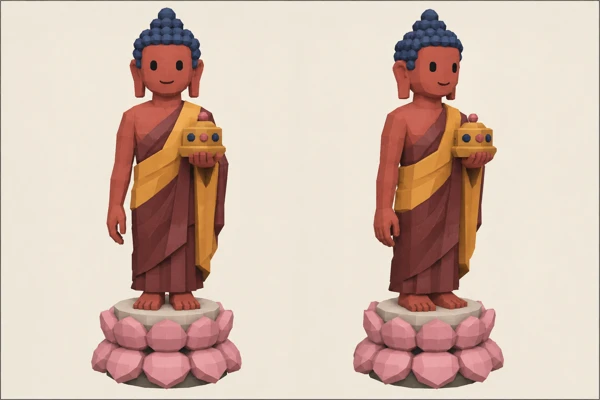
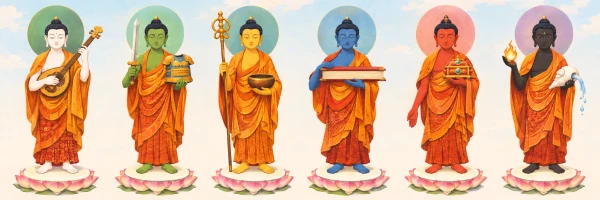
That red figure has a name in the six-Muni tradition: Jvālamukha, 'Flaming Mouth', the Muni of the hungry ghosts, red-bodied, standing, with a jewelled casket on his palm, the emanation of Śākyamuni who teaches the pretas. The repo's iconography dossier fixes him so and warns not to give him a fruit bowl. He shares his name with the preta of the Kangyur's dhāraṇī but is a Buddha, not a ghost.
The Pala sculptors made the feeding literal. Below Khasarpaṇa Lokeśvara's lowered right hand, in the gift-giving gesture, sits a tiny pot-bellied preta, Sūcīmukha, 'needle-mouth', who drinks the nectar dropping from his fingers; the Asia Society's text reads it as the belief that Avalokiteśvara feeds even hungry ghosts. In the Kangyur it is Avalokiteśvara (Lokeśvara) who gave the Buddha, in a former life, the Flaming Mouth dhāraṇī whose words begin 'homage to the one with the gaze of all tathāgatas', and the White Sur has the offerer become Khasarpaṇi.
The 'rays that cool them' belong to this circle of images: the nectar stream from the bodhisattva's palm, the Buddha under the tree who lets the Gaki-zōshi pretas drink while others burn, the embers that 'slightly cool the intense burning within them, as when a fire is extinguished with water'. No canon source found links Jambhala to the pretas' relief; the Jambhala water-pouring rite is a wealth practice with its own origin story, and the pairing of Jambhala water with preta water charity is a modern practice-sheet convenience, not scripture.
What canon fixes for the map
A buddha or bodhisattva stands in each realm of the painted Wheel; in the preta sector it is usually Avalokiteśvara, sometimes a red Buddha [HAR set 6021; Rubin Wheel text; HAR item 591].
The preta Muni is Jvālamukha, red, standing, with a jewelled casket [docs/buddhist-iconography shakyamuni-munis; dossier munis.json].
Khasarpaṇa Avalokiteśvara feeds the preta Sūcīmukha from his right hand [Asia Society 1979.040; Philadelphia Museum 12th-c. Khasarpana].
The Flaming Mouth dhāraṇī came from Lokeśvara and begins 'namaḥ sarvatathāgata avalokite' [Toh 1079 §§1.7–1.8; Toh 646].
Jambhala and the pretas: no canon source found; leave unlinked.
Who lives here
Jvālamukha, Muni of the hungry ghosts, an emanation of Śākyamuni, presence only [munis dossier].
Avalokiteśvara as Khasarpaṇa / Padmapāṇi, feeding the pretas [Asia Society; Beer's Wheel description].
Sūcīmukha, the preta at his hand [Asia Society 1979.040].
In the game now
Jvālamukha is built as overworld:munis:1 at hungry-ghost.seven-bowls (the munis rig member; the dossier's audit found a food bowl instead of a casket and a pyramid cap, to correct). No Avalokiteśvara presence in the realm; the four-armed Avalokiteśvara lives at Potalaka in Human.
Art (9)
the preta sector, lower left, with the bodhisattva and his vase
Philadelphia Museum of Art · traditional · No open licence
'Drips nectar from his right hand into the beak-like mouth of the tiny demon Suchimukha.'
Still missing: No open-licence image of Jvālamukha as the red preta Muni with the casket (the six-Muni plates on HAR are link-only), and no painting of Jambhala with pretas, which may not exist.
In six-sector Wheels the pretas sit at the lower right, between the asuras above and the hells below; in five-sector Wheels they flank the hells with the animals.
HAR's iconography page gives the rule: the third circle holds the six realms, each separated by a red line, and 'to the lower right is the realm of ghosts (preta)'. Chögyal Phagpa's instruction for the five-section Wheel says 'beneath the hub paint naraka, and on its two sides paint animals and hungry ghosts'. The repo's two Wellcome paintings are five-sector Wheels of this second kind, with the pretas at the right and the animals at the left of the hells; the Library of Congress scroll, the Thikse mural and the modern murals are six-sector with the pretas at the lower right.
What the sector contains is nearly fixed: naked grey, black or ochre figures with huge bellies and thin limbs, fire at their mouths or on the ground, pots or a laid table they cannot use, often a house, and the awakened figure with a vessel at the top. Guards with weapons appear in some (the Wellcome drawing's arrows). Painters never show the capital below Jambudvīpa, the iron cities or Yama's court; the preta sector is the dry surface.
The game's Wheel keeps this order: Deva north, Asura northeast, Preta southeast, Naraka south, Animal southwest, Human northwest, with the preta wedge at 120 degrees.
What canon fixes for the map
Six-sector Wheels: pretas at the lower right, between asuras and hells [HAR set 6021].
Five-sector Wheels: hells beneath the hub, animals and pretas on its two sides [Phagpa, Thirty-seven Heap Mandala Offering Prayer, via HAR set 6915].
The game's order: Preta southeast at 120° (Josie, 2026-10-28) [docs/wheel-geography-canonical-research-2026-10-01.md].
In the game now
place:hungry-ghost (built) at the 120° wedge; the Wheel frame (wheel:borders) keeps six equal wedges.
Himalayan Art Resources · traditional · No open licence
The example painting on HAR's iconography page; find the preta sector at the lower right.
Still missing: The repo's unsourced modern thangka (public/atlas/media/wheel-of-life/bhavacakra-thangka.png) has a clear preta sector but is not in runtime-assets and its source is unknown, so it is left out.
Repo: public/purelands/wheel-geography-research.md, 'Keep the approved Wheel order' paragraph
Yama's mirror hall today
Game id mirror-hall; district mirror-hall.hall
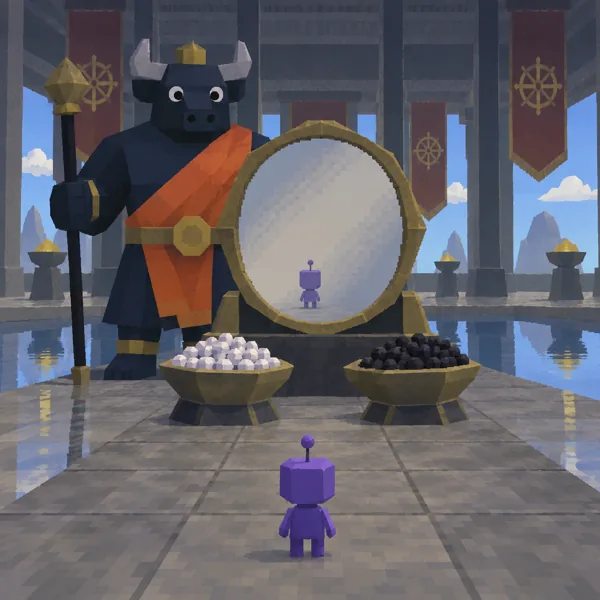
A plain 5.4 by 5.4 room off the open cut below the ghost city: a round mirror that shows only BodhiBot, one cushion, two bowls of 108 white and 108 black pebbles, and Yama, the Liberate path's last being.
The plan keeps the hall a room because a judge's hall is an interior and it lies underground with the pretas' principal abode. Its doorway, two navy pillars with gold capitals and the mirror's bronze knot on the lintel, stands at floor level in the south bay of the open cut's west face (hungry-ghost.city-below), reached from the food court. Inside: pale floor, bare navy-skirted walls, the round mirror (radius 0.95) on the back wall at z -2.7, the doorway to its left at x -1.95, one cushion facing the mirror, two bronze bowls beside it with 108 white and 108 black pebbles, the keepsake on the floor. The mirror shows BodhiBot and nothing else.
The route in is shut until the Liberate route reaches Yama, its last being; the route's order is unchanged. The way out returns to the cut's west-face door at the door's foot, never the old exterior lotus approach. Today the hall's door still stands behind the Wheel at the end of the Liberate route; the plan's rule R10 moves it, and the lone doorway and dais behind the Wheel become orphans.
Residents: Yama (liberate-giant-yama), bound and liberatable, fixed, seated by a build pass beside the mirror facing the door; the old unplaced 'yama' voice forwards to him (decision 17). Hooks: the Liberate stop at the mirror, the keepsake, and sitting on the cushion before the mirror that shows only her, 'the pebbles are never counted'.
What canon fixes for the map
Canon: Yama, king of the pretas, has his seat at their principal dwelling below Jambudvīpa; his servants set out from it [AK p. 460; K p. 28] (gateway.sources).
Canon: the judge Yama is a different identity from the Death that holds the Wheel [HAR set 2254] (gateway.sources).
Adaptation: the hall, the mirror, the pebbles and the cushion are invented staging of judgment; the door's old position behind the Wheel is a game link with no source (gateway.adaptation).
Adaptation: Yama as the Liberate path's final being, his bound/liberatable role and the rig that turns the Wheel are Josie's design, fixed (characters.liberate-giant-yama.adaptation).
Canon conflict kept visible: canon has Yama judge with the mirror of karma in the Bardo Thödol tradition and in the hell sector of paintings; the game's mirror shows only the player (plan: 'the mirror shows BodhiBot and nothing else').
Who lives here
Yama (liberate-giant-yama): the judge at the mirror, the Liberate path's last being; identity fixed by docs/story-mode-design.html §04.
yama (retired voice, 2026-10-03): forwards to liberate-giant-yama.
In the game now
place:mirror-hall built; being:liberate-giant-yama built (bound and liberated forms, dialogue, routine, liberation all pass); being:yama:king sketch (this is the same Yama). Gateway: from hungry-ghost at hungry-ghost.city-below.to-mirror-hall; shut until the Liberate route reaches Yama (hungry-ghost.hook.mirror-door). Return: mirror-hall-door at [-1.95,-2.2] to the cut's west-face door at [-13.6, 3.8].
Repo render (liberate-giant-yama) · world-view · Project art
The hall's one resident as built; his liberated form is at /atlas/beings/renders/liberate-giant-yama-5d1f0445a2e7-liberated-3q.webp.
Yama (concept study)
AI concept study (repo), media.json concept-yama · concept · Project art
The concept the rig follows.
Still missing: No capture of the hall interior (mirror, cushion, bowls) is registered in media.json or the in-world terrain captures; only the character renders exist.
Repo: docs/story-mode-design.html, §04 (the six-realm Liberate path and its bosses)
The Hungry Ghost section (the Preta wedge) today
Game id hungry-ghost; 20 districts; frame centre line 120°, origin radius 96
The Preta wedge as planned and built: the dispersed pretas' dry bowl of ash-lilac clay, one walled city where the living set out water tormas, and beside it the open cut that is the collective abode, with three courts and Yama's door.
The section's reason: the Preta wedge of the Wheel (120°, lower right) is the dispersed pretas' dry ground, 'a grim place of rocks and charred stumps' where water and fruit are seen far off and found dried, withered or guarded; one walled city where the living set out water tormas; and beside it, open to the sky, the collective abode below with a court for each obscuration and the door of Yama's hall. The chosen account is Patrul's (via Jigme Lingpa's note 5), with Kongtrul and the Abhidharma for the geography, Gampopa for the third class, and Chökyi Drakpa for the ground.
Relief: a dry bowl in a few large treads (step 0.29), the wedge 1.2 above both rings. Basin floor at base holds the Liberate strip and the whole city; the arrival gully runs between two shelves rising to overlooks; two offering courts stand on a +1 ring with a +2 dais; a dry pond east and a cistern west one step down; the north rim one step up behind the ruins. Ground: ash-lilac clay and dust, salt crust round the tank and the dry pond, plum strata on spires and risers; dust tracks only where a path leads somewhere; city streets of worn flags in dust. The one real surface water is a small salt-rimmed stone tank beside the outer stair (hungry-ghost:mirage-basin); the dry river runs from the gully across the east flank.
Districts, one line each:
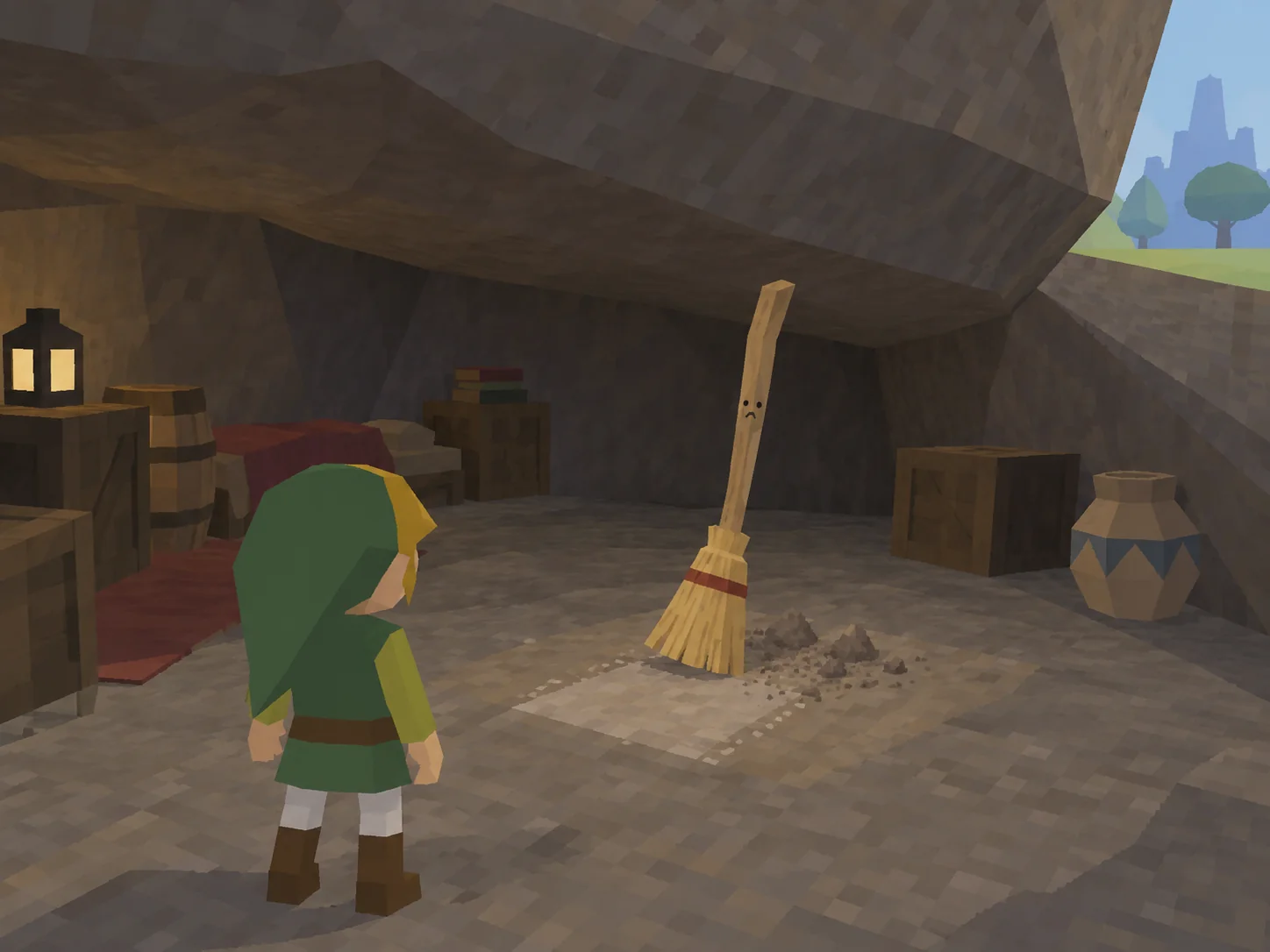
hungry-ghost.gully: the arrival from the hub, bowls left out for the hungry with nothing in them (adapted). hungry-ghost.route: the waiting flat, one straight walk to the open foot gate. hungry-ghost.seven-bowls: the withered tree, the standing Muni Jvālamukha on his lotus and moon, seven offering bowls that never fill (the seven bowls are an allowed exception). hungry-ghost.dry-river: the dry riverbed and the withered orchard, the external obscuration as landscape (WMPT p. 72; H). hungry-ghost.city-foot: the open foot gate, the lean-to shade corner where the three ghosts gather at dusk, Has-but-cant's Liberate stop and the rice balls (hook, fixed). hungry-ghost.city-street: the main street and its laid tables, walked with no load (R2), with the walk-in kitchen, grain shop and loft houses. hungry-ghost.city-well-court: the well, the city's one deed, water carried to the ghosts. hungry-ghost.city-gate: the sweet-dew gate at the street's head, shut on the feast (hungry-ghost.feast room) until the five ghosts are freed, with the shrine house. hungry-ghost.west-flank: the laid tables and the keeper's shelter, the way in from Asura; the mother of five hundred's stone by the farm track (planned). hungry-ghost.city-below: the open cut, eight wide steps down to a sunk round of paving with three courts (west external: food and water behind a fence, a shut gate and a stream that dries short; east internal: full jars with hair-thin necks; south food-and-drink: a laid table of embers and ash) and Yama's door in the south bay of the west face. hungry-ghost.west-court: the west offering court and the cistern. hungry-ghost.east-flank: the three dry wells, the dry pond and the searcher's ground; Hasnt-but-can's stop (hook, fixed) and the merit gate toward Naraka (hook, record retired 2026-10-30). hungry-ghost.east-court: the guarded court, the tank and the rim stair; bowls, a stall and a tank of water guarded by men only the pretas see. preta-granary: the stone-filled granary, entered through the thatch. hungry-ghost.hell-hollow: one of the occasional hells under a dry-river stone, the mortar and the broom, absorbing the retired hidden place hell-hungry-ghost.
Residents (9 in the record): Has-but-cant (liberate-pinhole-neck-one) at the city foot; Hasnt-but-can (liberate-legs-only-wanderer) at the east flank; Jvālamukha, Muni of the hungry ghosts (overworld:munis:1), awake, at the seven bowls; the three ghosts of the cut (preta-guarded, preta-throat, preta-embers), each at its court by day and at the lean-to at dusk; the mother of five hundred (preta-waiting-mother) at the west flank; the broom (obj-broom) and the one born in a mortar (ephemeral-hells:mortar/mortar) in the hell hollow. Orphans include the old loading zones (ghost-kitchen, ghost-grain-shop, ghost-loft, ghost-shrine-room, the granary stair), the fallen wall across the street's foot, the city's separate sky and fog, two of five bowls on each offering court, and fourteen scattered windbreak trees.
Seams: the inner apron to the Wheel descent at r 38; the outer apron to wheel-rim-4 at polar angle 126.99°; the Asura chasm at 90° with the seam bridge at r 61 and the stair bridge at r 54; and the Naraka seam carrying the merit gate path.
What canon fixes for the map
Canon: two sorts of preta and the three obscurations [WMPT pp. 72–75]; Yama's seat at the principal abode below Jambudvīpa [K pp. 28–29; AK p. 460]; the ground of rocks and charred stumps [H]; water tormas for pretas [Jigme Lingpa, water torma note] (section sources).
Adaptation: the surface city, the cut's layout, which ghost lives at which court, the courts' props, the offering courts, the seven bowls, the kitchen, grain shop, loft, shrine room, granary and feast rooms (account.adaptation; district claims marked 'adapted').
Adaptation: the third class follows the food-and-drink reading (Gampopa) over Patrul's 'specific', citing both (R37).
Adaptation: the guards of the external obscuration are not placed, since Gampopa has the pretas perceive them (R37 (4)); the pretas who move through space are not placed (R37 (5)).
Adaptation: the wedge's bearing (120°), size and seams; no source fixes the preta realm's direction (terrain, frame).
Fixed by Josie: the Liberate route order (arrival, Has-but-cant, Hasnt-but-can, merit gate to Naraka) and both beings' identities (notes.liberate; hooks).
Jvālamukha, Muni of the hungry ghosts (overworld:munis:1): awake, presence, built on the shared munis rig.
The one kept from the table (preta-guarded), the one with the needle throat (preta-throat), the one whose food burns (preta-embers): built, living at the cut's courts.
The mother of five hundred (preta-waiting-mother): sourced (WMPT pp. 74–75), missing.
The broom (obj-broom) and the one born in a mortar (ephemeral-hells:mortar/mortar): ephemeral-hell object beings at the hell hollow; the mortar is sketch.
In the game now
Samsara realm hungry-ghost: 20 items, 10 built, 5 sketch, 5 missing. Built: place:hungry-ghost, place:ghost-city:below, place:mirror-hall, being:pretas:external, being:pretas:internal, being:pretas:food-and-drink, being:liberate-pinhole-neck-one, being:liberate-legs-only-wanderer, being:liberate-giant-yama, being:worldly-spirits:ghosts-of-the-dead. Sketch: being:yama:king, being:ephemeral-hells:mortar/mortar, the three courts place:ghost-city:below:external/internal/food-and-drink. Missing: being:pretas:dispersed, being:preta-waiting-mother, being:yama:the-judged, being:worldly-spirits:yama-spirits, being:worldly-spirits:nine-bhairavas. The hidden place ghost-city is retired (R27) and keeps only save ids.
Art (9)
Hungry ghost realm: view from above (world capture)
Repo world capture, media.json terrain-hungry-ghost · world-view · Project art
The built wedge today.
Hungry ghost realm, whole segment (build image)
Repo terrain image, media.json segment-hungry-ghost · world-view · Project art
The segment image used for terrain review.
Hungry ghost realm: concept
AI concept study (repo), media.json wheel-02-preta · concept · Project art
The original wedge concept.
Hungry ghost realm: achievable map study (historical, retired)
AI layout study (repo), media.json map-02-preta-achievable-v2 · layout-study · Project art
Unapproved proposal of 1 October 2026, retired 22 October; history only.
The shared rig whose member 4 stands as Jvālamukha at the seven bowls; the dossier's audit found a bowl instead of a casket.
The one born in a mortar (concept)
AI concept study (repo) · concept · Project art
The hell hollow's resident, an ephemeral-hell object being.
The broom (concept)
AI concept study (repo), media.json concept-obj-broom · concept · Project art
Shares the hollow with the mortar.
Still missing: No world capture of the open cut, its three courts or the city street at ground level is registered; only the top-down terrain view exists. The mother of five hundred has no concept image.
missing Nothing in the game is this yet.sketch Something stands in: a model not yet placed, a placement drawn with a shared rig, a written voice, a court inside a shared room, or a place registered with no builder.built A placed character with its own model is this, or the place is built as its own room, zone or segment.
Beings
no art
Pretas dispersed outside the principal abode missing being
The name of a class of spirits: ghosts within the Wheel of Life, counted among the pretas, and worldly beings. Nine are common in the retinues of wrathful protectors such as Six-armed Mahākāla: Great Lord Bhairava, Pramita, Bhairawa, Bhaishantra, Kubera, Jnana Bhaira, Biti, Kala Bhaira and Ganapati. The nine as found in tantric maṇḍalas are emanations of the maṇḍala’s central deity.
The wrongdoers brought before King Yama missing being
Reborn in a bad place for bad deeds; the wardens of hell take them by the arms to King Yama for not respecting mother and father, ascetics and brahmins or the family elders. Asked about each messenger, they first say they saw nothing, then admit the sight but say they were negligent; the wardens then punish them.
The wardens and the hells that follow are the hot hells’ items (naraka-hot-hells:guardians and the stations); not repeated here.
The name of a class of spirits: ghosts within the Wheel of Life, counted among the pretas; several of the higher kinds of ghost can deal with humans in a limited way, causing mischief. As a class they are worldly beings. The eight named Yamas found in the retinues of wrathful protectors such as some forms of Mahākāla and Yama Dharmarāja are emanations of the maṇḍala’s central deity.
HY does not give the eight names. Not King Yama the judge (yama:king) nor the hells’ Yama’s servants (hot-hells).
Source: an adaptation grounded in Śroṇa’s opposed palaces of night and day, Toh 1-5, The Chapter on Leather §§1.73–1.93 (first man biography §§1.80–1.87; second cause unverified).
Why sketch: drawn with the shared palace-piebald-dog rig.
Placed: overworld (hungry-ghost.palaces).
Concept no
Model yes
Forms no
Placed yes
Home yes
Dialogue yes
Routine yes
Liberation yes
no art
A piebald dog of the palace 2 sketch being
Source: an adaptation grounded in Śroṇa’s opposed palaces of night and day, Toh 1-5, The Chapter on Leather §§1.73–1.93 (first man biography §§1.80–1.87; second cause unverified).
Why sketch: drawn with the shared palace-piebald-dog rig.
Placed: overworld (hungry-ghost.palaces).
Concept no
Model yes
Forms no
Placed yes
Home yes
Dialogue yes
Routine yes
Liberation yes
no art
A piebald dog of the palace 3 sketch being
Source: an adaptation grounded in Śroṇa’s opposed palaces of night and day, Toh 1-5, The Chapter on Leather §§1.73–1.93 (first man biography §§1.80–1.87; second cause unverified).
Why sketch: drawn with the shared palace-piebald-dog rig.
Placed: overworld (hungry-ghost.palaces).
Concept no
Model yes
Forms no
Placed yes
Home yes
Dialogue yes
Routine yes
Liberation yes
no art
A piebald dog of the palace 4 sketch being
Source: an adaptation grounded in Śroṇa’s opposed palaces of night and day, Toh 1-5, The Chapter on Leather §§1.73–1.93 (first man biography §§1.80–1.87; second cause unverified).
Why sketch: drawn with the shared palace-piebald-dog rig.
Placed: overworld (hungry-ghost.palaces).
Concept no
Model yes
Forms no
Placed yes
Home yes
Dialogue yes
Routine yes
Liberation yes
no art
King Yama (Dharma King Yama), Lord of the Dead, the judge sketch being
The wardens of hell bring him those who did wrong; he questions each about the five messengers of the gods, tells them the deed was theirs alone, then falls silent. He wishes to be reborn human, meet a Buddha and understand his teaching.
A living being of the preta realm, not a god or deity (HAR set 2254, entry 1). Phagpa names his city Kapila, also Candan, with thirty-six attendants; Kongtrul reads the thirty-six as the kinds of preta he rules. That city is the pretas’ principal abode (ghost-city:below), not a second place. Kept apart from Death who holds the Wheel, heavenly Yāma (meru:heaven-yama), Yamāntaka (wrathful-forms) and the protector Yama Dharmarāja of the Vajrabhairava cycle, a wrathful form of Mañjuśrī (HAR set 2254, entry 11).
Why sketch: related: Yama (character:liberate-giant-yama) at mirror-hall, Liberate route; the Liberate boss is this Yama, judge with the karma mirror; his presence form stands in the mirror hall (the rig also turns the Wheel, Josie’s design); related: Yama’s servants (character:hot-yama-servants) at overworld; his servants, who throw the damned into hell on his order (the hot hells’ guardians item).
Concept no
Model no
Placed no
Home no
Dialogue no
Routine no
The one born in a mortar sketch being
Source: an adaptation grounded in Hot hells, neighboring hells and isolated hells, H (Chökyi Drakpa, A Torch for the Path to Omniscience): The Defects of Saṃsāra · the ephemeral hells (docs/purelands-lore-populations.json)
Why sketch: drawn with the ephemeral-mortar rig, whose concept is this record's concept image.
Source: an adaptation grounded in Three kinds of hungry-ghost obstruction, Jigme Lingpa, common and uncommon preliminaries, note 5 (pretas’ external, internal and specific obscurations) points to Patrul Rinpoche, The Words of My Perfect Teacher (rev. ed.), p. 73: pretas with internal obscurations have mouths no bigger than a needle’s eye, throats as narrow as a horse-hair, stomachs the size of a country and grass-like limbs that cannot lift their bellies; what reaches the stomach bursts into flames at night
Source: an adaptation grounded in Three kinds of hungry-ghost obstruction, Jigme Lingpa, common and uncommon preliminaries, note 5 (pretas’ external, internal and specific obscurations) points to Patrul Rinpoche, The Words of My Perfect Teacher (rev. ed.), p. 72: pretas with external obscurations see a stream far off and find only the stony bed, an orchard and find the trees withered, food and drink and find it guarded by armed men; summer moonlight burns them, winter sun freezes them
Hungry spirits who suffer from internal obscurations built being
As the sublime Nagarjuna describes them, some, their mouths like needles’ eyes and their bellies huge as mountains, ache from want of food. DT adds that even if they find something to eat or drink, it will not go into their mouths; if it does, the food is dispersed inside their cheeks and the drink dries up in their poisonous mouths; should they manage to swallow a little, it does not get past the throat, and any that does is not enough to fill the stomach.
Why built: The one with the needle throat (character:preta-throat) placed at ghost-city:below; related: Has-but-cant (character:liberate-pinhole-neck-one) at Liberate route; Has-but-cant (Josie’s coinage): holds food, cannot swallow it.
Hungry spirits who suffer from obscurations related to food and drink built being
Any food and drink they do ingest bursts into flames, blazing away and burning all their entrails. The so-called filth eaters have to eat food that is bad and only causes them distress: unclean, foul-smelling things like excrement, urine, pus, blood, spittle and snot, or poison or glowing embers.
Source: an adaptation grounded in docs/overworld-lore.json#maudgalyayana-and-the-ullambana, Ullambana Sūtra, Chinese canon T685, tr. Shōjun Bandō (BDK 2005), printed pp.21–22; not in the Tibetan Kangyur.
Placed: overworld (hungry-ghost.route).
Concept no
Model yes
Forms no
Placed yes
Home yes
Dialogue yes
Routine yes
Liberation yes
Pretas obstructed from outside built being
Months and years without hearing of food or water; what they find is dried up or guarded by beings carrying weapons.
Why built: The one kept from the table (character:preta-guarded) placed at ghost-city:below; related: Hasnt-but-can (character:liberate-legs-only-wanderer) at Liberate route; Hasnt-but-can (Josie’s coinage): has no food, could eat it.
Source: an adaptation grounded in Śroṇa’s opposed palaces of night and day, Toh 1-5, The Chapter on Leather §§1.73–1.93 (first man biography §§1.80–1.87; second cause unverified).
Placed: overworld (hungry-ghost.palaces).
Concept no
Model yes
Forms no
Placed yes
Home yes
Dialogue yes
Routine yes
Liberation yes
no art
The crossroads dweller built being
Source: an adaptation grounded in docs/purelands-lore-populations.json#sources.AM, Toh 287 §2.1285, F.286.b–287.a; TEI tid 1518–1519 / milestones 1675–1676: the thirty-six classes include crossroads dwellers.
Placed: overworld (hungry-ghost.route).
Concept no
Model yes
Forms no
Placed yes
Home yes
Dialogue yes
Routine yes
Liberation yes
no art
The daughter-in-law built being
Source: an adaptation grounded in docs/overworld-lore.json#srona-kotikarna-journey, Patrul Rinpoche, The Words of My Perfect Teacher, printed pp.73–74, specific obscurations: jewelled woman and the four tied pretas.
Placed: overworld (hungry-ghost.palaces).
Concept no
Model yes
Forms no
Placed yes
Home yes
Dialogue yes
Routine yes
Liberation yes
no art
The ember eater built being
Source: an adaptation grounded in docs/purelands-lore-populations.json#sources.AM, Toh 287, F.308.a; TEI tid 1670–1673 / milestones 1841–1844.
Placed: overworld (hungry-ghost.east-flank).
Concept no
Model yes
Forms no
Placed yes
Home yes
Dialogue yes
Routine yes
Liberation yes
no art
The first night-palace nymph built being
Source: an adaptation grounded in Śroṇa’s opposed palaces of night and day, Toh 1-5, The Chapter on Leather §§1.73–1.93 (first man biography §§1.80–1.87; second cause unverified).
Placed: overworld (hungry-ghost.palaces).
Concept no
Model yes
Forms no
Placed yes
Home yes
Dialogue yes
Routine yes
Liberation yes
no art
The fourth night-palace nymph built being
Source: an adaptation grounded in Śroṇa’s opposed palaces of night and day, Toh 1-5, The Chapter on Leather §§1.73–1.93 (first man biography §§1.80–1.87; second cause unverified).
Placed: overworld (hungry-ghost.palaces).
Concept no
Model yes
Forms no
Placed yes
Home yes
Dialogue yes
Routine yes
Liberation yes
The ghosts of the dead built being
The ghosts of men and women who have died, and the spirits of the dead counted among the pretas.
The verse calls them the shades of men and women dead, and names female ghosts (para. 52). The game’s woman setting the table at the charnel ground, who does not know she is dead, is its own resident of the class.
The henchmen who chain the starving spirits built being
Shape-changing, weapon-bearing henchmen with hair carpeting their bodies like darkness, protruding lips and bellies and dangling earlobes. They seize the wrongdoer, chain him, drag him before the Lord of Death and request judgment.
This Toh287 description is kept separate from HY’s Yama-spirit class and the Naraka servants’ group; no shared named identity is asserted.
Why built: The dark-haired henchman (character:preta-yama-henchman) placed at overworld.
Placed: overworld (hungry-ghost.route).
Concept no
Model yes
Forms no
Placed yes
Home yes
Dialogue yes
Routine yes
Liberation yes
no art
The husband with chaff built being
Source: an adaptation grounded in docs/overworld-lore.json#srona-kotikarna-journey, Patrul Rinpoche, The Words of My Perfect Teacher, printed pp.73–74, specific obscurations: jewelled woman and the four tied pretas.
Placed: overworld (hungry-ghost.palaces).
Concept no
Model yes
Forms no
Placed yes
Home yes
Dialogue yes
Routine yes
Liberation yes
no art
The jewelled woman built being
Source: an adaptation grounded in docs/overworld-lore.json#srona-kotikarna-journey, Patrul Rinpoche, The Words of My Perfect Teacher, printed pp.73–74, specific obscurations: jewelled woman and the four tied pretas.
Placed: overworld (hungry-ghost.palaces).
Concept no
Model yes
Forms no
Placed yes
Home yes
Dialogue yes
Routine yes
Liberation yes
no art
The keeper of the iron city built being
Massive dark club-bearing gatekeeper: silent initially, speaks as Śroṇa leaves.
Why built: The keeper of the iron city (character:iron-city-gatekeeper) placed at overworld.
Placed: overworld (hungry-ghost.iron-city).
Concept no
Model yes
Forms no
Placed yes
Home yes
Dialogue yes
Routine yes
Liberation yes
no art
The man of the sunrise palace built being
Source: an adaptation grounded in Śroṇa’s opposed palaces of night and day, Toh 1-5, The Chapter on Leather §§1.73–1.93 (first man biography §§1.80–1.87; second cause unverified).
Placed: overworld (hungry-ghost.palaces).
Concept no
Model yes
Forms no
Placed yes
Home yes
Dialogue yes
Routine yes
Liberation yes
no art
The mother of five hundred built being
Source: an adaptation grounded in Three kinds of hungry-ghost obstruction, Jigme Lingpa, common and uncommon preliminaries, note 5 (pretas’ external, internal and specific obscurations) points to Patrul Rinpoche, The Words of My Perfect Teacher (rev. ed.), pp. 74–75: the Master Jetari meets a female preta, mother of five hundred children, whose husband went to Bodh Gaya twelve years before looking for food; at Bodh Gaya he finds him among the pretas jostling for a novice’s food and water tormas
Placed: overworld (hungry-ghost.west-flank).
Concept no
Model yes
Forms no
Placed yes
Home yes
Dialogue yes
Routine yes
Liberation yes
no art
The nymph of the sunrise palace built being
Source: an adaptation grounded in Śroṇa’s opposed palaces of night and day, Toh 1-5, The Chapter on Leather §§1.73–1.93 (first man biography §§1.80–1.87; second cause unverified).
Placed: overworld (hungry-ghost.palaces).
Concept no
Model yes
Forms no
Placed yes
Home yes
Dialogue yes
Routine yes
Liberation yes
no art
The scorched-post city pretas built being
Scorched-post bodies, huge stomachs, needle-eye mouths; twelve years without hearing water mentioned.
Three unique representative bodies; the full source crowd remains unmodeled.
Why built: The upright scorched-post preta (character:iron-city-upright) placed at overworld; The crouched scorched-post preta (character:iron-city-crouched) placed at overworld; The bent scorched-post preta (character:iron-city-bent) placed at overworld.
Placed: overworld (hungry-ghost.iron-city).
Concept no
Model yes
Forms no
Placed yes
Home yes
Dialogue yes
Routine yes
Liberation yes
no art
The second night-palace nymph built being
Source: an adaptation grounded in Śroṇa’s opposed palaces of night and day, Toh 1-5, The Chapter on Leather §§1.73–1.93 (first man biography §§1.80–1.87; second cause unverified).
Placed: overworld (hungry-ghost.palaces).
Concept no
Model yes
Forms no
Placed yes
Home yes
Dialogue yes
Routine yes
Liberation yes
no art
The servant with the bowl built being
Source: an adaptation grounded in docs/overworld-lore.json#srona-kotikarna-journey, Patrul Rinpoche, The Words of My Perfect Teacher, printed pp.73–74, specific obscurations: jewelled woman and the four tied pretas.
Placed: overworld (hungry-ghost.palaces).
Concept no
Model yes
Forms no
Placed yes
Home yes
Dialogue yes
Routine yes
Liberation yes
no art
The seven-coil centipede built being
Source: an adaptation grounded in Śroṇa’s opposed palaces of night and day, Toh 1-5, The Chapter on Leather §§1.73–1.93 (first man biography §§1.80–1.87; second cause unverified).
Placed: overworld (hungry-ghost.palaces).
Concept no
Model yes
Forms no
Placed yes
Home yes
Dialogue yes
Routine yes
Liberation yes
no art
The son with iron built being
Source: an adaptation grounded in docs/overworld-lore.json#srona-kotikarna-journey, Patrul Rinpoche, The Words of My Perfect Teacher, printed pp.73–74, specific obscurations: jewelled woman and the four tied pretas.
Placed: overworld (hungry-ghost.palaces).
Concept no
Model yes
Forms no
Placed yes
Home yes
Dialogue yes
Routine yes
Liberation yes
no art
The starving spirits punished by the Lord of Death built being
Those who, possessed of envy and stinginess, swore allegiance to a king and relinquished the Dharma without compassion; reborn as starving spirits, chained by the henchmen and brought before the Lord of Death.
The Toh287 account, not a relabeling of the separate Devadūta wrongdoers/five-messenger interrogation. A single class representative is staged at the saved road.
Why built: The chained preta (character:preta-yama-chained) placed at overworld.
Placed: overworld (hungry-ghost.route).
Concept no
Model yes
Forms no
Placed yes
Home yes
Dialogue yes
Routine yes
Liberation yes
no art
The third night-palace nymph built being
Source: an adaptation grounded in Śroṇa’s opposed palaces of night and day, Toh 1-5, The Chapter on Leather §§1.73–1.93 (first man biography §§1.80–1.87; second cause unverified).
The court of the hungry spirits with external obscurations sketch place
The Close Mindfulness Sutra mentions thirty-six kinds of hungry spirits, condensed into three categories; the first is the hungry spirits with external obscurations.
DT names the category, not a court: the court is the game’s, below the ghost city.
The court of the hungry spirits with internal obscurations sketch place
The Close Mindfulness Sutra mentions thirty-six kinds of hungry spirits, condensed into three categories; the second is those with internal obscurations.
DT names the category, not a court: the court is the game’s, below the ghost city.
The court of the hungry spirits with obscurations related to food and drink sketch place
The Close Mindfulness Sutra mentions thirty-six kinds of hungry spirits, condensed into three categories; the third is those with obscurations related to food and drink.
DT names the category, not a court: the court is the game’s, below the ghost city.
Source: an adaptation grounded in Three kinds of hungry-ghost obstruction, K PDF pp. 28–29: Preta principal abode below Jambu, others dispersed (docs/wheel-geography-canonical-research-2026-10-01.md; docs/purelands-lore-populations.json item ghost-city:below)
Placed: ghost-city (hungry-ghost.city-street).
Hell hungry ghost built place
Source: an adaptation grounded in docs/purelands-lore-populations.json, Jamgön Kongtrul · Treasury of Knowledge, book one (Myriad Worlds), Tsadra edition; PDF p. 28; https://dharmacloud.tsadra.org/wp-content/uploads/2024/09/TOK-VOL-1.pdf
Source: an adaptation grounded in Three kinds of hungry-ghost obstruction, AK PDF p. 116 / printed p. 460: principal underground Preta dwelling with Yama (docs/wheel-geography-canonical-research-2026-10-01.md)
Placed: mirror-hall.
Śroṇa’s iron city built place
A high broad iron city with a gate.
Built in the hungry-ghost segment at docs/world-plan/sections/hungry-ghost.json district hungry-ghost.iron-city. The registry matches the host segment; this is an open-air district, not a separate room or tray asset.