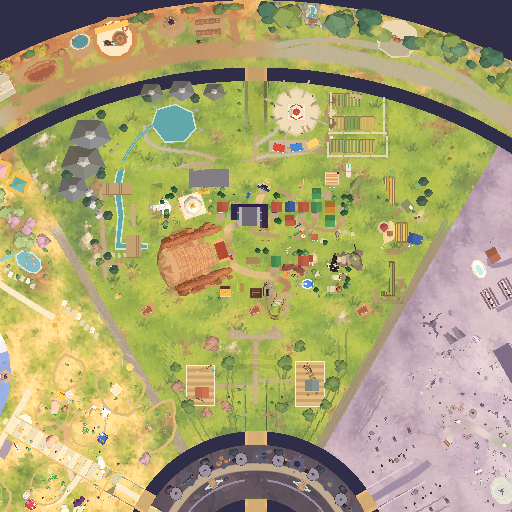
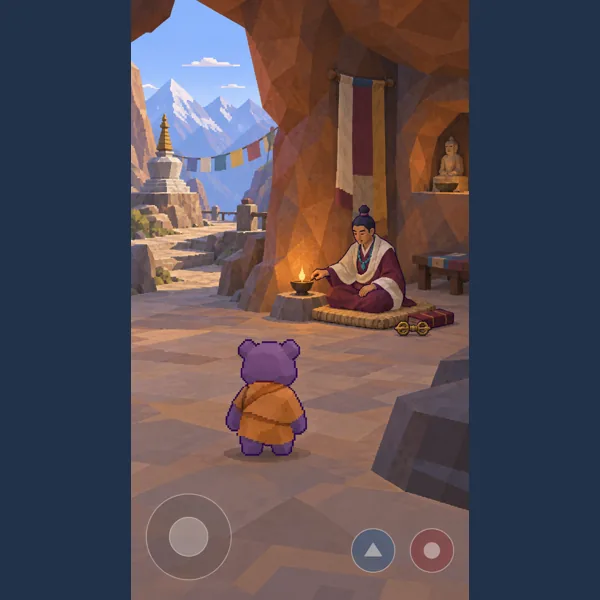
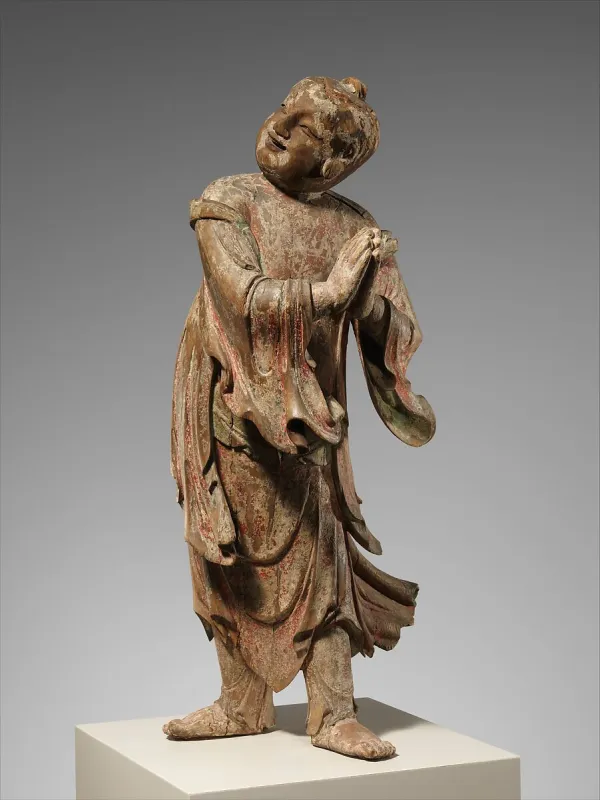
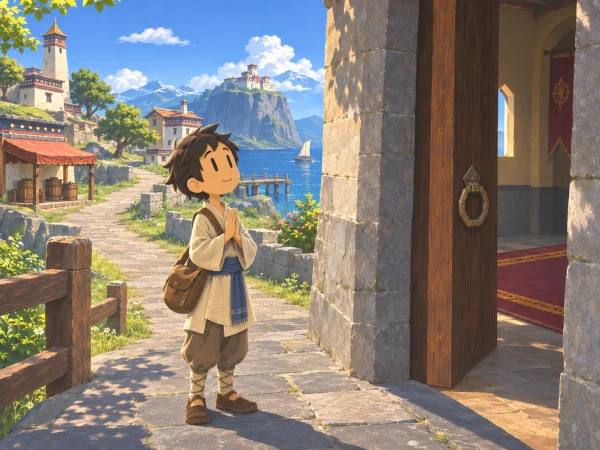
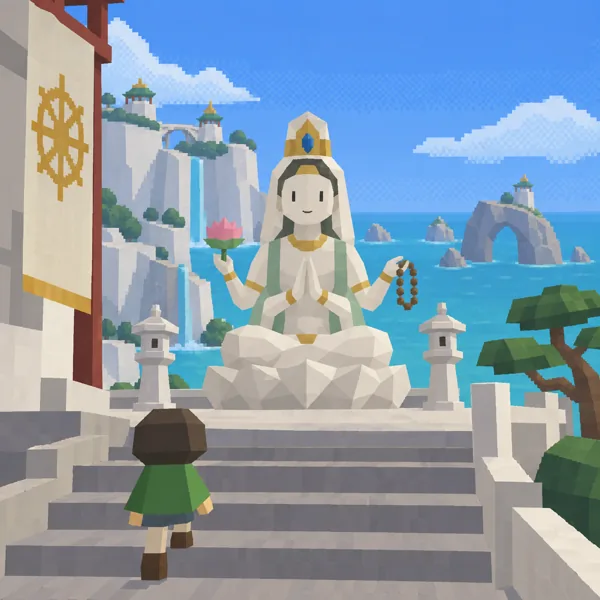
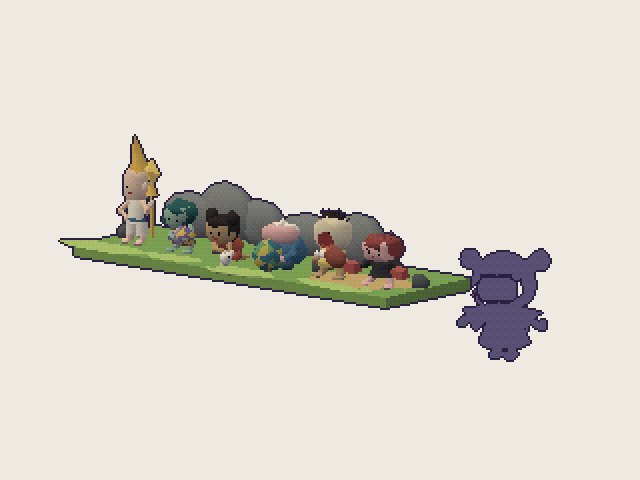
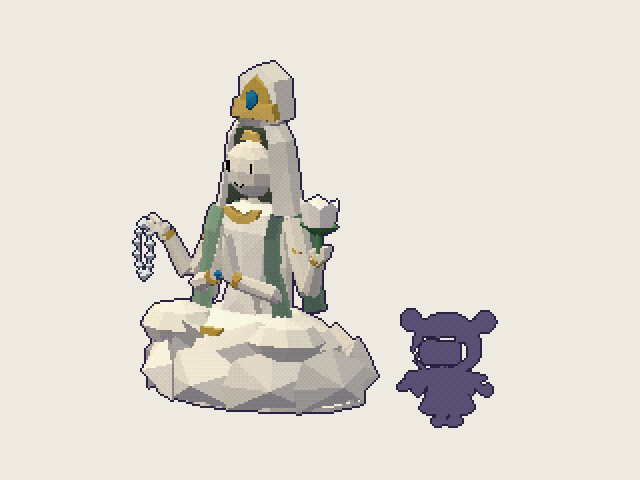
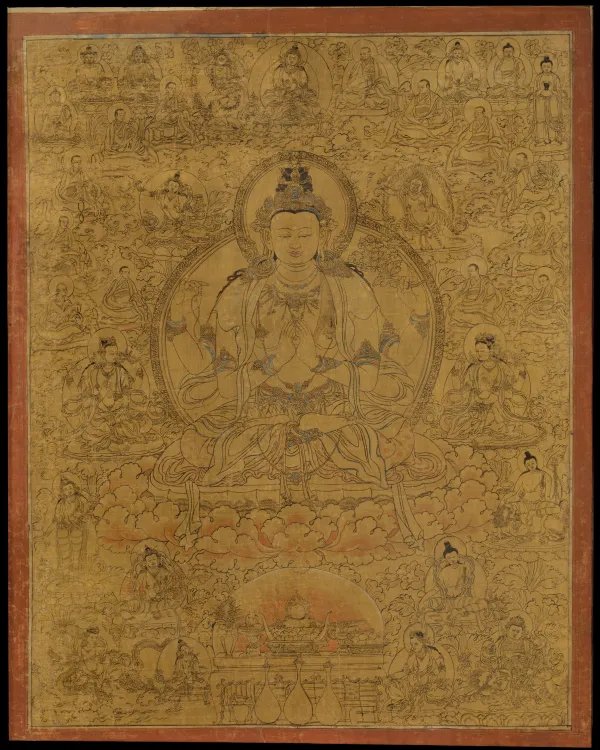
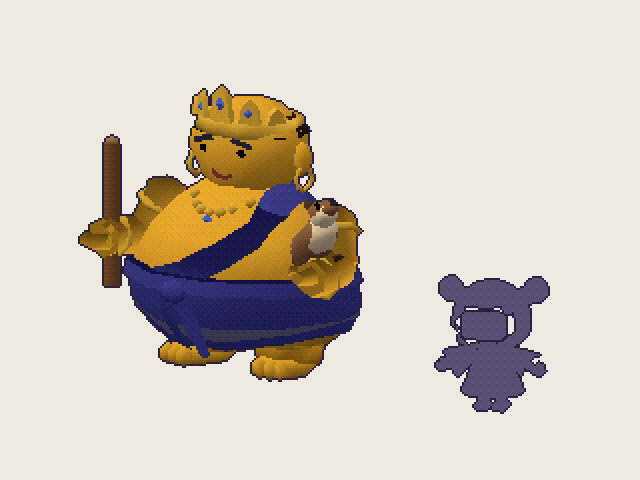
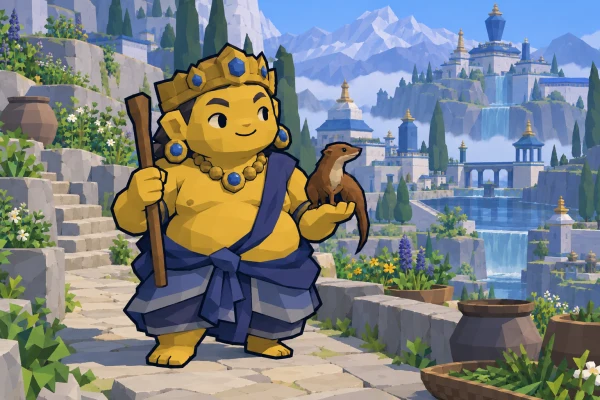
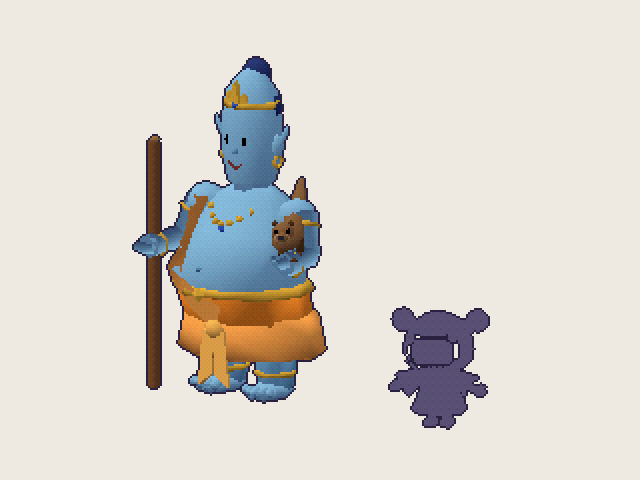
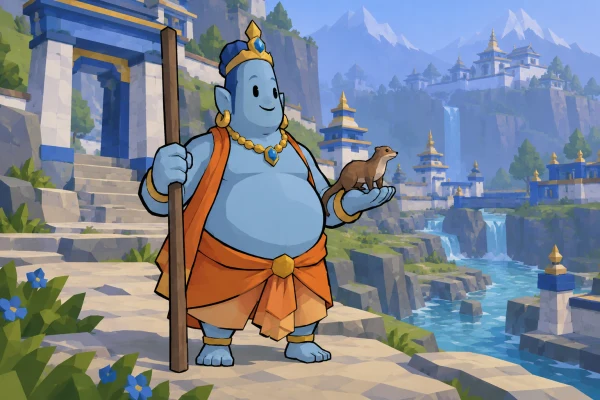
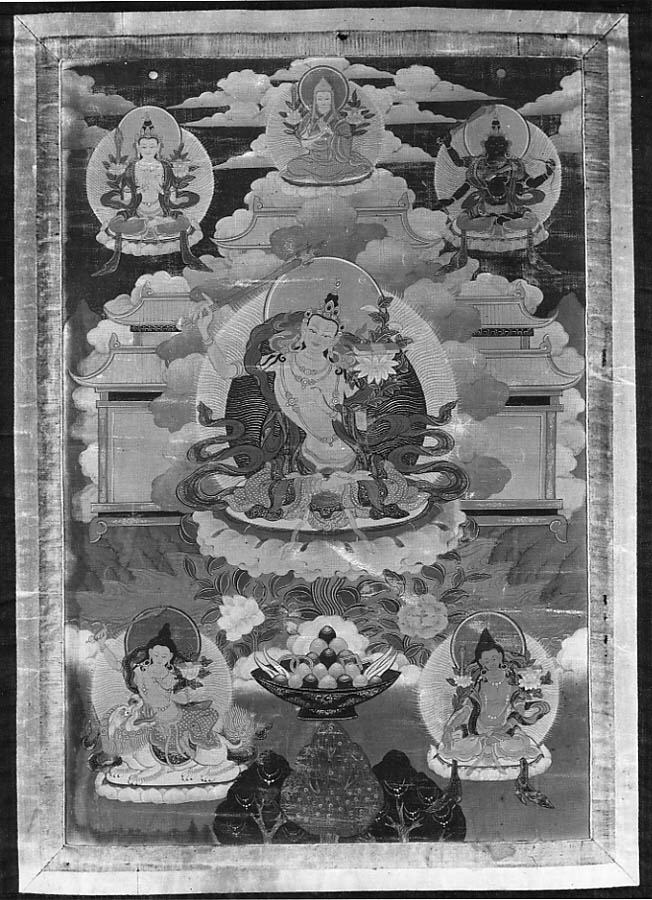
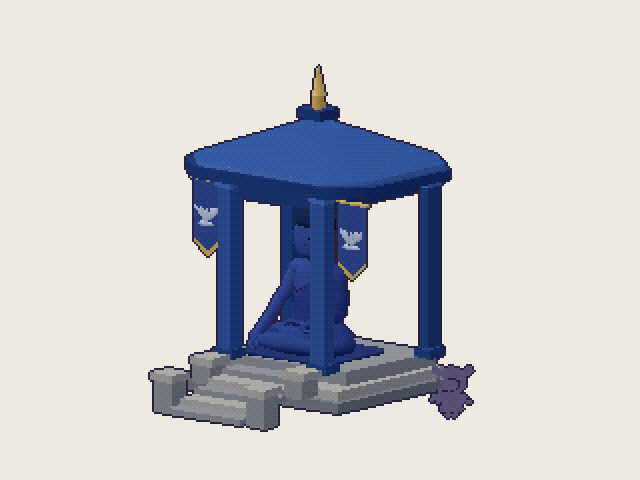
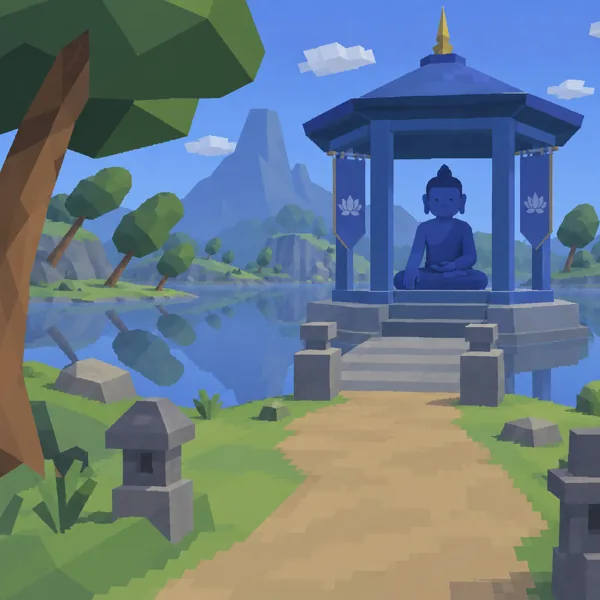
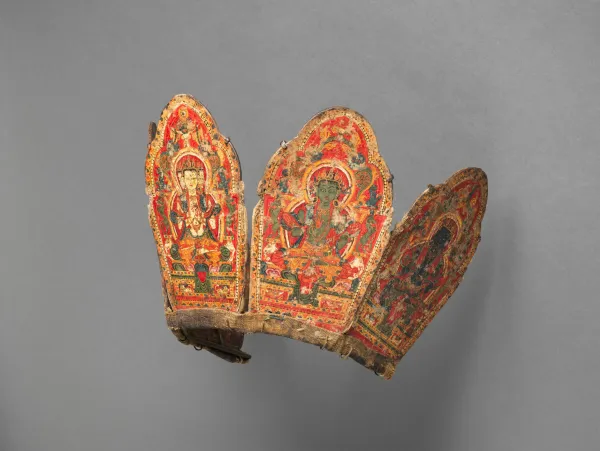
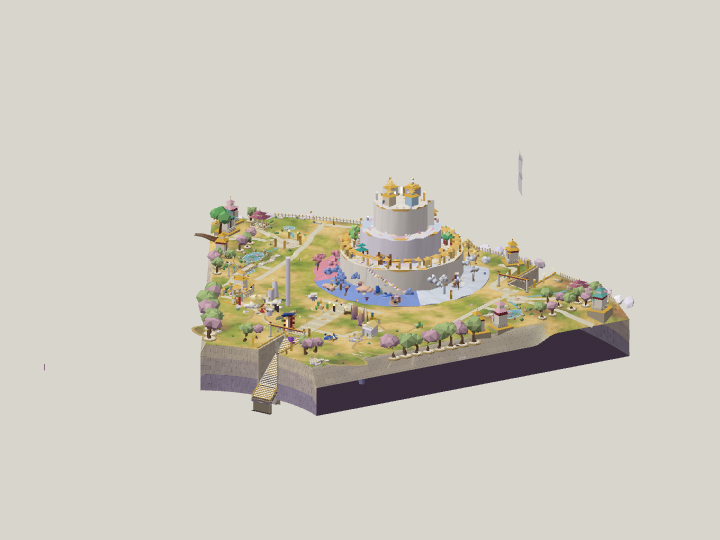
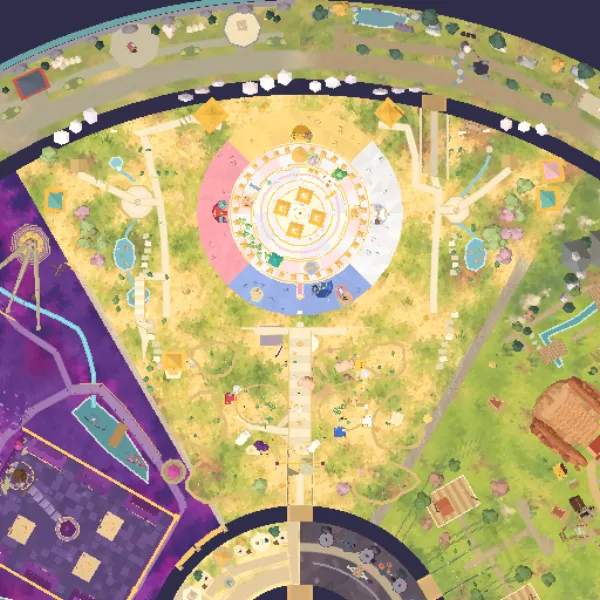
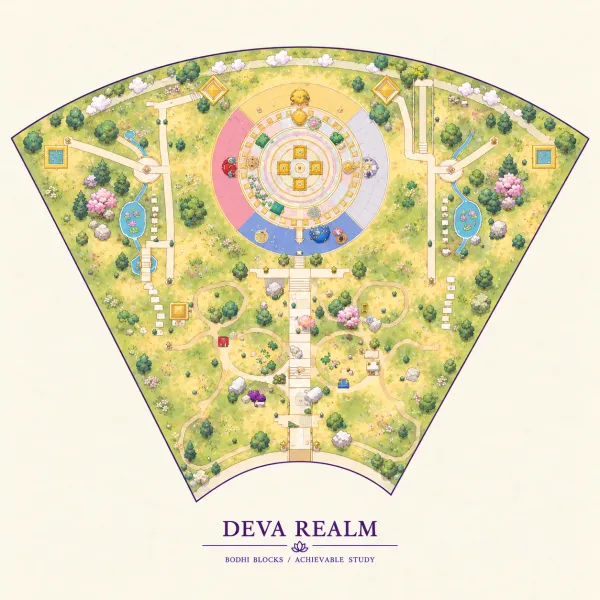
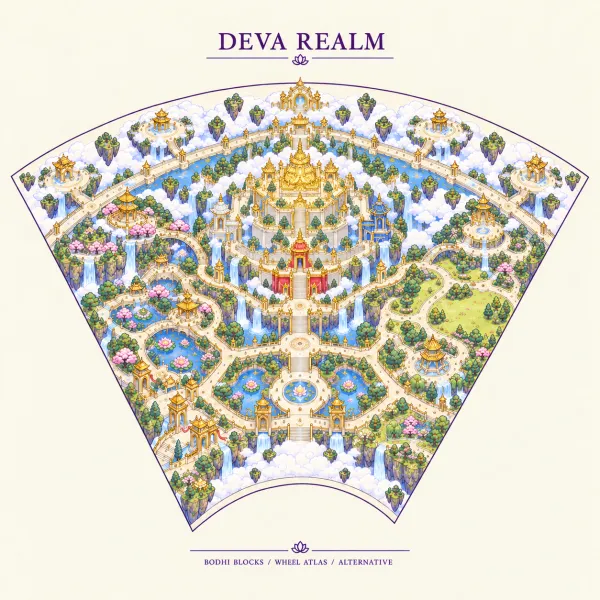
What canon says about each realm of the Wheel and the lands beside it: Jambudvīpa and the four continents, the animal realm, the hidden lands, the heavens on and above Meru, the asuras, the hungry ghosts, the hells, the hub and rim of the Wheel, the dark and the bardo, the charnel grounds, Tanaduk and the pure lands. Each topic carries every piece of art that shows it and a zoomed crop where the art shows it only in part. Gathered 2026-10-30 for the overworld layout studies: lore first, then layout. The checklist follows at What the game has.
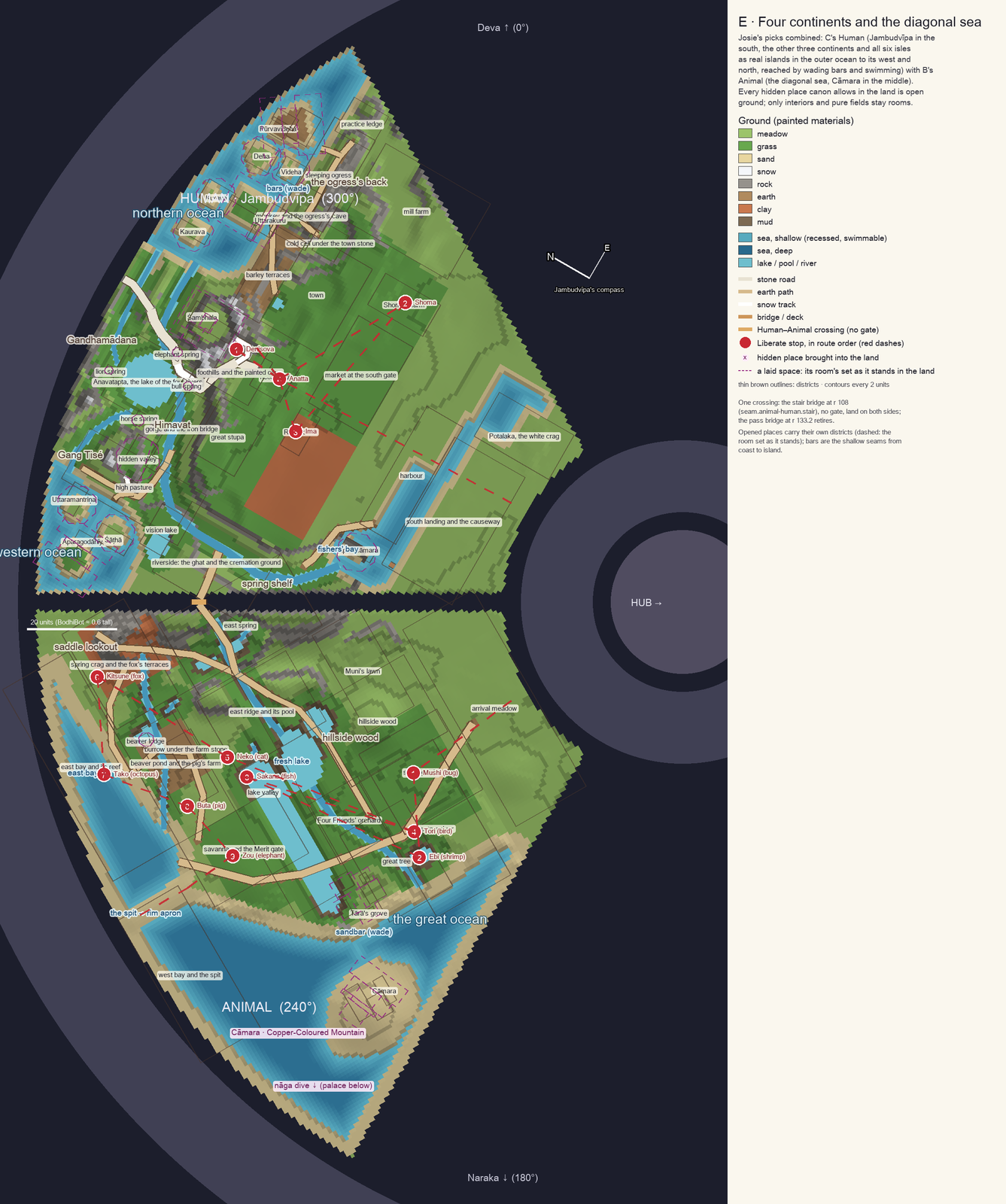
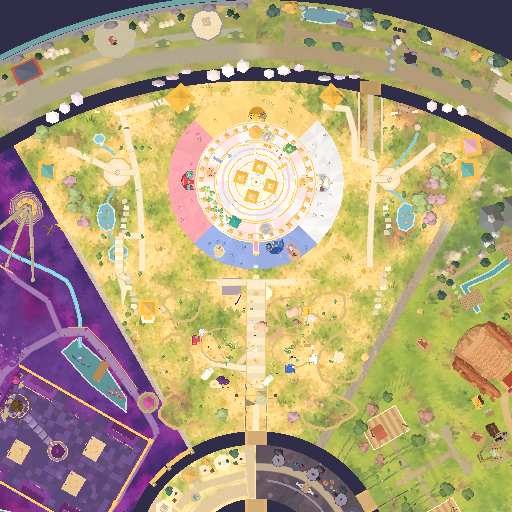
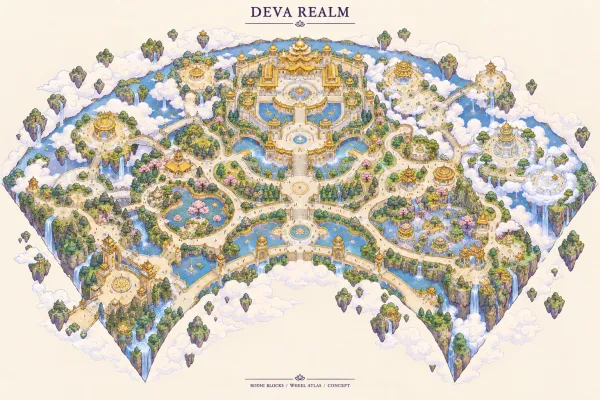
Chosen layout: Layout E
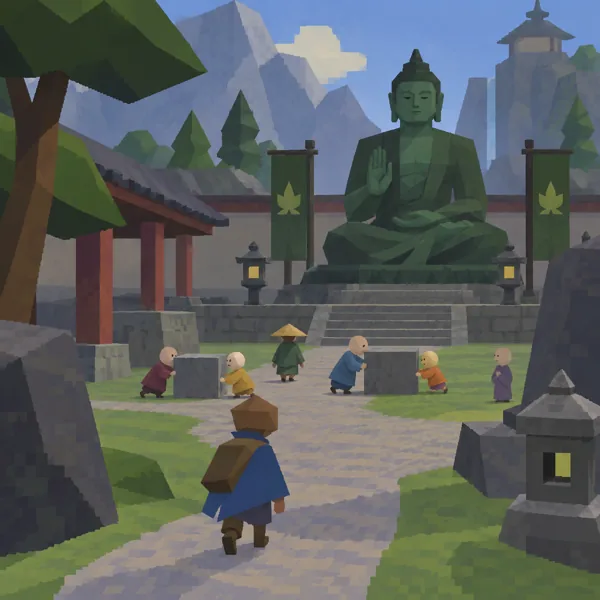
Layout E is in the game: its landforms, waters, paths and paint in Human and Animal, the district moves and the hidden places opened as land. It is being finished in the world editor now; the handoff lists what still needs the editor and the code.
Jambudvīpa, the southern continent, and the human condition
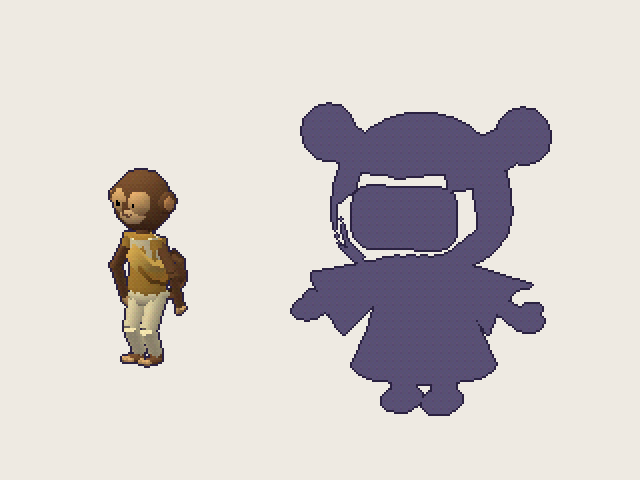
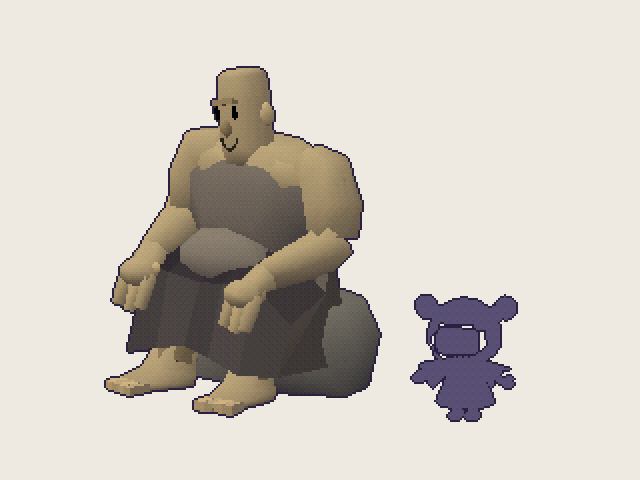
Jambudvīpa is our own continent, the cart-shaped land south of Meru where karma is made and buddhas awaken. This group gathers what canon fixes about its shape, its sacred road north to Lake Anavatapta, the Tibetan landscape read as an ogress and a monkey's family, the places of Milarepa, Thangtong Gyalpo and Vimalakīrti, and the human facts of birth, ageing, sickness and death. It is the ground the Human realm's overworld stands on.
Jambudvīpa, the southern continent
Skt. Jambudvīpa; Tib. 'dzam bu gling (Dzambuling), 'Land of Jambu'; also lho 'dzam bu'i gling
Our own continent: the cart-shaped land south of Meru, the one place where beings make new karma and where buddhas appear.
Jambudvīpa is the southern of the four great continents in the salt ocean around Mount Meru. It is shaped like a cart: three long sides of two thousand leagues and one short side of only three and a half, narrow toward the outer iron rim. Its people's faces are said to share its shape.
Two small companion islands sit at its sides: Cāmara (Tail-Fan) and Aparacāmara (Other Tail-Fan). One of them belongs to cannibal rākṣasas; every other island holds humans like those of its main continent.
People here are about three and a half or four cubits tall, far smaller than on the other continents. Their lifespans, wealth and size are never fixed. Over the ages life shrinks to ten years, with famine, plague and war at each low point, and then grows again to eighty thousand.
That restlessness is its gift. The other three continents only live out old karma; Jambudvīpa is the land of action, where a deed weighs most, where people are saddened by talk of impermanence and so are easy to guide, and where buddhas show awakening. The Great Mindfulness Scripture calls it the place of pure conduct, of awareness of birth and death, and of the indestructible seat of enlightenment.
What canon fixes for the map
South of Meru, in the outer salt ocean between the seven golden ranges and the iron rim [K p.23; AK printed p.455].
Shape: a cart or chariot, three sides of 2,000 leagues, one side of 3.5 leagues facing the iron rim; circumference 6,003.5 leagues [AK printed p.455; P printed p.14].
Kongtrul calls the shape trapezoidal; the faces of its people match the shape [K p.23; AK printed p.455].
Two satellite islands of the same shape: Cāmara and Aparacāmara (P puts Cāmara east, Aparacāmara west) [P printed p.14; K p.23].
Height of people: 3.5 to 4 cubits; the other continents' people are 8, 16 and 32 cubits [AK printed p.469 (vv.75–77); K p.48].
Lifespan unfixed: from immeasurable down to ten years and back to 80,000, eighteen intermediate cycles, famine, plague and war at the lows [K pp.49–50].
The only 'land of action' among the four continents; buddhas appear here [K pp.50–51].
Phagpa adds: sixteen great countries, about a thousand small ones, 360 peoples and 720 languages [P printed p.15].
Directly below lie Avīci and the hot hells, and the pretas' principal abode [AK printed p.456; K pp.27–29].
Who lives here
Humans of Jambudvīpa, small-bodied and short-lived, the beings best placed to practise.
Rākṣasas (cannibal demons) of Cāmara island, the only non-human island.
Wheel-monarchs (cakravartin), who in good ages rule most of the Land of Jambu [K p.56].
In the game now
place:jambudvipa (built: the Human section, 'the southern continent (trapezoidal)'); companions place:copper-mountain (Cāmara, built) and place:isle-aparacamara (built). The rebirth sign place:rebirth-guidance:sign-jambudvipa is missing.
Rōkashi Hōtan (Sōshun), Library of Congress · map-study · Public domain
A Japanese Buddhist world map of Jambudvīpa: India at the centre, Anavatapta above it, China and Japan to the east. East Asian, not Tibetan, but the same continent.
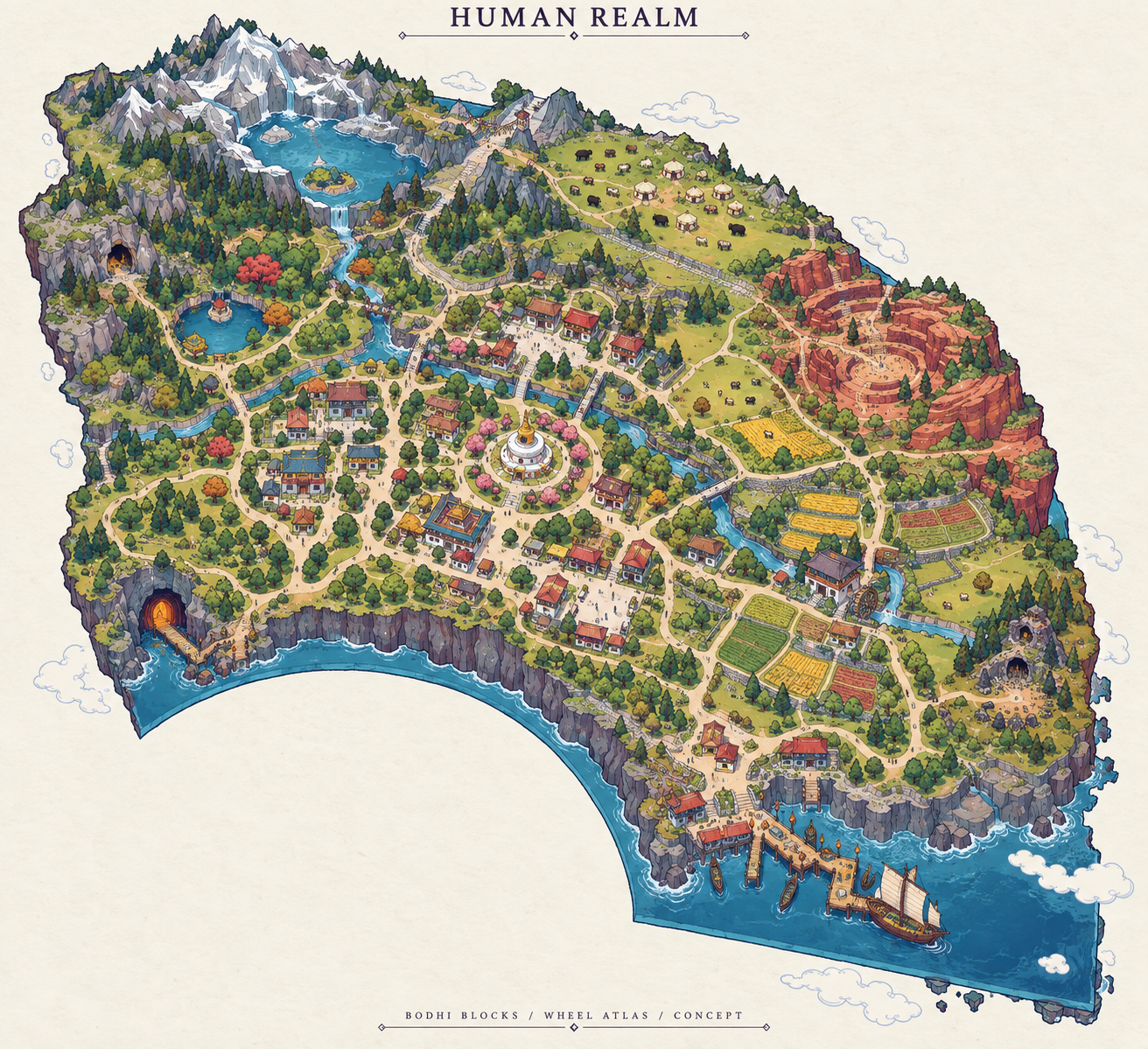
the whole Human wedge
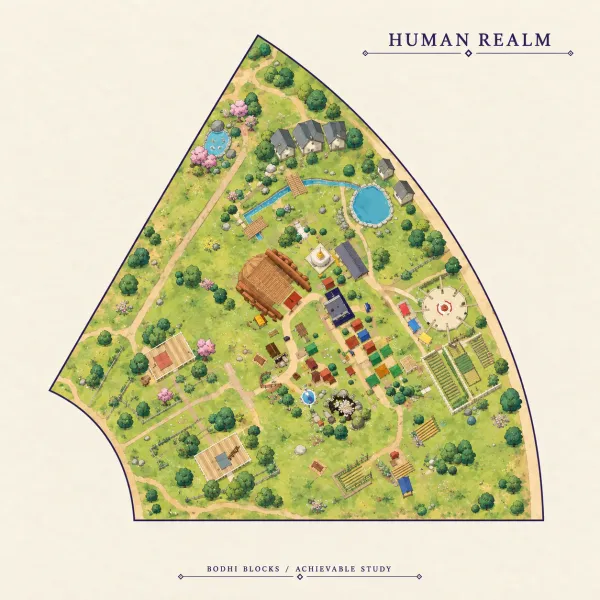
Human realm concept
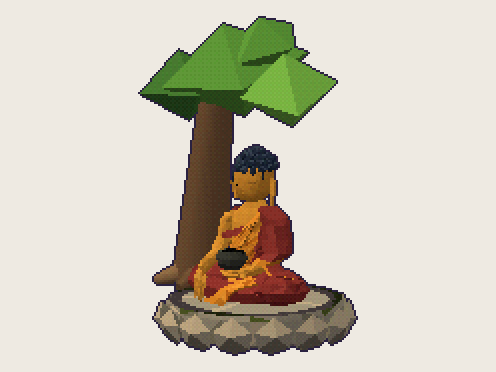
AI concept study (repo) · concept · Project art
The game's painted plan of the Human wedge: village, fields, harbour and coast.
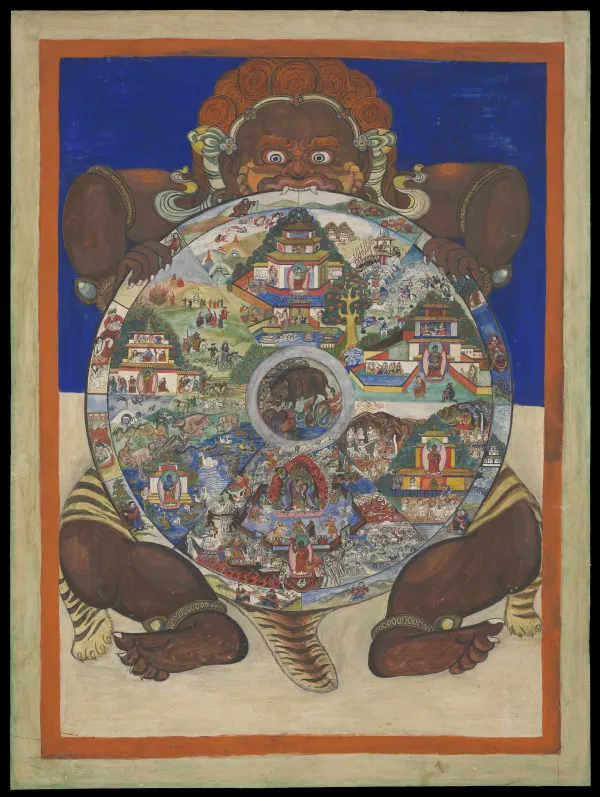
Rubin Museum of Art (Sikkim) · traditional · No open licence
Look at the human realm sector of the wheel, beside the god realm at the top.
Still missing: No Tibetan cosmology painting that shows the cart-shaped continent beside Meru with an open licence was found; HAR and Rubin cosmology sets would supply link-only cards.
The great fruit tree on Anavatapta's shore that gives the continent its name; its fallen fruit becomes river gold.
On the shore of Lake Anavatapta stands a single fruit tree called the jambu. Its sweet fruit is as big as a clay pot. When a ripe fruit falls into the water it makes the sound 'jambu', and so the tree, and then the whole continent, takes that name.
The nāga kings turn themselves into fish and swallow the fallen fruit. What they leave is carried off by the current and becomes the gold of the Jambu river, the finest gold there is.
Ordinary people do not see it. The lake can be reached only by those with magical powers, and a legend Kongtrul's translators record says there is only one jambu tree, visible only to the awakened.
What canon fixes for the map
Stands on the shore of Anavatapta, north of the Himavat [K pp.24–25; P printed p.15; AK printed p.456].
One tree; fruit the size of a clay pot or jar [K p.25; P printed p.15].
Fallen fruit eaten by nāgas in fish form; the rest becomes Jambu-river gold carried by the current [K p.26; P printed p.15].
Only those with magical powers can reach the lake [AK printed p.456].
Translator's note (not Kongtrul): some take it for the rose-apple, Eugenia jambolana; legend says it is unseen by ordinary people [K note 16, p.177].
Who lives here
The nāga kings of the lake, who eat the fruit in the form of fish.
In the game now
Part of place:anavatapta (built): the ledger's destination notes give a jambu-tree vista and a golden bank on the Gaṅgā side.
Art (1)
Anavatapta, the spiral lake, whose shore the tree stands on
The diamond throne at the centre of Jambudvīpa, resting on the golden earth, the only place a bodhisattva can awaken.
At the centre of Jambudvīpa, resting on the golden sphere beneath the world, is the diamond throne. Here the bodhisattva sits to enter the vajra-like concentration and become a buddha. No other place and no other person can bear that concentration.
Phagpa puts the centre of the continent in the land of Magadha, the place where the buddhas of the three times appear. Kongtrul, quoting the Great Mindfulness Scripture, names Jambudvīpa as the place that holds the indestructible seat of enlightenment.
In the Wheel of Time account, Magadha is the first of the six cities of the Exalted Land, and the seat of enlightenment lies within it.
What canon fixes for the map
At the centre of Jambudvīpa, resting on the sphere of gold [AK printed p.455].
The centre of Jambudvīpa is Magadha, where the buddhas of the three times appear [P printed p.14].
Kongtrul's 'centre of the Exalted Land' is glossed as Bodhgayā; the northward route to Anavatapta starts here [K pp.24–25 and note 10, p.176].
Wheel of Time: the seat is in Magadha, first of six cities of India in the south of the Small Land of Jambu [K p.78].
Copper Mountain prayers fix directions from it: Cāmara lies north-west of the Vajra Seat [repo source notes, docs/purelands-lore-source-notes.md].
Who lives here
Śākyamuni, and every buddha of this eon, who awakens here.
In the game now
No Vajra Seat place yet. being:shakyamuni (built) sits in the lha-khang's teaching precinct (place:lhakhang, built).
Christopher J. Fynn, from Cunningham's Mahâbodhi (1892) · photo · CC BY-SA 4.0
Old survey photographs of the polished stone seat with its carved side panels.
the figure
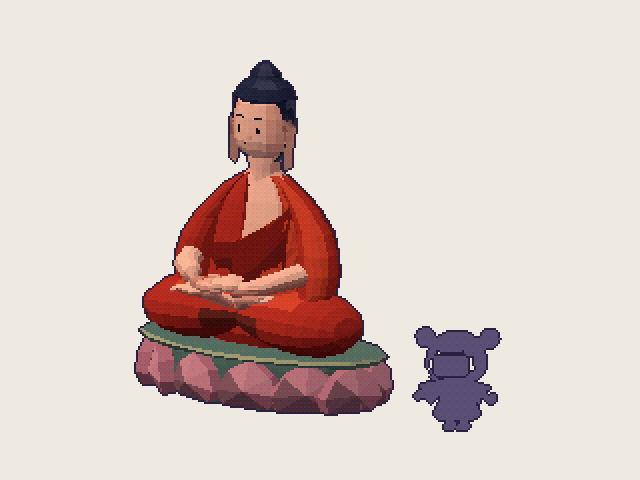
Śākyamuni
AI concept study (repo) · concept · Project art
The game's Śākyamuni, the one who sat on this seat.
Still missing: No traditional painting of the awakening at the Vajra Seat with an open licence was checked; a Tibetan life-of-the-Buddha thangka would add a link card.
The road north: nine dark ranges, the Snowy Mountains and the Fragrant Mountain
Nine black mountains (Tib. ri nag dgu) / nine ant-mountains (Skt. kīṭādri); Himavat (Tib. gangs can); Gandhamādana (Tib. spos ngad ldan)
Going north from the heart of India, you cross nine dark ranges, then the snow peaks, and find the lake before the Fragrant Mountain.
From the centre of India, the land rises northward in a fixed order. First come nine dark mountain ranges. Beyond them stand the Snowy Mountains, the Himavat. Beyond those, before the Fragrant Mountain, Gandhamādana, lies Lake Anavatapta.
Vasubandhu's commentary calls the nine ranges 'ant-mountains', in three sets of three, named for their shape. Tibetan accounts call them simply the nine black mountains.
Phagpa continues past the lake. Twenty leagues north of Gandhamādana is the Golden Cliff, fifty leagues a side, with eight thousand smaller cliffs. Twenty leagues further is the king of sāla trees, Supratiṣṭhita, ringed by seven rows of trees, and twenty leagues east of that is the round Lake Mandākinī full of lotuses with leaves like ox-hide and flowers like cartwheels. Śakra's battle elephant, also called Supratiṣṭhita, spends winter at the cliff, the hot season at the tree and the rains at the lake, with eight thousand elephants.
What canon fixes for the map
Order from south to north: centre of India, nine dark ranges, Himavat, Anavatapta, Gandhamādana [K pp.24–25; P printed p.14; AK printed p.456].
AK: three ant-shaped ranges, three more, three more, then Himavat (= the Himalayas) [AK printed p.456].
Himavat is 'said to possess auspiciousness (śrīmat)' [P printed p.14].
North of Gandhamādana, 20 leagues each step: the Golden Prāgbhāra Cliff (square, 50 leagues a side, 3.5 high); the sāla king Supratiṣṭhita (roots 40 arcs deep, 80 arcs high, seven rows of trees); then 20 leagues east, round Lake Mandākinī (50 leagues wide) [P printed pp.14–15].
The elephant king Supratiṣṭhita moves by season: winter at the cliff, hot season at the tree, rains at Mandākinī [P printed p.15].
Who lives here
Supratiṣṭhita, the elephant king Śakra rides into battle, with eight thousand elephants [P printed p.15].
In the game now
place:anavatapta (built) shows three white Himavat peaks to the south and three green Gandhamādana peaks to the north as silhouettes. The nine ranges, the Golden Cliff, the sāla king and Lake Mandākinī are not built.
A Himalayan snow peak, for the look of the Himavat; not itself named in this sequence.
Still missing: No traditional image of the nine dark ranges, the Golden Cliff, the sāla king or Lake Mandākinī was found. Concept art is needed for all four.
Skt. Anavatapta ('Unheated', 'Cool'); Tib. ma dros pa (Madröpa), mtsho ma dros pa
The square, cool lake between the Snowy and Fragrant mountains, source of the four great rivers that pour from an elephant, a bull, a horse and a lion.
Between the Himavat and Gandhamādana lies Anavatapta, the source of all rivers, forests, jewels and medicines. It is fifty leagues wide and fifty deep, square, two hundred leagues round, and full of water with the eight good qualities: cool, clear, light, sweet, soft, fragrant, and harmless to throat and stomach.
Its name has two explanations. Phagpa says a great nāga king called Anavatapta lives in it and gives it his name. Kongtrul tells an older story: a brahmin seer had a wheel-monarch cook rice offerings for twelve years, and the warm rice-water poured into a pit cooled there and became the lake.
From each side a river falls from a cliff shaped like an animal's head. East, from the elephant, flows the Gaṅgā with silver sand. South, from the bull, the Sindhu with blue beryl sand. West, from the horse, the Vakṣu with crystal sand. North, from the lion, the Sītā with gold sand.
Each river gathers five hundred tributaries and circles the lake seven times clockwise before it runs to the ocean in its own direction. The jambu tree stands on the shore. At the end of the eon, when the fourth sun rises, even Anavatapta dries up.
What canon fixes for the map
Between Himavat (south) and Gandhamādana (north), beyond nine dark ranges north of central India [K pp.24–25; P printed p.14; AK printed p.456].
Square, 50 leagues a side, 200 round (P); 50 leagues wide and deep (K, AK) [P printed p.14; K p.25; AK printed p.456].
East: elephant-head cliff, Gaṅgā, silver sand, to the eastern ocean [K p.25; P printed p.14].
South: bull-head cliff, Sindhu, blue beryl sand, to the southern ocean [K p.25; P printed p.14].
West: horse-head cliff, Vakṣu (Oxus), crystal sand, to the western ocean [K p.25; P printed p.14].
North: lion-head cliff, Sītā, gold sand, to the northern ocean [K p.25; P printed p.14].
Each river has 500 tributaries and circles the lake seven times clockwise before leaving [K p.25; P printed p.14].
Translator's identification of the rivers: Ganges, Indus, Oxus and Tarim [K note 15, p.177].
Reachable only by those with magical powers [AK printed p.456].
Dries up when the fourth of the seven suns of the eon's end appears [P printed p.40 (PDF p.53)].
Who lives here
Anavatapta, the great nāga king who lives in the lake [P printed p.14; 84000 Toh 156].
The nāga kings who eat the jambu fruit in the form of fish [K p.26; P printed p.15].
In the game now
place:anavatapta (built), with place:spring-elephant, place:spring-ox, place:spring-horse and place:spring-lion (all built). The ledger notes Himavat and Gandhamādana silhouettes, a jambu-tree vista and a golden bank on the Gaṅgā. Game adaptation: the four springs elsewhere in the world link back as symbolic approaches, not literal headwaters; nobody lives at the lake.
Art (6)
Anavatapta, the spiral lake with its outflowing rivers
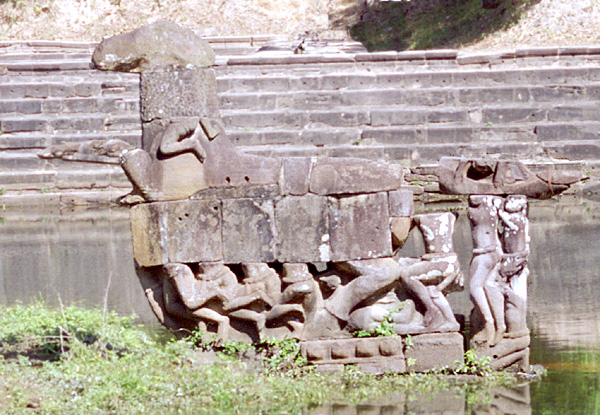
A Khmer temple pool built as Anavatapta, with animal-head spouts; a Southeast Asian reading, cited in the repo for Balāha.
Still missing: No Tibetan painting of the lake with its four animal-mouth cliffs was found with an open licence. A concept of the whole square lake with its four cliffs and seven clockwise river circuits is still needed.
Repo research note: public/purelands/wheel-geography-research.md (direct PDF checks of K, P, AK), 'Anavatapta: verified K and P agree here'
Gang Tisé (Kailash), the snow mountain of Cakrasaṃvara
Tib. gangs ti se (Gang Tisé), gangs rin po che; Skt. Kailāsa; Chang spells it 'Di Se'
The great snow peak of western Tibet, palace of Cakrasaṃvara, where Milarepa won the mountain from the Bön priest Naro Bönchung.
Marpa sends Milarepa to meditate at Gang Tisé, 'the site Himālaya prophesied by the Buddha and the palace of Cakrasaṃvara'. In Milarepa's songs it is 'the king of all snow mountains on this earth', where worldly gods with coarse bodies live, and its snow stands for the pure white teaching.
When Milarepa arrives from Bu Shen, the local gods of Tisé and Ma Pam come out to welcome him and show him the meditation caves. At the lake shore the Bön priest Naro Bönchung challenges him for the mountain.
They contest again and again. They circle the mountain in opposite directions, Bön counter-clockwise and Milarepa clockwise, and wrestle on a rock in the north-east valley, leaving footprints. Milarepa sits in the Lotus Cave on the west side of 'Castle Valley' and stretches his leg across it. Finally they race for the summit at dawn on the fifteenth: Naro flies up on his drum, but Milarepa rides the first sunlight and arrives in an instant. Naro's drum rolls down the southern slope.
The summit, Milarepa says, is the vajra garden where Cakrasaṃvara dwells. He grants Naro a nearby mountain from which he can still see Tisé. In the Praise to the Sixteen Arhats, the elder Aṅgaja also lives 'on the great snow mountain of Kailash' with 1,300 arhats.
What canon fixes for the map
Named by Marpa among Milarepa's retreats; prophesied by the Buddha as 'Himālaya'; palace of Cakrasaṃvara [LM ch.8 p.112; ch.11 p.164].
Lake Ma Pam lies at its foot; the two are approached together [HTS story 22, p.215].
Footprint rock in the north-east valley; Lotus Cave on the west side of Castle Valley; drum fell down the south slope [HTS pp.218–221].
Summit is Cakrasaṃvara's vajra garden, closed to the unworthy [HTS p.221].
A mountain opposite, granted to Naro, from which the Bönpo see Tisé [HTS p.223].
Abode of the elder Aṅgaja and 1,300 arhats [HAP verse 1].
Do not merge with Meru or with Gandhamādana: no source here equates them.
Who lives here
Milarepa, who wins the mountain [HTS story 22].
Naro Bönchung (Chang: Naro Bhun Chon), the Bön priest, with his brothers and sisters [HTS p.215].
The local gods of Tisé and Ma Pam, who welcome Milarepa and swear to protect his followers [HTS p.215].
Cakrasaṃvara (Korlo Dompa / Dem Chog) and his retinue at the summit [HTS p.221].
Rechungpa, who wakes Milarepa on the morning of the race [HTS p.221].
The elder Aṅgaja and his 1,300 arhats [HAP].
In the game now
place:milarepa:sites-foretold (missing) lists Gang Tisé. being:elder-01 Aṅgaja is a sketch in the shared arhats rig, tagged 'Kailash'. No mountain is built.
Art (4)
the summit, Cakrasaṃvara's vajra garden in the songs
Honolulu Museum of Art 12290.8 (Japan) · traditional · CC0
Aṅgaja, the elder whose abode is Kailash, in a Japanese rakan painting; the mountain itself is not shown.
Milarepa at his cave
Milarepa
AI concept study (repo) · concept · Project art
The game's Milarepa on his ledge.
Still missing: No traditional Kailash pilgrimage painting or painting of the summit race with an open licence was found. HAR holds Kailash-circuit paintings that would add link cards; a concept of the race at dawn is needed.
Tib. mtsho ma pham (Ma Pam / Mapham Yutso); Skt. Mānasarovara
The blue lake below Gang Tisé, home of its own local gods, where Milarepa covered the whole lake with his body without growing.
Lake Ma Pam lies at the foot of Tisé. Its local gods come out with Tisé's to welcome Milarepa. The Bön priest straddles the lake to show his power.
Milarepa then sits above the lake and, without his body growing or the lake shrinking, covers it all. Next he balances the whole lake on his fingertip without harming a single creature in it. He sings that the streams flowing into the 'famous Blue Lake of Ma Pam' stand for deliverance into the absolute.
Tibetan tradition reads this lake and Anavatapta separately in the texts used here. Kongtrul's text never names Ma Pam. Only his modern translators add a note that Anavatapta is 'presumably' Lake Manasarovar.
What canon fixes for the map
At the foot of Tisé, on the way from Bu Shen [HTS p.215].
Has its own local deities, distinct from Anavatapta's nāga king [HTS p.215].
Has living beings in its water [HTS p.218].
Streams flow into it; it is called the Blue Lake [HTS p.217].
Conflict: the identification of Anavatapta with Manasarovar comes only from a translator's note ('presumably') [K note 13, p.177]. Canon gives Anavatapta a square shape, four animal-mouth rivers and an unreachable site; keep the two as separate places.
Who lives here
The local gods of Ma Pam [HTS p.215].
Naro Bönchung, who first meets Milarepa on its banks [HTS p.215].
Tib. srin mo gan rkyal (the supine rākṣasī); mtha' 'dul (border-taming), yang 'dul (further-taming), ru gnon (horn-suppressing) temples; Ra sa 'Phrul snang (Jokhang)
The Chinese princess divines that the whole Snow Land is an ogress lying on her back; twelve temples are pinned into her limbs, and the Jokhang sits on her heart.
Princess Kongjo lays out her divination chart and reckons that the Snow-clad Kingdom has the shape of a rākṣasī-demoness lying on her back. The Milk Plain lake (O-thang) in Lhasa is her heart-blood, and three hills around it are her heart-bones.
So the lake must be filled in, carried earth loaded on white goats, and the temple raised on top. A door to the lower realms lies there too, and the black nāgas sleep below Ramoche. In the sky the princess sees the eight-spoked wheel, on the earth the eight-petalled lotus, and on the mountain sides the eight auspicious signs.
Twelve unmoving bolts pin her down, in three rings. The first four pin her shoulders and hips: Katsel (right shoulder), Tradruk (left shoulder), Tsangdram (right hip) and Drompa Gyang (left hip). The next four pin elbows and knees: Buchu in Kongpo, Khomting in Lhodrak, Jamtrin in the west and Pradun in the north. The last four pin palms and soles, far out at the borders: Longtang Drönma in Kham, Bumtang Kyerchu in Bhutan, a temple in Kashmir and one in the north.
The great temple of Lhasa, the Rasa Trulnang (Jokhang), stands on her heart.
What canon fixes for the map
The whole of Tibet is her body, lying on her back [GLR ch.XIII p.253].
Her heart is the O-thang lake in Lhasa, filled in for the Jokhang; three hills round it are her heart-bones [GLR pp.253–254].
Nāga palace beneath Ramoche; a door to the lower realms at the site [GLR p.254].
Twelve temples in three concentric sets of four [GLR pp.261–262; ch.XIV pp.275–279].
Shoulders and hips: Katsel right shoulder, Tradruk left shoulder, Tsangdram right hip, Drompa Gyang left hip [GLR pp.275–276].
Elbows and knees: Buchu (Kongpo, east, on the tiger's head) right elbow; Khomting (Lhodrak, south, on the dragon's crest) left elbow; Jamtrin (west, on the red rooster) right knee; Pradun (north, on the tortoise's forehead) left knee [GLR pp.276–278].
Palms and soles: Longtang Drönma (Kham) right palm; Bumtang Kyerchu left palm; Tsalrig Sherab Drönma in Kashmir (west) right foot; Tsangpa Lungnön (north) left foot [GLR pp.278–279].
Conflict: Sørensen notes that the Clear Mirror confuses the border-taming and horn-suppressing sets; other witnesses order them differently [GLR notes 770–771, p.261].
The supine rock-rākṣasī, the land itself (not a roaming monster).
Princess Kongjo (Wencheng), who divines the landscape [GLR ch.XIII].
King Songtsen Gampo, who builds the temples [GLR ch.XIV].
The black klu-bdud nāgas sleeping beneath Ramoche [GLR p.254].
The theu-rang and mi-ma-yin spirits who gather at a poison tree in south-west Lhasa [GLR p.254].
In the game now
human.ogress-ridge (from the retired ogress-ridge place): a ridge that reads as a sleeper from its viewpoint shelf, with three pinning temples and a stupa above her heart (ledger topic ogress-geography, partial). The full twelve-temple scheme is not built.
Wikimedia Commons, CC BY-SA 4.0 (repo copy) · traditional · CC BY-SA 4.0
Not the supine demoness: this is the separate rock ogress of the ancestor story. Kept here only to warn against merging the two.
Still missing: No openly licensed painting of the supine demoness was found; only the HAR link card. A concept of the land seen as her body, with the twelve temples, is needed.
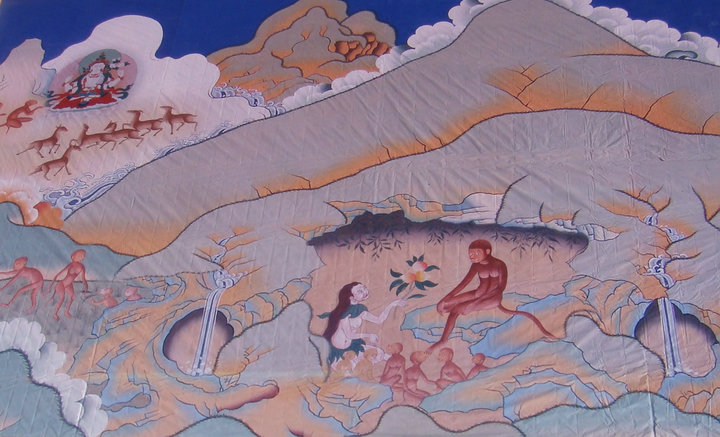
The monkey bodhisattva and the rock ogress of Tsethang
Tib. sprel byang chub sems dpa' (the bodhisattva ape), brag srin mo (the rock ogress); Zo-thang Gong-po-ri; rTse-thang (Tsethang); Nags ma Bya tshogs
Tibet's first people: the ape Avalokiteśvara sent to meditate, the rock ogress who begged to marry him, their six children and the plain where grain grew unploughed.
Avalokiteśvara gives an ape who can work miracles the vows of a lay devotee and sends him to the Snow-clad Realm to meditate. He sits on a black rock, meditating on compassion and emptiness. A rock ogress, tormented by her karma, comes to him again and again, at last in a woman's form, and pleads to be his wife. Unless he agrees, she says, she will marry an ogre and fill the land with ogre children.
The ape asks Avalokiteśvara, who tells him to marry her; the goddesses Bhṛkuṭī and Tārā cry from the sky, 'This is truly excellent!' Six children are born, one come from each realm of rebirth: dark-faced and tough from hell, ugly and always hungry from the pretas, dull and cruel-looking from the animals, clever but timid from the humans, jealous from the asuras, patient and virtuous from the gods.
The ape leaves them in a forest full of fruit trees, the Bird Colony. In three years they become five hundred, the fruit runs out, and they cry, 'Father, what shall we eat?' Avalokiteśvara takes barley, wheat, peas, buckwheat and grain from the hollow of Mount Meru and scatters it. The country fills with crops that need no ploughing. The ape leads them there and says 'Now eat!' (zo dang): so the place is called Zo-thang Gong-po-ri.
As they eat, their tails and body hair shorten and they become human. In time the forests cover the mountains, the flooded valleys drain into the Kongpo river, fields and towns appear, and the first king, Nyatri Tsenpo, arrives.
What canon fixes for the map
The ape meditates on a black rock in the Snow-clad Realm [GLR ch.VII p.127].
The Bird Colony forest: other versions name it in Tsethang of Yarlung, 'playground of the monkeys', near the bank of the Tsangpo [GLR n.342].
Zo-thang Gong-po-ri, the plain of unploughed grain, is in Yarlung (Yarlung Zo-thang) [GLR pp.131–132, n.349].
Seed comes from the hollow of Meru: barley, wheat, peas, buckwheat, unhusked grain [GLR p.131].
Mountains forested and valleys flooded until the water drains into the Kongpo river; then fields and towns [GLR pp.132–133, n.352].
Two lineages descend: the father's (gentle, devout) and the mother's (fierce, trading, quick) [GLR p.132].
Variant: Sørensen notes later sources make the ape an emanation of Avalokiteśvara and the ogress of Tārā; the Clear Mirror itself makes him Avalokiteśvara's lay devotee [GLR n.329].
Keep separate from the supine demoness of the twelve temples [ledger topic ogress-geography].
Who lives here
The bodhisattva ape, father of the Tibetans.
The rock ogress (brag srin mo), mother of the Tibetans.
Jomo Bhṛkuṭī and Jomo Tārā, voices from the sky.
The six children, one from each realm.
The five hundred ape-children who become human.
Avalokiteśvara (Ārya), who guides the ape.
In the game now
human.monkey-cave (from the retired monkey-cave place): being:monkey-ancestors:ape, being:monkey-ancestors:rock-ogress and the six children (all built), place:monkey-ancestors:black-rock (built). Missing: place:monkey-ancestors:bird-colony, place:monkey-ancestors:zothang-gongpori, place:monkey-ancestors:drained-valleys, being:monkey-ancestors:five-hundred, being:monkey-ancestors:two-lineages; being:monkey-ancestors:two-jomos is a sketch.
Tib. lha mo bla mtsho (Lhamoi Latso), the 'life-lake of the goddess' (Palden Lhamo)
The sacred lake in southern Tibet where the Regent saw letters, a monastery and a house that led the search to the Fourteenth Dalai Lama.
Lhamo Latso is a sacred lake in southern Tibet. After the Thirteenth Dalai Lama died, his embalmed head turned toward the north-east. The Regent went to the lake and looked into its waters.
There he saw three Tibetan letters float into view: Ah, Ka and Ma. Then a three-storeyed monastery with a turquoise and gold roof and a path running from it to a hill. Last, a small house with strangely shaped guttering.
Ah was read as Amdo, and the search party went there. Ka was taken for Kumbum monastery. The house led them to the child.
What canon fixes for the map
In southern Tibet [DL].
Visions appear on the water's surface: letters, a monastery roof, a house [DL].
Name ties it to the goddess Palden Lhamo (ledger); her direct presence at the lake is not in the cited source [ledger topic vision-lake].
Game adaptation: the game's lake shows pictures of places, reached from the Human riverside; that picture-only use is the plan's own [ledger topic vision-lake].
Who lives here
Palden Lhamo, the goddess of the lake (name only in the sources used).
The Regent (Reting Rinpoche), who saw the vision.
In the game now
human.vision-lake (from the retired vision-lake place): the lake, seat stone, two standing stones and flags, a butter lamp and a crane on the Human riverside (ledger vision-lake, partial). being:vision-lake:palden-lhamo is missing.
Art (0)
Still missing: No openly licensed photo or painting of Lhamo Latso was found on Wikimedia Commons in this pass; no HAR item was verified. A concept of the lake with images on its surface is needed.
Repo ledger: docs/purelands-cosmology.json and docs/purelands-lore-populations.json, docs/purelands-cosmology.json topic vision-lake
Milarepa's caves and fortresses
Tib. mi la ras pa; Drakar Taso (brag dkar rta so), La phyi (Lapchi, Skt. Godāvarī), Chu dbar (Chubar), the twenty fortresses (rdzong) and eight caves
The string of cliff caves on the Tibet–Nepal border where the cotton-clad yogin starved on nettles, learned inner heat and sang to hunters, demons and his sister.
At Drakar Taso, 'a most pleasant cave', Milarepa lays a small hard mat and vows never to go down to the village even if he dies of hunger, cold or sickness. In front of the white rock is a spot with warm sun, good water and many nettles. He lives on nettles alone until his body turns green with soft green hair. Hunters take him for a ghost; his sister Peta finds him so wasted she thinks the same.
Marpa named his main retreats: Lapchi Gangra, which is Godāvarī, one of the twenty-four sacred lands, and Chubar of Drin, the dwelling of the ḍākinīs who guard that region. At Lapchi he binds the great god Gaṇapati under oath and sings the Great Song of the Snow Ranges. At Chubar he teaches the cycles on Tseringma, and at Driché Puk he shows illness and dies.
Asked to name his retreats, he lists six well-known outer fortresses (Drakar Taso Üma, Minkyük Dripma, Lingwa Drakmar, Ragma Changchup, Kyangpen Namkha and Drakya Dorjé), six unknown inner ones, and more. At Minkyük Dripma he learns to fly. At Kyangpen Namkha Dzong he sings of a place among wildlife, rivers and rocks.
Marpa also foretold mountains further off: Gyalgi Śrī in Latö, Gang Tisé, Riwo Pelbar of Mangyul and Yolmo Gangra in Nepal.
What canon fixes for the map
Drakar Taso: cave in a white rock, sunny spot with water and nettles in front; he slips at the cave mouth when leaving [LM ch.10 pp.133, 135, 146–147].
Lapchi Gangra = Godāvarī, one of the twenty-four lands; Gaṇapati bound there; an interior sanctuary [LM ch.8 p.112; ch.11 pp.162–164].
Chubar of Drin with Driché Puk, where he dies [LM ch.12 pp.185, 188–189].
Kyipuk Nyima Dzong in Drin, on the way to Lapchi [LM ch.10 pp.150–151].
Six outer and six inner fortresses, plus caves (twenty fortresses and eight caves in all) [LM ch.11 pp.162–163].
Drakmar Chonglung: Vināyaka bound; Lingwa Drak: a demoness taught [LM ch.11 pp.163–164].
Longda, where a ploughman and son see him flying overhead [LM ch.10 pp.145–146].
Who lives here
Milarepa (Mila Töpaga), the cotton-clad yogin.
Peta Gönkyi, his sister; Dzesé, his childhood betrothed.
Marpa and Dakmema, his lama and the lama's wife (in Lhodrak, not at the caves).
Rechungpa and Gampopa, his heart-sons.
Tseringma, his non-human disciple; Gaṇapati (Lapchi); Vināyaka (Drakmar Chonglung); the demoness of Lingwa Drak.
Three bands of hunters at Drakar Taso; the huntsman Chirawa Gönpo Dorje with the deer and hound [SSM no.14].
The ploughman and his son at Longda.
In the game now
being:milarepa:jetsun (built); human.milarepa-ledge with nettle pot and the yak horn room (place:milarepa:yak-horn, built); place:beyul:kyangpen-namkha-dzong (sketch). Missing: place:milarepa:drakar-taso, place:milarepa:lapchi, place:milarepa:chubar, place:milarepa:kyipuk, place:milarepa:minkyuk-dripma-dzong, place:milarepa:fortresses, place:milarepa:sites-foretold, and every named companion (Peta, Dzesé, Marpa, Dakmema, Rechungpa, Gampopa, Tseringma, Gaṇapati, Vināyaka, the hunters).
Dhodeydrag Gonpa, Thimphu, Bhutan · traditional · Public domain
Milarepa with his hand to his ear, inside a cave ringed by green hills, snow peaks above and lineage teachers at the top.
Milarepa and the cave
Milarepa on his ledge
AI concept study (repo) · concept · Project art
The game's green-skinned Milarepa at his cave, with the yak horn.
the cave
Retreat practitioner
AI concept study (repo) · concept · Project art
The game's cave neighbour (a game-made being, not from the Life).
Still missing: No openly licensed image of Drakar Taso, Lapchi or Chubar was found. HAR's Milarepa life-story thangkas would add link cards; concepts for Drakar Taso and Lapchi are needed.
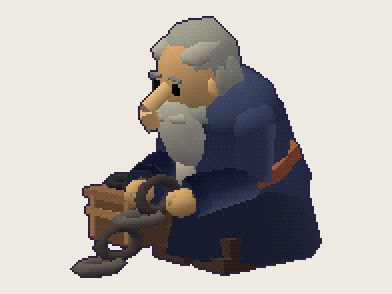
Tib. thang stong rgyal po (Thangtong Gyalpo, 'King of the Empty Plain'), lcags zam pa (Chakzampa, 'Iron-Bridge Man'); lCags zam chu bo ri (Chakzam Chuwori)
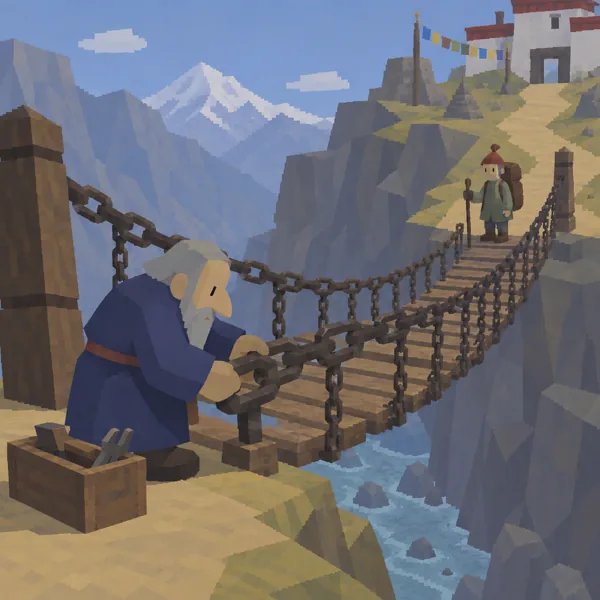
The fifteenth-century adept who hung iron-chain bridges across Tibet's rivers, with his seat on the hill above the great bridge over the Tsangpo.
Thangtong Gyalpo is remembered as the builder of iron-chain suspension bridges, ferries and stupas across Tibet and Bhutan. His biography, translated by Cyrus Stearns, counts fifty-eight iron bridges and 118 ferries.
His greatest bridge crossed the Yarlung Tsangpo at Chakzam, above its meeting with the Kyichu. On the holy hill of Chuwori, at the southern bridgehead, he founded his main monastery in 1444.
The bridge hung from great chains between two stone piers, with planks laid on rope hangers below the chains. Travellers in 1904 photographed and drew it, with its stupa-topped piers and the monastery on the hillside.
What canon fixes for the map
Chakzam bridge across the Yarlung Tsangpo, above the Kyichu confluence; monastery of Chuwori at the southern bridgehead [GE p.12].
Counts differ: 58 iron bridges and 118 ferries in the biography [ST, publisher's description]; another tradition says 108 bridges. Keep the counts apart.
Bridge form (1904 drawing): two masonry piers topped with chortens, iron chains, rope suspenders, plank footway [1904 diagram, see art].
Six old iron-chain bridges still stood, at least in part, in Gerner's survey [GE p.70].
This is a historical master's life, not sūtra cosmology; place bridges where real rivers are crossed.
Who lives here
Thangtong Gyalpo (Tsöndrü Zangpo), adept and engineer.
In the game now
being:thangtong-gyalpo (built) and being:bridge-keeper (built, a game-made keeper). The plan has a bridge station (docs/world-plan/places/bridge-station.json). No Chakzam crossing is built.
LACMA leaves the identity open between the two masters.
Thangtong and the bridge
Thangtong Gyalpo
AI concept study (repo) · concept · Project art
The game's Thangtong at work on a chain bridge.
the bridge
Bridge keeper
AI concept study (repo) · concept · Project art
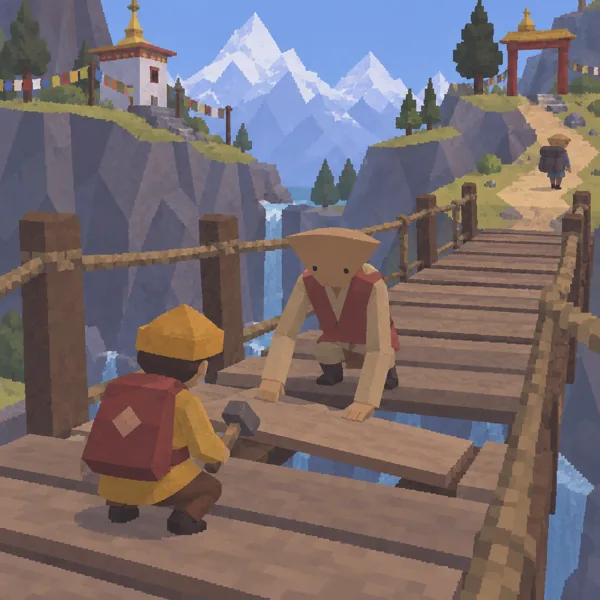
The game-made bridge keeper on a plank bridge.
Still missing: No traditional painting of Thangtong building a bridge with an open licence was checked.
Sources
Cyrus Stearns, King of the Empty Plain: The Tibetan Iron-Bridge Builder Tangtong Gyalpo (Snow Lion, 2007), translating Gyurmé Dechen's biography, Publisher's description; full biography not re-read in this pass
Skt. Vaiśālī, Vimalakīrti; Tib. yangs pa can, dri med grags pa; Āmrapālī's garden
The Licchavi city where a sick layman's empty little room held thirty-two thousand lion thrones.
Vimalakīrti is a Licchavi of the great city of Vaiśālī. He wears a layman's white clothes but lives like a monk; he goes to gambling dens and taverns to teach. He shows himself sick, and the king, ministers, merchants and townsfolk all come out to ask after him.
The Buddha stays in Āmrapālī's garden outside the city. He sends his disciples one by one to visit the invalid; each refuses, remembering how Vimalakīrti once corrected him. Only Mañjuśrī goes, with a great crowd.
As they come, Vimalakīrti empties the house. Even the doorkeeper vanishes; only his own couch remains. Then he borrows thirty-two thousand lion thrones from the universe Merudhvaja, each immensely tall, and they fit in the room without crowding the city or the continent.
A goddess living in the house showers flowers that stick to the disciples. Vimalakīrti sends an emanation to fetch a perfumed meal from the universe of perfumes, and lifts the world Abhirati in his right hand to show it.
What canon fixes for the map
In the great city of Vaiśālī; the Buddha teaches in Āmrapālī's garden nearby [VKN 1.2, 2.1].
The house is emptied: no doorkeeper, no seats, only his couch [VKN 4.4, 4.8, 4.11].
32,000 lion thrones from Merudhvaja fit inside without the city growing [VKN ch.5].
Gods, nāgas, yakṣas and others live in the house and hear the Dharma there [VKN 6.24].
Vaiśālī is one of the six cities of India in the Wheel of Time account [K p.78].
Who lives here
Vimalakīrti, the Licchavi layman.
Mañjuśrī and his retinue; Śāriputra and the reluctant disciples.
The goddess of the house.
Ratnākara and the five hundred Licchavi youths; the chieftain Candracchattra.
The people of Vaiśālī who come to ask after him.
In the game now
place:vimalakirti:house (built), being:vimalakirti:vimalakirti (built), place:vimalakirti:amrapali-garden (sketch). Missing: place:vimalakirti:vaisali (the city itself), place:vimalakirti:thrones, place:vimalakirti:flowers, being:vimalakirti:goddess and most of the cast.
Eight cremation grounds in the eight directions, haunts of adepts, protectors and scavengers; they have their own section in the game.
The tantras arrange eight great charnel grounds around the eight directions of a maṇḍala, each with its own name, and gather adepts, protectors, the restless dead and carrion birds in them.
The game already follows one Hevajra arrangement, starting with Skull Terror in the south and going clockwise. Full detail belongs to the charnel section, not here.
What canon fixes for the map
Eight grounds in eight directions: south Bhairavakapālika, south-west Bhairavāndhakāra, west Jvālamālālaṅkāra, north-west Kilikilāghoṣanādita, north Girigahvaronnati, north-east Ugropanyāsa, east Caṇḍograkaṭāsi, south-east Īśvaravana [CH; ledger topic charnel].
A sacred maṇḍala arrangement, not eight provinces of Jambudvīpa's map [ledger].
Who lives here
See the charnel section: Saraha, Tilopa, Virūpa, Kukkuripa, Machig Labdrön, the Citipati, the rolang, vultures and ravens (all built).
In the game now
place:charnel:1 to place:charnel:8 (all built) in the charnel region.
Repo ledger: docs/purelands-cosmology.json and docs/purelands-lore-populations.json, topic charnel
The precious human birth
Tib. dal 'byor rin po che (the precious freedoms and endowments); Skt. kṣaṇasampad
A human life free of the eight unfree states and rich in ten advantages: rare as stars in daylight, and only fully possible in Jambudvīpa.
A precious human life is one free of eight states with no chance to practise: the hells, the pretas, the animals, the long-lived gods, uncivilised border lands, wrong views, a time with no buddha, and lacking the faculties to understand.
It also has ten advantages. Five are personal: being human, having whole senses, being born in a central land, living by no harmful trade, and having faith. Five come from outside: a buddha has come, he has taught, the teaching lasts, people follow it, and a teacher has taken you in. Those who truly use such a life are as rare as stars in broad daylight.
Kongtrul gives the geography of this. The humans of the other three continents only reap old karma. Jambudvīpa alone is the land of action, where people are moved by talk of impermanence and buddhas appear, so a human life here is the best of all.
What canon fixes for the map
Eight unfree states and ten advantages as listed [JLP, precious human birth verses].
'Central land' (one of the ten) and 'uncivilised land' (one of the eight) are places: a land where the teaching is present versus a border land [JLP].
Jambudvīpa is the place of action; the other continents are places of experiencing results [K pp.50–51].
The long-lived gods count as an unfree state, so higher heavens are not better for practice [JLP; ledger topic precious-human].
Who lives here
Ordinary humans: the old, the sick, carers, children, workers (the game's own residents fill these roles).
In the game now
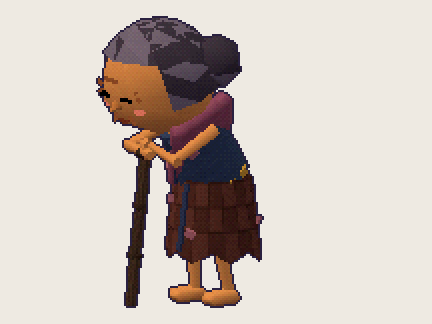
Ledger topic precious-human (partial): homes, fields, school and sickroom in the Human section; being:sickroom-tender (built), being:elderly-pilgrim (built), being:school-pupil (built).
Pāli devadūta (messengers of the gods); the four sights; Tib. skye rga na 'chi (birth, ageing, sickness, death)
A baby, an old person, a sick person and a corpse: the sights every human meets, which Yama asks about and which sent the prince from his palace.
Yama, judging those bound for hell, asks if they ever saw the messengers of the gods. A little baby lying in its own mess: you too are liable to be born. Someone of eighty or a hundred, bent on a staff, teeth broken, hair grey: you too will grow old. Someone gravely ill, lifted and laid down by others: you too will sicken. A criminal punished by the king. A corpse one, two or three days dead, bloated and festering: you too will die.
In the Play in Full, the gods put these sights on the prince's road. Leaving by the east gate of the city for the parks he sees an old man; by the south gate, a sick man lying in his own filth. Then a corpse carried on a bier, and a renunciant in saffron. After this he leaves the palace.
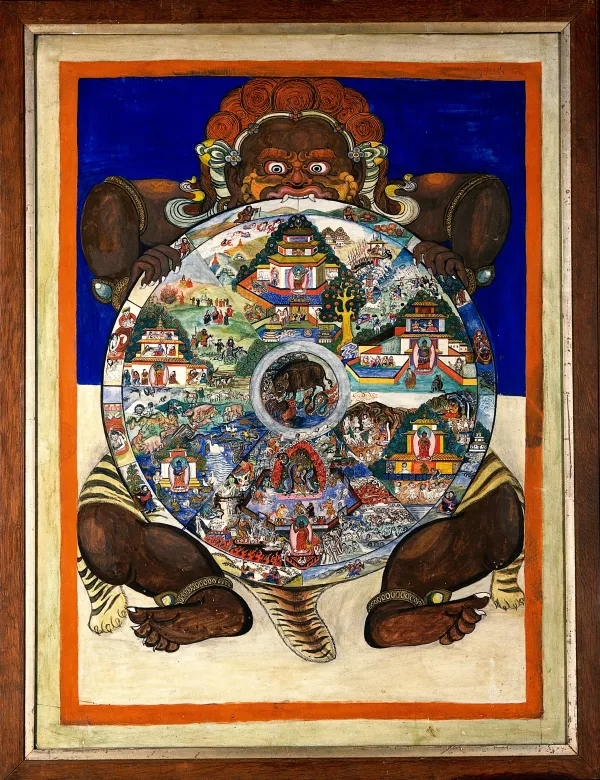
Tibetan Wheel of Life paintings show all of it in the human realm: a mother giving birth, the sick in bed with a doctor, old people with sticks, a body laid out and carried to the pyre.
What canon fixes for the map
Five messengers in the sutta: baby, aged person, sick person, punished criminal, corpse [DS §§4–8].
Four sights in the Play in Full: old man (east gate), sick man (south gate), corpse on a bier, renunciant; the corpse and renunciant gates are not given in the passages checked [LV ch.14].
Conflict: the sutta has five messengers and Yama asks about them after death; the Play in Full has four sights placed by the gods before the renunciation. Keep both, labelled.
Wheel paintings put birth, sickness, ageing and death scenes inside the human sector, and birth (link 11) and ageing-death (link 12) on the rim [art; repo wheel concepts].
Who lives here
The baby, the aged one, the sick one, the punished criminal and the dead (the messengers).
Yama, who asks the question (lives in the preta realm, not here).
Chandaka the charioteer and the prince, in the four-sights telling.
In the game now
Missing: being:yama:messenger:infant, being:yama:messenger:aged, being:yama:messenger:sick, being:yama:messenger:punished, being:yama:messenger:dead. The game has a sickroom (being:sickroom-tender, built) and rim segments for birth and ageing-death in the Wheel.
Art (3)
birth, sickness, old age and death around the muni's housethe cremation fire and funeral procession on the hill
Wellcome Collection L0069380 · traditional · Public Domain Mark
One building shows a birth (right annex), a sickbed with a doctor (middle floor), a death (top floor) and old people at the foot; a cremation and a funeral procession on the hill above.
the human realm with its scenes of birth, sickness, age and death
Parasol, golden fishes, vase, lotus, conch, endless knot, victory banner and wheel: held by eight goddesses, and seen on the mountainsides of Lhasa.
Mipham's verses name eight most precious emblems held by the eight auspicious goddesses, who make offerings to all buddhas: the precious parasol, the golden fishes, the wish-fulfilling vase, the lovely lotus, the conch of fame, the glorious endless knot, the victory banner that never falls, and the all-powerful wheel.
They also appear in the land itself. When Princess Kongjo surveys the site for the Jokhang, she sees the eight-spoked wheel in the sky, the eight-petalled lotus on the earth, and the eight auspicious signs on the sides of the mountains.
Each is held by one of eight goddesses; Mipham's explanation calls them eight female bodhisattvas [MEA verse 4; ledger].
Landscape: eight auspicious signs on the mountain sides around Lhasa, with a wheel in the sky and a lotus on the ground [GLR p.262].
Josie's rule: grouped props come in eights; this set is exactly eight [AGENTS.md].
Who lives here
The eight auspicious goddesses (bkra shis lha mo brgyad).
In the game now
All eight built as places in the lha-khang precinct court: place:eight-symbols:parasol, :golden-fish, :treasure-vase, :lotus, :conch, :endless-knot, :victory-banner, :dharma-wheel. being:eight-symbols:goddesses is missing. No mountainside signs.
Art (3)
all eight roundelsparasol, fishes and conch, top row
Tib. rlung rta (lungta, windhorse), dar lcog / dar cha (prayer flags); Skt. Balāha (the horse king)
The flag of the windhorse, the jewel-carrying horse king with a tiger, lion, garuḍa and dragon at his limbs, raised to lift good fortune on the wind.
Mipham's offering of the windhorse flag praises the miraculous king of horses, Balāha, adorned with every kind of jewel and soaring like the wind. From his four limbs a tiger, a lion, a garuḍa and a dragon spread out to the four directions and fly through the sky.
The flag is 'auspicious, sweet-sounding far and wide'. The prayer asks the vajra wind to increase life, prosperity, merit and the strength of one's windhorse, and ends: 'Hoist high the inspiring flag of auspiciousness and virtue.'
Windhorse texts are recited when flags are raised; some, tied to King Gesar, are meant to be written on the flags themselves.
What canon fixes for the map
The windhorse is Balāha, king of horses, carrying jewels [MSW].
Tiger, lion, garuḍa and dragon spread from his four limbs to the four directions [MSW].
Prayers are written on flags and recited [LTS: Gesar texts].
The texts do not say where flags hang; passes, peaks and roofs are common practice, not stated in these sources.
Josie's rule: prayer flags come in five colours, an exception to the threes-eights-108 rule [AGENTS.md].
Who lives here
Balāha, the windhorse; the tiger, lion, garuḍa and dragon; King Gesar in the Gesar windhorse texts.
In the game now
being:wind-horse (built) and being:spring-horse-wind (sketch); prayer flags and a paper windhorse activity at the pass (ledger windhorse-and-flags, partial).
Skt. ṣoḍaśa sthavira; Tib. gnas brtan bcu drug (the Sixteen Elders, Neten Chudruk)
Twelve of the sixteen arhats who stay in the world live in Jambudvīpa, each on his own mountain, island or cave with a retinue of hundreds.
The sixteen elders stay in the world to guard the teaching until Maitreya. The Tibetan praise names where each lives and how many arhats surround him. Four live off this continent: Kanakabhāradvāja in Aparagodānīya, Bakula in Uttarakuru, Piṇḍola in Pūrvavideha and Panthaka in the Heaven of the Thirty-three.
The rest live in Jambudvīpa. Aṅgaja on the great snow mountain Kailash with 1,300, holding incense and a fly-whisk. Ajita in a crystal cave on Sage Mountain with 100. Vanavāsin in the cave of Seven-Leaf Mountain with 1,400. Kālika in Jambudvīpa with 1,100, holding gold earrings. Vajrīputra on Siṃhala island with 1,000. Bhadra on an island in the Yamunā with 1,200. Kanakavatsa in Kashmir with 500. Rāhula on Priyaṅgu island with 1,100.
Cūḍapanthaka on Vulture Peak with 1,600. Nāgasena on Mount Vipulapārśva with 1,200, with vase and staff. Gopaka on Mount Bihula with 1,400, holding a book. Abheda on the king of snow mountains with 1,100, holding a stūpa.
The sixteen do not include the attendant Dharmatāla or the Four Kings [SAB].
Who lives here
The twelve Jambudvīpa elders above, each with his retinue of arhats; the upāsaka Dharmatāla and the Four Kings attend the assembly [SAB].
In the game now
being:elder-01 to being:elder-16 are all sketches inside one shared arhats rig (not individual models); the assembly sits in the lha-khang precinct. None of the abodes is built.
Himalayan Art Resources · traditional · No open licence
The praise page with each elder's verse; linked HAR sets show each elder in his landscape.
Still missing: No openly licensed Tibetan set of the sixteen elders in their abodes was found; each abode (Sage Mountain, Seven-Leaf cave, Bihula and the rest) still needs concept art.
Tib. 'dzam bu'i gling chung (Small Land of Jambu); 'phags yul (the Exalted Land, India); bod, li yul (Khotan), rgya nag (China), sham bha la
The Kālacakra account lines up the countries of Jambudvīpa from south to north: India, Tibet, Khotan, China, Shambhala and the Great Snow Range.
The Wheel of Time tantra draws the world differently. Its southern continent, the 'continent of fire', is triangular, and with two smaller ones beside it makes the Small Land of Jambu, a land of action.
In its central southern continent lie six regions in a row. In the south is the Exalted Land, India, with six cities: Magadha (where the seat of enlightenment is), Vaiśālī, Śrāvastī, Kormo Jig, Sāketa and Campaka, and provinces such as Bengal, Kauśāmbī and Kashmir.
North of India is Tibet, the country Avalokiteśvara made his own. Then Khotan, which Śāriputra and Vaiśravaṇa made by draining a lake. Then China, with Mañjuśrī's Five-Peaked Mountain. Then Shambhala, guarded by its thirty-two Buddhist kings, with its capital Kalāpa. Furthest north is the Great Snow Range, the edge of the continent.
What canon fixes for the map
South to north: India, Tibet, Khotan, China, Shambhala, Great Snow Range [K p.78].
Everything around and between the four continents: Mount Meru and its coloured faces, the golden ranges and sweet seas, the salt ocean, the iron rim, the sun and moon, the four continents and their eight islands, and Siṃhala's island of rākṣasīs. Canon fixes directions, shapes, sizes and who lives where, so this is the frame the Human continents and the Animal ocean will sit in. Where the Abhidharmakośa, Phagpa, Kongtrul, the Dīrgha Āgama and the Kālacakra disagree, each card says so.
The ground under everything: wind, water and gold
vāyumaṇḍala, jalamaṇḍala, kāñcanamaṇḍala; Tib. rlung gi dkyil 'khor, chu, gser gyi sa gzhi
The whole four-continent world floats on a disc of golden ground, set on a layer of water, set on a cross of wind in empty space.
After the long empty age, winds blow in from the ten directions and lock into a solid cross of wind. A cloud like a golden yoke forms above it and rains for ages, drops as thick as a chariot shaft. The water is held up by the wind.
Wind churns the water until its top sets like cream on boiled milk and turns to gold. That golden ground is the floor on which Meru, the seven golden ranges, the continents and the iron rim all stand. Every mountain and continent reaches eighty thousand leagues down through the ocean to rest on it.
In the middle of the first great ocean a thousand golden lotuses appear. The gods read them as a sign that a thousand Buddhas will come, and call this the Fortunate Age.
Rain falls again on the gold and becomes the great ocean. Wind sorts its stuff into three grades: the finest makes Meru, the middle makes the golden ranges, the coarsest makes the continents and the iron rim.
What canon fixes for the map
Layered from the bottom: wind, then water, then golden ground; the ocean lies on the gold [K pp.20–21; AK iii.45–47, pp.451–452].
Wind layer 1,600,000 yojanas thick and immeasurable round; water 800,000 thick after the gold forms; gold 320,000 thick; water and gold discs 1,203,450 yojanas across [AK iii.45–48, pp.451–452].
Phagpa colours the wind disc light blue [P printed p.12].
Meru, ranges, continents and rim all go down 80,000 yojanas to the gold [K pp.21–22; P printed p.16].
Kālacakra variant: four concentric half-spheres of wind, fire, water and earth, 400,000 / 300,000 / 200,000 / 100,000 leagues across, nested like bowls with level rims [K pp.72, 76].
Who lives here
The gods of the pure domains who see the thousand lotuses and name the Fortunate Age [K p.20].
In the game now
meru:system/foundation is built: a three-layer cutaway plinth (wind, water, golden ground) on the Meru chart's foot ring (docs/purelands-cosmology.json, entry meru). No samsara item of its own.
Sumeru / Meru; Tib. ri rab, ri'i rgyal po ri rab lhun po
The king of mountains stands in the middle of the world, each face a different jewel, and each continent's sky takes the colour of the face it looks at.
Meru rises 80,000 leagues out of the ocean and goes 80,000 leagues down to the golden ground. Seen from above it is square. Four terraces step out from its sides, from the sea up to half its height; the Four Great Kings and their peoples live there, and the Thirty-Three gods live on its flat top.
Each face is made of one jewel and colours the sky in front of it. Our continent faces the blue face, so our sky is blue. In Kongtrul's account the east face is crystal, the south blue beryl, the west ruby and the north gold.
The Abhidharma gives a different set: north gold, east silver, south lapis (beryl), west crystal. Phagpa follows it, and adds that the outer ocean takes the colours too: white in the east, bluish green in the south, red in the west, yellow in the north.
Gelug teachers commonly teach east silver-white, south lapis, west ruby, north gold, and say the eastern continent has a white sky, the western a red sky and the northern a yellow sky.
What canon fixes for the map
Centre of the world-system; square from above; 80,000 yojanas above water, 80,000 below; as wide as it is high [K p.22; AK iii.50–51, pp.453–454].
Faces (Kongtrul): east crystal, south blue beryl, west ruby, north gold; each colours the sky on its side [K p.22].
Faces (Kośa): north gold, east silver, south lapis, west crystal; the lapis face is why Jambudvīpa's sky is blue [AK iii.49d–50a, p.453]. Phagpa and the Dīrgha Āgama agree with the Kośa [P printed p.12; DA SC 31].
Sky colours by continent (Gelug oral teaching): east white, south blue, west red, north yellow [LZ, Kopan 1977].
Four terraces at 10,000-yojana steps, jutting 16,000, 8,000, 4,000 and 2,000 yojanas, reaching half Meru's height [AK iii.63–64, p.462; K p.22].
Shape varies: Abhidharma square; Kālacakra round and cup-shaped, 16,000 leagues across at the base and 50,000 at the top, with a 'neck', 'face' and 'crown' of thin air above [K pp.73–74]. The game's round, terraced Meru is an adaptation.
Asuras live in crevices of Meru's base below the waterline [K p.29].
Who lives here
The Four Great Kings and their retinues on the fourth terrace; the Vessel-Bearers, Garland-Bearers and Inebriates on terraces one to three [K p.30] (deva group covers them).
The Thirty-Three gods on the summit [K p.30].
Asuras in the crevices of the base [K p.29].
In the game now
Meru is built as the Deva section's mountain (docs/world-plan/places/meru.json): round, four terraces with four coloured faces, summit city, sky platforms, and the nested world-system chart room meru:system. Terrace peoples being:meru:terrace-1/2/3 built; place:asura:meru-crevices built.
Rubin Museum of Himalayan Art / Himalayan Art Resources item 877 · traditional · All rights reserved (link only)
Mongolian, 19th century. Top centre: Meru with the four continents as coloured shapes, each with its two islands; Jambudvīpa in the foreground, coloured blue.
Yugaṃdhara, Īṣādhara, Khadiraka, Sudarśana, Aśvakarṇa, Vinataka, Nimiṃdhara; Tib. gnya' shing 'dzin, gshol mda' 'dzin, seng ldeng can, blta na sdug, rta rna, rnam 'dud, mu khyud 'dzin
Seven rings of golden mountains stand round Meru like curtains, each half the height of the one inside it.
Beyond Meru seven ranges of gold stand round it, each forming a square. They are named for the shape of their peaks: Yoke, Plough, Acacia Forest, Pleasing-to-the-Eye, Horse's Ear, Bent, and Rim.
The first, Yoke, rises 40,000 leagues out of the water; each range after it is half as high, down to Rim at 625. Each is as wide as it is high.
Some of the Four Kings' retinue live on these ranges as well as on Meru's terraces. Above Yoke, the highest, there is no night and day: the light never changes, and beings there tell the time by flowers opening and closing.
Between the ranges lie the seven seas of pleasant water.
What canon fixes for the map
Seven concentric square ranges of gold between Meru and the outer ocean [K p.22; AK iii.48b–50a, pp.452–453; P printed p.13 'all lie in a square'].
Names in Tibetan order: Yoke, Plough, Acacia Forest, Pleasing-to-the-Eye, Horse's Ear, Bent, Rim [K p.22]; Phagpa gives the Tibetan commentary's last two as Elephant's Tusk and Fish Mouth [P printed p.13].
Some Four Kings' retinue live on the ranges [K p.30; AK iii.64, p.462].
Above Yoke, day and night are told by flowers [K pp.60–61].
The Dīrgha Āgama orders the ranges differently and gives other heights; keep it as a variant [DA SC 40–53].
Who lives here
Members of the Four Kings' company who live on the ranges [K p.30; P printed p.29].
In the game now
Drawn as rings inside the meru:system chart room; place:sun-moon:above-yoke built. No separate samsara item for the ranges.
Between the golden ranges lie seven seas of sweet water with eight good qualities, where the nāga kings play.
The spaces between the golden ranges are filled with seas whose water has eight qualities: cool, tasty, light, soft, clear, odourless, harmless to the throat and harmless to the stomach.
The first sea, between Meru and Yoke, is 80,000 leagues wide. Each sea after it is half as wide, down to 1,250 at the seventh.
Kongtrul calls them the seas enjoyed by the nāgas. Phagpa names the place where the nāga kings amuse themselves among the golden ranges Lalitasāgara.
These seven are the inner ocean. The salt ocean lies only outside the last range.
What canon fixes for the map
Seven seas, one between each pair of ranges from Meru to Nimiṃdhara [K p.22; AK iii.51c–52c, p.454].
mahāsamudra; Tib. rgya mtsho chen po, lan tshwa'i rgya mtsho
Outside the last golden range a vast salt ocean holds the four continents and runs out to the iron rim, and it is the animal realm's main home.
Beyond the golden ranges, everything up to the outer rim is salt water, except for the continents. The four continents and their islands sit in it, one opposite each face of Meru.
The fires of the iron rim keep this ocean from spilling over its edge.
Animals live on land, in water and in the air, but their main home is this great ocean. Nāgas and other creatures crowd its depths like fermenting grains of beer.
The sea takes Meru's colours: Phagpa says it is white in the east, bluish green in the south, red in the west and yellow in the north, and so it is called the four seas.
What canon fixes for the map
Between Nimiṃdhara and the iron rim; 322,000 yojanas wide [AK iii.52c, p.454; P printed p.13].
Salt; holds the four continents and eight islands [K pp.23–24].
Its edge touches the iron rim; the rim's volcanic fire keeps it in bounds [K p.24].
Animals' principal place [AK p.460; K pp.28–29].
Four coloured seas: east white, south bluish green, west red, north yellow [P printed pp.13–14].
The Kośa notes the ocean has no steep drop round the continents: continents are wider at the base, like heaps of grain [AK p.459].
Who lives here
The ocean's animals, nāgas in the depths [K pp.28–29]; asura kingdoms at levels above the ocean floor [K p.29]. Animal and asura groups write these.
In the game now
place:iron:salt-ocean built inside the meru:system chart; place:naga-palace:ocean-depths built. The Human section's ferries cross a sea to the continents.
A ring of iron mountains closes the world-system off at the edge of the salt ocean.
The outer rim is a mountain range of iron. Kongtrul calls it the Horse-faced range and says it is volcanic: its fires stop the ocean from going past its limits.
It is called Cakravāḍa because it circles the four continents and is shaped like a wheel. It is the lowest of the mountains, 312½ leagues out of the water.
Every world-system has its own rim. A thousand of them make a small thousand-world system, which has its own rim too, and so on up to the great thousand.
Beyond the rim is darkness. In the Dīrgha Āgama two chains of diamond mountains stand outside, with hells in the dark between them. In the Kālacakra, fire and then wind surround the rim, and beyond that is only empty space.
What canon fixes for the map
Outermost ring, made of iron, encircling the four continents [K p.24; AK iii.48b–50a, pp.452–453; P printed p.12].
312½ yojanas high and as wide [AK p.454; P printed p.13]. The Dīrgha Āgama gives 300 yojanas and says it is made of the seven treasures [DA SC 53].
Its volcanic fires hold the ocean back [K p.24].
Each thousand world-systems is ringed by a further Cakravāḍa [P printed p.20].
Kālacakra: the seventh ring is the Great Indestructible Perimeter, girdled by the Horse-faced Fire and then wind, each 50,000 leagues wide; beyond is vacuity [K pp.75–76].
Dīrgha Āgama: two chains of great diamond mountains outside the ocean, utter darkness and hells between them [DA SC 200–201, 300–303].
Who lives here
The Four Kings' company also lives on Mount Cakravāḍa [P printed p.29].
In the game now
place:iron:cakravada built in the meru:system chart. Missing: being:iron:cakravada/beings, place:iron:chiliocosm-rims, place:iron:indestructible-perimeter, place:iron:vajra-chains.
One sun and one moon, each a crystal palace of a god, ride a wind round Meru at the height of the first golden range.
The sun and moon rest on wind and circle Meru as if carried by a whirlpool. They move at the height of Yoke, the first golden range, which is halfway up Meru.
The sun's disc is fire crystal, 51 leagues across, with a golden rim and four spires. It is the palace of the Sun God and his retinue. The moon's disc is water crystal, 50 leagues across. It is the palace of the Moon God.
One sun lights all four continents, so it is never the same hour on two of them: when it is midday in Jambudvīpa it is sunset in the east, sunrise in the west and midnight in Kuru.
The moon wanes because it comes near the sun and its own shadow falls across it. In the Dīrgha Āgama, the moon's ministers put on blue robes and the moon shrinks.
The stars are smaller palaces of sky gods, one to six krośa across, all of the Four Kings' class.
What canon fixes for the map
At the height of Yugaṃdhara, half Meru's height, on wind [AK iii.60a, p.460]; Phagpa says 40,000 yojanas up [P printed p.16].
Sun disc 51 yojanas, moon 50 [AK iii.60b, p.460; P printed p.17].
They circle clockwise ('from the right') [P printed p.16].
One sun and moon per four-continent world [AK p.461; DA SC 7].
Times of day on the four continents [AK iii.61, p.461; DA SC 889].
Six months north, six south: days lengthen and shorten [P printed p.17; AK p.461].
Kālacakra: sun and moon are among ten planets on a celestial belt of wind between Meru's outer enclosure and the ring of fire; most planets move counterclockwise [K pp.81–85]. Their light never reaches the six inner ring continents [K pp.74–75].
Who lives here
The Sun God, called Quickness, in his golden hall [DA SC 832–839].
The Moon God, in his hall of beryl [DA SC 870–884].
The moon's blue-robed ministers [DA SC 880, 883].
The gods who live in the star palaces [P printed p.17].
In the game now
place:sun-moon:sun and place:sun-moon:moon built (chariots circling the meru:system chart, clockwise). Missing: being:sun-moon:sun-god, moon-god, moon-ministers, sky-gods, planets; place:sun-moon:celestial-sphere, enclosures.
Pūrvavideha, the eastern continent (Majestic Body)
Pūrvavideha; Tib. shar lus 'phags po
The eastern continent, shaped like a half-moon, where people are tall and beautiful and live 250 years.
East of Meru lies Majestic Body, named because its people's bodies are remarkably fine. It is shaped like a half-moon, and the faces of its people have the same shape.
People here are eight cubits tall, about twice our height, and live about 250 years. They farm grain and silk and trade gems, and marry as we do.
They do not suffer the famines, plagues and wars of the end of an age, though they grow weak and hungry when Jambudvīpa does.
It is a happy, peaceful place, but the teachings do not flourish there. The Bardo text warns the dead not to be drawn to the sign of this birth: a lake with male and female swans.
What canon fixes for the map
Faces Meru's east side [K p.23; AK iii.53, p.455].
Half-moon (semicircle); three sides of 2,000 yojanas and one of 350 [AK p.455]. Phagpa: the side toward Meru 350, the other side 6,000 [P printed pp.15–16].
Dīrgha Āgama variant: the east is perfectly round, 9,000 yojanas across [DA SC 28].
Kongtrul's names for its islands: Body and Majestic Body [K p.23].
Height 8 cubits [AK p.469; K p.48]; Dīrgha Āgama says 3½ like Jambudvīpa [DA SC 492].
Lifespan 250 years [AK iii.78, p.470; K p.48]; Phagpa gives 500 [P printed p.26]; the Dīrgha Āgama says rarely over 300 [DA SC 494].
Great tree: the Kadamba [DA SC 33].
Spared the knives, sickness and famine of the age’s end, though weakness and hunger reach it [AK p.490].
Its land is the broadest and largest; Jambudvīpa is better for courage, memory and the appearance of Buddhas [DA SC 563–564].
Its sky is white (Gelug teaching) [LZ].
Who lives here
Its people: tall, fine-bodied humans with half-moon faces.
In the game now
place:purvavideha built (docs/world-plan/places/purvavideha.json: a semicircular island with a ferry harbour, quay town and barley terraces; all of that is game adaptation). place:rebirth-guidance:sign-videha missing.
Art (7)
Pūrvavideha and its islands, half-moons on the right
Rubin Museum of Himalayan Art / Himalayan Art Resources item 877 · traditional · All rights reserved (link only)
Mongolian, 19th century. Top centre: Meru with the four continents as coloured shapes, each with its two islands; Jambudvīpa in the foreground, coloured blue.
Aparagodānīya, the western continent (Bountiful Cow)
Aparagodānīya / Godānīya; Tib. nub ba lang spyod
The round western continent of cattle and wealth, whose people are sixteen cubits tall and live 500 years.
West of Meru lies Bountiful Cow, round like the full moon. It is named for its wish-fulfilling cow and its many precious cattle. Its people have round faces.
People are sixteen cubits tall and live about 500 years. They live easily from livestock and gems, and marry.
Compared with us they have more cattle, more sheep and more treasure. We have more courage and memory, and Buddhas appear here, not there.
The Bardo text calls it a place of great wealth where the teachings do not flourish. Its sign is a lake ringed by male and female horses.
Dīrgha Āgama variant: the west is half-moon shaped, 8,000 yojanas across [DA SC 29].
Islands: Śāṭhā to the south and Uttaramantriṇa to the north [P printed p.16].
Height 16 cubits [AK p.469; K p.48; P printed p.26].
Lifespan 500 years [AK p.470; K p.48]; Phagpa gives 250 [P printed p.26]; the Dīrgha Āgama says rarely over 200 [DA SC 494].
Great tree: the Tinduka, with a stone bull banner one yojana tall beneath it [DA SC 34].
Spared the three calamities of the age’s end [AK p.490].
Its sky is red (Gelug teaching) [LZ].
Who lives here
Its people: very tall herders with round faces.
The wish-fulfilling cow (mandala point 16) [M37].
In the game now
place:aparagodaniya built (round island with a ferry harbour, round market and pastures: game adaptation). place:rebirth-guidance:sign-aparagodaniya missing.
Rubin Museum of Himalayan Art / Himalayan Art Resources item 877 · traditional · All rights reserved (link only)
Mongolian, 19th century. Top centre: Meru with the four continents as coloured shapes, each with its two islands; Jambudvīpa in the foreground, coloured blue.
Uttarakuru, the northern continent (Unpleasant Sound)
Uttarakuru / Kuru; Tib. byang sgra mi snyan
The square northern continent where wishing trees give everything, no one owns anything, and everyone lives exactly a thousand years.
North of Meru lies Kuru, perfectly square, its people square-faced and thirty-two cubits tall. The land is flat as a palm and soft underfoot; grass grows in clockwise coils, the colour of a peacock. There is no winter or summer, no thorns, no biting insects, no tigers.
Wishing trees give food, clothes, ornaments, garlands, vessels and instruments. Rice grows unplanted, without husk, and cooks itself in iron kettles over a glowing gem. Clothing is white bark from the trees, weighing an ounce. At night the nāga king of Anavatapta rains sweet rain that leaves no mud.
No one marries and no one owns anything. A couple goes to a grove; if they are not kin, trees called Bending Over lean down and screen them. Children are left at the crossroads and fed from passers-by's fingers; in seven days they are grown. The dead are adorned and left at a crossroads, and a bird named Uccaṃgama carries them away. No one weeps.
Everyone lives exactly a thousand years; seven days before death the wishing tree speaks: 'In seven days you will die.' Ten great mountains ring the land toward the sea. Its Tibetan name, Unpleasant Sound, comes from unruly nāgas who sometimes cloud its sun so its music sounds harsh.
It is a pleasure-land, not a Dharma land. People there cannot take vows or enter meditation, and birth there counts as an obstacle. The Bardo text warns the dead away from its sign: a lake with cattle on its shore, or with trees.
What canon fixes for the map
Faces Meru's north side [K p.23; AK p.455].
Square, each side 2,000 yojanas, 8,000 round [AK iii.55, p.455; P printed p.16]; the Dīrgha Āgama says 10,000 across [DA SC 27].
Islands Kurava and Kaurava at its two sides [P printed p.16; AK p.455].
Ten great mountains encircle it toward the sea, from Saṅkāśa to Endowed with Lotuses [AM 5.322].
Lake Sudarśana, a hundred yojanas, with four rivers and four parks [DA SC 107–126].
Height 32 cubits [AK p.469; K p.48; P printed p.26].
Fixed lifespan of 1,000 years; no untimely death [AK iii.78, 85a, pp.470, 473; K p.48; DA SC 494].
Food: uncultivated grain only; clothes white, from the wish tree [K p.60; P printed p.26].
No marriage or property; the trees screen couples [AK iv.83, p.667; DA SC 132].
Birth there is an obstacle of retribution; no vows, no meditation [AK iv.97d, p.681; AK iv.43, p.619].
After death: reborn among desire-realm gods [AK p.476]; Kongtrul specifies the Thirty-Three [K p.63].
Its sky is yellow (Gelug teaching) [LZ].
Who lives here
The people of Kuru (built in game as being:kuru:people).
Uccaṃgama, the bird that carries away the dead [DA SC 134].
The nāga king of Anavatapta who rains on Kuru by night [DA SC 127].
The unruly nāgas who cloud its sun [K p.26].
The birds of Kuru's forests, including jīvaṃjīvakas [AM 5.324–5.325].
In the game now
place:uttarakuru built (flat green square, wish-tree grove, south landing); place:kuru:wishing-tree built; being:kuru:people built. Missing: place:kuru:ten-mountains, place:kuru:sudarsana, place:kuru:bending-trees, being:kuru:uccamgama, being:kuru:birds, being:kuru:rain-nagas, being:kuru:cloud-nagas, place:rebirth-guidance:sign-uttarakuru.
Rubin Museum of Himalayan Art / Himalayan Art Resources item 877 · traditional · All rights reserved (link only)
Mongolian, 19th century. Top centre: Meru with the four continents as coloured shapes, each with its two islands; Jambudvīpa in the foreground, coloured blue.
Still missing: No traditional image of Kuru's life: wishing trees, bending trees, the crossroads and the Uccaṃgama bird.
Our own southern continent, the only one where Buddhas appear; its inner geography belongs to the jambudvipa group.
South of Meru lies the Land of Jambu, shaped like a cart: three long sides and one very short side. Its people's faces are that shape too. It faces Meru's blue face, so its sky is blue.
It is the smallest and hardest continent, with short and uncertain lives, but it is where Buddhas appear and where the Bodhisattva's diamond seat stands. Its people surpass the other three in courage, memory and religious life.
What canon fixes for the map
Faces Meru's south side; three sides of 2,000 yojanas and one of 3½ [AK iii.53, p.455]; the Dīrgha Āgama says narrow in the south and wide in the north, 7,000 across [DA SC 30].
Islands Cāmara (east) and Aparacāmara (west) [P printed p.14].
Only place a Buddha attains awakening [AK p.455; P printed p.14].
Kālacakra: triangular, the 'continent of fire', 8,000 leagues [K p.77].
See the jambudvipa group for Anavatapta, the rivers, the Jambu tree and regions.
In the game now
place:jambudvipa built (the Human section). See the jambudvipa group.
Two half-moon islands beside the eastern continent, peopled by humans like those of Pūrvavideha.
Beside Majestic Body lie two islands of the same half-moon shape: Body and Majestic Body (Deha and Videha). Their people resemble those of the main continent, at half its size.
An old commentator, Saṃghabhadra, says these islands will one day be deserted.
What canon fixes for the map
Same shape as Pūrvavideha, beside it [K p.23; AK iii.56, p.455].
Deha to the north, Videha to the south [P printed p.16].
Humans live there, like those of the main continent [K p.26]; half the main continent's size [P printed p.26].
Saṃghabhadra: Deha, Videha, Kurava and Kaurava will be deserted [AK note 389, p.531].
Mandala points 6–7 [M37].
Who lives here
Humans like those of Pūrvavideha.
In the game now
place:isle-deha and place:isle-videha built (ferry landings with one landscape each, no residents: game adaptation).
Two islands beside Jambudvīpa; one opinion keeps Cāmara for cannibal rākṣasas, and Tibetans set the Copper-Coloured Mountain there.
Beside our continent lie Tail-Fan and Other Tail-Fan (Cāmara and Aparacāmara), named for the yak tail.
All the other islands hold humans, but Kongtrul says Tail-Fan is inhabited only by cannibal demons, the rākṣasas. The Kośa reports this as one opinion.
Tibetan tradition places Guru Padmasambhava's Copper-Coloured Mountain on Cāmara, where he tames the rākṣasas. The hidden-lands group writes it in full.
What canon fixes for the map
Beside Jambudvīpa, same trapezoid shape [K p.23; AK p.455].
Cāmara to the east, Aparacāmara to the west [P printed p.14].
Cāmara (Tail-Fan) is rākṣasa land [K p.26; AK iii.56, p.456 'according to one opinion'].
Aparacāmara holds humans [K p.26].
Copper-Coloured Mountain: a south-west island of rākṣasas [Chokgyur Lingpa, Threefold Aspiration; see hidden-lands group].
Mandala points 8–9 [M37].
Who lives here
The rākṣasas of Cāmara (in game as being:copper-mountain:rakshasas, built).
Padmasambhava on the Copper-Coloured Mountain (hidden-lands group).
In the game now
place:copper-mountain built and named 'Cāmara, a companion of Jambudvīpa'; place:isle-aparacamara built. place:copper-mountain:eight-isles missing. The way in today is Potalaka's ferry, a game link (copper-mountain.json).
Siṃhaladvīpa; Pali Tambapaṇṇi, town Sirīsavatthu; Tib. seng ga la'i gling
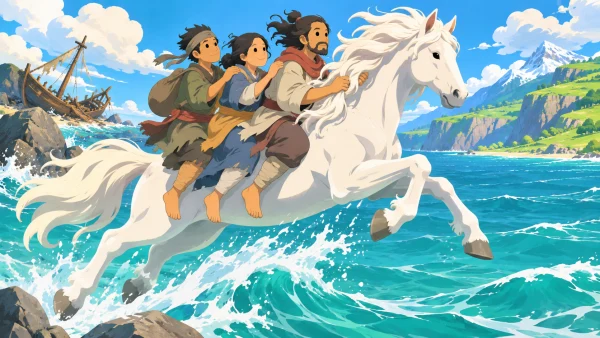
An island of the salt ocean near Jambudvīpa where five hundred shipwrecked merchants marry beautiful rākṣasīs, and a flying horse carries the faithful home.
In the Basket's Display, the Buddha tells of a past life as the head merchant Siṃhala, sailing with five hundred merchants. The rākṣasīs of Siṃhala Island send untimely winds and break the ship. The men swim ashore, and five hundred rākṣasīs come down in the form of maidens, give them cotton robes under a great magnolia tree, and take them home as husbands, to gardens and many bathing pools.
A lamp by the head merchant's bed laughs in the night and warns him. It sends him down the southern road to an iron fortress with no doors or windows, where earlier merchants are kept; a hundred are eaten every day and their bones lie round it.
The lamp tells him of Bālāha, the king of horses. Bālāha eats a herb, rolls on the golden sand and shakes so the island shakes, and three times asks who will cross to the far shore. Riders must not look back. The rākṣasīs run after them wailing; every merchant who looks back falls into the sea and is eaten. Only the head merchant reaches Jambudvīpa. The Buddha says Avalokiteśvara was the horse.
The Pali Valāhassa Jātaka tells it in Tambapaṇṇi (Ceylon), at the yakkha town of Sirīsavatthu. Half the five hundred traders stay and are eaten; the other two hundred and fifty ride home on a white flying horse, the Bodhisatta, who eats wild rice on the island and asks in a human voice: 'Who wants to go home?'
What canon fixes for the map
An island near Jambudvīpa, belonging to it [P printed p.16; K p.23 note 9].
Reached by sea from Jambudvīpa; the pilot weighs winds toward Ratnadvīpa, Yavanadvīpa or Siṃhala [KV 2.4].
Features: a great magnolia tree on the shore, a gated town, gardens, hundreds of bathing pools, golden sand where Bālāha rolls [KV 2.4–2.5, 2.12, 2.14].
The iron fortress lies down the road to the south [KV 2.7–2.8].
Inhabitants: five hundred rākṣasīs [KV 2.5]; in the Jātaka, yakkhinīs of Sirīsavatthu [VJ paras. 4–5].
The horse comes from elsewhere: from the Himālaya in the Jātaka [VJ para. 9].
Who lives here
Siṃhalarāja, the head merchant (Śākyamuni in a former life) [KV 2.4].
The five hundred merchants [KV 2.4–2.15].
The five hundred rākṣasīs and their senior [KV 2.5–2.15].
The laughing lamp [KV 2.7, 2.9].
The merchants in the iron fortress [KV 2.7–2.8].
Bālāha, king of horses (Avalokiteśvara) [KV 2.9–2.17].
The ship's pilot [KV 2.4].
The head merchant's parents, whose sight returns [KV 2.16].
Jātaka: the yakkhinīs of Sirīsavatthu and the flying horse (the Bodhisatta) [VJ].
In the game now
being:balaha:horse built (pure-lands, with concept and model); being:balaha:simhalaraja and being:balaha:valahassa sketch. Missing: place:balaha:simhala, place:balaha:iron-fortress, place:balaha:sirisavatthu, being:balaha:merchants, rakshasis, lamp, prisoners, pilot, parents, yakkhinis, jataka-traders.
Buddhavanam Jātaka reliefs; photo Anandajoti Bhikkhu, Wikimedia Commons · traditional · CC BY-SA 4.0 (photo: Anandajoti Bhikkhu)
Modern relief of the Siṃhala Avadāna: the rākṣasīs on the right, Siṃhala's men arriving by boat with elephants. It shows the Divyāvadāna version's later war on the island, an episode the Kāraṇḍavyūha does not tell.
Tibetan practitioners heap rice on a plate as the whole world-system, Meru, continents, islands, treasures, sun and moon, and offer it.
The practitioner says the ground is golden, ringed by an iron mountain wall, with Meru in the middle. East is Pūrvavideha, south Jambudvīpa, west Aparagodānīya, north Uttarakuru, each with its two islands.
Then come the jewel mountain, the wish-fulfilling tree, the wish-fulfilling cow and the harvest that needs no sowing; one belongs to each continent. Then the seven royal treasures, the treasure vase, eight offering goddesses, and last the sun, the moon, the precious umbrella and the victory banner.
In the heaps, east is set toward the one who offers. The treasures go east, south, west and north in that order: jewel mountain east, wish tree south, cow west, unsown harvest north.
This rite is how most Tibetans picture the world-system. Teachers explain the colours of the four skies while teaching it.
What canon fixes for the map
Order and names of all 37 points [M37].
Treasures by direction: jewel mountain east, wish tree south, cow west, unsown harvest north (FPMT placement instructions) [LZ2; Thubten Chodron].
Sun and moon: Pabongkha puts the sun south and the moon north; others put them south-east and north-west [LZ2].
East faces the practitioner on the plate [Thubten Chodron].
Rubin Museum of Himalayan Art / Himalayan Art Resources item 877 · traditional · All rights reserved (link only)
Mongolian, 19th century. Top centre: Meru with the four continents as coloured shapes, each with its two islands; Jambudvīpa in the foreground, coloured blue.
The Wheel of Time Tantra draws a different world: a round, cup-shaped Meru, six ring continents in seas of honey and milk, and our continents in a seventh ring.
The Kālacakra builds the world on four round discs of wind, fire, water and earth. Meru stands 100,000 leagues tall, narrow at the base and wide at the top like a porcelain cup. Above it are a 'neck', 'face' and 'crown' made only of wind and space.
Meru's centre is green and its sides are blue in the east, white in the north, red in the south and yellow in the west, made of emerald, blue beryl, crystal, ruby and topaz.
Five curtains hang from Meru's rim. Under them lie six ring continents named Moon, White, Most Excellent, Kuśa Grass, Centaur and Crane, between seas of honey, butter, yogurt, milk, water and beer, with ranges between. Sun and moon never shine there; the people glow with their own light.
Outside the last range, Cool, is the seventh ring, the Greater Land of Jambu: twelve lands like lotus petals, with the four great continents in the cardinal directions. Then a salt ocean, the Great Indestructible Perimeter, a ring of fire, a ring of wind, and empty space.
What canon fixes for the map
Meru round and cup-shaped, base 16,000 and top 50,000 leagues [K p.74]; contrast the Abhidharma's square Meru [K p.22].
Face colours east blue, north white, south red, west yellow, centre green [K p.73].
Six ring continents and six seas inside the Cool range [K p.75].
Great continents: east semicircular (wind) 7,000; south triangular (fire) 8,000; west round (water) 9,000; north square (earth) 10,000 leagues [K p.77]. The Abhidharma has no 'Tail-Fan' islands here [K p.77].
Salt ocean 50,000 leagues; perimeter, fire and wind rings each 50,000 [K p.76].
Kongtrul: 'there are many different models of this world-system' [K p.74].
Who lives here
The self-luminous people of the six ring continents [K p.74].
In the game now
Kālacakra items exist only as missing samsara entries: place:sun-moon:enclosures, place:sun-moon:celestial-sphere, place:iron:indestructible-perimeter, being:sun-moon:planets.
Canon puts the animals mainly in the great salt ocean, crowded in the dark depths and eating one another, with nāgas in jewel palaces below and garuḍas hunting them from above; the rest live scattered among humans and gods as livestock and hunted wild beasts. This group gathers what the texts fix about that ocean and its beings, the animal stories the game can draw on, and how Wheel of Life painters picture the animal sector, so the Animal realm can grow a real sea.
The seven sweet seas and the middle ocean
Skt. sītā; 'seas of enjoyment'; Tib. rol pa'i rgya mtsho; AMSD 'middle ocean' (rgya mtsho bar ma)
Between Meru's golden ranges lie seven sweet seas enjoyed by the nāgas, water of eight good qualities.
Between Meru and the seven square golden ranges lie seven seas. Kongtrul calls them the seas enjoyed by the nāgas. Their water has eight qualities: cool, tasty, light, soft, clear, odourless, harmless to the throat and harmless to the stomach.
The first sea, between Meru and Yoke, is eighty thousand leagues wide; each next one is half as wide, down to 1,250 leagues for the seventh. Together they are the inner ocean.
The Mindfulness sūtra places a nāga realm called Endowed with Enjoyments in the 'middle ocean', a thousand leagues across and full of nāga kings, righteous and unrighteous. Its translators take 'middle ocean' to mean the seas between Meru and the outer ring. Phagpa names one of these seas Lalitasāgara, where the nāga kings amuse themselves.
What canon fixes for the map
Seven seas between the eight mountains, each square [K p. 22; P p. 13].
Widths: 80,000 leagues, halving each time to 1,250 [AK III.51c–52c, p. 454; P p. 13].
Water of eight qualities [K pp. 22–23; AK p. 454].
Enjoyed by the nāgas [K p. 22 and n. 8]; nāga realm Endowed with Enjoyments, 1,000 leagues, in the middle ocean [AMSD 3.37, 3.51, n. 212].
Lalitasāgara, between the Seven Golden Mountains [P p. 13, per repo ledger naga-palace:lalitasagara].
Who lives here
Righteous and unrighteous nāga kings (see naga-kings topic) [AMSD 3.42, 3.51].
The nāga kings of the Lalitasāgara, first of Śakra's five protectors against the asuras [P pp. 27–28].
In the game now
place:naga-palace:lalitasagara (deva, missing); being:asura:lalitasagara-nagas (asura, missing). The Meru-system room shows the ranges and seas compressed (meru topic, partial).
Good nāgas send the right rain to all four continents; angry ones send hail, poison and storms; nāgas keep jewels and treasure.
Rain follows human conduct. When people are righteous, the righteous nāga kings grow strong and send timely, gentle rain to all four continents, and harvests have fine smell, taste and colour. When people turn from the Dharma, unrighteous nāgas move in black clouds, spoil the water, grow poison trees and raise hail that flattens barley and rice.
Each continent fears something different. Jambudvīpa fears failed harvests, war, poison and wind, and floods. The people of the west fear unclean water. The gentle people of the east fear thunder and lightning; angry nāgas there show eyes as large as chariots, bodies like black mountains and three fiery heads. In Kuru in the north, nāga clouds hide the sun, wither the lotuses and make the lutes sound harsh.
Kongtrul gives the same note for the north: the sun on Unpleasant Sound is sometimes clouded by unruly nāgas, and so its music turns to cacophony, which is how the continent got its name.
Nāgas guard treasure. Kongtrul's note says they guard treasures hidden under the earth; Dudjom says the wish-fulfilling jewel is found in the realms of gods or nāgas. A universal monarch's rain-proof canopy, ten leagues long, is the hide of a nāga from the ocean.
What canon fixes for the map
Righteous nāgas water all four human continents [AMSD 3.42–3.49, 3.59].
Unrighteous nāgas: hail, black clouds, poison, thunder; continent by continent [AMSD 3.52–3.55, 3.58].
Northern continent's name comes from nāga clouds spoiling its music [K p. 26].
Nāgas guard underground treasure; they cause illness when provoked [K n. 8].
Wish-fulfilling jewel in gods' or nāgas' realms [DT glossary, per repo ledger naga-palace:nagas].
Nāga-hide canopy among a universal monarch's possessions [K p. 58].
Who lives here
The nāgas who rain on Kuru [repo: being:kuru:rain-nagas]; the unruly nāgas who cloud Kuru's sun [being:kuru:cloud-nagas].
In the game now
being:kuru:rain-nagas (human, missing), being:kuru:cloud-nagas (human, missing). being:four-kings:nagas (deva, built: retinue of the west).
Art (1)
jewels and conches strewn in the sea round the nāga woman
The garuḍas, kings of the birds, hunt the ocean's nāgas until the Buddha's shawl protects them.
The garuḍa is a great bird, master of the skies, which traditionally preys on the nāgas (Dudjom). Patrul and Dudjom both count garuḍas among the nāgas' chief torments.
In the Questions of the Nāga King Sāgara, the nāga kings Breath, Great Breath, Takṣaka and Infinite Color tell the Buddha that the four garuḍas, kings of the birds, take their weak young nāga boys and girls and frighten every nāga in the ocean.
The Buddha gives Sāgara his shawl: 'Wherever a single strand of this shawl lies in this ocean, the garuḍas will not go.' However many pieces are cut from it, it is never used up.
The four garuḍas, displeased, come and ask: 'If we do not kill our prey, what shall we do?' The Buddha teaches them which foods lead to the lower realms; they take refuge and vow never to frighten a nāga. In Kanakamuni's time they had been four proud monks.
Nāgas know the shape. When Maudgalyāyana rises over Lake Anavatapta in the form of a garuḍa, the nāgas and nāgīs flee in terror, until their king calms them.
What canon fixes for the map
Four garuḍa kings prey on the ocean's nāgas [QNS 7.74].
A strand of the Buddha's shawl in the ocean keeps garuḍas away [QNS 7.75–7.76].
The garuḍas' conversion [QNS 8.1–8.6].
Garuḍa shape terrifies the nāgas of Anavatapta [QNA 1.144].
The game's own garuḍa (being:garuda) is a different being from these four [repo naga-palace:four-garudas note].
Who lives here
The four garuḍas, kings of the birds (in Kanakamuni's time the monks Nanda, Mahānanda, Superior and Superior Teacher) [QNS 8.1–8.6].
In the game now
being:naga-palace:four-garudas (sketch). being:garuda (human realm, built; not one of the four).
Art (5)
a garuḍa diving at the sea over the nāgas' pavilion
Some asuras count as animals and live at the ocean floor, on the sunken terraces of Meru.
Kongtrul: one kind of demi-god classified as an animal lives at the bottom of the ocean, while the chief demi-gods, Rāhu, Garland Necklace and others, live at different levels above the ocean floor.
The Mindfulness sūtra: under the nāga city at the sea bottom live the asuras who compete with the gods. Some belong to the starving spirits, some to the animal realm. Those of the animal realm live at the bottom of the sea, on which rests Meru's sunken base, with four plateaus, the first 21,000 leagues across.
When gods and asuras fight over the ocean, the sea suffers: falling rocks kill hundreds of thousands of sea beings, and the din makes the hearts of fish, shellfish and crocodiles burst.
What canon fixes for the map
An animal-class demi-god lives at the ocean bottom [K p. 29].
Animal-class asuras live at the sea bottom on Meru's base, which has four plateaus [AMSD 3.62–3.63]; the fourth level, Immovable, is 'included in the animal realm' [AMSD 3.184].
Their wars kill sea creatures [AMSD 3.243, 3.274].
Canon conflict: the game counts asuras as their own realm (Liberate path); these texts file some of them under animals. Keep both statements; this belongs mainly to the asura group.
Who lives here
Rāhu, Garland Necklace (Kaṇṭhamāla) and other asura lords above the sea floor [K p. 29; AMSD 3.64, 3.94].
In the game now
Asura realm content only (asura group). Nothing in the Animal wedge.
Art (0)
Still missing: No art found for the ocean-floor asuras.
Animals kept by humans are milked, loaded, pierced and yoked, and none of them dies a natural death.
Patrul: domestic animals 'are milked, loaded down, castrated, pierced through the nose and yoked to the plough. Not one of them escapes this continual round of slavery. Horses and yaks continue to be loaded and ridden even when their backs are nothing but one big sore. When they can go no further, they are whipped and pelted with stones.'
'Cattle and sheep are exploited until they die. Once they are too old, they are sold off or killed by the owners themselves... a natural death is unknown to them.' When the butcher comes with his knife, they only stare.
Dudjom adds having their hair pulled out and being killed for meat, blood, hide and bones. Gampopa calls this the suffering of being used: 'Powerless, they are tortured. Hands, feet, whips, and iron hooks enslave them.'
Kongtrul gives the one softer line: domesticated animals have some trace of happiness, unlike the creatures in the dark between the continents. Patrul's instruction: if you have animals of your own, treat them with kindness and love.
What canon fixes for the map
These animals live 'scattered' among humans and gods, not in a separate land [WMPT p. 76; DT p. 96].
Wild animals never eat a mouthful without fear: hawks kill small birds, small birds kill insects, and hunters kill them all.
Patrul: wild animals 'live in constant fear. They cannot eat a single mouthful of food without being on their guard... Hawks kill small birds, small birds kill insects, and so on, continually amassing evil actions in an endless round of killing and being killed.'
Hunters use nets, snares, traps and guns. Animals die for their own bodies: oysters for pearls, elephants for tusks and bones, tigers, leopards, otters and foxes for fur, musk deer for musk, wild asses and yaks for flesh and blood.
Gampopa calls this the suffering of slaughter, quoting: 'Some die for pearls, wool, bone, blood, meat, and skin.' Dudjom: they are preyed on by birds and carnivores and cannot resist being killed by humans.
The Mindfulness sūtra adds that animals differ in whether they live in harmony: some live together, some are enemies, like snakes and mongooses, crows and owls, horses and buffalo.
What canon fixes for the map
Wild animals 'share our human world' [WMPT p. 76].
Predation chain: hawk, small bird, insect [WMPT p. 76].
Hunted for body products, named per animal [WMPT p. 77].
Natural enemies: snakes and mongooses, crows and owls [AMSD 3.7, 3.9].
In the game now
Animal ladder: being:liberate-bug, being:liberate-bird, being:liberate-cat, being:liberate-fox, being:liberate-elephant (built). Ambient: kites, herons, sparrows, songbirds, ducks, terns, dragonflies, fireflies, butterflies (built). Predation traces at the nest crag and torn den (ANI-P02). being:animal.den-hillside.burrowers (missing).
Art (3)
a lion bringing down a deer, a tiger leaping, a rhinoceros, an elephant
Skt. Bālāha; Pali Valāhassa ('cloud horse'); Tib. rta'i rgyal po sprin gyi shugs can
A divine horse king on the ogresses' island carries shipwrecked merchants across the ocean, if they never look back.
In the Kāraṇḍavyūha, the Buddha tells how, as a head merchant, he was stranded with five hundred others on Siṃhala Island, where each man lived with a rākṣasī. A talking lamp warns him and shows him an iron fortress where other merchants are kept and eaten.
The lamp tells of Bālāha, king of horses, who has compassion for the desolate. He eats the herb sarvaśetāna, rolls back and forth on the golden sand, shakes his body until the island shakes, and asks three times: 'Who is going to cross over to the far shore?'
None may look back at the island. The others turn, fall and are eaten; the head merchant alone reaches Jambudvīpa, circles the horse three times and goes home. Avalokiteśvara was the horse. The Pali Valāhassa Jātaka tells the same tale with the Bodhisatta as the horse.
What canon fixes for the map
Place: Siṃhala Island, across the ocean from Jambudvīpa; golden sand on its shore [KV 2.13–2.16].
Kongtrul lists Siṃhala among sixteen regions around Jambudvīpa [K p. 23].
Who the horse is differs: Avalokiteśvara (Kāraṇḍavyūha) or the Bodhisatta (Pali Valāhassa Jātaka) [KV n. 17].
Who lives here
Bālāha, king of horses (Avalokiteśvara)
The rākṣasīs of Siṃhala
The head merchant (Śākyamuni) and five hundred merchants
The Copper-Coloured Mountain, Potalaka, Śambhala, the hidden valleys (beyul) and the sacred mountains Padmasambhava and Milarepa blessed, with Tanaduk and the nāga palaces briefly. Canon puts most of them inside our own world, reached across the sea, over the snows or through a guarded door, which is why they can be found from the overworld. Each topic's last canonFixes line says whether canon puts it in the human overworld, across the ocean, or apart.
Cāmara, the rākṣasa land
Cāmara (Skt.); Ngayab Ling, Ngayab Langké Ling (rnga yab gling); 'the country of Laṅka'
Cāmara is the island land of the rākṣasas across the sea to the south-west, where the Copper-Coloured Mountain rises.
Cāmara is one of the two small lands that go with our southern continent, Jambudvīpa, in the standard mandala of the world. Tibetan prayers place it to the south-west of Tibet and north-west of the Vajra Seat at Bodhgaya. It is the rākṣasas' domain, and The Crystal Stairway calls it 'the country of Laṅka'.
When the Guru was about to leave Tibet for the land of rākṣasas to the south-west, he rode out from the Gungtang pass on a horse, or perhaps a lion, with divine beings making offerings around him. He reached Ngayab Ling, climbed the Copper-Coloured Mountain, liberated Raksha Tötreng, king of the rākṣasas, and took on his form.
Eight islands ring the mountain. The Guru sent a copy of himself to live on each one: eight kings who teach the Eight Pronouncements (Kagyé) and other teachings. Kongtrul says that by this he saves the people of Jambudvīpa from mortal danger.
The aspirant prays not to be born there from a rākṣasa womb, but from a blue lotus in the nectar pools round the mountain.
What canon fixes for the map
South-west of Tibet; north-west of the Vajra Seat (Bodhgaya) [CSW v.2; SPM v.2 gives north-west of the Vajra Seat]
Reached from Tibet by the Guru via the Gungtang pass; a crossing to the south-west [KPL p.9]
Cāmara is a companion land (subcontinent) of Jambudvīpa in the four-continent scheme [MO]
The mountain stands amid eight rākṣasa isles; each isle has a king, an emanation of the Guru [CTA line 3; KPL p.9]
Inhabitants: rākṣasas; their king Raksha Tötreng, now the Guru in his form [CSW v.2; KPL p.9]
Placement: in samsara's own geography (a land of our world across the ocean), though the mountain on it is a nirmāṇakāya pure land 'an aspect of our world of Endurance' [SPM v.1]. It can sit in the overworld as an island across the sea.
No source read puts the eight great charnel grounds around the mountain, or names any rākṣasa city [CSW, SPM, CTA, DJC, KPL read in full]
Who lives here
Raksha Tötreng, king of the rākṣasas, liberated by the Guru, who took his form
The rākṣasas of Cāmara, as a class (no other rākṣasa is named)
The eight kings on the isles, eight emanations of the Guru
In the game now
place:copper-mountain (built): an island reached by Potalaka's pier ferry (human.potalaka.entrance-3), with the dark-sand rākṣasa shore (copper-mountain.shore). being:copper-mountain:rakshasas (built), being:copper-mountain:raksha-totreng (sketch), being:copper-mountain:eight-kings (sketch), place:copper-mountain:eight-isles (missing). The rak-shore, rak-child and rak-gate residents are the game's own. The ferry from Potalaka is a game link: no text read puts the two coasts side by side.
Art (7)
Jambudvīpa and its two companion isles (one is Cāmara), bottom
Chinese silk tapestry (kesi), unknown maker (Wikimedia Commons) · traditional · Public domain
Meru in the centre; the trapezoid continent at the bottom is Jambudvīpa, with its two small trapezoid companion isles on either side. One of those two is Cāmara; the tapestry does not label which.
the southern continent and its two companion isles, bottom
Prof Ranga Sai, Wikimedia Commons · traditional · CC BY-SA 4.0
Meru with its lapis southern face over a blue sea; at the bottom, the trapezoid southern continent with a small trapezoid isle on each side, one of them Cāmara.
Himalayan Art Resources, set 491 (Jeff Watt) · traditional · Link only
The set's essay: the mountain stands in the middle of the island, surrounded by water; demons fill the land below; Amitābha top floor, Avalokiteśvara second, the Guru with his eight forms on the ground floor.
Rubin Museum of Art F1997.8.2, Kham, 19th century · traditional · Link only
Palace on the summit at the centre; island shore and rākṣasas at the bottom.
Rākṣasa of the shore
AI concept study (repo) · concept · Project art
The game's own rākṣasa family on Cāmara's shore (being:copper-mountain:rakshasas).
Rākṣasa child
AI concept study (repo) · concept · Project art
Game resident of the rākṣasa shore.
Rākṣasa gate guard
AI concept study (repo) · concept · Project art
Game resident; the canon gatekeepers are the four great kings (CSW v.15).
Still missing: No open-licence painting of the Copper-Coloured Mountain was found on Commons or in Met Open Access; every traditional painting found is link-only. No art of the eight isles on their own.
Zangdok Palri, the Copper-Coloured Mountain and the palace of Lotus Light
Zangdok Palri (zangs mdog dpal ri), 'Glorious Copper-Coloured Mountain'; palace of Lotus Light (Padma Ö, pad ma 'od)
A heart-shaped mountain rises from the nāgas' realm to the form heavens, with the Guru's palace on its summit in three levels.
The mountain has the shape of a heart, a warrior's heart. Its base rests deep in the nāgas' realm, on the crown of the hooded nāga king. Its slopes are full of ḍākas and ḍākinīs at their feast. Its peak reaches the heavens of the form-realm gods. Rainbow light wraps it on all eight sides, music of gods, nāgas and humans fills it, and flowers of five jewels fall like rain.
On the summit stands a palace beyond measure, made of the five wisdoms. Its east side is white crystal, the south lapis lazuli, the west ruby and the north emerald, all see-through like a rainbow. It has corridors, parapets, terraces, friezes, jewel tassels, water-spouts and porches at the four doors, and on top a parasol, a pinnacle and a Dharma wheel. Dudjom Rinpoche calls the whole mountain 'made of enticing ruby'.
In the heart of the palace, on an eight-cornered jewel with a lotus, sun and moon seat, sits Padmākara (Tsokyé Dorje), all the buddhas in one. Above him lies the saṃbhogakāya palace where Avalokiteśvara, Lord of the World, presides. Higher still is the dharmakāya realm.
The two Lotsawa House prayers disagree on the top. Jigme Lingpa puts Samantabhadra there appearing as Amitābha. Khangsar Tenpé Wangchuk puts Samantabhadra alone, with no Amitābha. The paintings HAR describes show Amitābha on the third floor.
What canon fixes for the map
Heart-shaped; base in the nāga realm, slopes the ḍākinīs' abodes, summit at the form-realm heavens [CSW v.4; SPM v.3]
Rainbow light on all eight sides [CSW v.5]
Palace colours by direction: east crystal white, south lapis, west ruby, north emerald [CSW v.6; SPM v.4]
Four doors with porticoes; parasol, pinnacle and wheel on top [CSW v.7; SPM v.5]
Three levels: ground, the Guru (nirmāṇakāya); above, Avalokiteśvara/Padmapāṇi (saṃbhogakāya); top, dharmakāya [SPM vv.7, 12–13; CSW vv.9, 13–14]
Top level: Samantabhadra as Amitābha [SPM v.13] versus Samantabhadra alone [CSW v.14]: traditions differ
Paintings: Amitābha third floor, Avalokiteśvara second, the Guru with his eight forms on the ground floor [HAR set 491]
Placement: a nirmāṇakāya pure land inside our world [SPM v.1]; Dudjom calls it 'within pure personal perception … the spontaneously perfected Akaniṣṭha' [DJC v.1]. It is seen by pure vision, so the palace stays a sacred apart-place even if the island is in the overworld.
Who lives here
Padmākara / Tsokyé Dorje on the eight-cornered throne (ground level)
Avalokiteśvara (Padmapāṇi, Lord of the World) with his retinue (middle level)
Samantabhadra, appearing as Amitābha in SPM (top level)
Vidyādharas of India and Tibet in rows to his right; scholars and saints to his left [SPM v.9]
The king and twenty-five disciples, nirmāṇakāya tertöns, the eighty siddhas [SPM v.10; CSW v.10]
In the game now
place:copper-mountain:zangdok-palri (built), place:copper-mountain:lotus-light-palace (built): the palace of three floors (copper-mountain.palace), the Guru's throne, Avalokiteśvara above, a never-reached vision of light at the top. being:guru-form-04 Padmasambhava (built), being:chenrezig:thousand-armed (built), being:copper-mountain:vidyadharas (built), being:copper-mountain:kharchen-za (built), being:mandarava (built). The eight-form station band (copper-mountain.guru-band, guru-form-01…08). Game additions no source names: the lamp chamber, Mandāravā on the mountain, the ledges toward Khechara.
Himalayan Art Resources, set 491 (Jeff Watt) · traditional · Link only
The set's essay: the mountain stands in the middle of the island, surrounded by water; demons fill the land below; Amitābha top floor, Avalokiteśvara second, the Guru with his eight forms on the ground floor.
The Met 2012.459, Western Tibet or Ladakh, 14th century · traditional · Public domain
Iconography reference for the Guru on the palace's ground floor.
Avalokiteśvara, thousand-armed
AI concept study (repo) · concept · Project art
The middle-floor presence as the game draws it.
Padmasambhava
AI concept study (repo) · concept · Project art
The game's Guru on the ground floor (being:guru-form-04).
Yeshe Tsogyal (Kharchen Za)
AI concept study (repo) · concept · Project art
Kharchen Za, whom the ḍākinīs led to Lotus Light (SPM).
Mandāravā
AI concept study (repo) · concept · Project art
In the game's palace; no source read names her on the mountain.
Still missing: No open-licence traditional painting of the mountain; only link-only museum pieces and two CC BY-SA photos of modern temples modelled on it.
Four great kings guard the four gates; protectors fill the outer court, and gardens of wish-fulfilling trees and nectar pools surround the palace.
At the four gates wait the four great kings: Dhṛtarāṣṭra, Virūpākṣa, Virūḍhaka and Vaiśravaṇa. With them an army of the eight classes of gods and demons beats a victory drum over the māras' legions.
In the outer court and at the gates on four sides stand the seventy awesome protectors, the twenty-eight īśvarīs and the oath-bound guardians, spread out like a galaxy of stars.
The courtyards have wish-fulfilling trees, bathing pools of nectar and soft grass. Incarnate birds such as cuckoos sing the Dharma. In the groves ṛṣis, vidyādharas, flocks of birds and swarms of bees hum with the Dharma of the three vehicles, and there are fountains of nectar and green groves sweet with healing plants.
Dudjom Rinpoche adds a sandalwood forest with a turquoise meadow, rivers of camphor-scented nectar flowing into swirling pools, a tent of rainbows, and kiṃkaras, drum-beating skeleton attendants, dancing under a rain of flowers. Chokgyur Lingpa adds deer and birds in the forests.
What canon fixes for the map
Four gates, one per side, guarded by the four great kings; CSW names the four but not which gate each keeps [CSW v.15; SPM v.14]
The four cardinal and eight intermediate directions, corners and inner galleries are filled with ḍākas, ḍākinīs, gods and goddesses [SPM v.11]
Sandalwood forest, turquoise meadow, nectar rivers and pools [DJC vv.3–4]
Forests with ḍākinīs, birds and deer [CTA lines 6–7]
No charnel grounds named around the palace in any of the five texts read
Who lives here
Dhṛtarāṣṭra, Virūpākṣa, Virūḍhaka, Vaiśravaṇa: the four great kings at the gates
The gods and demons of the eight classes
The seventy protectors, the twenty-eight īśvarīs, the oath-bound guardians
Kiṃkaras, skeletal attendants who beat drums [DJC n.1]
Drekpas male and female, among the Guru's envoys [CTA lines 13–14]
Ṛṣis, incarnate birds, bees and deer
In the game now
place:copper-mountain:gardens (built): the practitioners' courtyard with eight shrubs (copper-mountain.courtyard). being:copper-mountain:four-kings (sketch), being:copper-mountain:dakas-dakinis (built). Missing: being:copper-mountain:protectors, :ishvaris, :oath-bound, :kimkaras, :drekpas, :eight-classes, :rishis, :birds, :bees, :deer, :lotus-born. The game's shore wall has one gate where both CSW and SPM give four.
Himalayan Art Resources, set 491 (Jeff Watt) · traditional · Link only
The set's essay: the mountain stands in the middle of the island, surrounded by water; demons fill the land below; Amitābha top floor, Avalokiteśvara second, the Guru with his eight forms on the ground floor.
Pema Namdol Thaye (Rubin Museum essay 'Celestial Visions in Three Dimensions') · traditional · No open licence (repo media ref-copper-pema-mandala)
A sculpted model of the palace: useful for the four-sided, stepped plan and colour by direction.
Dhṛtarāṣṭra, the eastern king
AI concept study (repo) · concept · Project art
One of the four kings at the gates.
Ḍāka
AI concept study (repo) · concept · Project art
Ḍākas dancing in every direction.
Ḍākinī
AI concept study (repo) · concept · Project art
Ḍākinīs of the slopes and court.
Vidyādhara
AI concept study (repo) · concept · Project art
The vidyādhara rows.
Still missing: No art of the kiṃkaras, the seventy protectors or the outer court on its own; the museum paintings show them small around the palace (link-only).
A jewel mountain in the southern sea where Avalokiteśvara teaches on a diamond rock, visited by the pilgrim Sudhana.
In the Stem Array, Sudhana is sent south and climbs Potalaka looking for Avalokiteśvara. In verse the mountain stands 'in the center of the glorious king of the waters', king of mountains, with jewel trees, flowers, parks, lotus ponds and flowing streams.
On the upper slope of its western side lies a fresh green pasture like a circle of blue beryl, with springs, waterfalls and streams, an open grove inside a great forest. Avalokiteśvara sits cross-legged on a diamond rock, ringed by bodhisattvas on rocks of many jewels. He lays his golden right hand on Sudhana's head and teaches him the gateway of great compassion.
While they talk, the bodhisattva Ananyagāmin arrives from the east through the sky and lands on a peak of the Cakravāla range. The world shakes and turns to jewels, and his light reaches the hells, the animals and Yama's world.
In the Marvelous Display of Buddhafields, the Buddha himself teaches on Potalaka on a lion throne of śrīgarbha gems. Monks, lay followers, devas, nāgas, yakṣas, gandharvas and eighty great yakṣiṇīs listen, and every kind of being comes, even pretas and those in Yama's darkness.
What canon fixes for the map
In the southern region of Jambudvīpa; Sudhana walks there [SA 29.19–29.21]
A mountain in the middle of the sea ('centre of the glorious king of the waters') [SA 29.21 verse]
The teaching grove is on the upper western slope: beryl-green pasture, springs, waterfalls, a diamond rock [SA 30.2]
Ananyagāmin alights on a Cakravāla peak to the east [SA 30.39–30.44]
The assembly is deliberately mixed: humans, gods, nāgas, yakṣiṇīs, pretas [MDB 1.2, 1.4–1.5]
Bālāha's rescue is a different story; the Kāraṇḍavyūha does not mention Potalaka [KV i.7]
Placement: an earthly mountain of Jambudvīpa's south, reachable by land and sea; it can sit in the overworld [SA ch.29–30; PROP rank 8]
Who lives here
Avalokiteśvara, teaching on the diamond rock
Sudhana, the head merchant's son, on his pilgrimage
The bodhisattvas on the jewel rocks
Ananyagāmin, the bodhisattva from the east
(MDB) the Blessed One; five hundred arhats; seven hundred bodhisattvas incl. Mañjuśrī and Vajrapāṇi; five thousand lay followers; eight thousand devas, nāgas, yakṣas, gandharvas; eighty great yakṣiṇīs incl. Anopamā, Bhīmā, Śaṅkhinī, Hārītī; the world guardians; Ānanda
In the game now
place:potalaka:mountain (built) and place:potalaka:western-grove (built), now open ground in the Human harbour basin (human.potalaka: a white crag in a turquoise sea, stepping stones, tide pools, the stair up the west flank to Chenrezig's terrace, the cave potalaka.cave). being:close-son-02 Avalokiteśvara (built), being:potalaka:sudhana (sketch), being:sudhana (built, placed in Tushita), being:balaha:horse (built; the game's staging by the crossing). Many MDB assembly items are missing (being:potalaka:ananda, :anopama, :bhima, :shankhini, :arhats, :lay-followers, :eight-thousand, :mahayakshinis, :ananyagamin).
Art (8)
the painting: Avalokiteśvara on the rocksSudhana, bottom left
Valleys Padmasambhava hid in the Himalaya as refuges for a dark age, found with treasure guidebooks that name the signs, the times and the doors.
Padmasambhava hid many valleys in the Himalaya. They are refuges for the Dharma and its followers when war and evil cover the world. Treasure revealers later find guidebooks that tell who should go, when, and by which road.
The guides give signs for the time of opening. The Khembalung key says the door opens when the great and small mountains of Tisé (Kailash) are destroyed, the Rasa (Jokhang) temple falls apart, Samye grows old, and the king's line in Mangyul is cut by the knife. Its inner sign: people lose their teeth at fifty. The Pemakö guide names avalanches on Kailash, foreign armies and famine, forty eons hence.
The road in is ritual as well as walking. Travellers make feast and smoke offerings, recite the Guru's mantra, and ask the local protectors not to make obstacles. Rocks collapse to make bridges, trees are felled to cross rivers, and rock doors open three arm-spans wide. Nature turns strange near the border: Sikkim guides speak of horned cats and sprouted rocks just before the land shows itself.
Inside, the lands are abundant. Fruit grows huge, grain and medicine plants never fail, the cold are warmed by inner heat, and whoever is born there goes on to a pure land. Hearing the name alone purifies, and seven steps towards Pemakö bring rebirth there.
Guides read a hidden land in three ways: outer (the valley you can walk to), inner (its deities and the practitioner's mind) and secret (the channels of the body). Some Sikkimese lamas say that once the secret land is found, every land is a hidden land.
What canon fixes for the map
Hidden by Padmasambhava in the Himalayan borderlands as refuges for a degenerate age [PKG ¶¶1–3, 12; REIN p.6, text ¶5]
Opened only at the prophesied time, by a destined revealer [PKG ¶22; REIN text ¶¶6–8]
Signs of the time: Kailash's mountains destroyed or hit by avalanches, foreign armies, ruined temples, broken law [REIN text ¶¶7–8; PKG ¶¶2–4]
The way in: offerings to the land's protectors, a bridge, a rock door, passes, rivers and cliffs that seal the land [REIN text ¶¶10–16; PKG ¶¶12–16]
Signs at the threshold: odd creatures and 'nature will misbehave' [SCH p.78]
Three readings: outer, inner, secret [SCH pp.79–80]
Placement: earthly valleys inside Jambudvīpa's mountain country. They sit in the overworld, hidden by terrain until found.
Who lives here
Padmasambhava, who hid the lands and speaks the guides
The treasure revealers (tertöns) who open them
Local protectors and gatekeepers of each land (e.g. Khembalung's Surarakye)
Nāgas (lu) and nyen in caves and rivers on the way in
In the game now
place:hidden-valley (built): the game's own unnamed fog-gated valley, reached from human.high-pasture; it borrows from Milarepa's hermitage songs and is not identified with any beyul. place:beyul:kyangpen-namkha-dzong (sketch). Most named beyul are missing (see their topics).
The most famous hidden land: a scorpion-shaped valley east of Samye, ringed by snow and rock, past Yama's site at Gyala.
East of Samye lies the valley of Dakpo. Following its river, you come to a valley that looks like a prone scorpion. At the tip of its tail sits Gyala, the supreme sacred site of Yama, Lord of Death.
From Gyala the road follows the river, or goes towards the Kukar pass past the great charnel ground Tsenmo Mebar, to a mountain shaped like an open flower where gods and rākṣasas gather, past border stones, to the four doors of the sacred site.
On the way the traveller makes a hundred feast offerings at Drangtsi Drak. Ziknang Drak shows the reflection of all who look into it. A fragrant tree two arm-spans wide is felled for a bridge. There is a stone stūpa as big as Meru, and Rabtröling, where every vision seems real. At Namdak Jatsön Ling the streams murmur the rulu mantra. The small Jokpama pass has a path shaped like the syllable bhyo, the ground like an eight-petalled lotus and the sky like an eight-spoked wheel.
Inside, around Gumik Lingtsé, lie the five great Kö (Namdak east, Palden south, Pemo west, Lerab north, Tayé in the centre) and four lesser Kö. Snow and rock ring the whole land, flowers rain, the cold are warmed by the bliss of inner heat, and fruit grows the size of a horse's head.
What canon fixes for the map
East of Samye, through Dakpo; a valley like a prone scorpion [PKG ¶12]
Gyala at the scorpion's tail tip: Yama's sacred site [PKG ¶12]
Route options: along the river, or via the Kukar pass and the charnel ground Tsenmo Mebar [PKG ¶12]
Four doors to the sacred site [PKG ¶12]
Centre: Gumik Lingtsé; Five Köchen by direction (E Namdak, S Palden, W Pemo, N Lerab, C Tayé), 180 furlongs; Four Köchung (Melong, Yönten, Pemo, Drakpo), 35 furlongs [PKG ¶16]
Perimeter of snow and rock; sealed by passes, rivers and cliffs [PKG ¶16]
One of the sixteen great hidden lands [PKG ¶¶12, 18, 28]
Revealed by Jatsön Nyingpo from the Guru's practice cave in Kongpo [PKG ¶¶22, 28]
Placement: an earthly valley of south-east Tibet, in the overworld's mountain country
Who lives here
Yama, Lord of Death, at Gyala
Gods and rākṣasas who gather at the flower-shaped mountain
Jatsön Nyingpo, the heart son who brings out the guide
Beyul Demojong / Dremojong ('bras mo ljongs), 'Valley of Rice'; Gawa Lung, 'Valley of Joy'; Rinchen Ding
Sikkim is the hidden land under Khangchendzonga, called the king of hidden lands, with Gawa Lung and Rinchen Ding inside it.
Jamyang Khyentse Chökyi Lodrö calls Sikkim 'king of hidden lands'. On a mountainside at its north-west border lies Gawa Lung, the Valley of Joy or Valley of Vajra Medicine: a ḍākinī realm of clay, slate and cliffs, meadows and woods, with eight caves, a golden lake, a milky lake and a lake of rakta, plains smooth as a mirror, and trees that hold the five sister ḍākinīs.
Near it, hidden separately, is Rinchen Ding: a vast plain in a ring of cliffs, a garden of medicinal fruit and flowers, a pond loved by White and Green Tārā, a cave of immortality and a secret ḍākinī cave. Practice there brings rebirth on the Glorious Mountain in Cāmara.
Older guidebooks describe Demojong in endless harvest, with caves holding a vase of the elixir of life, the Guru's dagger and a mirror showing the three realms. Khangchendzonga, 'five treasures of the great snow', holds stores to be opened when the world is threatened. Seen from Tashiding, the land's centre, one mountain looks like a sleeping pig.
A Rigdzin Gödem guide says the shape of Demojong is like a square celestial mansion. Lhatsün Chenpo's revealed cycle, near Tashiding, gives the mountain god three forms: a half-lha, half-tsen ruler outside, a lay monk with bowl and staff inside, and secretly the god of wealth.
What canon fixes for the map
Sikkim = king of hidden lands; Gawa Lung on a mountainside at its north-west border [GWL lines 1–4]
Gawa Lung: eight caves, golden, milky and rakta lakes, mirror-smooth plains, a temple with the three supports [GWL lines 1–27]
Rinchen Ding near Gawa Lung, inside a ring of rocky cliffs [GWL lines 31–56]
Tashiding is the land's geographical centre in Lhopo tradition [SCH abstract, p.78]
Shape: a square celestial mansion (Rigdzin Gödem guide) [SCH p.79]
Khangchendzonga holds five treasures [SCH p.78]
Placement: earthly land around and below Khangchendzonga; in the overworld's southern Himalaya
Who lives here
Dzö-nga, the spirit of Khangchendzonga (outer ruler, inner lay monk, secret god of wealth)
The five sister ḍākinīs of Gawa Lung's trees
White and Green Tārā at Rinchen Ding's pond
The hooked-knife-bearing wisdom protector of Gawa Lung's hill
A medicinal valley of blossoms and rainbows under Manaslu in Nubri, blessed by the Three Protectors and Padmasambhava.
Above Kyimolung rises Gangri Pungyen, 'Heap of Jewel-like Snow Mountains', the summit above all others. Its ridges join Mount Tisé.
To its east is the emanated realm of deities, to the south the Gomasālagandha stūpa, to the west the Vajra Throne, and to the north the snowy Himalaya.
The valley dazzles with blossoms and medicinal plants, rainbows span every direction, and galleried cliffs overhang with nests of birds. The Three Protectors (Mañjuśrī, Avalokiteśvara, Vajrapāṇi) and Padmasambhava blessed it; a king and princes trained in its caves, and Chokgyur Lingpa came as the Guru's regent.
What canon fixes for the map
Under Gangri Pungyen = Manaslu, in Nubri, Nepal [KML title, line 3, note 1]
Directions: E realm of deities; S Gomasālagandha stūpa; W Vajra Throne; N Himalaya [KML lines 6–9]
Ridges join Mount Tisé [KML line 10]
Medicinal valley, rainbows, cliffs with aviaries [KML lines 12–21]
Placement: an earthly valley of the Nepal Himalaya, in the overworld
Who lives here
The local protector deity of Manaslu [KML note 1]
The Three Protectors and Padmasambhava, who blessed it
Khenpalung (Khembalung), the hidden valley of the cave
Khenpalung / Khembalung (mkhan pa lung), 'Valley of Khenpa grass' (Reinhard: 'a kind of grass')
A jungle valley south of Tibet's border, entered by a long cave, which its guide calls like Dewachen and Potala.
The guide, 'The Key of Orgyan's Beyul Khembalung', is set at Samye. King Trisong Detsen dreams that his temple will be destroyed. The Guru tells him that when Tibet is about to fall to foreign soldiers, it is better to flee to a hidden place on Tibet's southern border, west of the Demet snow mountain and east of the Khumbu snow mountain.
Pilgrims meditate a month on Kamchung mountain, look south to a snow peak, and find a deep, narrow jungle valley. A female nāga lives in the cave; they make offerings to her and to the three Traktsen brothers on a torma-shaped rock. When the land opens, a rock mountain will fall and bridge the river, and the first rock door is three arm-spans wide.
Further on is a wide jungle valley of wrathful nāgas and nyen, a torma-shaped boulder under a great tree of a thousand lotuses, a medicine valley like a dancing floor, and a blue rock like a snow lion leaping to the sky, where the gatekeeper Surarakye lives.
Inside, the valley is wide like an upside-down frying pan, its floor like a sea of blue beryl. The central mountain looks like a king on a throne; behind it a mountain like a three-pointed vajra. There are three hundred villages, long life, no illness, and rebirth in Dewachen.
Today pilgrims go to a cave near Dobatak above the Chhoyang river. They take off their shoes under an inscribed overhang, pass prayer-flag poles into the cave mouth, light lamps for Guru Rinpoche, and go down narrow passages past a trident with a bell.
What canon fixes for the map
On Tibet's southern border; west of Demet snow mountain, east of Khumbu snow mountain [REIN text ¶6]
Approach: a deep narrow jungle valley west of a rock peak, south of Kamchung [REIN text ¶¶9–10]
Opening sign: Kailash's mountains destroyed, Jokhang and Samye fallen [REIN text ¶7]
First rock door three arm-spans wide, after a rock falls to bridge the river [REIN text ¶12]
Gatekeeper Surarakye on a blue snow-lion rock [REIN text ¶14]
The central basin faces south-west, its back to the north-east; mountains shaped like king, vajra, curtains [REIN text ¶¶17–18]
Physical cult site: a cave in the Chhoyang valley near Dobatak, under Chamlang [REIN pp. 9–10, plates]
Placement: an earthly valley of eastern Nepal, in the overworld
A deep east–west valley under Gauri Shankar, said to be cut by Padmasambhava's plough.
Rolwaling is a narrow east–west valley under Gauri Shankar, just south of the Tibetan border. Its name means the place of the furrow. Local tradition says Padmasambhava cut it with a single stroke of his plough, then stayed three months in meditation with Yeshe Tsogyal and his followers.
It is counted among the hidden valleys he made as sanctuaries for troubled times. Historians note that it became known as his valley only in the fourteenth century, through treasure revealers' visions.
What canon fixes for the map
East–west valley below Gauri Shankar, south of the Tibet border; villages Beding and Na; the lake Tsho Rolpa [secondary: Rolwaling chapter; monastery site]
Name: 'furrow'; cut by the Guru's plough (the Pema Kathang, as cited by secondary sources) [secondary]
Placement: earthly valley of the Nepal Himalaya, in the overworld
Thinly sourced: no translated guidebook was read. Treat details as provisional.
Who lives here
Padmasambhava and Yeshe Tsogyal, who stayed three months [secondary]
A hidden land north of Kathmandu, one of the mountain retreats Marpa foretold for Milarepa.
Marpa told Milarepa where to practise: Gyalgi Śrī, Gang Tisé, Riwo Pelbar and Yolmo Gangra among them. Yolmo Gangra is one of these foretold mountain retreats.
Treasure texts call Yolmo a hidden land concealed by Padmasambhava in the eighth century and opened later by the mantra-holder Śākya Zangpo. Its guides include an 'Essential Guide to the Yolmo Snow-Enclosure' and a 'Guide to the Lotus Grove'.
What canon fixes for the map
One of the retreats Marpa foretold [LM ch.8, PDF p.112; ch.11, PDF p.164]
On the Nepal–Tibet border north of Kathmandu (Helambu) [secondary]
Concealed by Padmasambhava, opened by Ngakchang Śākya Zangpo [secondary: 'Treasure Texts on the Age of Decline']
Placement: earthly valley in the overworld's mountain country
Padmasambhava's prophecy speaks of sixteen great hidden lands for refugees of a dark age; the guide names only Pemakö.
Forty eons hence, famine, war and plague will rise from the three poisons and foreign armies will invade every direction. It might be possible to escape to the sixteen greater and lesser hidden lands.
Few will escape: the rich are caught by avarice, the old have no will to travel, and children cannot find the path. For these reasons, the guide says, the sixteen great hidden lands exist, and Pemakö is one of them.
What canon fixes for the map
Sixteen great hidden lands, greater and lesser [PKG ¶¶3, 12, 18, 28]
The Pemakö guide names none of the sixteen except Pemakö [PKG, read in full]
Other counts exist: an anthropologist heard of seven beyul (Khumbu, Helambu, Rongshar, Lapchi, Dolpo, Nubri, Sikkim); a Tengboche lama said there may be twenty [REIN p.6]. Sources disagree; no canonical list of sixteen was found.
In the game now
place:beyul:sixteen-hidden-lands (missing).
Art (0)
Still missing: No art; a list of names would be needed first.
Lapchi Gangra (la phyi gangs ra); identified with Godāvarī, one of Cakrasaṃvara's twenty-four places
A snow range on the Tibet–Nepal border where Milarepa meditated and bound the great Gaṇapati.
Marpa sent Milarepa to practise at Lapchi Gangra, which the Life names with Godāvarī. There Milarepa bound the great deity Gaṇapati under oath.
Lapchi is one of the retreats Milarepa praises in song. Reinhard's informants counted it among the seven beyul of the Himalaya.
What canon fixes for the map
Lapchi Gangra = Godāvarī [LM ch.8, PDF p.112]
Milarepa binds Gaṇapati there [LM ch.11, PDF pp.162–164]
Counted among seven beyul by one informant [REIN p.6]
Placement: an earthly snow range in the overworld; the Life of Milarepa ties it to a real Tibetan border range
Who lives here
Milarepa
The great deity Gaṇapati, bound at Lapchi
Tseringma, his non-human disciple [repo item being:milarepa:tseringma]
In the game now
place:milarepa:lapchi (missing), being:milarepa:ganapati (missing), being:milarepa:tseringma (missing). Milarepa himself is built (being:milarepa:jetsun) at human.milarepa-ledge.
A sacred mountain of south-east Tibet, ranked with Kailash and Lapchi, walked in a yearly circuit and a great twelve-year one.
Tsari is a sacred mountain counted with Kailash and Lapchi among Tibet's holiest places. Its name is read as Cāritra, one of the twenty-four sacred places of the Cakrasaṃvara tantra.
Pilgrims walk a high circuit each summer and autumn from the Tsari Chu valley, hoping to meet the mountain's protectors. Once every twelve years the great Rongkor circuit went down the Subansiri river and back, with thousands of pilgrims. Women may not go beyond the Drölma La pass; they walk a lower circuit.
The Drukpa and Drikung Kagyu tie it to Cakrasaṃvara, and Tsangpa Gyaré is said to have opened it in the twelfth century.
What canon fixes for the map
South-east Tibet, Tsari region; peak about 5,735 m [Huber 1999 p.95, via Wikipedia]
Two circuits: yearly Shungkor from the north-west (Tsari Chu); twelve-yearly Rongkor via the Subansiri [Huber 1999 pp.105–108]
Women barred beyond Drölma La [Huber 1999 p.121]
Linked with Cakrasaṃvara; opened by Tsangpa Gyaré [Rigpa Wiki, secondary]
Not a beyul in the sources read; a 'né-ri' abode mountain [Huber 1999 pp.22–23]
Placement: earthly mountain, in the overworld
Who lives here
The mountain's protective deities met on the circuit [Huber 1999 p.108]
Cakrasaṃvara and his ḍākinīs, by Kagyu identification [secondary]
Śambhala (Skt.); bde 'byung; capital Kalāpa (also 'Kapala' in the Shambhala Prayer)
A Buddhist kingdom in the far north, shaped like an eight-petalled lotus inside rings of snow, with the capital Kalāpa at its heart.
In the Wheel of Time (Kālacakra) world-system, the three southern continents together are the Small Land of Jambu. Its central continent holds six regions, from south to north: India, Tibet, Khotan, China, Śambhala, and the Great Snow Range, which joins Śambhala's own northern snows.
Śambhala is protected by its chieftains, Buddhist kings who are emanations of bodhisattvas and wrathful deities. It has nine hundred and seventy million cities; Kalāpa is the first among them.
The Shambhala Prayer places the city 'in the northern direction'. Its grandest palace outshines Indra's mansion: square, with walls twelve ancient miles long, blazing with gems. In a pleasure grove finer than the gods' stand two maṇḍala palaces of the Ādibuddha, a large and a small. Great lakes full of gems lie to their right and left.
Paintings show the land as an eight-petalled lotus ringed by impassable snow mountains, its petals parted by rivers and mountains into ninety-six districts, the capital on a raised centre inside a second ring of snow.
What canon fixes for the map
North of China, before the Great Snow Range, in the central southern continent of the Kālacakra map [K PDF p.78]
Kālacakra cosmology differs from the Abhidharma map; keep it its own, not grafted onto Meru's [repo shambhala ledger; K Part III]
Ninety-six great lands, ruled by ninety-six satraps under Suchandra [KCI paras 9–10]
Capital Kalāpa; 970 million cities [K PDF p.78]
Palace square, walls twelve ancient miles; two maṇḍala palaces in the grove; lakes right and left [SHP paras 2–3]
Eight-petalled lotus, ring of snow, raised centre, 96 districts: from the painting tradition, not the texts read [HAR 2174; Rubin F1997.38.2]
Placement: inside the human world's geography, far north, beyond a four-month waterless wasteland. A hidden land by definition; can be a far-north find in the overworld.
Who lives here
The kings (kulika/kalki) of Śambhala
The ninety-six satraps
Bodhisattvas, Kālacakra and others who 'remain stable forever' in the city [SHP para 2]
In the game now
place:shambhala:land (built): the game's pass, walled garden with lotus-laid channels, observatory and guesthouse, reached from human.high-pasture. Missing: place:shambhala:kalapa, place:shambhala:palace, place:shambhala:mandala-grove, place:shambhala:snow-range. Residents being:tea-maker (built), being:shambhala:garden:yaksha:1 (sketch) are the game's own.
Art (5)
the lotus kingdom and its ring of snowKalāpa and the king's palace, centre
Himalayan Art Resources set 578 · traditional · Link only
Index of Shambhala paintings.
Shambhala's guesthouse host
AI concept study (repo) · concept · Project art
A game resident, not a canon figure.
Garden yakṣa
AI concept study (repo) · concept · Project art
A game resident of the garden, not a canon figure.
Still missing: Only one showable painting of the whole land (a CC BY-SA photo of the Rubin piece). No art of the Ādibuddha's grove or the lakes on their own.
Kings who keep the Kālacakra, a last king who will ride out against the barbarians, and a desert road four months wide.
King Suchandra, an emanation of Vajrapāṇi, came miraculously to the great stūpa of Dhānyakaṭaka in south India and asked the Buddha for the Kālacakra. He took the tantra home, wrote a commentary, built a maṇḍala of precious substances, and made his son Sureśvara king. The eighth king, Mañjuśrīyaśas, was the first called kulika, 'bearer of the lineage', and wrote the condensed tantra used today. Kalki Yaśas and Kalki Puṇḍarīka made the teaching shine like sun and moon.
Kongtrul counts the kings forward. After the chieftain Hidden Omnipresent One, an age of barbarism comes. Fifty-one years after the Forceful Wheel-Holder (Raudracakrin) takes the lion throne, he defeats the barbarians with his four-part army and a new age of completeness begins. The Shambhala Prayer has him ride a stone horse with the power of the wind among twelve great gods and a million troops.
The way there crosses a waterless wasteland that takes four months. When the youth later called Kālacakrapāda set out, the Kalki met him in an emanation body at the desert's edge, saying the road was very hard, and taught him there. The pandit Cilu met Mañjuśrī on a mountain on his way, and heard the same: if you can understand it, you can hear it here.
What canon fixes for the map
Thirty-two chieftains protect the land [K PDF p.78]; Aniruddha the twenty-first, reigning now (enthroned 1927) [K note 25]
Raudracakrin is the 25th king in painting descriptions [HAR 2174]
The road: a four-month waterless wasteland, north of India [KCI para 16]
The final battle is fought against 'the barbarians'; paintings put it below the lotus kingdom [K PDF pp.91–92; SHP paras 4–6; HAR 2174]
Pilgrims are met at the edge rather than let in [KCI paras 13–17]
Who lives here
King Suchandra (Dawa Zangpo)
Sureśvara, his son
Mañjuśrīyaśas, the first kulika
Kalki Yaśas and Kalki Puṇḍarīka
Hidden Omnipresent One
Raudracakrin, the Forceful Wheel-Holder, and his sons The Pure and Chief of the Gods
Aniruddha, the twenty-first chieftain
Kālacakrapāda and the pandit Cilu, travellers
In the game now
Nothing built for the kings or the road. Missing: being:shambhala:sucandra, :sureshvara, :manjushriyashas, :kalki-yashas, :kalki-pundarika, :hidden-omnipresent, :raudracakrin, :the-pure, :chief-of-the-gods, :aniruddha, :kulikas, :satraps, :kalacakrapada, :cilu; place:shambhala:wasteland, place:shambhala:dhanyakataka.
Tibetan thangka, Palpung style, unknown artist (Wikimedia Commons) · traditional · Public domain
Kings on wheeled thrones in a landscape, a central wrathful couple; Commons titles it 'Eight Kings from Shambala' (not checked against a museum record).
Still missing: No art of the wasteland road or of Dhānyakaṭaka.
The sages' city where the Medicine Buddha taught the Four Tantras, with a medicine mountain on each side.
The Root Tantra opens in the abode of the sages, the City of Medicine called Tanaduk. There stands an inconceivable palace of five precious substances, hung with medicinal jewels that cure the four hundred and four disorders.
To the south is Bigje, a mountain with the sun's energy, covered in hot medicines for cold disorders. To the north is Gangchen, snow-capped, with the moon's energy and cool medicines. To the east is Poenyedhen, fragrant with a forest of arura trees. To the west is Malaya, with the six superlative medicines, mineral exudates, medicinal waters and hot springs.
Saffron meadows surround the city. Peacocks, parrots and shang-shang birds sing in the forests; elephants, bears and musk deer live on the ground. At the centre of the palace, on a lapis throne, sits the Medicine Buddha, with four retinues: gods, sages, non-Buddhists and Buddhists, each hearing the teaching in its own way.
What canon fixes for the map
Four mountains: S Bigje, N Gangchen, E Poenyedhen, W Malaya [RT1 pp.3–5]
Saffron meadows round the city; medicinal stones and salts in the rocks [RT1 p.5]
Palace of five precious substances; lapis throne at its centre [RT1 pp.2, 6]
Four retinues (gods, sages, non-Buddhists, Buddhists) [RT1 pp.6–7]
Placement: the Root Tantra gives no place in our world's geography. Treat it as apart (a teaching abode), not as human ground; the game's arch from the Human town is its own link [tanaduk.json adaptation]
Who lives here
The Medicine Buddha, King of Aquamarine Light
Rigpé Yeshé and Yilé Kyé, sages emanated from his heart and speech (the dialogue's speakers)
Gods' retinue: Prajāpati Dakṣa, the Aśvins, Indra, Amṛta Devī
Sages: Ātreya, Agniveśa, Kāśyapa, Caraka, Bharadvāja, Dhanvantari and others
place:tanaduk:city (built), place:tanaduk:bigje / :gangchen / :malaya / :poenyedhen (built, on the horizons), place:tanaduk:palace (sketch). A small walled care garden reached by an arch from human.town. being:animal-caretaker (built); retinues are sketches; being:tanaduk:rigpe-yeshe and :yile-kye missing.
Art (4)
the palace and the four retinues, centremedicine forest and mountains, top bandmedicine forest, bottom band
Commissioned by Desi Sangye Gyatso, 1687–1703 (Wikimedia Commons) · traditional · Public domain
The whole city: the square palace with the Medicine Buddha and four retinues, streets of houses round it, medicine forests and mountains on all four sides.
The western land where, in the treasure accounts, the Guru was born from a lotus on an island near the rākṣasa country.
In the oceans round the western land of Uḍḍiyāna lies an island, close to the land of the rākṣasas, to Uḍḍiyāna's south-west. Amitābha sent a golden vajra marked HRĪḤ from his heart into a many-coloured lotus there, and it became an eight-year-old child holding a vajra and a lotus.
King Indrabhūti, heirless and returning from a voyage on the great lake with a wish-fulfilling jewel, found the child and named him Padmākara, Lotus-Born, and Tsokyé Dorje, Lake-Born Vajra.
Kongtrul notes that most Indian sources make him a king's or minister's son instead; the treasures mostly tell the miraculous birth.
What canon fixes for the map
Uḍḍiyāna is a western land; the lotus island lies in the waters to its south-west, near the rākṣasa land [KPL p.2]
Lake Dhanakośa holds the island [KPL pp.2–3]
Traditions differ: Indian sources, a royal or ministerial birth; terma, a lotus birth [KPL p.2]
Placement: inside Jambudvīpa's human geography. It bears on the overworld only as the Guru's origin and as a second rākṣasa-side coast; no source read joins it to Cāmara.
Who lives here
Padmasambhava as Tsokyé Dorje, the lake-born child
King Indrabhūti of Uḍḍiyāna
Minister Trigunadhara
Devas and ḍākinīs of the island
In the game now
Nothing as a place. being:guru-form-01 Tsokyé Dorje (built, on the Copper Mountain band).
An honest inventory of every non-retired place whose gateway chain leads to the Human or Animal section, plus the two sections themselves: what is built there, who lives there, how it is reached, and what canon says about where it sits relative to the human world. It exists so the layout overhaul can decide which of these can be folded into the open land and which canon keeps across the sea, under water, or outside samsara. Nothing here proposes a layout.
The Human section (Jambudvīpa) today
Skt Jambudvīpa; Tib. ’dzam bu gling (Dzambuling)
The Human wedge as planned and built: 49 districts (town, market, farms, stupa, Red Rocks, riverside, harbour, Potalaka, terraces, snow country, Anavatapta) with 62 residents, plus the rooms behind its doors.
Jambudvīpa, the southern continent, in the Tibetan Abhidharma account the game selected: its trapezoid is narrow in the south, so the wedge's narrow hub end is the southern coast and its broad rim end the snowy north: Himavat, Anavatapta with its four mouths, and beyond it Gandhamādana. Between them the central land, where precious human birth means practice amid birth, ageing, sickness and death [section account].
Relief: stepped PS1 ground rising south to north. Lowest the southern sea in two bays either side of the arrival causeway and the quay one tread above; base height the central land (market, town, farms, great stupa, Red Rocks, riverside); two treads up the barley terraces; three to six treads up the snow country (ogress ridge, Milarepa's crag, the monkey's crag, Anavatapta's bank). The river cuts a short gorge leaving the snow country [section terrain].
Districts, one line each:
human.landing: Where the inner bridge comes up from the descent ring onto Jambudvīpa’s southern shore: the road runs north and crosses the one southern sea on a low causeway, its one ar [0 residents]
human.ferry-quay: The quay along the west bay’s north shore. [1 resident: The ferryman]
human.potalaka: Avalokiteśvara's mountain in the open: a white crag out of a turquoise sea in the east bay of the southern sea, walked to over three stepping stones from the quay lane (o [8 residents: Avalokiteshvara — four-armed, Balāha, the cloud horse, Boat Keeper, The drowned merchant, Black-necked crane, Makara]
potalaka.cave: The source of the water, in the dark, where a voice answers itself; [1 resident: The echo]
human.riverside: The Sindhu’s lower course west of the town: the washing ghat where households wash, the mani cairn, and below it the cremation ground, an ordinary cemetery whose far gate [0 residents]
human.red-rocks: The town’s south-west edge, between the market and the great stupa: the red sandstone bowl and stage that is Ima’s place, and its backstage door. [1 resident: Ima]
human.market: Where the harbour road enters the town: three stalls, the corner shop, the printing house, the tea-house on the road and the potter’s kiln yard with its tsa-tsa room. [2 residents: Muni of the Humans (Śākyamuni), pigeons]
human.shoma-farm: Shoma’s stop, the second of the four: a small barley farm at the town’s east edge, the farmhouse whose door opens on the grain store, his yard and one field. [2 residents: Shoma, crow]
human.mill-farm: The farm of the east fields: the windmill and its court, the one farming household (byre, hearth and shrine; [0 residents]
human.great-stupa: The practice heart west of the town: the great white stupa on its kora path, the small temple (lha-khang) with the Śākyamuni precinct behind it, and the prayer-wheel hous [1 resident: Pilgrim of the Long Road]
human.neon-alley: Anatta’s stop, the last of the four: a short lit alley of four booths (arcade, karaoke, noodles, laundromat) at the town’s north-west corner, the future end of the realm’ [1 resident: Anatta]
human.town: Seven households on two lanes north of the market, each a well-made house with its room behind the door: Vimalakīrti’s, with the still pool in his garden; [2 residents: The man who shouts at the pool, The stone thrower]
human.hell-hollow: One of the occasional (ephemeral) hells: beings born in everyday objects, always used and unable to leave, in the world of the living (Kongtrul, Treasury of Knowledge, My [2 residents: The Rope, The one in the log]
human.chain-bridge: Where the Sindhu leaves the snow country through a short gorge, Thangtong Gyalpo’s iron-chain bridge carries the pasture road over it; [2 residents: Thangtong Gyalpo, Bridge keeper]
human.foothills: Denisova’s stop, the first of the four: the north road from the outer bridge comes down through rocky foothills between Anavatapta and the terraces, past a shoulder of ro [1 resident: Denisova]
human.terraces: Eight barley beds on two terraces climbing north of the town toward the mountain, where the first field lies under the monkey’s cave. [1 resident: Singer of the Steps]
human.monkey-cave: The monkey’s cave in the crag at the head of the terraces, the rock ogress’s fire and the six children’s places, with the first barley field below the cave mouth that the [9 residents: The monkey bodhisattva, The rock ogress, The six children, Proud child of the cave, Jealous child of the cave, Grasping child of the cave]
human.ogress-ridge: The land of Tibet as a demoness lying on her back (Demoness of Tibet, Rubin HAR 65719), a low ridge in the open meadow at the snow country’s east corner, above the mill f [1 resident: Blue sheep]
human.milarepa-ledge: Milarepa's cave hermitage on a rock face at the snow country’s east edge, beside the sleeping ogress (R27, ticket 12): a small grass ledge, four across, a stride and a ha [2 residents: Milarepa, Cave Neighbor]
human.milarepa-horn: Milarepa sat out a hailstorm inside a yak horn; [0 residents]
human.high-pasture: Open dry pasture in the snow country west of Anavatapta: the herders’ black yak-hair tent, the yak, the fog bank that hides the valley, the cairned way north to Shambhala [1 resident: Yak]
human.vision-lake: Lhamo Latso, the oracle lake: a small pale lake in a fold of the high pasture below Anavatapta’s shelf, found by a goat path of eight flat slabs off the lake path to Anav [1 resident: Lake Crane]
human.anavatapta: Anavatapta stands on its own raised shelf at the high pasture’s east edge, three risers above the pasture and reached by a stone stair up its west face: a square lake abo [0 residents]
corner-shop: The market’s supplies shop puts the shopkeeper and useful travelling equipment beside daily trade. [1 resident: Corner Shopkeeper]
human-house: The farming household of the mill farm: BodhiBot climbs from byre to hearth and seven-bowl shrine, with cellar storage below. [2 residents: The miller, The ploughwoman]
printing-house: A shared printing bench, 108 block racks and drying court serve the village’s ordinary devotional work. [2 residents: Pilgrim at the Press, Printer]
tsatsa-house: The kiln workshop’s room: the moulding bench and drying racks beside the kiln they fire in. [0 residents]
windmill: Millstones, hopper and clockwise spiral stair serve the farm; [0 residents]
town-school: Eight desks and a 108-bead counting frame give the town a shared place to learn. [3 residents: Small Pupil, Schoolroom Teacher, The child with the blunt chalk]
town-lamp: A quiet two-storey lamp house for sitting beside one tended lamp; [1 resident: The neighbour who leaves a lamp]
town-parlour: The town keeps a place where misplaced things can be cared for and returned. [2 residents: Keeper of Lost Things, The keeper of the spare chair]
town-weaver: A loom, yarn and work bench make a particular household’s livelihood visible. [1 resident: Weaver]
town-studio: Eight pigment cups, a blank prepared cloth and an open drying yard support the town painter’s work. [2 residents: Thangka Painter, The painter of the same cup]
town-sickroom: A bed, privacy screen and medicine bowls place care beside ordinary households. [3 residents: Sickroom window bird, Resting Traveller, Sickroom Tender]
town-wheel: The prayer-wheel house on the great stupa’s kora; [0 residents]
neon-arcade: Three cabinets give Anatta’s neon lane a specific gathering place and its existing small game. [1 resident: Neon Keeper]
neon-karaoke: A small stage and three audience cushions make a room for the lane’s singer and listeners; [1 resident: Karaoke Singer]
neon-noodles: Eight stools face the cook at one shared counter, turning an alley shop into a place to eat together. [1 resident: Noodle Cook]
neon-laundromat: Eight washing drums and a folding bench give the lane an everyday care task; [1 resident: Laundromat Attendant]
human-house.cellar: A cellar beneath the ordinary household; [0 residents]
printing-house.court: Three drying rails and a bench behind the printing workroom; [0 residents]
human.bridge-road: The village’s south gate: the head of the stair from Naraka, kept as Thangtong Gyalpo kept his iron bridges, with his forge beside it, the road teahouse, Denisova’s paint [0 residents]
human.craft-row: The village’s south-east corner, where things are made and where herders stop: the kiln, the tsa-tsa house, the nomad’s yak-hair tent, and the climb to the monkey cave. [0 residents]
human.east-common: The outer north-east of the wedge, down to the Deva seam: open hay meadow in tree clumps, as the target map draws it, crossed by the farm track that goes over the belt in [0 residents]
human.tarn: The high north-west: an alpine tarn under an overlook knoll, the pasture that climbs to it from the market, and the herders’ steading of three farmhouses beside its outle [0 residents]
town-teahouse: The hearth, working counter and raised sitting platform support hospitality in the town. [0 residents]
neon-photo: A curtained camera nook gives the neon lane a small playful place to stop. [0 residents]
neon-vending: Eight machines offer small devotional objects in an authored modern street setting. [0 residents]
human.charnel-ring: The charnel grounds of the Hevajra arrangement as one low walled grove on the riverside, south of the mani cairn: a hub with the shrine and eight small clearings round it [0 residents]
62 residents in all (section characters, incl. Liberate beings Denisova, Shoma, Ima, Anatta; the Muni of the Humans; Thangtong Gyalpo; Milarepa; the monkey, ogress and six children; Avalokiteśvara, Balāha, makara and garuda at Potalaka).
What canon fixes for the map
Jambudvīpa is the southern continent, trapezoidal, narrow in the south [Kongtrul TOK I pp. 22–26; Phagpa, Elucidation agreeing on Anavatapta; docs/wheel-geography-canonical-research-2026-10-01.md].
Its two companion isles (Cāmara, Aparacāmara) and the other three continents are reached by ferry and built as places apart [section account]. The salt ocean lies outside the continents toward the iron rim [K pp. 23–24].
Already brought into the open under R27/R29: Potalaka (white crag in the east bay), the vision lake, the ogress ridge, Milarepa's ledge, the monkey cave, Anavatapta, the ephemeral hell hollow, the bridge road; the charnel ring was tried and restored to an interior [section districts; charnel record notes].
Proposal 2026-10-10 said: first batch: vision lake, ogress ridge, monkey cave (all done); later: Anavatapta (done), Potalaka (done); hold: Milarepa's cave (its ledge is now open ground), charnel grounds.
World capture (repo terrain review) · world-view · Project art
The town at the middle, Red Rocks left of it, the great stupa, the tarn and steading top left, the Deva seam right. This capture predates the 2026-10-22 replan: no southern sea, harbour, Potalaka or Anavatapta shelf is drawn yet.
Still missing: Both overhead captures predate the 2026-10-22 replan (no southern sea, harbour, Potalaka crag or Anavatapta shelf). A fresh overhead is needed.
Sources
docs/wheel-geography-canonical-research-2026-10-01.md, Selected K account, K pp.23–24: south Jambu a trapezoid, two matching-shape adjacent islands to each continent, the salt ocean outside to the iron rim
docs/wheel-geography-canonical-research-2026-10-01.md, Anavatapta, K PDF/printed pp.24–25 and P printed p.14: the lake between Snowy/Himavat (south) and Fragrant/Gandhamādana (north), beyond nine black ranges north of the central land; east elephant/Gaṅgā, south bull/Sindhu, west horse/Vakṣu, north lion/Sītā; each river circles the lake seven times clockwise before its outflow
precious-human, docs/purelands-cosmology.json topic precious-human, source Jigme Lingpa, common and uncommon preliminaries (lotsawahouse): human life offers practice amid ageing, illness, loss and care; the sufferings of birth, ageing, sickness and death
docs/wheel-geography-canonical-research-2026-10-01.md, Source register T: Chökyi Drakpa, A Torch for the Path to Omniscience, “The Defects of Saṃsāra”: human vulnerabilities
docs/wheel-geography-canonical-research-2026-10-01.md, Source register W: historical Wheel images (Rubin C2004.21.1, the selected painting, decision A): the human sector as ordinary life, work and practice
Uttarakuru, the northern continent
Skt Uttarakuru / Kuru; Tib. sgra mi snyan (Draminyen)
The square northern continent across the ocean: a calm green lawn of wish trees in a still sea, reached by rowboat from the Human ferry quay.
In the game it is a zone (interiors/uttarakuru.js, 428 lines): a flat green square 24 on a side (HALF 12) set in a still sea with nothing past its edge. She lands on the south shore at a plank jetty with two lanterns, an apron of eight flags and a way of eight flat stones up to the trees.
Three districts: the south landing (jetty, boat, keepsake lotus seed pod on the lawn), the wish-tree grove (three rows of eight wish trees in four silhouettes, parasol, pagoda, cloud, weeper, each hung with three foods and three cloths that cannot be taken down) and the sand court near the west shore (a court of pale flags, three pots of coloured sand; a pattern is laid ring by ring, brushed up and poured into the sea; nothing is kept).
One resident: the Kuru smiler, a person of the square land sitting under the front row's sixth tree. Four ferry berths are water slips cut into the shore: east and west continents either side of the jetty, Kurava's and Kaurava's on the east shore (zc-isles.js).
Reached by boat: walking into the rowboat at human.ferry-quay.gateway-uttarakuru [12.7, -13.3] rows her across, open once the Human realm is reached. The jetty boat rows her back to the quay. Mood: calm, bright, a little empty on purpose; nothing changes here.
What canon fixes for the map
The four continents lie in the four directions of Meru in the outer salt ocean, each with two companion lands of its own shape: east semicircle, south trapezoid, west round, north square [Phagpa, Thirty-seven-point mandala offering; Kongtrul, Treasury of Knowledge book one (Tsadra), pp. 23–24].
The salt ocean lies outside the continents toward the iron rim [human section account: K pp. 23–24].
Uttarakuru is the square northern continent on the far side of Meru from Jambudvīpa, each side two thousand yojanas [Phagpa, Elucidation of the Knowable, printed p. 16 / PDF p. 29, via samsara place:uttarakuru]; it is a human continent, so reached from the Human section, and only by sea [record gateway.reason].
Canon separates it from Jambudvīpa by ocean and puts it north, beyond Meru: it cannot sit on Human land; the closest canon-compatible reading is an island or far shore across water to the north, not a district of the mainland.
The rebirth sign for Kuru is a lake with cattle or trees on its shore [Bardo Thödol, Gar Drolma ed. PDF pp. 364–365, samsara place:rebirth-guidance:sign-uttarakuru].
Wish trees, unsown rice, no change: the land's conditions [ledger uttarakuru: Thirty-seven-point offering; Dudjom Rinpoche, A Torch Lighting the Way to Freedom].
Proposal 2026-10-10 said: "Uttarakuru, Pūrvavideha, Aparagodānīya and the eight isles: they are other continents across the ocean" (should stay hidden, canon says apart).
Who lives here
Kuru smiler (bound, liberatable): One of the square land’s people, sitting under a wish tree in the front row because everything she could want hangs over her head
In the game now
Built as a zone (3 districts, 1 character record). Samsara: being:kuru:people (built); place:kuru:wishing-tree (built); place:uttarakuru (built)
World capture (repo terrain review) · world-view · Project art
For orientation only: the ferry quay the boat leaves from is not drawn yet. This capture predates the 2026-10-22 replan: no southern sea, harbour, Potalaka or Anavatapta shelf is drawn yet.
Still missing: No capture of the lawn, the wish trees or the sand court; the Human in-world capture predates the harbour. A traditional Meru-and-four-continents painting with the square northern continent is still to be found on the web (not in scope here).
Repo: docs/wheel-geography-canonical-research-2026-10-01.md, “Selected K account”: Kongtrul, Treasury of Knowledge book one (Tsadra), pp.23–24
Repo: docs/purelands-lore-populations.json, sources.P: Phagpa, Elucidation of the Knowable (BDK), Fascicle One, printed p.26 / PDF p.39, human-rebirth paragraph: natural rice, wish-tree clothes and necklaces.
Kurava, a companion land of Uttarakuru
Skt Kurava; Tib. sgra mi snyan
A small quiet companion island of Uttarakuru: one landscape composition, a seat, a keepsake, no residents.
A zone built by the shared companion-land builder (interiors/zc-isles.js, 472 lines for all seven): one small land 27 by 27 with its sea, in the square plan of its continent, with three things and nothing more: a ferry landing on the south strand (two boats, three mooring posts), one landscape composition with a seat at its landmark, and the way home.
Its composition: the dye works: a stepped pool of blue and lilac at the centre, three dye vats on the west, three cloth frames on the east, eight lanterns at the lawns' corners.
No one lives here; small traces of work stand where the ground gives them. Reached by a link-ferry from Uttarakuru's harbour berth; the return boat leaves the way she came and the ferry beside it goes back to Uttarakuru. Palette: the continent's own daylight, pale strand, still sea.
What canon fixes for the map
The four continents lie in the four directions of Meru in the outer salt ocean, each with two companion lands of its own shape: east semicircle, south trapezoid, west round, north square [Phagpa, Thirty-seven-point mandala offering; Kongtrul, Treasury of Knowledge book one (Tsadra), pp. 23–24].
The salt ocean lies outside the continents toward the iron rim [human section account: K pp. 23–24].
Kurava is one of the two companion lands of Uttarakuru, an adjacent island of the same shape, reached by a short coastal voyage from its own continent [record gateway.reason; Phagpa, Thirty-seven-point mandala offering; Kongtrul, Treasury of Knowledge book one (Tsadra), pp. 23–24].
The record itself asks for it to become open ground: an island lying off Uttarakuru's shore inside that continent's own zone, walked or rowed to with no loading [record layout, rule R1]. It belongs with its continent, so it can only sit in the Human overworld if its continent does.
Proposal 2026-10-10 said: "Uttarakuru, Pūrvavideha, Aparagodānīya and the eight isles: they are other continents across the ocean" (should stay hidden, canon says apart).
In the game now
Built as a room/interior (1 district, 0 character records). Samsara: place:isle-kurava (built)
Art (0)
Still missing: No capture of the island exists in the repo.
Repo: docs/wheel-geography-canonical-research-2026-10-01.md, “Selected K account”: Kongtrul, Treasury of Knowledge book one (Tsadra), pp.23–24
Kaurava, a companion land of Uttarakuru
Skt Kaurava; Tib. sgra mi snyan gyi zla
A small quiet companion island of Uttarakuru: one landscape composition, a seat, a keepsake, no residents.
A zone built by the shared companion-land builder (interiors/zc-isles.js, 472 lines for all seven): one small land 27 by 27 with its sea, in the square plan of its continent, with three things and nothing more: a ferry landing on the south strand (two boats, three mooring posts), one landscape composition with a seat at its landmark, and the way home.
Its composition: the lotus basins: eight lotus basins, every one its own, on lanes of pale stone; a small open pavilion at the seat, blossom trees either side.
No one lives here; small traces of work stand where the ground gives them. Reached by a link-ferry from Uttarakuru's harbour berth; the return boat leaves the way she came and the ferry beside it goes back to Uttarakuru. Palette: the continent's own daylight, pale strand, still sea.
What canon fixes for the map
The four continents lie in the four directions of Meru in the outer salt ocean, each with two companion lands of its own shape: east semicircle, south trapezoid, west round, north square [Phagpa, Thirty-seven-point mandala offering; Kongtrul, Treasury of Knowledge book one (Tsadra), pp. 23–24].
The salt ocean lies outside the continents toward the iron rim [human section account: K pp. 23–24].
Kaurava is one of the two companion lands of Uttarakuru, an adjacent island of the same shape, reached by a short coastal voyage from its own continent [record gateway.reason; Phagpa, Thirty-seven-point mandala offering; Kongtrul, Treasury of Knowledge book one (Tsadra), pp. 23–24].
The record itself asks for it to become open ground: an island lying off Uttarakuru's shore inside that continent's own zone, walked or rowed to with no loading [record layout, rule R1]. It belongs with its continent, so it can only sit in the Human overworld if its continent does.
Proposal 2026-10-10 said: "Uttarakuru, Pūrvavideha, Aparagodānīya and the eight isles: they are other continents across the ocean" (should stay hidden, canon says apart).
In the game now
Built as a room/interior (1 district, 0 character records). Samsara: place:isle-kaurava (built)
Art (0)
Still missing: No capture of the island exists in the repo.
Repo: docs/wheel-geography-canonical-research-2026-10-01.md, “Selected K account”: Kongtrul, Treasury of Knowledge book one (Tsadra), pp.23–24
Videha, the eastern continent
Skt Pūrvavideha (“Majestic Body”); Tib. lus ’phags po (Lüphakpo)
The half-moon eastern continent: a harbour town round a quay square, a mill stream and barley terraces, across the ocean east of Meru.
A zone (interiors/wheel-continents.js, shared with Aparagodānīya): one land 27 by 27 in a semicircle, a strand all round, sea about it, Meru low and gold on the western horizon; its straight shore faces Meru.
Three districts: the ferry harbour on the south shore with five berths (mainland, Uttarakuru, Deha, Videha, the way she came); the quay town, houses curving round a paved half-moon quay square with a bell tower at its middle, a ferryman's hut and jetty, a small chörten and flag line by the oldest house; the mill stream and barley terraces, a spring pond under a willow feeding a flume and a mill whose wheel turns clockwise only when she tends it, two stone-edged barley plots, drying sheaves, a net rack, a loom court, reeds in threes on the flat north shore.
No named residents (the villages, irrigation and pasture are authored human landscape, not textual claims). Keepsake: a shell at the harbour. Reached by ferry from human.ferry-quay at [-16, -8.6]; the return ferry leaves by the way she came. Mood: working harbour daylight.
What canon fixes for the map
The four continents lie in the four directions of Meru in the outer salt ocean, each with two companion lands of its own shape: east semicircle, south trapezoid, west round, north square [Phagpa, Thirty-seven-point mandala offering; Kongtrul, Treasury of Knowledge book one (Tsadra), pp. 23–24].
The salt ocean lies outside the continents toward the iron rim [human section account: K pp. 23–24].
The eastern continent is a semicircle (half-moon) across the ocean to the east of Meru; it is a human continent, not another rebirth realm [record gateway.reason; Kongtrul, Treasury of Knowledge book one (Tsadra), pp. 23–24].
Its flat side faces Sumeru in the common Abhidharma reading [wheel-continents.js header: an adaptation, the plan names no side].
Canon keeps it across the ocean east of Meru: it cannot be a district of Jambudvīpa; only water between it and the Human shore is canon-compatible.
Proposal 2026-10-10 said: "Uttarakuru, Pūrvavideha, Aparagodānīya and the eight isles: they are other continents across the ocean" (should stay hidden, canon says apart).
In the game now
Built as a zone (3 districts, 0 character records). Samsara: place:purvavideha (built)
Art (0)
Still missing: No capture of the quay town or terraces in the repo.
Repo: docs/wheel-geography-canonical-research-2026-10-01.md, “Selected K account”: Kongtrul, Treasury of Knowledge book one (Tsadra), pp.23–24
Repo: docs/purelands-lore-populations.json, sources.P: Phagpa, Elucidation of the Knowable (BDK), Fascicle One, printed p.26 / PDF p.39, human-rebirth paragraph: humans inhabit four great continents, eight intermediate continents and minor continents.
Deha, a companion land of Videha
Skt Deha; Tib. lus
A small quiet companion island of Pūrvavideha: one landscape composition, a seat, a keepsake, no residents.
A zone built by the shared companion-land builder (interiors/zc-isles.js, 472 lines for all seven): one small land 27 by 27 with its sea, in the semicircular plan of its continent, with three things and nothing more: a ferry landing on the south strand (two boats, three mooring posts), one landscape composition with a seat at its landmark, and the way home.
Its composition: the salt shore: three salt pans and heaped salt on the west, a salt barn at the back, a net rack and a hauled boat on the east.
No one lives here; small traces of work stand where the ground gives them. Reached by a link-ferry from Pūrvavideha's harbour berth; the return boat leaves the way she came and the ferry beside it goes back to Pūrvavideha. Palette: the continent's own daylight, pale strand, still sea.
What canon fixes for the map
The four continents lie in the four directions of Meru in the outer salt ocean, each with two companion lands of its own shape: east semicircle, south trapezoid, west round, north square [Phagpa, Thirty-seven-point mandala offering; Kongtrul, Treasury of Knowledge book one (Tsadra), pp. 23–24].
The salt ocean lies outside the continents toward the iron rim [human section account: K pp. 23–24].
Deha is one of the two companion lands of Pūrvavideha, an adjacent island of the same shape, reached by a short coastal voyage from its own continent [record gateway.reason; Phagpa, Thirty-seven-point mandala offering; Kongtrul, Treasury of Knowledge book one (Tsadra), pp. 23–24].
The record itself asks for it to become open ground: an island lying off Pūrvavideha's shore inside that continent's own zone, walked or rowed to with no loading [record layout, rule R1]. It belongs with its continent, so it can only sit in the Human overworld if its continent does.
Proposal 2026-10-10 said: "Uttarakuru, Pūrvavideha, Aparagodānīya and the eight isles: they are other continents across the ocean" (should stay hidden, canon says apart).
In the game now
Built as a room/interior (1 district, 0 character records). Samsara: place:isle-deha (built)
Art (0)
Still missing: No capture of the island exists in the repo.
Repo: docs/wheel-geography-canonical-research-2026-10-01.md, “Selected K account”: Kongtrul, Treasury of Knowledge book one (Tsadra), pp.23–24
Videha, a companion land of Videha
Skt Videha; Tib. lus ’phags
A small quiet companion island of Pūrvavideha: one landscape composition, a seat, a keepsake, no residents.
A zone built by the shared companion-land builder (interiors/zc-isles.js, 472 lines for all seven): one small land 27 by 27 with its sea, in the semicircular plan of its continent, with three things and nothing more: a ferry landing on the south strand (two boats, three mooring posts), one landscape composition with a seat at its landmark, and the way home.
Its composition: tea crescents: three low clipped hedge arcs stepping round the crown where the seat is, a lane between them, a tea shed, trays and a firing rack on the flanks.
No one lives here; small traces of work stand where the ground gives them. Reached by a link-ferry from Pūrvavideha's harbour berth; the return boat leaves the way she came and the ferry beside it goes back to Pūrvavideha. Palette: the continent's own daylight, pale strand, still sea.
What canon fixes for the map
The four continents lie in the four directions of Meru in the outer salt ocean, each with two companion lands of its own shape: east semicircle, south trapezoid, west round, north square [Phagpa, Thirty-seven-point mandala offering; Kongtrul, Treasury of Knowledge book one (Tsadra), pp. 23–24].
The salt ocean lies outside the continents toward the iron rim [human section account: K pp. 23–24].
Videha is one of the two companion lands of Pūrvavideha, an adjacent island of the same shape, reached by a short coastal voyage from its own continent [record gateway.reason; Phagpa, Thirty-seven-point mandala offering; Kongtrul, Treasury of Knowledge book one (Tsadra), pp. 23–24].
The record itself asks for it to become open ground: an island lying off Pūrvavideha's shore inside that continent's own zone, walked or rowed to with no loading [record layout, rule R1]. It belongs with its continent, so it can only sit in the Human overworld if its continent does.
Proposal 2026-10-10 said: "Uttarakuru, Pūrvavideha, Aparagodānīya and the eight isles: they are other continents across the ocean" (should stay hidden, canon says apart).
In the game now
Built as a room/interior (1 district, 0 character records). Samsara: place:isle-videha (built)
Art (0)
Still missing: No capture of the island exists in the repo.
Repo: docs/wheel-geography-canonical-research-2026-10-01.md, “Selected K account”: Kongtrul, Treasury of Knowledge book one (Tsadra), pp.23–24
Godānīya, the western continent
Skt Aparagodānīya (“Bountiful Cow”); Tib. ba lang spyod (Balangchö)
The round western continent: a cattle-market country with a round market hall, felt tents and paddocks, across the ocean west of Meru.
A zone (interiors/wheel-continents.js): one land 27 by 27 in a circle, strand all round, sea about it, Meru low and gold on the eastern horizon.
Three districts: the ferry harbour on the south shore with five berths; the round market at the middle, a hall on eight posts under a wheel-spoke roof, three rings of paving, a kerb of eight stones, eight tether stones, three stalls; the pastures: felt tents and fenced paddocks on the east with three hay heaps and a long trough, herders' huts, a barn and a well on the west lawn (its windlass is the water-work), a stone-edged watering pond by the lane, a churn and milk pails by the round hut's door.
No named residents. Keepsake: a shell at the harbour. Reached by ferry from human.ferry-quay at [16, -8.6]; ferries on to Uttarakuru, Śāṭhā and Uttaramantriṇa. Mood: dry pastoral daylight.
What canon fixes for the map
The four continents lie in the four directions of Meru in the outer salt ocean, each with two companion lands of its own shape: east semicircle, south trapezoid, west round, north square [Phagpa, Thirty-seven-point mandala offering; Kongtrul, Treasury of Knowledge book one (Tsadra), pp. 23–24].
The salt ocean lies outside the continents toward the iron rim [human section account: K pp. 23–24].
The western continent (Bountiful Cow) is a circle across the ocean to the west of Meru; a human continent [record gateway.reason; Kongtrul, Treasury of Knowledge book one (Tsadra), pp. 23–24].
Canon keeps it across the ocean west of Meru: not mainland ground; water between it and Jambudvīpa is the fix.
Proposal 2026-10-10 said: "Uttarakuru, Pūrvavideha, Aparagodānīya and the eight isles: they are other continents across the ocean" (should stay hidden, canon says apart).
In the game now
Built as a zone (3 districts, 0 character records). Samsara: place:aparagodaniya (built)
Art (0)
Still missing: No capture of the market or pastures in the repo.
Repo: docs/wheel-geography-canonical-research-2026-10-01.md, “Selected K account”: Kongtrul, Treasury of Knowledge book one (Tsadra), pp.23–24
Repo: docs/purelands-lore-populations.json, sources.P: Phagpa, Elucidation of the Knowable (BDK), Fascicle One, printed p.26 / PDF p.39, human-rebirth paragraph: humans inhabit four great continents, eight intermediate continents and minor continents.
Śāṭhā, a companion land of Godānīya
Skt Śāṭhā; Tib. g.yo ldan
A small quiet companion island of Aparagodānīya: one landscape composition, a seat, a keepsake, no residents.
A zone built by the shared companion-land builder (interiors/zc-isles.js, 472 lines for all seven): one small land 27 by 27 with its sea, in the round plan of its continent, with three things and nothing more: a ferry landing on the south strand (two boats, three mooring posts), one landscape composition with a seat at its landmark, and the way home.
Its composition: the reed lagoon: a two-tone pool with lotus, reed clumps of different heights on its rim, a half boardwalk on the north, a reed-gatherers' yard on the west, a dip net on the east, three willows over the seat.
No one lives here; small traces of work stand where the ground gives them. Reached by a link-ferry from Aparagodānīya's harbour berth; the return boat leaves the way she came and the ferry beside it goes back to Aparagodānīya. Palette: the continent's own daylight, pale strand, still sea.
What canon fixes for the map
The four continents lie in the four directions of Meru in the outer salt ocean, each with two companion lands of its own shape: east semicircle, south trapezoid, west round, north square [Phagpa, Thirty-seven-point mandala offering; Kongtrul, Treasury of Knowledge book one (Tsadra), pp. 23–24].
The salt ocean lies outside the continents toward the iron rim [human section account: K pp. 23–24].
Śāṭhā is one of the two companion lands of Aparagodānīya, an adjacent island of the same shape, reached by a short coastal voyage from its own continent [record gateway.reason; Phagpa, Thirty-seven-point mandala offering; Kongtrul, Treasury of Knowledge book one (Tsadra), pp. 23–24].
The record itself asks for it to become open ground: an island lying off Aparagodānīya's shore inside that continent's own zone, walked or rowed to with no loading [record layout, rule R1]. It belongs with its continent, so it can only sit in the Human overworld if its continent does.
Proposal 2026-10-10 said: "Uttarakuru, Pūrvavideha, Aparagodānīya and the eight isles: they are other continents across the ocean" (should stay hidden, canon says apart).
In the game now
Built as a room/interior (1 district, 0 character records). Samsara: place:isle-shatha (built)
Art (0)
Still missing: No capture of the island exists in the repo.
Repo: docs/wheel-geography-canonical-research-2026-10-01.md, “Selected K account”: Kongtrul, Treasury of Knowledge book one (Tsadra), pp.23–24
Repo: docs/purelands-lore-populations.json, continents, item isle-shatha: Śāṭhā, companion of Godānīya
Uttaramantriṇa, a companion land of Godānīya
Skt Uttaramantriṇa; Tib. lam mchog ’gro
A small quiet companion island of Aparagodānīya: one landscape composition, a seat, a keepsake, no residents.
A zone built by the shared companion-land builder (interiors/zc-isles.js, 472 lines for all seven): one small land 27 by 27 with its sea, in the round plan of its continent, with three things and nothing more: a ferry landing on the south strand (two boats, three mooring posts), one landscape composition with a seat at its landmark, and the way home.
Its composition: the bell frame: a stone spiral winding clockwise out from a bronze-belled gantry; a lamp shelf by the seat, incense, a wind-torn flag line, three slender windbreak trees.
No one lives here; small traces of work stand where the ground gives them. Reached by a link-ferry from Aparagodānīya's harbour berth; the return boat leaves the way she came and the ferry beside it goes back to Aparagodānīya. Palette: the continent's own daylight, pale strand, still sea.
What canon fixes for the map
The four continents lie in the four directions of Meru in the outer salt ocean, each with two companion lands of its own shape: east semicircle, south trapezoid, west round, north square [Phagpa, Thirty-seven-point mandala offering; Kongtrul, Treasury of Knowledge book one (Tsadra), pp. 23–24].
The salt ocean lies outside the continents toward the iron rim [human section account: K pp. 23–24].
Uttaramantriṇa is one of the two companion lands of Aparagodānīya, an adjacent island of the same shape, reached by a short coastal voyage from its own continent [record gateway.reason; Phagpa, Thirty-seven-point mandala offering; Kongtrul, Treasury of Knowledge book one (Tsadra), pp. 23–24].
The record itself asks for it to become open ground: an island lying off Aparagodānīya's shore inside that continent's own zone, walked or rowed to with no loading [record layout, rule R1]. It belongs with its continent, so it can only sit in the Human overworld if its continent does.
Proposal 2026-10-10 said: "Uttarakuru, Pūrvavideha, Aparagodānīya and the eight isles: they are other continents across the ocean" (should stay hidden, canon says apart).
In the game now
Built as a room/interior (1 district, 0 character records). Samsara: place:isle-uttaramantrina (built)
Art (0)
Still missing: No capture of the island exists in the repo.
Repo: docs/wheel-geography-canonical-research-2026-10-01.md, “Selected K account”: Kongtrul, Treasury of Knowledge book one (Tsadra), pp.23–24
Aparacāmara, a companion land of Jambudvīpa
Skt Aparacāmara; Tib. rnga yab gzhan
A small quiet companion island of Jambudvīpa: one landscape composition, a seat, a keepsake, no residents.
A zone built by the shared companion-land builder (interiors/zc-isles.js, 472 lines for all seven): one small land 27 by 27 with its sea, in the trapezoidal plan of its continent, with three things and nothing more: a ferry landing on the south strand (two boats, three mooring posts), one landscape composition with a seat at its landmark, and the way home.
Its composition: the dry river: a pale meandering bed with cracked mud edges, stepping slabs over it, a great cairn with its flag line at the far end, willows on the banks.
No one lives here; small traces of work stand where the ground gives them. Reached by a link-ferry from the Human ferry quay's harbour berth; the return boat leaves the way she came and the ferry beside it goes back to Jambudvīpa. Palette: the continent's own daylight, pale strand, still sea.
What canon fixes for the map
The four continents lie in the four directions of Meru in the outer salt ocean, each with two companion lands of its own shape: east semicircle, south trapezoid, west round, north square [Phagpa, Thirty-seven-point mandala offering; Kongtrul, Treasury of Knowledge book one (Tsadra), pp. 23–24].
The salt ocean lies outside the continents toward the iron rim [human section account: K pp. 23–24].
Aparacāmara is one of the two companion lands of Jambudvīpa, an adjacent island of the same shape, reached by a short coastal voyage from its own continent [record gateway.reason; Phagpa, Thirty-seven-point mandala offering; Kongtrul, Treasury of Knowledge book one (Tsadra), pp. 23–24].
The record itself asks for it to become open ground: an island lying off Jambudvīpa's shore inside that continent's own zone, walked or rowed to with no loading [record layout, rule R1]. It belongs with its continent, so it can only sit in the Human overworld if its continent does. Unlike the other six, its continent IS the Human section: canon puts it adjacent to Jambudvīpa, so an island off the Human south shore is canon-compatible [record gateway.reason, reached from human.ferry-quay].
Proposal 2026-10-10 said: "Uttarakuru, Pūrvavideha, Aparagodānīya and the eight isles: they are other continents across the ocean" (should stay hidden, canon says apart).
In the game now
Built as a room/interior (1 district, 0 character records). Samsara: place:isle-aparacamara (built)
Art (0)
Still missing: No capture of the island exists in the repo.
Guru Rinpoche’s palace on the rākṣasa island Cāmara, reached by Potalaka’s ferry: a dark-sand shore, a practitioners’ courtyard, the band of eight Guru forms and a three-floor palace.
A zone (interiors/copper-mountain.js, 640 lines, plus zi-copper-assemblies.js): an island in open ocean, about 26 by 27. South: the stone quay and the dark-sand rākṣasa shore (a family at dinner, a tide pool, a guard filling the one gate in the courtyard wall). Three white banners inside the gate mark the change from Cāmara's shore to the sacred mountain.
Middle: the practitioners' courtyard (three worn cushions, a bench of wrapped bundles, a water jar, a garden of eight shrubs, the practice cave in the west wall). Along the palace front a paved band of eight stations for the eight forms of the Guru; the fourth is an arch through which the Guru is seen on his throne.
North: the palace of three floors (the Guru's throne; thousand-armed Avalokiteśvara above; a vision of light at the top, never reached), the lamp chamber (copper-mountain:lamps; the far doorway reads only once three lamps are lit) and through a balcony slit the red-sky ledges (copper-mountain:khechara), three ledges on a clockwise path toward Khechara.
Twenty-one characters: Padmasambhava, seven Guru forms, Avalokiteśvara, Yeshe Tsogyal, Mandarava, a vidyadhara, a retreat practitioner, a lamp tender, a daka, a dakini, a snow lion, the gate rākṣasa, the shore rākṣasī and her child, a sky dakini. Reached only by the ferry at Potalaka's pier (human.potalaka.entrance-3); the return boat leaves the shore for the pier. Keepsake: a copper bell. Palette: copper, dark sand, red sky.
What canon fixes for the map
Cāmara is Jambudvīpa's south-western companion island, the rākṣasa land Guru Rinpoche went to tame; the mountain stands in it [ledger copper-mountain: Crystal Stairway (Khangsar Tenpe Wangchuk)].
The sources support a sea crossing south-west from the human continent; no checked text puts Potalaka's and Cāmara's coasts side by side [record gateway.adaptation].
The palace's three levels are Guru Rinpoche, Avalokiteśvara and Samantabhadra displayed as Amitābha [ledger three-kayas: Jigme Lingpa, Secret Path to the Mountain of Glory]; the eight forms are one Padmasambhava [ledger eight-gurus].
So: the island can lie in the Human ocean south-west of the shore (a companion land); the mountain itself is a pure realm and the iconography review applies to it. Outside samsara by canon as a buddha-field, on an island by geography.
An awakened figure's sacred place: the shore strip is contested (shoreRealm in places.js) [proposal risks].
Proposal 2026-10-10 said: "All pure fields (Sukhāvatī, Abhirati, Lapis Radiance and the six Medicine fields, the three family fields, Khechara, Turquoise Leaves, Copper Mountain): they are outside samsara" (should stay hidden).
Who lives here
Padmasambhava (awake): This is his mountain and his palace: he sits where every student in the courtyard can see him
Guru Tsokye Dorje (awake): Guru Tsokye Dorje: one of the eight forms of the one Guru, shown at its own station before his palace
Guru Shakya Senge (awake): Guru Shakya Senge: one of the eight forms of the one Guru, shown at its own station before his palace
Guru Nyima Ozer (awake): Guru Nyima Ozer: one of the eight forms of the one Guru, shown at its own station before his palace
Guru Loden Chokse (awake): Guru Loden Chokse: one of the eight forms of the one Guru, shown at its own station before his palace
Guru Pema Gyalpo (awake): Guru Pema Gyalpo: one of the eight forms of the one Guru, shown at its own station before his palace
Guru Senge Dradrok (awake): Guru Senge Dradrok: one of the eight forms of the one Guru, shown at its own station before his palace
Guru Dorje Drolo (awake): Guru Dorje Drolo: one of the eight forms of the one Guru, shown at its own station before his palace
Avalokiteshvara — thousand-armed (awake): The palace's middle level is Avalokiteshvara's: his thousand-armed form stands there. He is the same person as Potalaka's four-armed Avalokiteshvara
Yeshe Tsogyal (attendant): The Guru's foremost student: she stands at the courtyard's north-west, nearest the palace
Mandarava (attendant): The Guru's student: she keeps the west side of the courtyard, by the practice cave
Vidyadhara practitioner (attendant): One of the realized practitioners of the Guru's assembly: he sits at the practice cave
Retreat practitioner (bound, liberatable): A student still on the way: he sits on one of the three worn cushions
Lamp tender (bound, liberatable): Keeps the palace lamps: he works between the courtyard water jar and the lamp chamber door
Daka (bound, liberatable): One of the dakas who make offerings on the mountain: he keeps the courtyard's east side
Dakini of the Copper Halls (bound, liberatable): Guru Rinpoche's Copper-Coloured Mountain is crowded with dakas and dakinis making offerings; she dances in its halls
Snow lion (bound, liberatable): The mountain's lion: it lies at the east foot of the palace, by the stair tower
The Gate Rakshasa (bound, liberatable): fills the gateway, counts his teeth with a fingertip, loses count (setback) and starts again
The rākṣasī on the shore (bound, liberatable): A rakshasi of Camara at her dinner table on the dark sand
The rākṣasa child (bound, liberatable): Her child, practising scary faces in the tide pool's reflection
Sky Dakini (bound, liberatable): An authored sky-dakini visitor on Copper Mountain’s approach ledges; these ledges are not the distinct Khechara field
Repo: docs/buddhist-iconography/data/inline-depictions.json#copper-samantabhadra-amitabha-vision, entry "copper-samantabhadra-amitabha-vision": requirements, avoid list and model audit
Repo: docs/buddhist-iconography/data/guru-vajrayogini.json#guru-form-01, entry "guru-form-01": requirements, avoid list and model audit
Repo: docs/buddhist-iconography/data/guru-vajrayogini.json#guru-form-02, entry "guru-form-02": requirements, avoid list and model audit
Repo: docs/buddhist-iconography/data/guru-vajrayogini.json#guru-form-03, entry "guru-form-03": requirements, avoid list and model audit
Repo: docs/buddhist-iconography/data/guru-vajrayogini.json#guru-form-05, entry "guru-form-05": requirements, avoid list and model audit
Khechara, Vajrayoginī’s field
Skt Khecara; Tib. mkha’ spyod (Khachö)
A raised ruby ground under a red sky with a five-gem palace; Vajrayoginī at its centre, Vajradharma above. Reached from the Copper Mountain’s red-sky ledges.
A room of the Copper Mountain zone (interiors/zc-tara-khechara.js, 490 lines shared with Turquoise Leaves): a raised ruby ground under a red sky. South: the approach. Middle: an open courtyard where the sky-goers gather, kept clear so the palace's south door frames Vajrayoginī. North: the central palace of five gems, four-sided with four doors and three floors under a pinnacle, about 10 by 11.
Residents: Vajrayoginī (Naro Khechari) standing at the palace centre; Vajradharma seated at its top. Keepsake: a banner in the courtyard. Reached through khechara-passage on the far red-sky ledge of copper-mountain:khechara; the gate behind the arrival returns to the ledge. Palette: ruby, red sky, gold.
What canon fixes for the map
Khechara is an elevated jewelled realm with ruby ground and a central five-gem palace [Ngorchen Konchog Lhundrub, Staircase Ascending to Khechara, tr. Jeff Watt, HAR set 2395; docs/wheel-geography-canonical-research-2026-10-01.md].
Reached in vision by practice; no passage makes it a neighbour of the Copper-Coloured Mountain [record gateway.adaptation]. Outside samsara by canon.
places.js registers it host 'outside-wheel', interpretation 'distinct-buddha-field'.
Proposal 2026-10-10 said: "All pure fields (Sukhāvatī, Abhirati, Lapis Radiance and the six Medicine fields, the three family fields, Khechara, Turquoise Leaves, Copper Mountain): they are outside samsara" (should stay hidden).
Who lives here
Vajrayogini — Naro Khechari (awake): Khechara is her field and this is its central palace
Vajradharma (awake): The praise puts Vajradharma at the top of Vajrayogini's palace, above her
In the game now
Built as a room/interior (3 districts, 2 character records). Samsara: being:vajradharma (built); being:field-khechara:principal (built); place:field-khechara (built)
Repo: docs/wheel-geography-canonical-research-2026-10-01.md, Section "Khecara: primary praise now verified": HAR set 2395, The Staircase Ascending to Khechara, Ngorchen Konchog Lhundrub, tr. Jeff Watt, opening through courtyard verses and colophon
Repo: docs/buddhist-iconography/data/guru-vajrayogini.json#vajrayogini, entry "vajrayogini": requirements, avoid list and model audit
Repo: docs/buddhist-iconography/data/avalokiteshvara-attendants.json#vajradharma, entry "vajradharma": requirements, avoid list and model audit
The hidden valley behind the fog
after the Tibetan sbas yul (beyul); unnamed
A round green bowl of hot spring, flowers and eight hills behind a fog gate in the high pasture; a pika, a marmot and the spring’s keeper live round the water.
A zone (interiors/hidden-valley.js, 306 lines): a round green bowl 20 across ringed by eight lumpy hills and three far snow peaks. She comes in at the south with the fog bank behind her. In the middle-west the hot spring in a ring of eight smooth stones (she wades in it), a seat stone, 108 flowers through the grass, eight rhododendrons round the edge, eight flat stones north to the cleft.
Residents: a pika under the spring's rock lip, a marmot in the dry mound east of the spring, the territorial guardian who keeps the spring. Keepsake: a feather in the flowers. The hermit's path on the west slope (a gap between two rocks with a cairn of three) leads out to Milarepa's ledge in the Human east common.
Reached through the fog bank in a fold of human.high-pasture (two rocks leaning together under a wedged stone, bright fog in the gap; it lets her through on every visit); the cleft returns to the pasture. Palette: green, white mist, steam.
What canon fixes for the map
An isolated earthly mountain retreat among wildlife, rivers and rocks, after Milarepa's song of Kyangpen Namkha Dzong [ledger beyul: Lotsawa House]. It is earthly Himalayan ground, so it belongs to the Human mountain country [record gateway.reason].
The fog gate is the game's way of hiding it; no named beyul history is claimed [record gateway.adaptation; hidden-valley.js header]. Canon-compatible with sitting on Human ground: the hiding is a motif, not a cosmological separation.
The record asks that the cleft come out lower on the same mountain as the fog gate so the valley reads as one fold of that ground [record routes valley-cleft].
Proposal 2026-10-10 said: "Shambhala, Tanaduk, the hidden valley: these are hidden lands by definition" (should stay hidden).
Who lives here
Pika (bound, liberatable): It lives in the dark gap under the spring’s rock lip, where the stone stays warm
Marmot (bound, liberatable): Its burrow is in the dry mound east of the spring, the one dry rise in a wet meadow
Territorial guardian (bound, liberatable): The keeper of this valley’s spring: a local spirit bound to the water it tends
In the game now
Built as a zone (2 districts, 3 character records). Samsara: being:marmot (built); being:pika (built); place:hidden-valley (built)
Art (7)
the tarn, the three farmhouses of the steading and the road north (top left of the Human wedge)
World capture (repo terrain review) · world-view · Project art
The fog gate stands in the high pasture west of the herders' tent; this older capture shows the tarn and steading the pasture climbs from. This capture predates the 2026-10-22 replan: no southern sea, harbour, Potalaka or Anavatapta shelf is drawn yet.
A cairned road north from the high pasture climbs a snow pass to a col, and over it the first walled district of the hidden kingdom: a lotus of water channels, an observatory of sun and moon discs, and a guesthouse.
A zone (interiors/shambhala.js, 1,080 lines, plus zi-shambhala-kalacakra.js): two outdoor rooms and two indoor. The pass (shambhala, 24 by 27): the north road climbs between snow banks to a col with a flag-hung shrine cairn, a stone shelter and a wind-scoured traverse; its two old side pockets (vision lake, ogress ridge) are gone to the Human open ground (R27).
Over the col, the garden (shambhala:garden, about 18 by 24): one walled district of a city seen beyond its walls (a sight line only), water channels laid as an eight-petalled lotus that reads only from above, the observatory court to the west (a sun disc and a moon disc turned by hand round a lit stone on the golden tortoise's back; aligning them lights a door) and the guesthouse (tea by the hearth, a game of sho, a mala bench) with the chamber above (a teacher's dais and a king's cushion; nobody drawn).
Thirteen characters: on the pass a trance runner, a migö, the wind horse, a tiger, a snow fox, the mountain deity; in the garden the gatekeeper, a garden yaksha, the pilgrim with the blank guidebook; the calendar keeper; the guesthouse host, singer and pilgrim. Keepsake: a banner on the pass.
Reached by the cairn gate on the dry south tarn shore (human.tarn.gateway-shambhala [-12, 13.6], now in human.high-pasture); the road down returns. Palette: snow white, flag colours, cold blue.
What canon fixes for the map
Shambhala is a hidden teaching kingdom associated with Kālacakra; the teaching was given to its king and passed down its rulers [ledger shambhala: Dalai Lama, Kalachakra initiations].
The high-country threshold and snowy road are authored access, not a source claim of adjacency [record gateway.adaptation]. The repo cites no locator for Shambhala's direction from Tibet; tradition puts it in the north, but fix that only with a source.
A hidden land by definition: it can touch the Human snow country (its road already does) but canon has it closed behind mountains, not an open district.
Proposal 2026-10-10 said: "Shambhala, Tanaduk, the hidden valley: these are hidden lands by definition" (should stay hidden).
Who lives here
The trance runner (bound, liberatable): A trance runner on the north road, who cannot stop to arrive
The migö (bound, liberatable): hides behind the shrine, trembling
Wind horse / Lungta (bound, liberatable): The lungta itself, loose on the col beside its banner
Tiger (bound, liberatable): One of the four dignities on the windhorse banner, come down off the cloth: it keeps the rocks east of the road
Fox (bound, liberatable): A snow fox denning in the east bank's rocks, where the gap to the ridge once opened
Mountain deity (bound, liberatable): The pass's own god: he sits above the west bank of the road and is owed the first scarf
Gatekeeper (bound, liberatable): Shambhala is a hidden human kingdom ringed by snow mountains; its gate is kept by one of its own people
Garden Yaksha (bound, liberatable): An invented visiting yaksha guardian keeps this authored garden post; no source establishes a Shambhala posting from a northern association
The pilgrim with the blank guidebook (bound, liberatable): He reached the gate with a guidebook whose pages are blank, and cannot make himself go in
Calendar Keeper (bound, liberatable): An invented keeper of the game kingdom’s calendar, inspired by its Kalachakra association
Shambhala's Guesthouse Host (bound, liberatable): The guesthouse host: keeps the hearth and the tea
Guesthouse Singer (bound, liberatable): A singer who stopped for one night and stayed: she sings by the hearth
Guesthouse Pilgrim (bound, liberatable): An old pilgrim who made it: he threads a mala on the bench
In the game now
Built as a zone (5 districts, 13 character records). Samsara: being:shambhala:garden:yaksha:1 (sketch); being:calendar-keeper (built); being:fox (built); being:gatekeeper (built); being:wandering-singer (built); being:worldly-spirits:mountain-gods (built); being:tea-maker (built); being:sham-migo (built); being:sham-pilgrim (built); being:sham-runner (built); being:tiger (built); being:wind-horse (built); place:shambhala:kalapa (missing); place:shambhala:palace (missing); place:shambhala:snow-range (missing); place:shambhala:dhanyakataka (missing); place:shambhala:mandala-grove (missing); place:shambhala:wasteland (missing); place:shambhala:land (built)
Art (23)
the tarn, the three farmhouses of the steading and the road north (top left of the Human wedge)
World capture (repo terrain review) · world-view · Project art
The cairned road to the pass leaves the tarn shore at the top of the wedge. This capture predates the 2026-10-22 replan: no southern sea, harbour, Potalaka or Anavatapta shelf is drawn yet.
the Gaṅgā river mouth; Skt Anavatapta, Tib. ma dros pa
The walk-in grotto behind the elephant-mouthed weir on Anavatapta’s east shore, where the Gaṅgā leaves the lake carrying silver.
A room (interiors/springs.js, 391 lines for all four): a small round grotto about 4 across, brighter inside than the day: a wide round bathing chamber in pale blue stone: a great pool, a low mud wall round its far side, the carved stone elephant at the back left, trunk raised over the bath. One flat seat stone, the spring pool, three pale flat stones to the gap, which stands on the floor framed by eight darker stones with daylight and the back of the falling water beyond it. No straight wall and no door.
Reached from human.anavatapta (open ground on the Human tarn's high shelf since R27) by the arch astride the Gaṅgā on the weir; the gap behind the water returns to the strand at the Gaṅgā's ford. The record itself says it should be a walk-in cave of the lake district with no loading.
What canon fixes for the map
The Gaṅgā leaves Anavatapta on its east side through a cliff shaped like a elephant's mouth, carrying silver [Vidyutprabha's Questions 1.26, 84000 Toh 64; Questions of the Nāga King Anavatapta, Toh 156; Kongtrul TOK I pp. 24–25; Phagpa, Elucidation, printed p. 14].
Anavatapta lies on a high plateau of Jambudvīpa north of the nine black ranges, between Himavat and Gandhamādana; Phagpa gives it square [zc-anavatapta.js header citing Kongtrul pp. 24–25, Phagpa p. 14]. In the land: already on Human open ground.
Proposal 2026-10-10 said: rank 7, later: Anavatapta is on the Human continent (Toh 64 1.26, Toh 156); fits the far north of the wedge behind the tarn with the four mouths at its rim; four rivers leaving in four directions cannot cross the wedge, so a lake with symbolic outflows. (Since done: human.anavatapta is open ground; the grottoes stay rooms.)
In the game now
Built as a room/interior (1 district, 0 character records). Samsara: place:spring-elephant (built)
World capture (repo terrain review) · world-view · Project art
Anavatapta now stands on a shelf at the high pasture's east edge; this capture is older and does not show it. This capture predates the 2026-10-22 replan: no southern sea, harbour, Potalaka or Anavatapta shelf is drawn yet.
Repo: docs/wheel-geography-canonical-research-2026-10-01.md, “Anavatapta: verified K and P agree here”: Phagpa, Elucidation of the Knowable (BDK), PDF p.27, printed p.14; Kongtrul, Treasury of Knowledge book one (Tsadra), pp.24–25
The bull’s spring at Anavatapta
the Sindhu river mouth; Skt Anavatapta, Tib. ma dros pa
The walk-in grotto behind the bull-mouthed weir on Anavatapta’s south shore, where the Sindhu leaves the lake carrying blue beryl.
A room (interiors/springs.js, 391 lines for all four): a small round grotto about 4 across, brighter inside than the day: a low crawl in green stone: the carved ox lying by the wall, a milking corner (stool, pail, churn, hay), and a fern crack low in the wall with a thread of water running to the pool: the way to Tārā's grove. One flat seat stone, the spring pool, three pale flat stones to the gap, which stands on the floor framed by eight darker stones with daylight and the back of the falling water beyond it. No straight wall and no door.
Reached from human.anavatapta (open ground on the Human tarn's high shelf since R27) by the arch astride the Sindhu on the weir; the gap behind the water returns to the strand at the Sindhu's ford. The record itself says it should be a walk-in cave of the lake district with no loading.
What canon fixes for the map
The Sindhu leaves Anavatapta on its south side through a cliff shaped like a bull's mouth, carrying blue beryl [Vidyutprabha's Questions 1.26, 84000 Toh 64; Questions of the Nāga King Anavatapta, Toh 156; Kongtrul TOK I pp. 24–25; Phagpa, Elucidation, printed p. 14].
Anavatapta lies on a high plateau of Jambudvīpa north of the nine black ranges, between Himavat and Gandhamādana; Phagpa gives it square [zc-anavatapta.js header citing Kongtrul pp. 24–25, Phagpa p. 14]. In the land: already on Human open ground.
Proposal 2026-10-10 said: rank 7, later: Anavatapta is on the Human continent (Toh 64 1.26, Toh 156); fits the far north of the wedge behind the tarn with the four mouths at its rim; four rivers leaving in four directions cannot cross the wedge, so a lake with symbolic outflows. (Since done: human.anavatapta is open ground; the grottoes stay rooms.)
In the game now
Built as a room/interior (1 district, 0 character records). Samsara: place:spring-ox (built)
World capture (repo terrain review) · world-view · Project art
Anavatapta now stands on a shelf at the high pasture's east edge; this capture is older and does not show it. This capture predates the 2026-10-22 replan: no southern sea, harbour, Potalaka or Anavatapta shelf is drawn yet.
Repo: docs/wheel-geography-canonical-research-2026-10-01.md, “Anavatapta: verified K and P agree here”: Phagpa, Elucidation of the Knowable (BDK), PDF p.27, printed p.14; Kongtrul, Treasury of Knowledge book one (Tsadra), pp.24–25
The horse’s spring at Anavatapta
the Vakṣu river mouth; Skt Anavatapta, Tib. ma dros pa
The walk-in grotto behind the horse-mouthed weir on Anavatapta’s west shore, where the Vakṣu leaves the lake carrying crystal.
A room (interiors/springs.js, 391 lines for all four): a small round grotto about 5.4 across, brighter inside than the day: a long tunnel in rose stone: a rack of five blank wind-horse flags, one string of five across the tunnel, the carved horse's head on a plinth by the gap; the Horse of the Spring drinks here. One flat seat stone, the spring pool, three pale flat stones to the gap, which stands on the floor framed by eight darker stones with daylight and the back of the falling water beyond it. No straight wall and no door.
Reached from human.anavatapta (open ground on the Human tarn's high shelf since R27) by the arch astride the Vakṣu on the weir; the gap behind the water returns to the strand at the Vakṣu's ford. The record itself says it should be a walk-in cave of the lake district with no loading.
What canon fixes for the map
The Vakṣu leaves Anavatapta on its west side through a cliff shaped like a horse's mouth, carrying crystal [Vidyutprabha's Questions 1.26, 84000 Toh 64; Questions of the Nāga King Anavatapta, Toh 156; Kongtrul TOK I pp. 24–25; Phagpa, Elucidation, printed p. 14].
Anavatapta lies on a high plateau of Jambudvīpa north of the nine black ranges, between Himavat and Gandhamādana; Phagpa gives it square [zc-anavatapta.js header citing Kongtrul pp. 24–25, Phagpa p. 14]. In the land: already on Human open ground.
Proposal 2026-10-10 said: rank 7, later: Anavatapta is on the Human continent (Toh 64 1.26, Toh 156); fits the far north of the wedge behind the tarn with the four mouths at its rim; four rivers leaving in four directions cannot cross the wedge, so a lake with symbolic outflows. (Since done: human.anavatapta is open ground; the grottoes stay rooms.)
Who lives here
Horse of the Spring (bound, liberatable): He drinks first at the horse’s spring: the horse’s mouth is his water
In the game now
Built as a room/interior (1 district, 1 character record). Samsara: being:spring-horse-wind (sketch); place:spring-horse (built)
World capture (repo terrain review) · world-view · Project art
Anavatapta now stands on a shelf at the high pasture's east edge; this capture is older and does not show it. This capture predates the 2026-10-22 replan: no southern sea, harbour, Potalaka or Anavatapta shelf is drawn yet.
Repo: docs/wheel-geography-canonical-research-2026-10-01.md, “Anavatapta: verified K and P agree here”: Phagpa, Elucidation of the Knowable (BDK), PDF p.27, printed p.14; Kongtrul, Treasury of Knowledge book one (Tsadra), pp.24–25
the Śītā river mouth; Skt Anavatapta, Tib. ma dros pa
The walk-in grotto behind the lion-mouthed weir on Anavatapta’s north shore, where the Śītā leaves the lake carrying gold.
A room (interiors/springs.js, 391 lines for all four): a small round grotto about 4 across, brighter inside than the day: a cave of two levels in warm sand-coloured stone: a ledge with a straw den and the carved lion sat on its edge; the one keepsake of the four springs lies here. One flat seat stone, the spring pool, three pale flat stones to the gap, which stands on the floor framed by eight darker stones with daylight and the back of the falling water beyond it. No straight wall and no door.
Reached from human.anavatapta (open ground on the Human tarn's high shelf since R27) by the arch astride the Śītā on the weir; the gap behind the water returns to the strand at the Śītā's ford. The record itself says it should be a walk-in cave of the lake district with no loading.
What canon fixes for the map
The Śītā leaves Anavatapta on its north side through a cliff shaped like a lion's mouth, carrying gold [Vidyutprabha's Questions 1.26, 84000 Toh 64; Questions of the Nāga King Anavatapta, Toh 156; Kongtrul TOK I pp. 24–25; Phagpa, Elucidation, printed p. 14].
Anavatapta lies on a high plateau of Jambudvīpa north of the nine black ranges, between Himavat and Gandhamādana; Phagpa gives it square [zc-anavatapta.js header citing Kongtrul pp. 24–25, Phagpa p. 14]. In the land: already on Human open ground.
Proposal 2026-10-10 said: rank 7, later: Anavatapta is on the Human continent (Toh 64 1.26, Toh 156); fits the far north of the wedge behind the tarn with the four mouths at its rim; four rivers leaving in four directions cannot cross the wedge, so a lake with symbolic outflows. (Since done: human.anavatapta is open ground; the grottoes stay rooms.)
In the game now
Built as a room/interior (1 district, 0 character records). Samsara: place:spring-lion (built)
World capture (repo terrain review) · world-view · Project art
Anavatapta now stands on a shelf at the high pasture's east edge; this capture is older and does not show it. This capture predates the 2026-10-22 replan: no southern sea, harbour, Potalaka or Anavatapta shelf is drawn yet.
Repo: docs/wheel-geography-canonical-research-2026-10-01.md, “Anavatapta: verified K and P agree here”: Phagpa, Elucidation of the Knowable (BDK), PDF p.27, printed p.14; Kongtrul, Treasury of Knowledge book one (Tsadra), pp.24–25
Tārā’s turquoise grove
Tib. sgrol ma (Drolma); the grove is the game’s
A round green valley walked as one loop where Green Tārā sits in an open pavilion and the eight dangers wait as beings who have not let go; behind a fern crack in the ox’s spring.
A zone (interiors/tara-grove.js, 751 lines): a round green valley about 22 by 23 walked clockwise from above: the fern crack and the dammed ford (south), up a rock spine to the high rock and a lookout seat that sees Potalaka far to the west (a sight line only), along the spine as it becomes the bent tree's roots over the stream (north), down to Tārā's open pavilion (north-east), through the flower garden with its endless-knot path and the water garden with fish pools (east), over the stream crossing and back. Under the roots is one warm dry chamber (tara-grove:roots).
Fourteen characters: Green Tārā (one foot down, ready to rise), the eight dangers as beings (robber, flood, lion, chains, snake, doubt, elephant, fire), a caretaker with his lame sheep, a pika, a guardian of the root path, three pool fish. Keepsake: a feather.
Reached through the fern crack in the ox's spring grotto (spring-ox.grotto.gateway-tara-grove); a secondary root path leads out to the Animal friends' orchard; the turquoise arch on the east leads to Turquoise Leaves. places.js registers it realm 'animal', entrance 'link'. Palette: turquoise-green, warm wood.
What canon fixes for the map
Tārā protects from the eight dangers [ledger tara-grove: Green Tara practice, Thubten Chodron; Twenty-one homages, Toh 438].
The grove and its door are the game's invention: the sources describe no grove behind a spring and no door in a wood [record gateway.adaptation]. Canon fixes nothing about where it sits; it is an authored refuge that could sit on Human or Animal ground without contradicting a text, so long as nothing claims it is Tārā's realm (that is Turquoise Leaves).
Samsara files its residents under pure-lands; the lookout's view of Potalaka is adapted, no source.
Proposal 2026-10-10 said: not ranked; it is listed only as the host of Turquoise Leaves, a pure field that stays outside samsara.
Who lives here
Green Tara (awake): The grove is hers: she sits in its pavilion with one foot down, ready to rise for whoever is afraid
The robber in the ferns (bound, liberatable): Sits on his sack in the ferns by the way in, watching who comes
The one the flood took (bound, liberatable): Hangs from the branch that dams the ford, still holding on though the water is shallow
The lion on the high rock (bound, liberatable): Held on the high rock by pride: he will not climb down while anyone watches
The woman in her own chains (bound, liberatable): Wrapped in chains she keeps closed herself, beside the root path
The coiled one (bound, liberatable): Coiled tight round the pavilion's outer post, as near Tara as envy lets it come. The coil stays on the post and never crosses her figure
The doubter (bound, liberatable): Hesitates on the ledge behind the pavilion, in sight of Tara and unable to step down
The Elephant in the Mud (bound, liberatable): Stuck knee-deep in the garden's mud, too stubborn to back out
The ember child (bound, liberatable): Curled on a garden stone, glowing with a temper that has nothing left to burn
Grove Caretaker (bound, liberatable): Took refuge here with his lame sheep and stayed: he tends the flower garden
Waiting Sheep (bound, liberatable): Tara saves from the eight dangers; the caretaker and his lame sheep took refuge in her grove and stayed
Grove Pika (bound, liberatable): keeps to its nook among the roots and rocks of Tara's grove, where the eight fears pass it by
Grove Guardian (bound, liberatable): Guards the root path, the grove's back way out to the Animal realm
The three pool fish (bound, liberatable, x3): They live in the sunny pool and want the shade
In the game now
Built as a zone (5 districts, 14 character records). Samsara: being:tara-grove:animal-caretaker:1 (sketch); being:tara-grove:pika:1 (sketch); being:waiting-animal (sketch); being:tara-grove:tara (built); being:fear-snake (built); being:fear-doubt (built); being:fear-elephant (built); being:fear-fire (built); being:fear-lion (built); being:fear-flood (built); being:fear-robber (built); being:ambient-grove-fish (built); being:fear-chains (built); place:tara-grove (built)
Skt Harītāvanaprabhā? (unverified); Tib. g.yu lo bkod pa (Yulokö)
Golden ground, two pools and a lapis palace where the twenty-one Tārās sit in a ring round an empty throne; past a turquoise arch at the grove’s east edge.
A room of the Tārā grove (interiors/zc-tara-khechara.js): golden ground about 25 by 32, a living garden with two pools and turquoise-leaf trees, a luminous lapis palace across the north. The twenty-one forms sit on a ring in three groups of seven, clockwise from above: the palace arc (1–7), the east pool (8–14), the west pool (15–21). At the centre one empty lotus throne under a halo of eight turquoise leaves, a depiction of the grove's Tārā.
Residents: the twenty-one Tārās of Atiśa's lineage, each at her lotus station. Keepsake: a seedpod at the east pool. Reached by the turquoise arch at tara-grove.gardens [10.3, -1.6]; the arch behind the arrival returns. Palette: gold, turquoise, lapis.
What canon fixes for the map
Tārā's realm is where those who remember her are reborn [Sera Khandro aspiration, Lotsawa House, via docs/wheel-geography-canonical-research-2026-10-01.md 'Hidden places' table].
The twenty-one are one Tārā's forms, not twenty-one people [Praise in Twenty-one Homages, 84000 Toh 438].
A pure field reached by rebirth and remembrance, not a doorway in a wood; the arch is a game link [record gateway.adaptation]. Outside samsara by canon.
Proposal 2026-10-10 said: "All pure fields (Sukhāvatī, Abhirati, Lapis Radiance and the six Medicine fields, the three family fields, Khechara, Turquoise Leaves, Copper Mountain): they are outside samsara" (should stay hidden).
Who lives here
Tara 01: Heroic swiftness (awake): Sits in lotus station 1 of the twenty-one-form garden assembly, one leg folded and the extended foot supported, raising the utpala, offering the vase
Tara 02: Autumn-moon whiteness (awake): Sits in lotus station 2 of the twenty-one-form garden assembly, one leg folded and the extended foot supported, raising the utpala, offering the vase
Tara 03: Golden radiance (awake): Sits in lotus station 3 of the twenty-one-form garden assembly, one leg folded and the extended foot supported, raising the utpala, offering the vase
Tara 04: Tathagata crown (awake): Sits in lotus station 4 of the twenty-one-form garden assembly, one leg folded and the extended foot supported, raising the utpala, offering the vase
Tara 05: Hum proclamation (awake): Sits in lotus station 5 of the twenty-one-form garden assembly, one leg folded and the extended foot supported, raising the utpala, offering the vase
Tara 06: Three-world victory (awake): Sits in lotus station 6 of the twenty-one-form garden assembly, one leg folded and the extended foot supported, raising the utpala, offering the vase
Tara 07: Overcoming adversaries (awake): Sits in lotus station 7 of the twenty-one-form garden assembly, one leg folded and the extended foot supported, raising the utpala, offering the vase
Tara 08: Supreme ability; defeating maras (awake): Sits in lotus station 8 of the twenty-one-form garden assembly, one leg folded and the extended foot supported, raising the utpala, offering the vase
Tara 09: Granting gifts (awake): Sits in lotus station 9 of the twenty-one-form garden assembly, one leg folded and the extended foot supported, raising the utpala, offering the vase
Tara 10: Ending sorrow (awake): Sits in lotus station 10 of the twenty-one-form garden assembly, one leg folded and the extended foot supported, raising the utpala, offering the vase
Tara 11: Summoning; averting misfortune (awake): Sits in lotus station 11 of the twenty-one-form garden assembly, one leg folded and the extended foot supported, raising the utpala, offering the vase
Tara 12: Auspicious illumination (awake): Sits in lotus station 12 of the twenty-one-form garden assembly, one leg folded and the extended foot supported, raising the utpala, offering the vase
Tara 13: Ripening (awake): Sits in lotus station 13 of the twenty-one-form garden assembly, one leg folded and the extended foot supported, raising the utpala, offering the vase
Tara 14: Wrathful brow (awake): Sits in lotus station 14 of the twenty-one-form garden assembly, one leg folded and the extended foot supported, raising the utpala, offering the vase
Tara 15: Deep peace (awake): Sits in lotus station 15 of the twenty-one-form garden assembly, one leg folded and the extended foot supported, raising the utpala, offering the vase
Tara 16: Releasing attachment (awake): Sits in lotus station 16 of the twenty-one-form garden assembly, one leg folded and the extended foot supported, raising the utpala, offering the vase
Tara 17: Accomplishing bliss (awake): Sits in lotus station 17 of the twenty-one-form garden assembly, one leg folded and the extended foot supported, raising the utpala, offering the vase
Tara 18: Victory (awake): Sits in lotus station 18 of the twenty-one-form garden assembly, one leg folded and the extended foot supported, raising the utpala, offering the vase
Tara 19: Removing suffering (awake): Sits in lotus station 19 of the twenty-one-form garden assembly, one leg folded and the extended foot supported, raising the utpala, offering the vase
Tara 20: Accomplishments (awake): Sits in lotus station 20 of the twenty-one-form garden assembly, one leg folded and the extended foot supported, raising the utpala, offering the vase
Tara 21: Completion (awake): Sits in the twenty-first lotus station at the west pool, holding two utpala flowers and the open giving palm while greeting the end of the visitor arc
Still missing: No capture of the field; the twenty-one Tārās have Atlas captures.
Sources
Repo: docs/wheel-geography-canonical-research-2026-10-01.md, Hidden places table, row "Tārā / Turquoise Leaves": Sera Khandro aspiration (https://www.lotsawahouse.org/tibetan-masters/sera-khandro/tara-pureland-aspiration): remembered Tārā and direct rebirth in her realm
Repo: docs/purelands-cosmology.json, entries[id=twenty-one-taras] and registered Sera Khandro source in geography research, opening golden-ground/pools/mansion/central-Tārā/twenty-one-forms stanzas; https://www.lotsawahouse.org/tibetan-masters/sera-khandro/tara-pureland-aspiration
Repo: docs/buddhist-iconography/data/tara.json#tara-atisha-01, entry "tara-atisha-01": requirements, avoid list and model audit
Repo: docs/buddhist-iconography/data/tara.json#tara-atisha-02, entry "tara-atisha-02": requirements, avoid list and model audit
Repo: docs/buddhist-iconography/data/tara.json#tara-atisha-03, entry "tara-atisha-03": requirements, avoid list and model audit
Repo: docs/buddhist-iconography/data/tara.json#tara-atisha-04, entry "tara-atisha-04": requirements, avoid list and model audit
Repo: docs/buddhist-iconography/data/tara.json#tara-atisha-05, entry "tara-atisha-05": requirements, avoid list and model audit
Repo: docs/buddhist-iconography/data/tara.json#tara-atisha-06, entry "tara-atisha-06": requirements, avoid list and model audit
Repo: docs/buddhist-iconography/data/tara.json#tara-atisha-07, entry "tara-atisha-07": requirements, avoid list and model audit
Repo: docs/buddhist-iconography/data/tara.json#tara-atisha-08, entry "tara-atisha-08": requirements, avoid list and model audit
Repo: docs/buddhist-iconography/data/tara.json#tara-atisha-09, entry "tara-atisha-09": requirements, avoid list and model audit
Tanaduk, the city of medicine
Skt Sudarśana; Tib. lta na sdug (Tanaduk, “Lovely to Behold”)
A small walled garden city of care walked clockwise: herb garden, care courtyard, the lapis pavilion where the Medicine Buddha teaches, and a house with kitchen and resting room.
A zone (interiors/tanaduk.js, 704 lines): a walled garden city about 20 by 22 walked clockwise: the arch on the channel (south, kept by a yaksha general, a crane in the water), the herb garden (west: eight raised beds either side of a gravel path, arura trees), the care courtyard (north-west: benches, a round basin, a parasol), the lapis pavilion (north: the Medicine Buddha between Sunlight and Moonlight) and the house (east) with two rooms, tanaduk:kitchen (a fever patient by the hearth) and tanaduk:rest (the heavy sleeper on a sunk cushion). A different medicine mountain stands on each horizon.
Thirteen characters: Medicine Buddha, Sunlight, Moonlight, the yaksha general, a gardener, an animal healer and her sheep, a crane, three humour patients (wind, bile, phlegm), a garden visitor and a pilgrim. Keepsake: a seedpod by the arura.
Reached by the arch on the channel from human.town.gateway-tanaduk [12.6, 7.9] beside the Human sickroom; the arch returns. In the north-east corner a lapis gate leads to Vaiḍūryanirbhāsa. Palette: green, white walls, lapis.
What canon fixes for the map
Tanaduk is the city of medicine where the Medicine Buddha teaches the Four Medical Tantras, ringed by four medicine mountains [ledger tanaduk: Sorig Museum; Seven Medicine Buddhas, Toh 503].
The record's sources give the city and its four mountains, not a road from a town; the arch is a game link, an authored vision threshold, not a geographical identity between the two cities [record gateway.adaptation, note]. Canon as cited gives it no place in Jambudvīpa: fixing it on Human ground needs a source the repo does not yet hold.
Samsara lists place:tanaduk:palace as sketch and other named features (see inGame).
Proposal 2026-10-10 said: "Shambhala, Tanaduk, the hidden valley: these are hidden lands by definition" (should stay hidden).
Who lives here
Medicine Buddha (awake): Tanaduk is where he teaches medicine: he sits in the lapis pavilion at the head of the channel
Sunlight Bodhisattva (awake): One of the two bodhisattvas who attend the Medicine Buddha
Moonlight Bodhisattva (awake): One of the two bodhisattvas who attend the Medicine Buddha
Medicine Buddha yaksha general (bound, liberatable): A guardian general posted at the city's gate
Garden Tender (bound, liberatable): tends the herb strip whose leaves are offered to the Medicine Buddha; Tanaduk's raised beds close in round her
Tanaduk's Animal Healer (bound, liberatable): An invented animal healer tends a sheep in the game’s Tanaduk care garden
The garden sheep (bound, liberatable): A sheep the animal healer is treating: it grazes the garden's edge
Herb-Garden Crane (bound, liberatable): A crane standing in the channel: water birds come to clean water
The one who cannot sit (bound, liberatable): The wind patient: he cannot sit, and paces a worn line past three cushions
The fevered one (bound, liberatable): fans himself at the stove; the kitchen crowds round him
The heavy sleeper (bound, liberatable): sunken into the cushion until liberated: snoring, tossing, and failing to wake - lifts its head, cracks its eyes, slumps back
Garden Visitor (bound, liberatable): A patient resting in the city of medicine: Tanaduk's garden is a place of care, and its healers and patients are its people
Pilgrim of the Herb Garden (bound, liberatable): A patient in the city of medicine, asking the gardener about one leaf
In the game now
Built as a zone (7 districts, 13 character records). Samsara: being:tanaduk-gardener (sketch); being:tanaduk:crane:1 (sketch); being:tanaduk-sheep (sketch); being:medicine-yaksha-general (built); being:moonlight-bodhisattva (built); being:sunlight-bodhisattva (built); being:animal-caretaker (built); being:humour-bile (built); being:humour-phlegm (built); being:humour-wind (built); place:tanaduk:palace (sketch); place:tanaduk:bigje (built); place:tanaduk:gangchen (built); place:tanaduk:malaya (built); place:tanaduk:poenyedhen (built); place:tanaduk:city (built); being:medicine-buddha:7 (built)
Repo: docs/buddhist-iconography/data/medicine-buddhas.json#medicine-buddha, entry "medicine-buddha": requirements, avoid list and model audit
Repo: docs/buddhist-iconography/data/avalokiteshvara-attendants.json#sunlight-bodhisattva, entry "sunlight-bodhisattva": requirements, avoid list and model audit
Repo: docs/buddhist-iconography/data/avalokiteshvara-attendants.json#moonlight-bodhisattva, entry "moonlight-bodhisattva": requirements, avoid list and model audit
Vaiḍūryanirbhāsa, the Medicine Buddha’s field
Skt Vaiḍūryanirbhāsa; Tib. bai ḍūrya’i snang ba
A long blue-beryl field walked north: twelve generals’ niches, a round Medicine court with six vision gates, and the assembly dais under a lapis roof.
A zone (interiors/zc-g2-medicine.js): a long blue-beryl field about 26 by 46, walked north. She arrives at the south end, passes a hemicycle of twelve niches where the twelve yaksha generals keep watch (six each side, clockwise from the west), under a torana into the round Medicine court with six vision gates (one for each other Medicine Buddha's field), and on to the assembly dais under a lapis roof, a secondary depiction of Tanaduk's Medicine Buddha with Sunlight and Moonlight.
Residents: the twelve named generals (Kiṃbhīra, Vajra, Mekhila, Antila, Anila, Saṇṭhila, Indala, Pāyila, Mahāla, Cidāla, Caundhula, Vikala), each at a niche with a small job (tea ledge, lost-item enquiries, late arrivals). Keepsake: a cup in the court.
Reached through the small lapis gate in Tanaduk's north-east corner (tanaduk.pavilion.gateway-field-lapis-radiance [6.4, -7.7]); the gate behind the arrival returns. Palette: lapis and beryl blue.
What canon fixes for the map
Vaiḍūryanirbhāsa is the Medicine Buddha's own field, far to the east beyond countless worlds, with blue-beryl ground and the bodhisattvas Sunlight and Moonlight [Seven Medicine Buddhas, 84000 Toh 503; ledger medicine-field].
Twelve named yaksha generals vowed to protect whoever keeps the Medicine Buddha's name [Toh 503; ledger twelve-generals].
It is a different place from Tanaduk; the lapis gate is a vision, a game link [record gateway.adaptation]. Outside samsara by canon.
Proposal 2026-10-10 said: "All pure fields (Sukhāvatī, Abhirati, Lapis Radiance and the six Medicine fields, the three family fields, Khechara, Turquoise Leaves, Copper Mountain): they are outside samsara" (should stay hidden).
Who lives here
Kiṃbhīra, Medicine Buddha general (attendant): Keeping the first arrival-court watch with the vajra at ease and mongoose supported
Vajra, Medicine Buddha general (attendant): Keeping the second quiet watch with the sword at rest, greeting and listening
Mekhila, Medicine Buddha general (attendant): Receiving conversations at the tea ledge, leaning on the short staff and checking the mongoose
Antila, Medicine Buddha general (attendant): Watching arrivals beside the blue beryl wall before greeting them
Anila, Medicine Buddha general (attendant): Attending the warm niche for cold visitors with the trident held at ease
Saṇṭhila, Medicine Buddha general (attendant): Keeping the slow misty watch with the sword at rest
Indala, Medicine Buddha general (attendant): Keeps his watch at his own niche in the hemicycle, one of the twelve who vowed to protect those who keep the Medicine Buddha's name
Pāyila, Medicine Buddha general (attendant): Receiving visitors at the food-and-chat station with staff and mongoose supported
Mahāla, Medicine Buddha general (attendant): Keeps his watch at his own niche in the hemicycle, one of the twelve who vowed to protect those who keep the Medicine Buddha's name
Cidāla, Medicine Buddha general (attendant): Receiving lost-item enquiries at the niche with the relaxed lasso coiled
Caundhula, Medicine Buddha general (attendant): Listening for the echoing niche to answer with the upright staff at rest
Vikala, Medicine Buddha general (attendant): Keeping the court gate in view and receiving late arrivals with the wheel upright
In the game now
Built as a zone (3 districts, 12 character records). Samsara: being:twelve-generals:05 (built); being:twelve-generals:04 (built); being:twelve-generals:11 (built); being:twelve-generals:10 (built); being:twelve-generals:07 (built); being:twelve-generals:01 (built); being:twelve-generals:09 (built); being:twelve-generals:03 (built); being:twelve-generals:08 (built); being:twelve-generals:06 (built); being:twelve-generals:02 (built); being:twelve-generals:12 (built); place:medicine-field:beryl-ground (built); place:field-lapis-radiance (built)
Repo: docs/wheel-geography-canonical-research-2026-10-01.md, Hidden places table, row "Vaiḍūryanirbhāsa / Medicine fields": Toh504 §1.6 (https://84000.co/translation/toh504), east beyond innumerable fields
Repo: docs/buddhist-iconography/data/medicine-buddhas.json#medicine-buddha, entry "medicine-buddha": requirements, avoid list and model audit
Unconquered, the field of Suparikīrtitanāmadheyaśrīrāja
Skt Suparikīrtitanāmadheyaśrīrāja; one of the seven eastern Medicine Buddha fields
A small sanctuary built as a walled citadel terrace, one route to the Buddha’s throne, seen as a vision from the Medicine court and entered through its gate.
A room (interiors/zc-g2-medicine.js, 789 lines for all seven): a small sanctuary about 12 wide, built as a walled citadel terrace: an arrival, one route to the Buddha's throne, a quiet seat to pause on, and the door back. In the Buddha's colours.
One resident: Suparikīrtitanāmadheyaśrīrāja, seated on the lotus seat. Keepsake at the throne. Reached from field-lapis-radiance.court through vision gate lapis-vision-01; the door behind the arrival returns to that gate.
What canon fixes for the map
Unconquered is the field of Suparikīrtitanāmadheyaśrīrāja, one of seven eastern fields each with its own Buddha and vows [Seven Medicine Buddhas, 84000 Toh 503].
The sutra sets the seven fields far apart in the east and joins them by no doors; the vision gate is a game link [record gateway.adaptation]. Outside samsara by canon.
Proposal 2026-10-10 said: "All pure fields (Sukhāvatī, Abhirati, Lapis Radiance and the six Medicine fields, the three family fields, Khechara, Turquoise Leaves, Copper Mountain): they are outside samsara" (should stay hidden).
Who lives here
Suparikīrtitanāmadheyaśrīrāja (awake): Sits cross-legged on the lotus seat of medicine-field-01, offering the teaching-ring gesture with the other hand in the lap while receiving visitors
In the game now
Built as a room/interior (1 district, 1 character record). Samsara: being:medicine-buddha:1 (built); place:medicine-field-01 (built)
Repo: docs/wheel-geography-canonical-research-2026-10-01.md, Hidden places table, row "Vaiḍūryanirbhāsa / Medicine fields": Toh504 §1.6 (https://84000.co/translation/toh504), east beyond innumerable fields
Repo: docs/buddhist-iconography/data/medicine-buddhas.json#medicine-buddha-01, entry "medicine-buddha-01": requirements, avoid list and model audit
Abounding in Jewels, the field of Kuśalatejonirghoṣarāja
Skt Kuśalatejonirghoṣarāja; one of the seven eastern Medicine Buddha fields
A small sanctuary built as a jewel avenue, one route to the Buddha’s throne, seen as a vision from the Medicine court and entered through its gate.
A room (interiors/zc-g2-medicine.js, 789 lines for all seven): a small sanctuary about 12 wide, built as a jewel avenue: an arrival, one route to the Buddha's throne, a quiet seat to pause on, and the door back. In the Buddha's colours.
One resident: Kuśalatejonirghoṣarāja, seated on the lotus seat. Keepsake at the throne. Reached from field-lapis-radiance.court through vision gate lapis-vision-02; the door behind the arrival returns to that gate.
What canon fixes for the map
Abounding in Jewels is the field of Kuśalatejonirghoṣarāja, one of seven eastern fields each with its own Buddha and vows [Seven Medicine Buddhas, 84000 Toh 503].
The sutra sets the seven fields far apart in the east and joins them by no doors; the vision gate is a game link [record gateway.adaptation]. Outside samsara by canon.
Proposal 2026-10-10 said: "All pure fields (Sukhāvatī, Abhirati, Lapis Radiance and the six Medicine fields, the three family fields, Khechara, Turquoise Leaves, Copper Mountain): they are outside samsara" (should stay hidden).
Who lives here
Kuśalatejonirghoṣarāja (awake): Sits cross-legged on the lotus seat of medicine-field-02, offering the teaching-ring gesture with the other hand in the lap while receiving visitors
In the game now
Built as a room/interior (1 district, 1 character record). Samsara: being:medicine-buddha:2 (built); place:medicine-field-02 (built)
Repo: docs/wheel-geography-canonical-research-2026-10-01.md, Hidden places table, row "Vaiḍūryanirbhāsa / Medicine fields": Toh504 §1.6 (https://84000.co/translation/toh504), east beyond innumerable fields
Repo: docs/buddhist-iconography/data/medicine-buddhas.json#medicine-buddha-02, entry "medicine-buddha-02": requirements, avoid list and model audit
Heaped with Jewels and Full of Perfume, the field of Suvarṇabhadravimalaratnaprabhāsavratasiddhi
Skt Suvarṇabhadravimalaratnaprabhāsavratasiddhi; one of the seven eastern Medicine Buddha fields
A small sanctuary built as a plaza of three fragrant heaps, one route to the Buddha’s throne, seen as a vision from the Medicine court and entered through its gate.
A room (interiors/zc-g2-medicine.js, 789 lines for all seven): a small sanctuary about 12 wide, built as a plaza of three fragrant heaps: an arrival, one route to the Buddha's throne, a quiet seat to pause on, and the door back. In the Buddha's colours.
One resident: Suvarṇabhadravimalaratnaprabhāsavratasiddhi, seated on the lotus seat. Keepsake at the throne. Reached from field-lapis-radiance.court through vision gate lapis-vision-03; the door behind the arrival returns to that gate.
What canon fixes for the map
Heaped with Jewels and Full of Perfume is the field of Suvarṇabhadravimalaratnaprabhāsavratasiddhi, one of seven eastern fields each with its own Buddha and vows [Seven Medicine Buddhas, 84000 Toh 503].
The sutra sets the seven fields far apart in the east and joins them by no doors; the vision gate is a game link [record gateway.adaptation]. Outside samsara by canon.
Proposal 2026-10-10 said: "All pure fields (Sukhāvatī, Abhirati, Lapis Radiance and the six Medicine fields, the three family fields, Khechara, Turquoise Leaves, Copper Mountain): they are outside samsara" (should stay hidden).
Who lives here
Suvarṇabhadravimalaratnaprabhāsavratasiddhi (awake): Sits cross-legged on the lotus seat of medicine-field-03, offering the teaching-ring gesture with the other hand in the lap while receiving visitors
In the game now
Built as a room/interior (1 district, 1 character record). Samsara: being:medicine-buddha:3 (built); place:medicine-field-03 (built)
Repo: docs/wheel-geography-canonical-research-2026-10-01.md, Hidden places table, row "Vaiḍūryanirbhāsa / Medicine fields": Toh504 §1.6 (https://84000.co/translation/toh504), east beyond innumerable fields
Repo: docs/buddhist-iconography/data/medicine-buddhas.json#medicine-buddha-03, entry "medicine-buddha-03": requirements, avoid list and model audit
Without Anguish, the field of Aśokottamaśrī
Skt Aśokottamaśrī; one of the seven eastern Medicine Buddha fields
A small sanctuary built as an asoka grove round a pool, one route to the Buddha’s throne, seen as a vision from the Medicine court and entered through its gate.
A room (interiors/zc-g2-medicine.js, 789 lines for all seven): a small sanctuary about 12 wide, built as an asoka grove round a pool: an arrival, one route to the Buddha's throne, a quiet seat to pause on, and the door back. In the Buddha's colours.
One resident: Aśokottamaśrī, seated on the lotus seat. Keepsake at the throne. Reached from field-lapis-radiance.court through vision gate lapis-vision-04; the door behind the arrival returns to that gate.
What canon fixes for the map
Without Anguish is the field of Aśokottamaśrī, one of seven eastern fields each with its own Buddha and vows [Seven Medicine Buddhas, 84000 Toh 503].
The sutra sets the seven fields far apart in the east and joins them by no doors; the vision gate is a game link [record gateway.adaptation]. Outside samsara by canon.
Proposal 2026-10-10 said: "All pure fields (Sukhāvatī, Abhirati, Lapis Radiance and the six Medicine fields, the three family fields, Khechara, Turquoise Leaves, Copper Mountain): they are outside samsara" (should stay hidden).
Who lives here
Aśokottamaśrī (awake): Sits cross-legged on the lotus seat of medicine-field-04, resting and settling the joined meditation hands while receiving visitors
In the game now
Built as a room/interior (1 district, 1 character record). Samsara: being:medicine-buddha:4 (built); place:medicine-field-04 (built)
Repo: docs/wheel-geography-canonical-research-2026-10-01.md, Hidden places table, row "Vaiḍūryanirbhāsa / Medicine fields": Toh504 §1.6 (https://84000.co/translation/toh504), east beyond innumerable fields
Repo: docs/buddhist-iconography/data/medicine-buddhas.json#medicine-buddha-04, entry "medicine-buddha-04": requirements, avoid list and model audit
Victory Banner of the Dharma, the field of Dharmakīrtisāgaraghoṣa
Skt Dharmakīrtisāgaraghoṣa; one of the seven eastern Medicine Buddha fields
A small sanctuary built as a stepped banner ridge, one route to the Buddha’s throne, seen as a vision from the Medicine court and entered through its gate.
A room (interiors/zc-g2-medicine.js, 789 lines for all seven): a small sanctuary about 12 wide, built as a stepped banner ridge: an arrival, one route to the Buddha's throne, a quiet seat to pause on, and the door back. In the Buddha's colours.
One resident: Dharmakīrtisāgaraghoṣa, seated on the lotus seat. Keepsake at the throne. Reached from field-lapis-radiance.court through vision gate lapis-vision-05; the door behind the arrival returns to that gate.
What canon fixes for the map
Victory Banner of the Dharma is the field of Dharmakīrtisāgaraghoṣa, one of seven eastern fields each with its own Buddha and vows [Seven Medicine Buddhas, 84000 Toh 503].
The sutra sets the seven fields far apart in the east and joins them by no doors; the vision gate is a game link [record gateway.adaptation]. Outside samsara by canon.
Proposal 2026-10-10 said: "All pure fields (Sukhāvatī, Abhirati, Lapis Radiance and the six Medicine fields, the three family fields, Khechara, Turquoise Leaves, Copper Mountain): they are outside samsara" (should stay hidden).
Who lives here
Dharmakīrtisāgaraghoṣa (awake): Sits cross-legged on the lotus seat of medicine-field-05, extending the generous hand with the other hand in the lap while receiving visitors
In the game now
Built as a room/interior (1 district, 1 character record). Samsara: being:medicine-buddha:5 (built); place:medicine-field-05 (built)
Repo: docs/wheel-geography-canonical-research-2026-10-01.md, Hidden places table, row "Vaiḍūryanirbhāsa / Medicine fields": Toh504 §1.6 (https://84000.co/translation/toh504), east beyond innumerable fields
Repo: docs/buddhist-iconography/data/medicine-buddhas.json#medicine-buddha-05, entry "medicine-buddha-05": requirements, avoid list and model audit
Standing in an Ocean of Jewels, the field of Dharmasāgarāgramativikrīḍitābhijñārāja
Skt Dharmasāgarāgramativikrīḍitābhijñārāja; one of the seven eastern Medicine Buddha fields
A small sanctuary built as a causeway across a jewel sea, one route to the Buddha’s throne, seen as a vision from the Medicine court and entered through its gate.
A room (interiors/zc-g2-medicine.js, 789 lines for all seven): a small sanctuary about 12 wide, built as a causeway across a jewel sea: an arrival, one route to the Buddha's throne, a quiet seat to pause on, and the door back. In the Buddha's colours.
One resident: Dharmasāgarāgramativikrīḍitābhijñārāja, seated on the lotus seat. Keepsake at the throne. Reached from field-lapis-radiance.court through vision gate lapis-vision-06; the door behind the arrival returns to that gate.
What canon fixes for the map
Standing in an Ocean of Jewels is the field of Dharmasāgarāgramativikrīḍitābhijñārāja, one of seven eastern fields each with its own Buddha and vows [Seven Medicine Buddhas, 84000 Toh 503].
The sutra sets the seven fields far apart in the east and joins them by no doors; the vision gate is a game link [record gateway.adaptation]. Outside samsara by canon.
Proposal 2026-10-10 said: "All pure fields (Sukhāvatī, Abhirati, Lapis Radiance and the six Medicine fields, the three family fields, Khechara, Turquoise Leaves, Copper Mountain): they are outside samsara" (should stay hidden).
Who lives here
Dharmasāgarāgramativikrīḍitābhijñārāja (awake): Sits cross-legged on the lotus seat of medicine-field-06, extending the generous hand with the other hand in the lap while receiving visitors
In the game now
Built as a room/interior (1 district, 1 character record). Samsara: being:medicine-buddha:6 (built); place:medicine-field-06 (built)
Repo: docs/wheel-geography-canonical-research-2026-10-01.md, Hidden places table, row "Vaiḍūryanirbhāsa / Medicine fields": Toh504 §1.6 (https://84000.co/translation/toh504), east beyond innumerable fields
Repo: docs/buddhist-iconography/data/medicine-buddhas.json#medicine-buddha-06, entry "medicine-buddha-06": requirements, avoid list and model audit
The eight charnel grounds
Skt aṣṭaśmaśāna; Tib. dur khrod brgyad
A dusk mandala of eight cremation grounds round a crossroads shrine, stepped into through a white-cloth gate at the Human cremation ground, where mahāsiddhas and charnel creatures practise.
A zone (interiors/charnel.js, 773 lines, plus zi-charnel-arrangement.js): one open ground under one dusk sky, about 42 across. The crossroads hub (radius 6) in the middle with the shrine platform, the crossed vajra and the empty cup; eight gateways of posts and white cloth on its rim; eight grounds (radius 5.9) at radius 14 in the eight directions of the Hevajra arrangement, so walking clockwise round the hub walks the compass. Each ground keeps its own tree (acacia, bare tree, mango, ashoka, banyan, jambu, arjuna, pipal), a small doorless stūpa and its feature (bone field, sky-burial stone, pyres, stakes, black pool, tall grass, pale ash, ribcage).
Seventeen characters: Saraha, Machig Labdrön, Tilopa, Virūpa, Kukkuripa and his dog, the Citipati pair, the rolang, the woman setting the table (shidre), a raven, a Himalayan vulture, and five flocks of birds and flies. Keepsake: a bell in the hub.
Reached by walking through two posts and white cloth at the far side of the ordinary cremation ground (human.riverside.gateway-charnel [-21.6, -7.6]); the gate's inside returns her one step outside the cloth. Palette: dusk, bone, ash: desaturated.
What canon fixes for the map
The eight grounds are a mandala's directional surround arranged by direction round a hub [Hevajra assembly, HAR 792 via proposal; ledger charnel: Four kinds of guests; Crystal Stairway].
The sources give the grounds and their directions, not a way in; the gate from the town's cremation ground is the game's link and keeps the real cemetery and the mandala set distinct [record gateway.adaptation].
It has already been tried in the open: retired to human.charnel-ring under R27 (2026-10-10), then restored as an interior on 2026-10-22 (R29) because in the overworld the eight grounds collapsed into one overlapping place [record notes]. A practice landscape, not town ground: canon keeps it apart in order, not in distance.
Proposal 2026-10-10 said: rank 10, hold: "The eight grounds are arranged by direction around a hub, as a mandala. Spread through the Human wedge they would lose that order and crowd a bright realm with charnel content. Keep them as a zone."
Who lives here
Saraha (awake): The arrow-maker’s ground: his rack of arrows stands among the bones, one laid across a stone to be straightened
Machig Labdrön (awake): She practises at the sky-burial stone, her great drum resting on its cloth beside her shelter
Tilopa (awake): He pounds sesame for lamp oil beside the three pyres
Virūpa (awake): His unpaid bill stands on the table and the sun he stopped hangs low over the ground
Kukkuripa (awake): He lives in the tall grass with his dog
Kukkuripa’s dog (bound, liberatable): Kukkuripa’s companion; the flattened round in the grass is where it lies, a bowl of water by it
Citipati Pair (awake, x2): They dance side by side on the two rounds pressed in the pale ash
The rolang (bound, liberatable): A risen corpse by its own bier under the banyan, cords loosed
The woman setting the table (bound, liberatable): She does not know she is dead; she lays the family table again and again
Raven (bound, liberatable): A scavenger of the crossroads: it trades calls from the gateways’ posts and collects odd treasures from the bones
Himalayan Vulture (bound, liberatable): The sky-burial stone is its work; it waits there and watches
charnel-2-birds (bound, liberatable, x3): Scavengers belong to this charnel ground’s stones, remains and sheltered roost; they are distinct from its named adepts
charnel-4-birds (bound, liberatable, x3): Scavengers belong to this charnel ground’s stones, remains and sheltered roost; they are distinct from its named adepts
charnel-6-birds (bound, liberatable, x3): Scavengers belong to this charnel ground’s stones, remains and sheltered roost; they are distinct from its named adepts
charnel-7-birds (bound, liberatable, x3): Scavengers belong to this charnel ground’s stones, remains and sheltered roost; they are distinct from its named adepts
charnel-birds (bound, liberatable, x3): Scavengers belong to this charnel ground’s stones, remains and sheltered roost; they are distinct from its named adepts
charnel-flies (bound, liberatable, x3): Scavengers belong to this charnel ground’s stones, remains and sheltered roost; they are distinct from its named adepts
Charnel practice grounds: Crystal Stairway, CH (Hevajra assembly, Himalayan Art Resources item 792): the eight grounds and their directions (docs/purelands-lore-populations.json)
Skt Vimalakīrti; the house in Vaiśālī; Tib. dri ma med par grags pa
An ordinary town-house door in the Human town opens on a room far roomier than the house, where Vimalakīrti holds a tiny Abhirati on his table.
An interior (interiors/vimalakirti.js, 176 lines): one modest room, 6 by 8, running back under eight beams, far roomier than the house could hold. A rug, a low table with his seat behind it, a guest cushion and eight more cushions in two rows. On the table, on a round blue cloth, a tiny blue land: Abhirati; leaning close sets her on its pier.
Residents: Vimalakīrti on his stool, Mañjuśrī beside the table (he came to ask after the illness and stayed), a pilgrim by the small door and a singer. Keepsake: a shell.
Reached by the house door in human.town at [6.1, 2.98], the house next along from the town house, a little more cared for (stone step, hood, lamp). Mood: warm lamp-lit room tone.
What canon fixes for the map
Vimalakīrti is a householder in a city among ordinary people; his small room holds vast assemblies [Vimalakīrti sutra, 84000 Toh 176].
In the land: a building interior of the Human town; which door in which town is the game's choice [record gateway.adaptation]. Samsara still names Vaiśālī, Āmrapālī's garden, the thrones and the meal as missing (place:vimalakirti:*).
Proposal 2026-10-10 said: not ranked; building interiors stay rooms of buildings ("Building interiors: they are rooms of buildings").
Who lives here
Vimalakirti (awake): Sits on his stool behind the table receiving guests, holding the little land on his palm; a seated host, no gait
Manjushri (awake): He came to ask after Vimalakirti's illness and stayed to talk: he sits beside the table
Pilgrim by the Small Door (bound, liberatable): A pilgrim who followed Manjushri in and sits on the cushion nearest the door
Singer of the Small Room (bound, liberatable): A singer who came for the company and found the room bigger than the house
Vimalakirti (awake): Sits on his stool behind the table receiving guests, holding the little land on his palm; a seated host, no gait
In the game now
Built as a room/interior (1 district, 5 character records). Samsara: being:vimalakirti:wandering-singer:2 (sketch); being:close-son-01 (built); being:vimalakirti:vimalakirti (built); place:vimalakirti:merudhvaja (missing); place:vimalakirti:sarvagandhasugandha (missing); place:vimalakirti:vaisali (missing); place:vimalakirti:flowers (missing); place:vimalakirti:thrones (missing); place:vimalakirti:meal (missing); place:vimalakirti:amrapali-garden (sketch); place:vimalakirti:house (built)
Repo: docs/buddhist-iconography/data/narrative-bodhisattvas.json#vimalakirti, entry "vimalakirti": requirements, avoid list and model audit
Repo: docs/buddhist-iconography/data/eight-bodhisattvas.json#manjushri, entry "manjushri": requirements, avoid list and model audit
Abhirati, Akṣobhya’s eastern field
Skt Abhirati; Tib. mngon par dga’ ba (Ngönpar Gawa)
One small shore on a lake that never moves, with Akṣobhya’s blue pavilion and jewel ladders to its own heaven; entered by leaning into a tiny land on Vimalakīrti’s table.
A zone (interiors/abhirati.js, 717 lines, plus zc-h1-abhirati.js for the terrace and ladders): one shore on a still lake, about 18 by 20. Clockwise from the first pool (north-east): the low pier, the still-water court of eight lotus lamps on the east shore, the blue pavilion on the south shore with Akṣobhya's seat, three jewel ladders behind it, the two-layer garden wall on the west shore with a real path through found by its reflection from the pier, and the outer shore.
The ladders climb to Abhirati's own divine terrace (abhirati:heaven, an octagon of radius 7.5) and a stair room; a separately authored portal there leads to the Deva palace.
Residents: Akṣobhya in earth-witness posture, a yaksha and a deva of the shore, three lake birds that cross so the water is seen not to move. Keepsake: a cup on the west shore.
Reached two ways: leaning close to the tiny blue land on Vimalakīrti's table (vimalakirti.room.gateway-abhirati) or wading into the reflection of a blue mountain in the Human town's still pool (human.town, the pool with the shouter and the stone thrower). Mood: cold blue stillness.
What canon fixes for the map
Akṣobhya's world Abhirati is shown to the assembly by Vimalakīrti, who brings it into the room without rising [Vimalakīrti sutra, 84000 Toh 176, §§11.13–11.18]; its gods and humans are its own [record abhirati.heaven claim].
A pure buddha-field: outside samsara by canon. The tabletop, the reflection pool and the Deva stair are game access, not roads [record gateway.adaptation].
Proposal 2026-10-10 said: "All pure fields (Sukhāvatī, Abhirati, Lapis Radiance and the six Medicine fields, the three family fields, Khechara, Turquoise Leaves, Copper Mountain): they are outside samsara" (should stay hidden).
Who lives here
Akshobhya (awake): seated in the earth-witness posture beside the water at Abhirati: right hand presses toward the earth, left lap hand lifts to receive a visitor
Yaksha of the Shore (attendant): Abhirati: in the sutras yakshas vow to guard the Dharma and those who keep it; this one keeps the cushion beside Akshobhya's seat and carries for the
Deva of the Shore (attendant): a god come down Abhirati's jewel stair to sit near Akshobhya (Vimalakirti sutra), cross-legged on the shore tending the basket (enter with 'sit', leav
The lake birds (bound, liberatable, x3): They cross the lake so that it can be seen not to move
In the game now
Built as a zone (6 districts, 4 character records). Samsara: being:four-kings:yakshas (built); being:abhirati:akshobhya (built); being:abhirati:gods (built); being:ambient-abhirati-birds (built); place:abhirati:bodhi-tree (built: abhirati.pavilion.bodhi-tree, in the lake straight behind his seat); place:abhirati:golden-palms (sketch: map-table asset flora_goldenPalm, not yet placed); place:abhirati:mansions (built: abhirati.court.mansion and abhirati.court.bathing-pond, on a meadow across the lake east of the court); place:abhirati:lotuses (sketch: map-table asset ltGoldenLotus, not yet placed); place:abhirati:wish-trees (sketch: map-table asset flora_abhiratiWishTree, not yet placed); place:abhirati:trayastrimsa (built); place:abhirati:meru (built); place:abhirati:land (built); place:abhirati:ladders (built)
Repo: docs/purelands-connection-guidance.json, vimalakirti-abhirati: plan and boundary; narrative transfer differs from reciprocal walking access
Repo: docs/buddhist-iconography/data/five-buddhas.json#akshobhya, entry "akshobhya": requirements, avoid list and model audit
Repo: docs/wheel-geography-canonical-research-2026-10-01.md, Hidden places table, row "Abhirati": Toh50 introduction i.6, its own gods and humans connected by stairs
The lha-khang and its teaching precinct
Tib. lha khang (temple)
A small village temple beside the great stupa: a shrine hall with an empty lotus throne, and behind it an open precinct where Śākyamuni teaches among the sixteen arhats and the eight close sons.
An interior (interiors/lhakhang.js, 268 lines, plus zi-lhakhang-precinct.js): the hall, long and low, 7.2 by 3.8, ochre mural walls over a maroon dado, a tiered altar with an empty lotus throne, seven water bowls, butter lamps in three threes, three torma, eight cushions on a red rug, a prayer wheel at the door that turns clockwise only as she passes, shelves of eight wrapped books. In the left wall a small amber niche opens on the field Glorious Beauty.
The precinct (lhakhang:precinct): an open stone court under the sky, 20 by 15, with Śākyamuni at its head, the sixteen arhats (one shared rig for sixteen named elders, each with attribute) and the close sons Vajrapāṇi, Samantabhadra, Ākāśagarbha, Sarvanivaraṇaviṣkambhin, Mañjuśrī. A scripture custodian keeps the hall. Keepsake: a bell before the niche.
Reached by the hall door from human.great-stupa.gateway-lhakhang [-7.77, 6.8]; the precinct door should become a walked gate (R1). Palette: ochre, maroon, gold.
What canon fixes for the map
Śākyamuni taught in the human world; sixteen named arhats form a composition round him, the upāsaka Dharmatāla and the Four Kings outside the count [ledger sixteen-arhats: Jamyang Khyentse Wangpo, The Sixteen Elders, Lotsawa House]; the eight close sons [ledger eight-bodhisattvas: Mipham].
A building interior in the Human village: the assemblies are sourced, the village temple and its placement beside the great stupa are authored [record gateway.adaptation]. In the land.
Proposal 2026-10-10 said: not ranked; building interiors stay rooms of buildings ("Building interiors: they are rooms of buildings").
Who lives here
Scripture custodian (bound, liberatable): The lha-khang is her one temple: she keeps its shelf of eight books, airs their wraps and never sets a text on the floor
Shakyamuni (awake): The Buddha of this world, teaching in the human realm with his elders and the eight close sons round him
The sixteen arhats (awake, x16): They are the composition round Śākyamuni, so they sit behind his seat
Vajrapani (awake): One of the eight close sons; the court is his only home
Samantabhadra bodhisattva (awake): The standing yellow bodhisattva with sun-emblem lotus in the selected Chokling court; distinct from Copper Mountain’s Buddha Samantabhadra. The elepha
Akashagarbha (awake): One of the eight close sons; the court is his only home
Sarvanivaranavishkambhin (awake): One of the eight close sons; the court is his only home
Repo: docs/purelands-lore-populations.json, entries[lore=sixteen-arhats].items elder-01 through elder-16: the named elders, each condition quoting its homage verse in Jamyang Khyentse Wangpo’s A Brief Practice of Paying Homage and Making Offerings to the Sixteen Elders (JKE).
Repo: docs/world-plan/briefs/lore-needed.json, characters elder-01 through elder-16.
Repo: docs/buddhist-iconography/data/shakyamuni-munis.json#shakyamuni, Mipham: Treasury of Blessings; Visualisation beginning with the jewelled lion throne: gold body, three Dharma robes, vajra posture, right earth-touching hand, left meditative palm with nectar alms bowl; Eight Close Sons and Sixteen Elders.; https://www.lotsawahouse.org/tibetan-masters/mipham/treasury-blessings-practice-buddha-shakyamuni
Repo: docs/buddhist-iconography/data/eight-bodhisattvas.json, Second Neten Chokling: Vast Clouds of Samantabhadra’s Display; II.A.4, Visualizing Them Taking Their Seats, English lines 664–719 on 2026-10-02; https://www.lotsawahouse.org/tibetan-masters/neten-chokling-ngedon-drubpe-dorje/vast-clouds-samantabhadras-display
Repo: docs/buddhist-iconography/data/eight-bodhisattvas.json#samantabhadra, The Verses of the Eight Noble Auspicious Ones; Homage to the eight bodhisattvas: ordered names and ordered emblems; Samantabhadra and sun appear eighth; Mipham Rinpoche; https://www.lotsawahouse.org/tibetan-masters/mipham/verses-eight-noble-auspicious-ones
Repo: docs/buddhist-iconography/data/eight-bodhisattvas.json#akashagarbha, Mipham Rinpoche, Verses of the Eight Noble Auspicious Ones; Ordered Eight Bodhisattvas/emblems stanza; Ākāśagarbha seventh, sword seventh. No color/hand prescription.; https://www.lotsawahouse.org/tibetan-masters/mipham/verses-eight-noble-auspicious-ones
Repo: docs/buddhist-iconography/data/eight-bodhisattvas.json#sarvanivaranavishkambhin, Mipham Rinpoche, Verses of the Eight Noble Auspicious Ones; Ordered Eight Bodhisattvas/emblems stanza: Sarvanīvaraṇaviṣkambhin sixth, moon sixth. No hand/color/posture prescription.; https://www.lotsawahouse.org/tibetan-masters/mipham/verses-eight-noble-auspicious-ones
Glorious Beauty, Ratnasambhava’s field
Skt Śrīmat; Tib. dpal dang ldan pa
A modest open field in two parts, a threshold and an equal-hospitality court, with Ratnasambhava’s lotus seat at its head; reached by devotion through the amber shrine niche in the lha-khang's side wall.
A room (interiors/zc-family-fields.js, 528 lines for the three): a modest open field about 18 by 20 in two parts: the threshold where she arrives (south) and an equal-hospitality court: tables and seats set the same for everyone, fruit trees, and baskets that circle clockwise as she passes, with the Buddha's lotus seat at its head (north).
Resident: Ratnasambhava on the lotus seat. Keepsake in the court. Reached from lhakhang.hall through the amber shrine niche in the lha-khang's side wall; back through the threshold. Palette: the family's colour.
What canon fixes for the map
The south field is named Glorious Beauty and is Ratnasambhava's [Chokgyur Lingpa, prayer to the vidyādhara gurus, Lotsawa House; ledger south-field].
The prayer names the field, its direction and its Buddha, nothing more; the direction is the field's own, not a place on the Wheel; the threshold is a game link [record gateway.adaptation]. Outside samsara by canon.
Proposal 2026-10-10 said: "All pure fields (Sukhāvatī, Abhirati, Lapis Radiance and the six Medicine fields, the three family fields, Khechara, Turquoise Leaves, Copper Mountain): they are outside samsara" (should stay hidden).
Who lives here
Ratnasambhava (awake): Glorious Beauty is his field. The registry holds his rig and concept with no place; today the seat is empty and pending
In the game now
Built as a room/interior (2 districts, 1 character record). Samsara: place:field-glorious-beauty (built)
Repo: docs/buddhist-iconography/data/five-buddhas.json#ratnasambhava, entry "ratnasambhava": requirements, avoid list and model audit
The great stupa’s relic chamber
Skt stūpa; Tib. mchod rten (chörten)
A round whitewashed chamber inside the bell of the great white stupa, round a life-pole wound in three cloths, with 108 tsa-tsas in niches and a well of light that opens on Dense Array.
An interior (interiors/stupa.js, 225 lines): a round chamber 6 across lit from high up round the life-pole, a wooden tree the stupa's whole height wound in maroon, saffron and blue, standing in a stone drum on an eight-petalled floor. Four ledges hold 108 tsa-tsas one to a niche; a low table of three butter lamps; eight small copper prayer wheels ring the pole and turn clockwise only as she walks by. A well of light on the floor (a pale disc with eight lozenges) opens on the field Dense Array.
Resident: the keeper of the stupa lamps. Keepsake: a bell. Reached by the door in the plinth at human.great-stupa [-12.1, 5.65]. Palette: whitewash and lamp gold.
What canon fixes for the map
Votive forms, lamps and prayer wheels are the everyday vocabulary of devotion [ledger offerings-and-objects: Thirty-seven-point mandala offering]; the stupa stands over the heart of the supine demoness [ledger ogress-geography: Rubin, Demoness of Tibet, HAR 65719].
A walk-in relic chamber is the game's; stupas are sealed [record gateway.adaptation]. In the land: the inside of a sealed monument stays a room (R1).
Proposal 2026-10-10 said: not ranked; building interiors stay rooms of buildings ("Building interiors: they are rooms of buildings").
Who lives here
Keeper of the Stupa Lamps (bound, liberatable): A lay keeper of the three butter lamps before the life-pole; the lamps are the chamber’s only work
In the game now
Built as a room/interior (1 district, 1 character record). Samsara: being:stupa:lamp-tender:2 (sketch); place:stupa (built)
Skt Ghanavyūha Akaniṣṭha; Tib. ’og min stug po bkod pa
A modest open field in two parts, a threshold and a spacious reflective assembly, with Vairocana’s lotus seat at its head; reached by devotion through the well of light in the great stupa's relic chamber.
A room (interiors/zc-family-fields.js, 528 lines for the three): a modest open field about 18 by 20 in two parts: the threshold where she arrives (south) and a spacious reflective assembly: three rings of cushions and jewel towers, with jewels that circle clockwise as she passes, with the Buddha's lotus seat at its head (north).
Resident: Vairocana on the lotus seat. Keepsake in the court. Reached from stupa.chamber through the well of light in the great stupa's relic chamber; back through the threshold. Palette: the family's colour.
What canon fixes for the map
The centre field is named Densely Ornamented Akaniṣṭha and is Vairocana's [Chokgyur Lingpa, prayer to the vidyādhara gurus, Lotsawa House; ledger central-field]. Not the worldly Ogmin on Meru (meru:ogmin) [record gateway.adaptation].
The prayer names the field, its direction and its Buddha, nothing more; the direction is the field's own, not a place on the Wheel; the threshold is a game link [record gateway.adaptation]. Outside samsara by canon.
Proposal 2026-10-10 said: "All pure fields (Sukhāvatī, Abhirati, Lapis Radiance and the six Medicine fields, the three family fields, Khechara, Turquoise Leaves, Copper Mountain): they are outside samsara" (should stay hidden).
Who lives here
Vairocana (awake): Densely Ornamented Akanishtha is his field. The registry holds his rig and concept with no place; today the seat is empty and pending
In the game now
Built as a room/interior (2 districts, 1 character record). Samsara: place:field-dense-array (built)
Repo: docs/buddhist-iconography/data/five-buddhas.json#vairocana, entry "vairocana": requirements, avoid list and model audit
Fulfilled Activity, Amoghasiddhi’s field
Skt Karmaprasiddhi; Tib. las rab rdzogs pa
A modest open field in two parts, a threshold and coordinated water gardens, with Amoghasiddhi’s lotus seat at its head; reached by devotion through a cairn gate on Milarepa's practice ledge in the Human east common.
A room (interiors/zc-family-fields.js, 528 lines for the three): a modest open field about 18 by 20 in two parts: the threshold where she arrives (south) and coordinated water gardens: sluice gates and water wheels that work only together, with the Buddha's lotus seat at its head (north).
Resident: Amoghasiddhi on the lotus seat. Keepsake in the court. Reached from human.milarepa-ledge through a cairn gate on Milarepa's practice ledge in the Human east common; back through the threshold. Palette: the family's colour.
What canon fixes for the map
The north field is named Fulfilled Activity and is Amoghasiddhi's [Chokgyur Lingpa, prayer to the vidyādhara gurus, Lotsawa House; ledger north-field].
The prayer names the field, its direction and its Buddha, nothing more; the direction is the field's own, not a place on the Wheel; the threshold is a game link [record gateway.adaptation]. Outside samsara by canon.
Proposal 2026-10-10 said: "All pure fields (Sukhāvatī, Abhirati, Lapis Radiance and the six Medicine fields, the three family fields, Khechara, Turquoise Leaves, Copper Mountain): they are outside samsara" (should stay hidden).
Who lives here
Amoghasiddhi (awake): Fulfilled Activity is his field
In the game now
Built as a room/interior (2 districts, 1 character record). Samsara: being:field-fulfilled-activity:principal (built); place:field-fulfilled-activity (built)
Repo: docs/buddhist-iconography/data/five-buddhas.json#amoghasiddhi, entry "amoghasiddhi": requirements, avoid list and model audit
The potter’s kiln
Tib. tsha tsha (votive tablets)
A barrel-vaulted brick kiln room off the market, lit red from the firebox, where tsa-tsas and pots are fired.
An interior (interiors/kiln.js): one long low barrel-vaulted brick room 5.6 across, soot up the crown. The firebox in the middle with a glowing arched mouth and a flue; three shelves of eight (pots, raw tsa-tsas, bowls); a kick wheel that turns clockwise only as she passes, with a water trough; the clay bin and a stool.
Residents: the mould-presser at the kiln and the kiln fox that sleeps where the brick is warm. Keepsake: an ember. Reached by the arched door from human.market (planned craft-row [11.45, -6.9]). Palette: red firelight, soot.
What canon fixes for the map
Tsa-tsa as votive forms are sourced in offerings generally [ledger offerings-and-objects]; this workshop and its place are the game's [record gateway.adaptation]. In the land: a building interior beside the tsa-tsa house.
Proposal 2026-10-10 said: not ranked; building interiors stay rooms of buildings ("Building interiors: they are rooms of buildings").
Who lives here
Mould-Presser at the Kiln (bound, liberatable): He presses the tsa-tsa moulds that are fired here; his bench is by the wheel
Kiln Fox (bound, liberatable): An ordinary wild fox that sleeps where the brick is warm and hunts mice under the floor
In the game now
Built as a room/interior (1 district, 2 character records). Samsara: being:kiln:fox:1 (sketch); being:kiln:printer:2 (sketch); place:kiln (built)
A low deep inn on the through road where a traveller first comes off a crossing: copper kettle on three stones, benches down both walls, eight cups on a shelf.
An interior (interiors/teahouse.js): a low deep room 4.6 by 5.2, rough plaster over laid stone, dark posts and rafters. The big copper kettle on three hearth stones, a bar beside it, eight cups, three thermoses, the butter-tea churn, long benches with low tables, eight bunches of dried herbs, sacks of tsampa, one window, one lantern.
Residents: the butter-tea maker of the road and a pilgrim with a leaned staff. Keepsake by the far wall. Reached by the door from human.market (planned bridge-road [-0.32, -6.65]). Palette: warm plaster, lantern.
What canon fixes for the map
Human life offers practice amid care for others; generosity as a small act [ledger precious-human: Jigme Lingpa; six-perfections: Rongton]. A local game interior; the source supports hospitality, not this building [record gateway.adaptation]. In the land.
Proposal 2026-10-10 said: not ranked; building interiors stay rooms of buildings ("Building interiors: they are rooms of buildings").
Who lives here
Butter-Tea Maker of the Road (bound, liberatable): The host: the hearth, the bar and the aisle between them are her workplace
Pilgrim with the Leaned Staff (bound, liberatable): A traveller warming her hands on the right-hand bench after the pass; the teahouse is where a pilgrim on this road stops
In the game now
Built as a room/interior (1 district, 2 character records). Samsara: being:teahouse:tea-maker:1 (sketch); place:teahouse (built)
A wide low yak-hair tent on the high pasture: three-stone hearth, family shrine, eight sacks of tsampa, a marmot under the quilt.
An interior (interiors/nomad-tent.js): a wide low room 6.2 across under a black roof of woven strips with a slit of daylight along the ridge. The three-stone hearth with a big black pot in the middle; the family shrine (a painted chest, three butter lamps, a blank thangka) and a half-drawn curtain; eight sacks of tsampa, three saddlebags, a churn, felt rugs, ropes, dried meat on the ridge.
Residents: the tender of the yak-hair tent (the herder) and the marmot under the quilt. Keepsake by the shrine. Reached by the tent flap on human.high-pasture (host threshold human.tarn.gateway-nomad-tent [-25, 14.8]). Palette: black felt, ember orange.
What canon fixes for the map
A yak-hair tent is a herder's home on the high pasture [record gateway.reason]; the source supports ordinary human homes and work [ledger precious-human]. In the land.
Proposal 2026-10-10 said: not ranked; building interiors stay rooms of buildings ("Building interiors: they are rooms of buildings").
Who lives here
Tender of the Yak-Hair Tent (bound, liberatable): The herder whose tent this is: she keeps its fire and its animals
Marmot under the Quilt (bound, liberatable): It lives under the tent’s quilt, as marmots burrow round every nomad camp
In the game now
Built as a room/interior (1 district, 2 character records). Samsara: being:nomad-tent:marmot:2 (sketch); being:nomad-tent:animal-caretaker:3 (sketch); place:nomad-tent (built)
Art (5)
the tarn, the three farmhouses of the steading and the road north (top left of the Human wedge)
World capture (repo terrain review) · world-view · Project art
The tent stands on the high pasture by the tarn. This capture predates the 2026-10-22 replan: no southern sea, harbour, Potalaka or Anavatapta shelf is drawn yet.
Josie’s Liberate being Shoma; the farm is the game’s
The long ochre farmhouse at the back of Shoma’s yard, cut away: a loft of eight sheaves, grain bins, the hand quern, a stove, and a pika counting barley.
An interior (interiors/shoma-farm.js): one long low room 5.6 by 3.8, near side cut away. A loft up a steep ladder with eight sheaves drying; three grain bins and sacks; the stone hand quern that turns clockwise only while she walks by; a clay stove with its fire and the butter churn; one clean cushion with a steaming bowl of tea. Shoma is not home.
Resident: the pika among the sacks. Keepsake in the loft. Reached by the farmhouse door at human.shoma-farm [-0.9, -3.64]. Palette: ochre, straw.
What canon fixes for the map
Shoma is Josie's Liberate being and her home is the game's; the source supports human homes and work as the ground of practice [record gateway.adaptation; ledger precious-human]. In the land.
Proposal 2026-10-10 said: not ranked; building interiors stay rooms of buildings ("Building interiors: they are rooms of buildings").
Who lives here
Pika among the Sacks (bound, liberatable): It gleans in the grain sacks; its nest of straw is between them
In the game now
Built as a room/interior (1 district, 1 character record). Samsara: being:shoma-farm:pika:3 (sketch); place:shoma-farm (built)
Josie’s Liberate being Denisova; the cave is the game’s
A lobed dome cave in the foothills’ rock wall: a fire in a ring of eight stones lights a frieze of twelve painted figures; the oldest painter’s home.
An interior (interiors/denisova-cave.js): a small lobed dome cave about 7.4 by 7.2. A low alcove of three sleepers' mats, another of pale boulders, the mouth between them. A fire in a ring of eight stones lights a frieze round the wall running clockwise: twelve figures in four groups of three (red deer, hand stencils, dark bulls, red horses). Three pots of ochre and three of charcoal with a grinding stone, a spear and a hafted axe, a smoke hole letting down daylight.
Resident: the keeper of the painted fire, a retreat practitioner. Keepsake by the mouth. Reached by the cave mouth in the lit rock wall of human.foothills where Denisova stands. Palette: firelight and ochre in the dark.
What canon fixes for the map
No lore source describes it: Denisova and her cave are the game's [record gateway.adaptation]. In the land: a cave in a rock face stays a room because the dark and the firelight are the point (R1).
Proposal 2026-10-10 said: not ranked; building interiors stay rooms of buildings ("Building interiors: they are rooms of buildings").
Who lives here
Keeper of the Painted Fire (bound, liberatable): He keeps the fire under the old paintings while Denisova stands outside at her wall, and practises on his mat between stirring the pot
In the game now
Built as a room/interior (1 district, 1 character record). Samsara: being:denisova-cave:retreat-practitioner:2 (sketch); place:denisova-cave (built)
Still missing: No capture of the room in the repo.
Sources
Repo: docs/world-plan/places/denisova-cave.json, the place record (no lore source: an authored place)
Red Rocks: the green room under the stage
Josie’s Liberate being Ima; the amphitheatre is the game’s
The room under the stage of Ima’s sandstone amphitheatre: a dresser ringed by eight bulbs, a costume rack of nine cloths, the band’s bell, and a gandharva rehearsing on a bare lute.
An interior (interiors/red-rocks-backstage.js): one long low room 7.6 by 3.4 and 2.5 high, the stage's joists for a ceiling, three slits of stage light. Along the back wall: the stage door, a dresser with a mirror ringed by eight bulbs, a costume rack (three red, three indigo, three saffron), the band's bell in a case, a prop table of three blank masks, a red cushion. Five steps climb to a landing in the wings with three sandbags and a black curtain in three drops.
Residents: the singer at the dressing mirror and the gandharva of the bare lute. Keepsake: a ticket on the landing. Reached by the stage door in the back of the amphitheatre's eastern wing at human.red-rocks [-3.21, -2.1]. Palette: stage light, red, indigo.
What canon fixes for the map
Gandharvas are fragrance-eating musicians of Dhṛtarāṣṭra's retinue, a spirit class, not a rebirth realm [ledger animal-habitats via record claim]. The amphitheatre and room are the game's [record gateway.adaptation]. In the land.
Proposal 2026-10-10 said: not ranked; building interiors stay rooms of buildings ("Building interiors: they are rooms of buildings").
Who lives here
Singer at the Dressing Mirror (bound, liberatable): A travelling singer warming up before the mirror; a backstage is where a singer waits
Gandharva of the Bare Lute (bound, liberatable): A gandharva comes where music and incense rise; this one rehearses under the stage and never steps onto it
In the game now
Built as a room/interior (1 district, 2 character records). Samsara: being:red-rocks-backstage:gandharva:3 (sketch); being:red-rocks-backstage:wandering-singer:4 (sketch); place:red-rocks-backstage (built)
Art (5)
Red Rocks, the sandstone bowl and stage, with the town east of it
World capture (repo terrain review) · world-view · Project art
The red sandstone bowl at the wedge's middle-left is the amphitheatre. This capture predates the 2026-10-22 replan: no southern sea, harbour, Potalaka or Anavatapta shelf is drawn yet.
missing Nothing in the game is this yet.sketch Something stands in: a model not yet placed, a placement drawn with a shared rig, a written voice, a court inside a shared room, or a place registered with no builder.built A placed character with its own model is this, or the place is built as its own room, zone or segment.
Beings
no art
‘Mighty Lotus’ Hayagrīva and the deities of his maṇḍala missing being
The deity of power who magnetizes all appearance and existence, invoked with all the deities of his maṇḍala, attendants and emissaries, in a verse that may be inserted in the offering of the windhorse flag.
The bardo’s gatekeeper Hayagrīvarāja (bardo-five:hayagrivaraja) is another account, not linked.
A human with the eighteen freedoms and advantages (the precious human body) missing being
Free of the eight states that lack opportunity, with the five individual advantages (born a human; in a central land where the Dharma is propagated; with all faculties complete; without a conflicting lifestyle; with faith in the Buddha and the Dharma) and the five circumstantial advantages (a Buddha has come, rarer than the udumbara flower; he taught the Dharma; his teachings endure; there are those who follow and practise them; and they compassionately guide other beings). To obtain such a body is even more amazing than a blind pauper’s finding the greatest of precious gems. The three lower realms are as many as the dust particles of the earth, the higher realms only as many as the dust on a fingernail; among those with a human body, the spiritually inclined are next to none.
Chökyi Drakpa and Jigme Lingpa’s verse end the circumstantial advantages differently: the teaching has been embraced (H: “There must be extraordinary friends who have embraced the teachings”; JLN: “I have embraced it”) and a master or spiritual friend has accepted you (H, a. The Difficulty of Gaining the Freedoms and Endowments › ii. Recognizing the Freedoms and Advantages, “For the five advantages due to circumstances…”; JLN, Free and Well-Favoured Human Birth, stanza 1); DT’s last two are a following that is kind-hearted and able to guide others. Both are kept, not merged; the spiritual friend has its own item. H’s numbers are hell beings as atoms in the earth, hungry ghosts as grains of sand on a riverbank, animals as grains in a barrel of chang, humans as particles of dust on a fingernail, and those who act by the Dharma as rare as stars in broad daylight (H, b. Meditating on Impermanence, “If you do not seize the opportunity…”; JLN, Free and Well-Favoured Human Birth, stanza 2).
Anavatapta, king of the nāgas of the lake missing being
A nāga king whose home is Lake Anavatapta. Having heard the Buddha teach at Vulture Peak, he invites him and his assembly to stay at the lake for three months; the Buddha declines three months and two, and accepts half a month. Anavatapta conjures jewelled trees, mansions and thrones across the seven hundred leagues between the king of snow mountains and the lake, and receives them there.
QNA: with his wives, sons and relatives he takes refuge (1.397); the Buddha foretells that after seven thousand five hundred incalculable eons he will be the Buddha Anavatapta (1.410). QNS: among the seventy-two thousand nāga lords at the Buddha’s assembly on Vulture Peak (1.2, 1.4); later, Sāgara’s son is sent to bow at his feet and bid him to the ocean (6.6); he asks the Buddha what prophecy, a thus-gone one and awakening are, and, satisfied, lays on the Buddha a pearl garland worth all Jambudvīpa (7.25 and 7.30). DA has the nāga king of Anavatapta rain on Kuru (kuru:rain-nagas).
Born in a world to which a Buddha has come, but barbarians in border regions where the Dharma has not spread: one of the four human states that lack opportunity.
H: “The Buddha’s teachings are not found in uncivilized lands of the border regions, so living there is also an impossible state” (a. The Difficulty of Gaining the Freedoms and Endowments › ii. Recognizing the Freedoms and Advantages, “There are eight freedoms and ten advantages”); JLN: “in uncivilized lands” (Free and Well-Favoured Human Birth, stanza 1).
Brahmā Śikhin, from the Aśoka universe missing being
At the head of ten thousand Brahmās, he had come from the Aśoka universe with its four sectors to see, venerate and serve the Buddha and hear the Dharma. When Śāriputra saw this field as impure, Śikhin told him he sees Śākyamuni’s field as splendid as the abodes of the highest deities, and that the highs and lows Śāriputra sees are in his own mind.
Candracchattra, the Licchavi chieftain, and the eighty-four thousand Licchavis missing being
Smelling the meal’s fragrance, the brahmins and householders of Vaiśālī and even the Licchavi chieftain Candracchattra, amazed and cleansed in body and mind, came at once to Vimalakīrti’s house with all eighty-four thousand of the Licchavis. Seeing the bodhisattvas on the lion-thrones, they bowed to the great disciples and bodhisattvas and sat down to one side.
Not the Prince Candracchattra of the Buddha’s past life, son of King Ratnacchattra (12.8–12.18).
Source: an adaptation grounded in Milarepa’s retreat and inner heat, Patrul Rinpoche: Six Yogas Synopsis, https://www.lotsawahouse.org/tibetan-masters/patrul-rinpoche/six-yogas
Concept no
Model no
Forms no
Placed no
Home no
Dialogue no
Routine no
Liberation no
no art
Chief of the Gods, the Forceful Wheel-Holder’s son, and the wheel-holders of his line missing being
Kings descended from the family of the Chief of the Gods will defeat the barbarians of the western southern continent 1,800 years after the era of completeness has begun here, and then those of the other land masses in turn. Starting with the Chief of the Gods, wheel-holders of that lineage appear clockwise through the twelve lands; when all have appeared, a chieftain also known as Forceful Wheel-Holder will again defeat the barbarians in this land.
One item for the son and his line, as Kongtrul tells them together; he names none of the line. Not built.
The lama’s wife, who schemes with a turquoise on Milarepa’s behalf during his trials, is told again and again to prepare the ritual feast, and weeps when he is sent to retreat.
Dakpo Lharjé (Gampopa), the monk Dawö Zhönu missing being
At Trodé Tashigang in Drin he meets the incomparable Dakpo Lharjé, the great being foretold by previous buddhas, the most excellent heart-disciple, the monk and great heroic bodhisattva Dawö Zhönu.
The Life’s cycle on Bonpori occurs while Gampopa stays with him (PDF p. 166); Khantipālo calls him the ‘sun-like’ disciple (SSM introduction). Not built; no character.
Dhvajāgrakeyūrā (Gyaltsen Tsemö Pung Gyen), the dhāraṇī become a goddess missing being
The Buddha tells Śakra that with her dhāraṇī, in war, fights, quarrels or wherever he goes, he will never be afraid and will always be victorious (the introduction: those who recite and retain it become victorious). Tied atop a standard or worn around the neck it protects kings of humans and courageous ones, and takes the appearance of a woman who stands in front of them, eliminates their fears, protects them, makes opposing armies retreat and constantly brings auspiciousness, purity, good reputation, prosperity and abundance. The translator: dhvajāgra, “crest insignia”, was a symbol mounted at the end of a long pole as a martial ensign; the deity and her dhāraṇī have become associated with the Tibetan windhorse, their functions being similar.
Karma Chakme’s prayer names her Gyaltsen Tsemö Pung Gyen, roughly ‘Ornament on the Top of the Victory Banner’, a female deity whose dhāraṇī is treasured for enhancing windhorse, and asks her to avert all weakening of life force, body, wangtang and windhorse (LWP line 9; note 1). HAR calls her an emanation of the Buddha, like Uṣṇīṣavijayā (HPF Part 2, para. 3), and gives her forms: three faces and four arms, blue (Bari Lotsawa); four faces and four arms, yellow; four faces and eight arms, blue (Shakya Rakshita) (HDF, subject list). The 84000 introduction says she is traditionally predominantly yellow with four heads (i.2). An awake presence, never a being to liberate.
Dragyab Monastery in the Chamdo region of Tibet has raised its special protector Dorje Setrab from worldly to wisdom (enlightened) status.
HMG para. 3 says the same. Homed with the human realm: HDS paras. 1–3 call him a worldly deity brought from India to Tibet, or perhaps an indigenous local god of Tibet subjugated by Padmasambhava, appointed a guardian of the Buddhist religion and claimed as the special protector of Sangpu Neutog Monastery (founded 1071/72); some believe him an emanation of Amitābha; Dragyab ranks him among the wisdom protectors, and most other traditions of Tibet rank him worldly.
Dzesé, betrothed to him in childhood missing being
Betrothed to Töpaga in childhood. At the festival she tells the weeping Peta it is probably her brother and sends her to Drakar Taso; days later she comes with Peta bringing food, and the two women’s offerings let the subtle constituents in his channels ascend. He dedicates their virtue to their enlightenment.
Forceful Wheel-Holder (Raudracakrin, Drag-po ’khor-lo-can) missing being
The 1,800-year period of barbarism will end fifty-one years after Forceful Wheel-Holder ascends the lion throne. He will conquer the arrogant barbarians with the four divisions of his army and convert them to Buddhism; the era of completeness will begin again, and the human lifespan will gradually increase to 1,800 years.
Kongtrul’s translators make him the twenty-fifth chieftain of Śambhala, the last the Wheel of Time Tantra names, to ascend the throne in 2327 (K note 48, PDF p. 184). Khenpo Gangshar’s prayer addresses him as the emanation of Mañjughoṣa, Raudracakrin, ‘Forceful Bearer of the Wheel’, invoked from the region of border wars to pacify the conflicts of this turbulent age (KGP lines 1–4). The Shambhala Prayer, its own account: the sublime teacher it addresses, the all-around perfect Ādibuddha (Kālacakra) who made the lineage widespread in the cities of Shambhala (para. 1), becomes Rudra the Forceful, the Holder of the Castes, and defeats the troops of the savage hordes so that the times are like an age having everything complete; riding a stone-horse with the power of the wind, a short spear in hand, he stabs their Infantile-Minded Bala-mati, his Hanumanta, Possessor of Deadly Arms, stabs their Mahachandra-putra, and his twelve great gods put an end to their legions of anti-gods; after teaching many years he passes with hundreds of thousands to Akaniṣṭha in the year of the horse and manifests there as a sambhogakāya (SHP paras. 4–7). The accounts are kept apart. Not built.
Gandhottamakūṭa, the tathāgata of Sarvagandhasugandhā missing being
Resides, lives and is manifest in Sarvagandhasugandhā, teaching a gathering of bodhisattvas only, not by sound and language but by perfumes alone: smelling them, the bodhisattvas attain the concentration called ‘source of all bodhisattva-virtues’. Asked through Vimalakīrti’s emanation for the remains of his meal, he poured some of his food, impregnated with all perfumes, into a fragrant vessel and gave it.
Source: an adaptation grounded in Shambhala and Kalachakra, Dalai Lama: Kalachakra, https://www.dalailama.com/teachings/kalachakra-initiations
Concept no
Model no
Forms no
Placed no
Home no
Dialogue no
Routine no
Liberation no
no art
Gesar Norbu Dradül Tsal, king of dralas missing being
To raise lungta a consecrated image of Gesar, king of dralas, is placed in front, windhorse flags raised in the sky and chemar, sang and serkyem offered. In the tent of the deep-blue sky the Jewel Palace of supreme bliss appears, where the mighty king of dralas, Gesar Norbu Dradül Tsal, resides, surrounded by māra-taming dralas and wermas and all the haughty spirits of the eight classes.
Boosting the Good relies on King Dradül of Tibet, the vidyādhara Norbu Dradül, King Vajra Great Lion, arising from Vidyādhara Padma’s wisdom mind (title; para. 1; the stanza “Hūṃ. Embodiment of the magical net”); the Daily Lungta Recitation calls him lord of the personal deities, great being Gesar (LWD line 5). HAR: King Gesar flags, with him in place of the horse, are very popular (HPF Part 2, para. 1). The prayers name him; the epic and its cast are not drawn from them (the ledger’s pending).
Gesar’s fearless warriors, ladies, attendants and envoys missing being
Invoked with Gesar Norbu Dradul Tsal and his miraculous, wild and skilful vajra steed, in a verse that may be inserted in the offering of the windhorse flag.
Boosting the Good has the most beautiful maidens sing round him and the voices of his legions of warriors fill the air (the stanza “Hūṃ. Embodiment of the magical net”). One class; no member is named.
Gesar’s vajra steed, the horse of Boosting the Good missing being
Mipham ties the success or failure of our activities to the energies of the “wind stallion”. The powerful and skilful horse, propelled by the forceful vajra wind, gallops freely across the sky, his form more delightful than the most beautiful of clouds; this vajra steed brings the conditions for swift, efficient action and can influence the power of good actions as he gallops through saṃsāra to nirvāṇa. He is the steed, wild and skilful, that Norbu Dradül manifests to accomplish his activities, offered back to him; on the flag the horse is printed in yellow.
The Swift Fulfilment’s Gesar verse names his miraculous, wild and skilful vajra steed too (LWF, inserted verse ‘Gesar’). The Prayer to Raise Lungta names a stallion, Excellent Wind of Activities, ridden toward the upper reaches of the sky of worldly existence (LWR closing instruction, lines 42–45), and does not call it Gesar’s; it is not filed here.
Glorious protector Gaṇapati (Tsokdak) and his consort missing being
Invoked with his consort, the protectors of body, speech and mind and the protectors of the eight classes in the ten directions, in a verse that may be inserted in the offering of the windhorse flag.
The Daily Lungta Recitation invokes Glorious Gaṇapati too (LWD line 4). The Gaṇapati bound at Lapchi in Milarepa’s life (milarepa:ganapati) is another account, not linked.
Source: an adaptation grounded in Shambhala and Kalachakra, Dalai Lama: Kalachakra, https://www.dalailama.com/teachings/kalachakra-initiations
Concept no
Model no
Forms no
Placed no
Home no
Dialogue no
Routine no
Liberation no
no art
Hidden Omnipresent One (Khyab-’jug sbas-pa) missing being
Fifty-one years after the chieftain Hidden Omnipresent One ascended the lion throne of Śambhala, the 1,800-year period of barbarism began in our land, where the four eras of the wheel-holders last 21,600 years: Buddhism prevails for 19,800 of them and barbaric religions for the remaining 1,800.
Kongtrul gives the four eras after the eighth Karmapa, Mikyö Dorjé (K PDF p. 90). His translators make him the seventh chieftain of Śambhala (note 47, PDF p. 184). Not built.
His aunt Khyungtsa Paldren, who pays him for his fields missing being
Sister of Yungdrung Gyaltsen, the relative who came to Kyangatsa with his household; with the uncle she seized the family’s wealth; his mother renamed her Dümo Takdren, Demoness Leader of Tigers. After his years with Marpa, while he meditates near his ruined home, she brings three loads of barley flour, a ragged blanket, a garment of fine cloth and some meat as payment for his field and asks him to go where she will not see him; he gives her the house as well, and she calls him a truly great dharma practitioner. The blanket and the empty flour sacks become his only clothes at Drakar Taso.
Source: an adaptation grounded in Anavatapta and four river mouths, Vidyutprapta’s Questions, 1.26 (84000 Toh 64); The Questions of the Naga King Anavatapta (84000 Toh 156): the river that leaves the lake by the horse’s mouth (the place record, docs/world-plan/places/spring-horse.json)
Concept no
Model no
Forms no
Placed no
Home no
Dialogue no
Routine no
Liberation no
no art
Kālacakrapāda, the youth the Kalki met at the desert’s edge (Dro account) missing being
Born to a couple who practised the yoga of Yamāntaka, he learned that in the north the bodhisattvas themselves taught the Dharma and went to listen. The Kalki of Shambhala knew his pure motivation and that the waterless wasteland would endanger his life, and met him by an emanation body at the edge of the desert: “That road is very difficult. But if you can understand these things, couldn’t you listen to them even here?” There the Kalki initiated him and for four months taught him all the highest tantras, above all the three Bodhisattva Corpus commentaries; back in India he became renowned as an emanation of Mañjuśrī, named Kālacakrapāda.
The Dro tradition’s story; the account does not name the Kalki. Not built.
Named among the many great kings who appeared in the dynasty of Shambhala; with Kalki Yashas and others he caused the profound Dharma of the Kālacakra to shine like the sun and the moon.
Named first among the many great kings who appeared in the dynasty of Shambhala; with Kalki Pundarika and others he caused the profound Dharma of the Kālacakra to shine like the sun and the moon.
Kewtsang Rinpoché, who prayed at the lake missing being
Among the dignitaries who offered prayers at Lhamoi Latso; when he reached Taktser, near Kumbum, he felt that it was the very place he had seen in Lake Lhamoi Latso.
DLB paras. 2–3: the leader of the search party, of Sera monastery; disguised as a servant, he spent much of the evening observing and playing with the youngest child in the house, who recognised him.
King Sucandra (Dawa Zangpo), who requested the tantra missing being
Vajrapāṇi’s emanation, King Suchandra of Shambhala, came miraculously to Śrī Dhānyakaṭaka and entered the sphere of phenomena; he circumambulated, worshipped the teacher’s feet with flowers made of jewels and sat before the Buddha, and requested the tantra for an entourage of listeners, redacted it and taught it. He wrote the twelve-thousand-verse Basic Tantra down in a volume and returned miraculously to Shambhala, where he composed a sixty-thousand-line commentary on it, erected a Kālacakra maṇḍala made of precious substances, appointed his son Sureshvara king and teacher of the tantra, and passed away.
Kongtrul’s translators: the Buddha taught the tantra to Sucandra, King of Śambhala (K note 1, PDF p. 180); the tantra’s “Lord of Humanity” is King Dawa Zangpo (Sucandra), to whom it was taught (K Part IV, The Causes of Cyclic Life, PDF p. 111, and its note 13, PDF p. 185). The game’s chamber above the guesthouse holds his transmission as two presence seats, a teacher’s dais and the king’s cushion, with no figure (shambhala:chamber). The account calls him Vajrapāṇi’s emanation; he is not marked as Vajrapāṇi’s identity (vajrapani). Not built.
Source: An adaptation: the plan's own, with no canon source on its record.
Concept no
Model no
Forms no
Placed no
Home no
Dialogue no
Routine no
Liberation no
no art
Magyal Pomra, great guardian of the eastern lands of Dokham missing being
Invoked with his entourage and attendants, the Masang wermas and dralas and all his ladies, in a verse that may be inserted in the offering of the windhorse flag.
A guardian of a land, of the kind the mountain gods and local deities class holds (worldly-spirits:mountain-gods); the prayer does not call him a mountain god, so he is not merged into it.
Mañjuśrīyaśas (’Jam-dpal grags-pa), the eighth king, first of the kulikas missing being
The eighth king of Śambhala and the first to be called kulika, “one who bears the lineage”, after he was empowered by the deities of the vajra family. He composed the condensed Kālacakra Tantra known today as the Wheel of Time Tantra (Toh 362), five chapters in one thousand and forty-seven verses; the original tantra is said to have prophesied him as the one who would write it.
Kongtrul’s translators’ notes, not his root text. The Dalai Lama’s account names a Kalki Yashas among the dynasty’s great kings without a fuller name or number (shambhala:kalki-yashas); the two are not made one here. Not built.
A direct disciple of Nāropa, king of translators, in the remote hermitage of Drowolung in Lhodrak. Sending Milarepa away, he names the retreats to meditate in, hands him a sealed scroll to open only when an obstacle arises with the channels and winds, and says father and son will not meet again in this life. At Drakar Taso, when Milarepa cannot give rise to bliss-warmth, women sent by Marpa show him the exercises.
Merupradīparāja, the tathāgata of Merudhvaja missing being
The tathāgata who dwells in Merudhvaja; his body measures eighty-four hundred thousand leagues in height and his throne sixty-eight hundred thousand. At Vimalakīrti’s feat he sent thirty-two hundred thousand thrones to this universe, and the great disciples bowed down to him before they could sit on them.
Old age, sickness, death and decline are four great dangers no speed, strength, wealth, mantra or medicine averts. When the Lord of Death impales him on his torch, his joints go lax, his flesh and blood dry up, the doctors give him up, and he lies on his bed for the last time; utterly alone, with no one to accompany him, he leaves this world for the world beyond, while his family gather round as he breathes his last and say, “Let’s divide up his fortune,” weeping. Before long his body is borne by four people, his kin beating their breasts, and taken out through the southern gate of the city.
Causes of death are many: epilepsy, a chronic illness that leaves one bed-ridden, food poisoning, a fall from a precipice, weapons; life is like a candle in the wind or a tiny bird on a branch (H, b. Meditating on Impermanence, “There are many circumstances that cause death”). At death one is separated from companions, possessions, relatives and loved ones (H, b. Meditating on Impermanence, “At this present moment…”, glossing JLN, Impermanence, stanza 1). The aged, the sick and the corpse as messengers of the gods are the yama group’s. The Lord of Death has no item here; the yama group keeps King Yama and Death, holding the Wheel, apart (yama:king, yama:death-holding-wheel).
Called a wisdom deity by some traditions and a worldly deity by others.
Homed with the human realm: HPG para. 3 has Pehar a non-Tibetan spirit subjugated by Guru Rinpoche and bound by oath to protect all the Buddhist temples and monasteries of Tibet, or, in other stories, a local protector of Bata-Hor in the north brought back to Tibet; HPG para. 1 counts the Five Pehar Gyalpo Ku Nga among the worldly protector deities.
Born when he was four and named Gönmokyi, nicknamed Peta. A beggar after their mother’s death, she hears hunters sing his Song of the Five Happinesses at Kyangatsa’s festival, finds him at Drakar Taso so wasted she takes him for a ghost, and brings beer and porridge; later she carries woollen cloth to Drakar Taso and follows him to Kyipuk, where he sings to her to give up the eight worldly concerns and come with him to Lapchi.
Ratnākara, the young Licchavi bodhisattva missing being
With five hundred Licchavi youths, each holding a precious parasol of seven kinds of jewels, he came from Vaiśālī to Āmrapālī’s grove; each bowed at the Buddha’s feet, circumambulated him clockwise seven times and laid down his parasol, and the parasols became a single canopy covering the billion-world galaxy, in which all of it could be seen. Kneeling, Ratnākara praised the Buddha in verse, then asked him, for the five hundred, what the bodhisattvas’ purification of the buddhafield is.
Tib. dkon mchog ’byung gnas; the Chinese versions have Ratnarāśi. Other Mahāyāna sūtras also make him a Licchavi, a merchant’s son and a tenth-stage bodhisattva (n. 20).
Rechungpa Dorjé Drakpa, his heart-son missing being
Prophesied by the lady Vajrayoginī as the disciple who would receive the ḍākinī aural transmission; Milarepa meets him at Zaök Puk at the upper end of Rala in Gungtang. He goes to India to cure an illness and is met again on his return; in the Life he is the disciple who asks where the Jetsün first practised, opening the account of the retreats.
Khantipālo calls him the first, ‘moon-like’ disciple (SSM introduction). The game’s Cave Neighbor is not Rechungpa or any named disciple. Not built; no character.
Source: An adaptation: the plan's own, with no canon source on its record.
Concept no
Model no
Forms no
Placed no
Home no
Dialogue no
Routine no
Liberation no
no art
Śāriputra, the elder in the house missing being
In the house he wonders where the disciples and bodhisattvas will sit and when they will eat, and Vimalakīrti answers each thought. He cannot sit on the Merudhvaja thrones until he bows down to Merupradīparāja; the goddess’s flowers stick to him, and she makes him appear in her form. In Āmrapālī’s garden he asks where Vimalakīrti died before being reborn here.
Before the visit he sees this buddhafield as if filled with ordure, and Brahmā Śikhin tells him the highs and lows are in his own mind (1.46–1.50). He is the first sent to visit and the first to decline (3.2; vimalakirti:reluctant).
Tārā in five colours, for five windhorses (Adeu Rinpoche) missing being
Noble Lady Tārā, queen of space, perfectly pure essence of the wind that pervades all, who gives birth to all worlds. As the lady whose face gleams white as the autumn moon she generates the windhorse of dissolving the eight dangers into space; shining golden as the sun, the windhorse of expanding prosperity and fortune; blazing with the lustre of red rubies, the windhorse of magnetizing the triple world; sparkling with blue sapphire, the windhorse of overpowering demonic hordes; beaming emerald green, the windhorse of acting on a space-like scale.
Said at the end of a Tārā practice or after the Praise to Tārā with Twenty-One Verses of Homage (the opening instruction and its note 2). Her twenty-one forms and her grove are the twenty-one-taras and tara-grove groups; these five are not drawn.
The assembly the Daily Lungta Recitation invokes missing being
The Three Jewels, Three Roots, gods and sages; the lords of the three families and the goddess Vijayā; Padma Tötreng Tsal and all the vidyādharas of India and Tibet; Glorious Gaṇapati, warrior spirits and armies of gods; the lord of the personal deities, great being Gesar; and the deities in the line of interdependent existence, asked to pacify all that impairs and diminishes lungta. Its mantras are those of Mañjuśrī, Avalokiteśvara, Vajrapāṇi, Guru Padmasambhava and the Kālacakra cycle, of lungta, of Avalokiteśvara as the Jewel of Windhorse, and invocations of Gesar with his dralas and wermas and of the ‘four animals’.
One list, kept as one item; the text does not say who Vijayā is, and none is supplied. Recited daily, it increases the power and strength of merit and windhorse (closing paragraph).
Benefactors from Drothang come to an audience and ask Milarepa what special qualities the place has; at the song’s end he tells them, ladies and gentlemen gathered there, to follow after him, forsake negative deeds and accomplish virtue.
Chang has the patrons from Dro Tang (SSM no. 3). Not built.
In the forest of Blue Shadows on Saṅkāśa live birds called as one pleases, which play with Kuru’s people; always joyous birds, whose sight gives lasting joy; hot and cold birds, which relieve heat and cold; wind raisers, whose sight lets people cross a thousand leagues in an instant; and jīvaṃjīvakas, which mimic the speech of every continent. In Home of Birds, whenever one of its birds dies while the Dharma remains in Jambudvīpa, it is reborn there as a king of swans; Anavatapta’s swan king is there too.
DA: countless birds sing to each other peacefully by Kuru’s mountain parks and lakes (SC 91).
The blind man who finds a precious gem at a crossroads missing being
As rare as for a blind man to find a precious gem at a crossroads is it for beings blinded by the cataract of ignorance to find a human birth, a source of tremendous joy.
Longchenpa’s verse on the same page: “Like a blind man finding a treasure of jewels”. DT’s own prose makes him a blind pauper (same page).
The blind turtle and the yoke with a single opening missing being
Were the great earth a single ocean with a yoke with a single opening on it, driven by a wind called “up-draughts and down-draughts”, a blind turtle surfacing once in a hundred years might put its neck through the opening; to become human again after falling into the lower realms is harder still.
DT also gives Nāgārjuna’s and Śāntideva’s verses of the turtle and the yoke (same pages). In the Pali suttas the turtle is one-eyed, surfacing once every hundred years: sooner than a fool fallen to the underworld is reborn human (YH, SN 56.47 SC 1.1–2.1); in the second sutta the earth is covered with water, the four winds waft the yoke, and human birth, a Buddha’s arising and his teaching shining in the world are each as rare (YH, SN 56.48 SC 1.1–2.4).
The bodhisattvas on the walkways and thrones missing being
Countless bodhisattvas on the walkways and seated on thrones: some walking, some in meditation, some filled with compassion for beings, some composing treatises to benefit the world, some receiving, chanting or writing the scriptures, some asking questions, some reciting The Confession of the Three Heaps and dedication prayers.
The bodhisattvas who came to Jetavana from the ten directions missing being
From a world realm in each of the ten directions a bodhisattva came to the Sahā world with bodhisattvas as many as the atoms in countless buddha realms. Each company emanated kūṭāgāras of jewels in its direction, some covered with nets of jewels or of strings of pearls, and sat cross-legged on jewel lotuses, most with their bodies adorned with networks of jewels.
The chieftains (kulika, kalki) of Śambhala missing being
Śambhala is protected by the thirty-two chieftains, Buddhist kings who are emanations of bodhisattvas and wrathful deities.
Kongtrul’s translators: kulika (rigs ldan), “one who bears the lineage”, is the general name for the kings of Śambhala; the first so called was the eighth king, Mañjuśrīyaśas; the Wheel of Time Tantra mentions twenty-five chieftains (K note 25, PDF pp. 182–183). The Dalai Lama’s account: many great kings appeared in the dynasty of Shambhala, Kalki Yashas, Kalki Pundarika and others, and the Kālacakra was transmitted through the succession of kalkis (“chieftains”) (KCI paras. 11–12). Khenpo Gangshar’s prayer calls the Kulika Dharma-Kings guardians of many beings (KGP line 1). The kings these sources name are their own items. Not built.
The creatures round Kyangpen Namkha Dzong missing being
Wild beasts roar and growl on all sides; vultures, kings among birds, fly about; bees hum continuously; jennies and foals dance and play; monkeys big and small practise acrobatics; mother larks and their young abound with song.
Chang’s translation has beasts roaming at the cave’s edge, vultures and eagles, bees, mares and foals, monkeys and larks (SSM no. 3). The game’s pika and marmot in the hidden valley are its own animals, not these. Not built.
The ḍākinī Gaura, from whom Boosting the Good was heard missing being
Closing his instruction on windhorse flags, sang to the dralas and the dreams that follow, Mipham writes: “I have heard this from the ḍākinī Gaura herself.”
The text says nothing more of her; nothing is supplied.
Kachöpa: the universe and its inhabitants, the expanse of the five elements, are the five mothers, and from the space of their wisdom mind all the deities of the windhorse, throughout saṃsāra and nirvāṇa, are called to the offered flag of the windhorse, to increase renown, rouse windhorse and make us victorious.
Boosting the Good: the light bindu blazing with the essences of the five sensory stimulants of the five primary elements that make the three realms produces the secret, indestructible vajra windhorse deities, from whom the interdependence of good and virtue arises (the stanza “In the primordially empty space”). One class: neither text names one of them.
Drawn to Lingwa Drak on his way to Riwo Pelbar and Yolmo Gangra, he stays a while and teaches the demoness of Lingwa Drak. After his death the Life counts the demon of Lingwa Drak among his non-human disciples, protectors of the virtuous.
Lingwa Drakmar Dzong is among the six well-known outer fortresses (milarepa:fortresses). The game’s sleeping ogress beside the ledge is the ogress-geography topic’s, not this demoness. Not built.
Printed in blue on the flag. The womb of heavy new rain clouds, lit by flashes of red lightning, gives birth to the roar of fame and virtuous praise: the formidable thunder of the virtuous banner, the roar of the dralas’ dragon. The dragon who proclaims universal fame and thunders renown is emanated from Gesar’s enlightened speech.
The druk dragon at Meru (character druk-dragon) is not this emblem and is not linked.
The dralas and wermas, Gesar’s armies missing being
Māra-taming dralas and wermas, with all the haughty spirits of the eight classes, surround the king of dralas in his palace. They are invoked as armies: “Ki so cha’o, armies of dralas! Move like a fearsome golden cloud!”, and the forces of wermas are told not to forget their sacred vows; they are offered the drink of warriors and asked to bring strength as powerful as a blaze of vajra fire fanned by wind.
Boosting the Good: the dralas and wermas amass around Norbu Dradül like rainclouds and the dralas’ flags flutter and thrash (the stanza “Hūṃ. Embodiment of the magical net”), and the garuḍa is leader of the wermas. The Swift Fulfilment lists them among the guests (LWF line 20) and gives Magyal Pomra his Masang wermas and dralas. The eight classes are copper-mountain:eight-classes.
The earth goddess and the local spirit of Ragma missing being
At Ragma Changchup Dzong on the side of Riwo Pelbar he teaches the instructions recorded in the cycle on binding under oath the earth goddess and the local spirit of Ragma.
The Life names the cycle only; neither being is described. Worldly spirits as a class are the worldly-spirits group’s. Not built.
The eight auspicious goddesses (bkra shis lha mo brgyad), who hold the eight emblems missing being
Holding the eight most precious emblems, they are the creators of delight, making offerings to the buddhas of all directions and times; merely thinking of them makes success grow more and more. Mipham’s explanation calls them the eight female bodhisattvas, who abide throughout all times as goddesses who worship and delight all the buddhas of the three times and in essence are no different from the buddhas; here they appear as the eight auspicious goddesses, and simply recollecting any one of them brings auspiciousness and ends all misfortune.
From “Mipham’s explanation” on, the condition is MEX ‘The Eight Male and Female Bodhisattvas’, paras. 2 and 4. The explanation also calls them the eight bodhisattva goddesses of auspiciousness (MEX ‘The Power of the Prayer’, para. 1). The translation of the verses names them Beauty, Garlands, Song, Dance, Flowers, Incense, Light and Perfume; the Tibetan line reads sgeg sogs, Beauty “and the rest” (MEA verse 4). Neither text pairs a goddess’s name with an emblem: the explanation names each only as the goddess of her emblem (the eight symbol items). The explanation says the eight female bodhisattvas appear in the tantras in other attire, forms and names, Gaurī and other goddesses among them (MEX, same section, para. 3). One class: no goddess is drawn. The Sukhāvatī offering bearers (the offering-goddess rig) carry another eight, the offerings from water to music, so they are not linked here.
The eight goddesses of the maṇḍala offering missing being
The goddess of beauty, the goddess of garlands, the goddess of song, the goddess of dance, the goddess of flowers, the goddess of incense, the goddess of light and the goddess of perfume, offered in the maṇḍala after the precious possessions and before the sun and moon.
HAR’s quotation of the same prayer gives them as goddesses of beauty, garlands, song, dance, incense, flowers, lamps and perfume (HMP para. 3), its own translation’s order. The prayer gives names only, no colours or attributes, and none is supplied. They are not the eight offering goddesses of the customary offerings (offerings-and-objects:offering-goddesses), whose list begins with the two waters; the two lists are kept apart.
The father’s lineage and the mother’s lineage of the Tibetans missing being
The people of the Snow-clad Realm, descended from the father ape and the mother rock ogress, fall into two lines. The father’s are tolerant, trustful, compassionate, laborious, keen on virtue, soft-spoken and able to talk. The mother’s are lustful, wrathful, mindful of trade and profit, covetous and competitive, loud in laughter, strong and courageous, never at rest, full of whims, rash, beset with the five vices, glad to hear of others’ faults, and hot-tempered.
Some of the mother’s traits in GLR are not traced in its prime sources (n. 351).
Source: an adaptation grounded in Precious human birth and ordinary impermanence, docs/purelands-cosmology.json topic precious-human, source Jigme Lingpa, common and uncommon preliminaries (lotsawahouse): human life offers practice amid ageing, illness, loss and care; the sufferings of birth, ageing, sickness and death
Concept no
Model no
Forms no
Placed no
Home no
Dialogue no
Routine no
Liberation no
no art
The fifth messenger of the gods: a corpse missing being
A woman or man dead for one, two or three days, bloated, livid and festering: one too is liable to die.
The five hundred ape-infants who turned human missing being
In three years in the forest the six became five hundred by the power of karma. The fruit trees gave out, and with nothing to eat they raised their arms, exhausted and miserable: “Father, what shall we eat? Mother, what shall we eat?” Eating the unploughed crops, their hunger was satisfied, their hair and tails shortened, they learned to speak and turned human, and they clothed themselves in leaves from the trees.
The Maṇi bka’ ’bum, the text Sørensen cites as MBNTH, and GLR have five hundred; the other versions have four hundred (n. 343).
They came with Ratnākara from Vaiśālī, each with a parasol of seven jewels, and asked what the bodhisattvas’ purification of the buddhafield is. When the Buddha showed this field’s splendour, they all attained the conformative tolerance of ultimate birthlessness.
The seven jewels are gold, silver, pearl, sapphire, ruby, emerald and diamond, though sources vary (n. 21).
Wrecked by the rākṣasīs’ untimely winds, they swam ashore, and each was taken home by a rākṣasī to be master of her house. Told the truth, they agreed to flee and not look back; on Bālāha’s back they heard the rākṣasīs wailing behind them, turned to look, fell headlong into the water, and were pulled out and eaten.
The five hundred rākṣasīs of Siṃhala Island missing being
They send untimely winds that break the ship, come down to the shore with a great cry in the form of maidens, give the castaways cotton robes and offer them homes with food and drink, gardens and bathing pools. Each takes a merchant to be master of her house, the senior rākṣasī the head merchant. When the merchants flee on Bālāha they run after them, weeping and wailing, and eat those who fall.
Earlier in the same sūtra Avalokiteśvara, in a handsome form, agreed to be the rākṣasīs’ husband if they did as he commanded, taught them the noble eightfold path, and they vowed to kill no more (1.81–1.82); the translator notes the contradiction with the horse story (i.26). The Tibetan’s ‘extremely aged’ for the senior rākṣasī misses the meaning (n. 181).
The five hundred shipwrecked traders missing being
Cast ashore and taken as husbands. The chief trader, finding his yakkhinī cold when she came back from eating men’s flesh, warned the rest; two hundred and fifty would not leave and were later devoured, and two hundred and fifty fled with him and were carried home by the horse. Those two hundred and fifty were the Buddha’s followers.
The five Indian demons with eyes as large as saucers, and the local demons, ghosts and gods missing being
Returning from gathering firewood, Milarepa finds five Indian demons with eyes as large as saucers, whom he takes for apparitions of deities who dislike him, never having made them an offering. He sings to the local demons, ghosts and gods, all friends of Milarepa, to drink the nectar of kindness and compassion and return to their abodes.
The demons’ arrival is Khantipālo’s précis, quoting Chang; the song is Chang’s. The Life’s Vināyaka at Drakmar Chonglung is its own item (milarepa:vinayaka); the two are not made one. Not built.
A grouping distinct from the eight offering goddesses, appearing in murals and scroll paintings: the five sense goddesses represent sight, sound, smell, taste and touch, and the goddess of taste holds a conch shell filled with nectar.
HAR describes only the goddess of taste; no colours or attributes are supplied for the other four. The Rain of Virtue’s ‘five sensual delights’ (RVG §10, part 1) are offerings, not said to be goddesses, and are not merged with these.
Printed in green on the flag. On top of the wish-granting tree the fabulous bird, with wings so powerful that she can race against the wind, soars high in the sky that is her dominion; marvellous, flawless leader of the wermas, she enhances qualities in people’s minds and manifests from the qualities of those who dwell in Intense Joy (the translator’s note: Abhirati).
The text names her a fabulous bird; the colour instruction calls her the garuda. HAR: the bird on Buddhist flags is believed to be a garuda, from Indian culture and literature, while the bird on Bon flags has a different meaning and history (HPF Part 2, para. 2). The four garuḍa kings of the nāga palace group are another account.
A goddess who lived in the house, delighted by the bodhisattvas’ teaching, manifested herself in a material body and showered the bodhisattvas and great disciples with heavenly flowers. She has been in the house twelve years, hearing only discourses on the great love, the great compassion and the inconceivable qualities of the Buddha. Asked by Śāriputra what prevents her from transforming herself out of her female state, she makes him appear in her form and herself in his, then releases them: in all things there is neither male nor female. Vimalakīrti says she has served ninety-two million billion buddhas, has attained irreversibility, and can live wherever she wishes on the strength of her vow.
The sūtra gives her no name. Asked where she will be born, she says where all the Tathāgata’s magical incarnations are born (6.37); asked when she will awaken, when the elder becomes an ordinary individual once more (6.39–6.40).
The gods and spirits who live in the house missing being
The Śakras, Brahmās, Lokapālas, devas, nāgas, yakṣas, gandharvas, asuras, garuḍas, kinnaras and mahoragas who live in Vimalakīrti’s house hear the Dharma from his mouth and, enticed by the perfume of the virtues of the buddha qualities, conceive the spirit of enlightenment.
The goddess (vimalakirti:goddess) is one who lives there. 6.24 names Śakras and Brahmās in the plural and does not say which, so they are not tied to the Śakra or Brahmā rigs.
The golden bodhisattva Vimalakīrti emanates missing being
Without rising from his couch, Vimalakīrti magically emanated an incarnated bodhisattva, golden in colour, adorned with the signs and marks, outshining the whole assembly, and sent him up to Sarvagandhasugandhā to bow at Gandhottamakūṭa’s feet, ask after his health and beg the remains of his meal for the buddha-work in the Sahā world. He came back to the house in a fraction of a second with the vessel, gave it to Vimalakīrti, and told the doubting disciples that the food could never be exhausted.
None of the gathered bodhisattvas would go, restrained by Mañjuśrī’s power (9.4). Some versions have him seen rising into the air; the Tibetan, that he went invisibly swift (n. 186).
The great deity Gaṇapati, bound at Lapchi missing being
Going to Lapchi to carry out his lama’s command, he binds the great deity Gaṇapati under oath and teaches the instructions of the cycle on Lapchi Chuzang.
The Ganapati among the Nine Great Bhairavas in protectors’ retinues (worldly-spirits:nine-bhairavas) is HAR’s listing; the two are not made one. Not built.
The great gathering in Āmrapālī’s garden missing being
Eight thousand bhikṣus, all arhats; thirty-two thousand bodhisattvas, great spiritual heroes; ten thousand Brahmās; twelve thousand Śakras from various four-sector universes; other Lokapālas, devas, nāgas, yakṣas, gandharvas, asuras, garuḍas, kinnaras and mahoragas; and the fourfold community of bhikṣus, bhikṣuṇīs, laymen and laywomen.
The named bodhisattvas include Avalokiteśvara, Maitreya and Mañjuśrīkumārabhūta (1.10; eight-bodhisattvas close-son-02, -04, -01) and Mahāsthāmaprāpta, whom VKN does not identify with any other group’s figure (sukhavati:attendant-vajrapani is another sūtra’s), and a Gandhahastin and a Gajagandhahastin; AKV names bodhisattvas of those names in Abhirati (abhirati:gandhahastin, abhirati:gajagandhahastin), but VKN does not say they are the same, so they are kept apart. The bhikṣus are not the sixteen arhats. At the end Śakra, king of the gods, speaks in the garden and pledges his help and protection to those who believe and uphold this teaching (12.1).
The guests of the windhorse flag offering missing being
The vast offering treasure of the windhorse flag is offered to the root and lineage masters, the peaceful and wrathful yidam deities, the ḍākinīs of the three places and the oath-bound Dharma protectors; to dralas, wermas, wealth gods and treasure-keepers; to local deities and masters of the earth, all who safeguard what is beneficial and wholesome; and to all the guests who care for and protect us.
One list, kept as one item: its local deities are of worldly-spirits:mountain-gods’ kind and its oath-bound protectors copper-mountain:oath-bound’s, but the prayer does not name them further. The dralas and wermas have their own item.
The half-bodies rising from the jewel trees missing being
From the flowers and fruits of the precious trees emerged the upper halves of many bodies of every shape and colour: buddhas, bodhisattvas, devas, nāgas, yakṣas, gandharvas, asuras, garuḍas, kinnaras and mahoragas, Śakra, Brahmā and world lords, cakravartins, princes, merchants, men, women, children, monks, nuns and lay followers. Some held garlands or jewels, some bowed with palms joined, gazing unblinking, some praised, some rested in meditation.
The household gathered in one’s house missing being
When one was young, parents, family, livestock, guard dogs and possessions were all gathered in the house and seemed they would be there forever; now some have died, some gone away, some come together, others separated. A crowd assembled in a marketplace, at a crossroads or in a guesthouse seems permanent for a while but quickly disperses.
The game’s households (human-house and the Human section’s homes) are its own invented families; none is cast as this example.
The hunters who come to his cave at Drakar Taso missing being
Three bands, years apart, before the nettle pot breaks. Hunters from the market of Kyirong, having killed no game, take him for a ghost, demand provisions, and lift and drop him again and again; one who stood by asks for protection. Hunters carrying meat take him for a ghost, find nothing in the cave but nettles, and offer meat and barley flour. Hunters from Tsa recognize Töpaga by the gap in his teeth, cook nettles seasoned with nettles, and hear his Song of the Five Happinesses, which they later sing at Kyangatsa’s festival.
The Life says the governor later punished the first band, all but the one who would not harm him. More hunters meet him on his way when the pot has broken (ch. 10, PDF p. 147). Not built.
The huntsman Chirawa Gwunbo Dorje, with the deer and the hound missing being
A frightened deer dashes by Milarepa as he meditates, chased by a ravening hound; by loving-kindness he makes them lie down, one on either side of him, and preaches to them. The fierce huntsman comes after, shoots an arrow at him and misses; Milarepa sings to him and his heart begins to turn to the Dharma. Seeing the austere life, great faith arises in him and he wishes to practise after talking with his family; warning him that this meritorious thought may change, Milarepa sings “Hearken, hearken, huntsman!”: pleasures are dream-visions, and the time has come to rely upon a Guru.
The story is Khantipālo’s précis of Chang (he spells it Gwumbo in his introduction); the song is Chang’s. The booklet’s frontispiece, Milarepa with a deer, a hunting dog and a kneeling huntsman, follows this story. Not built.
A burning lamp by the head merchant’s bed that laughs in the night and tells him the woman beside him is a rākṣasī who will kill him. It sends him down the southern road to the iron fortress for proof, then tells him of Bālāha and what to answer him.
The Tibetan, not understanding the Sanskrit’s unusual word for lamp, has the sleeping woman laughing (n. 183).
Printed in white on the flag. The lion’s glorious form is that of a great warrior, his stride majestic; he looks on contentedly as he dominates the world from the summit of the mountain of meteoric iron. Manifested in the three realms from the magic elixir of the gods, he overcomes all opponents in an instant and radiates the light of increasing virtue, abundance and prosperity: the Great Lion’s emanation, highest of the high and supreme leader of people.
Mipham and HAR both say lion; neither calls it a snow lion. The snow lion at Copper Mountain (character snow-lion) is not this emblem and is not linked.
Merchants thrown into the iron fortress, some alive and some dead. Hearing the head merchant spit from the magnolia tree, they tell him that a hundred of them are taken and eaten each day.
Source: an adaptation grounded in Precious human birth and ordinary impermanence, docs/purelands-cosmology.json topic precious-human, source Jigme Lingpa, common and uncommon preliminaries (lotsawahouse): human life offers practice amid ageing, illness, loss and care; the sufferings of birth, ageing, sickness and death
Concept no
Model no
Forms no
Placed no
Home no
Dialogue no
Routine no
Liberation no
no art
The nāgas for whom the prayer wheel was first meant missing being
A common narrative credits Śākyamuni Buddha with teaching a practice by which the very lazy and uneducated nāga spirits could acquire some small amount of merit by turning a cylinder of mantras, dhāraṇīs and auspicious verses clockwise: the prayer wheel was originally intended for the nāga world, where the serpent-like creatures were too lazy to engage in meritorious acts.
HAR gives this as a common narrative and cites no sūtra for it; none is supplied. A class, no individuals. The nāgas’ own realm is the naga-palace group’s; no nāga in the game turns a wheel.
At the middle and end of the night the nāga king of Anavatapta makes pure clouds that release a sweet rain of eight flavours, for as long as it takes to milk a cow; the water soaks in and leaves no mud.
AM: in Saṅkāśa’s fifth forest seven thousand nāgas frolic, among them Free from Anger, Vāsuki, Venomous Fangs, Garland of Lightning and Dharma Master Surrounded by Clouds, and cause a rain of Dharma to fall throughout Kuru (5.329). Two accounts, kept apart.
The nāgas who swallow the jambu fruit missing being
When the jambu tree’s ripe fruits fall into Lake Anavatapta, the nāgas change into fish and swallow them.
P calls them dragons (nāgas). QNA 1.144: the nāgas and female nāgas who live in Lake Anavatapta flee in terror when Mahāmaudgalyāyana takes a garuḍa’s form to survey the lake.
The ninety million bodhisattvas of Sarvagandhasugandhā missing being
They came with the emanation to see, honour and serve Śākyamuni and to see Vimalakīrti, told by their buddha to go without their perfumes lest the Sahā world’s beings become mad and intoxicated, to hide their beauty, and to feel no contempt for that world; Vimalakīrti created ninety million lion-thrones for them. In Āmrapālī’s garden they gave up the negative idea they had first conceived of this field, heard the teaching on the destructible and the indestructible, covered the earth knee-deep in fragrant powder, incense, perfumes and flowers, and were back home in a split second.
They ask Vimalakīrti how Śākyamuni teaches, and he tells them of the Sahā world’s ten virtuous practices found in no other buddhafield (9.23–9.27).
The ninety-six emanated satraps of Shambhala’s ninety-six great lands missing being
Suchandra requested the Kālacakra for an entourage of listeners: the ninety-six emanated satraps of the ninety-six great lands within Shambhala, with a limitless host of fortunate bodhisattvas, gods, demons and others. The Buddha gave the assembly the worldly and transcendental initiations, prophesied that they would obtain buddhahood and taught them the twelve-thousand-verse Basic Tantra.
One class; the account names none of them. Not built.
The pandit Cilu, who set out for Shambhala (Ra account) missing being
Born in Orissa and schooled at Ratnagiri, Vikramaśīla and Nālandā, Cilu knew that the Bodhisattva Corpus commentaries were extant in Shambhala and set out with traders seeking jewels in the ocean, then went on alone in stages. Climbing a mountain, he met a man who asked where he was going; told “to Shambhala”, the man said it was extremely difficult to go there, but if he could understand it he could listen to it even here. Cilu knew him for an emanation of Mañjuśrī, prostrated, offered a maṇḍala and received all the initiations, commentaries and oral instructions; realizing the entire Bodhisattva Corpus, he went back the way he had come and returned to eastern India.
The Ra tradition’s story, kept apart from the Dro tradition’s (shambhala:kalacakrapada). The game’s travellers on the road in (sham-pilgrim, guesthouse-pilgrim) are its own. Not built.
Among the local deities invited as protectors for their qualities; and in the prayers to avert harm, the planetary forces, nāgas and arrogant king-like spirits who so abruptly cut short the breath of beings’ life are to be repelled.
The nāgas are the four-kings and naga-palace groups’ items. Homed with the human realm as the mountain gods are: GR para. 55 names the planetary and stellar forces among the local deities of every place and continent, represented by those of Jambudvīpa.
Flying back to Drakar Taso, he passes over Longda, where a man and his son plough. The son cries that a man is flying; the father, brother of the uncle’s daughter-in-law who died when the uncle’s house fell, calls him cunning Mila worn down by starvation and dodges his shadow, while the son keeps looking.
Source: an adaptation grounded in Precious human birth and ordinary impermanence, docs/purelands-cosmology.json topic precious-human, source Jigme Lingpa, common and uncommon preliminaries (lotsawahouse): human life offers practice amid ageing, illness, loss and care; the sufferings of birth, ageing, sickness and death
Concept no
Model no
Forms no
Placed no
Home no
Dialogue no
Routine no
Liberation no
no art
The Pure, the Forceful Wheel-Holder’s son missing being
Of the two sons of Forceful Wheel-Holder, The Pure and the Chief of the Gods, The Pure will ascend to power in this land.
The Regent, who looked into the lake missing being
Shortly after the Thirteenth Dalai Lama’s head was found turned from south to the northeast, the Regent, himself a senior lama, had a vision. Looking into the waters of the sacred lake, he clearly saw the Tibetan letters Ah, Ka and Ma float into view, then the image of a three-storied monastery with a turquoise and gold roof and a path running from it to a hill, and finally a small house with strangely shaped guttering. He was sure the letter Ah referred to Amdo, so it was there that the search party was sent.
DLN para. 8, in His Holiness’s words: the Regent, Reting Rinpoché, and other dignitaries including Kewtsang Rinpoché offered prayers at Lhamoi Latso seeking signs of where to look; they saw three Tibetan syllables on the surface of the water, A, KA and MA, and also the likeness of a house and its surroundings. DLB para. 2: the search party took Ka to indicate the monastery at Kumbum, which was indeed three-storied and turquoise-roofed.
Pilot of an excellent ship that had been to Siṃhala Island many times. Asked whether the winds blew toward Ratnadvīpa, Yavanadvīpa or the island of the rākṣasīs, he answered that the breeze was blowing toward Siṃhala Island.
Yavanadvīpa is only in the Tibetan (n. 177); Ratnadvīpa, Siṃhala and the rākṣasīs’ island are normally one place, though Ratnadvīpa seems set apart here (n. 176).
The spiritual friend who has accepted one missing being
The last of the five advantages due to circumstances: a master or a spiritual friend must have accepted you.
JLN: “A true spiritual friend has accepted me” (Free and Well-Favoured Human Birth, stanza 1). DT counts this advantage differently (precious-human:free-and-endowed).
Source: Chökyi Drakpa · A Torch for the Path to Omniscience, a. The Difficulty of Gaining the Freedoms and Endowments › ii. Recognizing the Freedoms and Advantages, “For the five advantages due to circumstances…”
Concept no
Model no
Placed no
Home no
Dialogue no
Routine no
no art
The third messenger of the gods: a sick woman or man missing being
Gravely ill, collapsed in their own urine and feces, picked up by some and put down by others: one too is liable to become sick.
The unruly nāgas who cloud Kuru’s sun missing being
Through the mischief of unruly nāgas the northern continent’s sun is sometimes covered with clouds, so that drums and stringed instruments sound unpleasant and their music becomes a cacophony; hence its name, Unpleasant Sound.
AM: when people who do not respect mendicants or brahmins appear, the hostile nāgas raise thick clouds over Kuru; the lotuses wither and lose their scent, the people grow gloomy, and lutes and clay drums sound unpleasant (3.55); cold winds and black clouds also stop the birds singing, and when righteous nāga kings who follow the Dharma appear, there are none (3.49).
The women Marpa sent, who teach him to raise bliss-warmth missing being
At Drakar Taso, weakened on thin barley gruel and unable to control the subtle winds, he feels no bliss-warmth and becomes intensely cold. One night in luminosity a host of women appear saying lama Marpa sent them; they perform a ritual feast and demonstrate a series of yogic exercises, and meditating in that way a most wonderful bliss-warmth spreads through him.
The Life names the three bindings it gives; they are practice and not set out here. The game’s cloth-drying on the ledge is its metaphor for inner heat, not this. Not built.
When a ship is wrecked they deck themselves out and come to the castaways with rice and gruel, trains of slaves and children on their hips, making them see men ploughing and herds so the place seems a human city. They say their own husbands sailed three years ago and must have perished, and take the merchants as husbands: five hundred for five hundred, the chief yakkhinī the chief man. By night they eat the men caught before; later they devour the two hundred and fifty who stayed.
The prose calls them yakkhinīs; verse 1 calls them rakkhasīs.
Born completely dumb and not intelligent enough to undertake what is right and reject what is wrong: one of the four human states that lack opportunity. “Dumb” here means both mental dullness and the inability to speak.
JLN and H: “incapable of understanding”, unable to understand the meaning of the teachings (JLN, Free and Well-Favoured Human Birth, stanza 1; H, a. The Difficulty of Gaining the Freedoms and Endowments › ii. Recognizing the Freedoms and Advantages).
Born in worlds devoid of a Buddha, places to which no Buddha has come: one of the four human states that lack opportunity.
H adds “or during a dark kalpa”: even the words “Three Jewels” would be unknown (a. The Difficulty of Gaining the Freedoms and Endowments › ii. Recognizing the Freedoms and Advantages, “There are eight freedoms and ten advantages”).
Those cut off from the Dharma by the eight states of mind missing being
The eight impossible states where mind cuts one off from the Dharma: little renunciation, seeing the lower realms’ sufferings without fear; lacking the jewel of devotion; caught in worldly ties and cravings for wealth, possessions and friends; crude, degenerate behaviour, like black coal that cannot be made clean; never holding back from harmful actions; without the slightest real interest, like an animal gazing at a temple; prātimokṣa and bodhisattva vows broken; samaya torn to shreds.
JLN, Free and Well-Favoured Human Birth, stanza 4.
Those overtaken by the eight incidental circumstances missing being
The eight incidental circumstances that make Dharma impossible: misled by corrupting influences; the five poisons raging inside; overtaken by negative karma; distracted by laziness; like a slave, under someone else’s control; turning to Dharma simply out of insecurity or fear; merely pretending to practise; chronically senseless and stupid.
H’s commentary: the corrupting influences are teachers who do not act according to the Dharma; the pretenders practise for food and clothing, as a cure for illness or harmful spirits, or out of fear of punishment, like donkey meat passed off as venison, or act the practitioner in company for respect or reward; the senseless feel no enthusiasm for virtue and no fear of wrongdoing, influenced by negative friends (H, b. Meditating on Impermanence, “It is especially important not to fall prey…”). H folds fear into the pretending; JLN counts it apart, and the eight here are JLN’s.
Born even where the Dharma has spread, they hold wrong views and do not believe in past and future lives, in actions leading to results, or in the Three Jewels: one of the four human states that lack opportunity.
H: their minds are contaminated by false beliefs, “just like Devadatta or Sunakṣatra” (a. The Difficulty of Gaining the Freedoms and Endowments › ii. Recognizing the Freedoms and Advantages, “There are eight freedoms and ten advantages”). The two are named only as examples; Devadatta’s own lore is his place in Avīci (naraka-hot-hells:avici/beings/devadatta).
After the non-humans who tormented him and his first human disciples came Tseringma with her display of magic; the non-human Tseringma and the human Üpa Tönpa will spread his teachings. At Chubar he teaches the three successive cycles on Tseringma.
After his death the Life counts the Tsering Chenga sisters among his innumerable non-human disciples, protectors of the virtuous (the section the translator titles “Milarepa’s Disciples”, PDF p. 212); it does not describe them or her mountain, and nothing more is made up. Gawa Lung’s five sister ḍākinīs are not made one with her (beyul:gawa-lung/five-sister-dakinis). Not built; no character.
Uccaṃgama, the bird that carries away the dead missing being
When Kuru’s people die, no one laments or weeps; they adorn the corpse and leave it at a crossroads, and the bird Uccaṃgama takes it away to other regions.
DA’s account alone. DA adds that the ground opens when they relieve themselves and closes again after (SC 135).
Universal emperors, kings, ministers, monastics, brahmins and householders missing being
Universal emperors with dominion over the four continents, kings, ministers, monks and nuns, brahmins, householders and the rest: not a single being is exempt from death. “Emperors who possess the seven jewels, Kings and ministers, Monastics, brahmins, householders, and the rest— All these beings are impermanent: They are like beings in a dream.”
DT names the universal monarch again among what cannot help at death: his dominion and his friendship (ch. 6, III.B–C, PDF pp. 79–80).
“We pay homage to the noble elder Abhedya, / Who dwells among the king-like Snowy Peaks, / Surrounded by a thousand arhats, / And holds an enlightenment stūpa”
“We pay homage to the noble elder Ajita, / Who dwells in the crystal forest on Sage Mountain, / Surrounded by a hundred arhats, / And makes the gesture of equanimity with his two hands”
“We pay homage to the noble elder Aṅgaja, / Who dwells on the great snow-capped peak of Kailash, / Surrounded by one thousand three hundred arhats, / And holds an incense burner and fly whisk”
“We pay homage to the noble elder Bakula, / Who dwells on the northern continent of Uttarakuru, / Surrounded by nine hundred great arhats, / And holds a mongoose with his two hands”
Bālāha, king of horses, as the windhorse (The Swift Fulfilment of All Wishes) sketch being
Offering the flag of the windhorse: miraculous and mighty is the king of horses, Bālāha, adorned with the jewel of many kinds; he soars like the wind and travels with indestructible strength wherever we wish. From his four miraculous limbs a tiger, a lion, a garuḍa and a dragon spread out in the four directions, taking flight and soaring in the sky. The translator’s note: Bālāha is an emanation of Avalokiteśvara.
The Daily Lungta Recitation asks for the meritorious windhorse complete with its four miraculous limbs (LWD lines 13–14) and has a mantra for Avalokiteśvara as the Jewel of Windhorse (LWD, list of mantras). The Bālāha rescue story is the balaha group’s.
Why sketch: related: Balāha, the cloud horse (character:balaha) at overworld; the same king of horses, Avalokiteśvara, as balaha:horse; no second body.
Concept no
Model no
Placed no
Home no
Dialogue no
Routine no
Gopaka sketch being
“We pay homage to the noble elder Gopaka, / Who dwells on Vihula, king of mountains, / Surrounded by one thousand four hundred arhats, / And holds a text in his two hands”
Why sketch: related: Green Tara (character:green-tara) at tara-grove; Tārā, here a voice from the sky; GLR names no form.
Concept no
Model no
Placed no
Home no
Dialogue no
Routine no
Kālika sketch being
“We pay homage to the noble elder Kālika, / Who dwells on Copper Island in Jambudvīpa, / Surrounded by one thousand one hundred arhats, / And holds golden earrings”
“We pay homage to Kanakabhāradvāja, / Who dwells on the western continent of Godānīya, / Surrounded by seven hundred great arhats, / And makes the gesture of equanimity with his two hands”
“We pay homage to the noble elder Kanakavatsa, / Who dwells in the supreme land of Kashmir, / Surrounded by five hundred great arhats, / And holds a jewelled chain”
“We pay homage to the elder Kṣudrapanthaka, / Who dwells on Vulture Peak mountain, / Surrounded by one thousand nine hundred arhats, / And makes the gesture of equanimity with his two hands”
He came to the kūṭāgāra from elsewhere with a retinue of hundreds of thousands, Śakra on his right and Brahmā on his left. He told Sudhana to go inside and look, opened the door with a snap of his fingers, and when Sudhana had seen, snapped his fingers again to raise him from samādhi: this is the nature of phenomena, without any nature of their own, like conjurations, dreams and reflections. He dwells there in the southern region, ripening and guiding beings.
Why sketch: related: Maitreya (character:maitreya) at tushita, lhakhang:precinct; the same bodhisattva, whom the game seats on his teaching throne in Tuṣita (tushita:maitreya); no second body.
Concept no
Model no
Placed no
Home no
Dialogue no
Routine no
Nāgasena sketch being
“We pay homage to the noble elder Nāgasena, / Who dwells on the slopes of Mount Meru, / Surrounded by one thousand two hundred arhats, / And holds a vase and monk’s staff”
“We pay homage to the noble elder Panthaka, / Who dwells in the heaven of Thirty Three, / Surrounded by nine hundred great arhats, / And makes the gesture of teaching the Dharma while holding a text”
“We pay homage to Piṇḍolabhāradvāja, / Who dwells on the eastern continent of Pūrvavideha, / Surrounded by a thousand arhats, / And holds a text and alms bowl”
“We pay homage to the noble elder Rāhula, / Who dwells in the land of Priyaṅgu, / Surrounded by one thousand one hundred arhats, / And holds a jewelled crown”
Siṃhalarāja, the head merchant (Śākyamuni in a former life) sketch being
As a bodhisattva named Siṃhalarāja, Śākyamuni sailed for Siṃhala Island with five hundred merchants. Taken home by the senior rākṣasī and warned by the lamp, he found the iron fortress, led the merchants to Bālāha, mounted first and, never looking back, reached Jambudvīpa alone; he circumambulated the horse three times, bowed and went home to his parents.
The name is the Sanskrit’s; the Tibetan omits it (n. 175). The telling slips between first and third person (nn. 180, 186, 188).
Why sketch: related: Shakyamuni (character:shakyamuni) at lhakhang:precinct; Śākyamuni tells this as his own former life (KV 2.4, 2.17).
Concept no
Model no
Placed no
Home no
Dialogue no
Routine no
Śrībhadra sketch being
“We pay homage to the noble elder Śrībhadra, / Who dwells on an island in the Yamunā river, / Surrounded by one thousand two hundred arhats, / And makes the gestures of teaching the Dharma and equanimity”
Sudhana, the head merchant’s son, in the kūṭāgāra sketch being
Sent south by the boy Śrīsaṃbhava and the girl Śrīmati, he prostrated at the kūṭāgāra’s door and circumambulated it hundreds of thousands of times. Inside, he saw the kūṭāgāras as reflections, perceived himself at the feet of the tathāgatas and the Maitreyas they showed, and in one moment perceived quintillions of kalpas, until Maitreya’s finger snap raised him from samādhi.
Why sketch: related: Sudhana, the young pilgrim (character:sudhana) at tushita; the same pilgrim as potalaka:sudhana; the game gives him a waiting place at the Tuṣita tower door, which does not claim his journey ends there.
Concept no
Model no
Placed no
Home no
Dialogue no
Routine no
no art
The disciples and bodhisattvas who declined to visit sketch being
Sent one by one by the Buddha to ask after Vimalakīrti’s illness, each declined, recalling an earlier meeting in which Vimalakīrti had corrected or out-taught him: the disciples Śāriputra, Mahāmaudgalyāyana, Mahākāśyapa, Subhūti, Pūrṇamaitrāyaṇīputra, Mahākātyāyana, Aniruddha, Upāli, Rāhula and Ānanda; then the bodhisattva Maitreya, the young Licchavi Prabhāvyūha, the bodhisattva Jagatindhara and the merchant’s son Sudatta.
In the same way all the bodhisattvas told of their conversations with Vimalakīrti and declined (3.83). Each recollection is set elsewhere and before, so its scene is not an item. Śāriputra is also vimalakirti:shariputra; Rāhula is sixteen-arhats elder-10; Ānanda is potalaka:ananda in another sūtra.
Why sketch: related: Maitreya (character:maitreya) at tushita, lhakhang:precinct; named among those who declined; his items are eight-bodhisattvas close-son-04 and tushita:maitreya; to him the Buddha later transmits this unexcelled, perfect enlightenment, that such a teaching will spread in the future (12.19–12.24).
Concept no
Model no
Placed no
Home no
Dialogue no
Routine no
no art
The eight offering goddesses sketch being
One of two groupings of female figures (the other is the five sense goddesses) that can appear in murals and scroll paintings, holding objects that represent the substances offered in ritual; the goddesses are also personified as the offerings themselves. For the drinking and washing water they are often white, with one face and two hands, beautiful and youthful, adorned with gold and jewels and wearing silks, holding golden bowls or conch shells; the goddess of scented water is sometimes green. The Yongle-commissioned Rakta Yamāri, Cakrasaṃvara and Vajrabhairava textiles are good examples of the eight (less one).
HAR names three of the eight in its subject list (Arguam, water for drinking; Padyam, water for washing; Gande, scented water) and describes no others, so no other names, colours or attributes are supplied. The eight goddesses of the maṇḍala offering below are a different list and are kept apart. The goddesses who make clouds of offerings in Sukhāvatī are sukhavati:offering-goddesses (JLS verse 12), who are given neither number nor offerings.
Why sketch: related: The water bearer (character:offering-water) at sukhavati; the game’s water bearer, one of eight offering bearers keeping Sukhāvatī’s pavilion; HAR’s goddess of drinking water (Arguam) carries the same offering, but no source read sets her in Sukhāvatī; related: The washing-water bearer (character:offering-washing) at sukhavati; the game’s washing-water bearer in Sukhāvatī’s pavilion; HAR’s Padyam carries washing water; related: The fragrance bearer (character:offering-perfume) at sukhavati; the game’s fragrance bearer in Sukhāvatī’s pavilion; HAR’s Gande carries scented water; related: The flower bearer (character:offering-flower) at sukhavati; the game’s flower bearer in Sukhāvatī’s pavilion; HAR does not describe this goddess; related: The incense bearer (character:offering-incense) at sukhavati; the game’s incense bearer in Sukhāvatī’s pavilion; HAR does not describe this goddess; related: The lamp bearer (character:offering-light) at sukhavati; the game’s lamp bearer in Sukhāvatī’s pavilion; HAR does not describe this goddess; related: The food bearer (character:offering-food) at sukhavati; the game’s food bearer in Sukhāvatī’s pavilion; HAR does not describe this goddess; related: The music bearer (character:offering-music) at sukhavati; the game’s music bearer in Sukhāvatī’s pavilion; HAR does not describe this goddess.
Concept no
Model no
Placed no
Home no
Dialogue no
Routine no
no art
The flying horse of the Valāhassa Jātaka (the Bodhisatta) sketch being
The Bodhisatta born as a flying horse, white all over, beaked like a crow, with hair like muñja grass, possessed of supernormal powers. He flies from the Himālayas to Ceylon, passes over its ponds and tanks eating the paddy that grows wild there, and three times, in human speech filled with mercy, asks who wants to go home. He takes up even those who stand saluting him, carries all two hundred and fifty to their own country, sets each down in his own place, and goes back to his dwelling.
Why sketch: related: Balāha, the cloud horse (character:balaha) at overworld; the game’s horse is the Kāraṇḍavyūha’s, where Avalokiteśvara is the horse; here the Bodhisatta is (‘I was the horse myself’).
Concept no
Model no
Placed no
Home no
Dialogue no
Routine no
no art
The foxes, vultures and dogs that tear the body sketch being
The body one holds so dear is carried out alone from its bed to some desolate spot to be torn to pieces by foxes, vultures and dogs.
H, b. Meditating on Impermanence, “At this present moment…”. DT names the other ends of a body: eaten by grubs and worms when buried, by fishes in a river, by vultures and carnivorous beasts in a charnel ground, by dogs when abandoned, by flies and grubs as it rots (ch. 6, III.A, PDF p. 76), and crows, vultures and foxes in the Sutra of Advice to the King (PDF p. 78).
Why sketch: related: Himalayan Vulture (character:vulture) at charnel; the Himalayan vulture of the eight charnel grounds, which waits at its sky-burial stone; it touches this population but is its own resident, not cast as these scavengers.
Concept no
Model no
Placed no
Home no
Dialogue no
Routine no
The one in the log sketch being
Source: an adaptation grounded in Hot hells, neighboring hells and isolated hells, H (Chökyi Drakpa, A Torch for the Path to Omniscience): The Defects of Saṃsāra · the ephemeral hells (docs/purelands-lore-populations.json)
Why sketch: drawn with the ephemeral-log rig, whose concept is this record's concept image.
Source: an adaptation grounded in Precious human birth and ordinary impermanence, Jigme Lingpa: preliminaries; https://www.lotsawahouse.org/tibetan-masters/jigme-lingpa/common-uncommon-preliminaries; repo topic precious-human (lore and pending paragraphs)
Why sketch: drawn with the studio-painter rig, whose concept is this record's concept image.
The people of Vaiśālī who came to ask after him sketch being
When Vimalakīrti manifested himself as if sick, the king, the officials, the lords, the youths, the brahmins, the householders, the businessmen, the townsfolk, the countryfolk and thousands of other living beings came from Vaiśālī to call on the invalid. He taught them that the body is impermanent, like a ball of foam, and turned them toward the body of the Tathāgata; many hundreds of thousands conceived the spirit of unexcelled, perfect enlightenment.
Why sketch: related: Singer of the Small Room (character:singer-of-the-small-room) at vimalakirti; the game’s singer who sings for the sick householder, as these visitors came to his bed: an authored individual (the plan’s adaptation); the sūtra names no singer.
Concept no
Model no
Placed no
Home no
Dialogue no
Routine no
no art
The seven Buddhas who came to this World of Forbearance sketch being
Vipaśyin, Śikhin, Viśvabhū, Krakucchanda, Kanakamuni, Kāśyapa and Śākyamuni blazed with the major and minor marks like the full moon in autumn and came with retinues of Listeners, Bodhisattvas, Brahmās and other worldly protectors; firm and stable as diamonds, they all passed into nirvana, and even their teachings, apart from those of the Lord of the Śākyas, have gradually disappeared.
DT spells them Vipashyi, Shikhin, Vishvabhu, Krakucchanda, Kanakamuni, Kashyapa and Shakyamuni. Set before the reader as an example of impermanence; no other group holds the seven.
Why sketch: related: Shakyamuni (character:shakyamuni) at lhakhang:precinct; Śākyamuni, the seventh, whose teachings alone endure; the game’s Śākyamuni is the same person, met elsewhere.
Concept no
Model no
Placed no
Home no
Dialogue no
Routine no
no art
The tathāgatas who come to the house sketch being
At Vimalakīrti’s wish the innumerable tathāgatas of the ten directions come to his house, such as Śākyamuni, Amitābha, Akṣobhya, Ratnaśrī, Ratnārcis, Ratnacandra, Ratnavyūha, Duḥprasāha, Sarvārthasiddha, Prabhūtaratna, Siṃhanādanādī and Siṃhaghoṣa; they teach the door of Dharma called The Secrets of the Tathāgatas, and then depart.
The seventh of the house’s eight wonders. For Siṃhanādanādī the Tibetan suggests Siṃhakīrti (n. 161); Lamotte takes the door of Dharma as the sūtra Toh 47, which the translator doubts (n. 162).
Why sketch: related: Shakyamuni (character:shakyamuni) at lhakhang:precinct; named among the many who come (6.30); drawn with his own rig; related: Amitabha (character:amitabha) at sukhavati; named among the many who come (6.30); drawn with his own rig; related: Akshobhya (character:akshobhya) at abhirati; named among the many who come (6.30); drawn with his own rig.
Concept no
Model no
Placed no
Home no
Dialogue no
Routine no
no art
Those who followed Mañjuśrī to the house sketch being
Expecting a profound teaching from Mañjuśrī and Vimalakīrti, eight thousand bodhisattvas, five hundred disciples, a great number of Śakras, Brahmās and Lokapālas and many hundreds of thousands of gods and goddesses followed Mañjuśrī into Vaiśālī.
They take their seats on the Merudhvaja thrones (5.9–5.11); in the house the bodhisattvas each explain the entrance into nonduality before Mañjuśrī and Vimalakīrti answer (8.1–8.34); they are carried with the thrones to the Buddha (10.3–10.4).
Why sketch: related: Pilgrim by the small door (character:pilgrim-by-the-small-door) at vimalakirti; the game’s pilgrim who followed Mañjuśrī in, on the cushion nearest the door: an authored individual (the plan’s adaptation); the sūtra names no pilgrim.
Concept no
Model no
Placed no
Home no
Dialogue no
Routine no
Vajrīputra sketch being
“We pay homage to the elder Vajrīputra, / Who dwells in the land of Śrī Laṅka, / Surrounded by a thousand great arhats, / And holds a fly whisk while making the threatening gesture”
“We pay homage to the noble elder Vanavāsin, / Who dwells in a cave on Seven Leaf Mountain, / Surrounded by one thousand four hundred arhats, / And holds a fly whisk while making the threatening gesture”
Source: an adaptation grounded in The six rebirth realms, docs/purelands-cosmology.json topic sources: Transformation of Karma (Toh 339); Wheel of Life (HAR item 78)
Named “Lord Avalokiteśvara” in the homage to the Eight Bodhisattvas, who gracefully hold their emblems and are supreme in granting auspiciousness and success.
Also itemised among the fourth day’s male bodhisattvas (bardo-five:red-radiance), in Tanaduk’s retinue of Buddhists (tanaduk:retinue-buddhists), attending Amitābha (sukhavati:attendant-avalokiteshvara) and on his mountain (potalaka:mountain); his forms are the chenrezig-forms group.
Source: an adaptation grounded in The six rebirth realms, docs/purelands-cosmology.json topic sources: Transformation of Karma (Toh 339); Wheel of Life (HAR item 78)
Source: an adaptation grounded in The six rebirth realms, docs/purelands-cosmology.json topic sources: Transformation of Karma (Toh 339); Wheel of Life (HAR item 78)
Named “protector Maitreya” in the homage to the Eight Bodhisattvas, who gracefully hold their emblems and are supreme in granting auspiciousness and success.
Also itemised among the second day’s male bodhisattvas (bardo-five:white-radiance), as regent in Tuṣita (tushita:maitreya) and in his kūṭāgāra (jewel-net:maitreya).
Named “youthful Mañjuśrī” in the homage to the Eight Bodhisattvas, who gracefully hold their emblems and are supreme in granting auspiciousness and success.
Also itemised among the fourth day’s male bodhisattvas (bardo-five:red-radiance) and in Tanaduk’s retinue of Buddhists (tanaduk:retinue-buddhists).
Milarepa, Mila Töpaga, the Tibetan cotton-clad yogin built being
Named Töpaga (Delightful to Hear) at birth in Kyangatsa. After the years with Marpa he vows at Drakar Taso not to descend until he gains realization, lives on nettles until his body turns the colour of nettles with soft green hair, and sings himself the Tibetan cotton-clad yogin with a soft cotton robe and a meditation belt. He later flies, meditates at Chubar, Lapchi and many fortresses, and in his eighty-fourth year, after showing the appearance of illness at Driché Puk in Chubar, dissolves his body into the sphere of reality.
Chang’s songs give the inner heat in his own voice: “Long used to burning Duma-heat, I have forgotten clothing” (SSM no. 58, Chang pp. 579–580; Khantipālo’s n. 67 glosses it as heat produced by meditation, and says he wore one piece of cotton), and “Wearing cotton from Nepal, my body’s always happy” (no. 59, pp. 537–538). The game’s Milarepa sits at the cave mouth on its own ledge, a presence, never a match.
Spirits native to one region and worshipped by its people, whether Bon, Buddhist or regional; the more famous have been taken into the religious traditions and are worshipped across Tibet and the Himalayas. They are hard to class as living beings: not human, not gods of the god realm, not animals or hell beings; closest to the ghost realm, though not quite hungry ghosts.
GR counts among the guests invited for their qualities, the protectors, the local deities of every place and continent, represented by Jambudvīpa’s: the earth-lords, devas and nāgas, the planetary and stellar forces, the guardians of the directions, the terrifying ones and the great kings (para. 55). HP para. 5: such gods safeguard Buddhism, their regions and particular monasteries. HMG para. 3: many gods and spirits generally held worldly are promoted by some traditions to wisdom deities (worldly-spirits:dorje-setrab).
Why built: Mountain deity (character:mountain-deity) placed at shambhala; Territorial guardian (character:territorial-guardian) placed at hidden-valley; Grove Guardian (character:tara-grove:territorial-guardian:1) placed at tara-grove.
Named “Samantabhadra noblest of all” in the homage to the Eight Bodhisattvas, who gracefully hold their emblems and are supreme in granting auspiciousness and success.
Also itemised among the third day’s male bodhisattvas (bardo-five:yellow-radiance); not the Samantabhadra of bardo-five:samantabhadra-union.
Named Sarvanīvaraṇaviṣkambhin in the homage to the Eight Bodhisattvas, who gracefully hold their emblems and are supreme in granting auspiciousness and success.
Also itemised, as Nivaraṇaviṣkambhin, among the fifth day’s male bodhisattvas (bardo-five:green-radiance).
Source: an adaptation grounded in The six rebirth realms, docs/purelands-cosmology.json topic sources: Transformation of Karma (Toh 339); Wheel of Life (HAR item 78)
Changed existence from the abode of the gods: a forbearing disposition, and virtuous.
The game’s child carries the deva temper as pride; GLR gives forbearance and virtue. The bKa’ chems ka khol ma versions have no six ape-infants at all; they belong to the Maṇi bka’ ’bum and the Chos ’byung me tog snying po (n. 341).
The bodhisattva-ape, father of the Tibetans built being
An ape who can display miracles, given the vow of a lay devotee by Ārya Avalokita and sent to the Snow-clad Realm of Tibet to meditate. On a black rock he meditates on bodhicitta, compassion and benevolence and is devoted to the profound doctrine of emptiness. He refuses the rock ogress for his vow, but fearing the greater sin goes in a trice to Mount Potala to ask, and on Ārya’s word becomes her husband. He brings their six children to the forest of the Bird Colony; after three years he finds five hundred with nothing to eat, goes again to Potala and laments, then leads them to the unploughed crops: “Now eat!”
The Maṇi bka’ ’bum and the bKa’ chems ka khol ma explicitly tie the ape to the ape-king and champion Ha-lu ma-da, Hanumān, made an emanational pupil of Avalokiteśvara (n. 329). The meditation topics are GLR’s alone, but for a trace in dPa’-bo (n. 331); several witnesses give him the five lay precepts (n. 330).
Why built: The monkey bodhisattva (character:monkey) placed at overworld; related: Avalokiteshvara — four-armed (character:avalokiteshvara-four-armed) at overworld, lhakhang:precinct; Ārya Avalokita gives him the lay vow, bids him marry and scatters the grain (GLR pp. 127, 129, 131); GLR names no form of him.
Source: an adaptation grounded in Precious human birth and ordinary impermanence, Jigme Lingpa: preliminaries; https://www.lotsawahouse.org/tibetan-masters/jigme-lingpa/common-uncommon-preliminaries; repo topic precious-human (lore and pending paragraphs)
Why built: drawn with the school-child rig, whose concept is this record's concept image.
Source: an adaptation grounded in Precious human birth and ordinary impermanence, Jigme Lingpa: preliminaries; https://www.lotsawahouse.org/tibetan-masters/jigme-lingpa/common-uncommon-preliminaries; repo topic precious-human (lore and pending paragraphs)
Why built: drawn with the parlour-neighbour rig, whose concept is this record's concept image.
Source: an adaptation grounded in Abhirati, Akshobhya’s eastern world, docs/purelands-cosmology.json topic source: Vimalakirti sutra (Toh 176); ledger note: both angry visitors occupy the Human approach, a boundary choice
Source: an adaptation grounded in Precious human birth and ordinary impermanence, Jigme Lingpa: preliminaries; https://www.lotsawahouse.org/tibetan-masters/jigme-lingpa/common-uncommon-preliminaries; repo topic precious-human (lore and pending paragraphs)
Why built: drawn with the lamp-keeper rig, whose concept is this record's concept image.
They live one thousand years without fail; unlike the people of the other three continents, none of them meets an untimely end. They eat natural wild rice, and their clothes and necklaces come from the wishing tree. They are thirty-two cubits tall, and their faces have the shape of their continent.
Kongtrul: a thousand years, and a stature double that of Bountiful Cow’s people (K PDF p. 48); only an uncultivated grain to eat; clothing all white, of wish-tree bark weighing an ounce; no concern for rain or harvest (K PDF pp. 60–61). AT: unselfish and without possessions, they neither sow nor plough, and their rice ripens in untilled soil (AT 7.1–7.12). DA, its own account: no marriage and no hoarding; all alike, youthful as twenty-year-olds; rice that grows unplanted, cooked in kettles by a gem’s light; a newborn left at a crossroads, fed from passers-by’s fingers and grown in seven days; seven cubits tall (DA SC 97–98, 129–136, 492, 505). Born there through the ten virtues (DA SC 136–140; AM 5.377), they are reborn in heaven (DA SC 136); AM tells the signs when one dying in Kuru is born among the gods, there with a tremendous desire for pleasures (AM 4.B.1201–1204); when the world empties, in the Thirty-three (K PDF p. 63), or among the desire gods before the first trance (P printed p. 40 / PDF p. 53). Of the Dharma: Jambudvīpa’s people are better in that they can live the religious life and buddhas appear in their land (DA SC 565); buddhas are born in Jambudvīpa and on no other continent (AM 3.56); in Kuru no one is free from passion and no arhat is born there (VS ch. VIII, Sarvāstivāda thesis 15, printed p. 112 / PDF p. 125). Dudjom: apart from Uttarakuru’s, beings’ lifespans are uncertain (DT ch. 6, PDF p. 72 and note d).
The rock ogress (brag srin mo), mother of the Tibetans built being
A female rock ogress tormented by her karma. She appears where the ape meditates, shows many signs of passion and vanishes; later, in a woman’s shape, she asks him to live with her, and when he refuses she says her time is done and rests close to him. Then she laments: born by her karma among the ogresses, if she is not his wife she will join a male ogre, kill ten thousand beings each day and devour a thousand each evening, bear countless ogress-infants, and make the Snow-clad Realm a town of ogresses. Blessed by Ārya as his wife, she bears the six children.
In the Chos ’byung me tog snying po and the text Sørensen cites as MBNTH she dons the cloth of a female ape, bares herself and signals for seven full days (n. 332). Her lament has twelve lines in GLR and seventeen in the Maṇi bka’ ’bum (n. 336). Sørensen (n. 329) says she was conceived as an emanation of Tārā.
Source: an adaptation grounded in Abhirati, Akshobhya’s eastern world, docs/purelands-cosmology.json topic source: Vimalakirti sutra (Toh 176); ledger note: both angry visitors occupy the Human approach, a boundary choice
Printed in red on the flag. The tiger, whose roar is intimidating and overwhelming, fans the raging flames of wrath; awesome and splendid, he bounds and leaps, embodying the might of the assembly of dralas and granting courage and strength of mind. He is the vajra that overcomes mountains of malicious foes, emanated from the mind of the wrathful annihilator Dradül, the Tamer of Enemies, and moves through saṃsāra, manifesting from the power of virtue.
In The Swift Fulfilment he is one of the four that spread from Bālāha’s limbs (LWF lines 8–9); HAR puts the four animals in the flag’s corners (HPF Part 1, para. 2). None of the sources read calls the four ‘the four dignities’, the world plan’s name for them. The game’s tiger, come down off the banner cloth to keep the rocks east of the pass road, is its staging.
The wind horse (lungta) at the centre of the flag built being
Prayer flags in Tibet are called lungta, “wind horse”, and were traditionally always recognizable by a horse drawn at the centre with four other animals round it. The early Bon flags, printed from woodblocks, showed the wind horse at the centre and four animals in the corners without any inscriptions. A traditional wind horse flag must include the five animals with the horse at the centre, and it is thought that the horse rides the wind and carries the auspicious wishes and prayers to the world.
HAR thinks the five animals relate to five early clan families of the Tibetan plateau (Part 1, para. 2). The game’s wind horse, loose on the col beside its banner (shambhala.pass), is a living horse: the ledger’s imaginative extension of the motif, not something the source says. Mipham’s accounts of the horse are the next two items, kept apart from this one.
Why built: place shambhala: built (zone); Wind horse / Lungta (character:wind-horse) placed at shambhala; related: Horse of the Spring (character:spring-horse) at spring-horse; not the lungta: the Horse of the Spring at the horse-mouthed spring of Anavatapta is an ordinary horse on his own rig (R13 decision, 2026-10-31), among five blank wind-horse flags; none of these sources names him.
Named “glorious Vajrapāṇi” in the homage to the Eight Bodhisattvas, who gracefully hold their emblems and are supreme in granting auspiciousness and success.
Also itemised among the fifth day’s male bodhisattvas (bardo-five:green-radiance) and in Tanaduk’s retinue of Buddhists (tanaduk:retinue-buddhists). The sukhavati-attendants group itemises Vajrapāṇi (Mahāsthāmaprāpta) attending Amitābha (sukhavati:attendant-vajrapani).
A Licchavi of the great city of Vaiśālī who had served the ancient buddhas and lived there to develop living beings by skill in liberative art. He wore the white clothes of a layman yet lived like a religious devotee; he had a son, a wife and female attendants yet kept continence; he went to the crossroads, schools, casinos, brothels and drinking-houses to mature the people there. Out of that same skill he manifested himself as if sick, and taught the Dharma to all who came to ask after him.
Asked by Mañjuśrī for the entrance into nonduality, he kept his silence, saying nothing at all, and Mañjuśrī applauded it (8.34). He is sick only because the elements of living beings are disturbed by sicknesses (4.13). Without rising from his couch he emanates the bodhisattva who fetches the meal (9.6), and at the end he places the whole assembly, thrones and all, on his right hand and sets it down before the Buddha in Āmrapālī’s garden (10.3). The game seats him on a stool behind the table; the text has him on his couch (4.4, 9.6).
Why built: Vimalakirti (character:vimalakirti) placed at vimalakirti; related: Akshobhya (character:akshobhya) at abhirati; the Buddha says Vimalakīrti came here from the presence of Akṣobhya in Abhirati (11.9); his showing of Abhirati in his right hand (11.13–11.19) is the abhirati group’s (abhirati:land, abhirati:meru, abhirati:ladders), not repeated here.
Source: An adaptation: the plan's own, with no canon source on its record.
Placed: town-weaver (town-weaver).
Concept yes
Model yes
Forms no
Placed yes
Home yes
Dialogue yes
Routine yes
Liberation yes
Yak built being
Source: an adaptation grounded in docs/wheel-geography-canonical-research-2026-10-01.md, Source register AK: Abhidharmakośabhāṣya III, Pruden vol. II printed p.460 (animals occupy land, water and air); Animal row: animals living among humans
A central land, where the Dharma is propagated missing place
Of the five individual advantages: to have been born in a central land in which the Dharma is propagated.
H: “a place where the teachings are available” (a. The Difficulty of Gaining the Freedoms and Endowments › ii. Recognizing the Freedoms and Advantages, “Secondly, the ten advantages…”); JLN, Free and Well-Favoured Human Birth, stanza 1. The Human section’s plan calls its middle ground of town, market, farms and practice “the central land” (docs/world-plan/sections/human.json, account), a district of the game’s own layout and not a registry place, so nothing matches.
Old villages, once prosperous, happy and delightful places to be, that have ended up in ruins: so one’s own house, valuables and possessions are not exempt.
Bu-chu in Kong-po, pinning her right elbow missing place
To suppress her right elbow the temple of Bu-chu is raised in Kong-po, upon the head of the tiger in the east.
The grey tiger of the east is elsewhere a mountain near Lhasa (p. 260), an inconsistency Sørensen notes; Nel-pa puts other temples on the tiger’s corner-tooth (n. 847). GLR heads this set the Temples Taming Beyond the Border (pp. 262, 277); Sørensen takes it to be properly the Four Temples Suppressing the Border, the mTha’-’dul (n. 845).
Bum-thang sKyer-chu, pinning her left palm missing place
To suppress the left palm of her hand the temple of Bum-thang sKyer-chu is raised in the south, with craftsmen from To-dkar as supervisors.
Sørensen, after Aris, takes GLR’s Bum-thang sKyer-chu to be two ‘Bhutanese’ temples run together, the Byams-pa lha-khang of Bum-thang and the sKyer-chu lha-khang (n. 856). GLR heads this set the Temples Suppressing the Four Horns (pp. 262, 278); Sørensen takes it to be properly the Four Temples Suppressing the Area Beyond the Border, the Yang-’dul (nn. 773, 854).
Byams-sprin dGe-rgyas, pinning her right knee missing place
To suppress her right knee the temple of Byams-chen [= Byams-[pa] [sprin]-chen] dGe-rgyas is raised upon the lumbar part of the red rooster in the west.
Aris places it near sKyid-grong in Mang-yul (n. 850); Nel-pa has the rooster’s beak (n. 851). GLR heads this set the Temples Taming Beyond the Border (pp. 262, 277); Sørensen takes it to be properly the Four Temples Suppressing the Border, the mTha’-’dul (n. 845).
Marpa names Chubar of Drin as the dwelling place of the ḍākinīs who protect the region; it is one of his two principal retreats, where he teaches the three cycles on Tseringma, and where he shows the appearance of illness at Driché Puk and dies.
Driché Puk of Drin is one of the four great well-known caves (ch. 11, PDF p. 163). Not built.
A most pleasant cave at Taso where he lays a small hard mat and vows not to go down to the village even if he dies of hunger, cold or sickness. In front of Drakar he finds a spot with warm sun, excellent water and many nettles and lives on nettles alone. Leaving for Chubar he slips at the cave mouth: the clay nettle pot cracks and inside stands a single mass of green nettle residue in the pot’s shape, an exhortation to impermanence.
Before leaving for Taso he names the cave where he had been meditating, on the ridge behind his house, Kangtsuk Puk (Firm Foothold Cave), because his equipoise took firm foothold there (ch. 10, PDF pp. 126 and 133); the Life lists Drakar Taso Üma Dzong first of the six well-known outer fortresses and Kangtsuk Puk of Tsa, separately, among the four unknown caves (ch. 11, PDF pp. 162–163). The game’s ledge has a nettle pot with one thread of smoke and is not identified with this cave (human.milarepa-ledge). Not built.
Drangtsi Drak and Ziknang Drak, the rocks on the way in missing place
At Drangtsi Drak the traveller performs a hundred feast offerings and smoke offerings and declares the power of the words of truth. Then comes Ziknang Drak, which shows the reflection of all who gaze upon it; then a great eddy and a fragrant tree two arm spans wide, felled to make a bridge; a stone stūpa as big as Mount Meru; and Rabtröling, where all visions seen appear as if real.
Later Buddhists substituted popular figures or deities for the wind horse in the middle of the flag, keeping the four animals in the corners. Many modern flags replace the horse with deities and teachers such as Padmasambhava; one very popular flag shows the quasi-mythical Tibetan hero King Gesar. The newer personalized flags generally keep the four animals in the corners, sometimes by their written names instead of images.
An object, filed as place. No such flag is drawn in the game.
Gawa Lung, the Valley of Joy or Valley of Vajra Medicine missing place
A celestial realm of ḍākinīs with clay, slate and rocky cliffs, meadows and woods, where Indian adepts (the Lord of Oḍḍiyāna, Virūpa, Saraha, Ḍombī) and Tibetan awareness-holders (Tsogyal, Drok, Nanam Dorje Dudjom, Lüi Wangpo, Milarepa, Tangtong Gyalpo and others) practised. Eight caves; the hill of the hooked-knife-bearing wisdom protector; hand- and footprints of Amitāyus, Kurukullā, Tārā and others; a golden lake, a milky lake and a great lake of rakta; grassy plains smooth as a mirror; a temple with the three supports. A place to escape dangers to life, where hostile forces are pacified.
The guide calls itself an instruction imparted to Tri Song (lines 28–29). Its saying that Milarepa practised here is its own claim; the Life’s list of his retreats does not name Gawa Lung (milarepa:fortresses). The game’s hidden valley is not Gawa Lung. Not built.
Grom-pa rGyang of gTsang, pinning her left hip missing place
To suppress her left hip the king raises the temple of Grub-pa [= Grom-pa rGyang] rGyal Dri-ma med-pa rnam-dag, with ’Bre as its branch temple and the rock cave of rGyang as its meditation cave.
GLR’s first list names it the Grum-pa rGyang temple in gTsang (p. 261). GLR heads this set the Four Temples Taming the Border (p. 261); Sørensen takes it to be properly the Four Ru-gnon (horn-suppressing) temples (nn. 771, 832), as one bKa’ chems ka khol ma version (KCHKKHM-2) lists them (Appendix, n. 770, p. 564).
gTsang-’brang of g.Yas-ru, pinning her right hip missing place
To suppress her right hip the king raises the temple of g.Yas-ru gTsang ’brang [= ’gram] Byang-chub dge-gnas, with dGe-drung as its branch temple and the rock cave of [g]Tse as its meditation cave.
GLR’s first list has gTsang-’phrang (p. 261). Klong-rdol places it in the Thob-rgyal area on the left bank of the gTsang-po (n. 839). The game’s small temple at her right hip on the ridge is unnamed and is not this temple. GLR heads this set the Four Temples Taming the Border (p. 261); Sørensen takes it to be properly the Four Ru-gnon (horn-suppressing) temples (nn. 771, 832), as one bKa’ chems ka khol ma version (KCHKKHM-2) lists them (Appendix, n. 770, p. 564).
Gyala, Yama’s supreme sacred site, on the road into Pemokö missing place
At the tip of the scorpion-shaped valley’s tail sits Gyala, the extraordinary supreme sacred site of Yama, Lord of Death; from there the way follows the river, or goes towards the Kukar pass.
The guidebook says only that the site is his; the site is not the yama group’s court. Not built.
Ka-tshal of dBu-ru, pinning her right shoulder missing place
To suppress the demoness’s right shoulder the king raises the temple of sBu [= dBu]-ru Ka-rtsal [= tshal] mi-’gyur, with gSer Shang gi rti as its branch temple and the rock cave of rTse-no-gdong as its meditation cave.
It lies in Mal-gro (n. 833). The form Ka-rtsal mi-’gyur is GLR’s alone and may join two names (n. 834). GLR heads this set the Four Temples Taming the Border (p. 261); Sørensen takes it to be properly the Four Ru-gnon (horn-suppressing) temples (nn. 771, 832), as one bKa’ chems ka khol ma version (KCHKKHM-2) lists them (Appendix, n. 770, p. 564).
Principal among Śambhala’s nine hundred and seventy million cities. The translators gloss the name as “composed of aspects”, where in the Wheel of Time “aspect” refers to pristine wisdom.
The gloss is the translators’ note, not Kongtrul’s root text. The Shambhala Prayer’s palace in the city it spells Kapala is shambhala:palace. The ledger lists the full capital as pending; the game’s garden is one walled district of a city seen beyond its walls and does not name the city. Not built.
Kho-mthing in lHo-brag, pinning her left elbow missing place
To suppress her left elbow the temple of mKhon [= Kho]-mthing is raised in lHo-brag, upon the crest of the dragon in the south.
Nel-pa raises other temples on the blue dragon’s feather, and Nyang-ral puts sKyer-chu of sPa-gro there (n. 849). GLR heads this set the Temples Taming Beyond the Border (pp. 262, 277); Sørensen takes it to be properly the Four Temples Suppressing the Border, the mTha’-’dul (n. 845).
Khra-’brug of g.Yo-ru, pinning her left shoulder missing place
To suppress her left shoulder the king raises the temple of g.Yo [= g.Yu]-ru Khra-’brug bKra-shis Byams-snyoms, with Tsan-thang as its branch temple and Phug-po-che as its meditation cave.
Sørensen takes it to be probably the oldest temple in Tibet, and in no doubt raised in Srong-btsan sgam-po’s time (n. 836). The game’s small temple at her left shoulder on the ridge is unnamed and is not this temple. GLR heads this set the Four Temples Taming the Border (p. 261); Sørensen takes it to be properly the Four Ru-gnon (horn-suppressing) temples (nn. 771, 832), as one bKa’ chems ka khol ma version (KCHKKHM-2) lists them (Appendix, n. 770, p. 564).
Klong-thang sGron-ma in Khams, pinning her right palm missing place
To suppress the right palm of the demoness’s hand the Glang-thang sGron-ma is raised in mDo-Khams, with craftsmen from Mi-nyag as supervisors.
GLR’s first list names it Klong-thang sGron-ma in Khams (p. 262). It lies in ’Dan-ma khog in Khams along the ’Bri-chu (n. 855). GLR heads this set the Temples Suppressing the Four Horns (pp. 262, 278); Sørensen takes it to be properly the Four Temples Suppressing the Area Beyond the Border, the Yang-’dul (nn. 773, 854).
Kyimolung, the hidden valley under Gangri Pungyen missing place
Gangri Pungyen, Heap of Jewel-like Snow Mountains, appears as the summit above all others: to the east the emanated realm of deities, to the south the Gomasālagandha stūpa, to the west the Vajra Throne and to the north the snowy Himalayas; its ridges join Mount Tisé. Its medicinal valley dazzles with blossoms, rainbows span every direction, and galleried cliffs overhang with aviaries; the Three Protectors and Padmasambhava blessed it, a king and princes trained in its caves, and Chokgyur Lingpa came as Guru Rinpoche’s regent. Fortunate men and women of times to come will practise there.
The translators make Gangri Pungyen Mount Manaslu over the Nubri valley, home to the local protector deity (n. 1), the four directions the Jokhang, Svayambhū, Bodh Gaya and Everest and Tisé Kailash (nn. 2–6), the Three Protectors Mañjuśrī, Avalokiteśvara and Vajrapāṇi (n. 10), and the people of Nubri heirs of King Tri Songdetsen (n. 12); the poem names neither the protector nor the princes. Its landscape stands for the five wisdoms (n. 7). Not built.
On his way to Drin he stays at Kyipuk Nyima Dzong and his practice flourishes for months; when people from Drin begin bringing food, he resolves to go to Lapchi as his lama commanded. There Peta finds him.
One of the two further fortresses (ch. 11, PDF p. 163). Not built.
A lake a hundred yojanas across, ringed by stepped embankments of the seven treasures, with the Āmra tree to its north. Four rivers flow from it: Sugati east, Wondrous Body south, Wondrous Flavor west, Reflection north; four parks lie round it: Sudarśana, Mahāsudarśana, Recreation and Fully Flowering. Sudarśana Park has no wardens; people wander in it for a day or up to seven, then leave.
DA also sets four Anavatapta lakes on Kuru’s four sides, each a hundred yojanas across and each the source of four great rivers (SC 93–94). DA’s account; P, K and AM do not name these lakes.
Named by Marpa as Godāvarī, one of the twenty-four sacred lands; one of his two principal retreats. There he binds the great deity Gaṇapati under oath, and in its interior sanctuary sings the widely known Great Song of the Snow Ranges.
Düdül Puk of Lapchi is one of the four great well-known caves (ch. 11, PDF p. 163). Not built.
Merudhvaja, the universe of the finest thrones missing place
To the east, beyond buddhafields more numerous than the grains of sand of thirty-two Ganges rivers: the universe where the Tathāgata Merupradīparāja dwells. Its bodhisattvas are forty-two hundred thousand leagues tall and their thrones thirty-four hundred thousand leagues high; Mañjuśrī, who has been in innumerable buddhafields, names its thrones the finest and most superb.
mTshal-rig Shes-rab sgron-ma, pinning her right foot missing place
To suppress her right foot (rkang mthil g.yas) the temple of mTshal-Rig Shes-rab sgron-ma is raised in glorious Kashmir to the west, with Newar craftsmen as supervisors.
Otherwise unidentified (n. 857). GLR heads this set the Temples Suppressing the Four Horns (pp. 262, 278); Sørensen takes it to be properly the Four Temples Suppressing the Area Beyond the Border, the Yang-’dul (nn. 773, 854).
Namdak Jatsön Ling and the Jokpama pass missing place
Namdak Jatsön Ling seems endowed with the eight auspicious signs and the eight articles; incense billows, the streams murmur the rulu mantra, and meditative concentration arises of itself. Then a small pass, Jokpama, where the path has the shape of the syllable bhyo, the earth an eight-petalled lotus and the sky an eight-spoked wheel.
East of Samye lies the valley of Dakpo; following its river there is a valley like a prone scorpion. Round the place called Gumik Lingtsé lie the Five Köchen (Namdak Köpa east, Palden Köpa south, Pemo Köpa west, Lerab Köpa north, Tayé Köpa in the centre), whose area is a hundred and eighty furlongs, and the Four Köchung (Melong, Yönten, Pemo and Drakpo Köchung), thirty-five furlongs; the perimeter is snow and rock, flowers rain continually, and every area is sealed by passes, rivers and cliffs, with no risk of conflict. Whoever hears of or recalls it is purified; seven steps towards it bring birth there; the cold wear the union of fire and wind as clothing, the self-blazing warmth of bliss arises, and fruit grows the size of a horse’s head.
Jatsön Nyingpo brought the guide forth from the Guru Rinpoche Practice Cave in Kongpo (para. 28). Not built.
To suppress her left knee the temple of Pra-dan [= dun]-tse [= rtse] is raised upon the forehead of the tortoise in the north.
Aris places it west of Sa-dga’ rdzong in mNga’-ris, which would put it in the west, not the north (n. 852); Nyang-ral has the tortoise’s back for its forehead (n. 853). GLR heads this set the Temples Taming Beyond the Border (pp. 262, 277); Sørensen takes it to be properly the Four Temples Suppressing the Border, the mTha’-’dul (n. 845).
Ra-sa ’Phrul-snang, the temple on her heart missing place
“The very spot upon which we now stand is the very heart of the demoness”: Kong-jo bids the temple be raised upon the filled-in lake, the pinning temples first. By virtue of erecting the temples, the Goat-Site (Ra-sa) ’Phrul-snang rises without mishap or obstruction, and Khri-btsun and Kong-jo complete it and Ra-mo-che, with all their statues and frescoes, each within twelve months.
Sørensen, on the four animal mountains that are the gods of this gtsug lag khang, glosses it as the Jo-khang (n. 766). The game’s small temple at her heart on the ridge is unnamed and is not this temple.
Villagers from Ragma ask why he likes the place so much. He sings: the snow mountain, dwelling-place of deities, stands high above; his patrons live far below in the village; wish-granting trees stand in front, meadows bloom wild in the valley, cranes bend their necks by the stream and the lake, monkeys bound in the treetops, herds graze and shepherds sing and play their reeds; from the top of the Resplendent Gem Rock the yogi sees all this as fleeting.
The Life lists Ragma Changchup Dzong among the six well-known outer fortresses and puts it on the side of Riwo Pelbar (LM ch. 11, PDF pp. 162 and 164); Chang’s song calls the seat the Resplendent Gem Rock. Not built.
Red Rock Jewel Valley, where his hut stands (Chang) missing place
A lonely spot where his hut stands, pleasing to the Buddhas, where accomplished beings dwell: white clouds glide above, the Tsang River flows below and wild vultures wheel between; bees hum among the flowers, birds swoop in the trees, young sparrows learn to fly, monkeys leap and swing and beasts run and race.
Chang’s translation as the Sixty Songs reprints it; the frame (five Indian demons on his return with firewood) is Khantipālo’s précis quoting Chang. Not identified here with any fortress in the Life’s list. Not built.
Rinchen Ding, the hidden land near Gawa Lung missing place
Concealed separately and anew: within a circle of rocky cliffs, a vast plain with a garden of medicinal fruits and flowers; a pond in its corner delights White and Green Tārā, with beautiful beasts and birdsong; the cavern of vajra immortality, like a second Māratika, a secret ḍākinī cave and a cave of the great Awesome One of the nine yidam classes. Travelling there makes wind-energy and awareness clear and inspires bliss; practice there brings rebirth on the Glorious Mountain in Cāmara and protects from the terrors of foreign invasion.
The translator reads sdengs as sdings (n. 3). The Glorious Mountain in Cāmara is the copper-mountain group’s. Not built.
Sarvagandhasugandhā, the universe of perfumes missing place
In the direction of the zenith, beyond as many buddhafields as there are sands in forty-two Ganges rivers. Its trees’ fragrance surpasses every human and divine fragrance of the buddhafields of the ten directions; even the names ‘disciple’ and ‘solitary sage’ do not exist there; its houses, avenues, parks and palaces are made of perfumes, and the fragrance of its food pervades immeasurable universes. At the foot of each perfume-tree sits a bodhisattva.
By Vimalakīrti’s concentration the whole gathering in his house saw it distinctly, with its buddha and bodhisattvas at their meal (9.2–9.3).
Siṃhala Island, the land of the rākṣasīs missing place
The island the merchants sail for and are wrecked on: a large magnolia tree where the castaways sit, a town with a gate, pleasing gardens filled with flowers and many hundreds of bathing pools, and the golden sand where Bālāha rolls. When the horse shakes his body, the island shakes.
The glossary makes Siṃhala Sri Laṅka, which the Rāmāyaṇa peoples with rākṣasas. The text wavers between one island and several (n. 179).
Sirīsavatthu, the yakkha town in Ceylon, and its house of torment missing place
A yakkha town in the island of Ceylon, peopled by yakkhinīs. Men caught earlier are bound with magic chains and cast into the house of torment; by night the yakkhinīs go to the house of death to kill and eat them.
Finding no shipwrecked men, its yakkhinīs scour the coast as far as the river Kalyāṇī on one side and the island of Nāgadīpa on the other (para. 4).
The floor was a great ground of beryl in a checkerboard pattern, and within each square were countless reflections, of realms, of bodhisattvas and of buddhas; the whole array of adornments of the kūṭāgāras appeared reflected in each square.
The customary offerings: drinking water, water for the feet, flowers, incense, lamps, scented water, food and music missing place
Offerings that fill the whole of space in all directions: drinking water, water to bathe the feet, flowers, incense, lamps, scented water, food, music and the like, vast ocean-like clouds of offerings like those Samantabhadra creates. In the consecration rite they are presented after the offerings are cleansed, purified and blessed, as the short form for one who cannot manage the customary offerings, the seven previous emblems, the five sensual delights and the sixteen offering goddesses as they are generally done.
An offering verse inside one consecration rite; the rite itself is not itemized. The sixteen offering goddesses, seven emblems and five sensual delights it mentions are named there only, not listed, so none is filed from it. Not matched: the lhakhang altar holds bowls, lamps, a censer and torma (interiors/lhakhang.js), but no room lays out this set of eight. The game’s eight offering bearers, one to each of these offerings, are related to the offering-goddesses item below.
The desolate spot where the body is left missing place
The body is carried out alone from its bed to some desolate spot, to be torn by foxes, vultures and dogs; then, in the bardo, nothing but terror.
DT, quoting the Sutra of Advice to the King: abandoned in a great charnel ground full of crows, foxes and nauseating human corpses, or buried in a wasteland outside the city’s southern gate (ch. 6, III.A, PDF p. 78). Not the eight great charnel grounds (charnel), which are another account. The game’s riverside cremation ground (district human.riverside) is where its town takes its dead; it is a district, not a registry place, so nothing matches.
The flagpole of the windhorse and the jewel on its crest missing place
Having called on the dralas’ and wermas’ pledge, the prayer asks that on the summit of the three realms of existence be planted the flagpole of the windhorse, whose marvellous thundering sound roars with incomparable might, and says the supreme banner of victory over all adversity flies above the whole world; it asks that the wish-fulfilling jewel that beautifully adorns its crest be placed in the practitioner’s hands. Its closing instruction: whoever would ride the stallion Excellent Wind of Activities toward the upper reaches of the sky of worldly existence should plant posts of Sengchen Dorje’s prayer flag and take the wish-fulfilling jewel, the “king of power”, in hand.
Boosting the Good also names the unfaltering banner adorned with a jewel finial (the supplication, “The unfaltering banner”) and the never-faltering victory banner whose finial jewel rises high (the lines from “From the display of the lotus”). The windhorse banner on a pole that the game sets on the pass (shambhala.pass.banner) is its own staging and is not matched here.
The forest of the Bird Colony (Nags ma Bya tshogs) missing place
A forest grove teeming with fruit trees, where the ape installs his six children for three years, until the fruit gives out.
Sørensen calls it the first ‘historical’ place of the Tibetan race. The Maṇi bka’ ’bum reads the Peacock Colony; two bKa’ chems ka khol ma versions and the Chos ’byung me tog snying po place it at “[Yar-lung] rTsan[g]-thang” (his brackets), which Sørensen takes to be the modern Tsethang area of the Yarlung valley near the Tsangpo. The texts he cites there add that apes already lived in it, and that he brought his children there so the mother would not devour them and so they could mate with those apes (n. 342).
The grandest palace, in the city called Kapala (Shambhala Prayer) missing place
In the city called Kapala in the northern direction, where bodhisattvas, Kālacakra and others remain stable forever and the hallowed measures of Dharma are supremely widespread: the grandest palace, more magnificent than the excellent mansion of Indra, square, with walls twelve ancient miles in length, blazing and adorned with copious gems, surrounded by nine hundred million villages.
The prayer’s own account. Its count (nine hundred million villages) and Kongtrul’s (nine hundred and seventy million cities, K PDF p. 78) are kept apart. Not built.
The city where Vimalakīrti lives and where the Buddha stays in Āmrapālī’s garden. Its king, officials, lords, youths, brahmins, householders, businessmen, townsfolk and countryfolk come out of it to ask after the invalid; Mañjuśrī and his retinue enter it to visit him. When the thrones fill his house the city is not obscured but appears just as before, and the fragrance of the meal permeates the whole city.
The game sets his house in the Human town (human.town.house-vimalakirti); which town and which door is the game’s choice (docs/world-plan/places/vimalakirti.json, gateway). No district is built or named as Vaiśālī.
The Great Snow Range, joined to Śambhala’s northern snow mountains missing place
Most distant from the Exalted Land, the sixth region of the central southern continent: the Great Snow Mountain Range, which joins the northern snow mountains of Śambhala and lies at the northernmost extremity of this continent of Jambu.
The game’s snow pass climbs into its Shambhala from the south, off the Human high pasture; its world plan records the pass as authored access (shambhala.pass.hidden), not this range. Not built.
The great stūpa of Śrī Dhānyakaṭaka, where the tantra was taught missing place
While the Buddha taught the Perfection of Wisdom on Vulture Heap, on the full moon of March/April in the twelfth month after his awakening, he manifested another form inside the great stūpa of Śrī Dhānyakaṭaka, near Śrī Parvata in south India, and taught the Mantrayāna. The stūpa was more than six leagues from top to bottom; inside it he emitted two maṇḍalas, that of Dharmadhātu Vāgīśvara below and the great maṇḍala of the splendid asterisms above, and in the centre, on the vajra lion throne, absorbed in the Kālacakra samādhi, he stood in the form of the Lord of the maṇḍala.
Its entourage within the maṇḍala was a host of buddhas, bodhisattvas, furies, gods, nāgas and goddesses (KCI para. 9). Kongtrul’s translators, after Butön: the tantra was taught at Śrī Dhānyakaṭaka (Amaravati, in Andhra Pradesh) in the year of the Buddha’s enlightenment to Sucandra, King of Śambhala; another version has it in the year of his passing, at eighty (K note 1, PDF p. 180). Not in Śambhala. Not built.
The greatest kūṭāgāra at the centre, holding a billion worlds missing place
At the centre stood one kūṭāgāra greater and more adorned than all the others. Within it was a billion-world realm with a billion four-continent worlds, Jambudvīpas and Tuṣita paradises, and in those Jambudvīpas Maitreya was born from a lotus, walked seven steps, went forth, subdued the māras and attained buddhahood; Sudhana perceived himself at the feet of them all.
The heavenly flowers that stick to the disciples missing place
The goddess’s heavenly flowers fell off the bodies of the bodhisattvas to the floor, but stuck to the great disciples and would not shake off, even by their magical powers. Śāriputra said they were not proper for religious persons; the goddess answered that the flowers have neither constructual thought nor discrimination, and stick only to those who have not eliminated their instincts for the passions.
Monks may not wear garlands or perfumes (n. 154). Not built.
The iron fortress on the southern road missing place
Down the road south, a high iron fortress without windows or doorways, a magnolia tree beside it. Many hundreds of merchants have been thrown inside, some alive and some dead; each day a hundred are taken and eaten, and their bones are scattered around it.
The Tibetan has ‘to the right’ for the road south and ‘city’ for the fortress (nn. 184–185).
Since practitioners of virtue are so scarce, to obtain a human body is like arriving at an island of jewels; to use it only to amass negative deeds is like a merchant who lands on an island of precious jewels and returns empty-handed.
JLN: “this jewel island, the human body” (Free and Well-Favoured Human Birth, stanza 3). DT makes him a navigator, and the loss of a wasted human life worse than returning from the island empty-handed (ch. 5, III.C and IV.A, PDF pp. 63–64).
A jambu tree on the shore of Lake Anavatapta, its fine-tasting fruits the size of a jar. Ripe, they fall into the water with the sound jambu; what the nāgas leave is carried off by the current and becomes jambu gold. The continent is named Jambudvīpa for this tree.
The anavatapta place has a jambu bank (district anavatapta.jambu-bank); no registry place is the tree, and none is matched.
The jewel checkerboards on the walls missing place
All the walls of the buildings, palaces and kūṭāgāras bore checkerboards of every jewel, and within their squares Sudhana saw Maitreya’s past bodhisattva conduct: giving away his head, his eyes, his hands, his clothes, his crest jewel, his teeth and his tongue, practising the six perfections for countless kalpas.
The kūṭāgāra in Jetavana, become boundless missing place
The Bhagavat was in a greatly adorned kūṭāgāra in Jetavana, Anāthapiṇḍada’s park at Śrāvastī. When he rested in the samādhi called the gaping lion, the kūṭāgāra became so vast it had no end or centre, arrayed in networks of all kings of precious jewels and covered with nets of all precious jewels, with rows of countless kūṭāgāras of various jewels in shining networks of every kind of jewel. The world realms of the ten directions, to the limits of space, became like Jetavana.
The lake of the Plain of Milk (’O-thang), her heart-blood missing place
Kong-jo recognizes the lake ‘Plain of Milk’ (’O[-ma’i] thang) in Lhasa to be the very heart-blood of the demoness, and a door to the lower existences is also found there. The temple is to be raised upon the lake once it is dried up and filled in, with earth loaded on white goats. Khri-btsun, given the message mixed up by her maid-servant, loads earth on goats but cannot fill even a trifling part of it.
In one bKa’ chems ka khol ma version (KCHKKHM-2) as Sørensen renders it, the lake is the heart of the demoness and so is known as her heart-blood, and the palace of the king of the klu is her very heart (Appendix, n. 726, p. 556). Sørensen compares the Kathmandu Valley and Khotan, also founded on dried-up lakes, and finds the Lake of Milk already in the Dunhuang Annals as ’O-dang (n. 727).
By Vimalakīrti’s miraculous feat the Tathāgata Merupradīparāja sent thirty-two hundred thousand thrones from Merudhvaja, so tall, spacious and beautiful that the bodhisattvas, great disciples, Śakras, Brahmās, Lokapālas and other gods had never seen the like. They descended from the sky into the house and arranged themselves without crowding; the house seemed to enlarge itself, while Vaiśālī, Jambudvīpa and the world of four continents appeared just as before. Bodhisattvas with the superknowledges made their bodies forty-two hundred thousand leagues tall to sit on them; the great disciples could sit only after bowing down to Merupradīparāja.
For the ninety million bodhisattvas who come with the meal, Vimalakīrti creates ninety million lion-thrones exactly like these (9.16); he carries the assembly, thrones and all, to the Buddha (10.3). Seating listeners above the teacher breaks the usual interdiction, which the translator reads as a tantric tinge (n. 138). The game’s room has cushions, not thrones: not built.
In the mirrors he saw countless reflections: the assemblies of tathāgatas, bodhisattvas, śrāvakas and pratyekabuddhas; defiled realms and pure ones; world realms with a buddha and without; small, great, narrow and vast realms, realms within magical illusion, sideways and upside down.
The mountain retreats Marpa foretold: Gyalgi Śrī, Gang Tisé, Riwo Pelbar and Yolmo Gangra missing place
Gyalgi Śrī in Latö, a mountain blessed by the great adepts of India; Gang Tisé, the site Himālaya prophesied by the Buddha and the palace of Cakrasaṃvara; Riwo Pelbar of Mangyul; and Yolmo Gangra in Nepal, prophesied in the Avataṃsaka Sūtra, where he later stays at Takpuk Sengé Dzong in the dense forest of Singala. In the east lie Devīkoṭa and Tsari, not yet to be opened: his spiritual descendants will establish themselves there.
Chang’s song “In the wood on Singa Mountain, I, Milarepa, meditate on voidness” (SSM no. 54, Chang pp. 81–83) is not made one with Singala here. Kyimolung’s poem says its ridges join Mount Tisé (beyul:kyimolung). Not built.
The nets of bells that thunder the Dharma missing place
From all the nets of strings of bells and jingle bells, and from the music and songs, Sudhana heard the thunder of the clouds of the Dharma: the kinds of aspiration, the perfections, the bhūmis, and which bodhisattva, in which world realm, under which tathāgata, practised what. Hearing them, he attained many doors of eloquence, patience and conduct.
Many nets of light of all the kings of jewels came from the pillars, blue, yellow, red, white, crystal, gold, sapphire, rainbow-coloured and Jambu River gold, bringing happiness to body and mind; from the strings of pearls fell a gentle rain of water of the eight qualities, and rows of lamps shone from the nets of strings of beryl jewels.
The perfumed meal in the fragrant vessel missing place
The remains of Gandhottamakūṭa’s meal, food impregnated with all perfumes, in a fragrant vessel. Its fragrance permeated Vaiśālī and spread through a hundred universes. Vimalakīrti called it ambrosia perfumed by the great compassion; the whole gathering ate and it was not depleted, and from every pore of those who ate rose a perfume like that of Sarvagandhasugandhā’s trees.
It began with Śāriputra wondering when they would eat before noon (9.1; monks may eat only before noon, n. 185). Drawn by the perfume, the gods of the earth, of the desire realm and of the realm of pure matter came to the house (9.18). Vimalakīrti tells Ānanda the food is digested in forty-nine days and its perfume stays seven days more (10.11). Not built.
The pleasure grove and the two maṇḍala palaces of the Ādibuddha (Shambhala Prayer) missing place
In a magnificent pleasure grove, more exceptional than those in the lands of the gods, stand two maṇḍala palaces of the Ādibuddha, a grand and a small; just to behold them heralds the supreme attainment. They are made of priceless jewels, and to their right and left are delightful great lakes filled with gems, twelve ancient miles in size.
The prayer does not say who built them. The Dalai Lama’s account says Suchandra, back in Shambhala, erected a Kālacakra maṇḍala made of precious substances (KCI para. 11); the two are not made one. The game’s garden has lotus-shaped water channels, sun and moon discs and a golden tortoise, recorded as the kingdom’s Kālacakra motifs (the cosmology topic’s shambhala/kalacakra destination); no source here names them. Not built.
The prayer flags of Dhvajāgrakeyūrā’s long dhāraṇī missing place
Buddhist prayer flags are generally amalgams of Indian Buddhist banners and Tibetan lungta. Chief among the texts on the Indian banners, and now on Tibetan prayer flags, is the long dhāraṇī of the wrathful female deity Dvajagrakeyura, several hundred syllables long; her tantric source literature explains the importance of making banners that display it for the benefit of all. Despite its length the flag still fits the four animals in the corners, and sometimes a small wind horse at the centre.
An object, filed as place. HAR’s Dvajagrakeyura page: the Sanskrit text instructs the follower to make a banner-flag displaying the complete long dhāraṇī, typically printed from a carved woodblock (HDF, the paragraph “The Sanskrit text for the deity”). The dhāraṇī says only that it is tied atop a standard or worn around the neck (DDK 1.6).
The rest of his twenty fortresses and eight caves missing place
Asked to name his retreats: the six well-known outer fortresses (Drakar Taso Üma, Minkyük Dripma, Lingwa Drakmar, Ragma Changchup, Kyangpen Namkha and Drakya Dorjé Dzong); the six unknown inner (Chonglung Kyungi, Kyipa Nyima, Khuchuk Wenpa, Shelpuk Chushing, Begtsé Döyön and Tsikpa Kangtil Dzong); the six secret (Gyatrak Namkha, Takpuk Sengé, Bepuk Mamo, Lapuk Padma, Langgo Ludü and Trogyal Dorjé Dzong); two further (Kyipuk Nyima and Poto Namkha Dzong); the four great well-known caves (Dröpa Puk of Nyanam, Düdül Puk of Lapchi, Driché Puk of Drin, Dzutrul Puk of Tisé); and the four unknown (Kangtsuk Puk of Tsa, Ösal Puk of Rön, Zaök Puk of Rala, Pukrön Puk of Kutang).
Those with items of their own: milarepa:drakar-taso, milarepa:minkyuk-dripma-dzong, milarepa:kyipuk, milarepa:chubar, milarepa:lapchi, beyul:ragma, beyul:kyangpen-namkha-dzong. Not built.
The seven precious possessions and the vase of great treasure, as offered in the maṇḍala missing place
The precious wheel, the precious gem, the precious queen, the precious minister, the precious elephant, the precious horse and the precious general, with the vase of great treasure, offered among the riches of the maṇḍala after the jewel mountain, the wish-fulfilling tree, the wish-fulfilling cow and the harvest which needs no sowing.
The prayer names them only; whose they are and what each does is not told there and is not supplied. HAR’s quotation of the prayer gives the same eight in the same order (HMP para. 3). Emblems in an offering, filed as place because the schema has only being and place, though three are persons.
The sixteen great hidden lands (Pemokö guidebook) missing place
Padmasambhava, the Lake-Born, foretells that forty eons hence famine, war and pestilence will arise from the three poisons and Turkish armies will invade every direction. It might be possible to escape to the sixteen greater and lesser hidden lands, but by the power of negative karma very few will escape: the wealthy caught by avarice, the elderly without the will to travel, children unable to find the path. For these reasons there exist the sixteen great hidden lands, of which Pemokö is one.
The guidebook names only Pemokö of the sixteen; no list of the rest is made up. Not built.
The Snow-clad Realm when the valleys were drained missing place
At that time the mountains turned into forests and the valleys were filled with water; when the Kong-chu river-arm opened, all the water went into it. Then the plains became fields and many towns were built, and before long King Nyatri Tsenpo arrived as king of Tibet.
Sørensen could not trace this passage in GLR’s sources (n. 352).
Saṅkāśa, Equal Peaks, Tamer of Deer Enemies, White Cloud Keeper, Lofty Summit, Garland-Draped, Seasonal Joy, Holder of Joy, Delightful and Endowed with Lotuses encircle Kuru toward the sea, as Himavat, Vindhya, Malaya and Kailāśa surround Jambudvīpa.
AM tells each at length (5.323–5.375): Saṅkāśa’s five forests (Blue Shadows, Home of Birds, Deep, White Cloud, Flow) and its trees that light the night; the wish-fulfilling trees and forty-seven great lakes of Equal Peaks; Seasonal Joy, which shows all six seasons. Beings are born on them through the ten virtues (5.376–5.377). AM also names lands within Kuru, among them Eyes Beyond the World and Vast Sky, whose people are called garment dwellers (5.386). DA speaks only of many mountains with parks and lakes (SC 91).
The thirty-seven point maṇḍala offering missing place
The earth is the golden ground, completely pure, full of beauty and power, surrounded by the circular iron mountain wall; in the centre is Meru, king of mountains, with Pūrvavideha in the east, Jambudvīpa in the south, Aparagodānīya in the west and Uttarakuru in the north, and beside them Deha and Videha, Cāmara and Aparacāmara, Śāthā and Uttaramantriṇa, Kurava and Kaurava; the jewel mountain, the wish-fulfilling tree, the wish-fulfilling cow and the harvest which needs no sowing; the seven precious possessions and the vase of great treasure; the eight goddesses; the sun, the moon, the precious umbrella and the royal banner victorious in all directions. All this, the bountiful wealth of gods and men, complete and flawless, is offered, with the request that it be accepted with compassion for the benefit of beings and that blessing be granted.
HAR calls the maṇḍala offering an abstract symbolic offering of a small universe, presented to teachers, buddhas and deities, its central focus Meru with the four continents, and quotes the same prayer as Chögyal Phagpa’s (HMP paras. 1 and 3). The world it offers is the world of the meru, continents, iron-enclosure and sun-moon groups; its places are not re-filed here. Its precious possessions and goddesses are the next two items. Not matched: no room in the game stages the offering; the plate it is made on is the mandala-plate item.
The three mountains around Lhasa, her heart-bones missing place
Kong-jo recognizes three mountains around Lhasa to be the demoness’s ‘heart-bones’ (snying gi rus pa), so that the place is right upon her heart.
The other texts list four mountains in the four directions (n. 727). In one bKa’ chems ka khol ma version (KCHKKHM-2) as Sørensen renders it, three hillocks around Lhasa are her nipples and life-vein, the four mountains in the directions her mouth, and dMar-po-ri and lCags-kha-ri, like the tails of a lion and a tiger tied together, her vicious disposition and her heart-bones, which devour the life of beings; those two are also the very bodies of the king and of the Nepalese princess Khri-btsun (Appendix, n. 726, p. 556).
When men and women stop beneath them in the rain, their leaves line up so that no water drips through. When a man and a woman who are not kin through father or mother go to a forest park, the trees bend over and screen them, for a day or up to seven, and then the two go their separate ways; for kin the trees do not bend.
The waterless wasteland on the road to Shambhala missing place
The way to Shambhala crosses a waterless wasteland that takes four months to cross; the Kalki, knowing it would endanger the youth’s life, met him at the edge of the desert.
The Dro tradition’s story (shambhala:kalacakrapada). The game’s road in is a snowy pass, not this desert. Not built.
Tsenmo Mebar, the great charnel ground towards the Kukar pass missing place
Going towards the Kukar pass there is the great charnel ground Tsenmo Mebar. The guide goes on to a mountain behind in the shape of an open flower, a place about seven furlongs away where gods and rākṣasas gather, many large and small border stones, and then the four doors to the sacred site.
Not one of the eight charnel grounds of the charnel group. Not built.
Tshangs-pa Rlung-gnon, pinning the sole of her left foot missing place
To suppress the left palm of her foot the temple of Tshangs-pa Rlung-[g]non is raised in the north, with sBa dPal-dbyangs of Hor as supervisor.
Klong-rdol places it near sNye-thang, close to Lhasa (n. 858). In KCHKKHM-2 it is added after the twelve, raised to suppress the demoness’s breath (Sørensen’s reading, with a query) (Appendix, n. 770, p. 565). GLR heads this set the Temples Suppressing the Four Horns (pp. 262, 278); Sørensen takes it to be properly the Four Temples Suppressing the Area Beyond the Border, the Yang-’dul (nn. 773, 854).
Zothang Gongpori, the plain of the unploughed crops missing place
Ārya takes barley, wheat, peas, buckwheat and unhusked grain from the inner hollow of Mount Sumeru and scatters them on the ground, and the country fills with crops that need no ploughing. The ape leads his children there and says “Now eat!” (da zo dang), whence the name.
Sumeru and the ploughless crop are absent from GLR’s prime sources, kept by dPa’-bo (nn. 346, 348). The name is a word-play on zo, ‘eat’; dPa’-bo calls it, among other names, Yarlung Zothang (n. 349).
Āmrapālī’s garden, where the Buddha teaches sketch place
The garden of Āmrapālī in Vaiśālī, where the Buddha sat on a majestic lion-throne teaching a great gathering. There the parasols became one canopy over the billion-world galaxy, and his big toe on the ground showed this field as a mass of jewels, everyone in the assembly perceiving himself seated on a throne of jewelled lotuses. As Vimalakīrti and Mañjuśrī came with their multitude, the area grew larger and the assembly was tinged with gold.
Why sketch: related: Shakyamuni (character:shakyamuni) at lhakhang:precinct; the Buddha who teaches here, sends the visitors (chs. 3–4) and receives the assembly Vimalakīrti carries on his hand (10.3–10.5).
no art
Kyangpen Namkha Dzong, the isolated place Milarepa likens to a palace sketch place
Warm southern clouds gather above, blue rivers flow below; behind are red rocks and the expanse of sky, in front flowers dazzle on meadows. Light rain falls, cool streams of mineral water speak pleasantries, and the languages of the seasons are aids to meditative experience. Milarepa sings its inconceivable qualities when the benefactors ask what special qualities the sacred place has.
Chang’s translation of the same song calls it the Sky Castle of Junpan (Junpan Nanka Tsang), with dark clouds above, the River Tsang far below and the Red Rock of Heaven behind (SSM no. 3, Chang pp. 68–69); the two are kept as the translators give them. The Life lists it among the six well-known outer fortresses and says he stayed there and benefited numerous humans and non-humans (LM ch. 11, PDF pp. 162 and 164). Not built.
Why sketch: related: Milarepa (character:milarepa) at overworld; he sings this song; the game’s ledge scene paraphrases it once (human.milarepa-ledge, milarepa.ledge.life) without identifying the ledge with this place.
Aparacāmara (“Superior Yak”), a companion of Jambudvīpa built place
The other of Jambudvīpa’s two intermediate continents: Aparacāmara (“Superior Yak”), in the west.
Kongtrul’s Other Tail-Fan, near the Land of Jambu in the South (K PDF p. 23); the Mahāvyutpatti gives aparacāmaraḥ (also avaracāmaraḥ) as rnga yab gzhan (MVY no. 3053).
Cāmara (“Yak”), a companion of Jambudvīpa built place
One of Jambudvīpa’s two intermediate continents: Cāmara (“Yak”), in the east.
Kongtrul’s Tail-Fan, near the Land of Jambu in the South (K PDF p. 23): among the twelve continents and islands, Tail-Fan Island is inhabited only by cannibal demons, while all the rest are populated by humans (K PDF p. 26). The Mahāvyutpatti gives cāmaraḥ as rnga yab (MVY no. 3052). The Copper-Coloured Mountain on Cāmara and its rākṣasas are the copper-mountain group.
Source: An adaptation: the plan's own, with no canon source on its record.
Placed: denisova-cave.
Godānīya, the western continent (like the full moon) built place
The western continent of the outer ocean, shaped like the full moon: its diameter two thousand five hundred yojanas, its circumference seven thousand five hundred. Because its people possess a great many precious cows, it is called Godānīya. Its people live two hundred and fifty years and measure sixteen cubits, and their face is like the shape of their continent.
Kongtrul’s Bountiful Cow, round, where the wish-fulfilling cow provides an abundance of wealth (K PDF pp. 23, 26); he gives its people five hundred years and a stature double that of Majestic Body’s (K PDF p. 48). The Mahāvyutpatti’s aparagodānīyaḥ, nub kyi ba lang spyod (MVY no. 3054).
Source: an adaptation grounded in docs/purelands-lore-populations.json, Jamgön Kongtrul · Treasury of Knowledge, book one (Myriad Worlds), Tsadra edition; PDF p. 28; https://dharmacloud.tsadra.org/wp-content/uploads/2024/09/TOK-VOL-1.pdf
Jambudvīpa, the southern continent (like a chariot) built place
In the south of the outer ocean, shaped like a chariot: narrow toward Mount Cakravāḍa, three and a half yojanas, its remaining three sides two thousand yojanas each, its circumference six thousand three and a half. Its center is the land of Magadha, the place where the Buddhas of the three periods come into existence. It is called Jambudvīpa because of the name of the jambu tree on the shore of Lake Anavatapta. Its people’s lifespan, immeasurable in the initial origination kalpa, has decreased to sixty years now and will decrease to ten; they measure four cubits, and their face is like the shape of their continent.
Kongtrul’s Land of Jambu, trapezoidal (K PDF p. 23), known as the land beautified by the jambu tree (K PDF pp. 24–26). The lake, its rivers and the jambu tree are the anavatapta group.
Kaurava (“Relating to Kurava”), the other intermediate continent at Kuru’s side.
Kongtrul’s Moon of Unpleasant Sound (K PDF p. 23); the Mahāvyutpatti gives kauravaḥ as sgra mi snyan gyi zla ba (MVY no. 3059). Its people as on isle-kurava.
Kurava (“With Excellence”), one of the two intermediate continents at Kuru’s two sides.
Kongtrul’s Unpleasant Sound, the first of the north’s two islands (K PDF p. 23); the Mahāvyutpatti gives kuravaḥ as sgra mi snyan (MVY no. 3058). Phagpa: the people of the smaller continents are like those of the main continent, but half their size (P printed p. 26 / PDF p. 39); Kongtrul: they resemble those of their principal continent (K PDF p. 26).
Labtse, the abode of the local territorial god (an Amdo ethnography) built place
Labtse (lab tse, lab rtse, lab btsas, la btsas, la rdzas) constructions are understood as abodes and places of veneration for the local territorial gods, and are the centre of communal rituals that reinforce the exclusive relationship between a mountain deity, “his” local community and a territory, for mundane benefits such as health, wealth and good fortune (g.yang). In recent years the cults have revived: new labtse have been erected and small, simple ones rebuilt larger and more elaborate.
One village’s cult, Fudi in the Labrang area of Amdo, from scholarship, not a canonical text. The abstract does not call the labtse a cairn, put it on a pass or tie it to windhorse flags. The game has two such places, both its staging, matched here as the nearest things it has: the Human segment’s pass mast, which its code calls a lha-tse (a spelling not among the abstract’s), a mast in a cairn with eight flag lines in the five colours and three cairns stepped down beside the track (human.mill-farm.pass-flags and pass-cairns), and the flag-hung shrine cairn at Shambhala’s col (shambhala.pass.cairn).
Why built: place shambhala: built (zone); Wheel segment human: built; related: Mountain deity (character:mountain-deity) at shambhala; the game’s god of the pass, who tends a cairn there; his population is worldly-spirits:mountain-gods.
Placed: shambhala.
Lhamoi Lhatso, the sacred lake built place
The sacred lake, Lhamoi Lhatso, in southern Tibet, into whose waters the Regent looked and had a vision.
DLN para. 8: Lhamoi Latso, the lake sacred to Palden Lhamo, not far from Lhasa. HGG para. 7: Gendun Gyatso, the second Dalai Lama, was crucial in the empowerment of Lhamo Lhatso (lha mo lha mtsho); the lake continued to play an important role in the recognition of later Dalai Lamas and is still considered the most powerful source of divinations in Tibet. The game’s lake shows pictures of places, never letters; its place on the Human high pasture is authored.
Source: An adaptation: the plan's own, with no canon source on its record.
Placed: red-rocks-backstage.
Śambhala, north of China in the Small Land of Jambu (Wheel of Time) built place
In the Wheel of Time Tantra’s world-system the three southern continents together are the Small Land of Jambu. The central one holds six regions: the Exalted Land (India) in the south, then northward Tibet, Khotan, China, Śambhala and the Great Snow Range. Śambhala is protected by the thirty-two chieftains, Buddhist kings who are emanations of bodhisattvas and wrathful deities; it has nine hundred and seventy million cities, principal among them Kalāpa.
Kongtrul’s Wheel of Time chapter (Part III) alone; his translators call it the mythical land where the tantra flourished (K note 1, PDF p. 180). The Dalai Lama’s account counts ninety-six great lands within Shambhala, each with an emanated satrap (KCI para. 9; shambhala:satraps). The game’s Shambhala is a snowy pass off the Human high pasture and one walled garden district with an observatory, a guesthouse and a chamber; its world plan records them as authored access and vignette, not a surveyed place (docs/world-plan/places/shambhala.json, shambhala.pass.geography). No source here names the pass, its cairn or banner, the observatory or the guesthouse.
The conch of fame and glory (snyan grags dung), the fifth of the eight most precious emblems held by the eight auspicious goddesses, who create delight, making offerings to the buddhas of all directions and times. The goddess of the conch creates auspiciousness for good teeth, an excellent reputation, health and so forth.
What its goddess brings is Mipham’s Explanation (MEX ‘The Eight Male and Female Bodhisattvas’, para. 4). HES lists it fifth, as Right-turning Conch Shell; neither Mipham text says which way it turns. Not a place: an emblem, filed as place because the schema has only being and place. Drawn as the Deva palace’s music room, a great white conch on a gold foot among wind chimes (interiors/palace.js), and an icon on a low pedestal in the ring round the lhakhang precinct court’s sit spot (heroes/offering-props.js).
Why built: place spring-elephant: built (interior).
Placed: spring-elephant.
The endless knot built place
The glorious knot of prosperity (phun tshogs dpal be’u), the sixth of the eight most precious emblems held by the eight auspicious goddesses, who create delight, making offerings to the buddhas of all directions and times. The goddess of the endless knot creates auspiciousness for fulfilling wishes, increasing intelligence and so forth.
What its goddess brings is Mipham’s Explanation (MEX ‘The Eight Male and Female Bodhisattvas’, para. 4). The verse names it the glorious knot of prosperity; the explanation calls her the goddess of the endless knot. HES lists it sixth, as Glorious Endless Knot. Not a place: an emblem, filed as place because the schema has only being and place. Drawn as the Deva palace’s bedchamber, a gold knot woven on its rug (interiors/palace.js), and an icon on a low pedestal in the ring round the lhakhang precinct court’s sit spot (heroes/offering-props.js).
Why built: place deva-palace:bed: built (interior); place lhakhang:precinct: built (room).
Placed: deva-palace:bed.
The flags of the five colours, printed and raised (Boosting the Good) built place
Flags of the five colours, with more of the colour of the year element, of the relevant section of the eight trigrams, of the related section of the nine mewas, or of the wind element, printed with the drawings and inscriptions for raising windhorse: the horse in yellow, the tiger in red, the dragon in blue, the garuda in green and the lion in white, with four silk streamers added, and the Sampa Lhundrupma, the Vajra Guru mantra, the prayer requesting one’s wishes and the windhorse mantras. Written with the supplication, they are soaked in fine saffron water and hoisted high; one looks piercingly up into the sky, shouts “Ki ki so so ha ha!”, recites the Vajra Guru and Essence of Dependent Origination mantras, offers sang with drum and song, and scatters blessed barley grains over the flags.
An object, filed as place. The text pairs colours only with the animals, not with the elements; no source read here pairs the five flag colours with the five elements, so none is given (the five flag colours are AGENTS.md’s one exception to threes, eights and 108). Its closing verses repeat it: prepare five-coloured flags, then offer sang to the dralas; dreams of raising flags atop a mountain that dominates in every direction are a sign (the stanza “The key points of the hidden meaning”). The game’s flags in the five colours, the eight lines at the Human pass mast and the string on Shambhala’s pass, are unlettered.
Why built: place shambhala: built (zone); Wheel segment human: built.
Placed: shambhala.
The golden fishes built place
The auspicious golden fishes (bkra shis gser gyi nya), the second of the eight most precious emblems held by the eight auspicious goddesses, who create delight, making offerings to the buddhas of all directions and times. The goddess of the golden fish creates auspiciousness for clear vision, intelligence and physical wellbeing.
What its goddess brings is Mipham’s Explanation (MEX ‘The Eight Male and Female Bodhisattvas’, para. 4). HES lists it second, as Golden Fish. Not a place: an emblem, filed as place because the schema has only being and place. Drawn as the Deva palace’s fish room, a pair leaping over a long pool (interiors/palace.js), and an icon on a low pedestal in the ring round the lhakhang precinct court’s sit spot (heroes/offering-props.js).
Why built: place deva-palace:fish: built (interior); place lhakhang:precinct: built (room).
Placed: deva-palace:fish.
The hundred thousand kūṭāgāras within, each a reflection built place
Within the kūṭāgāra Sudhana saw a hundred thousand more, as vast and as adorned, arranged so that in a single perception they appeared like reflections, separate from one another, not mingled and distinct, all of them seen at once. Bowing, he found he had entered all of them, and in each saw a part of Maitreya’s career: his first aspiration, his conduct, his lives as a cakravartin, a Śakra and a Brahmā, his light ending the sufferings of the hells, his food and drink for the pretas, his births among animals.
The game’s room re-entered eight times, with eight towers in its niches, is its staging of these, an adaptation.
The exquisite kamala flower (yid ’ong ka ma la), the fourth of the eight most precious emblems held by the eight auspicious goddesses, who create delight, making offerings to the buddhas of all directions and times. The goddess of the lotus creates auspiciousness for articulate speech, attractive physique and being faultless.
What its goddess brings is Mipham’s Explanation (MEX ‘The Eight Male and Female Bodhisattvas’, para. 4). The verse names it the kamala flower; the explanation calls her the goddess of the lotus. HES lists it fourth, as Lotus. Not a place: an emblem, filed as place because the schema has only being and place. Drawn as the Deva palace’s bath, a cloud bath with an eight-petalled lotus rising from it (interiors/palace.js), and an icon on a low pedestal in the ring round the lhakhang precinct court’s sit spot (heroes/offering-props.js).
Why built: place deva-palace:bath: built (interior); place lhakhang:precinct: built (room).
Placed: deva-palace:bath.
The maṇḍala plate and the shrine maṇḍala built place
A specific ritual object called a maṇḍala plate is used for the offering, though anything flat and clean is also acceptable. Maṇḍala plates filled with rice and multi-tiered are also commonly kept on a permanent shrine: a flat metal plate, then three or four rings of metal, often engraved, embossed or repoussé, topped with a small replica of a heavenly palace or a Dharma wheel.
Drawn as the three-tiered maṇḍala plinth in the back corner of Shambhala’s chamber (interiors/zi-shambhala-kalacakra.js; heroes/offering-props.js offMandala, whose coloured rings, four gates and eight rice mounds are the kit’s, not HAR’s). HAR adds Chögyal Phagpa’s colours for Meru’s four sides and a Kagyu variant (para. 2); they are the meru group’s and are not repeated.
The offered lamp (Atiśa’s Light Offering Prayer) built place
May this vessel become as vast as the billionfold universe, its wick as large as Sumeru and the oil within as vast as the great ocean at the edge of the world, and may a billion such lamps appear before each and every buddha, their light banishing the darkness of ignorance from the very peak of existence down to the lowest hell and revealing all the realms of buddhas and bodhisattvas in the ten directions. The light is offered to the thousand buddhas of this fortunate age, gurus, yidam deities, ḍākinīs and dharmapālas and the deities of all the maṇḍalas, with the wish that all beings, one’s own parents foremost, see the buddhas’ realms directly and remain forever inseparable from Amitābha. It is said that Atiśa and seventeen of his disciples would chant it in unison as they made offerings in the shrines of Ü and Tsang.
Atiśa’s lamp has a vessel, a wick and oil; it does not say butter. A lamp of melted butter is named in the Lamp Offering Prayer attributed to Jamyang Khyentse Wangpo: ‘May this bright light-giving lamp of melted butter symbolize the path of the vidyādhara practitioners’ (LKP lines 16–17), whose exact authorship its translator calls unclear (LKP note 1). The game’s butter lamps are its staging: one on a stone dish in the house with the lamp (interiors/zh-lamp.js), threes on the lhakhang altar (interiors/lhakhang.js), three before the life-pole in the stupa’s chamber (interiors/stupa.js) and a row of eight in the lhakhang precinct (interiors/zi-lhakhang-precinct.js). The lamps of Copper Mountain are the copper-mountain group’s.
Why built: place town-lamp: built (interior); place lhakhang: built (interior); place stupa: built (interior); place lhakhang:precinct: built (room).
Placed: town-lamp.
The prayer flag (Himalayan Art Resources) built place
A printed image on paper or cloth, to be thrown into the wind or fixed wherever the wind blows, often with images of animals, deities or auspicious inscriptions; common in the popular cultures of both Buddhist and Bon religions. Its origins are attributed to Bon but are likely an adaptation from an earlier Chinese culture based in the Xining region of Qinghai, whose woodblock prints typically showed a single animal each; the early Bon flags showed five. The Buddhists of India had no prayer flags but had banners with short sūtras or long dhāraṇīs; in Tibet the Buddhists took the five animals and added their own sacred texts.
An object, filed as place because the schema has only being and place. HAR adds that there are very few overarching rules, which has encouraged endless variation (Part 1, para. 4). The game’s flag lines at the Human pass mast (human.mill-farm.pass-flags) and its string of five on Shambhala’s pass (shambhala.pass.flags) are unlettered, and the horse’s grotto has a rack and a string of five blank flags (spring-horse); by HAR’s account a traditional wind horse flag carries the five animals, if only as written names. The paper windhorse thrown at the pass in the game is this paper print, by HAR’s first sentence.
Why built: place shambhala: built (zone); place spring-horse: built (interior); Wheel segment human: built.
Placed: shambhala.
The prayer wheel (mani korlo) built place
The prayer wheel, sometimes called mani korlo or mani wheel, is mainly a phenomenon of the Buddhist Himalayas, Nepal, Ladakh and Tibet and the regions Tibetan Buddhism influenced. A coil of mantras, often hundreds of thousands, printed from woodblocks on long sheets of paper, is rolled and placed in the cylinder, and one spins the wheel; the most popular mantra inside is the Mani, the sound essence of Avalokiteśvara. Wheels come in all sizes, hand-held, tabletop or stationary; HAR’s types are hand, table, architectural, water, wind and lamp-powered prayer wheels, and the spinning Buddhist canon of China.
HAR adds that the Maṇi Kabum, an apocryphal Tibetan text it dates to the eleventh to thirteenth century, mentions the prayer wheel, and that the hand-held wheel appears to be a very late creation (para. 1). The game’s two large wheels, in the prayer-wheel house (interiors/zh-wheel.js) and by the lhakhang door (interiors/lhakhang.js), turn clockwise only as she passes (rooms.js prayerWheelStep), as the turning in HAR’s narrative is clockwise; their drums carry no glyph (DESIGN-INTENT §2), so the mantra coil inside is not shown.
Why built: place town-wheel: built (interior); place lhakhang: built (interior).
Placed: town-wheel.
The precious parasol built place
The most precious umbrella (rin chen gdugs mchog), the first of the eight most precious emblems held by the eight auspicious goddesses, who create delight, making offerings to the buddhas of all directions and times. The goddess of the auspicious parasol creates auspiciousness for quelling the misfortunes of a kingdom.
What its goddess brings is Mipham’s Explanation (MEX ‘The Eight Male and Female Bodhisattvas’, para. 4). HES lists it first, as Parasol. Not a place: an emblem, filed as place because the schema has only being and place. Drawn as the Deva palace’s parasol room, a white canopy over a cushion hung on a gold stand (interiors/palace.js), and an icon on a low pedestal in the ring round the lhakhang precinct court’s sit spot (heroes/offering-props.js).
Why built: place deva-palace:parasol: built (interior); place lhakhang:precinct: built (room).
Placed: deva-palace:parasol.
The seven water bowls built place
When Atiśa went to Tibet he recommended that people make water offerings: they were poor, Tibet had wonderfully clean water, and it was free, so no one is too poor to offer a small cup of water. The tradition is to offer it in seven bowls, set out in a traditional, respectful way, and the seven bowls are for the seven limbs of the seven-limb prayer. They are set up in the morning, after the room is swept and cleaned, and emptied later in the day, usually in the late afternoon, the water disposed of respectfully.
A teacher’s explanation of a living custom, not a canonical text. Berzin ties the seven bowls to the seven limbs, not to the customary offerings of the next item, and no source read here pairs the bowls one to one with drinking water, water for the feet and the rest, so no pairing is supplied. The eight qualities of the water he gives from the Uttaratantra (‘The Eight Qualities of the Water’) are not itemized. The seven bowls are AGENTS.md’s exception to threes, eights and 108. Drawn as the seven silver bowls along the front of the lhakhang’s altar table (interiors/lhakhang.js), and as the hero kit’s seven bowls with an eighth offering, a lamp (heroes/offering-props.js offBowls), at the overlook corner of Abhirati’s heaven (interiors/zc-h1-abhirati.js); both settings are the game’s.
Why built: place lhakhang: built (interior); place abhirati:heaven: built (room).
Placed: lhakhang.
The Snow-clad Kingdom as a rākṣasī-demoness lying on her back (srin mo gan rkyal) built place
The Continent of Great Marvel, the kingdom of Snow-clad Tibet, has the shape of a rākṣasī lying on her back: a country of deep ravines, densely peopled by demons and spirits, with rough black mountains, dark and obscure. Laying out her divination chart, Kong-jo reckons the Snow-clad Kingdom to have the shape of a rākṣasī-demoness resting on her back. To suppress all her major limbs and members, twelve immovable bolts are to be pinned down into her body.
Sørensen places the locus classicus in a number of the king’s testaments (bka’ chems) no longer extant, and cites foremost the Maṇi bka’ ’bum, the bKa’ chems ka khol ma and others (n. 726); the twelve bolts themselves are lacking from all GLR’s primary sources but for a distorted parallel in Nel-pa (n. 770). GLR gives her no movement and no voice. The ledger’s painting (Rubin collection, HAR 65719) is catalogued under the subject Demoness of Tibet and bears no inscription.
Why built: place ogress-ridge: built (pocket); related: The rock ogress (character:ogress) at overworld; The rock ogress, mother of the Tibetans (monkey-ancestors:rock-ogress, GLR chapter VII), is another being; GLR does not make her this land.
Placed: ogress-ridge.
The south outflow: the Sindhu from the bull’s mouth built place
The wish-fulfilling vase of goodness (’dod ’byung bum bzang), the third of the eight most precious emblems held by the eight auspicious goddesses, who create delight, making offerings to the buddhas of all directions and times. The goddess of the vase creates auspiciousness for endless material resources, the endless resounding of the Dharma from one’s throat, and so forth.
What its goddess brings is Mipham’s Explanation (MEX ‘The Eight Male and Female Bodhisattvas’, para. 4). HES lists it third, as Treasure vase. Not a place: an emblem, filed as place because the schema has only being and place. Drawn as the Deva palace’s vase room, a great gold vase on a plinth with jewels round its foot (interiors/palace.js), and an icon on a low pedestal in the ring round the lhakhang precinct court’s sit spot (heroes/offering-props.js).
Why built: place deva-palace:vase: built (interior); place lhakhang:precinct: built (room).
Placed: deva-palace:vase.
The victory banner built place
The eternal banner of victory (mi nub rgyal mtshan), the seventh of the eight most precious emblems held by the eight auspicious goddesses, who create delight, making offerings to the buddhas of all directions and times. The goddess of the victory banner creates auspiciousness for physical majesty, victory in all directions, high status and so forth.
What its goddess brings is Mipham’s Explanation (MEX ‘The Eight Male and Female Bodhisattvas’, para. 4). HES lists it seventh, as Victory Sign. Not a place: an emblem, filed as place because the schema has only being and place. Drawn as the Deva palace’s banner room, a long hall to a tall banner on a dais (interiors/palace.js), and an icon on a low pedestal in the ring round the lhakhang precinct court’s sit spot (heroes/offering-props.js).
The all-powerful wheel (dbang bsgyur ’khor lo), the eighth of the eight most precious emblems held by the eight auspicious goddesses, who create delight, making offerings to the buddhas of all directions and times. The goddess of the wheel creates dominion over everything, auspicious hands and feet, the subjugation of opponents and so forth.
What its goddess brings is Mipham’s Explanation (MEX ‘The Eight Male and Female Bodhisattvas’, para. 4). HES lists it eighth, as Wheel. Not a place: an emblem, filed as place because the schema has only being and place. Drawn as the Deva palace’s wheel room, an upright gold wheel on a lotus that turns, clockwise seen from the door, only as she passes (interiors/palace.js; the two deer beside it are the game’s, from no source read here), and an icon on a low pedestal in the ring round the lhakhang precinct court’s sit spot (heroes/offering-props.js).
Why built: place deva-palace:wheel: built (interior); place lhakhang:precinct: built (room).
Placed: deva-palace:wheel.
The wishing tree built place
Everything Kuru’s people enjoy comes from the wishing tree. Seven days before their death an unpleasant voice comes from it, saying, “In seven days you will die.”
Drawn in the game’s wish-tree grove (uttarakuru.wish-grove). Kongtrul: garments there are made from the bark of a wish-fulfilling tree (K PDF p. 60). AM puts wish-fulfilling trees that shine like a second sun on Equal Peaks, giving fabrics, jewels, ornaments and rivers of food and drink (AM 5.332). DA has instead seven kinds of tree, for perfume, cloth, ornaments, garlands, vessels, fruit and instruments, whose ripe fruit splits open to give them and which bend down for the people after they bathe (DA SC 100–116).
The yak horn, on Rechungpa’s return from India built place
While staying at Drakmar Poto he sees Rechungpa returning from India and goes to greet him, the episode the cycle on the yak horn records, with the cycle on the Song of Wild Asses.
The Life only names the cycle; the hailstorm inside the horn, which neither grows nor shrinks him, is the Hundred Thousand Songs’ Story of the Yak Horn, which the world plan cites from Chang (human.milarepa-horn.story) and which is not reprinted in SSM; it is not checked here. The game’s horn room is on its own ledge, not at Drakmar Poto.
Torma (Sanskrit balimta) are cone-shaped ritual food offerings of barley flour, sculpted in many shapes and sizes, coloured and adorned with flat circular ‘buttons’ of butter. They are made as special offerings for specific deities on special days, sometimes to represent the subject of an initiation, and as weapons in repulsion rituals such as turning back obstacles at the New Year; red, triangular torma are offered to fearsome protectors such as Mahākāla and Śrī Devī, and torma are sometimes depicted in paintings hung in the temples of the wrathful protectors.
Drawn as three torma cakes on the lhakhang altar’s tier, white cones on gold dishes with a red band (interiors/lhakhang.js); the room does not say which deity they are for, and none is supplied.
Stamped clay images, commonplace in the Himalayas, are of three main subject types: figurative, text plaque, and stupa-shaped (two- or three-dimensional). They are often made from clay mixed with the ashes of revered teachers; making them is an act of devotion, and the finished images are distributed to the faithful or placed inside stupas or at sacred sites. The moulds are generally of cast metal; some tsa-tsa are painted and used in place of metal images on shrines or in amulet boxes, and they cost far less to make than metal or stone sculpture.
The game’s tsa-tsas are all of HAR’s third type, little stupas without letters: pressed from a brass mould and set in an alcove in the tsa-tsa house (interiors/tsatsa-house.js) and a hundred and eight on the ledges of the stupa’s relic chamber (interiors/stupa.js). Figurative and text tsa-tsa are not drawn.
Why built: place tsatsa-house: built (interior); place stupa: built (interior).
Placed: tsatsa-house.
Uttarakuru, the northern continent (square) built place
The northern continent of the outer ocean, called Kuru: four-cornered like a square, each side two thousand yojanas, its circumference eight thousand.
The name, in three accounts kept apart. Phagpa tells of the wishing tree’s unpleasant voice that foretells death (kuru:wishing-tree); “some say” instead that the lowly tongue of its people is cut, so Kuru means “unpleasant voice” in the language of the flesh-eating demons (piśācas) (P, same page). Kongtrul calls it Unpleasant Sound (sgra mi snyan): unruly nāgas sometimes cloud its sun, so drums and stringed instruments sound unpleasant (K PDF pp. 23, 26; kuru:cloud-nagas). DA reads the name as the best and supreme of the four continents (DA SC 141). AM and DA make it square but ten thousand leagues (yojanas) across (AM 5.298; DA SC 27); Phagpa’s two thousand a side stays apart. Its people’s faces are square like their land (P printed p. 26 / PDF p. 39; AM 5.298). Who and what canon names on it is the uttarakuru group.
Uttaramantriṇa (“Supreme Deportment”), a companion of Godānīya built place
The other of Godānīya’s two intermediate continents: Uttaramantriṇa (“Supreme Deportment”), to the north.
Kongtrul’s Treading the Perfect Path, near Bountiful Cow in the West (K PDF p. 23); the Mahāvyutpatti gives uttaramantriṇaḥ as lam mchog ’gro ba (MVY no. 3056).
Why built: place isle-uttaramantrina: built (zone).
Placed: isle-uttaramantrina.
Vairocanavyūhālaṃkāragarbha, Maitreya’s kūṭāgāra built place
A great kūṭāgāra in the park Mahāvyūha, in the province Samudrakaccha in the southern region, created by the ripening of a bodhisattva’s roots of merit; Maitreya dwells in it. At his finger snap its door opened, and it closed by itself behind Sudhana. Inside it was many hundreds of thousands of yojanas wide, as high as the sky and as vast as space, adorned with the lights of countless nets of strings of jewels, nets of gold strings, bells, and strings of tiny bells that sounded when moved.
The game’s tower of towers (place `tower`) stands for it, reached from Maitreya’s Tuṣita court; the sūtra sets the kūṭāgāra in the south of Jambudvīpa, not in Tuṣita (the plan’s own gateway note says no source makes them adjacent). The plan’s claim tower.room.towers cites this passage.
Videha, the eastern continent (half-moon) built place
The continent to the east of the outer ocean, shaped like a half-moon: the side opposite Mount Sumeru is three hundred and fifty yojanas, the other side six thousand, its circumference six thousand three hundred and fifty. Some say its people’s appearance is fine, and because their person is excellent it is called Videha. Its people live five hundred years and measure eight cubits, and their face is like the shape of their continent.
Kongtrul’s Majestic Body, semicircular, where the human body is remarkably majestic (K PDF pp. 23, 26); he gives its people two hundred and fifty years and a stature of eight cubits measured on a human in the Land of Jambu (K PDF p. 48). The Mahāvyutpatti’s pūrvavidehaḥ, shar gyi lus ’phags (MVY no. 3047).
As Mañjuśrī approached with his many attendants, Vimalakīrti wished the house transformed into emptiness, and it became empty: even the doorkeeper disappeared, and except for the invalid’s couch on which he lay no bed, couch or seat could be seen. Asked why his house was empty and why he had no servants, he answered that all buddhafields are also empty, because of emptiness, and that all māras and opponents are his servants.
The goddess names eight wonders always seen in it: a golden light so bright that day and night are hard to tell, in which neither sun nor moon shines distinctly; no affliction troubles whoever enters; Śakra, Brahmā, the Lokapālas and bodhisattvas of other fields never forsake it; it is never empty of the sounds of the Dharma; the music of gods and men always sounds the Dharma; four inexhaustible treasures of jewels never decrease though the poor take their fill; the tathāgatas of the ten directions come at his wish; and all the splendours of the gods’ abodes and buddhafields shine forth in it (6.26–6.31). The translator, after Lamotte, takes the treasures as four famous ones each guarded by a nāga king (n. 160). The thrones that later fill it are vimalakirti:thrones. The game’s room is one modest room far roomier than the house could hold, with a low table, his seat, a guest cushion and eight more.
Why built: place vimalakirti: built (interior); related: Manjushri (character:manjushri) at vimalakirti, lhakhang:precinct; sent by the Buddha, Mañjuśrī comes to ask after Vimalakīrti’s illness and converses with him here (4.1–4.8); his item is eight-bodhisattvas close-son-01.