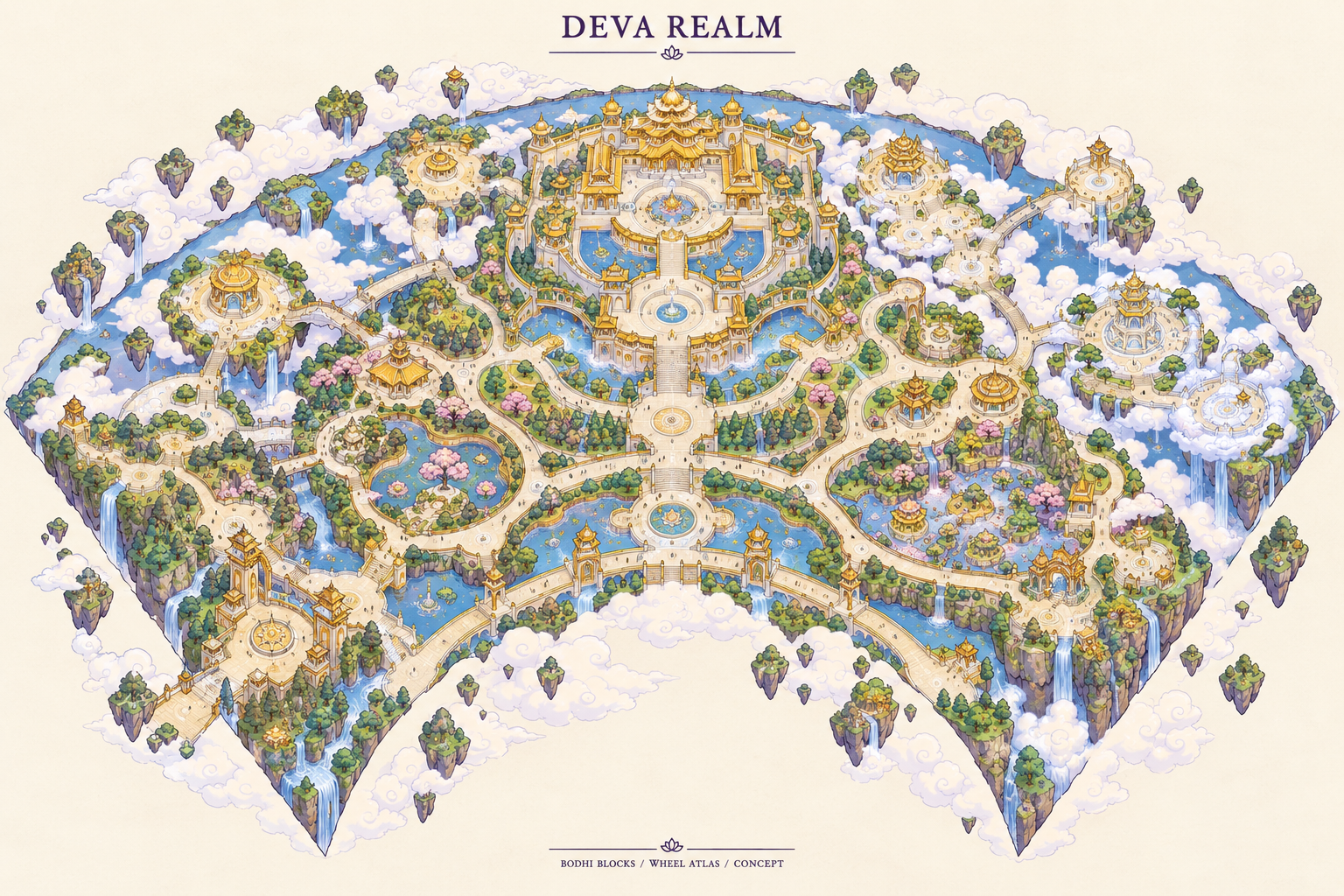
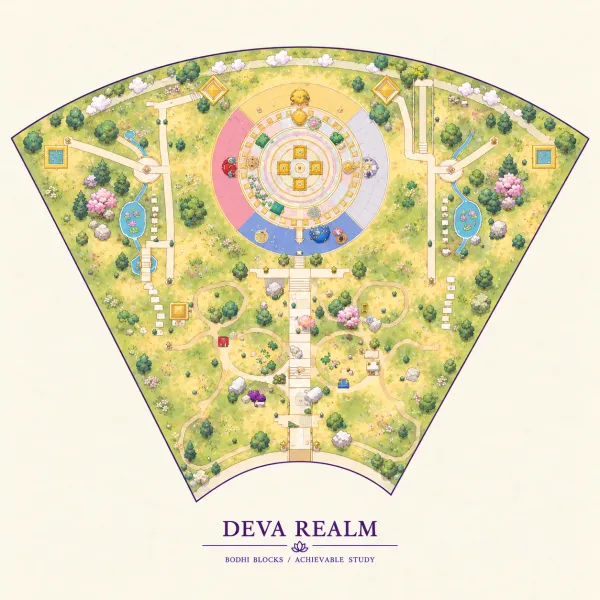
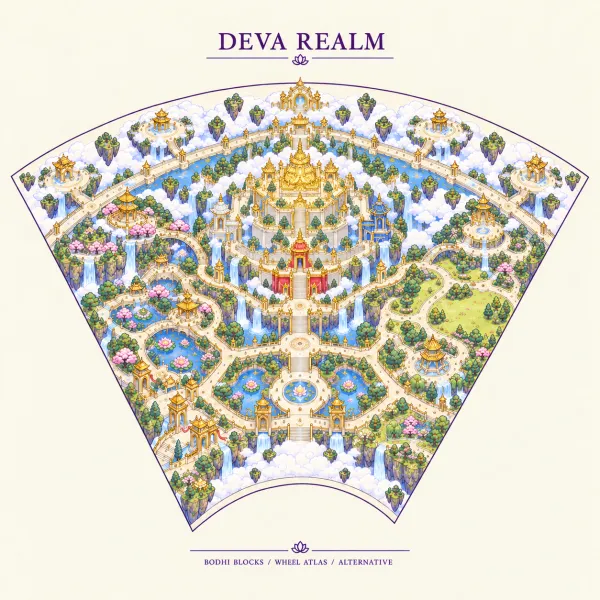
What canon says about each realm of the Wheel and the lands beside it: Jambudvīpa and the four continents, the animal realm, the hidden lands, the heavens on and above Meru, the asuras, the hungry ghosts, the hells, the hub and rim of the Wheel, the dark and the bardo, the charnel grounds, Tanaduk and the pure lands. Each topic carries every piece of art that shows it and a zoomed crop where the art shows it only in part. Gathered 2026-10-30 for the overworld layout studies: lore first, then layout. The checklist follows at What the game has.
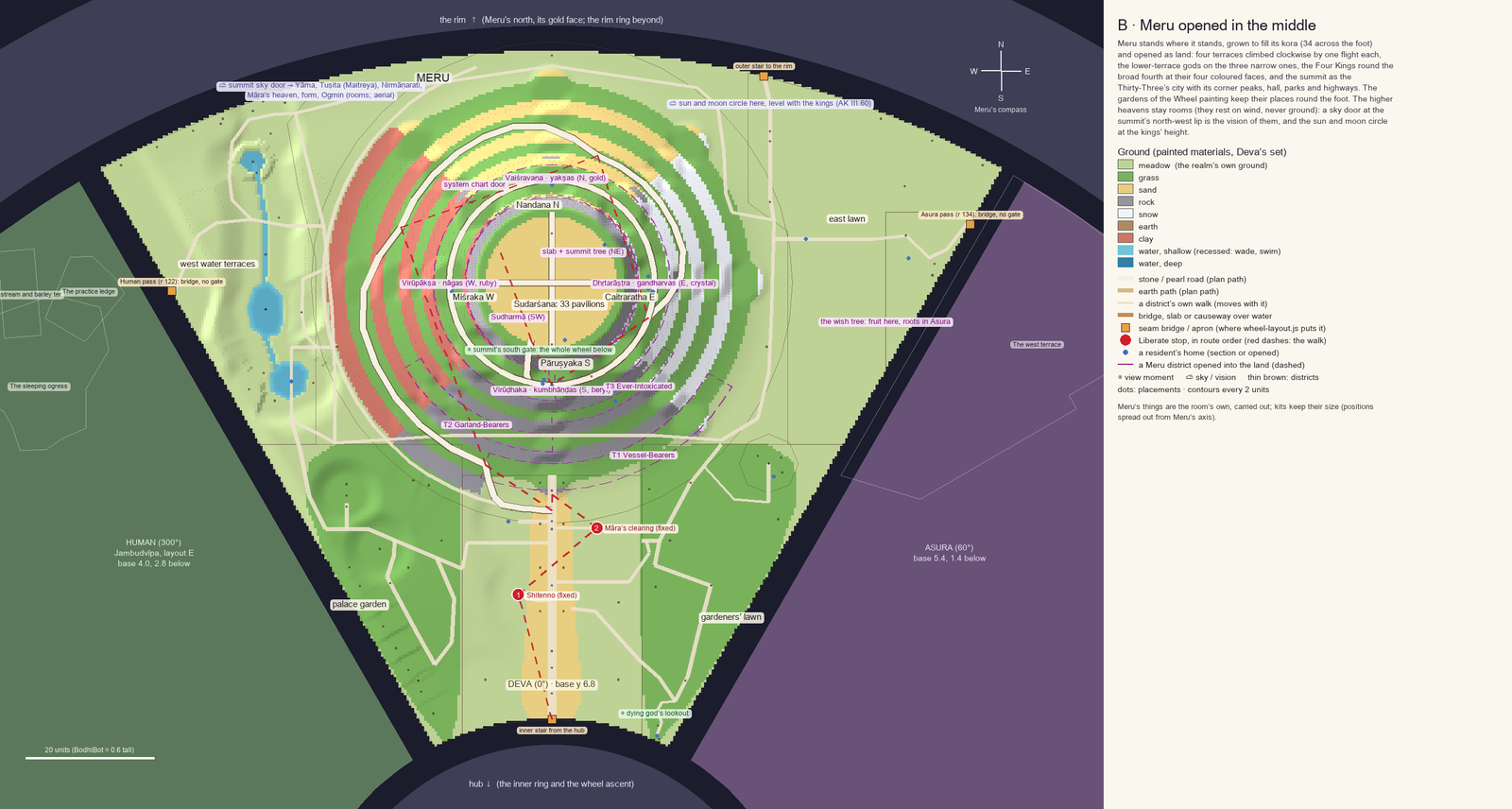
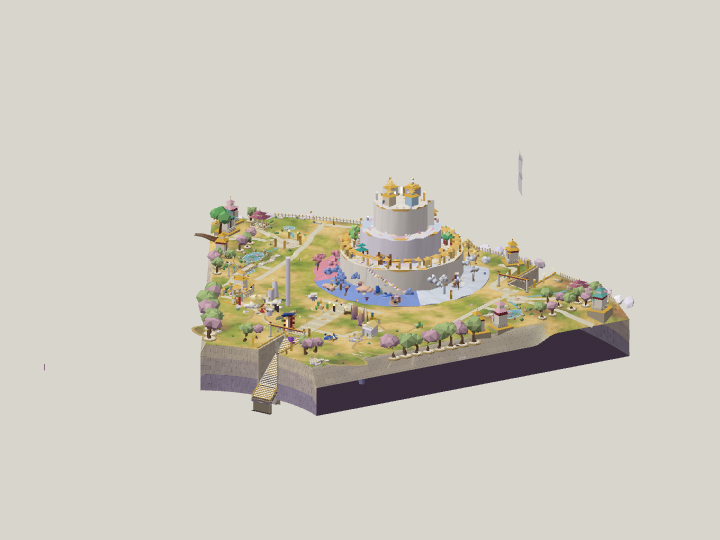
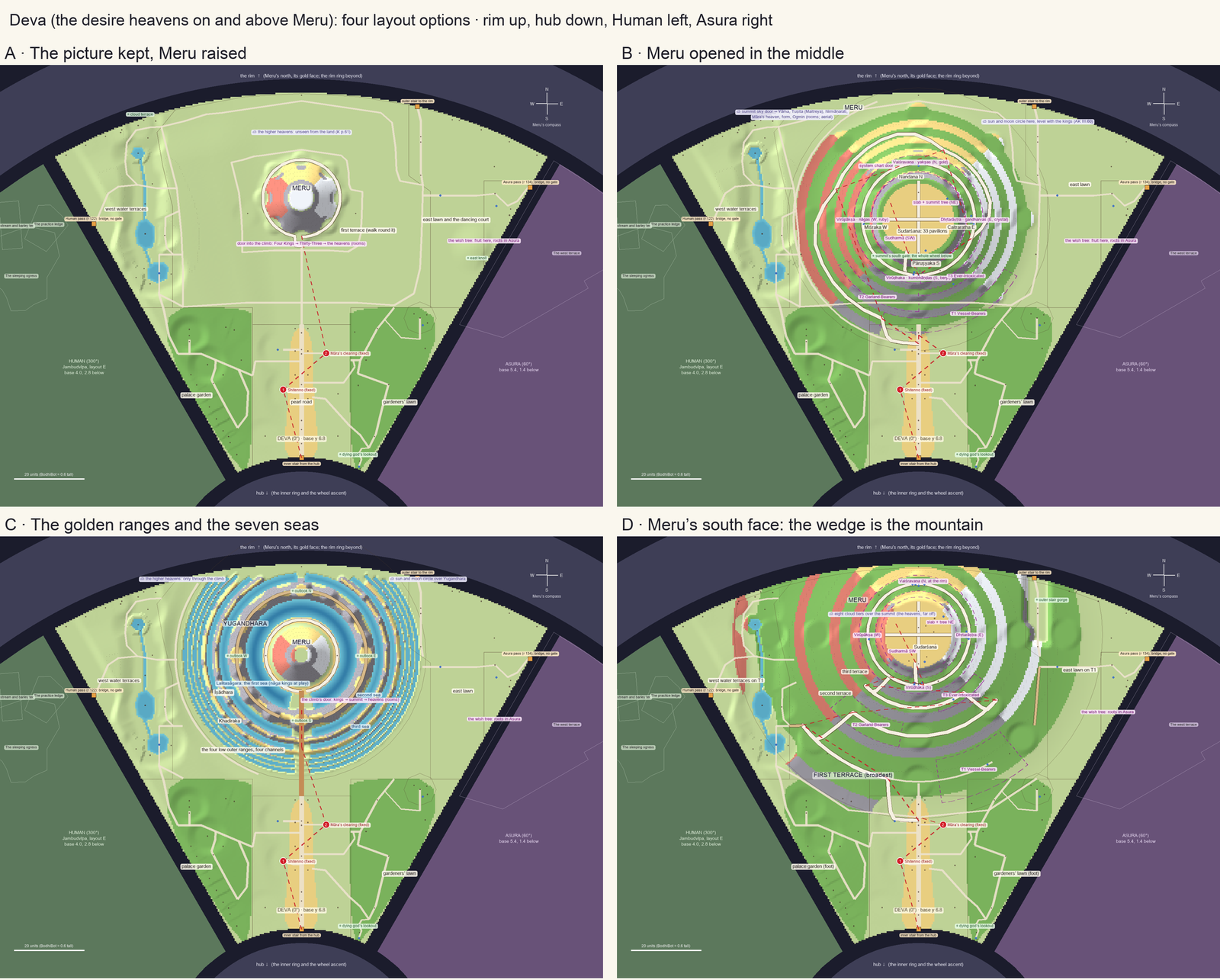
Chosen layout: B · Meru opened in the middle
Meru grows to fill its kora and opens as land: four terraces climbed clockwise, the Four Kings at their coloured faces and the Thirty-Three's city on the summit, while every garden of the Wheel painting stays where it is. The higher heavens stay unseen, reached through a sky door on the summit.
The gods' mountain: Meru, the Four Kings and the Thirty-Three
Canon builds the lowest two heavens on Meru itself: the Four Great Kings and their gandharvas, kumbhāṇḍas, nāgas and yakṣas on the fourth of the mountain's four terraces, with the sun and moon circling at that height, and the Thirty-Three on the flat summit in Śakra's golden city with its palace, four parks, wishing tree, white stone slab and round assembly hall. This group gathers what Vasubandhu, Phagpa, Kongtrul, the Mindfulness sūtra and the practice texts fix about those places, how gods are born, measured, fight the asuras and die, and every painting that shows them, so the Deva realm and the Meru climb can be laid out from it. The heavens above the summit are another agent's.
Meru, the gods' mountain
Skt. Sumeru / Meru; Tib. ri rab (Rirab), ri rgyal lhun po
A square mountain of four jewels, eighty thousand leagues above the sea and as many below, whose four faces colour the sky on each side.
Meru stands at the centre of the world. It rises eighty thousand leagues above the ocean and reaches eighty thousand leagues below it, resting with the seven golden ranges, the four continents and the iron rim on the golden disc called Mighty. It is square: seen from above it is four square slabs, each smaller than the one below.
Each face is one substance. In Kongtrul's account the eastern face is crystal, the southern blue beryl, the western ruby and the northern gold, and the sky on each side reflects that colour: this is why the sky over Jambudvīpa, the southern continent, is blue. Phagpa gives silver for the east and crystal for the west; Vasubandhu says only that Meru is made of four jewels.
Because Meru's faces colour the water too, the one outer ocean looks white in the east, blue-green in the south, red in the west and yellow in the north, and is spoken of as the four seas.
From the sea up to half its height Meru carries four terraces, where the lowest gods live; its summit is the Heaven of the Thirty-Three. The sun and moon circle Meru at half its height. Everything above the summit floats in the sky and is another agent's subject.
What canon fixes for the map
Square, four square slabs of decreasing size; 80,000 leagues above the sea, 80,000 below [K p. 22; AK III.48-50; P printed p. 12].
Faces: east crystal, south blue beryl, west ruby, north gold; the sky each side takes the colour [K p. 22]. Variant: east silver, west crystal [P printed p. 12; HAR Sumeru page also records a Kagyu variant with emerald north].
The outer ocean is white east, blue-green south, red west, yellow north from the faces' colours [P printed pp. 12-13].
Four terraces from sea level to half the height [K p. 22; AK III.63-64; P printed p. 17].
Summit: the Thirty-Three; sides 80,000 leagues, or by other masters 20,000 a side [AK III.65 and bhāṣya].
Sun and moon at mid-Meru, i.e. level with the top of Yugandhara [AK III.60; P printed p. 16].
Meru's base is surrounded by sixty thousand mountains; its surface measures 84,000 leagues; cascades, ponds and lotus pools on it [GMS 4.A.4].
In the game now
D1 opens lower Meru into the continuous Deva terrain: a square four-jewel mountain (east crystal, south blue beryl, west ruby, north gold), base y6.8, summit y22.8 and corner peaks y25.8. The old round stand is retired with forwarding records. Lower districts now address deva.terrace-1/2/3, deva.kings-terrace and deva.summit; higher desire/form heavens, Tuṣita, tower and system chart remain separate rooms. Source verification: Kongtrul PDF22; AK III.63–64 and bhāṣya, Pruden PDF118 (extracted printed462, differing from the older printed464 locator); Phagpa PDF31 (extracted printed18, differing from older printed17). Compression is in scale and the functional clockwise ascent, not square shape or terrace ratios. D2/D3 still own final summit architecture and missing beings; D1 is not realm acceptance.
Art (10)
Meru's body, its stepped terraces and the summit, with the heavens drawn as Buddhas above
Skt. pariṣaṇḍa (terrace); Karoṭapāṇi, Mālādhara, Sadāmatta/Sadāmada; Tib. lag na gzhong thogs, phreng thogs, rtag myos
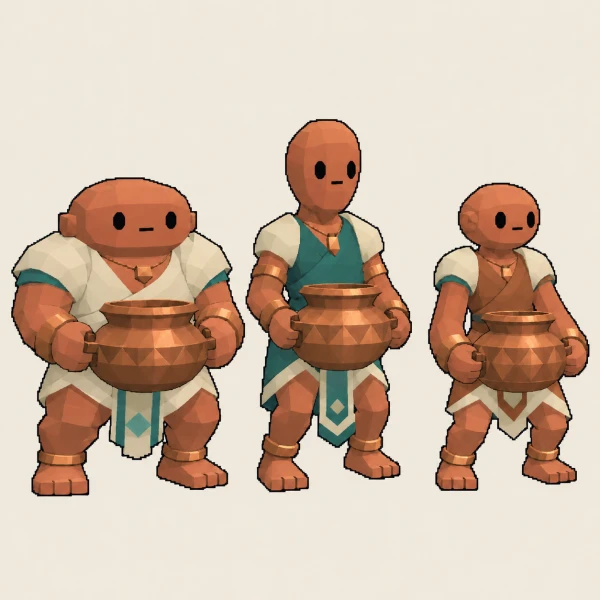
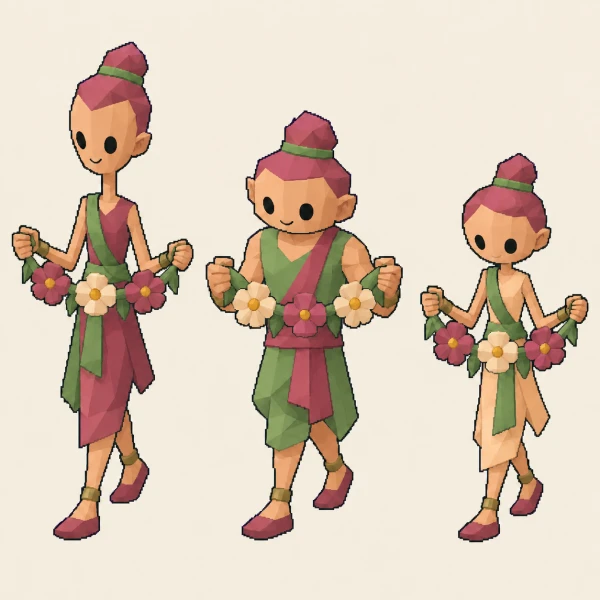
Four terraces step up the lower half of Meru, each ten thousand leagues above the last: Vessel-Bearers, Garland-Bearers, the Ever-Intoxicated, and on the fourth the Four Great Kings.
Four terraces ring Meru from the water up to its middle. The first is ten thousand leagues above the sea and juts sixteen thousand leagues out from the mountain; the second, another ten thousand up, juts eight thousand; the third four thousand; the fourth two thousand. So the mountain is widest low down and the terraces narrow as they climb.
The lowest gods live on them, all of the class of the Four Great Kings. On the first terrace are the Vessel-Bearers (yakṣas with a pitcher in hand), on the second the Garland-Bearers, on the third the Ever-Intoxicated. Their kings, the Four Great Kings, live in the four directions of the fourth terrace with their attendants.
The Mindfulness sūtra treats the garland bearers as the first subclass, living on all four sides of Meru with different names by direction, and gives the war-roles of the lower gods: when the asuras march, the garland bearers, the ever-infatuated, the vessel bearers and the triple-lute-bearers climb to the summit of the beryl mountain and take up positions, proud that they often beat the asuras without Śakra's help.
The gods of this class are the most numerous of all gods. They do not keep only to Meru: they have villages and towns on the seven golden ranges, and may dwell wherever suits them, in space or on the ranges like Yugandhara.
What canon fixes for the map
Terraces at 10,000, 20,000, 30,000 and 40,000 leagues above the water, jutting 16,000 / 8,000 / 4,000 / 2,000 leagues [AK III.63-64 and bhāṣya; P printed p. 17; K p. 22].
Terrace 1 Vessel-Bearers, terrace 2 Garland-Bearers, terrace 3 Inebriates, terrace 4 the Four Kings in the four directions [K p. 30; AK bhāṣya III.64 (Pitcher-in-hand, Wearers of garlands, Always Intoxicated); P printed p. 28 (Karoṭapāṇi, Mālādhāra, Sadāmada)].
GMS names garland bearers first and adds triple-lute-bearers; they climb to the summit to meet the asuras [GMS 4.A.2; 3.271].
Also on the seven golden mountains; most numerous gods [AK bhāṣya III.64]; may dwell in space or on Yoke and the others [K p. 30].
Who lives here
Vessel-Bearers (Karoṭapāṇi): yakṣa-gods of the first terrace [AK, K, P].
Garland-Bearers (Mālādhara): gods of the second terrace [AK, K, P].
The Ever-Intoxicated (Sadāmatta/Sadāmada): gods of the third terrace [AK, K, P].
Triple-lute-bearers: a fourth lower group in the war muster [GMS 3.271].
In the game now
D1 seats the existing three named terrace populations and their tableaux outdoors in deva.terrace-1/2/3, with the existing Four Kings and retinues on deva.kings-terrace. Four levels are at 1/8, 2/8, 3/8 and 4/8 of the exposed height (world y8.8/10.8/12.8/14.8 above base6.8). Juts 16:8:4:2 are measured from a common square core: core half-width10, juts17.6/8.8/4.4/2.2. AK III.63–64 and bhāṣya, Pruden PDF118 (extracted printed462; old locator464), Phagpa PDF31 (extracted printed18; old locator17), and Kongtrul PDF22/30 verified. Saved lower-room records remain with forwardTo; they no longer expose duplicate active lower floors. Sun/moon chariots sit at fourth-terrace/mid-Meru height and turn clockwise only on proximity/passing or realm freedom, never idle.
Art (7)
Meru's faces and terraces with the Four Kings' pavilions
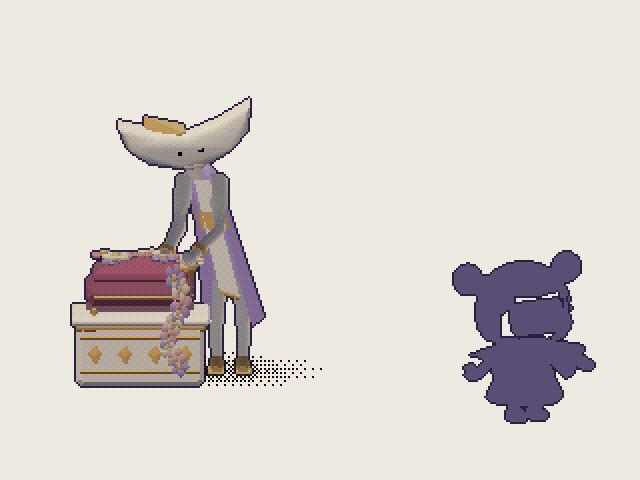
The lowest heaven: four kings on Meru's fourth terrace, east, south, west and north, each with his own people: gandharvas, kumbhāṇḍas, nāgas and yakṣas.
On the fourth terrace of Meru the Four Great Kings live in the four directions. Dhṛtarāṣṭra in the east rules the gandharvas, the scent-eating musicians; Virūḍhaka in the south the kumbhāṇḍas; Virūpākṣa in the west the nāgas; Vaiśravaṇa in the north the yakṣas. Together with everyone of their class on the terraces, the golden ranges, the sun, moon and stars, the iron rim, the mountains of Jambudvīpa and the tāla trees, they form one company.
Phagpa gives them fortresses on the first golden range, Yugaṃdhara: Aṭakāvatī in the north for Vaiśravaṇa and his yakṣas, Excellent in the east for Dhṛtarāṣṭra and his gandharvas, Various Forms in the west for Virūpākṣa and his nāgas, and Virūḍhaka in the south for Virūḍhaka and his kumbhāṇḍas. Kongtrul puts the kings on the fourth terrace and lets their households dwell wherever suits them.
They are the world's guardians. When the asuras rise from under the sea they are met first by the nāgas, then by the Vessel-Bearers, Garland-Bearers and the Ever-Intoxicated, and then by the Four Kings leading their four armies in precious armour; usually they win, and when they cannot hold they go up to Śakra. Śakra also sends them down into Jambudvīpa to find out whether people are faithful, honest and dutiful to their parents, and they carry the report back up the heavens.
Fifty human years make one of their days; they live five hundred such years, and stand a quarter of a krośa (earshot) tall. Giving up killing is the discipline that brings birth among them.
What canon fixes for the map
Kings in the four directions of the fourth terrace [K p. 30; AK bhāṣya III.64]. Variant: fortresses on Yugaṃdhara: Aṭakāvatī north, Excellent east, Various Forms west, Virūḍhaka south [P printed pp. 28-29].
Retinues: east gandharvas, south kumbhāṇḍas, west nāgas, north yakṣas [P printed pp. 28-29; K p. 30 by implication of 'their kings'].
One company spread over terraces, golden ranges, sun, moon, stars, Cakravāḍa, Jambudvīpa's mountains and tāla trees [P printed p. 29].
Day = 50 human years; life 500 years; height a quarter krośa [AK III.76, III.79; K p. 48; P printed p. 29; DT PDF p. 91].
Order of defence against the asuras: nāgas, lower terraces, Four Kings, then Śakra [P printed pp. 27-28]; the kings carry news up through the heavens [GMS 2.234; 3.134].
Birth there comes from giving up killing [GMS 4.A.415].
Who lives here
Dhṛtarāṣṭra, king of the east, lord of gandharvas [P, K].
Virūḍhaka, king of the south, lord of kumbhāṇḍas [P, K].
Virūpākṣa, king of the west, lord of nāgas [P, K].
Vaiśravaṇa (Kubera), king of the north, lord of yakṣas, god of wealth [P, K note 23].
The gandharvas, kumbhāṇḍas, nāgas and yakṣas of the four quarters [P].
In the game now
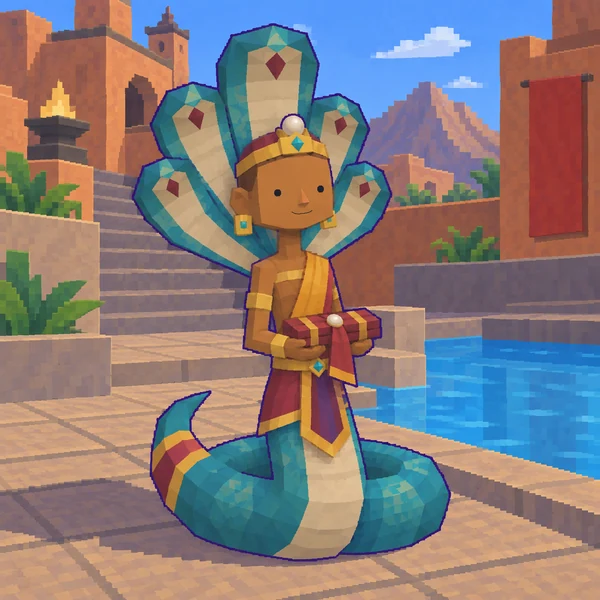
Built: being:four-kings:dhritarashtra, :virudhaka, :virupaksha, :vaishravana on meru.four-kings in their directions (east crystal, south blue, west ruby, north gold), with being:four-kings:gandharvas, :kumbhandas, :nagas, :yakshas; sketch: three named gandharvas, three kumbhāṇḍas, a court nāga, three yakṣas and the treasury mongoose (companion-mongoose) at Vaiśravaṇa's feet. The Liberate being 'The Shitenno' (being:liberate-the-four-kings-huddled) on deva.pearl-road is Josie's design. place:desire:four-kings built; being:iron:cakravada/beings (the kings' company on the iron rim) missing.
Art (13)
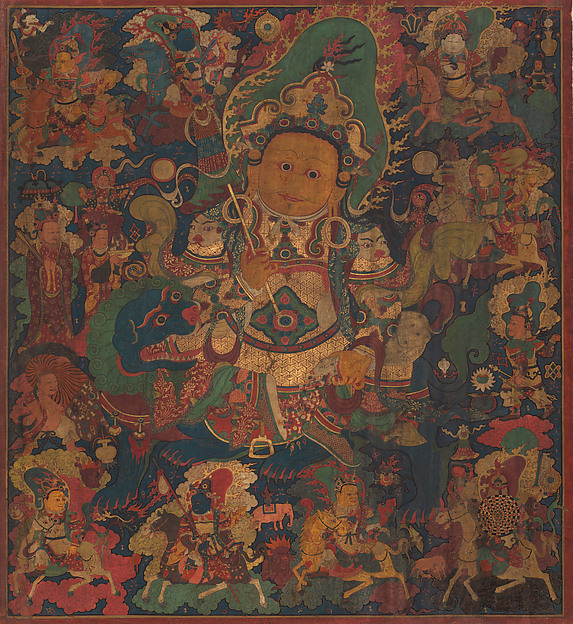
two of the Four Kings on the left (one with the lute: the eastern king of the gandharvas)
Himalayan Art Resources · traditional · No open licence (link only)
Forty-one paintings of the kings; look at the door-guardian murals and the Sixteen Arhats sets.
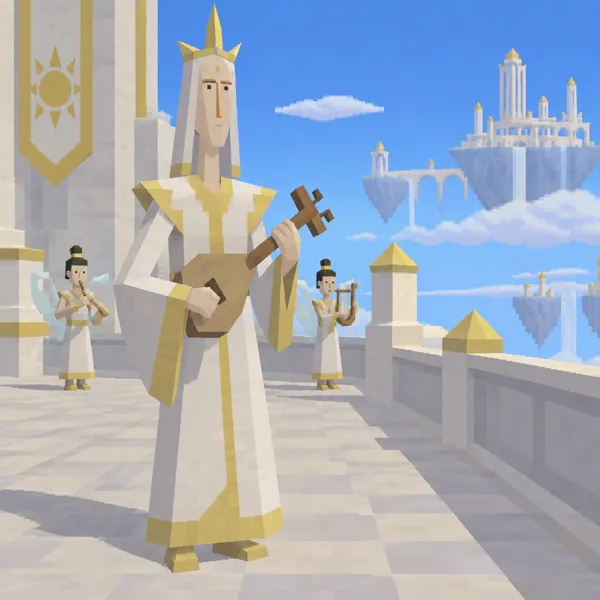
Dhṛtarāṣṭra: concept
AI concept study (repo) · concept · Project art
Eastern king with his lute.
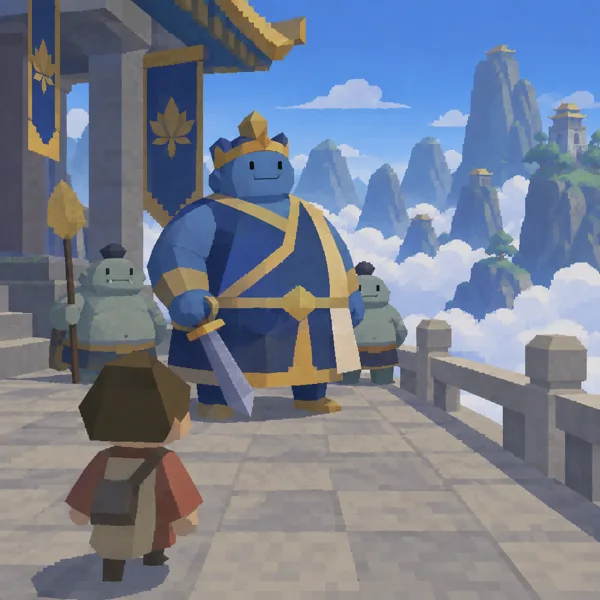
Virūḍhaka: concept
AI concept study (repo) · concept · Project art
Southern king.
Virūpākṣa: concept
AI concept study (repo) · concept · Project art
Western king.
Vaiśravaṇa: concept
AI concept study (repo) · concept · Project art
Northern king.
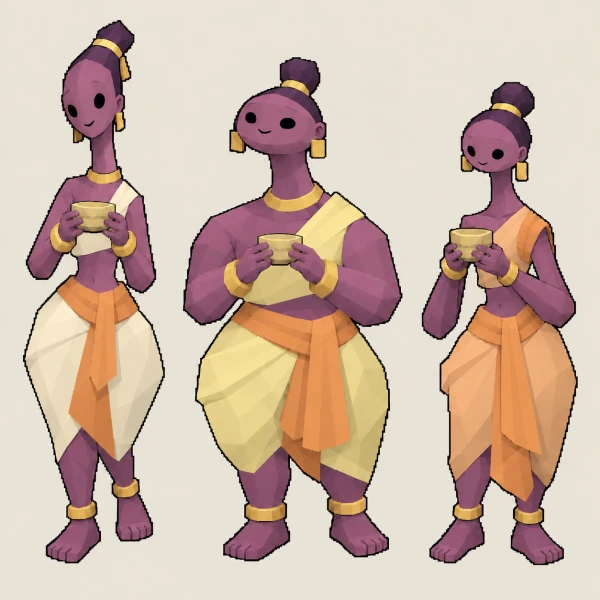
Gandharva musician: concept
AI concept study (repo) · concept · Project art
Retinue of the east.
Yakṣa: concept
AI concept study (repo) · concept · Project art
Retinue of the north.
Nāga: concept
AI concept study (repo) · concept · Project art
Retinue of the west.
Still missing: No open-licence painting of Phagpa's four fortresses on Yugaṃdhara; the kumbhāṇḍas have no concept of their own (the game reuses the medicine-yakṣa general's).
The seven golden ranges and the seas between, as the gods use them
Skt. Yugandhara, Īṣādhara, Khadiraka, Sudarśana, Aśvakarṇa, Vinataka, Nimindhara; Tib. gnya' shing 'dzin, gshol mda' 'dzin, seng ldeng can, blta na sdug, rta rna, rnam 'dud, mu khyud 'dzin; seas of enjoyment, Sītā
Seven square golden ranges, each half the height of the one inside, with seven sweet seas between them; the Four Kings' people keep villages on them and the nāga kings play in the seas.
Round Meru, like curtains, stand seven golden mountain ranges, each square and each half as high as the one within: Yoke (Yugandhara, 40,000 leagues), Plough (20,000), Acacia Forest (10,000), Pleasing-to-the-Eye (5,000), Horse's Ear (2,500), Bending (1,250) and Rim-Holder (625). Each is as wide as it is high above the water.
Between them lie seven seas of enjoyment, filled with water of eight qualities, each half as wide as the one inside: 80,000 leagues for the first. The seas are named for the ranges. Phagpa calls the water between the golden ranges Lalitasāgara, where the nāga kings amuse themselves; the Sītā seas of some accounts are these inner seas, as against the salt ocean outside.
For the heavens the ranges matter because the Four Kings' people live on them: Vasubandhu says they have villages and towns on Yugandhara and the rest, Kongtrul that they may dwell on any of the seven. Phagpa's four royal fortresses stand on Yugandhara, whose top is level with the sun and moon. When the gods win a battle they chase the asura chariots as far as the first sea.
Above Yugandhara there is no sun or moon, so the gods' day and night are told by flowers that open and close, by birds that sing or fall silent, and by sleep; and the gods themselves give light.
What canon fixes for the map
Seven square golden ranges, halving in height from 40,000 to 625 leagues; width equal to height above water [K p. 22; P printed p. 12; AK III.48-52].
Seven seas between, water of eight qualities, halving in width from 80,000 leagues [P printed p. 12; K p. 22].
Lalitasāgara, the nāga kings' playground, between the golden ranges [P printed p. 12].
Four Kings' villages and towns on the ranges [AK bhāṣya III.64]; Phagpa's fortresses on Yugaṃdhara [P printed pp. 28-29].
No sun or moon above Yugandhara: day told by flowers, birds and sleep [AK bhāṣya III.80].
Victorious gods pursue the asuras to the first sea [P printed p. 28].
Who lives here
The nāga kings at play in Lalitasāgara [P].
The distinct aquatic inhabitants of the seven seas [K p. 22, samsara being:meru:inner-seas/beings].
In the game now
Built: the ranges and seas as rings of the walkable chart meru.system (claim meru.system.ranges, after Dudjom); place:sun-moon:above-yoke ('Day and night above Yoke, told by flowers') built; place:naga-palace:lalitasagara and being:meru:inner-seas/beings missing. The chart's concentric circles are the game's simplification of square ranges (ledger 'meru').
The sun and moon circle Meru halfway up, level with the top of Yugandhara and the fourth terrace; the gods who live in their palaces belong to the Four Kings' class.
At mid-Meru, forty thousand leagues up and level with the top of the first golden range, the sun and moon go round the mountain on a firm circle of wind, together with the stars. The sun's disc is fire crystal, fifty-one leagues across; the moon's is water crystal, fifty leagues. Each has a golden rim and four spires and is a palace where the sun god or moon god lives with his retinue.
Those gods are of the class of the Four Great Kings: Vasubandhu says the inhabitants of the houses of the sun, moon and stars are Cāturmahārājakāyikas, the only gods of that class who live in houses in the sky, while a great number of them live on the terraces of Meru. In Phagpa's list the sun, moon and stars are among the places where the Four Kings' company dwells.
Because the sun circles below the summit, the heavens above Yugandhara have no sun or moon: their light is the gods' own. The Four Kings' terrace, at the sun's own height, is where a visitor could see the sun and moon pass at eye level.
What canon fixes for the map
Sun and moon at mid-Meru; moon 50 leagues, sun 51 [AK III.60]; forty thousand leagues up on a circle of wind [P printed p. 16].
Their inhabitants are gods of the Four Kings' class, in houses [AK bhāṣya before III.63, PDF p. 118; P printed p. 29].
No sun or moon above Yugandhara [AK bhāṣya III.80].
Variant: the Dīrgha Āgama sets the sun palace 42,000 leagues up (repo populations ledger, sun-moon note).
Who lives here
The sun god 'Quickness and 1,000 Rays' and his retinue [DA via repo ledger sun-moon:sun-god].
The moon god and his blue-robed ministers [DA via repo ledger sun-moon:moon-god, moon-ministers].
In the game now
Built: place:sun-moon:sun and place:sun-moon:moon as chariots circling the meru.system chart at about Yoke's height, clockwise as she walks; being:sun-moon:sun-god, :moon-god, :moon-ministers, :sky-gods, :planets missing.
Art (4)
the sun (three-legged bird) and moon (hare) beside Meru's foot
Repo ledger: docs/purelands-lore-populations.json, entry sun-moon (items sun-moon:sun, sun-moon:moon and their DA notes)
The summit of Meru and the city Sudarśana
Skt. Trāyastriṃśa, Sudarśana; Tib. sum cu rtsa gsum, lta na sdug (Lovely)
On Meru's flat summit, with a yakṣa-guarded peak at each corner, stands the golden city Lovely: 2,500 leagues a side, soft as cotton underfoot, four gates each kept by five hundred armoured young gods.
The Heaven of the Thirty-Three is Meru's summit, a plateau eighty thousand leagues on a side (other masters say twenty thousand a side and eighty thousand round). At its four corners stand four peaks, five hundred leagues high and wide, where the yakṣas called Vajrapāṇi, the secretive vajra-holders, live. Kongtrul's note adds why they are there: they keep the playing gods and goddesses from falling off the edge of the mountain.
In the middle of the plateau is Śakra's royal city Sudarśana, Lovely or Beautiful to Behold. It is square, two thousand five hundred leagues on each side and ten thousand round, one and a half leagues high, of gold, walled in gold and adorned with a hundred and one kinds of jewel. Its ground is soft as cotton and gives under the foot and rises again as one walks.
Sixteen thousand jewelled pillars stand along its four sides, with precious beams, rafters and eaves. It has four great gates and nine hundred and ninety-nine lesser ones; by the four gates five hundred gods in solid armour keep guard. Four highways cross it and smaller streets run between.
Everything else of the heaven stands in relation to this city: the palace at its centre, the four parks outside it, the wishing tree to its north-east and the assembly hall to its south-west.
What canon fixes for the map
Summit 80,000 leagues a side, or 20,000 a side by other masters [AK III.65 and bhāṣya].
Four corner peaks 500 leagues high and wide, home of the Vajrapāṇi yakṣas [AK bhāṣya III.65; K p. 33; P printed p. 17 (4.5 high, 125 wide, 500 round)].
City: 2,500 leagues a side, 10,000 round, 1.5 high, of gold, 101 colours, cotton-soft ground [AK III.66; K p. 32; P printed p. 17].
16,000 jewelled pillars; four gates and 999 small gates; 500 armoured gods at each gate; four highways [P printed p. 17; K p. 32].
Kongtrul's verse list of the summit's features: the Victorious Residence, the city Lovely, parks, playing fields, the All-gathering Tree, the stone slab, the Assembly Hall of the Excellent Law, the yakṣas' dwelling [K p. 30].
Who lives here
The Vajrapāṇi yakṣas of the four corner peaks [AK, K, P].
Five hundred armoured gate-guards at each gate [K, P].
In the game now
D1 opens existing summit homes, living residents, four park courts, tree/slab and teaching hall into deva.summit at y22.8, with corner peaks y25.8. The existing 33 represented living gods retain identities; this is an authored staging allocation, not a textual census. Kongtrul PDF32 establishes parks east/south/west/north, tree/slab northeast and hall southwest; the sky door is northwest by the chosen functional layout. D2 builds missing Vaijayanta and finishes summit architecture; D3 builds missing guards/corner yakṣas/dying and revelling gods and owns Śacī with Śakra in Vaijayanta. Existing rigs at the bar receive no geometry change. Higher aerial heavens remain rooms; no bodily formless settlement is added.
Art (8)
the summit palace of Sudarśana with the lord of the Thirty-Three inside
Wellcome Collection (repo copy, media.json painting-wellcome-L0069380) · traditional · Public Domain Mark
Wheel paintings compress the city to one palace on the top of the god sector.
The living summit assembly: concept
AI concept study (repo) · concept · Project art
Authored ensemble of the summit's residents.
The summit pavilion devas: concept
AI concept study (repo) · concept · Project art
Authored.
Still missing: No painting shows the four corner peaks, the gates with their guards, or the city's plan; Meru paintings reduce the summit to one palace.
Skt. Vaijayanta, Śakra / Indra / Kauśika; Tib. rnam par rgyal ba'i khang bzang (the Victorious Residence), brgya byin
At the centre of Lovely stands Śakra's square palace of a hundred and one turrets, where he lives with Śacī and the goddesses, his two elephants, his horse, a drum that preaches and a vase against death.
In the middle of the city is Vaijayanta, the Victorious Residence, which makes every other house blush by its richness and gems. It is square, two hundred and fifty leagues on a side and a thousand round, four and a half leagues high. A hundred and one jewelled turrets ring it; Phagpa unfolds them: for each turret seven pavilions, for each pavilion seven smaller ones, for each of those seven ponds, in each pond seven lotuses, on each lotus seven boys and girls making music, singing and dancing.
Here Śakra, lord of the gods, lives with his asura wife Śacī and many apsarases, tirelessly enjoying their desires. Of the twelve sun-gods he is the chief, called the Powerful One; the other thirty-two chiefs are 'Nearly as Powerful'. He has two royal elephants, each seven leagues round with eight thousand lesser elephants: Supratiṣṭhita, which he rides to war, and Airāvaṇa, which he rides in the parks (in the Mindfulness sūtra he rides Airāvaṇa to war too). His royal horse Balāhaka lives with eight thousand horses.
When the gods grow heedless a great celestial drum sounds by itself: all formations are impermanent, impure, painful; all things are without self; their stilling is happiness. Kongtrul lists the heaven's other wonders: the drum that proclaims the four seals, the vase of ambrosia that keeps the gods from sickness, ageing and untimely death, the elephants Sturdy and Son of the Land Guardian, the horse Thunder-Cloud with hundreds of thousands of attendants.
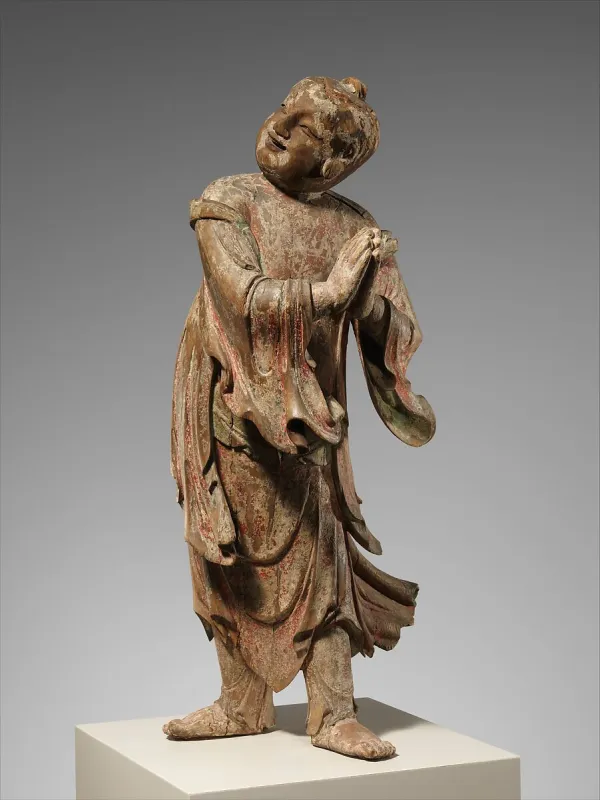
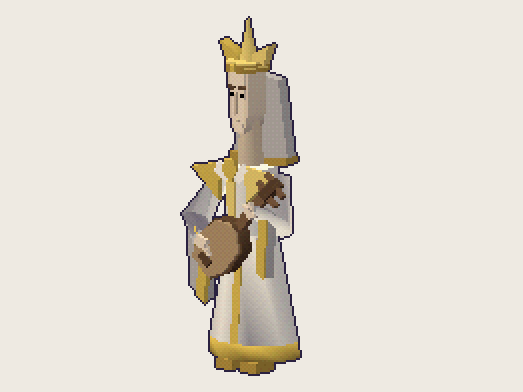
In Wheel of Life paintings Śakra appears in this palace playing a stringed instrument; HAR notes he is often misread as Sarasvatī there. Some traditions take that lute-player to be the Buddha's emanation among the gods, the Muni of the gods.
What canon fixes for the map
Vaijayanta square, 250 leagues a side, 1,000 round [AK III.67; P printed p. 18]; 4.5 leagues high [P; K p. 32]. Kongtrul's commentary gives 50 leagues a side, a figure that disagrees with AK and P.
101 jewelled turrets; sevens of pavilions, ponds, lotuses and dancing children [K p. 32; P printed p. 18].
Śakra with Śacī and the apsarases; elephants Supratiṣṭhita (war) and Airāvaṇa (parks), seven leagues round, 8,000 each; horse Balāhaka with 8,000 horses [P printed p. 29].
Śakra chief of the twelve suns; thirty-two 'Nearly as Powerful' [K p. 30]; thirty-two assisting officials [P printed p. 29].
The self-sounding drum; the vase of ambrosia; elephants Sturdy and Son of the Land Guardian; horse Thunder-Cloud [K p. 33; P printed p. 29].
Airāvaṇa's hundred heads and ten tusks each, lotus pools on the tusks, used to carry all the gods to the parks [GMS 4.B.246]; his own pool of pink and blue lotuses [GMS 3.371].
Who lives here
Śakra (Indra, Kauśika), lord of the Thirty-Three [all sources].
Śacī, his asura wife [P printed p. 29].
Airāvaṇa and Supratiṣṭhita, his elephants [P; GMS].
Balāhaka, his horse [P] (not the cloud-horse Bālāha of Avalokiteśvara's rescue story).
Mātali, his charioteer [GMS 3.295].
The apsarases and goddesses of the palace [P; GMS 4.B.5: nine million nine hundred thousand goddesses to each god].
In the game now
Built: being:shakra sits in the summit teaching hall at the head of its eight cushions (meru.thirty-three; the plan notes his saved anchor is wrong and should move off the form terrace). The deva Muni with his lute (overworld:munis:5, statue-muni-deva concept) stands on deva.pearl-road and is kept separate from Śakra, as the repo's iconography decisions require. No Vaijayanta, Śacī, elephants, horse, drum or vase yet; the 'garden palace' (deva-palace) with its 33 doors is an authored interior in the Deva wedge, not Vaijayanta.
Art (9)
the god sector, top: Śakra's palace with the lute-player, the wish tree, the war with the asuras on the right
The four parks: Caitraratha, Pāruṣyaka, Miśraka, Nandana
Skt. Caitraratha (east), Pāruṣyaka (south), Miśraka (west), Nandana (north); Tib. shing rta sna tshogs, rtsub 'gyur, 'dres pa, dga' ba
Outside the city's four sides lie four parks, each a thousand leagues round, with fields of play twenty leagues beyond them: chariots to the east, armour to the south, mixed pleasures to the west, delight to the north.
The city is adorned outside by four parks, the gods' fields of play. East of Lovely is the Park of Various Chariots, Caitraratha, where all ride; south is Pāruṣyaka, the Park of Armoury, the place of those who go into battle; west is Miśraka, the Park of Various Activities, for every kind of behaviour; north is Nandana, the Park of Delights, for merriment. Each is a thousand leagues round.
Twenty leagues beyond each park lies a fine ground of the same size and name, a marvellous field of play that seems to rival its park; Vasubandhu calls them excellent grounds with a wonderful soil.
The parks are where the war begins and ends: the gods take their chariots in Caitraratha, steel themselves in Pāruṣyaka, and after victory lay their armour and weapons down again in Caitrarathavana. The Mindfulness sūtra describes a great park of gold, silver, beryl, sapphire and ruby trees with songbirds and lotus ponds where Airāvaṇa plays with his cows, and a forest of flowers that never wither, one coloured like moonlight and one like sunlight.
Kongtrul's verse also names 'playing fields' bordering the parks, and a drum, elephants and the vase among the heaven's wonders; Śakra tours the forests with all the gods and goddesses riding on Airāvaṇa's emanated heads.
What canon fixes for the map
Caitraratha east, Pāruṣyaka south, Miśraka west, Nandana north; each 1,000 leagues round [K p. 32; P printed p. 18; AK III.67-68].
Grounds of the same names and size 20 leagues beyond each park [P printed p. 18; AK III.68 and bhāṣya].
Caitraratha: chariots; Pāruṣyaka: those going into battle; Miśraka: all behaviour; Nandana: merriment [P printed p. 18].
Chariots taken in Caitraratha and armour left there after the war [P printed p. 28; GMS 3.371].
A park of jewel trees with ponds for Airāvaṇa; flowers that never wither, moonlight and sunlight blooms [GMS 4.B.74, 4.B.125].
Who lives here
Airāvaṇa and his elephant cows in the park ponds [GMS 4.B.125].
In the game now
Built: meru.thirty-three mentions 'four parks' in its purpose line but no district, name or direction is given to any of them; the Deva wedge's pleasure gardens (deva.palace-garden, deva.west-wing, deva.east-wing with its dancing court) are the Wheel painting's gardens, not these parks (section account).
Art (3)
the god sector, top of the wheel: palaces, gardens and trees
The Pāriyātraka wishing tree and the Pāṇḍukambala stone
Skt. Pārijāta / Pāriyātraka / Pāriyātra, Pāṇḍukambalaśilā; Tib. yongs 'du sa brtol (the All-gathering Tree), ar mo ni ka / a mo li ka (Armoniga), rdo leb
North-east of the city grows the gods' wishing tree, a hundred leagues high with roots fifty deep, and under it lies the square white stone slab, fifty leagues a side, on which Śakra and the Buddha have sat.
Beyond the parks, north-east of Lovely, grows the All-gathering Tree, Pārijātaka, the fully-developed tree. It is a hundred leagues high, its branches reach fifty leagues, its roots go fifty leagues into the earth. It grants wishes, and for the Thirty-Three it is the place above all others for pleasure and love.
Below it lies a square stone slab called Armoniga, which looks like a white woollen blanket: fifty leagues on each side, two hundred round. It is Śakra's seat. In the Dhvajāgrakeyūrā dhāraṇī the Buddha himself is sitting on the Pāṇḍukambala rock in the Heaven of the Thirty-Three when Śakra comes to him routed by the asuras; the sūtra's glossary places the slab under the Pāriyātraka tree.
The Mindfulness sūtra ties the tree to the human world: when the people of Jambudvīpa are righteous it blooms with flowers whose scent carries a hundred leagues and the gods crowd round it delighted; when most people turn from the Dharma its leaves and flowers wither and its light dims, like a winter sun in fog. Then Śakra carries a statue of the Buddha to the tree, the gods worship, and leaf by leaf it blooms again, white as cloud and adorned with bees.
The Wheel of Life's wish tree, rooted among the asuras and fruiting among the gods, is a painter's motif that these sources do not describe; the asuras' grievance in the Mindfulness sūtra is Śakra's delightful city and Sudharma hall, and in Dudjom their jealousy of the gods' splendour.
What canon fixes for the map
Tree north-east of the city, beyond the parks; 100 leagues high, branches 50, roots 50 deep [K p. 32; P printed p. 18; AK III.68 and bhāṣya].
Slab under the tree: square, 50 leagues a side, 200 round, white as a blanket [K p. 32 and note 22; P printed p. 18].
The Buddha seated on the Pāṇḍukambala rock in the Thirty-Three [DDK 1.2; glossary g.9].
The tree blooms or withers with Jambudvīpa's virtue; Śakra brings a Buddha statue to revive it [GMS 4.B.321-332].
The root-and-fruit war of the Wheel paintings is not in these texts [repo populations ledger, asura-tree note; GMS 3.75; DT PDF p. 98].
Who lives here
The gods 'Dwelling by the Pārijāta Tree', one of the thirty-three regions [GMS 4.B.2, 4.B.321].
In the game now
Built: place:asura:armoniga ('the white stone slab under the tree') and the wish tree on the Deva wedge's Asura seam (deva.wish-tree, with the sentry of the fruit missing as a being) following the Wheel painting's root-and-fruit motif. place:windhorse-and-flags:pandukambala (the slab in the Thirty-Three) is missing; being:windhorse-and-flags:shakra-routed sketched. The game thus has the slab under the asuras' tree and not yet on the summit where canon puts it.
Art (6)
the wish tree, trunk in the asura sector, crown among the gods
Repo ledger: docs/purelands-lore-populations.json, entry asura-tree, note on the fruit war
Sudharmā, the assembly hall of the gods
Skt. Sudharmā; Tib. chos bzang (the Assembly Hall of the Excellent Law)
South-west of the city, a round hall nine hundred leagues round with Śakra's golden throne in the middle and the seats of the thirty-two chiefs around it, where the gods hear the Dharma and where the war is proclaimed.
South-west of Lovely is the round Gathering Place Where the Gods Hear the Excellent Law, Sudharmā, nine hundred leagues in circumference. In its centre is the golden throne on which Śakra teaches the law of the gods, and round it the seats of the thirty-two Nearly-as-Powerful chiefs, so that all thirty-three are seated.
The Mindfulness sūtra gives it five hundred leagues, a beryl foundation, coral columns, crystal fences adorned with coral, walls of refined gold studded with diamonds, and jewel thrones set with rubies and sapphires; there Kauśika rules in accordance with the Dharma, and each god who earns a seat there is waited on by a retinue of goddesses with a chief queen among them.
The hall is where the heaven's business happens. When the asuras march, Śakra's seat in Sudharma trembles; he announces the war in Sudharma and at the crossroads of Sudarśana, Airāvaṇa is brought to the hall, and after the victory he rides back to Sudharma and takes his throne again while the gods return home. Some gods are posted at the hall and stay behind when the rest advance.
Birth among the gods 'Dwelling in Sudharma' comes from unbroken sevenfold discipline joined with open-handed generosity to the worthy, to ailing parents and to the noble ones.
What canon fixes for the map
South-west of the city; round; 900 leagues round; golden throne at centre; 32 seats round it [K pp. 32-33; P printed p. 18].
The seat trembles before a war; the war is proclaimed here; Śakra returns to his throne here [GMS 3.288-3.290, 3.371].
Gods Dwelling in Sudharma, first of the thirty-three regions [GMS 4.B.2-4.B.5].
Who lives here
The gods Dwelling in Sudharma and their goddesses [GMS 4.B.5].
The thirty-two chiefs with seats round the throne [K, P].
In the game now
Built: the summit 'teaching hall where he sits' with eight cushions in meru.thirty-three (adaptation; the plan's eight cushions are not canon's thirty-three seats). Not round, not south-west, no measurements.
Art (2)
the Buddha teaching the gods in Tāvatiṃsa; Sakka's palace at the left
Skt. Trāyastriṃśa deva; Tib. sum cu rtsa gsum pa'i lha
Thirty-three groups of gods under thirty-three chiefs: Śakra and thirty-two 'Nearly as Powerful'; the Mindfulness sūtra names the thirty-three regions they live in.
The heaven is named for thirty-three groups of gods. Kongtrul counts their chiefs the Indian way: the eight gods of wealth (the Vasus), the two Aśvins, the eleven wrathful ones (the Rudras) and the twelve suns (the Ādityas). One of the twelve suns, Śakra, rules as the Powerful One; the other thirty-two chiefs are 'Nearly as Powerful'. Phagpa simply says Śakra's assisting officials number thirty-two, so with him they are the thirty-three gods.
The Great Mindfulness Scripture, which Kongtrul quotes, instead lists thirty-three regions of the heaven, each with its own gods: Dwelling in Sudharma, in the Lofty, on Summits, in Excellent View, in One Direction, in Forests, in Various Chariots, in Enjoyment, in Beauty, by the Pārijāta Tree, on Mixed Riverbanks, on Forest Riverbanks, in Essence of Jewels, Engaging in Clarification, House of Refined Gold, Shaded by Garlands, Moving on Springy Ground, Distinguished in Many Colourful Ways, Subtle Engagement, Enraptured by Song, Blazing Splendour, Resembling the Full Moon, Pair of Śāla Trees, Moving in the Wink of an Eye, Fine Complexion and Large Body, Draped with Jewels, Part of the Assembly, Dwelling on the Disk, High Conduct, Supreme Splendour, Garland of Splendour, and Unmixed.
Each region is reached by a particular virtue: Sudharma by discipline with generosity, the Pārijāta region by providing for one's parents, and so on through the list. The sūtra also says the bodies of these gods measure five, four or three leagues according to their deeds.
What canon fixes for the map
Chiefs: 8 gods of wealth, 2 Aśvins, 11 wrathful ones, 12 suns; Śakra one of the suns; 32 'Nearly as Powerful' [K p. 30].
32 assisting officials plus Śakra [P printed p. 29].
The 33 regions by name [K p. 31 quoting GMS; GMS 4.B.2]; the 84000 and Tsadra renderings of the names differ in wording.
Body size 5, 4 or 3 leagues by karma [GMS 2.1035]; Abhidharma gives half a krośa [AK III.76; P printed p. 30].
Who lives here
Śakra, chief of the twelve suns [K].
The eight Vasus, two Aśvins, eleven Rudras, twelve Ādityas as the thirty-three chiefs [K].
The gods of the thirty-three regions, from Dwelling in Sudharma to Unmixed [GMS 4.B.2].
In the game now
Built: being:meru.thirty-three.co-residents (the summit pavilion devas) and the sketch ensemble being:meru.thirty-three.assembly; the thirty-three pavilions are Josie's allocation, with no named groups.
Art (3)
The living summit assembly: concept
AI concept study (repo) · concept · Project art
The game's assembly of the summit, authored.
The summit pavilion devas: concept
AI concept study (repo) · concept · Project art
Authored.
the Buddha teaching the gods in Tāvatiṃsa; Sakka's palace at the left
Skt. devāsura-saṃgrāma; the asura kings Vemacitrin and Rāhu; Tib. lha dang lha min gyi g.yul
When the asuras climb Meru the defence rises level by level: nāgas, the three lower terraces, the Four Kings, then Śakra on his elephant with the Thirty-Three, who chase the losers to the first sea and lay their arms down in Caitraratha.
The asuras live below Meru's waters and envy what is above: Śakra's delightful city and the Sudharma hall rich in pleasures, as the Mindfulness sūtra has them say to Rāhu. Dudjom gives the cause as jealousy of the gods' splendour. From time to time they march. Phagpa's order of battle: first the nāgas meet them; if the nāgas cannot hold, the Vessel-Bearers, Garland-Bearers and Ever-Intoxicated come down from their terraces; then the Four Great Kings lead their four armies in jewelled armour. They usually win. If they cannot drive the asuras back they go up to Śakra and say, 'We, the protectors, cannot drive the asura armies back; you, king, must rout the enemy.'
Śakra mounts his elephant and tells the Thirty-Three the asuras have reached the top of Meru: put on your armour and take your chariots. The gods go to Caitraratha Park for their chariots, steel body and mind in Pāruṣyaka, and ride out of Sudarśana to fight. In the Mindfulness sūtra Śakra's seat in Sudharma trembles first, he proclaims the war at the hall and the crossroads, Airāvaṇa grows a hundred heads, the column of chariots stretches to the golden mountains, and gods and asuras hurl mountains at each other until the sky is gold dust for a thousand leagues; the gandharvas of all Meru ride with him.
If the asuras win they invade the city. If the gods win they pursue the asura chariots down to the first sea; afterwards Śakra, moved by compassion for the defeated, calls home the gods of Sudharma, sits again on his throne, and the gods leave their armour and weapons in Caitrarathavana while Airāvaṇa goes back to his lotus pool. Gods and asuras alike die if cut at the waist, but severed hands and feet grow back; Dudjom adds that a god heals unless head or waist is severed, while an asura dies like a human when a vital organ is struck.
While a Buddha, a pratyekabuddha or a universal monarch is in the world the asuras have no thought of war; when the wholesome grows in the world the gods win, when the unwholesome grows the asuras win, so the gods protect what is wholesome. Once Śakra was routed outright: in the Dhvajāgrakeyūrā dhāraṇī he comes to the Buddha on the Pāṇḍukambala rock, beaten by Vemacitrin and the gods of the Thirty-Three scattered, and is given the banner-crest dhāraṇī to fasten to a standard. The Yāma heaven above is named 'free from strife' precisely because this war never reaches it.
What canon fixes for the map
Order of defence: nāgas, lower terraces, Four Kings, Śakra and the Thirty-Three [P printed pp. 27-28].
Chariots from Caitraratha, resolve in Pāruṣyaka, sortie from Sudarśana; victors pursue to the first sea; losers' city invaded [P printed p. 28].
Wounds: death if cut at the waist; limbs regrow [P printed p. 28]; gods heal unless head or waist is cut [DT PDF p. 99].
No war while a Buddha, pratyekabuddha or cakravartin is in the world; wholesome vs unwholesome decides the winner [P printed p. 28].
GMS war sequence: the trembling seat, the proclamation, Airāvaṇa, mountains thrown, the return to Sudharma, arms left in Caitrarathavana [GMS 3.288-3.371].
Śakra routed by Vemacitrin, the banner dhāraṇī given on the Pāṇḍukambala rock [DDK 1.2-1.6].
Yāma heaven is free from this conflict [K p. 33; P printed p. 30].
Game adaptation: the Wheel's root-and-fruit standoff on the Deva-Asura seam is a painters' motif, not these texts [deva.wish-tree purpose; populations ledger asura-tree note].
Who lives here
Vemacitrin (Vemacitra), the asura king who fights Śakra [DDK 1.2; GMS 3.289; P printed p. 27].
Rāhu, first asura king [GMS 3.75; P printed p. 26].
Overjoyed, an asura ruler in the GMS war [GMS 3.289-3.350].
Śakra on Supratiṣṭhita (P) or Airāvaṇa (GMS); Mātali his charioteer [GMS 3.295].
In the game now
Built as the Wheel painting's standoff: deva.wish-tree with the fruit lookout facing the asuras' root crown across the chasm, its sentry (being:deva.wish-tree.sentry) missing; the Asura wedge's battlefield is the asura group's. No order of battle, no chariots, no Caitraratha muster, no banner dhāraṇī; being:windhorse-and-flags:shakra-routed is a sketch.
A god appears full-formed on the lap of a god or goddess, like a child of five, grows at once, speaks the noble tongue, and shines; the lower two heavens unite like humans, the higher ones by embrace, touch, smile and look.
All gods are born apparitionally, in an instant, with no womb or egg. A small god or goddess simply appears on the knees, or out of the knees, of a god or goddess, and is their son or daughter. The newborn is like a human child of five to ten years, by the class of god, and young gods grow up quickly. Gods of the form realm are born complete and clothed; desire gods come as children.
All gods speak the Aryan language. They are luminous: their own bodies give light, which is how the heavens above the sun are lit. In the Yāma heaven above the summit the gods are born in pairs, which is why that heaven is also called Twins.
The gods of the Four Kings and the Thirty-Three live on the ground and unite as humans do, though they quench desire with a wind and not with seed. Above them the Yāma gods unite by embracing, the Tuṣita gods by the touch of hands, the Nirmāṇarati gods by a smile and the Paranirmitavaśavartin gods by a look. The Vaibhāṣikas read this as how long the union lasts, not how it is done: the keener the pleasure, the shorter the act.
The Mindfulness sūtra tells what birth looks like from inside: the moment a god appears and sees the goddesses, desire strikes like a snake's fangs; he rises from his seat and goes to them and they run to him, and from then on he is never alone until the day they leave him.
What canon fixes for the map
Apparitional birth on or from the knees of a god or goddess; newborn like a five- to ten-year-old; quick growth [AK bhāṣya III.69-70, PDF pp. 121-122 (printed p. 466); K note 25].
Form-realm gods born complete and clothed; all gods speak the Aryan language [AK III.70 and bhāṣya].
Gods are self-luminous [AK bhāṣya III.80].
Modes of union by heaven: coupling (Four Kings, Thirty-Three), embrace (Yāma), touch of hands (Tuṣita), smile (Nirmāṇarati), look (Paranirmitavaśavartin) [AK III.69 and bhāṣya; Prajñapti vs Vaibhāṣika reading].
Yāma gods born in pairs ('Twins') [K p. 33].
In the game now
Nothing yet: no god is born in the game, and no resident is a child-god.
Art (2)
Deva: concept
AI concept study (repo) · concept · Project art
The game's generic deva, used for the Deva of the Sky Doors, the Tuṣita gods and the shed's deva.
the god sector, top of the wheel: palaces, gardens and trees
The Four Kings' gods are a quarter earshot tall and live five hundred years of fifty-human-year days; the Thirty-Three half an earshot, a thousand years of hundred-year days; each higher heaven doubles both.
The desire gods grow by quarters of an earshot: the Four Kings' gods a quarter krośa (five hundred cubits), the Thirty-Three half, the Yāma gods three quarters, the Tuṣita gods one, the Nirmāṇarati gods one and a quarter, the Paranirmitavaśavartin gods one and a half. Phagpa reckons the Thirty-Three at half a league and the Yāma gods at two; the Mindfulness sūtra gives the Thirty-Three five, four or three leagues by their deeds.
Fifty human years make one day and night for the Four Kings' gods, and they live five hundred years of twelve thirty-day months of such days. For the Thirty-Three a day is a hundred human years and the life a thousand years. Above that each heaven doubles both the day and the life. Dudjom gives the same figures and uses them to measure the hells: the whole five-hundred-year life of a Four Kings' god is one day in the Reviving Hell.
Humans in Jambudvīpa, for comparison, are three and a half or four cubits tall and live an indeterminate span, ten years at the end of an age and incalculable at its beginning; the Kurus live a thousand years. The Four Kings' gods are the most numerous of all gods, and giving up killing is enough to be born among them, giving up killing and stealing among the Thirty-Three.
What canon fixes for the map
Heights: quarter krośa (Four Kings), half (Thirty-Three), increasing by quarters to one and a half [AK III.76 and bhāṣya, PDF pp. 125-126; K p. 48 with note 45: one krośa = 2,000 cubits]. Variant: P printed p. 29-30 gives a quarter krośa and half a league.
Lifespans: Four Kings 500 years of 50-human-year days; Thirty-Three 1,000 years of 100-human-year days; doubling upward [AK III.79-80 and bhāṣya, PDF pp. 126-127; K p. 48; P printed pp. 29-30; DT PDF pp. 90-91].
GMS variant for the Thirty-Three's size: 5, 4 or 3 leagues [GMS 2.1035].
Discipline for birth: no killing (Four Kings); no killing or stealing (Thirty-Three) [GMS 4.A.415-416].
In the game now
Nothing yet; the game's gods have no stated stature or span. Resident rigs follow the Pilgrimage art direction's varied proportions, not canon measures.
Art (2)
the heavens stacked above the summit, one over the other
Tib. lha'i 'chi ltas lnga (the five death-signs of the gods); 'pho ba (transmigration), ltung ba (falling)
Seven gods' days before a god dies his garland wilts, his clothes stain, he sweats, he smells, and his seat no longer pleases him; his companions leave, he sees where he is falling, and most fall to the lower realms.
A god's vital parts are not cut as a human's are; instead five signs come. Vasubandhu lists first five premonitory signs: some of his clothes and ornaments give off unpleasant sounds, the light of his body dims, drops of water cling to him after his bath, his mind, naturally mobile, fixes on one object, and his eyes, naturally steady, open and close. Then the five signs of death: his clothes become dirty, his aura fades, sweat appears in his armpits, his body gives off a bad smell, and he no longer enjoys his seat. Gampopa and Dudjom give the second five: stained clothes, fading garlands, sweat from the two armpits, a foul odour, and dislike of one's own seat.
Dudjom says these portents appear seven gods' days before death, so the anguish is enormous and long. The gods of the desire realm are seduced by carefree pleasure and never notice their lives trickling away; now their goddesses and attendants abandon them and go to other gods. The Mindfulness sūtra draws it exactly: like bees leaving a withered flower, the goddesses carry their garlands to the newly born gods, and the dying god who watches them go is tortured as if burning in Ultimate Torment.
Worse than the loss is the sight. With divine sight the dying god sees that he can hardly be born among the gods again, that few even become human, and that most fall to the lower realms for long ages. The Close Mindfulness Sūtra says the agony of falling from the gods' abodes is such that hell-beings do not endure a sixteenth of it; Nāgārjuna's Letter to a Friend adds that even Indra, universally revered, will fall to earth again through the force of action. Chökyi Drakpa puts it in one line: the gods face the suffering of death and transmigration and of falling into the lower realms.
There are smaller sufferings too: lesser gods are intimidated by the splendour of greater ones and driven out of their homes by the stronger, and the gods of the Four Kings and the Thirty-Three are cut and torn in the asura war. The Mindfulness sūtra names a cause of the worst death: the god who dies watching his goddesses go to another is reaping adultery in a past life.
What canon fixes for the map
Five premonitory signs and five death signs [AK bhāṣya on III.43-44, PDF p. 106 (printed p. 450)].
Five signs: stained clothes, fading garlands, armpit sweat, foul odour, dislike of the seat [JOL ch. 5 'F. God Realm', PDF p. 31; DT ch. 7, PDF p. 99 (seats, garlands, clothes, sweat, complexion)].
Seven gods' days before death; abandonment by goddesses and attendants; foresight of the fall [DT PDF p. 99].
Falling is worse than hell by sixteen; Indra falls too [DT PDF p. 99 quoting the Close Mindfulness Sūtra and Letter to a Friend].
Goddesses leave the dying god like bees a withered flower; such a death ripens adultery [GMS 4.B.404-405].
Gods face death, transmigration and the fall [T, 'd. The Defects of Saṃsāra'].
Lesser gods driven out by greater; Four Kings' and Thirty-Three's gods wounded in the war [DT PDF p. 100].
In the game now
Planned, missing: being:deva.gardeners-lawn.dying-god ('The god whose garland wilts') sitting alone at the lookout on the Deva wedge's inner edge, day and night until he falls (deva.gardeners-lawn, claim deva.gardeners-lawn.fall); being:deva.east-wing.revelling-god (the god at ease who never goes to the lookout) missing; the Form-realm 'god who stopped perceiving' (being:statue-god) is another agent's. Concept art exists for a fading god (deva-fading-god).
Art (3)
The fading god: concept
AI concept study (repo) · concept · Project art
A god with the signs on him; the concept behind the planned dying god.
the god sector, top: Śakra's palace with the lute-player, the wish tree, the war with the asuras on the right
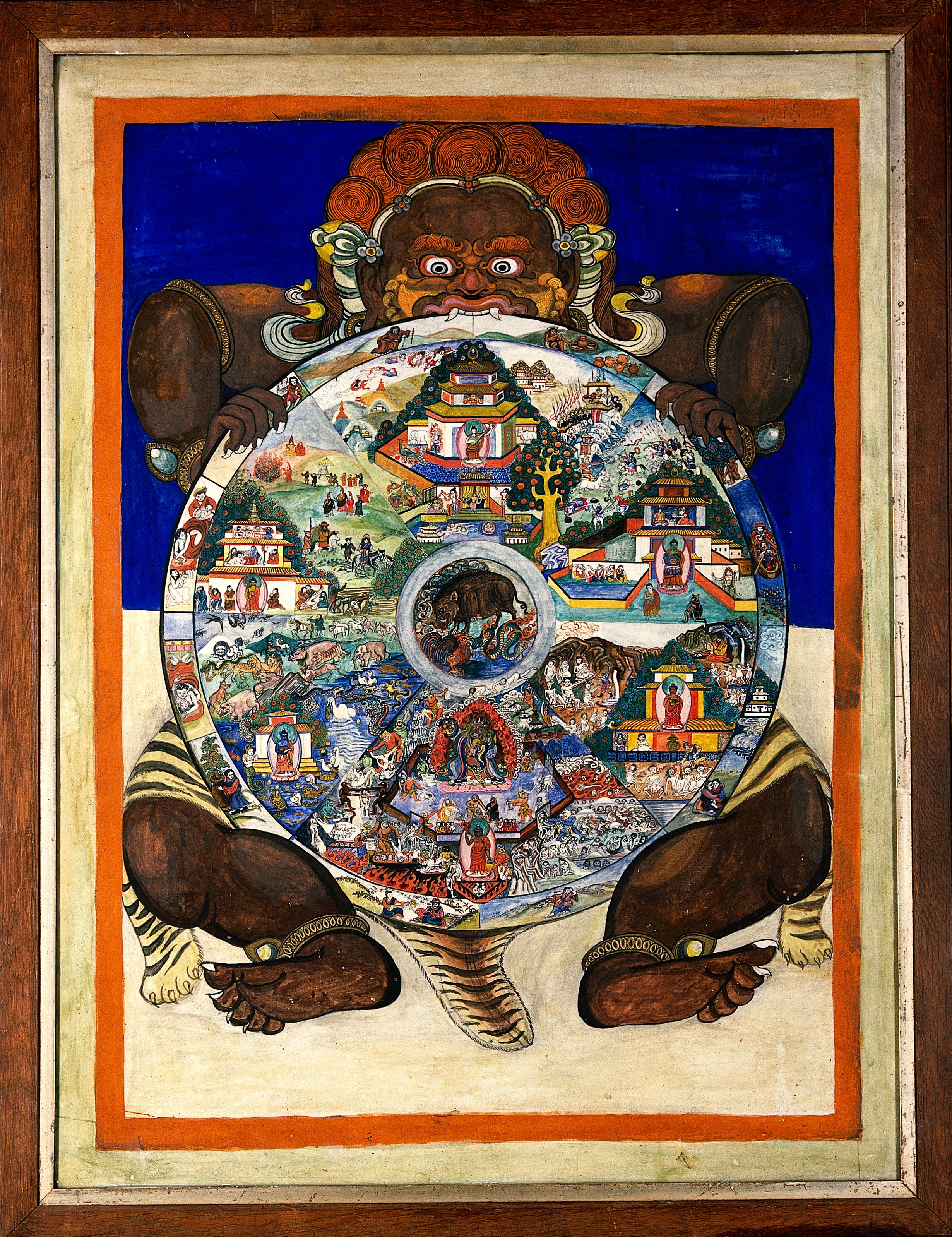
At the top of the Wheel the gods get a palace with Śakra and his lute, pleasure gardens, the wish tree, and the war with the asuras at its foot; the Buddha of the gods carries the lute.
In Wheel paintings the god realm takes the top of the wheel. Jeff Watt's description of HAR 78 names its centre: the god Śakra in a palace playing a stringed instrument, with the asuras to the right of the gods 'always engaged in conflict'. Some traditions take that lute-player to be Śākyamuni's emanation among the gods, which is why the repo keeps the Muni of the Gods and Śakra as two beings.
Compositions vary. The Wellcome gouache (L0069380 / V0017705) puts the palace at the top centre, trees and pools either side, and the asura war under the wish tree at the right. The Library of Congress scroll makes the tree the hinge: its trunk rises from the asura sector into the gods'. The Rubin's Sikkimese Wheel C2004.21.1, the game's selected painting, puts gods and demigods together in one upper-left wedge; the game keeps six equal wedges.
What the painters leave out is as useful as what they put in: no terraces, no corner peaks, no Sudharmā, no five signs. The sector is a picture of enjoyment with its end implied by the falling figures of the inner ring, and the repo's Deva section is built as that picture rather than as the cosmography.
What canon fixes for the map
Śakra with a stringed instrument in a palace at the top; asuras to the right [HAR78].
Rubin C2004.21.1: gods and demigods share the top-left segment [RUBIN].
The tree between gods and asuras is a painters' motif [repo populations ledger, asura-tree note].
Game: the Deva section is 'the Wheel painting's god realm, not a cosmographic map' [docs/world-plan/sections/deva.json reason].
Who lives here
Śakra (Indra) with the lute [HAR78].
The Muni of the gods, by the repo's reading kept distinct [docs/buddhist-iconography shakyamuni-munis].
In the game now
Built: the Deva wedge (docs/world-plan/sections/deva.json) as the Wheel's god realm: pearl road, palace garden, gardeners' lawn, Meru's foot, west water terraces, wish tree, east lawn; the Muni of the Gods (overworld:munis:5) with his lute on the road.
Art (11)
the god sector, top: Śakra's palace with the lute-player, the wish tree, the war with the asuras on the right
place id meru; districts meru.terrace-1..3, meru.four-kings, meru.thirty-three, meru.desire-sky, meru.form, meru.formless, meru.system
One round mountain of four floors climbed clockwise from the Deva wedge: three lower-terrace patches and the Four Kings' seats on the rim floor, the Thirty-Three's city on the summit floor, the sky heavens and form heavens above, and the same mountain walkable as a world-system chart.
Meru is entered from the Deva wedge at deva.meru-kora (threshold at [0, -4.75] in the host frame): the first terrace is ground she walks onto from Deva, and the palace ladder is a second way up. The mountain is round, four floors about one axis with radii 26, 18, 12 and 8, each climbed by one lit flight per terrace; Meru's own compass is east +x, south +z. The game's meru:system room is the same mountain seen whole as a walkable chart: seven golden ranges, seven seas, the salt ocean, the continents' outlines and the iron boundary, with the sun and moon chariots circling.
Districts, one line each:
meru.terrace-1 / -2 / -3: the Vessel-Bearers, Garland-Bearers and Inebriates as compact playable patches at the rim with three authored representatives each [beings meru:terrace-1, -2, -3; adaptation: geometry is a compression, the terraces are not jutting shelves].
meru.four-kings: the fourth terrace with four royal seats in four colours and the southern arrival gate [Dhritarashtra east (21,0), Virudhaka south (0,21) by the threshold, Virupaksha west (-21,0) over the nāga pool, Vaishravana north (0,-21) between two storehouses; three gandharvas at the east station, three kumbhāṇḍas at the south, a court nāga west, three yakṣas and the treasury mongoose north].
meru.thirty-three: Shakra's city, a ring of small palaces, four parks, the wish tree and the teaching hall [Shakra at the head of eight cushions; the summit pavilion devas; the Druk dragon on the cloud bank off the rim; orphan: remove the 33 identical seated Buddhas under the pavilions].
meru.desire-sky, meru.form, meru.formless: the four upper desire heavens (Māra's daughters, Māra as a far apparition), the form heavens (Brahma, the statue god) and the four formless cubes: another agent's subjects.
meru.system: the world-system chart, centre [0,0] solid and never walkable, the square foot ring at Chebyshev radius 9.6-13.6.
Canon kept: Four Kings on the fourth terrace in their directions, the Thirty-Three on the summit, four higher desire heavens above (K pp. 22, 30-34). Adaptation: one round mountain, floor radii, the thirty-three-pavilion city, the eight-cushion hall, all stairs and homes; 'names describe cosmological populations, not four literal heavens per walking tier'.
What canon fixes for the map
Gateway from deva at deva.meru-kora; the climb begins in the Deva realm [meru.json gateway].
Repo ledger: docs/wheel-geography-canonical-research-2026-10-01.md, K passage table
The gardener's shed today
place id garden-shed; district garden-shed.shed
A bright potting shed on the Deva wedge's gardeners' lawn where a deva keeps the heavenly garden's tools and a trellis he always means to mend: the game's picture of heavenly ease, with no source behind it.
The shed stands on deva.gardeners-lawn, entered by deva.gardeners-lawn.shed-door at [8.4, -14.1] in the host frame, and returns by the door in its back wall to the cloud step on the lawn. Inside: pale boards under a gilt-beamed roof, 5.6 across; a skylight in the back slope drops a pearly shaft on a flowering shrub in a pot in the middle; along the back wall the potting bench with seedlings and a sieve, eight tools on pegs each a different silhouette, a shelf of eight seed jars, three stacks of three flower pots, a round window; front left the trellis with one slat snapped, the mallet and nails left by it, the vine up only half of it; a heap of fallen petals in the corner; three bunches of herbs drying from the beam.
One resident: the Deva of the Garden Shed (garden-shed:deva:5), bound and liberatable, at [-1.15, -0.6]; from 06:00 he cuts and arranges blooms at the bench, from 12:00 he stands looking at the trellis meaning to mend it. The plan records him as in residentLife.json but missing from the Atlas registry, and as using the model of Abhirati's Deva of the Shore, a different being, which the no-shared-rig rule forbids.
Canon vs adaptation: the record's sources are empty; its one claim, 'the desire heavens belong to samsara: comfort that is still impermanent', is marked adapted and cites the six desire heavens ledger. The shed, the deva and the postponed repair are the game's own. Rule R1 keeps it a room because every building has a room.
What canon fixes for the map
No source describes the shed [garden-shed.json adaptation].
Gateway from deva.gardeners-lawn via shed-door [8.4, -14.1]; return clear of the threshold [garden-shed.json gateway].
Landmarks: the shrub at [0,0]; the broken trellis at [-1.75, 0.5]; path from the door round the shrub to the trellis [garden-shed.json districts].
Who lives here
Deva of the Garden Shed (garden-shed:deva:5): the gardener who never mends the trellis [authored].
In the game now
Samsara: place:garden-shed built; being:garden-shed:deva:5 missing (no own concept, no own model: needs a unique rig).
Art (1)
Deva: concept
AI concept study (repo) · concept · Project art
The generic deva concept the shed's resident currently borrows; he needs his own.
Still missing: No concept, model or capture of the shed or its deva.
The Wheel painting's god realm as a wedge at 0° on the Wheel: a pearl road up to Meru's foot, the gods' palace and cloud pools, a water stair on the west, a dancing lawn on the east, the wish tree's fruit under guard on the Asura seam, and a dying god at the lookout.
The account chosen is the god sector of the Rubin Wheel C2004.21.1 (HAR 78 as corroboration): a palace and pleasure gardens of beings absorbed in enjoyment, the wish tree whose fruit the gods keep and whose roots the asuras hold, the Muni of the gods with his lute, and the death and fall that end a god's ease (Chökyi Drakpa's Torch). Its cosmography follows Kongtrul: square Meru with four coloured faces and four terraces, the Four Kings on the fourth, the Thirty-Three on the summit, four higher desire heavens above; those heavens are the meru place's, entered at Meru's foot, and the sector claims none of them. The six-wedge position, the gardens, road and walks are authored Wheel compression; the Rubin puts gods and asuras in one wedge.
Relief: base y 6.8, highest of the six wedges; the centre (pearl road, arrival lawns, Meru's footprint and forecourt) at base; the west wing climbs in single .29 steps (koi and lotus basins at level 0, court band +1, spring terrace +2, cloud terrace on the rim); the east wing stays flat. Water: one system on the west, the spring pool falling down both risers to the lotus pool, whose overflow runs to the koi pool by the palace; the east lotus pool and the old palace pool are retired (R33).
Districts, one line each:
deva.pearl-road: the one way in, up the inner stair, under the gate, along the pearl road to Meru's foot; the two Liberate clearings (the Shitenno at [-5.2, -36.6], then Māra) and the Muni of the Gods on its shoulders [residents: The Shitenno, Muni of the Gods].
deva.palace-garden: the tiered palace on its pearl plaza, three cloud pools on three lawns, the gong; the god at ease comes here in the afternoon [deva-palace: the garden palace's gallery with eight auspicious-symbol rooms and twenty-five sky doors, authored interior; residents the Deva of the Sky Doors and the Palace Kinnara, both sketch].
deva.gardeners-lawn: the plain side of heaven: the gardener's shed, the ordinary stone over the hollow, and the lookout at the inner edge where the god whose five signs have come sits looking down at the birth he is falling to [resident: The god whose garland wilts, missing].
deva.meru-kora: open kora and forecourt round Meru with access to the fourth-terrace kings inside; their seats are not duplicated at the foot; claim: Meru's faces crystal east, blue beryl south, ruby west, gold north.
deva.west-wing: the water stair and the cloud terrace where the gods sit and look out, one shelter [residents: eight koi in two pools].
deva.wish-tree: the trunk and fruiting crown on the Asura seam, three great roots reaching over the edge into the asuras' root crown, the fruit lookout, one young god on sentry, the walk to the Asura bridge: 'the war of the Wheel paintings, met as a quiet standoff' [resident: The sentry of the fruit, missing].
deva.east-wing: the flat lawn with the dancing court where the god at ease spends his mornings, three orchard trees, the walk to the wish tree and the outer stair to the rim [resident: The god at ease, missing].
deva.hell-hollow: one of the occasional hells under the gardens' stone: a pushable stone, a shallow round hollow with two low steps, the millstone that turns clockwise only when BodhiBot passes [resident: The millstone, built].
Counts kept by R33: one palace with a door, one water system, orchards of eight on each seam's inner half and three on the outer, three new residents needing concept art and their own models (the dying god, the god at ease, the sentry). Liberate order unchanged: the Shitenno, then Māra, both on the road.
What canon fixes for the map
Wedge frame: Deva at 0° on the Wheel, origin on the centre line at r 48, v from -28 (r 20) to 24 (r 72) [deva.json frame].
Story gate at the inner stair; Liberate stops the Shitenno then Māra on deva.pearl-road [deva.json hooks].
Seam passes: seam.asura-deva.pass via deva.wish-tree.seam-walk; seam.deva-human.pass via deva.east-wing.human-pass; the outer apron via deva.east-wing.outer-stair [deva.json notes].
Who lives here
The Shitenno (Liberate being, Josie's design); the Muni of the Gods (overworld:munis:5).
Deva of the Sky Doors; Palace Kinnara (deva-palace, sketch).
The god whose garland wilts; the god at ease; the sentry of the fruit (planned, missing).
Deva pool koi; the millstone.
In the game now
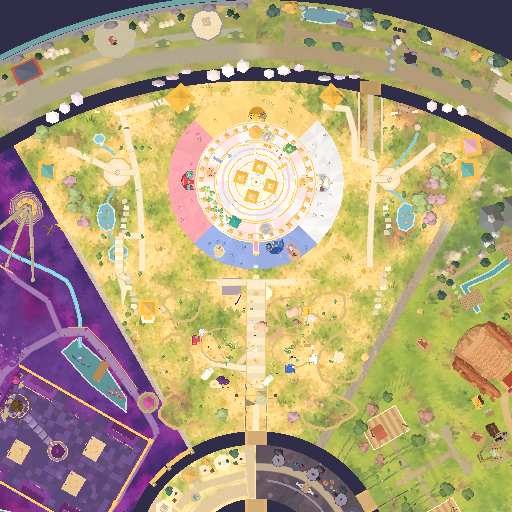
Samsara deva realm: 101 items, 55 built, 10 sketch, 36 missing; the wedge's own residents: liberate-the-four-kings-huddled built, obj-millstone built, inline-deva-pool-koi built, palace-door-deva and palace-kinnara sketch, the three new gods missing.
Art (9)
God realm: view from above
Project art (world capture) · world-view · Project art
The whole wedge: road, Meru's ring, wings and seams.
Wellcome Collection (repo copy, media.json painting-wellcome-L0069380) · traditional · Public Domain Mark
The painting the wedge compresses.
Still missing: No captures of the palace garden, the water stair, the wish-tree lookout or the hollow; the three planned gods have no art but the fading-god concept.
The heavens above Meru: Yāma to Akaniṣṭha, and the end of worlds
Above the Thirty-Three the heavens have no ground: Yāma, Tuṣita, Nirmāṇarati and Māra’s Paranirmitavaśavartin rest on wind in space, each twice the last and as far above it as it is above the earth, and over them the seventeen form heavens up to Akaniṣṭha and the placeless formless attainments. This group gathers what canon fixes about those sky-heavens (their heights, sizes, days, inhabitants and the day told by flowers), Maitreya’s Tuṣita with its forty-nine-storey palace and the Tibetan wish to be born there, Brahmā and the Pure Abodes, and the seven suns that burn it all, together with the art that shows gods’ palaces standing on cloud. Meru’s own terraces, the Four Kings and the Thirty-Three belong to the Meru group.
The heavens above Meru: mansions on wind and cloud
Skt. vimāna (aerial abode); Tib. gzhal yas khang (celestial palace); Kongtrul: ‘riches like cloud formations in the sky’
Above the Thirty-Three the four higher desire heavens and all the form heavens have no ground: their palaces rest on wind in space, tiered one above the other, each as far above the last as the last is above Jambudvīpa.
The gods higher than the Thirty-Three live in vimānas, aerial abodes. They are the Yāmas, the Tuṣitas, the Nirmāṇaratis and the Paranirmitavaśavartins, and above them the sixteen classes of the form realm beginning with the Brahmakāyikas: twenty-two kinds of gods with set residences in all. Kongtrul puts it in a picture: above the Thirty-Three the gods live on levels one above the other, supported by magnificent divine riches resembling cloud formations in the sky, celestial palaces created by each kind of god’s own past actions.
Phagpa gives the ladder. Eighty thousand yojanas above Meru’s summit is the palace of the Yāma gods, made of precious materials and resting on the wind in space, twice the size of Meru’s top. One hundred and sixty thousand yojanas higher is Tuṣita’s palace, twice as large again; three hundred and twenty thousand higher, Nirmāṇarati’s; six hundred and forty thousand higher, Paranirmitavaśavartin’s, each doubling the one below. Vasubandhu gives the same rule without the figures: as far as a residence is above Jambudvīpa, so far is it below the next, all the way up to Akaniṣṭha, above which there are no more residences.
No sun or moon shines above Yugandhara. Day and night are told by flowers that open and close, by birds that sing or fall silent, by sleep that ends or begins; and the gods are luminous themselves. They eat ambrosia, feel hunger and thirst (the form gods do not), wear cloth of white, yellow, blue and red woven from the bark of a wish-fulfilling tree, soft and light, and the clothes grow lighter heaven by heaven until in Akaniṣṭha they weigh nothing.
The gods of these heavens taste pleasure differently as one climbs: the Yāmas appease desire by embracing, the Tuṣitas by the touch of hands, the Nirmāṇaratis by a smile, the Paranirmitavaśavartins by a look; a small god appears on a god’s knee as its child. A lower god cannot see or visit a higher heaven without magic or the help of a higher god; the higher come down freely, the desire gods in their own bodies.
Their bodies and lives grow with the height. Vasubandhu: a quarter krośa for the Four Kings’ gods, rising by quarters to a krośa and a half in the highest desire heaven. Phagpa gives yojanas instead: two for Yāma, four for Tuṣita, eight for Nirmāṇarati, sixteen for Paranirmitavaśavartin. A day in each heaven is twice the day of the one below (200, 400, 800, 1,600 human years) and the lifespan doubles with it: 2,000, 4,000, 8,000 and 16,000 of their own years.
What canon fixes for the map
The four upper desire heavens and the form heavens are aerial abodes (vimānas); their gods do not live on the ground [AK III.69a-b, p. 465].
They rest on wind in space, tiered one above the other, each palace twice the extent of the one below; Yāma’s is twice Meru’s summit [P printed p. 19 / PDF p. 32; K p. 36 ‘the heavens double in size’].
Heights above Meru’s summit: Yāma 80,000 yojanas; Tuṣita 160,000 higher; Nirmāṇarati 320,000 higher; Paranirmitavaśavartin 640,000 higher [P printed p. 19 / PDF p. 32]. Rule: each residence is as far below the next as it is above Jambudvīpa [AK III.72a-b, p. 467].
One opinion: the four upper desire heavens have the dimension of Meru’s summit; the first dhyāna that of a four-continent world, the second, third and fourth a small, medium and great chiliocosm [AK III.72, p. 468].
No sun or moon above Yugandhara; day told by flowers, birds and sleep; the gods are self-luminous [AK III.79–80, p. 471; K pp. 60–61].
Desire gods eat ambrosia and wear multicoloured bark-cloth; clothes lighten upward to weightless in Akaniṣṭha [K p. 60].
Mode of union: embrace (Yāma), touch of hands (Tuṣita), smile (Nirmāṇarati), look (Paranirmitavaśavartin) [AK III.69b-d, p. 465].
Lower gods cannot see higher heavens without magic or a guide; higher gods descend, desire gods in their own form [AK III.72c-d, p. 468; K p. 61].
Stature by quarters of a krośa to one and a half krośa [AK III.75–77, p. 469; K p. 48]; or 2, 4, 8, 16 yojanas [P printed p. 30 / PDF p. 43]. Day and life double heaven by heaven [AK III.79–80, pp. 470–471; K pp. 48–49].
Wheel of Life painters draw this as palaces standing on cloud banks at the top of the god sector, reached by stairs that end in air (see the crops).
In the game now
The four upper heavens are rooms of Meru reached from a sky threshold on the third terrace and walked in order (place:meru:heaven-yama, place:meru:heaven-tushita, place:meru:heaven-nirmanarati, place:meru:heaven-paranirmita, all built; district meru.desire-sky in docs/world-plan/places/meru.json). Each room is a lawn island over a sea of cloud with far islands on the horizon (prototypes/world-map/interiors/zc-desire-upper.js): adaptation of the cloud-mansion idea. The ascent is spatially compressed: no rebirth by walking (ledger desire-heavens).
Art (6)
the god sector at the top of the wheel: the palace, the Muni with his lute, the wish tree and the war
Library of Congress, via Wikimedia Commons · traditional · Public domain
The clearest cloud-mansion in the repo set: the gods’ pavilion floats on cloud over a stepped stair that ends in air, with gods seated on separate clouds.
the god sector: gold-roofed palaces on a green hill
Rubin Museum of Himalayan Art · traditional · No open licence (link only)
The painting the game’s Deva section follows: gods and asuras share the upper-left wedge; the gods’ palaces stand on clouds at its top.
Still missing: No traditional painting found that diagrams the six desire heavens in order with the form heavens above them (Tibetan cosmology charts of that kind exist in printed Abhidharma manuals but none open-licence); the Bhutanese thanka is the nearest.
Repo ledger: docs/world-plan/places/meru.json, district meru.desire-sky
Yāma, the heaven Free from Conflict
Skt. Yāma; Tib. ’thab bral (Free from Conflict); also ‘Twins’ (the gods born in pairs)
The third desire heaven and the first with no ground: a palace twice the size of Meru’s top, resting on wind 80,000 yojanas above the summit, whose gods never war with the asuras.
Yāma is called Free from Conflict because, although it is in the desire realm, it is beyond the reach of the asura war that troubles the Thirty-Three below. Kongtrul adds a second name, Twins, because its gods are born miraculously in pairs. The Yāma gods are not the household of Yama the judge of the dead: the names are alike and the beings are not.
Phagpa sets its palace eighty thousand yojanas above Meru’s summit, made of precious materials, resting on the wind in space, twice as large as the top of Sumeru. Two hundred human years are one of its days and nights; its gods live two thousand of their years and their bodies measure two yojanas (Vasubandhu: three quarters of a krośa). They appease desire by embracing.
Above Yugandhara no sun or moon reaches; Yāma is the first heaven whose day is told only by the opening and closing of flowers, the birds and sleep, under the gods’ own light.
What canon fixes for the map
Third of the six desire heavens, directly above the Thirty-Three [K pp. 33–34; P printed p. 30 / PDF p. 43].
Free from the asura war; gods born in pairs [K p. 33; P printed p. 30 / PDF p. 43].
Palace 80,000 yojanas above Meru’s summit, on wind in space, twice the summit’s size [P printed p. 19 / PDF p. 32].
Day = 200 human years; life 2,000 years; body 2 yojanas (P) or 3/4 krośa (AK) [P printed p. 30 / PDF p. 43; AK III.76, 79, pp. 469–471].
No sun or moon; day told by flowers [AK III.79–80, p. 471; K pp. 60–61].
Not the hell judge Yama’s household (ledger desire-heavens; the two are kept apart in the game).
In the game now
place:meru:heaven-yama (built): a hushed pink-and-violet room with no sun or moon, three lotuses on a still pool keeping time (open, half, shut), lamps, a hall and a seat, no side-beings so nothing can be mistaken for the judge (zc-desire-upper.js, ‘experience’ and ‘quiet’). Meru’s third terrace stages the same three lotuses (meru.desire-sky.yama-pool).
Art (0)
Still missing: No traditional image shows the Yāma heaven as such; Wheel paintings do not distinguish it. Art for Yāma would have to be drawn from the general cloud-mansion pictures (see the first topic).
The fourth desire heaven, 160,000 yojanas above Yāma on the wind, where the gods are filled with joy at hearing the Dharma of Maitreya, the Invincible, who holds the regency there until his birth on earth.
Tuṣita means Joyful. Kongtrul: its gods are filled with joy at hearing the teaching of the victorious one, Invincible (Ajita, a name of Maitreya). Phagpa: in Tuṣita is the venerable Maitreya, who will succeed to the throne of the Dharma King; experiencing the happiness of the great doctrine, the gods are called Tuṣita, ‘all happy’.
Its palace is a hundred and sixty thousand yojanas above Yāma’s, made of valuables, resting on the wind in space, twice Yāma’s extent. Four hundred human years are one day and night there; the gods live four thousand of their years and stand four yojanas tall (Vasubandhu: one krośa). They appease desire by the touch of hands.
Tuṣita is still a desire heaven. Its ordinary gods are not awakened; what sets it apart is the bodhisattva with one birth left who teaches there. When the Bodhisattva (the Buddha-to-be) announced he would leave for Jambudvīpa, the gods wept and embraced his feet, and he set his crown on Maitreya’s head and enthroned him in his place.
The Sūtra on Maitreya’s Birth in the Heaven of Joy (a Kangyur text translated from Chinese) tells how the gods there, five hundred quintillion of them, took off their crowns and prayed to worship the coming bodhisattva; the crowns became as many palaces, each with seven parks of the seven precious substances, sixty-two leagues high and fourteen wide, their trees swaying and sounding impermanence, suffering, emptiness and selflessness, and five billion nāga kings encircling each palace and raining on its trees.
What canon fixes for the map
Fourth desire heaven, above Yāma, below Nirmāṇarati [K pp. 33–34; P printed p. 30 / PDF p. 43].
Palace 160,000 yojanas above Yāma’s, on wind in space, twice Yāma’s extent [P printed p. 19 / PDF p. 32].
Day = 400 human years; life 4,000 years; body 4 yojanas (P) or 1 krośa (AK) [P printed p. 30 / PDF p. 43; AK III.76, 79–80].
Maitreya is regent there now, enthroned by the Bodhisattva before his descent [LV 5.2–5.3; P printed p. 30 / PDF p. 43].
Ordinary gods of Tuṣita are not awakened; the heaven belongs to saṃsāra [ledger tushita; docs/purelands-lore-source-notes.md].
Crown-palaces: 62 leagues high, 14 wide, seven parks each, nāga kings around each [MT 1.6–1.8].
Kongtrul (earshots) and Phagpa (yojanas) give two accounts of the gods’ size; kept apart [K p. 48; P printed p. 30].
Who lives here
Maitreya (Ajita, Invincible): the bodhisattva regent who teaches the gods [LV 5.2–5.3; K p. 33; P p. 30] (being:tushita:maitreya, built).
The gods of Tuṣita, joyful at the teaching [K p. 33; P p. 30] (being:tushita:gods, built).
The nāga kings round the crown-palaces [MT 1.8] (being:tushita:naga-kings, missing).
Those reborn there through devotion to Maitreya [MT 1.23–1.24] (being:tushita:newcomers, missing).
In the game now
Outer Tuṣita is place:meru:heaven-tushita (built), a warm gold room with an avenue of lanterns, a canopy, a hall and a light-shaft, and a link to the inner teaching court (place:tushita, built-tushita below). Beings: being:tushita:maitreya (built), being:tushita:gods (built, concept /purelands/concepts/deva-600.webp), being:tushita:svetaketu (sketch), being:tushita:newcomers, :goddesses, :naga-kings, :laodubati and the five great kings (all missing). Places place:tushita:crown-palaces (missing), :dharmoccaya and :uccadhvaja (sketch: map-table assets palDharmoccaya and palUccadhvaja, not yet placed), place:tushita:dharma-palace (built as the court).
Art (8)
Maitreya enthroned among the gods of Tuṣita, the centre of the lunette
Le Coq, Die buddhistische Spätantike in Mittelasien VI, via Wikimedia Commons · traditional · Public domain
The oldest common Tuṣita image: Maitreya crowned, in a halo, legs crossed at the ankles, with the gods of Tuṣita seated in rows to either side under a ruined cloud-and-palace border.
the inner court of Maitreya’s palace, with its halls, rails and pavilions
Nihon Bijutsu Zenshū vol. 11 (Shogakukan, 2013), via Wikimedia Commons · traditional · Public domain (PD-Japan, PD-Art)
Tuṣita as a palace-city: gold courts and pavilions, railings, bridges and ponds, tiny gods walking the terraces, dark sky above. A Japanese (East Asian) picture of the heaven, kept apart from the Tibetan accounts.
Rubin Museum of Himalayan Art · traditional · No open licence (link only)
Maitreya on his celestial throne in Tuṣita radiating light, legs extended as if ready to descend, flask on a nāgakesara stem; no landscape, a dark-blue sky with clouds; the side registers carry the lineage of the Five Treatises.
Rubin Museum of Himalayan Art · traditional · No open licence (link only)
Two bodhisattvas on lotus seats before a pagoda-roofed palace: Maitreya with pendant legs, wheel and flask on lotuses. The game’s selected reference for its Maitreya sitter (iconography dossier).
The shared Tuṣita god concept behind the four court devas.
Still missing: No open-licence Tibetan painting of Tuṣita as a place (palace, parks, gods) was found; the Rubin, HAR and Hwajeong paintings are link-only. The crown-palaces and nāga kings of MT have no art anywhere.
Repo ledger: docs/purelands-lore-populations.json, group tushita (note and items)
The Dharma palace of forty-nine storeys and Maitreya’s rebirth there
MT: the jewelled palace raised by Laodubati (Chinese 牢度跋提); the lion throne four leagues high
Inside Tuṣita one great god, Laodubati, vowed to build Maitreya a palace; jewels from between his brows became a forty-nine-storey hall with lotus railings, self-sounding instruments, beryl reservoirs and a throne four leagues high, where Maitreya will sit sixteen leagues tall and turn the Dharma wheel day and night.
The great king (the Chinese says great god) Laodubati rose in his palace, bowed to the buddhas of the ten directions and prayed: if he had the merit to build a Dharma palace for Maitreya, let gems appear from between his eyebrows. A billion jewels appeared and became an amazing jewelled palace of forty-nine storeys. Every railing bears a trillion jewelled lotuses; ninety million gods and five billion goddesses stand along them; instruments hang in the air and sound unplayed; goddesses born among the railings dance and sing of the ten virtues and the four aspirations.
Its parks hold reservoirs of beryl in eight hues. At the four entrances lotuses rise, and on each lotus twenty-four goddesses hold vessels of ambrosia and extol the six perfections. Others stand among the draperies with white whisks, or play on the railings music that sounds suffering, emptiness, impermanence and selflessness. Brahmā kings hang chimes and jewelled nets; four jewelled pillars, each of a hundred thousand mansions, mark the corners.
In the palace stands a lion throne of the seven jewels, four leagues high, adorned with gold of the Jambū river. Five great kings serve it: Ratnadhvaja rains the seven precious substances that become instruments; Flower Scatterer’s rain of flowers forms parasols over the whole palace; Incense Voice’s sandalwood incense circles the palace seven times; Joyous Bliss rains wish-fulfilling jewels that sound refuge and the precepts; Fierce Voice rains water on whose every drop float lotuses bearing crystal goddesses.
Twelve years after the Buddha spoke, Maitreya passes away in Bāvarī’s household near Vārāṇasī and is reborn in the Heaven of Joy on that lion throne, seated cross-legged on a lotus, sixteen leagues tall, with the marks of a great being, a beryl topknot and a jewelled crown in which emanated buddhas appear; light from his brow shows the marks; he turns the nonregressing Dharma wheel day and night until, after fifty-six trillion Jambudvīpa years, he descends.
Those who keep vows, make offerings, sweep stūpas, recite sūtras and Maitreya’s name are reborn there as fast as a strong man stretches out his arm, arriving cross-legged on lotuses while gods play music and scatter mandārava flowers and tell them to take refuge in Maitreya; the light of his ūrṇā frees them from ninety eons of birth and death.
What canon fixes for the map
The palace is inside Tuṣita, raised by Laodubati from jewels of his brow; forty-nine storeys [MT 1.9–1.10].
Railings set with lotuses and lined with gods and goddesses; instruments play unplayed [MT 1.11].
Parks with beryl reservoirs in eight hues; lotuses at the four entrances, twenty-four goddesses each [MT 1.12].
Lion throne of seven jewels, four leagues high; four jewelled corner pillars [MT 1.13–1.15].
Five great kings (great gods in the Chinese) and their rains [MT 1.16 and note 32].
Maitreya reborn there on the throne, sixteen leagues tall, cross-legged [MT 1.20–1.22]. The game seats him with legs pendant after its iconography reference (C2002.21.3); recorded, not changed.
Rebirth there by vows, offerings and reciting his name; arrival on lotuses with music and flowers [MT 1.17–1.18, 1.23–1.24].
MT was translated into Tibetan from Chinese (Taishō 452); the Lalitavistara’s Tuṣita palaces are a separate account, kept apart [MT i.2; populations note tushita].
Who lives here
Laodubati, who raised the palace [MT 1.9–1.10] (being:tushita:laodubati, missing).
Ratnadhvaja, Flower Scatterer, Incense Voice, Joyous Bliss, Fierce Voice: the five great kings [MT 1.16] (being:tushita:king:*, missing).
The goddesses of the railings and reservoirs [MT 1.11–1.15] (being:tushita:goddesses, missing).
Maitreya on the lion throne [MT 1.20–1.22] (being:tushita:maitreya, built).
In the game now
place:tushita:dharma-palace (built) is stood for by the teaching court (tushita.court: a lawn terrace in the sky, Maitreya’s throne under an awning, eight cushions); no forty-nine-storey hall is drawn. The five kings, Laodubati, the goddesses and the newcomers are missing samsara items with no art.
Art (2)
the inner court of Maitreya’s palace, with its halls, rails and pavilions
Nihon Bijutsu Zenshū vol. 11 (Shogakukan, 2013), via Wikimedia Commons · traditional · Public domain (PD-Japan, PD-Art)
The nearest picture of Maitreya’s palace as a built place: gold halls and terraces with gods on them; Japanese, after the Chinese Maitreya sūtras (MT is Taishō 452), so the same textual family as the palace account.
Rubin Museum of Himalayan Art · traditional · No open licence (link only)
Maitreya on his celestial throne in Tuṣita radiating light, legs extended as if ready to descend, flask on a nāgakesara stem; no landscape, a dark-blue sky with clouds; the side registers carry the lineage of the Five Treatises.
Still missing: Nothing shows the forty-nine storeys, the beryl reservoirs, the five great kings or the goddesses of the railings; the palace is unpainted in any collection searched.
The Bodhisattva in Tuṣita: Śvetaketu, the great palaces and the descent
Śvetaketu (Tib. dam pa tog dkar po), the Bodhisattva’s name in Tuṣita; palaces Dharmoccaya and Uccadhvaja
Before his last birth the Buddha-to-be lived in Tuṣita as the god Śvetaketu in a palace of 32,000 floors, taught the gods from two great palaces, gave the 108 gateways of the Dharma, enthroned Maitreya and came down to Jambudvīpa.
With one lifetime remaining, the Bodhisattva was reborn in the Heaven of Joy as the divine child Śvetaketu. The gods revered him as one who would leave them, take birth among humans and become the Buddha. He dwelt in a celestial palace of thirty-two thousand floors, where eighty-four thousand instruments sounded verses recalling his past deeds and Dīpaṃkara’s prophecy.
When the time came he went to the great Dharmoccaya Palace and taught from a lion throne called Sublime Dharma: gods of equal fortune and bodhisattvas from the ten directions, 680 million in all, without the divine maidens or ordinary gods. There he announced that in twelve years he would enter his mother’s womb. Then in Uccadhvaja, a palace sixty-four leagues around, he gathered all the gods and goddesses of the Heaven of Joy and gave his final teaching, the 108 gateways to the light of the Dharma.
He told the weeping gods that Maitreya would teach them, took the crown from his own head, set it on Maitreya’s and said, ‘You, virtuous one, shall awaken to perfect and complete buddhahood after me.’ Then he descended to Jambudvīpa and entered Queen Māyā’s womb in the form of a white elephant: the scene Borobudur, Ajanta and the Kizil painters show.
Śvetaketu is a past situation: Maitreya holds the regency now. The Lalitavistara names Dharmoccaya and Uccadhvaja as teaching palaces, sets Dharmoccaya apart from the Bodhisattva’s own palace, and none of them is Maitreya’s court.
being:tushita:svetaketu is sketch; the Dharmoccaya Palace and Uccadhvaja stand on isles across outer Tuṣita's sky (place:meru:heaven-tushita, plan meru.heaven-tushita). The descent itself is not staged anywhere.
Art (3)
Maitreya enthroned among the gods of Tuṣita, the centre of the lunette
Le Coq, Die buddhistische Spätantike in Mittelasien VI, via Wikimedia Commons · traditional · Public domain
The lunette shows the Bodhisattva-type figure enthroned among the gods of Tuṣita over the cave door: the Tuṣita assembly before the descent, in the Kizil manner.
Photographs on Wikimedia Commons (various, CC BY-SA) · photo · Mixed CC licences (link only)
Twenty-six photographs of the Borobudur Lalitavistara panels and Thai murals: the Bodhisattva among the gods, the gods’ request, the descent as an elephant. Stone, not paint.
Wikimedia Commons · photo · Not checked (link only)
The Ajanta mural of the Bodhisattva in Tuṣita before his rebirth; the category also holds the Gandhāran and Sanchi reliefs of the Tuṣita sermon.
Still missing: No Tibetan painting of Śvetaketu or of the Dharmoccaya and Uccadhvaja teachings was found; Tibetan life-of-the-Buddha sets show the descent as the elephant dream, not the heaven.
The Tuṣita wish: Asaṅga’s visit, Tsongkhapa and Atiśa at Maitreya’s side
Tib. dga’ ldan lha brgya ma (Ganden Lhagyama, ‘the hundred gods of Tuṣita’); Tsongkhapa in Tuṣita: Mañjugarbha (’jam dpal snying po); Atiśa: Namkhé Drimé
Tuṣita is the heaven Tibetan practitioners pray to be born in: Asaṅga was carried there by Maitreya and brought back the Five Treatises, and the Geluk hold that Tsongkhapa and Atiśa now sit at Maitreya’s side there.
The sūtra itself gives the practice: generate the mind of awakening, keep the eight precepts, be diligent, practise the ten virtues and wish single-pointedly for rebirth there; after the Buddha’s nirvāṇa those who keep vows, sweep stūpas, offer flowers and incense, recite sūtras and Maitreya’s name arrive in Tuṣita on lotuses, welcomed with music and mandārava flowers.
Tradition tells how Asaṅga meditated on Maitreya in a cave for twelve years in four stretches of three, saw nothing, and on leaving met a wounded dog crawling with maggots; his compassion for it purified his sight and the dog was Maitreya. Maitreya took him to Tuṣita, where he received the Mahāyāna teachings for one morning of the gods, fifty human years, and came back to write down the Five Treatises of Maitreya. This is the account of Butön and Tāranātha as the tradition tells it; the sūtras do not record it.
The Geluk guru yoga of the Hundred Gods of Tuṣita calls Tsongkhapa down from the heart of Maitreya, ‘the savior of the hundred deities of Tuṣita, on the peak of a cloud resembling a clump of extremely white fresh curd’, together with his two sons. In Tuṣita he is held to sit at Maitreya’s left as the god Mañjugarbha, and Atiśa at Maitreya’s right as the god Namkhé Drimé (Stainless Space); Jamyang Khyentse Chökyi Lodrö’s praise says it plainly: ‘In the presence of the great Maitreya in Tuṣita heaven, you are the bodhisattva renowned as Mañjugarbha.’
Painters make the same picture: Tsongkhapa and his sons on a bank of white cloud emanating from Maitreya in Tuṣita above (HAR set 2044), or Maitreya in a palace flanked by Atiśa and Tsongkhapa (the Hwajeong thangka). The cloud is the heaven: there is no ground to draw.
What canon fixes for the map
Rebirth in Tuṣita by bodhicitta, the eight precepts, the ten virtues and single-pointed wish; the welcome on lotuses [MT 1.17–1.18, 1.23–1.24].
Asaṅga: twelve years’ retreat, the dog, taken to Tuṣita for one morning = fifty human years, the Five Treatises written from memory [SB after Butön and Tāranātha; a traditional account, not sūtra].
Tsongkhapa in Tuṣita as Mañjugarbha at Maitreya’s left; Atiśa as Namkhé Drimé at his right [GLG; FF stanza 10]. A Geluk devotional tradition, not Abhidharma cosmology.
Ganden Lhagyama verse: Tsongkhapa descends from Maitreya’s heart on a white cloud [GLG; HAR set 2044].
Kongtrul: lower beings cannot reach a higher heaven without magic or a higher god’s guidance [K p. 61], which is how Asaṅga’s visit is framed.
Who lives here
Maitreya, teaching in Tuṣita (being:tushita:maitreya, built).
Asaṅga, the visitor who returned with the Five Treatises [SB] (no samsara item).
Tsongkhapa as Mañjugarbha and Atiśa as Namkhé Drimé beside Maitreya [GLG] (no samsara items).
In the game now
Nothing yet for the wish, Asaṅga or the two masters. The teaching court (built-tushita) has eight cushions and Sudhana as its pilgrim; being:tushita:newcomers (those reborn through devotion to Maitreya) is a missing item that would carry the sūtra’s practice.
Himalayan Art Resources · traditional · No open licence (link only)
Tsongkhapa and his two sons on a bank of white cloud, emanating from the heart of Maitreya who sits in Tuṣita above: the standard Geluk picture of a cloud-heaven.
Rubin Museum of Art, via Wikimedia Commons · traditional · Public domain (PD-Art), link only: the Tuṣita scene is not identified in the file record
A public-domain Tsongkhapa life painting; its upper-left vignettes may include his passing, but Commons gives no caption, so it is not claimed as a Tuṣita image.
Still missing: No open-licence Ganden Lhagyama painting (Tsongkhapa descending from Maitreya in Tuṣita) and no painting of Asaṅga in Tuṣita were found; both are common subjects in museum collections (HAR set 2044) but link-only.
The fifth desire heaven, 320,000 yojanas above Tuṣita, whose gods conjure their own pleasures and enjoy them, and are content with a smile.
In Enjoying Creations the gods freely enjoy pleasures they have themselves created: whatever they wish for they emanate. Phagpa’s palace is three hundred and twenty thousand yojanas above Tuṣita’s, of valuables, on the wind in space, twice Tuṣita’s extent.
Eight hundred human years are one of its days; its gods live eight thousand of their years and stand eight yojanas tall (Vasubandhu: a krośa and a quarter). Their desire is satisfied by a smile.
What canon fixes for the map
Fifth desire heaven, above Tuṣita and below Paranirmitavaśavartin [K pp. 33–34; P printed p. 30 / PDF p. 43].
Palace 320,000 yojanas above Tuṣita’s, twice its extent, on wind in space [P printed p. 19 / PDF p. 32].
Gods enjoy pleasures they create themselves [K p. 33; P printed p. 30 / PDF p. 43].
Day = 800 human years; life 8,000 years; body 8 yojanas (P) or 1¼ krośa (AK); union by a smile [P p. 30; AK III.69, 76, 79–80].
In the game now
place:meru:heaven-nirmanarati (built): a pale green-and-white room over cloud where three pavilions stand each at another stage of being made, and a ring of eight posts round a centre that forms as she nears (zc-desire-upper.js; meru.desire-sky.pavilions on the terrace). No residents.
Art (0)
Still missing: No traditional image of this heaven exists as such; painters never single it out.
Paranirmitavaśavartin, the highest desire heaven, and Māra its king
Skt. Paranirmitavaśavartin; Tib. gzhan ’phrul dbang byed (Mastery over Others’ Creations); Māra, the evil one (bdud), also Antaka; his daughters Tṛṣṇā, Rati and Arati
The sixth and highest desire heaven, 640,000 yojanas above Nirmāṇarati, whose gods command the pleasures other gods create; its awesome sovereign is Lord Māra, father of the daughters Craving, Passion and Discontent.
In Mastery over Others’ Creations the gods have power over the enjoyments that other gods have created. Phagpa: the celestial king among them, their awesome sovereign, is Lord Māra. From Avīci below up to this heaven is the realm of desire, so called because its beings indulge in desire and eat food in lumps.
Its palace is six hundred and forty thousand yojanas above Nirmāṇarati’s, twice its extent, on the wind in space. One thousand six hundred human years are one of its days; its gods live sixteen thousand of their years and stand sixteen yojanas tall (Vasubandhu: a krośa and a half, the largest desire body). They appease desire by looking at one another.
The Play in Full tells the assault at the seat of awakening. Māra, the most powerful demon in the desire realm, comes with his terrifying army; when force fails he sends his daughters to examine the Bodhisattva: ‘The most seductive and sweet girls, Tṛṣṇā, Rati, and Arati’, skilled in female deception, who put on sixty-four displays of amorous behaviour, ring their anklets and let their clothes slip, and are answered with verses on the impurity of the body. After the awakening the three, named again as Rati, Arati and Tṛṣṇā, ask their dejected father who this man is and offer to bind him with the lasso of desire. Māra writes on the ground with a stick, ‘He has gone beyond my range!’
Māra is a god of this heaven, inside saṃsāra, and not Yama the judge, not the hell-lord and not the Wheel’s holder; the game keeps those apart. Kongtrul notes that the Wheel of Time and other systems also use ‘māra’ for the four obstructions, a different sense.
What canon fixes for the map
Sixth and highest desire heaven; the top of the desire realm (kāmadhātu) which runs from Avīci to here [P printed p. 30 / PDF p. 43; K p. 34].
Palace 640,000 yojanas above Nirmāṇarati’s, twice its extent, on wind in space [P printed p. 19 / PDF p. 32].
Its sovereign is Māra [P printed p. 30 / PDF p. 43].
Gods command pleasures made by others [K p. 34; P p. 30].
Day = 1,600 human years; life 16,000 years; body 16 yojanas (P) or 1½ krośa (AK); union by a look [P p. 30; AK III.69, 76, 79–80].
Māra’s daughters: Tṛṣṇā (Craving), Rati (Passion/Delight), Arati (Discontent) [LV 21.146; LV 24.79]; their sixty-four displays [LV 21.148 area]; Māra’s army of demons at the seat of awakening [LV ch. 21].
Māra is not the hell judge, not the Wheel-holder [wheel-geography research; source notes].
Who lives here
Māra, lord of this heaven [P p. 30; LV ch. 21] (being:liberate-mara, built; the Deva Liberate boss).
Māra’s sons Sārthavāha, Acalamati, Anivartin, Anupaśānta and others who argue with him [LV 21.14, 21.43, 21.65–21.75] (no items).
Māra’s army of demons [LV ch. 21] (no items).
In the game now
place:meru:heaven-paranirmita (built): a violet room where lamps brighten as she nears and a table is laid by others; at the edge one veiled, dimmed seat, a presence, not a ruler; far out on the sky over it Māra’s shadow, a crowned head and shoulders (zc-desire-upper.js, meru.js). Māra (being:liberate-mara) lives here and is the Deva Liberate boss; his daughters keep a full bowl, a perfect room and a mirror (meru.desire-sky.mara-set): their stations are the game’s staging, their names are canon (LV). The Liberate rig in cast-deva-snake.js is canonical; the Purelands duplicate mara.js is to be merged or deleted (AGENTS.md).
Art (9)
the upper half: a wrathful figure in flames at the top and Māra’s host of demons pressing in on both sides
Musée Guimet, via Wikimedia Commons · traditional · Public domain (PD-old-100)
The great Dunhuang assault: the Buddha at the centre, Māra’s demons (animal-headed, armed, in Central Asian armour) on every side, flaming figures above. Māra and the daughters are among the small court figures near the throne.
below the throne: Māra’s court, a ragged ascetic in a niche and the demons around the base
Musée Guimet, via Wikimedia Commons · traditional · Public domain (PD-old-100)
The lower register round the throne where the painter puts Māra’s retinue and daughters; the identification of each small figure is the museum’s, not read here.
Thai and Burmese temple murals (‘Mara Attacks the Bodhisatta’, ‘Mara’s Daughters’), the Wellcome gouache V0046085, Gandhāran reliefs. Browse for the host; none is Tibetan except the Rubin thangka above.
She sets out the small perfect room again and again.
Still missing: No painting shows Paranirmitavaśavartin as a heaven; Māra is painted only at the assault. A Tibetan thangka of the assault with an open licence was not found (Rubin C2004.28.5 is link-only).
Repo ledger: docs/world-plan/places/meru.json, district meru.desire-sky; characters liberate-mara, mara-craving, mara-passion, mara-discontent
The form realm: four concentrations, seventeen heavens
Skt. rūpadhātu; Tib. gzugs khams; the four dhyānas (bsam gtan bzhi)
Above the desire realm the gods of the four concentrations live in seventeen heavens stacked one over the other and doubling in size, free of desire but not of matter, with no day or night, white clothes, the food of contemplation and bodies measured in yojanas and lives in kalpas.
Phagpa counts seventeen gods of the realm of form in the four trances: three in the first (Brahmakāyika, Brahmapurohita, Mahābrahma), three in the second (Parīttābha, Apramāṇābha, Ābhāsvara), three in the third (Parīttaśubha, Apramāṇaśubha, Śubhakṛtsna) and eight in the fourth: Anabhraka, Puṇyaprasava and Bṛhatphala, dwellings for the common, and the five pure abodes Avṛha, Atapa, Sudṛśa, Sudarśana and Akaniṣṭha, dwellings for the noble. Kongtrul gives the same seventeen with Tibetan names (Group of the Pure, Priests of Brahmā, Great Pure Ones; Dim, Measureless and Clear Light; Lesser, Limitless and Flourishing Virtue; Cloudless, Merit-Born, Great Result, Not Greater, Without Distress, Manifest Richness, Good Vision, Unsurpassed): sixteen heavens with Lesser Unsurpassed above them all.
Their size follows the trance. The heaven of the first trance is as large as the four-continent world; the second as a small chiliocosm; the third as a medium; the fourth as a great trichiliocosm, and the distance between them always doubles. Vasubandhu records this as one of three opinions, another making the fourth trance measureless. Cloudless, the first heaven of the fourth trance, is so named because it lacks the basis of billowing clouds that all the other heavens have: the heavens below it stand on clouds.
Bodies and lives grow together: Brahmakāyikas half a yojana tall and half a kalpa long-lived, Brahmapurohitas one, Mahābrahmas one and a half; Parīttābhas two yojanas and two kalpas, then doubling, four, eight, sixteen, thirty-two, sixty-four; Anabhrakas 125 yojanas and 125 kalpas; 250, 500, 1,000, 2,000, 4,000, 8,000, up to Akaniṣṭha’s 16,000 yojanas and 16,000 kalpas. In Kongtrul’s rule the form gods live as many ages as they are leagues tall.
There is no day and night in the form realm; lifespans are counted in kalpas. The gods are free from desire but not from matter. They live on the food of contemplation, feel neither hunger nor thirst, and wear only white. They are born and die alone where the ground is shared: all the gods who lack perception inhabit one area of Great Result, and in the fourth concentration each god’s palace and possessions appear and dissolve with that god. Form gods can come to Jambudvīpa, not in their own bodies but emanating into a human form.
The first concentration and everything below is burned at the end of the age; the second is drowned, the third blown apart; only the fourth is not destroyed by the elements.
What canon fixes for the map
Seventeen heavens in four groups of 3, 3, 3 and 8; the last five are the pure abodes [P printed pp. 30–31 / PDF pp. 43–44; K pp. 34–36].
Sizes: first trance = a four-continent world; second = small chiliocosm; third = medium; fourth = trichiliocosm; distances double [P printed p. 20 / PDF p. 33]; AK records this and a variant where the fourth is measureless [AK III.72, p. 468].
All heavens below Cloudless rest on clouds; Cloudless lacks them [K p. 35].
Body/life ladder from ½ yojana / ½ kalpa to 16,000 / 16,000 [P printed pp. 30–31 / PDF pp. 43–44; AK III.77, 81, pp. 470–471; K p. 49].
No day or night; food of contemplation; white clothes; no hunger or thirst [AK III.80, p. 471; K p. 60].
Non-percipient gods are a region within Great Result, not an eighteenth heaven [K p. 36; AK III.72].
Form gods emanate a human form to visit Jambudvīpa [K p. 61]; the form realm is free of desire but not of matter [P printed p. 32 / PDF p. 45].
Fire ends at the first concentration, water at the second, wind at the third; the fourth is spared [K pp. 63–65; P printed pp. 40–41].
Who lives here
The gods of each of the seventeen heavens as classes; no individual is named except Brahmā and his assembly (next topic) [P; K].
In the game now
Five nested rooms of Meru, place:meru:form-1 … form-4 and place:meru:pure-abodes (all built; zc-form-heavens.js), entered by a pale doorway on the summit and progressively quieter (17, 12, 6, 5, 4 things), names carried in descriptors and never on signs; the non-percipient condition is a bare plinth in Bṛhatphala’s ring. No residents by design: the gods here are meditators, not villagers. On the summit, the still terrace meru.form with Brahma’s seat and three plinths where gods sit like statues (being:statue-god, built).
Art (3)
the upper tiers of cloud above Meru: the painter’s form heavens
Trongsa Dzong, Bhutan, via Wikimedia Commons · traditional · Public domain (PD-old-100)
The only common pictorial form the upper heavens take: rows of haloed figures on cloud tiers over the summit; the thanka does not label which heaven is which.
In-game rig capture (repo) · world-view · Project art
Seated like a statue on the middle plinth under a withered garland.
Still missing: No traditional art depicts the seventeen form heavens individually; cosmology charts in Tibetan Abhidharma manuals list them as tiers but no open-licence painting was found.
Repo ledger: docs/world-plan/places/meru.json, district meru.form
Brahmā and his assembly, lords of the first concentration
Skt. Mahābrahmā, Brahmapurohita, Brahmakāyika; Tib. tshangs pa chen po, tshangs pa’i mdun na ’don, tshangs ris
The first concentration holds the Brahma gods: the Group of the Pure, the Priests who recite before Brahmā, and Great Brahmā himself, the god who was born first into an empty palace and believed he had made the rest; a worldly god inside saṃsāra.
The first level of concentration has three heavens. Group of the Pure (Brahmakāyika) is called pure because its gods have left evil and non-virtue, and a group because they are counted together; Priests of Brahmā (Brahmapurohita) because the gods there recite prayers before Brahmā; Great Pure Ones (Mahābrahma), lords of this third-order thousand Endurance world-system, surpass the others in lifespan, size and splendour through their great virtue. Their bodies are half a yojana, one, and one and a half; their lives half a kalpa, one, and one and a half.
Phagpa tells how Brahmā came to think himself a maker. When the world forms again after the fire, a god whose life in Ābhāsvara has ended is reborn in the place of Mahābrahma. Alone and weary he cries out, ‘Why couldn’t someone with the same fate be reborn in this world?’ Other gods’ lives end and they are born there; the first-born thinks ‘They are reborn because of my longing,’ and all in the world call him their ancestor Mahābrahma. Then beings are born successively among the Brahmapurohitas, the Brahmakāyikas, the Paranirmitavaśavartins and so on down to the Four Kings and the four continents.
Brahmā in the sūtras is a high god, not a creator outside the Wheel. The Play in Full counts the worlds ‘with its gods, Māra, Brahmā’; the Buddha’s voice ‘exceeded even the voice of Brahmā’. The Stem Array uses Mahābrahmā’s divine palace as an image: within it the reflections of all the world realms of the billion-world universe appear clearly and distinctly. Brahmā kings hang chimes and nets in Maitreya’s Tuṣita palace.
Tibetan art knows two Brahmās and keeps them apart: the four-faced Indian god on a goose in tantric retinues (and trampled under wrathful deities), and the white, one-faced, conch-crowned horseman Tsangpa Karpo, a worldly protector. Neither is a portrait of the form-heaven Brahmā, who is seldom painted on his own.
What canon fixes for the map
Three heavens of the first concentration: Brahmakāyika, Brahmapurohita, Mahābrahma; sizes ½, 1, 1½ yojanas; lives ½, 1, 1½ kalpas [P printed pp. 30–31 / PDF pp. 43–44; K p. 34].
Mahābrahmā is lord of the Endurance world-system; his heaven is the size of a four-continent world [K p. 34; P printed p. 20 / PDF p. 33].
The first-born Brahmā and his mistaken belief that his longing made the others [P printed p. 33 / PDF p. 46].
Brahmā is a worldly god of the form realm inside saṃsāra; not a creator, not Amitābha [source notes lines 23, 34, 43–45; LV 1.5].
Mahābrahmā’s palace reflects all world realms (an analogy) [SA 54.390] (place:jewel-net:mahabrahma-palace, missing).
The first concentration burns with everything below at the age’s end [K pp. 63–64].
Who lives here
Mahābrahmā, Great Brahmā, the first-born of the new world [P p. 33 / PDF p. 46; K p. 34] (being:liberate-brahma, built: the final Liberate boss).
The Brahmapurohitas who recite before him and the Brahmakāyikas [K p. 34] (no items).
In the game now
being:liberate-brahma (built) is the story’s last being: a distant giant on a high pedestal on the still terrace meru.form, only his four faces and robe stirring; the Liberate rig in cast-endgame.js is canonical and the duplicate parts/purelands/brahma.js is to be merged or deleted (AGENTS.md). place:meru:form-1 (built) holds a ring of eight empty seats (Brahmakāyika), a dais of three (Brahmapurohita) and an empty lotus throne with an unlettered marker for Mahābrahma (pending station). place:jewel-net:mahabrahma-palace is missing. The source notes warn: never call Brahmā the Buddha of Sukhāvatī; the ‘Brahma’s lotus’ sunset is a fixed Liberate structure to be explained, not renamed.
Wellcome Collection, via Wikimedia Commons · traditional · CC BY 4.0
Not Brahmā himself but his offering-banner: black ground, his attributes and skull-cups, a white-conch cone; Wellcome calls this Brahmā a protector tied to the form realm. The only open-licence Tibetan Brahmā image found.
Himalayan Art Resources · traditional · No open licence (link only)
The Tibetan form: white, one-faced, warrior dress, a white conch on the head, on horseback. Keep apart from the four-faced Mahābrahmā of the form heavens.
In-game rig capture (repo) · world-view · Project art
The canonical final-boss rig, cast-endgame.js.
Still missing: No open-licence Tibetan painting of Mahābrahmā enthroned in his heaven; he appears only in retinues, as a protector banner, or trampled. The first-born Brahmā story is unillustrated.
The five Pure Abodes and Akaniṣṭha (Ogmin), the highest of form
Skt. Śuddhāvāsa: Avṛha, Atapa, Sudṛśa, Sudarśana, Akaniṣṭha; Tib. gnas gtsang ma; ’og min (Ogmin, ‘Unsurpassed’, also ‘Final Gathering’); above it the Place of the Great Lords (Asaṅga)
The top five heavens of the fourth concentration are dwellings for the noble only; the last, Akaniṣṭha, is the limit of matter, 16,000 yojanas of body and 16,000 kalpas of life, with no residence above it, and its name also names a pure field beyond the three realms that the game keeps separate.
Of the eight heavens of the fourth trance the last five are the pure abodes, dwellings for the noble where the three below are for the common. Kongtrul: Not Greater has no qualities greater than the higher pure heavens; the gods of Without Distress are free of the distress of emotions and regret; Manifest Richness reflects perfect tranquillity and unmatched beauty; in Good Vision the gods’ vision is correct; Unsurpassed is so called because no heaven of its group surpasses it, and is also known as Final Gathering, since it is the final form composed of particles of matter. Only exalted ones are born in the pure domains; by some texts, non-returners in their last lives.
Vasubandhu: above the Akaniṣṭhas there are no more residences; the name means that no residence is superior to it, or (agha-niṣṭha) that it is the limit of assembled matter. The Akaniṣṭhas are above the Sudarśanas by the same number of yojanas that the Sudarśanas are above Jambudvīpa. Their bodies measure sixteen thousand yojanas and their lives sixteen thousand kalpas; their garments weigh nothing.
The gods of the fourth concentration who share one environment do not share one fate: each undergoes a solitary birth and death, its palace and possessions appearing and dissolving with it. Nothing destroys this level: the fourth concentration has none of the imperfections that fire, water and wind answer.
Akaniṣṭha names two things. The Abhidharma’s highest heaven of form, inside saṃsāra, is this one. Many scriptures, the Descent into Laṅkā among them, and some tantras make Unsurpassed the abode of the enjoyment body; Kongtrul’s Universal Way cosmology begins from ‘the realm Unsurpassed’, Richly Adorned, where Illuminator dwells, and his translators report three views of where that is. That field is the game’s field-dense-array, not this room. Asaṅga’s Five Treatises on the Stages add that the Place of the Great Lords, where bodhisattvas who have mastered the tenth stage take birth, lies above Unsurpassed.
What canon fixes for the map
Five pure abodes, the last five of the fourth trance’s eight heavens; for the noble only [P printed p. 31 / PDF p. 44; K p. 36].
Akaniṣṭha: the highest residence of form; none above it; the limit of matter [AK III.72, p. 467; K p. 36 ‘Final Gathering’].
Height rule: as far above Sudarśana as Sudarśana is above Jambudvīpa [AK III.72a-b].
Body 16,000 yojanas, life 16,000 kalpas; garments weightless [P printed p. 31 / PDF p. 44; K pp. 49, 60].
Solitary birth and death with one’s palace; not destroyed by the elements [K pp. 36, 65].
Two senses of Akaniṣṭha: highest form heaven (this) and the sambhogakāya field Richly Adorned (field-dense-array) [K pp. 5–6, 36, note 8 pp. 174–175; T191 glossary]. The game’s meru:ogmin means the heaven only.
The Place of the Great Lords above Unsurpassed, per Asaṅga [K pp. 34, 36] (place:ogmin:great-lords, missing).
Who lives here
The gods of Akaniṣṭha, exalted ones only; none named [K p. 36; P p. 31] (being:meru:ogmin/beings, missing).
The non-returners of the pure abodes, presences only [T191 glossary; 84000 authority ‘śuddhāvāsa’] (no models by design).
Tenth-stage bodhisattvas in the Place of the Great Lords [K p. 36] (no items).
In the game now
place:meru:pure-abodes (built): the fifth form room, four Pure Abodes together, white, almost empty, with Akaniṣṭha as the doorway on. place:meru:ogmin (built): one pale, silent chamber behind a doorway of light at the top of the form heavens, one seat and no guide, meaning the highest form heaven only (interiors/meru.js P02). place:ogmin:great-lords and being:meru:ogmin/beings are missing; the climb goes from Ogmin straight to the four formless rooms.
Art (0)
Still missing: No traditional image of the Pure Abodes or of cosmological Akaniṣṭha exists as a place; paintings of ‘Akaniṣṭha’ show the sambhogakāya field (Vajradhara or Vairocana in Ghanavyūha), which belongs to the pure-lands page, not here.
Repo ledger: docs/purelands-lore-populations.json, group ogmin (note and items)
The four formless attainments: no place at all
Skt. ārūpyadhātu: Ākāśānantyāyatana, Vijñānānantyāyatana, Ākiṃcanyāyatana, Naivasaṃjñānāsaṃjñāyatana; Tib. gzugs med khams
Infinite space, infinite consciousness, nothingness and neither perception nor non-perception are rebirths without body or abode: one born there arises where one died, and lives twenty to eighty thousand great kalpas.
The realm of non-form has no separate places. If someone is born there, he is reborn in the place where his life had ended, because he dwells in an immaterial meditative attainment. The four gods of the formless realm have no bodily form and no abode; the four are distinguished by their attainment alone: the sphere of unlimited space, of unlimited consciousness, of nothingness, and of neither identification nor non-identification.
Their lives are twenty thousand, forty thousand, sixty thousand and eighty thousand great kalpas. Phagpa says they are not without matter altogether but without coarse matter, so they have no name-and-form. Vasubandhu agrees that formless existence has no place; Kongtrul records that some attribute spatial levels to it, as alternatives, not as the principal view.
These are the only heavens the destruction of worlds never reaches, because there is nothing there to burn, drown or scatter.
What canon fixes for the map
No separate place; rebirth where one died [P printed p. 20 / PDF p. 33; AK III (the formless realm is not a place)].
Four attainments; no corporeal form, no abode [P printed p. 32 / PDF p. 45].
Lifespans 20,000, 40,000, 60,000, 80,000 great kalpas [P printed p. 32 / PDF p. 45; K p. 49].
Without coarse matter, so no name-and-form [P printed p. 32 / PDF p. 45].
Experiences, not countries: no bodily citizens are planned (populations note, formless).
In the game now
Four cubes of one flat colour round a cushion at the top of Meru, each a room of one colour with one seat and nothing else, the same size inside as out: place:meru:space, place:meru:mind, place:meru:nothing, place:meru:neither (all built; interiors/meru.js). Each has its own doorway, light and window: an arch and a window on the deep; a moon-gate and a still ripple; no frame and a blank white window; a frame within a frame, half day half night. Adaptation of the thresholds, with no literal population.
Art (0)
Still missing: By nature unpaintable; no tradition depicts the formless attainments as places.
The end of a world: seven suns, the sixty-four destructions and the thousandfold worlds
Skt. saṃvartakalpa (age of destruction); the seven suns; small, medium and great chiliocosm (trisāhasra-mahāsāhasra lokadhātu); Sahā (Endurance), our world-system
When the beings have emptied upward into the form heavens, no rain falls, seven suns rise one after another and burn everything from Avīci to the Brahma world; after seven such fires a flood reaches the second concentration, after seven of those a wind the third; sixty-four cycles in all, in a universe of a thousand thousand thousand such worlds.
The emptying comes first. A human attains the first concentration and announces it; others follow until not one human is left in Jambudvīpa, then in the eastern and western continents; the northern continent’s people are born among the Thirty-Three. A god announces the second concentration and gradually all the gods below it rise into the form realm. When no being is left in the heaven of the Pure or below, the inhabitants’ destruction is complete.
Then no rain falls. Seven suns arise over the four continents. With the first, herbs and orchards wither; with the second, ditches and ponds dry; with the third, the Ganges and the great rivers; with the fourth, Lake Anavatapta; with the fifth the ocean sinks to knee-deep; with the sixth it dries; with the seventh the whole inanimate world is a heap of fire and everything from Avīci up to the Brahma world burns for an intermediate kalpa, until a single tongue of fire has consumed the first concentration and all below and only space remains. The Dīrgha Āgama tells it its own way: a dark gale sets one sun palace after another halfway up Sumeru, and the continents and Sumeru burn like a potter’s kiln, the flames blown up to Ābhāsvara.
A new world forms, abides and burns again. After seven fires, at the end of the eighth abiding a great cloud gathers in Clear Light and a deluge dissolves the world as salt in water, destroying the second concentration and below; even the water evaporates. Seven fires alternating with one flood, seven times over, then seven more fires; at the end a wind pulverizes even Meru and destroys the third concentration. The fourth, free of the imperfections that fire, water and wind answer (investigation, joy, breath), is not destroyed by the elements. Sixty-four great cycles in all, equal to the lifespan of the gods of Virtue Increasing; each of formation, abiding, destruction and vacuity lasts twenty intermediate ages, together one cosmic age.
This is one world among a thousand. One sun and moon light one four-continent world with its Meru, its heavens up to the Brahma world and its Cakravāḍa; a thousand such are a small chiliocosm, a thousand small a medium, a thousand medium a great trichiliocosm, each ringed by its own Cakravāḍa, formed and destroyed together, a single Buddha-field. Kongtrul’s Universal Way cosmology names ours Endurance (Sahā), the thirteenth of twenty-five tiers of world-systems on four jewelled lotuses in a scented sea, and its central four-continent world Destructible, ringed by ten satellite worlds formed and destroyed with it.
What canon fixes for the map
Emptying upward before destruction; the north continent’s humans go to the Thirty-Three [K pp. 62–63].
Seven suns and what each dries; fire from Avīci to the Brahma world for one intermediate kalpa [P printed pp. 40–41 / PDF pp. 53–54; K pp. 63–64]; DA’s sun-palaces halfway up Sumeru, flames to Ābhāsvara [DA SC 620–648].
Order: 7 fires, 1 flood (second concentration), ×7, then 7 fires, then wind (third concentration); the fourth is spared; 64 cycles [K pp. 64–66]; the same alternation in P [printed pp. 40–41].
Four ages of twenty intermediate kalpas each = one great kalpa [K p. 66; P printed pp. 32–33 / PDF pp. 45–46].
Chiliocosms: 1,000 → small; ×1,000 → medium; ×1,000 → great; each ringed by a Cakravāḍa [P printed p. 20 / PDF p. 33; AK III.73–74, pp. 468–469; DA SC 7–8].
Endurance (Sahā), thirteenth of twenty-five tiers; Destructible and its ten satellites [K pp. 14–16] (Universal Way, kept apart from the Abhidharma account).
The dark places between the world-mountains have no day or night [P printed p. 20 / PDF p. 33].
In the game now
place:worlds:seven-suns (missing). place:worlds:sixty-four-destructions (built) and place:worlds:thousandfold (built) are the Meru-system chart’s static walk-past: four phase bars of twenty ages, an 8 × 8 tile floor of the sixty-four, two rings of eight small Meru-systems on the horizon and a three-plinth scale exhibit (meru:system/cycles, meru:system/multiplicity; nothing is destroyed, nothing resets). place:worlds:saha and place:worlds:destructible are missing.
Art (2)
the whole world-system: Meru, the rings and continents below, the heavens above
The Metropolitan Museum of Art (Open Access), via Wikimedia Commons · traditional · Public domain / Met Open Access
A Chinese picture of one world-system: Meru as an inverted pyramid in its square ranges, the sun (three-legged bird) and moon (hare) at its sides, the continents as landscapes round the rim. No heavens drawn above.
Still missing: No painting of the seven suns or of the destruction by fire, water and wind was found in any Tibetan collection; the subject is textual. The repo Meru-system chart is the only visual.
Game place `tushita`, inner court of place:meru:heaven-tushita
A round lawn terrace in the sky over a sea of cloud: Maitreya’s throne under an awning with eight cushions, a garden balcony with a kinnara, a model-city hall with a door into the tower of towers, and an upper walkway on to the next heaven.
Gateway: from Meru at meru.desire-sky (host threshold meru.desire-sky.gateway-tushita). The plan’s reason: Tuṣita is the fourth desire heaven, above Meru; its inner teaching court opens from the Tuṣita reach of the desire sky, which does not place the heaven on a terrestrial terrace. The gate goes back down to Meru (arrival ‘tushita’); the north walkway carries on up to the next heaven (arrival ‘creating’).
Layout: middle, the teaching court under a cloth awning, eight cushions in two rows before Maitreya’s high throne with its footstool and lotus-petal back, the path from the gate past a dry bowl and a full jar straight up the aisle. East, the garden balcony with one flowering tree and the musician’s stool at the rail. West, the model-city hall: eight small buildings on a table, one with a lit window she can enter (tushita:room), and the gold tower doorway at the west side. North, the upper walkway over the court, the view that proves the awning and throne clear Maitreya.
Districts: tushita.court (the teaching court; claims: Maitreya teaches as a bodhisattva seated with both legs down; Tuṣita is a desire heaven whose ordinary gods are not all awakened: both mapped), tushita.balcony (the heaven’s pleasure: music, shade and the view over cloud; claim adapted: one balcony stands for outer Tuṣita), tushita.model-hall (Maitreya’s tower in little; claim adapted, authored pending a precise Stem Array locator), tushita.walkway (the way on up; claim mapped: the heaven of those who delight in creating lies above).
Residents: Maitreya (awake, presence, not liberatable, on the throne with feet pendant and the teaching gesture grasping the lotus stems); Sudhana, the young pilgrim (bound, liberatable; waits at the tower door, sits on the last cushion, studies the model: authored staging of the Stem Array pilgrim); Kinnara (bound, liberatable; plays at the balcony rail); four gods of Tuṣita, Deva of the Fruit Basket (the court’s caretaker in all but name), Deva of the Terrace Rail, Deva of the Morning Light, Deva of the Long Nap (dozing through the teaching: enjoyment without practice), all bound and liberatable, all authored individuals inspired by the cited lore. Side matches with the gods, the kinnara and Sudhana, never with Maitreya.
Deeds and states: place the waiting cushion in the empty seat; move the screen to shelter the musician; fill the dry bowl from the jar; later visits show the use. Bound: one cushion missing and the bowl dry; freed: unchanged (R8), no source supports an environmental change. Keepsake: a cup.
What canon fixes for the map
Canon: Tuṣita is a desire heaven above Meru where Maitreya teaches as regent [84000 authority entity-42026; LV 5.2–5.3; P printed p. 30]; its ordinary gods are not awakened [source notes line 121].
Adaptation: the balcony standing for outer Tuṣita; the model-city hall and its recursion; Sudhana’s home here (the Stem Array’s tower is in the south of Jambudvīpa, not Tuṣita: populations jewel-net:maitreya-kutagara note); the four devas’ persons and routines; the kinnara.
Adaptation: the court stands for MT’s forty-nine-storey Dharma palace without drawing it [populations tushita:dharma-palace note].
Sizing rule R4: throne and awning openings at least a quarter of the figure taller and wider than Maitreya’s silhouette; nothing crosses his crown in any capture.
Who lives here
Maitreya (awake presence)
Sudhana, the young pilgrim (bound)
Kinnara (bound)
Deva of the Fruit Basket, Deva of the Terrace Rail, Deva of the Morning Light, Deva of the Long Nap (bound)
In the game now
Samsara: place:meru:heaven-tushita built; place:tushita:dharma-palace built (as this court); being:tushita:maitreya built (concept, presence capture, iconography page); being:tushita:gods built (shared deva concept and capture); being:sudhana built; being:kinnara built; being:tower-stair-counter built next door. Missing: crown-palaces, Laodubati, the five kings, goddesses, nāga kings, newcomers; sketch: Śvetaketu; Dharmoccaya and Uccadhvaja built (on isles in outer Tuṣita's sky, plan meru.heaven-tushita).
Rubin Museum of Himalayan Art · traditional · No open licence (link only)
Two bodhisattvas on lotus seats before a pagoda-roofed palace: Maitreya with pendant legs, wheel and flask on lotuses. The game’s selected reference for its Maitreya sitter (iconography dossier).
Still missing: No in-world capture of the Tuṣita court exists in runtime-assets.json (no terrain-review/in-world image for tushita); the court is seen only through its character renders. A capture of the lawn terrace over cloud would show whether it reads as a cloud-mansion.
Repo ledger: public/atlas/iconography/dossiers/maitreya.json, requirements and variants
The tower of towers (place tower) today
Game place `tower`, after Maitreya’s kūṭāgāra Vairocanavyūhālaṃkāragarbha (Stem Array)
One tall narrow room reached from Maitreya’s court: eight small towers in eight wall niches, a gold tower out of reach over the far door, and a far door that leads back into the same room with one of three things moved, so eight passes bring it round to its start.
Gateway: from tushita at tushita.court (host threshold tushita.court.gateway-tower at [-4.1, 3.6]). The plan is frank: the common figure, Maitreya, supports the choice; no source makes the two settings physically adjacent. Decision 6 made this authored doorway the canonical approach and retired the old Asura door. The near portal returns to Tuṣita; the far door loops to the same room’s entrance; the count is the visit’s own and is never saved.
Layout: a room with a door at each end; eight small towers in eight niches (four a wall), the towers within the tower and what the counter counts; a lamp, a banner and a small tower on its stand, each with two places, one of which has moved on each pass; a gold tower on a ledge over the far door, the one thing out of reach (the Asura rule).
The canon it stands for: in the Stem Array, Maitreya’s great kūṭāgāra stands in the park Mahāvyūha in Samudrakaccha in the south of Jambudvīpa. At his finger-snap its door opened and closed itself behind Sudhana; inside it was hundreds of thousands of yojanas wide, as high as the sky, hung with nets of jewels and bells; and within it Sudhana saw a hundred thousand more kūṭāgāras, as vast and adorned, appearing in a single perception like reflections, separate and unmingled, and bowing he found he had entered all of them, seeing in each a part of Maitreya’s career. The game reduces this to one room re-entered eight times.
Resident: the Stair Counter (bound, liberatable), an invented seeker who walks niche to niche counting the eight towers and starts again when something has moved; the registry said he counts stairs, the room has none, so the plan gives him the niches. Bound: he loses count at every pass; freed: he sits by a niche and counts nothing. Side match with the counter; keepsake a banner.
What canon fixes for the map
Canon: the kūṭāgāra is in the south of Jambudvīpa, not in Tuṣita [SA 53.14; populations jewel-net:maitreya-kutagara]; the Tuṣita doorway is an authored link (tower.json gateway.adaptation).
Canon: a hundred thousand kūṭāgāras within, seen as reflections, separate and not mingled; Sudhana enters all [SA 54.325–54.329]; adapted to one room, eight passes, eight niches.
Adaptation: the Stair Counter, the three movers, the ledge tower and the loop are game inventions (tower.json characters[0].adaptation, notes.sourceGap).
Who lives here
Stair Counter (bound, invented)
In the game now
being:tower-stair-counter built (no art recorded in samsara.json). The place is reachable from tushita.court and from nowhere else; the populations ledger lists the kūṭāgāra and its reflections under jewel-net with where: human.
Still missing: No capture of the tower room exists in runtime-assets.json and the Stair Counter has no concept or render. No traditional painting of Maitreya’s kūṭāgāra with its reflected towers was found; the Stem Array’s Sudhana paintings show his fifty-three visits, not the tower’s interior.
missing Nothing in the game is this yet.sketch Something stands in: a model not yet placed, a placement drawn with a shared rig, a written voice, a court inside a shared room, or a place registered with no builder.built A placed character with its own model is this, or the place is built as its own room, zone or segment.
Beings
no art
Baka the Brahmā, who held his realm eternal missing being
Baka has the harmful misconception that his realm is permanent, everlasting, eternal, whole and not liable to pass away, a place with no birth, ageing or death and no escape beyond it. The Buddha appears in that realm of Brahmā and declares Baka lost in ignorance; Māra the Wicked takes possession of a member of Brahmā’s retinue, urges the Buddha to do exactly as Brahmā says, and presents Brahmā’s assembly; the Buddha names him Māra.
Baka is this sutta’s own Brahmā, whom Māra calls the Great Brahmā (BNS 5.2); nothing identifies him with brahma:mahabrahma or with the first-born of BJS.
Source: an adaptation grounded in Four Kings and directional retinues, K PDF pp. 29–33 (docs/purelands-lore-populations.json, entry four-kings)
Concept no
Model no
Forms no
Placed no
Home no
Dialogue no
Routine no
Liberation no
no art
Brahmā Sahampati, who asked the Buddha to teach missing being
Newly awakened, at the goatherd’s banyan on the Nerañjarā, the Buddha’s mind inclines not to teach. Knowing it, Brahmā Sahampati thinks the world will perish, vanishes from the Brahmā realm, kneels before him with joined palms and asks him to teach, for there are beings with little dust in their eyes. The Buddha surveys the world and sees beings like water lilies and lotuses in a pool, some under the water, some at its surface, some risen above it with no water clinging, and answers that the doors to the deathless are flung open. Sahampati bows, circles him keeping him on his right, and vanishes.
MN 26 tells the same appeal in the Buddha’s own voice (The Noble Quest, tr. Sujato, SuttaCentral segments 20.1–21.10). Kept apart from the Play in Full’s telling (brahma:great-top-knotted).
Fierce Voice, fifth of the five great kings missing being
Water rains from all his pores; on each drop float five billion lotuses, each bearing twenty-five crystal goddesses whose pores ring with victory over the divine māra.
Flower Scatterer, second of the five great kings missing being
A rain of flowers from his body forms parasols of flowers over the whole palace, each with hundreds of thousands of flags and streamers that guide one along the way.
Source: an adaptation grounded in Four Kings and directional retinues, K PDF pp. 29–33 (docs/purelands-lore-populations.json, entry four-kings)
Concept no
Model no
Forms no
Placed no
Home no
Dialogue no
Routine no
Liberation no
no art
Gandharva of the Middle String missing being
Source: an adaptation grounded in Four Kings and directional retinues, K PDF pp. 29–33 (docs/purelands-lore-populations.json, entry four-kings)
Concept no
Model no
Forms no
Placed no
Home no
Dialogue no
Routine no
Liberation no
no art
Great Top-Knotted Brahmā, lord of the trichiliocosm missing being
When the newly awakened Buddha is set on keeping the Dharma to himself, light from his forehead fills the trichiliocosm and Great Top-Knotted Brahmā, its lord, comes with six million eight hundred thousand Brahmās, bows at his feet and asks him to turn the wheel of Dharma. He comes again with Śakra and the gods of the heavens, and again at the close of night, lighting the ground around the tree of liberation. Seeing beings like lotuses in a pond, some submerged, some at water level, some above it, the Buddha answers him: “O Brahmā, the gates of nectar are opened.”
The translators’ introduction counts four requests, by all the gods headed by Brahmā and Śakra (LV i.9). LV names this Brahmā and sets Śakra beside him; the Pali appeal (brahma:sahampati) has Sahampati alone. Two tellings, kept apart.
Joyous Bliss, fourth of the five great kings missing being
Wish-fulfilling jewels rain from his body and settle atop the flags and streamers, sounding refuge in the Three Jewels, the five branches of discipline, the perfections and the aids to Maitreya’s awakening.
Laodubati, the great king who raised Maitreya’s palace missing being
Rose in his palace, bowed to the buddhas of the ten directions and prayed that, if he had the merit to build a Dharma palace for Maitreya, gems would appear from between his eyebrows; a billion jewels appeared and became the palace.
The name is transcribed from the Chinese 牢度跋提; its meaning and any Sanskrit equivalent are uncertain, and the Chinese calls him a great god rather than a great king (MT note 32 and glossary).
The first being reborn there, who believes he made the others missing being
Alone there a long time, he grows dissatisfied and anxious and wishes other beings would come; others pass from the luminous gods and are reborn with him. Because his wish came first, he takes himself for the Great Brahmā, the Maker, the Creator, the Father of those born and yet to be born, and these beings for his creation; they believe it because he was there first. He is longer-lived, more beautiful and more illustrious than they. One of them, reborn in this world and recollecting that life but no further, teaches that Brahmā is permanent and eternal and his creatures impermanent: the first ground of partial eternalism.
P tells the origination in Abhidharma terms: the Ābhāsvara god reborn alone in the place of Mahābrahma cries out for company; others are reborn there, though not through the power of his thinking; he takes it they came by his longing, and so all the world call their ancestor Mahābrahma (printed p. 33 / PDF p. 46). Two accounts, kept apart. The sutta gives this as one of the views the Realized One understands and goes beyond (BJS 2.35.1–2.36.5), not as how the world was made.
The Four Kings’ company on Mount Cakravāḍa missing being
Besides the Four Great Kings in their fortresses, a multitude of their group dwells on the four terraces, the seven golden mountains, the sun, moon and stars, Mount Cakravāḍa, the mountains of Jambudvīpa and the tāla trees; all form the one company of the Four Kings. Fifty human years are one of their days and nights, and they live five hundred years.
The kings and their retinues are the four-kings group’s items; those of the sun, moon and stars are sun-moon:sky-gods. Kongtrul: the gods of the kings’ entourage generally live with their kings but may dwell elsewhere, in space or on one of the seven ranges such as Yoke (K PDF p. 30).
Source: an adaptation grounded in The six rebirth realms, Wheel of Life, himalayanart.org/items/78; Rubin C2004.21.1 (DECISIONS A): the god sector drawn as palace, pleasure gardens and the gods’ enjoyment, with the war at the wish tree on its asura side
Concept no
Model no
Forms no
Placed no
Home no
Dialogue no
Routine no
Liberation no
no art
The god whose garland wilts missing being
Source: an adaptation grounded in The six desire heavens, H (Chökyi Drakpa, A Torch for the Path to Omniscience), d. The Defects of Saṃsāra: “The gods face the suffering of death and transmigration, and the suffering of falling into the lower realms” (lotsawahouse, read 2026-10-23)
Concept no
Model no
Forms no
Placed no
Home no
Dialogue no
Routine no
Liberation no
no art
The goddesses of Maitreya’s palace missing being
Born miraculously among the railings, they take up the instruments that sound by themselves, dance, and sing of the ten virtues and the four aspirations; at the reservoirs’ four entrances, twenty-four on each lotus hold vessels of ambrosia; others stand among the draperies with white whisks or play on the railings music that sounds suffering, emptiness, impermanence and selflessness.
Only exalted ones are born in the pure domains, Not Greater to Unsurpassed. The gods of the fourth concentration who share a common environment do not share a common fate: each undergoes a solitary birth and death, its celestial palace and possessions appearing and dissolving with it.
P: the five pure abodes are dwellings for the noble; Akaniṣṭha’s gods live sixteen thousand kalpas and their bodies measure sixteen thousand yojanas (printed p. 31 / PDF p. 44). K: the gods’ garments grow lighter heaven by heaven up to Unsurpassed, where they are weightless (PDF p. 60). Neither text names one god of Akaniṣṭha, so this is one class item. 84000’s Toh 191 glossary adds that by some texts non-returners dwell there in their last lives. The game’s chamber has no figure in it.
The gods of Brahmakāyika (Group of the Pure) missing being
The lowest heaven of the first concentration: called pure because its gods have eradicated evil and non-virtue, and group because they are considered collectively.
P: they live half a kalpa and their bodies measure half a yojana (printed pp. 30–31 / PDF pp. 43–44); K: half an age (PDF p. 49). In DN 11 the gods of Brahmā’s host, the sutta’s name for the gods around Brahmā rather than a heaven it counts, do not know where the elements cease, and know Brahmā is coming by light arising and radiance appearing (KDS 80.1–80.12). A class, no individuals.
The gods of Brahmapurohita (Priests of Brahmā) missing being
The second heaven of the first concentration, so named because its gods recite prayers before Brahmā.
P: they live one kalpa and their bodies measure one yojana (printed pp. 30–31 / PDF pp. 43–44). Neither text names one of them, so this is one class item.
The gods who dwell in space, in the star palaces missing being
The gods who dwell in space abide on the circle of wind with the sun, moon and stars. The stars are their palaces, made of precious materials and round, the smallest one krośa across, the middle three and the largest six; they belong to the group of the Four Great Kings.
Phagpa also counts those dwelling on the sun, moon and stars in the Four Kings’ company (printed p. 29 / PDF p. 42; iron:cakravada/beings). DA: ten thousand yojanas above is a heavenly palace of crystal called the stellar constellations, on which the sun’s light makes heat (SC 849). The Wheel of Time’s houses and constellations are sun-moon:celestial-sphere.
The Great Brahmā who could not answer the monk missing being
A monk asking where earth, water, fire and air cease without remainder rises in meditation through the gods of the desire heavens, each sending him higher, to the gods of Brahmā’s host, who do not know either. Light and radiance herald Great Brahmā. Twice he answers only that he is Brahmā, the Maker, the Creator; asked a third time, he takes the monk aside by the arm: these gods think there is nothing he does not know, so he would not answer before them, but he too does not know. The mistake is the monk’s, for passing over the Buddha; he should go and ask him.
The Buddha’s reply opens with the simile of the sea-merchants’ land-spotting bird, which finding no land returns to the ship (KDS 85.2–85.7), then shows how the question should be asked (85.8–85.27). Kept apart from brahma:first-born: this sutta tells no world’s origin.
The great Brahmā who offered the nectar of the lotus missing being
On the evening the Bodhisattva entered the womb, a lotus rose from below the waters, piercing the earth, six million eight hundred thousand leagues up to the Brahma realm; only the best of charioteers and the great Brahmā, master of a thousand powers, could see it. In it appeared a drop of nectar, the essence and vitality of the whole trichiliocosm. The great Brahmā placed it in a beryl vessel and offered it to the Bodhisattva, who drank it out of affection for him.
LV retells it in verse: the lotus burst forth beneath the trichiliocosm and reached the world of Brahmā within seven days (6.64). LV 6.54 has Brahmā, lord of the Sahā World, come to the Bodhisattva in the womb one evening carrying a drop of the vital force of the divine realms; LV’s own naming, recorded without merging him with the appeal’s Brahmā. The lotus of the conception, kept apart from the appeal to teach (brahma:great-top-knotted), and not the story’s lotus ending.
The great ministers of the moon palace, in blue robes missing being
Inside the moon palace the great ministers put on blue robes; where they stand turns blue, and the moon decreases. When they take the blue robes off, the moon’s light grows full.
The moon god, called Quickness and 1,000 Rays of Light missing being
He stands in his hall of beryl, sixteen yojanas high; his light shines through the hall and the moon palace onto the four continents. Like the sun god he lives five hundred heavenly years with his descendants succeeding him, is carried unaware of the motion with gods and spirits leading the way, gives off a thousand rays, and is reborn there through the same giving, ten good deeds and five precepts. On the fifteenth day he sits in his place to entertain himself; his light blocks the light of the gods, as a great torch outshines lamps, and he counters the sun god’s sixty rays, so the moon is full.
Phagpa names the moon’s disc the palace where the Moon God and his retinue dwell (P printed p. 17 / PDF p. 30). DA’s account; no character draws him.
Source: an adaptation grounded in Asuras, gods and the wish tree, H (Chökyi Drakpa, A Torch for the Path to Omniscience), d. The Defects of Saṃsāra: “The asuras or demi-gods suffer from wars and strife”; Wheel of Life, himalayanart.org/items/78: the wish tree rooted in the asura sector and fruiting in the god sector
Concept no
Model no
Forms no
Placed no
Home no
Dialogue no
Routine no
Liberation no
no art
The sun god, called Quickness and 1,000 Rays of Light missing being
He stands in his hall of pure gold, sixteen yojanas high, on a throne of the seven treasures; his body’s light shines on the hall, the hall’s on the sun palace and the palace’s on the four continents. He lives five hundred heavenly years, and his descendants succeed him. He has no notion of the palace’s motion and enjoys the five desires, walking or standing; countless gods and spirits lead its way, delighting in its speed, so he is called Quickness. His body gives off a thousand rays, five hundred downward and five hundred across. One who gives to ascetics, priests and the poor, or keeps the ten good deeds or the five precepts, is reborn as the sun god.
Phagpa names the sun’s disc the palace where the Sun God and his retinue dwell (P printed p. 17 / PDF p. 30). DA’s account; no character draws him.
The ten planets, Eclipser among them (Wheel of Time) missing being
The ten planets are Sun, Moon, Mars, Mercury, Jupiter, Venus, Saturn, Long Tail [of Smoke], Eclipser and Fire of Time. The eight from the Sun to Long Tail move counterclockwise round Meru, Eclipser and Fire of Time clockwise. Sun, Mars, Jupiter and Saturn are malefic, the right branches; Moon, Mercury, Venus and Long Tail benefic, the left branches.
The translators’ note gives Long Tail as Ketu, Eclipser as Rāhu and Fire of Time as Kālāgni, with the Indian story that Rāhu swallows the sun and moon (K note 34, PDF p. 183; likewise the Dudjom translators, DT ch. 6 note m, PDF p. 85); the root text tells no such story. Dudjom: Kālacakra followers add Rāhu and Ketu to the seven- and twenty-three-pile maṇḍalas, making nine and twenty-five (DT ch. 12, PDF p. 184). DA tells of the asura king Rāhu wishing to make the sun and moon his earrings before he goes to war with the gods (SC 759); he is asura:rahu, not a planet item.
Those reborn in Tuṣita through devotion to Maitreya missing being
Those who keep their vows, make offerings and recite Maitreya’s name, and at death receive the eight vows, purify their misdeeds and make prayers, arrive sitting cross-legged on lotuses while gods play music, scatter mandārava flowers and bid them take refuge in Maitreya and prostrate to him; light from the ūrṇā between his eyebrows touches them and frees them from ninety eons of birth and death.
Source: an adaptation grounded in Four Kings and directional retinues, K PDF pp. 29–33 (docs/purelands-lore-populations.json, entry four-kings)
Concept no
Model no
Forms no
Placed no
Home no
Dialogue no
Routine no
Liberation no
no art
Yaksha of the Rice Sack missing being
Source: an adaptation grounded in Four Kings and directional retinues, K PDF pp. 29–33 (docs/purelands-lore-populations.json, entry four-kings)
Concept no
Model no
Forms no
Placed no
Home no
Dialogue no
Routine no
Liberation no
no art
Yaksha of the Water Jar missing being
Source: an adaptation grounded in Four Kings and directional retinues, K PDF pp. 29–33 (docs/purelands-lore-populations.json, entry four-kings)
Concept no
Model no
Forms no
Placed no
Home no
Dialogue no
Routine no
Liberation no
no art
Mahābrahmā, the worldly Great Brahmā of the first concentration sketch being
The highest of the first concentration’s three heavens, above Group of the Pure and Priests of Brahmā, in the realm of form. Its Great Pure Ones, lords of this third-order thousand Endurance world-system, surpass the others in lifespan, physical dimensions and so on, through their great virtue.
P: the Mahābrahmas live one and a half kalpas and their bodies measure one and a half yojanas (printed pp. 30–31 / PDF pp. 43–44); every heaven from Brahmakāyika up is of the realm of form, free from desire but not free from matter (printed p. 32 / PDF p. 45). K gives the form gods’ lifespans as equal in ages to their stature in leagues, from half an age in Group of the Pure (PDF p. 49). K note 28: in Buddhism Brahmā is not the single creator god of Hinduism but a type of god of elevated status (PDF p. 178).
Why sketch: related: Brahma (character:liberate-brahma) at meru, Liberate route; the Liberate boss is this worldly Brahmā, seated bound on his pedestal in the form heavens (docs/world-plan/places/meru.json: district meru.form, placement meru.form.brahma-seat); his battle, rig and liberation are Josie’s design, unchanged. The retired Pilgrimage brahma record forwards to it.
Concept no
Model no
Placed no
Home no
Dialogue no
Routine no
no art
Śakra, routed by the asuras, given the banner dhāraṇī sketch being
Śakra, lord of the gods, defeated in war by the asura king Vemacitri with all the gods of the Heaven of the Thirty-Three routed, rushes in distress to the Blessed One and asks what to do. The Buddha gives him the Dhāraṇī of Dhvajāgrakeyūrā: with it he will never be afraid and will always be victorious. Śakra, the bhikṣus and the bodhisattvas rejoice.
Vemacitri is the asura-tree group’s Vemacitra (asura:vemacitra). The 84000 introduction: in the early Dhvajāgra sūtras (Toh 292 and 293) the crest insignia is a metaphor for refuge, with no goddess, in the same analogy of the gods near defeat by the asuras (i.2); those sūtras are not read here.
Why sketch: related: Shakra / Indra (character:shakra) at meru:sudharma; the same lord of the gods, seated at Meru; no second body.
Concept no
Model no
Placed no
Home no
Dialogue no
Routine no
no art
Śvetaketu, the Bodhisattva’s last life before his descent sketch being
With one lifetime remaining, he was reborn in the Heaven of Joy as the divine child Śvetaketu; the gods revered him as one who would leave them, take birth among humans and soon become the Buddha. He dwelt in a celestial palace of 32,000 floors, where 84,000 instruments sounded verses recalling his past deeds and Dīpaṃkara’s prophecy.
LV’s glossary (‘Heaven of Joy’) calls him the tenth-level bodhisattva and regent Śvetaketu. A past situation: Maitreya holds the regency now (tushita:maitreya).
Why sketch: related: Shakyamuni (character:shakyamuni) at lhakhang:precinct; the same being, later born in Jambudvīpa (LV chapters 5–6); Śvetaketu is his divine life in Tuṣita, not the Buddha’s form, so the Shakyamuni rig does not draw him.
Concept no
Model no
Placed no
Home no
Dialogue no
Routine no
The living summit assembly sketch being
Source: an adaptation grounded in The six desire heavens, Subahu’s Questions, https://84000.co/translation/toh70
Why sketch: drawn with the meru-thirty-three-assembly rig, whose concept is this record's concept image.
Why built: Big-Jar Kumbhanda (character:kumbhanda-big-jar) placed at overworld; Little-Jar Kumbhanda (character:kumbhanda-little-jar) placed at overworld; Cracked-Jar Kumbhanda (character:kumbhanda-cracked-jar) placed at overworld.
Placed: overworld.
Concept no
Model yes
Placed yes
Home yes
Dialogue yes
Routine yes
Maitreya (Ajita), regent in Tuṣita built being
Before leaving for Jambudvīpa the Bodhisattva tells the gods that Maitreya will teach them the Dharma, takes the crown from his own head and sets it on Maitreya’s, saying “You, virtuous one, shall awaken to perfect and complete buddhahood after me,” and so enthrones him in the Heaven of Joy.
Phagpa: in Tuṣita is the venerable Maitreya, who will succeed to the throne of the Dharma King (P printed p. 30 / PDF p. 43). MT tells it as a prophecy: twelve years on, Maitreya dies in the region of Vārāṇasī, is miraculously reborn on the lion throne of his palace in Tuṣita, seated cross-legged on a lotus, sixteen leagues tall, and turns the Dharma wheel of the nonregressing level day and night (MT 1.20–1.22). The game seats him with legs pendant after its iconography entry (docs/buddhist-iconography/data/eight-bodhisattvas.json#maitreya); recorded, not changed. The same identity as eight-bodhisattvas close-son-04 (his seat at the lha-khang precinct).
Experiencing the happiness of the great doctrine, they are called Tuṣita, “all happy.” Four hundred human years are one of their days and nights; they live four thousand years and their bodies measure four yojanas.
Kongtrul names them as the gods filled with joy at hearing the teaching of the victorious one, Invincible (Ajita, another name for Maitreya: K PDF p. 33 and note 26, PDF p. 177); he gives the desire gods’ stature as rising from a quarter earshot in the lowest heaven to one and a half in the highest, and their lifespans as doubling from heaven to heaven above the Thirty-three (K PDF pp. 48–49). Phagpa’s yojanas and Kongtrul’s earshots are two accounts, kept apart. In LV 5.2 these gods weep and embrace the Bodhisattva’s feet when he says he will leave.
Why built: Deva of the Fruit Basket (character:tushita-fruit-basket-deva) placed at tushita; Deva of the Terrace Rail (character:tushita-terrace-rail-deva) placed at tushita; Deva of the Morning Light (character:tushita-morning-light-deva) placed at tushita; Deva of the Long Nap (character:tushita-long-nap-deva) placed at tushita.
Placed: tushita.
Concept no
Model yes
Placed yes
Home yes
Dialogue yes
Routine yes
The millstone built being
Source: An adaptation: the plan's own, with no canon source on its record.
Destructible, our four-continent world-system, and its ten satellites (Universal Way) missing place
Our four-continent world-system, at the centre of Endurance, is called Destructible. It is said to be surrounded by ten satellite four-continent world-systems: from the east, Well Protected, Joyful, Unbearable, Excellent Essence, Befriended, Fine Land, Lion Inhabited and Well Formed, with Bearing Wealth above and Radiant Light below. They are formed and destroyed together, and are the experiential domain solely of the lords of the tenth stage.
Kongtrul’s Universal Way cosmology (Part I) alone. The two rings of eight small systems on the chart’s horizon (meru:system/multiplicity) are not these ten.
Endurance (Sahā), our third-order thousand world-system (Universal Way) missing place
In the Flower-Filled World, four immense jewelled lotuses in a sea of scented water support a tier of twenty-five world-systems; the thirteenth is ours, Endurance, so called because its beings endure afflictions and sufferings and its bodhisattvas patiently endure hardship. It is spherical, with a four-vajra boundary, rests on a multicoloured configuration of wind and a network of lotuses, and is encircled by buddha realms as many as its particles: Covered to the east, Surpassing to the south, Stainless to the west, Variously Emerged to the north.
Kongtrul’s Universal Way cosmology (Part I) alone tells the tier and its neighbours. Phagpa: the circle of wind is the ground of the Sahā world (P printed p. 12 / PDF p. 25). Dudjom’s offering verse offers “the billionfold World of Forbearance” (DT ch. 12, PDF p. 193).
Sarvajagadvaravyūhagarbha, Mahābrahmā’s palace missing place
Named only as an analogy for what Sudhana saw: within Mahābrahmā’s divine palace the reflections of all the world realms of the billion-world universe appear clearly and distinctly.
The same run of analogies likens it to all the world realms of a billion-world universe appearing as reflections on the great ocean, and to a yakṣa’s palace within a human one (54.393–54.394).
The Cakravāḍas round each thousand world-systems missing place
A thousand realms of four continents make a small chiliocosm, surrounded by a Mount Cakravāḍa; a thousand small chiliocosms make a medium chiliocosm, surrounded by a Mount Cakravāḍa; a thousand medium make a trichiliocosm, surrounded by a Mount Cakravāḍa. So all the realms of four continents are spread out, surrounded by Cakravāḍas.
Kongtrul’s Universal Way cosmology (Part I), after the Marvellous Life of the Buddha and the Pure Golden Light Scripture: a first-order thousand is encircled by a rim, a second-order by a perimeter and a third-order by a great rim, without saying of what; in a Flower-Filled World each world-system rests on its own great ocean and is encircled by a rim, and one great rim encircles them all (K PDF p. 13). The thousands themselves are worlds:thousandfold.
The celestial sphere, its twelve houses and twenty-eight constellations (Wheel of Time) missing place
A belt of wind, the celestial sphere, fills the space between the place where Meru’s outermost enclosure meets Cool range and the inner edge of the ring of fire. It supports all the gods’ celestial palaces, slightly higher near Meru like a bent bow and lower near the fire like a lotus petal. In it the twelve houses and the twenty-eight constellations formed first, set clockwise; the planets, the sun and moon among them, rise above them and govern them like lords.
Kongtrul’s Wheel of Time chapter (Part III), kept apart from his Parts I and II, P and DA; the planets are sun-moon:planets. The three kinds of day are a fifteenth of a phase of the moon, one revolution of the sun round the continents, and a thirtieth of the sun’s passage through a house (K PDF pp. 85–86).
The five indestructible enclosures that keep sun and moon from the inner continents (Wheel of Time) missing place
From the edge of Meru’s vast upper surface five concentric enclosures hang like ornamental curtains, each longer than the one inside, the outermost reaching the peak of Cool range. So the light of the sun and moon does not strike the six ring continents within, Moon, White, Most Excellent, Kuśa Grass, Centaur and Crane; their people are sustained by their own natural luminosity.
Kongtrul’s Wheel of Time chapter alone. Tsuglag Trengwa taught that the central enclosure is like an axis and the four others hang down, like a five-pointed scepter (K PDF p. 74).
The Great Indestructible Perimeter, ringed by the Horse-faced Fire and wind (Wheel of Time) missing place
In the Wheel of Time Tantra’s world-system a salt ocean 50,000 leagues wide surrounds the Greater Land of Jambu; beyond it the seventh mountain ring, the Great Indestructible Perimeter, is surrounded by the fire rising from the sphere of fire, the Horse-faced Fire, and that by the wind rising from the sphere of wind, each 50,000 leagues wide. The whole world-system is 400,000 leagues high and broad; around it is only vacuity, devoid of motility, darkness and lightness.
Kongtrul’s Wheel of Time chapter (Part III), kept apart from his Part II rim (iron:cakravada). The celestial sphere reaches out to the inner edge of this ring of fire (K PDF p. 81; sun-moon:celestial-sphere). Dudjom: Kālacakra followers’ maṇḍalas lay out Meru and the continents after the Kālacakra tradition (DT ch. 12, PDF p. 184).
Tuṣita’s five hundred quintillion gods, each practising the perfection of generosity, took off their crowns and prayed to worship the bodhisattva with one birth remaining; the crowns became as many palaces, each with seven parks of the seven precious substances, sixty-two leagues high and fourteen wide, whose trees sway in the breeze and sound impermanence, suffering, emptiness, selflessness and all the perfections.
The Pāṇḍukambala rock in the Heaven of the Thirty-Three missing place
Where the Blessed One was sitting, in the Heaven of the Thirty-Three, when the defeated Śakra came to him and the Dhāraṇī of Dhvajāgrakeyūrā was taught.
The game’s Heaven of the Thirty-Three is Meru’s summit (desire:thirty-three); no rock is built there and none is matched.
The Place of the Great Lords, above Akaniṣṭha missing place
According to Asaṅga’s Five Treatises on the Stages, the lord bodhisattvas reside above Lesser Unsurpassed, the last of the seventeen heavens of form: the Place of the Great Lords, where bodhisattvas who have mastered the tenth stage take birth, lies above Unsurpassed.
Myriad Worlds’ note 8 (PDF p. 174), which names neither Asaṅga nor this place, reports a related debate: scholars hold the realm Unsurpassed to be the highest of the pure heavens; or included within the pure heavens but above the ordinary Unsurpassed, the abode only of tenth-stage bodhisattvas; or a realm not included in the pure heavens. P names no such place. Not built: the game’s climb goes from meru:ogmin to the four formless rooms.
The seven suns of the destruction by fire missing place
When everything from Avīci to the Brahma world has emptied, seven suns arise in the four continents. With the first, where no rain falls, herbs and orchards wither; with the second, ditches and ponds dry up; with the third, the Ganges and the other rivers; with the fourth, Lake Anavatapta; with the fifth the ocean sinks to knee-high; with the sixth it dries; with the seventh the inanimate world is stirred up by a heap of fire, and everything from Avīci up to the Brahma world burns, for one intermediate kalpa.
Kongtrul: once the world has emptied no rain falls; seven suns blaze, drying everything from plants to the great oceans, until a single tongue of fire burns from Unceasing Torment up to the first concentration (K PDF pp. 63–64). DA, its own account: each time a dark gale sets another sun palace halfway up Sumeru, from the second sun to the seventh, drying the streams, the great rivers, the lakes and the ocean, until the continents and Sumeru burn as in a potter’s kiln and the flames are blown up to the Ābhāsvara Heaven (SC 620–648); a moon palace and seven sun palaces formed at the world’s making (SC 671). Dudjom quotes Letter to a Friend: the ground, Meru and the oceans will be consumed by seven blazing suns (DT ch. 6, PDF p. 69).
The two chains of great diamond (vajra) mountains missing place
A great ocean encircles the 8,000 islands round the four continents, and a chain of great diamond mountains encircles that ocean; beyond it is a second chain. Between the two is utter darkness, where the light of the sun and moon gods does not reach; eight great hells are there, each with sixteen lesser hells, and ten more hells besides. The chains block the wind called Sāṃkhya that blows between them, which would blow the earth and Sumeru away as dust, scorch the world with its heat and blind its beings with its stench.
DA’s account alone: formed from foam blown onto the four continents and 80,000 islands, the great vajra chain is 168,000 yojanas high and across, as hard as diamond and indestructible (SC 673); King Yama’s palace is inside the great diamond mountain south of Jambudvīpa (SC 319). K and P put the hot hells under Jambudvīpa (hot-hells group); the darkness itself is the ledger’s dark topic.
So named because of the initial thought, “This is infinite consciousness.” At the death of a god in the Infinite Consciousness realm, the consciousness of Infinite Space arises, and that experience causes the god to be born in the equivalent state. Its gods live forty thousand ages.
When an individual first achieves contemplative absorption, the thought occurs, “This is infinite like space.” Once this experience arises, it grows and develops; this path results in a birth having the same name. Its gods live twenty thousand ages.
Absorption of Neither Discernment nor No Discernment built place
So named because of a feeble discernment, an initial thought: “Discernment is like a sickness, tumor, or pain; no discernment is total numbness.” It is the peak of existence, and the formless realm first comes into existence beginning with it. Its gods live eighty thousand ages.
So named because of the initial thought, “This is nothing at all.” When a god of the highest level dies, the discernment of Nothing Whatever arises, slightly coarser than the previous absorption; since that experience feels blissful, attachment to it develops and the god falls to that level. Its gods live sixty thousand ages.
Akaniṣṭha (Ogmin), the highest heaven of form built place
The last of the eight heavens of the fourth trance and the last of the five pure abodes, which are dwellings for the noble, where the three heavens below them are dwellings for the common. Its gods live sixteen thousand kalpas and their bodies measure sixteen thousand yojanas. With every heaven from Brahmakāyika up, it belongs to the realm of form, whose beings are free from desire but not free from matter.
K: Unsurpassed, so called because no heaven of its group surpasses it, and also Final Gathering, since it is the final form composed of particles of matter (PDF p. 36); its gods live sixteen thousand ages (PDF p. 49). K counts sixteen heavens from Group of the Pure with Lesser Unsurpassed above them all, seventeen in all (PDF p. 34). The game’s chamber is one pale, silent room behind a doorway of light at the top of the form heavens, with one seat and no guide (interiors/meru.js): Akaniṣṭha in this sense only, not the pure field.
Day and night above Yoke, told by flowers built place
In the four continents night and day depend on the light of the sun and moon. Above Yoke, the highest golden range, the realms’ own radiance does not vary between light and dark, and their inhabitants tell day from night by the opening and closing of flowers.
Drawn only for Yāma’s heaven: its room’s three lotuses on a still pool keep its time under no sun or moon (meru:heaven-yama, prototypes/world-map/interiors/zc-desire-upper.js), and Meru’s third terrace stages the same three, open, half and shut (meru.desire-sky.yama-pool, docs/world-plan/places/meru.json).
Source: An adaptation: the plan's own, with no canon source on its record.
Placed: garden-shed.
Hell deva built place
Source: an adaptation grounded in docs/purelands-lore-populations.json, Jamgön Kongtrul · Treasury of Knowledge, book one (Myriad Worlds), Tsadra edition; PDF p. 28; https://dharmacloud.tsadra.org/wp-content/uploads/2024/09/TOK-VOL-1.pdf
Placed: hell-deva (deva.hell-hollow).
Mount Cakravāḍa, the outer rim of iron mountains built place
The outer rim of the world-system is a mountain range of iron, the Horse-faced range, made of volcanic iron, which surrounds the continents. It formed from the base elements of the churned ocean, as the continents did, and like Meru, the seven ranges and the continents it reaches eighty thousand leagues down into the ocean, to the golden ground.
Phagpa: Mount Cakravāḍa, formed from the mass of the lowest quality, is made only of iron (P printed p. 12 / PDF p. 25); it stands beyond the four great continents, 312½ yojanas high and as wide as it is high above the water, 3 lakṣas and 22,000 yojanas beyond Nimiṃdhara (printed p. 13 / PDF p. 26), its circumference 36 lakṣas and 2,625 yojanas (printed p. 14 / PDF p. 27). The offering: “The circular iron mountain wall completely surrounds it” (MO, the line after oṃ vajrarekhe āḥ hūṃ). Dudjom: reciting oṃ vajrarekhe, one lays the grain counterclockwise round the edge of the maṇḍala base as the iron mountain, the periphery, the Horse-Headed Mountain Range, a fiery ring of iron mountains (DT ch. 12, Offer the Mandala, PDF p. 185). DA differs and stays apart: its Cakravāḍa is the last of eight ranges, 300 yojanas high and across, made of the seven treasures, with the great ocean and the Jambu tree beyond it (DA SC 53–55, 670); its outer boundary is iron:vajra-chains. Drawn as the iron boundary of the Meru-system chart (meru:system).
Jewels from between the great king Laodubati’s eyebrows became a jewelled palace of forty-nine stories: its railings set with lotuses and lined with gods and goddesses, instruments sounding unplayed, parks with beryl reservoirs in eight hues, and in it a lion throne four leagues high. Maitreya is to be reborn there, on the lion throne.
The game’s teaching court (tushita.court: a lawn terrace in the sky, Maitreya’s throne under an awning, eight cushions) stands for this palace; it draws no forty-nine-story hall. No reliable source was found for the inner court Tibetan tradition names in Tuṣita, so this item does not claim that name.
Exhorted that the time had come, the Bodhisattva went to the great Dharmoccaya Palace and taught the gods of the Heaven of Joy from a lion throne called Sublime Dharma: gods of equal fortune who had entered the same vehicle and bodhisattvas from the ten directions, with their retinues, 680 million in all, without the divine maidens or ordinary gods. There he announced that in twelve years he would enter his mother’s womb.
Why built: map-table asset palDharmoccaya placed in meru.heaven-tushita.
no art
The empty mansion of Brahmā built place
When, after a very long time, the contracted cosmos expands, an empty mansion of Brahmā appears; a being passing away from the host of luminous gods, its life-span or merit run out, is reborn there first, mind-made, feeding on rapture, self-radiant, wandering in midair.
K: at the beginning of a world’s formation after a destruction by fire, a god of the second concentration dies and takes birth in the empty celestial residence of Brahmā, on the first level, and from there beings spread downward through the realms (PDF p. 42). P: the Ābhāsvara god is reborn ‘in the place of Mahābrahma’ (printed p. 33 / PDF p. 46). Its heaven is meru:form-1: the mansion (palBrahmaMansion) stands out in midair behind Mahābrahma's empty throne (plan meru.form-1.brahma-mansion).
Why built: map-table asset palBrahmaMansion placed in meru.form-1.
The moon’s disc, palace of the Moon God built place
The moon’s disc is water crystal, fifty yojanas across and six and one-eighteenth thick, with four spires of gold, silver, beryl and crystal: the palace of the Moon God and his retinue. As the sun is far or near, its own shadow increases and diminishes: part by part it waxes until the fifteen parts are full, and wanes until its own shadow covers it. The waxing and waning give the sky-day; a day and a night is the earth-day; thirty make a month.
DA: two-thirds heavenly silver and one-third beryl, forty-nine yojanas across, held up by five winds; it moves south for half a year without going beyond Jambudvīpa, then north (SC 866–869, 878). It wanes because it rises diagonally, because its ministers put on blue robes and because the sun palace’s sixty rays outshine it; it grows full because its facing is square, the ministers take off their robes and the moon god counters those rays on the fifteenth (SC 879–884); the dark shadow on it is the shadow of the Jambu tree (SC 885). Dudjom: above the western continent, water crystal with a silver aura, fifty leagues across (DT ch. 12, PDF p. 188). Drawn as the moon chariot opposite the sun’s (meru:system).
The Salt Water Ocean, out to the iron rim built place
Except for the continents, the whole area beyond the golden ranges as far as the outer rim is filled with salt water, the Salt Water Ocean. Its edge touches the Horse-faced range, whose volcanic fires keep the ocean from exceeding its limits.
Phagpa: the outer ocean tastes salty; it is undivided, but Meru’s colours make it white in the east, bluish green in the south, red in the west and yellow in the north, so it is called the four seas; its perimeter is 36 lakṣas and 750 yojanas (P printed pp. 13–14 / PDF pp. 26–27). DA gives three causes for the ocean’s salt, the first that a great rain washes the heavenly palaces and the world and their bitter, salty impurities flow down into it (DA SC 676). Drawn as the Meru-system chart’s salt ocean (meru:system).
Fire destroys the first concentration and everything below, leaving only space; a new world-system forms, abides and is burned again. After seven fires, a deluge at the end of the eighth destroys the second concentration and below. Seven fires and one flood, seven times over, then seven more fires; at the end a wind pulverizes even Meru and destroys the third concentration and below. The fourth, free of their imperfections, is not destroyed by the elements. The sixty-four great cycles equal the lifespan of the gods of Virtue Increasing; formation, abiding, destruction and vacuity last twenty intermediate ages each, together one cosmic age.
Phagpa: the same alternation of fire, water and wind; origination, continuance, destruction and emptiness last twenty intermediate kalpas each, eighty in all, one great kalpa (P printed pp. 40–41 / PDF pp. 53–54). DA tells the catastrophes of fire, water and wind in its own way, without the count of sixty-four (SC 614–649, 680–694, 699–715). Drawn as the Meru-system chart’s static walk-past: four phase bars of twenty ages and an 8 × 8 tile floor of the sixty-four (meru:system/cycles); nothing is destroyed.
The small, medium and great thousand world-systems built place
As one sun and moon circle the four continents and light them, there are a thousand such worlds, with a thousand suns and moons, a thousand Sumerus, four thousand continents, a thousand King Yamas and a thousand of each heaven up to the Brahma heavens: a small thousand worlds. A thousand small make a medium thousand worlds, and a thousand medium a triple-thousand great thousand worlds. They revolve as they form and are destroyed, and the beings in them are called a single Buddha realm.
Phagpa: the four continents, the seven mountains, Sumeru, Cakravāḍa, the six desire heavens and the first trance are one realm of four continents; a thousand make a small chiliocosm, and so up to a trichiliocosm; the first trance heaven equals a realm of four continents in size, the second a small chiliocosm, the third a medium, the fourth a trichiliocosm (P printed p. 20 / PDF p. 33). Kongtrul’s Universal Way cosmology (Part I), after the Marvellous Life of the Buddha and the Pure Golden Light Scripture: one billion four-continent world-systems, each from the wind up to Unsurpassed, make a great third-order thousand; multiplying by a billion gives Infinite Links, Infinite Continuums, Oceanic Infinity and one Flower-Filled World, the sphere of one supreme manifest dimension of awakening, though the phenomenologists count only from the Pure heaven down (K PDF pp. 12–13); in Part II, quoting the Treasury of Phenomenology, proclaimers see a second-order thousand, solitary sages a third-order, buddhas countless world-systems (K PDF p. 37). In the maṇḍala one offers a billion universes, “a third-order universal system of a billion worlds” (DT ch. 12, PDF pp. 183, 192). Drawn as the chart’s horizon of small Meru-systems and its scale exhibit of one system, three and the great thousandfold (meru:system/multiplicity). Their rims are iron:chiliocosm-rims.
Forty thousand yojanas up, on a pure, unobstructed and very firm circle of wind, the sun, moon and stars move round from the right. The sun’s disc is fire crystal, fifty-one yojanas across and six and one-eighteenth thick, with a golden rim and four spires of gold, silver, beryl and crystal: the palace of the Sun God and his retinue. Moved by the wind, it goes round the four continents in a day and a night; six months north, when the days lengthen, and six south, when they shorten, bringing winter and summer; once round the circle of the stars is a year.
DA, its own account: two whirlwinds set the sun palace halfway up Sumeru, and it rises in the east and sets in the west round the world; two-thirds heavenly gold and one-third crystal, fifty-one yojanas across, with seven walls, balustrades, nettings, bells and rows of trees, it is held up by five winds; it moves south for six months without going beyond Jambudvīpa, then north (SC 821–831, 840); its light is hot on the eight ranges, the star palace and the earth, and cold on the lakes between the ranges, the rivers and the ocean (SC 841–864). Dudjom: in the maṇḍala the sun is above the eastern continent, fire crystal with a golden aura, fifty-one leagues across, a special possession of the gods (DT ch. 12, PDF p. 188); MO offers “the sun, the moon”. Kongtrul: night and day in the four continents depend on the light of the sun and moon (K PDF p. 60). At the world’s formation, as beings’ own light faded, the sun and moon came out (P printed p. 34 / PDF p. 47; K PDF p. 52; DA SC 820–823, where the third rising gives the sun its name). Drawn as the sun chariot circling the Meru-system chart clockwise as she walks (meru:system).
Why built: place meru:heaven-tushita: built (room).
Placed: meru:heaven-tushita.
Uccadhvaja, the palace of the final teaching built place
A great celestial palace sixty-four leagues around, where the Bodhisattva gathered all the gods and goddesses of the Heaven of Joy and, from a jewelled lion throne, gave his final teaching: the 108 gateways to the light of the Dharma.
LV names Dharmoccaya and Uccadhvaja as palaces where the Bodhisattva taught, and sets Dharmoccaya apart from his own palace (3.1); none of them is Maitreya’s court.